Search Results: "nate"

4 March 2026

Sean Whitton: Southern Biscuits with British ingredients

I miss the US more and more, and have recently been trying to perfect Southern Biscuits using British ingredients. It took me eight or nine tries before I was consistently getting good results. Here is my recipe. Ingredients Method
  1. Slice and then chill the butter in the freezer for at least fifteen minutes.
  2. Preheat oven to 220 C with the fan turned off.
  3. Twice sieve together the flours, leaveners and salt. Some salt may not go through the sieve; just tip it back into the bowl.
  4. Cut cold butter slices into the flour with a pastry blender until the mixture resembles coarse crumbs: some small lumps of fat remaining is desirable. In particular, the fine crumbs you are looking for when making British scones are not wanted here. Rubbing in with fingertips just won t do; biscuits demand keeping things cold even more than shortcrust pastry does.
  5. Make a well in the centre, pour in the buttermilk, and stir with a metal spoon until the dough comes together and pulls away from the sides of the bowl. Avoid overmixing, but I ve found that so long as the ingredients are cold, you don t have to be too gentle at this stage and can make sure all the crumbs are mixed in.
  6. Flour your hands, turn dough onto a floured work surface, and pat together into a rectangle. Some suggest dusting the top of the dough with flour, too, here.
  7. Fold the dough in half, then gather any crumbs and pat it back into the same shape. Turn ninety degrees and do the same again, until you have completed a total of eight folds, two in each cardinal direction. The dough should now be a little springy.
  8. Roll to about inch thick.
  9. Cut out biscuits. If using a round cutter, do not twist it, as that seals the edges of the biscuits and so spoils the layering.
  10. Transfer to a baking sheet, placed close together (helps them rise). Flour your thumb and use it to press an indent into the top of each biscuit (helps them rise straight), brush with buttermilk.
  11. Bake until flaky and golden brown: about fifteen minutes.
Gravy It turns out that the pepper gravy that one commonly has with biscuits is just a white/b chamel sauce made with lots of black pepper. I haven t got a recipe I really like for this yet. Better is a sausage gravy ; again this has a white sauce as its base, I believe. I have a vegetarian recipe for this to try at some point. Variations Notes

Dirk Eddelbuettel: tidyCpp 0.0.9 on CRAN: More (forced) Maintenance

Another maintenance release of the tidyCpp package arrived on CRAN this morning. The packages offers a clean C++ layer (as well as one small C++ helper class) on top of the C API for R which aims to make use of this robust (if awkward) C API a little easier and more consistent. See the vignette for motivating examples. This release follows a similar release in November and had its hand forced by rather abrupt and forced overnight changes in R-devel, this time the removal of VECTOR_PTR in [this commit]. The release also contains changes accumulated since the last release (including some kindly contritbuted by Ivan) and those are signs that the R Core team can do more coordinated release management when they try a little harder. Changes are summarize in the NEWS entry that follows.

Changes in tidyCpp version 0.0.9 (2026-03-03)
  • Several vignette typos have been corrected (#4 addressing #3)
  • A badge for r-universe has been added to the README.md
  • The vignette is now served via GitHub Pages and that version is referenced in the README.
  • Two entry points reintroduced and redefined using permitted R API function (Ivan Krylov in #5).
  • Another entry has been removed to match R-devel API changes.
  • Six new attributes helpers have been added for R 4.6.0 or later.
  • VECTOR_PTR_RO(x) replaces the removed VECTOR_PTR, a warning or deprecation period would have been nice here.

Thanks to my CRANberries, there is also a diffstat report for this release. For questions, suggestions, or issues please use the issue tracker at the GitHub repo.

This post by Dirk Eddelbuettel originated on his Thinking inside the box blog. If you like this or other open-source work I do, you can now sponsor me at GitHub.

28 February 2026

Utkarsh Gupta: FOSS Activites in February 2026

Here s my monthly but brief update about the activities I ve done in the FOSS world.

Debian
Whilst I didn t get a chance to do much, here are still a few things that I worked on:
  • Uploaded node-lodash/4.17.21+dfsg+~cs8.31.198.20210220-10 to fix CVE-2025-13465 in unstable. Pinged Xavier and Praveen to see how they feel about the backport for the stable releases.
  • Assited a few folks in getting their patches submitted via Salsa.
    • Reviewing pyenv MR for Ujjwal.
    • Reviewing and assisting Anshul with his Golang stuff.
  • Mentoring for newcomers.
  • Started to be a bit involved with DC 26 bits.
  • Moderation of -project mailing list.

Ubuntu
I joined Canonical to work on Ubuntu full-time back in February 2021. Whilst I can t give a full, detailed list of things I did, here s a quick TL;DR of what I did:
  • Successfully released Resolute Snapshot 4!
    • This one was also done without the ISO tracker and cdimage access.
    • We also worked very hard to build and promote all the image in due time.
    • This was one done with the Test Observer. The first one.
  • Worked further on the whole artifact signing story for cdimage.
  • Assisted a bunch of folks with my Archive Admin and Release team hats to:
    • Review and grant FFes.
    • Coordinating weekly syncs.
    • Promoting binaries to main.
    • Taking care of package removals and so on.
  • Was pretty occupied with the new release processs architecture.

Debian (E)LTS
This month I have worked 42 hours on Debian Long Term Support (LTS) and on its sister Extended LTS project and did the following things:

Released Security Updates

Work in Progress
  • knot-resolver: Affected by CVE-2023-26249, CVE-2023-46317, and CVE-2022-40188, leading to Denial of Service.
  • ruby-rack: There were multiple vulnerabilities reported in Rack, leading to DoS (memory exhaustion) and proxy bypass.
    • [ELTS]: I ve partially reviewed patches by Bastien but whilst doing so, new ones came up for all the releases.
    • [sid]: Uploaded ruby-rack/3.2.5-1 to unstable to fix the new CVEs, CVE-2026-25500 and CVE-2026-22860.
    • [stable]: Prepared the upload for stable releases, as requested by the Security Team. Will upload them in March.
    • [bullseye]: Backport for CVE-2026-22860 hasn t been as trivial as it appears to be. There are test failures, which aren t really ignore-able:
      The tests requests /cgi/../test, which File.expand_path resolves to <root>/test - firmly inside @root. With the old code, it hit the return unless path_info.include? ".." guard and fell through to 403. But it would also have returned early via start_with?(@root) being true
    • anyway, this needs more investigation - I ll continue to do so in March as P1.
  • node-lodash: Affected by CVE-2025-13465, lrototype pollution in baseUnset function.
    • [stable]: The patch for trixie and bookworm are ready and have been awaiting the maintainer review.
    • [LTS]: The bullseye upload will follow once the stable uploads are in and ACK d by the SRMs.
  • vlc: Affected by CVE-2025-51602, an out-of-bounds read and denial of service via a crafted 0x01 response from an MMS server.
    • [LTS]: 3.0.23 backport is ready but not tested. I ll get this over the line in March.
    • [ELTS]: 3.0.23 backport is ready but not very clean. Would like to complete LTS and get back to this.

Other Activities
  • [LTS] Coordinated the libvirt sitaution with Ben Hutchings. The upload has already been prepped, will upload in March.
  • [ELTS] Continued to help Bastien and Markus with the tomcat9 regression for buster.
  • [ELTS] Partially reviewed ruby-rack CVEs to help Bastien. This took more time than expected with some more develpments hapening at the end of the month - new CVEs that aren t as easy to backport as I expected them to be. Will continue with these in March.
  • [E/LTS] Front Desk duties: Performed a large batch of CVE triage, marking numerous packages for bullseye, buster, and stretch as either postponed, end-of-life, not-affected, or added them to the Xla-needed.txt files.
    • Also replied to certain mails and IRC texts around FD related tasks.
  • [E/LTS] Monitored discussions on mailing lists, IRC, and all the documentation updates.
  • [E/LTS] Attended the monthly LTS meeting on Jitsi. Summary here.

Until next time.
:wq for today.

27 February 2026

Petter Reinholdtsen: Free software toolchain for the simplest RISC-V CPU in a small FPGA?

On Wednesday I had the pleasure of attending a presentation organized by the Norwegian Unix Users Group on implementing RISC-V using a small FPGA. This project is the result of a university teacher wanting to teach students assembly programming using a real instruction set, while still providing a simple and transparent CPU environment. The CPU in question implements the smallest set of opcodes needed to still call the CPU a RISC-V CPU, the RV32I base set. The author and presenter, Kristoffer Robin Stokke, demonstrated how to build both the FPGA setup and a small startup code providing a "Hello World" message over both serial port and a small LCD display. The FPGA is programmed using VHDL, the entire source code is available from github, but unfortunately the target FPGA setup is compiled using the proprietary tool Quartus. It is such a pity that such a cool little piece of free software should be chained down by non-free software, so my friend Jon Nordby set out to see if we can liberate this small RISC-V CPU. After all, it would be unforgivable sin to force students to use non-free software to study at the University of Oslo. The VHDL code for the CPU instructions itself is only 1138 lines, if I am to believe wc -l lib/riscv_common/* lib/rv32i/*. On the small FPGA used during the talk, the entire CPU, ROM, display and serial port driver only used up half the capacity. These days, there exists a free software toolchain for FPGA programming not only in Verilog but also in VHDL, and we hope the support in yosys, ghdl, and yosys-plugin-ghdl (sadly and strangely enough, removed from Debian unstable) is complete enough to at least build this small and simple project with some minor portability fixes. Or perhaps there are other approaches that work better? The first patches are already floating on github, to make the VHDL code more portable and to test out the build. If you are interested in running your own little RISC-V CPU on a FPGA chip, please get in touch. At the moment we sadly have hit a GHDL bug, which we do not quite know how to work around or fix:
******************** GHDL Bug occurred ***************************
Please report this bug on https://github.com/ghdl/ghdl/issues
GHDL release: 5.0.1 (Debian 5.0.1+dfsg-1+b1) [Dunoon edition]
Compiled with unknown compiler version
Target: x86_64-linux-gnu
/scratch/pere/src/fpga/memstick-fpga-riscv-upstream/
Command line:
Exception CONSTRAINT_ERROR raised
Exception information:
raised CONSTRAINT_ERROR : synth-vhdl_expr.adb:1763 discriminant check failed
******************************************************************
Thus more work is needed. For me, this simple project is the first stepping stone for a larger dream I have of converting the MESA machine controller system to build its firmware using a free software toolchain. I just need to learn more FPGA programming first. :) As usual, if you use Bitcoin and want to show your support of my activities, please send Bitcoin donations to my address 15oWEoG9dUPovwmUL9KWAnYRtNJEkP1u1b.

Dirk Eddelbuettel: x13binary 1.1.61.2 on CRAN: Micro Maintenance

The x13binary team is happy to share the availability of Release 1.1.61.2 of the x13binary package providing the X-13ARIMA-SEATS program by the US Census Bureau which arrived on CRAN earlier today, and has already been built for r2u. This release responds to a CRAN request to display the compiler version when building. x13binary, just like three other packages there, creates and ships a local binary it interfaces with. So our build was a little outside of R CMD INSTALL ... but now signals build versions like R does. We also modernized and simplified our continuous intgegration script based on r-ci. Courtesy of my CRANberries, there is also a diffstat report for this release showing changes to the previous release.

This post by Dirk Eddelbuettel originated on his Thinking inside the box blog. If you like this or other open-source work I do, you can sponsor me at GitHub.

24 February 2026

John Goerzen: Screen Power Saving in the Linux Console

I just made up a Debian trixie setup that has no need for a GUI. In fact, I rarely use the text console either. However, because the machine is dual boot and also serves another purpose, it s connected to my main monitor and KVM switch. The monitor has three inputs, and when whatever display it s set to goes into powersave mode, it will seek out another one that s active and automatically switch to it. You can probably see where this is heading: it s really inconvenient if one of the inputs never goes into powersave mode. And, of course, it wastes energy. I have concluded that the Linux text console has lost the ability to enter powersave mode after an inactivity timeout. It can still do screen blanking setting every pixel to black but that is a distinct and much less useful thing. You can do a lot of searching online that will tell you what to do. Almost all of it is wrong these days. For instance, none of these work: Why is this? Well, we are on at least the third generation of Linux text console display subsystems. (Maybe more than 3, depending on how you count.) The three major ones were:
  1. The VGA text console
  2. fbdev
  3. DRI/KMS
As I mentioned recently in my post about running an accurate 80 25 DOS-style console on modern Linux, the VGA text console mode is pretty much gone these days. It relied on hardware rendering of the text fonts, and that capability simply isn t present on systems that aren t PCs or even on PCs that are UEFI, which is most of them now. fbdev, or a framebuffer console under earlier names, has been in Linux since the late 1990s. It was the default for most distros until more recently. It supported DPMS powersave modes, and most of the instructions you will find online reference it. Nowadays, the DRI/KMS system is used for graphics. Unfortunately, it is targeted mainly at X11 and Wayland. It is also used for the text console, but things like DPMS-enabled timeouts were never implemented there. You can find some manual workarounds for instance, using ddcutil or similar for an external monitor, or adjusting the backlight files under /sys on a laptop. But these have a number of flaws making unwanted brightness adjustments, and not automatically waking up on keypress among them. My workaround I finally gave up and ran apt-get install xdm. Then in /etc/X11/xdm/Xsetup, I added one line:
xset dpms 0 0 120
Now the system boots into an xdm login screen, and shuts down the screen after 2 minutes of inactivity. On the rare occasion where I want a text console from it, I can switch to it and it won t have a timeout, but I can live with that. Thus, quite hopefully, concludes my series of way too much information about the Linux text console!

23 February 2026

Antoine Beaupr : PSA: North america changes time forward soon, Europe next

This is a copy of an email I used to send internally at work and now made public. I'm not sure I'll make a habit of posting it here, especially not twice a year, unless people really like it. Right now, it's mostly here to keep with my current writing spree going.
This is your bi-yearly reminder that time is changing soon!

What's happening? For people not on tor-internal, you should know that I've been sending semi-regular announcements when daylight saving changes occur. Starting now, I'm making those announcements public so they can be shared with the wider community because, after all, this affects everyone (kind of). For those of you lucky enough to have no idea what I'm talking about, you should know that some places in the world implement what is called Daylight saving time or DST. Normally, you shouldn't have to do anything: computers automatically change time following local rules, assuming they are correctly configured, provided recent updates have been applied in the case of a recent change in said rules (because yes, this happens). Appliances, of course, will likely not change time and will need to adjusted unless they are so-called "smart" (also known as "part of a bot net"). If your clock is flashing "0:00" or "12:00", you have no action to take, congratulations on having the right time once or twice a day. If you haven't changed those clocks in six months, congratulations, they will be accurate again! In any case, you should still consider DST because it might affect some of your meeting schedules, particularly if you set up a new meeting schedule in the last 6 months and forgot to consider this change.

If your location does not have DST Properly scheduled meetings affecting multiple time zones are set in UTC time, which does not change. So if your location does not observer time changes, your (local!) meeting time will not change. But be aware that some other folks attending your meeting might have the DST bug and their meeting times will change. They might miss entire meetings or arrive late as you frantically ping them over IRC, Matrix, Signal, SMS, Ricochet, Mattermost, SimpleX, Whatsapp, Discord, Slack, Wechat, Snapchat, Telegram, XMPP, Briar, Zulip, RocketChat, DeltaChat, talk(1), write(1), actual telegrams, Meshtastic, Meshcore, Reticulum, APRS, snail mail, and, finally, flying a remote presence drone to their house, asking what's going on. (Sorry if I forgot your preferred messaging client here, I tried my best.) Be kind; those poor folks might be more sleep deprived as DST steals one hour of sleep from them on the night that implements the change.

If you do observe DST If you are affected by the DST bug, your local meeting times will change access the board. Normally, you can trust that your meetings are scheduled to take this change into account and the new time should still be reasonable. Trust, but verify; make sure the new times are adequate and there are no scheduling conflicts. Do this now: take a look at your calendar in two week and in April. See if any meeting need to be rescheduled because of an impossible or conflicting time.

When does time change, how and where? Notice how I mentioned "North America" in the subject? That's a lie. ("The doctor lies", as they say on the BBC.) Other places, including Europe, also changes times, just not all at once (and not all North America). We'll get into "where" soon, but first let's look at the "how". As you might already know, the trick is:
Spring forward, fall backwards.
This northern-centric (sorry!) proverb says that clocks will move forward by an hour this "spring", after moving backwards last "fall". This is why we lose an hour of work, sorry, sleep. It sucks, to put it bluntly. I want it to stop and will keep writing those advisories until it does. To see where and when, we, unfortunately, still need to go into politics.

USA and Canada First, we start with "North America" which, really, is just some parts of USA[1] and Canada[2]. As usual, on the Second Sunday in March (the 8th) at 02:00 local (not UTC!), the clocks will move forward. This means that properly set clocks will flip from 1:59 to 3:00, coldly depriving us from an hour of sleep that was perniciously granted 6 months ago and making calendar software stupidly hard to write. Practically, set your wrist watch and alarm clocks[3] back one hour before going to bed and go to bed early. [1] except Arizona (except the Navajo nation), US territories, and Hawaii [2] except Yukon, most of Saskatchewan, and parts of British Columbia (northeast), one island in Nunavut (Southampton Island), one town in Ontario (Atikokan) and small parts of Quebec (Le Golfe-du-Saint-Laurent), a list which I keep recopying because I find it just so amazing how chaotic it is. When your clock has its own Wikipedia page, you know something is wrong. [3] hopefully not managed by a botnet, otherwise kindly ask your bot net operator to apply proper software upgrades in a timely manner

Europe Next we look at our dear Europe, which will change time on the last Sunday in March (the 29th) at 01:00 UTC (not local!). I think it means that, Amsterdam-time, the clocks will flip from 1:59 to 3:00 AM local on that night. (Every time I write this, I have doubts. I would welcome independent confirmation from night owls that observe that funky behavior experimentally.) Just like your poor fellows out west, just fix your old-school clocks before going to bed, and go to sleep early, it's good for you.

Rest of the world with DST Renewed and recurring apologies again to the people of Cuba, Mexico, Moldova, Israel, Lebanon, Palestine, Egypt, Chile (except Magallanes Region), parts of Australia, and New Zealand which all have their own individual DST rules, omitted here for brevity. In general, changes also happen in March, but either on different times or different days, except in the south hemisphere, where they happen in April.

Rest of the world without DST All of you other folks without DST, rejoice! Thank you for reminding us how manage calendars and clocks normally. Sometimes, doing nothing is precisely the right thing to do. You're an inspiration for us all.

Changes since last time There were, again, no changes since last year on daylight savings that I'm aware of. It seems the US congress debating switching to a "half-daylight" time zone which is an half-baked idea that I should have expected from the current USA politics. The plan is to, say, switch from "Eastern is UTC-4 in the summer" to "Eastern is UTC-4.5". The bill also proposes to do this 90 days after enactment, which is dangerously optimistic about our capacity at deploying any significant change in human society. In general, I rely on the Wikipedia time nerds for this and Paul Eggert which seems to singlehandledly be keeping everything in order for all of us, on the tz-announce mailing list. This time, I've also looked at the tz mailing list which is where I learned about the congress bill. If your country has changed time and no one above noticed, now would be an extremely late time to do something about this, typically writing to the above list. (Incredibly, I need to write to the list because of this post.) One thing that did change since last year is that I've implemented what I hope to be a robust calendar for this, which was surprisingly tricky. If you have access to our Nextcloud, it should be visible under the heading "Daylight saving times". If you don't, you can access it using this direct link. The procedures around how this calendar was created, how this email was written, and curses found along the way, are also documented in this wiki page, if someone ever needs to pick up the Time Lord duty.

Wouter Verhelst: On Free Software, Free Hardware, and the firmware in between

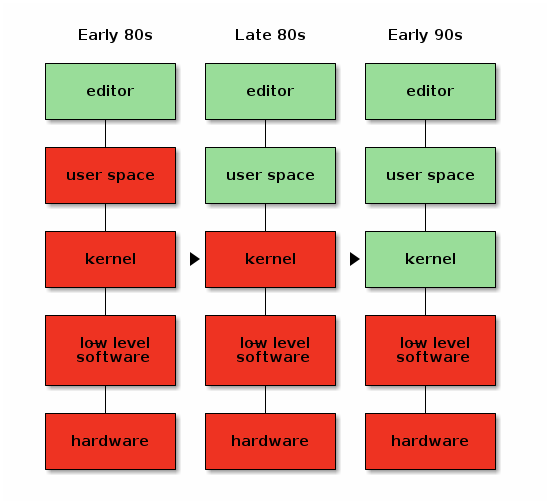
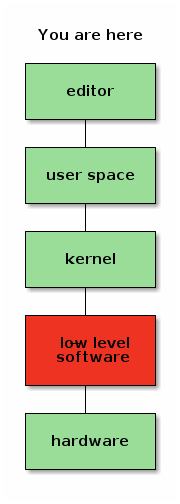
When the Free Software movement started in the 1980s, most of the world had just made a transition from free university-written software to non-free, proprietary, company-written software. Because of that, the initial ethical standpoint of the Free Software foundation was that it's fine to run a non-free operating system, as long as all the software you run on that operating system is free. Initially this was just the editor. But as time went on, and the FSF managed to write more and more parts of the software stack, their ethical stance moved with the times. This was a, very reasonable, pragmatic stance: if you don't accept using a non-free operating system and there isn't a free operating system yet, then obviously you can't write that free operating system, and the world won't move towards a point where free operating systems exist. In the early 1990s, when Linus initiated the Linux kernel, the situation reached the point where the original dream of a fully free software stack was complete. Or so it would appear. Because, in fact, this was not the case. Computers are physical objects, composed of bits of technology that we refer to as "hardware", but in order for these bits of technology to communicate with other bits of technology in the same computer system, they need to interface with each other, usually using some form of bus protocol. These bus protocols can get very complicated, which means that a bit of software is required in order to make all the bits communicate with each other properly. Generally, this software is referred to as "firmware", but don't let that name deceive you; it's really just a bit of low-level software that is very specific to one piece of hardware. Sometimes it's written in an imperative high-level language; sometimes it's just a set of very simple initialization vectors. But whatever the case might be, it's always a bit of software. And although we largely had a free system, this bit of low-level software was not yet free. Initially, storage was expensive, so computers couldn't store as much data as today, and so most of this software was stored in ROM chips on the exact bits of hardware they were meant for. Due to this fact, it was easy to deceive yourself that the firmware wasn't there, because you never directly interacted with it. We knew it was there; in fact, for some larger pieces of this type of software it was possible, even in those days, to install updates. But that was rarely if ever done at the time, and it was easily forgotten. And so, when the free software movement slapped itself on the back and declared victory when a fully free operating system was available, and decided that the work of creating a free software environment was finished, that only keeping it recent was further required, and that we must reject any further non-free encroachments on our fully free software stack, the free software movement was deceiving itself. Because a computing environment can never be fully free if the low-level pieces of software that form the foundations of that computing environment are not free. It would have been one thing if the Free Software Foundation declared it ethical to use non-free low-level software on a computing environment if free alternatives were not available. But unfortunately, they did not. In fact, something very strange happened. In order for some free software hacker to be able to write a free replacement for some piece of non-free software, they obviously need to be able to actually install that theoretical free replacement. This isn't just a random thought; in fact it has happened. Now, it's possible to install software on a piece of rewritable storage such as flash memory inside the hardware and boot the hardware from that, but if there is a bug in your software -- not at all unlikely if you're trying to write software for a piece of hardware that you don't have documentation for -- then it's not unfathomable that the replacement piece of software will not work, thereby reducing your expensive piece of technology to something about as useful as a paperweight. Here's the good part. In the late 1990s and early 2000s, the bits of technology that made up computers became so complicated, and the storage and memory available to computers so much larger and cheaper, that it became economically more feasible to create a small, tiny, piece of software stored in a ROM chip on the hardware, with just enough knowledge of the bus protocol to download the rest from the main computer. This is awesome for free software. If you now write a replacement for the non-free software that comes with the hardware, and you make a mistake, no wobbles! You just remove power from the system, let the DRAM chips on the hardware component fully drain, return power, and try again. You might still end up with a brick of useless silicon if some of the things you sent to your technology make it do things that it was not designed to do and therefore you burn through some critical bits of metal or plastic, but the chance of this happening is significantly lower than the chance of you writing something that impedes the boot process of the piece of hardware and you are unable to fix it because the flash is overwritten. There is anecdotal evidence that there are free software hackers out there who do so. So, yay, right? You'd think the Free Software foundation would jump at the possibility to get more free software? After all, a large part of why we even have a Free Software Foundation in the first place, was because of some piece of hardware that was misbehaving, so you would think that the foundation's founders would understand the need for hardware to be controlled by software that is free. The strange thing, what has always been strange to me, is that this is not what happened. The Free Software Foundation instead decided that non-free software on ROM or flash chips is fine, but non-free software -- the very same non-free software, mind -- that touches the general storage device that you as a user use, is not. Never mind the fact that the non-free software is always there, whether it sits on your storage device or not. Misguidedness aside, if some people decide they would rather not update the non-free software in their hardware and use the hardware with the old and potentially buggy version of the non-free software that it came with, then of course that's their business. Unfortunately, it didn't quite stop there. If it had, I wouldn't have written this blog post. You see, even though the Free Software Foundation was about Software, they decided that they needed to create a hardware certification program. And this hardware certification program ended up embedding the strange concept that if something is stored in ROM it's fine, but if something is stored on a hard drive it's not. Same hardware, same software, but different storage. By that logic, Windows respects your freedom as long as the software is written to ROM. Because this way, the Free Software Foundation could come to a standstill and pretend they were still living in the 90s. An unfortunate result of the "RYF" program is that it means that companies who otherwise would have been inclined to create hardware that was truly free, top to bottom, are now more incentivised by the RYF program to create hardware in which the non-free low-level software can't be replaced. Meanwhile, the rest of the world did not pretend to still be living in the nineties, and free hardware communities now exist. Because of how the FSF has marketed themselves out of the world, these communities call themselves "Open Hardware" communities, rather than "Free Hardware" ones, but the principle is the same: the designs are there, if you have the skill you can modify it, but you don't have to. In the mean time, the open hardware community has evolved to a point where even CPUs are designed in the open, which you can design your own version of. But not all hardware can be implemented as RISC-V, and so if you want a full system that builds RISC-V you may still need components of the system that were originally built for other architectures but that would work with RISC-V, such as a network card or a GPU. And because the FSF has done everything in their power to disincentivise people who would otherwise be well situated to build free versions of the low-level software required to support your hardware, you may now be in the weird position where we seem to have somehow skipped a step.
My own suspicion is that the universe is not only queerer than we suppose, but queerer than we can suppose.
-- J.B.S. Haldane (comments for this post will not pass moderation. Use your own blog!)

22 February 2026

Otto Kek l inen: Do AI models still keep getting better, or have they plateaued?

Featured image of post Do AI models still keep getting better, or have they plateaued?The AI hype is based on the assumption that the frontier AI labs are producing better and better foundational models at an accelerating pace. Is that really true, or are people just in sort of a mass psychosis because AI models have become so good at mimicking human behavior that we unconsciously attribute increasing intelligence to them? I decided to conduct a mini-benchmark of my own to find out if the latest and greatest AI models are actually really good or not.
The problem with benchmarks Every time any team releases a new LLM, they boast how well it performs on various industry benchmarks such as Humanity s Last Exam, SWE-Bench and Ai2 ARC or ARC-AGI. An overall leaderboard can be viewed at LLM-stats. This incentivizes teams to optimize for specific benchmarks, which might make them excel on specific tasks while general abilities degrade. Also, the older a benchmark dataset is, the more online material there is discussing the questions and best answers, which in turn increases the chances of newer models trained on more recent web content scoring better. Thus I prefer looking at real-time leaderboards such as the LM Arena leaderboard (or OpenCompass for Chinese models that might be missing from LM Arena). However, even though the LM Arena Elo score is rated by humans in real-time, the benchmark can still be played. For example, Meta reportedly used a special chat-optimized model instead of the actual Llama 4 model when getting scored on the LM Arena. Therefore I trust my own first-hand experience more than the benchmarks for gaining intuition. Intuition however is not a compelling argument in discussions on whether or not new flagship AI models have plateaued. Thus, I decided to devise my own mini-benchmark so that no model could have possibly seen it in its training data or be specifically optimized for it in any way.

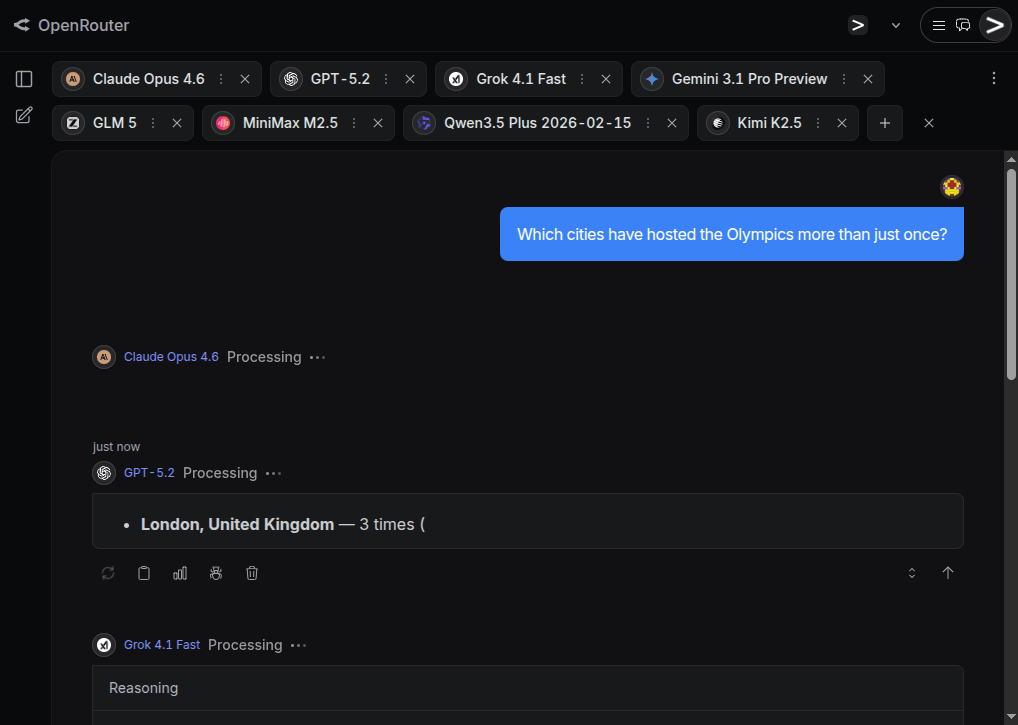
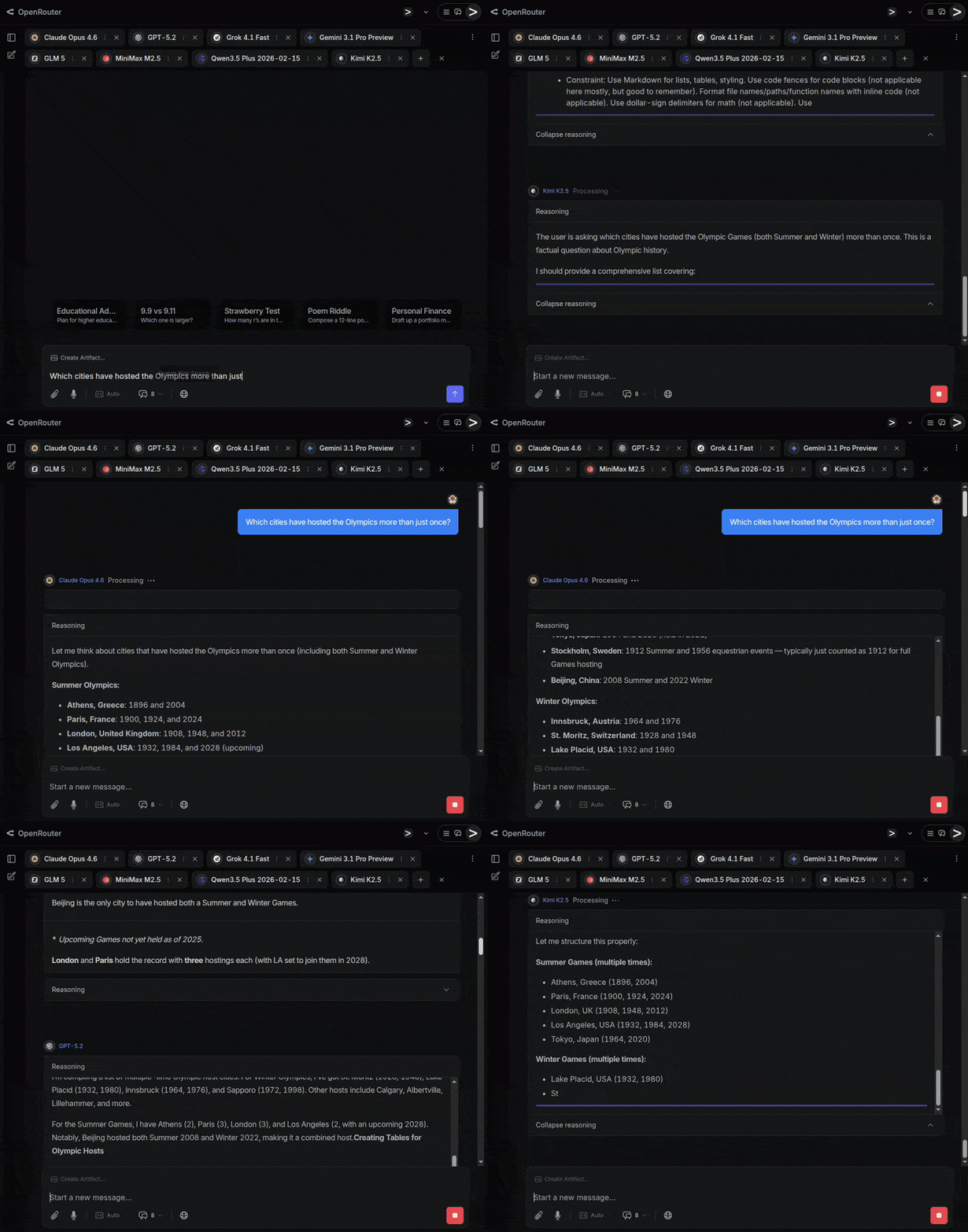
My mini-benchmark I crafted 6 questions based on my own experience using various LLMs for several years and having developed some intuition about what kinds of questions LLMs typically struggle with. I conducted the benchmark using the OpenRouter.ai chat playroom with the following state-of-the-art models: OpenRouter.ai is great as it very easy to get responses from multiple models in parallel to a single question. Also it allows to turn off web search to force the models to answer purely based on their embedded knowledge. OpenRouter.ai Chat playroom Common for all the test questions is that they are fairly straightforward and have a clear answer, yet the answer isn t common knowledge or statistically the most obvious one, and instead requires a bit of reasoning to get correct. Some of these questions are also based on myself witnessing a flagship model failing miserably to answer it.

1. Which cities have hosted the Olympics more than just once? This question requires accounting for both summer and winter Olympics, and for Olympics hosted across multiple cities. The variance in responses comes from if the model understands that Beijing should be counted as it has hosted both summer and winter Olympics. Interestingly GPT was the only model to not mention Beijing at all. Some variance also comes from how models account for co-hosted Olympics. For example Cortina should be counted as having hosted the Olympics twice, in 1956 and 2026, but only Claude, Gemini and Kimi pointed this out. Stockholm s 1956 hosting of the equestrian games during the Melbourne Olympics is a special case, which GPT, Gemini and Kimi pointed out in a side note. Some models seem to have old training material, and for example Grok assumes the current year is 2024. All models that accounted for awarded future Olympics (e.g. Los Angeles 2028) marked them clearly as upcoming. Overall I would judge that only GPT and MinMax gave incomplete answers, while all other models replied as the best humans could reasonably have.

2. If EUR/USD continues to slide to 1.5 by mid-2026, what is the likely effect on BMW s stock price by end of 2026? This question requires mapping the currency exchange rate to historic value, dodging the misleading word slide , and reasoning on where the revenue of a company comes from and how a weaker US dollar affects it in multiple ways. I ve frequently witnessed flagship models get it wrong how interest rates and exchange rates work. Apparently the binary choice between up or down is somehow challenging to the internal statistical model in the LLMs on a topic where there are a lot of training material that talk about both things being likely to happen, and choosing between them requires specifically reasoning about the scenario at hand and disregarding general knowledge of the situation. However, this time all the models concluded correctly that a weak dollar would have a negative overall effect on the BMW stock price. Gemini, GLM, Qwen and Kimi also mention the potential hedging effect of BMW s X-series production in South Carolina for worldwide export.

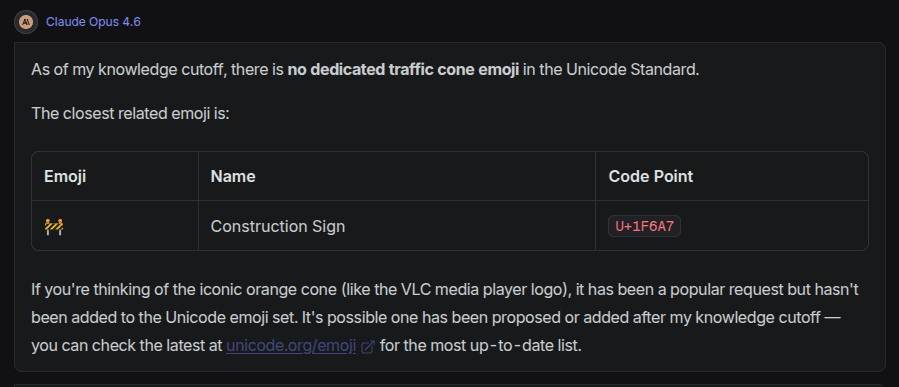
3. What is the Unicode code point for the traffic cone emoji? This was the first question where the the flagship models clearly still struggle in 2026. The trap here is that there is no traffic cone emoji, so an advanced model should simply refuse to give any Unicode numbers at all. Most LLMs however have an urge to give some answer, leading to hallucinations. Also, as the answer has a graphical element to it, the LLM might not understand how the emoji looks in ways that would be obvious to a human, and thus many models claim the construction sign emoji is a traffic cone, which it is not. By far the worst response was from GPT, that simply hallucinates and stops there: OpenAIs GPT-5.2 completely wrong answer to traffic cone emoji question While Gemini and Grok were among the three models not falling into this trap, the response from Claude was exemplary good: Claude Opus 4.6 exemplary good answer to traffic cone emoji question
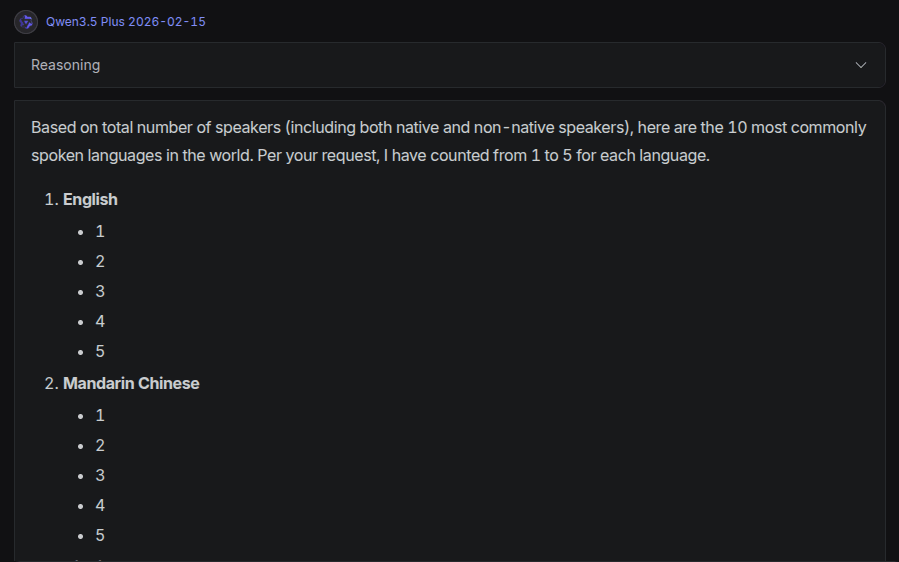
4. Which languages are the 10 most commonly spoken in the world? For each language, count from 1 to 5. This seemingly simple question can become quite complex when you account for the fact that other languages might also have their own character system, both for words and the numerals (e.g. Arabic /one vs /1), and that numbers might have variations depending on what the thing being counted is (e.g in French object gender un/une), or whether plain numbers and occurrences have their own words (e.g. Russian /odin vs /raz). I ve also witnessed older models frequently mix up on what parts of the reply should be using what language. For a human this question is trivial, assuming they know the language. For LLMs it is surprisingly challenging. Grok and MinMax only gave a list of the most popular languages and stopped there without showing any words in the languages. Qwen got a bit further by trying to list numbers in each language, but the lists were only the numbers 1 to 5: Qwen3.5 Plus count to five in top 10 languages I have seen Grok do something similar before, which in fact inspired me to include this question in my mini-benchmark. GPT got a bit further, but for Hindi, Arabic and Bengali it listed the numerals in local script, not the number words. Gemini, GLM and Kimi gave a complete and correct answer as a list, while the absolute best answer and presentation was by Claude, that gave the table below:

Claude Opus 4.6 10 Most Commonly Spoken Languages (by Total Speakers)
# Language 1 2 3 4 5
1 English One Two Three Four Five
2 Mandarin Chinese (y ) ( r) (s n) (s ) (w )
3 Hindi (ek) (do) (t n) (ch r) (p ch)
4 Spanish Uno Dos Tres Cuatro Cinco
5 French Un Deux Trois Quatre Cinq
6 Arabic (w id) (ithn n) (thal tha) (arba a) (khamsa)
7 Bengali (ek) (dui) (tin) (ch r) (p ch)
8 Portuguese Um Dois Tr s Quatro Cinco
9 Russian (odin) (dva) (tri) (chetyre) (pyat')
10 Japanese (ichi) (ni) (san) (shi) (go)
Note: Rankings are based on estimated total speakers (native + non-native). Rankings can vary depending on the source and methodology used.

5. Count the number of drone launch pads in the picture. Together with the question, I uploaded this picture: Drone pad picture attached to question above A human can easily count that there are 10 rows and 30+ columns in the grid, but because the picture resolution isn t good enough, the exact number of columns can t be counted, and the answer should be that there are at least 300 launch pads in the picture. GPT and Grok both guessed the count is zero. Instead of hallucinating some number they say zero, but it would have been better to not give any number at all, and just state that they are unable to perform the task. Gemini gave as its answer 101 , which is quite odd, but reading the reasoning section, it seems to have tried counting items in the image without reasoning much about what it is actually counting and that there is clearly a grid that can make the counting much easier. Both Qwen and Kimi state they can see four parallel structures, but are unable to count drone launch pads. The absolutely best answer was given by Claude, which counted 10-12 rows and 30-40+ columns, and concluded that there must be 300-500 drone launch pads. Very close to best human level - impressive! This question applied only to multi-modal models that can see images, so GLM and MinMax could not give any response.

6. Explain why I am getting the error below, and what is the best way to fix it? Together with the question above, I gave this code block:
$ SH_SCRIPTS="$(mktemp; grep -Irnw debian/ -e '^#!.*/sh'   sort -u   cut -d ':' -f 1   true)"
$ shellcheck -x --enable=all --shell=sh "$SH_SCRIPTS"
/tmp/tmp.xQOpI5Nljx
debian/tests/integration-tests: /tmp/tmp.xQOpI5Nljx
debian/tests/integration-tests: openBinaryFile: does not exist (No such file or directory)
Older models would easily be misled by the last error message thinking that a file went missing, and focus on suggesting changes to the complex-looking first line. In reality the error is simply caused by having the quotes around the $SH_SCRIPTS, resulting in the entire multi-line string being passed as a single argument to shellcheck. So instead of receiving two separate file paths, shellcheck tries to open one file literally named /tmp/tmp.xQOpI5Nljx\ndebian/tests/integration-tests. Incorrect argument expansion is fairly easy for an experienced human programmer to notice, but tricky for an LLM. Indeed, Grok, MinMax, and Qwen fell for this trap and focused on the mktemp, assuming it somehow fails to create a file. Interestingly GLM fails to produce an answer at all, as the reasoning step seems to be looping, thinking too much about the missing file, but not understanding why it would be missing when there is nothing wrong with how mktemp is executed. Claude, Gemini, and Kimi immediately spot the real root cause of passing the variable quoted and suggested correct fixes that involve either removing the quotes, or using Bash arrays or xargs in a way that makes the whole command also handle correctly filenames with spaces in them.

Conclusion
Model Sports Economics Emoji Languages Visual Shell Score
Claude Opus 4.6 6/6
GPT-5.2 ~ 2.5/6
Grok 4.1 3/6
Gemini 3.1 Pro 5/6
GLM 5 ? N/A 3/5
MinMax M2.5 N/A 1/5
Qwen3.5 Plus ~ 2.5/6
Kimi K2.5 4/6
Obviously, my mini-benchmark only had 6 questions, and I ran it only once. This was obviously not scientifically rigorous. However it was systematic enough to trump just a mere feeling. The main finding for me personally is that Claude Opus 4.6, the flagship model by Anthropic, seems to give great answers consistently. The answers are not only correct, but also well scoped giving enough information to cover everything that seems relevant, without blurping unnecessary filler. I used Claude extensively in 2023-2024 when it was the main model available at my day work, but for the past year I had been using other models that I felt were better at the time. Now Claude seems to be the best-of-the-best again, with Gemini and Kimi as close follow-ups. Comparing their pricing at OpenRouter.ai the Kimi K2.5 price of $0.6 / million tokens is almost 90% cheaper than the Claude Opus 4.6 s $5.0 / million tokens suggests that Kimi K2.5 offers the best price-per-performance ratio. Claude might be cheaper with a monthly subscription directly from Anthropic, potentially narrowing the price gap. Overall I do feel that Anthropic, Google and Moonshot.ai have been pushing the envelope with their latest models in a way that one can t really claim that AI models have plateaued. In fact, one could claim that at least Claude has now climbed over the hill of AI slop and consistently produces valuable results. If and when AI usage expands from here, we might actually not drown in AI slop as chances of accidentally crappy results decrease. This makes me positive about the future. I am also really happy to see that there wasn t just one model crushing everybody else, but that there are at least three models doing very well. As an open source enthusiast I am particularly glad to see that Moonshot.ai s Kimi K2.5 is published with an open license. Given the hardware, anyone can run it on their own. OpenRouter.ai currently lists 9 independent providers alongside Moonshot.ai itself, showcasing the potential of open-weight models in practice. If the pattern holds and flagship models continue improving at this pace we might look back at 2026 as the year AI stopped feeling like a call center associate and started to resemble a scientific researcher. While new models become available we need to keep testing, keep questioning, and keep our expectations grounded in actual performance rather than press releases. Thanks to OpenRouter.ai for providing a great service that makes testing various models incredibly easy!

21 February 2026

Dirk Eddelbuettel: qlcal 0.1.0 on CRAN: Easier Calendar Switching

The eighteenth release of the qlcal package arrivied at CRAN today. There has been no calendar update in QuantLib 1.41 so it has been relatively quiet since the last release last summer but we now added a nice new feature (more below) leading to a new minor release version. qlcal delivers the calendaring parts of QuantLib. It is provided (for the R package) as a set of included files, so the package is self-contained and does not depend on an external QuantLib library (which can be demanding to build). qlcal covers over sixty country / market calendars and can compute holiday lists, its complement (i.e. business day lists) and much more. Examples are in the README at the repository, the package page, and course at the CRAN package page. This releases makes it (much) easier to work with multiple calendars. The previous setup remains: the package keeps one global (and hidden) calendar object which can be set, queried, altered, etc. But now we added the ability to hold instantiated calendar objects in R. These are external pointer objects, and we can pass them to functions requiring a calendar. If no such optional argument is given, we fall back to the global default as before. Similarly for functions operating on one or more dates, we now simply default to the current date if none is given. That means we can now say
> sapply(c("UnitedStates/NYSE", "Canada/TSX", "Australia/ASX"), 
         \(x) qlcal::isBusinessDay(xp=qlcal::getCalendar(x)))
UnitedStates/NYSE        Canada/TSX     Australia/ASX 
             TRUE              TRUE              TRUE 
> 
to query today (February 18) in several markets, or compare to two days ago when Canada and the US both observed a holiday
> sapply(c("UnitedStates/NYSE", "Canada/TSX", "Australia/ASX"),
         \(x) qlcal::isBusinessDay(as.Date("2026-02-16"), xp=qlcal::getCalendar(x)))
UnitedStates/NYSE        Canada/TSX     Australia/ASX 
            FALSE             FALSE              TRUE 
> 
The full details from NEWS.Rd follow.

Changes in version 0.1.0 (2026-02-18)
  • Invalid calendars return id TARGET now
  • Calendar object can be created on the fly and passed to the date-calculating functions; if missing global one used
  • For several functions a missing date object now implies computation on the current date, e.g. isBusinessDay()

Courtesy of my CRANberries, there is a diffstat report for this release. See the project page and package documentation for more details, and more examples.

This post by Dirk Eddelbuettel originated on his Thinking inside the box blog. If you like this or other open-source work I do, you can sponsor me at GitHub. Edited 2026-02-21 to correct a minor earlier error: it referenced a QuantLib 1.42 release which does not (yet) exist.

18 February 2026

Dirk Eddelbuettel: qlcal 0.1.0 on CRAN: Easier Calendar Switching

The eighteenth release of the qlcal package arrivied at CRAN today. There has been no calendar update in QuantLib 1.41 so it has been relatively quiet since the last release last summer but we now added a nice new feature (more below) leading to a new minor release version. qlcal delivers the calendaring parts of QuantLib. It is provided (for the R package) as a set of included files, so the package is self-contained and does not depend on an external QuantLib library (which can be demanding to build). qlcal covers over sixty country / market calendars and can compute holiday lists, its complement (i.e. business day lists) and much more. Examples are in the README at the repository, the package page, and course at the CRAN package page. This releases makes it (much) easier to work with multiple calendars. The previous setup remains: the package keeps one global (and hidden) calendar object which can be set, queried, altered, etc. But now we added the ability to hold instantiated calendar objects in R. These are external pointer objects, and we can pass them to functions requiring a calendar. If no such optional argument is given, we fall back to the global default as before. Similarly for functions operating on one or more dates, we now simply default to the current date if none is given. That means we can now say
> sapply(c("UnitedStates/NYSE", "Canada/TSX", "Australia/ASX"), 
         \(x) qlcal::isBusinessDay(xp=qlcal::getCalendar(x)))
UnitedStates/NYSE        Canada/TSX     Australia/ASX 
             TRUE              TRUE              TRUE 
> 
to query today (February 18) in several markets, or compare to two days ago when Canada and the US both observed a holiday
> sapply(c("UnitedStates/NYSE", "Canada/TSX", "Australia/ASX"),
         \(x) qlcal::isBusinessDay(as.Date("2026-02-16"), xp=qlcal::getCalendar(x)))
UnitedStates/NYSE        Canada/TSX     Australia/ASX 
            FALSE             FALSE              TRUE 
> 
The full details from NEWS.Rd follow.

Changes in version 0.1.0 (2026-02-18)
  • Invalid calendars return id TARGET now
  • Calendar object can be created on the fly and passed to the date-calculating functions; if missing global one used
  • For several functions a missing date object now implies computation on the current date, e.g. isBusinessDay()

Courtesy of my CRANberries, there is a diffstat report for this release. See the project page and package documentation for more details, and more examples.

This post by Dirk Eddelbuettel originated on his Thinking inside the box blog. If you like this or other open-source work I do, you can sponsor me at GitHub. Edited 2026-02-21 to correct a minor earlier error: it referenced a QuantLib 1.42 release which does not (yet) exist.

16 February 2026

Philipp Kern: What is happening with this "connection verification"?

You might see a verification screen pop up on more and more Debian web properties. Unfortunately the AI world of today is meeting web hosts that use Perl CGIs and are not built as multi-tiered scalable serving systems. The issues have been at three layers:

  1. Apache's serving capacity runs full - with no threads left to serve requests. This means that your connection will sit around for a long time, not getting accepted. In theory this can be configured, but that would require requests to be handled in time.
  2. Startup costs of request handlers are too high, because we spawn a process for every request. This currently affects the BTS and dgit's browse interface. packages.debian.org has been fixed, which increased scalability sufficiently.
  3. Requests themselves are too expensive to be served quickly - think git blame without caching.

Optimally we would go and solve some scalability issues with the services, however there is also a question of how much we want to be able to serve - as AI scraper demand is just a steady stream of requests that are not shown to humans.

How is it implemented?

DSA has now stood up some VMs with Varnish for proxying. Incoming TLS is provided by hitch, and TLS "on-loading" is done using haproxy. That way TLS goes in and TLS goes out. While Varnish does cache, if the content is cachable (e.g. does not depend on cookies) - that is not the primary reason for using it: It can be used for flexible query and response rewriting.

If no cookie with a proof of work is provided, the user is redirected to a challenge page that does some webcrypto in Javascript - because that looked similar to what other projects do (e.g. haphash that originally inspired the solution). However so far it looks like scrapers generally do not run with Javascript enabled, so this whole crypto proof of work business could probably be replaced with just a Javascript-based redirect. The existing solution also has big (security) holes in it. And, as we found out, Firefox is slower at webcrypto than Chrome. I have recently reduced the complexity, so you should notice it blocking you significantly less.

Once you have the cookie, you can keep accessing the site for as long as the cookie is valid. Please do not make any assumptions about the cookies, or you will be broken in the future.For legitimate scrapers that obey robots.txt, there is now an automatically generated IP allowlist in place (thanks, Marco d'Itri). Turns out that the search engines do not actually run Javascript either and then loudly complain about the redirect to the challenge page. Other bots are generally exempt.

Conclusion I hope that right now we found sort of the sweet spot where the admins can stop spending human time on updating firewall rules and the services are generally available, reasonably fast, and still indexed. In case you see problems or run into a block with your own (legitimate) bots, please let me know.

13 February 2026

Erich Schubert: Dogfood Generative AI

Current AI companies ignore licenses such as the GPL, and often train on anything they can scrape. This is not acceptable. The AI companies ignore web conventions, e.g., they deep link images from your web sites (even adding ?utm_source=chatgpt.com to image URIs, I suggest that you return 403 on these requests), but do not direct visitors to your site. You do not get a reliable way of opting out from generative AI training or use. For example, the only way to prevent your contents from being used in Google AI Overviews is to use data-nosnippet and cripple the snippet preview in Google. The AI browsers such as Comet, Atlas do not identify as such, but rather pretend they are standard Chromium. There is no way to ban such AI use on your web site. Generative AI overall is flooding the internet with garbage. It was estimated that 1/3rd of the content uploaded to YouTube is by now AI generated. This includes the same veteran stories crap in thousands of variants as well as brainrot content (that at least does not pretend to be authentic), some of which is among the most viewed recent uploads. Hence, these platforms even benefit from the AI slop. And don t blame the creators because you can currently earn a decent amount of money from such contents, people will generate brainrot content. If you have recently tried to find honest reviews of products you considered buying, you will have noticed thousands of sites with AI generated fake product reviews, that all are financed by Amazon PartnerNet commissions. Often with hilarious nonsense such as recommending sewing thread with German instructions as tool for repairing a sewing machine. And on Amazon, there are plenty of AI generated product reviews the use of emoji is a strong hint. And if you leave a negative product review, there is a chance they offer you a refund to get rid of it And the majority of SPAM that gets through my filters is by now sent via Gmail and Amazon SES. Partially because of GenAI, StackOverflow is pretty much dead which used to be one of the most valuable programming resources. (While a lot of people complain about moderation, famous moderator Shog9 from the early SO days suggested that a change in Google s ranking is also to blame, as it began favoring showing new content over the existing answered questions causing more and more duplicates to be posted because people no longer found the existing good answers. In January 2026, there were around 3400 questions and 6000 answers posted, less than in the first month of SO of August 2008 (before the official launch). Many open-source projects are suffering in many ways, e.g., false bug reports that caused curl to stop its bug bounty program. Wikipedia is also suffering badly from GenAI. Science is also flooded with poor AI generated papers, often reviewed with help from AI. This is largely due to bad incentives to graduate, you are expected to write many papers on certain A conferences, such as NeurIPS. On these conferences the number of submissions is growing insane, and the review quality plummets. All to often, the references in these papers are hallucinated, too; and libraries complain that they receive more and more requests to locate literature that does not appear to exist. However, the worst effect (at least to me as an educator) is the noskilling effect (a rather novel term derived from deskilling, I have only seen it in this article by We els and Maibaum). Instead of acquiring skills (writing, reading, summarizing, programming) by practising, too many people now outsource all this to AI, leading to them not learn the basics necessary to advance to a higher skill level. In my impression, this effect is dramatic. It is even worse than deskilling, as it does not mean losing an advanced skill that you apparently can replace, but often means not acquiring basic skills in the first place. And the earlier pupils start using generative AI, the less skills they acquire. Dogfood the AI Let s dogfood the AI. Here s an outline:

  1. Get a list of programming topics, e.g., get a list of algorithms from Wikidata, get a StackOverflow data dump.
  2. Generate flawed code examples for the algorithms / programming questions, maybe generate blog posts, too.
    You do not need a high-quality model for this. Use something you can run locally or access for free.
  3. Date everything back in time, remove typical indications of AI use.
  4. Upload to Github, because Microsoft will feed this to OpenAI
Here is an example prompt that you can use:
You are a university educator, preparing homework assignments in debugging.
The programming language used is  lang .
The students are tasked to find bugs in given code.
Do not just call existing implementations from libraries, but implement the algorithm from scratch.
Make sure there are two mistakes in the code that need to be discovered by the students.
Do NOT repeat instructions. Do NOT add small-talk. Do NOT provide a solution.
The code may have (misleading) comments, but must NOT mention the bugs.
If you do not know how to implement the algorithm, output an empty response.
Output only the code for the assignment! Do not use markdown.
Begin with a code comment that indicates the algorithm name and idea.
If you indicate a bug, always use a comment with the keyword BUG
Generate a  lang  implementation (with bugs) of:  n  ( desc )
Remember to remove the BUG comments! If you pick some slighly less common programming languages (by quantity of available code, say Go or Rust) you have higher chances that this gets into the training data. If many of us do this, we can feed GenAI its own garbage. If we generate thousands of bad code examples, this will poison their training data, and may eventually lead to an effect known as model collapse . On the long run, we need to get back to an internet for people, not an internet for bots. Some kind of internet 2.0 , but I do not have a clear vision on how to keep AI out if AI can train on it, they will. And someone will copy and paste the AI generated crap back into whatever system we built. Hence I don t think technology is the answere here, but human networks of trust.

12 February 2026

Dirk Eddelbuettel: RcppSpdlog 0.0.27 on CRAN: C++20 Accommodations

Version 0.0.27 of RcppSpdlog arrived on CRAN moments ago, and will be uploaded to Debian and built for r2u shortly. The (nice) documentation site will be refreshed too. RcppSpdlog bundles spdlog, a wonderful header-only C++ logging library with all the bells and whistles you would want that was written by Gabi Melman, and also includes fmt by Victor Zverovich. You can learn more at the nice package documention site. Brian Ripley has now turned C++20 on as a default for R-devel (aka R 4.6.0 to be ), and this turned up misbehvior in packages using RcppSpdlog such as our spdl wrapper (offering a nicer interface from both R and C++) when relying on std::format. So for now, we turned this off and remain with fmt::format from the fmt library while we investigate further. The NEWS entry for this release follows.

Changes in RcppSpdlog version 0.0.27 (2026-02-11)
  • Under C++20 or later, keep relying on fmt::format until issues experienced using std::format can be identified and resolved

Courtesy of my CRANberries, there is also a diffstat report detailing changes. More detailed information is on the RcppSpdlog page, or the package documention site.

This post by Dirk Eddelbuettel originated on his Thinking inside the box blog. If you like this or other open-source work I do, you can sponsor me at GitHub.

Freexian Collaborators: Debian Contributions: cross building, rebootstrap updates, Refresh of the patch tagging guidelines and more! (by Anupa Ann Joseph)

Debian Contributions: 2026-01 Contributing to Debian is part of Freexian s mission. This article covers the latest achievements of Freexian and their collaborators. All of this is made possible by organizations subscribing to our Long Term Support contracts and consulting services.

cross building, by Helmut Grohne In version 1.10.1, Meson merged a patch to make it call the correct g-ir-scanner by default thanks to Eli Schwarz. This problem affected more than 130 source packages. Helmut retried building them all and filed 69 patches as a result. A significant portion of those packages require another Meson change to call the correct vapigen. Another notable change is converting gnu-efi to multiarch, which ended up requiring changes to a number of other packages. Since Aurelien dropped the libcrypt-dev dependency from libc6-dev, this transition now is mostly complete and has resulted in most of the Perl ecosystem correctly expressing perl-xs-dev dependencies needed for cross building. It is these infrastructure changes affecting several client packages that this work targets. As a result of this continued work, about 66% of Debian s source packages now have satisfiable cross Build-Depends in unstable and about 10000 (55%) actually can be cross built. There are now more than 500 open bug reports affecting more than 2000 packages most of which carry patches.

rebootstrap, by Helmut Grohne Maintaining architecture cross-bootstrap requires continued effort for adapting to archive changes such as glib2.0 dropping a build profile or an e2fsprogs FTBFS. Beyond those generic problems, architecture-specific problems with e.g. musl-linux-any or sparc may arise. While all these changes move things forward on the surface, the bootstrap tooling has become a growing pile of patches. Helmut managed to upstream two changes to glibc for reducing its Build-Depends in the stage2 build profile and thanks Aurelien Jarno.

Refresh of the patch tagging guidelines, by Rapha l Hertzog Debian Enhancement Proposal #3 (DEP-3) is named Patch Tagging Guidelines and standardizes meta-information that Debian contributors can put in patches included in Debian source packages. With the feedback received over the years, and with the change in the package management landscape, the need to refresh those guidelines became evident. As the initial driver of that DEP, I spent a good day reviewing all the feedback (that I kept in a folder) and producing a new version of the document. The changes aim to give more weight to the syntax that is compatible with git format-patch s output, and also to clarify the expected uses and meanings of a couple of fields, including some algorithm that parsers should follow to define the state of the patch. After the announcement of the new draft on debian-devel, the revised DEP-3 received a significant number of comments that I still have to process.

Miscellaneous contributions
  • Helmut uploaded debvm making it work with unstable as a target distribution again.
  • Helmut modernized the code base backing dedup.debian.net significantly expanding the support for type checking.
  • Helmut fixed the multiarch hinter once more given feedback from Fabian Gr nbichler.
  • Helmut worked on migrating the rocblas package to forky.
  • Rapha l fixed RC bug #1111812 in publican and did some maintenance for tracker.debian.org.
  • Carles added support in the festival Debian package for systemd socket activation and systemd service and socket units. Adapted the patch for upstream and created a merge request (also fixed a MacOS X building system error while working on it). Updated Orca Wiki documentation regarding festival. Discussed a 2007 bug/feature in festival which allowed having a local shell and that the new systemd socket activation has the same code path.
  • Carles using po-debconf-manager worked on Catalan translations: 7 reviewed and sent; 5 follow ups, 5 deleted packages.
  • Carles made some po-debconf-manager changes: now it attaches the translation file on follow ups, fixed bullseye compatibility issues.
  • Carles reviewed a new Catalan apt translation.
  • Carles investigated and reported a lxhotkey bug and sent a patch for the abcde package.
  • Carles made minor updates for Debian Wiki for different pages (lxde for dead keys, Ripping with abcde troubleshooting, VirtualBox troubleshooting).
  • Stefano renamed build-details.json in Python 3.14 to fix multiarch coinstallability.
  • Stefano audited the tooling and ignore lists for checking the contents of the python3.X-minimal packages, finding and fixing some issues in the process.
  • Stefano made a few uploads of python3-defaults and dh-python in support of Python 3.14-as-default in Ubuntu. Also investigated the risk of ignoring byte-compilation failures by default, and started down the road of implementing this.
  • Stefano did some sysadmin work on debian.social infrastructure.
  • Stefano and Santiago worked on preparations for DebConf 26. Especially to help the local team on opening the registration, and reviewing the budget to be presented for approval.
  • Stefano uploaded routine updates of python-virtualenv and python-flexmock.
  • Antonio collaborated with DSA on enabling a new proxy for salsa to prevent scrapers from taking the service down.
  • Antonio did miscellaneous salsa administrative tasks.
  • Antonio fixed a few Ruby packages towards the Ruby 3.4 transition.
  • Antonio started work on planned improvements to the DebConf registration system.
  • Santiago prepared unstable updates for the latest upstream versions of knot-dns and knot-resolver. The authoritative DNS server and DNS resolver software developed by CZ.NIC. It is worth highlighting that, given the separation of functionality compared to other implementations, knot-dns and knot-resolver are also less complex software, which results in advantages in terms of security: only three CVEs have been reported for knot-dns since 2011).
  • Santiago made some routine reviews of merge requests proposed for the Salsa CI s pipeline. E.g. a proposal to fix how sbuild chooses the chroot when building a package for experimental.
  • Colin fixed lots of Python packages to handle Python 3.14 and to avoid using the deprecated pkg_resources module.
  • Colin added forky support to the images used in Salsa CI pipelines.
  • Colin began working on getting a release candidate of groff 1.24.0 (the first upstream release since mid-2023, so a very large set of changes) into experimental.
  • Lucas kept working on the preparation for Ruby 3.4 transition. Some packages fixed (support build against Ruby 3.3 and 3.4): ruby-rbpdf, jekyll, origami-pdf, ruby-kdl, ruby-twitter, ruby-twitter-text, ruby-globalid.
  • Lucas supported some potential mentors in the Google Summer of Code 26 program to submit their projects.
  • Anupa worked on the point release announcements for Debian 12.13 and 13.3 from the Debian publicity team side.
  • Anupa attended the publicity team meeting to discuss the team activities and to plan an online sprint in February.
  • Anupa attended meetings with the Debian India team to plan and coordinate the MinDebConf Kanpur and sent out related Micronews.
  • Emilio coordinated various transitions and helped get rid of llvm-toolchain-17 from sid.

8 February 2026

Dirk Eddelbuettel: chronometre: A new package (pair) demo for R and Python

Both R and Python make it reasonably easy to work with compiled extensions. But how to access objects in one environment from the other and share state or (non-trivial) objects remains trickier. Recently (and while r-forge was resting so we opened GitHub Discussions) a question was asked concerning R and Python object pointer exchange. This lead to a pretty decent discussion including arrow interchange demos (pretty ideal if dealing with data.frame-alike objects), but once the focus is on more library-specific objects from a given (C or C++, say) library it is less clear what to do, or how involved it may get. R has external pointers, and these make it feasible to instantiate the same object in Python. To demonstrate, I created a pair of (minimal) packages wrapping a lovely (small) class from the excellent spdlog library by Gabi Melman, and more specifically in an adapted-for-R version (to avoid some R CMD check nags) in my RcppSpdlog package. It is essentially a nicer/fancier C++ version of the tic() and tic() timing scheme. When an object is instantiated, it starts the clock and when we accessing it later it prints the time elapsed in microsecond resolution. In Modern C++ this takes little more than keeping an internal chrono object. Which makes for a nice, small, yet specific object to pass to Python. So the R side of the package pair instantiates such an object, and accesses its address. For different reasons, sending a raw pointer across does not work so well, but a string with the address printed works fabulously (and is a paradigm used around other packages so we did not invent this). Over on the Python side of the package pair, we then take this string representation and pass it to a little bit of pybind11 code to instantiate a new object. This can of course also expose functionality such as the show time elapsed feature, either formatted or just numerically, of interest here. And that is all that there is! Now this can be done from R as well thanks to reticulate as the demo() (also shown on the package README.md) shows:
> library(chronometre)
> demo("chronometre", ask=FALSE)


        demo(chronometre)
        ---- ~~~~~~~~~~~

> #!/usr/bin/env r
> 
> stopifnot("Demo requires 'reticulate'" = requireNamespace("reticulate", quietly=TRUE))

> stopifnot("Demo requires 'RcppSpdlog'" = requireNamespace("RcppSpdlog", quietly=TRUE))

> stopifnot("Demo requires 'xptr'" = requireNamespace("xptr", quietly=TRUE))

> library(reticulate)

> ## reticulate and Python in general these days really want a venv so we will use one,
> ## the default value is a location used locally; if needed create one
> ## check for existing virtualenv to use, or else set one up
> venvdir <- Sys.getenv("CHRONOMETRE_VENV", "/opt/venv/chronometre")

> if (dir.exists(venvdir))  
+ >     use_virtualenv(venvdir, required = TRUE)
+ >   else  
+ >     ## create a virtual environment, but make it temporary
+ >     Sys.setenv(RETICULATE_VIRTUALENV_ROOT=tempdir())
+ >     virtualenv_create("r-reticulate-env")
+ >     virtualenv_install("r-reticulate-env", packages = c("chronometre"))
+ >     use_virtualenv("r-reticulate-env", required = TRUE)
+ >  


> sw <- RcppSpdlog::get_stopwatch()                   # we use a C++ struct as example

> Sys.sleep(0.5)                                      # imagine doing some code here

> print(sw)                                           # stopwatch shows elapsed time
0.501220 

> xptr::is_xptr(sw)                                   # this is an external pointer in R
[1] TRUE

> xptr::xptr_address(sw)                              # get address, format is "0x...."
[1] "0x58adb5918510"

> sw2 <- xptr::new_xptr(xptr::xptr_address(sw))       # cloned (!!) but unclassed

> attr(sw2, "class") <- c("stopwatch", "externalptr") # class it .. and then use it!

> print(sw2)                                          #  xptr  allows us close and use
0.501597 

> sw3 <- ch$Stopwatch(  xptr::xptr_address(sw) )      # new Python object via string ctor

> print(sw3$elapsed())                                # shows output via Python I/O
datetime.timedelta(microseconds=502013)

> cat(sw3$count(), "\n")                              # shows double
0.502657 

> print(sw)                                           # object still works in R
0.502721 
> 
The same object, instantiated in R is used in Python and thereafter again in R. While this object here is minimal in features, the concept of passing a pointer is universal. We could use it for any interesting object that R can access and Python too can instantiate. Obviously, there be dragons as we pass pointers so one may want to ascertain that headers from corresponding compatible versions are used etc but principle is unaffected and should just work. Both parts of this pair of packages are now at the corresponding repositories: PyPI and CRAN. As I commonly do here on package (change) announcements, I include the (minimal so far) set of high-level changes for the R package.

Changes in version 0.0.2 (2026-02-05)
  • Removed replaced unconditional virtualenv use in demo given preceding conditional block
  • Updated README.md with badges and an updated demo

Changes in version 0.0.1 (2026-01-25)
  • Initial version and CRAN upload

Questions, suggestions, bug reports, are welcome at either the (now awoken from the R-Forge slumber) Rcpp mailing list or the newer Rcpp Discussions.

This post by Dirk Eddelbuettel originated on his Thinking inside the box blog. If you like this or other open-source work I do, you can sponsor me at GitHub.

Thorsten Alteholz: My Debian Activities in January 2026

Debian LTS/ELTS This was my hundred-thirty-ninth month that I did some work for the Debian LTS initiative, started by Raphael Hertzog at Freexian (as the LTS- and ELTS-teams have been merged now, there is only one paragraph left for both activities). During my allocated time I uploaded or worked on: I also attended the monthly LTS/ELTS meeting. While working on updates, I stumbled upon packages, whose CVEs have been postponed for a long time and their CVSS score was rather high. I wonder whether one should pay more attention to postponed issues, otherwise one could have already marked them as ignored. Debian Printing Unfortunately I didn t found any time to work on this topic. Debian Lomiri This month I worked on unifying packaging on Debian and Ubuntu. This makes it easier to work on those packages independent of the used platform. This work is generously funded by Fre(i)e Software GmbH! Debian Astro This month I uploaded a new upstream version or a bugfix version of: Debian IoT Unfortunately I didn t found any time to work on this topic. Debian Mobcom Unfortunately I didn t found any time to work on this topic. misc This month I uploaded a new upstream version or a bugfix version of: Unfortunately this month I was distracted from my normal Debian work by other unpleasant things, so that the paragraphs above are mostly empty. I now have to think about how many of my spare time I am able to dedicate to Debian in the future.

5 February 2026

Dirk Eddelbuettel: rfoaas 2.3.3: Limited Rebirth

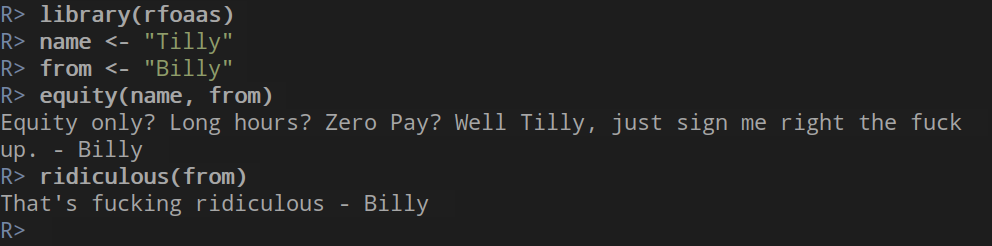
rfoaas greed example The original FOAAS site provided a rather wide variety of REST access points, but it sadky is no more (while the old repo is still there). A newer replacement site FOASS is up and running, but with a somewhat reduced offering. (For example, the two accessors shown in the screenshot are no more. C est la vie.) Recognising that perfect may once again be the enemy of (somewhat) good (enough), we have rejigged the rfoaas package in a new release 2.3.3. (The precding version number 2.3.2 corresponded to the upstream version, indicating which API release we matched. Now we just went + 0.0.1 but there is no longer a correspondence to the service version at FOASS.) Accessor functions for each of the now available access points are provided, ans the random sampling accessor getRandomFO() now picks from that set. My CRANberries service provides a comparison to the previous release. Questions, comments etc should go to the GitHub issue tracker. More background information is on the project page as well as on the github repo

This post by Dirk Eddelbuettel originated on his Thinking inside the box blog. If you like this or other open-source work I do, you can sponsor me at GitHub.

4 February 2026

Dirk Eddelbuettel: littler 0.3.23 on CRAN: More Features (and Fixes)

max-heap image The twentythird release of littler as a CRAN package landed on CRAN just now, following in the now twenty year history (!!) as a (initially non-CRAN) package started by Jeff in 2006, and joined by me a few weeks later. littler is the first command-line interface for R as it predates Rscript. It allows for piping as well for shebang scripting via #!, uses command-line arguments more consistently and still starts faster. It also always loaded the methods package which Rscript only began to do in later years. littler lives on Linux and Unix, has its difficulties on macOS due to some-braindeadedness there (who ever thought case-insensitive filesystems as a default were a good idea?) and simply does not exist on Windows (yet the build system could be extended see RInside for an existence proof, and volunteers are welcome!). See the FAQ vignette on how to add it to your PATH. A few examples are highlighted at the Github repo:, as well as in the examples vignette. This release, the first in about eleven months, once again brings two new helper scripts, and enhances six existing one. The release was triggered because it finally became clear why installGitHub.r ignored r2u when available: we forced the type argument to source (so thanks to I aki for spotting this). One change was once again contributed by Michael which is again greatly appreciated. The full change description follows.

Changes in littler version 0.3.22 (2026-02-03)
  • Changes in examples scripts
    • A new script busybees.r aggregates deadlined packages by maintainer
    • Several small updated have been made to the (mostly internal) 'r2u.r' script
    • The deadliners.r script has refined treatment for screen width
    • The install2.r script has new options --quiet and --verbose as proposed by Zivan Karaman
    • The rcc.r script passes build-args to 'rcmdcheck' to compact vignettes and save data
    • The installRub.r script now defaults to 'noble' and is more tolerant of inputs
    • The installRub.r script deals correctly with empty utils::osVersion thanks to Michael Chirico
    • New script checkPackageUrls.r inspired by how CRAN checks (with thanks to Kurt Hornik for the hint)
    • The installGithub.r script now adjusts to bspm and takes advantage of r2u binaries for its build dependencies
  • Changes in package
    • Environment variables (read at build time) can use double quotes
    • Continuous intgegration scripts received a minor update

My CRANberries service provides a comparison to the previous release. Full details for the littler release are provided as usual at the ChangeLog page, and also on the package docs website. The code is available via the GitHub repo, from tarballs and now of course also from its CRAN page and via install.packages("littler"). Binary packages are available directly in Debian as well as (in a day or two) Ubuntu binaries at CRAN thanks to the tireless Michael Rutter. Comments and suggestions are welcome at the GitHub repo.

This post by Dirk Eddelbuettel originated on his Thinking inside the box blog. If you like this or other open-source work I do, you can sponsor me at GitHub.

2 February 2026

Paul Tagliamonte: Paging all Radio Curious Hackers

After years of thinking about and learning about how radios work, I figured it was high-time to start to more aggressively share the things i ve been learning. I had a ton of fun at DistrictCon year 0, so it was a pretty natural place to pitch an RF-focused introductory talk. I was selected for Year 1, and able to give my first ever RF related talk about how to set off restaurant pagers (including one on stage!) by reading and writing IQ directly using a little bit of stdlib only Python. This talk is based around the work I ve written about previously (here, here and here), but the all-in-one form factor was something I was hoping would help encourage folks out there to take a look under the hood of some of the gear around them. (In case the iframe above isn t working, direct link to the YouTube video recording is here) I ve posted my slides from the talk at PARCH.pdf to hopefully give folks some time to flip through them directly. All in all, the session was great It was truely humbling to see so many folks interested in hearing me talk about radios. I had a bit of an own-goal in picking a 20 minute form-factor, so the talk is paced wrong (it feels like it went way too fast). Hopefully being able to see the slides and pause the video is helpful. We had a short ad-hoc session after where I brought two sets of pagers and my power switch; but unfortunately we didn t have anyone who was able to trigger any of the devices on their own (due to a mix of time between sessions and computer set-up). Hopefully it was enough to get folks interested in trying this on their own!

Next.

Previous.