Search Results: "mpalmer"

16 December 2007

Matthew Palmer: Camping: CGIs on steroids

There's no way around it: I'm a bit of a Rails fanboy. While it's got it's glitches, it's certainly made the part of my life that involves writing web applications a hell of a lot easier, and introduced me to the wonder that is the Ruby programming language. However, there are plenty of times when Rails just isn't a good fit. It's not particularly simple to deploy, it's quite heavy, and it does have a definite learning curve. So, when I need to write something simple, I've just used Ruby's built-in CGI support. But I will do so no longer. For I have found Camping. The name doesn't make a whole lot of sense, and until you come to grips with Why The Lucky Stiff's weird sense of humour, the docs will probably make you think that acid trip you took several years ago has just kicked in again. However, the purpose of Camping is pretty easy to understand: it allows you to make simple (CGI level) web "applications" using Rails-like (or more properly, MVC) concepts, which are fairly easy to write and deploy. If you're familiar with Rails (or probably most of the other Rails-clones that have sprung up in other languages) then Camping will probably smell at least faintly familiar. You have routes, which map URLs to controller actions, which retrieve models and feed them to a view which sends results back as HTML. From that perspective, Camping is easy to learn -- it's core concepts can piggyback on existing knowledge, and you can get started very quickly. Using your Rails-fu, however, will only get you so far. For one thing, the API is similar-but-different enough that while your first couple of simple experiments will probably Just Work, getting more complex things done will either fall under the "different" or "difficult" headings. That isn't meant to be a slight on Camping, though -- if you want to do horribly complex things, then you're heading into territory best served by Rails anyway. But there is a bit of a middle ground where the utter simplicity of Camping is stretched a little, but it's still more appropriate to write a Camping app than a Rails app, and it's important to remember that you're not using full-blown framework when you thump up against something that's beyond-trivial in Rails, but is not quite so simple in Camping. Camping is a microframework -- it says so right there on the front page. Why's intention is that Camping will always be provided in less than 4kB of code. So you're never going to get, for instance, the broad range of HTML helpers that Rails' ActionView provides to make writing HTML templates so easy, or the Prototype JavaScript framework shipped with the main code. If you don't want to blow a steam pipe, then, when starting out with Camping, you need to think "this is a lot easier than hand-writing CGIs" instead of "this is a lot harder than writing a Rails app". There are a few things that are undeniably a pest in Camping, though. The docs are a little incomplete and hard to follow (even when you account for Why's "unique" style of writing), and some of the coding tricks that are employed in making the framework can make debugging a bit tricky. They're not showstoppers, but it's worth knowing about them in advance so you don't go nuts when you're first using the framework. If you're not the sort of person who needs small, self-contained web scripts, then I'd say you'll probably never get much benefit out of Camping. On the other hand, if you're still writing your CGIs against the "bare(ish) metal", then I would strongly encourage you to take a look at Camping, to make your life just that little bit more delightful.

12 December 2007

Matthew Palmer: E-Commerce, thy name is mud

So much for the idea that you can buy anything you like online, whenever you want. My laptop's screen has been acting dicky lately, and research suggests the most likely candidate is the backlight inverter. Luckily, there's online guides that show me (with pictures!) how to get at that and get the FRU number off it. Easy so far. Now I just need to find a new one. $SEARCH_ENGINE to the rescue. Plug in the FRU number and up come pages and pages of results. Oh goody, I should have no trouble here. Except that, when I visit this myriad of sites, there's a lot of similarity in pricing and content (not the look of the sites -- no, they're all completely different -- just the prices and textual descriptions). I've only managed to identify four separate stores, from visiting a good couple of dozen search results: My choices, then, are: extortion, impossibility, slow extortion, or probable scam artist. What a set of choices. So, I've come to the conclusion that e-commerce is a complete and utter joke unless you're in the US. So much for the global market and all that bollocks. Back to shopping the old-fashioned way for me.

5 December 2007

Matthew Palmer: Strategists and Tacticians

Like most things, the scale of decisions that have to be made by a person or organisation fall across a wide spectrum. At one end, you've got the fine-detail work: lines of code, individual config settings, IP addresses, that sort of thing. This is crucial work, because it's this detail that ultimately produces saleable results. Travelling all the way to the other end, there's the "big picture" decisions: the "visionary" stuff. What market segment will we target? What will we do (in large-scale terms) to get there? I am convinced that individuals naturally gravitate towards one end of this spectrum or the other, depending on their psychology. While people usually can work at all scales, they have a "most comfortable" point where they work the most naturally. The further away from this point they are pushed, the less comfortable and effective they are. No level of thinking is better or worse than the other; they're just different. While "large scale thinker" and "small scale thinker" could be taken as being insulting, I certainly don't mean it that way. I should point out that "Strategy" isn't (just) about setting goals. A strategist isn't someone who comes out with grand pronouncements like "By the end of next year this company should be providing telecommunications services to 20% of the Fortune 500" without knowing how to get there. That's not a strategist, that's a poor-quality management consultant. People whose only skill is making vague pronouncements should just be taken out and shot. They're not doing anything useful for anyone. A strategist is someone who is good at planning the goal of "20% of the Fortune 500". They're thinking about the big picture issues, without getting bogged down in the minutiae. A tactician, given the job of planning something at the macro scale, will chase some good idea down an intricately detailed rabbit hole, and miss the other dozen or so large issues that need to be considered. The strategist's planning needs to stop at a certain level and let other people take on the detail work. Conversely, a good tactician can focus on the individual details without getting distracted by the big picture. A strategist put into a tactical role will miss all the important minutiae because they're working out how their little part fits into the big picture, instead of working out how to make their little part work, in and of itself. It's important, for individual happiness, to try and work out what level you're most comfortable thinking at, and then trying to find a job that puts you there. It's almost as important to make sure that the people who are working at the more and less detail levels around you are equally comfortable. Take, for example, the micromanager. We've all either been there ourselves or have heard multiple stories on the subject. I think the micromanager is nothing more than a person who wants to work at a smaller scale than they're being forced to by their organisational rank. Since they can't do the detail work any more, their only outlet is working vicariously through their subordinates. Voila! Instant micromanagement. An even more painful case of micromanagement would be when the subordinate wants to think at a larger scale than the superior. In that case, the subordinate will naturally be thinking large scale, and will miss the details. To the small scale thinking superior, that is incompetence, and will naturally be dealt with by more micromanagement. In reality, both parties are incompetent at their jobs, and they should really swap roles, so that everyone is in their element. It would be nice if companies stopped thinking hierarchically in this way -- that a more "senior" person has to think at larger levels. Just because you've been somewhere longer (or have been working in an industry longer, or got higher marks, or whatever), it doesn't mean that you're more of a strategist. This is probably the Peter Principle restated: people get promoted to a level where they just can't comfortably think at the necessary scale any more. If instead people were put into a planning hierarchy based on their natural scale of thinking, we'd all be a lot better off. There'd be a lot less power games, though, which makes me think it's not going to happen any time soon. A business, at whatever size it might be, needs an appropriate mix of strategists and tacticians. A really small business (1-10 people) can get away without needing large scale thinkers, in the same way that a really small boat can get away without needing a rudder or pilot. If a really small boat gets itself into trouble, everyone on board can grab an oar or bucket and help get the boat out it's predicament -- it's small and nimble enough to be able to do that. As the company expands, though, it's important to make sure you've got some strategists around. If you don't have anyone to keep an eye out for problems and plan around them, your small-to-medium sized boat is likely to have a hole punched in it by a submerged rock. Even if somebody on board happens to notice the rock before you actually hit it, once you get to a certain size you can't physically stop or turn the boat in time. If you don't understand the growth issues in the company, you might not even realise that you're no longer the nimble and low-inertia dinghy until you're up to your knees in sea water. Although an obvious solution to this problem might be to say that all businesses should be small and nimble ones, it's as impractical as saying that all boats should be dinghies. A fleet of dinghies isn't going to be able to support the worldwide sea freight market, and a fleet of small companies doesn't have the necessary resources on hand to take on the big projects that are so often needed. Also, a dinghy is at risk of being swamped by one freak wave, while a larger ship can weather significant storms without going under. Regardless of the size of the business, there always needs to be a good supply of tacticians. A boat (of whatever size) full of people who are all looking out for rocks isn't going to go anywhere, because nobody's making the thing move. Similarly, a company full of strategists isn't going to be doing any of the day-to-day work that actually earns money, and no money means no company. The single most important thing, though, is be self-aware enough to know what sort of person you are, and try to find something that lets you work at the level you're most comfortable at. Otherwise you're just setting yourself up for unhappiness.
(I'm not really sure why I'm suddenly writing management blog posts; this idea of "levels of thinking" just came to me and I figured I'd put it out there. If it makes you feel more comfortable, there's a fairly transparent mapping of these ideas to the practice of software development, although I'll leave the execution of that mapping to the reader. Comments are welcome.)

29 November 2007

Michal Čihař: Retries

Matt, SMSD in Gammu has retries (but sure it has another bugs :-).

Matthew Palmer: Stupid

I think these log messages really speak for themselves:
2007-11-29 13:17:10,6,smsd: I have to send 2 messages for /var/spool/sms/checked/smsgw.out.CWlda8
[...]
2007-11-29 13:18:54,4,smsd: Sending SMS to 0421XXXYYY on GSM1 failed
2007-11-29 13:18:54,6,smsd: Deleted file /var/spool/sms/checked/smsgw.out.CWlda8
"Retries? We don't need no stinkin' retries!"

11 October 2007

Matthew Palmer: EBay Sez: Linux is for scammers

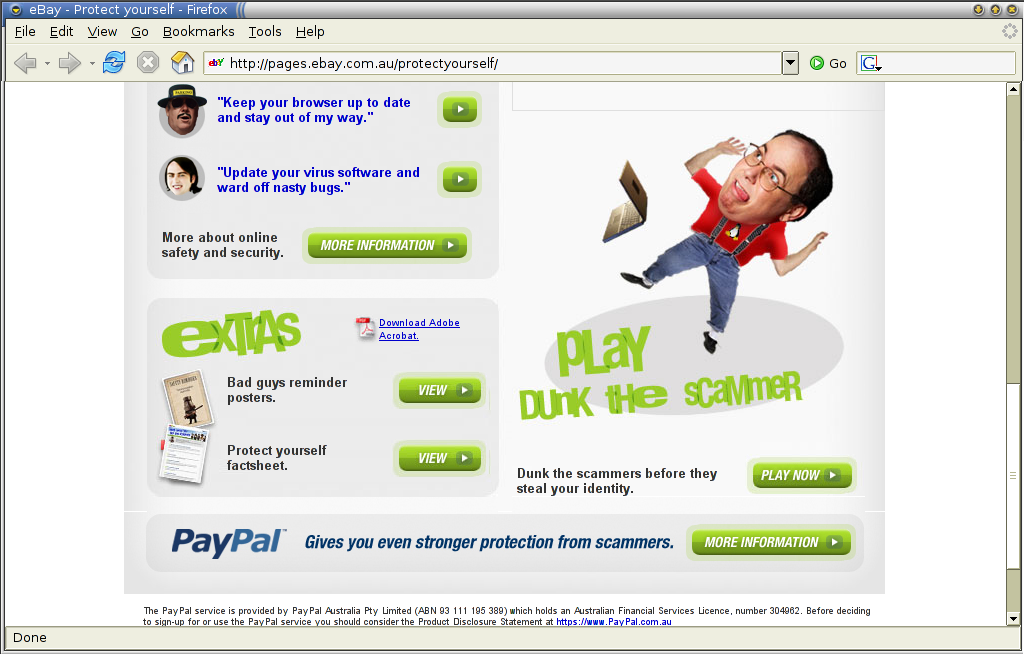
In what I can only assume is a case of "graphic design spec gone horribly wrong", EBay has decided to portray our lovable penguin friend as the mascot of the online scam artist: Linux is for scammers, says EBay (Click on the image for a full-size version) Personally, I think the scam artists' best friend is a Windows machine, as it provides a rich source of untraceable connectivity, but my guess is that Microsoft has scarier lawyers. I don't know how long the image has been up there for, but I'd imagine it won't last long. Linux users may not be that numerous, but we're a noisy lot. <grin>

3 October 2007

Matthew Palmer: That Didn't Take Long

Although I predicted that I'd be a busy boy with my bushfire brigade on Tuesday, I wasn't expecting to get our first "Bush Alight" fire call so quickly. But, yesterday (Wednesday), a few minutes after 1800, off goes the pager, and off I go to the station. Thankfully the high winds that had been a major feature of the day had settled down quite a bit, so it was relatively easy to control and stamp out (we were back at the station by around 2015) I still found it a little overwhelming -- "I'm supposed to help Stop This Fire". At a couple of hectares in size, it wasn't too massive, and it wasn't visually "spectacular" (like the fires you always see on the news) but still... given that my only experience of fire in the past has been small campfires and the occasional bonfire, having an area the size of a football field in front of you glowing with embers and flaring with small clusters of flames, it was certainly a very different experience. The heat, the smoke, the noise (those truck pumps are loud), and the adrenalin, it's a hell of a mix. Being that I'm the newest and least experienced crew there, I got given the unglamourous but important job of controlling traffic, as we had one lane of the one-each-way 100km/h road closed to give our crews more working space around the trucks. Let me just say that I now have an infinitely greater respect for road repair crews, and I think that every person should do an evening of traffic control with a group of their mates on the road behind them, so that they know what it feels like outside their car. Car drivers do the darnedest things. So, I've popped my bushfire-fighting cherry now, and I'd be more than happy if there's nothing more impressive than that awaiting me for the rest of the season.

2 October 2007

Matthew Palmer: That ain't no *disco* inferno

We're a third of the way through spring, and already we're hitting temperatures that would be a respectable mid-summer day. Tomorrow has also been declared a Total Fire Ban day in our area. That's probably nearly unheard of, especially given the large amount of rain that we've had over winter. I think I'm going to be a busy boy this summer. The bush around our town last had a bushfire through it seven years ago, and there's a regular seven year cycle of major bushfires. We're due for it. As this is my first summer as a qualified bush firefighter, I'm a bit twitchy about what the continued hot, dry weather may bring. Here's hoping it's not too horrific.

29 September 2007

Matthew Palmer: The Plain Text PDA

(or: Why Everyone Should Learn Some Basic Programming) I am an organisational disaster area. I just can't remember "event oriented" information (like "I need to do $foo" or "I need to do $bar at $time"). I think I've accumulated such a huge collection of technical trivia that it's taken over the event planning part of my brain -- although, since I've never been able to remember event oriented information, even before I became a computer geek, it's more likely that I was just built without that bit of the brain. So I guess I'm the perfect target market for some sort of external brain pack (a la "Ratbert the Consultant"). I've tried paper-based organisers (the mighty Filofax), a few pre-written apps, and I even bought an SL-C3200 Zaurus a while ago (although, to be fair, that was really just for the hack factor, regardless of what justification I may have given to others at the time). None have worked, for various reasons. I can't grep paper, and Other People's Apps bug me because they've got their idea of workflow, and I've got mine, and when they don't match up (and they never do) I just get irritated -- not to mention the fact that the ubiquitous relational database, while wonderful in some ways, does tend to get in the way of ad-hoc faffing with your data. But this article is a success story, not a rant (gasp!), so it's safe for you to assume that I've got something that's working for me. My method is real simple -- plain text files, managed by vim-outliner and a simple shell one-liner I've named 'pda', which just runs vim ~/pda/$1.otl. At the moment I've got a monster todo.otl, which is my world's todo list, and a deeply underused calendar.otl. I'm also using vim-outliner to do some project planning, which has been moderately successful, although I'm a bit freaked out by the idea of trying to manage a large-scale project using it. The really, really cool part of this whole shebang, though, is that because all of my data is (structured) plain text, writing little programs to parse the data and do funky things with it is dead simple. For example, in my project outlines, I put estimated, actual, and remaining times in for all tasks (a la Joel Spolsky's Painless Software Schedules) so I can keep track of my estimates and where they differ from reality (because one day I'd like to not Suck at estimating times, and feedback is the only way I'm going to do that). So, about an hour's worth of Ruby gave me "estimator", a script that reads all that data and does a pile of mathematical gubbins about how far over my estimate I am so far (or under estimate, if that were to ever happen), the percentage of the project complete (based on the estimates and number of tasks completed), and things like that. Similarly, today I wrote a small script (run out of cron in the wee hours of the morning) to read my calendar and send me an e-mail if I've got anything in there for today. Since I practically live in mutt, a morning e-mail is going to be far more effective than my trying to remember to check my calendar every morning (especially since, at present, I'm not using the calendar as often as I should, so there's even less motivation to check it). This, in my opinion, is why everybody (literally, every single person) should learn to program at some fairly simple level, like learning to read and write. By using plain text and small scripts, I've got a workflow that works for me, and it's cost me less time than I'd spend learning some large pre-written app and putting all my data into it. Being able to manipulate data like this is, I think, a fairly important tool in the modern world, and I don't think it should be left to any sort of priesthood of developers -- it should be as universal as most countries try to make literacy and numeracy.

20 September 2007

Matthew Palmer: Suing over Software

Colin Charles, writing about how "Linux isn't ready for the laptop" (no link -- I don't link through FeedBurner's shite):
However, I should caution all these companies from even going near Linux with a ten-foot pole. Quite simply, this is because Linux doesn't work. If their product doesn't work as advertised, what are the chances of a customer possibly suing them, for a product that isn't fit for purpose?
Puhlease. As Microsoft has convincingly demonstrated over the years, the chances of a consumer suing over non-functional software is zero, even after being shit on from a great height for nearly two decades.

18 September 2007

Sven Mueller: Brane Dump The Thoughts of Matt Palmer

In “Documentation - the chicken and the egg” [1], Matt Palmer wrote about the problem that noone writes documentation because noone reads it and that noone reads documentation because the few documentation in existence usually isn’t very good. So he, like me hs the habit of searching for help on the net instead of in a projects documentation. However I disagree with him in the consequences a bit. Because I noticed that on several projects with good documentation (subversion is an example that immediately comes to my mind, but postfix isn’t too bad either), the internet search returns a reference to the docs more often than not. Of course, this means that the documentation needs to be searchable for those webcrawlers. So if you have the task to write documentation, I strongly suggest to make it searchable in some way. For company-internal projects, this obviously means that the documentation must be reachable via an internal search engine. In a project a few years back, we implemented an internal search engine which included company internal information (even with user based access rules so that each user only got those results he could actually access) as well as an external search engines results. It was closed source, but a pretty nice idea. It didn’t, however, index any locally (user’s desktop) stored documents, only what was on some company web page (but including .doc, .rtf, .pdf and the like which where retrievable via http). [1] http://www.hezmatt.org/~mpalmer/blog/general/documentation_the_chicken_and_the_egg.html

Matthew Palmer: Documentation: The Chicken and the Egg

The other day, as I was putting a couple of pages of documentation together for a company-internal development project, I got this terrible feeling of malaise about what I was writing. "Why the hell am I bothering writing this lot? It's a given that nobody's ever going to read it." Why? Because nobody reads documentation. Funnily enough, I tend to work the other way, too. While I will often go looking for help through Google, checking for assistance in structured, project-produced documentation (manuals, et al) is usually one of the last things I'll try. Why? Because nobody writes documentation. Now, given that I feel minimal motivation to write documentation because nobody reads it, and I don't usually read documentation because nobody writes it (probably because nobody reads it), an obvious question comes to mind: did one of these states come first, which then caused the other? Are we in an ever-deepening spiral of shite docs, the logical end of which is just giving up and reverting to code reading and experimentation?

14 September 2007

Matthew Palmer: Free To Good Home...

Slightly used Leopard main battle tanks. One owner, always garaged, great for soccer mums and men with very small penises.

30 August 2007

Matthew Palmer: "Printer Friendly"

Obviously some people have a much, much better printer than me, because the "Printer Friendly" link I just clicked on took me to a page with a flash ad at the top of it.

24 August 2007

Matthew Palmer: APEC Provocateur?

So it would seem that the forces of "justice" in Canada might not be above a little shit-stirring to cast their opponents in a bad light. Considering all of the hoo-hah around the security of the upcoming APEC meetings in Sydney, I wonder if the local constabulary has any similar plans? Remember, if you're planning on protesting the senseless waste of money that is APEC, carry your ID at all times, to prove you're a legitimate protester and not a security shill! <grin>

15 August 2007

Simon Richter: VCS merges

Matthew, the situation you describe can be avoided by creating an explicit relationship between the values that need to change together, either by computing those that can be computed, or by having the build process error out at some point if you did something wrong. For example, I can use either char const *const keywords[] =

    "foo",
    "bar"
;
unsigned int const num_keywords = sizeof keywords / sizeof *keywords;
(for more correctness, use "(&keywords[1] - &keywords[0])" as the divisor), or you can explicitly tell the compiler how many keywords you expect, using unsigned int const num_keywords = 2;
char const *const keywords[num_keywords] =

    "foo",
    "bar"
;
What we lerned in our database courses is true in other places as well: redundant information has a habit of going out-of-sync, so we should avoid it (=> db normalisation), or create a connection between the redundant bits (=> foreign keys).

Robert Collins: 15 Aug 2007

When are two identical changes the same, and when aren't they? Theres a little bit of debate started by Andrew Cowie posting about unmixing the paint. Matt Palmer followed up with a claim that a particular technique used by Andrew is dangerous, and finally Andrew Bennetts makes the point that text conflicts are a small subset of merge conflicts. That said, one critical task for a version control system is the merge command. Lets define merge at a human level as "reproduce the changes made in branch A in my branch B". There are a lot of taste choices that can be made without breaking this definition. For instance, merge that combines all the individual changes into one - losing the individual commit deltas meets this description. So does a merge which requires all text conflicts to be resolved during the merge commands execution, or one that does not give a human a chance to review the merged tree before recording it as a commit. So if the goal of merge is to reproduce these other changes, then we are essentially trying to infer what the *change* was. For example, in an ideal world, merging a branch that changes all "log messages of floating points to 6 digit scale." would know enough to catch all new log messages added in my branch, regardless of language, actual api used etc etc. But that is fantasy at the moment. The best we can do today depends on how we capture the change. For instance, Darcs allows some changes to be captured as symbol changing patches, and others as regular textual diffs. So the problem about whether arriving at the same result can be rephrased 'when is arriving at the same result correct or incorrect'. For instance, if I write a patch and put it up as plain text on a website, then two people developing $foo download it and apply it, they have duplicate changes but its clearly correct that a merge between them should not error on this. On the other hand, the example Andrew Bennetts quotes in his post is a valid example of two people making the same change, but the line needing a change during the merge to remain correct. Here's another, example though. If I commit something faulty to my branch, and you pull from me before I fix it. Then while I fix the bug, you also fix it - the same way. That is another example of no-conflict being correct. If its possible for either answer - conflict, or do not conflict - to be correct, then what should a VCS author do? There are several choices here: I think that our job is to assess what the maximum harm from choosing the wrong default is, and the likely hood of that occuring, and then make a choice. Short of fantasy no merge is, in general, definately good or bad - your QA process (such as an automatic test suite) needs to run regardless of the VCS's logic. The risk of a bad merge is relatively low, because you should be testing, and if the merge is wrong you can just not commit it, or roll it back. So our job in merge is to make it likely as possible that your test suite will pass when you have done the merge, without further human work. This is very different to trying to always conflict whenever we cannot be 100% sure that the text is what a human would have created. Its actually harder to take this approach than conflicting - conflicting is easy.

14 August 2007

Matthew Palmer: Dangerous Merging

Andrew Cowie, talking about Orthogonal Patches, believes that having your revision control system assume that patches which are the same text is the same is a good thing:
If X = B [in the java equals() sense], and if Z = D..E, it's no problem, because when the day comes that X and Z are merged to some branch which happens to be the public mainline, and you later pull from that public branch, then X and B will "contend" and merge without conflict, and likewise Z will merge without conflict. It's all the same text. Mission accomplished.
If you think this is right, "think about two different patches each adding a new keyword and also changing the line #define NUM_OF_KEYWORDS 17'' to #define NUM_OF_KEYWORDS 18''." (example taken from the darcs manual, because I'm not going to come up with a better example than that).

8 August 2007

MJ Ray: SPI Elections: Corrections

Well, yesterday I asked
"WTF? There seem to be some 30 or 40 voters who really dislike me, but didn't tell me that straight, preferring to be silent then vote me down. Are you cowards, or what?"
Not the most polite of questions(!), but it's what I was wondering at the time. I had some good replies in the comments and a reply by Pingback that I didn't like, but it turned out to be a very educational reply in the end. A comment from Filipus Klutiero included:
"Sometimes, it's not really possible to explain a bad opinion of someone, because we forget the reasons for that opinion. However, if you think that voting based on reputation is a bad idea, you probably can't understand these "cowards"."
I've mentioned before that I don't seem to fit the debian developers stereotype, so I guess it's not surprising if I don't understand them sometimes. If reputation is always going to be such a big factor, one problem I need to overcome in debian and SPI is that some other participants do make crap up about me. You can usually spot it by phrases like "seems to think" (there are not that many mind-readers out there), but eventually, mud sticks. How to overcome this? Patiently post corrections, or is that futile? Here are posts from Andrew Pollock and Matt Palmer which I think are wrong on several points:- First off, I haven't decided to call anyone cowards - it was a question, albeit a bit "nasty, british and short". The underlying sentiment was continued disappointment and puzzlement at why voters behave like that in a non-secret vote, not rage. It was not really an "outburst," coming a week after the results. I'm not unhappy with the results - I've congratulated the winners by several methods, including the last post, although I mentioned my mixed feelings. Isn't that usual? I think very few non-elected candidates express unbridled joy about the experience. After all, it's not an easy decision to stand, but I did it for two main reasons: shortage of other candidates I really liked, at the time I chose to stand (as I mentioned in my platform); and for practical experience of how Condorcet behaves. I'm not rabid - I've even written against the Rabid Right recently - and I'm not rabidly anti-Google. I had polite chats with various people from Sun, Microsoft and Google at debconf - I don't like those companies, but I don't feel a need to tell their workers that at every point. I think reasons to like and dislike Sun and Microsoft are old and well-known, but a few years ago, I got so bored of explaining why I don't agree that Google is God's Gift to our communities that I posted a FAQ-ish page about it, which I update as I look at its new developments. Let's politely disagree, until Google fix the bugs which brought me to that view. Andrew Pollock's point about debian-legal is vague and maybe fair comment. It's not often a fun or popular thing. But "precious ego"? Ha! Yes, a guy who humiliates himself with cheap stunts for environmental protests is clearly very precious about his ego(!) (Sorry if that's rude, but I find it hilarious.) I don't mind people having different opinions, but it would be nice if their opinions about me were mostly based on reality, instead of misunderstandings. One fair point from Matt Palmer's post and also, I discovered eventually, from Antti-Juhani Kaijanaho's site, is that SPI's elections apparently are meant to be secret, as far as I can tell from the starts of Article Five and Article Seven of the SPI by-laws. I tend to value practice more than theory and the current voting practice is merely confidential, not secret. I think that's part of why I didn't understand the approach taken by some voters - they were treating it as a secret ballot. That's fine and now that I realise it's meant to be secret, I've suggested making it a secret ballot. (2007-08-08: 1 comment)

Matthew Palmer: Just so I'm not accused of being a coward...

Since MJ Ray seems to think that anyone who doesn't vote for him but doesn't tell him why is a coward, I'm going to be up-front about it so I can't be accused of cowardice. Elections are all about everyone making their own decision, for their own reasons, in the hope that the aggregate of those decisions will produce a useful and workable result. (Whether that happens in reality is a whole other issue). The individual's decision is a statement of their opinion, nothing more. Adding confidentiality to the voting process is meant to remove any pressure from the voter to make a decision on any basis other than their own opinion. Complaints about it like this from a candidate is pretty weak:
There seem to be some 30 or 40 voters who really dislike me, but didn't tell me that straight, preferring to be silent then vote me down. Are you cowards, or what?
Given this outburst, I'm hardly surprised that people weren't keen on telling Mark upfront that they weren't going to vote for him. (As a disclaimer, I didn't vote in the SPI election, because I don't have a specific opinion on any of the candidiates' suitability for office on the SPI board.)

Next.

Previous.