Search Results: "mako"

10 February 2011

Jurij Smakov: My own little Squeeze release

Squeeze installer for sparc is affected by a number of problems, discovered late in the release cycle. In particular: These are documented in Squeeze installation notes, however it would be nice to push available fixes for these bugs into the first point release. In order to test the fixes I've created a couple of unofficial Squeeze installer images for sparc, which can be found here. See the README file for details. If you have a sparc system where install is affected by one of these bugs, it would be great if you could try it out and send a report to debian-sparc or directly to me. There is also #611314 (sym53c8xx module is not loaded automatically), but we don't know what causes it yet. For now just use a simple workaround described in the bug.

7 February 2011

Matt Zimmerman: A diversity statement for Ubuntu

The Ubuntu website states that we aim to make Ubuntu a wonderful place to participate . We developed the Ubuntu Code of Conduct to set a standard for participants to accept each other in the spirit of cooperation, and have improved it over time to state these principles more clearly. It is implicit in our philosophy that these and other Ubuntu values should hold equally true for everyone. I would like to propose that we upgrade this to an explicit statement on behalf of the project. I have spoken with many people who were interested in joining a free software project, but were put off because they felt unwelcome. I know various people who participate in Ubuntu today, but sometimes face difficult social obstacles in order to do so. Going forward, I would like for us, as members of the Ubuntu community, to make the extra effort to accept all kinds of people. This may sound simple, but it can be very difficult to put into practice. People often don t even notice they ve gotten it wrong, until the offended party points it out to them. We need tools and guidance to make this a reality. To that end, I would like to propose a diversity statement for Ubuntu. This draft has already received support from a majority of the Community Council, but I d like to take it a step further. Because I want this to be a commitment that we can all stand behind, I m also calling for support from the community as a whole. Please give this issue your consideration, and let me know in the comments if you can get on board with an official statement like this. The more support we have, the more real this commitment can be. Here s the text. Many thanks to Mary Gardiner, Valerie Aurora and Benjamin Mako Hill for their review and input.
The Ubuntu project welcomes and encourages participation by everyone. We are committed to being a community that everyone feels good about joining. Although we may not be able to satisfy everyone, we will always work to treat everyone well. Standards for behavior in the Ubuntu community are detailed in the Code of Conduct and Leadership Code of Conduct. We expect participants in our community to meet these standards in all their interactions and to help others to do so as well. Whenever any participant has made a mistake, we expect them to take responsibility for it. If someone has been harmed or offended, it is our responsibility to listen carefully and respectfully, and do our best to right the wrong. Although this list cannot be exhaustive, we explicitly honor diversity in age, culture, ethnicity, genotype, gender identity or expression, language, national origin, neurotype, phenotype, political beliefs, profession, race, religion, sexual orientation, socio-economic status, subculture, and technical ability. Some of the ideas and wording for this statement were based on diversity statements from the Python community and Dreamwidth Studios (CC-BY-SA 3.0).

6 February 2011

Benjamin Mako Hill: Editor-to-Reader Ratios on Wikipedia

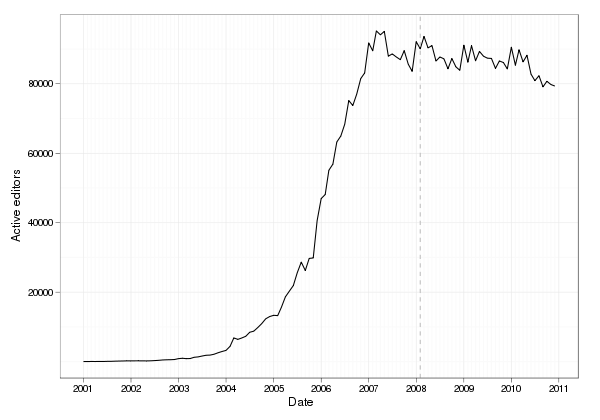
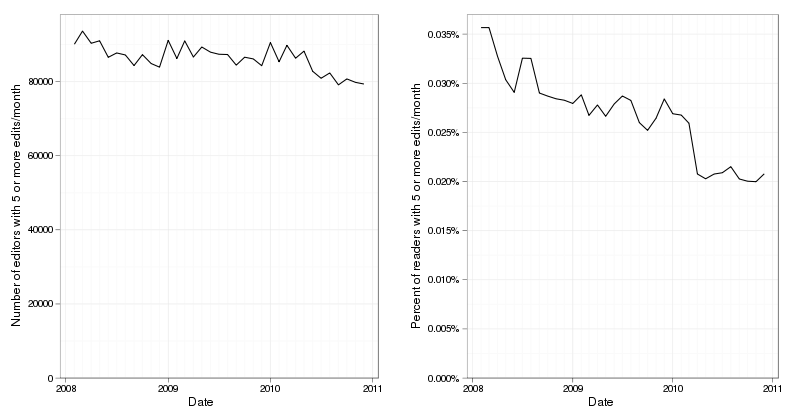
It's been reported for some time now that the number of active editors on Wikipedia (usually defined as people who have edited at least 5 times in a given month) peaked in 2007 and has been mostly stable since then. A graph of the total number of active editors in every month since Wikipedia's founding is shown below. The graph shows the aggregate numbers for all language Wikipedias. English Wikipedia is the largest component of this and is generally more variable. That said, very similar patterns exist for most larger languages. /copyrighteous/images/active_editors_all_wikpiedia.png Felipe Ortega, who has provided many of these statistics, has warned against fatalist claims. Although there seems to be a decrease in the total number of active editors over the last two years, the situation seems to have somewhat stabilized in most languages. New editors in Wikipedia are replacing folks at almost the rate that they are leaving. It is also widely known that the number of readers of Wikipedia has been increasing during this period. According to the report cards released by the foundation using comScore data, the number of unique visitors to Wikipedia each month has increased by 61 million people in the last year -- over 17%. This discrepancy between rising readership and stable or sinking editorship should raise major concern. After all, the Wikimedia Foundation's mission is two part: (1) to empower and engage people around the world to collect and develop educational content and (2) to disseminate it effectively and globally. Although the Foundation report cards include measures of raw levels of editorship, a better metric of engagement and empowerment might be the proportion of readers who engage in editing. I could not find reliable data on the number of unique readers reached each month for more than a few months in the last year. What is available, however, is wonderful data on page views each month going back to 2008. Analysis of the data from available report cards show that, at least during the last year, there is a very stable ratio of 35 page views per unique visitor, as estimated by comScore. Using that measure, we can do a back of the envelope estimation on the proportion of users that are editors for the period where page view data is available, dating back from February 2008 ( marked with the grey dashed lined above). The graphs below show the very different results you get when you consider the change in the number of Wikipedia editors and the change in the editor-to-reader ratio. Once again, these data are combined data for all language Wikipedias although graphs look very similar for most larger languages. The results are striking. Although there has been a 12% decrease between February 2008 and December 2010 in the number of active editors, there is a 42% decrease in the proportion of readers who edit at least five times a month. We can see that fulfilling the first half of the Wikimedia mission remains a struggle. /copyrighteous/images/wikipedia_editors_combined_graph.png Although the graphs above do not say anything directly about the most active core contributors to Wikipedia, the fact that Wikipedia is being maintained by a tiny -- and shrinking -- proportion of its readership does mean that the idea behind Wikipedia is under threat. Although none are as big as Wikipedia, there are lots of good encyclopedias out there. The reason Wikipedia is different, interesting, and important is because -- unlike all those others -- Wikipedia is the encyclopedia that anyone can edit. Wikipedia is powerful because it allow its users to transcend their role as consumers of the information they use to understand the world. Wikipedia allows users to define the reference works that define their understanding of the their environment and each other. But 99.98% of the time, readers do not transcend that role. I think that's a problem. Worse, that the number is growing. The Wikimedia Foundation recently ran a major successful effort to attract donations in its annual fundraiser. Jimmy Wales' smiling mug is apparently enough in the way of motivation to get something like 1% of its readers to donate money to support the project. I think that's very good news. If the Wikimedia community can entice even half of those people to contribute through an increased involvement in the projects themselves, they might do more than ensure Wikipedia's continued growth. They would help take a step toward the empowerment and engagement of those users in sharing their own knowledge, and the continued fulfillment of a critically important mission.

5 February 2011

Benjamin Mako Hill: Antifeatures at the Free Technology Academy

In addition to lecturing for two courses at MIT this term, I recently had the pleasure of giving a lecture on antifeatures at the Free Technology Academy -- a program which offers Masters courses over the Internet. Quite a few of the FTA courses are about free software, free knowledge, and related topics! It was my first time giving a lecture to microphone and an empty room. Although I found it a little tricky to adapt to the lack of any audience, the FTA folks put together a great video. I'm psyched that the course material will be available as open education resources for anyone who might want to incorporate it into another course. If you've seen my LCA keynote about antifeatures (which is also available online), there's not going to be a whole new in the lecture. If didn't see it, you might want to check out the lecture. I'll be in the online discussion group around the Lecture for the next couple weeks but you need to sign up to participate.

25 January 2011

Benjamin Mako Hill: Annual Free Software Foundation Fundraiser

<script type="text/javascript"> var fsf_widget_text = "Help protect your freedom!"; var fsf_widget_d_btn = "Donate"; var fsf_widget_share = "Share this widget."; var fsf_widget_size = "normal"; var fsf_associate_id = "3427"; </script> <script src="http://gplv3.fsf.org/static/widget/widget.js" type="text/javascript"></script>
The Free Software Foundation is in the last week of its annual fundraiser and has still has a bit of ground to make up. The FSF needs members and donations to merely sustain its basic activity protecting free software and engaging in minimal outreach. So as I've done in the last couple years, I've written a fundraising appeal for the organization. That why today my face is plastered, Jimmy Wales style, all over the FSF website. (For the record, the last bit was not my idea and I find it a little embarrassing.) My appeal this year begins with my feeling that as our lives become increasingly mediated by technology, the question of who controls technology becomes another way of asking "Who controls us?" Read the appeal for more. That statement, like much of the FSF's work, is not going to get very far with most users today. Most people don't think of technology as the source of control, power, or autonomy. They don't understand why software should be free or even what that might mean. Making this argument widely is something the FSF works hard to do. But supporting this work is a bit of a chicken-egg problem. The users we most need to reach have never heard our message and it can take some time to turn even the most receptive into supporters. For those of us that do care about technology and the power it has over its users, it's hugely important that we take action to support software freedom and organizations like the FSF that play a key place in this struggle. If we don't, nobody else will. The pool of people who might support the FSF today is small -- there are currently about 3,000 members -- but the stakes are huge: A choice between a world of DRM, locked down mobile phones, and non-free network services on one hand, and the possibility of a world where there are free alternatives on the other. The FSF won't win this fight alone, but it plays a critical role in it. The FSF is a small, humble, and responsible non-profit and a little money can have a big impact. If you are not an FSF associate member, now would be a great time to join. Membership is $120 per year ($60 for students) and payable monthly. In preparing this appeal, I realized that my membership had lapsed a couple months ago and that my partner Mika was still donating at the reduced student price. We've personally fixed both these things and made an addition donation. If you are a member, you can check your status or make a donation. If you are not yet, Please consider joining us.

19 January 2011

Benjamin Mako Hill: An Only Slightly Fictionalized Story

Before heading back to graduate school, my brother worked full-time as a personal fitness and strength trainer. Like many trainers, he started out in an established gym and then struck out on his own once he had established an clientele base. Working on his own, he got almost all of his new business from referrals. Although one might think that a trainer's trusted long-term clients would be the source of most new business, it was mostly the newer, less established clients who referred new trainees. The established clients had already referred everyone in their social network that might be interested. That's how I learned about the weak ties of strength.

15 January 2011

Jordi Mallach: Hiking through the Pyrenean GR 11

Tomorrow, at this time, I'll probably be unsuccessfully trying to find a comfortable position on a seat of the Bilmanbus to Irun. Very early on Saturday, as soon as we get off the bus, Maria and I will quickly head to Hondarribia's beach in Cape Higer to symbolically wet our feet in the waters of the Cantabrian Sea. We won't have much time to enjoy the cold waters of the ocean, though. Soon after that, we'll have to take a deep breath, look East, and start walking if we want to achieve our utmost objective: take a bath in the beautiful beaches of the Cap de Creus, in the Mediterranean sea. In between, 30 days and 840 kilometres of thick woods, deep valleys, high peaks and cold waters, all of which shape incredible landscapes.


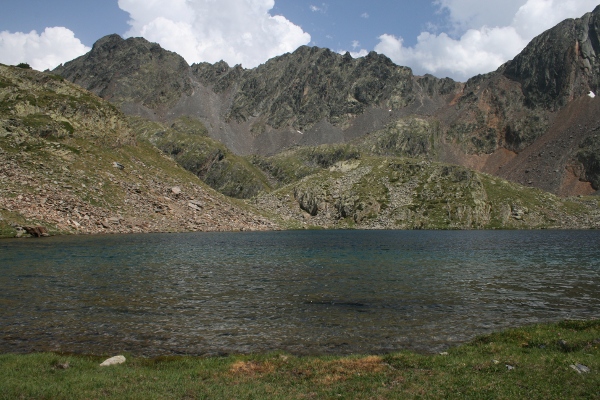
The Portella de Baiau, during our 2008 trip For a whole month, we'll be mostly disconnected from everything else that isn't our knee ache, our blisters, the Sun over our heads or where to get food. It's the first time I leave on a hiking trip as long and tough as this one, and I feel both uncertainty and eagerness. We've been so busy during the last few months that we've been unable to train at all for this, and I'm probably in the worst physical condition in a decade. It's too late to take care of that now, so we'll try to take good care of our legs and spine. In order to get back home in the Mediterranean, we'll have to be fast, some days joining two stages and skipping a few that we know are not that interesting (sections over asphalt, etc.). It's hard to make it in just one month, but we'll try our best. The plan is going to sleep not long after sunset, getting up at dawn, to be able to walk for a decent time before the heat starts being a handicap and just resting at midday, when the Sun is strongest. Of course, this means that I'm missing, yet again, this year's edition of DebConf in New York City, which is really sad because I was looking forward hanging around with Mako, Mika, Biella, micah, Clint and the rest of the NYC/ Boston gang, but when the idea of doing a long trip this summer popped up around January, it was clear DebConf seemed unlikely this year. I hope all of you have a lot of fun, and see you in a few weeks!

7 January 2011

Paul Wise: Another year, another log entry

It has been almost a full year since my last log entry. It has been a busy work year, I attended some nice conferences and did minimal FLOSS stuff. On the work side of things I was a third of an Australian VoIP startup that came and went. I setup Debian servers, installed OpenSIPS and associated software, wrote OpenSIPS scripts, wrote peripheral software and did customer support. We had a good thing going there for a while, some fans on the Whirlpool forums but in the end there wasn't enough money for the requisite marketing and local market circumstances were squeezing Australian VoIP providers anyway. On the conference side of things I went to LCA 2010, the Thai Mini-DebCamp 2010, DebConf10 and FOSSASIA 2010. Had a great time at all of them. At LCA 2010 in windy Wellington, New Zealand the distributions summit organised by Martin Krafft was one of the highlights. It was dominated by Debian/Ubuntu talks but there were some other interesting ones, especially the one on GoboLinux's integration of domain-specific package managers. Also excellent were the keynotes given by Gabriella Coleman (Best & worst of times), Mako Hill (Antifeatures) and others, which I felt gave LCA an improved and very welcome focus on software freedom. There were quite a few Debian folks at LCA, it was great to hang out with them during the week and afterwards. Monopedal sumo with mako and others was hilarious fun. At the Thailand Mini-DebCamp 2010 in Khon Kaen, I was glad to see Andrew Lee (Taiwan) and Christian Perrier (France) again and meet Yukiharu YABUKI (Japan) and Daiki Ueno (Japan). In addition to the five international folks, there were quite a few locals, including Thailand's currently sole Debian member, Theppitak Karoonboonyanan. The event was hosted at Khon Kaen University and opened with my talk about the Debian Social Contract and the Debian Free Software Guidelines. This was followed by a number of talks about Debian package building, a 3-day BSP where we touched 57 bugs, a great day of sightseeing and talks about i18n, derivative distros, keysigning, mirrors, contribution and a discussion about DebConf. During the week there was also the usual beersigning, combined with eating of unfamiliar and "interesting" Thai snacks. After the conference Andrew and I roamed some markets in Bangkok and got Thai massages. Beforehand I also visited a friend from my travels on the RV Heraclitus in Chiang Mai, once again experiencing the awesomeness of trains in Asia, unfortunately during the dry season this time. I took a lot of photos during my time in Thailand and ate a lot of great and spicy food. As a vegetarian I especially appreciated the organiser's efforts to accommodate this during the conference. At DebConf10 in New York City, by far the highlight was Eben Moglen's vision of the FreedomBox. Negotiating the hot rickety subways was fun, the party at the NYC Resistor space was most excellent, Coney Island was hot and the water a bit yuck, zack threw a ball, the food and campus was really nice. Really enjoyed the lintian BoF, ARM discussions, shy folks, GPLv3 question time, paulproteus' comments & insights, wiki BoF, puppet BoF, derivatives BoF, Sita, astronomy rooftop, cheese, virt BoF, Libravatar, DebConf11, Brave new Multimedia World, bagels for breakfast, CUT, OpenStreetMap & lightning talks. Having my power supply die was not fun at all. Afterwards I hung out with a couple of the exhausted organisers, ate awesome vegan food and fell asleep watching a movie about dreams. One weird thing about DebConf10 was that relatively few folks used the DebConf gallery to host their photos, months later only myself and Aigars Mahinovs posted any photos there. At FOSSASIA 2010 in H Ch Minh City (HCMC) was a mini-DebConf. I arrived at the HCMC airport and was greeted by Huyen (thanks!!), one of FOSSASIA's numerous volunteers, who bundled me into a taxi bound for the speakers accommodation and pre-event meetup at The Spotted Cow Bar. The next day the conference opened at the Raffles International College and after looking at the schedule I noticed that I was to give a talk about Debian that day. Since I didn't volunteer for such a talk and had nothing prepared, the schedule took me by surprise. So shortly after an awesome lunch of Vietnamese pancakes we gathered some Debian folks and a random Fedora dude and prepared a short intro to Debian. The rest of the day the highlights were the intro, video greetings and the fonts, YaCy and HTML5 talks. The next day the Debian MiniConf began with Arne Goetje and everyone trying to get Debian Live LXDE USB keys booted on as many machines in the classroom as possible (many didn't boot). Once people started showing up we kicked off with Thomas Goirand's introduction to the breadth of Debian. Others talked about Debian pure blends, Gnuk and building community and packages. The second last session was about showing the Vietnamese folks in the room how to do l10n and translation since Debian had only one Vietnamese translator (Clytie Siddall). After manually switching keyboard layouts (seems LXDE doesn't have a GUI for that) on the English LXDE installs, the two Cambodian folks were able to do some Khmer translation too. This was a great session and it resulted in two extra Vietnamese translators joining Debian. It went over time so I didn't end up doing my presentation about package reviewing. We rushed off to a university where the random Fedora ch^Wambassador was hosting a Fedora 14 release party in a huge packed classroom. There were a lot of excited faces, interesting and advanced questions and it was in general a success. Afterwards we had some food, joined up with some other speakers and ended up in a bar in the gross tourist zone. On the final day we hung around in the Debian room, went downstairs for the group photo and final goodbyes. Later we found a place with baked goods, coffee and juices and navigated the crazy traffic to a nice local restaurant. The next morning Arne & I went to the airport, others went on a Mekong Delta tour and Jonas hung out with the organisers. I took less photos than at other events but got a few interesting ones. I avoided doing a lot of FLOSS stuff over the last year, I hope to work on some things in the coming months; I'm also planning some interesting travel and acquiring some new technological goods, more on those in some later posts.

12 December 2010

Neil Williams: Free software under the bus

Sometimes, free software isn't better than proprietary, it's true - and one of the principal reasons is that the majority of free software does not use the full power of the freedom of the software. Far too many free software projects are single-developer projects. Many single-developer projects at SourceForge or Savannah and elsewhere have a single maintainer for the distribution providing the packages too and some (including nearly all of my own) have one person doing both jobs. In other words, there is no collaboration upstream or in packaging, so there is little or no benefit to the code of being free software...

It begs the question of what happens when the omnipresent developer-under-a-bus risk actually bites.

When comparing free software and proprietary, considering end-of-life effects can be very illuminating, especially when considering the interests of third-parties who come to rely upon the output of the project. When a proprietary software producer declares a software product to be end-of-life (whether due to collapse/purchase of the company or some other restructuring) third parties are left high and dry. In effect, all proprietary software is directly equivalent to a single developer writing free software. The more important the software, the worse this gets because at least if the single free software developer does disappear, the third party can try and pick up the pieces.

The bigger problem for free software is the common failure to actually collaborate. This has been my main upstream bug bear for a long time now. The model must change. New contributors must be dissuaded from writing new code just because they prefer one language over another. Distributions need to change their guidelines for new developers to actively discourage new packagers from starting with new upstream code. We are in danger of undermining the main appeal of free software by not stamping harder on the NotInventedHere (NIH) syndrome. NIH is pernicious, NIH is dangerous and there is even an argument for considering NIH as an anti-feature.
New is considered harmful
New is not necessarily a good idea, new can be positively harmful to the interests of the wider software community. New promotes reinventing the wheel. It's another incidence of "Just because we can, does not mean we should."

If free software advocates neglect to counteract the poison of NIH, then free software will lose the argument by losing the fundamental merit of free software. A freedom which is not utilised is akin to not having that freedom at all. Yes, someone can pick up a free software project after the single developer abandons it but, in practise, what actually happens is that someone else comes along whilst the single developer is struggling along alone and decides to fall prey to NIH simply because the original is written in C and their preferred language is Python or Ruby or Haskell or whatever.

The "choice" argument is simply invalid - providing another implementation of program foo in a different language is just a way of reinventing the bugs already fixed in foo in new ways in a new language - and then adding some more which are unique to that language. Yes, the new developer might argue that the new code is more active but for how long? Long enough to become just as stable as the abandoned code? What benefit is that? In a few years time we will have two abandoned codebases in two different languages written by two different developers who never collaborated on the actual problem both of them were trying to solve independently. Lunacy.

The dilemma for distributions like Debian is that the list of Debian Packages that Need Lovin' is a burden to Debian during a release freeze yet provides an ideal launchpad for new developers to refresh stale code. I've long thought that Debian needs to be more strict on removing such packages, yet at the same time I cannot help but feel that this tends to encourage more NIH behaviour.

It's a common mantra amongst free software developers that many eyes make all bugs shallow. The problem for free software is that outside certain key teams, there are simply too few eyes and the community is not doing enough to shine a light on existing code before dancing to the sound of the NIH drum.

Far too much free software is at risk from that omnipresent bus called "RealLife" and this makes far too much free software little better than proprietary software. Pandering to the fashions of NIH only makes things worse.

This isn't a technical problem that can be solved with a new cool tool (which itself is subject to the NIH poison), it is a social problem and, sadly, the free software community has a history of failing to tackle purely social problems successfully.

There is a small role for existing technical solutions to make it easier to spot NIH tendencies, including sites like SourceForge and Savannah having greater scrutiny about new projects and distributors like Debian being more averse to adding yet more ITP bugs (or closing them automatically unless something happens within a month). Fundamentally, it comes down to how new and existing members of the free software community decide to handle their own projects and bugs. The model of "do it this way because that's more fun" has got us so far, the challenge is to remove NIH tendencies without removing that fun.

Benjamin Mako Hill: When Free Software Isn't Better

I have an essay in the latest Free Software Foundation's bulletin which FSF members should be receiving this week. I've also republished the article on my website as When Free Software Isn't Better. The article confronts the fact that free software is sometimes not as high quality or featureful as proprietary alternatives and that most free software projects aren't particularly collaborative. It reflects on what these facts mean for free software and for open source. The Bulletin goes out to all FSF associate members. You should join to get a copy mailed to you in the future -- but mostly you should join because doing so supports the work of the foundation.

28 November 2010

Benjamin Mako Hill: Doppelg nger

/copyrighteous/images/food_network_mako-small.png It's funny, I don't remember donning a cape and making an apperance on the food network.

25 November 2010

Cyril Brulebois: Debian XSF News

Since people seem to like it, I ll be trying to publish some news about ongoing work on the XSF side, on a (possibly) regular basis. Let s have a look at what happened since last time I blogged about X in Debian, mostly by checking what appeared in my =debian-x mailbox. Debian XSF News #1 What are the XSF plans?

22 November 2010

Petter Reinholdtsen: Lenny->Squeeze upgrades of the Gnome and KDE desktop, now with apt-get autoremove

Michael Biebl suggested to me on IRC, that I changed my automated upgrade testing of the Lenny Gnome and KDE Desktop to do apt-get autoremove when using apt-get. This seem like a very good idea, so I adjusted by test scripts and can now present the updated result from today: This is for Gnome: Installed using apt-get, missing with aptitude
apache2.2-bin aptdaemon baobab binfmt-support browser-plugin-gnash cheese-common cli-common cups-pk-helper dmz-cursor-theme empathy empathy-common freedesktop-sound-theme freeglut3 gconf-defaults-service gdm-themes gedit-plugins geoclue geoclue-hostip geoclue-localnet geoclue-manual geoclue-yahoo gnash gnash-common gnome gnome-backgrounds gnome-cards-data gnome-codec-install gnome-core gnome-desktop-environment gnome-disk-utility gnome-screenshot gnome-search-tool gnome-session-canberra gnome-system-log gnome-themes-extras gnome-themes-more gnome-user-share gstreamer0.10-fluendo-mp3 gstreamer0.10-tools gtk2-engines gtk2-engines-pixbuf gtk2-engines-smooth hamster-applet libapache2-mod-dnssd libapr1 libaprutil1 libaprutil1-dbd-sqlite3 libaprutil1-ldap libart2.0-cil libboost-date-time1.42.0 libboost-python1.42.0 libboost-thread1.42.0 libchamplain-0.4-0 libchamplain-gtk-0.4-0 libcheese-gtk18 libclutter-gtk-0.10-0 libcryptui0 libdiscid0 libelf1 libepc-1.0-2 libepc-common libepc-ui-1.0-2 libfreerdp-plugins-standard libfreerdp0 libgconf2.0-cil libgdata-common libgdata7 libgdu-gtk0 libgee2 libgeoclue0 libgexiv2-0 libgif4 libglade2.0-cil libglib2.0-cil libgmime2.4-cil libgnome-vfs2.0-cil libgnome2.24-cil libgnomepanel2.24-cil libgpod-common libgpod4 libgtk2.0-cil libgtkglext1 libgtksourceview2.0-common libmono-addins-gui0.2-cil libmono-addins0.2-cil libmono-cairo2.0-cil libmono-corlib2.0-cil libmono-i18n-west2.0-cil libmono-posix2.0-cil libmono-security2.0-cil libmono-sharpzip2.84-cil libmono-system2.0-cil libmtp8 libmusicbrainz3-6 libndesk-dbus-glib1.0-cil libndesk-dbus1.0-cil libopal3.6.8 libpolkit-gtk-1-0 libpt2.6.7 libpython2.6 librpm1 librpmio1 libsdl1.2debian libsrtp0 libssh-4 libtelepathy-farsight0 libtelepathy-glib0 libtidy-0.99-0 media-player-info mesa-utils mono-2.0-gac mono-gac mono-runtime nautilus-sendto nautilus-sendto-empathy p7zip-full pkg-config python-aptdaemon python-aptdaemon-gtk python-axiom python-beautifulsoup python-bugbuddy python-clientform python-coherence python-configobj python-crypto python-cupshelpers python-elementtree python-epsilon python-evolution python-feedparser python-gdata python-gdbm python-gst0.10 python-gtkglext1 python-gtksourceview2 python-httplib2 python-louie python-mako python-markupsafe python-mechanize python-nevow python-notify python-opengl python-openssl python-pam python-pkg-resources python-pyasn1 python-pysqlite2 python-rdflib python-serial python-tagpy python-twisted-bin python-twisted-conch python-twisted-core python-twisted-web python-utidylib python-webkit python-xdg python-zope.interface remmina remmina-plugin-data remmina-plugin-rdp remmina-plugin-vnc rhythmbox-plugin-cdrecorder rhythmbox-plugins rpm-common rpm2cpio seahorse-plugins shotwell software-center system-config-printer-udev telepathy-gabble telepathy-mission-control-5 telepathy-salut tomboy totem totem-coherence totem-mozilla totem-plugins transmission-common xdg-user-dirs xdg-user-dirs-gtk xserver-xephyr
Installed using apt-get, removed with aptitude
cheese ekiga eog epiphany-extensions evolution-exchange fast-user-switch-applet file-roller gcalctool gconf-editor gdm gedit gedit-common gnome-games gnome-games-data gnome-nettool gnome-system-tools gnome-themes gnuchess gucharmap guile-1.8-libs libavahi-ui0 libdmx1 libgalago3 libgtk-vnc-1.0-0 libgtksourceview2.0-0 liblircclient0 libsdl1.2debian-alsa libspeexdsp1 libsvga1 rhythmbox seahorse sound-juicer system-config-printer totem-common transmission-gtk vinagre vino
Installed using aptitude, missing with apt-get
gstreamer0.10-gnomevfs
Installed using aptitude, removed with apt-get
[nothing]
This is for KDE: Installed using apt-get, missing with aptitude
ksmserver
Installed using apt-get, removed with aptitude
kwin network-manager-kde
Installed using aptitude, missing with apt-get
arts dolphin freespacenotifier google-gadgets-gst google-gadgets-xul kappfinder kcalc kcharselect kde-core kde-plasma-desktop kde-standard kde-window-manager kdeartwork kdeartwork-emoticons kdeartwork-style kdeartwork-theme-icon kdebase kdebase-apps kdebase-workspace kdebase-workspace-bin kdebase-workspace-data kdeeject kdelibs kdeplasma-addons kdeutils kdewallpapers kdf kfloppy kgpg khelpcenter4 kinfocenter konq-plugins-l10n konqueror-nsplugins kscreensaver kscreensaver-xsavers ktimer kwrite libgle3 libkde4-ruby1.8 libkonq5 libkonq5-templates libnetpbm10 libplasma-ruby libplasma-ruby1.8 libqt4-ruby1.8 marble-data marble-plugins netpbm nuvola-icon-theme plasma-dataengines-workspace plasma-desktop plasma-desktopthemes-artwork plasma-runners-addons plasma-scriptengine-googlegadgets plasma-scriptengine-python plasma-scriptengine-qedje plasma-scriptengine-ruby plasma-scriptengine-webkit plasma-scriptengines plasma-wallpapers-addons plasma-widget-folderview plasma-widget-networkmanagement ruby sweeper update-notifier-kde xscreensaver-data-extra xscreensaver-gl xscreensaver-gl-extra xscreensaver-screensaver-bsod
Installed using aptitude, removed with apt-get
ark google-gadgets-common google-gadgets-qt htdig kate kdebase-bin kdebase-data kdepasswd kfind klipper konq-plugins konqueror ksysguard ksysguardd libarchive1 libcln6 libeet1 libeina-svn-06 libggadget-1.0-0b libggadget-qt-1.0-0b libgps19 libkdecorations4 libkephal4 libkonq4 libkonqsidebarplugin4a libkscreensaver5 libksgrd4 libksignalplotter4 libkunitconversion4 libkwineffects1a libmarblewidget4 libntrack-qt4-1 libntrack0 libplasma-geolocation-interface4 libplasmaclock4a libplasmagenericshell4 libprocesscore4a libprocessui4a libqalculate5 libqedje0a libqtruby4shared2 libqzion0a libruby1.8 libscim8c2a libsmokekdecore4-3 libsmokekdeui4-3 libsmokekfile3 libsmokekhtml3 libsmokekio3 libsmokeknewstuff2-3 libsmokeknewstuff3-3 libsmokekparts3 libsmokektexteditor3 libsmokekutils3 libsmokenepomuk3 libsmokephonon3 libsmokeplasma3 libsmokeqtcore4-3 libsmokeqtdbus4-3 libsmokeqtgui4-3 libsmokeqtnetwork4-3 libsmokeqtopengl4-3 libsmokeqtscript4-3 libsmokeqtsql4-3 libsmokeqtsvg4-3 libsmokeqttest4-3 libsmokeqtuitools4-3 libsmokeqtwebkit4-3 libsmokeqtxml4-3 libsmokesolid3 libsmokesoprano3 libtaskmanager4a libtidy-0.99-0 libweather-ion4a libxklavier16 libxxf86misc1 okteta oxygencursors plasma-dataengines-addons plasma-scriptengine-superkaramba plasma-widget-lancelot plasma-widgets-addons plasma-widgets-workspace polkit-kde-1 ruby1.8 systemsettings update-notifier-common
Running apt-get autoremove made the results using apt-get and aptitude a bit more similar, but there are still quite a lott of differences. I have no idea what packages should be installed after the upgrade, but hope those that do can have a look.

20 November 2010

Petter Reinholdtsen: Lenny->Squeeze upgrades, apt vs aptitude with the Gnome and KDE desktop

I'm still running upgrade testing of the Lenny Gnome and KDE Desktop, but have not had time to spend on reporting the status. Here is a short update based on a test I ran 20101118. I still do not know what a correct migration should look like, so I report any differences between apt and aptitude and hope someone else can see if anything should be changed. This is for Gnome: Installed using apt-get, missing with aptitude
apache2.2-bin aptdaemon at-spi baobab binfmt-support browser-plugin-gnash cheese-common cli-common cpp-4.3 cups-pk-helper dmz-cursor-theme empathy empathy-common finger freedesktop-sound-theme freeglut3 gconf-defaults-service gdm-themes gedit-plugins geoclue geoclue-hostip geoclue-localnet geoclue-manual geoclue-yahoo gnash gnash-common gnome gnome-backgrounds gnome-cards-data gnome-codec-install gnome-core gnome-desktop-environment gnome-disk-utility gnome-screenshot gnome-search-tool gnome-session-canberra gnome-spell gnome-system-log gnome-themes-extras gnome-themes-more gnome-user-share gs-common gstreamer0.10-fluendo-mp3 gstreamer0.10-tools gtk2-engines gtk2-engines-pixbuf gtk2-engines-smooth hal-info hamster-applet libapache2-mod-dnssd libapr1 libaprutil1 libaprutil1-dbd-sqlite3 libaprutil1-ldap libart2.0-cil libatspi1.0-0 libboost-date-time1.42.0 libboost-python1.42.0 libboost-thread1.42.0 libchamplain-0.4-0 libchamplain-gtk-0.4-0 libcheese-gtk18 libclutter-gtk-0.10-0 libcryptui0 libcupsys2 libdiscid0 libeel2-data libelf1 libepc-1.0-2 libepc-common libepc-ui-1.0-2 libfreerdp-plugins-standard libfreerdp0 libgail-common libgconf2.0-cil libgdata-common libgdata7 libgdl-1-common libgdu-gtk0 libgee2 libgeoclue0 libgexiv2-0 libgif4 libglade2.0-cil libglib2.0-cil libgmime2.4-cil libgnome-vfs2.0-cil libgnome2.24-cil libgnomepanel2.24-cil libgnomeprint2.2-data libgnomeprintui2.2-common libgnomevfs2-bin libgpod-common libgpod4 libgtk2.0-cil libgtkglext1 libgtksourceview-common libgtksourceview2.0-common libmono-addins-gui0.2-cil libmono-addins0.2-cil libmono-cairo2.0-cil libmono-corlib2.0-cil libmono-i18n-west2.0-cil libmono-posix2.0-cil libmono-security2.0-cil libmono-sharpzip2.84-cil libmono-system2.0-cil libmtp8 libmusicbrainz3-6 libndesk-dbus-glib1.0-cil libndesk-dbus1.0-cil libopal3.6.8 libpolkit-gtk-1-0 libpt-1.10.10-plugins-alsa libpt-1.10.10-plugins-v4l libpt2.6.7 libpython2.6 librpm1 librpmio1 libsdl1.2debian libservlet2.4-java libsrtp0 libssh-4 libtelepathy-farsight0 libtelepathy-glib0 libtidy-0.99-0 libxalan2-java libxerces2-java media-player-info mesa-utils mono-2.0-gac mono-gac mono-runtime nautilus-sendto nautilus-sendto-empathy openoffice.org-writer2latex openssl-blacklist p7zip p7zip-full pkg-config python-4suite-xml python-aptdaemon python-aptdaemon-gtk python-axiom python-beautifulsoup python-bugbuddy python-clientform python-coherence python-configobj python-crypto python-cupshelpers python-cupsutils python-eggtrayicon python-elementtree python-epsilon python-evolution python-feedparser python-gdata python-gdbm python-gst0.10 python-gtkglext1 python-gtkmozembed python-gtksourceview2 python-httplib2 python-louie python-mako python-markupsafe python-mechanize python-nevow python-notify python-opengl python-openssl python-pam python-pkg-resources python-pyasn1 python-pysqlite2 python-rdflib python-serial python-tagpy python-twisted-bin python-twisted-conch python-twisted-core python-twisted-web python-utidylib python-webkit python-xdg python-zope.interface remmina remmina-plugin-data remmina-plugin-rdp remmina-plugin-vnc rhythmbox-plugin-cdrecorder rhythmbox-plugins rpm-common rpm2cpio seahorse-plugins shotwell software-center svgalibg1 system-config-printer-udev telepathy-gabble telepathy-mission-control-5 telepathy-salut tomboy totem totem-coherence totem-mozilla totem-plugins transmission-common xdg-user-dirs xdg-user-dirs-gtk xserver-xephyr zip
Installed using apt-get, removed with aptitude
arj bluez-utils cheese dhcdbd djvulibre-desktop ekiga eog epiphany-extensions epiphany-gecko evolution-exchange fast-user-switch-applet file-roller gcalctool gconf-editor gdm gedit gedit-common gnome-app-install gnome-games gnome-games-data gnome-nettool gnome-system-tools gnome-themes gnome-utils gnome-vfs-obexftp gnome-volume-manager gnuchess gucharmap guile-1.8-libs hal libavahi-compat-libdnssd1 libavahi-core5 libavahi-ui0 libbind9-50 libbluetooth2 libcamel1.2-11 libcdio7 libcucul0 libcurl3 libdirectfb-1.0-0 libdmx1 libdvdread3 libedata-cal1.2-6 libedataserver1.2-9 libeel2-2.20 libepc-1.0-1 libepc-ui-1.0-1 libexchange-storage1.2-3 libfaad0 libgadu3 libgalago3 libgd2-noxpm libgda3-3 libgda3-common libggz2 libggzcore9 libggzmod4 libgksu1.2-0 libgksuui1.0-1 libgmyth0 libgnome-desktop-2 libgnome-pilot2 libgnomecups1.0-1 libgnomeprint2.2-0 libgnomeprintui2.2-0 libgpod3 libgraphviz4 libgtk-vnc-1.0-0 libgtkhtml2-0 libgtksourceview1.0-0 libgtksourceview2.0-0 libgucharmap6 libhesiod0 libicu38 libisccc50 libisccfg50 libiw29 libjaxp1.3-java-gcj libkpathsea4 liblircclient0 libltdl3 liblwres50 libmagick++10 libmagick10 libmalaga7 libmozjs1d libmpfr1ldbl libmtp7 libmysqlclient15off libnautilus-burn4 libneon27 libnm-glib0 libnm-util0 libopal-2.2 libosp5 libparted1.8-10 libpisock9 libpisync1 libpoppler-glib3 libpoppler3 libpt-1.10.10 libraw1394-8 libsdl1.2debian-alsa libsensors3 libsexy2 libsmbios2 libsoup2.2-8 libspeexdsp1 libssh2-1 libsuitesparse-3.1.0 libsvga1 libswfdec-0.6-90 libtalloc1 libtotem-plparser10 libtrackerclient0 libvoikko1 libxalan2-java-gcj libxerces2-java-gcj libxklavier12 libxtrap6 libxxf86misc1 libzephyr3 mysql-common rhythmbox seahorse sound-juicer swfdec-gnome system-config-printer totem-common totem-gstreamer transmission-gtk vinagre vino w3c-dtd-xhtml wodim
Installed using aptitude, missing with apt-get
gstreamer0.10-gnomevfs
Installed using aptitude, removed with apt-get
[nothing]
This is for KDE: Installed using apt-get, missing with aptitude
autopoint bomber bovo cantor cantor-backend-kalgebra cpp-4.3 dcoprss edict espeak espeak-data eyesapplet fifteenapplet finger gettext ghostscript-x git gnome-audio gnugo granatier gs-common gstreamer0.10-pulseaudio indi kaddressbook-plugins kalgebra kalzium-data kanjidic kapman kate-plugins kblocks kbreakout kbstate kde-icons-mono kdeaccessibility kdeaddons-kfile-plugins kdeadmin-kfile-plugins kdeartwork-misc kdeartwork-theme-window kdeedu kdeedu-data kdeedu-kvtml-data kdegames kdegames-card-data kdegames-mahjongg-data kdegraphics-kfile-plugins kdelirc kdemultimedia-kfile-plugins kdenetwork-kfile-plugins kdepim-kfile-plugins kdepim-kio-plugins kdessh kdetoys kdewebdev kdiamond kdnssd kfilereplace kfourinline kgeography-data kigo killbots kiriki klettres-data kmoon kmrml knewsticker-scripts kollision kpf krosspython ksirk ksmserver ksquares kstars-data ksudoku kubrick kweather libasound2-plugins libboost-python1.42.0 libcfitsio3 libconvert-binhex-perl libcrypt-ssleay-perl libdb4.6++ libdjvulibre-text libdotconf1.0 liberror-perl libespeak1 libfinance-quote-perl libgail-common libgsl0ldbl libhtml-parser-perl libhtml-tableextract-perl libhtml-tagset-perl libhtml-tree-perl libio-stringy-perl libkdeedu4 libkdegames5 libkiten4 libkpathsea5 libkrossui4 libmailtools-perl libmime-tools-perl libnews-nntpclient-perl libopenbabel3 libportaudio2 libpulse-browse0 libservlet2.4-java libspeechd2 libtiff-tools libtimedate-perl libunistring0 liburi-perl libwww-perl libxalan2-java libxerces2-java lirc luatex marble networkstatus noatun-plugins openoffice.org-writer2latex palapeli palapeli-data parley parley-data poster psutils pulseaudio pulseaudio-esound-compat pulseaudio-module-x11 pulseaudio-utils quanta-data rocs rsync speech-dispatcher step svgalibg1 texlive-binaries texlive-luatex ttf-sazanami-gothic
Installed using apt-get, removed with aptitude
amor artsbuilder atlantik atlantikdesigner blinken bluez-utils cvs dhcdbd djvulibre-desktop imlib-base imlib11 kalzium kanagram kandy kasteroids katomic kbackgammon kbattleship kblackbox kbounce kbruch kcron kdat kdemultimedia-kappfinder-data kdeprint kdict kdvi kedit keduca kenolaba kfax kfaxview kfouleggs kgeography kghostview kgoldrunner khangman khexedit kiconedit kig kimagemapeditor kitchensync kiten kjumpingcube klatin klettres klickety klines klinkstatus kmag kmahjongg kmailcvt kmenuedit kmid kmilo kmines kmousetool kmouth kmplot knetwalk kodo kolf kommander konquest kooka kpager kpat kpdf kpercentage kpilot kpoker kpovmodeler krec kregexpeditor kreversi ksame ksayit kshisen ksig ksim ksirc ksirtet ksmiletris ksnake ksokoban kspaceduel kstars ksvg ksysv kteatime ktip ktnef ktouch ktron kttsd ktuberling kturtle ktux kuickshow kverbos kview kviewshell kvoctrain kwifimanager kwin kwin4 kwordquiz kworldclock kxsldbg libakode2 libarts1-akode libarts1-audiofile libarts1-mpeglib libarts1-xine libavahi-compat-libdnssd1 libavahi-core5 libavc1394-0 libbind9-50 libbluetooth2 libboost-python1.34.1 libcucul0 libcurl3 libcvsservice0 libdirectfb-1.0-0 libdjvulibre21 libdvdread3 libfaad0 libfreebob0 libgd2-noxpm libgraphviz4 libgsmme1c2a libgtkhtml2-0 libicu38 libiec61883-0 libindex0 libisccc50 libisccfg50 libiw29 libjaxp1.3-java-gcj libk3b3 libkcal2b libkcddb1 libkdeedu3 libkdegames1 libkdepim1a libkgantt0 libkleopatra1 libkmime2 libkpathsea4 libkpimexchange1 libkpimidentities1 libkscan1 libksieve0 libktnef1 liblockdev1 libltdl3 liblwres50 libmagick10 libmimelib1c2a libmodplug0c2 libmozjs1d libmpcdec3 libmpfr1ldbl libneon27 libnm-util0 libopensync0 libpisock9 libpoppler-glib3 libpoppler-qt2 libpoppler3 libraw1394-8 librss1 libsensors3 libsmbios2 libssh2-1 libsuitesparse-3.1.0 libswfdec-0.6-90 libtalloc1 libxalan2-java-gcj libxerces2-java-gcj libxtrap6 lskat mpeglib network-manager-kde noatun pmount tex-common texlive-base texlive-common texlive-doc-base texlive-fonts-recommended tidy ttf-dustin ttf-kochi-gothic ttf-sjfonts
Installed using aptitude, missing with apt-get
dolphin kde-core kde-plasma-desktop kde-standard kde-window-manager kdeartwork kdebase kdebase-apps kdebase-workspace kdebase-workspace-bin kdebase-workspace-data kdeutils kscreensaver kscreensaver-xsavers libgle3 libkonq5 libkonq5-templates libnetpbm10 netpbm plasma-widget-folderview plasma-widget-networkmanagement xscreensaver-data-extra xscreensaver-gl xscreensaver-gl-extra xscreensaver-screensaver-bsod
Installed using aptitude, removed with apt-get
kdebase-bin konq-plugins konqueror

15 November 2010

Benjamin Mako Hill: Between the Bars

Almost a year ago, I blogged about Between the Bars -- a project that offers a blogging platform to the 1% of the United States population that is currently incarcerated. The way it works is pretty simple: prisoners send letters through the postal mail. We scan them and put them up on the web. Visitors can transcribe letters or leave comments which are mailed back to the authors. About a month ago, my collaborator Charlie DeTar and I finally finished planning and paperwork and opened the site to bloggers. Over the last few weeks, we've had a bunch of authors sign up. We now have a daily stream of blog posts going up on the site. Please visit the site. Leave comments. Transcribe posts. If you know of prisoners who might like to use the site, let them know. If you want postcard fliers to send to prisoners, let us know.

7 November 2010

Benjamin Mako Hill: Monopedal Sumo

At LCA in Wellington -- immediately after a trip to Japan where I saw sumo for the first time -- a number of us created a game we called "monopedal sumo." Basically, the rules are those of sumo wrestling. Push your opponent either down or out of a ring before they do so to you. Unlike normal sumo, in our game you do so standing only one one leg. If your second leg touches the ground. That also counts as a loss. It's surprisingly entertaining. Try it!

6 November 2010

Jurij Smakov: DVD media for SunBlade 1000

This might save someone a good deal of sifting through ancient posts on obscure forums: if you wonder why your SunBlade 1000 workstation refuses to boot off a freshly burned DVD, keep in mind that the standard-issue DVD drive in those machines (typically Toshiba SD-M1401) is pretty picky about the DVD media type used. Trying to boot off DVD-R discs invariably failed for me with a "read failed" error, while the same image burned onto a DVD+R blank worked like a charm.

24 October 2010

Benjamin Mako Hill: Sharing an Email Address

I used to think that couples who share a single email address were just too cute. Then I saw this article which imported this whole "keeping each other honest" logic into the practice. Mika and I have never even had accounts on each other's servers.

18 October 2010

Benjamin Mako Hill: Redefining "Realistic"

When talking about free culture or free software, many people suggest that they would love to support free models, but that they don't see how to make it all work. Until they have an alternate model in front of them, they cannot bring themselves to argue for a more ethical alternative. I disagree with this approach. Instead, I say, "this is the world I want to live in and, even though I don't know exactly how to get to there from here, I'm going to refuse to settle for anything short of this ideal." Most people dismiss such thinking as "impractical" and "unrealistic." I think most people are being unimaginative. Robot jockeys are one recent illustrative reason, among many, that I feel comfortable taking this position. Some background is necessary for those that are unfamiliar with the example. A decade ago, several Gulf emirates used thousands of young boys from Sudan and South Asia as jockeys for camel racing. Human rights groups campaigned against the practice and suggested that these boys were at sometimes held as slaves and intentionally underfed to keep their weight low. Despite criticism, camel racers resisted moving away from young boys as jockeys. If they moved to heavier adults instead of young boys, they reasoned, the camels would be much slower. Of course, they were right. But they were being unimaginative in the alternatives they were considering. As the young jockeys became a increasingly unjustifiable public relations disaster for the states that supported it, law-makers in several Gulf states gave in to calls from UNICEF and others and created laws to outlaw the practice. Within three years of UAE passing strict laws against child jockeys, Swiss engineers, funded by racers desperate for an alternative, had created the first robotic camel jockey. Within several years these jockeys were lighter, cheaper, more responsive to the owner, and well on their way to being more effective than any young boy. When forced, by law and by an ethical prerogative, to come up with an alternative to young boys, racers created a solution that was superior, along nearly every axis, to the system they had fought to keep. Although the costs to society of proprietary software cannot be compared to slavery and abuse, the basic same pattern of solution-seeking can be seen in the example of free software. Early free software advocates suggested that most programmers would likely need to take a paycut. As it turned out, vibrant and successful economic models to support free software have supported a large and growing free software industry. But we have free software business models only because a small group of principled individuals refused to settle for what they knew, came up with creative ethical business models that "just might work," and put their own paychecks on the line to try them out. As open source has shown, some of these creative solutions offered models superior to what we had before. In the world of software development, free software redefined "practical" and "realistic." One can think of solving human problems as like searching for the highest point in hilly terrain in thick fog. It's easy to get stuck on the top of the first little hill you walk up (i.e., a local maximum) and then conclude you can never do better. If we refuse to compromise and force ourselves to leave that first little hill, chances are pretty good we'll find a "higher" peak. Of course, it is also possible that we will find the global maximum or the best possible solution to a given problem. In those cases, any change will mean a sacrifice. But when dealing with most most social and legal dilemmas, there are enough variables involved that this seems very unlikely. Indeed, most big problems can be thought of as having many interacting dimensions -- and only some of these will be ethical concerns. In other words, most social problems are more like the problem of child camel jockeys than they are like trying to transcend the laws of physics. Business models and laws for the regulation of technology and knowledge are extremely complicated human creations. Do we really think we cannot create ethical systems to compensate cultural creators that are at least as good as what we have now? If we never force ourselves to be "impractical" and "unrealistic", we will never find out.

14 October 2010

Axel Beckert: Thoughts on Gitorious and GitHub plus a useful git hook

When I took over the developement of xen-tools, I looked around for an appropriate git hosting. I especially had a look at GitHub and Gitorious. If you just regard the features, GitHub is definitely more targetted on single developers and Gitorious more towards projects: At GitHub, every repository has its URL under the URL of a user page which makes it nearly impossible to have user independent, official repositories for projects which have more than one official developer. At Gitorious, every hosted repository needs to belong to a project, even if it s only a published configuration. But a project can have more than one git repository. You only seem to be able to have personal repositories if you clone some existing Gitorious repository. So from a feature point of view, the xen-tools git repositories fit way better to Gitorious hosting while the git repositories with zshrc, conkerorrc and desktop configuration files defintely have a more fitting addresses on GitHub, in my case http://github.com/xtaran/$repository. On Gitorious, they are now together under a project called Axel s configuration files at http://gitorious.org/abe which contains git repositories of my on grml s .zshrc based .zshrc, my configuration for Conkeror and all the files necessary for my ratpoison/xmobar based netbook/laptop desktop. I though feel a little bad for giving the project the very short slug name abe instead of abe-config (as I did initially) since abe is IMHO not a proper project name for my configuration files and possibly other projects would have a more reasonable claim for that project name on Gitorious. But that way it suites more its purpose: Gather some of my git repositories which don t belong to a proper project. But there s another important point when comparing Gitorious and GitHub: Free Software needs free tools as Benjamin Mako Hill posted recently on Planet Debian. Despite my (probably well known) distrust against Google and therefore also Google Code, and despite knowing the history of SourceForge becoming non-free, I was not that much aware that GitHub s software is only partially open source and therefore also not free software while Gitorious is both as it s licensed under the GNU Affero General Public License (like StatusNet/identi.ca for example) which is basically GPLv3, but its ideas applied to hosted web applications scenario (where the GPL itself doesn t grasp), too. Initially I just had the xen-tools git repositories on Gitorious and all my small one-repository projects as copies of the repositories on my own git server on GitHub to get some more publicity for them and allow social cloning . After reading Mako s article, I decided to at least have repository clones on Gitorious of all repositories I mirror at GitHub, too. That way I force nobody to use the non-free tools on GitHub for social cloning one of my git repositories. And of course I have copies of my code somewhere on the net as backup. Or to say it with Linus Torvalds (slightly updated) words: Only wimps use tape backup: real men just upload their important stuff on git, and let the rest of the world clone it. ;-) But isn t that tedious to always push your code to three repositories? No, it isn t. I just push my code to git.noone.org where I have configured the according remotes and the following post-receive hook:
#!/bin/sh
                                                                     
read oldrev newrev refname
git push gitorious $ refname:t 
git push github $ refname:t 
The only other thing necessary is to use ssh-agent and SSH agent forwarding to at least the host you re pushing to.

Next.

Previous.