Search Results: "luk"

13 July 2012

Michal Čihař: Intel SSD firmware update on Linux

For quite some time, I've suffered slow boot - it had useless 10 seconds delay while initializing SATA with SSD disk:
[    2.761669] ata1: SATA max UDMA/133 abar m2048@0xf2528000 port 0xf2528100 irq 44
[    8.118202] ata1: link is slow to respond, please be patient (ready=0)
[   12.764701] ata1: COMRESET failed (errno=-16)
[   13.084612] ata1: SATA link up 3.0 Gbps (SStatus 123 SControl 300)
After some googling, I came to conclusion it is bug in SSD firmware and looked for update. Release notes documented some fixes to slow boot, what seemed to be related. The only issue was that the firmware update is available only as ISO image. And guess what I have no CDROM (actually I have no clue for what I would have used it). Fortunately the update is doable with just grub and syslinux. First, download ISO provided by Intel and extract eltorito boot image from it using geteltorito script and copy it to /boot/. Then get yourself syslinux and copy memdisk to /boot/. Now you just need to edit grub configuration to include following lines (you might need to adjust it according to your partition setup):
menuentry "SSD Update"  
        insmod part_msdos
        insmod ext2
        set root='(hd0,msdos1)'
        linux16 /memdisk
        initrd16 /ssd-fw.img
 
Now you can reboot and choose SSD Update from the grub menu and perform update! After update the slowest part of boot process is me entering LUKS password, but I'm afraid this is not easily fixable :-). PS: The difference you can see after update:
[    2.797551] ata1: SATA max UDMA/133 abar m2048@0xf2528000 port 0xf2528100 irq 44
[    3.115694] ata1: SATA link up 3.0 Gbps (SStatus 123 SControl 300)

Filed under: English Linux 0 comments Flattr this!

20 June 2012

DebConf team: Call for DebConf14 venues! (Posted by Gunnar Wolf)

2000, Bordeaux, France. 2001, Bordeaux, France. 2002, Ottawa, Canada. 2003, Oslo, Norway. 2004, Porto Alegre, Brazil. 2005, Helsinki, Finland. 2006, Oaxtepec, Mexico. 2007, Edinburgh, United Kingdom. 2008, Mar del Plata, Argentina. 2009, C ceres, Spain. 2010, New York, United States. 2011, Banja Luka, Bosnia and Herzegovina. 2012, Managua, Nicaragua. 2013, Vaumarcus, Switzerland. We have gone to all different latitudes (although not yet longitudes!). We have had very hot and very cold weather. Great cities and small villages have hosted us. What will be the next addition to this great list? As we approach DebConf12 (10 days to DebCamp and counting, yay!), we should keep the future in mind. So, as every year in recent history, we will once again have a DebConf session presenting possible venues for the next year. Organizing DebConf in your city means a lot of hard work. It also means one of the greatest personal experiences you can imagine. And it is a great way to contribute to Debian. The decision process for every DebConf venue starts two years before, with presentations during DebConf(n-2). That means, if you consider presenting a bid for DebConf14, now is the moment to act! Do you have to be present at Managua to propose your bid? No. You can proxy via somebody I d suggest to do it via somebody who knows the location you are suggesting, but basically, choose a friend that you trust that trusts you. Of course, you can participate in the presentation session via IRC. Do you have to be a Debian Developer to propose a bid? No. For DebConf9, none of the C ceres guys was a DD; for DebConf10, some of the people most involved from the local New Yorkers were not DDs. For DC11, none of our hosts in Bosnia are DDs. And for DC12, the dear and overworked Nicaraguan crew is also made from people interested in getting closer to the Debian project, but not DDs. Do you have to decide now? No. This is just a call for a first presentation, but the decision regarding DC14 will be taken probably around March 2013. However, giving a nice presentation at DebConf helps a lot, gives you visibility, and will get the ball rolling. Is there a geographical bias? Slight. So far, and since the second DebConf, we have kept the tradition not to repeat continents on two successive DebConfs. This is not a hard condition, however! While there is some probability that DebConf14 will be somewhere in America (the continent, of course), it depends on the proposals more than on any pseudo-rule. What do you need to start thinking about? Go visit our prospective location checklist. You can also look at what other teams have historically presented. And of course, go to the DebConf14 wiki planning page Register there, even if you are just in the early phases of finding data.

6 April 2012

Raphaël Hertzog: People Behind Debian: Francesca Ciceri, Member of the Debian Press & Publicity Teams

Francesca Ciceri, photo by Andrew McMillan, CC-BY-SA 2.0

I met Francesca in Debconf 11 in Banja Luka. If I recall correctly, it s Enrico Zini who introduced me to her, because she was the madamezou (her IRC nickname) who started to get involved in the publicity team. Since then and despite having a bachelor thesis to complete she got way more involved and even gained official responsibilities in the project. Before starting with the interview, I wanted to mention that Francesca is drafting a diversity statement for Debian I was expecting the discussions to go nowhere but she listened to all objections and managed to improve the text and build a consensus around it. Thank you for this and keep up the good work, Francesca! Rapha l: Who are you? Francesca: My name is Francesca, I m 30 and I studied Social Sciences. Currently I live in Italy but I m planning to go abroad (not a lot of jobs here for geeky social scientists). Apart for Debian and FLOSS world in general, I have unrestrained passions for chocolate; zombie movies; sci-fi; zombie books; knitting sewing crafting and DIY in general; zombie videogames; bicycles; pulling apart objects to look inside them; splatter B movies, David Foster Wallace s books, playing trumpet, and did I already mentioned zombies? Days are too short for all this stuff, but I try to do my best. Raphael: How did you start contributing to Debian? Francesca: Some years ago I was stuck in bed for literally some months, due to a grave series of migraine attacks. I wasn t able to do anything: no social life, no books or television. So, I decided to turn on the laptop and do something constructive with it: I was already a Debian user and it seemed quite logical to me to try to give back to the community. I am not a coder and I ve not studied Computer Science, so my first step was to join an Italian Debian on-line community (Debianizzati) and help with tutorials, users support, wiki management. In a couple of months I learnt many things: helping other users with their problems forces you to do lots of research! My first contributions to the Debian project were mostly translations of the main website. Translators are the perfect typos spotters: they work so precisely on the text to be translated that they finish to do a great QA job. This is how I ve started to contribute to the Debian website: with very simple things, fixing typos or wrong links or misplaced wml tags. I still remember my first commit to the website: the idea was to undercase some tags, but it ended up that I misplaced some of them and in addition I fixed them only in the English page and not on the translations as well. When after a couple of minutes, K re Thor Olsen a long time contributor of the team and now webmaster reverted my commit, I felt so stupid and full of shame. But, to my great surprise, no one treated me like an idiot for that error: Gerfried Fuchs, one of the guru of the team, replies me in a really helpful and polite way explaining what I did wrong and how to do things correctly. I think this episode was a turning point in my Debian life: there s this idea that Debian Developers are just a bunch of arrogant assholes and maybe it was true in the past, but for my experience they are not. Well, at least the ones I met and work with ;) .
To my great surprise, no one treated me like an idiot for that error.
Since then, I joined the WWW team and helped them apply the shiny new design provided by Kalle S derman. A lot of work was done during the week immediately before the release of the new website. Oh that was a week! We worked night and day to have the new design ready for February 6th, and it was fantastic when we finally published it, simultaneously with the release of Squeeze. At the same time, I started to contribute more actively to the Debian Publicity team, not only translating news but also writing them. It can sound scary for a non native English speaker to write something from scratch in English, but you have to keep in mind that your text will be reviewed by native speakers before being published. And we have some fantastic reviewers in the English localisation team: particularly Justin B Rye, who is tireless in his effort and more recently Moray Allan. I think I m particularly lucky to work with all these people: there s a special mood in both Publicity and WWW team, which makes you feel happy to do things and at the same time pushes you to do more just because it s fun to work with them sharing jokes, ideas, rants, patches and hugs. Rapha l: I believe that you have been trough the new member process very quickly. You re now a Non-Uploading Debian Developer. How was the experience and what does this mean to you? Francesca: Becoming a Debian Developer was not so obvious for me, because I didn t need to be a DD for the work I do in Debian. For instance, I don t maintain packages, so I had no reasons to want to become a DD in order to have uploading rights. For a while I didn t really feel the necessity of being a DD. Luckily, some people started to pester me about it, asking me to apply for the NM process. I remember Martin Zobel-Helas doing this for an entire week every single day, and Gerfried Fuchs doing it as well. Suddenly, I realized that people I worked with felt that I deserved the DD status and that I simply had thought I didn t. As a non coder and a woman, there probably was a bit of impostor syndrome involved. Having people encouraging me, gave me more confidence and the desire to finally become a DD. And so I did. The process for non uploading DD is identical to the one to become an uploading DD, with one exception: in the second part of the process (named Tasks and Skills) instead of questions about how to create and maintain packages, there are questions about the non packaging work you usually do in Debian. The general resolution which created the possibility to become a non uploading DD gave us a chance to recognize the great effort of Debian contributors who work in various area (translations, documentation, artworks, etc.) that were not always considered as important as packaging efforts. And this is great because if you are a regular contributor, if you love Debian and you are committed to the project, there are no reasons to not be an official member of it. With regards to this, I like the metaphor used by Meike Reichle in her recent talk about the Debian Women Project (video recording here):
a Debian Developer status is a lot like a citizenship in a country that you re living in. If you live in a country and you don t have citizenship, you can find a job, buy a house, have a family [...] but if this country at any point in time decides to go into a direction that you don t like, there s nothing you can do about it. You are not in the position to make any change or to make any effect on that country: you just live there, but there s no way that you can excercise influence on the people who run this country.
Rapha l: You recently joined the Debian Press Team. What does it involve and how are you managing this new responsibility? Francesca: The Press Team is basically the armed wing of the Publicity Team: it handles announcements that need to be kept private until the release, moderate the debian-announce and debian-news mailing list and maintain contacts with press people from outside the project. The real job, so, is done within the Publicity Team. The most important part of our work is to write announcements and the newsletter: while the newsletter is published bi-weekly, the announcements need to be write in a shorter timeframe. Localization is really important in spreading Debian word, so we work closely with translators: both announcements and DPN are usually translated in four or five different languages. The publicity work could be stressful, as we have strict deadlines, we need to take quick decisions and often do last-minute changes. Personally, I like it: I work better under pressure. But I know that is sometimes difficult for contributors to accept that we can t debate endlessly on details, we have just to go on and do our best in a given timeframe.
The publicity work could be stressful, as we have strict deadlines, [ ]. Personally, I like it.
Raphael: You re one of the main editor behind the Debian Project News. What s the role and scope of this newsletter? Francesca: Debian Project News is our beloved newsletter, direct successor of the Debian Weekly News founded by Joey Hess in 1999 and later kept alive by Martin Schulze. In 2007, Debian Weekly News was discontinued but in 2008 the project was revived by Alexander Reichle Schmehl. The idea behind DPN is to provide our users an overview of what is happening inside and outside the project. As the core team of editors is formed by three people, the main problem is to be able to collect enough news from various sources: in this sense we are always glad when someone points us to interesting blogposts, mails and articles. DPN is also a good chance for non coders to contribute to Debian: propose news, write paragraphs and review the draft before the publication are quite easy tasks but very useful. English native speakers can do a proofread (as no one of the main editors is a native speaker) while others can always translate DPN in their native language. People who want to help us can take a look at our wiki page.
DPN is also a good chance for non coders to contribute to Debian.
Just yesterday I realized that since January we don t miss or delay an issue: so I d like to thank the fantastic team of editors, reviewers and translators who made it possible. The team is now working on another way of spreading Debian s message: a long-time project is finally becoming real. Stay tuned, surprise arriving! Raphael: You re trying to organize IRC training sessions but that doesn t seem to take off in Debian, while it s quite common in the Ubuntu community. How do you explain that? Francesca: I m not sure about it: both Debian users and contributors seemed to appreciate this initiative in the past. I was quite surprised by the amount of Debian members present during the various sessions and by the amount of interesting questions asked by the users. So the only reason I can think about is that I need to put more enthusiasm in convincing the teams to do it: they need more encouragement (or to be pestered more!). I, for myself, think that IRC training sessions are a great way to promote our work, to share our best practice, to talk about our project to a wider audience. And I ll sure try to organize more of them. Help, suggestions, ideas are really welcome! Raphael: If you could spend all your time on Debian, what would you work on? Francesca: There is a project I d like to give more love, but I always end up without the time to do it: the debian-community.org project. Back in 2007, Holger Levsen founded it with the aim of reducing the gap between Debian contributors and Debian users, giving all an opportunity to contribute, share ideas and more. The project was discontinued and I d really like to revive it: in these years various things have changed, but I think that the core idea of having a node to connect existing local communities is still good and doable. In Debian we don t have the wide and well articulated local infrastructure present in other distributions (Ubuntu, particularly, but also Fedora): even if I don t like too centralized structures, I think that a better connection between the project and local groups of users and on-line communities would be a step forward for the project. Being part of the Events Team, I m aware of how much we need to improve our communication with local groups. An example is the events organization: sometimes, Publicity and Events teams even don t know about regional Debian related events (like booth at conferences, workshops, talks, install parties, etc) and this is a shame because we could offer a lot of help in organizing and promoting local events. What we lack is better communication. And debian-community.org project could give us exactly this. Could be a cluster of local groups, a platform for events organization and even a useful resource for newbies who want to find a local group near them. I started some effort in this sense, sending a proposal about it, working on a census of Debian local groups. Any help is appreciated! I m really curious to see how many Debian communities (from all around the world and the web) are out there, and I d love to have members from these communities better connected with the Debian Project. Raphael: What s the biggest problem of Debian? Probably the bikeshedding feticism of almost all of us. It s the other side of the coin of Debian s commitment to technical excellence and our perfectionism, but sometimes it leads just to endless discussions about details, and it is a blocker for various initiatives. In Debian, you have to be really patient and in a way stubborn to push some changes. This is frustrating sometimes. On the other hand, I really appreciate how people take some times to think to each proposals, give some feedback and discuss about it: the process could be annoying, indeed, but the result is often an improvement of the initial proposal. Raphael: Is there someone in Debian that you admire for their contributions? Most of my teammates are simply brilliant and adorable and hard-working. But I have to admit that I particularly admire David Pr vot: beside being a webmaster he does a lot of things, from French translations to DPN editing. All his contributions have a great quality and he s able to push you always further in doing things and doing them better. He is a good example of how I d like to be as contributor: smart, tireless, friendly.
Thank you to Francesca for the time spent answering my questions. I hope you enjoyed reading her answers as I did. Note that older interviews are indexed on wiki.debian.org/PeopleBehindDebian.

Subscribe to my newsletter to get my monthly summary of the Debian/Ubuntu news and to not miss further interviews. You can also follow along on Identi.ca, Google+, Twitter and Facebook.

3 comments Liked this article? Click here. My blog is Flattr-enabled.

30 March 2012

Andreas Barth: Traveling to DebConf 11 - back to Zagreb and M nchen

Back from Banja Luka was the DebConf bus trip to Zagreb. Even though the train connection should allow to catch the night train to M nchen, the time in Zagreb was too short to be sure (as with the other Bosnian track, two trains per day - taking a earlier train was not possible if I wanted to get at least a bit of sleep). So, I went on the DebConf-bus to Zagreb, and arrived there on time. Border checks into Hrvatska were a bit more time consuming then in the other direction - too much traffic but nothing else. In Zagreb, I dropped off my luggage at the train station again, and then went by tram to the parts of the city I hadn't been before (and which were more normal parts, and not the tourist-areas). Incidently I also experienced tram track works, and so had to switch to the bus; however, information was so bad that not only I didn't notice it (which wasn't too bad and unexpected - I plan with enough time as tourist) but also locals were taken by surprise. (Many parts of) Zagreb appears to have many too wide roads, with pedestrians pushed away. Not too uncommon for some cities here as well. But sad to see if public space is not created with humans in mind. This used to be modern in the 60ies, whereas it should have now advanced to center around humans again. If one compares the situation how one feels while standing in a too far road (where the wind blows easily cold) with a decent road in any city center, one could see the difference. But as said, many german cities make the same mistake. After arriving back at the train station, this was in time for taking the night train. Obviously there were many DDs on board. Passport checks in Hravatska went smooth but with many boarder guards. The train had an extra stop not in the official timetable so that they didn't leave their territory armed. On arriving in Slovenija the train had to stop some time. Border checks were quite strict (as this was entering the european union) and time consuming, e.g. partly cover sheets of the train were removed. After entering Slovenija the reminder of the trip was uneventful (or at least: ignored while sleeping), so the trip ended in M nchen as planned. Summarising it was an interesting and nice trip. I had no problem using public transport in spite of the warnings before. Of course, as always while traveling in foreign countries one should expect the country to be more different to home than just temperature and language - i.e. one should expect a bit of the unexpected, and be able to cope with. But that's true for any place one is going to. And these areas are worth another visit another time. I also learned more about "local" history (whereas local covers everything within 1000 kilometers around M nchen). However, the really bad thing is when comparing Hrvatska and Bosna i Hercegovina to see how much more Bosna i Hercegovina could have advanced within the last 16 years, but didn't due to incompetent management. Thinking that the same ways of obstructing decision-making happens in this country (and the european union as a whole) as well (but isn't as visible - we hadn't had a war, but also not much advances in our infrastructure) makes me more sad. Having said this, I still enjoyed the tour quite much - it was a good decision to have done it.

4 March 2012

John Goerzen: Unreported Disk Data Corruption Kernel Bug?

Well this is new, and I m utterly baffled. Here s a file that s not in use by anything.
$ md5sum xppro.vdi
589cbb5501dcddda047344a3550aaa95 xppro.vdi
$ md5sum xppro.vdi
a69806ec60d39e06473edbb0abd71637 xppro.vdi
Every time I run md5sum on it, I get a different answer. Same story with sha256sum. If I grab just the first 100MB, it gives the same answer each time. dmesg doesn t show any sort of errors whatsoever during the time I m running the tools. The file is 13GB, and was copied from one laptop to another (the new one being a Thinkpad T420s). The old laptop gives the same answer every time. The new one doesn t. I ve put the file on different ext4 filesystems on the same machine (one using LUKS encryption, the other not, both under LVM) same result. This will have also guaranteed different placement on the underlying hard disk. I verified that nothing is modifying the file by using lsof and inotify. The system is a freshly-installed Debian wheezy running kernel 3.2.0-1-amd64. Any ideas how I go about troubleshooting/fixing this? So far I don t know if it s hardware or software, though my gut says software; SMART isn t showing issues here, and the kernel didn t log hardware issues, either.

19 February 2012

Gregor Herrmann: RC bugs 2012/07

thanks to the Paris BSP & other activities we're seeing a nice decline in RC bugs. here are my recent contributions:

2 February 2012

MJ Ray: Two Campaigns, One Spot

Sometimes two campaigns that I care about a lot pick the same day to hold an awareness-raising drive. It happened again on Tuesday. The one I took part in was advertising the Stop ACTA London Protest on Sat 11 Feb. The Anti-Counterfeiting Trade Agreement (#ACTA) is a plurilateral international agreement on enforcement of so-called intellectual property rights copyrights, trademarks and so on. It ll have major implications for freedom of expression, access to culture and privacy. It will also harm international trade and stifle cooperation. (More background at EDRI or a fairly large AJE page thanks to Occupy Bristol for the AJE link.) So the one I didn t support at the time was the Move Your Money UK launch day. That s a great idea too, suggesting that if we, the 99%, are actually unhappy with the big banks and their titled leaders, we should move as much as possible out of those banks and into financial institutions that we control. As you might expect for someone whose first memory of mutuals is a trust account at the local building society, I support that too. I still have building society accounts, as well as banking with the co-op bank and recently joining my local credit union. I ve moved my money. Why don t you? I didn t try to support both campaigns simultaneously on social networks because I thought it would reduce the number of people who saw my message. I backed the ACTA protest because a lot of my networks were already discussing Move Your Money and I thought Stop ACTA would benefit more. Was that the right decision? Who can tell? What would you have done?

25 January 2012

Pietro Abate: new thinkpad x220

This summer my beloved thinkpad x301 died in a cloud of smoke. It was exactly 3 years and 20 days old while my warranty was valid only for 3 years. Now, don't tell me this is a coincidence. Anyway. After about 5 months, I finally managed to convince my employer to get me a new thinkpad, the x220. My specs includes a 128G SSD , 4G of RAM, 2.4Gz processor, camera and fingerprint reader. It's a pity that the x300 series is not in production anymore. They were light, with a solid battery and a large screen. The X1 just don't cut it. Even though it can be consider the successor of the x300, its battery life is just not enough for my needs. On the other hand, the x220 is a very nice machine : the screen is a bit smaller then the X300, but it is light, with a very powerful processor, good battery and it feels very solid. In my opinion lenovo should have packed the new hw of the x220 in the chassis of the x300, maybe with small compromise on the battery life (I got the big battery and I can squeeze almost 7 hs with a single charge) but clearly this was not a good business choice... Installing debian on this laptop is not immediate because none of the official debian installers are shipped with a recent kernel (as in 3.x series). Since with the official debian installer I cannot have neither the driver for the Ethernet card or the driver for the wirelles card, I opted to use a custom installer built by kmuto (http://kmuto.jp/debian/d-i/ ) . Using this installer the ethernet card is recognized immediately and it's easy to proceed with the installation as usual. Another option would have been to add the binary blog for the wireless chip, but apparently the deb installer supports only WEP auth, while all my access point are WPA. I didn't spend too much time on the wireless setup, so it might well be that is indeed possible to install using a WPA access point. Last time I installed a laptop, I used the automatic partition option to have lvm on top of a lucks encrypted partition, only to discover later that the default dimensions of the partitions were a bit too small for me. For example, by default the boot partition is only 256Mb. This is plenty if you want to have only one kernel image installed at each given time, but if you want more then one kernel, memtest and for example a grml rescue iso, it's easy to run out of space. So I proceed to manually partition the disc creating a boot partition of 512M, and using the rest as a luks encrypted device with lvm on top and 3 logical volumes : sys (15G), swap (4G) and home (the rest). For my daily use having 15G on my laptop for /usr, /var, etc should more the enough... Next step was to install the system. Since in recent times I got extremely pissed off with gnome 3, I've decided to dump it completely and go back to awesome. But since awesome all by itself is a bit sad, I paired it up with xfce. Everything works, except the automount, and I'm still trying to figure out how to make it work. Apparently is a consolkit problem... I'll write another post about the xfce4 + awsome setup soon... Today I've also started playing with the finger print reader. It seems working, but I haven't managed yet to use it in conjunction with pam for authentication ... more to come. And... On last closing remark : during the last 5 months I've used a dell latitude e6410 ... Gosh. I feel I'm on anther planet. The keyboard of a thinkpad give you pleasure, not pain, from 2 to 4G of RAM is a big jump and from a conventional HD to a SSD ... well... it seems I'm flyinggggg :) I've the impression my productivity just went up 50% !!! If you work with your laptop everyday get a good laptop. It is well worth the investment ...

15 January 2012

Roland Mas: Looking for the ultimate distributed filesystem

(This is not quite a Dear lazyweb post. If anything, it's Dear lazyweb, I've done my homework, now what? ) I'm looking for the ultimate distributed filesystem. Something that's simple to use, redundant, fault-tolerant, and still smart enough to avoid the more obvious performance chokepoints. Ideally, it should work for all of the following sets of files: The requirements on the ultimate distributed filesystem (which I'll call UDFS for short, otherwise you'll get bored and go look at pictures of kittens) are as follows: Quite a few constraints, eh? I have a feeling they are not mutually incompatible though, so I had a look at several candidates. I started with Wikipedia, and I followed the links to Tahoe-LAFS, XtreemFS and Ceph. The following is my evaluation of these candidates based on much reading of docs and websites and wikis, some questioning on IRC, and very little testing. The overall picture seems full of good things scattered across different solutions, but unfortunately none of the existing ones seems to address the whole problem; at least, not my whole problem. It would be good if each focused on one layer and did that layer well, but that seems not to be the case either, so they can't be combined to get the best of all worlds. It may be that I'm missing something, or that I failed to read some docs properly, or that I misunderstood the docs, or that the docs themselves are simply lacking; but my ideal UDFS currently doesn't seem to exist as a turn-key solution. However, the main pieces are available, and implementing the remaining parts may be doable. My humble idea of a way forward would be based on Tahoe-LAFS, with the following three changes: Also nice to have would be a way to work with multiple introducer nodes, but that seems to be in the works already. This would be pretty damn close to my UDFS; read/write performance would certainly be far from what can be obtained on native filesystems stored on local disks, but my use cases involve reasonably small files for which instant access is not compulsory, and the filesystem cache would probably absorb most of the access times. In case anyone is looking for ideas of things to do in their spare time, here are rough sketches of other possible UDFS implementations I thought of. These are wild ideas, and I'm not even sure they could be doable in practice: Such is the state of my research so far. I would welcome feedback, pointers to things I neglected to read, corrections for things I misread or misunderstood, comments on the ideas and so on. I'll probably post an update if my search goes significantly forward. Update: I've already received two pieces of feedback, including a lengthy one with corrections about Tahoe-LAFS. For the sake of fairness, I'll solicit (and wait for) the same from the other candidates I looked at. I was also pointed at HekaFS, GlusterFS and git-annex, which I'll have to look at in more details. Other suggestions are still welcome, but the more I get, the more the full update will be delayed. Thanks already!

18 December 2011

Gregor Herrmann: RC bugs 2011/50

here's my RCBW report for this week. again, nothing spectacular, mostly uploading packages where patches were already in the BTS. thanks to all the patch creators and forwarders!

14 December 2011

Luke Faraone: Making Message-ID useful in Thunderbird

In Thunderbird, if you read a message on a mailing list and want to reference a post in a blog or elsewhere, you may often want to access a copy of the mailing list posting on the web. While you can often accomplish this by searching for the subject or manually finding it in the specific archives of that list, if you re using full mail headers, there s a built-in way to find a message on the web.Each email or Usenet message has a unique Message-ID. These are indexed at various providers which archive mailing lists, with Gmane being the most notable in the Free Software community.If you right-click on the Message-ID of a message in Thunderbird, you can choose to Open Browser with Message-ID . By default this menu item opens sensible-browser with a Google Groups page, which, while indexing of Usenet, remains ignorant about most mailing lists. Most people reading this will probably find that Gmane carries their favourite mailing lists, while Google does not.This is configurable, but sadly you have to choose one or another. In Thunderbird, go to Edit Preferences Advanced Config Editor, and set the mailnews.messageid_browser.url property to http://mid.gmane.org/%mid. (default of http://groups.google.com/groups?selm=%mid&rnum=1)

12 December 2011

Simon Josefsson: Small syslog server

My home network has several devices that do not have large persistent storage to keep log files. For example, my wireless routers based on OpenWRT doesn t log to the limited local storage it has, and a Flukso energy metering device log power readings to a ramdisk. These devices log a fair amount of information that I ideally would like to keep for later analysis. I have never before seen a need to setup a syslogd server, thinking that storing logs locally and keeping regular backups of the machine is good enough. However, it appears like this situation calls for a syslogd server. I found an old NSLU2 in my drawer and installed Debian Squeeze on it following Martin Michlmayr s instructions. I m using a 4GB USB memory stick for storage, which should hold plenty of log data. I keep backups of the machine in case the USB memory stick wears out. After customizing the installation to my preferences (disable ssh passwords, disable portmap/rpc.statd/exim4, installing etckeeper, emacs23-nox, etc) I am ready to configure Rsyslog. I found what looked like the perfect configuration example, Storing messages from a remote system into a specific file , but it requires me to hard code a bit too much information in the configuration file for my taste. Instead, I found the DynFile concept. With a file /etc/rsyslogd.d/logger.conf as below I can point any new device to my log server and it will automatically create a new file for it. And since the dates are embedded into the filename, I get log rotation suitable for rsync-style backups for free.
$ModLoad imudp
$UDPServerRun 514 $ModLoad imtcp
$InputTCPServerRun 514 $template DynFile, /var/log/network-%HOSTNAME%-%$year%-%$month%-%$day%.log
:fromhost-ip, !isequal, 127.0.0.1 ?DynFile
:fromhost-ip, !isequal, 127.0.0.1 ~

flattr this!

12 October 2011

Sam Hartman: Moonshot SSP

It s been a while since I ve written about Moonshot. A lot has gone on; we ve been too busy doing to be busy blogging. However there s something that s happened recently that s so cool I had to take a moment to discuss it. Padl Software, the same people (well person) who brought us LDAP support to replace NIS and the first Active Directory clone, has now produced a GSS-EAP Security Service Provider. That s software that implements the Moonshot protocol and plugs it into the standard Windows security infrastructure. This is neat because it allows you to use GSS-EAP with unmodified Windows applications like Internet Explorer and Outlook/Exchange. Obviously, this will be great for Moonshot. However, I think the positive affects are more far-reaching than that. Luke has demonstrated that we can evolve the Windows security infrastructure without waiting for Microsoft to lead the way. For those of us working in the enterprise security space, that s huge. We can innovate and bring our innovation to Windows. In terms of getting acceptance in important user communities, getting funding for work, and making a practical difference, that s a big deal. This code is still in the early stages. Padl has not decided how the code will be made available. We don t know if it will be under an open-source license yet. Luke, naturally wants to get paid for his work. However if this code does get released under an open-source license, it will be very valuable. That will give all of us who are looking for a starting point for security innovations a starting point for bringing our innovations to Windows. Some in the open-source community will argue that we shouldn t work on improving Windows: if the open-source platforms have features Windows does not, then it may drive people to open-source. Especially for enterprise infrastructure, it tends not to work that way. You need broad cross-platform support to drive new technology. However, it does mean that we can take control of the evolution of our infrastructure; even for Windows there is no requirement that a single vendor controls what is possible.

10 September 2011

Biella Coleman: How to secure revolution in Silicon Valley

This is the best response to this (simplistic) claim about net access and revolt in Egypt featured in the New York Times: [m] In a widely circulated American Political Science Association conference paper, Yale scholar Navid Hassanpour argues that shutting down the internet made things difficult for sustaining a centralized revolutionary movement in Egypt. But, he adds, the shutdown actually encouraged the development of smaller revolutionary uprisings at local levels where the face-to-face interaction between activists was more intense and the mobilization of inactive lukewarm
[m] maybe we ll have some more fiber optic cable cuts in silicon valley and then the revolution will happen

2 September 2011

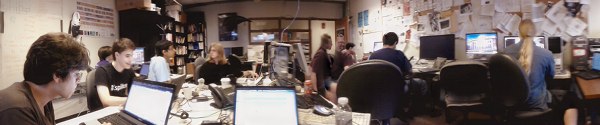
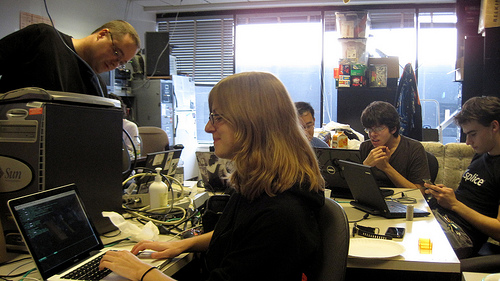
Asheesh Laroia: Debian bug squashing party at SIPB, MIT


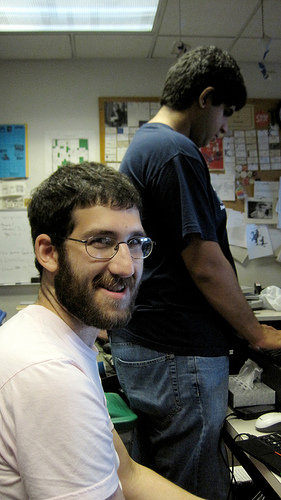
(Photo credit: Obey Arthur Liu; originally on Picasa, license.) Three weekends ago, I participated in a Debian bug squashing party. It was more fun than I had guessed! The event worked: we squashed bugs. Geoffrey Thomas (geofft) organized it as an event for MIT's student computing group, SIPB. In this post, I'll review the good parts and the bad. I'll conclude with beaming photos of my two mentees and talk about the bugs they fixed. So, the good:

The event was a success, but as always, there are some things that could have gone more smoothly. Here's that list: Still, it turned out well! I did three NMUs, corresponding to three patches submitted for release-critical bugs by my two mentees. Those mentees were: Jessica enjoying herself Jessica McKellar is a software engineer at Ksplice Oracle and a recent graduate of MIT's EECS program. She solved three release-critical bugs. This was her first direct contribution to Debian. In particular: Jessica has since gotten involved in the Twisted project's personal package archive. Toward the end of the sprint, she explained, "I like fixing bugs. I will totally come to the next bug squashing party." Noah grinning Noah Swartz is a recent graduate of Case Western Reserve University where he studied Mathematics and played Magic. He is an intern at the MIT Media Lab where he contributes to DoppelLab in Joe Paradiso's Responsive Environments group. This was definitely his first direct contribution to Debian. It was also one of the most intense command-line experiences he has had so far. Noah wasn't originally planning to come, but we were having lunch together before the hackathon, and I convinced him to join us. Noah fixed #625177, a fails-to-build-from-source (FTBFS) bug in nslint. The problem was that "-Wl" was instead written in all lowercase in the debian/rules file, as "-wl". Noah fixed that, making sure the package properly built in pbuilder, and then spent some quality time with lintian figuring out the right way to write a debian/changelog. That's a wrap! We'll hopefully have one again in a few months, and before that, I hope to write up a guide so that we run things even more smoothly next time.

31 August 2011

Wouter Verhelst: Debian-installer support for NBD

Folkert asks, not without reason, whether my debian-installer support for NBD is available for testing. The answer is: yes, it is! At DebConf11 in Banja Luka, I sat down with Otavio, who helped me get the necessary modules uploaded in the correct way. As such, you can now install debian to an NBD device with a regular debian-installer build although for now, you'll probably still need a daily build to get it to work[1]. To test, you should do the following: And that's it! Everything else should Just Work(tm). Well, almost. There's some loose ends that I need to fix, which I haven't had the time to look into yet. Hopefully that won't take too long. [1] It's possible that cdimage builds will work too, but I haven't tested that.

30 August 2011

Miriam Ruiz: Fantastic Park 2011 is over

On the 26th of June I wrote that I wouldn t be able to travel anywhere this summer (including DebConf 11), because I was going to be teaching lots of things related to Information and Communication Technologies (ICT) to a bunch of kids. That was a bit more than two months ago. On the 27th of June we started the first edition of Fantastic Park with a lot of enthusiasm, and hoping that the kids participating could get in touch to the ICT world while having fun. After all, it was summer holidays. The results have not only more than fulfilled our expectations but, from what their parents tell, we have also been able to overcome what the children were expecting. It was somehow encouraging to know that the kids were telling their parents to get up half an hour earlier (heh, sorry for them, but that s what being a parent is about, isn t it?), to be able to start as soon as they could, and also to make them wait until the last minute for going back home. These four editions have involved more than two months of work (280 hours), and 82 kids have taken part on it (57 boys and 25 girls). There have also been visits to different companies that work on the field of ICT (32 in total), and there was an important number of other people collaborating (thanks to all of them). Finally, the last edition of the Park has ended yesterday. Along these weeks, the kids have been able to get acquainted with a lot of different things, such as robotics (using Lego WeDo), digital photography and photo edition (using Pinta), Free Software, satellites, GPS or learning to code with Scratch. It has been very intensive and I m almost exhausted, but I m also quite sad that it s over. Hopefully some of these children might have developed an interest in this field, and who knows what might come out of it. If somebody is interested in the daily activities at the Park, we have been writing a blog with daily entries (in Spanish, sorry). We have also published quite a lot of photos of the activities. Of course, needless is to say that I m really happy to have taken part on it, and that the kids participating were simply great. I ll miss them.

28 August 2011

Micha Lenk: Finally transitioning to a new GnuPG key

Finally I managed to write up a transition statement for my not so new, but stronger GnuPG key. See below:
-----BEGIN PGP SIGNED MESSAGE-----
Hash: SHA1,SHA256
I am transitioning my GPG key from an old 1024-bit key to a new 4096-bit key.
The old key will continue to be valid for some time, but I prefer all new
correspondence to be encrypted for the new key, and will be making all
signatures going forward with the new key.
If you have signed my old key, I would appreciate signatures on my new key as
well, provided that your signing policy permits that without reauthenticating
me.
The old key, which I am transitioning away from, is:
pub   1024D/99E141B4 2004-02-10
      Key fingerprint = 25FE 4741 4770 0558 949D  1DB1 58DD 3FE2 99E1 41B4
The new key, to which I am transitioning, is:
pub   4096R/51B85139 2009-06-18
      Key fingerprint = A3EB B41F C5AB D675 CEE4  1C45 EA6C A6B9 51B8 5139
Thanks in advance.
Cheers,
Micha Lenk
-----BEGIN PGP SIGNATURE-----
Version: GnuPG v1.4.10 (GNU/Linux)
iEYEARECAAYFAk5aOnkACgkQWN0/4pnhQbTxPgCgzRhREZlQiKJyI9UIdJLLs3Zq
bH4AnA1myFxgDWM7aUMHXgvvsujLTjiWiQIcBAEBCAAGBQJOWjp5AAoJEOpsprlR
uFE5gCsP/0dtCUPl9aQHV1MbQl7+bMofpsC2ikkpdZmrzi68jTG16We49BuzY+PV
S8FhXqg17/YxhKYDnDNTowfztUOyjAOJxy5vrqm3X5xiLwTqN3js9mra+vb4s35k
EVbKMzLLDhj3i0FjeargWEmJmm9cVhaZWKvOvQUhDJAilqvEQ0/50P7B8I+1YvtV
UHoQKbweTljVSlK5R1YPPy9i6r2/oZBYxK4nrknWwS+qPQ5luqelJd+mZdgQ6tow
7HIvtmPgCblJ+hYZWFpoZK6vxs8RaBbuCQcKwYArNhZT/v4TeD/LAaUmIkbQMyKV
J2TKuEHya4+5GMbtg6BGKeiZpleEHPnAq1AfvGpz6opkxjxCLG3RO3X8D3EuM3RW
mkq60mWM8+Zwu1yKbb62iHplp6jpyiQgdjJlB6eHjX7SdY7CvHgYZxGDx4kclP0/
HAdig2U1T+nG6Nn5XflmmKwvNLuKlQlIwJ5NeXyCONRnYvdomQn2hgvkjwMLCdFh
ulIhxa4UvDY7/aQNPZeOrvDHb2XYpiV3TwA9hLgQXXWd0FPmUMVVPpKpRjilaWth
Mtq/QiMGP5Mq/YxgLInRZHGyajDtE67RD4+RgHYOP50cP3UGPoB4ncc2EEtM2kfe
BzJrXPHmdtyGEA6Korl0YwUTRnYsqkqkY1VqDsO0UkOLlV7RAzb9
=9vw1
-----END PGP SIGNATURE-----

Wouter Verhelst: At Steve's, again

for the second time, I'm at Steve's for his yearly barbecue. After I'd done my waffles back at Banja Luka, I off-hand suggested to do them again at the barbecue, which people replied to with an enthousiastic 'oh yes!' from multiple mouths. So that's what happened. I did overdo it on the amounts, though since after I'd baked 750g flour worth of dough, everyone still awake had already had a waffle; and I still had 500g flour worth to go. Since the dough can't be conserved overnight, I had to finish all of them. Which meant that I was still making waffles at 2AM, and no-one was eating them anymore. Bummer. Oh well, some people (including myself) had waffles this morning instead. Speaking of waffles, and by popular demand: A few years ago I blogged the recipe of my waffles (hidden in a blog post about a large number of other things). The rest of the barbecue was fairly nice, too. I mean, obviously it is: good food, good beer, good people to talk to, what more would you want? Exactly. Right now I'm waiting for food that is being prepared, after which I'll probably get in my car and start driving home again. But that's not for now just yet.

23 August 2011

Dirk Eddelbuettel: Accelerating path-dependent loops: A quick Rcpp case study

User BobH asked on StackOverflow about accelerating path-dependent loops. He provided a simple example in which a vector gets filled conditional on the value of the preceding element. Simple to code, but hard to vectorise. By the time I saw that question yesterday evening, Josh Ulrich had already posted a nice answer suggesting to switch from ifelse to if to escape the overhead of a vectorised expression on simple scalars. I meekly added a comment suggesting that Rcpp would likely do well on this and that someone should volunteer such an answer. Well, it is still August and Mr. Someone is on holiday, so this morning I followed up with such an answer. And as it turns out to work quite well indeed, we will repost it here. Let's start with the general setup, and the two functions supplied by Josh. We also byte-compile these using the compiler package which is the culmination of several years of work by R core member Luke Tierney. This package was added to R during the last major release, and we assessed it in this earlier blog post as well as several Rcpp-related follow-ups. We also load the packages for on-the-fly 'inline' compilation and easy benchmarking:
library(inline)
library(rbenchmark)
library(compiler)
fun1 <- function(z)  
  for(i in 2:NROW(z))  
    z[i] <- ifelse(z[i-1]==1, 1, 0)
   
  z
 
fun1c <- cmpfun(fun1)
fun2 <- function(z)  
  for(i in 2:NROW(z))  
    z[i] <- if(z[i-1]==1) 1 else 0
   
  z
 
fun2c <- cmpfun(fun2)
We see that basic worker just assign to the i-th element based on the preceding element. Function two uses the aforementioned if statement, and both are also byte-compiled. Writing the same code in C++ using both Rcpp (for the R/C++ integration) and inline for the on-the-fly compilation, linking and loading of C++ code into R is pretty straightforward too:
funRcpp <- cxxfunction(signature(zs="numeric"), plugin="Rcpp", body="
  Rcpp::NumericVector z = Rcpp::NumericVector(zs);
  int n = z.size();
  for (int i=1; i<n; i++)  
    z[i] = (z[i-1]==1.0 ? 1.0 : 0.0);
   
  return(z);
")
This single R function call takes the code embedded in the argument to the body variable, builds a complete function in temporary file, and then compiles, links and loads it. We can now call funRcpp() just like the other four functions and do so via the benchmark() function of the rbenchmark package.
R> z <- rep(c(1,1,0,0,0,0), 100)
R> identical(fun1(z),fun2(z),fun1c(z),fun2c(z),funRcpp(z))
[1] TRUE
R> 
R> res <- benchmark(fun1(z), fun2(z),
+                  fun1c(z), fun2c(z),
+                  funRcpp(z),
+                  columns=c("test", "replications", "elapsed", "relative", "user.self", "sys.self"),
+                  order="relative",
+                  replications=1000)
R> print(res)
        test replications elapsed relative user.self sys.self
5 funRcpp(z)         1000   0.005      1.0      0.01        0
4   fun2c(z)         1000   0.482     96.4      0.48        0
2    fun2(z)         1000   1.989    397.8      1.98        0
3   fun1c(z)         1000  11.365   2273.0     11.37        0
1    fun1(z)         1000  13.210   2642.0     13.21        0
We can focus on the columns labelled elapsed and relative. The C++ version is faster by a factor of almost one-hundred compared to the byte-compiled version of funtion2, and almost four-hundred times faster than the plain-R variant of function2. And function1 is even worse, coming at well over twenty-two-hundred times the run-time of the C++ version. Byte-compilation also helps little here. For comparison, we also ran the original example of a very short vector, called more frequently:
R> z <- c(1,1,0,0,0,0)
R> res2 <- benchmark(fun1(z), fun2(z),
+                  fun1c(z), fun2c(z),
+                  funRcpp(z),
+                  columns=c("test", "replications", "elapsed", "relative", "user.self", "sys.self"),
+                  order="relative",
+                  replications=10000)
R> print(res2)
        test replications elapsed relative user.self sys.self
5 funRcpp(z)        10000   0.047  1.00000      0.04        0
4   fun2c(z)        10000   0.134  2.85106      0.13        0
2    fun2(z)        10000   0.328  6.97872      0.32        0
3   fun1c(z)        10000   1.080 22.97872      1.08        0
1    fun1(z)        10000   1.243 26.44681      1.24        0
The qualitative ranking is unchanged: the Rcpp version dominates. Function2 using if instead of the vectorised ifelse is second-best with the byte-compiled version being about twice as fast that the plain R variant, but still almost three times slower than the C++ version. And the relative differences are less pronounced: relatively speaking, the function call overhead matters less here and the actual looping matters more: C++ gets a bigger advantage on the actual loop operations in the longer vectors. That it is an important result as it suggests that on more real-life sized data, the compiled version may reap a larger benefit. All in all a nice demonstration of Rcpp, and a gain of almost one-hundred to the best byte-compiled version is nothing to sneeze at---especially when it is so easy to write and load a five-line C++ function thanks to Rcpp. Before closing, a quick reminder that I will giving two classes on Rcpp in a few weeks. These will be in New York on September 24, and San Franciso on October 8, see this blog post as well as this page at Revolution Analytics (who are a co-organiser of the classes) for details and registration information.

Next.

Previous.