Search Results: "lucas"

21 August 2013

Lucas Nussbaum: DebConf was fantastic (not just the view)

So, I m back from DebConf, which probably translated to the 10 busiest days of my life, but also to one of the best times of my life. The Le Camp venue clearly contributed to this success: having everybody at the same place, but at the same time many opportunities for quiet chat or just enjoying the view, was really a good idea. Everybody who made DebConf possible deserve a huge thank you , as well as all attendees: it is really a honor to be a part of such a fantastic community. Now, let s go back to daily life, and to my re-filled Debian TODO list!

16 August 2013

Lucas Nussbaum: Debian birthday

This upload was the first one of my very first package in Debian. It was sponsored by Dafydd Harries, who I ve finally met at DebConf13, and got out of NEW on 2005-08-16. Exactly 8 years ago today. I only realized that yesterday evening, and Debian s birthday feels even more special to me now. Dafydd, it looks like I owe you a lot! :)

Lucas Nussbaum: DebConf

This DebConf is obviously quite special for me, being the DPL. It has really been great so far to talk to meet so many people, and especially to meet so many new Debian contributors or Developers. I m really happy to see that the next generation is ready! :) On Sunday, I delivered my Bits from the DPL talk. The video is available, and I ve finally uploaded the slides (working link here, it seems that Penta ate my slides). I hope you enjoyed it/will enjoy it!

12 August 2013

Richard Hartmann: DebConf13 I

DebConf! The venue here at Le Camp is pretty much perfect. Short walking distances, organic layout of the buildings, and a stunning view of the lake. I would be hard pressed to think of other venues which could be as nice... After arriving Fri/Sat night at 0330, Saturday was spent setting up the Access points: Me prior to pull-ups on the roof beams Access Point in pillow cases This little green valve caused a power outage in the server room, messing with servers, and resetting several switches to old configs. Xtaran had a lot of fun as a result of this. The valve of evil. And water. The ikiwiki BoF on sunday was rather interesting. I will try to publish some notes from this BoF and the other Git-related ones towards the end of the week. The Gitify ALL the things BoF managed to fill the room from "full-ish" over "good thing we don't need the beamer and can use the space in front of the whitescreen" over "out of chairs" over "the chairs from other rooms won't fit any more" to the final state of "people stand around near the walls and in the doors". At a total of 54 people, turnout has been... unexpectedly high.. The BoF started at 1130 and usually, slots are 45 minutes long. We extended our BoF into lunch time (I chose the slot just prior to lunch for precisely that reason) and finally finished at around 1245, i.e. 30 minutes late. After a quick show of hands on if there's interest in another BoF, I applied for and got the next slot, tomorrow at 11:30, once again in BoF room 1 and just before lunch. It's called Gitify EVEN MORE of the things and will expand on use cases and best practices. At a guess, we will focus on managing configurations and photos in default and complex situations. Sadly, neither of those BoF are taped. Afterwards, I had a chance to sit down with Lucas Nussbaum to talk over some points regarding the Debian Trademark Team. Finally, during Why Debian should (or should not) make systemd the default (it probably should not, but that's a different story), my kernel panicked. 3.9 and 3.10 have been less than ideal on my new X1 Carbon, but this was the first panic. I was not even done cussing and Ben Hutchings suddenly appeared on my side, telling me that yes, this particular module (mei) has been causing issues recently. Kernel panic As a closing note, I am really enjoying my first DebConf. Great venue, great people, great content, winebeer and cheese party tonight, and I found out that we have a fire place and fire wood...

11 August 2013

Gregor Herrmann: DebCamp 2013

[no pictures here, just a short report]. Today DebConf, this year's edition of the annual Debian developer conference, started with two inspiring talks about Debian proper, one by Lucas Nussbaum, the other by Joey Hess. This also means that yesterday DebCamp ended, the period preceeding DebConf and dedicated to working on Debian together with others. Here's a short report from my point of view: I arrived here on Tuesday, the first day of DebCamp. I immediately fell in love with the venue, & despite the early stage of setup, everything I needed was working fine for me from the very start. Like in previous years, I used the time to do work in the Debian Perl Group, especially taking advantage of the presence of other team members. That's the great thing about DebCamp & DebConf: collaborating in real-life & real-time, from quickly asking a question over sitting together to think about solutions for a problem to "just" chatting & thereby developping ideas for the future. In the previous days I I really enjoy my time here, & I'm especially happy to meet some people for the first time in meat space. This is only possible due to the generous support of the DebConf sponsors & the immense efforts of the DebConf team. Thank you!

9 August 2013

Gunnar Wolf: Not in Switzerland But still, cheering for Debian's 20th anniversary!

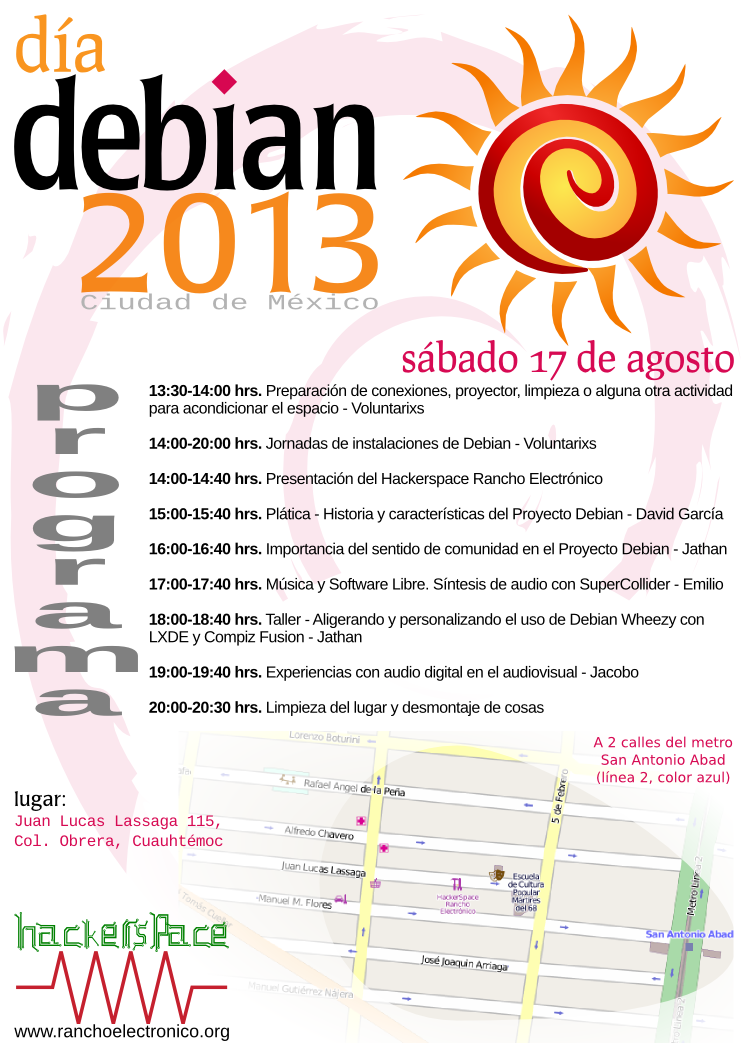
So... Well, contrary to the popular sentiment in Planet Debian, this year I'm very sorry to inform that... -( This is the first DebConf I miss in ten years, so... Yes, it's a big bummer for me. I'm not attending because this year, DebC(amp onf) coincide with the two first weeks of classes at my university And as a new teacher, I cannot afford to miss it! Anyway, but that should not stand in the way to attend a nice Debian 20th anniversary party! Parties will be held around the world. (Didn't find your city? Plan something and add it *now!*). In Mexico City, the nice guys at the very interesting Rancho Electr nico hackerspace took the lead, and organized the following activities: Debian Day 2013 Mexico City program Don't you yet know the hackerspace? You should go there! It's in a very centric location, just two blocks West from Metro San Antonio Abad (Juan Lucas Lassaga 114, col. Obrera). And the only two times I have been there, it has been good fun. Surely this Saturday we can have a nice party as well! The planned activities are from 13:30 to 20:30. See you there!
8 August 2013

Nicolas Dandrimont: Hello from DebCamp

DebConf flag (minus the wind) Small update as someone was complaining about the lack of pictures from DebCamp on planet. Not to worry, everything is going fine, and some of the most important stuff is ready s3kr3t You can see a few pictures from the gallery. The view from the venue is quite outstanding (it was better when there was some sun on Tuesday, but my camera battery was out ). On my TODO-list: See you there!

23 June 2013

Gregor Herrmann: RC bugs 2013/24-25

thanks to lucas & his trainees, we're seeing archive rebuilds & tons of new RC bugs again. besides that, there are still some patches in the BTS. here goes my list of recently worked on bugs; most of them in the pkg-perl group

6 May 2013

Sylvestre Ledru: Follow up on Debian & Clang

A week after the Euro LLVM conference, I am glad to share the results I presented and discussed during the event. 1) Parallel building infrastructure using clang instead of gcc Based on the work that Alexander Pashaliyski and I did during the GSoC 2012, we are now able to automatically rebuild each package uploaded in Unstable transparently. Results are published here:
http://buildd-clang.debian.net/
This provides a quick and easy way to any Debian contributors or upstream packaged in Debian to check how the package behaves with clang.
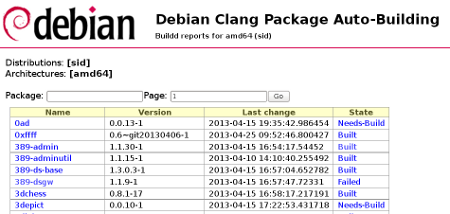
For Debian Developer and maintainer, a per maintainer view is also provided. This will list all packages maintained by a Debian packager. My page as example Here is an example of the list of package:
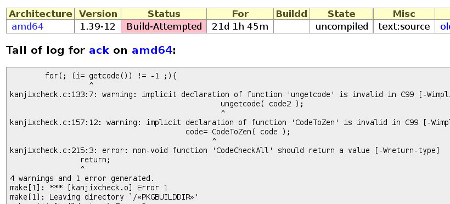
And an example of package failing:
At time of writing, most of the packages in unstable have been rebuilt (16 % are remaining). However, due to resource constraints, only amd64 packages are built. Contact me if you have resources to share for other architectures. Thanks to Paul Wise, the PTS (Debian package tracking system) proposes a link to the clang build logs (failing or not). A repository will be automatically updated with the results of these builds (once I find the time to get into buildd). 2) clang-built repository
Thanks to the Amazon Cloud, with our new DPL (Debian Project Leader), Lucas Nussbaum, we rebuilt unstable last April and published it at the following address:
deb http://clang.debian.net/repository-2013-04-07/ unstable-clang main
This allows some cool stuff like:
$ echo "deb http://clang.debian.net/repository-2013-04-07/ unstable-clang main">>/etc/apt/sources.list
$ apt-get update
$ apt-get install coreutils/unstable-clang
$ ls
$ awk
Note that this repository was only one-shoot and does not get updated. Quality of the binary produced (performance and size) can be tested thanks to this repository. Feedbacks are welcome!

26 April 2013

Francesca Ciceri: And the winner is...

I totally forgot it, but as the DPL elections are now done, we have a winner for the #DPL game. Of the (more or less) fifteen persons who participated to the game (thank you!), only four received points for having at least one of their Fantastic Four running for DPL: As Lucas is now the new DPL, our one and only winner of the DPL game is... ... Mehdi Dogguy! Congrats!
20 April 2013

Ulrich Dangel: Analyzing rc bug messages

Michael Stapelberg recently posted a blog post about looking into the number of Debian Developers actively working on RC bugs for the upcoming wheezy release. In this blog post I analyze the data shared by Michael and provide the R commands used to generate the plots & findings. If you are interested into looking into the data yourself, but don t like R, I suggest using ipython notebook + numpy instead.

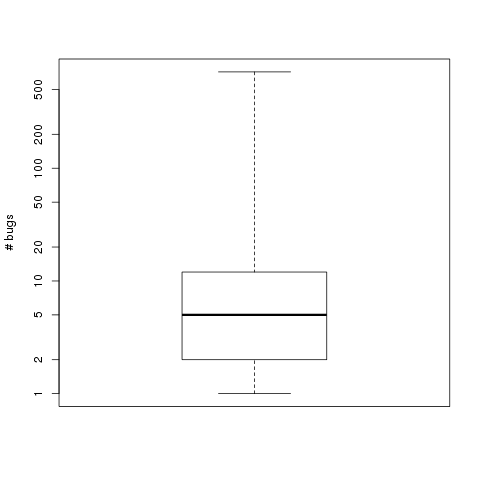
Analysis After parsing the data file we typically want to get an understanding of the data, by using summary(bugs) we get the minimum(1), median(5), mean(15.4), max(716) and quantiles of the data. This shows that the number of messages is wide-spread and a few people contribute a lot. To visualize the dispersion of the data we can create a box plot showing the range of messages: boxplot As the first and third quantile are close together we can assume that the majority of the work is done by a few, especially since the second quantile is 5. This is supported by the histogram below, where the x axis is the number of recorded messages and y is the number of developers. histogram
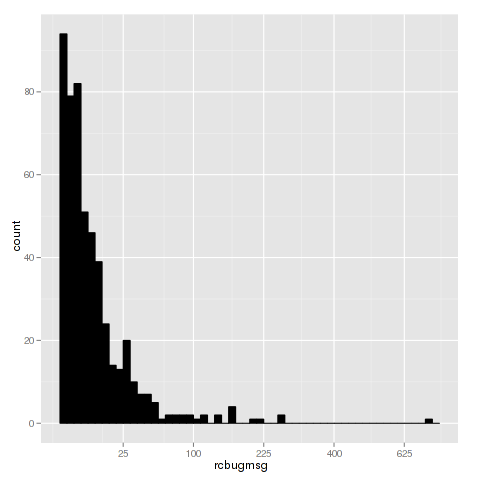
Top 10 contributors The TOP 10 contributors, according to the dataset, are:
  1. Lucas Nussbaum - 716 messages
  2. Gregor Herrmann - 270 messages
  3. Jakub Wilk - 270 messages
  4. Andreas Beckmann - 225 messages
  5. Julien Cristau - 205 messages
  6. Cyril Brulebois - 169 messages
  7. Moritz Muehlenhoff - 162 messages
  8. Michael Biebl - 159 messages
  9. Salvatore Bonaccorso - 158 messages
  10. Christoph Egger - 142 messages

r commands These are the commands used to generate the plots and information in this plot:
bugs <- read.csv("by-msg.csv")
summary(bugs)
boxplot(bugs$rcbugmsg, log='y', range=0, ylab="# bugs")
quantile(bugs$rcbugmsg)
0%  25%  50%  75% 100%
1    2    5   12  716
# create histogram
llibrary('ggplot2')
ggplot(bugs, aes(x=rcbugmsg)) + geom_histogram(binwidth=.5, colour="black", fill="black") + scale_x_sqrt()
top10 <- tail(bugs[order(bugs$rcbugmsg),], 10)
top10

Ulrich Dangel: Analyzing rc bug messages

Michael Stapelberg recently posted a blog post about looking into the number of Debian Developers actively working on RC bugs for the upcoming wheezy release. In this blog post I analyze the data shared by Michael and provide the R commands used to generate the plots & findings. If you are interested into looking into the data yourself, but don t like R, I suggest using ipython notebook + numpy instead.

Analysis After parsing the data file we typically want to get an understanding of the data, by using summary(bugs) we get the minimum(1), median(5), mean(15.4), max(716) and quantiles of the data. This shows that the number of messages is wide-spread and a few people contribute a lot. To visualize the dispersion of the data we can create a box plot showing the range of messages: boxplot As the first and third quantile are close together we can assume that the majority of the work is done by a few, especially since the second quantile is 5. This is supported by the histogram below, where the x axis is the number of recorded messages and y is the number of developers. histogram

Top 10 contributors The TOP 10 contributors, according to the dataset, are:
  1. Lucas Nussbaum - 716 messages
  2. Gregor Herrmann - 270 messages
  3. Jakub Wilk - 270 messages
  4. Andreas Beckmann - 225 messages
  5. Julien Cristau - 205 messages
  6. Cyril Brulebois - 169 messages
  7. Moritz Muehlenhoff - 162 messages
  8. Michael Biebl - 159 messages
  9. Salvatore Bonaccorso - 158 messages
  10. Christoph Egger - 142 messages

r commands These are the commands used to generate the plots and information in this plot:
bugs <- read.csv("by-msg.csv")
summary(bugs)
boxplot(bugs$rcbugmsg, log='y', range=0, ylab="# bugs")
quantile(bugs$rcbugmsg)
0%  25%  50%  75% 100%
1    2    5   12  716
# create histogram
llibrary('ggplot2')
ggplot(bugs, aes(x=rcbugmsg)) + geom_histogram(binwidth=.5, colour="black", fill="black") + scale_x_sqrt()
top10 <- tail(bugs[order(bugs$rcbugmsg),], 10)
top10

16 April 2013

Stefano Zacchiroli: bits from the DPL for March-April 2013

Dear Project Members,
   "Now that I have your attention, I would like to make the following
delegations:"

... nah, scrap that. In my last day in office I first of all owe you a report of DPL activities for the last reporting period of this term, i.e. March 8th until today. Here it is! Highlights Talks Over the past month or so I've attended and spoken on behalf of Debian in the following occasions: Assets I've approved the budget for the following forthcoming sprints: Also, we've bought a 3-year warranty pack for the disk array that powers ftp-master.d.o (~900 USD). On the income side, Brian Gupta has started an interesting matching fund experiment, in order to raise funds for the forthcoming DebConf13. The matching fund will be open until April 30th, so your help in spreading news would be welcome. Many thanks to Brian for the idea and to his company, Brandorr Group, for funding it. DPL helpers Three more DPL helpers IRC meetings have been held; minutes are available at the usual place. Legal Spring Cleaning I've finally cleaned up the pile of pending legal matters (but I'm sure new ones will show up for the delight of the next DPL :-P) Once again, I'd like to thank SFLC for the pro bono and very high quality legal advice they keep on offering to Debian. Miscellaneous
Now, before I get sentimental, let me thank Gergely, Lucas, and Moray for running in the recently concluded DPL election. Only thinking of running and then go through a campaign denote a very high commitment to the Project; we should all be thankful to them. Then I'd like to congratulate Lucas for his election. I've known him for a long time, and I can testify about his clear vision of the role Debian has to play in Free Software and on what Debian needs to improve to do so. Best wishes for the term ahead, Lucas! Finally, I'd like to thank you all for the support you've shown me over the past 3 years. Serving as DPL is a great honor, but also a very demanding job. Thank to you all, and to how cool Debian is, it has been for me an incredibly rewarding experience. I had no idea what I were doing when I embarked on this adventure, but in hindsight I don't regret any of it. See you around, as I don't plan to be anywhere far away from Debian anytime soon. Cheers.
PS the day-to-day activity logs for March and April 2013 are available at the usual place master:/srv/leader/news/bits-from-the-DPL.txt.20130 3,4

14 April 2013

Bits from Debian: DPL election is over, congratulations Lucas Nussbaum!

The Debian Project Leader election has concluded and the winner is Lucas Nussbaum. Of a total of 988 developers, 390 developers voted using the Condorcet method. More information about the result is available in the Debian Project Leader Elections 2013 page. The new term for the project leader will start on April 17th and expire on April 17th 2014.

7 April 2013

Rapha&#235;l Hertzog: My Free Software Activities in March 2013

This is my monthly summary of my free software related activities. If you re among the people who made a donation to support my work (114.19 , thanks everybody!), then you can learn how I spent your money. Otherwise it s just an interesting status update on my various projects. Simple-CDD and debian-cd I tried to use wheezy s version of debian-cd and simple-cdd to generate an automatic installer. In this process, I filed a couple of bugs on simple-cdd (#701963: type-handling package is gone and should not be listed in default.downloads, and #701998: the --keyboard parameter is not working with wheezy s debian-installer) and I commited fixes for a few issues in debian-cd: Debian France I completed the new website for Debian France and I put it online. Later I merged some supplementary enhancements prepared by Tanguy Ortolo (and I gave him commits rights at the same time). I tried to update our Galette installation to the latest upstream version but I reverted to the former version after having encountered two problems (filed here and here). In the process, I created a Debian package for galette (you can grab it on git.debian.org). I also suggested an idea of improvement for Galette s paypal plugin and it has been quickly implemented. Thus I updated the plugin installed on france.debian.net. Kali related work It s been a few months that I have been helping the Kali team to prepare this new Debian derivative. Now that the derivative has gone public, I can attribute some of my Debian work to my collaboration with the Kali team. This month I contributed a few features and fixes to debian-installer and live-build: After the launch, we registered Kali in the derivative census. Paul Wise quickly reported some misfiled bugs from early Kali users and I discovered that reportbug was not behaving properly even though we correctly updated base-files (see #703678 on reportbug and #703677 on lsb-release). Misc packaging work DPL election I also spent quite some time to read and participate to the discussions on debian-vote since it was campaigning time for the DPL candidates Thanks This was a rather active month if you take into account the fact that I got a second son Lucas on March 6th. See you next month for a new summary of my activities.
4 comments Liked this article? Click here. My blog is Flattr-enabled.

30 March 2013

Lucas Nussbaum: Debian releases used by popcon participants

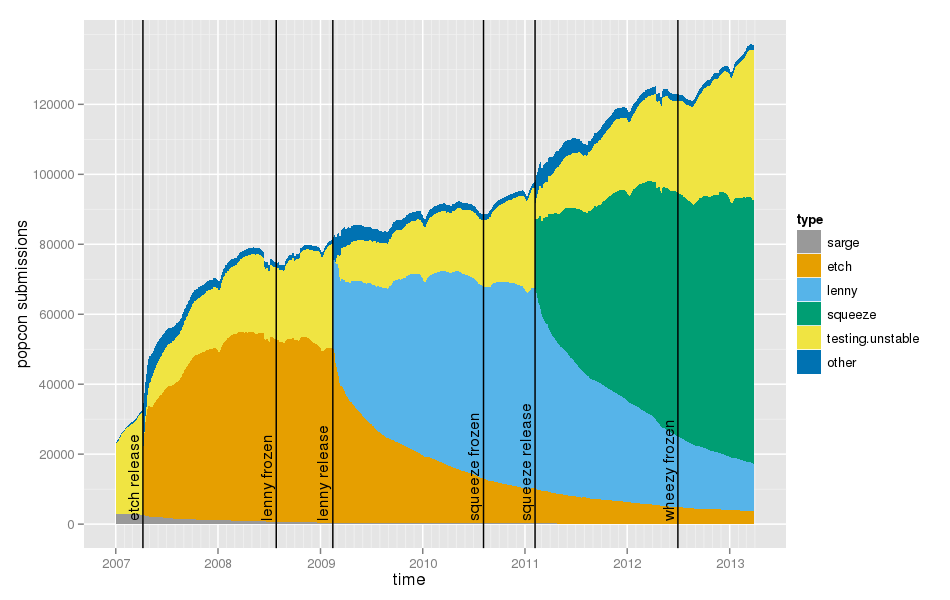
The graph below is generated from popcon submissions. Since they include the version of the popularity-contest package, one can determine the Debian release that was used by the submitter (a new version of the popularity-contest package is generally uploaded just after the release to make that tracking possible). The graph is similar to the one found on popcon, except that versions newer than the latest stable release are aggregated as testing/unstable . Comments: Scripts are available on git.debian.org.

27 March 2013

Bits from Debian: Debian Project Leader elections 2013: interview with Moray Allan

We have asked Moray Allan, one of the three candidates for DPL elections 2013, to tell our readers about himself and his ideas for the Debian Project. You can also read the interviews to the other two candidates: Lucas Nussbaum and Gergely Nagy.
Please tell us a little about yourself. I'm Moray Allan, from Edinburgh in Scotland. I'm 32. After working in academic research for a few years, I'm now working freelance on a wide mixture of topics, with recent projects in Indonesia, Romania and Kuwait. When I'm not working, I'm likely to be found walking through a city or the countryside, or otherwise relaxing at home reading a novel in French or Spanish. What do you do in Debian and how did you started contributing? In recent years, most of my Debian time was taken up organising the annual Debian conferences. But I still have a load of packages, mostly connected to an upstream Linux-on-handheld-computers project I was working on before I joined Debian to create packages for it. Why did you decide to run as DPL? I've been involved in Debian for about 10 years now, including working for the last few years in DebConf in a way similar to how the DPL acts within overall Debian. Previously I'd ruled out running due to lack of time, but currently I'm in a more flexible work situation. It seems the right time to put myself forward, and see if the ideas in my platform interest project members. Three keywords to summarise your platform. Transparency, communication, openness. (Three ways I'd like us to think about teams in Debian.) What are the biggest challenges that you envision for Debian in the future? I think the biggest challenges are for free software in general.
End-users are moving to more closed hardware -- will our software be able to run on the phones and tablets people are shifting towards? At the same time, end-users and server users are moving to "the cloud", and often depending more heavily on non-free infrastructure outside their own control. What are, in your opinion, the areas of the project more in need of technical and/or social improvements? In my platform I give a few ideas about teams and delegations, coordination and mediation, and both internal and external communication, including more organised fundraising. These are areas where I think relatively simple changes can give big benefits. Why should people vote for you? I have proven leadership experience within Debian, as I've been working on coordination and mediation tasks for some years already. At the same time, I do regular packaging work, and work in other parts of Debian like the press and publicity teams, so I'm in touch with the experience of normal Debian contributors. People should vote for me if they support my platform, which is about coordination-level changes that I would have no mandate or authority to push through unless I am elected. Name three tools you couldn't stay without. APT, emacs, ssh. What keep you motivated to work in Debian? I've used Debian on all my computers for a long time, and by now working on the distribution myself feels a natural part of that.
Fortunately I'm constantly positively surprised by Debian and by the Debian community. Are there any other fields where you call yourself a geek, besides computers? Certainly history (such as the eastern Mediterranean region in late antiquity), languages (including dead ones) and music (especially Josquin to Monteverdi).

Bits from Debian: Debian Project Leader elections 2013: interview with Lucas Nussbaum

We have asked Lucas Nussbaum, one of the three candidates for DPL elections 2013, to tell our readers about himself and his ideas for the Debian Project. You can also read the interviews to the other two candidates: Gergely Nagy and Moray Allan.
Please tell us a little about yourself. Hi! I'm a 31 years old french computer geek. In my day job, I'm an assistant professor (Ma tre de Conf rences) of Computer Science at Universit de Lorraine. What do you do in Debian and how did you started contributing? Like many, I started contributing to Debian by creating and maintaining packages for my own software, in the Ruby team. Then, I discovered that, even if it's not so obvious from the outside, there are a lot of areas in Debian that could use more contributors. So I just started to contribute to more and more things. There's a list of things I did in Debian in my platform. What I have been doing recently is: Why did you decide to run as DPL? Two main reasons: Three keywords to summarise your platform. (re-)make Debian the center of the Free Software ecosystem; foster innovation inside Debian; reduce barriers to contributions What are the biggest challenges that you envision for Debian in the future? I often have the impression that the project is losing momentum, positive energy, and slowing down. It feels like we are living on the benefits of the past. A lot of very cool things happen in the Debian ecosystem, but very often outside the Debian project (in derivative distributions). Debian should aim at reinforcing its position in the center of the Free Software ecosystem: it should be the main active intermediary between upstream projects and final users. To achieve that, we need to reinforce the visibility and the impact of Debian. This is extremely important because the values we fight for as a project are often neglected by our derivatives. What are, in your opinion, the areas of the project more in need of technical and/or social improvements? Fostering innovation inside Debian: we should be more welcoming towards innovation and experiments inside the project. Often, we merely tolerate them, and bureaucracy makes them hard and slow to conduct. As a result, people tends to innovate outside the Debian project. Making it easier to contribute to Debian: we compete with more and more projects to attract contributors. While we are already quite good at welcoming new contributors with good documentation and mentoring (much better than people usually think), there's still a lot of room for improvement. Why should people vote for you? A great thing in Debian's voting system is that you don't vote "for" or "against" a specific candidate. Instead, due to our use of the Condorcet method, you rank candidates (and also indicate those who you consider suitable for the role by ranking a virtual "None of the above" candidate). Why am I a good candidate? My previous contributions to Debian show that I have a pretty good understanding of the inner workings of the project, and that I have a track record of managing projects successfully inside Debian. I think that those are two required qualities for a DPL. Name three tools you couldn't stay without. vim, mutt, ssh. What keep you motivated to work in Debian? Debian is a fantastic project from a technical point of view (focus on technical excellence, lots of interesting challenges), but also from a social point of view: the Debian community is a great community where I have lots of good friends. Also, what's great when you contribute to Debian is that your work has a real impact, and that you see people using stuff you worked on everywhere. Are there any other fields where you call yourself a geek, besides computers? I'm not sure this really qualifies as "besides computers", but I've gotten very interested in the OpenStreetMap project lately. I very much enjoy exploring unmapped areas on a mountain bike. It feels like being Christopher Columbus or Marco Polo, but 20 minutes from home. ;) The OpenStreetMap and Debian projects also share many values, such as a great attention to quality and details.

Next.

Previous.