
Search Results: "lamby"

7 June 2010

Chris Lamb: Distributing locking with Python and Redis

This is already possible with Memcache, but if you are already drinking the Koolaid...
import time
class Lock(object):
    def __init__(self, key, expires=60, timeout=10):
        """
        Distributed locking using Redis SETNX and GETSET.
        Usage::
            with Lock('my_lock'):
                print "Critical section"
        :param  expires     We consider any existing lock older than
                             expires  seconds to be invalid in order to
                            detect crashed clients. This value must be higher
                            than it takes the critical section to execute.
        :param  timeout     If another client has already obtained the lock,
                            sleep for a maximum of  timeout  seconds before
                            giving up. A value of 0 means we never wait.
        """
        self.key = key
        self.timeout = timeout
        self.expires = expires
    def __enter__(self):
        timeout = self.timeout
        while timeout >= 0:
            expires = time.time() + self.expires + 1
            if redis.setnx(self.key, expires):
                # We gained the lock; enter critical section
                return
            current_value = redis.get(self.key)
            # We found an expired lock and nobody raced us to replacing it
            if current_value and float(current_value) < time.time() and \
                redis.getset(self.key, expires) == current_value:
                    return
            timeout -= 1
            time.sleep(1)
        raise LockTimeout("Timeout whilst waiting for lock")
    def __exit__(self, exc_type, exc_value, traceback):
        redis.delete(self.key)
class LockTimeout(BaseException):
    pass
One common use case for distributed locks in web applications is to prevent clients dog-piling onto an expensive cache key:
def cache_without_dogpiling(key, cb, cache_expiry=None, *args, **kwargs):
    val = cache.get(key)
    if val is not None:
        return val
    # Cache miss; gain the lock to prevent multiple clients calling cb()
    with Lock(key, *args, **kwargs):
        # Check cache again - another client may have set the cache
        val = cache.get(key)
        if val is None:
            val = cb()
            cache.set(key, val, cache_expiry)
        return val
def slow():
    print "Inside slow()"
    return 1 + 1 # Python is slow
>>> cache_without_dogpiling('my_key', slow, 60 * 10)
Inside slow()
2
>>> cache_without_dogpiling('my_key', slow, 60 * 10)
2
As a bonus, if you don't want your test or development environment to rely on Redis, you can replace it with a no-op lock:
import contextlib
@contextlib.contextmanager
def Lock(*args, **kwargs):
    yield

1 June 2010

Chris Lamb: Appending the request URL to SQL statements in Django

import sys
from django.http import HttpRequest
from django.db.backends import BaseDatabaseWrapper, util
class URLCursor(util.CursorDebugWrapper):
    def execute(self, sql, *args):
        f = sys._getframe()
        while f:
            request = f.f_locals.get('request')
            if isinstance(request, HttpRequest):
                sql += ' -- %s' % repr(request.path)[2:-1].replace('%', '%%')
                break
            f = f.f_back
        return self.cursor.execute(sql, *args)
fn = BaseDatabaseWrapper.cursor
BaseDatabaseWrapper.cursor = lambda self: URLCursor(fn(self), self)
Now your SQL statements look like:
SELECT "auth_user"."id", [..] WHERE "auth_user"."id" = 1 -- /login
This allows you to quickly go from a misbehaving query in your production environment to the view that is executing it.

4 May 2010

Chris Lamb: Rotating email into your inbox using imapfilter

I'm not a fan of "life hacks", but I have the adopted the following automated processing of my email inbox: if I don't want to deal with a message today, I move it to (eg.) Mail.DELAYED.4 and it will reappear in my inbox automatically in 4 days. It is inspired by the Inbox Zero, tickler files and the Debian DELAYED queue. My implementation uses imapfilter. You'll need to tweak the move_messages syntax for lenny's version; the following works fine in squeeze and sid:
mbox = IMAP  
    server = 'mail.server.net',
    username = 'username',
    password = 'password',
    ssl = 'ssl3'
 
num = 14
dst = 'INBOX'
prefix = 'Mail.DELAYED.'
for x = num, 1, -1 do
    mbox[prefix .. x]:select_all():move_messages(
        mbox[x == 1 and dst or prefix .. (x - 1)]
    )
end
The messages are moved when I'm (hopefully) asleep:
# m h dom mon dow command
  0 6 *   *   *   imapfilter -c /path/to/delayed.lua >/dev/null

22 April 2010

Chris Lamb: Locating source for any Python module

When I'm too lazy to find API documentation I just read the source code. To make this slightly easier in Python, here's what I use in my ~/.$ SHELL rc:
cdp ()  
  cd "$(python -c "import os.path as _, $ 1 ; \
    print _.dirname(_.realpath($ 1 .__file__[:-1]))"
  )"
 
For packages, this takes you to the corresponding source directory:
$ cdp twisted.web
$ pwd
/usr/share/pyshared/twisted/web
$ ls
_auth/  domhelpers.py  html.py  iweb.py  resource.py
[..]
The realpath and [:-1] hackery follow any python-support symlinks. For "standalone" .py (or .so) modules, cdp will take you to the directory it resides in:
$ cdp subprocess
$ pwd
/usr/lib/python2.5
$ ls subprocess.py
subprocess.py

17 March 2010

Chris Lamb: Per-channel BTS bot filtering

Just a short announcement that my Debian BTS IRC bot which hangs out on #debian-devel-changes can now spam your favourite subproject's channel with specific bug activity and uploads. Filtering is done with a regular expression tested against the package name. /msg me with your (channel, regex) tuples (in Python re format, please).

27 December 2009

Chris Lamb: Readline tab completion using Django models

The following snippet allows readline-style tab completion backed onto Django models. I am using this in management commands in preference to specifying primary keys as arguments.
class QuerySetCompleter(object):
    def __init__(self, qs, field):
        self.qs = qs
        self.field = field
        self.prefix = None
    def __call__(self, prefix, index):
        if prefix != self.prefix:
            qs = self.qs.values_list(self.field, flat=True)
            if prefix:
                qs = qs.filter(** 
                    '%s__startswith' % self.field: prefix,
                 )
            self.matching = list(qs)
            self.prefix = prefix
        try:
            return self.matching[index]
        except IndexError:
            return None
Example usage:
import readline
from mymodels import MyModel
completer = QuerySetCompleter(MyModel.objects.all(), 'name')
readline.set_completer(completer)
readline.parse_and_bind("tab: complete")
readline.set_completer_delims('')
while 1:
    print repr(raw_input(">>> "))
Pressing <tab> at this >>> prompt will complete from the name field of the MyModel model just like a regular shell would. We call readline.set_completer_delims as our items may contain word delimeters - otherwise readline would attempt a seperate completion of (eg) "Bar" if one of our items was "Foo Bar".

19 November 2009

Chris Lamb: Transparent directory replacement with zsh

Under UNIX, it is possible to get into a position where your shell's working directory is pointing to an inode that no longer exists, but a "newer" directory with the same name exists. The easiest way of reproducing this scenario is as follows:
$ cd $(mktemp -d)
$ rm -rf $PWD
$ mkdir $PWD
However, as concrete example, imagine you are debugging something deep inside a generated code tree if you ran make clean and then make again from another shell, your debugging shell would be left pointing to an inode that does not exist (as it was removed by make clean), yet the make call would have made an identically named directory in its place. Shells behave rather unintuitively in this situation; ls will (correctly) return no results, but attempting to do anything useful results in curious error messages. I use the following zsh precmd hook to transparently fix this for me:
precmd ()  
  # "DOS emulation mode"
  if [ "$(stat -c %i . 2>/dev/null)" != \
                 "$(stat -c %i -- "$ PWD " 2>/dev/null)" ]
  then
    OLDOLDPWD="$ OLDPWD "
    if ! cd -- "$ PWD " >/dev/null 2>&1
    then
      echo "W: $ PWD  does not exist anymore"
      return 1
    fi
    OLDPWD="$ OLDOLDPWD "
  fi
 
The cost of the stat calls seem justified by the convenience and are in any case insignificant compared to the other things I am doing in my precmd. If you are using zmodload zsh/stat, then replace stat -c %i with stat +inode. (My previous experience with zsh tricks is that the functionality invariably exists already in some obscurely named builtin. Here's hoping.)

9 November 2009

Tim Retout: Greetings

Hello, Planet! (Thanks to lamby for adding me to Planet Debian.) If you don't know me... I'm not surprised. I do some occasional pkg-perl work, but I've really been slacking (and changing jobs, and moving halfway across the UK). Last week I fixed one RC bug, in libgnupg-interface-perl. Better than none, I suppose. It turned out to be quite interesting; the tests failed when the package was built on the buildds, but not locally. Other people had done the hard work, and figured out that this was happening when there was no tty; I just had to debug why the particular perl variable was getting unset. I'm somewhere near the end of the NM process; one of these days, I'll be able to upload my own packages, and those of other people. I'm still working out where best to apply myself within Debian - I do want to share some of the pkg-perl upload burden (because gregoa is an absolute hero, and deserves to be able to take holidays). The status of Debian mentoring in general intrigues me; there seem to be so many places where more minds are needed, and perhaps this makes encouraging and training new developers especially important. More on this later.

5 November 2009

Chris Lamb: Confusing bugs

I love bugs that are just confusing and/or break your mental model of how you think the software works. Here is a good example: Given the following HTML in Gecko, what happens when a user clicks the button?
<form method="POST" action="/form-action">
  <a href="/anchor-target">
    <input type="button" value="harro">
  </a>
</form>
GET /anchor-target HTTP/1.1
2 GET requests? Okay, perhaps some sort of event bubbling problem; it's relatively common in GUI internals. But what about:
<form method="POST" action="/form-action">
  <a href="/anchor-target">
    <input type="image" src="http://upload.wikimedia.org/wikipedia/en/7/75/LHC5.jpg">
  </a>
</form>
POST /form-action HTTP/1.1
GET /anchor-target HTTP/1.1
Wait, this time it POSTs the form and makes 2 GET requests? Answers in a Bugzilla report, thanks.

30 September 2009

Chris Lamb: GeoDjango and the UK postcode database

This post describes how to play with the UK postcode database that recently turned up on WikiLeaks using GeoDjango. You will need the following pieces of free software:
  1. PostgreSQL (MySQL does not provide sufficient geospacial features) I will be using Postgres 8.4.1; please adjust your paths for your version and/or distributor.
  2. PostGIS spacial database extensions I will be using version 1.4.0.
  3. Django I will be using version 1.1. This version includes the GeoDjango framework.
  4. GEOS geometry engine I will be using version 3.0.0 from the libgeos-c1 package in Debian unstable.
You will also need a copy of the leaked postcode data. Usage of this data is almost certainly a copyright violation.
Getting started First, create a Django project and application for this example:
$ django-admin startproject ukpostcodes
$ cd ukpostcodes
$ ./manage.py startapp postcodes
Next, edit settings.py:
  • Configure DATABASE_*. You must use the postgresql_psycopg2 PostgreSQL database driver.
  • Add django.contrib.gis & ukpostcodes.postcodes to INSTALLED_APPS.
If you have not already done so, you must install PostGIS in your database:
$ sudo -u postgres createlang plpgsql -d <databasename>
$ sudo -u postgres psql <databasename> -f /usr/share/postgresql/8.4/contrib/postgis.sql
$ sudo -u postgres psql <databasename> -f /usr/share/postgresql/8.4/contrib/spatial_ref_sys.sql
Modelling a postcode Now define a simple model to store imported postcodes:
from django.contrib.gis.db import models
class Postcode(models.Model):
    name = models.CharField(max_length=8, db_index=True)
    location = models.PointField()
    objects = models.GeoManager()
  • We import models from django.contrib.gis.db instead of django.db.
  • We override the default objects manager with GeoDjango's GeoManager() so we can perform spacial queries.
Save this model in postcodes/models.py. We can now create this model in our database using:
$ ./manage syncdb
Importing postcode data We will use a management command to import the data. First, create the necessary modules with:
$ mkdir -p postcodes/management/commands
$ touch postcodes/management/commands/__init__.py
$ touch postcodes/management/__init__.py
Next, save the following code in postcodes/management/commands/import_postcodes.py:
import sys
import csv
from django.contrib.gis.geos import Point
from django.core.management.base import BaseCommand
from postcodes.models import Postcode
class Command(BaseCommand):
    def handle(self, \*args, \*\*options):
        Postcode.objects.all().delete()
        count = 0
        for row in csv.reader(sys.stdin):
            try:
                name = row[0].upper().strip().replace('  ', ' ')
                location = Point(map(float, row[13:15]))
            except ValueError:
                print "I: skipping %r" % row
                continue
            Postcode.objects.create(name=name, location=location)
            count += 1
            if count % 10000 == 0:
                print "Imported %d" % count
Finally, we can import the data using:
$ bunzip2 /path/to/uk-post-codes-2009.bz2   ./manage.py import_postcodes
This takes approximately one hour on my computer. If you plan to import the data multiple times, consult the Django documentation for faster methods of importing initial data.
Quering the postcode database We can now query our postcode database. First, let's find the postcode for Buckingham Palace:
>>> from postcodes.models import Postcode
>>> palace = Postcode.objects.get(name='SW1A 1AA')
>>> palace
<Postcode: SW1A 1AA>
Next, let's find all postcodes within 1 mile. For this, we will need to construct a tuple representing the area we want to search in.
>>> from django.contrib.gis.measure import Distance
>>> area = (palace.location, Distance(mi=1))
>>> Postcode.objects.filter(location__distance_lte=area)
[<Postcode: SE1 7BF>, <Postcode: SE1 7SG>, <Postcode: SE1 7JA>, <Postcode: SE1 7PB>,
 <Postcode: SE1 7PD>, <Postcode: SW1A 1DW>, <Postcode: SW1A 1EA>, <Postcode: SW1A 1EE>,
 <Postcode: SW1A 1EF>, <Postcode: SW1A 1EG>, '...(remaining elements truncated)...']
>>> Postcode.objects.filter(location__distance_lte=area)
7024
To find "neighbour" postcodes, we can pass a Point object to the .distance(..) method on our queryset this adds a field we can then sort on:
>>> Postcode.objects.distance(palace.location).order_by('distance')[:4]
[<Postcode: SW1A 1AA>, <Postcode: SW1E 6JP>, <Postcode: SW1E 6LA>, <Postcode: SW1E 6WG>]
Putting it all together Let's pretend we are making an app to find pizza from an arbitrary user-submitted postcode. (We will assume we have parsed the user's postcode and have found its Postcode object, but we will continue to use Buckingham Palace here.) First, define the following model in postcodes/models.py and re-run ./manage.py syncdb:
class PizzaJoint(models.Model):
    name = models.CharField(max_length=200)
    postcode = models.ForeignKey(Postcode)
    objects = models.GeoManager()
    def __unicode__(self):
         return self.name
Now, add some local pizza places:
>>> def add_pizza_joint(name, loc):
...     code = Postcode.objects.get(name=loc)
...     PizzaJoint.objects.create(name=name, postcode=code)
...
>>> add_pizza_joint('Pizza Hut', 'SW1E 6SQ')
>>> add_pizza_joint('Pizza Express', 'SW1E 5NA')
>>> add_pizza_joint('Pizza On The Park', 'SW1X 7LY')
If we were not using GeoDjango, we would have to be content with simply matching the postcode:
>>> PizzaJoint.objects.filter(postcode=palace)
[]
However, we can now find the cloest pizza places:
>>> PizzaJoint.objects.distance(palace.location,
            field_name='postcode__location').order_by('distance')
[<PizzaJoint: Pizza Hut>, <PizzaJoint: Pizza Express>, <PizzaJoint: Pizza On The Park>]
The .distance(..) method also sets a distance attribute on all the objects returned; this makes it easy to show the actual distance to the user:
>>> for x in PizzaJoint.objects.distance(palace.location,
                     field_name='postcode__location').order_by('distance'):
...    print "%s (%d metres away)" % (x, x.distance.m)
...
Pizza Hut (499 metres away)
Pizza Express (509 metres away)
Pizza On The Park (902 metres away)
For more details, see the GeoDjango documentation.

3 June 2009

Chris Lamb: Checklist for configuring a Debian system

In the spirit of Thomas Limoncelli's Time Management for System Administrators, this is my checklist for setting up a new Debian system. I have added a few notes to the original list to justify their existence and to provide some background information. Whilst you should avoid performing repetitive interactive configuration and defer to the multitude of tools designed for this task, constructing and sharing a checklist can still be an instructive step. It can also be useful in situations where a machine has already been partly configured for you.
Software
  • /etc/apt/sources.list

    • Choose a sensible primary mirror
    • Ensure use of release codenames (eg. "lenny") instead of synonyms
    • Confirm security mirror is enabled
    • Remove references to contrib and non-free
  • Disable installation of Recommends:

    echo 'APT::Install-Recommends "0";' > /etc/apt/apt.conf.d/90recommends
    
  • Ensure we are up to date security-wise:

    apt-get update && apt-get dist-upgrade
    
  • Setup and configure locales first to avoid annoying Perl warnings. Don't choose All locales; you almost certainly don't want that.

    apt-get install locales
    dpkg-reconfigure -plow locales
    
  • Install some essential utilities:

    apt-get install vim-nox ntp openssh-server screen most tree bzip2 unzip moreutils dnsutils htop pwgen telnet manpages manpages-dev vrms acl gawk strace curl tcpdump
    
Users
  • Before we create any real users, we configure PAM to reject weak passwords. Custom banned passwords can be added to the dictionary by editing /usr/share/dict/cracklib and running update-cracklib.

    apt-get install libpam-cracklib
    sed -i -e 's ^password # \0 ' /etc/pam.d/common-password
    echo 'password required    pam_cracklib.so retry=3 minlen=6 difok=3' >> /etc/pam.d/common-password
    echo 'password required    pam_unix.so use_authtok nullok md5' >> /etc/pam.d/common-password
    
    (Edit: Please read this response from Steve Langasek regarding this modification on squeeze and Ubuntu 8.10)
  • Configure sudo. I prefer to create a new group instead of re-using adm as that is already used by logfiles.

    addgroup rootusers
    adduser myuser
    adduser myuser rootusers
    apt-get install sudo
    echo 'User_Alias ROOTUSERS  = %rootusers' >> /etc/sudoers
    echo 'ROOTUSERS, root     ALL=(ALL) ALL' >> /etc/sudoers
    
Mail relay Email remains the primary method to asynchronously inform the system adminstrator that their attention is required. It is assumed that the machine will not handle your day-to-day email (or indeed accept any external mail) but will instead simply forward it elsewhere. We also assume a preference for Exim, but the configurion for Postfix is almost identical.
  • First, install the mail packages:

    apt-get install exim4-daemon-light bsd-mailx
    dpkg-reconfigure exim4-config
    
  • During the Exim configuration, choose Internet site and follow all the defaults, ensuring that you only listen on 127.0.0.1 and you are not relaying mail for any other domains.

  • We then configure forwarding to another email address so we don't have to continually poll this machine for issues:

    echo 'root: you@example.com' >> /etc/aliases
    newaliases
    
  • Finally, we test mail delivery:

    echo "Test 1 from $(hostname)"   mail root -s "Test 1 from $(hostname)"
    
The d-i manual has some further advice on this, including the use of "smarthosts".
Miscellaneous
  • Stop Emacs creating backup files everywhere:

    mkdir -p /etc/emacs/site-start.d
    echo '(setq backup-inhibited t)' > /etc/emacs/site-start.d/10no-backup.el
    
  • Configure Munin:

    apt-get install munin-node
    echo 'allow ^123\.123\.123\.123$' >> /etc/munin/munin-node.conf
    /etc/init.d/munin-node restart
    
    For baroque network configurations, you can generate the regular expression line with this script.
  • Configure molly-guard, a tool for preventing accidental shutdowns. As molly-guard cannot detect shutdowns initiated within a combination of GNU screen and SSH, we configure it to always query the hostname:

    apt-get install molly-guard
    echo "ALWAYS_QUERY_HOSTNAME=true" >> /etc/molly-guard/rc
    
  • Monitor disk S.M.A.R.T. attributes:

    apt-get install hddtemp smartmontools
    sed -i 's ^#start_smartd=yes start_smartd=yes ' /etc/default/smartmontools
    /etc/init.d/smartmontools start
    
  • Setup backups - I'm quite partial to backupninja because it automates most of the tedious SSH configuration. I adjust the time of the backup to when I'm likely to be around to fix issues and cut down on email noise by not reporting successful backups:

    apt-get install backupninja hwinfo debconf-utils rdiff-backup
    sed -i -e 's ^when = everyday at 01:00 when = everyday at 9:30 ' /etc/backupninja.conf
    sed -i -e 's ^reportsuccess = yes reportsuccess = no ' /etc/backupninja.conf
    ninjahelper
    
  • Filesystems

    • In /etc/fstab, check noatime is enabled on all filesystems, and acl where needed.
    • Use tune2fs to adjust how much of the disk is reserved for the superuser - the default of 5% is excessive for large volumes.
  • Reboot. You should be prompted by molly-guard before your computer restarts.

18 May 2009

Chris Lamb: Poor man's Google Checkout

Google Checkout recently gained support for taking recurring payments, a frequently requested enhancement for my Xen-based server. However, to use any of the non-trivial features we must provide Google with generate a signed XML file for each transaction. This would normally preclude the use of some server-side scripting, but if the details of transaction are static there is no reason we shouldn't be able to generate the relevant HTML ahead-of-time. The resulting HTML file can be hosted anywhere, is almost completely independent of the server configuration and greatly reduces the attack surface by being a simple static file. The main disadvantage of this approach (and indeed of this submission method in general) is that allows trivial replay attacks of previous transactions. Anyway, first we create our request XML:
$ head -n6 order.xml
<?xml version="1.0" encoding="UTF-8"?>
<checkout-shopping-cart xmlns="http://checkout.google.com/schema/2">
 <shopping-cart>
   <items>
     <item>
       <item-name>Lunar object affixed to slender carrying attachment</item-name>
Next, we construct a simple template:
$ cat order.html.in
<h1>Order stuff</h1>
<form method="POST"
    action="https://checkout.google.com/api/checkout/v2/checkout/Merchant/__MERCHANT_ID__">
 <input type="hidden" name="cart" value="__CART__">
 <input type="hidden" name="signature" value="__SIGNATURE__">
 <input type="image" name="Google Checkout" alt="Fast checkout through Google"
   src="http://checkout.google.com/buttons/checkout.gif?merchant_id=__MERCHANT_ID__&w=180&h=46&style=white&variant=text&loc=en_US"
   height="46" width="180">
</form>
Finally, we generate the final page from the above files using the following Makefile:
MERCHANT_ID  = # Enter your merchant ID here
MERCHANT_KEY = # Enter your merchant key here
FILES = order.html
all: $(FILES)
%.html: %.html.in %.xml
       sed -e 's __MERCHANT_ID__ $(MERCHANT_ID) g' \
           -e 's __CART__ '$$(base64 -w0 $*.xml)' g' \
           -e 's __SIGNATURE__ '$$( \
           openssl dgst -sha1 -hmac $(MERCHANT_KEY) -binary <$*.xml   base64 -w0)' ' \
           <$< >$@
clean:
       rm -f $(FILES)
.PHONY: clean
$ make
[...]
$ head -n4 index.html
<h1>Order stuff</h1>
<form method="POST"
    action="https://checkout.google.com/api/checkout/v2/checkout/Merchant/007">
 <input type="hidden" name="cart" value="iAgICAgICAgICAgIDxpdGVtLWRlc2NyaXB0aW9 [..]
Non-trivial dependencies are OpenSSL (to generate the HMAC-SHA-1 signature) and make. You should ensure that you don't upload or otherwise reveal your Makefile as it contains your merchant key.

1 May 2009

Chris Lamb: April 2009 in UK civil liberties

Wednesday 1st
At the G20 protests, Londoner Ian Tomlinson collapses and is attended to by the emergency services; Metropolitan Police claim "during this time a number of missiles - believed to be bottles - were being thrown at them". Tomlinson dies that evening.
Thursday 2nd
The Evening Standard reports that "police were bombarded with bricks, bottles and planks of wood" as they helped Tomlinson.
Saturday 4th
Postmortem of Tomlinson finds he died of a heart attack.
Monday 6th
The EC Data Retention Regulations 2009 comes into force requiring internet service providers to retain details of emails, internet phone calls and other web traffic.
Tuesday 7th
The Guardian publishes a video of a police officer assualting Tomlinson on 1st April.
Wednesday 8th
Twelve Pakistani students are arrested on suspicion of planning terror attacks over the Easter holiday weekend.
Thursday 9th
The Guardian publishes a second video of Tomlinson's assualt, contributing that no missiles were thrown.
Monday 13th
Police arrest 114 climate protestors on conspiracy to cause criminal damage at Nottingham power plant. [ref]
Tuesday 14th
A video of a seperate assualt at the G20 protests is published.
Thursday 16th
Police claim tourist's photography of transport-related buildings is "strictly forbidden" and demand the photos are deleted. [ref]
Friday 17th
A second postmortem of Iam Tomlinson finds the cause of death to be an abdominal haemorrhage. A policeman is interviewed under caution on suspicion of manslaughter. [ref]
Saturday 18th
The Times reveals MP Damian Green private emails were searched by the police using the keywords "Shami Chakrabarti" (director of Liberty) after his arrest last year.
Monday 20th
The Guardian reveals police intelligence was given to E.On before the Nottingham climate demonstration, including movements of protesters and their meetings.
Tuesday 21st
Another video of the Tomlinson assault is revealed showing his head hitting the pavement. The Independent Police Complaints Commission fails to obtain an injunction to prevent broadcast.
Wednesday 22nd
Nine Pakistani students arrested during anti-terror raids are released after 13 days without charge and are passed to UK Border Agency custody for deportation. [ref]
Monday 27th
Home Secretary Jacqui Smith announces that ISPs and telecoms companies will be asked to record usage "to track murderers and paedophiles" without a warrant. [ref]
Tuesday 28th
Emails are revealed of the Home Office asking Phorm, the behavioural targeted advertising service, whether they are falling outside the law. Home Office claim Phorm would be legal if consent is obtained and that "providers of goods and services need only ensure they are compliant with relevant legislation". [ref]
Wednesday 29th
The Guardian documents the friends of the 7/7 bombers were denied bail on secret evidence - "the appellant asked the judge the question: why are you sending me to prison? To which the judge replied: 'I cannot tell you that.'"

15 April 2009

Chris Lamb: Targeted optimisation with django-dumpslow

django-dumpslow is a reusable Django application that logs requests that take a long time to execute and provides an tool to summarise the resulting data. Modelled on mysqldumpslow, django-dumpslow is intended as a tool to determine which parts of a project might benefit most from optimisation and to provide valuable empirical data. The tool groups requests that are similar by exploiting Django's ability to reverse URLs - requests that use the same view are not counted distinctly. Views can then be grouped by the total accumulated time spent by that view or simply by their raw frequency in the logs. An example output is:
$ ./manage.py dumpslow
View                                         Accumulated time
=============================================================
example.views.slow                                     92.88
/unknown (unreversible url)                            16.84
If the log entries contain timestamps then django-dumpslow can optionally limit queries by a user-defined interval. This can be useful for generating regular reports of slow pages, perhaps by regularly emailing the "top 10 worst pages" to a development mailing list. Source, tarballs, etc. Patches welcome.

11 April 2009

Chris Lamb: Installing FogBugz the Debian way

Yeah, proprietary software is bad, but let's at least install it the Debian way. The following walkthrough assumes Debian lenny.
#!/bin/sh
set -e
for PEAR_PKG in Auth_SASL HTTP_Client Mail_Mime XML_Tree
do
        PKG_TEMP=$(mktemp -d)
        cd $ PKG_TEMP 
        pear download $ PEAR_PKG 
        dh-make-pear $ PEAR_PKG *.tgz
        cd $(find -mindepth 1 -type d   head -n1)
        dpkg-buildpackage -uc -us -rfakeroot
        sudo dpkg -i ../*.deb
        rm -rf $ PKG_TEMP 
done
$ sudo ./install.sh
/***************************************\
*            FogBugz 6 Setup
\***************************************/
--    Checking for required tools
 +      found mono 1.9.1
[..]

28 March 2009

Chris Lamb: Orphaning the Gnome BTS Applet

As I haven't used Gnome in over a year, I'm orphaning my Debian BTS Applet (original blog post). After the original release it was forked for Launchpad and there were even plans for OpenSUSE fork. Jon Dowland also released his debgtd tool which isn't Gnome-specific and somewhat more useful for developers, although actual development has stalled with patches pending. I would be willing to sponsor uploads if a non-Debian Developer was to adopt it.

27 March 2009

Chris Lamb: Don't rely on others to speak out

http://chris-lamb.co.uk/wp-content/2009/met_poster.jpg
For the benefit of non-Londoners, the above poster (and others) appeared a few days ago. Any further remark seems superfluous. Somewhat related, James Welch recently wrote about your rights at the so-called "knife arches".

15 March 2009

Chris Lamb: Joachim Raff and the orchestration of Bach's Chaconne

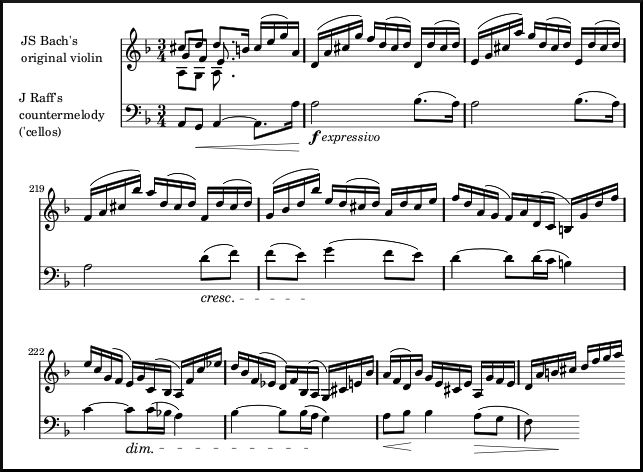
Earlier today I stumbled across a recording of a work I had not heard in a few years by the obscure Swiss-German composer Joachim Raff. The composition is an orchestral transcription of the Chaconne from Bach's Partita in D minor, without doubt the finest work ever written for solo violin. This piece has been transcribed countless times; the source material is clearly a masterpiece, but what makes the movement really attractive is its implicit nature - dispite the violin's limited facilities for counterpoint and polyphony in general, Bach succeeds in alluding to a multitude of voices within the same line. Larry Solomon provides a brief overview of what to look out for. Raff's transcription thus endeavours to render the implicit explicit; for example, where there is the implication of a held note, it can played for its implied duration. Indeed, Raff believed that Chaconne was in itself a "reduction" from an orchestrated original. Whilst I don't share that literal belief, it is certainly good working model for a transcription. And what a transcription! I've often thought of the romantic transcriptions such as these to be a guilty pleasures; they clearly violate any sensibilities I have about performing early music. However, what is most surprising (and guilt-relieving) about Raff's effort is the sheer amount of novel material involved. Here is an example starting at bar 216 - I have overlayed Bach's original line with a melody of Raff's own invention:
http://chris-lamb.co.uk/wp-content/2009/raff_chaconne.png
There are countless other examples which, following Bach's example, vary greatly in their subtlety. No prizes for guessing why I chose this excerpt though. However, dispite these additions I feel some crucial aspects are actually lost in translation. Firstly, we can muse over whether Bach would have approved of such a rendering - not wishing to dwell too deeply in well-tread arguments, many would point to Bach's re-use of his own material (as well as his transcriptions of other composers) to illustrate that he was not against the practice, but I find that argument difficult to apply to the Chaconne - the dualism between the implicit and the explicit would have greatly appealed to Bach, so to rob the work of it would seem to be doing him a serious discourtesy. Furthermore, the implications in Bach's work are certainly not followed to the same conclusions by all - a truly solo musician has the advantage of being able to make their own decisions about the music, perhaps even on the spur of the moment. In contrast, an ensemble is effectively forced to obey Hr. Raff's inferences. This lack of spontaneity is particularly damning; I am sure one would tire of differing interpretations of Raff's transcription quicker than one would of Bach's original. Lastly (and certainly most subjectively) there is something disarmingly solitary about the original work which is only amplified by being played solo - dispite my inability to provide a satisfactory rendition I would find performing this piece with (or even to) others rather discomforting. In conclusion, I would recommend listening to this work (and the rest of the CD). I have found it extremely illuminating, if only about Bach's original than of Raff's.

8 March 2009

Chris Lamb: Statically analysing Django applications with Django Lint

Django Lint is a static analysis tool that checks (or lints) web applications that are built around the Django web development framework. It aims to encourage the development of high-quality reusable Django applications. It currently reports on: Admittedly, some of the checks are based on the implementation details of MySQL, PostgreSQL and SQLite backends, but this fits with the goal of promoting re-usable applications anyway. GPLv3 source, tarballs, etc. Patches welcome.

10 February 2009

Chris Lamb: Beethoven's String Quartet in F, Op. 135

http://chris-lamb.co.uk/wp-content/2009/op135scherzo.jpg
Michael Steinberg writes of the above section (from the Vivace):
Then it is time for Beethoven to turn to one of his favourite tricks, the one where he simply picks up an idea boldly and puts it down again on another pitch the way you might pick up your cat and move it from your favourite chair to another.
I am fully in favour of this feline-oriented musical interpretation.

Next.

Previous.