Please excuse the intrusion to your usual software and co-op news items but vine seems broken and as part of my community and democratic interests, I d like to share this short clip quoting Norfolk s Deputy Police Commissioner Jenny McKibben about why Commissioner Stephen Bett believes it s important to get views from the west of the county about next year s police budget:
Personally, with a King s Lynn + West Norfolk Bike Users Group hat on, I d like it if people supported a 2% ( 4/year average) tax increase to reduce the police s funding cut (the grant from gov.uk is being cut by 4%) so that we re less likely to have future cuts to traffic policing. The consultation details and response form are on the PCC website.
Back in the mists of Internet time (2002) when spirits were brave, the stakes were high, men were real men, women were real women and small furry creatures from Alpha Centauri were real small furry creatures from Alpha Centauri there were few hosting options for a budding open source project.
Despite the meteoric rise of many dot com companies in the early noughties a project either had to go it alone by running everything themselves or pick from a small selection of companies that had not yet worked out how to turn free hosting into money.
One such company, arguably the first, was VA Research with their SourceForge system. Many projects used their platform including a small niche web browser called NetSurf. For years the service was great, there were rough edges but nothing awful.
Over time the NetSurf projects requirements grew beyond what SourceForge could provide and service after service was migrated away eventually all that was left was the bug tracking system. This remained the state of affairs until mid 2013 when SourceForge forced a migration to their new platform which made them unsuitable for the projects use case.
Aside from the issue trackers questionable user interface SourceForge had started aggressively placing advertising throughout their platform. Some of the placements so inadvisable that projects started taking the decision to leave.
While I appreciate that SourceForge had to make money to provide a service they appear to have sown discontent within a large part of their user base without understanding that there are a number of alternatives solutions with a much less onerous funding model.
NetSurf used this as an opportunity to move the remaining issue tracking service to our own infrastructure. Rob Kendrick proceeded to evaluate several solutions and in December 2013 I finally found the time to migrate an XML dump of the old data from SourceForge into MantisBT.
Migrating data from one database into another via incompatible formats took me back to my roots. My early career started with programming tasks moving historical business data from ancient large systems which were about to be scrapped to modern Sparc based systems. Later I would be in a role where financial data needed to be retrieved from obsolete proprietary systems and moved into databases on x86 servers.
My experience in this field was not really stretched as it turns out that modern systems can process a few tens of megabytes in seconds rather than the days for a run in my youth! So some ugly perl scripts and a few hours later I had a nice shiny SQL database filled with NetSurfs bugs and MantisBT instance configured to use them.
Then came the hard bit, triaging all the open bugs, fixing up all the bugs submitted as an anonymous user but with email addresses in, removing duplicates and checking every open bug was still valid took almost two weeks of tedious drudge.
I set up an initial bug workflow within the system that the project developers are still fine tuning to better suit their needs but overall Mantis is proving a very flexible tool. The main deficiencies center around configuration for the projects useage, especially removing unused fields from filters and making the workflow more intuitive..
The resulting system is now getting bug reports submitted again where the sourceforge system had had three in the six months since the forced migration.
The issue tracker is once more a useful tool for the developers allowing us to focus on areas actually causing problems for our users and allowing us to see progress we are making fixing issues.
Overall this was a successful migration and provides a platform the NetSurf project can control where we can offer guarantees to our users about their personal information usage and having a clean rapid interface with no advertisements.
The Female Man is one of the most famous novels of feminist science
fiction, written by a giant of the field. Joanna Russ was one of the
strongest writers of the first era of explicitly feminist SF and one of
the most challenging. Along with Alice Sheldon (James Tiptree, Jr.) and
Sheri Tepper, she's probably the best known author whose approach tended
towards the directly confrontational. She was also a noted essayist,
critic, and reviewer; her book How to Suppress Women's Writing is
one of the most famous works of feminist literary criticism.
That said, I wasn't sure what to expect from this book. I'd heard that it
was about four different women: Jeannine, Joanna, Janet, and Jael.
They're parallels of sorts but from far different cultures, alternate
worlds displaced in time. I'd also heard that it was full of biting,
accurate sarcasm, which is certainly the case. This is a book written
from a place of righteous anger combined with keen social observation and
a desire to point out how different the world could be. And how toxic
male behavior towards women currently is.
What it's not, however, is much of a novel, in the sense of having a clear
plot that carries the reader through the book. There is a story of sorts,
which revolves around the appearance of Janet in Joanna's time. Janet is
a native of Whileaway, an alternate future Earth in which there are no men
at all and social organization is significantly different. We get a
fairly detailed description of her life and of some Whileaway customs over
the course of the book. But they're mixed with excerpts from the lives of
both Jeannine (from an alternate past in which the Great Depression never
ended) and Joanna.
If Janet's story is a sort of utopian alternate future, following the
basic model of female separatist societies, Jeannine's is the dystopia
drawn from our past. She's locked entirely into traditional gender roles
and the desire to catch a man and be a wife. I found her the hardest
character to read about by far, largely because she locks herself into the
worst constraints of that role. She's almost entirely passive, and she's
devoted to a man for whom it's difficult to have any respect at all.
Janet is interesting in part because she's not particularly exceptional in
either ability or intelligence. She just reflects the Whileaway culture,
which leads to some sharp conflicts with the norms of Joanna's time. It's
a very effective tactic for alienating the reader from current gender
roles (or, at least, roles from the 1970s) and showing how absurd they
appear with a different set of starting assumptions. Russ makes the point
clearly; this is not a book that tends towards the subtle, although it can
be a little hard to track the characters' progress through alternate
timelines.
Towards the end of the book, they meet the fourth character. (This is not
really the sort of book that is possible to spoil by summary.) Jael is by
far the most aggressive of any of them, the closest that any of them come
to the caricature of a "man-hating feminist." One of the strengths of
The Female Man is that, by the time the story reaches her, I at
least was feeling quite a lot of sympathy towards her aggressively violent
approach, after watching Joanna be put down and Jeannine simper
ineffectually. However, it's worth nothing that Janet, the representative
of the supposed utopia, does not agree with Jael or her methods, and the
relationship between their worlds is interestingly complex.
None of the four characters are exactly wrong (although Jeannine comes
close); none of them are entirely right either. They're all struggling in
different ways with how to define femininity. While the quiet and
simplicity of Janet's world has definite appeal, it's the sort of utopia
that one isn't sure one would actually want. And Jael has some pointed
commentary on how wanting such a world is one thing, but the acts required
to create it is quite another.
I can see why this book is so well-known. Many of the scenes that show
gender relations and male behavior are both painful and funny. Reading it
forty years after it was written, it's clear that social norms have
changed; men do and say things here that they would no longer be able to
get away with, that are clearly from another era. But it's also clear
that some of the underlying attitudes have not changed, just been cloaked
in different language. And Russ's bluntness here is refreshing: this book
does not pull its punches, both in openly ridiculing sexist behavior, and
in showing how oppressive it is for women.
That said, it didn't work as a story for me, in part because the plot is
sketchy at best. It's a collection of individual excerpts and commentary,
only some of which are shaped like a story. Much of it feels stream of
consciousness, and when cut between three different viewpoints, it's also
occasionally confusing. There are also a few too-obvious characters: some
of the men, particularly in Jael's section, but also Jeannine, who I never
liked even after she starts changing her mind about women's roles. I
wanted a bit more story and a bit less introspection.
I think this is an important book that's worth reading, and sadly it's not
as obsolete as one would like. But I don't think it's entirely successful
as a novel. Best treated as a piece of literary history.
Rating: 6 out of 10
There have been some dark days for UK coops recently the crystal Methodist and all that and I have not been able to talk about it much because of the amount of work that I want to do before the end of the year.
Happily good colleagues have been writing about it and here s another good article from Kate Whittle that links to Ed Mayo and Ian Snaith who are the other two that I d suggest. http://www.cooperantics.coop/2013/12/09/co-ops-governance/
I should be back in a few days to summarise the event I attended last week.
I'm getting the hang of the more or less daily RC bug fixing again. below
you find what I did this week.
as a side note: as you can see, quite a few of the patches are taken from
ubuntu; it's great that someone over there already took the time to come up
with a fix; thanks! not so great is that only one of them was in the
BTS. guys, you have already been better at forwarding your patches to the
debian BTS, please try to get back into this good habit :)
#709908 src:make-dfsg: "make-dfsg: FTBFS with automake1.13: automatic de-ANSI-fication support has been removed" change build dependency like done in Ubuntu by Colin Watson, upload to DELAYED/2
#711572 src:libhtml-widget-perl: "libhtml-widget-perl: FTBFS with perl 5.18: test failure" add patch to fix hash randomisation issue with perl 5.18 (pkg-perl)
#713159 src:jruby: "jruby: FTBFS: build.xml:313: The archive nailgun-0.7.1.jar doesn't exist" add modified patches from Ubuntu / Julian Taylor (pkg-java)
#713393 src:libzip: "libzip: FTBFS: dh_auto_test: make -j1 check returned exit code 2" add autotools patch from upstream via Ubuntu / Bjoern Michaelsen, upload to DELAYED/2
#713559 src:libfakekey: "libfakekey: FTBFS: ld: fakekey-test.o: undefined reference to symbol 'XOpenDisplay'" add fix from Ubuntu / Daniel T Chen (link against missing lib), upload to DELAYED/2
#713628 src:prelink: "prelink: FTBFS: (.text+0x1d8): undefined reference to pthread_atfork'" sponsor QA upload prepapred by Andreas Moog
#723964 src:devtodo: "devtodo: FTBFS: required file './compile' not found" prepare two alternative debdiffs
#728588 libhttp-async-perl: "libhttp-async-perl: FTBFS: test requires internet connectivity" skip test that requires internet access (pkg-perl)
#728646 src:libfilesys-smbclient-perl: "libfilesys-smbclient-perl: FTBFS: libsmbclient.h: No such file or directory" prepare patches (pkg-perl)
Just because a very, very, very restricted segment of the population is into accounting or other jobs needing frequent numeric input, almost all laptop manufacturers feel the stupid urge to place a numpad on laptops with screens over 14''.
Reasons why a numpad on a laptop is a bad idea:
can lead to health issues: it forces the user to assume a bad position in front of the screen; this can affect the eyes and the backbone; It's bad enough many people have a bad posture in front of the computer as it is, no need to pump up Scoliosis' position in the laundry list of modern day health risks
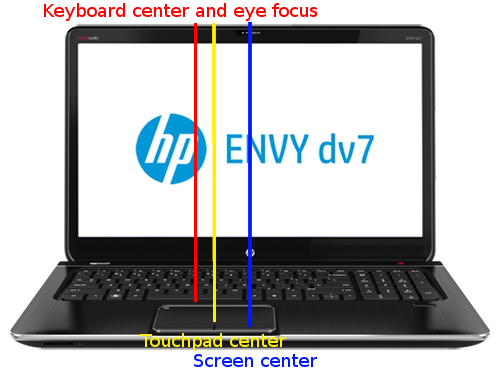
The numpad forces eye focus and users' hands to be way off center.
The touchpad looks as if it was thrown to the side by accident
Note how the designer tried to offset the misalignment forced
by the numpad by "positioning" the touchpad closer to center,
but not in line with the space bar (and the keyboard)
ugly design: it simply looks ugly; why do people think Apple didn't jump into this stupid bandwagon? Because it's ugly design!
Without numpad the position is almost perfect!
The symmetry of the laptop improves on the design.
Notice how the touchpad is also centered.
the numpad is useless for the vast majority of people, and those who need numpads, already use them at desktop (keyboard) or, can buy numpads
it's more expensive to manufacture (more moving parts, more complex wiring and more expensive materials - plastic is cheaper than plastic+copper+rubber)
less resilient: more ways to fail, higher risk to get liquids inside
bad mechanical design: wider keyboard means less distance from the edge to the keyboard, which can mean a more fragile case
makes the laptop heavier: the plastic or material that covers the keys would be enough to cover the insides; the extra rubber, wiring, support etc, add extra weight
it kills the opportunity to use the real estate for other useful things (or things which improve the overall design): speakers, volume keys, finger print readers, other special function keys, LEDs or other output devices
What's worse is that most resellers do not have filters for this particular mis-feature, so you can't easily exclude laptops corrupted by this horrendous idea. So, if you're a laptop designer, please stop putting numpads on laptops.
It will make for better looking laptops and you'll have the opportunity to be the one stating the obvious: numpads are generally useless! Even on desktop keyboards!
I ve transitioned to a new key announcement here or below. If you ve signed my key in the past please consider signing my new key to get it integrated into the web of trust. Thanks!
-----BEGIN PGP SIGNED MESSAGE-----
Hash: SHA1,SHA256
Sun, 2013-10-13
Time for me to migrate to a new key (shockingly late - sorry!).
My old key is set to expire early next year. Please use my new key effective
immediately. If you have signed my old key then please sign my key - this
message is signed by both keys (and the new key is signed by my old key).
old key:
pub 1024D/FBD3EB8E 2002-07-20
Key fingerprint = 9222 8732 859D 25CC 2560 B617 867B F9A9 FBD3 EB8E
new key:
pub 4096R/AAC0E286 2013-10-13
Key fingerprint = 8244 0CEA B440 83C7 9431 D2CC 298E 9A19 AAC0 E286
The new key is up on the keyservers, so you can just pull it from there.
- -Rob
-----BEGIN PGP SIGNATURE-----
Version: GnuPG v2.0.19 (GNU/Linux)
iEYEARECAAYFAlJZ8FEACgkQhnv5qfvT644WxACfWBoKdVW+YDrMR1H9IY6iJUk8
ZC8AoIMRc55CTXsyn3S7GWCfOR1QONVhiQEcBAEBCAAGBQJSWfBRAAoJEInv1Yjp
ddbfbvgIAKDsvPLQil/94l7A3Y4h4CME95qVT+m9C+/mR642u8gERJ1NhpqGzR8z
fNo8X3TChWyFOaH/rYV+bOyaytC95k13omjR9HmLJPi/l4lnDiy/vopMuJaDrqF4
4IS7DTQsb8dAkCVMb7vgSaAbh+tGmnHphLNnuJngJ2McOs6gCrg3Rb89DzVywFtC
Hu9t6Sv9b0UAgfc66ftqpK71FSo9bLQ4vGrDPsAhJpXb83kOQHLXuwUuWs9vtJ62
Mikb0kzAjlQYPwNx6UNpQaILZ1MYLa3JXjataAsTqcKtbxcyKgLQOrZy55ZYoZO5
+qdZ1+wiD3+usr/GFDUX9KiM/f6N+Xo=
=EVi2
-----END PGP SIGNATURE-----
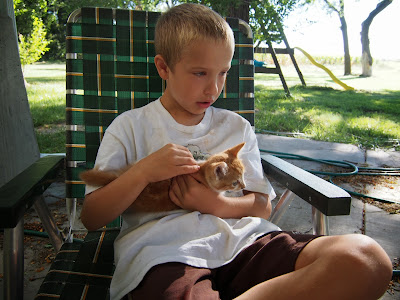
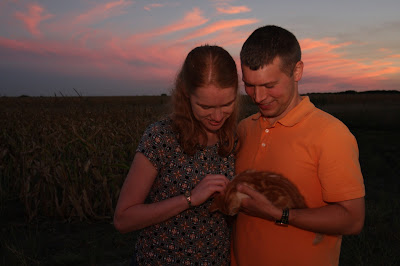
Almost every time he got off the bus for the past month and a half, Jacob started his afternoon in the same way. Before toys, before his trains and his toy bus, before anything indoors, he went for our cats. Here he is, cradling his favorite, Tigger:
Laura and I both grew up around cats. We had been talking about kittens, and shortly after we got engaged, one of my relatives offered us some free kittens. We went to his place one evening and selected two of them one calico and one tiger-colored. Since what is now my place will soon be our place, they came to live with me. Our cats were one of the first things we did to prepare for our lives together.
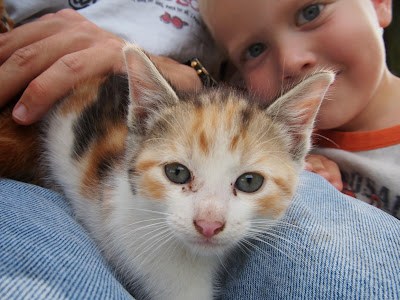
Oliver wanted to name them some rather impractical sentence-long names ( The Cat Who Always Likes To Run ), so Laura and I suggested some names from one of their favorite books: Tigger and Roo. They both liked the names, but Oliver thought they should be called Tigger the Digger and Roo the Runner . Never mind that they were just 6 weeks old at the time, and not really old enough to either dig or run. Here s Oliver with Roo, the day after the kittens arrived here.
I have always had outside cats, both because I m allergic to cats so I need them to be outside, and because they sometimes literally quiver with joy of being outdoors. Tigger and Roo often chased insects, wrestled with each other, ran up (and slowly came back down) trees, and just loved the outside. Sometimes, I have taken my laptop and wireless headset and work from the back porch. The kittens climb up my jeans, inspect the laptop, and once Roo even fell asleep on my lap at one of those times.
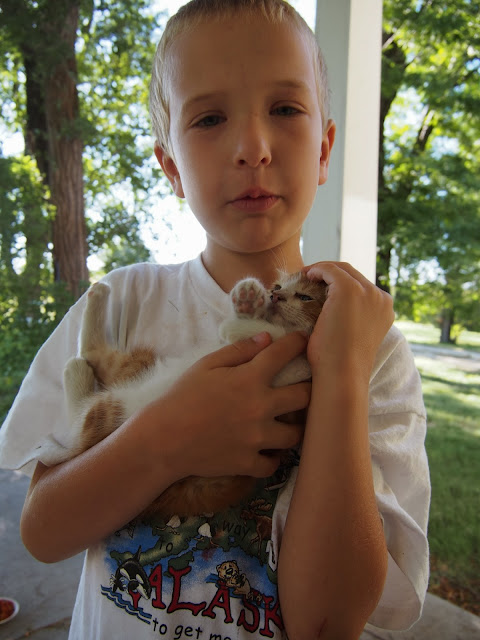
Jacob has been particularly attached to Tigger, calling him my very best friend. When Jacob picks him up after school, Tigger often purrs while cradled in Jacob s arms, and Jacob comments that Tigger loves me. Oh dad, he knows I am his friend!
The kittens have been growing, and becoming more and more comfortable with their home in the country. Whenever I go outside, it isn t long before there are two energetic kittens near my feet, running back and forth, sometimes being very difficult to avoid stepping on. I call and I see little heads looking at me, from up in a tree, or peeking out from the grain elevator door, or from under the grill. They stare for just a second, and then start running, sometimes comically crashing into something in their haste.
Yesterday when I went to give them food, I called and no cats came. I was concerned, and walked around the yard, but at some point either they come or they don t.
Yesterday afternoon, just after the bus dropped off Jacob, I discovered Tigger on the ground, motionless. Once Jacob was in the house, I went to investigate, and found Tigger was dead. As I was moving his body, I saw Roo was dead, too. Both apparently from some sort of sudden physical injury a bit mysterious, because neither of them were at a place where they had ever gone before. While all this was happening, I had to also think about how I was going to tell the boys about this.
I tried to minimize what he could see, Jacob had caught an unavoidable glimpse of Tigger as we were walking back from the bus, but didn t know exactly what had happened. He waited in the house, and when I came back, asked me if Tigger was dead. I said he was. Jacob started crying, saying, Oh Dad, I am so sad , and reached up for a hug. I picked him up and held him, then sat down on the couch and let him curl up on my lap. I could quite honestly let him know he wasn t alone, telling him I am sad, too.
Oliver arrived not long after, and he too was sad, though not as much as Jacob. Both boys pretty soon wanted to see them. I decided this was important for them for closure, and to understand, so while they waited in the house, I went back out to arrange the kittens to hide their faces, the part that looks most unnatural after they die. The boys and I walked out to where I put them, then I carried both of them the last few feet. We stood a little ways back close enough to see who was there, far enough to not get too much detail and they were both sniffling. I tried to put voice to the occasion, saying, Goodbye, Tigger and Roo. We love you. Oliver asked if they could hear us. I said No, but I told them what I felt like anyway. Jacob, through tears, said, Dad, maybe they are in heaven now.
We went back inside. Jacob said, Oh dad, I am so sad. This is the saddest day of my life. My heart is breaking. Hearing a 7-year-old say that isn t exactly easy for a dad. Pretty soon he was thinking of sort of comfort activities to do, saying I think I would feel better if we did So they decided to watch a favorite TV program. Jacob asked if Laura knew yet, and when I said no, he got his take-charge voice and said, Dad, you will start the TV show for us. While we are watching, you will send Laura an email to tell her about Tigger and Roo. OK? What could I say, it wasn t a bad idea.
Pretty soon both boys were talking and laughing. It was Big Truck Night last night, at a town about half an hour away. It s an annual event we were already planning to attend, where all sorts of Big Trucks firetrucks, school bus, combine, bucket truck, cement truck, etc show up and are open for kids to climb in and explore. It s always a highlight for them. They played and sang happily as we drove, excitedly opened and closed the big door on the school bus and yelled All Aboard! from the top of the combine. We ate dinner, and drove back home. When we got home, Jacob mentioned the cats again, in a sort of matter-of-fact way, and also wanted to make sure he knew Laura had got the message.
A person never wakes up expecting to have to dump a bowl of un-eaten cat food, or to give an impromptu cat funeral for little boys. As it was happening, I wished they hadn t been around right then. But in retrospect, I am glad they were. They had been part of life for those kittens, and it is only right that they could be included in being part of death. They got visual closure this way, and will never wonder if the cats are coming back someday. They had a chance to say goodbye.
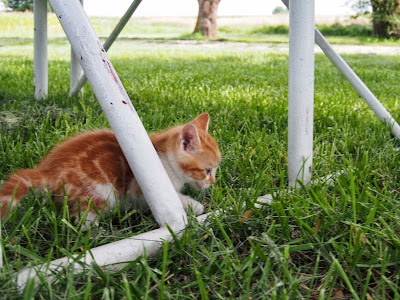
Here is how I remember the kittens.
We like guidelines. In our work, things like the Debian Free Software Guidelines, pep8 and Koha Coding Guidelines are quite useful. I follow guidelines for how I work, too. In addition to the financial reports required by government, our co-op produces an annual social report which we share with our members and other key stakeholders. Since 2007, the backbone of it is The Worker Co operative Code of Governance published by our national federation.
In 2012, the Worker Co-op Council updated the code. I don t remember why an update was felt necessary, but as a side-effect of producing of our 2013 social report, I ve made a list of the changes:
Principle 1 is reordered, with information becoming the first point and membership offered to all becoming the last item.
Principle 2 sees democratic processes drop down the order, plus it loses the item on long-term planning.
Principle 3 has the point about reserves clarified and gains a last item about distributing surplus fairly.
Principle 4 loses its first item about regular reviews, the skills assessment point moves to principle 5 and it gains a build capability point.
Principle 5 gains items on replacing key members and skills assessment (from the previous section), while most points seem rephrased.
Principle 6 is reordered, active co-operation is split into distinct points about referring and collaborating and the point about actively sharing good practice is deleted.
Principle 7 is unchanged.
Are these good changes? Much of it seems like tinkering and maybe shifting emphasis the reorderings add little and make it harder to spot the changes while the lost points on long-term planning and sharing good practice are surprising. I would have preferred to see the items that seem mainly to promote the code itself and its publisher Co-operatives UK deleted instead. The additions and clarifications about surplus are good, though, and there s nothing new that I think should stop us adopting it.
What do you think? Should all business behave this way?
The BBC coverage of the UCI Women Road Race World Championship wasn t starting until 3pm, BBC Radio 5 Live had football and Sports Extra was playing an advert loop (really BBC?), Eurosport wasn t covering the race at all, RAI Sport 2 had coverage which was fine while I was watching the TV, but my Italian isn t good enough to follow the commentary and I wanted to get some other stuff done.
So the obvious thing is to have the computer watch for changes to the great http://live.cyclingnews.com/ ticker and read them out, right? Well, it was to me. Here s the script I used:
#!/usr/bin/rc
# Send updates to live cycling news reports to the speech synth
# initialise
url=http://live.cyclingnews.com/
if (~ $1 *:*)
  url=$1

last=""
while (true)
    # download the update and strip html - if you don't have html2text try
    # sed -e '1,/<ol/d;s/<br[^>]*>/n/g;s/<[^>]*>//g;s/ / /g;s/[[:space:]]*$//'
    next= () curl -s $url   html2text -width 9999   sed -e 's/^ *[0-9]*. //'
    # look for some added lines in the update section - timezone will need changing for non-European races
    say= () diff -u < echo $last  < echo $next
        sed -ne '/^+/!d;s///;s/**//g;/ CES*T/,/^ *$/p'   head -9
    # feed them to the speech synth in reverse order
    echo $say '
      Race Update'   tac   spd-say -e
    # update variables, pause and loop
    last=$next
    # set this to a prime number over 60, like 61, 67, 71, 73, 79, 83, 89
    sleep 67
Any questions, comments or improvements? I could have done more, like not saying Race Update even when there was no update, but I wanted to start listening as soon as possible!
On a regular basis, I find myself the odd-man-out when it comes to talking
about how to work with Python on Debian systems. I'm going to write this and
post it so that I might be able to point people at my thoughts without having
to write the same email in response to each thread that pops up.
Turns out I don't fit in with the Debian hardliners (which is to say, the
mindset that pip sucks and shouldn't exist), nor do I fit in with the Python
hardliners (which is to say apt and dpkg are out of date, and neither have
a place on a Development machine).
I think our discourse on this topic has become petty and stupid in general.
Let's all try to step back and drop a bit of the attitude.
pip doesn't suck, and neither does apt.
The truth is, both sides are wrong. As with any subject, the real
answer here is much more nuanced than either side presents it. I'm going to
try and present my opinion on this, in the way that both my Pythonista self
and my Debianite self see the issue. Hopefully I can keep this short, to
the point, and caked with logic.
The case for dpkg (the Debianite in me)
In defense of dpkg and apt, imagine having to install python-gnome2
on all your systems when you install. It'd be hell on earth.
Imagine having a user try to do this. It's insane to assume that
end-users will be using pip for this purpose.
pip is fun and all, but it's also installing 100% untrusted code to your
system (perhaps as root, if you're using pip with sudo for some reason),
and hasn't been reviewed for software freeness, which is something Debian
(and Debian users) take seriously. This isn't even to mention the hell that
pip wreaks on dpkg controlled files / packages.
Try to remember how much of your system running (yes, right now) is running
because of Python or Python modules. Try to imagine how much of a pain in
the ass it'd be if you couldn't boot into GNOME to use nm-applet to connect
to wifi to pip install something. I'm sure even the most extreme pip'er
understands the need for Operating System level package management.
Debian also has a bigger problem scope - we're not maintaining a library
in Debian for kicks, we're maintaining it so that end user applications may
use the library. When we update something like Django, we have to make sure
that we don't break anything using it (although, to be honest, the fact that we
package webapps is an entire rant for later) before we get to update it to the
newest release.
Hell, with a few coffees, I could automate the process of releasing a .deb
with a new upstream release, 100% unattended. I won't, however, since this is
an insane idea. Let's go over a brief list of things I do before uploading a
new package:
Review the entire codebase for simple mistakes.
Review the entire codebase for license issues.
Review the entire codebase for files without source, and track down
(and include source for) any sourceless files (such as pickle
files, etc).
Get to know the upstream, get to know open bugs, write something using
the lib, in case I need to debug later.
Install the package.
Test the package.
Work out any Debian package issues (this is easy).
Now, a brief list of things I do before I update a package:
Review the changes between the last uploaded version (in diff format, if
it's sane, otherwise get the VCS and review), ensure all the above are still
OK.
Review for Debian-local issues (such as how it will upgrade, using
piuparts, and adequate, etc).
Check to make sure it won't break any reverse dependencies.
Review for bugfixes that I might need to bring back to the stable release.
Figure out if I should (or even can) backport the package, if API is
stable.
Review for bugs (upstream or in Debian) that I need to mention in the
debian/changelog.
Clearly, this isn't a quick-and-dirty task. It's not a matter of getting a
package updated (technically), it's a much more detailed process than that.
This is also why Debian is so highly regarded for its technical virtuosity,
and why the
ISS decided to deploy Debian in space,
despite other commercial distros such as Red Hat, or Ubuntu, and
community distros, such as Fedora or Arch.
It's also not Debian's job to package the world in the archive. This is an
insane task, and it's not Debian's place to do it. We introduce libraries
as things need them, not because we wrote some new library that someone
may find slightly useful at some point in the future. maybe.
Upstream developers and language communities (not only Python here) tend to
lose sight of why we're doing this in the first place, which
is our users. This isn't some sort of technical pissing contest to see who can
distribute the software in the best way. Debian-folk always keep end users
as our highest priority.
I quote the
Debian Social Contract, when I say
that Our priorities are our users and free software. No one's trying to
get developers to use dpkg to create software. In fact, as you'll see
below, I actively discourage using system modules for development.
The case for pip (the Pythonista in me)
In defense of pip, the idea that Debian will keep the latest versions of
packages is insane. The idea that we can keep pace with upstream releases is
nuts, and the idea that every upstream release on pypi is ready to ship is
bananas. b-a-n-a-n-a-annas.
As a developer, I don't want to support every release, and I surely don't want
other people depending on some random snapshot.
Often times, I'll put stuff up on pypi as a preview, or to release often, and
solicit feedback without having to give out instructions on using a git
checkout (it's also easier to have them try a version from pypi so I can
cross-ref the git tag to reproduce issues when they file them)
pypi is easy, ubiquitous and works regardless of the platform, which means
less of my development time is spent packaging stuff up for platforms I don't
really care about (Arch, Fedora, OSX, Windows), even though I value
feedback from users on those systems. The effort it takes to release something
is limited to python setup.py sdist upload, and it's in a place (and in a
shape) that anyone can use it without having 10 sets of platform-local
instructions.
Even ignoring all the above, when I'm writing a new app or bit of code,
I want to be sure I'm targeting the latest version of the code I depend on,
so that future changes to API won't hit me as hard. By following
along with my dependencies' development, I can be sure that my code breaks
early, and breaks in development, not production. Upstreams also tend to not
like bug reports against old branches, so ensuring I have the latest code from
pypi means I can properly file bugs.
Lastly, I prefer virtualenv based setups for development, since I'm usually
working on many things at once. This often means version mismatches in
libraries, which brings in API changes (another whole rant here as well).
I don't want to keep installing and uninstalling packages to switch between
the two projects, and using a chroot(8) means a lot of overhead and that it's
disconnected from my development environment / filesystem, so I resort to
virtualenv to isolate my Development environment.
Final notes
I don't want to keep arguing about this. Just accept that the world's a big
place and that there exist use-cases that both apt and pip need to exist
and work in the way they're working now. At the very least, try and understand
there exist smart people on both sides, and no one is trying to screw anyone
over or keep their own little private club to themselves. Hopefully, going
forward, we can make sure that the integration between these two tools gets
better, not worse.
Help make this dream a reality. Contribute to a productive tone, not a
destructive one. In short:
Use pip without sudo always. Don't tell people to use sudo.
Use apt or dpkg when deploying system-wide.
Understand people are going to package, and they will be more concerned
about software using your library then keeping your library up to date.
Understand Debian Developers and package maintainers have to do a lot of
work when updating or sponsoring an upload.
Understand upstream developers can't be bothered to fix every issue
with every release (release early, release often) with some snapshot
you introduced into unstable.
Use pip and virtualenv in development setups, so we can upgrade your
app when we upgrade the lib.
DebConf 13 report (by Andreas Tille)
General impression
I'm beginning my DebConf report in an unofficial
"Scenic Hacklab" right at the edge of the lake in Yverdon. This
is the right place to memorise the last days. When I started from
this place cycling to Le Camp 12 days ago I was full of great
expectations and what should I say - the reality has even beaten
these.
Once it comes about comparing DebConfs even if it is an unfair
comparison due all the differences my secret long term favourite was
Helsinki very closely followed by Argentina and also very closely
followed by all the other great DebConfs I joined (and I joined all in
Europe). Would Le Camp be able to beat it? The short answer is: Yes,
it is now my favourite DebConf while I think I do not suffer from the
last-Debconf-was-the-best-DebConf-syndrome (and I realised there are
others
thinking the same).
As you might probably know I'm a bit addicted to swimming. While
Helsinki had admittedly the better conditions I was at least able to
fix the distance issue using my bicycle. (Hey, those Le Camp
photographers did a great job in hiding the fact that you can not
actually touch the lake right from the meadow of Le Camp.) Being able
to have my bicycle at DebConf scored some extra points. However, the
really great view of the lake, the inspiring "Scenic Hacklab" which
was my favourite place has bumped DebConf13 at first place in my
personal ranking.
So it comes quite natural to say: "Kudos to the great organisation
team!" They did a Swiss-like precise work and perfectly succeeded in
hiding any problems (I assume there were some as always) from the
attendees so everything went smooth, nice and shiny for the attendees.
The local team was even precise in setting up great weather conditions
for DebConf.
While saying thanks to the local team I would like to also explicitly
thank Luca Capello who has quite some share that this DebConf was
possible at all (while I have to decrease my DebConf score one point
because he was not really there - Luca to bad that you were not able to
come full time!) Also thanks to Gunnar and Gannef who helped remotely
(another score down because I were missing them this year as well).
Even if it was my favourite DebConf I was not able to work down my
todo list fully (which was not only uploading one package per day
which I at least statistically fullfilled). But that's probably a
general feature of todo lists anyway. One item was definitely done:
Doing my daily swimming BoF. I actually was able to do the other
parts of the triathlon which was skipped by Christian and have done in
summary about 150km cycling with 3500m elevation and estimated 7-8km
swimming (0m elevation ;-)). Considering the great view at sunrise
over the lake I was not hating my "Senile bed
escape" disease too much (I was every day waking up at sunset) -
it was simply a great experience. I will never forget seeing water
drips glimmering like gold inside the morning sun while seeing the
Alps panorama in the distant. I hope I was able to help all
interested swimmers with the DebConf Beach Map
which was just a by-product of my activities in DebCamp.
Speaking about OSM: I was astonished that the area was way less
covered than I expected. Thanks to several DebConf attendees the
situation became better and the map does not only show random trees in
the wild but also the tracks leading to these. (Remark: It was no
DebConf attendee who is responsible for plastering the map with single
trees.) While I had my mapping focus basically close to the edge of
the lake I was also able to even map my very
own street. :-)
I clearly remember one specific mapping tour when I was invited by the
DPL: He convinced me to join him on a bicycle tour and since I was
afraid to get fired I joined him instead to keep on hacking. Also
Sorina was brave enough to join us on the tour and she did quite well.
(Sorina, do you remember the agreement about your work on the installer?
;-)) Lucas described the tour as: going uphill on only asphalted roads.
Sorina and me were witnessing the mighty DPL powers when we left the
wood around Le Camp to reach the described road: The asphalt was just
put onto the road - no doubt that it was done on the immediate demand of
mighty DPL. :-)
DebCamp time was flying like nose dive and a lot of known (and unknown)
faces arrived at Le Camp. What I really liked a lot this year was that
several really young children has pulled down the average age of DebConf
attendees. I clearly remember all the discussion one year ago what to
do about children. As always the issue was solved in a typical Debian
way: Just do it and bring your children - they had obviously a great
time as well. I think the youngest child was 2 months and the oldest
"child" above 20. ;-) Actually Baptiste Perrier did great in making the
C&W party a success and had obviously a nice time. (I wished my son
would have been able to come as well but he needs to write his
bachelor s thesis in physics. :-()
It was nice to see the kids using all playing facilities and
communicating with geeks. Also I would like to point out that even the
very young attendees had their share at the success of DebConf: Just
think of the three "bell ringing assistants" who helped me ringing the
bells for lunch and dinner. I've got this cool job from Didier in the
beginning of DebCamp. I must say having some real bells ringing is by
far nicer than just the "lunch / dinner starts in 10 minutes" from IRC
bot. The only thing I did not understand was that people did not
considered ringing the bells at 8:00 for breakfast as a good idea.
Regarding the food in general I would also like to send kudos to the
kitchen: It was tasty, freshly prepared, regional food with a good
change rate. I really liked this. Extra points for having the chance
to sit outside when eating.
Talks
But lets have a look into the conference programme. I'd really
recommend watching the videos of the talks Bits
from the DPL (video)
and Debian
Cosmology (video).
I considered both talks as entertaining and interesting. I also
really hope that the effort Enrico Zini started in Debian
Contributors (video)
will be successful.
I had some talks and BoFs myself starting with Why
running a Blend (video)
and I admit that (as usual) the number of attendees was quite low even
if I think there is some proof (see below) that it is interesting for
way more people who should consider working more "blendish" in their
team. Do you know how to recruit one developer per year and relax the
man power problem in your team? Feel free to watch the video.
We have confirmation that ten DDs of our team have considered to join
Debian only because Debian Med exists. Admittedly biology and
medicine are really leaf topics inside the Debian universe. So if
even this topic that has a very tiny share of the Debian users is able
to attract this level of attention - how many more people could we win
for multimedia, games, GIS and others?
So if you feel you are quite overworked with your packaging and you
have no time this is most probably wrong. The amount of time is
basically a matter of priorities you set for your tasks. Try to put
some higher priority onto using the just existing Blends tools I
explained in my talk to attract more users and developers to your team
and by doing so spread the workload over more people. It works, the
prove was given in my
main talk. So before you start working on a specific
package you should wonder who else could have an even stronger
interest to get this work done and provide him with some additional
motivation and help to get the common goal done.
The interesting thing is that my BoF about How
to attract new developers for your team (video)
- which was a simple report about some by-product of the Blends work -
made it into the main talk room and got way more attention. For me
this is the proof that the Blends concept itself is probably badly
perceived as something like "a few outsiders are doing damn specific
stuff which is not really interesting for anybody else" instead of
what is really is: Smoothing the way from specific upstream
applications to the end user via Debian.
Once you see the video
of this BoF you can observe how my friend Asheesh Laroia became
more and more excited about the Blends concept and admitted what I
said above: We should have more Blends for different fields. Funnily
enough Asheesh asked me in his excitement to talk more about Blends.
This would have been a really good suggestion ten years ago. At
DebConf 3 in Oslo I had my very
first talk about Blends (at this time under the name "Debian
Internal Projects"). I continuously kept on talking about this
(MiniDebConf
Peking 2005, DebConf
5, Helsinki (video),
DebConf
7, Edinburgh (video),
DebConf
8, Mar del Plata (video),
DebConf
9, C ceres (video),
MiniDebConf
Berlin 2010 (video
in German),
MiniDebConf
Paris 2010 (not video recorded),
DebConf
11, Banja Luka (video)
... and these are only (Mini)DebConfs my talks page is full
of this topic)
and every new year I try different ways to communicate the idea to my
fellow Debianistas. I'm wondering how I could invent a title +
abstract avoiding the term Blends, put "Git", "release" and "systemd
versus upstart" in and being able to inform about Blends reasonably by
not becoming to off topic with the abstract.
I also registered the Debian
Science round table. I admit we were lacking some input from
remote via IRC which used to be quite helpful in the past. The
attendees agreed upon the handling of citations in debian/upstream
files which was invented by Debian Med team to create even stronger
bounds to our upstream developers by giving their work extra reward
and providing users with even better documentation (see my summary in
Wiki).
As usual I suggested to create some Debian Science offsprings like
"Debian Astronomy", "Debian Electronics", "Debian Mathematics",
"Debian Physics" etc. who could perfectly leave the Debian Science
umbrella to get a more fine grained structure and a more focused team
to enhance the contact to our users. Unfortunately there is nobody
who volunteers to take over the lead for such Blends. I have given a
short summary about this BoF on the Debian
Science mailing list.
In the Debian
Med meeting I have given some status report. No other long term
team members were attending DebConf and so I gave some kind of
introduction for newcomers and interested people. I touched also the
DebiChem topic which maintains some packages that are used by
biologists frequently and so we have a good connection to this team.
Finally I had registered three BoFs in Blends I'm actually not (or not
yet) active part of. My motivation was to turn the ideas I have
explained in my
main talk into specific application inside these teams and helping
them to implement the Blends framework.
In the first BoF about Debian GIS I have shown the usual team metrics
graphs to demonstrate, that the one packaging team Pkg-OSM is in danger
to become MIA. There are only three persons doing actual uploads. Two
of them were at DebConf but did not joined the BoF because they do not
consider their contribution to Pkg-OSM as a major part of their general
Debian work. I will contact the main contributor David Paleino about
his opinion to move the packages step by step into maintenance of Debian
GIS packaging team to try to overcome the split of two teams that are
sharing a good amount of interest. At least if I might become an
Uploader for one of the packages currently maintained by Pkg-OSM I will
move this to pkg-grass-devel (which is the name of the packaging team of
Debian GIS for historical reasons). The attendees of the BoF have
considered this plan as sensible.
Moreover I talked about my experiences with OSGeo Live - an Ubuntu
derivative that tries to provide a full tool chain to work on GIS and
OSM problems ... basically the same goal as Debian GIS has just
provided by the OSGeo project. I'm lurking on OSGeo mailing list when
I asked explicitly I've got the answer that they are working together
with Debian GIS and are using common repository (which is IMHO the
optimal way of cooperation). However, it seems that several
protagonists of OSGeo Live are underestimating the resources provided
by Debian. For instance there was a question about Java packaging
issues but people were not aware about the existence of the
debian-java mailing list. I was able to give an example how the
Debian Med team managed to strengthen its ties to BioLinux that
is also an Ubuntu derivative for biologists. At our first Debian
Med sprint in 2011 we invited developers from BioLinux and reached
a state where they are using the very same VCS on Alioth where we are
maintaining our packages. At DebConf I was able to upload two
packages where BioLinux developers did certain changes for enhancing
the user experience. My "work" was just bumping the version number in
changelog and so we did profit from the work of the BioLinux
developers as well as they are profiting from our work. I plan to
dive a bit more into Debian GIS and try to strengthen the connection
to OSGeo Live a bit.
The next BoF was the Debian Multimedia meeting. It was nice that the
current leader of Ubuntu Studio
Kaj Ailomaa joined the meeting. When I was explaining my ideas about
cooperation with derivatives I repeated my detailed explanation about
the relation with BioLinux. It seems every topic you could cover
inside Debian has its related derivative. So to me it seems to be
quite natural to work together with the developers of the derivative
to join forces. I actually consider a Blend a derivative done the
right way = inside Debian. The final work for the derivers that might
be left for them is doing some shiny customising of backgrounds or
something like this - but all the hard work could and should be done
in common with the relevant Debian team. My dream is to raise such
relevant teams inside Debian ... the Blends.
Finally the last BoF of this series was the Debian Games meeting. As
always I presented the team metrics graphs and the Debian Games team
members who attended the BoF were quite interested. So it seems to be
some unknown fact that team metrics are done
for several teams in side Debian and so I repeat the link to it for
those who are not yet aware of it. As a result of the BoF Debian
Games team members agreed to put some more effort into maintaining
their Blends tasks. Moreover Miriam Ruiz wants to put some effort
into reviving Debian Jr. Regarding Debian Jr. there was an
interesting talk
about DouDouLinux - in case you might want to watch the video I'd
recommend skipping the first 30min and rather watch the nice live
demo. There was also an ad hoc BoF about Debian Jr scheduled to bring
together all people interested into this cute project and Per Anderson
volunteered to take over the lead. I have given a
summary about this specific BoF at the Debian Jr list.
For some other talks that I'd regard as remarkable for some reasons:
I'd regard the talk "Debian-LAN"
by Andreas Mundt as some hidden pearl because it did not got a lot
of attention but after having seen the video I was quite impressed -
specifically because it is also relevant for the Blends topic.
Memories
I also liked "Paths
into Debian" by Moray Allan (and I was only able to enjoy the
latter talks thanks to the great work of the video team!) because it
also scratched the same topic I was concerned about in my
mentoring talk. Related to this was in my opinion also "Women
in Debian 2013" were we tried to find out reasons for the lack of
woman compared to other projects and how to overcome this issue.
Besides the talks I will probably never forget
two specific moments that make DebConf so special. One of these
moments is recorded on an image that clearly needs no words - just
see Geert hovering over the grass.
Another strong moment in my personal record was in the DebConf Newbies
BoF "First
time at DebConf" that unfortunately was not recorded but at least
for this statement it would have been very great if we would have some
reference better than personal memory. Aarsh Shah a GSoC student from
India suddenly raised up and said: "Four months ago I was not even
aware that Free Software exists. Now I'm here with so many people who
are totally equal. If I will tell my mother at home that I was
standing in the same queue where the Debian Project Leader was queuing
up for food she will never believe me." He was totally excited about
things we are regarding as normal. IMHO we should memorise moments
like this that might be part of the key to success in cultures, where
Debian is widely unknown and very rarely in use.
Amongst these not scheduled great moments the scheduled day trip was also
a great thing. I had a really hard time to decide what tour I might
join but ended up in the "long distance walking (or should I say
running) group". Inspired by the "running Bubulle" who was flashing
between the walking groups we went uphill with 5.4km/h which was a nice
exercise. Our destination the large cliff was an exciting landscape and
I guess we all enjoyed the dinner organised by the "Trout cabal". ;-)
So I had a hard time to leave Le Camp and tried hard to
make sure my memories will remain as long as possible. Keeping some
signs attached to my bicycle, conserving the "Scenic Hacklab" sign
for my private "scenic hacklab @ home" was one part. I also have cut
some branches of the Buxus sempervirens in Le Camp and have put them
in my garden at home (where I create some hedgerow from places where
I spent some great time). These will probably build a great part of
the hedgerow ...
Thanks for reading this longish report.
Looking forward to see you all in Germany 2015 (or earlier)
Andreas.
So I have upgraded my main workstation at last, but there are a few things I wanted to figure out. Some of these I found an answer to, but others I haven t and some answers open more questions:
Where did debian-menu.menu go and why doesn t lxlauncher have the Debian menu by default anyway? Answer: It seems this is a combination of debian bug 333848 and bug 722563 which I reported yesterday in that lxlauncher doesn t use the debian menus. Workaround for now: install menu-xdg and hack the lxlauncher menu file.
Why don t my xterm shells load .profile any more? Did I bodge that before without making a note?
How do I stop kernel or initrd or whatever it is configuring the network with the dhcp settings at boot time instead of the better wicd ones that are available once the system is up?
Continuing with networking, how did network-manager (which doesn t cope with my network configuration) get installed again? Answer: debian bug 645656 explains that debian is simply following a silly decision taken upstream and refers to attempts to make network-manager optional as the Crusade . Workaround: remove gnome and install its dependencies like gnome-core directly instead. Drawback: any new dependencies of gnome will have to be installed manually.
Why is the audio capture volume at 10% by default and what s the best way to change that? I suspect this might be 682731 but that bug is untouched in over a year. I m tempted to remove pulseaudio, but gnome-core Depends pulseaudio so this is yet more hardware-breaking caused by gnome dependency changes and the only way out of this one would be to remove gnome-core and install its dependencies. Or maybe I should just give up and finally remove gnome because its packages have jumped the shark. I installed gnome to make the system easier to use and it s broken it in at least two ways now.
One question that makes me hesitate is: why is gdm3 faster to start than lightdm?
In cryptography, a Caesar cipher, also known as Caesar's cipher, the shift cipher, Caesar's code or Caesar shift, is one of the simplest and most widely known encryption techniques. It is a type of substitution cipher in which each letter in the plaintext is replaced by a letter some fixed number of positions down the alphabet. [...]
#!/bin/shIN="MJHVIZN ZPIO YJHPN"for I in $(seq 25); doecho$I$IN tr $(printf %$ Is tr ' ''.')\A-Z A-ZA-Z
done
As announcement on debian-devel-announce, I just uploaded java-common version 0.49. This version changes the default version of OpenJDK to version 7.
That means that packages depending on default-jdk/default-jre will be now built with OpenJDK 7 (instead of the 6) and also that the java/javac commands will be providing Java 7.
I also used the opportunity of this upload to update the Java policy.
There s been some media coverage at the start of this week about blocking child porn. Except it s not about child porn that s a trojan horse. People who want to access pornography that is already illegal (Protection of Children Act 1978) are probably already using security tools to hide their downloading and will be unaffected by this unless they re pretty stupid.
And the announcement, about the same time as the predicted birth of a royal baby, third in line to the throne, seems like a cynical attempt to bury bad news taken straight from the Blair Government. That would almost be enough reason to oppose it: they don t want the media to look at this too closely for some reason.
So what s this actually about? It looks like a way to force through widespread acceptance of the ability to censor most UK internet users by shouting won t somebody think of the children? If you doubt it, take a look at the list of filtered topics:
Dating
Drugs, Alcohol and Tobacco
File Sharing Sites
Gambling
Games
Pornography
Social Networking
Suicide and Self-Harm
Weapons and Violence
So if they get away with this censorship, you won t be able to use Twitter or contact the Samaritans until you deactivate it. Except I suspect you will because they re pretty big and the Cameron Government won t want to pick a fight with them: it ll be the next Twitter and the next Samaritans, currently much smaller and unable to defend themselves, who get shut out of UK homes.
So what can we do, besides explaining this and writing to our MPs? Are we better off joining parties who oppose this censorship, like the Pirate Party, or joining existing parties and trying to overturn their stupid support for it?
Cooperatives Fortnight 2013 starts tomorrow. Our co-op is taking part in a few activities this year. Come along and meet us, or find other events on the national website.
This Sunday, I ll be riding 50 miles in support of Leonard Cheshire. Some of it is familiar roads, some of it new. I ll also be riding 12 miles just to get to the start line. If you re a UK resident and would like to guess my time and make a small donation, please give it a try on guess2give.
Next Thursday 27 June, I ll be at Somerset Cooperative Services AGM in Taunton. See their site for further news.
There might be something on Monday 1 July. To be announced later maybe.
On Thursday 4July, mjkaye will be at Building Our Co-ops in Liverpool. See the national event listing for details.
So what will you be doing for co-ops fortnight?
One of our co-op s clients asked me what I use for anti-virus at the moment and tips for what they should use on their Windows system.
Well, flame me now, but I don t actually use any anti-virus at the moment: I rely on system security, firewalling and intrusion detection. The diversity of GNU/Linux software and I use some pretty odd stuff probably helps too. Even if I did want to run antivirus software, most of what s available for GNU is actually aimed at detecting and preventing transmission of Windows viruses. There are few real-world GNU viruses and fewer attack opportunities left open.
Also, I prefer firewalling and fairly paranoid security settings because, like an antibiotic, an antivirus is only effective once the virus is already on your system somehow hopefully held in quarantine by the browser or email client and not actively malignant in the processor.
There s quite a list at http://en.wikipedia.org/wiki/Comparison_of_antivirus_software#Microsoft_Windows but I expect most of the purchase-free proprietary ones (labelled as Free or Freemium but you usually pay by watching adverts) will try to sell you upgrades, as that s how their production is funded. If you don t mind doing such things, you can disable the ads in at least one of them
The only very free ones I found were Immunet (also funded by upgrades not sure if it s actually Free and Open Source Software) and ClamWin (donation-funded) which both use the same scanning engine. If I had to use Microsoft Windows, I think I d probably use and donate to ClamWin, install the (altruism-funded I think) Clam Sentinel alongside it and be rather cautious about what I downloaded or used online. I m a bit worried that it doesn t do great in reviews, though. What do/would you do?
I don t really know about paying for security. The only paid product I ve really seen has been Norton and that seemed no better than the ad-funded ones, still getting in the way and always trying to sell upgrades. It also irks me that there s this huge market just to fix fundamental defects in Microsoft s product. There s a Microsoft Security Essentials add-on listed on Wikipedia, but it does fairly badly in this PC Magazine review and do any of them do intrusion detection?
And finally, if you do decide to download something new, I strongly suggest getting it from a trusted source and/or triple-checking the link with wikipedia, a magazine review like CNET and a search engine. Don t just trust a search engine, because fake antivirus software is a big way of getting viruses and worse onto computers: there s even one calling itself Microsoft Security Essentials 2011 !
This Clevo laptop is a new machine and like a lot of new machines, not all of its hardware has drivers in the current stable release of debian.
Happily, there is a driver for its rtl8723ae wireless networking device in the later 3.8 Linux kernel versions. So it s just a case of installing the package called kernel-package and following the instructions in it, to make a new linux-image package with the latest drivers in it.
One small thing which tripped me up is that you usually need to write make-kpkg rootcmd fakeroot initrd kernel-image now. I forgot the initrd option at first.
 Please excuse the intrusion to your usual software and co-op news items but vine seems broken and as part of my community and democratic interests, I d like to share this short clip quoting Norfolk s Deputy Police Commissioner Jenny McKibben about why Commissioner Stephen Bett believes it s important to get views from the west of the county about next year s police budget:
Personally, with a King s Lynn + West Norfolk Bike Users Group hat on, I d like it if people supported a 2% ( 4/year average) tax increase to reduce the police s funding cut (the grant from gov.uk is being cut by 4%) so that we re less likely to have future cuts to traffic policing. The consultation details and response form are on the PCC website.


 I'm getting the hang of the more or less daily RC bug fixing again. below
you find what I did this week.
as a side note: as you can see, quite a few of the patches are taken from
ubuntu; it's great that someone over there already took the time to come up
with a fix; thanks! not so great is that only one of them was in the
BTS. guys, you have already been better at forwarding your patches to the
debian BTS, please try to get back into this good habit :)
 ... numpads on laptop keyboards.


 On a regular basis, I find myself the odd-man-out when it comes to talking
about how to work with Python on Debian systems. I'm going to write this and
post it so that I might be able to point people at my thoughts without having
to write the same email in response to each thread that pops up.
Turns out I don't fit in with the Debian hardliners (which is to say, the
mindset that

