Jonathan Dowland: PaperWM

 My PaperWM desktop, as I write this post.
For my PhD work, I've been working on preparing an experimental branch of
StrIoT for merging down to the main branch. This has been a long-lived branch
(a year!) within which I've been exploring some ideas. Some of the code I want
to keep, and some I don't.
The history of the experimental branch is consequently messy. Looking it over
and considering what a reviewer needs to see, there's a lot of things that are
irrelevant and potentially distracting. And so, I've been going through an
iterative process of steadily whittling down the history to the stuff that
matters: some strings of commits are dropped, others squashed together, and
others re-ordered. The resulting branch is a historic fiction.
This is common practice. Joey Hess ruminated about it 5 years ago in "our
beautiful fake
histories",
pointing out that the real history is also useful, and perhaps worth
preserving.
After a recent conversation with my supervisor I realised the situation was
analagous to writing a research paper (or a thesis): the process of getting to
the conclusion which the thesis documents is messy, with false starts, wrong
directions, and plenty of roads-not-travelled. The eventual write-up focusses
on the path that lead to the conclusion, and a lot of the side-quest stuff
disappears.
The "true history" then, is captured elsewhere: in lab books, diaries and
the like, and these have their own value. So do my messy exploratory branches,
before they've been cleaned up for merging.


 I have recently become an OpenJDK Author. Practically this means I can query
the Java Bug Database directly, and I can author
Mercurial for committing to the relevant OpenJDK project myself, rather than
needing sponsors in both cases.
A small milestone but one I'm proud of! Thanks to my team members who have
encouraged me and helped me by sponsoring and reviewing my work so far.
Next step, Committer!
 Over the summer I decided to migrate my backups from rdiff-backup to borg,
which offers some significant advantages, in particular de-duplication, but
comes at a cost of complexity, and a corresponding sense of unease about how
sound my backup strategy might be. I've now hit the Point Of No Return: my
second external backup drive is overdue being synced with my NAS, which will
delete the last copy of the older rdiff-backup backups.
Whilst I hesitate over this last action to commit to borg, something else
happened. My wife wanted to put a copy of her iTunes music library on her
new phone, and I couldn't find it: not only could I not find it on any of
our computers, I also couldn't find a copy on the NAS, or in backups, or even
in old DVD-Rs. This has further knocked my confidence in our family data
management, and makes me even more nervous to commit to borg. I'm now wondering
about stashing the contents of the second external backup disk on some cloud
service as a fail-safe.
There was one known-good copy of Sarah's music: on her ancient iPod Nano.
Apple have gone to varying lengths to prevent you from copying music from an
iPod. When Music is copied to an iPod, the files are stripped of all their
metadata (artist, title, album, etc.) and renamed to something non-identifying
(e.g.
F01/MNRL.m4a), and the metadata (and correlation to the obscure file
name) is saved in separate database files. The partition of the flash drive
containing all this is also marked as "hidden" to prevent it appearing on macOS
and Windows systems. We are lucky that the iPod is so old, because Apple went
even further in more recent models, adding a layer of encryption.
To get the music off the iPod, one has to undo all of these steps.
Luckily, other fine folks have worked out reversing all these steps and
implemented it in software such as libgpod and its frontend, GtkPod, which
is still currently available as a Debian package. It mostly worked, and I got
back 95% of the tracks. (It would have been nice if GtkPod had reported the
tracks it hadn't recovered, it was aware they existed based on the errors
it did print. But you can't have everything.)
GtkPod is a quirky, erratic piece of software, that is only useful for old
Apple equipment
that is long out of production,
prior to the introduction of the encryption.
The upstream homepage is dead, and I suspect it is unmaintained.
The Debian package is orphaned. It's been removed from testing, because
it won't build with GCC 10. On the other hand, my experience shows that it
worked, and was useful for a real problem that someone had today.
I'm in two minds about GtkPod's fate. On the one hand, I think Debian has far
too many packages, with a corresponding burden of maintenance responsibility
(for the whole project, not just the individual package maintainers), and
there's a quality problem: once upon a time, if software had been packaged in
a distribution like Debian, that was a mark of quality, a vote of confidence,
and you could have some hope that the software would work and integrate well
with the rest of the system. That is no longer true, and hasn't been in my
experience for many years. If we were more discerning about what software we
included in the distribution, and what we kept, perhaps we could be a leaner
distribution, faster to adapt to the changing needs in the world, and of a
higher quality.
On the other hand, this story about GtkPod is just one of many similar stories.
Real problems have been solved in open source software, and computing
historians, vintage computer enthusiasts, researchers etc. can still benefit
from that software long into the future. Throwing out all this stuff in the
name of "progress", could be misguided. I'm especially sad when I see the glee
which people have expressed when ditching libraries like Qt4 from the archive.
Some software will not be ported on to Qt5 (or Gtk3, Qt6, Gtk4, Qt7, etc., in
perpetuity). Such software might be all of: unmaintained, "finished", and
useful for some purpose (however niche), all at the same time.
In Summer 2019 Red Hat were invited to the Turing
Institute to provide a workshop on issues around
building and sustaining an Open Source community. I was part of a group of
about 6 people to visit the Turing and deliver the workshop. It seemed to have
been well received by the audience.
The Turing Institute is based within the British
Library. For many years I have enjoyed visiting the
British Library if I was visiting or passing through London for some reason or
other: it's such a lovely serene space in a busy, hectic part of London. On one
occasion they had Jack Kerouac's manuscript for "On The Road" on display in one
of the public gallery spaces: it's a continuous 120-foot long piece of paper
that Kerouac assembled to prevent the interruption of changing sheets of paper
in his typewriter from disturbing his flow whilst writing.
The Institute itself is a really pleasant-looking working environment. I got a
quick tour of it back in February 2019 when visiting a friend who worked there, but
last year's visit was my first prolonged experience of working there. (I also
snuck in this February, when passing through London, to visit my supervisor who
is a Turing Fellow)
I presented a section of a presentation entitled "How to build a successful
Open Source community". My section attempted to focus on the "how". We've put
out all the presentations under a Creative Commons license, and we've published
them on the Red Hat Research website:
https://research.redhat.com/blog/2020/08/12/open-source-at-the-turing/
The workshop participants were drawn from PhD students, research associates,
research software engineers and Turing Institute fellows. We had some really
great feedback from them which we've fed back into revisions of the workshop
material including the presentations.
I'm hoping to stay involve in further collaborations between the Turing and Red
Hat. I'm pleased to say that we participated in a recent Tools, practices and
systems seminar
(although I was not involved).
I'm now into my 4th calendar year of my part-time PhD,
corresponding to half-way through Stage 2, or Year 2 for a full-time student.
Here's a report I wrote that describes what I did last year and what I'm
working on going forward.
year3 progression report.pdf (223K PDF)
I've started struggling to see my mouse pointer on my desktop. I probably need
to take an eye test and possibly buy some new glasses. In the meantime, I've
changed my mouse pointer to something larger and more colourful: The Amiga
Workbench 1.3 mouse pointer that I grew up with, but scaled up to 128x128
pixels (from 16x16, I think)
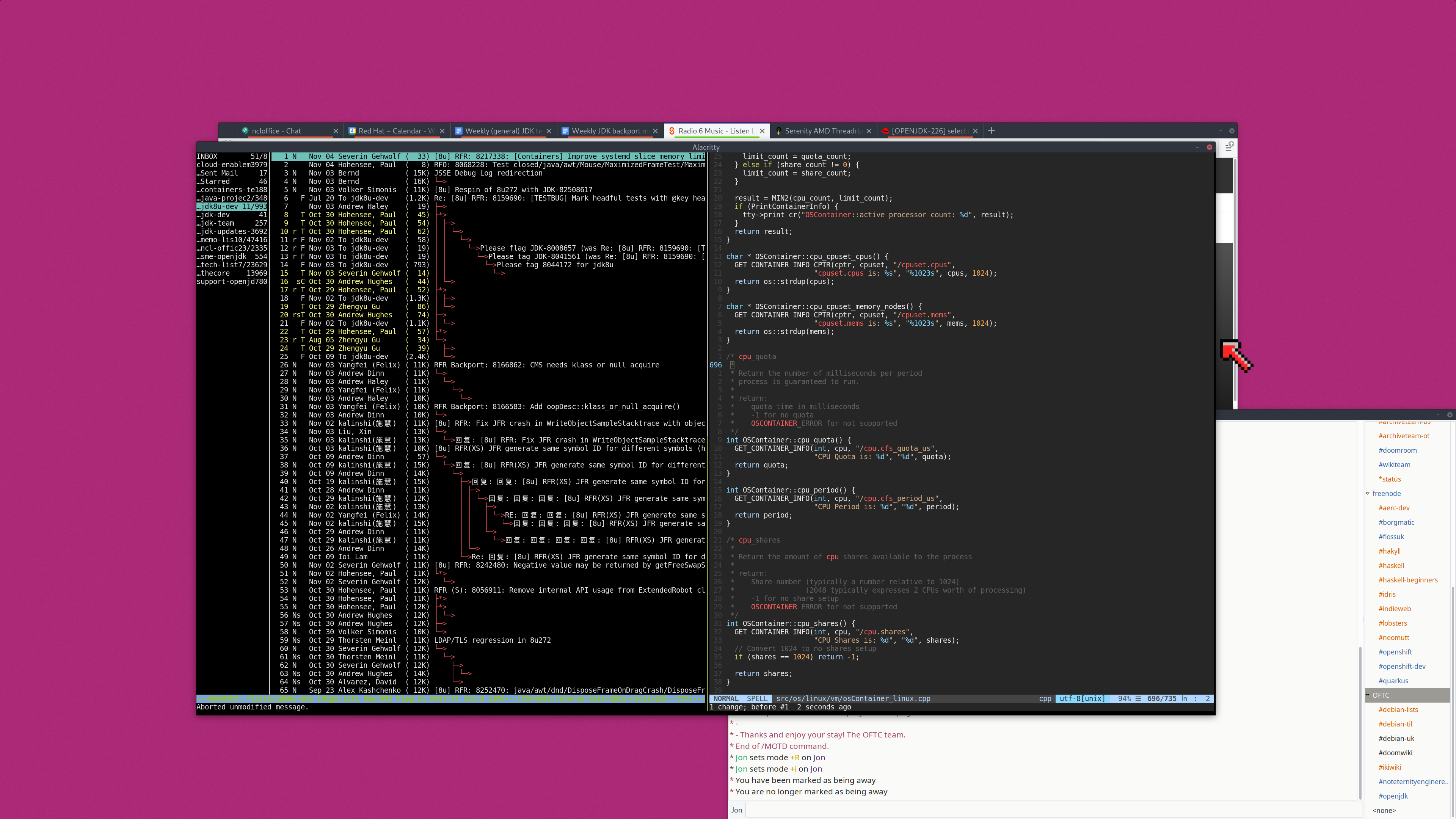 See if you can spot it

I must fight this sickness / Find a cure
I wanted to share Type design issue I hit recently with Striot.
Within StrIoT you define a stream-processing program, which is a series of
inter-connected operators, in terms of a trio of graph types:
Graph a. This layer deals with all the topology concerns: what is
connected to what.StreamVertex, which is used to replace
a in the above and make the concrete type Graph StreamVertex. Here we
define all the properties of the operators. For example: the parameters supplied
to the operator, and a unique vertexID integer that is unfortunately necessary.
We also define which operator type each node represents, with an
instance of the third type,StreamOperator, a simple enumeration-style type:
StreamOperator = Map Filter Scan vertexID, etc. This was mostly
fine for totally novel code, but where I had existing code paths that operated
in terms of Graph StreamVertex and now needed access to these parameters, it
would have meant refactoring a lot of code. So instead, I added these properties
directly to the types above.
Some properties are appropriate for all node types, e.g. mean average service time.
In that case, I added the parameter to the StreamVertex type:
data StreamVertex = StreamVertex
      vertexId   :: Int

    , serviceTime:: Double
Source node types;
selectivity is appropriate only for filter types. So, I added these to the
StreamOperator type:
data StreamOperator = Map
                      Filter Double -- selectivity

                      Source Double -- arrival rate
Graph StreamVertex
to test something unrelated to the modelling work, I now had to add filter
selectivities and source arrival rates. This was tedious but mostly solved with
automatically with some editor macros.
One area though, that was a problem, was equality checks and pattern matching.
Before this change, I had a few areas of code like this
if Source == operator (head (vertexList sg))

if a /= b then  -- where a and b are instances of StreamOperator
cmpOps :: StreamOperator -> StreamOperator -> Bool
cmpOps (Filter _) (Filter _) = True
cmpOps (FilterAcc _) (FilterAcc _) = True
cmpOps x y = x == y
Filter, and I didn't care
about the selectivity, indeed, it was meaningless for the way I was using the type.
I have a higher-level function that handles "hoisting" an Operator through a Merge:
So, before, you have some operator occurring after a merge operation, and afterwards,
you have several instances of the operator on all of the input streams prior to the
Merge. Invoking it now looks like this
filterMerge = pushOp (Filter 0)
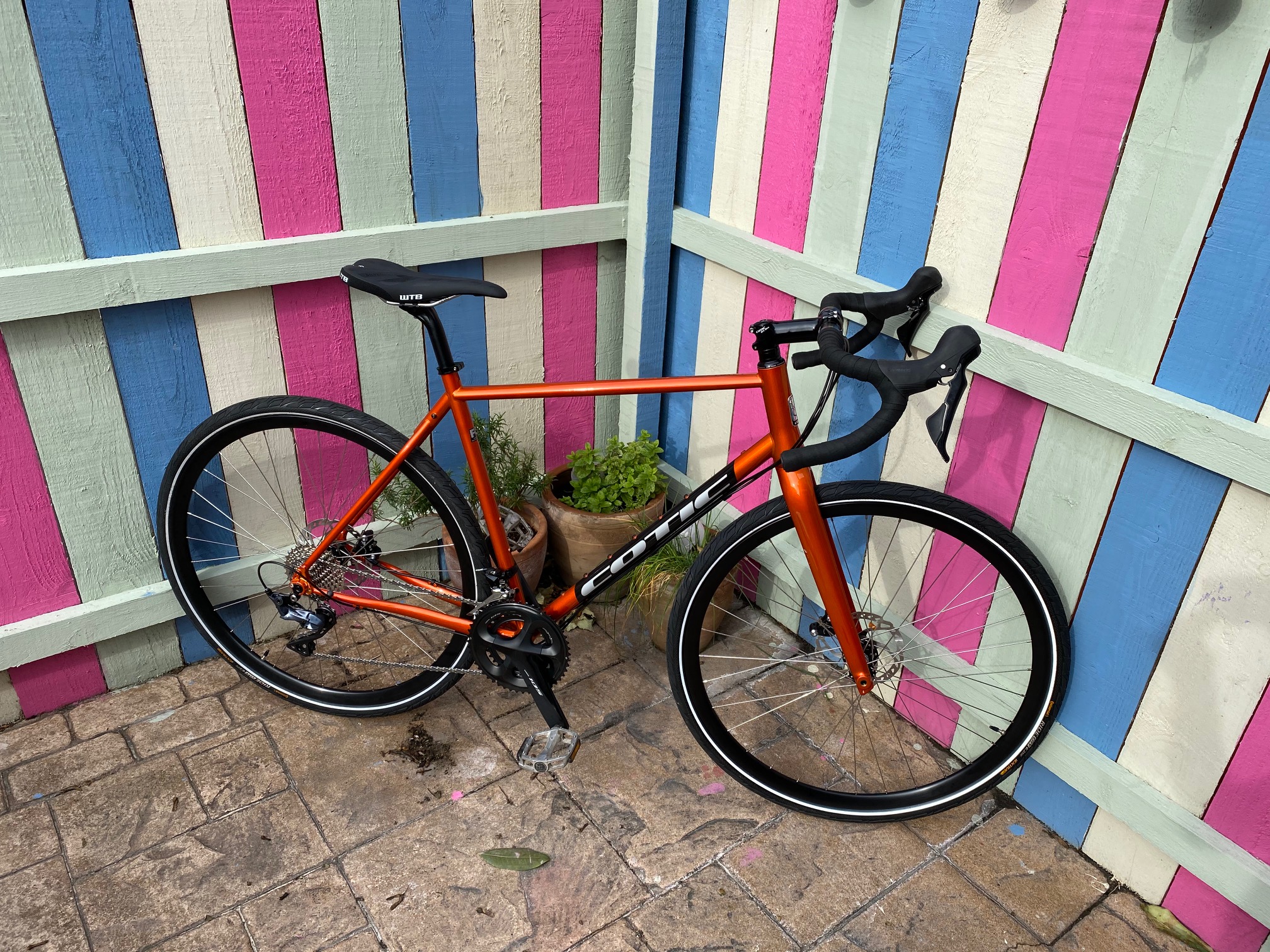 My new Cotic Escapade

 Chemical Brothers Out Of Control (21 Minutes of Madness remix)
Copy 1143 of 1999
When I did the work described earlier in template
haskell, I also explored generic programming
in Haskell to solve a particular problem. StrIoT is a program generator: it
outputs source code, which may depend upon other modules, which need to be
imported via declarations at the top of the source code files.
The data structure that StrIoT manipulates contains information about what
modules are loaded to resolve the names that have been used in the input code,
so we can walk that structure to automatically derive an import list. The
generic programming tools I used for this are from
Scrap Your Boilerplate
(SYB), a module written to complement
a paper of the same name.
In this code snippet,
everything and mkQ are from SYB:
extractNames :: Data a => a -> [Name]
extractNames = everything (++) (\a -> mkQ [] f a)
     where f = (:[])
Data, as must all its
members (and their members etc.): This holds for the Template Haskell Exp
types. The output is a normal list of Names. The utility function has a
more specific type Name -> [Name]. This is all that's needed to walk over
the heterogeneous data structures and do something specific (f) when we
encounter a Name.
Post-processing the Names to get a list of modules is simple
nub . catMaybes . map nameModule . concatMap extractNames
words :: String -> [String] can normally
be used without an explicit import (since it's a Prelude function). However,
once round-tripped through a Name, it becomes GHC.OldList.words. Attempting
to import GHC.OldList fails in some contexts, because it's a hidden module or
package. I've been meaning to investigate further and, if necessary, file a GHC
bug about this.
For this reason I've scrapped all the above and gone with a different plan. We
go back to requiring the user to specify their required import list explicitly.
We then walk over the Exp data type prior to code generation and decanonicalize
all the Names. I also use generic programming/SYB to do this:
unQualifyNames :: Exp -> Exp
unQualifyNames = everywhere (\a -> mkT f a)
     where f :: Name -> Name
           f n = if n == '(.)
            then mkName "."
            else (mkName . last . splitOn "." . pprint) n
.) since that code-point is also used
as the delimiter between package, module and function. Otherwise this looks
very similar to the earlier function, except using everywhere and mkT (make
transformation) instead of everything and mkQ (make query).
At the start of the year I begun keeping a daily diary for work as a
simple text file. I've used various other approaches for this over the years,
including many paper diaries and more complex digital systems. One great advantage
of the one-page text file was it made assembling my weekly status report email
very quick, nearly just a series of copies and pastes. But of course there are
drawbacks and room for improvement.
vimwiki is a personal wiki plugin for the vim and
neovim editors. I've tried to look at it before, years ago, but I found it too
invasive, changing key bindings and display settings for any use of vim, and
I use vim a lot.
I decided to give it another look. The trigger was actually something
completely unrelated: Steve Losh's blog post "Coming Home to
vim". I've
been using vim for around 17 years but I still learned some new things from
that blog post. In particular, I've never bothered to Use The Leader for user-specific shortcuts.
The Leader, to me, feels like a namespace that plugins should not touch: it's
like the /usr/local of shortcut keys, a space for the local user only. Vimwiki's
default bindings include several incorporating the Leader. Of course since I didn't
use the leader, those weren't the ones that bothered me: It turns out I regularly
use carriage return and backspace for moving the cursor around in normal mode, and
Vimwiki steals both of those. It also truncates the display of (what it thinks are)
URIs. It turns out I really prefer to see exactly what's in the file I'm editing.
I haven't used vim folds since I first switched to it, despite them being why
I switched.
Disabling all the default bindings and URI concealing stuff and Vimwiki is now
much less invasive and I can explore its features at my own pace:
let g:vimwiki_key_mappings =   'all_maps': 0,
let g:vimwiki_conceallevel = 0
let g:vimwiki_url_maxsave = 0
nnoremap <leader>ww :VimwikiIndex<cr>
nnoremap <leader>wi :VimwikiDiaryIndex<cr>
nnoremap <leader>wd :VimwikiMakeDiaryNote<cr>
nnoremap <CR> :VimwikiFollowLink<cr>
nnoremap <Tab> :VimwikiNextLink<cr>
nnoremap <S-Tab> :VimwikiPrevLink<cr>
nnoremap <C-Down> :VimwikiDiaryNextDay<cr>
nnoremap <C-Up> :VimwikiDiaryPrevDay<cr>
,wd (my leader) now brings me straight to today's diary page, and I can create
separate, non-diary pages for particular work items (e.g. a Ticket reference) that
will span more than one day, and keep all the relevant stuff in one place.
This is the tenth part in a series of blog posts. The previous post was Amiga floppy recovery project: what next?. The whole series is available here: Amiga.
 Rotary encoder, OLED display and mount
Next.

