Search Results: "gfa"

11 March 2009

Asheesh Laroia: Photo galleries

I prefer to host my own Internet services. Here is a quick summary of what I have found in the past two hours of my life: It's 2009. Am I just going to use Flickr and call it a day? I selected these by looking through web photo gallery programs on freshmeat.net. I'd like a dynamic one so I can accept comments. It does seem there are some decent galleries for WordPress, in particular NextGEN Gallery. What do others in the autonomous world do? Am I supposed to write my own? (Waiting for Gallery3 is probably a good path forward, failing that.)

22 February 2009

Biella Coleman: No final decision but I am excited!

I can t believe Debconf will be on American soil next summer. This is exciting, whichever city (Boston/NY) wins!

18 February 2009

Julien Blache: mt-daapd EPIC WIN

I ve been doing some code lately, fixing things here and there, and over the last few days gave mt-daapd some attention. First, I was reported a segfault of mt-daapd when reloading web pages too fast. Surprisingly, it turned out to be a stupid omission in a simple routine and it is hard to hit without disabling the cache in the browser. Now, I just fixed something that s been bugging me for a while: mt-daapd did not handle Avahi daemon restarts, leading to mt-daapd becoming invisible to clients relying on mDNS until you restarted it. And, wow, that went a bit further than expected. As I expected, the simple piece of code needed to handle that wasn t there. But still it did not work, as it turns out the event loop for the Avahi polling wasn t being run. Replace stupid code reinventing the wheel by the Avahi-provided wheel and there, it works. But not when run as a daemon (aka foreground only). Well yes, starting the thread before daemonizing isn t going to work well, so fix that. EPIC WIN \o/ As mt-daapd s upstream is not active anymore I m accumulating fixes for mt-daapd in the Debian package, to the point I m starting to consider setting up a git repository somewhere with those fixes and possibly some more code rework if I feel like it.

1 February 2009

Patrick Winnertz: Midnight Commander revived (new version available)

After everybody though that Midnight Commander is dead and the next release of it will be released together with hurd, it is very cool to announce that a new team of developers are active again. We've taken over officially the development in December and now, after two months of work a new version of mc is available: 4.6.2. This is mostly a bugfix release addressing several very nasty bugs which are also present in the debian package. Here the notes what has changed in this release: As you see.. quite a long list of fixes :) Have fun and check the new release out right here! :)

23 December 2008

Steve Kemp: Guess he wasn't too popular at the end, huh?

Previously I've posted a couple of running commentries describing how I've examined and gone about fixing a couple of bugs in Debian packages I use, enjoy, or have stumbled upon by accident. Each of these commentries has resulted in a change or two to the affected software to make the bug vanish. Fixing the bug is usually the hard part, but obviously it isn't the only thing that you need to do. While it is fun to have a locally fixed piece of software if you don't share it then the very next release will have the same bug again - and you'll spend your life doing nothing more than fixing the same bug again and again. Generally the way that I report my fixes is by sending email to the Debian bug tracker - because I usually only try to fix bugs that I see reported already. Specificially I tend to only care about: This entry got a little bit long .. click to read more ObFilm: Ghostbusters 2

22 December 2008

Steve Kemp: What can you do? Sparta will need sons.

Since I've ranted a little recently lets do another public bugfix. The last few times people seemed to like them, and writing things down helps me keep track of where I am, what I'm doing, and how soon it will be "beer o'clock". So I looked over the release critical bug list, looking for things that might be easy to fix. One bug jumped out at me: I installed the package:
skx@gold:~$ apt-get install gnomad2
..
The following NEW packages will be installed
  gnomad2 libmtp7 libnjb5 libtagc0
..
Once I copied an .mp3 file to my home directory, with the .ogg suffix I got a segfault on startup:
skx@gold:~$ cp /home/music/Audio/RedDwarf-back-to-reality.mp3 ~/foo.ogg
skx@gold:~$ gnomad2
..
LIBMTP_Get_First_Device: No Devices Attached
PDE device NULL.
TagLib: Ogg::File::packet() -- Could not find the requested packet.
TagLib: Vorbis::File::read() - Could not find the Vorbis comment header.
[segfault]
skx@gold:~$
So I downloaded the source ("apt-get source gnomad2"), and the dependencies for rebuilding ("apt-get build-dep gnomad2"). This allowed me to rebuild it locally:
skx@gold:/tmp/gnomad2-2.9.1$ ./configure --enable-debug && make
skx@gold:/tmp/gnomad2-2.9.1$ cd src/
And now it can be run under GDB.
skx@gold:/tmp/gnomad2-2.9.1/src$ gdb ./gnomad2
GNU gdb 6.8-debian
...
(gdb) run
Starting program: /tmp/gnomad2-2.9.1/src/gnomad2
...
LIBMTP_Get_First_Device: No Devices Attached
PDE device NULL.
[New Thread 0x41dcd950 (LWP 23593)]
TagLib: Ogg::File::packet() -- Could not find the requested packet.
TagLib: Vorbis::File::read() - Could not find the Vorbis comment header.
Program received signal SIGSEGV, Segmentation fault.
[Switching to Thread 0x41dcd950 (LWP 23593)]
0x00007fc89e0340b0 in taglib_tag_artist () from /usr/lib/libtag_c.so.0
(gdb)
Interestingly the crash comes from a library, libtag_c.so.0. So either: Time to guess which that is. Charitably we'll assume any library that segfaults will be quickly fixed, because it will have more users than a single program.. Moving on we can look at the gnomad2 source for mentions of taglib. Several mentions are found, but src/tagfile.c is clearly the correct place to look. That file contains the following code:
void
get_tag_for_file (metadata_t *meta)
 
  gchar *tmppath = filename_fromutf8(meta->path);
  TagLib_Tag *tag;
  const TagLib_AudioProperties *properties;
  TagLib_File *file = taglib_file_new(tmppath);
  if(file == NULL)  
    g_printf("could not open file %s", tmppath);
    g_free(tmppath);
    return;
   
  g_free(tmppath);
  tag = taglib_file_tag(file);
  properties = taglib_file_audioproperties(file);
  gchar* artist = taglib_tag_artist(tag);
  ..
This looks like a great place to explore because opening a file to read the tags is most likely where the crash is going to be coming from. Interestingly we see the code: Let us guess that the file opening is succeeding but that the tag structure fetched via taglib_file_tag is NULL - and this causes the crash. A quick edit:
  g_free(tmppath);
  tag = taglib_file_tag(file);
  if(tag == NULL)  
    g_printf("tag was null");
    return;
   
  properties = taglib_file_audioproperties(file);
  gchar* artist = taglib_tag_artist(tag);
Rebuild, and the segfault is gone. We have a winner. Now we just need to file a patch... ObFilm: 300

21 November 2008

John Goerzen: If Programming Languages Were Christmas Carols

Last spring, I posted If Version Contol Systems Were Airlines, which I really enjoyed. Now, because I seem to have a desire to take a good joke way too far, it’s time for: IF PROGRAMMING LANGUAGES WERE CHRISTMAS CAROLS I apologize in advance. (Feel free to add your own verses/carols in the comments.) Away in a Pointer (C) (to Away in a Manger) Away in a pointer, the bits in a row.
A little dereference to see where they go.
I look down upon thee, and what do I see?
A segfault and core dump, right there just for me. I saw thy init there, a reaping away
My process, from its address space, so sorry to say.
I thought I had saved thee, from void pointers all,
But maybe I missed one, and doomed you to fall. Be near me, debugger, I ask thee to stay
Close by my terminal, and help me, I pray;
To find all the bugs and the void pointers too,
And if my kernel oopses, help me reboot for you. Joy to the Wall (Perl) (to Joy to the World) Joy to the Wall, the Perl is come!
Let awk receive her King;
Let every grep prepare him room,
And bash and sed shall sing,
And bash, and bash, and sed shall sing. Joy to the keyboard, we’ll use it all!
Let men, shift keys, employ;
Implicit variables, and globals never fall.
Repeat the line noise now,
Repeat, repeat, the line noise now. Perl rules the world with truth and ASCII,
And makes the doctors prove
The glories of carpal tunnel hands,
And we do it more than one way,
And we do it, and we do it, more than one way. Hark! The Herald Coders Sing (Haskell) (to Hark! The Herald Angels Sing) Hark! The herald coders sing,
“Map and fold, recursive King;
Recursion and patterns wild,
Pure and IO — they’re reconciled!”
Joyful, all ye functions rise,
Join the typeclasses of the types,
With recursion, do proclaim,
“Laziness is born in this domain.” Refrain
Hark! The herald coders sing,
“Map and fold, recursive king!” Monads, by highest Heav’n adored;
Monads, their depths still unexplored;
Late in time, behold they’re good,
Never once were understood.
Veiled in functions, the Monads stay,
Used for IO, and more, each day,
With excitement, Monads say,
“Arrows are stranger, so with us stay.” (Refrain) Hail the glorious compiler of Glasgow!
Hail the threaded run-time system!
Join the beautiful Cabal of Hackage,
Upload there thy perfect package.
We know best, what we will Handle,
You’re safe with us: no pointers, no vandals.
Born to make your exceptions throw,
Unless you unsafePerformIO. (Refrain) Lispy the Paren (to Frosty the Snowman) Lispy the paren was a jolly happy soul,
With a lot of cars and a little cons
And two ends made out of curves.
Lispy the paren is a fairy tale, they say,
He was just common, but the children know
how he came to life one day.
There must have been some magic in that
Old Symbolics they found.
For when they placed him on its disk,
It recursed around and ’round. O, Lispy the paren,
Was recursive as can be.
And the coders say it would take a day
To put his parens away.
Clunkety clunk clunk,
Look at Lispy go.
Clunkety clunk clunk,
Consing on the car. Lispy the snowman knew
The keyboard was hot the day,
So he said, “Let’s cons and we’ll have some fun
now before they Scheme away.”
Down to the function,
With a list there in his RAM,
Running here and there,
all around the LAN, saying
“cdr me if you can.”
He led them down the streets of disk
Right to the traffic bus.
And only paused a moment when
He heard them holler (quit). Oh BASIC Night (to O Holy Night) Oh BASIC night, the LEDs are brightly glinting;
It is the night of the dear GOSUB’s birth!
Long lay the world in sin and error printing,
Till you appeared and the RAM felt its worth.
Shiver of fear, line numbers do inspire,
For yonder breaks a mostly harmless GOTO.
Fall on your bits, O hear the Visual voices!
O BASIC divine, O BASIC where GOTO was born!
O BASIC, O Holy BASIC, O BASIC, you’re mine! Some want to say, “GOTO is harmful always,”
But what of them, in their post-modern world.
We PRINT the truth, in the line-numbered goodness,
But Dijkstra appeared, and the faith, it was lost.
A thrill of hope, when .NET BASIC announces,
But Visual BASIC, what kind of thing are you?
Fall on your GUI, O see the old line numbers!
Behold BASICA, O BASIC when DOS was born!
O numbers, O lines, spaghetti divine! Guido We Have Heard on High (Python) (to Angels We Have Heard on High) Guido we have hard on high
Sweetly indenting o’re the code,
And the functions in reply
Their exceptions sweetly flowed. Refrain Indent….. in your whitespace careful!
Indent…… in your whitespace careful! Spaces, why this jubilee?
Why semicolons have you so wronged?
What backslashes must we use
If we want our lines so long? (Refrain) Come to Guido here to see
“One Right Way” is good, of course.
There’s no need for Perl, you know,
We have to be more verbose. (Refrain) Now the PEP will show the way
To the future, we shall see.
Banish lambda and the rest
Of the things we liked the best. (Refrain)

20 November 2008

Alastair McKinstry: One of Those Codes

--3177-- VALGRIND INTERNAL ERROR: Valgrind received a signal 11 (SIGSEGV) - exiting
--3177-- si_code=80;  Faulting address: 0x0;  sp: 0x402A9FD40
valgrind: the 'impossible' happened:
   Killed by fatal signal
   ==3177==    at 0x3801FDEA: unlinkBlock (m_mallocfree.c:190)
   ==3177==    by 0x38020CAE: vgPlain_arena_malloc (m_mallocfree.c:1055)
   ==3177==    by 0x38035516: vgPlain_cli_malloc (replacemalloc_core.c:101)
   ==3177==    by 0x380022F5: vgMemCheck_malloc (mc_malloc_wrappers.c:182)
   ==3177==    by 0x38035BA7: do_client_request (scheduler.c:1158)
   ==3177==    by 0x380372B1: vgPlain_scheduler (scheduler.c:869)
   ==3177==    by 0x38051B59: run_a_thread_NORETURN (syswrap-linux.c:87)
This code has already killed one debugger (Intel DB) and sent strace into an infinite loop of segfaults. <Sigh />. Tags , ,

9 November 2008

Simon McVittie: Implementing D-Bus services with telepathy-glib

(Part 1 of an ongoing series: shiny things in telepathy-glib)
16:46 < epmf> tp-glib is made of magic

—#telepathy, 2008-04-15

Rob pointed out today that I'd been promising to blog about telepathy-glib for several months and still haven't done so. I think there's too much to cover in one blog post, so I'll start with the oldest part - implementing a service (typically a Telepathy connection manager).

While telepathy-glib is (obviously) intended for Telepathy implementors, I think the ideas we've been implementing are likely to be useful for any D-Bus API, particularly flexible/complex APIs where an object implements many interfaces.

Introduction to telepathy-glib telepathy-glib started out as a collection of code extracted from our XMPP connection manager, telepathy-gabble, but at some point it grew beyond that into a wrapper around/partial replacement for dbus-glib. We've been quite pleased with it, really :-) My first major round of work on telepathy-glib, during the first half of 2007, was to split it out from telepathy-gabble (versions up to 0.5.9 were released as part of Gabble 0.5.x tarballs, in fact), leading to the release of the 0.6.x stable branch in late September. This was very helpful for implementing connection managers - Salut, Idle and telepathy-sofiasip (our connection managers for link-local XMPP, IRC and SIP) all started off by forking/cargo-culting from Gabble, and achieved huge code reductions by porting to telepathy-glib. Also, Will Thompson used it in his Summer of Code project, telepathy-haze, to go from nothing to a working and useful Telepathy implementation based on libpurple in a matter of a few months. The second major round of work, which I'll discuss in a later article, added client code to telepathy-glib, obsoleting the older/worse libtelepathy and allowing client programs like Empathy and telepathy-stream-engine to be written using telepathy-glib. In the process, I accidentally reinvented DBusGProxy :-) More details to come later!
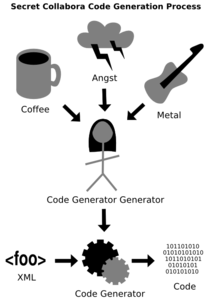
Some background: service-side code generation
The secret Collabora code-generation process

(credit: daf)

Supporting D-Bus in the GObject world has always involved quite a lot of code generation. The core API of dbus-glib is heavily reliant on varargs functions, which aren't type-safe and are easy to get wrong. dbus-glib contains a program called dbus-binding-tool, which is meant to generate reasonably sane GObject APIs for D-Bus objects. Unfortunately, it seems to be intended to generate a whole GObject at a time. Early versions of telepathy-gabble used dbus-binding-tool plus a script called gengobject.py to generate API stubs for the exported objects; developers then filled in the blanks, and hey presto, we had a GObject on D-Bus. This was fine up to a point, but had a couple of major drawbacks. Whenever we changed the D-Bus API (quite common during the early development of Telepathy), there was a very laborious and error-prone merging process. We ended up with the following process:
  • copy the D-Bus introspection XML from the telepathy-spec repository into a directory xml/pristine (actually, the canonical form for the spec was Python for a while, and we had a script that exported a contrived object onto D-Bus and introspected itself to get the XML - but that's another story!)
  • preprocess the introspection XML to add the dbus-glib CFunctionName annotation, resulting in a directory xml/modified
  • run dbus-binding-tool and a Python script gengobject.py to generate C source in xml/src
  • three-way-diff the old version of xml/src, the new version of xml/src, and the real C code in src to create a new version of src
  • pray that the diff process hadn't randomly exchanged functions' implementations
  • update the resulting code in src so it worked
  • check the whole mess back into darcs
  • hope that nobody else had made changes that would result in darcs conflicts
If you haven't yet gathered, this was a bit of a nightmare. Also, it was very easy to return the wrong thing from a method without noticing - because all the APIs were varargs, the compiler didn't notice, and the first we'd know about it was a mysterious segfault under certain circumstances.
How telepathy-glib fixes code generation telepathy-glib improves on this by taking advantage of this innocuous-looking feature in dbus-glib:
commit 355ef78d98d6fc65715845d56232199162cab12a
Author: Steve Fr cinaux <steve istique net>
Date:   Thu Aug 17 11:48:20 2006 +0200
    Interface support for bindings.
Instead of running dbus-binding-tool or creating GObjects with D-Bus interfaces, we put the entire Telepathy spec through glib-ginterface-gen.py, a distant descendant of Gabble's gengobject.py. For each interface in the spec, we generate a GInterface that mirrors the D-Bus interface. Any GObject that implements the GInterface automatically gets the D-Bus interface if it's exported onto D-Bus. There are a few non-obvious refinements, though:
  • The signature of the method implementation is always in the mode that dbus-glib calls "asynchronous", where the method implementation can either send a reply message before or after it returns. For "slow" methods, this is the only thing you can do. For instance, many Telepathy D-Bus methods can't return anything until some TCP round-trips to the server have happened. This is also the only thing you can do if you want to extract extra information, like the sender's unique name, from the method-call message (dbus-glib's "synchronous" API doesn't allow this to be done). For "fast" methods, sending a reply message before returning is just as easy as using the "synchronous" API (it's just a difference of syntax), and has an API consistent with that of the "slow" methods, making it easier for service authors.

  • The layout of the GInterface vtable is private, and (auto-generated) accessor functions are used to fill in implementations. This means our ABI doesn't change just because we re-ordered functions in the spec.

  • If no implementation is provided for a method, we just raise an appropriate error (org.freedesktop.Telepathy.Errors.NotImplemented), rather than suffering an assertion failure. This means we can safely add methods to an interface.

  • While we're generating code anyway, we generate some static inline wrapper functions which wrap dbus_g_method_return(), to have type-safe method returns. You can easily check that a method replies with correct types, by checking that the implementation of Foo() replies by calling tp_svc_some_interface_return_from_foo().

  • Similarly, we generate wrapper functions to emit signals, to get type-safe signal emission.

Not all interfaces are stable enough to be included in telepathy-glib's stable API and ABI, so some of our other projects include a copy of the telepathy-glib code-generation tools, and generate their own "mini-telepathy-glib" (traditionally in a /extensions/ directory) for their implementation-specific (drafts of) interfaces. This isn't yet as polished as it ought to be (mainly because we don't want to freeze the augmented-introspection-XML format that we write the Telepathy spec in, because it's rather ad-hoc and hackish in places) but it works quite well in practice. To see what this looks like in practice, have a look at the examples in telepathy-glib, or at a Telepathy connection manager like telepathy-gabble.
Mixins and base classes Another feature of telepathy-glib which makes life easier for connection manager authors is that it provides "mixins" and base classes which implement some of the GInterfaces. There's absolutely nothing magic about the base classes - they don't have any access to private implementation details of the GInterfaces, they just implement them like everyone else does. The "mixins" are only slightly more magical - they store some extra state inside the structures representing GObjects and their classes, and use it to provide default implementations of some or all of the methods on a particular interface (or two interfaces, in the case of the new TpMessageMixin). I'll leave it up to Rob to explain those in greater detail, since I seem to remember that he invented them :-P The examples and regression tests in telepathy-glib are quite good examples of how these work in practice.

17 October 2008

MJ Ray: What topics do you want to read here?

I’ve just set up a poll on my site asking: what topics do you want to read here? Since this July, when cycling and most local and political themes were split off into other blogs, this site has been mostly Web Development and GNU/Linux topics, with an SPI article appearing most weeks, and minor themes of Koha news and ideas and general internet/telecoms issues around ThePhoneCoop. Finally, Drupal, OSCommerce and general business topics appear less frequently. By traffic, the SPI series seems by far the most popular (but at least one of those is heavily spam-attacked now, so I’d discount it), followed by other political themes, then the technical posts. I suspect that politics is getting a temporary boost because of the US and Canadian elections, even though I’ve not written about them much. But is there some other theme that people want to read about? The poll box on the right column lets you tick as many or as few as you want. It requires javascript, but if you don’t have javascript, please leave a comment on my site. If you want to suggest a new topic which I should add, please leave that in a comment too.

15 September 2008

Erich Schubert: Eclipse segfaulting on AMD 64

... might be due to a bug in Sun Java 6. Try upgrading to Java 6 Update 10 release candidate (also known as 'beta') or using a different Java VM such as IBMs or GNU. Worked for me.Bug reported in Feb 2008 and Bug reported in Oct 2008 at Sun (note: they are marked as 'fix delivered' but that includes beta releases such as the 6u10RC linked above.

11 September 2008

MJ Ray: Away From Keyboard

I’ve been away from the blogging keyboard for a few more days than I expected. For some reason, my Wordpress doesn’t work in lynx so I couldn’t post from the mobile phone when I had chance. I was at:- I’ll write up the remaining events over the next few days and they should appear linked from below this article - please leave me a comment if you want to influence the order I write them. First I need to attend to some business matters, though. Other recent random things: upgrading my kernel (to enable an rt2500 wireless card instead of the nasty bcm4301 I was using) seems to have fixed an X/GNUstep copy-paste problem I was having; why does http://identi.ca say “OpenID authentication failed: Not in requested trust domain” to my OpenID?

6 September 2008

Wouter Verhelst: Bughunting is fun

Two reasons:
  1. 'foo FTBFS on m68k' is not RC. 'foo FTBFS on m68k because it segfaults during the build since it does bar and baz, which just happens to result in a segfault on m68k at startup but might randomly result in a segfault on every architecture, really' in most cases is.
  2. It, well, is just fun to debug someone else's code. On m68k, it's easy to do that, too, if you know a bit of assembly language.
Today's (and last week's) bug: #497262. Xemacs21 segfaults at startup on m68k (and FTBFSes because of that), which is RC for m68k. Reason: confusion between a pointer and its value. In other words: the sanity check might succeed, or it might not, depending on your luck. In fact, the first time the code flows through this buggy path, it does not bomb. Once we do get through this bit, it's also very likely that regular error handling will catch it—the only reason why xemacs segfaults here is because we're still in initialization, and the error object in the lisp stuff hasn't been initialized yet, so we get a nice null pointer dereference... That alone isn't enough to make it RC everywhere, but it's good enough to make it important and fixable for the maintainer. Like I said, fun. Sorry for those of you who want to release Lenny ASAP, but I think I'll be making your life a bit harder :-> Next week's bug: a similar issue in emacs, or the build failure of ghc6 on m68k, depending on time and complexity.

26 July 2008

MJ Ray: Good Tour for Software and Cooperatives Enters Final Weekend

This weekend, I will be mostly watching the Tour de France. It’s been a very good tour for software and cooperatives. Look at the current leaderboards:-
Teams
  1. Carlos Sastre Candil (also 2nd in King of Mountains) Team Computer Sciences Corporation - Saxo Bank
  2. Frank Schleck (3rd KoM) Team CSC - Saxo Bank
  3. Bernhard Kohl (1st KoM) Gerolsteiner bottled water - OK, not related
  4. Cadel Evans, Silence anti-snoring product - Lotto Belgium - also unrelated
  5. Denis Menchov, Rabobank cooperative
Points
  1. Oscar Freire Gomez, Rabobank
  2. Erik Zabel, Team Milram, a brand of Nordmilch cooperative
  3. Thor Hushovd, Cr dit Agricole cooperative banks
Teams
  1. Team CSC Saxo Bank
  2. AG2R-La Mondiale insurance mutuals
  3. Rabobank
  4. Euskaltel - Euskadi - privately-owned telco and a government
  5. Caisse d’Epargne cooperative bank
So however it finishes, I think it probably will have been a much better race for software and cooperatives than last year’s tour, likely to take 4 of the top 5 team positions and 1-2-3 in the green jersey contest… even the doping scandals have been for other teams this year, I think. One day, one of my companies will sponsor pro-cycling. I hope. Anyway, if you’d like to cheer on other Software and Cooperative firm teams until then, European TV coverage details are on another site of mine and Saturday’s time trial start times are posted on a sister site.

13 July 2008

Bastian Venthur: Porting rng to QT4

Today I was busy porting reportbug-ng to QT4. One really cool thing I noticed is the new QWebView widget, which is the main widget of the QWebKit module. It works surprisingly easy compared to the good old QTextBrowser of QT3 — now you can just throw an URL at it and it will render the page nicely complete with CSS, images, etc. Here’s the obligatory screenshot: reportbug-ng qt4 as you can see, the bugreport looks much better than in the old version of rng. WebKit does a really good job rendering the HTML, I think the fonts look even smoother than under firefox. To ease the transition to from QT3 to QT4 I’ve extracted all the Debian BTS specific stuff to python-debianbts and uploaded it to unstable. Rng uses it to query our Bug Tracking System via it’s SOAP interface and get the data in Python’s native data types. There is still the problem with rng (QT3) crashing when showing bugreports. I’ve investigated the problem a bit and found out that it is not rng’s fault but probably a problem with python-qt3 or one of it’s underlying libs. QTextBrowser causes segfaults in nearly 50% of the cases where you try to render html from a different thread: here’s an easy way to reproduce:
# crash.py
# Usage: python crash.py "some text"
#        python crash.py "some evil html”
from qt import *
import sys
import threading
class Form(QMainWindow):
    def __init__(self,parent = None,name = None,fl = 0):
        QMainWindow.__init__(self,parent,name,fl)
        self.browser = QTextBrowser(self, “browser”)
        self.setCentralWidget(self.browser)
if __name__ == ‘__main__’:
    if len(sys.argv)  2:
        print 'Usage: %s "some text"' % sys.argv[0]
        sys.exit()
    s = str(sys.argv[1])
    # setup qt stuff with a browser
    app = QApplication(sys.argv)
    app.connect(app, SIGNAL("lastWindowClosed()"), app, SLOT("quit()"))
    form = Form()
    app.setMainWidget(form)
    form.show()
    # start a different thread and try to set the text in the browser
    # we wait 1.0 second -- just to make sure the change happens after the
    # start of app.exec_loop() below
    t = threading.Timer(1.0, form.browser.setText, (s, ))
    t.start()
    app.exec_loop()
QWebView doesn’t seem to have this problem, the QT4 version of rng didn’t crash a single time. I’m not quite ready with the porting to QT4, and since I’ll be quite busy during the next weeks I suppose it will take a few weeks until the new version will be updated to unstable.

7 July 2008

Bastian Venthur: Segfaults Everywhere

Dear Lazyweb, A few weeks ago rng started to show some segfaulty behavior. I’ve absolutely no idea what’s going on, since Python code usually doesn’t segfault. I guess the problem lies in the qt3-bindings rng uses — does someone know how to verify this? There is a backtrace which seems to show that the problem lies somewhere in /usr/lib/python2.5/site-packages/qt.so but I’m not entirely sure how to interpret that.

18 June 2008

Steve Kemp: Manni - you're not dead yet.

Well I'm back and ready to do some fun work. In the meantime it seems that at least one of my crash-fixes, from the prior public bugfixing, has been uploaded: I'm still a little bit frustrated that some of the other patches I made (to different packages) were ignored, but I guess I shouldn't be too worried. They'll get fixed sooner or later regardless of whether it was "my" fix. In other news I've been stalling a little on the Debian Administration website. There are a couple of reasonable articles in the submissions queue - but nothing really special. I can't help thinking that the next article being a nice round number of 600 deserves something good/special/unique? hard to quantify, but definitely something I'm thinking. I guess I leave it while the weekend and if nothing presents itself I'll just go dequeue the pending pieces. In other news I've managed to migrate the mail scanning service into a nicely split architecture - with minimal downtime. I'm pleased that: Probably more changes to come once I've had a rest (but I guess I write about that elsewhere; because otherwise people get bored!). The most obvious change to consider is to allow almost "instant-activation". I dislike having to manually approve and setup new domains, even if it does boil down to clicking a button on a webpage - so I'm thinking I should have a system in place such that you can sign up, add your domain, and be good to go without manual involvement. (Once DNS has propogated, obviously!) Anyway enough writing. Ice-cream calls, and then I must see if more bugs have been reported against my packages... ObQuote: Run Lola Run.

16 June 2008

Julien Blache: pommed v1.20: minor fixes

pommed v1.20 is out, with two minor fixes: Available on Alioth now, in unstable after the next mirror push. Also I have to block pommed >= 1.19 from entering testing because Linux 2.6.25 is not yet available in Lenny. I hope this will be fixed soon, in the meanwhile, grab the packages from unstable if you’re running testing with a 2.6.25 kernel.

3 June 2008

MJ Ray: BBC website, TV and Technology

[Dish]
(How I get TV) The British Broadcasting Corporation, the largest UK public service broadcaster, is seen as a slow lumbering beast and a bit clueless about technology, as you can see from the comment when I wrote about Click: Free=beer and facebook-flaming recently. I think that's a pretty typical view. For example, the BBC has recently helped to launch Freesat which is good in some ways (free-to-air and maybe more standards-based than Sky) but still publishes half-truths like

"Installing a satellite dish is a job for professionals"
(On balance, it's no harder than installing most TV aerials, in my opinion, but remember you get no warranty on DIY.) It's pretty much the same situation online, which is why stories like The BBC and innovation [DavePress] and Good news for websites - BBC told to link out more! continue to be news, nearly 12 years after the BBC's website launched. (Source) One of the few areas where BBC triumphs is probably news-gathering, picking up stories that are unpopular with both business and government, like BBC NEWS: Towns triumph in broadband tests which follows the Experts Say Ofcom Wrong About Rural Broadband storm online. I recently helped The Doon of May team look into internet connectivity and I was surprised how bad it was in their location: a bit of attention from BBC News is most welcome. If you'd like to try receiving the BBC - or some other national broadcasters in Europe - by satellite, I'm currently taking Questions About Cycling on Satellite over on my Cycling Fans blog.

2 June 2008

Russ Allbery: podlators 2.1.0

Switching to Perl 5.10 for Debian unstable uncovered a bunch of little problems with the Pod::Man based on Pod::Simple that's included with it. I've unfortunately been slow to fix those problems due to being buried in other work, but this release finally cleans up the ones that have been reported, namely: However, the big change is that pod2man now supports a -u (--utf8) option saying to not munge input characters into ASCII and *roff escapes that only work with troff and instead output literal UTF-8 characters and assume one's man program can cope. This will now be true of Debian as of lenny. I have no good ideas for how to do the transition, since the resulting *roff is not portable and, if copied to another system, can even cause deficient nroff programs to segfault. One of the goals of Pod::Man was always to produce portable *roff output, so this option is not the default. However, it is clearly the Right Thing To Do for systems whose man and/or nroff are sufficiently intelligent; any other option either requires embedding groff-specific character escapes (same portability problem) or corrupting non-ASCII characters badly (the previous approach). Any bright ideas welcome. In the meantime, people who know they're working on systems with modern nroff and man can at least get correct output now. Hopefully podlators 2.1.0 will make it into lenny (as part of the Perl package, since it's a Perl core module), either as 5.10.1 if upstream is fast enough or as a Debian-local modification. (We definitely need a new Perl release before lenny; #480428 would be embarassing and is already driving me nuts by producing spurious output from lots of cron jobs. I'm thinking about asking for an upgrade of the priority.)

Next.

Previous.

