Search Results: "gabriel"

26 September 2011

Biella Coleman: Photos for Coding Freedom

So my first book, Coding Freedom: The Ethics and Aesthetics of Hacking is mostly sort of done. All the arguments are in place and I am doing the final, very annoying, seemingly endless work of adding a few final citations, hunting for permissions, and tweaking about 10 paragraphs that I feel can be slightly improved (down from about 20 last week). The book is based on the dissertation but re-framed significantly with lots of new material and best of all a lot of the cruft has been zapped away, I think. The book will include two published pieces, although slightly revised. One of them is one of my all time favorite pieces on the hacker conference (which is the least academic/jargony of the peer reviewed articles). I thought it might be fun to change some of the photos for my book: so if you have some awesome, high quality photos that exude the joy of conferencing from past Debconfs or ANY hacker conference (preferably with computers in the background) please share. I am open to anything although I am looking for a high quality/sharp photo of people hacking away in the hack lab. The photo I have is good but I would like one with better lighting/sharper focus. The book will be published under a CC license (the most restrictive one, but heck as a junior scholar, I took what I could get and it is the first book that Princeton University Press is releasing under such a license). If you hold the copyright, I will need more official permission, otherwise, if it is under a CC or copyleft license, I will be adding the correct attribution/notice in the book.

24 September 2011

Biella Coleman: Hack Week On the Media

So much reporting on hacking is . so bad (no surprise to readers here). Worse is that term term was bandied out constantly during the News of the World Scandal. In contrast to this historical tradition, On the Media has curated a stellar Hack Week that provides depth, breath, and nuance; the producer of the show, Alex Goldman, poured an enormous amount of time, labor, and thought in compiling a rich set of materials to get at the term hackers, the many facets of hacking (from phreaking to hardware hacking) and best of all, interviewed the fantastic Marcia Hoffman from the EFF on one of the laws, the Computer and Fraud Abuse Act, whose massiveness (and vagueness) has the potential to do a lot of damage and which is often wielded against hackers (and many non-hackers as well). There is also an audio section on the term hacker, which I myself might have done slightly differently, emphasizing, that alongside the MIT hacker (covered so well by Steven Levy) phone phreaking (only called as such in 1973 but well and alive before then) fed into a transgressive tradition that was not simply about malicious hacking nor about the media portrayals that started to explode in the 1980s. The interview gets at the fact that there are differences and hackers can be quite sectarian but I might have pushed this fact a little further. All in all and after the ad nauseum use and abuse of the term hacking during the News of the World scandal (and its overabuse with Anonymous), this collection is the perfect antidote.

Biella Coleman: On Leaving NYU/NYC for Montreal/McGill

funny-pictures-cat-is-canadian Despite being on sabbatical last academic year, life was hectic and chaotic leaving me with next to no time to write entries here. Anonymous, which I had worked on for a few years, exploded. I was excommunicated from my house (due to a flood/something likely mold making be very sick) and had to commute to Princeton from the far reaches of Manhattan where I crashed at a friends house for 5 months, while fighting my landlords. I then decided to go on a job hunt primarily as I did not know what would happen with my housing situation in NYC but I was also pursuing some interesting opportunities. Though the housing issue was eventually resolved, in May a rare and enticing opportunity arose. Come January 2012 I will be joining the Art History and Communication Department at McGill University as the Wolfe Chair in Scientific and Technological Literacy. The decision to leave MCC NYU was torturous. The faculty is stellar. The graduate students are top notch and cream of the crop. And the digital media faculty is a force of nature, perhaps one of the deepest and most dynamic departments when it comes to the study of digital media. They also know how to treat their junior faculty right, which made it a place I respected and am deeply indebted to. But this type of opportunity is rare and it helped that NYC as wonderful as it is, is not my cup of tea. I wanted to eventually settle in one of the large Canadian cities, and Montreal was on the top of my list. I get to join one of the best universities in the world and a department whose work on digital media, STS, and politics converges with much of my own. The position provides resources, time, and room to cultivate scholarly work, help build a program of some sort in Science Technology Studies at McGill, and also engage with the public about the ethics and politics of science and technology. I will be teaching a class to joint BA/BS majors on scientific and technological controversies, a topic close to my heart. I also hope to create an open courseware website for my hacker course, which I will teach sometime in the 2012-2013 academic year. It is all that I can ask for, well, except for the weather. I would be lying if I did not admit that the winter scares the heck out of me I know some days I will feel just like this . lolcat4823558

22 September 2011

Biella Coleman: Congressional Quarterly on Hackers

When I was in graduate school, there were two publications that when I found out about them, they changed my life, for the better. One is the Annual Review of Anthropology (and there are many other Annual Reviews) and Congressional Quarterly Researcher. Both, albeit in very different ways, provide clear and crisp road maps and resources related to the topic under discussion. I had the pleasure of writing an ARA on digital media and I had always hoped that there was a Congressional Quarterly on hackers and hacking. Well now there is one and I have to say, they have done a fantastic job. I am not surprised. They tend to be pretty matter of factual and present many sides to an issue. The author, Marcia Clemmitt, did just that, covering open source, transgressive hacking, Anonymous, and cybersecurity among many other issues. Out of all the recent publicly oriented publications on hackers and hacking, this is the one that is the most in-depth but accessible. The only hitch is that the article is behind a pay wall but most universities subscribe to them and you can order an individual copy. update: I forgot to mention that there is an excellent segment in the 24 page report by Daniel Flower, which covers the history and significance of the protests. It is compact but the best account I have seen.

18 September 2011

Biella Coleman: Birds of a Feather for Academics (aka how to study digital media)

lol-bird-watch There is nothing more dispiriting for a scholar of digital media to see the astounding plurality of forms, formats, and politics reduced to one of a handful of tepid categories such as 1) network society 2) peer to peer production 3) digital activism and 4) the absolute most vacuous terms ever, Web 2.0. The problem is summed up rather nicely by a bunch of folks who published an article by the name of Birds of the Internet that every scholar interested in digital media should read: Observing participation without any guide to its diversity is like watching birds with no sense of what distinguishes them other than that they fly and squawk (when of course, many do neither). Rather than
lumping every instance of Internet-mediated participation into boxes labeled digital
culture , virtual reality , online community or network society , a field guide could aid in observing differences and testing, rather than proliferating classifications.

11 September 2011

Biella Coleman: Raymond Williams on the masses

Given his theory of the masses, critical theorist Raymond Williams would probably have not liked or believed in the concept of social engineering: The are in fact no masses, but only ways of seeing people as masses.

10 September 2011

Biella Coleman: How to secure revolution in Silicon Valley

This is the best response to this (simplistic) claim about net access and revolt in Egypt featured in the New York Times: [m] In a widely circulated American Political Science Association conference paper, Yale scholar Navid Hassanpour argues that shutting down the internet made things difficult for sustaining a centralized revolutionary movement in Egypt. But, he adds, the shutdown actually encouraged the development of smaller revolutionary uprisings at local levels where the face-to-face interaction between activists was more intense and the mobilization of inactive lukewarm
[m] maybe we ll have some more fiber optic cable cuts in silicon valley and then the revolution will happen

29 August 2011

Biella Coleman: Redesign

I sorely need to update this blog with some real content and news as there is some big news. In the meantime, I did redesign my main website (finally) and you can see what I have been up to there

14 June 2011

Biella Coleman: Manifestos

It is about time I get back to this blog. It has been way way too long and there are a few things I want to say (a lot to report). But I will start with something small, a mother of a programming manifesto. Enjoy.

25 April 2011

Mirco Bauer: Amazon MP3 Downloader and 64-bit Linux

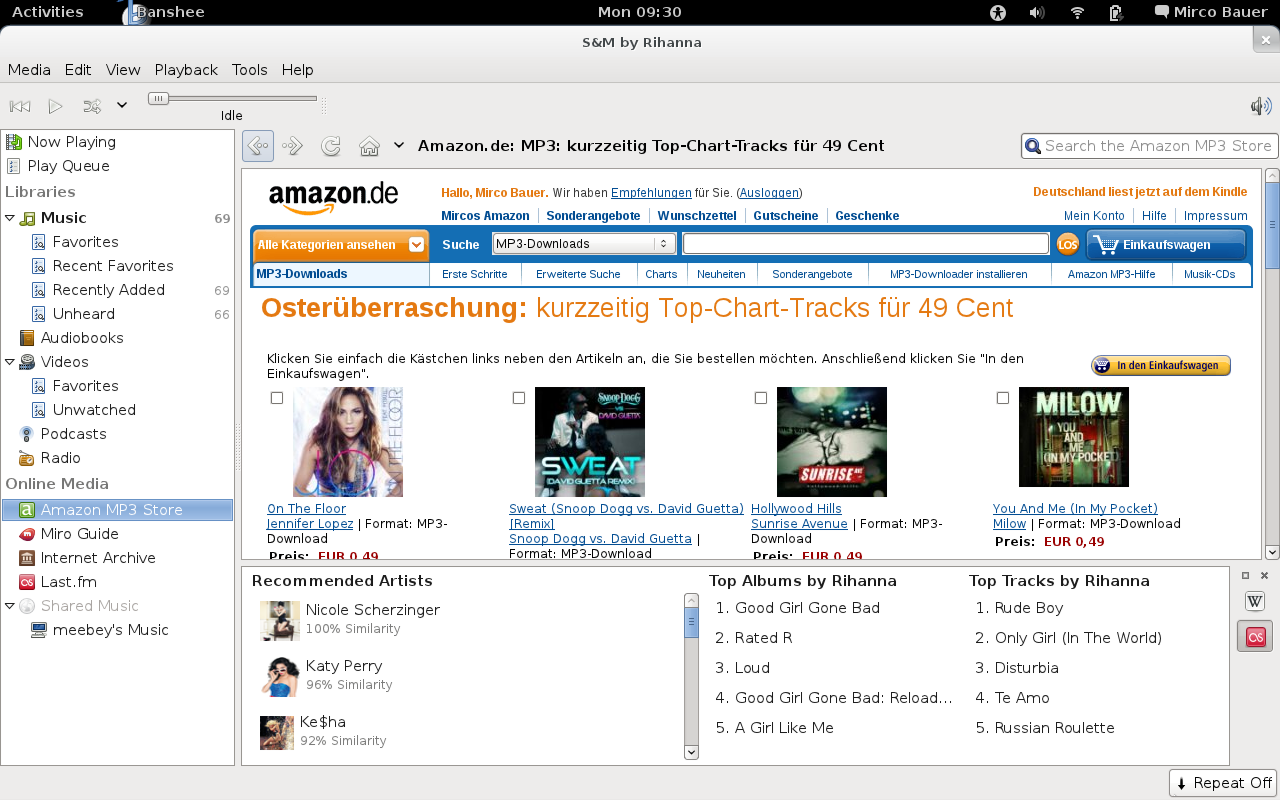
Last night I wanted to buy an album on Amazon and I couldn't do the checkout as the site required me to install the Amazon MP3 Downloader to make the purchase and download of the album. The downloader is not needed for a single song though, but buying each song separately would be more expensive and more work. The good news is that it automatically offered me packages for different Linux distros: Ubuntu, Debian, Fedora and OpenSUSE instead of telling me off for using Linux and leaving me behind with a Windows only download. But here comes the catch, all offered packages are only for the Intel 32-bit architecture. Now this is a showstopper for me, as I am running an AMD64 Debian which is a 64-bit architecture. I first tried to download and run the 32-bit debian package nonetheless as there was some hope with the ia32-libs and ia32-libs-gtk package. But this was not working as the application needs gtkmm libraries like libglademm and bailed when I tried to run it. So I filed a wishlist bug report against ia32-libs-gtk for inclusion of gtkmm and possibly other needed libraries to run the Amazon MP3 downloader on AMD64. So I bought the album using MusicLoad instead which simply puts all songs in a single archive on-the-fly and let me download that archive. When I tweeted my frustration on Twitter I was hinted by Jo Shields and also by Gabriel Burt that there would have been a much simpler solution to this issue by using Banshee which includes an Amazon MP3 Store plugin: Banshee screenshot showing the Amazon MP3 Store plugin This plugin allows you to log into your Amazon account browse their store like the regular Amazon store, plays the song samples directly, purchase songs, downloads the songs and imports them into Banshee's database so you can play them right away. And as if this wasn't good enough yet, with the the purchase of MP3 songs on Amazon using Banshee automatically makes a donation to the GNOME foundation. As I am the only one who forgot or wasn't aware of this awesome solution this deserved some blogging. Update: some people pointed out that clamz is also available to make MP3 purchases on Amazon.

9 April 2011

Biella Coleman: Berlin

I am going to Berlin to give a talk at Re:Publica and will be there from Monday through Thursday (11th-14th of April). I am interested in getting together with Debian developers so please contact me if interested. Feel free to leave a comment about your favorite things to do in Berlin as well as I might have a day or two to check out the sites.

3 April 2011

Biella Coleman: Protected: Draft

This post is password protected. To view it please enter your password below:

15 January 2011

Biella Coleman: Gazed deeply into the abyss

Someone by the name of lobster described my recent work in terms of its potential and damaging psychological effects (on me):
As for Ms. Coleman, I appreciate the work she s doing but I would not want to be locked in a room with her. She has gazed deeply into the abyss. Who knows what horrors have taken root in her mind, and lie sleeping, waiting to unleash unfathomable nightmares for the lulz?
(Yes I loled; captures beautifully a bit of the trauma that can ensue from working on the abyss)

Jordi Mallach: Hiking through the Pyrenean GR 11

Tomorrow, at this time, I'll probably be unsuccessfully trying to find a comfortable position on a seat of the Bilmanbus to Irun. Very early on Saturday, as soon as we get off the bus, Maria and I will quickly head to Hondarribia's beach in Cape Higer to symbolically wet our feet in the waters of the Cantabrian Sea. We won't have much time to enjoy the cold waters of the ocean, though. Soon after that, we'll have to take a deep breath, look East, and start walking if we want to achieve our utmost objective: take a bath in the beautiful beaches of the Cap de Creus, in the Mediterranean sea. In between, 30 days and 840 kilometres of thick woods, deep valleys, high peaks and cold waters, all of which shape incredible landscapes.


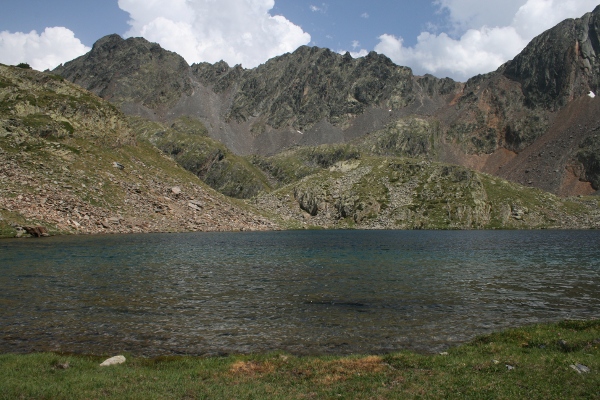
The Portella de Baiau, during our 2008 trip For a whole month, we'll be mostly disconnected from everything else that isn't our knee ache, our blisters, the Sun over our heads or where to get food. It's the first time I leave on a hiking trip as long and tough as this one, and I feel both uncertainty and eagerness. We've been so busy during the last few months that we've been unable to train at all for this, and I'm probably in the worst physical condition in a decade. It's too late to take care of that now, so we'll try to take good care of our legs and spine. In order to get back home in the Mediterranean, we'll have to be fast, some days joining two stages and skipping a few that we know are not that interesting (sections over asphalt, etc.). It's hard to make it in just one month, but we'll try our best. The plan is going to sleep not long after sunset, getting up at dawn, to be able to walk for a decent time before the heat starts being a handicap and just resting at midday, when the Sun is strongest. Of course, this means that I'm missing, yet again, this year's edition of DebConf in New York City, which is really sad because I was looking forward hanging around with Mako, Mika, Biella, micah, Clint and the rest of the NYC/ Boston gang, but when the idea of doing a long trip this summer popped up around January, it was clear DebConf seemed unlikely this year. I hope all of you have a lot of fun, and see you in a few weeks!

7 January 2011

Paul Wise: Another year, another log entry

It has been almost a full year since my last log entry. It has been a busy work year, I attended some nice conferences and did minimal FLOSS stuff. On the work side of things I was a third of an Australian VoIP startup that came and went. I setup Debian servers, installed OpenSIPS and associated software, wrote OpenSIPS scripts, wrote peripheral software and did customer support. We had a good thing going there for a while, some fans on the Whirlpool forums but in the end there wasn't enough money for the requisite marketing and local market circumstances were squeezing Australian VoIP providers anyway. On the conference side of things I went to LCA 2010, the Thai Mini-DebCamp 2010, DebConf10 and FOSSASIA 2010. Had a great time at all of them. At LCA 2010 in windy Wellington, New Zealand the distributions summit organised by Martin Krafft was one of the highlights. It was dominated by Debian/Ubuntu talks but there were some other interesting ones, especially the one on GoboLinux's integration of domain-specific package managers. Also excellent were the keynotes given by Gabriella Coleman (Best & worst of times), Mako Hill (Antifeatures) and others, which I felt gave LCA an improved and very welcome focus on software freedom. There were quite a few Debian folks at LCA, it was great to hang out with them during the week and afterwards. Monopedal sumo with mako and others was hilarious fun. At the Thailand Mini-DebCamp 2010 in Khon Kaen, I was glad to see Andrew Lee (Taiwan) and Christian Perrier (France) again and meet Yukiharu YABUKI (Japan) and Daiki Ueno (Japan). In addition to the five international folks, there were quite a few locals, including Thailand's currently sole Debian member, Theppitak Karoonboonyanan. The event was hosted at Khon Kaen University and opened with my talk about the Debian Social Contract and the Debian Free Software Guidelines. This was followed by a number of talks about Debian package building, a 3-day BSP where we touched 57 bugs, a great day of sightseeing and talks about i18n, derivative distros, keysigning, mirrors, contribution and a discussion about DebConf. During the week there was also the usual beersigning, combined with eating of unfamiliar and "interesting" Thai snacks. After the conference Andrew and I roamed some markets in Bangkok and got Thai massages. Beforehand I also visited a friend from my travels on the RV Heraclitus in Chiang Mai, once again experiencing the awesomeness of trains in Asia, unfortunately during the dry season this time. I took a lot of photos during my time in Thailand and ate a lot of great and spicy food. As a vegetarian I especially appreciated the organiser's efforts to accommodate this during the conference. At DebConf10 in New York City, by far the highlight was Eben Moglen's vision of the FreedomBox. Negotiating the hot rickety subways was fun, the party at the NYC Resistor space was most excellent, Coney Island was hot and the water a bit yuck, zack threw a ball, the food and campus was really nice. Really enjoyed the lintian BoF, ARM discussions, shy folks, GPLv3 question time, paulproteus' comments & insights, wiki BoF, puppet BoF, derivatives BoF, Sita, astronomy rooftop, cheese, virt BoF, Libravatar, DebConf11, Brave new Multimedia World, bagels for breakfast, CUT, OpenStreetMap & lightning talks. Having my power supply die was not fun at all. Afterwards I hung out with a couple of the exhausted organisers, ate awesome vegan food and fell asleep watching a movie about dreams. One weird thing about DebConf10 was that relatively few folks used the DebConf gallery to host their photos, months later only myself and Aigars Mahinovs posted any photos there. At FOSSASIA 2010 in H Ch Minh City (HCMC) was a mini-DebConf. I arrived at the HCMC airport and was greeted by Huyen (thanks!!), one of FOSSASIA's numerous volunteers, who bundled me into a taxi bound for the speakers accommodation and pre-event meetup at The Spotted Cow Bar. The next day the conference opened at the Raffles International College and after looking at the schedule I noticed that I was to give a talk about Debian that day. Since I didn't volunteer for such a talk and had nothing prepared, the schedule took me by surprise. So shortly after an awesome lunch of Vietnamese pancakes we gathered some Debian folks and a random Fedora dude and prepared a short intro to Debian. The rest of the day the highlights were the intro, video greetings and the fonts, YaCy and HTML5 talks. The next day the Debian MiniConf began with Arne Goetje and everyone trying to get Debian Live LXDE USB keys booted on as many machines in the classroom as possible (many didn't boot). Once people started showing up we kicked off with Thomas Goirand's introduction to the breadth of Debian. Others talked about Debian pure blends, Gnuk and building community and packages. The second last session was about showing the Vietnamese folks in the room how to do l10n and translation since Debian had only one Vietnamese translator (Clytie Siddall). After manually switching keyboard layouts (seems LXDE doesn't have a GUI for that) on the English LXDE installs, the two Cambodian folks were able to do some Khmer translation too. This was a great session and it resulted in two extra Vietnamese translators joining Debian. It went over time so I didn't end up doing my presentation about package reviewing. We rushed off to a university where the random Fedora ch^Wambassador was hosting a Fedora 14 release party in a huge packed classroom. There were a lot of excited faces, interesting and advanced questions and it was in general a success. Afterwards we had some food, joined up with some other speakers and ended up in a bar in the gross tourist zone. On the final day we hung around in the Debian room, went downstairs for the group photo and final goodbyes. Later we found a place with baked goods, coffee and juices and navigated the crazy traffic to a nice local restaurant. The next morning Arne & I went to the airport, others went on a Mekong Delta tour and Jonas hung out with the organisers. I took less photos than at other events but got a few interesting ones. I avoided doing a lot of FLOSS stuff over the last year, I hope to work on some things in the coming months; I'm also planning some interesting travel and acquiring some new technological goods, more on those in some later posts.

5 January 2011

Biella Coleman: test

2 December 2010

Biella Coleman: If I could have, I would have

As I previously blogged about, I wrote an Annual Review of Anthropology on digital media last year. About a month ago, I found out that anyone can download it thanks to a link provided by the ARA, which we are allowed to put on one institutional web page. So go here (and go to the citation for the link) for those who are interested in a way too short review of some of the ethnographic literature on digital media. Writing the piece left me many psychological wounds and scars, one of which had to do with the fact that I probably overlooked some folks. I have been left out of review type essays and honestly, it sucks. I tried to be as comprehensive as possible: I chose not to massively whittle down the scope (which was an option) and was able to smuggle in more citations than originally allowed and yet I still cut out 200 citations. But in the end I overlooked some folks as I found out about them too late. If I could go back in time, this is who I would include (well there are others but I have chosen these for now). So Shaka McGlotten: not only does he have a cool name, he studies some cool stuff like DIY online porn, race, and zombies. He has published a bunch of articles and a book is forthcoming. Check out his work here. I missed this book Online a Lot of the Time: Ritual, Fetish, and Sign by Ken Hills which looks quite pertinent and a great read. Jonathan Marshall is an anthropologist in Sydney who has been working on digital stuff for a long while now and recently published Living Cybermind, which covers in detail modes of interacting and communicating in a detailed examination of a mailing list by the name of Cybermind. Although this book is not out yet, it will be soon and looks fascinating: Digital Jesus (great cover). From what I understand, and one of the reasons I want to dive into the book , is because it is so longitudinal, at least when measured in Internet years. Rob Howard has studied Christians online since the days of Usenet to the present and thus this ethnography promises to have some real meat to it. I am eagerly anticipating the forthcoming book by Beth Coleman . I had a chance to read a chapter recently and it looks fantastic. While in some respects grounded in virtual worlds, it is far more expansive than that topic, addressing a range of issues from desire, experience, emotion and race. Can t wait. I cite four dissertations in the ARA mostly because I read them, thought they were great, and material based on the dissertation is en route to being published in some form in the next future. The one dissertation I wish I had read is Jenny Cool s thesis on cyberorganic.

23 September 2010

Biella Coleman: Automated Message

So I suspect folks have received a message from a professor when on sabbatical and it usually goes something like this:
Thank you for your message. This is an automated reply.
I am on sabbatical leave and unable to reply to my email. For all matters concerning the __________________________ Department of __________ Contact ____________ .
Thank you for your patience,
Professor
I have been thinking of writing one myself, being I am also on sabbatical but thought I might be a bit more honest and forthcoming. This is what I have so far come up with:
Thank you for your message. This is an automated reply. I am on sabbatical leave and while I am able to reply to my email, in fact, I have a heck of a lot more time compared to when I teach, it is customary to write a message like this and claim otherwise. However, being on leave does relieve you of (most) all department responsibilities. And given the grueling pace of academic jobs and the contemporary burden of email avalanches we all suffer from, I am taking the license (the sabbatical license) to say: 1) I may never get back to you 2) I may but it may take longer than usual 3) honestly I suffer from MEAD (Massive Email Anxiety Disorder) and hate it when people don t respond to me, so I will likely get back to you but don t you get MEAD if I fail to do so. Thanks for your patience,
Gabriella Coleman
On leave 2010-2011

18 September 2010

Biella Coleman: Trolling, its exhausting

Trolling and refueling the tank of spectacle.

Next.

Previous.