Search Results: "edd"

11 September 2025

Freexian Collaborators: Debian Contributions: Preparing for setup.py install deprecation, Salsa CI, Debian 13 "trixie" release and more! (by Anupa Ann Joseph)

Debian Contributions: 2025-08 Contributing to Debian is part of Freexian s mission. This article covers the latest achievements of Freexian and their collaborators. All of this is made possible by organizations subscribing to our Long Term Support contracts and consulting services.

Preparing for setup.py install deprecation, by Colin Watson setuptools upstream will be removing the setup.py install command on 31 October. While this may not trickle down immediately into Debian, it does mean that in the near future nearly all Python packages will have to use pybuild-plugin-pyproject (though they don t necessarily have to use pyproject.toml; this is just a question of how the packaging runs the build system). Some of the Python team talked about this a bit at DebConf, and Colin volunteered to write up some notes on cases where this isn t straightforward. This page will likely grow as the team works on this problem.

Salsa CI, by Santiago Ruano Rinc n Santiago fixed some pending issues in the MR that moves the pipeline to sbuild+unshare, and after several months, Santiago was able to mark the MR as ready. Part of the recent fixes include handling external repositories, honoring the RELEASE autodetection from d/changelog (thanks to Ahmed Siam for spotting the main reason of the issue), and fixing a regression about the apt resolver for *-backports releases. Santiago is currently waiting for a final review and approval from other members of the Salsa CI team, and being able to merge it. Thanks to all the folks who have helped testing the changes or provided feedback so far. If you want to test the current MR, you need to include the following pipeline definition in your project s CI config file:
---
include:
  - https://salsa.debian.org/santiago/pipeline/raw/sbuild-unshare-02-salsa-ci/salsa-ci.yml
  - https://salsa.debian.org/santiago/pipeline/raw/sbuild-unshare-02-salsa-ci/pipeline-jobs.yml
As a reminder, this MR will make the Salsa CI pipeline build the packages more similar to how it s built by the Debian official builders. This will also save some resources, since the default pipeline will have one stage less (the provisioning) stage, and will make it possible for more projects to be built on salsa.debian.org (including large projects and those from the OCaml ecosystem), etc. See the different issues being fixed in the MR description.

Debian 13 trixie release, by Emilio Pozuelo Monfort On August 9th, Debian 13 trixie was released, building on two years worth of updates and bug fixes from hundreds of developers. Emilio helped coordinate the release, communicating with several teams involved in the process.

DebConf 26 Site Visit, by Stefano Rivera Stefano visited Santa Fe, Argentina, the site for DebConf 26 next year. The aim of the visit was to help build a local team and see the conference venue first-hand. Stefano and Nattie represented the DebConf Committee. The local team organized Debian meetups in Buenos Aires and Santa Fe, where Stefano presented a talk on Debian and DebConf. Venues were scouted and the team met with the university management and local authorities.

Miscellaneous contributions
  • Rapha l updated tracker.debian.org after the trixie release to add the new forky release in the set of monitored distributions. He also reviewed and deployed the work of Scott Talbert showing open merge requests from salsa in the action needed panel.
  • Rapha l reviewed some DEP-3 changes to modernize the embedded examples in light of the broad git adoption.
  • Rapha l configured new workflows on debusine.debian.net to upload to trixie and trixie-security, and officially announced the service on debian-devel-announce, inviting Debian developers to try the service for their next upload to unstable.
  • Carles created a merge request for django-compressor upstream to fix an error when concurrent node processing happened. This will allow removing a workaround added in openstack-dashboard and avoid the same bug in other projects that use django-compressor.
  • Carles prepared a system to detect packages that Recommends packages which don t exist in unstable. Processed (either reported or ignored due to mis-detected problems or temporary problems) 16% of the reports. Will continue next month.
  • Carles got familiar and gave feedback for the freedict-wikdict package. Planned contributions with the maintainer to improve the package.
  • Helmut responded to queries related to /usr-move.
  • Helmut adapted crossqa.d.n to the release of trixie .
  • Helmut diagnosed sufficient failures in rebootstrap to make it work with gcc-15.
  • Helmut fixed the CI pipeline of debvm.
  • Helmut sent patches for 19 cross build problems.
  • Faidon discovered that the Multi-Arch hinter would emit confusing hints about :any annotations. Helmut identified the root cause to be the handling of virtual packages and fixed it.
  • Enrico took some dust off python-debiancontributors and prototyped a receiving end for salsa webpings, to start followup work to contributors.debian.org discussions at DebConf25.
  • Colin upgraded about 70 Python packages to new upstream versions, which is around 10% of the backlog; this included a complicated Pydantic upgrade in collaboration with the Rust team.
  • Colin fixed a bug in debbugs that caused incoming emails to bugs.debian.org with certain header contents to go missing.
  • Thorsten uploaded sane-airscan, which was already in experimental, to unstable.
  • Thorsten created a script to automate the upload of new upstream versions of foomatic-db. The database contains information about printers and regularly gets an update. Now it is possible to keep the package more up to date in Debian.
  • Stefano prepared updates to almost all of his packages that had new versions waiting to upload to unstable. (beautifulsoup4, hatch-vcs, mkdocs-macros-plugin, pypy3, python-authlib, python-cffi, python-mitogen, python-pip, python-pipx, python-progress, python-truststore, python-virtualenv, re2, snowball, soupsieve).
  • Stefano uploaded two new python3.13 point releases to unstable.
  • Stefano updated distro-info-data in stable releases, to document the trixie release and expected EoL dates.
  • Stefano did some debian.social sysadmin work (keeping up quotas with growing databases and filesystems).
  • Stefano supported the Debian treasurers in processing some of the DebConf 25 reimbursements.
  • Lucas uploaded ruby3.4 to experimental. It was already approved by FTP masters.
  • Lucas uploaded ruby-defaults to experimental to add support for ruby3.4. It will allow us to start triggering test rebuilds and catch any FTBFS with ruby3.4.
  • Lucas did some administrative work for Google Summer of Code (GSoC) and replied to some queries from mentors and students.
  • Anupa helped to organize release parties for Debian 13 and Debian Day events.
  • Anupa did the live coverage for the Debian 13 release and prepared the Bits post for the release announcement and 32nd Debian Day as part of the Debian Publicity team.
  • Anupa attended a Debian Day event organized by FOSS club SSET as a speaker.

9 September 2025

Dirk Eddelbuettel: RcppSMC 0.2.9 on CRAN: Maintenance

Release 0.2.9 of our RcppSMC package arrived at CRAN today. RcppSMC provides Rcpp-based bindings to R for the Sequential Monte Carlo Template Classes (SMCTC) by Adam Johansen described in his JSS article. Sequential Monte Carlo is also referred to as Particle Filter in some contexts. The package now also features the Google Summer of Code work by Leah South in 2017, and by Ilya Zarubin in 2021. This release is again entirely internal. It updates the code for the just-released RcppArmadillo 15.0.2-1, in particular opts into Armadillo 15.0.2. And it makes one small tweak to the continuous integration setup switching to the r-ci action. The release is summarized below.

Changes in RcppSMC version 0.2.9 (2025-09-09)
  • Adjust to RcppArmadillo 15.0.* by setting ARMA_USE_CURRENT and updating two expressions from deprecated code
  • Rely on r-ci GitHub Action which includes the bootstrap step

Courtesy of my CRANberries, there is also a diffstat report detailing changes. More information is on the RcppSMC page and the repo. Issues and bugreports should go to the GitHub issue tracker.

This post by Dirk Eddelbuettel originated on his Thinking inside the box blog. If you like this or other open-source work I do, you can sponsor me at GitHub.

8 September 2025

Dirk Eddelbuettel: RcppArmadillo 15.0.2-1 on CRAN: New Upstream, Some Changes

armadillo image Armadillo is a powerful and expressive C++ template library for linear algebra and scientific computing. It aims towards a good balance between speed and ease of use, has a syntax deliberately close to Matlab, and is useful for algorithm development directly in C++, or quick conversion of research code into production environments. RcppArmadillo integrates this library with the R environment and language and is widely used by (currently) 1279 other packages on CRAN, downloaded 41.2 million times (per the partial logs from the cloud mirrors of CRAN), and the CSDA paper (preprint / vignette) by Conrad and myself has been cited 644 times according to Google Scholar. Fairly shortly after the release of Armadillo 14.6.3 (which became our precedig release 14.6.3), Conrad released version 15.0.0 of Armadillo. It contains several breaking changes which made it unsuitable for CRAN as is. First, the minimum C++ standard was lifted to C++14. There are many good reasons for doing so, but doing it unannounced with no transition offered cannot work at CRAN. For (mostly historical) reasons (as C++11 was once a step up from even more archaic code) many packages still enforce C++11. These packages would break under Armadillo 15.0.0. With some reverse-dependency checks we quickly found that this would affect over 200 packages. Second, Armadillo frequently deprecates code and issues a warning offering a hint towards an improved / current alternative. That too is good practice, and recommended. But at CRAN a deprecation warning seen leads to NOTE and an unfixed NOTEs can lead to archival which is not great. For that reason, we had added a global muffler suppressing the deprecation warnings. This was now removed in C++14 (as one can rely on newer compiler attributes we cannot undo, whereas the old scheme just used macros). Again, not something we can do at CRAN. So I hatched the plan of offering both the final release under the previous state of the world, i.e. 14.6.3, along with 15.0.0. User could then opt-into 15.0.0 but have a fallback of 14.6.3 allowing all packages to coexist. The first idea was to turn the fallback on only if C++11 compilation was noticed. This lead still a lot of deprecation warnings meaning we had to more strongly default to 14.6.3 and only if users actively selected 15.0.* would they get it. This seemed to work. We were still faced with two hard failures. Turns out one was local to a since-archived package, the other reveal a bad interaction betweem Armadillo and gcc for complex variables and lead to bug fix 15.0.1. Which I wrapped and uploaded a week ago. Release 15.0.1 was quickly seen as only temporary because I overlooked two issues. Moving legacy and current into, respectively, a directory of that name meant to top-level include header armadillo remained. This broked a few use cases where packages use a direct #include <armadillo> (which we do not recommend as it may miss a few other settings we apply for the R case). The other is that an old test for limited LAPACK capabilities made noise in some builds (for example on Windows). As (current) R versions generally have sufficient LAPACK and BLAS, this too has been removed. We have tested and rested these changed extensively. The usual repository with the logs shows eight reverse-dependency runs each of which can take up to a day. This careful approach, together with pacing uploads at CRAN usually works. We got a NOTE for seven uploads in six months for this one, but a CRAN maintainer quickly advanced it, and the fully automated test showed no regression or other human intervention which is nice given the set of changes, and the over 1200 reverse dependencies. The changes since the last announced CRAN release 14.6.3 follow.

Changes in RcppArmadillo version 15.0.2-1 (2025-09-08)
  • Upgraded to Armadillo release 15.0.2-1 (Medium Roast)
    • Optionally use OpenMP parallelisation for fp16 matrix multiplication
    • Faster vectorisation of cube tubes
  • Provide a top-level include file armadillo as fallback (#480)
  • Retire the no-longer-needed check for insufficient LAPACK as R now should supply a sufficient libRlapack (when used) (#483)
  • Two potential narrowing warnings are avoided via cast

Changes in RcppArmadillo version 15.0.1-1 (2025-09-01)
  • Upgraded to Armadillo release 15.0.1-1 (Medium Roast)
    • Workaround for GCC compiler bug involving misoptimisation of complex number multiplication
  • This version contains both 'legacy' and 'current' version of Armadillo (see also below). Package authors should set a '#define' to select the 'current' version, or select the 'legacy' version (also chosen as default) if they must. See GitHub issue #475 for more details.
  • Updated DESCRIPTION and README.md

Changes in RcppArmadillo version 15.0.0-1 (2025-08-21) (GitHub Only)
  • Upgraded to Armadillo release 15.0.0-1 (Medium Roast)
    • C++14 is now the minimum required C++ standard
    • Aded preliminary support for matrices with half-precision fp16 element type
    • Added second form of cond() to allow detection of failures
    • Added repcube()
    • Added .freeze() and .unfreeze() member functions to wall_clock
    • Extended conv() and conv2() to accept the "valid" shape argument
  • Also includes Armadillo 14.6.3 as fallback for C++11 compilations
  • This new 'dual' setup had been rigorously tested with five interim pre-releases of which several received full reverse-dependency checks

Courtesy of my CRANberries, there is a diffstat report relative to previous release. More detailed information is on the RcppArmadillo page. Questions, comments etc should go to the rcpp-devel mailing list off the Rcpp R-Forge page.

This post by Dirk Eddelbuettel originated on his Thinking inside the box blog. If you like this or other open-source work I do, you can sponsor me at GitHub.

6 September 2025

Reproducible Builds: Reproducible Builds in August 2025

Welcome to the August 2025 report from the Reproducible Builds project! Welcome to the latest report from the Reproducible Builds project for August 2025. These monthly reports outline what we ve been up to over the past month, and highlight items of news from elsewhere in the increasingly-important area of software supply-chain security. If you are interested in contributing to the Reproducible Builds project, please see the Contribute page on our website. In this report:

  1. Reproducible Builds Summit 2025
  2. Reproducible Builds and live-bootstrap at WHY2025
  3. DALEQ Explainable Equivalence for Java Bytecode
  4. Reproducibility regression identifies issue with AppArmor security policies
  5. Rust toolchain fixes
  6. Distribution work
  7. diffoscope
  8. Website updates
  9. Reproducibility testing framework
  10. Upstream patches

Reproducible Builds Summit 2025 Please join us at the upcoming Reproducible Builds Summit, set to take place from October 28th 30th 2025 in Vienna, Austria!** We are thrilled to host the eighth edition of this exciting event, following the success of previous summits in various iconic locations around the world, including Venice, Marrakesh, Paris, Berlin, Hamburg and Athens. Our summits are a unique gathering that brings together attendees from diverse projects, united by a shared vision of advancing the Reproducible Builds effort. During this enriching event, participants will have the opportunity to engage in discussions, establish connections and exchange ideas to drive progress in this vital field. Our aim is to create an inclusive space that fosters collaboration, innovation and problem-solving. If you re interesting in joining us this year, please make sure to read the event page which has more details about the event and location. Registration is open until 20th September 2025, and we are very much looking forward to seeing many readers of these reports there!

Reproducible Builds and live-bootstrap at WHY2025 WHY2025 (What Hackers Yearn) is a nonprofit outdoors hacker camp that takes place in Geestmerambacht in the Netherlands (approximately 40km north of Amsterdam). The event is organised for and by volunteers from the worldwide hacker community, and knowledge sharing, technological advancement, experimentation, connecting with your hacker peers, forging friendships and hacking are at the core of this event . At this year s event, Frans Faase gave a talk on live-bootstrap, an attempt to provide a reproducible, automatic, complete end-to-end bootstrap from a minimal number of binary seeds to a supported fully functioning operating system . Frans talk is available to watch on video and his slides are available as well.

DALEQ Explainable Equivalence for Java Bytecode Jens Dietrich of the Victoria University of Wellington, New Zealand and Behnaz Hassanshahi of Oracle Labs, Australia published an article this month entitled DALEQ Explainable Equivalence for Java Bytecode which explores the options and difficulties when Java binaries are not identical despite being from the same sources, and what avenues are available for proving equivalence despite the lack of bitwise correlation:
[Java] binaries are often not bitwise identical; however, in most cases, the differences can be attributed to variations in the build environment, and the binaries can still be considered equivalent. Establishing such equivalence, however, is a labor-intensive and error-prone process.
Jens and Behnaz therefore propose a tool called DALEQ, which:
disassembles Java byte code into a relational database, and can normalise this database by applying Datalog rules. Those databases can then be used to infer equivalence between two classes. Notably, equivalence statements are accompanied with Datalog proofs recording the normalisation process. We demonstrate the impact of DALEQ in an industrial context through a large-scale evaluation involving 2,714 pairs of jars, comprising 265,690 class pairs. In this evaluation, DALEQ is compared to two existing bytecode transformation tools. Our findings reveal a significant reduction in the manual effort required to assess non-bitwise equivalent artifacts, which would otherwise demand intensive human inspection. Furthermore, the results show that DALEQ outperforms existing tools by identifying more artifacts rebuilt from the same code as equivalent, even when no behavioral differences are present.
Jens also posted this news to our mailing list.

Reproducibility regression identifies issue with AppArmor security policies Tails developer intrigeri has tracked and followed a reproducibility regression in the generation of AppArmor policy caches, and has identified an issue with the 4.1.0 version of AppArmor. Although initially tracked on the Tails issue tracker, intrigeri filed an issue on the upstream bug tracker. AppArmor developer John Johansen replied, confirming that they can reproduce the issue and went to work on a draft patch. Through this, John revealed that it was caused by an actual underlying security bug in AppArmor that is to say, it resulted in permissions not (always) matching what the policy intends and, crucially, not merely a cache reproducibility issue. Work on the fix is ongoing at time of writing.

Rust toolchain fixes Rust Clippy is a linting tool for the Rust programming language. It provides a collection of lints (rules) designed to identify common mistakes, stylistic issues, potential performance problems and unidiomatic code patterns in Rust projects. This month, however, Sosth ne Gu don filed a new issue in the GitHub requesting a new check that would lint against non deterministic operations in proc-macros, such as iterating over a HashMap .

Distribution work In Debian this month: Lastly, Bernhard M. Wiedemann posted another openSUSE monthly update for their work there.

diffoscope diffoscope is our in-depth and content-aware diff utility that can locate and diagnose reproducibility issues. This month, Chris Lamb made the following changes, including preparing and uploading versions, 303, 304 and 305 to Debian:
  • Improvements:
    • Use sed(1) backreferences when generating debian/tests/control to avoid duplicating ourselves. [ ]
    • Move from a mono-utils dependency to versioned mono-devel mono-utils dependency, taking care to maintain the [!riscv64] architecture restriction. [ ]
    • Use sed over awk to avoid mangling dependency lines containing = (equals) symbols such as version restrictions. [ ]
  • Bug fixes:
    • Fix a test after the upload of systemd-ukify version 258~rc3. [ ]
    • Ensure that Java class files are named .class on the filesystem before passing them to javap(1). [ ]
    • Do not run jsondiff on files over 100KiB as the algorithm runs in O(n^2) time. [ ]
    • Don t check for PyPDF version 3 specifically; check for >= 3. [ ]
  • Misc:
    • Update copyright years. [ ][ ]
In addition, Martin Joerg fixed an issue with the HTML presenter to avoid crash when page limit is None [ ] and Zbigniew J drzejewski-Szmek fixed compatibility with RPM 6 [ ]. Lastly, John Sirois fixed a missing requests dependency in the trydiffoscope tool. [ ]

Website updates Once again, there were a number of improvements made to our website this month including:

Reproducibility testing framework The Reproducible Builds project operates a comprehensive testing framework running primarily at tests.reproducible-builds.org in order to check packages and other artifacts for reproducibility. In August, however, a number of changes were made by Holger Levsen, including:
  • reproduce.debian.net-related:
    • Run 4 workers on the o4 node again in order to speed up testing. [ ][ ][ ][ ]
    • Also test trixie-proposed-updates and trixie-updates etc. [ ][ ]
    • Gather seperate statistics for each tested release. [ ]
    • Support sources from all Debian suites. [ ]
    • Run new code from the prototype database rework branch for the amd64-pull184 pseudo-architecture. [ ][ ]
    • Add a number of helpful links. [ ][ ][ ][ ][ ][ ][ ][ ][ ]
    • Temporarily call debrebuild without the --cache argument to experiment with a new version of devscripts. [ ][ ][ ]
    • Update public TODO. [ ]
  • Installation tests:
    • Add comments to explain structure. [ ]
    • Mark more old jobs as old or dead . [ ][ ][ ]
    • Turn the maintenance job into a no-op. [ ]
  • Jenkins node maintenance:
    • Increase penalties if the osuosl5 or ionos7 nodes are down. [ ]
    • Stop trying to fix network automatically. [ ]
    • Correctly mark ppc64el architecture nodes when down. [ ]
    • Upgrade the remaining arm64 nodes to Debian trixie in anticipation of the release. [ ][ ]
    • Allow higher SSD temperatures on the riscv64 architecture. [ ]
  • Debian-related:
    • Drop the armhf architecture; many thanks to Vagrant for physically hosting the nodes for ten years. [ ][ ]
    • Add Debian forky, and archive bullseye. [ ][ ][ ][ ][ ][ ][ ]
    • Document the filesystem space savings from dropping the armhf architecture. [ ]
    • Exclude i386 and armhfr from JSON results. [ ]
    • Update TODOs for when Debian trixie and forky have been released. [ ][ ]
  • tests.reproducible-builds.org-related:
  • Misc:
    • Detect errors with openQA erroring out. [ ]
    • Drop the long-disabled openwrt_rebuilder jobs. [ ]
    • Use qa-jenkins-dev@alioth-lists.debian.net as the contact for jenkins.debian.net. [ ]
    • Redirect reproducible-builds.org/vienna25 to reproducible-builds.org/vienna2025. [ ]
    • Disable all OpenWrt reproducible CI jobs, in coordination with the OpenWrt community. [ ][ ]
    • Make reproduce.debian.net accessable via IPv6. [ ]
    • Ignore that the megacli RAID controller requires packages from Debian bookworm. [ ]
In addition,
  • James Addison migrated away from deprecated toplevel deb822 Python module in favour of debian.deb822 in the bin/reproducible_scheduler.py script [ ] and removed a note on reproduce.debian.net note after the release of Debian trixie [ ].
  • Jochen Sprickerhof made a huge number of improvements to the reproduce.debian.net statistics calculation [ ][ ][ ][ ][ ][ ] as well as to the reproduce.debian.net service more generally [ ][ ][ ][ ][ ][ ][ ][ ].
  • Mattia Rizzolo performed a lot of work migrating scripts to SQLAlchemy version 2.0 [ ][ ][ ][ ][ ][ ] in addition to making some changes to the way openSUSE reproducibility tests are handled internally. [ ]
  • Lastly, Roland Clobus updated the Debian Live packages after the release of Debian trixie. [ ][ ]

Upstream patches The Reproducible Builds project detects, dissects and attempts to fix as many currently-unreproducible packages as possible. We endeavour to send all of our patches upstream where appropriate. This month, we wrote a large number of such patches, including:

Finally, if you are interested in contributing to the Reproducible Builds project, please visit our Contribute page on our website. However, you can get in touch with us via:

2 September 2025

Debian Outreach Team: Spaarsh Gsoc Report

layout: post title: GSoC 2025 Report: Enhancing Debian packages with ROCm GPU acceleration date: 2025-09-01 categories: gsoc debian ROCm debian-packaging author: Spaarsh Thakkar

GitLab Salsa: @Spaarsh

GitHub: Spaarsh

Introduction I am Spaarsh Thakkar, a final-year Computer Science Engineering undergrad from India. My interests lie in research and systems. My recent work has been in and around Graphics Processing Units and I also hold a keen interest in Computer Networks. At the time of writing, I have been an open-source contributor for almost a year.

Proposal Description (as shown on GSoC Project Profile1) Due to Debian s open-source nature, no Debian package in main can have a proprietary GPU package listed as a dependency. While AI and HPC workloads increasingly rely on GPU acceleration, many Debian packages still focus solely on CUDA, which is proprietary. With the advent of ROCm, an open-source GPU computing platform, we can now integrate full-fledged AMD GPU support into Debian packages. This will improve the experience of developers working in AI/ML and HPC while positioning Debian as a strong OS choice for GPU-driven workloads. The proposal aims to aid in solving the aforementioned program by packaging several ROCm packages for debian and add ROCm support to some existing debian packages. The deliverables are as follows:
  1. New Debian packages with GPU support
  2. Enhanced GPU support within existing Debian packages
  3. More autopackagetests running on the Debian ROCm CI

Key Objectives Enable ROCm in:
  1. dbcsr
  2. gloo
  3. cp2k
Publish the following packages to debian apt archive:
  1. hipblas-common
  2. hipBLASlt

Work Report

1. Publishing hipblas-common to apt This objective was successfully completed, resulting in hipblas-common being published in the apt repository2. The process involved the following steps:
  1. Filing a Intent-To-Package (ITP)3
  2. Pulling the upstream source code repository from GitHub
  3. Adding the debian/ packaging files
  4. Testing the package locally
  5. Creating the corresponding project under rocm-team4
  6. Applying the necessary changes
  7. Building the package
  8. Testing it using sbuild
  9. Signing the package files
  10. Uploading the package to the mentors.debian.net archive(now in official archive)5
  11. Addressing review feedback and making changes
  12. Requesting sponsorship6
  13. Securing sponsorship, which led to the package being accepted into the experimental branch of apt
Since the beginning of GSoC, the package has also been promoted to the unstable branch2.

2. DBCSR ROCm and Multi-Arch Support During my GSoC project, I worked on extending the DBCSR (Distributed Block Compressed Sparse Row)7 package to improve its ROCm/HIP support, and handling multi-architecture GPU kernels in a way that is both practical for upstream maintainers and debian package developers. The code changes can be found at my dbcsr fork here8.

ROCm/HIP Enablement
  • Enabled ROCm backend support to DBCSR, allowing GPU acceleration beyond CUDA by enabling HIP-based builds.
  • Investigated and resolved build issues specific to HIP kernels within DBCSR.

Multi-Architecture GPU Kernel Handling (The following content was presented in greater detail at DebConf 25 as well. The presentation video can be found here9 and the presentation slide can be found here10).
  • DBCSR contains GPU kernels that are heavily optimized for specific architectures. By default, these are built for a single target architecture, which poses challenges for packaging where binaries need to support multiple possible GPU targets.
  • Explored different strategies for solving the multi-arch GPU kernel distribution problem, including:
    • Option 1: Fat binaries (embedding multiple GPU architectures into a single binary, with runtime dispatch). This is ideal for end-users but requires deeper changes upstream and is not straightforward with HIP/ROCm.
    • Option 2: Arch-specific libraries (e.g., libdbcsr.gfxXXX.a), where the alternatives system or explicit user selection would determine which one is used. This solves the problem but pushes complexity downstream into packaging and user configuration.
    • Option 3: Prefixed functions inside a single file, where kernels are compiled separately per architecture, functions are renamed with an arch prefix, and runtime logic in DBCSR decides which kernel to invoke. This shifts complexity upstream but could give a clean downstream experience.
  • I critically analyzed these options in the context of Debian packaging and upstream maintainability. Arch-specific .a files introduce exponential dependency complexity. The prefixed-function approach seemed like a plausible way forward, though it requires upstream buy-in.
  • After consulting with my mentor, these concerns were raised in the dbcsr repository as a discussion here11

Summary My work involved:
  • Enabling HIP/ROCm support in DBCSR.
  • Prototyping strategies for handling GPU multi-arch builds.
  • Evaluating the trade-offs between upstream maintainability and downstream packaging complexity.

3. gloo, hipification and source code issues One of the other packages that were targeted was gloo12. It is a collective communications library and has the implementations of different Machine Learning communication algorithms. The code changes can be found at my gloo fork here13 (some changes have not be committed at the time of writing).

HIP/ROCm Enablement
  1. Fixing old ROCm CMake functions The upstream Gloo codebase still used old ROCm CMake functions that began with the hip_ prefix (for example, hip_add_executable). These functions have since been deprecated/removed. I updated the build system to use the modern ROCm CMake equivalents so that the package can build properly in a current ROCm environment.
  2. Debian packaging changes I modified debian/control to add a new package, libgloo-rocm, in addition to the existing packages. This allows proper separation and handling of ROCm-enabled builds in Debian.
  3. First successful library build After these changes, I was able to successfully build the library. However, I ran into issues when trying to produce the shared library: there were undefined symbol errors at link time.

Source Code Issue On investigating the undefined symbol errors, I identified that these came from a lack of explicit template instantiation for some Gloo classes. Since C++ templates only get compiled when explicitly used or instantiated, this resulted in missing symbols in the shared library. To solve this, I explored the source code and noticed that the HIP backend code was not natively written it was generated from the CUDA backend using a custom hipification script maintained by the repo.
  • I experimented with modifying the HIPification process itself, trying out hipify-perl14 instead of the repository s custom Python script.
  • I also tried tweaking the source code in places where template instantiations were missing, so that the ROCm build would correctly export the needed symbols.

Summary The issue is still unresolved. The core problem lies in how the source code is structured: the HIP backend is almost entirely auto-generated from CUDA code, and the process does not handle template instantiations correctly. Because of this, the Debian package for Gloo with ROCm support is not yet ready for release, and further source-level fixes are required to make the ROCm build reliable.

4. cp2k CP2K15 is a quantum chemistry and solid state physics software package that can perform atomistic simulations of solid state, liquid, molecular, periodic, material, crystal, and biological systems.

HIP/ROCm Enablement cp2k depends on dbcsr and hence, HIP/ROCm enablement in this package required the dbcsr16 package to get through. Even though dbcsr isn t ready yet, it was worthwhile to plan how it shall be built with HIP/ROCm once we have dbcsr in place. Upon doing this, it was realized that the architecture-wise libraries provided by the dbcsr package will result in a complicated building process for cp2k. No changes have been made to this package yet and more concrete steps shall be taken once the dbcsr package work is completed.

Summary The multi-arch build process for cp2k maybe complicated by the one static-library-per-architecture method used in the dependent package, dbcsr.

Auxiliary Work & Activities While working on the aformentioned GSoC Goals, there were a few other things that were also done.
  1. libamdhip64-dev bug file17 While trying to enable HIP/ROCm in dbcsr, CMakeDetermineHIPCompiler.cmake was unable to find HIP runtime CMake package. After going through some similar issues faced by other developers earlier, it was decided to file a bug report under the libamdhip64-dev package. After discussions with and trying the changes suggested by Cory (my mentor) under the bug, the issue was resolved. Turns out, the wrong compiler was being used by me! The gcc compiler was supposed to be used and I was using hipcc. The bug was closed since it was not due an issue with the package. Cory suggested that I add this info under the ROCm wiki page. It is yet to be done and hopefully I get it done soon.
  2. DebConf25 Talk After facing the multi-arch build dilemma with dbcsr (and also getting to know about the issues faced by other fellow package developers), I came to realise that this was more than a packaging, build or programming issue. GPU-packaging was facing a policy issue. Hence, I decided to cover this problem in greater detail at my DebConf25 Virtual Presentation under the Outreach Session. Shoutout to Cory for his support and Lucas Kanashiro for encouraging me to present my work!
  3. Bi-Weekly AMD ROCm Meetings Shortly after the Coding period started, Cory began the initiative of Bi-Weekly AMD ROCm Meetings18. Being a part of the meetings (participated in all but one!), seeing the work the other folks are doing and being able to discuss my own problems was a delight.
  4. (Upcoming) IndiaFOSS 2025 Talk After understanding the nuances and beauty of the debian packaging ecosystem in these months, I decided to spread the work about debian packaging and packaging software in general. My talk19 for the same got accepted in the upcoming IndiaFOSS 202520 conference! I hope this beings more people towards the packaging ecosystem and to the debian developer ecosystem.

Conclusion My GSoC time was fantastic! I plan to complete the work that I have started during my GSoC and beyond. Working with Cory21 and Utkarsh22 (a fellow GSoC 25 contributor under Cory) has been a very positive experience. HIP/ROCm GPU-packaging is in a nascent stage. It is an exciting time to be in this space right now. The problems are new and never encountered before (CPU packaging isn t architecture specific!). The problems were shall face in the coming time, and our solutions to them will set a precendent for the future.

References 1 : https://summerofcode.withgoogle.com/programs/2025/projects/9s4jUjV0 2 : https://tracker.debian.org/pkg/hipblas-common 3 : https://bugs.debian.org/cgi-bin/bugreport.cgi?bug=1105114 4 : https://salsa.debian.org/rocm-team 5 : https://packages.debian.org/source/sid/hipblas-common 6 : https://lists.debian.org/debian-ai/2025/05/msg00088.html 7 : https://www.cp2k.org/dbcsr 8 : https://salsa.debian.org/Spaarsh/dbcsr/ 9 : https://drive.google.com/file/d/14WQuTMcI-L0lbi3zkUc9pT6RGwwVY0j1/view?usp=sharing 10 : https://docs.google.com/presentation/d/1p-nkHPgg5C5jKGy7ySZ8rts5G2vNFQpQJQ8UySOWgVE 11 : https://github.com/cp2k/dbcsr/discussions/933 12 : https://github.com/pytorch/gloo 13 : https://salsa.debian.org/Spaarsh/gloo 14 : https://tracker.debian.org/pkg/hipify 15 : https://www.cp2k.org/ 16 : https://tracker.debian.org/pkg/dbcsr 17 : https://bugs.debian.org/cgi-bin/bugreport.cgi?https://fossunited.org/indiafoss/2025bug=1108159 18 : https://lists.debian.org/debian-ai/2025/05/msg00113.html 19 : https://fossunited.org/c/indiafoss/2025/cfp/dpq0b26ece 20 : https://fossunited.org/indiafoss/2025 21 : https://salsa.debian.org/cgmb 22 : https://salsa.debian.org/utk4r-sh

1 September 2025

Guido G nther: Free Software Activities August 2025

Another short status update of what happened on my side last month. Released Phosh 0.49.0 and added some more QoL improvements to Phosh Mobile stack (e.g. around Cell broadcasts). Also pulled my SHIFT6mq out of the drawer (where it was sitting in a drawwer far too long) and got it to show a picture after a small driver fix. Thanks to the work the sdm845-mainlining folks are doing that was all that was needed. If I can get touch to work better that would be another nice device for demoing Phosh. See below for details on the above and more: phosh phoc phosh-mobile-settings stevia (formerly phosh-osk-stub) xdg-desktop-portal-phosh pfs feedbackd feedbackd-device-themes libcmatrix Chatty Debian Cellbroadcastd ModemManager gnome-clocks git-buildpackage mobian-recipies Linux Reviews This is not code by me but reviews on other peoples code. The list is (as usual) slightly incomplete. Thanks for the contributions! Help Development If you want to support my work see donations. Comments? Join the Fediverse thread

20 August 2025

Dirk Eddelbuettel: x13binary 1.1.61.1 on CRAN: Micro Fix

The x13binary team is happy to share the availability of Release 1.1.61.1 of the x13binary package providing the X-13ARIMA-SEATS program by the US Census Bureau which arrived on CRAN earlier today. This release responds to a recent change in gfortran version 15 which now picks up a missing comma in a Fortran format string for printing output. The change is literally a one-char addition which we also reported upstream. At the same time this release also updates one README.md URL to an archive.org URL of an apparently deleted reference. There is now also an updated upstream release 1.1-62 which we should package next. Courtesy of my CRANberries, there is also a diffstat report for this release showing changes to the previous release.

This post by Dirk Eddelbuettel originated on his Thinking inside the box blog. If you like this or other open-source work I do, you can sponsor me at GitHub.

Dirk Eddelbuettel: RcppArmadillo 14.6.3-1 on CRAN: Minor Upstream Bug Fixes

armadillo image Armadillo is a powerful and expressive C++ template library for linear algebra and scientific computing. It aims towards a good balance between speed and ease of use, has a syntax deliberately close to Matlab, and is useful for algorithm development directly in C++, or quick conversion of research code into production environments. RcppArmadillo integrates this library with the R environment and language and is widely used by (currently) 1268 other packages on CRAN, downloaded 41 million times (per the partial logs from the cloud mirrors of CRAN), and the CSDA paper (preprint / vignette) by Conrad and myself has been cited 642 times according to Google Scholar. Conrad made three minor bug fix releases since the 4.6.0 release last month. We need to pace releases at CRAN so we do not immediately upload there on each upstream release and then CRAN also had the usual (and well-deserved) summer rest leading to a slight delay relative to the last upstream. The minor changes in the three releases are summarized below. All our releases are always available via the GitHub repo and hence also via r-universe, and still rigorously tested via our own reverse-dependency checks. We also note that the package once again passed with flying colours and no human intervention which remains impressive given the over 1200 reverse dependencies.

Changes in RcppArmadillo version 14.6.3-1 (2025-08-14)
  • Upgraded to Armadillo release 14.6.3 (Caffe Mocha)
    • Fix OpenMP related crashes in Cube::slice() on Arm64 CPUs

Changes in RcppArmadillo version 14.6.2-1 (2025-08-08) (GitHub Only)
  • Upgraded to Armadillo release 14.6.2 (Caffe Mocha)
    • Fix for corner-case speed regression in sum()
    • Better handling of OpenMP in omit_nan() and omit_nonfinite()

Changes in RcppArmadillo version 14.6.1-1 (2025-07-21) (GitHub Only)
  • Upgraded to Armadillo release 14.6.1 (Caffe Mocha)
    • Fix for speed regression in mean()
    • Fix for detection of compiler configuration
    • Use of pow optimization now optional

Courtesy of my CRANberries, there is a diffstat report relative to previous release. More detailed information is on the RcppArmadillo page. Questions, comments etc should go to the rcpp-devel mailing list off the Rcpp R-Forge page.

This post by Dirk Eddelbuettel originated on his Thinking inside the box blog. If you like this or other open-source work I do, you can sponsor me at GitHub.

19 August 2025

Russell Coker: Colmi P80 SmartWatch First Look

I just bought a Colmi P80 SmartWatch from Aliexpress for $26.11 based on this blog post reviewing it [1]. The main things I was after in this was a larger higher resolution screen because my vision has apparently deteriorated during the time I ve been wearing a Pinetime [2] and I now can t read messages on it when not wearing my reading glasses. The watch hardware is quite OK. It has a larger and higher resolution screen and looks good. The review said that GadgetBridge (the FOSS SmartWatch software in the F-Droid repository) connected when told that the watch was a P79 and in a recent release got support for sending notifications. In my tests with GadgetBridge it doesn t set the time, can t seem to send notifications, can t read the battery level, and seems not to do anything other than just say connected . So I installed the proprietary app, as an aside it s a neat feature to have the watch display a QR code for installing the app, maybe InfiniTime should have a similar QR code for getting GadgetBridge from the F-Droid repository. The proprietary app is quote OK for the basic functionality and a less technical relative who is using one is happy. For my use the proprietary app is utterly broken. One of my main uses is to get notifications of Jabber messages from the Conversations app (that s in F-Droid). I have Conversations configured to always have a notification of how many accounts are connected which prevents Android from killing it, with GadgetBridge that notification isn t reported but the actual message contents are (I don t know how/why that happens) but with the Colmi app I get repeated notifcation messages on the watch about the accounts being connected. Also the proprietary app has on/off settings for messages to go to the watch for a hard coded list of 16 common apps and an Others setting for the rest. GadgetBridge lists the applications that are actually installed so I can configure it not to notify me about Reddit, connecting to my car audio, and many other less common notifications. I prefer the GadgetBridge option to have an allow-list for apps that I want notifications from but it also has a configuration option to use a deny list so you could have everything other than the app that gives lots of low value notifications. The proprietary app has a wide range of watch faces that it can send to the watch which is a nice feature that would be good to have in InfiniTime and GadgetBridge. The P80 doesn t display a code on screen when it is paired via Bluetooth so if you have multiple smart watches then you are at risk of connecting to the wrong one and there doesn t seem to be anything stopping a hostile party from connecting to one. Note that hostile parties are not restricted to the normal maximum transmission power and can use a high gain antenna for reception so they can connect from longer distances than normal Bluetooth devices. Conclusion The Colmi P80 hardware is quite decent, the only downside is that the vibration has an annoying tinny feel. Strangely it has a rotation sensor for a rotating button (similar to analogue watches) but doesn t seem to have a use for it as the touch screen does everything. The watch firmware is quite OK (not great but adequate) but lacking a password for pairing is a significant lack. The Colmi Android app has some serious issues that make it unusable for what I do and the release version of GadgetBridge doesn t work with it, so I have gone back to the PineTime for actual use. The PineTime cost twice as much, has less features (no sensor for O2 level in blood), but seems more solidly constructed. I plan to continue using the P80 with GadgetBridge and Debian based SmartWatch software to help develop the Debian Mobile project. I expect that at some future time GadgetBridge and the programs written for non-Android Linux distributions will support the P80 and I will transition to it. I am confident that it will work well for me at some future time and that I will get $26.11 of value from it. At this time I recommend that people who do the sort of things I do get one of each and that less technical people get a Colmi P80.

16 August 2025

Bits from Debian: Debian turns 32!

Alt 32th Debian Day by Daniel Lenharo On August 16, 1993, Ian Murdock announced the Debian Project to the world. Three decades (and a bit) later, Debian is still going strong, built by a worldwide community of developers, contributors, and users who believe in a free, universal operating system. Over the years, Debian has powered servers, desktops, tiny embedded devices, and huge supercomputers. We have gathered at DebConfs, squashed countless bugs, shared late-night hacking sessions, and helped keep millions of systems secure. Debian Day is a great excuse to get together, whether it is a local meetup, an online event, a bug squashing party, a team sprint or just coffee with fellow Debianites. Check out the Debian Day wiki to see if there is a celebration near you or to add your own. Here is to 32 years of collaboration, code, and community, and to all the amazing people who make Debian what it is. Happy Debian Day!

6 August 2025

Reproducible Builds: Reproducible Builds in July 2025

Welcome to the seventh report from the Reproducible Builds project in 2025. Our monthly reports outline what we ve been up to over the past month, and highlight items of news from elsewhere in the increasingly-important area of software supply-chain security. If you are interested in contributing to the Reproducible Builds project, please see the Contribute page on our website. In this report:
  1. Reproducible Builds Summit 2025
  2. Reproducible Builds an official goal for SUSE Enterprise Linux
  3. Reproducible Builds at FOSSY 2025
  4. New OSS Rebuild project from Google
  5. New extension of Python setuptools to support reproducible builds
  6. diffoscope
  7. New library to patch system functions for reproducibility
  8. Independently Reproducible Git Bundles
  9. Website updates
  10. Distribution work
  11. Reproducibility testing framework
  12. Upstream patches

Reproducible Builds Summit 2025 We are extremely pleased to announce the upcoming Reproducible Builds Summit, set to take place from October 28th 30th 2025 in Vienna, Austria! We are thrilled to host the eighth edition of this exciting event, following the success of previous summits in various iconic locations around the world, including Venice, Marrakesh, Paris, Berlin, Hamburg and Athens. Our summits are a unique gathering that brings together attendees from diverse projects, united by a shared vision of advancing the Reproducible Builds effort. During this enriching event, participants will have the opportunity to engage in discussions, establish connections and exchange ideas to drive progress in this vital field. Our aim is to create an inclusive space that fosters collaboration, innovation and problem-solving. If you re interesting in joining us this year, please make sure to read the event page which has more details about the event and location. Registration is open until 20th September 2025, and we are very much looking forward to seeing many readers of these reports there!

Reproducible Builds an official goal for SUSE Enterprise Linux On our mailing list this month, Bernhard M. Wiedemann revealed the big news that reproducibility is now an official goal for SUSE Linux Enterprise Server (SLES) 16:
[Everything] changed earlier this year when reproducible-builds for SLES-16 became an official goal for the product. More people are talking about digital sovereignty and supply-chain security now. [ ] Today, only 9 of 3319 (source) packages have significant problems left (plus 7 with pending fixes), so 99.5% of packages have reproducible builds.

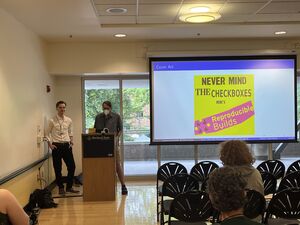
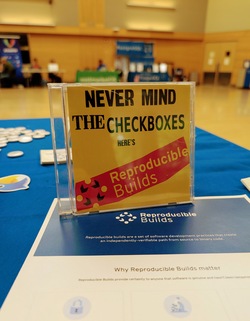
Reproducible Builds at FOSSY 2025 On Saturday 2nd August, Vagrant Cascadian and Chris Lamb presented at this year s FOSSY 2025. Their talk, titled Never Mind the Checkboxes, Here s Reproducible Builds!, was introduced as follows:
There are numerous policy compliance and regulatory processes being developed that target software development but do they solve actual problems? Does it improve the quality of software? Do Software Bill of Materials (SBOMs) actually give you the information necessary to verify how a given software artifact was built? What is the goal of all these compliance checklists anyways or more importantly, what should the goals be? If a software object is signed, who should be trusted to sign it, and can they be trusted forever?
Hosted by the Software Freedom Conservancy and taking place in Portland, Oregon, USA, FOSSY aims to be a community-focused event: Whether you are a long time contributing member of a free software project, a recent graduate of a coding bootcamp or university, or just have an interest in the possibilities that free and open source software bring, FOSSY will have something for you . More information on the event is available on the FOSSY 2025 website, including the full programme schedule. Vagrant and Chris also staffed a table, where they will be available to answer any questions about Reproducible Builds and discuss collaborations with other projects.

New OSS Rebuild project from Google The Google Open Source Security Team (GOSST) published an article this month announcing OSS Rebuild, a new project to strengthen trust in open source package ecosystems by reproducing upstream artifacts. As the post itself documents, the new project comprises four facets:
  • Automation to derive declarative build definitions for existing PyPI (Python), npm (JS/TS), and Crates.io (Rust) packages.
  • SLSA Provenance for thousands of packages across our supported ecosystems, meeting SLSA Build Level 3 requirements with no publisher intervention.
  • Build observability and verification tools that security teams can integrate into their existing vulnerability management workflows.
  • Infrastructure definitions to allow organizations to easily run their own instances of OSS Rebuild to rebuild, generate, sign, and distribute provenance.
One difference with most projects that aim for bit-for-bit reproducibility, OSS Rebuild aims for a kind of semantic reproducibility:
Through automation and heuristics, we determine a prospective build definition for a target package and rebuild it. We semantically compare the result with the existing upstream artifact, normalizing each one to remove instabilities that cause bit-for-bit comparisons to fail (e.g. archive compression).
The extensive post includes examples about how to access OSS Rebuild attestations using the Go-based command-line interface.

New extension of Python setuptools to support reproducible builds Wim Jeantine-Glenn has written a PEP 517 Build backend in order to enable reproducible builds when building Python projects that use setuptools. Called setuptools-reproducible, the project s README file contains the following:
Setuptools can create reproducible wheel archives (.whl) by setting SOURCE_DATE_EPOCH at build time, but setting the env var is insufficient for creating reproducible sdists (.tar.gz). setuptools-reproducible [therefore] wraps the hooks build_sdist build_wheel with some modifications to make reproducible builds by default.

diffoscope diffoscope is our in-depth and content-aware diff utility that can locate and diagnose reproducibility issues. This month, Chris Lamb made the following changes, including preparing and uploading versions 301, 302 and 303 to Debian:
  • Improvements:
    • Use Difference.from_operation in an attempt to pipeline the output of the extract-vmlinux script, potentially avoiding it all in memory. [ ]
    • Memoize a number of calls to --version, saving a very large number of external subprocess calls.
  • Bug fixes:
    • Don t check for PyPDF version 3 specifically, check for versions greater than 3. [ ]
    • Ensure that Java class files are named .class on the filesystem before passing them to javap(1). [ ]
    • Mask stderr from extract-vmlinux script. [ ][ ]
    • Avoid spurious differences in h5dump output caused by exposure of absolute internal extraction paths. (#1108690)
  • Misc:
    • Use our_check_output in the ODT comparator. [ ]
    • Update copyright years. [ ]
In addition: Lastly, Chris Lamb added a tmpfs to try.diffoscope.org so that diffoscope has a non-trivial temporary area to unpack archives, etc. [ ] Elsewhere in our tooling, however, reprotest is our tool for building the same source code twice in different environments and then checking the binaries produced by each build for any differences. This month, reprotest version 0.7.30 was uploaded to Debian unstable by Holger Levsen, chiefly including a change by Rebecca N. Palmer to not call sudo with the -h flag in order to fix Debian bug #1108550. [ ]

New library to patch system functions for reproducibility Nicolas Graves has written and published libfate, a simple collection of tiny libraries to patch system functions deterministically using LD_PRELOAD. According to the project s README:
libfate provides deterministic replacements for common non-deterministic system functions that can break reproducible builds. Instead of relying on complex build systems or apps or extensive patching, libfate uses the LD_PRELOAD trick to intercept system calls and return fixed, predictable values.
Describing why he wrote it, Nicolas writes:
I originally used the OpenSUSE dettrace approach to make Emacs reproducible in Guix. But when Guix switch to GCC@14, dettrace stopped working as expected. dettrace is a complex piece of software, my need was much less heavy: I don t need to systematically patch all sources of nondetermism, just the ones that make a process/binary unreproducible in a container/chroot.

Independently Reproducible Git Bundles Simon Josefsson has published another interesting article this month. Titled Independently Reproducible Git Bundles, the blog post describes the advantages of why you might a reproducible bundle, and the pitfalls that can arise when trying to create them:
One desirable property is that someone else should be able to reproduce the same git bundle, and not only that a single individual is able to reproduce things on one machine. It surprised me to see that when I ran the same set of commands on a different machine (started from a fresh git clone), I got a different checksum. The different checksums occurred even when nothing had been committed on the server side between the two runs.

Website updates Once again, there were a number of improvements made to our website this month including:

Distribution work In Debian this month:
Debian contributors have made significant progress toward ensuring package builds produce byte-for-byte reproducible results. You can check the status for packages installed on your system using the new package debian-repro-status, or visit reproduce.debian.net for Debian s overall statistics for trixie and later. You can contribute to these efforts by joining #debian-reproducible on IRC to discuss fixes, or verify the statistics by installing the new rebuilderd package and setting up your own instance.

The IzzyOnDroid Android APK repository made further progress in July, crossing the 50% reproducibility threshold congratulations. Furthermore, a new release of the Neo Store was released, which exposes the reproducible status directly next to the version of each app.
In GNU Guix, a series of patches intended to fix the reproducibility for the Mono programming language was merged, fixing reproducibility in Mono versions 1.9 [ ], 2.4 [ ] and 2.6 [ ].
Lastly, in addition to the news that openSUSE Enterprise Linux now [has an official goal of reproducibility]((https://lists.reproducible-builds.org/pipermail/rb-general/2025-July/003846.html), Bernhard M. Wiedemann posted another monthly update for their work there.

Reproducibility testing framework The Reproducible Builds project operates a comprehensive testing framework running primarily at tests.reproducible-builds.org in order to check packages and other artifacts for reproducibility. In July, however, a number of changes were made by Holger Levsen, including:
  • Switch the URL for the Tails package set. [ ]
  • Make the dsa-check-packages output more useful. [ ]
  • Setup the ppc64el architecture again, has it has returned this time with a 2.7 GiB database instead of 72 GiB. [ ]
In addition, Jochen Sprickerhof improved the reproducibility statistics generation:
  • Enable caching of statistics. [ ][ ][ ]
  • Add some common non-reproducible patterns. [ ]
  • Change output to directory. [ ]
  • Add a page sorted by diffoscope size. [ ][ ]
  • Switch to Python s argparse module and separate output(). [ ]
Holger also submitted a number of Debian bugs against rebuilderd and rebuilderd-worker:
  • Config files and scripts for a simple one machine setup. [ ][ ]
  • Create a rebuilderd user. [ ]
  • Create rebuilderd-worker user with sbuild. [ ]
Lastly, Mattia Rizzolo added a scheduled job to renew some SSL certificates [ ] and Vagrant Cascadian performed some node maintenance [ ][ ].

Upstream patches The Reproducible Builds project detects, dissects and attempts to fix as many currently-unreproducible packages as possible. We endeavour to send all of our patches upstream where appropriate. This month, we wrote a large number of such patches, including: There were a number of other patches from openSUSE developers:

Finally, if you are interested in contributing to the Reproducible Builds project, please visit our Contribute page on our website. However, you can get in touch with us via:

1 August 2025

Sergio Cipriano: How I deployed this Website

How I deployed this Website I will describe the step-by-step process I followed to make this static website accessible on the Internet.

DNS I bought this domain on NameCheap and am using their DNS for now, where I created these records:
Record Type Host Value
A sergiocipriano.com 201.54.0.17
CNAME www sergiocipriano.com

Virtual Machine I am using Magalu Cloud for hosting my VM, since employees have free credits. Besides creating a VM with a public IP, I only needed to set up a Security Group with the following rules:
Type Protocol Port Direction CIDR
IPv4 / IPv6 TCP 80 IN Any IP
IPv4 / IPv6 TCP 443 IN Any IP

Firewall The first thing I did in the VM was enabling ufw (Uncomplicated Firewall). Enabling ufw without pre-allowing SSH is a common pitfall and can lock you out of your VM. I did this once :) A safe way to enable ufw:
$ sudo ufw allow OpenSSH      # or: sudo ufw allow 22/tcp
$ sudo ufw allow 'Nginx Full' # or: sudo ufw allow 80,443/tcp
$ sudo ufw enable
To check if everything is ok, run:
$ sudo ufw status verbose
Status: active
Logging: on (low)
Default: deny (incoming), allow (outgoing), disabled (routed)
New profiles: skip
To                           Action      From
--                           ------      ----
22/tcp (OpenSSH)             ALLOW IN    Anywhere                  
80,443/tcp (Nginx Full)      ALLOW IN    Anywhere                  
22/tcp (OpenSSH (v6))        ALLOW IN    Anywhere (v6)             
80,443/tcp (Nginx Full (v6)) ALLOW IN    Anywhere (v6) 

Reverse Proxy I'm using Nginx as the reverse proxy. Since I use the Debian package, I just needed to add this file:
/etc/nginx/sites-enabled/sergiocipriano.com
with this content:
server  
    listen 443 ssl;      # IPv4
    listen [::]:443 ssl; # IPv6
    server_name sergiocipriano.com www.sergiocipriano.com;
    root /path/to/website/sergiocipriano.com;
    index index.html;
    location /  
        try_files $uri /index.html;
     
 
server  
    listen 80;
    listen [::]:80;
    server_name sergiocipriano.com www.sergiocipriano.com;
    # Redirect all HTTP traffic to HTTPS
    return 301 https://$host$request_uri;
 

TLS It's really easy to setup TLS thanks to Let's Encrypt:
$ sudo apt-get install certbot python3-certbot-nginx
$ sudo certbot install --cert-name sergiocipriano.com
Saving debug log to /var/log/letsencrypt/letsencrypt.log
Deploying certificate
Successfully deployed certificate for sergiocipriano.com to /etc/nginx/sites-enabled/sergiocipriano.com
Successfully deployed certificate for www.sergiocipriano.com to /etc/nginx/sites-enabled/sergiocipriano.com
Certbot will edit the nginx configuration with the path to the certificate.

HTTP Security Headers I decided to use wapiti, which is a web application vulnerability scanner, and the report found this problems:
  1. CSP is not set
  2. X-Frame-Options is not set
  3. X-XSS-Protection is not set
  4. X-Content-Type-Options is not set
  5. Strict-Transport-Security is not set
I'll explain one by one:
  1. The Content-Security-Policy header prevents XSS and data injection by restricting sources of scripts, images, styles, etc.
  2. The X-Frame-Options header prevents a website from being embedded in iframes (clickjacking).
  3. The X-XSS-Protection header is deprecated. It is recommended that CSP is used instead of XSS filtering.
  4. The X-Content-Type-Options header stops MIME-type sniffing to prevent certain attacks.
  5. The Strict-Transport-Security header informs browsers that the host should only be accessed using HTTPS, and that any future attempts to access it using HTTP should automatically be upgraded to HTTPS. Additionally, on future connections to the host, the browser will not allow the user to bypass secure connection errors, such as an invalid certificate. HSTS identifies a host by its domain name only.
I added this security headers inside the HTTPS and HTTP server block, outside the location block, so they apply globally to all responses. Here's how the Nginx config look like:
add_header Content-Security-Policy "default-src 'self'; style-src 'self';" always;
add_header X-Frame-Options "DENY" always;
add_header X-Content-Type-Options "nosniff" always;
add_header Strict-Transport-Security "max-age=31536000; includeSubDomains" always;
I added always to ensure that nginx sends the header regardless of the response code. To add Content-Security-Policy header I had to move the css to a separate file, because browsers block inline styles under strict CSP unless you allow them explicitly. They're considered unsafe inline unless you move to a separate file and link it like this:
<link rel="stylesheet" href="./resources/header.css">

23 July 2025

Peter Pentchev: Ringlet software updates (2025-03-23)

Ringlet software updates (2025-03-23)Recent initial releases of [Ringlet software][r-site] (a fancy name for my pet projects):

Dirk Eddelbuettel: qlcal 0.0.16 on CRAN: Regular Update

The sixteenth release of the qlcal package arrivied at CRAN today, once again following the QuantLib 1.39 release this morning. qlcal delivers the calendaring parts of QuantLib. It is provided (for the R package) as a set of included files, so the package is self-contained and does not depend on an external QuantLib library (which can be demanding to build). qlcal covers over sixty country / market calendars and can compute holiday lists, its complement (i.e. business day lists) and much more. Examples are in the README at the repository, the package page, and course at the CRAN package page. This releases mainly synchronizes qlcal with the QuantLib release 1.39.

Changes in version 0.0.16 (2025-07-23)
  • Synchronized with QuantLib 1.39 released today
  • Calendar updates for Israel, minor utility functions update
  • Minor package maintenance updates

Courtesy of my CRANberries, there is a diffstat report for this release. See the project page and package documentation for more details, and more examples.

This post by Dirk Eddelbuettel originated on his Thinking inside the box blog. If you like this or other open-source work I do, you can sponsor me at GitHub.

22 July 2025

Iustin Pop: Watching website scanning bots

Ever since I put up http://demo.corydalis.io, and setup logcheck, I m inadvertently keeping up with recent exploits in common CMS frameworks, or maybe even normal web frameworks issues, by seeing what 404s I get from the logs. Now, I didn t indent to do this per se, I just wanted to make sure I don t have any 500s, and at one point, I did actually catch a bug by seeing seemingly valid URLs, with referrer my own pages, leading to 404s. But besides that, it s mainly a couple times per week, a bot finds the site, and then it tries in fast succession something like this (real log entries, with the source IP address removed):
[21/Jul/2025:09:27:09 +0200] "GET /pms?module=logging&file_name=../../../../../../~/.aws/credentials&number_of_lines=10000 HTTP/1.1" 404 - "" "Mozilla/5.0"
[21/Jul/2025:09:27:11 +0200] "GET /admin/config?cmd=cat+/root/.aws/credentials HTTP/1.1" 404 - "" "Mozilla/5.0"
[21/Jul/2025:09:27:11 +0200] "GET /.env HTTP/1.1" 404 - "" "Mozilla/5.0"
[21/Jul/2025:09:27:13 +0200] "GET /.env.local HTTP/1.1" 404 - "" "Mozilla/5.0"
[21/Jul/2025:09:27:13 +0200] "GET /.env.production HTTP/1.1" 404 - "" "Mozilla/5.0"
[21/Jul/2025:09:27:16 +0200] "GET /.env.dev HTTP/1.1" 404 - "" "Mozilla/5.0"
[21/Jul/2025:09:27:17 +0200] "GET /.env.development HTTP/1.1" 404 - "" "Mozilla/5.0"
[21/Jul/2025:09:27:19 +0200] "GET /.env.prod HTTP/1.1" 404 - "" "Mozilla/5.0"
[21/Jul/2025:09:27:19 +0200] "GET /.env.stage HTTP/1.1" 404 - "" "Mozilla/5.0"
[21/Jul/2025:09:27:22 +0200] "GET /.env.test HTTP/1.1" 404 - "" "Mozilla/5.0"
[21/Jul/2025:09:27:23 +0200] "GET /.env.example HTTP/1.1" 404 - "" "Mozilla/5.0"
[21/Jul/2025:09:27:25 +0200] "GET /.env.bak HTTP/1.1" 404 - "" "Mozilla/5.0"
[21/Jul/2025:09:27:26 +0200] "GET /.env.old HTTP/1.1" 404 - "" "Mozilla/5.0"
[21/Jul/2025:09:27:28 +0200] "GET /.envs/.production/.django HTTP/1.1" 404 - "" "Mozilla/5.0"
[21/Jul/2025:09:27:28 +0200] "GET /blog.env HTTP/1.1" 404 - "" "Mozilla/5.0"
[21/Jul/2025:09:27:31 +0200] "GET /wp-content/.env HTTP/1.1" 404 - "" "Mozilla/5.0"
[21/Jul/2025:09:27:32 +0200] "GET /application/.env HTTP/1.1" 404 - "" "Mozilla/5.0"
[21/Jul/2025:09:27:34 +0200] "GET /app/.env HTTP/1.1" 404 - "" "Mozilla/5.0"
[21/Jul/2025:09:27:35 +0200] "GET /apps/.env HTTP/1.1" 404 - "" "Mozilla/5.0"
[21/Jul/2025:09:27:37 +0200] "GET /config/.env HTTP/1.1" 404 - "" "Mozilla/5.0"
[21/Jul/2025:09:27:38 +0200] "GET /config/config.env HTTP/1.1" 404 - "" "Mozilla/5.0"
[21/Jul/2025:09:27:40 +0200] "GET /config/.env HTTP/1.1" 404 - "" "Mozilla/5.0"
[21/Jul/2025:09:27:41 +0200] "GET /api/.env HTTP/1.1" 404 - "" "Mozilla/5.0"
[21/Jul/2025:09:27:43 +0200] "GET /vendor/.env HTTP/1.1" 404 - "" "Mozilla/5.0"
[21/Jul/2025:09:27:44 +0200] "GET /backend/.env HTTP/1.1" 404 - "" "Mozilla/5.0"
[21/Jul/2025:09:27:46 +0200] "GET /server/.env HTTP/1.1" 404 - "" "Mozilla/5.0"
[21/Jul/2025:09:27:46 +0200] "GET /home/user/.aws/credentials HTTP/1.1" 404 - "" "Mozilla/5.0"
[21/Jul/2025:09:27:49 +0200] "GET /aws/credentials HTTP/1.1" 404 - "" "Mozilla/5.0"
[21/Jul/2025:09:27:50 +0200] "GET /.aws/credentials HTTP/1.1" 404 - "" "Mozilla/5.0"
[21/Jul/2025:09:27:52 +0200] "GET /.aws/config HTTP/1.1" 404 - "" "Mozilla/5.0"
[21/Jul/2025:09:27:52 +0200] "GET /config/aws.yml HTTP/1.1" 404 - "" "Mozilla/5.0"
[21/Jul/2025:09:27:55 +0200] "GET /config/aws.json HTTP/1.1" 404 - "" "Mozilla/5.0"
[21/Jul/2025:09:27:55 +0200] "GET /.env.production HTTP/1.1" 404 - "" "Mozilla/5.0"
[21/Jul/2025:09:27:58 +0200] "GET /config.json HTTP/1.1" 404 - "" "Mozilla/5.0"
[21/Jul/2025:09:27:59 +0200] "GET /config/config.json HTTP/1.1" 404 - "" "Mozilla/5.0"
[21/Jul/2025:09:28:01 +0200] "GET /config/settings.json HTTP/1.1" 404 - "" "Mozilla/5.0"
[21/Jul/2025:09:28:02 +0200] "GET /config/secrets.json HTTP/1.1" 404 - "" "Mozilla/5.0"
[21/Jul/2025:09:28:04 +0200] "GET /config.yaml HTTP/1.1" 404 - "" "Mozilla/5.0"
[21/Jul/2025:09:28:04 +0200] "GET /config.yml HTTP/1.1" 404 - "" "Mozilla/5.0"
[21/Jul/2025:09:28:07 +0200] "GET /config.py HTTP/1.1" 404 - "" "Mozilla/5.0"
[21/Jul/2025:09:28:08 +0200] "GET /secrets.json HTTP/1.1" 404 - "" "Mozilla/5.0"
[21/Jul/2025:09:28:10 +0200] "GET /secrets.yml HTTP/1.1" 404 - "" "Mozilla/5.0"
[21/Jul/2025:09:28:11 +0200] "GET /credentials.json HTTP/1.1" 404 - "" "Mozilla/5.0"
[21/Jul/2025:09:28:13 +0200] "GET /.git-credentials HTTP/1.1" 404 - "" "Mozilla/5.0"
[21/Jul/2025:09:28:14 +0200] "GET /.git/config HTTP/1.1" 404 - "" "Mozilla/5.0"
[21/Jul/2025:09:28:16 +0200] "GET /.gitignore HTTP/1.1" 404 - "" "Mozilla/5.0"
[21/Jul/2025:09:28:18 +0200] "GET /.gitlab-ci.yml HTTP/1.1" 404 - "" "Mozilla/5.0"
[21/Jul/2025:09:28:19 +0200] "GET /.github/workflows HTTP/1.1" 404 - "" "Mozilla/5.0"
[21/Jul/2025:09:28:22 +0200] "GET /.idea/workspace.xml HTTP/1.1" 404 - "" "Mozilla/5.0"
[21/Jul/2025:09:28:22 +0200] "GET /.vscode/settings.json HTTP/1.1" 404 - "" "Mozilla/5.0"
[21/Jul/2025:09:28:25 +0200] "GET /docker-compose.yml HTTP/1.1" 404 - "" "Mozilla/5.0"
[21/Jul/2025:09:28:25 +0200] "GET /docker-compose.override.yml HTTP/1.1" 404 - "" "Mozilla/5.0"
[21/Jul/2025:09:28:28 +0200] "GET /docker-compose.prod.yml HTTP/1.1" 404 - "" "Mozilla/5.0"
[21/Jul/2025:09:28:28 +0200] "GET /docker-compose.dev.yml HTTP/1.1" 404 - "" "Mozilla/5.0"
[21/Jul/2025:09:28:32 +0200] "GET /phpinfo HTTP/1.1" 404 - "" "Mozilla/5.0"
[21/Jul/2025:09:28:32 +0200] "GET /_profiler/phpinfo HTTP/1.1" 404 - "" "Mozilla/5.0"
[21/Jul/2025:09:28:34 +0200] "GET /phpinfo.php HTTP/1.1" 404 - "" "Mozilla/5.0"
[21/Jul/2025:09:28:34 +0200] "GET /info.php HTTP/1.1" 404 - "" "Mozilla/5.0"
[21/Jul/2025:09:28:37 +0200] "GET /storage/logs/laravel.log HTTP/1.1" 404 - "" "Mozilla/5.0"
[21/Jul/2025:09:28:37 +0200] "GET /storage/logs/error.log HTTP/1.1" 404 - "" "Mozilla/5.0"
[21/Jul/2025:09:28:40 +0200] "GET /logs/debug.log HTTP/1.1" 404 - "" "Mozilla/5.0"
[21/Jul/2025:09:28:40 +0200] "GET /logs/app.log HTTP/1.1" 404 - "" "Mozilla/5.0"
[21/Jul/2025:09:28:49 +0200] "GET /debug.log HTTP/1.1" 404 - "" "Mozilla/5.0"
[21/Jul/2025:09:28:51 +0200] "GET /error.log HTTP/1.1" 404 - "" "Mozilla/5.0"
[21/Jul/2025:09:28:53 +0200] "GET /.DS_Store HTTP/1.1" 404 - "" "Mozilla/5.0"
[21/Jul/2025:09:28:55 +0200] "GET /backup.zip HTTP/1.1" 404 - "" "Mozilla/5.0"
[21/Jul/2025:09:28:58 +0200] "GET /.backup HTTP/1.1" 404 - "" "Mozilla/5.0"
[21/Jul/2025:09:29:00 +0200] "GET /db.sql HTTP/1.1" 404 - "" "Mozilla/5.0"
[21/Jul/2025:09:29:03 +0200] "GET /dump.sql HTTP/1.1" 404 - "" "Mozilla/5.0"
[21/Jul/2025:09:29:06 +0200] "GET /database.sql HTTP/1.1" 404 - "" "Mozilla/5.0"
[21/Jul/2025:09:29:09 +0200] "GET /backup.tar.gz HTTP/1.1" 404 - "" "Mozilla/5.0"
Now, this example is actually trying to catch a bit more things, but many times it s focused on some specific thing, or two things. Here we have docker, MacOS .DS_Store (I m not sure how that s useful - to find more filenames?), VSCode settings, various secrets, GitHub workflows, log output, database dumps, AWS credentials, and still I guess from the wp filename WordPress settings. The first few years were full of WordPress scanners, now it seems it has quieted down, I haven t seen a bot scanning 200 WP potential filenames in ages. And this bot even bothers to put in Mozilla/5.0 as browser identification . Side-note: I don t think the filename path in the first log entry, i.e. ../../../../../../~/, ever properly resolves to the home directory of any user. So I m not that particular scanner ever works, but who knows? Maybe some framework does bad tilde expansion, but at least bash will not expand ~ inside a path, it seems that path is passed as-is to an invoked command (strace confirms it). What s surprising here is that these are usually plain dumb scanners, from the same IP address, no concern on throttling, no attempt to hide, just 2 minutes of brute-forcing a random list of known treasures , then moving on. For this to be worth, it means there are still victims found using this method, sadly. Well, sometimes I get a single, one-off "GET /wp-login.php HTTP/1.1, which is strange enough it might not be a bot even, who knows. But in general, periods of activity of this type are coming and going, probably aligned with new CVEs. And another surprising thing is that for this type of scanning to work (and I ve seen many over the years), the website framework/configuration must allow random file download. Corydalis itself is written in Haskell, using Yesod, and it has a hardcoded (built at compile time) list of static resources it will serve. I haven t made the switch to fully embedding in the binary, but at that point, it won t need to read from the filesystem at all. Right now it will serve a few CSS and JS files, plus fonts, but that s it, no arbitrary filesystem traversal. Strange that some frameworks allow it. This is not productively spent time, but it is fun, especially seeing how this changes over time. And probably the most use anyone gets out of http://demo.corydalis.io .

21 July 2025

Jonathan Dowland: Nine Inch Nails, Paris, 2025-07-07

On July 7th I did a quick one-day trip to Paris to watch Nine Inch Nails, who were performing one of their last shows for the European leg of the tour. I'd missed all the UK dates, which were announced after I was committed to a family holiday. The setup for these shows differs a lot from the norm. First, the support act was German-Iraqi techno DJ Boys Noize, who TR&AR had collaborated with on their soundtrack for the recent movie Challengers. BN did a 75-minute opening set:
Stripped down Set 1 Stripped down Set 1
The main gig was divided into four acts. Act 1 took place on a square "B Stage", situated in the middle of the main floor. Trent and 2-3 band members performed three stripped-down songs, with interpolations to other songs, alternative lyrics, and the like. I enjoyed this section more than I expected to.
Main stage lighting Main stage lighting
They then transition to the main stage for a six-song full-band set. The main stage was draped in layers of transparent curtains. One of the team was on-stage, walking around with a video camera, and the live camera footage was processed and projected onto the curtains in realtime. The visuals were truly fantastic. For the third act, Trent and Atticus returned to the B stage, to be joined by Boys Noize, who then performed four songs in a reworked, remixed, electronic dance format. This ended up being the highlight of the gig for me. I felt the reworkings breathed new life into some old songs.
remix Set 3 remix Set 3
Finally, back to the main stage to close out with a final seven songs. The traditional triad of closers was adjusted, substituting "The Hand That Feeds" for "The Perfect Drug"; a song that wasn't played at all from 1997 to 2018, and has now become a regular fixture. Several tapers recorded the show, and their recordings are up at nin.live. Overall it was great fun: I ended up flying via London and the airport time was a bit of a pain, but I did get a good start on my corrections. I was home the next afternoon. I'm trying not to think of the cost.

20 July 2025

Michael Prokop: What to expect from Debian/trixie #newintrixie

Trixie Banner, Copyright 2024 Elise Couper Update on 2025-07-28: added note about Debian 13/trixie support for OpenVox (thanks, Ben Ford!) Debian v13 with codename trixie is scheduled to be published as new stable release on 9th of August 2025. I was the driving force at several of my customers to be well prepared for the upcoming stable release (my efforts for trixie started in August 2024). On the one hand, to make sure packages we care about are available and actually make it into the release. On the other hand, to ensure there are no severe issues that make it into the release and to get proper and working upgrades. So far everything is looking pretty well and working fine, the efforts seemed to have payed off. :) As usual with major upgrades, there are some things to be aware of, and hereby I m starting my public notes on trixie that might be worth for other folks. My focus is primarily on server systems and looking at things from a sysadmin perspective. Further readings As usual start at the official Debian release notes, make sure to especially go through What s new in Debian 13 + issues to be aware of for trixie (strongly recommended read!). Package versions As a starting point, let s look at some selected packages and their versions in bookworm vs. trixie as of 2025-07-20 (mainly having amd64 in mind):
Package bookworm/v12 trixie/v13
ansible 2.14.3 2.19.0
apache 2.4.62 2.4.64
apt 2.6.1 3.0.3
bash 5.2.15 5.2.37
ceph 16.2.11 18.2.7
docker 20.10.24 26.1.5
dovecot 2.3.19 2.4.1
dpkg 1.21.22 1.22.21
emacs 28.2 30.1
gcc 12.2.0 14.2.0
git 2.39.5 2.47.2
golang 1.19 1.24
libc 2.36 2.41
linux kernel 6.1 6.12
llvm 14.0 19.0
lxc 5.0.2 6.0.4
mariadb 10.11 11.8
nginx 1.22.1 1.26.3
nodejs 18.13 20.19
openjdk 17.0 21.0
openssh 9.2p1 10.0p1
openssl 3.0 3.5
perl 5.36.0 5.40.1
php 8.2+93 8.4+96
podman 4.3.1 5.4.2
postfix 3.7.11 3.10.3
postgres 15 17
puppet 7.23.0 8.10.0
python3 3.11.2 3.13.5
qemu/kvm 7.2 10.0
rsync 3.2.7 3.4.1
ruby 3.1 3.3
rust 1.63.0 1.85.0
samba 4.17.12 4.22.3
systemd 252.36 257.7-1
unattended-upgrades 2.9.1 2.12
util-linux 2.38.1 2.41
vagrant 2.3.4 2.3.7
vim 9.0.1378 9.1.1230
zsh 5.9 5.9
Misc unsorted apt The new apt version 3.0 brings several new features, including: systemd systemd got upgraded from v252.36-1~deb12u1 to 257.7-1 and there are lots of changes. Be aware that systemd v257 has a new net.naming_scheme, v257 being PCI slot number is now read from firmware_node/sun sysfs file. The naming scheme based on devicetree aliases was extended to support aliases for individual interfaces of controllers with multiple ports. This might affect you, see e.g. #1092176 and #1107187, the Debian Wiki provides further useful information. There are new systemd tools available: The tools provided by systemd gained several new options: Debian s systemd ships new binary packages: Linux Kernel The trixie release ships a Linux kernel based on latest longterm version 6.12. As usual there are lots of changes in the kernel area, including better hardware support, and this might warrant a separate blog entry. To highlight some changes with Debian trixie: See Kernelnewbies.org for further changes between kernel versions. Configuration management For puppet users, Debian provides the puppet-agent (v8.10.0), puppetserver (v8.7.0) and puppetdb (v8.4.1) packages. Puppet s upstream does not provide packages for trixie, yet. Given how long it took them for Debian bookworm, and with their recent Plans for Open Source Puppet in 2025, it s unclear when (and whether at all) we might get something. As a result of upstream behavior, also the OpenVox project evolved, and they already provide Debian 13/trixie support (https://apt.voxpupuli.org/openvox8-release-debian13.deb). FYI: the AIO puppet-agent package for bookworm (v7.34.0-1bookworm) so far works fine for me on Debian/trixie. Be aware that due to the apt-key removal you need a recent version of the puppetlabs-apt for usage with trixie. The puppetlabs-ntp module isn t yet ready for trixie (regarding ntp/ntpsec), if you should depend on that. ansible is available and made it with version 2.19 into trixie. Prometheus stack Prometheus server was updated from v2.42.0 to v2.53, and all the exporters that got shipped with bookworm are still around (in more recent versions of course). Trixie gained some new exporters: Virtualization docker (v26.1.5), ganeti (v3.1.0), libvirt (v11.3.0, be aware of significant changes to libvirt packaging), lxc (v6.0.4), podman (v5.4.2), openstack (see openstack-team on Salsa), qemu/kvm (v10.0.2), xen (v4.20.0) are all still around. Proxmox already announced their PVE 9.0 BETA, being based on trixie and providing 6.14.8-1 kernel, QEMU 10.0.2, LXC 6.0.4, OpenZFS 2.3.3. Vagrant is available in version 2.3.7, but Vagrant upstream does not provide packages for trixie yet. Given that HashiCorp adopted the BSL, the future of vagrant in Debian is unclear. If you re relying on VirtualBox, be aware that upstream doesn t provide packages for trixie, yet. VirtualBox is available from Debian/unstable (version 7.1.12-dfsg-1 as of 2025-07-20), but not shipped with stable release since quite some time (due to lack of cooperation from upstream on security support for older releases, see #794466). Be aware that starting with Linux kernel 6.12, KVM initializes virtualization on module loading by default. This prevents VirtualBox VMs from starting. In order to avoid this, either add kvm.enable_virt_at_load=0 parameter into kernel command line or unload the corresponding kvm_intel / kvm_amd module. If you want to use Vagrant with VirtualBox on trixie, be aware that Debian s vagrant package as present in trixie doesn t support the VirtualBox package version 7.1 as present in Debian/unstable (manually patching vagrant s meta.rb and rebuilding the package without Breaks: virtualbox (>= 7.1) is known to be working). util-linux The are plenty of new options available in the tools provided by util-linux: Now no longer present in util-linux as of trixie: The following binaries got moved from util-linux to the util-linux-extra package: And the util-linux-extra package also provides new tools: OpenSSH OpenSSH was updated from v9.2p1 to 10.0p1-5, so if you re interested in all the changes, check out the release notes between those versions (9.3, 9.4, 9.5, 9.6, 9.7, 9.8, 9.9 + 10.0). Let s highlight some notable behavior changes in Debian: There are some notable new features: Thanks to everyone involved in the release, looking forward to trixie + and happy upgrading!
Let s continue with working towards Debian/forky. :)

15 July 2025

Dirk Eddelbuettel: anytime 0.3.12 on CRAN: Minor Bugfix and Maintenance

A maintenance release 0.3.132 of the anytime package arrived on CRAN today. The package is fairly feature-complete, and code and functionality remain mature and stable. anytime is a very focused package aiming to do just one thing really well: to convert anything in integer, numeric, character, factor, ordered, input format to either POSIXct (when called as anytime) or Date objects (when called as anydate) and to do so without requiring a format string as well as accomodating different formats in one input vector. See the anytime page, or the GitHub repo for a few examples, and the beautiful documentation site for all documentation. This release covers a corner case reported in a GitHub issue: the (nonsensical but possible) input of zero-length (floating point or integer) vectors was not dealt with properly which lead to an error. We now return the requested type (POSIXct or Date, depending on the call) also with length zero. Two minor maintenance tasks were also addressed since the last release six months ago. The short list of changes follows.

Changes in anytime version 0.3.12 (2025-07-14)
  • Continuous integration now uses r-ci action with embedded bootstrap
  • The versioned depends on Rcpp now requires 1.0.8 or newer to support use of the updated header file structure
  • The corner-case of an empty (numeric or integer) vector argument is now addressed, new tests have been added (#135)))

Courtesy of my CRANberries, there is also a diffstat report of changes relative to the previous release. The issue tracker tracker off the GitHub repo can be use for questions and comments. More information about the package is at the package page, the GitHub repo and the documentation site.

This post by Dirk Eddelbuettel originated on his Thinking inside the box blog. If you like this or other open-source work I do, you can now sponsor me at GitHub.

7 July 2025

Sahil Dhiman: Let's Talk About AI

Recently, Seth Godin wrote Productivity, AI and pushback:
Typesetters did not like the laser printer. Wedding photographers still hate the iphone. And some musicians are outraged that AI is now making mediocre pop music.
In the article, Seth connected how AI is increasing productivity and how anything that improves productivity always wins. Nowadays, large language models (LLMs) have become synonymous with AI, while AI is a broader field. AI has brought a shift in how things are done. Use cases might vary, but it s helping in ways like quickly summarizing huge knowledge bases to answer questions or, in my case, helping understand the contextual meaning of complex word (or sentence) usage in language and literature in both English and Hindi, which was sometimes not easy to comprehend with simple web search results. Even if you or I don t really like AI in everything , we can t deny the fact that AI is here to stay. This doesn t take away from the fact that AI needs to become ethical, regulated, and environmentally sustainable.

5 July 2025

Taavi V n nen: Tracking my train travel by parsing tickets in emails

Rumour has it that I might be a bit of a train nerd. At least I want to collect various nerdy data about my travels. Historically that data has lived in manual form in several places,1 but over the past year and a half I've been working on a toy project to collect most of that information into a custom tool. That toy project2 uses various sources to get information about trains to fill up its database: for example, in Finland Fintraffic, the organization responsible for railway traffic management, publishes very comprehensive open data about almost everything that's moving on the Finnish railway network. Unfortunately, I cannot be on all of the trains.3 Thus I need to tell the system details about my journeys. The obvious solution is to make a form that lets me save that data. Which I did, but I got very quickly bored of filling out that form, and as regular readers of this blog know, there is no reason to settle for a simple but boring solution when the alternative is to make something that is ridiculously overengineered.

Parsing data out of my train tickets Finnish long-distance trains generally require train-specific seat reservations, which means VR (the train company) knows which trains I am on. We just need to find a way to extract that information in some machine-readable format. So my plan for the ridiculously overengineered solution was to parse the booking emails to get the details I need. Now, VR ticket emails include the data I want in a couple of different formats: they're included as text in the HTML email body, they're in the embedded calendar invite, as text in the included PDF ticket, and encoded in the Aztec Code in the included PDF ticket. I chose to parse the last option with the hopes of building something that could be ported to parse other operators' tickets with relative ease.
Example Aztec code
Example Aztec code
After a bit of digging (thank you to the KDE Itinerary people for documenting this!) I stumbled upon an European Union Agency for Railways PDF titled ELECTRONIC SEAT/BERTH RESERVATION AND ELECTRONIC PRODUCTION OF TRANSPORT DOCUMENTS - TRANSPORT DOCUMENTS (RCT2 STANDARD) which, in its Appendix C.1, describes how the information is encoded in the code.4 (As a side note, various sources call these codes SSB version 1 codes, although that term isn't used in this specification. So maybe there are more specifications about the format that I haven't discovered yet!) I then wrote a parser in Go for the binary data embedded in these codes. So far it works, although I wouldn't be surprised if there are some edge cases that it doesn't handle. In particular, the spec specifies a custom lookup table for converting between text and binary data, and that only has support for characters 0-9 and A-Z. But Finnish railway station codes can also use and .. maybe I need to buy a ticket to a station with one of those.

Extracting barcodes out of emails A parser just for the binary format isn't enough here if the intended source input is the emails that VR sends upon making a booking. Time to write a single-purpose email server! In short, the logic in the server, again written in Go and with the help of go-smtp and go-message, is:
  • Accept any mail with a reasonable body size
  • Process through all body parts
  • For all PDF parts, extract all images
  • For all images, run them through ZXing
  • For all decoded barcodes, try to parse them with my new ticket parsing library I mentioned earlier
  • If any tickets are found, send the data from them and any metadata to the main backend, which will save them to a database
The custom mail server exposes an LMTP interface over TCP for my internet-facing mail servers to forward to. I chose LMTP for this because it seemed like a better fit in theory than normal (E)SMTP. I've since discovered that curl doesn't support LMTP which makes development much harder, and in practice there's no benefit of LMTP here as all mails are being sent to the backend in a single request regardless of the number of recipients, so maybe I'll migrate it to regular SMTP at some point.

Side quest time The last missing part is automatically forwarding the ticket mails to the new service. I've routed a dedicated subdomain to the new service, and the backend is configured to allocate addresses like i2v44g2pygkcth64stjgyuqz@somedomain.example for each user. That's great if we wanted to manually forward mails to the service, but we can go one step above that. I created a dedicated email alias in my mail server config that routes both to my regular mailbox and the service address. That way I can update my VR account to use the alias and have mails automatically processed while still receiving backup copies of the tickets (and any other important mail that VR might send me). Unfortunately that last part turns out something that's easier said than done. Logging in on the website, I'm greeted by this text stating I need to contact customer service by phone to change the address associated with my account.5 After a bit of digging, I noticed that the mobile app suggests filling out a feedback form in order to change the address. So I filled that, and after a day or two I got a "confirm you want to change your email" mail. Success!

  1. Including (but not limited to): a page of this website, the notes app on my phone, and an uMap map.
  2. Which I'm not directly naming here because I still think it needs a lot more work before being presentable, but if you're really interested it's not that hard to find out.
  3. Someone should invent human cloning so that we can fix this.
  4. People who know much more about railway ticketing than I do were surprised when I told them this format is still in use somewhere. So, uh, sorry if you were expecting a nice universal worldwide standard!
  5. In case you have not guessed yet, I do not like making phone calls.

Next.

Previous.