Search Results: "ed"

7 August 2026

Reproducible Builds (diffoscope): diffoscope 327 released

The diffoscope maintainers are pleased to announce the release of diffoscope version 327. This version includes the following changes:
[ Colin Watson ]
* Handle missing openssh-client binaries in autopkgtests.
You find out more by visiting the project homepage.

6 August 2026

Bits from Debian: DebConf26 closes in Santa Fe and DebConf27 announced

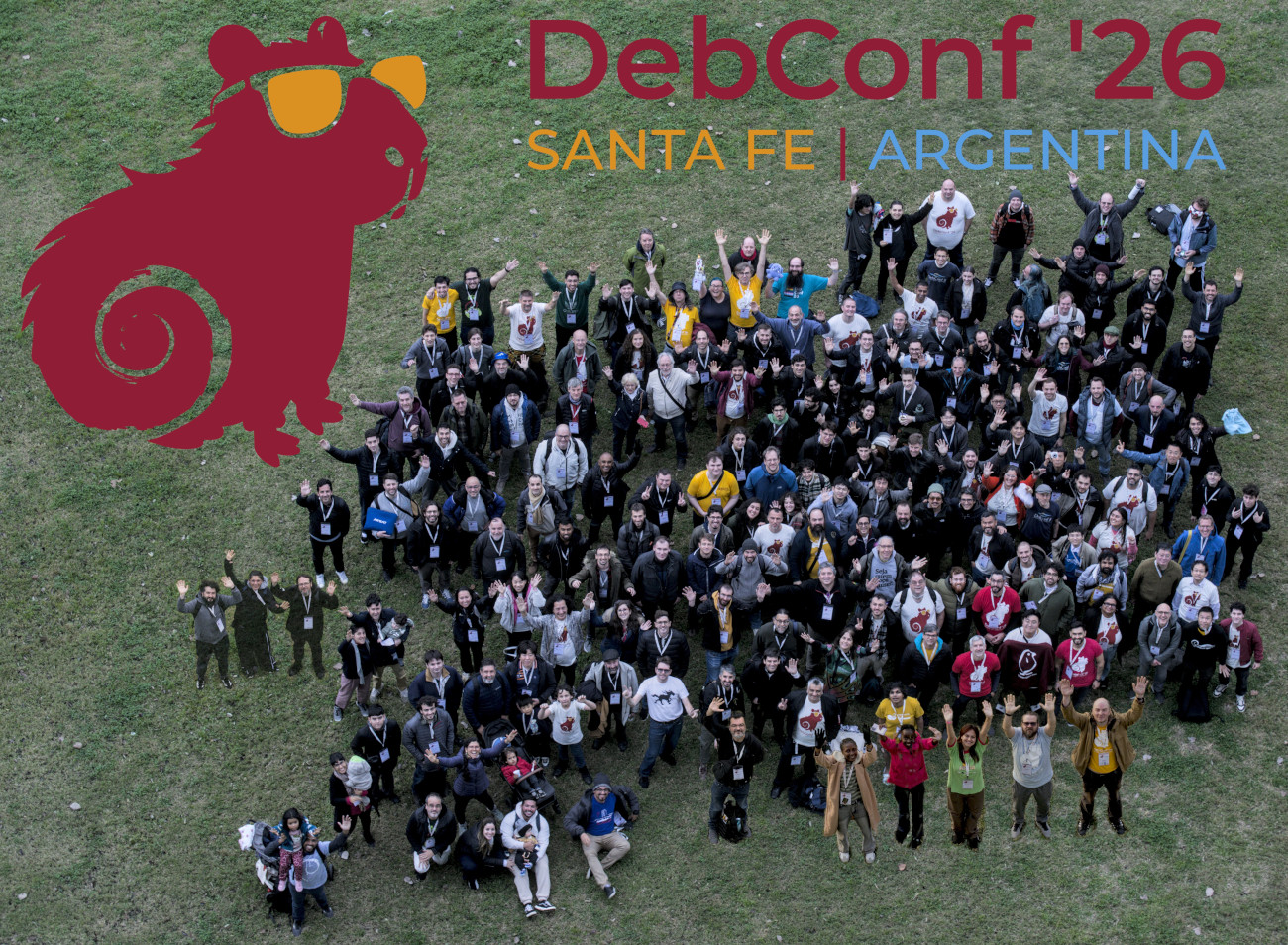
DebConf26 group photo - click to enlarge On Saturday 25 July 2026, the annual Debian Developers and Contributors Conference came to a close. Over 270 attendees representing 35 countries from around the world came together for a combined 90 events (including some which took place during the DebCamp) including more than 27 Talks, 21 Short Talks, 29 Birds of a Feather sessions ("BoF" informal meeting between developers and users), 8 workshops, and activities in support of furthering our distribution and free software, learning from our mentors and peers, building our community, and having a bit of fun. The conference was preceded by the annual DebCamp hacking session held 13 through 19 July where Debian Developers and Contributors convened to focus on their individual Debian-related projects or work in team sprints geared toward in-person collaboration in developing Debian. As has been the case for several years, a special effort has been made to welcome newcomers and help them become familiar with Debian and DebConf by organizing a sprint "New Contributors Onboarding" every day of Debcamp, followed more informally by mentorship during DebConf. Half a dozen new contributors joined the sessions and learned about Debian, free software, packaging and much more. This year, a week-long DebCamp session was dedicated to auditing, patching, and modernizing the Go ecosystem in Debian and enable the transition triggered by the recent upload of dh-golang enabling GO111MODULE=on by default in Experimental. In order to make the conference more accessible for local participants, a local language track was included in the schedule for talks in Spanish, as was done at DebConf19 in Brazil. The actual Debian Developers Conference started on Monday 20 July 2026. In addition to the traditional "Bits from the DPL" talk, the continuous key-signing party, lightning talks, and the announcement of next year's DebConf27, there were several update sessions shared by internal projects and teams. Many of the hosted discussion sessions were presented by our technical core teams with the usual and useful "Meet the Technical Committee", three talks about Linux Kernel, early boot and improving Debian s kernel and installer support for Chromebooks, and about twenty BoFs and talks about Debian packaging policy, Debian infrastructure, security and privacy. This year, and echoing ongoing discussions within the Free Software community, Artificial Intelligence and Age Verification have been the subject of several talks. The Python, Perl, Ruby, Go, and Rust programming language teams also shared updates on their work and efforts. More than 17 BoFs and talks about community, diversity, and local outreach highlighted the work of various teams involved in not just the technical but also the social aspect of our community The schedule was updated each day with planned and ad hoc activities introduced by attendees over the course of the conference. Several traditional activities took place: a poetry performance, the traditional Cheese and Wine party, the Group Photos, and the Day Trip. For those who were not able to attend, most of the talks and sessions were broadcasted live and recorded. One can find the seventy hours of recorded videos available via the conference schedule, or alternatively through this link. Almost all of the sessions facilitated remote participation via IRC and Matrix messaging apps or online collaborative text documents which allowed remote attendees to "be in the room" and ask questions or share comments with the speaker or assembled audience. DebConf26 saw over 341 T-shirts, a day trip, and up to 130 meals planned per day. All of these events, activities, conversations, and streams coupled with our love, interest, and participation in Debian and F/OSS certainly made this conference an overall success both here in Santa Fe, Argentina and online around the world. The DebConf26 website will remain active for archival purposes and will continue to offer links to the presentations and videos of talks and events. Next year, DebConf27 will be held in Asahikawa, Hokkaido, Japan, from Sunday September 5th to Saturday September 11th, 2027. As tradition follows before the next DebConf the local organizers in Japan will start the conference activities with DebCamp with a particular focus on individual and team work towards improving the distribution. DebConf is committed to a safe and welcome environment for all participants. See the web page about the Code of Conduct on the DebConf26 website for more details on this. Debian thanks the commitment of numerous sponsors to support DebConf26, particularly our Platinum Sponsors: Infomaniak, and Proxmox, and our Gold Sponsors : Freexian, and Viridien. We also wish to thank our Video and Infrastructure teams, the DebConf26 and DebConf committees, our host nation of Argentina, and each and every person who helped contribute to this event and to Debian overall. Thank you all for your work in helping Debian continue to be "The Universal Operating System". See you next year! About Debian The Debian Project was founded in 1993 by Ian Murdock to be a truly free community project. Since then the project has grown to be one of the largest and most influential Open Source projects. Thousands of volunteers from all over the world work together to create and maintain Debian software. Available in 70 languages, and supporting a huge range of computer types, Debian calls itself the universal operating system. About DebConf DebConf is the Debian Project's developer conference. In addition to a full schedule of technical, social and policy talks, DebConf provides an opportunity for developers, contributors and other interested people to meet in person and work together more closely. It has taken place annually since 2000 in locations as varied as Scotland, Bosnia and Herzegovina, India, Korea, France. More information about DebConf is available from https://debconf.org/. About Infomaniak Infomaniak is an independent, employee-owned Swiss technology company that designs, develops, and operates its own cloud infrastructure and digital services entirely in Switzerland. With over 300 employees more than 70% engineers and developers the company reinvests all profits into R&D. Its public cloud is built on OpenStack, with managed Kubernetes, Database as a Service, object storage, and sovereign AI services accessible via OpenAI-compatible APIs, all running on its own Swiss infrastructure. Infomaniak also develops a sovereign collaborative suite messaging, email, storage, online office tools, videoconferencing, and a built-in AI assistant developed in-house and as a privacy-respecting solution to proprietary platforms. Open source is central to how Infomaniak operates. Its latest data center (D4) runs on 100% renewable energy and uses no traditional cooling: all the heat generated by its servers is captured and fed into Geneva's district heating network, supplying up to 6,000 homes in winter and hot water year-round. The entire project has been documented and open-sourced at d4project.org. About Proxmox Proxmox develops powerful, yet easy-to-use open-source server solutions. The comprehensive open-source ecosystem is designed to manage divers IT landscapes, from single servers to large-scale distributed data centers. Our unified platform integrates server virtualization, easy backup, and rock-solid email security ensuring seamless interoperability across the entire portfolio. With the Proxmox Datacenter Manager, the ecosystem also offers a "single pane of glass" for centralized management across different locations. Since 2005, all Proxmox solutions have been built on the rock-solid Debian platform. We are proud to return to DebConf26 as a sponsor because the Debian community provides the foundation that makes our work possible. We believe in keeping IT simple, open, and under your control. Contact Information For further information, please visit the DebConf26 web page at https://debconf26.debconf.org/ or send mail to press@debian.org.

Russell Coker: TV Control etc

In 2008 I wrote a blog post The Problem is Too Many Remote Controls [1] about the issues of controlling a TV and related things. It recently got some comments on Mastodon so I think it s time for an update. The first issue I raised was Now it s not uncommon to have separate remote controls for the TV, VCR, DVD player, and the Cable TV box a total of four remote controls which seems to have alleviated. VCRs seem to have almost entirely gone away. The VHS Wikipedia page [2] is worth reading for everyone who hasn t seen a VCR in operation, which I expect to be more than a few readers now and an increasing number over the next 18 years. I personally don t have Cable TV, I own a DVD player which isn t connected to my TV because I haven t used it for years, I don t own a VCR, and I don t watch free to air TV. So I have one remote control for the TV which I use for Netflix and sometimes YouTube. When viewing YouTube on TV there are significantly more adverts and longer adverts. I presume that is because installing an ad-blocker on my TV isn t a viable option for me and it s a total impossibility for most users. Generally my desktop PC is a much better platform for YouTube than my TV, it has a better quality display, is more user friendly (my previous post addressed the difficulty of getting to the data source that s desired), and doesn t require entering search terms via a slow on-screen keyboard. Netflix on Linux is limited to 720p at low bitrate which is obviously of low visual quality while on the TV it s in 4K. I have Netflix so I use that only on the TV. In my previous post I wrote a thought experiment on how to use a cheap laptop ($500 at the time equivalent to $777 in 2025 money according to the Reserve Bank of Australia) to control a $5000 TV ($7770 in 2025 money). Now you can buy a new 65 4K TV for under $800 and a new laptop capable of 4K output for under $400 so the options are very different. For a $800 TV the manufacturer isn t going to develop a remote control interface and Google (who develops the software the TVs run) won t do it because it could reduce their advertising revenue. But a typical home user could setup a cheap laptop connected to their TV via HDMI providing a familiar and efficient user interface for themselves and visitors. For a Windows laptop 4K Netflix should work and for a Linux laptop the options of a laptop for everything apart from Netflix and the TV for Netflix are bearable, two controls are worse than one but better than the 3+ that used to be common. In my previous post I raised the issue that it s often the case that you don t want to stop watching one show while trying to find another . This is still an unsolved problem and is not addressed in modern software. I am not aware of a Linux music player that supports such functionality and this would be much easier for a music player than for a video player where the screen would have to be shared between the interface for finding the next thing to play and the space for playing the end of the current one. Maybe I should file a bunch of wishlist bugs against music players asking for this. I suggested that cable modem and cable TV box could be integrated into a single device. That has not happened, in fact it s got worse. A relative who has Foxtel has a cable modem, a cable TV box, and a Wifi AP with VOIP to provide landline phone service and to make it more exciting the latter two both have bugs that require a periodic hardware reset to fix. Hopefully cable TV will go away in the next 18 years. Regular PCs have become less noisy in recent years. I am currently using a HP Z640 to write this post and I have HP Z840 and HP Z4G4 systems behind me running as servers and the background noise is still very low. The allegedly 8K TV [3] that I have in my lounge room has cooling fans that make more noise than those three high-end HP computers combined. Using a quiet PC like one of those HP systems to drive a TV is a very viable option and I did just that for a couple of years. Kogan has currently got a selection of refurbished Lenovo ThinkStation systems on sale for under $400, they are quiet and would do well for this, it s also nice that Kogan is selling systems with ECC RAM at home user prices. TV does seem to be going away. YouTube and streaming services seem to get more watching time and many people don t use TV at all. Since my previous post the number of streaming services has increased so torrenting offers increasing benefits as no-one wants to subscribe to 6+ services. For anyone who wants to get all the content that interests them while paying the user interface situation is much worse now than it used to be in 2008. If you use KDE on a PC then the kconnect program allows a phone to be used to remotely control some aspects of a PC and has a good interface for pause/resume of a video and seeking 10 seconds forwards/backwards. The interface for controlling volume is hard to get to and doesn t work on my installation. If you want to use a keyboard to start something playing and then a phone for pause control then kdeconnect is a decent option. A comment on my previous post by Michael Croes raised the issue of remote control which is now a solvable problem. Justin also wrote a comment suggesting a Nokia N800 as a remote. Jason suggested a programmable remote, which would be a good option for a power user and a viable option for someone setting things up for their grandparents. But the amount of pain is greater than I m interested in as lounge room TV isn t an important thing to me. It may appeal to more people than having a dedicated lounge room PC though.

Gunnar Wolf: Subscription Bombing Email under Attack

This post is an unpublished review for Subscription Bombing Email under Attack
One of the most important inputs one can have when designing a response strategy against a security attack is a good characterization. This article describes a relatively newly described attack mode (subscription bombing), hypothetizes on the motivations that can lie behind it, and presents some countermeasures that can be taken by different actors to reduce its impact. At its core, suscription bombing is a classical reflection attack: it uses a third party service so that the answer to a relatively simple request is amplified and results in a distributed denial of service (DDoS) for the victim. And, as with most DDoS attacks, its effectivity lies in that there is not much a person can do against traffic coming from seemingly random different providers all around the world. The core differentiatof for subscription bombing is that the attack s victim is not a network port, but an individual s e-mail address. The attacker builds a database of service providers that allow interested users to sign up for newsletter on their activities, or a mailing list, or even just to create a new account on a given Web system. This action will generate a (seemingly legitimate) confirmation mail sent to the victim. But the attacker scripts together hundreds of thousands of such request, creating a deluge of confirmation mails sent to the unsuspecting victim. The authors explain the goals an attacker might pursue by performing this kind of attack. They suppose this can be due to harassment (a disgruntled employee being denied a salary raise, a political adversary, or even a romantic ex-partner wanting to inconvenience the victim s use of their e-mail). More worryingly, the attack can be used as a distraction: by sending a high volume of mails in a controlled timeframe, the attacker can reduce the probability of the victim noticing a specific attack warning them of, i.e., financial fraud, unwanted purchases, or break-in attempts into their accounts. Attacks targetting mailboxes at private mail servers can also lead to overloading an account s limit, causing it to reject mails after the attack is delivered and before the folder is cleaned. And it can also pave the way for follow-up, targetted deception attacks, where the attackers call the victim pretending to be the company s IT department, and get them to install a remote desktop monitoring and management tool, with which they can effectively seize control of the victim s data. To do this, they present a study they made over 24 cases of victims, from which 47,970 total e-mails were received between October and December 2024, with individual attacks receiving between 81 and 3,387 e-mails per hour, from where they presented several descriptive analysis. The authors explored cyber criminal s offers on underground websites, comparing flooding services and pricing schemes. Finally, mitigation strategies are discussed. Mitigation is quite problematic, as none of the mail servers is acting in either a hostile way or lacking permissions they are performing just the task they should. The authors suggest four mitigation strategies for mail server operators to reduce the burden on their users, although none of them is easily automatizab (rate-limit the number of emails a given inbox can receive from previously unseen senders; educate users about this kind of attacks; group similar newsletter or account reset mails during active attacks; and automatically unsubscribe or bounce newsletter messages when a surge is detected). They also recommend newsletter providers and services accepting the unrestricted creation of user accounts to provide some hardening to increase the effort wrongdoers need to spend to abuse their services, such as requiring CAPTCHAs or requiring users to take several steps before requesting a subscription, although they recognize this adds friction to the process providers are most interested in providing; filtering and triaging known-good and known-bad domains, although this is hard to implement on a preemptive fashion, and adhering to easy unsubscription standards, such as easily identifiable headers with which mass unsubscription could be performed more easily victims, instead of hunting for the right places to click, potentially even in mails written in an unknown language. The described problem is interesting, and properly tackling it can be a game changer for many users who will suffer this kind of abuse, and the article is easy to read and soundly supports its claims.

5 August 2026

Iustin Pop: Yes-yes, still alive!

I am not sure what happened, but my interests have changed significantly, and I haven t blogged, I haven t done any open source work, and didn t even process any pictures for the entire year. Not because anything went bad, just new stuff, new interests, life changes. However, still alive, and still struggling with sports, and with sleep :) On the positive side, on a recent mid-length flight, I thought I haven t done any work on Corydalis, since last year I closed quite of a few of my must have features, so probably, nothing else to do for now, right? I opened an editor and started thinking about ideas, and surprised! One hour later, I had written down enough ideas for a couple of months of work. So now just need to find the time but can t wait for the planned things! Stay well!

Enrico Zini: Gnome refusing to suspend

I'm tired, I want to do go bed. I click "sleep" on gnome shell, nothing happens. Swearwords. I want to go to bed. I might have want to put my laptop in a bag and run to catch a train. I hate when this happens. systemd-inhibit --list --mode=block doesn't help much:
$ systemd-inhibit --list --mode=block
WHO    UID  USER   PID  COMM            WHAT                                                     WHY                        MODE
enrico 1000 enrico 3042 gsd-power       handle-lid-switch                                        External monitor attached  block
enrico 1000 enrico 3037 gsd-media-keys  handle-power-key:handle-suspend-key:handle-hibernate-key GNOME handling keypresses  block
enrico 1000 enrico 2878 gnome-session-b sleep                                                    user session inhibited     block
After much googling I found out about gnome-session-inhibit:
$ gnome-session-inhibit  --list
mutter: idle-inhibit (idle)
/usr/lib/chromium/chromium: Playing audio (suspend)
Found the right tab in chromium, paused playing, sleep works again. My sleep was a good half an hour overdue, and all I got for it was to write this blog post. Of course Gnome could have shown me its inhibitor list instead of doing nothing, since it has that information, but it didn't. What I really would expect is that if I intentionally click a suspend button, audio and video playing wouldn't inhibit the suspend. Maybe in a future version of Gnome?

4 August 2026

Russell Coker: Monitors for Work

The Corporate Monitor Issue Some time ago I worked in the IT department of a company that had a corporate standard of two 27 FUllHD (either 1920*1080 or 1920*1200) monitors for the desktop. I was pushing to make the standard be one 32 4K monitor or the two cheaper monitors. They ended up making one 27 4K monitor an option which was still a better option for many users than two FullHD monitors due to having twice the pixels even though it had half the screen area. It was a surprise to me when hardly anyone took up that option. One man who worked there brought a wide curved monitor from home and ran with one of the FullHD monitors on each side of that. As an employee in the IT department I had concerns about expensive personal equipment being used in the office regarding who s going to pay the bill if it gets broken. But I was assured that it was his old monitor that he didn t need after buying a better one for gaming at home and he wouldn t be too upset if something happened to it. This isn t the only time I ve witnessed such problems of companies paying large salaries for skilled people and providing poor equipment for them to do the work. One previous time I raised a OH&S issue because the outdated monitors were so blurry but the company determined that the monitors wouldn t cause health problems and spending $150 per employee on better replacements was a waste of money. Computer hardware tends to become cheaper over time and one thing that has become really cheap recently is portable monitors. Kogan has a 15.6 FullHD monitor with USB-C and mini-HDMI inputs for $89 [1]. It wouldn t be difficult for someone to put one of those on each side of the monitor or monitors that their employer provides and put them in a desk drawer at the end of the day to minimise risk. The same Kogan page has a 16 monitor with 2560*1600 resolution for $189. Company Ownership I previously wrote about the potential benefits to companies in not owning all those keyboards, mice, and headsets when they could just give each employee the money and have them buy their own [2]. I don t think we are at the stage where that can be applied to monitors as the cheapest price for a decent monitor is about $500 which takes it out of the disposable price range that keyboards and mice are in. Also from an IT support perspective there are real support issues with monitors and cables having compatibility issues. But paying small amounts of money to reimburse employees who buy cheap portable monitors to supplement their main monitor is a more reasonable option. For some people that will allow noteworthy improvements in work performance. Who Will it Help? I don t think that adding such portable monitors will directly help the majority of workers. I think that to maximise performance and efficiency we need to chase the long tail of improvements. Big monitors, really big monitors (65 at a larger distance), multiple monitors, standing desks, and whatever else people want. There was some research from Microsoft some years ago (back when 27 was a really big monitor) showing that some tasks had a 50% increase in performance with a larger monitor. Now that 27 is about the smallest monitor size commonly available the potential for improvement is reduced. Probably most workers now already have monitors that provide the benefits to them that the big monitors in Microsoft research provided. But there will always be some portion of the user base who will benefit. If you can get a 50% performance boost for 1% of the users that s really worth doing. If you can get a 0.5% benefit for 100% of the users that is also worth doing and will theoretically give equal benefits. Costs of Employees It is claimed that the total cost of an employee including all overheads of management and providing office facilities etc amounts to twice their base salary. If that is the case then a minimum wage employee in Australia costs $100k per year, someone at the low end of the IT pay scale costs $200k, and someone at the high end of the IT scale is around $400k. It seems clearly worthwhile to spend $1000 in hardware purchases for a $100k employee who declares that it will really help their work, anything which is noticeable to the user is going to be more than a 1% difference in performance. For someone at the high end of the IT pay scale spending $40,000 on hardware to improve their performance could pay for itself. This is not only due to direct return on investment but because the people who do such work are often in key roles in important projects. If there s too much work for one person on minimum wage to do then you just hire another person. You can t hire another senior IT person and have them just do the work, it can take months to get up to speed. But as management in corporations seems unable to recognise this cheap hardware employees can afford to buy with their own money can bridge the gap. Job Interviews In future when interviewing for jobs I ll ask about the hardware that s to be used. I won t say I m not interested in this job offer because you don t respect your employees enough to buy adequate hardware , but I may make it a condition of working at a company that the hardware on my desk will not be obsolete.

Dirk Eddelbuettel: #058: Reverse Dependencies Made Easy, Fast, Reliable

Welcome to post 58 in the R4 series. R and the CRAN repositories maintain a very high level of what we might call quality assurrance by requiring that newly-added code does not break any existing dependencies. This is frequently called a reverse-dependency check . For any given CRAN package one can quickly determine it reverse dependencies. Calling tools::package_dependencies(pkgName, reverse=TRUE) will for a scalar or vector-valued argument return a named list with the reverse dependencies. It is then a matter of looping over this list. There are helper functions in base R as well as in contributed packages on and off CRAN. I also wrote my own with package prrd which, while possibly a wee bit specialised and under-documented has served me well to check on Rcpp and related packages which can indeed have a large number of reverse dependencies. I recently looked into one of these contributed runner packages, and while I will refrain from naming its implementation language let me just mention that the term cargo cult may be a real thing here. What go me interested in this was the fact that if one has a simple-to-use runner then the fact that r2u makes it fast, easy, reliable: pick all three (to borrow its slogan) to deal with actual depencies if Ubuntu has indeed been selected as the host. We will maintain the position that if you can in fact integrate with the system-wide package management then any alternative per-repo package management approach not doing so will likely be dominated by an approach that does integrate with the system facilities. Which is what precisely what r2u does, and offers. And why it is used enough to by now have shipped eighty eight million binary packages. So I tested it for the reverse-dependency check task. What I learned by looking into the (much more complicated) runner was that it at the end of the day it hands the actual task of running the reverse dependecies off to a helper function rev_check that is part of the xfun package by Yuhui. I quickly found that besides xfun we would also need its suggested dependency tinytex which in turn would error unless the tlmgr binary was present. So as the sole requirement (on an Ubuntu system with r2u) turns out to be
$ apt install r-cran-xfun r-cran-tinytex texlive-base
where we do it all in one apt call (as root in the container). (Given r2u we could also call install.packages(c("xfun","tinytext")) followed by apt install texlive-base but it is simpler for this setup step to be just one call). With that we are basically done. I did this (twice) using a rocker/r2u container with r2u preinstalled, mounting a local work and scrap directory for the container. In it we expand the package to be tested (i.e. tar xaf pkgName_*tar.gz for a given source package pkgName from CRAN) and then just call with the package name and expanded direcrtory. I.e. I used this call to test my package AsioHeaders (which has just three reverse dependencies) to both name it and to point to the expanded source directory created for this purposed:
> system.time( res <- xfun::rev_check("AsioHeaders", src="AsioHeaders") )
## ... earlier output omitted for brevity here ...
   user  system elapsed 
 35.732   3.333 149.683 
> res
   httpgd ipaddress websocket 
        0         0         0 
> 
and about a good two minutes later I would get the timing result and the summary in variable res. As I checked the current CRAN version, the check was as expected free of concerns or issues. To support this, r2u did indeed go off and install about sixty seven binary packages (and the total includes all binary dependencies fully resolved) delivering on the just works promise by the r2u documentation. As another check, I did the same for RcppAnnoy which has seven reverse dependencies and needed about two hundred CRAN packages to be installed. The full test took just over four minutes with the timing function reporting some nice gains from parallelisation as total user compute time was on the order of just under eight minutes. Again, test results were clean and free of worries as expected:
> system.time( res <- xfun::rev_check("RcppAnnoy", src="RcppAnnoy") )
## ... earlier output omitted for brevity here ...
   user  system elapsed 
471.765 378.220 266.855 
> res
   bbknnR  bigANNOY  blocking     scDHA    Seurat      uwot VectrixDB 
        0         0         0         0         0         0         0 
> 
Overall this was a rather useful quick excursion as it demonstrates that - existing functions can be used to orchestrate a reverse dependency check - with reasonable dependency scale we can do this on a single machine quite easily taking advantage of parallel computing on multi-core machines - using r2u gives us fast, easy, reliable package installation making testing of packages we might not otherwise use or know a breeze - doing this in an ephemeral Docker container facilitates easy build-up of required resources and leaves no side effects behind which might affect our normal development environment

This post by Dirk Eddelbuettel originated on his Thinking inside the box blog. If you like this or other open-source work I do, you can now sponsor me at GitHub.

Petter Reinholdtsen: FreeCAD MCP with llama.cpp, toy or tool?

After seeing a video a few months ago demonstrating how a proprietary CAM solution uses machine learning and large language models to automatically generate CNC instructions, and successfully testing it on a real CNC, I began wondering if the same could be achieved with free software. I still do not know the answer, but I may be getting closer to finding out. Two weeks ago, I came across the video "I Connected Claude AI to FreeCAD (And It Models Parts Like an Engineer)" by Make Form, which introduced me to the FreeCAD MCP project. Even though the video creator apparently believes it is acceptable to download and run random binaries from the Internet on a local machine (his setup uses UCX), I do not. I would probably have left the project alone entirely if I had not noticed that all of its dependencies are already available in Debian. This significantly boosted my motivation, so I set out to test it using packages built from source on Debian rather than relying on untrusted binaries. The first hurdle was that the MCP SDK for Python was not present on my Debian Forky test machine. I initially believed it was missing from Debian altogether, but it has been available in Debian Unstable for about a month and is only absent from Forky because some automated tests fail on architectures like riscv64 and s390. Fortunately, backporting it was straightforward using apt-get source -b python3-mcp . The next hurdle involved an outdated version of the Validators Python library. Since I am a member of Debian's Python team, which maintains this package, updating it to a sufficient version for FreeCAD MCP was relatively easy. I could not upgrade to the latest upstream release due to a new dependency on an Ethereum-related library, so I settled on a 2024 version. With those dependencies in place, I proceeded to create a Debian package for FreeCAD MCP. I had previously submitted a request for packaging of FreeCAD MCP to gauge interest while deciding whether to prioritize maintaining it myself. Because salsa.debian.org blocks access from Tor users like myself, I published my draft packaging scripts in a Git repository on Codeberg as the Debian FreeCAD MCP project and got it working with the FreeCAD 1.1 version in Forky. I initially struggled with the button controls for the MCP feature, which led me to submit a pull request titled "Fixed startup sync of checkable toolbar buttons" proposing a fix. Once this confusion was resolved and the MCP setup was enabled via the GUI, I was able to run FreeCAD completely headless using xvfb-run on a machine without an X server to generate models. I am using a private LLM service running the Debian package of llama.cpp with the Qwen 3.6 model downloaded from Hugging Face, configured with a maximum context window of 105k tokens. I also tested the Bonsai model on my test laptop; initially, its context window was too small (8k and 16k could not accommodate the FreeCAD MCP instructions), but even after increasing it to 32k, it proved useless for generating FreeCAD models so far. I've used Claw Code, Aider and Open Code with my server so far, and for this test I ended up with OpenCode because it was easy to set up to use an MCP. Because none of my LLM services are set up to be multimodal (capable of processing both text and images in this case), I configured the MCP to return only textual feedback from FreeCAD. I am unsure if this is a major limitation, though I suspect it might be. My testing experience remains limited, with no clear successes yet. Part of the issue likely stems from my ability to provide effective instructions for modeling 3D objects (I am relatively new to FreeCAD, English is not my first language, and I lack a precise vocabulary for describing construction features to an LLM). Nevertheless, the LLM has demonstrated the capacity to create 3D models in FreeCAD. In one of my first tests, I asked it to generate a cube and then produce CAM/G-code instructions for a CNC machine. It did output G-code (which remains untested), but I was surprised to find that it bypassed FreeCAD's built-in CAM module entirely and instead generated an external Python script to produce the code. This was not quite what I intended, though my instructions were probably unclear. The Qwen model with OpenCode seems to strongly prefer programming directly; it frequently executes Python snippets inside FreeCAD to achieve its goals rather than using the standard sketch-and-extrude workflow I am accustomed to. In another test, I asked the LLM to create a parameterized pipe assembly to see which of FreeCAD's parametric tools it would choose, but found no evidence of traditional parametric features in the output. When prompted, the LLM explained that the parameters were embedded directly in the Python script used to generate the model, rather than in native FreeCAD features. With more explicit instructions, it eventually created a FreeCAD spreadsheet to manage the parameters. The resulting model looked much closer to my expectations and could have been useful with further refinement. My so far last experiment was less successful: I asked it to design a pipe clamp, but the LLM repeatedly failed to position the clamping screws in a way that would actually secure the brackets around the pipe. It is unclear whether this limitation lies with the model, my prompt, or other factors. Based on my testing so far, I am uncertain whether FreeCAD MCP is merely a fun toy or a genuinely useful tool. I will only commit time to maintaining it in Debian if it proves to be practically valuable. I would welcome feedback from anyone who has experience with the project, preferably via the original request-for-packaging mailing list thread. Alternatively, I am available in the FreeCAD and Debian AI IRC channels for further discussion. As usual, if you use Bitcoin and wish to support my activities, please send donations to 15oWEoG9dUPovwmUL9KWAnYRtNJEkP1u1b.

Anuradha Weeraman: Plan 9 from Bell Labs, the little OS that could

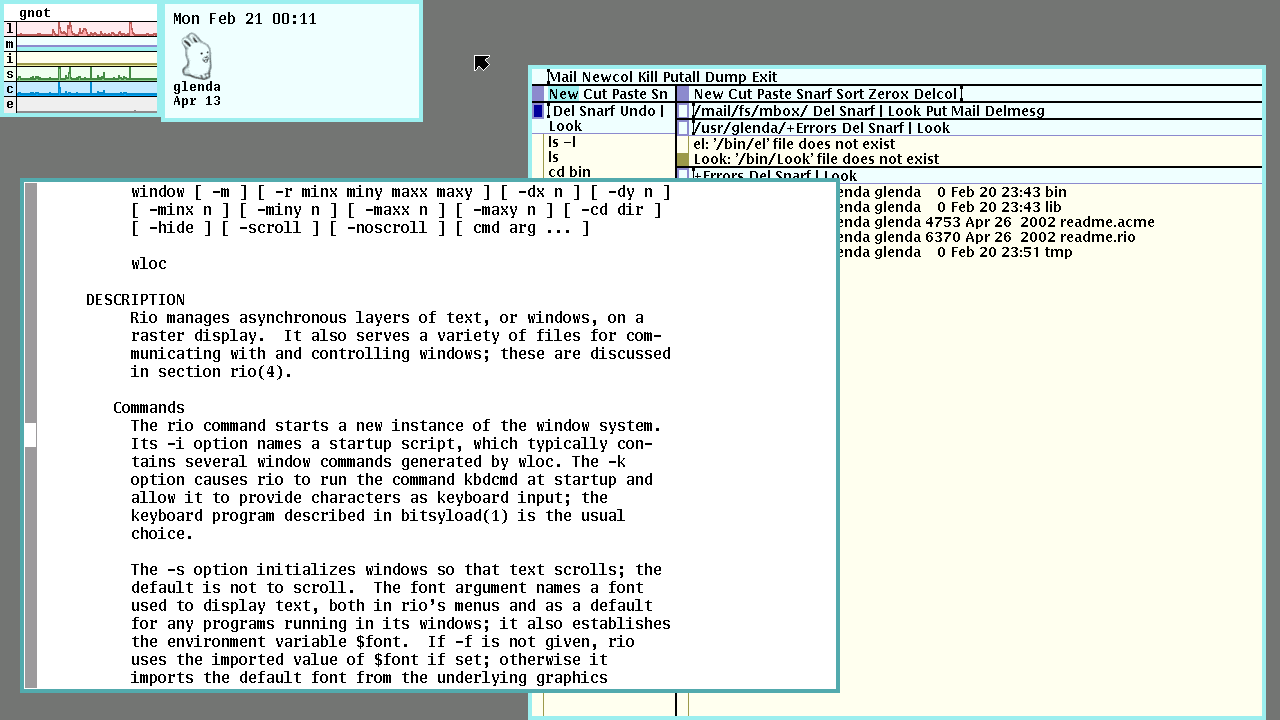
Plan 9 Fourth Edition showing the rio windowing systemScreenshot by VulcanSphere via Wikimedia Commons MIT License
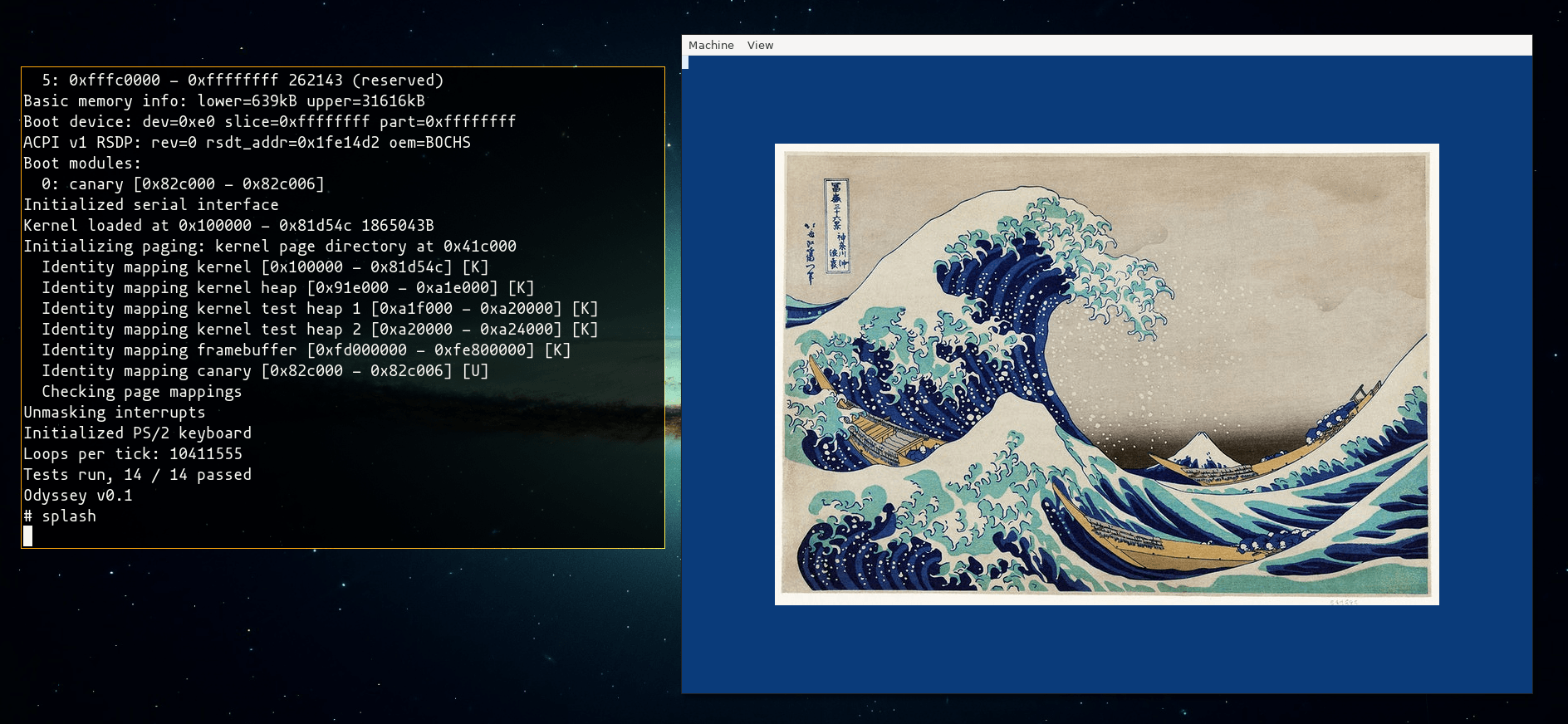
I first heard of Plan 9 from my friend Vajra in 1999 or so, as we were distro-hopping on early Linux distributions and trying to find our way. Vajra is now a Nebula Award-winning science fiction author - have a look at his work. We had just been through Tom's Root Boot, a UNIX-like operating system crammed into a single floppy, and through it discovered a whole new world outside of DOS 6.22. Combing through old UNIX manuals, we went in search of the perfect OS, through Slackware, Caldera, TurboLinux, SUSE and Red Hat. I finally settled on Debian, which lived up to everything I stood for. Plan 9 was distinct. It came out of the Computing Sciences Research Center at Bell Labs, built by Rob Pike, Ken Thompson, Dave Presotto and Phil Winterbottom, with Dennis Ritchie heading the department. The name is a joke at their own expense, borrowed from Ed Wood's 1959 Plan 9 from Outer Space, routinely nominated as the worst film ever made. Thompson and Ritchie had, of course, built the original UNIX; it almost seemed as if they were building a new OS from the lessons learnt from building it - which was in turn built on the lessons from Multics. I remember the awe I felt playing around with Plan 9, and I've not been able to replicate it since. Plan 9 was different in a couple of fundamental ways: per-process namespaces, and a protocol that abstracted locality of resources to processes. As a consequence of these core primitives, the OS surface area was distinctly small. The entire system from the core kernel, to the system call interface, to the compiler, linker and shell was reduced to a form small enough that a single developer could hold it in their head. Lessons from the implementation of UNIX helped the designers make the system leaner, and in Ken Thompson's words, it's the "best operating system out except that it doesn't have the apps that everybody demands" [1]. It also took the concept of "everything is a file" in UNIX to a whole new level. The network stack is a filesystem (/net), processes are files, the display is a file (/dev/draw). Because every resource speaks 9P and every process has its own namespace, you can mount another machine's /net into your namespace and your program makes network calls through that machine's stack without knowing or caring. No sockets API, no RPC layer, just ordinary file system operations through a simple system call interface. Some would say that OS research is dead, and that backwards-compatibility and POSIX killed it. Rob Pike himself argued as much in his 2000 talk, "Systems Software Research is Irrelevant" - but we didn't care at the time. There was so much happening that we didn't have time to take it all in. And then Linux happened, and Software Freedom became a focal point (more on that in a later post). In the summer of 2020, with the world deep in Covid lockdowns, I decided to build a toy operating system, just to try my hand at the the thing that I had always wanted to do. I spent three feverish months working on Odyssey and, looking back, it is perhaps the most fun I have ever had. I would not dare compare it to the magnum opus that is Plan 9, but it gave me perspective: how hard it is to build an OS from scratch, and above all, how fun it is to build an OS from scratch, and why the original creators kept coming back to the same problem. The highlight of those three months was booting the OS and watching it render "The Great Wave off Kanagawa". Nothing in my professional achievements to date captures what that meant to me.
Odyssey rendering The Great Wave off Kanagawa during boot Odyssey displaying "The Great Wave Off Kanagawa"
Decades on from the first time I booted Plan 9, I look back with nothing but awe and respect for the creators of this little operating system and marvel at the foresight that went into it. While many readers will not have heard of Plan 9, they have almost certainly worked with the ideas that came from it: 9P (if you ever used the Windows Subsystem for Linux), UTF-8 (if you ever used any modern operating system), per-process namespaces (if you've ever run a container), Go (whose assembler still uses Plan 9 syntax). Plan 9 still lives on in 9front, a community-maintained fork. Separately, Yoann Padioleau [2] has produced a set of annotated books at principia-softwarica.org, presenting the Plan 9 source in the spirit of Donald Knuth's literate programming - an admirable effort to introduce new readers to the art of operating systems engineering. Pike thought systems research had become irrelevant, and Thompson thought Plan 9 would never "make it" [1]. Both were right about the industry, but may have been pessimistic about the impact. The system lost as a product but won as a set of ideas, assimilated one at a time by modern operating systems. Success is not always measured by popularity. The mark that Plan 9 left behind is greater than what's reflected in its current user base. To me, Plan 9 will always be the OS that punched above its weight class, the little OS that could. References [1] Ken Thompson Interview, March 6, 2024 [2] Yoann Padioleau Principia Softwarica, May 9, 2026

3 August 2026

Bernhard R. Link: I learned something new about URLs today

Today I stumbled over some behavior that I found quite surprising:

$ ipython3 -c 'import httpx;print(httpx.URL("https://example.com/foo/bar/../../baz"))'
https://example.com/baz
Even more surprising that behavior is actually standards-compliant, even mandated by RFC 3986. The underlying motivation is relative reverences. If some resource reachable by "https://example.com/foo/bar" references another resource relatively as "../../baz" then this is of course the intended result. Getting from this problem to what RFC 3986 suggests might be surprising in the result, but somewhat understandable if you look at the consequences of that problem: Giving the path components ".." (and ".") special meaning at the start of the relative reference means that if you allowed them in absolute URLs those would be impossible (or at least very convoluted) to address as relative URLs. So RFC 3986 describes a way to handle them everywhere: Just join the path of the base URL and the path of the relative reference and normalize the result. Or normalize the absolute on either side if only that is to be taken. This makes things very convenient: Multiple reference URLs can just be joined without special handling for relative references starting with dots, making writing applications handling them easier. Programmers don't have to care how to handle relative references and can just join everything in whatever way they want. For maximum elegance there is still some corner case left: What happens if an absolute URL has a path starting with double-dot components? Or an relative path starting with more of them then the base URL's path has components. You just ignore them:
$ ipython3 -c 'import httpx;print(httpx.URL("https://example.com/../../baz"))'
https://example.com/baz
With that last point every URL is valid and has well-defined meaning. Handling relative references and relative paths is very easy and convenient. So this shows a high regard for simplicity, elegance and convenience. And a total and uncompromising disregard of security. After all the most convenient it is for an attacker; If they are allowed to supply a path component for a request a system does in their behalf, then they can easily escape anything they were supposed to be limited to. The ignoring of dots at the start means they don't even have to know exactly how deep their request is:
$ python3 -c 'import httpx;print(httpx.URL("https://example.com/public/api/public/resources/harmless/../../../../../../../../../internal/data"))'
https://example.com/internal/data
So even if the resource server securely handles request (unless you consider not having any way to lower your permissions for one request to a specific subset), your fully RFC conforming client library will already request the permission they should not have permission for. Even worse dots are usually not characters you can easily forbid so once slashes are to be allowed things get complicated. There also would have been a simple, elegant and secure way: Consider every path element ".." or "." in an (absolute) URL an error. Define a reference resolution that allows the relative reference to only start with "./" or one or multiple "../" and consider every appearance of a dot or two dots as path components after than an error. Everything joining two paths has to either use an implementation of that path joining algorithm, but only if they want to joins paths in the potentially dangerous way allowing leading "../". Otherwise they can just use the normal join and even if an attacker gets those dots that will just cause the generated URL to be rejected as invalid. Of course using a secure implementation is now even more inconvenient thanks to RFC 3986 being around: If you have no control over the generator of relative references, it is always possible that they generate relative references with ".." components after non-dot components. And if you check all code to properly filter out "/../", keep in mind that convienence does not stop there. After all it is not unheared of for server implementations to helpfully normalize unicode characters, too, or translate them to their nearest ASCII equivalents. Or translate percent escaped characters back before doing path splitting. Or you might think there was some unicode codepoints between those two dots, but they that those were some meaningless control characters that can be omitted. So you need some really restrictive allow lists...

John Goerzen: Celebrating 45 Years of Kermit with the First New C-Kermit Release in 15 Years (and working with a decades-old C codebase)

1981 was a different time for computing. It was expensive (both hardware and software), and it was far from a given that machines from one vendor would be able to talk to those from another. In fact, Columbia University had just such a problem, so in 1981, Frank da Cruz and Bill Catchings designed a serial protocol they called Kermit. Because of the many quirks of the DEC-20 and IBM mainframes, the Kermit protocol was highly adaptable from the start: able to handle systems that had trouble processing more than 96 bytes of data at once, able to transfer 8-bit files over 7-bit links, able to translate between character sets (ASCII and EBCDIC then; now also various Unicodes), and of course, handling of error-prone serial links. Kermit spread rapidly; by 1982, Kermit had been ported to MS-DOS and Unix. Eventually, C-Kermit (an implementation of Kermit in C) became the flagship Kermit. It gained TCP support, an interactive CLI, a powerful scripting language (with features from the shell, Lisp, and expect), and optimizations for today s high-speed links, such as jumbo packets, sliding windows, and streaming modes. Along the way, Kermit flew on the International Space Station, ran data collection from sensors during hurricanes, and many other uses including postal systems, Boeing 787 manufacturing, and more. Today, I use it as a powerful ssh wrapper (letting me easily transfer files through multiple nested ssh, sudo, su, etc. commands), a BBS client, to exchange data with me HP 48GX calculator, and so on. It s also used today to transmit firmware updates to embedded devices. And, of course, anyone that works with vintage systems is likely to use Kermit at some point. It wouldn t be until the late 1990s that the TCP/IP stack was finally adopted by most OS vendors, establishing something of a common basis for communication. Of course, we assume this today. Though transferring large files between OSs (say, Linux, Windows, MacOS, Android, iPad, etc.) is still a challenge, even though they all speak TCP/IP! I find that the easiest way to get large files from two computers is to spin up Kermit (see ckwin for a Windows fork of C-Kermit) and just set up a TCP connection over the LAN. In fact, I added a new show interfaces command in C-Kermit 11, making it easy to see your system s local IPs. For most of its history, Columbia s Kermit project was self-funded. Columbia charged for commercial use, which limited its inclusion in Linux distributions. In 2011, 30 years after its founding, Columbia canceled the Kermit Project and released C-Kermit as Open Source under a BSD license. Frank da Cruz, who had still been working with the Kermit project all those years, volunteered to continue maintaining Kermit outside Columbia, and continued development with alpha and beta releases through his retirement from the project in 2025. I dive into this C codebase As Debian maintainer of Kermit, I noticed some areas where it wasn t matching modern expectations. One area was, not surprising for a project of its age, security. Another area was that its character set or line-ending conversions are usually not desired now; we are used to byte-identical binary transfers, and the defaults caused confusion and even some rare instances of data corruption. So I started making a few patches last year. I ve worked with old C codebases before, such as Varnish. I ve generally hated it. You usually find a mix of bad and terrible practices, unclear memory management, and so forth. But I ve been living in the C-Kermit codebase for a few months now, and I enjoy it. Yes, this thing is still designed to build on VMS, OS/2, and with compilers that haven t heard of ANSI and those that require modern practices. (That em-dash was mine; I knew how to use them before LLMs existed and I m not going to stop just because LLMs have copied people like me! No AI was used for this post.) The there is an elegance in all of that. As I worked, I fixed a bunch more potential security issues, both with memory safety and with protecting against a malicious remote in roughly the same manner that some patches to scp did a few years back. I added IPv6 support, of course conditionally compiled because some systems C-Kermit builds on have never heard of IPv6 and never will. (And, of course, with fallback algorithms at runtime for systems that have IPv6 support but not IPv6 connectivity.) I added unit tests and Python-based end-to-end tests, running nearly 2000 test cases in total. Along the way, I found and fixed a number of bugs going back decades. I learned about FIONREAD being broken on macOS, about NetBSD s bugs in the pty driver, and fixed bugs in the Kermit protocol implementation itself. I added compatibility tests with the gkermit and ekermit (embedded) implementations, as well as the last full release, C-Kermit 9.0.302 from 2011 (which was difficult to get compiled on a modern system). There is an extensive changelog describing all the improvements in C-Kermit 11. C-Kermit development had never really used a VCS at any point, though Kermit veteran Jeffrey Altman imported historical releases into a Git repo, along with some patches that hadn t made it into a release (which I also pulled in.) There was a lot of disabled code behind COMMENT, along with commentary describing why it was no longer used. With Git, we would now generally just remove the old code and explain why in a commit message. I went through and did so with a lot of it, meaning that, at last check, C-Kermit actually has fewer lines of code now than it used to. Towards a new release It became apparent pretty quickly that I was making more changes than would make sense as a Debian patch series. Not only that, but they would be more widely applicable to more than just Debian and Ubuntu users. As Linux and BSD distributions were running everything from the last non-beta release (2011 s 9.0.302) to the last beta release (about 1.5 years ago), depending on their different policies about running betas, even sharing patches in a useful fashion was going to be quite difficult. So, I spun up a project at Open Kermit to coordinate future development in the open and keep Kermit going. With modern CI, I run that test suite on Linux (x86_64 and arm64), macOS, FreeBSD, NetBSD, and OpenBSD. It builds binary releases on all those platforms, plus a statically-linked Linux binary built with musl libc. You can download the latest C-Kermit release, and of course contribute to C-Kermit and its website. Dedication Frank da Cruz was directly involved with Kermit for 44 years. I m not aware of any other Open Source project founder being involved for so long. Richard Stallman started working on GNU Emacs in 1984, 3 years after Frank started working on Kermit, but Richard hasn t been in that role since around 2008. Accordingly, C-Kermit 11 bears this dedication:
I dedicate this release of C-Kermit to Frank da Cruz. Frank was directly involved with Kermit for 44 years, from its initial design in 1981 all the way through 2025. He maintained Kermit as an Open Source project after Columbia University ended its sponsorship. I know of no other Open Source project where the founder remains so personally involved for so long. When Kermit was begun, transfers between different hardware and operating systems were difficult or impossible. Frank helped build a bridge. Kermit glued systems together, from the International Space Station to pocket calculators, and set a new standard for interoperability. It continues to do so. Kermit is still one of the quietly-working pillars of computing today, enabling everything from firmware upgrades to radios. And, yes, it still reliably transfers files over serial lines. As we start to spend a lot of time in the Kermit codebase, we do so standing on the shoulders of a giant. Thanks, Frank, for your decades of work on Kermit. John Goerzen, July 2026

2 August 2026

Russ Allbery: Term::ANSIColor v6.0.0 TRIAL release

Yesterday, I uploaded Term::ANSIColor v6.0.0-TRIAL to CPAN for early testing. This release will raise the minimum required Perl version to 5.12, dropping support for Perl 5.8 and 5.10. When I did the same with podlators a couple of years ago, it upset a few people and one of them asked me to make this sort of test release in the future. Hopefully this will help. I have not run the normal release machinery and haven't archived this release in the normal places, since I intend it to be transient. It's only on CPAN, where people can retrieve it for testing. Once v6.0.0 is released, few traces of this TRIAL release will be left. This doesn't appear to be how other people use the TRIAL mechanism, but it felt more comfortable to me. If I have to make substantial changes, I'll consider changing my approach. I plan on turning this into the v6.0.0 release in about a month or two, hopefully with only documentation changes. Term::ANSIColor is a "very upstream" core module with a lot of dependencies, and CPAN (unlike some of the archives that followed it, such as PyPI) doesn't support conditionally retrieving packages based on the current Perl version. This release may therefore be disruptive for people who are still trying to support Perl 5.8 and 5.10, since CPAN installation tools may attempt to install an incompatible Term::ANSIColor version. I'm sad that this will be the result, since I know some people still care about those versions. I'm pressing forward with updating my Perl modules anyway, though. I realized that honoring other people's desire for stability to such a degree that I was unable to use Perl features added more than 15 years ago was destroying my motivation to work on these Perl modules at all. So I've decided on a very slow and gradual approach where I'm going to keep pushing the minimum supported version forward but try to give people a lot of warning. Personally, I think it's time to let ancient versions of Perl go and follow the Lyon Amendment about supported Perl versions. When we're talking installing new modules for software released more than 15 years ago, we're talking about special limited environments and retrocomputing more than what I would consider routine software maintenance. Those tasks should expect to need different tools and a different workflow so that they can pin historical versions. Since this isn't something I'm personally interested in, my willingness to expend time and energy to assist is limited. As you can probably tell, I still feel nervous about pressing forward in this way, but I think this is the approach that lets me continue to enjoy maintaining these Perl modules. It's been 29 years for Term::ANSIColor, but I still enjoy fixing bugs in it and putting out a new release from time to time, particularly if I can clean up the code a bit each time I touch it.

Ben Hutchings: FOSS activity in July 2026

Russell Coker: Packet Edit Meme and Debian SE Linux

There s yet another Linux kernel exploit based on container functions, here s the result when run as user_t on a SE Linux system:
$ ./packet_edit_meme 
[*] target /bin/su as uid 1000; entry at file offset 0x4340; shellcode 48 bytes
unshare: Permission denied
[-] page-cache corruption failed
Here is the audit log entry for this failure:
type=AVC msg=audit(1785640621.498:1843): avc:  denied    create   for  pid=1770 comm="packet_edit_mem" scontext=user_u:user_r:user_t:s0 tcontext=user_u:user_r:user_t:s0 tclass=user_namespace permissive=0
Here s the result of running it from the unconfined_t domain:
$ ./packet_edit_meme 
[*] target /bin/su as uid 1001; entry at file offset 0x4340; shellcode 48 bytes
[+] su entry overwritten; exec'ing su -> interactive root shell
# id
uid=0(root) gid=0(root) groups=0(root),1001(test2) context=unconfined_u:unconfined_r:unconfined_t:s0-s0:c0.c1023
# 
Daniel Baumann wrote a blog post describing how this is fixed for Debian systems without SE Linux.

1 August 2026

Russ Allbery: Review: How to Steal a Galaxy

Review: How to Steal a Galaxy, by Beth Revis
Series: Chaotic Orbits #2
Publisher: DAW Books
Copyright: December 2024
ISBN: 0-7564-1949-2
Format: Kindle
Pages: 143
How to Steal a Galaxy is a far-future science fiction caper short novel (maybe a novella?) and the sequel to Full Speed to a Crash Landing. You don't have to remember the details of the previous book to enjoy this one. There's an excellent inline summary at the start of this installment. After an annoying negotiation with people who keep trying to preach at her about causes, Ada Lamarr has a new contract. She is going undercover, after a fashion, at a charity gala and auction on Rigel-Earth. While she's there, she's going to steal something. What, precisely, she keeps a mystery from both the other characters and from the reader until the end of the story. Government agent Rian White is working security at this charity gala. Due to its link with the plot of Full Speed to a Crash Landing, he was fairly certain Ada would be there, as indeed she is. What she is planning, however, is maddeningly unclear. Also maddening is how good Ada looks in a dress. As with the previous book, How to Steal a Galaxy is told by Ada in the first person using the same teasing tone and constant misdirection that she uses when verbally fencing with Rian and the other characters. I found this novella even more entertaining and satisfying than the previous one. The charity gala is supposedly intended to benefit the poor people of Earth, and is run with exactly the sort of condescension and disguised capitalist looting typical of such exercises in elite charity. Ada's narration is scathing in a deeply relatable way. Also, there is a trillionaire tech-bro fake philanthropist who is smug and condescending and accustomed to getting exactly what he wants.
"I don't think anyone should have enough personal wealth to decimate a large country's income just because he's going through a midlife crisis."
Ada's interactions with Strom Fetor are an absolute delight. He is so sure of himself that he is incapable of registering her as a threat, and she effortlessly deceives him by hiding in plain sight.
"You really shouldn't be talking about this," Rian starts. Fetor waves aside his concerns. "We're all friends here." "Not me," I say. "I hate you. Remember?" Fetor laughs in a tone I'm sure he thinks is charming.
Fetor's complete inability to realize that a beautiful woman might both sincerely not like him and not be flirting with him is perfect. I was cackling through half of this book. Like any good heist story, there are twists and turns, surprises, double agents, unexpected complications, and a delightful amount of verbal fencing. I adore the narrative tone Revis uses for these stories. Ada has just the right mix of idealism, cynicism, professionalism, and irreverence to carry off the feeling that she's a step ahead of everyone else. Underneath the bones of a delightful plot is a character who cares deeply but is very aware of her limitations, and therefore has taught herself to laugh at and be ruthless with her own emotions. I am finding it an incredibly compelling type of competence porn. I enjoyed the first book of this series, but this one was so much better. These stories are exactly the right length to keep the reader engrossed throughout and satisfied but wanting more at the end. How to Steal a Galaxy ends on a cliffhanger of sorts, to be resolved in the next and final book. I can hardly wait to start it. Highly recommended. Followed by Last Chance to Save the World. Rating: 9 out of 10

31 July 2026

Clint Adams: N.K. Jemisin is doing a worldbuilding workshop at the Bronx Library Center tomorrow afternoon

Normally, I do not read book reviews. Either I haven't read the book, in which case there's spoiler potential, or I have, in which case it's unlikely to be useful or enjoyable for me to read a thing about a thing I've already read. But Review: Radiant Star caught my eye, and I thought, Hmm, I've read all those books and was curious. Of course, because I am old and senile and have no understanding of time, the May 2026 staring at me was not able to trigger the neural synapses that would remind me that I haven't read any Ann Leckie since 2023. However, as I read Russ's review, and began to wonder what the hell he was talking about, I was able to piece together that while I have, in fact, read 6 Ann Leckie books, none of them have been Radiant Star. This presented an opportunity, so I resolved to add Radiant Star to my todo list. To my surprise, it was already there.
Posted on 2026-07-31
Tags:

Russell Coker: Links July 2026

Bruce Schneier and Nathan E. Sanders wrote a disturbing and informative article about the use of AI by the US government [1]. Bruce Schneier wrote an interesting blog post about corporate liability for AI decisions and the German court ruling about Google s AI summaries [2]. Cybersecurity News has an interesting article about how Pliny the Liberator succeeded in jailbreaking Anthropic s latest LLM to give instructions on writing exploits, writing exploitable code (backdoors?), and making meth [3]. Andrew Pam wrote about the number of cars with internal combustion engines in NSW decreasing for the first time since 1910, EVs are taking over [4]. Cory Doctorow wrote an informative blog post about Facebook s attempts to silence whistleblowers and what a pathetic little loser Zuckerberg is [5]. Scott Santens wrote an insightful article about how to effectively levy taxes in the future when AI significantly reduces the number of workers [6]. Ron Garrett wrote an insightful post about birthright citizenship in the US and his status as a US citizen who was not born there [7]. The BBC has an interesting article about the Scottish Violence Reduction Unit and how treating violence as a disease can significantly address the problem [8]. The LA Times has an interesting article about Covid19 causing cancer that had been in remission to return, sparking some new research into the effects of viruses on mammals [9]. CMU has an interesting video about ways to physically modify QR codes and how they could be used in real life [10]. Tim Retout wrote an informative post about the pervasive forms of advertising on the Internet, even on the BBC s site and how some of it can be blocked [11]. The Intercept Fund is a project to address respiratory illnesses and the long term mostly unnoticed costs they cause to society, we need governments and corporations to get on board with this [12]. The German news site DW has an interesting article about activists registering neo-nazi slang as trademarks to prevent the sale of nazi merchanise which funds racism [13]. The Conversation has an insightful article about how in South Sudan and other war ravaged countries the peace process usually just allocates the spoils of war and therefore encourages more war [14].

Russ Allbery: Review: Painting the Blues in Gretna Green

Review: Painting the Blues in Gretna Green, by Linzi Day
Series: Midlife Recorder #2
Publisher: Linzi Day
Copyright: November 2022
ISBN: 9798360228431
Format: Kindle
Pages: 577
Painting the Blues in Gretna Green is a self-published fantasy novel and the second in the Midlife Recorder series. It picks up immediately after the end of Midlife in Gretna Green. I also read it almost immediately after, so I didn't pay attention to how good the recap of previous events was. As before, this is urban fantasy except not urban. Day calls it paranormal women's fantasy, which I suppose is as good of a genre label as any. The other book I can think of off-hand that would go into that genre would be Nancy Springer's Larque on the Wing, although it is considerably more literary. I suspect I'm going to read this whole series and it's going to be impossible to review these books without talking about Niki's job, so I'm not going to treat that as a spoiler. It's fairly well-advertised in the marketing for the book, so that feels justified. If you're particularly averse to any spoilers, though, you may want to stop reading here until you've gotten to the reveal in the first book. Niki is now officially the Recorder, with the power, advice book, and sentient house to go with it. She's about to face her first test in managing interworld politics: There's something amiss in the world of the Picts. Her allies are dropping hints, there's a petition from a group on the Pict world that she can't make sense of, and although she likes the queen of the Picts, there is a great deal of tension beneath the surface that she doesn't understand. Meanwhile, after the incompetent disaster that she uncovered in the first book, Niki is determined to pick her new staff by her own criteria. The second book leans even harder into giving Niki both a tangled mess created by previous incompetence and enough power to fix it. Watching that happen is very satisfying, particularly when it involves surprising people who are rather too used to getting their own way. I was somewhat less convinced that Niki is getting the right training to make the decisions that she's making. Diplomacy and staff management are real skills that one needs to learn, not just wing on vibes and gut instinct. My love of competence porn occasionally wishes that Niki had a bit more structure around her competence. We do at least get a new fictional self-help book on how to rule that contributes the quotes that open each chapter. Not the ethics and management training that I would have chosen, but it's something! In defense of Niki's technique, it becomes clear in this book that the last few recorders have been far too cautious, conservative, and content with a status quo that involved a minimum of work. One of the delights of this book is that Niki thinks power exists to be used to fix things and is determined to use it, not just sit on it. I had more suspension of disbelief issues with this book than with the first some of the problems Niki is solving seem far too obvious to have been in stasis for this long while also having this easy of a solution, and the level of political power given to the Recorder is a bit unbelievable but it is so satisfying to see Niki cajole and bully people into being sensible. I have no idea if this is intentional on Day's part, but I will not be at all surprised if adult-diagnosed ADHD comes up at some point in this series. The way that Niki's focus jumps, her tendency to veer between focusing on a problem and forgetting about it, and something about the way she switches between trains of thought or misses important context because she's jumping to conclusions is making me wonder. This, to be clear, is not a complaint; I think it makes Niki more relatable and more interesting. It's a good thing that she has a sentient house to serve as her assistant. The glee with which she's delegating any task that involves keeping track of details or following up with other people feels like a bit of an indicator by itself. I did get a bit frustrated with the plot structure of this book. Niki keeps mentioning that a critical petition submitted to her office makes no sense, but it takes half of this (rather long) book before she finally explains to anyone else, even the reader, what's deficient about it. The excuse within the book is that she's having a rather busy day, but by the third time Niki mentions and then fails to do anything about the petition, I was wishing Day would stop bringing it up until she was ready for that part of the plot. This, as with a few issues in the previous book, feels partly like an editing problem. There is something joyful in indulgent, sprawling books, but only up to the point where they become repetitive. Painting the Blues was right at that line, and once again I wish someone had helped Day trim about fifty pages out of it. All that said, and despite having more quibbles with this book than the previous one, this continues to be great fun. It's satisfying wish-fulfillment about fixing long-standing problems and having the power to not have to put up with abusive nonsense and ridiculous bullshit, and I am so here for that. I hope Niki realizes she's eventually going to need more refined skills than a heart-to-heart over wine, but she's learning on the job and I'm happily along for the ride. She's also capable of recognizing skill in other people, and that goes a long way. Recommended if you liked the first one and are in the mood for another fantasy of "no, we're not going to leave it that way, we're going to fix that right now." Followed by Ties that Bond in Gretna Green. Rating: 7 out of 10

Jonathan McDowell: My CPU died

I built my current house server back in 2019. It had an upgrade from the original Ryzen 2700 to a 5700G in late 2021, but otherwise is still running with the original setup. Back in November it developed some erratic behaviour (initially manifesting as problems with the TPM, which is ironic as I ve spent a bunch of time at my day job trying to improve TPM reliability), culminating in unreliable reboots. I had a limited amount of ability to swap parts out, but ultimately decided it was a motherboard issue (thinking perhaps VRM problems), found a replacement locally, and everything seemed fine. Until May. At that point I rebooted the machine for a Debian point release, and it failed to come back. Fans would spin, but there was no sign of actual life. I ended up pressing a temporary machine into service (that could at least run the Home Assistant container, and a few other critical bits) while I tried to work out what was wrong. I d kept the previous motherboard, and still had the Ryzen 2700, so I did a bunch of swaps (and obtained a motherboard buzzer to try and get some indication about whether there were useful beep codes being emitted), and ultimately came to the conclusion that the CPU had died. I m not quite clear what happened here. I played it safe and replaced the PSU at the same time, in case that was the original cause back in November and ultimately damaged the CPU, but both old + new motherboards worked just fine with the 2700. That left a decision about what to do. This previous server was from 2013, so this machine has now lasted longer than that and I could justifiably upgrade. However when I went to look at what the equivalent modern machine would be it s only a couple of generations later (Zen 5 vs Zen 3), and 64GB RAM alone would have set me back ~ 1k. For not a lot of gain. So I ended up buying a replacement Ryzen 5700G, hopefully allowing me to put off thinking about an upgrade until Zen 6 is out, and RAM prices are saner (though I understand that might take a couple of years). It s not the first time I ve had a faulty PSU be the cause of a dead machine, but it was a pretty frustrating experience.

Next.

Previous.