Search Results: "dod"

10 May 2008

Martin F. Krafft: America does not exist, they never found it

From Berne, the Swiss capital, hails a band I really like by the name of Z ri West. The name itself is a pun: the folks from Berne love their city (rightfully so!) and join the rest of Switzerland in looking down a bit upon Zurich, which is metropolitan and hip and has often been considered the real capital of Switzerland. Located west of Zurich, Berne is thus Z ri West , and by using this name, the Bernese band ridicules the Zurich folks a bit. Well, that s my interpretation anyway and I make no claim over its correctness, and I surely don t want to get mixed up in local politics! Where was I? Oh yeah: Z ri West (Flash-using homepage] make rock music, and they re good with their instruments. The result are groovy and melodic sounds, which everyone in Switzerland knows. What I find particularly amazing about this band are their lyrics. Kuno, the singer, sings almost all songs in the Bernese dialect, which I ve learnt to the point of understanding it, though I can t speak it yet. It s a beautiful dialect, and Kuno displays magnificent control over it. When I say beautiful, I do not only mean its sound, but also the way it allows one to express thoughts, situations, feelings, etc.. It s very lyrical, often poetic, but always very much to the point. It sounds natural, yet not at all blunt. In addition, Z ri West s songs display no haste. Again, this is a bit ironic since the Bernese are said to be slow, but what I mean is that the band is unafraid to take their time to recount what they have to say. Forget 4/4 beats and verse-chorus-bridge-verse-chorus, it s a lot more as if the band shaped the music around the story they re telling. (Of course I have no reason to claim that the Bernese are actually slow. According to my dear (Bernese) friend Isabel, they are just considerate to give the rest of the world enough time to parse and understand their sophisticated verbal and non-verbal output). I won t be able to convey all of the lyrical beauties of their music to you, but what I want to do is translate my favourite of their songs, which is based on a story by Peter Bichsel and it s called America does not exist . Keep in mind that their version rhymes, which I won t be able to achieve in the translation. I ll try to keep the flow though. Imagine a jazzy, slightly Latin groove to it. And it s sung, not spoken.
This is the story of Colombo
not the one from the TV show
but of a guy who once lived in Spain
and who was a bit of a freak
capable of nothing
and always telling weird stuff
without giving it much thought
until one day someone told him: you ve got to learn a trade
you have to live your life
nobody takes you for real like this
and most just laugh about you
what are the options
he asked - what do you do
I m an explorer - the other guy said
I sail my ship out to the sea
through the various parts of the globe
that sounds very interesting - I d like that too
and so Colombo said - I ll become a famous explorer And he told it to everyone
and everyone just started laughing
and he said: just wait and see
and the people didn t believe him
and he got sulky
and the people almost died laughing
and he left the town
and hid somewhere in the forest
where he remained for 13 weeks - 13 weeks in the shrubs
and the people searched and felt ashamed
and noone knew where he might be
and noone laughed anymore when suddenly on a wonderful morning he was back
then everyone rejoiced
and when he said: i told you so
I discovered a new land
it s out there somewhere in the sea
then everyone listened
and was kind to him
and tried hard to make some dreadfully serious faces The explorer from the first verse
Amerigo Vespucci is his name
just happened to be in town
and said: good for you, but I won t believe you until I see it myself
and went off to set sail immediately
and after exactly 13 weeks and a day and a night he was finally back
and the people all went down to the port
and Colombo was nervous, almost ill because he had lied
and he was horribly frightened
and pale
and looked noone in the eyes But Vespucci smiled and stood in front of the people
and blinked at Colombo and told that he had found it
and Colombo was so glad that he didn t tell on him
and called out Amerigo Amerigo and the people joined in And Colombo became famous and until the end of his days
he was never actually sure and never dared to ask
whether America really existed
over time, more people went there and when they came back
they told stories and they tell the same stories until today
and noone knows anything more than he knew before
and everyone saw exactly the same
and that sounds very dodgy
and tastes a bit like screenplay and Hollywood America doesn t exist
they never found it
America doesn t exist
it s all just a tale
America doesn t exist
it s all lies and made up
America doesn t exist
America is just a rumour
NP: Z ri West: Z ri West

17 April 2008

Russell Coker: Making Linux DVDs

Anthony Towns writes about using an improved version of jigdo to download CD/DVD images [1]. His improvement is basically to pipeline operation for better performance. Jigdo (the Jigsaw download) is a tool to download a set of files and then use them to create a CD or DVD image [2]. The idea is that most web sites that have CD or DVD images also have a collection of files which comprise the DVD image available. This removes the need to store the data twice (wasting disk space on mirrors and in some situations breaking web caching). I have never used jigdo, and for all Debian installations in recent times (the last few years at least) I download a small net-inst CD image and then have it download the other files from the net. I have Squid set up to cache large objects so this doesn’t waste too much of my precious network bandwidth (which is limited and expensive in Australia). Now I’m thinking about what the optimum method for doing installs might be. One thing that would be good would be to support multiple repositories, the packages have unique file names and checksums so it should be possible to check one repository and then check another if it’s not working. I don’t mean multiple “deb” lines in the APT configuration. What I would like to do is to have an NFS file server or web server with an archive of downloaded packages and have APT check there first before downloading a file. So APT could get a list of packages from the net and then get the actual files locally if they are available. The next thing that would be good is the ability to create a CD or DVD image dynamically and to store all temporary files. So I could download files from the repository and create a DVD image with just the packages that I need. Every time I create a DVD image my sub-set of the Debian archives would increase and the number of files actually downloaded in the creation process would be reduced. The effect would be to incrementally create a local mirror of the Debian repository. Then I would like to see a two-stage DVD install process. I would like to boot from a CD or DVD and start the install and then have it give a list of files needed (which could be stored on a USB device or floppy) to create further CDs or DVDs for installation. One situation where this could have been beneficial was when I was doing an emergency install of CentOS. I did the first part of the install (selecting packages etc) to determine which CDs were needed. It turned out that almost all CDs were needed even though some of the CDs had only a few files that I was installing. If the installer could have written a list of packages to a USB device then I could have downloaded just those packages and got the install working a lot sooner. It seems to me that it’s fairly common to do one test install and then do some dozens of other installs with the same settings. So the ability to create a DVD of exactly the needed files for the other dozens of installs would be a great benefit. Now this is just random commentary, unfortunately don’t have time to do any coding on this. But it seems obvious that something has to be done to improve the situation for developers and IT staff who need some degree of mirroring of the Debian package pool but who can’t do a full mirror. Back in 1996 I was able to mirror Debian over a 28K8 modem link and fit it on what was a reasonable hard drive by the standards of the day (incredibly tiny by today’s standards). Now I can’t practically mirror Debian over an Australian cable broadband connection and even by the standards of about 4 years ago (the age of most of my hard disks) the space requirements are significant. I hope this post helps inspire some interest in developing these features. As delays in joining Debian [3] is the topic of the day it should be noted that work on preparing DVD images can easily be done by people who are not DDs. Such software should work from Debian archives without requiring any changes to them, and thus nothing special is needed from the Debian project to start work.

15 April 2008

Anthony Towns: Jigdo Downloads

Last month we had a brief discussion on debian-devel about what images would be good to have for lenny – we’re apparently up to about 30 CDs or 4 DVDs per architecture, which over 12 architectures adds to about 430GB in total. That’s a lot, given it’s only one release, and meanwhile the entire Debian archive is only 324GB. The obvious way to avoid that is to make use of jigdo – which lets you recreate an iso from a small template and the existing Debian mirror network. I’ve personally never used jigdo much, half because I don’t usually use isos anyway, but also because the few times I have tried jigdo it always seemed really unnecessarily slow. So the other day I tried writing my own jigdo download tool focussed on making sure it was as fast as possible. The official jigdo download tool, ttbomk, is jigdo-lite – which you give a .jigdo file, and the url of a local mirror. It then downloads the first ten files using wget, and once they’re all downloaded, it calls jigdo-file to get them merged into the output image. This gets repeated until all the files have been downloaded. By doing the download in sequence like this, you miss out on using your full network connection in two ways: one during the connection setup latency when starting to download the next package, and also while jigdo-lite stops downloading to run jigdo-file. And if you’ve got a fast download link, but a slower CPU or disk, you can also find yourself constrained in that you’re maxing those out while running jigdo-file, but leaving them more or less idle while downloading. To avoid this, you want to do multiple things at once: most importantly, to be writing data to the image at the same time as you’re downloading more data. With jigdodl (the name I’ve given to my little program), I went a little bit overboard, and made it not only do that, but also manage four downloads and the decompression of the raw data from the template. That’s partly due to not being entirely sure what needed to be done to get a speedy jigdo program, and partly because the communicate module I’d just written to deal with this sort of parallelism making that somewhat natural. In the end, it works: from wireless over ADSL to my ISP’s Debian mirror, I get the following output:
Jigsaw download:
  Filename: debian-40r3-amd64-CD-1.iso
  Length:   675477504
  MD5sum:   d3924cdaceeb6a3706a6e2136e5cfab2
Total: 679 s; d/l: 586 MB at 883 kB/s; dump: 57 MB at 57 MB/s          
Finished!
which is only slightly short of maxing out my downstream bandwidth, taking a total of about 11m20s. Running jigdodl with a closer mirror works pretty well too, though evidently some of my more recent changes weren’t so great, because I’ve gone from 9153 kB/s on a 100 Mbps link down to 7131 kB/s or lower. The CPU usage also seems a bit high, hovering at between five to ten percent at 900 kB/s. For comparison, running jigdo-lite on the same file took 17m41s, which is about 566 kB/s, with the overhead being about 6m20s. What that means is if I doubled my bandwidth to about 20Mbps, jigdodl would halve its time for the download to about 5m50s, while jigdo-lite would still have about the same non-download overhead, and thus take 12m10, which is still 69% of its original speed. Going from 10Mbps ADSL speed to 100Mbps LAN gets jigdodl down to 1m31s (13% of the time, with optimal being 10%), while jigdo-lite would be expected to still be about 7m51s (43% of its original time). I suspect the next thing to do is to rewrite the downloading code to use python-curl instead of running curl, and thus downloading multiple files with a single connection, and tweaking the code so that it writes the file in order, rather than updating whichever parts are ready first. Anyway, debs are available for anyone who wants to try it out, along with source in the new git source package format.

4 April 2008

Neil Williams: HP laptop repaired (and wireless)!

OK, after a mainboard replacement by HP, I have my AMD64 HP Pavilion DV6000 (DV6615ea) back and a quick update has given me working wireless! The last remaining obstacle has gone - the most recent 2.6.24 kernel update includes working support for the Broadcom Corporation BCM94311MCG wlan mini-PCI (rev 02) in the b43 kernel driver.
a little tip
When connecting this laptop to the mains for a recharge, plug into the mains before connecting the mains lead to the laptop itself. I have a strong suspicion (but it is no more than that) the repair was caused by a power spike from a dodgy extension cable. Plugging into the extension without the other end being connected to the laptop isolates such spikes.
Necessary support
$ uname -a
Linux dwarf 2.6.24-1-amd64 #1 SMP Thu Mar 27 16:52:38 UTC 2008 x86_64 GNU/Linux

 $ dpkg -l 'linux-image-2.6*'
linux-image-2.6-amd64 2.6.24+13
linux-image-2.6.24-1-amd64 2.6.24-5

Wireless config
The first dmesg output showed a useful tip:
Apr  4 20:07:06 dwarf kernel: b43-phy0 ERROR: 
YOUR FIRMWARE IS TOO NEW. Please downgrade your firmware.
Apr 4 20:07:06 dwarf kernel: b43-phy0 ERROR:
Use this firmware tarball: http://downloads.openwrt.org/sources/broadcom-wl-4.80.53.0.tar.bz2
Apr 4 20:07:06 dwarf kernel: b43-phy0 ERROR:
Use this b43-fwcutter tarball: http://bu3sch.de/b43/fwcutter/b43-fwcutter-009.tar.bz2
Apr 4 20:07:06 dwarf kernel: b43-phy0 ERROR: Read, understand and _do_ what this message says, please.

Unpack the b43-fwcutter and call make. Execute ./b43-fwcutter ../broadcom-wl-4.80.53.0/kmod/wl_apsta.o, remove any existing firmware in /lib/firmware/b43/ and replace it with the content created by b43-fwcutter.
Reboot to load the updated firmware into the kernel and your amber wireless light will flash blue. sudo iwlist scan then shows the available access points and network-manager is able to connect without problems.
I'm posting this from the HP laptop over wireless.
Summary: this laptop should be eminently supportable in Lenny
After all my doubts and all the hassle, providing you use 'noapic nolapic' and the support of the Debian-Installer for Lenny.

25 March 2008

Wouter Verhelst: Dear lazyweb,

In an effort to improve the performance of nbd-server, I wrote a patch to make it use some common sendfile() implementations (specifically, Linux- and FreeBSD-style sendfile calls). Unfortunately, however, when I test the Linux version (I haven't done tests with the FreeBSD version yet), the server outputs some garbage in fron of the actual data that it needs to send; as a result, obviously the client can't make heads or tails of it, and the connection is dropped. However, when I run it inside gdb, everything is fine. When I call strace over the server, I don't see any obvious errors. I tried using the DODBG version of the server (see the code for details), but that didn't help me. At this point, I'm pretty clueless as to what is going on. If anyone were to give me some hints or pointers, I would be eternally grateful.

23 January 2008

Luca Bruno: Nemiver in experimental


A lot of new features were recently added to nemiver, a new and promising standalone graphical debugger for GNOME. Jonathan and Dodji announced a shiny new global variables watcher and an impressive hex memory viewer/editor, based on gtkhex widget. However, before being able to release the next stable version, they need a lot of testing and bug-hunting: so I’ve just uploaded a recent SVN version to experimental. Please test and report any bug not yet reported.Also, note that upstream contributors are always really welcome, and that there is also plenty of non-coding work to do, as documentation and translations are still in progress…

21 January 2008

Rudy Godoy: involucrate.org - the first release

For the time being offline I've been doing a lot of things, and some of them involve free software of course. I'm glad to announce that this march Peru will be heading the direction from its current status-quo to, what we expect, is the first step into a real and sustainable ecosystem where our talented people (from academy, and others) get their hands dirty into to real contribution to free software projects. involucrate.org has born as a project focused on building an environment to foster a real free software community focused on technical contribution and making our country have a larger spot on the free software contributors world-map. The lack of appropiate models and the inhability to stablish a link between the real actors on such scenary have led to a poor involvement and groups atomization for "ideological" or political means, making room for "religionization" of a very technical and licensing model matter where debate over technical aspects have gone 0. Our manifesto (in Spanish) explains our vision and mission, and also how we expect to achieve such a challenging goal. Is in our will to link our academic people, who was somehow behind the walls (a luxury for a country like mine), and the other actors here and globally. We want our talented people to see globally, and offer our life-experience on the field to make them aware and show them the opportunities that they can have and how other people near us who are making it right!. This time, thanks to the wonderful guys at GNOME Foundation, we are having our very first international conference called involucrate+GOME focused on free software development and, as we expect to be, be the first step of a series of world-class events where we expect to set a yearly world-known free software event here in Peru. Something we dodn't have after more than 10 years since the first group of people gathered together to discuss which is the best distro or something like that and the discussion is still ongoing. As noted the conference will be focused mostly, well almost 90%, in GNOME, but we expect to have more editions dedicated to one or more projects. So, I invite you to check our program and our cool speakers, all from south america and all contributing on GNOME. Of course you are invited to attend to, if you happen to like us! Bring your questions and contributions to this initiative to both our project web or DebianPeru web who is coordinating this initiative, I mean this is almost a debianite sub-project ;) I want to say as a side-note, that despite what media has made people think, we are making a real cool relationship with the chilean community. Expect to hear from us soon, and not because we've buying more wine from Chile and they are importing real pisco from Peru, or because we'll mimic our presidents. I really like this time, it comes 10 years late, however!

15 January 2008

Joey Hess: high country

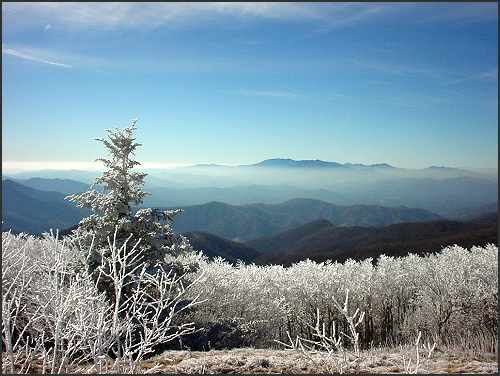
The past few weekends I've been drawn to the mountains. Two weeks ago I went up on Holston mtn after the snow had melted down here, and enjoyed a snowy hike on the AT. From there I drove over to Shady valley, and found the only gas station I've seen with a wood stove in it. I've never enved a gas station attendant their workplace before, but that was nice. Last weekend Maggie and I went up to Roan mtn. On road up we began to get glimpses of the peak in between the fog, and it looked strange, almost like there was snow, but not as white as you'd expect. While the ground was clear of snow, the windward side of each pine, rhododendron, and leaf of grass in the balds was outlined in a thick coat of frost. Gorgeous. As a sheltered Southerner, I've never seen anything like it, but I think it was soft rime, formed from the fog. We wished we'd brought a camera, but thanks to the magic of the 'net, here's a similar rime on Roan: rimeonroan.jpg

1 December 2007

Joey Hess: my mpd setup

One of the hard things about getting started with mpd is that there seems to be little documentation about the details of how other people use it. Instead you're given a collection of great tools and an excellently designed system, and expected to build your own personal music playing setup out of them with little direction. So I thought I'd document mine. There are several computers around the house that run mpd. One in my office, one has speakers in the bedroom. My laptop, of course. And I put a nslu2 in the living room in a fun lego case that embeds the little computer into a remote controlled speaker (photos when I find a camera). All of these machines have their music libraries synchronised using unison. I use sonata as a graphical frontend and browser. I keep one instance of sonata running on my desktop in the office, so I can go there to change music if my laptop's not on. Also so guests can change the music. I like to listen to whole albums at a time, and sonata doesn't make this especially easy in its user interface. I eventually realised that the best way to do it, for me, was to create a separate playlist for each album. Sonata does make it really easy to click on a playlist and start playing it. I wrote mpgenplaylists to automatically generate those playlists for me. I wrote a set of commands that I can use to transfer state between my mpd daemons. The easiest to use and most useful of these is mpswap, which swaps the state of two daemons. Generally I only have one mpd playing at a time, and the others are paused, though it'll also swap the states of two running mpds. So if I run "mpswap dodo dragon", the music that had been playing in my bedroom starts coming out the speakers in the office. Same song, not a single missed note. That's pretty handy. Or I can run "mpswap dodo" to swap state with my laptop, and carry the music out of the house with me. (This would be more seamless if I carried some bluetooth wundergadget so my computers knew where I am, but I think I'll pass.) Another tool I wrote is mpstore, which dumps the mpd daemon state out to stdout, so it can be saved to a file and later loaded with mpload. I use this when I'm listening to audiobooks, to store my place. Another one is mpfade, that can wake me up by slowly fading in music. Or slowly fade out and stop. Writing these little hacks is addictive, but I won't bore you with the rest. On some of the servers I run mpd-dynamic, a daemon that watches the playlist and makes sure it always has 10 unplayed items in it, chosing new items at random. It also removes old played items from the playlist. This is nice if I want music going without the bother of picking what. I typically add some albums to the playlist, and then when they're done, it keeps playing random stuff until I manually add something else. I do want to find something that can more intelligently pick things to play. I tried lastfmpdqc, but didn't like its results. Switching to mpd has meant that the filenames of mp3s matter again, since mpd UIs expose the filenames (a pity). I used exfalso to clean up all my file names based on the music's tags. I also added ReplayGain information to all my music so mpd can use it to normalise volume. BTW, after all this, I'll probably still only listen to music for an average of 3 hours per week.
mpd-dynamic is in the Audio::MPD perl module. mpdswap, mpdstore, mpfade, mpgenplaylists, and more are in mpdtoys.

17 September 2007

MJ Ray: Run on the Bank

For one UK bank, "innovation" has included funding long-term home loans mostly with short-term inter-bank loans. So, the increased costs of obtaining inter-bank loans during a credit crisis caused Northern Rock to obtain support from the central bank, the Bank of England. Once that became public knowledge, as it must, it started a predictable run on the bank, as described in Guardian Unlimited: Between Rock and a hard place - savers besiege bank. Savings are leaving at a rate of almost a billion pounds (1.6bn euro?) each day just now. In turn, that makes the bank's loans-to-savings ratio even more extreme, which then worries more savers and we're into a feedback loop, with queues growing out of the bank's doors, customer sit-ins [BBC West] and other unsettling side-effects. Northern Rock is a former member-owned building society which demutalised (converted to a shareholder-owned bank) in 1997. In just ten years, it has become committed to a business model which seems to scare many of its savers. Would it have done that if it was still controlled by its savers and borrowers? Is this exodus of savings going to be matched by loan customers moving away too? Will any of these customers return to the mutual and co-operative sector? It now seems sort of academic whether Northern Rock is on the list of online banks that work with free software, as commentators suggest it may be taken over soon. 2007-09-18 Update: the UK government has guaranteed all deposits in the dodgy bank. This is a bad thing, as explained on niq's soapbox: Race to the bottom.

31 August 2007

Ross Burton: Evolution Lovers and Haters

Evolution (the email client, not the theory) really seems to bring out extreme emotions in its users.
RP: pgc: I'm with you, I hate evolution
dodji: yay
dodji: evo haters fanclub
chris: I also hate Evo, but everyone here loves it and wants to have its babies
ross: I've had evo's babies
chris: ross: I bet there were random duplicates
Poor Evolution. NP: Directions LP, Acroplane

17 July 2007

Jose Carlos Garcia Sogo: Spanish Anthem needs lyrics

For those who have asked youself sometimes, when watching any of the Spanish sucess in any kind of sports (but football), why when Spanish athem is sounding no one signs anything, or why, when sound system breaks, people sings "ti-to-ti-to-ta-ri-ro-ri-ro-rit-to-ti..." you have to learn that Spanish Athem has no lyrics. Of course, it had, but was removed when democracy imposed over other darker options 30 years ago. Today, I have seen that, from a mistake, the old lyrics were used by a Romanian ship in a competition at Barcelona. You can see (and listen to it) below.

I cannot understand why this can be considered fascist by reading the lyrics. But listening to it I have felt again that we need lyrics. We cannot go out at the world mumbling our athem, as we cannot sign it. Recently, Spanish Olimpic Comitee requested lyrics to be written. I strongly think that they will be some king of "flower power" lyrics, to avoid hurting anyone (which is impossible)

6 July 2007

Matthew Palmer: Well, that was surreal

I just got a call from a "Katherine" at Mantech IT (or Mantec -- they can't seem to get their domain name synced up with their business name), claiming that they've previously supplied Java developers on contract to "your organisation", and having another one to palm off onto us. Now, anyone who has the slightest bit of knowledge of the company I work for would know that's a laughable proposition. We Don't Do Java. We also don't do enough software development that hiring programmers of unknown capability from a dodgy agency is an effective proposition for us. With my "WTF?" antennae twitching, I asked what company she thought I worked for. She mumbled something that could have been plausible, but I didn't really catch it. I said "pardon?", and she said "oh sorry" and hung up. Suffice it to say, I don't think that Mantech is a company you want to be dealing with (either as a candidate or a company) if this interaction is anything to go by. Sigh. Yet another "all recruiters are scum" data point. I'm getting quite a file by now.

16 June 2007

Steve Langasek: Did you hear that etch is out?

One of the reasons I tend not to blog very much is that I don't have much to say to the Planet Debian audience (the only place I know my blog is syndicated) that hasn't been said a dozen times before. But the world's best release party (the one good enough to cross an ocean for) gave me food for thought, and for once I'm inspired in the true spirit of blogging to write even if nobody cares what I have to say. Even if it has taken me until two months after the release to write it... Folks within the Debian community have been asking for years whether it's really still worthwhile for Debian to do stable releases, or if we're better off focusing on our "core competency" of testing and unstable and leaving stable releases to derivatives. For me, the answer to this question is an unqualified: yes, it's worthwhile. Of course that's the answer you'd expect from a release manager. Who would want to believe after committing as much time as the release team does that their efforts had been wasted? But the investment I've made in the etch release wasn't done without reflection; I recognize that the level of involvement required to be a release manager has come at some personal cost to me, as it does for each member of the release team, and I have made the investment anyway because I believe in Debian's philosophy, its goals, and its community. Even outside of a stable release, Debian packages really are great; in spite of the bugs and library transitions that we as release managers spend our time on in unstable and testing, and figures showing that within a month of the etch release we already had some 500 RC bugs identified for lenny, both unstable and testing do a great job of meeting the needs of many of our users. And package maintainers are constantly improving their packages in unstable, fixing bugs and adding new features. Unstable is a flowing river, vibrant and vital, never the same twice -- and only rarely are people dragged to their deaths by the undertow. ;) Maintainers often don't get to choose the version of their package that goes into stable. When it comes to a stable release, the bug you know is quite often better than the bug you don't. But although the release team is charged with chasing out the release-critical issues in preparation of a stable release, it isn't just the release team who deserves credit for etch. Etch is a monument to the work of all Debian maintainers, who have each helped shape the release with their contributions. "Stable" doesn't mean "perfect", but it does mean "lasting": in etch we have not only created what I think is the highest-quality OS I've ever had the privilege to be involved in, we have created something permanent that will be burned to thousands or millions of disks, something that users will continue to use and install for years to come. Far from standing in opposition to unstable, it is a perfect complement, letting us share everything that's great about Debian with users for whom tracking a constantly-changing testing or unstable simply isn't an option. I had decided well before etch was finished that it was time for me to move on from serving as release manager, but I still look forward to great things from Debian stable for lenny and releases beyond. With last weekend's release team meeting in Juelich, and the wonderful collaboration that's sure to take place this week at DebConf 7, I think we're off to a great start. The grumbling on IRC about broken packages and missing builds and uncoordinated library transitions is already in full swing for lenny -- and I'm no small contributor to that myself even now -- but we shouldn't let that blind us to what a great achievement etch has been for the Debian community, and what a great achievement lenny will be when it's released exactly on schedule next year.

8 June 2007

MJ Ray: Comments on dropping and not subscribing to feeds

tm suggested:
"delete the feeds you find yourself reading less and less frequently"
In general, maybe, but there are always exceptions, like feeds which rarely update but carry important information when they do. I guess I should scan my subscriptions to see if there are any extremely unupdated feeds. Update: tm clarified:
"I meant those feeds you've subscribed to, but find out you don't read so often, regardless of how often they're updated. for me, one of those is/was: http://feeds.howstuffworks.com/DailyStuff"
That's not so easy for me to tell. I read my subscriptions through a planet-like page, so they appear in the page flow whether or not I expand them or not. Matt Palmer replied:
"I've got to say that I've never had a problem commenting on Limes & Lycopene. I suspect that the problem you had with Alexis Sukrieh's blog was likely unrelated to SpamKarma2 (or if it was SK2, it was a dodgy deployment -- you don't sound too sure what the cause of his breakage was). On the other hand, if there is anything broken on a blog, the polite thing to do is to tell the owner about it -- it might not necessarily be a problem for everyone (although with SQL errors and things like that, it should be possible for the site owner to get error reports via e-mail, but how often do you reckon that gets done?). And yes, Captchas give me the faeces too. For L&L, at least, I know for a fact that any problems will get looked at and fixed up damn quick. Contact e-mail is on Kathryn's site."
I sent a pingback. No response yet. I'll try email if there's no response later.
"Oh, and a comment on your comment system -- the text entry box is tiny (6 lines by maybe 35 characters just isn't enough for a literate comment)."
My preference is for 40x20 but if I make it that big, I get feedback that it's too big. It's always a compromise. It's meant to be about 22x8 now, but what size should it be?

29 May 2007

Wouter Verhelst: Web passwords

Thomas grumbles about websites with password policies, that make it impossible for you to use your 'standard' password which you use for other sites. I cannot agree with him more. I have memorized a number of multi-character random passwords (generated with 'pwgen -s'), but these cannot be used on such sites; sometimes they require me to use a character that just doesn't happen to be in the password, or sometimes they're "too long", or whatever. The worst of them all is sites which require you to change your password every so often, as I've ranted of before; after all, making people change their password too often makes it harder for them to choose a hard-to-guess password; after all, hard-to-guess passwords are often also hard-to-remember passwords, and nobody likes to memorize something useless every two months In all, I decided not to use my secure passwords on such sites anymore. Not only do their policies usually suck, they also often have dodgy "security questions" which are easy to guess by anyone familiar with yourself. On top of that, there's usually nothing to make me believe their password database is actually secure. Except, of course, if they have OpenID. Because then it's actually my own server where the password is verified. Whoo.

23 May 2007

MJ Ray: Co-op: National AGM, Whistleblower, Food Miles online discussion

Rounding off AGM season, Sam reports on the national AGM with a second part and also mentions more on the food retail ethical policy. While considering food retail ethics, did you see last night's BBC Whistleblower programme about dodgy practices at Tesco and Sainsburys? I don't believe the claims that this isn't widespread. I've not bought much fresh stuff from them since a friend told me about discovering some of those tricks during his time working in two of those stores. Most of the time, I buy fresh from small independents, but I'm not going to link them here because I don't like their web sites. I'm glad the co-operative food wasn't on the BBC show, but I wonder how good our labelling is at showing the source. It can't be that bad, as I've been able to choose not to buy co-op's Kent-sourced Cheddar since moving to Somerset, as I mentioned in the Food Miles topic of the Climate Doctor Online Discussion yesterday (members only link). I was quite talkative in that, but hopefully not too much. It's not a very lively "live" discussion, because there's no way to see new contributions as they come in or discuss things privately. It's like a web discussion board from 1996, but less accessible.

8 April 2007

Brett Parker: Oh Noes! This means lots of work!

Debian GNU/Linux 4.0 has been released - congratulations to all those involved in the release process, you've all done a fantastic job (as always ;). Now I've just got to test the upgrade for the NFS root desktop machines at work (that's going to be *sooo* much fun!) and make sure that nothing obvious breaks - I'm not expecting many problems, it *should* go quite smoothly (probably!). Might also use the "official" non-free packages for the sun j2sdk rather than using java-package, haven't decided yet (and actually, as we also use sun-j2sdk1.4, I'm going to have to use java-package for that anyways!). Hmmm, I suppose I should update all of my various build chroots and set up all the scripts that I'm going to need also - feh - that can wait for a bit. Ahh - and I'm going to need to compile an etch version of ion3 from unstable, can't be having my workstation running one of those dodgy window managers that makes it almost impossible to get anything done without using the mouse, afterall! Right - anyways - I think I shall just go faint, that was *far* too quick between sarge and etch!

5 April 2007

Andrew Pollock: [opinion] The Australian Government's starting to smell a bit fishy

Okay, so firstly, I thought the whole David Hicks situation (mainly the fact that it was starting to become a bit of a political hot-potato near an election so they got his trial hurried up) was a bit fishy (particularly the bit about how he's gagged until after the next election), but this morning, I learned that there's legislation to close the electoral rolls at 8pm on the day the election is called. That stinks to high heaven! I mean how on earth could justify bringing out legislation like that? How does that improve anything? I'll be really disappointed if that just gets steamrolled through the Senate. All this reminds me that I need to re-enroll to vote.

Next.

Previous.