Search Results: "christoph"

15 September 2013

Christoph Berg: Jessie, the HP 6715b, and Wifi

If you are upgrading your HP/Compaq 6715b to Debian Jessie, and suddenly Wifi stops working because the PCI device is gone, install the "rfkill" package:
# lspci   tail -2
02:04.1 FireWire (IEEE 1394): Ricoh Co Ltd R5C832 IEEE 1394 Controller (rev 02)
10:00.0 Ethernet controller: Broadcom Corporation NetLink BCM5787M Gigabit Ethernet PCI Express (rev 02)
# rfkill list 1
1: hp-wifi: Wireless LAN
    Soft blocked: yes
    Hard blocked: no
# rfkill unblock wifi
# rfkill list 1
1: hp-wifi: Wireless LAN
    Soft blocked: no
    Hard blocked: no
# lspci   tail -2
10:00.0 Ethernet controller: Broadcom Corporation NetLink BCM5787M Gigabit Ethernet PCI Express (rev 02)
30:00.0 Network controller: Broadcom Corporation BCM4311 802.11a/b/g (rev 02)
Reports on the internet say that the same could be done by going into the BIOS and selecting "Reset to default" - this makes the Wifi LED active until about udev is started on the next boot. To be done: figure out how to automate this.

31 July 2013

Christoph Berg: Version Numbers

Following an idea by Ansgar Burchardt, I've done some digging on version numbers in Debian: Most common version numbers:
projectb=> select version::text, count(*) from source group by 1 order by 2 desc;
  version     count 
------------+-------
 4:4.10.5-1     131
 1.0-1          120
 1.0.0-1         95
 1.1-1           95
 1.0.1-1         93
 1.2-1           88
 1.0-2           82
 0.2-1           80
 0.3-1           79
 0.5-1           77
 0.04-1          76
 1.1.1-1         76
 0.10-1          74
 1.4-1           72
 1.1-2           71
 0.1-1           70
 0.11-1          70
Version number with the most spellings: (considered equal by the dpkg definition, implemented in the "debversion" type)
projectb=> select version::text, count(*) from source where version = '1.02-1' group by 1 order by 2 desc;
  version     count 
------------+-------
 1.2-1           88
 1.02-1          46
 1.002-1          4
 1.000002-1       1
 001.002-1        1
 1.00002-1        1
If we look at equivalent version numbers, the first table above looks entirely different:
projectb=> select version, count(*) from source group by 1 order by 2 desc limit 30;
  version     count 
------------+-------
 0.3-1          162
 1.0-1          160
 0.05-1         156
 0.04-1         154
 0.02-1         151
 1.02-1         141
 0.006-1        133
 1.001-1        131
 4:4.10.5-1     131
 0.7-1          127
(I'm also participating in the "longest version number" contest, I've just uploaded bind9 version 1:9.8.4.dfsg.P1-6+nmu2+deb7u1~bpo60+1 to backports.)

7 July 2013

Paul Tagliamonte: Hy 0.9.10 released

A huge release, the combined 0.9.9 and 0.9.10 releases (I made a mistake releasing) are now tagged and pushed to pypi. It features a number of enhancements and fixes, and is just an absolute thrill to play with. Thanks to the contributors this cycle:
Bob Tolbert Christopher Allan Webber Duncan McGreggor Guillermo Vaya Joe H. Rahme Julien Danjou Konrad Hinsen Morten Linderud Nicolas Dandrimont Ralph Moritz rogererens Thomas Ballinger Tuukka Turto
Outstanding! New features are now being considered for 0.9.11. Thanks!

26 April 2013

Vincent Sanders: When you make something, cleaning it out of structural debris is one of the most vital things you do.

Collabora recently had a problem with a project's ARM build farm. In a nice change of pace it was not that the kernel was crashing, nor indeed any of the software or hardware.
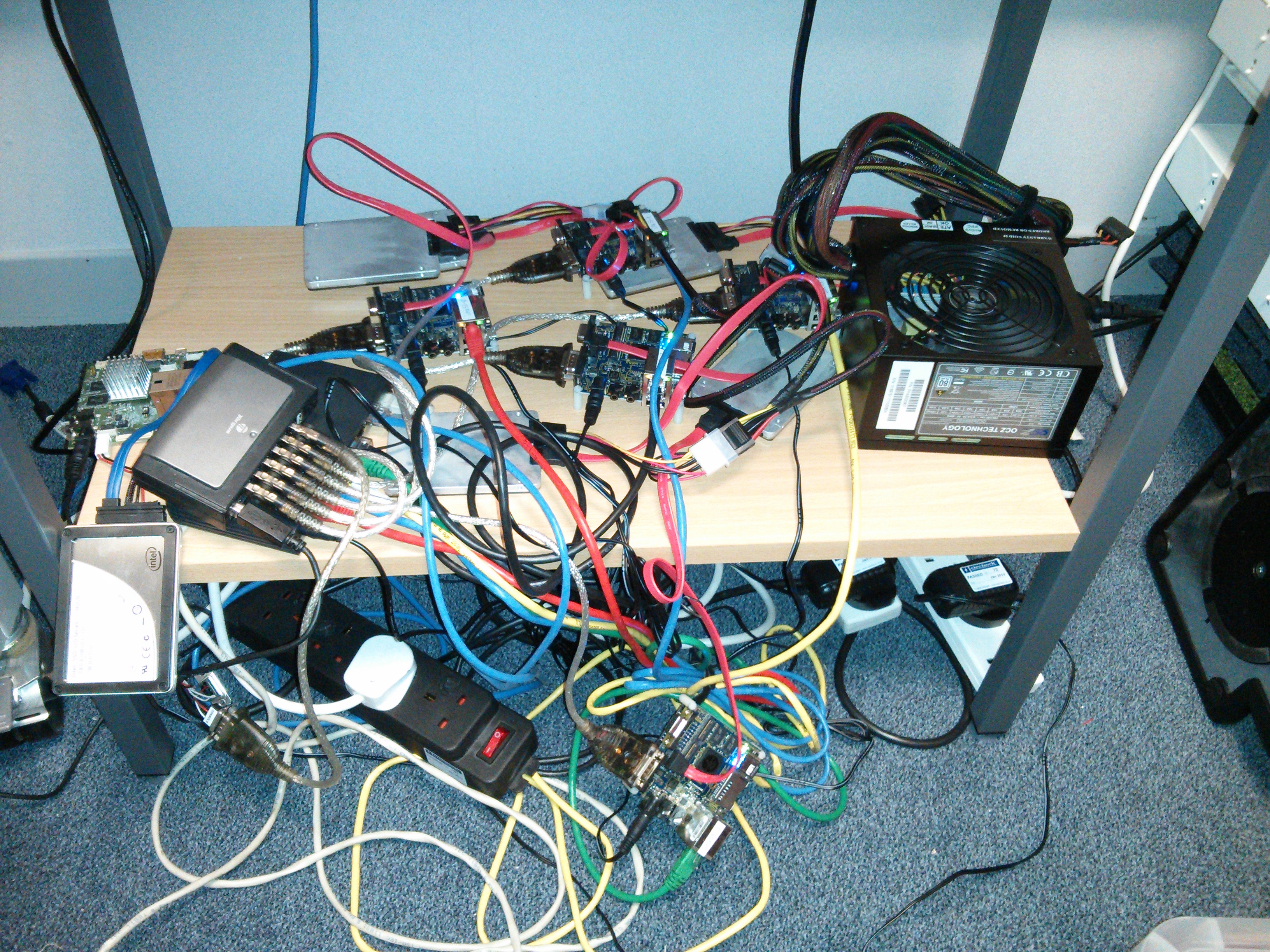
The ProblemInstead our problem was our build farm could best be described as "a pile of stuff" and we wanted to add more systems to it and have switched power control for automated testing.

Which is kinda where the Christopher Alexander quote comes into this. I suggested that I might be able to come up with a better, or at least cleaner, solution.
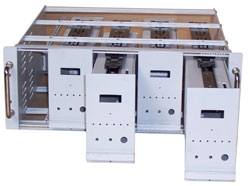
The IdeaA subrack with sub modulesPrevious experience had exposed me to the idea of using 19 inch subracks for mounting circuits inside submodules.

I originally envisaged the dev boards individually mounted inside these boxes. However preliminary investigation revealed that the enclosures were both expensive and used a lot of space which would greatly increase the rack space required to house these systems.

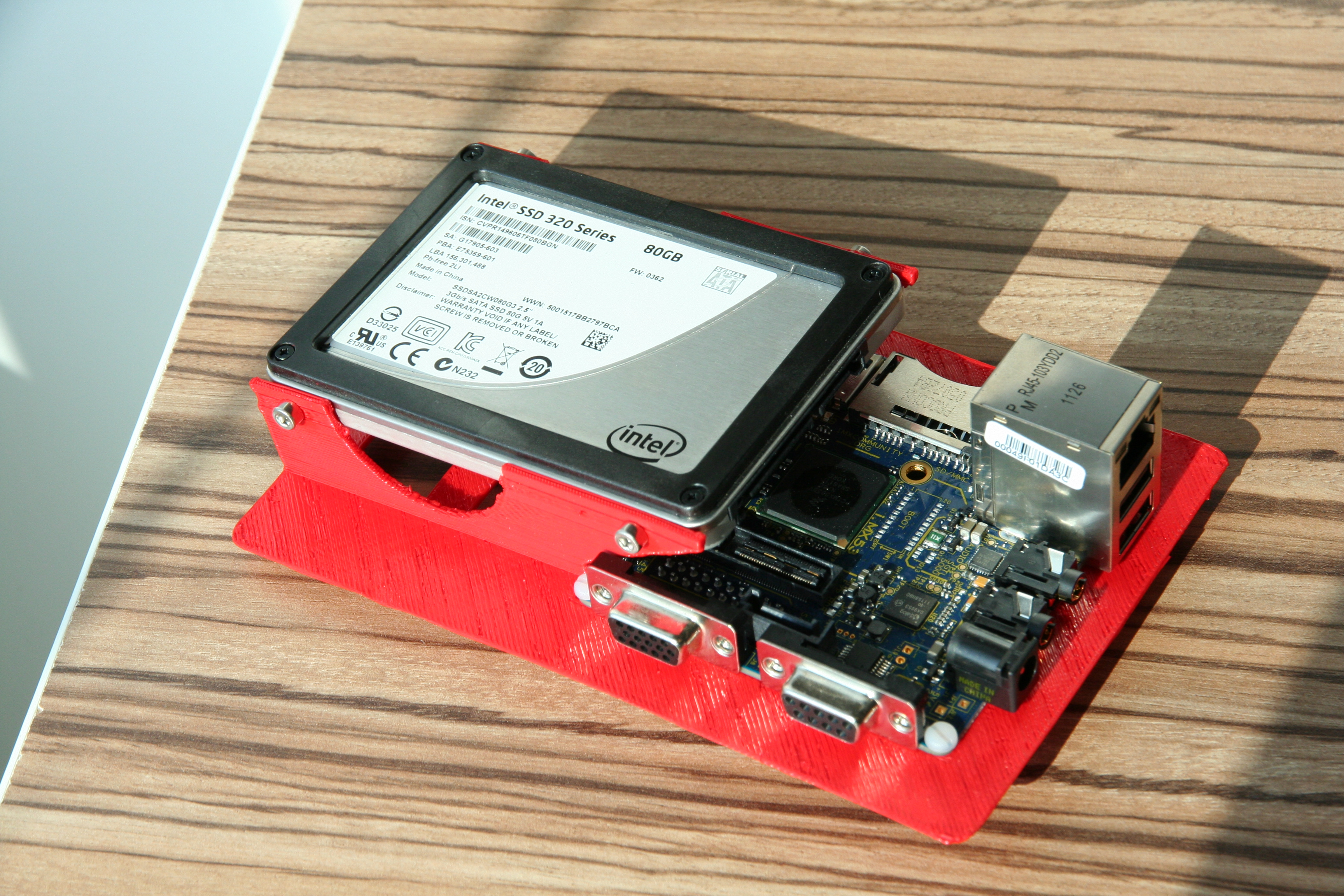
imx53 QSB eurocard carrier
I decided to instead look at eurocard type subracks with carriers for the systems. Using my 3D printer I came up with a carrier design for the imx53 QSB and printed it. I used the basic eurocard size of 100mm x 160mm which would allow the cards to be used within a 3U subrack.

Once assembled it became apparent that each carrier would be able to share resources like power supply, ethernet port and serial console via USB just as the existing setup did and that these would need to be housed within the subrack.
The Prototype
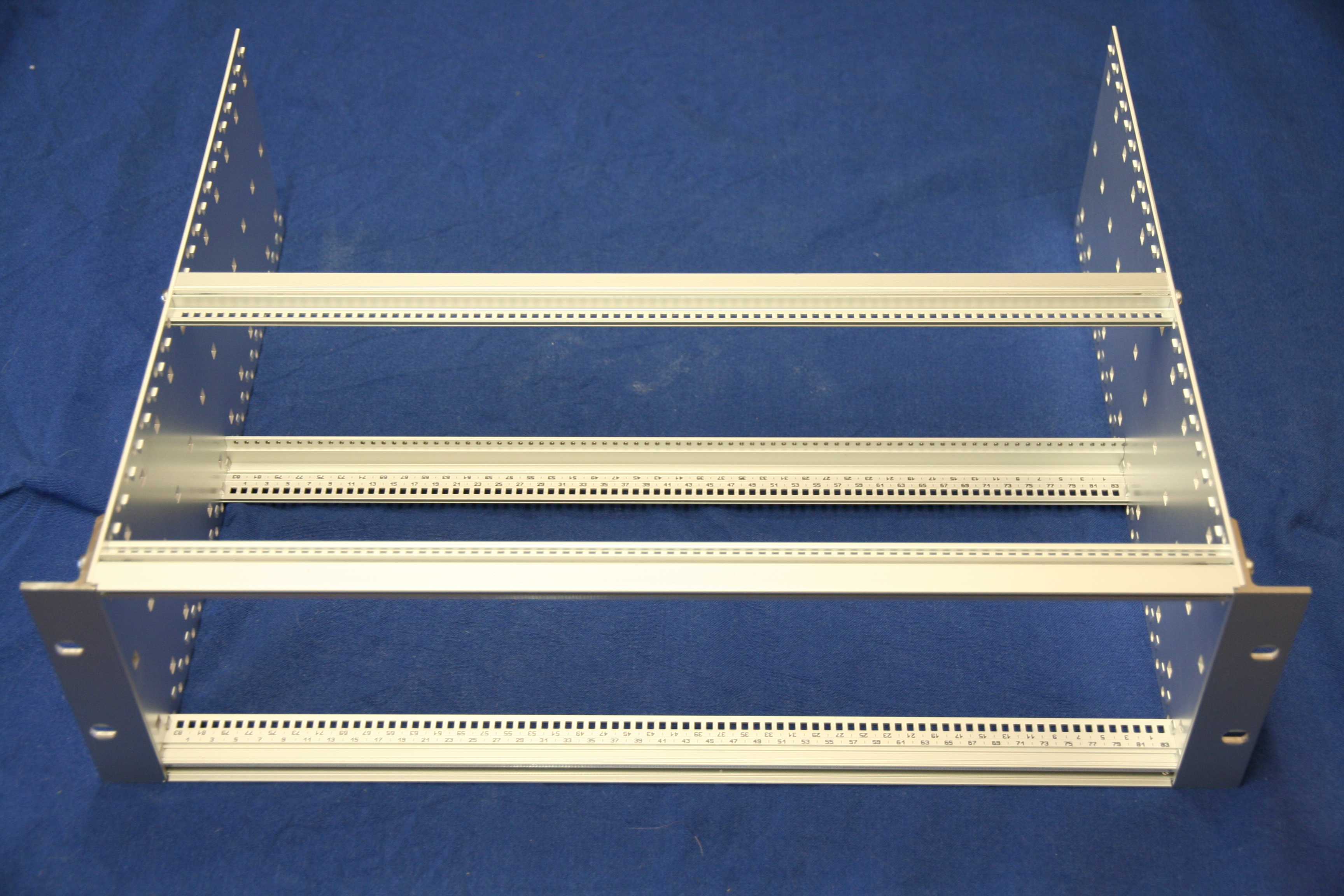
The carrier prototype was enough to get enough interest to allow me to move on to the next phase of the project. I purchased a Schroff 24563-194 subrack kit and three packs of guide rails from Farnell and assembled it.

Initially I had envisaged acquiring additional horizontal rails from Schroff which would enable constructing an area suitable for mounting the shared components behind the card area.
Rear profile for Schroff subrackUnfortunately Schroff have no suitable horizontal profiles in their catalog and are another of those companies who seem to not want to actually sell products to end users but rather deal with wholesalers who do not have their entire product range!

Printed rear profile for Schroff subrack
Undaunted by this I created my own horizontal rail profile and 3D printed some lengths. The profile is designed to allow a 3mm thick rear cover sheet attached with M2.5 mounting bolts and fit rack sides in the same way the other profiles do.

At this point I should introduce some information on how these subracks are dimensioned. A standard 19 inch rack (as defined in IEC 60297) has a width of 17.75 inches(450.85mm) between the vertical posts. The height is measured in U (1.75 inches)

A subrack must obviously fit in the horizontal gap while providing as much internal space as possible. A subrack is generally either 3 or 6 U high. The width within a subrack is defined in units called HP (Horizontal Pitch) which are 0.2 inches(5.08 mm) and subracks like the Schroff generally list 84 usable HP.

However we must be careful (or actually just learn from me stuffing this up ;-) as the usable HP is not the same thing as the actual length of the horizontal rails! The enclosures actually leave and additional 0.1 inch at either end giving a total internal width of 85HP (17 inches, 431.8 mm) which leaves 0.75 inches for the subrack sides and some clearance.

The Schroff subrack allows eurocards to be slotted into rails where the card centre line is on HP boundaries, hence we describe the width of a card in the slot in terms of HP
I cannot manufacture aluminium extrusions (I know it is a personal failing) nor produce more than 100 mm long length of the plastic profile on my printer.

Even if full lengths are purchased from a commercial service (120 euros for a pair including tax and shipping) the plastic does not have sufficient mechanical strength.

The solution I came up with was somewhat innovative, as an alternative a M5 bolt into a thread in the aluminium extrusion I used a 444mm long length of 4mm threaded rod with nuts at either end. This arrangement puts the extrusion under compression and gives it a great deal of additional mechanical strength as the steel threaded rod is very strong.

Additionally to avoid having to print enough extrusion for the entire length I used some 6mm aluminium tube as a spacer between 6HP(30.48mm) wide sections of the printed extrusion.

It was intended to use a standard modular PC power supply which is 150mm wide which is pretty close to 30HP (6 inches) so it was decided to have a 6HP section of rail at that point to allow a rear mounting plate for the PSU to be attached.

This gives 6HP of profile, 21HP(106.68mm) of tube spacer, 6HP of profile, 46HP(233.68 mm) of tube spacer and a final 6HP profile summing to our total of 85HP. Of course this would be unnecessary if a full continuous 85HP rail had been purchased, but 6 of 6 HP long profile is only 51 euro a saving of 70 euro.

To provide a flat area on which to mount the power switching, Ethernet switch and USB hubs I ordered a 170 x 431 mm sheet of 3mm thick aluminium from inspiredsteel who, while being an ebay company, were fast, cheap and the cutting was accurate.

Do be sure to mention you would prefer it if any error made the sheet smaller rather than larger or it might not fit, for me though they were accurate to the tenth of a mm! If you would prefer the rear section of the rack to be enclosed when you are finished, buy a second sheet for the top. For my prototype I only purchased a 170 x 280mm sheet as I was unsure if I wanted a surface under the PSU (you do, buy the longer sheet)
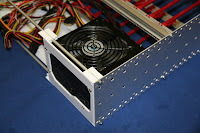
PC power supply mounted to back plateMounting the PSU was a simple case of constructing a 3 mm thick plate with the correct cutouts and mounting holes for an ATX supply. Although the images show the PSU mounted on the left hand side of the rack this was later reversed to improve cable management.

The subrack needed to provide Ethernet switch ports to all the systems. A TP-Link TL-SF1016DS 16-Port 10/100Mbps Switch was acquired and the switch board removed from its enclosure. The switch selected has an easily removed board and is powered by a single 3.3V input which is readily available from the ATX PSU.

Attention now returned to the eurocard carriers for the systems, the boards to be housed were iMX53 QSB and iMX6 SABRE Lite and a Raspberry Pi control system to act as USB serial console etc.

The carriers for both main boards needed to be 8HP wide, comprised of:
Although only 38 mm this is 7.5HP and fractions of an HP are not possible with the selected subrack.

With 8HP wide modules this would allow for ten slots, within the 84 usable HP, and an eleventh 4HP wide in which the Raspberry Pi system fits.
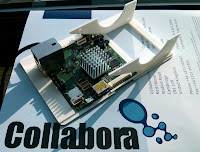
iMX6 SABRE Lite eurocard carrierCarrier designs for both the i.MX53 QSB and the i.MX6 SABRE Lite boards were created and fabricated at a professional 3D print shop which gave a high quality finish product and removed the perceived risk of relying on a personal 3D printer for a quantity of parts.

This resulted in changes in the design to remove as much material as possible as commercial 3D services charge by the cubic cm. This Design For Manufacture (DFM) step removed almost 50% from the price of the initial design.

i.MX53 QSB carriers with wiring loom
The i.MX6 design underwent a second iteration to allow for the heatsink to be mounted and not mechanically interfere with the hard drive (although the prototype carrier has been used successfully for a system that does not require a hard drive). The lesson learned here is to be aware that an design iteration or two is likely and that it is not without cost.

The initial installation was to have six i.MX53 and two i.MX6 this later changed to a five/four split, however the carrier solution allows for almost any combination, the only caveat (discovered later) is the imx53 carriers should be to the right hand side with the small 4HP gap at that end as they have a JTAG connector underneath the board which otherwise foul the hard drive of the next carrier.

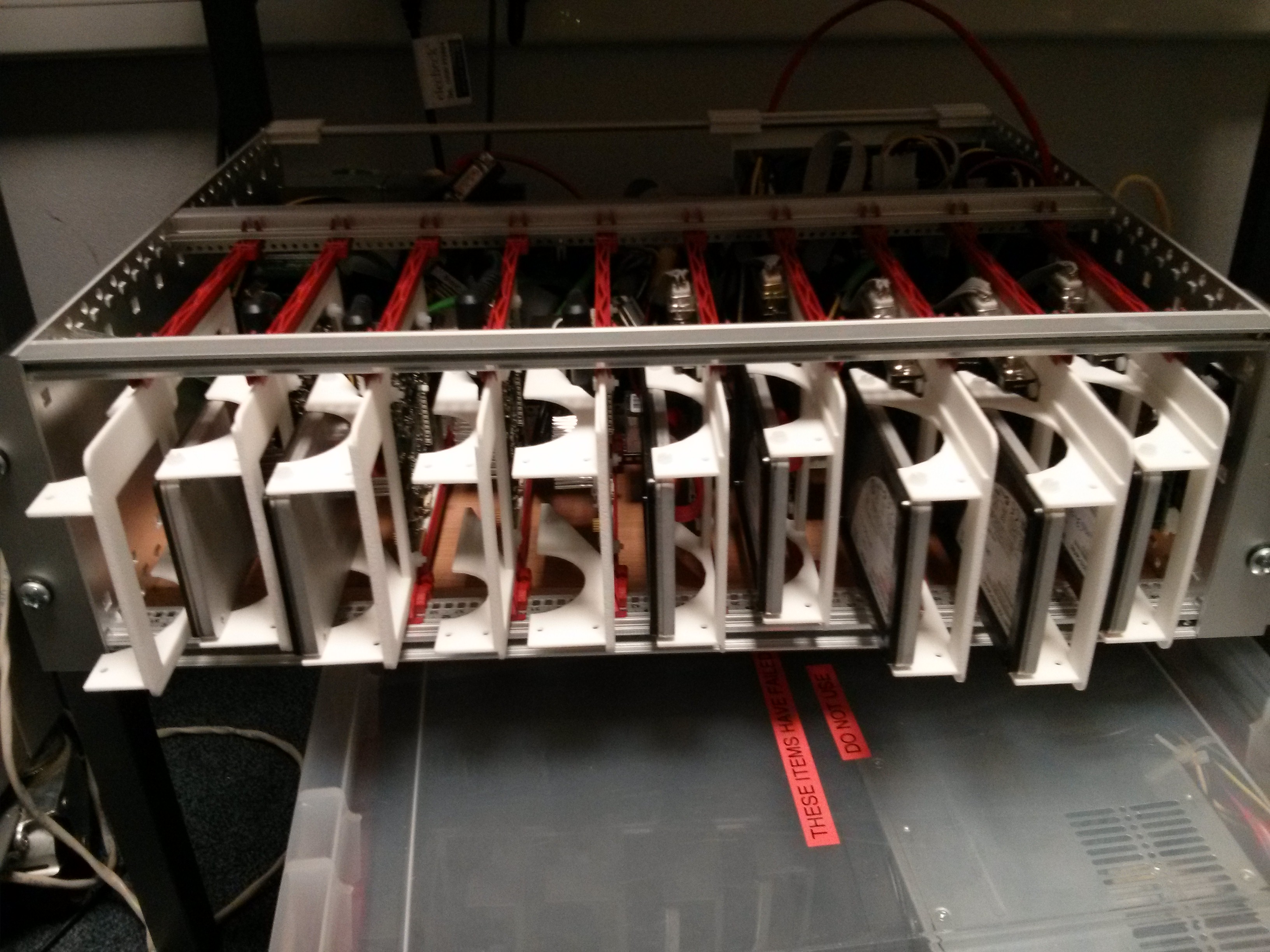
Racked cards showing unwanted cable tails
A wiring loom was constructed for each board giving them a connector tail long enough to allow them to be removed. This was the wrong approach! if you implement this design (or when I do it again) the connector tails on the wiring loom should present all the connections to the rear at the same depth as the Ethernet connection.

The rack cables themselves should be long enough to allow the slides to be removed but importantly it is not desirable to have the trailing cable on the cards. I guess the original eurocard designers figured this out as they designed the cards around the standard fixed DIN connectors at the back of the card slots.

USB relay board with wiring loom attached
We will now briefly examine a misjudgement that caused the initially deployed solution to be reimplemented. As the design was going to use USB serial converters to access the serial console a USB connected relay board was selected to switch the power to each slot. I had previously used serial controlled relay boards with a USB serial convertor however these were no longer available.

Initial deployment with USB controlled relay board
All the available USB relay boards were HID controlled, this did not initially seem to be an issue and Linux software was written to provide a reasonable interface. However it soon became apparent that the firmware on the purchased board was very buggy and crashed the host computer's USB stack multiple times.

Deployed solutionOnce it became apparent that the USB controlled power board was not viable a new design was conceived. As the Ethernet switch had ports available Ethernet controlled relay boards were acquired.

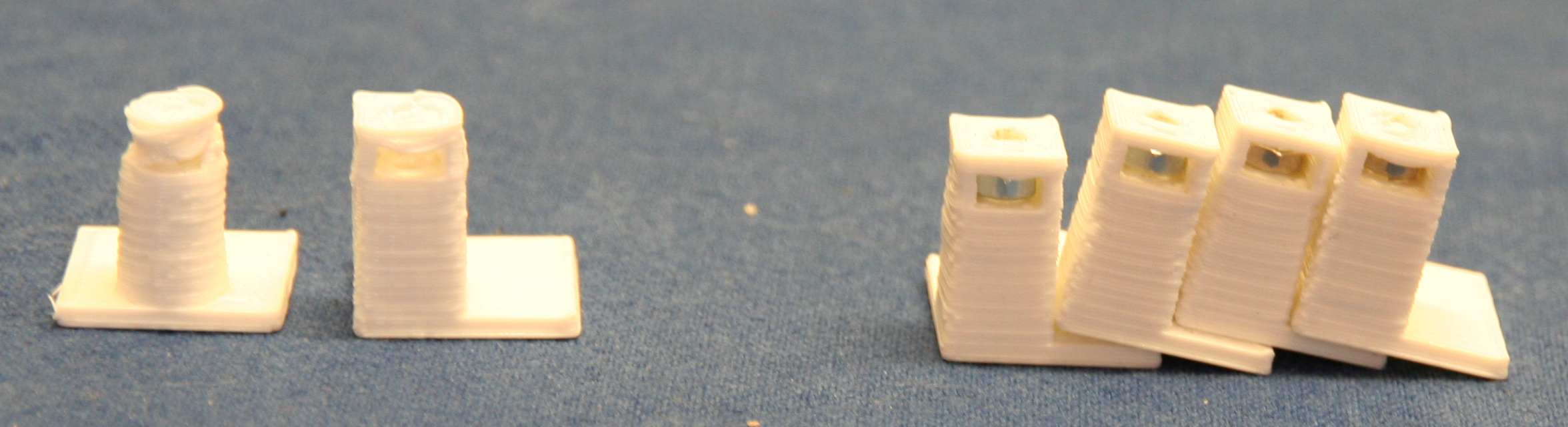
Evolution of 3mm PCB pillars
It did prove necessary to design and print some PCB support posts with M3 nut traps to allow the relay boards to be easily mounted using double sided adhesive pads.

By stacking the relay boards face to face and the Ethernet switch on top separated using nylon spacers it was possible to reduce the cable clutter and provide adequate cable routing space.

A busbar for Ground (black) and unswitched 12V (yellow) was constructed from two lengths of 5A chock block.

An issue with power supply stability was noted so a load resistor was added to the 12V supply and an adhesive thermal pad used to attach it to the aluminium base plate.

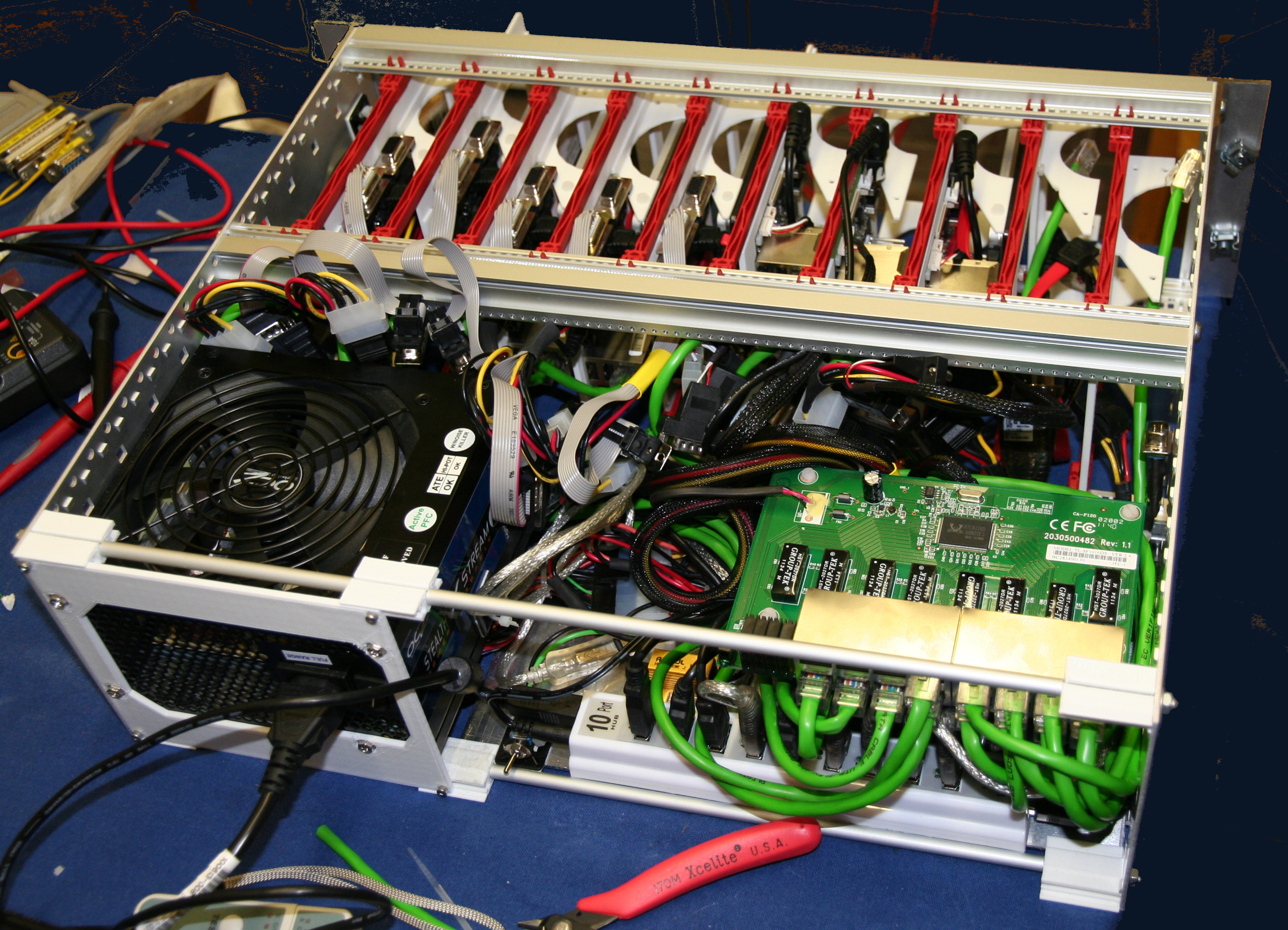
Completed redesign
It was most fortunate that the ethernet switch mounting holes lined up very well with the relay board mounting holes allowing for a neat stack.

This second edition is the one currently in use, it has proved reliable in operation and has been successfully updated with additional carriers.

The outstanding issues are mainly centered around the Raspberry Pi control board:
  • Needs its carrier fitting. It is currently just stuck to the subrack end plate.
  • Needs its Ethernet cable replacing. The existing one has developed a fault post installation.
  • Needs the USB hub supply separating from the device cable. The current arrangement lets the hub power the Pi which means you cannot power cycle it.
  • Connect its switched supply separately to the USB hub/devices.
Shopping listThe final bill of materials (excluding labour and workshop costs) which might be useful to anyone hoping to build their own version.

Prices are in GBP currency converted where appropriate and include tax at 20% and delivery to Cambridge UK and were correct as of April 2013.

The purchasing was not optimised and for example around 20GBP could be saved just by ordering all the shapeways parts in one order.
Base subrack
ItemSupplierQuantityLine Price
Schroff 24563-194 subrack kitFarnell141.28
Schroff 24560-351 guide railsFarnell313.65
Schroff rack rear horizontal railShapeways2100.00
1000mm length of 4mm threaded rodB and Q11.48
170mm x 431mm x 3mm Aluminium sheetinspired steel240.00
PSU mounting plateShapeways135.42
PCB standoffShapeways422.30
160mm Deep Modular PC supplyCCL155.76
TP-Link TL-SF1016DS 16-Port 10/100Mbps-SwitchCCL123.77
8 Channel 16A Relay Board Controlled Via EthernetRapid2126.00
Raspberry PiFarnell126.48
USB Serial convertersCCL1037.40
10 port strip style USB HUBEbay17.00
Parts for custom Ethernet cablesRS1326.00
Parts for custom molex power cables (salvaged from scrap ATX PSU)Workshop1111.00
33R 10W wirewound resistor for dummy loadRS11.26
24pin ATX female connector pre-wiredMaplin12.99
Akasa double sided thermal padMaplin15.00
Small cable tie basesMaplin16.49
Miscellaneous cable, connectors, nylon standoffs, solder, heatshrink, zip ties, nuts, washers etc. Workshop120.00
Total for subrack603.28

The carriers are similarly not optimally priced as over five GBP each can be saved by combining shipping on orders alone. Also the SSD drive selection was made some time ago and a newer model may be more suitable.
i.MX53 QSB carrier
ItemSupplierQuantityLine Price
i.MX53 QSBFarnell1105.52
Intel 320 SSD 80GCCL1111.83
Carrier boardShapeways130.00
combined sata data and power (15 to 20cm version)EBay15.00
Low profile right angle 5.5mm x 2.1mm barrel jackEBay10.25
Parts for 9pin serial cable extensionRS15.00
Miscellaneous solder, heatshrink, nylon nuts, bolts and washersWorkshop15.00
Total for carrier262.60

i.MX6 SABRE Lite carrier
ItemSupplierQuantityLine Price
i.MX6 SABRE LiteFarnell1128.06
Intel 320 SSD 80GCCL1111.83
Carrier boardShapeways135.00
combined sata data and power (15 to 20cm version)EBay15.00
Low profile right angle 5.5mm x 2.1mm barrel jackEBay10.25
Parts for 9pin serial cable modificationRS12.00
Miscellaneous solder, heatshrink, nylon nuts, bolts and washersWorkshop15.00
Total for carrier287.14
ConclusionThe solution works and in a 3U high 355mm deep subrack ten ARM development boards can be racked complete with local ethernet switching, power control and serial consoles.

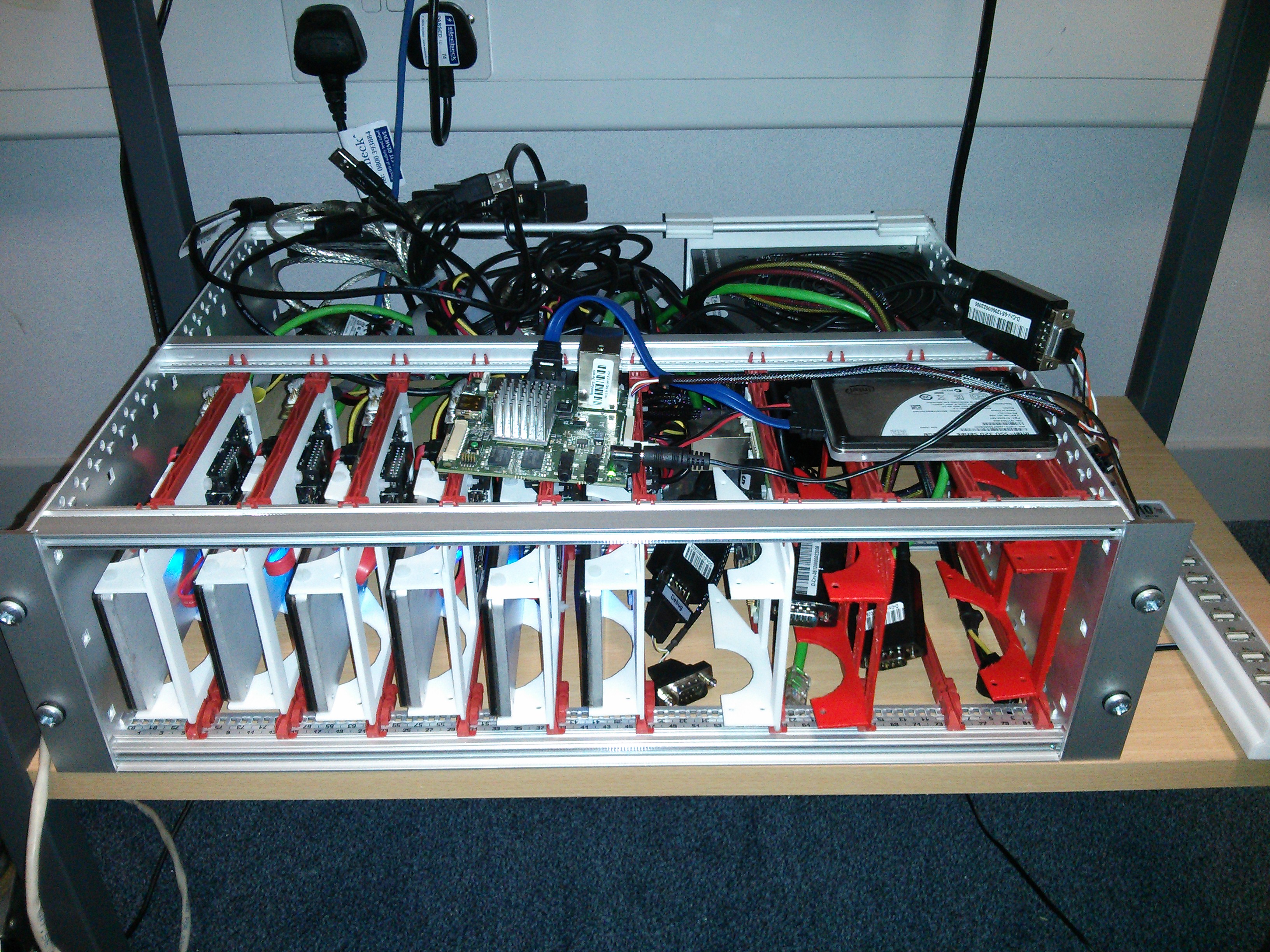
Deployed system in situ configured as a build and test farm
The solution is neat and provides flexibility, density and reproducibility the "pile of stuff" solution failed to do.

For current prototype with nine filled slots the total cost was around 3000GBP or around 330GBP per slot which indicates a 100GBP per slot overhead over the "pile of stuff" solution. These figures omit the costs of the engineer and workshop time, which are estimated at an additional 1500GBP. Therefore a completed rack, fully filled with i.MX6 carriers costs around 5000GBP

Density could be increased if boards with lower height requirements were used however above twelve units there issues with Ethernet switch, power switch and USB port availability become a factor. For Example the 16 port Ethernet switch requires a port for uplink, one for each relay board and one for the console server which leaves only 12 ports for systems.

Addressing the outstanding issues would result in a much more user friendly solution. As the existing unit is in full time use and downtime is not easily scheduled for all ten systems, the issues are not likely to be fixed on the prototype and would have to be solved on a new build.

The solution is probably not suitable for turning into a product but that was not really the original aim. A commercial ARM blade server using this format would almost certainly use standard DIN connectors and a custom PCB design rather than adapting existing boards.

20 April 2013

Ulrich Dangel: Analyzing rc bug messages

Michael Stapelberg recently posted a blog post about looking into the number of Debian Developers actively working on RC bugs for the upcoming wheezy release. In this blog post I analyze the data shared by Michael and provide the R commands used to generate the plots & findings. If you are interested into looking into the data yourself, but don t like R, I suggest using ipython notebook + numpy instead.

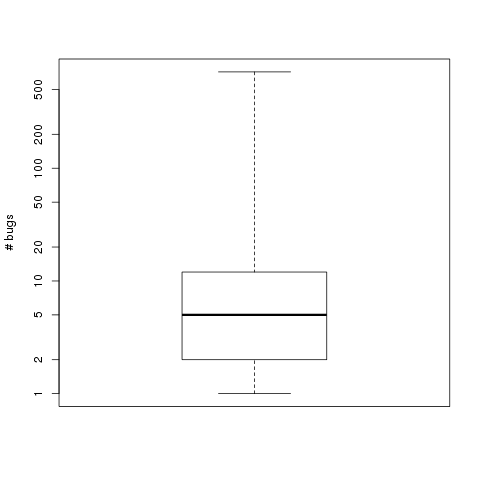
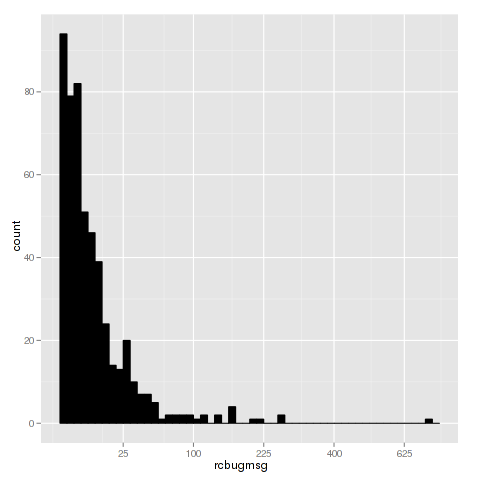
Analysis After parsing the data file we typically want to get an understanding of the data, by using summary(bugs) we get the minimum(1), median(5), mean(15.4), max(716) and quantiles of the data. This shows that the number of messages is wide-spread and a few people contribute a lot. To visualize the dispersion of the data we can create a box plot showing the range of messages: boxplot As the first and third quantile are close together we can assume that the majority of the work is done by a few, especially since the second quantile is 5. This is supported by the histogram below, where the x axis is the number of recorded messages and y is the number of developers. histogram
Top 10 contributors The TOP 10 contributors, according to the dataset, are:
  1. Lucas Nussbaum - 716 messages
  2. Gregor Herrmann - 270 messages
  3. Jakub Wilk - 270 messages
  4. Andreas Beckmann - 225 messages
  5. Julien Cristau - 205 messages
  6. Cyril Brulebois - 169 messages
  7. Moritz Muehlenhoff - 162 messages
  8. Michael Biebl - 159 messages
  9. Salvatore Bonaccorso - 158 messages
  10. Christoph Egger - 142 messages

r commands These are the commands used to generate the plots and information in this plot:
bugs <- read.csv("by-msg.csv")
summary(bugs)
boxplot(bugs$rcbugmsg, log='y', range=0, ylab="# bugs")
quantile(bugs$rcbugmsg)
0%  25%  50%  75% 100%
1    2    5   12  716
# create histogram
llibrary('ggplot2')
ggplot(bugs, aes(x=rcbugmsg)) + geom_histogram(binwidth=.5, colour="black", fill="black") + scale_x_sqrt()
top10 <- tail(bugs[order(bugs$rcbugmsg),], 10)
top10

Ulrich Dangel: Analyzing rc bug messages

Michael Stapelberg recently posted a blog post about looking into the number of Debian Developers actively working on RC bugs for the upcoming wheezy release. In this blog post I analyze the data shared by Michael and provide the R commands used to generate the plots & findings. If you are interested into looking into the data yourself, but don t like R, I suggest using ipython notebook + numpy instead.

Analysis After parsing the data file we typically want to get an understanding of the data, by using summary(bugs) we get the minimum(1), median(5), mean(15.4), max(716) and quantiles of the data. This shows that the number of messages is wide-spread and a few people contribute a lot. To visualize the dispersion of the data we can create a box plot showing the range of messages: boxplot As the first and third quantile are close together we can assume that the majority of the work is done by a few, especially since the second quantile is 5. This is supported by the histogram below, where the x axis is the number of recorded messages and y is the number of developers. histogram

Top 10 contributors The TOP 10 contributors, according to the dataset, are:
  1. Lucas Nussbaum - 716 messages
  2. Gregor Herrmann - 270 messages
  3. Jakub Wilk - 270 messages
  4. Andreas Beckmann - 225 messages
  5. Julien Cristau - 205 messages
  6. Cyril Brulebois - 169 messages
  7. Moritz Muehlenhoff - 162 messages
  8. Michael Biebl - 159 messages
  9. Salvatore Bonaccorso - 158 messages
  10. Christoph Egger - 142 messages

r commands These are the commands used to generate the plots and information in this plot:
bugs <- read.csv("by-msg.csv")
summary(bugs)
boxplot(bugs$rcbugmsg, log='y', range=0, ylab="# bugs")
quantile(bugs$rcbugmsg)
0%  25%  50%  75% 100%
1    2    5   12  716
# create histogram
llibrary('ggplot2')
ggplot(bugs, aes(x=rcbugmsg)) + geom_histogram(binwidth=.5, colour="black", fill="black") + scale_x_sqrt()
top10 <- tail(bugs[order(bugs$rcbugmsg),], 10)
top10

10 April 2013

Julian Andres Klode: apt-show-versions rewrite in C++ (more than 10 times faster)

The script apt-show-versions is developed by another Debian Developer called Christoph Martin in Perl. Recently, it turned out that apt-show-versions is too slow for some users; so I decided to rewrite his program using APT s C++ API. I expect this to be part of a future APT release, rendering the original apt-show-versions obsolete. The rewrite is sadly not 100% backwards compatible to the original version; as some option names had to be renamed due to our command-line parser not supporting option names like -nh, and some other options were dropped because they are hard to support (like status-file and lists-dir) with our command-line parsing. I also decided not to keep the the -p and -r options, but use the standard APT command-line conventions insteads. For now, it also cannot show you the distribution names you have specified in your sources.list file, but will always display codenames instead; if available. I hope to fix this in Jessie by extending APT s cache format a bit. On the performance side, this program now takes about 0.09s compared to the 1.40 seconds needed by apt-show-versions. The times are taken with all data in caches. The current version can be found in a git repository, a link to gitweb is: http://anonscm.debian.org/gitweb/?p=users/jak/apt-show-versions.git
Please also note that support for allversions is not 100% implemented yet, but it should work for most uses. Now, go testing and report back!
Filed under: Debian

4 April 2013

Martin Pitt: Urgent PostgreSQL security updates for Debian/Ubuntu

PostgreSQL just released security updates. 9.1 (as found in Debian testing and unstable and Ubuntu 11.10 and later) is affected by a critical remote vulnerability which potentially allows anyone who can access the TCP port (without credentials) to corrupt local files. If your PostgreSQL database exposes the TCP port to any potentially untrusted location, please shut down your servers and update now! PostgreSQL 8.4 for Debian stable (squeeze) and Ubuntu 8.04 LTS and 10.04 LTS also got an update, but these are much less urgent. Debian and Ubuntu advisories for all stable releases, as well as Debian testing are going out as we speak. The updates are already on security.debian.org and security.ubuntu.com. I also uploaded updates for Debian unstable (8.4, 9.1, and 9.2 in experimental) and the Ubuntu backports PPA, but it will take a bit for these to build as we don t have embargoed staging builds for those. Christoph updated the apt.postgresql.org repository as well. Warning: If you use the current Ubuntu raring Beta-2 candidate images, you will still have the old version. So if you do anything serious with those installations, please make sure to upgrade immediately. Update: Debian and Ubuntu security announcements have been sent out, and all packages in the backports PPA are built. Please see the official FAQ if you want to know some more details about the nature of the vulnerabilities.

27 March 2013

Bits from Debian: Debian Project Leader elections 2013: interview with Lucas Nussbaum

We have asked Lucas Nussbaum, one of the three candidates for DPL elections 2013, to tell our readers about himself and his ideas for the Debian Project. You can also read the interviews to the other two candidates: Gergely Nagy and Moray Allan.
Please tell us a little about yourself. Hi! I'm a 31 years old french computer geek. In my day job, I'm an assistant professor (Ma tre de Conf rences) of Computer Science at Universit de Lorraine. What do you do in Debian and how did you started contributing? Like many, I started contributing to Debian by creating and maintaining packages for my own software, in the Ruby team. Then, I discovered that, even if it's not so obvious from the outside, there are a lot of areas in Debian that could use more contributors. So I just started to contribute to more and more things. There's a list of things I did in Debian in my platform. What I have been doing recently is: Why did you decide to run as DPL? Two main reasons: Three keywords to summarise your platform. (re-)make Debian the center of the Free Software ecosystem; foster innovation inside Debian; reduce barriers to contributions What are the biggest challenges that you envision for Debian in the future? I often have the impression that the project is losing momentum, positive energy, and slowing down. It feels like we are living on the benefits of the past. A lot of very cool things happen in the Debian ecosystem, but very often outside the Debian project (in derivative distributions). Debian should aim at reinforcing its position in the center of the Free Software ecosystem: it should be the main active intermediary between upstream projects and final users. To achieve that, we need to reinforce the visibility and the impact of Debian. This is extremely important because the values we fight for as a project are often neglected by our derivatives. What are, in your opinion, the areas of the project more in need of technical and/or social improvements? Fostering innovation inside Debian: we should be more welcoming towards innovation and experiments inside the project. Often, we merely tolerate them, and bureaucracy makes them hard and slow to conduct. As a result, people tends to innovate outside the Debian project. Making it easier to contribute to Debian: we compete with more and more projects to attract contributors. While we are already quite good at welcoming new contributors with good documentation and mentoring (much better than people usually think), there's still a lot of room for improvement. Why should people vote for you? A great thing in Debian's voting system is that you don't vote "for" or "against" a specific candidate. Instead, due to our use of the Condorcet method, you rank candidates (and also indicate those who you consider suitable for the role by ranking a virtual "None of the above" candidate). Why am I a good candidate? My previous contributions to Debian show that I have a pretty good understanding of the inner workings of the project, and that I have a track record of managing projects successfully inside Debian. I think that those are two required qualities for a DPL. Name three tools you couldn't stay without. vim, mutt, ssh. What keep you motivated to work in Debian? Debian is a fantastic project from a technical point of view (focus on technical excellence, lots of interesting challenges), but also from a social point of view: the Debian community is a great community where I have lots of good friends. Also, what's great when you contribute to Debian is that your work has a real impact, and that you see people using stuff you worked on everywhere. Are there any other fields where you call yourself a geek, besides computers? I'm not sure this really qualifies as "besides computers", but I've gotten very interested in the OpenStreetMap project lately. I very much enjoy exploring unmapped areas on a mountain bike. It feels like being Christopher Columbus or Marco Polo, but 20 minutes from home. ;) The OpenStreetMap and Debian projects also share many values, such as a great attention to quality and details.

25 March 2013

Christoph Berg: How not to monitor a boolean

We were lazy and wrote a simple PostgreSQL monitoring check in shell instead of using some proper language. The code looked about this:
out=$(psql -tAc "SELECT some_stuff, t > now() - '1 day'::interval FROM some_table" some_db 2>&1)
case $out in
    *t) echo "OK: $out" ;;
    *) echo "NOT OK: $out" ;;
esac
If the string ends with 't', all is well, if it ends with 'f' or someting else, something is wrong. Unfortunately, this didn't go that well: OK: psql: FATAL: database "some_db" does not exist

27 February 2013

Sylvain Le Gall: planet.ocaml.org spring cleaning

Hi planet.ocaml.org. Just a quick post to thanks Marek Kubica for his help on the planet.ocaml.org spring cleaning. Here are the feeds that have been removed: http://redlizards.com/blog/feed/?tag=ocaml http://blog.mestan.fr/feed/?cat=16 http://www.sairyx.org/tag/ocaml/feed/ http://blog.dbpatterson.com/rss http://www.nicollet.net/toroidal/ocaml/feed/ http://ocamlhackers.ning.com/profiles/blog/feed?tag=ocaml&xn_auth=no http://eigenclass.org/R2/feeds/rss2/all http://procrastiblog.com/category/ocaml/feed http://savonet.sourceforge.net/liquidsoap.rss Here is the feed that have been added: http://newblog.0branch.com/rss.xml Here are the feeds that have been updated: https://ocaml.janestreet.com/?q=rss.xml http://scattered-thoughts.net/atom.xml http://www.rktmb.org/feed/tag/ocaml/atom http://nleyten.com/feed/tag/ocaml/atom http://www.mega-nerd.com/erikd/Blog/index.rss20 http://y-node.com/blog/feeds/latest/ If you want that we had back your blog, please follow the howto add your feed to planet. We didn't have removed feed on purpose, this was just a way to get rid of a lot of 404, And don't forget, planet.ocamlcore.org is now served by planet.ocaml.org! Update your feed reader.

7 February 2013

Christoph Berg: PostgreSQL minor releases

We've just put the new PostgreSQL minor releases live on apt.postgresql.org. Building 5 major versions for 10 distributions produces quite a lot of stuff: Compiling took a bit more than 10 hours on a 2-cpu VM. Of course that includes running regression tests and the postgresql-common testsuite. Note: This will be the last update published on pgapt.debian.net. Please update your sources.list entries to point to apt.postgresql.org!

12 January 2013

Russ Allbery: Review: Asimov's, April/May 2011

Review: Asimov's Science Fiction, April/May 2011
Editor: Sheila Williams
Issue: Volume 35, No. 4 & 5
ISSN: 1065-2698
Pages: 192
Williams's editorial this issue is about the tendency of SF to take a rose-colored view of the world, which on the surface seems odd given the tendency of recent SF towards dystopia. But she makes a good point that the portrayal of the past is rose-colored, linking that into the current steampunk trend. She doesn't take the argument quite as far as I'd like, but I'm glad to see editorials raising points like this. I'm inclined to think that a lot of the rose-colored frame of the past is because few of us want to read about real historic conditions at any length, even for edification, because the stench and discomfort isn't fun to read about. Silverberg's column is another discussion of programmatic plot generators, which mostly makes the point that plot ideas are the easy part of writing. James Gunn contributes an extended biography of Isaac Asimov that probably won't be new to long-time genre readers but may fill in some details (although it politely sticks to mostly flattering material). Spinrad's book review column is one of his better ones; it looks at two novels by China Mi ville and two by Ian McDonald and explores differences in world-building. Spinrad predictably makes the case in favor of science fiction with rules and against the New Weird, but the discussion along the way was worth reading. "The Day the Wires Came Down" by Alexander Jablokov: Speaking of steampunk, here's an example. There is even an airship, although the primary technological focus is suspended street cars. Jablokov postulates a city-wide transportation network of suspended carriages called telpher cars, along with a city built around the telpher cables: stores on roofs, windows displaying merchandise to passing cars, and even a history of heated competition and dirty tricks between competing telpher networks. The story is set, as the title would indicate, on the last day of the network. It's being shut down for cost, with some hints that progress is destroying something precious. There is a plot here, revolving around some mysteries of the history of the telpher network and the roles of several people in that history. But the story is primarily a celebration of old technology. It's a rail fan's story recast with a steampunk technology, featuring the same mix of fascination with mechanics and a sense that the intricate details are falling out of common knowledge (and perhaps usefulness). As a story, it's a bit slow-moving, but I enjoyed the elegiac tone. (7) "An Empty House with Many Doors" by Michael Swanwick: This is a very short story, more of an emotional profile, involving a man's reaction to the death of his wife. Oh, and parallel universes. It's sort of the inverse of Niven's classic "All the Myriad Ways." Similar to Niven's story, I found the idea vaguely interesting but the conclusion and emotional reaction unbelievable and alien. (5) "The Homecoming" by Mike Resnick: Resnick tends to yank on the heart-strings rather sharply in his stories, so I knew roughly what to expect when a father comes home to find his son is visiting. A son who, rather against his father's wishes, has been significantly altered to be able to live with aliens. Throw in a mother with serious dementia, and you can probably predict what Resnick does with this. Still, most of the story is a two-sided conversation, and I thought he succeeded in doing justice to both sides, even though one of them was destined to lose. (6) "North Shore Friday" by Nick Mamatas: Illegal Greek immigrants, a family-run system for getting them married off before the INS catch them, government psi probes and eavesdropping on thoughts, joint projects between computer and religion departments, secret government experiments, and even ghosts... this story is a complex mess, with numerous thoughts stuck into small boxes and scattered through the surface story. It's one of those stories where figuring out what's going on, and even how to read the story in a sensible way, is much of the fun. If you find that fun, that is; if not, it will probably be frustrating. I wished there was a bit more plot, but there's something delightful about how much stuff Mamatas packs into it. (6) "Clockworks" by William Preston: This is a prequel to Preston's earlier "Helping Them Take the Old Man Down". Like that story, it's primarily a pulp adventure, but layered with another level of analysis and thoughtfulness that tries to embed the pulp adventure in our understanding of human behavior and the nature of the world, although this one stays a bit more pulp than its predecessor. As with Preston's other story, we don't get directly in the head of the Old Man (here, just called the man, but identifiable from clues in both stories as Doc Savage); instead, the protagonist is a former villain named Simon Lukic who the man hopes to have fixed by operating on his brain. The undercurrent that lies beneath a more typical pulp adventure is the question of whether Lukic is actually healed. I think there was a bit too much daring-do and human perfection, but it's a perfectly servicable pulp story with some depth. (6) "The Fnoor Hen" by Rudy Rucker: If you've read any of Rucker's work before, you probably know what to expect: a mind-boggling blizzard of mathematically-inspired technobabble that turns into vaguely coherent surrealism. (You can probably tell that I'm not much of a fan, although the clear good humor in these stories makes it hard to dislike them too much.) There's a mutated chicken and some sort of alternate mathematical space and then something that seems like magic... I'd be lying if I said that I followed this story. If you like Rucker, this seems like the sort of thing that you'd like. (4) "Smoke City" by Christopher Barzak: At the start of this story, I thought it was going to be an emotional parable about immigration. The progatonist lives two lives: one in our world, and one in the Smoke City of industry, a world of hard labor, pollution, and little reward, with families in both. But nearly all of the story is set within Smoke City, and the parable turns out to be a caustic indictment of industry and its exploitation of labor. I kind of wish Barzak hadn't used rape as a metaphor, but when the captains of industry show up, I can't argue with how deeply and accurately the story shoves in the knife. There isn't much subtlety here, but it's still one of the better stories in this issue. (7) "A Response from EST17" by Tom Purdom: I'm very happy to see Purdom's writing appearing regularly. His stories are always quiet and matter-of-fact, and at first seem to miss emotional zest, but they almost always grow on me. He lets the reader fill in their own emotional reactions to events, and there's always a lot going on. This story is a first-contact story, except that the "humans" here are not human at all. They're automated probes sent by two separate human civilizations, with different programming and different governance algorithms, and they quickly start competing negotiations. The aliens they've discovered similarly have factions, who start talking to the different probes in an elaborate dance of gathering information without giving too much away. The twist is that this pattern has replayed itself many times in the past, and information itself can be a weapon. I enjoyed this one from start to finish. (7) "The One That Got Away" by Esther M. Friesner: Friesner is best known, at least to me, for humorous fantasy, and this story is advertised as such from early on. The first-person protagonist is a prostitute in a seaside town. She's bemused to finally be invited over by a sailor who's been eyeing her all evening, but that sailor has something else in mind than normal business. For much of this story, the fantasy element is unclear; when it finally comes, it was an amusing twist. (7) "The Flow and Dream" by Jack Skillingstead: This is a mildly interesting variation on the old SF story of hibernating humans (on a generation ship or elsewhere) waking up to a transformed world. Here, it's not a ship, it's a planet, and the hiberation was to wait for terraforming rather than for transit. The twist comes from an excessively literal computer and the fun of putting together the pieces. Sadly, the story trails off at the end without much new to say. (5) "Becalmed" by Kristine Kathryn Rusch: "Becalmed" takes place immediately before "Becoming One with the Ghosts" and explains the incident that created the situation explored in that story. The first-person protagonist of "Becalmed" is a linguist, an expert in learning alien languages so that the Fleet can understand the civilizations that it runs across. But something went horribly wrong at their last stop, something that she's largely suppressed, and now she's confined to quarters and possibly in deep trouble. As is the ship; they're in foldspace, and they have been for days. "Becalmed" is structed like a mystery, centered around recovering the protagonist's memories. It's also a bit of a legal procedural; the ship is trying to determine what to do with her and to what degree she's responsible. But the heart of the story is a linguistic and cultural puzzle. This is another great SF story from Rusch, whose name on a cover will make me eager to start reading a new magazine. I love both angles on the universe she's built, but I think I like the Fleet even better than the divers. The Fleet captures some of the magic of the original Star Trek, but with much more mature characters, more believable situations, and a more sensible and nuanced version of the Prime Directive. Rusch writes substantial, interesting plots that hold my interest. I'd love to see more like this. (8) Rating: 7 out of 10

22 December 2012

Bartosz Fe&#324;ski: Two full-time days to work on Debian

My current employer as a benefit offers two days of paid volunteer time every calendar year. In September I decided to devote this time for Debian project. It wasn t easy to convince HR and my manager (hi Gloria ;) ) that such activity can be considered as volunteering but I eventually did it! So last Thursday and Friday were days I could spent working on my packages and other stuff related to Debian ;) Let s talk about effects. 5 packages updated, 16 bugs closed, more than 50 lintian warnings/errors solved. Here goes changelogs from updated packages:

calcurse (3.1.2-1) unstable; urgency=low
* The Akamai Technologies paid volunteer days release.
* Package made from scratch (this was funny experience):
- uses new quilt source format
- uses new copyright format
- uses debhelper compatibility level 9 w/hardening options
- uses the newest Standards-Version
* New upstream version:
- supports UTF8 (Closes: #558671)
- hopefully fixes problem with accented characters (Closes: #466010) -- Bartosz Fenski <fenio> Thu, 20 Dec 2012 13:51:08 +0100 httpie (0.3.1-1) unstable; urgency=low * The Akamai Technologies paid volunteer days release.
* Includes manual page (Closes: #673067)
Courtesy of Khalid El Fathi <khalid>. Thanks!
* New upstream version. (Closes: #693810)
- handles binary transfers properly (Closes: #689974) -- Bartosz Fenski <fenio> Thu, 20 Dec 2012 14:27:59 +0100 skipfish (2.10b-1) unstable; urgency=low * The Akamai Technologies paid volunteer days release.
* New upstream version.
* Bumped Standards-Version (no changes needed).
* Various path fixes because of upstream changes.
* Added new libpcre3-dev build dependency.
* Totally rewritten copyright file to comply with new copyright standard. -- Bartosz Fenski <fenio> Thu, 20 Dec 2012 14:59:36 +010 ipcalc (0.41-3) unstable; urgency=low * The Akamai Technologies paid volunteer days release.
* ACK previous NMU, thanks Christopher!
* Documents some missing features in the manpage (Closes: #588143)
Thanks Tanguy Ortolo <tanguy>!
* Fixes other minor problems in manpage (Closes: #688148)
* Description now says it's tool IPv4 only (Closes: #628955)
* Fixes lack of </table> tag when printing supernets (Closes: #600251)
* The following changes are courtesy of Jari Aalto <jari.aalto>:
- Remove deprecated dpatch and upgrade to packaging format "3.0 quilt".
- Update to Standards-Version to 3.9.3 and debhelper to 9.
- Add build-arch and build-indep targets; use dh_prep in rules file.
- Patch 03: update with "quilt refresh" to make it apply cleanly.
Thanks to these changes (Closes: #670737) -- Bartosz Fenski <fenio> Fri, 21 Dec 2012 12:30:11 +0100 netw-ib-ox-ag (5.39.0-1) unstable; urgency=low * The Akamai Technologies paid volunteer days release.
* New upstream version.
* Uses Homepage header. (Closes: #615219, #615294, #615321, #615436, #645522)
* Bumped Standards-Version (no changes needed).
* Switch to dpkg-source 3.0 (quilt) format)
* Fixes FTBFS on s390x and sparc64 (Closes: #639493)
* Fixes 29 (sic!) lintian warnings/errors thus many small changes
in packaging scripts.
-- Bartosz Fenski <fenio> Fri, 21 Dec 2012 15:38:29 +0200
Despite this I did something else. I sent end of the world joke-mail to debian-mentors mailing list stating (ignore the fact that my own server marked me as spammer; fixed already ;P) that I m going to review and try to upload every package that will be send to me during end-of-the-world day.
That action was quite successful although no package has been uploaded yet. I reviewed 4 of them and two more are yet to come. So it looks that these two days sponsored by Akamai motivated me enough to spent few more days or even months and help other people to contribute to Debian. Thank you Akamai!

17 December 2012

Lars Wirzenius: Obnam 1.3 (backup software) and other releases

I've just pushed out the release files for Obnam version 1.3, my backup application, as well as Larch, my B-tree library, and cliapp, my Python framework for command line applications. They are available via my home page (http://liw.fi/). Since Debian is frozen, I am not uploading packages to Debian, but .deb files are available from my personal apt repository for the intrepid. (I will be uploading to Debian again after the freeze. I am afraid I'm too lazy to upload to experimental, or do backports. Help is welcome!) From the Obnam NEWS file: Bug fixes for Obnam: NEWS for Larch: NEWS for cliapp:

7 December 2012

Christoph Berg: apt.postgresql.org

So we finally made it, and sent out an official announcement for apt.postgresql.org. This new repository hosts packages for all PostgreSQL server versions (at the moment 8.3, 8.4, 9.0, 9.1, 9.2) for several Debian/Ubuntu distributions (squeeze, wheezy, sid, precise) on two architectures (amd64, i386). Now add packages for extension modules on top of all these, and you get a really large amount of binaries from a small number of sources. Right now there's 1670 .deb files and 148 .dsc files, but the .dsc count includes variants that only differ in the version number per distribution (we attach .pgdg60+1 for squeeze packages, .pgdg70+1 for wheezy and so on), so the real number of different sources is rather something like 81, with 38 distinct source package names. Dimitri Fontaine, Magnus Hagander, and I have been working on this since I first presented the idea at PGconf.EU 2011 in Amsterdam. We now have a Jenkins server building all the packages, an archive server with the master repository, and a feed that syncs the repository to the postgresql.org FTP (well, mostly http) server. If you were previously using pgapt.debian.net, that's the same archive as on apt.postgresql.org (one rsync away). Please update your sources.list to point to apt.postgresql.org, I'll shut down the archive at that location at the end of January. Here's the Quickstart instructions from the Wiki page: Import the repository key from http://apt.postgresql.org/pub/repos/apt/ACCC4CF8.asc:
wget -O - http://apt.postgresql.org/pub/repos/apt/ACCC4CF8.asc   sudo apt-key add -
Edit /etc/apt/sources.list.d/pgdg.list. The distributions are called codename-pgdg. In the example, replace squeeze with the actual distribution you are using:
deb http://apt.postgresql.org/pub/repos/apt/ squeeze-pgdg main
Configure apt's package pinning to prefer the PGDG packages over the Debian ones in /etc/apt/preferences.d/pgdg.pref:
Package: *
Pin: release o=apt.postgresql.org
Pin-Priority: 500
Note: this will replace all your Debian/Ubuntu packages with available packages from the PGDG repository. If you do not want this, skip this step. Update the package lists, and install the pgdg-keyring package to automatically get repository key updates:
apt-get update
apt-get install pgdg-keyring

3 December 2012

Christoph Egger: Generating .wot files now

Generating .wot files now

30 November 2012

Christoph Berg: pgbouncer running on the same hardware

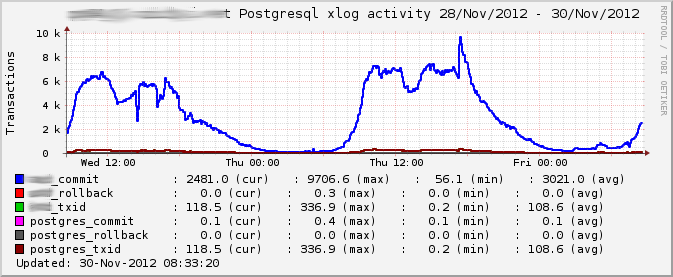
We have a PostgreSQL server with 16 cores that was apparently running well below its capacity: load something between 3.0 and 4.0, around 200 active database connections, almost all always being <IDLE>. However, when the tps count reached 7k transactions per second, things started to throttle, and pgbouncer (running on the database server) started listing up to half of the client connections to be in cl_waiting state. Load was still low, but application performance was bad. The culprit turned out to be the kernel scheduler, fairly distributing CPU time among all running processes. There's one single pgbouncer process, but hundreds of postgres processes. A simple renice of the pgbouncer process did the trick and gave us another extra 2k tps.
26 November 2012

Christoph Berg: Shared Memory and Swapping

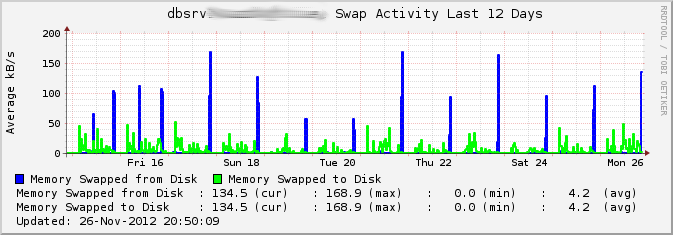
We have this PostgreSQL server with plenty of RAM that is still using some of its swap over the day (up to 600MB). Then suddenly everything is swapped in again. It turned out the reason is there are two clusters running, and the second one isn't used as heavily as the first one. Disk I/O activity of the first cluster slowly evicts pages from the second shared buffers cache to swap, and then the daily pg_dump run reads them back every evening. I was not aware of an easy way to get numbers for "amount of SysV shared memory swapped to disk", but some googling led to shmctl(2):
#define _GNU_SOURCE 1
#include <sys/ipc.h>
#include <sys/shm.h>
#include <stdio.h>
#include <unistd.h>
int main ()
 
        struct shm_info info;
        int max;
        long PAGE_SIZE = sysconf(_SC_PAGESIZE);
        max = shmctl(0, SHM_INFO, (struct shmid_ds *) &info);
        printf ("max: %d\nshm_tot: %ld\nshm_rss: %ld\nshm_swp: %ld\n",
                        max,
                        info.shm_tot * PAGE_SIZE,
                        info.shm_rss * PAGE_SIZE,
                        info.shm_swp * PAGE_SIZE);
        return 0;
 
The output looks like this:
max: 13
shm_tot: 13232308224
shm_rss: 12626661376
shm_swp: 601616384
Update: Mark points out that ipcs -mu shows the same information. Thanks for the hint!
# ipcs -mu
------ Shared Memory Status --------
segments allocated 2
pages allocated 3230544
pages resident  3177975
pages swapped   51585
Swap performance: 0 attempts     0 successes

22 November 2012

Christoph Berg: grep -r foobar

In Wheezy's grep version [1], you can omit the "." in
$ grep -r foobar .
and just write
$ grep -r foobar
[1] actually since 2.11

Next.

Previous.