Search Results: "bab"

3 September 2025

Valhalla's Things: English Paper Piecing, Done Wrong

Posted on September 3, 2025
Tags: madeof:bits
A square mat made of orange, green and grey knit fabric hexagons sewn together. For quite some time, I have been thinking about trying a bit of patchwork, and English Paper Piecing looked like a technique suited to my tastes, with the handsewing involved and the fact of having a paper pattern of sort and everything. The problem is, most of the scraps of fabric I get from my sewing aren t really suitable for quilting, with a lot of them being either too black and too thick or too white and too thin. The other side of the same mat, made of orange and green squares. On the other hand, my partner wears polo shirts at work, and while I try to mend the holes that form, after a while the edges get worn, and they just are no longer suitable for the office, even with some creative mending, and they get downgraded to home wear. But then more office shirts need to be bought, and the home ones accumulate, and there is only so much room for polo shirts in the house, and the worst ones end up in my creative reuse pile. Some parts are worn out and they will end up as cabbage stuffing for things, but some are still in decent enough conditions and could be used as fabric. But surely, for English Paper Piecing you d need woven fabric, not knit, even if it s the dense piqu used in polo shirts, right? Especially if it s your first attempt at the technique, right? The hexagon side of the mat, with my hexagonal pattern weights decorated with Standard Compliant stickers: they fit exactly on the mat pattern. Well, probably it wouldn t work with complex shapes, but what about some 5-ish cm tall Standard Compliant bestagon? So I printed out some hexagons on thick paper, printed some bigger hexagons with sewing allowance as a cutting aid, found two shirts in the least me colours I could find (and one in grey because it was the best match for the other two) and decided to sacrifice them for the experiment. And as long as the paper was still in the pieces, the work went nicely, so I persevered while trying to postpone the Moment of Truth. The squares side of the mat, with a few random Piecepack pieces: the tiles take almost exactly 2   2 squares, and the coins fit inside each square with room to pick them up. After a while I measured things out and saw that I could squeeze a 6.5 7 hexagon pattern into something resembling a square that was a multiple of the 2.5 cm square on the back of my Piecepack tiles, and decided to go for another Standard for the back (because of course I wasn t going to buy new fabric for lining the work). I kept the paper in the pieces until both sides were ready, and used it to sew them right sides together, leaving the usual opening in the middle of one side. Then I pressed, removed the paper, turned everything inside out, pressed again and. It worked! The hexagon side of the mat, with a set of polyhedral dice. The hexagons look like hexagons, the squares look like squares, the whole thing feels soft and drapey, but structurally sound. And it s a bit lumpy, but not enough to cause issues when using it as a soft surface to put over a noisy wooden table to throw dice on. I considered adding some lightweight batting in the middle, but there was really no need for it, and wondered about how to quilt the piece in a way that worked with the patterns on the two sides, but for something this small it wasn t really required. However, I decided to add a buttonhole stitch border on all edges, to close the opening I had left and to reinforce especially the small triangles on the hexagons side, as those had a smaller sewing allowance and could use it. The squares sides of the mat, with some blue and purple stones  in the starting position for a hnefatafl game. And of course, the 11 11 squares side wasn t completely an accident, but part of A Plan. For this project there isn t really a pattern, but I did publish the files I used to print the paper pieces even if they were pretty trivial. And there are more polo shirts in that pile, and while they won t be suitable for anything complex, maybe I could try some rhombs, or even kites and darts?

1 September 2025

Iustin Pop: Small PSA: git.k1024.org turndown

Just a small thing: I m going to turn down the very simple gitweb interface at https://git.k1024.org/. Way back, I thought I should have a backup for GitHub, but the decentralised Git model makes this not really needed, and gitweb is actually pretty heavy, even if it is really bare-bones. Practically, as small as that site was, it was fine before the LLM era. Since then, I keep getting lots of traffic, as if these repositories which already exist on GitHub hold critical training information Thus, I finally got the impetus to turn it down, for no actual loss. Keeping it would make sense only if I were to change it into a proper forge, but that s a different beast, in which I have no interest (as a public service). So, down it goes. I ll probably replace all of it with a single static page, text-only even Next in terms of simplification will probably be removing series from this blog, since there s not enough clear separation between tags and series. Or at least, I m not consequent enough to write a very clean set of articles that can be ordered and numbered as a unit.

31 August 2025

Otto Kek l inen: Managing procrastination and distractions

Featured image of post Managing procrastination and distractionsI ve noticed that procrastination and inability to be consistently productive at work has become quite common in recent years. This is clearly visible in younger people who have grown up with an endless stream of entertainment literally at their fingertips, on their mobile phone. It is however a trap one can escape from with a little bit of help. Procrastination is natural they say humans are lazy by nature after all. Probably all of us have had moments when we choose to postpone a task we know we should be working on, and instead spent our time doing secondary tasks (valorisation). Classic example is cleaning your apartment when you should be preparing for an exam. Some may procrastinate by not doing any work at all, and just watching YouTube videos or the like. To some people, typically those who are in their 20s and early in their career, procrastination can be a big challenge and finding the discipline to stick to planned work may need intentional extra effort, and perhaps even external help. During my 20+ year career in software development I ve been blessed to work with engineers of various backgrounds and each with their unique set of strengths. I have also helped many grow in various areas and overcome challenges, such as lack of intrinsic motivation and managing procrastination, and some might be able to get it in check with some simple advice.

Distance yourself from the digital distractions The key to avoiding distractions and procrastination is to make it inconvenient enough that you rarely do it. If continuing to do work is easier than switching to procrastination, work is more likely to continue. Tips to minimize digital distractions, listed in order of importance:
  1. Put your phone away. Just like when you go to a movie and turn off your phone for two hours, you can put the phone away completely when starting to work. Put the phone in a different room to ensure there is enough physical distance between you and the distraction, so it is impossible for you to just take a quick peek .
  2. Turn off notifications from apps. Don t let the apps call you like sirens luring Odysseus. You don t need to have all the notifications. You will see what the apps have when you eventually open them at a time you choose to use them.
  3. Remove or disable social media apps, games and the like from your phone and your computer. You can install them back when you have vacation. You can probably live without them for some time. If you can t remove them, explore your phone s screen time restriction features to limit your own access to apps that most often waste your time. These features are sometimes listed in the phone settings under digital health .
  4. Have a separate work computer and work phone. Having dedicated ones just for work that are void of all unnecessary temptations helps keep distance from the devices that could derail your focus.
  5. Listen to music. If you feel your brain needs a dose of dopamine to get you going, listening to music helps satisfy your brain s cravings while still being able to simultaneously keep working.
Doing a full digital detox is probably not practical, or not sustainable for an extended time. One needs apps to stay in touch with friends and family, and staying current in software development probably requires spending some time reading news online and such. However the tips above can help contain the distractions and minimize the spontaneous attention the distractions get. Some of the distractions may ironically be from the work itself, for example Slack notifications or new email notifications. I recommend turning them off for a couple of hours every day to have some distraction free time. It should be enough to check work mail a couple times a day. Checking them every hour probably does not add much overall value for the company unless your work is in sales or support where the main task itself is responding to emails.

Distraction free work environment Following the same principle of distancing yourself from distractions, try to use a dedicated physical space for working. If you don t have a spare room to dedicate to work, use a neighborhood caf or sign up for a local co-working space or start commuting to the company office to find a space to be focused on work in.

Break down tasks into smaller steps Sometimes people postpone tasks because they feel intimidated by the size or complexity of a task. In particular in software engineering problems may be vague and appear large until one reaches the breakthrough that brings the vision of how to tackle it. Breaking down problems into smaller more manageable pieces has many advantages in software engineering. Not only can it help with task-avoidance, but it can also make the problem easier to analyze, suggest solutions and test them and build a solid foundation to expand upon to ultimately later reach a full solution on the entire larger problem. Working on big problems as a chain of smaller tasks may also offer more opportunities to celebrate success on completing each subtask and help getting in a suitable cadence of solving a single thing, taking a break and then tackling the next issue. Breaking down a task into concrete steps may also help with getting more realistic time estimations. Sometimes procrastination isn t real someone could just be overly ambitious and feel bad about themselves for not doing an unrealistic amount of work.

Intrinsic motivation Of course, you should follow your passion when possible. Strive to pick a career that you enjoy, and thus maximize the intrinsic motivation you experience. However, even a dream job is still a job. Nobody is ever paid to do whatever they want. Any work will include at least some tasks that feel like a chore or otherwise like something you would not do unless paid to. Some would say that the definition of work itself is having to do things one would otherwise not do. You can only fully do whatever you want while on vacation or when you choose to not have a job at all. But if you have a job, you simply need to find the intrinsic motivation to do it. Simply put, some tasks are just unpleasant or boring. Our natural inclination is to avoid them in favor of more enjoyable activities. For these situations we just have to find the discipline to force ourselves to do the tasks and figuratively speaking whip ourselves into being motivated to complete the tasks.

Extrinsic motivation As the name implies, this is something people external to you need to provide, such as your employer or manager. If you have challenges in managing yourself and delivering results on a regular basis, somebody else needs to set goals and deadlines and keep you accountable for them. At the end of the day this means that eventually you will stop receiving salary or other payments unless you did your job. Forcing people to do something isn t nice, but eventually it needs to be done. It would not be fair for an employer to pay those who did their work the same salary as those who procrastinated and fell short on their tasks. If you work solo, you can also simulate the extrinsic motivation by publicly announcing milestones and deadlines to build up pressure for yourself to meet them and avoid publicly humiliation. It is a well-studied and scientifically proven phenomenon that most university students procrastinate at the start of assignments, and truly start working on them only once the deadline is imminent.

External help for addictions If procrastination is mainly due to a single distraction that is always on your mind, it may be a sign of an addiction. For example, constantly thinking about a computer game or staying up late playing a computer game, to the extent that it seriously affects your ability to work, may be a symptom of an addiction, and getting out of it may be easier with external help.

Discipline and structure Most of the time procrastination is not due to an addiction, but simply due to lack of self-discipline and structure. The good thing is that those things can be learned. It is mostly a matter of getting into new habits, which most young software engineers pick up more or less automatically while working along the more senior ones. Hopefully these tips can help you stay on track and ensure you do everything you are expected to do with clear focus, and on time!

29 August 2025

Noah Meyerhans: Determining Network Online Status of Dualstack Cloud VMs

When a Debian cloud VM boots, it typically runs cloud-init at various points in the boot process. Each invocation can perform certain operations based on the host s static configuration passed by the user, typically either through a well known link-local network service or an attached iso9660 drive image. Some of the cloud-init steps execute before the network comes up, and others at a couple of different points after the network is up. I recently encountered an unexpected issue when configuring a dualstack (uses both IPv6 and legacy IPv4 networking) VM to use a custom apt server accessible only via IPv6. VM provisioning failed because it was unable to access the server in question, yet when I logged in to investigate, it was able to access the server without any problem. The boot had apparently gone smoothly right up until cloud-init s Package Update Upgrade Install module called apt-get update, which failed and broke subsequent provisioning steps. The errors reported by apt-get indicated that there was no route to the service in question, which more accurately probably meant that there was not yet a route to the service. But there was shortly after, when I investigated. This was surprising because the apt-get invocations occur in a cloud-init sequence that s explicitly ordered after the network is configured according to systemd-networkd-wait-online. Investigation eventually led to similar issues encountered in other environments reported in Debian bug #1111791, systemd: network-online.target reached before IPv6 address is ready . The issue described in that bug is identical to mine, but the bug is tagged wontfix. The behavior is considered correct.

Why the default behavior is the correct one While it s a bit counterintuitive, the systemd-networkd behavior is correct, and it s also not something we d want to override in the cloud images. Without explicit configuration, systemd can t accurately infer the intended network configuration of a given system. If a system is IPv6-only, systemd-networkd-wait-online will introduce unexpected delays in the boot process if it waits for IPv4, and vice-versa. If it assumes dualstack, things are even worse because it would block for a long time (approximately two minutes) in any single stack network before failing, leaving the host in degraded state. So the most reasonable default behavior is to block until any protocol is configured. For these same reasons, we can t change the systemd-networkd-wait-online configuration in our cloud images. All of the cloud environments we support offer both single stack and dual stack networking, so we preserve systemd s default behavior. What s causing problems here is that IPv6 takes significantly longer to configure due to its more complex router solicitation + router advertisement + DHCPv6 setup process. So in this particular case, where I ve got a dualstack VM that needs to access a v6-only apt server during the provisioning process, I need to find some mechanism to override systemd s default behavior and wait for IPv6 connectivity specifically.

What won t work Cloud-init offers the ability to write out arbitrary files during provisioning. So writing a drop-in for systemd-networkd-wait-online.service is trivial. Unfortunately, this doesn t give us everything we actually need. We still need to invoke systemctl daemon-reload to get systemd to actually apply the changes after we ve written them, and of course we need to do that before the service actually runs. Cloud-init provides a bootcmd module that lets us run shell commands very early in the boot process , but it runs too early: it runs before we ve written out our configuration files. Similarly, it provides a runcmd module, but scripts there are towards the end of the boot process, far too late to be useful. Instead of using the bootcmd facility, to simply reload systemd s config, it seemed possible that we could both write the config and trigger the reload, similar to the following:
 bootcmd:
- mkdir -p /etc/systemd/system/systemd-networkd-wait-online.service.d
- echo "[Service]" > /etc/systemd/system/systemd-networkd-wait-online.service.d/10-netplan.conf
- echo "ExecStart=" >> /etc/systemd/system/systemd-networkd-wait-online.service.d/10-netplan.conf
- echo "ExecStart=/usr/lib/systemd/systemd-networkd-wait-online --operational-state=routable --any --ipv6" >> /etc/systemd/system/systemd-networkd-wait-online.service.d/10-netplan.conf
- systemctl daemon-reload
But even that runs too late, as we can see in the logs that systemd-networkd-wait-online.service has completed before bootcmd is executed:
root@sid-tmp2:~# journalctl --no-pager -l -u systemd-networkd-wait-online.service
Aug 29 17:02:12 sid-tmp2 systemd[1]: Starting systemd-networkd-wait-online.service - Wait for Network to be Configured...
Aug 29 17:02:13 sid-tmp2 systemd[1]: Finished systemd-networkd-wait-online.service - Wait for Network to be Configured
.
root@sid-tmp2:~# grep -F 'config-bootcmd ran' /var/log/cloud-init.log
2025-08-29 17:02:14,766 - handlers.py[DEBUG]: finish: init-network/config-bootcmd: SUCCESS: config-bootcmd ran successfully and took 0.467 seconds
At this point, it s looking like there are few options left!

What eventually worked I ended up identifying two solutions to the issue, both of which involve getting some other component of the provisioning process to run systemd-networkd-wait-online.

Solution 1 The first involves getting apt-get itself to wait for IPv6 configuration. The apt.conf configuration interface allows the definition of an APT::Update::Pre-Invoke hook that s executed just before apt s update operation. By writing the following to a file in /etc/apt/apt.conf.d/, we re able to ensure that we have IPv6 connectivity before apt-get tries accessing the network. This cloud-config snippet accomplishes that:
 - path: /etc/apt/apt.conf.d/99-wait-for-ipv6
content:  
APT::Update::Pre-Invoke   "/usr/lib/systemd/systemd-networkd-wait-online --operational-state=routable --any --ipv6";  
This is safe to leave in place after provisioning, because the delay will be negligible once IPv6 connectivity is established. It s only during address configuration that it ll block for a noticeable amount of time, but that s what we want. This solution isn t entirely correct, though, because it s only apt-get that s actually affected by it. Other service that start after the system is ostensibly online might only see IPv4 connectivity when they start. This seems acceptable at the moment, though.

Solution 2 The second solution is to simply invoke systemd-networkd-wait-online directly from a cloud-init bootcmd. Similar to the first solution, it s not exactly correct because the host has already reached network-online.target, but it does block enough of cloud-init that package installation happens only after it completes. The cloud-config snippet for this is
bootcmd:
- [/usr/lib/systemd/systemd-networkd-wait-online, --operational-state=routable, --any, --ipv6]
In either case, we still want to write out a snippet to configure systemd-networkd-wait-online to wait for IPv6 connectivity for future reboots. Even though cloud-init won t necessarily run in those cases, and many cloud VMs never reboot at all, it does complete the solution. Additionally, it solves the problem for any derivative images that may be created based on the running VM s state. (At least if we can be certain that instances of those derivative images will never run in an IPv4-only network!)
write_files:
- path: /run/systemd/system/systemd-networkd-wait-online.service.d/99-ipv6-wait.conf
content:  
[Service]
ExecStart=
ExecStart=/lib/systemd/systemd-networkd-wait-online --any --operational-state=routable --ipv6

How to properly solve it One possible improvement would be for cloud-init to support a configuration key allowing the admin to specify the required protocols. Based on the presence of this key, cloud-init could reconfigure systemd-networkd-wait-online.service accordingly. Alternatively it could set the appropriate RequiredFamilyForOnline= value in the generated .network file. cloud-init supports multiple network configuration backends, so each of those would need to be updated. If using the systemd-networkd configuration renderer, this should be straightforward, but Debian uses the netplan renderer, so that tool might also need to be taught to pass such a configuration along to systemd-networkd.

28 August 2025

Valhalla's Things: 1840s Underwear

Posted on August 28, 2025
Tags: madeof:atoms, craft:sewing, FreeSoftWear
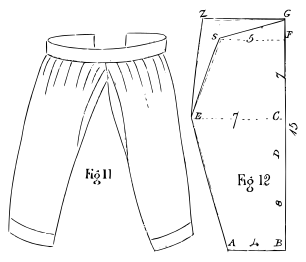
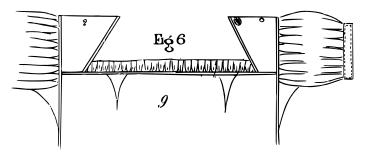
A woman wearing a knee-length shift with very short pleated sleeves and drawers that are a bit longer than needed to be ankle-length. The shift is too wide at the top, had to have a pleat taken in the center front, but the sleeves are still falling down. She is also wearing a black long sleeved t-shirt and leggings under said underwear, for decency. A bit more than a year ago, I had been thinking about making myself a cartridge pleated skirt. For a number of reasons, one of which is the historybounding potential, I ve been thinking pre-crinoline, so somewhere around the 1840s, and that s a completely new era for me, which means: new underwear. Also, the 1840s are pre-sewing machine, and I was already in a position where I had more chances to handsew than to machine sew, so I decided to embrace the slowness and sew 100% by hand, not even using the machine for straight seams. A woman turning fast enough that her petticoat extends a considerable distance from the body. The petticoat is white with a pattern of cording from the hem to just below hip level, with a decreasing number of rows of cording going up. If I remember correctly, I started with the corded petticoat, looking around the internet for instructions, and then designing my own based on the practicality of using modern wide fabric from my stash (and specifically some DITTE from costumers favourite source of dirty cheap cotton IKEA). Around the same time I had also acquired a sashiko kit, and I used the Japanese technique for sewing running stitches pushing the needle with a thimble that covers the base of the middle finger, and I can confirm that for this kind of things it s great! I ve since worn the petticoat a few times for casual / historyBounding / folkwearBounding reasons, during the summer, and I can confirm it s comfortable to use; I guess that during the winter it could be nice to add a flannel layer below it. The technical drawing and pattern for drawers from the book: each leg is cut out of a rectangle of fabric folded along the length, the leg is tapered equally, while the front is tapered more than the back, and comes to a point below the top of the original rectangle. Then I proceeded with the base layers: I had been browsing through The workwoman's guide and that provided plenty of examples, and I selected the basic ankle-length drawers from page 53 and the alternative shift on page 47. As for fabric, I had (and still have) a significant lack of underwear linen in my stash, but I had plenty of cotton voile that I had not used in a while: not very historically accurate for plain underwear, but quite suitable for a wearable mockup. Working with a 1830s source had an interesting aspect: other of the usual, mildly annoying, imperial units, it also used a lot a few obsolete units, especially nails, that my qalc, my usual calculator and converter, doesn t support. Not a big deal, because GNU units came to the rescue, and that one knows a lot of obscure and niche units, and it s quite easy to add those that are missing1 Working on this project also made me freshly aware of something I had already noticed: converting instructions for machine sewing garments into instructions for hand sewing them is usually straightforward, but the reverse is not always true. Starting from machine stitching, you can usually convert straight stitches into backstitches (or running backstitches), zigzag and overlocking into overcasting and get good results. In some cases you may want to use specialist hand stitches that don t really have a machine equivalent, such as buttonhole stitches instead of simply overcasting the buttonhole, but that s it. Starting from hand stitching, instead, there are a number of techniques that could be converted to machine stitching, but involve a lot of visible topstitching that wasn t there in the original instructions, or at times are almost impossible to do by machine, if they involve whipstitching together finished panels on seams that are subject to strong tension. Anyway, halfway through working with the petticoat I cut both the petticoat and the drawers at the same time, for efficiency in fabric use, and then started sewing the drawers. the top third or so of the drawers, showing a deep waistband that is closed with just one button at the top, and the front opening with finished edges that continue through the whole crotch, with just the overlap of fabric to provide coverage. The book only provided measurements for one size (moderate), and my fabric was a bit too narrow to make them that size (not that I have any idea what hip circumference a person of moderate size was supposed to have), so the result is just wide enough to be comfortably worn, but I think that when I ll make another pair I ll try to make them a bit wider. On the other hand they are a bit too long, but I think that I ll fix it by adding a tuck or two. Not a big deal, anyway. The same woman as in the opening image from the back, the shift droops significantly in the center back, and the shoulder straps have fallen down on the top of the arms. The shift gave me a bit more issues: I used the recommended gusset size, and ended up with a shift that was way too wide at the top, so I had to take a box pleat in the center front and back, which changed the look and wear of the garment. I have adjusted the instructions to make gussets wider, and in the future I ll make another shift following those. Even with the pleat, the narrow shoulder straps are set quite far to the sides, and they tend to droop, and I suspect that this is to be expected from the way this garment is made. The fact that there are buttonholes on the shoulder straps to attach to the corset straps and prevent the issue is probably a hint that this behaviour was to be expected. The technical drawing of the shift from the book, showing a the top of the body, two trapezoidal shoulder straps, the pleated sleeves and a ruffle on the front edge. I ve also updated the instructions so that they shoulder straps are a bit wider, to look more like the ones in the drawing from the book. Making a corset suitable for the time period is something that I will probably do, but not in the immediate future, but even just wearing the shift under a later midbust corset with no shoulder strap helps. I m also not sure what the point of the bosom gores is, as they don t really give more room to the bust where it s needed, but to the high bust where it s counterproductive. I also couldn t find images of original examples made from this pattern to see if they were actually used, so in my next make I may just skip them. Sleeve detail, showing box pleats that are about 2 cm wide and a few mm distance from each other all along the circumference, neatly sewn into the shoulder strap on one side and the band at the other side. On the other hand, I m really happy with how cute the short sleeves look, and if2 I ll ever make the other cut of shift from the same book, with the front flaps, I ll definitely use these pleated sleeves rather than the straight ones that were also used at the time. As usual, all of the patterns have been published on my website under a Free license:

  1. My ~/.units file currently contains definitions for beardseconds, bananas and the more conventional Nm and NeL (linear mass density of fibres).
  2. yeah, right. when.

27 August 2025

Russell Coker: ZRAM and VMs

I ve just started using zram for swap on VMs. The use of compression for swap in Linux apparently isn t new, it s been in the Linux kernel since version 3.2 (since 2012). But until recent years I hadn t used it. When I started using Mobian (the Debian distribution for phones) zram was in the default setup, it basically works and I never needed to bother with it which is exactly what you want from such a technology. After seeing it s benefits in Mobian I started using it on my laptops where it worked well. Benefits of ZRAM ZRAM means that instead of paging data to storage it is compressed to another part of RAM. That means no access to storage which is a significant benefit if storage is slow (typical for phones) or if storage wearing out is a problem. For servers you typically have SSDs that are fast and last for significant write volumes, for example the 120G SSDs referenced in my blog post about swap (not) breaking SSD [1] are running well in my parents PC because they outlasted all the other hardware connected to them and 120G isn t usable for anything more demanding than my parents use nowadays. Those are Intel 120G 2.5 DC grade SATA SSDs. For most servers ZRAM isn t a good choice as you can just keep doing IO on the SSDs for years. A server that runs multiple VMs is a special case because you want to isolate the VMs from each other. Support for quotas for storage IO in Linux isn t easy to configure while limiting the number of CPU cores is very easy. If a system or VM using ZRAM for swap starts paging excessively the bottleneck will be CPU, this probably isn t going to be great on a phone with a slow CPU but on a server class CPU it will be less of a limit. Whether compression is slower or faster than SSD is a complex issue but it will definitely be just a limit for that VM. When I setup a VM server I want to have some confidence that a DoS attack or configuration error on one VM isn t going to destroy the performance of other VMs. If the VM server has 4 cores (the smallest VM server I run) and no VM has more than 2 cores then I know that the system can still run adequately if half the CPU performance is being wasted. Some servers I run have storage limits that make saving the disk space for swap useful. For servers I run in Hetzner (currently only one server but I have run up to 6 at various times in the past) the storage is often limited, Hetzner seems to typically have storage that is 8* the size of RAM so if you have many VMs configured with the swap that they might need in the expectation that usually at most one of them will be actually swapping then it can make a real difference to usable storage. 5% of storage used for swap files isn t uncommon or unreasonable. Big Servers I am still considering the implications of zram on larger systems. If I have a ML server with 512G of RAM would it make sense to use it? It seems plausible that a system might need 550G of RAM and zram could make the difference between jobs being killed with OOM and the jobs just completing. The CPU overhead of compression shouldn t be an issue as when you have dozens of cores in the system having one or two used for compression is no big deal. If a system is doing strictly ML work there will be a lot of data that can t be compressed, so the question is how much of the memory is raw input data and the weights used for calculations and how much is arrays with zeros and other things that are easy to compress. With a big server nothing less than 32G of swap will make much difference to the way things work and if you have 32G of data being actively paged then the fastest NVMe devices probably won t be enough to give usable performance. As zram uses one stream per CPU code if you have 44 cores that means 44 compression streams which should handle greater throughput. I ll write another blog post if I get a chance to test this.

Matthew Palmer: StrongBox: Simple, Safe Data Encryption for Rust

Some time ago, I wanted to encrypt a bunch of data in an application I was writing in Rust, mostly to be stored in a database, but also session cookies and sensitive configuration variables. Since Rust is widely known as a secure-yet-high-performance programming language, I was expecting that there would be a widely-used crate that gave me a secure, high-level interface to strong, safe cryptography. Imagine my surprise when I discovered that just didn t seem to exist. Don t get me wrong: Rust is replete with fast, secure, battle-tested cryptographic primitives. The RustCrypto group provides all manner of robust, widely-used crates for all manner of cryptography-related purposes. They re the essential building blocks for practical cryptosystems, but using them directly in an application is somewhat akin to building a car from individual atoms of iron and carbon. So I wrote my own high-level data encryption library, called it StrongBox, and have been happily encrypting and decrypting data ever since.

Cryptography So Simple Even I Can t Get It Wrong The core of StrongBox is the StrongBox trait, which has only two methods: encrypt and decrypt, each of which takes just two arguments. The first argument is the plaintext (for encrypt) or the ciphertext (for decrypt) to work on. The second argument is the encryption context, for use as Authenticated Additional Data, an important part of many uses of encryption. There s essentially no configuration or parameters to get wrong. You can t choose the encryption algorithm, or block cipher mode, and you don t have to worry about generating a secure nonce. You create a StrongBox with a key, and then you call encrypt and decrypt. That s it.

Practical Cryptographic Affordances Ok, ok that s not quite it. Because StrongBox is even easier to use than what I ve described, thanks to the companion crate, StructBox. When I started using StrongBox in the wild , it quickly became clear that what I almost always wanted to encrypt in my application wasn t some ethereal plaintext . I wanted to encrypt things, specifically structs (and enums). So, through the magic of Rust derive macros, I built StructBox, which provides encrypt and decrypt operations on any Serde-able type. Given that using Serde encoders can be a bit fiddly to use, it s virtually easier to get an encrypted, serialized struct than it is to get a plaintext serialized struct.

Key Problems in Cryptography The thing about cryptography is that it largely turns all data security problems into key management problems. All the fancy cryptographic wonkery is for naught if you don t manage the encryption keys well. So, most of the fancy business in StrongBox isn t the encryption and decryption, but instead solving problems around key management.

Different Keys for Different Purposes Using the same key for all of your cryptographic needs is generally considered a really bad idea. It opens up all manner of risks, that are easily avoided if you use different keys for different things. However, having to maintain a big pile of different keys is a nightmare, so nobody s going to do that. Enter: key derivation. Create one safe, secure root key, and then use a key derivation function to spawn as many other keys as you need. Different keys for each database column, another one to encrypt cookies, and so on. StrongBox supports this through the StemStrongBox type. You ll typically start off by creating a StemStrongBox with the root key, and then derive whatever other StrongBoxes you need, for encrypting and decrypting different kinds of data.

You Spin Me Round Sometimes, keys need to be rotated. Whether that s because you actually know (or even have reason to suspect) someone has gotten the key, or just because you re being appropriately paranoid, sometimes key rotation has to happen. As someone who has had to rotate keys in situations where such an eventuality was not planned for, I can say with some degree of authority: it absolutely sucks to have to do an emergency key rotation in a system that isn t built to make that easy. That s why StrongBox natively supports key rotation. Every StrongBox takes one encryption key, and an arbitrary number of decryption keys, and will automatically use the correct key to decrypt ciphertexts.

Will You Still Decrypt Me, Tomorrow? In addition to manual key rotation, StrongBox also supports time-based key rotation with the RotatingStrongBox type. This comes in handy when you re encrypting a lot of ephemeral data, like cookies (or server-side session data). It provides a way to automatically expire old data, and prevents attacks that become practical when large amounts of data are encrypted using a single key.

Invasion of the Invisible Salamanders! I mostly mention this just because I love the name, but there is a kind of attack possible in common AEAD modes called the invisible salamanders attack. StrongBox implements mitigations against this, by committing to the key being used so that an attacker can t forge a ciphertext that decrypts validly to different plaintexts when using different keys. This is why I love cryptography: everything sounds like absolute goddamn magic.

Call Me Crazy, Support Me Maybe? If you re coding in Rust (which you probably should be), encrypting your stored data (which you definitely should be), and StrongBox makes your life easier (which it really will), you can show your appreciation for my work by contributing to my open source code-fund. Simply by shouting me a refreshing beverage, you ll be helping me out, and helping to grow the software commons. Alternately, if you re looking for someone to Speak Rust to Computers on a professional basis, I m available for contracts or full-time remote positions.

22 August 2025

Russell Coker: Dell T320 H310 RAID and IT Mode

The Problem Just over 2 years ago my Dell T320 server had a motherboard failure [1]. I recently bought another T320 that had been gutted (no drives, PSUs, or RAM) and put the bits from my one in it. I installed Debian and the resulting installation wouldn t boot, I tried installing with both UEFI and BIOS modes with the same result. Then I realised that the disks I had installed were available even though I hadn t gone through the RAID configuration (I usually make a separate RAID-0 for each disk to work best with BTRFS or ZFS). I tried changing the BIOS setting for SATA disks between RAID and AHCI modes which didn t change things and realised that the BIOS setting in question probably applies to the SATA connector on the motherboard and that the RAID card was in IT mode which means that each disk is seen separately. If you are using ZFS or BTRFS you don t want to use a RAID-1, RAID-5, or RAID-6 on the hardware RAID controller, if there are different versions of the data on disks in the stripe then you want the filesystem to be able to work out which one is correct. To use IT mode you have to flash a different unsupported firmware on the RAID controller and then you either have to go to some extra effort to make it bootable or have a different device to boot from. The Root Causes Dell has no reason to support unusual firmware on their RAID controllers. Installing different firmware on a device that is designed for high availability is going to have some probability of data loss and perhaps more importantly for Dell some probability of customers returning hardware during the support period and acting innocent about why it doesn t work. Dell has a great financial incentive to make it difficult to install Dell firmware on LSI cards from other vendors which have equivalent hardware as they don t want customers to get all the benefits of iDRAC integration etc without paying the Dell price premium. All the other vendors have similar financial incentives so there is no official documentation or support on converting between different firmware images. Dell s support for upgrading the Dell version is pretty good, but it aborts if it sees something different. The Attempts I tried following the instructions in this document to flash back to Dell firmware [2]. This document is about the H310 RAID card in my Dell T320 AKA a LSI SAS 9211-8i . The sas2flash.efi program didn t seem to do anything, it returned immediately and didn t give an error message. This page gives a start of how to get inside the Dell firmware package but doesn t work [3]. It didn t cover the case where sasdupie aborts with an error because it detects the current version as 00.00.00.00 not something that the upgrade program is prepared to upgrade from. But it s a place to start looking for someone who wants to try harder at this. This forum post has some interesting information, I gave up before trying it, but it may be useful for someone else [4]. The Solution Dell tower servers have as a standard feature an internal USB port for a boot device. So I created a boot image on a spare USB stick and installed it there and it then loads the kernel and mounts the filesystem from a SATA hard drive. Once I got that working everything was fine. The Debian/Trixie installer would probably have allowed me to install an EFI device on the internal USB stick as part of the install if I had known what was going to happen. The system is now fully working and ready to sell. Now I just need to find someone who wants IT mode on the RAID controller and hopefully is willing to pay extra for it. Whatever I sell the system for it seems unlikely to cover the hours I spent working on this. But I learned some interesting things about RAID firmware and hopefully this blog post will be useful to other people, even if only to discourage them from trying to change firmware.

20 August 2025

Antoine Beaupr : Encrypting a Debian install with UKI

I originally setup a machine without any full disk encryption, then somehow regretted it quickly after. My original reasoning was that this was a "play" machine so I wanted as few restrictions on accessing the machine as possible, which meant removing passwords, mostly. I actually ended up having a user password, but disabled the lock screen. Then I started using the device to manage my photo collection, and suddenly there was a lot of "confidential" information on the device that I didn't want to store in clear text anymore.

Pre-requisites So, how does one convert an existing install from plain text to full disk encryption? One way is to backup to an external drive, re-partition everything and copy things back, but that's slow and boring. Besides, cryptsetup has a cryptsetup-reencrypt command, surely we can do this in place? Having not set aside enough room for /boot, I briefly considered a "encrypted /boot" configuration and conversion (e.g. with this guide) but remembered grub's support for this is flaky, at best, so I figured I would try something else. Here, I'm going to guide you through how I first converted from grub to systemd-boot then to UKI kernel, then re-encrypt my main partition. Note that secureboot is disabled here, see further discussion below.

systemd-boot and Unified Kernel Image conversion systemd folks have been developing UKI ("unified kernel image") to ship kernels. The way this works is the kernel and initrd (and UEFI boot stub) in a single portable executable that lives in the EFI partition, as opposed to /boot. This neatly solves my problem, because I already have such a clear-text partition and won't need to re-partition my disk to convert. Debian has started some preliminary support for this. It's not default, but I found this guide from Vasudeva Kamath which was pretty complete. Since the guide assumes some previous configuration, I had to adapt it to my case. Here's how I did the conversion to both systemd-boot and UKI, all at once. I could have perhaps done it one at a time, but doing both at once works fine. Before your start, make sure secureboot is disabled, see the discussion below.
  1. install systemd tools:
    apt install systemd-ukify systemd-boot
    
  2. Configure systemd-ukify, in /etc/kernel/install.conf:
    layout=uki
    initrd_generator=dracut
    uki_generator=ukify
    
    TODO: it doesn't look like this generates a initrd with dracut, do we care?
  3. Configure the kernel boot arguments with the following in /etc/kernel/uki.conf:
    [UKI]
    Cmdline=@/etc/kernel/cmdline
    
    The /etc/kernel/cmdline file doesn't actually exist here, and that's fine. Defaults are okay, as the image gets generated from your current /proc/cmdline. Check your /etc/default/grub and /proc/cmdline if you are unsure. You'll see the generated arguments in bootctl list below.
  4. Build the image:
    dpkg-reconfigure linux-image-$(uname -r)
    
  5. Check the boot options:
    bootctl list
    
    Look for a Type #2 (.efi) entry for the kernel.
  6. Reboot:
    reboot
    
You can tell you have booted with systemd-boot because (a) you won't see grub and (b) the /proc/cmdline will reflect the configuration listed in bootctl list. In my case, a systemd.machine_id variable is set there, and not in grub (compare with /boot/grub/grub.cfg). By default, the systemd-boot loader just boots, without a menu. You can force the menu to show up by un-commenting the timeout line in /boot/efit/loader/loader.conf, by hitting keys during boot (e.g. hitting "space" repeatedly), or by calling:
systemctl reboot --boot-loader-menu=0
See the systemd-boot(7) manual for details on that. I did not go through the secureboot process, presumably I had already disabled secureboot. This is trickier: because one needs a "special key" to sign the UKI image, one would need the collaboration of debian.org to get this working out of the box with the keys shipped onboard most computers. In other words, if you want to make this work with secureboot enabled on your computer, you'll need to figure out how to sign the generated images before rebooting here, because otherwise you will break your computer. Otherwise, follow the following guides:

Re-encrypting root filesystem Now that we have a way to boot an encrypted filesystem, we can switch to LUKS for our filesystem. Note that you can probably follow this guide if, somehow, you managed to make grub work with your LUKS setup, although as this guide shows, you'd need to downgrade the cryptographic algorithms, which seems like a bad tradeoff. We're using cryptsetup-reencrypt for this which, amazingly, supports re-encrypting devices on the fly. The trick is it needs free space at the end of the partition for the LUKS header (which, I guess, makes it a footer), so we need to resize the filesystem to leave room for that, which is the trickiest bit. This is a possibly destructive behavior. Be sure your backups are up to date, or be ready to lose all data on the device. We assume 512 byte sectors here. Check your sector size with fdisk -l and adjust accordingly.
  1. Before you perform the procedure, make sure requirements are installed:
    apt install cryptsetup systemd-cryptsetup cryptsetup-initramfs
    
    Note that this requires network access, of course.
  2. Reboot in a live image, I like GRML but any Debian live image will work, possibly including the installer
  3. First, calculate how many sectors to free up for the LUKS header
    qalc> 32Mibyte / ( 512 byte )
      (32 mebibytes) / (512 bytes) = 65536
    
  4. Find the sector sizes of the Linux partitions:
    fdisk  -l /dev/nvme0n1   awk '/filesystem/   print $1 " " $4  '  
    
    For example, here's an example with a /boot and / filesystem:
    $ sudo fdisk -l /dev/nvme0n1   awk '/filesystem/   print $1 " " $4  '
    /dev/nvme0n1p2 999424
    /dev/nvme0n1p3 3904979087
    
  5. Substract 1 from 2:
    qalc> set precision 100
    qalc> 3904979087 - 65536
    
    Or, last step and this one, in one line:
    fdisk -l /dev/nvme0n1   awk '/filesystem/   print $1 " " $4 - 65536  '
    
  6. Recheck filesystem:
    e2fsck -f /dev/nvme0n1p2
    
  7. Resize filesystem:
    resize2fs /dev/nvme0n1p2 $(fdisk -l /dev/nvme0n1   awk '/nvme0n1p2/   print $4 - 65536  ')s
    
    Notice the trailing s here: it makes resize2fs interpret the number as a 512 byte sector size, as opposed to the default (4k blocks).
  8. Re-encrypt filesystem:
    cryptsetup reencrypt --encrypt /dev/nvme0n1p2 --resize-device-size=32M
    
    This is it! This is the most important step! Make sure your laptop is plugged in and try not to interrupt it. This can, apparently, be resumed without problem, but I'd hate to show you how. This will show progress information like:
    Progress:   2.4% ETA 23m45s,      53GiB written, speed   1.3 GiB/s
    
    Wait until the ETA has passed.
  9. Open and mount the encrypted filesystem and mount the EFI system partition (ESP):
    cryptsetup open /dev/nvme0n1p2 crypt
    mount /dev/mapper/crypt /mnt
    mount /dev/nvme0n1p1 /mnt/boot/efi
    
    If this fails, now is the time to consider restoring from backups.
  10. Enter the chroot
    for fs in proc sys dev ; do
      mount --bind /$fs /mnt/$fs
    done
    chroot /mnt
    
    Pro tip: this can be done in one step in GRML with:
    grml-chroot /mnt bash
    
  11. Generate a crypttab:
    echo crypt_dev_nvme0n1p2 UUID=$(blkid -o value -s UUID /dev/nvme0n1p2) none luks,discard >> /etc/crypttab
    
  12. Adjust root filesystem in /etc/fstab, make sure you have a line like this:
    /dev/mapper/crypt_dev-nvme0n1p2 /               ext4    errors=remount-ro 0       1
    
    If you were already using a UUID entry for this, there's nothing to change!
  13. Configure the root filesystem in the initrd:
    echo root=/dev/mapper/crypt_dev_nvme0n1p2 > /etc/kernel/cmdline
    
  14. Regenerate UKI:
    dpkg-reconfigure linux-image-$(uname -r)
    
    Be careful here! systemd-boot inherits the command line from the system where it is generated, so this will possibly feature some unsupported commands from your boot environment. In my case GRML had a couple of those, which broke the boot. It's still possible to workaround this issue by tweaking the arguments at boot time, that said.
  15. Exit chroot and reboot
    exit
    reboot
    
Some of the ideas in this section were taken from this guide but was mostly rewritten to simplify the work. My guide also avoids the grub hacks or a specific initrd system (as the guide uses initramfs-tools and grub, while I, above, switched to dracut and systemd-boot). RHEL also has a similar guide, perhaps even better. Somehow I have made this system without LVM at all, which simplifies things a bit (as I don't need to also resize the physical volume/volume groups), but if you have LVM, you need to tweak this to also resize the LVM bits. The RHEL guide has some information about this.

16 August 2025

Birger Schacht: Updates and additions in Debian 13 Trixie

Last week Debian 13 (Trixie) was released and there have been some updates and additions in the packages that I maintain, that I wanted to write about. I think they are not worth of being added to the release notes, but I still wanted to list some of the changes and some of the new packages.

sway Sway, the tiling Wayland compositor was version 1.7 in Bookworm. It was updated to version 1.10 (and 1.11 is already in experimental and waiting for an upload to unstable). This new version of sway brings, among a lot of other features, updated support for touchpad gestures and support for the ext-session-lock-v1 protocol, which allows for more robust and secure screen locking. The configuration snippet that activates the default sway background is now shipped in the sway-backgrounds package instead of being part of the sway package itself. The default menu application was changed from dmenu to wmenu. wmenu is a Wayland native alternative to dmenu which I packaged and it is now recommended by sway. There are some small helper tools for sway that were updated: swaybg was bumped from 1.2.0 to 1.2.1, swaylock was bumped from 1.7.2 to 1.8.2. The grimshot script, which is a script for making screenshots, was part of the sway s contrib folder for a long time (but was shipped as a separate binary package). It was removed from sway and is now part of the sway-contrib project. There are some other useful utilities in this source package that I might package in the future. slurp, which is used by grimshot to select a region, was updated from version 1.4 to version 1.5.

labwc I uploaded the first labwc package two years ago and I m happy it is now part of a stable Debian release. Labwc is also based on wlroots, like sway. It is a window-stacking compositor and is inspired by openbox. I used openbox for a long time back in the day before I moved to i3 and I m very happy to see that there is a Wayland alternative.

foot Foot is a minimalistic and fast Wayland terminal emulator. It is mostly keyboard driven. foot was updated from version 1.13.1 to 1.21.0. The probably most important change for users updating might be the fact that:
  • Control+Shift+u is now bound to unicode-input instead of show- urls-launch, to follow the convention established in GTK and Qt
  • show-urls-launch now bound to Control+Shift+o

et cetera The Wayland kiosk cage was updated from 0.1.4 to 0.2.0. The waybar bar for wlroots compositors was updated from 0.9.17 to 0.12.0. swayimg was updated from 1.10 to 3.8 and now brings support for custom key bindings, support for additional image types (PNM, EXR, DICOM, Farbfeld, sixel) and a gallery mode. tofi, another dmenu replacement was updated from 0.8.1 to 0.9.1, wf-recorder a tool for screen recording in wlroots-based compositors, was updated from version 0.3 to version 0.5.0. wlogout was updated from version 1.1.1 to 1.2.2. The application launcher wofi was updated from 1.3 to 1.4.1. The lightweight status panel yambar was updated from version 1.9 to 1.11. kanshi, the tool for managing and automatically switching your output profiles, was updated from version 1.3.1 to version 1.5.1. usbguard was updated from version 1.1.2 to 1.1.3.

added
  • fnott - a lightweight notification daemon for wlroots based compositors
  • fyi - a utility to send notifications to a notification daemon, similar to notify-send
  • pipectl - a tool to create and manage short-lived named pipes, this is a dependency of wl-present. wl-present is a script around wl-mirror which implements output mirroring for wlroots-based compositors
  • poweralertd - a small daemon that notifies you about the power status of your battery powered devices
  • wlopm - control power management of outputs
  • wlrctl - command line utility for miscellaneous wlroots Wayland extensions
  • wmenu - already mentioned, the new default launcher of sway
  • wshowkeys - shows keypresses in wayland sessions, nice for debugging
  • libsfdo - libraries implementing some freedesktop.org specs, used by labwc

15 August 2025

Freexian Collaborators: Monthly report about Debian Long Term Support, July 2025 (by Roberto C. S nchez)

Like each month, have a look at the work funded by Freexian s Debian LTS offering.

Debian LTS contributors In July, 17 contributors have been paid to work on Debian LTS, their reports are available:
  • Adrian Bunk did 19.0h (out of 19.0h assigned).
  • Andrej Shadura did 5.0h (out of 0.0h assigned and 8.0h from previous period), thus carrying over 3.0h to the next month.
  • Bastien Roucari s did 18.5h (out of 18.75h assigned), thus carrying over 0.25h to the next month.
  • Ben Hutchings did 12.5h (out of 3.25h assigned and 15.5h from previous period), thus carrying over 6.25h to the next month.
  • Carlos Henrique Lima Melara did 10.0h (out of 10.0h assigned).
  • Chris Lamb did 18.0h (out of 18.0h assigned).
  • Daniel Leidert did 18.75h (out of 17.25h assigned and 1.5h from previous period).
  • Emilio Pozuelo Monfort did 18.75h (out of 18.75h assigned).
  • Guilhem Moulin did 15.0h (out of 14.0h assigned and 1.0h from previous period).
  • Jochen Sprickerhof did 2.0h (out of 16.5h assigned and 2.25h from previous period), thus carrying over 16.75h to the next month.
  • Lee Garrett did 7.0h (out of 0.0h assigned and 23.25h from previous period), thus carrying over 16.25h to the next month.
  • Markus Koschany did 9.0h (out of 18.75h assigned), thus carrying over 9.75h to the next month.
  • Roberto C. S nchez did 10.25h (out of 18.5h assigned and 2.75h from previous period), thus carrying over 11.0h to the next month.
  • Santiago Ruano Rinc n did 7.25h (out of 12.75h assigned and 2.25h from previous period), thus carrying over 7.75h to the next month.
  • Sylvain Beucler did 18.75h (out of 18.75h assigned).
  • Thorsten Alteholz did 15.0h (out of 15.0h assigned).
  • Utkarsh Gupta did 15.0h (out of 1.0h assigned and 14.0h from previous period).

Evolution of the situation In July, we released 24 DLAs.
  • Notable security updates:
    • angular.js, prepared by Bastien Roucari s, fixes multiple vulnerabilities including input sanitization and potential regular expression denial of service (ReDoS)
    • tomcat9, prepared by Markus Koschany, fixes an assortment of vulnerabilities
    • mediawiki, prepared by Guilhem Moulin, fixes several information disclosure and privilege escalation vulnerabilities
    • php7.4, prepared by Guilhem Moulin, fixes several server side request forgery and denial of service vulnerabilities
This month s contributions from outside the regular team include an update to thunderbird, prepared by Christoph Goehre (the package maintainer). LTS Team members also contributed updates of the following packages:
  • commons-beanutils (to stable and unstable), prepared by Adrian Bunk
  • djvulibre (to oldstable, stable, and unstable), prepared by Adrian Bunk
  • git (to stable), prepared by Adrian Bunk
  • redis (to oldstable), prepared by Chris Lamb
  • libxml2 (to oldstable), prepared by Guilhem Moulin
  • commons-vfs (to oldstable), prepared by Daniel Leidert
Additionally, LTS Team member Santiago Ruano Rinc n proposed and implemented an improvement to the debian-security-support package. This package is available so that interested users can quickly determine if any installed packages are subject to limited security support or are excluded entirely from security support. However, there was not previously a way to identify explicitly supported packages, which has become necessary to note exceptions to broad exclusion policies (e.g., those which apply to substantial package groups, like modules belonging to the Go and Rust language ecosystems). Santiago s work has enabled the notation of exceptions to these exclusions, thus ensuring that users of debian-security-support have accurate status information concerning installed packages.

DebCamp 25 Security Tracker Sprint The previously announced security tracker sprint took place at DebCamp from 7-13 July. Participants included 8 members of the standing LTS Team, 2 active Debian Developers with an interest in LTS, 3 community members, and 1 member of the Debian Security Team (who provided guidance and reviews on proposed changes to the security tracker); participation was a mix of in person at the venue in Brest, France and remote. During the days of the sprint, the team tackled a wide range of bugs and improvements, mostly targeting the security tracker. The sprint participants worked on the following items: As can be seen from the above list, only a small number of changes were brought to completion during the sprint week itself. Given the very compressed timeframe involved, the broad scope of tasks which were under consideration, and the highly sensitive data managed by the security tracker, this is not entirely unexpected and in no way diminishes the great work done by the sprint participants. The LTS Team would especially like to thank Salvatore Bonaccorso of the Debian Security Team for making himself available throughout the sprint to answer questions, for providing guidance on the work, and for helping the work by reviewing and merging the MRs which were able to merged during the sprint itself. In the weeks that follow the sprint, the team will continue working towards completing the in progress items.

Thanks to our sponsors Sponsors that joined recently are in bold.

6 August 2025

Reproducible Builds: Reproducible Builds in July 2025

Welcome to the seventh report from the Reproducible Builds project in 2025. Our monthly reports outline what we ve been up to over the past month, and highlight items of news from elsewhere in the increasingly-important area of software supply-chain security. If you are interested in contributing to the Reproducible Builds project, please see the Contribute page on our website. In this report:
  1. Reproducible Builds Summit 2025
  2. Reproducible Builds an official goal for SUSE Enterprise Linux
  3. Reproducible Builds at FOSSY 2025
  4. New OSS Rebuild project from Google
  5. New extension of Python setuptools to support reproducible builds
  6. diffoscope
  7. New library to patch system functions for reproducibility
  8. Independently Reproducible Git Bundles
  9. Website updates
  10. Distribution work
  11. Reproducibility testing framework
  12. Upstream patches

Reproducible Builds Summit 2025 We are extremely pleased to announce the upcoming Reproducible Builds Summit, set to take place from October 28th 30th 2025 in Vienna, Austria! We are thrilled to host the eighth edition of this exciting event, following the success of previous summits in various iconic locations around the world, including Venice, Marrakesh, Paris, Berlin, Hamburg and Athens. Our summits are a unique gathering that brings together attendees from diverse projects, united by a shared vision of advancing the Reproducible Builds effort. During this enriching event, participants will have the opportunity to engage in discussions, establish connections and exchange ideas to drive progress in this vital field. Our aim is to create an inclusive space that fosters collaboration, innovation and problem-solving. If you re interesting in joining us this year, please make sure to read the event page which has more details about the event and location. Registration is open until 20th September 2025, and we are very much looking forward to seeing many readers of these reports there!

Reproducible Builds an official goal for SUSE Enterprise Linux On our mailing list this month, Bernhard M. Wiedemann revealed the big news that reproducibility is now an official goal for SUSE Linux Enterprise Server (SLES) 16:
[Everything] changed earlier this year when reproducible-builds for SLES-16 became an official goal for the product. More people are talking about digital sovereignty and supply-chain security now. [ ] Today, only 9 of 3319 (source) packages have significant problems left (plus 7 with pending fixes), so 99.5% of packages have reproducible builds.

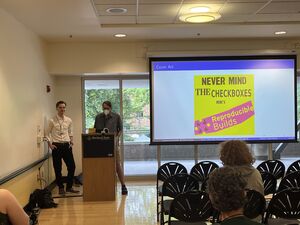
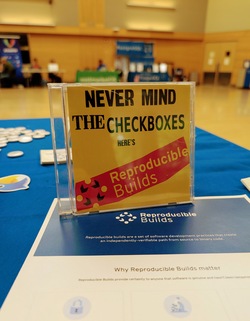
Reproducible Builds at FOSSY 2025 On Saturday 2nd August, Vagrant Cascadian and Chris Lamb presented at this year s FOSSY 2025. Their talk, titled Never Mind the Checkboxes, Here s Reproducible Builds!, was introduced as follows:
There are numerous policy compliance and regulatory processes being developed that target software development but do they solve actual problems? Does it improve the quality of software? Do Software Bill of Materials (SBOMs) actually give you the information necessary to verify how a given software artifact was built? What is the goal of all these compliance checklists anyways or more importantly, what should the goals be? If a software object is signed, who should be trusted to sign it, and can they be trusted forever?
Hosted by the Software Freedom Conservancy and taking place in Portland, Oregon, USA, FOSSY aims to be a community-focused event: Whether you are a long time contributing member of a free software project, a recent graduate of a coding bootcamp or university, or just have an interest in the possibilities that free and open source software bring, FOSSY will have something for you . More information on the event is available on the FOSSY 2025 website, including the full programme schedule. Vagrant and Chris also staffed a table, where they will be available to answer any questions about Reproducible Builds and discuss collaborations with other projects.

New OSS Rebuild project from Google The Google Open Source Security Team (GOSST) published an article this month announcing OSS Rebuild, a new project to strengthen trust in open source package ecosystems by reproducing upstream artifacts. As the post itself documents, the new project comprises four facets:
  • Automation to derive declarative build definitions for existing PyPI (Python), npm (JS/TS), and Crates.io (Rust) packages.
  • SLSA Provenance for thousands of packages across our supported ecosystems, meeting SLSA Build Level 3 requirements with no publisher intervention.
  • Build observability and verification tools that security teams can integrate into their existing vulnerability management workflows.
  • Infrastructure definitions to allow organizations to easily run their own instances of OSS Rebuild to rebuild, generate, sign, and distribute provenance.
One difference with most projects that aim for bit-for-bit reproducibility, OSS Rebuild aims for a kind of semantic reproducibility:
Through automation and heuristics, we determine a prospective build definition for a target package and rebuild it. We semantically compare the result with the existing upstream artifact, normalizing each one to remove instabilities that cause bit-for-bit comparisons to fail (e.g. archive compression).
The extensive post includes examples about how to access OSS Rebuild attestations using the Go-based command-line interface.

New extension of Python setuptools to support reproducible builds Wim Jeantine-Glenn has written a PEP 517 Build backend in order to enable reproducible builds when building Python projects that use setuptools. Called setuptools-reproducible, the project s README file contains the following:
Setuptools can create reproducible wheel archives (.whl) by setting SOURCE_DATE_EPOCH at build time, but setting the env var is insufficient for creating reproducible sdists (.tar.gz). setuptools-reproducible [therefore] wraps the hooks build_sdist build_wheel with some modifications to make reproducible builds by default.

diffoscope diffoscope is our in-depth and content-aware diff utility that can locate and diagnose reproducibility issues. This month, Chris Lamb made the following changes, including preparing and uploading versions 301, 302 and 303 to Debian:
  • Improvements:
    • Use Difference.from_operation in an attempt to pipeline the output of the extract-vmlinux script, potentially avoiding it all in memory. [ ]
    • Memoize a number of calls to --version, saving a very large number of external subprocess calls.
  • Bug fixes:
    • Don t check for PyPDF version 3 specifically, check for versions greater than 3. [ ]
    • Ensure that Java class files are named .class on the filesystem before passing them to javap(1). [ ]
    • Mask stderr from extract-vmlinux script. [ ][ ]
    • Avoid spurious differences in h5dump output caused by exposure of absolute internal extraction paths. (#1108690)
  • Misc:
    • Use our_check_output in the ODT comparator. [ ]
    • Update copyright years. [ ]
In addition: Lastly, Chris Lamb added a tmpfs to try.diffoscope.org so that diffoscope has a non-trivial temporary area to unpack archives, etc. [ ] Elsewhere in our tooling, however, reprotest is our tool for building the same source code twice in different environments and then checking the binaries produced by each build for any differences. This month, reprotest version 0.7.30 was uploaded to Debian unstable by Holger Levsen, chiefly including a change by Rebecca N. Palmer to not call sudo with the -h flag in order to fix Debian bug #1108550. [ ]

New library to patch system functions for reproducibility Nicolas Graves has written and published libfate, a simple collection of tiny libraries to patch system functions deterministically using LD_PRELOAD. According to the project s README:
libfate provides deterministic replacements for common non-deterministic system functions that can break reproducible builds. Instead of relying on complex build systems or apps or extensive patching, libfate uses the LD_PRELOAD trick to intercept system calls and return fixed, predictable values.
Describing why he wrote it, Nicolas writes:
I originally used the OpenSUSE dettrace approach to make Emacs reproducible in Guix. But when Guix switch to GCC@14, dettrace stopped working as expected. dettrace is a complex piece of software, my need was much less heavy: I don t need to systematically patch all sources of nondetermism, just the ones that make a process/binary unreproducible in a container/chroot.

Independently Reproducible Git Bundles Simon Josefsson has published another interesting article this month. Titled Independently Reproducible Git Bundles, the blog post describes the advantages of why you might a reproducible bundle, and the pitfalls that can arise when trying to create them:
One desirable property is that someone else should be able to reproduce the same git bundle, and not only that a single individual is able to reproduce things on one machine. It surprised me to see that when I ran the same set of commands on a different machine (started from a fresh git clone), I got a different checksum. The different checksums occurred even when nothing had been committed on the server side between the two runs.

Website updates Once again, there were a number of improvements made to our website this month including:

Distribution work In Debian this month:
Debian contributors have made significant progress toward ensuring package builds produce byte-for-byte reproducible results. You can check the status for packages installed on your system using the new package debian-repro-status, or visit reproduce.debian.net for Debian s overall statistics for trixie and later. You can contribute to these efforts by joining #debian-reproducible on IRC to discuss fixes, or verify the statistics by installing the new rebuilderd package and setting up your own instance.

The IzzyOnDroid Android APK repository made further progress in July, crossing the 50% reproducibility threshold congratulations. Furthermore, a new release of the Neo Store was released, which exposes the reproducible status directly next to the version of each app.
In GNU Guix, a series of patches intended to fix the reproducibility for the Mono programming language was merged, fixing reproducibility in Mono versions 1.9 [ ], 2.4 [ ] and 2.6 [ ].
Lastly, in addition to the news that openSUSE Enterprise Linux now [has an official goal of reproducibility]((https://lists.reproducible-builds.org/pipermail/rb-general/2025-July/003846.html), Bernhard M. Wiedemann posted another monthly update for their work there.

Reproducibility testing framework The Reproducible Builds project operates a comprehensive testing framework running primarily at tests.reproducible-builds.org in order to check packages and other artifacts for reproducibility. In July, however, a number of changes were made by Holger Levsen, including:
  • Switch the URL for the Tails package set. [ ]
  • Make the dsa-check-packages output more useful. [ ]
  • Setup the ppc64el architecture again, has it has returned this time with a 2.7 GiB database instead of 72 GiB. [ ]
In addition, Jochen Sprickerhof improved the reproducibility statistics generation:
  • Enable caching of statistics. [ ][ ][ ]
  • Add some common non-reproducible patterns. [ ]
  • Change output to directory. [ ]
  • Add a page sorted by diffoscope size. [ ][ ]
  • Switch to Python s argparse module and separate output(). [ ]
Holger also submitted a number of Debian bugs against rebuilderd and rebuilderd-worker:
  • Config files and scripts for a simple one machine setup. [ ][ ]
  • Create a rebuilderd user. [ ]
  • Create rebuilderd-worker user with sbuild. [ ]
Lastly, Mattia Rizzolo added a scheduled job to renew some SSL certificates [ ] and Vagrant Cascadian performed some node maintenance [ ][ ].

Upstream patches The Reproducible Builds project detects, dissects and attempts to fix as many currently-unreproducible packages as possible. We endeavour to send all of our patches upstream where appropriate. This month, we wrote a large number of such patches, including: There were a number of other patches from openSUSE developers:

Finally, if you are interested in contributing to the Reproducible Builds project, please visit our Contribute page on our website. However, you can get in touch with us via:

David Bremner: Using git-annex for email and notmuch metadata

Introducing git-remote-notmuch Based on an idea and ruby implementation by Felipe Contreras, I have been developing a git remote helper for notmuch. I will soon post an updated version of the patchset to the notmuch mailing list (I wanted to refer to this post in my email). In this blog post I'll outline my experiments with using that tool, along with git-annex to store (and sync) a moderate sized email store along with its notmuch metadata.

WARNING The rest of this post describes some relatively complex operations using (at best) alpha level software (namely git-remote-notmuch). git-annex is good at not losing your files, but git-remote-notmuch can (and did several times during debugging) wipe out your notmuch database. If you have a backup (e.g. made with notmuch-dump), this is much less annoying, and in particular you can decide to walk away from this whole experiment and restore your database.

Why git-annex? I currently have about 31GiB of email, spread across more than 830,000 files. I want to maintain the ability to search and read my email offline, so I need to maintain a copy on several workstations and at least one server (which is backed up explicitly). I am somewhat commited to maintaining synchronization of tags to git since that is how the notmuch bug tracker works. Commiting the email files to git seems a bit wasteful: by design notmuch does not modify email files, and even with compression, the extra copy adds a fair amount of overhead (in my case, 17G of git objects, about 57% overhead). It is also notoriously difficult to completely delete files from a git repository. git-annex offers potential mitigation for these two issues, at the cost of a somewhat more complex mental model. The main idea is that instead of committing every version of a file to the git repository, git-annex tracks the filename and metadata, with the file content being stored in a key-value store outside git. Conceptually this is similar to git-lfs. From our current point, the important point is that instead of a second (compressed) copy of the file, we store one copy, along with a symlink and a couple of directory entries.

What to annex For sufficiently small files, the overhead of a symlink and couple of directory entries is greater than the cost of a compressed second copy. When this happens depends on several variables, and will probably depend on the file content in a particular collection of email. I did a few trials of different settings for annex.largefiles to come to a threshold of largerthan=32k 1. For the curious, my experimental results are below. One potentially surprising aspect is that annexing even a small fraction of the (largest) files yields a big drop in storage overhead.
Threshold fraction annexed overhead
0 100% 30%
8k 29% 13%
16k 12% 9.4%
32k 7% 8.9%
48k 6% 8.9%
100k 3% 9.1%
256k 2% 11%
(git) 0 % 57%
In the end I chose to err on the side of annexing more files (for the flexibility of deletion) rather than potentially faster operations with fewer annexed files at the same level of overhead. Summarizing the configuration settings for git-annex (some of these are actually defaults, but not in my environment).
$ git config annex.largefiles largerthan=32k
$ git config annex.dotfiles true
$ git config annex.synccontent true

Delivering mail To get new mail, I do something like
# compute a date based folder under $HOME/Maildir
$ dest = $(folder)
# deliver mail to $ dest  (somehow).
$ notmuch new
$ git -C $HOME/Maildir add $ folder 
$ git -C $HOME/Maildir diff-index --quiet HEAD $ folder    git -C $HOME/Maildir commit -m 'mail delivery'
The call to diff-index is just an optimization for the case when nothing was delivered. The default configuration of git-annex will automagically annex any files larger than my threshold. At this point the git-annex repo knows nothing about tags. There is some git configuration that can speed up the "git add" above, namely
$ git config core.untrackedCache true
$ git config core.fsmonitor true
See git-status(1) under "UNTRACKED FILES AND PERFORMANCE" Defining notmuch as a git remote Assuming git-remote-notmuch is somewhere in your path, you can define a remote to connect to the default notmuch database.
$ git remote add database notmuch::
$ git fetch database
$ git merge --allow-unrelated database
The --allow-unrelated should be needed only the first time. In my case the many small files used to represent the tags (one per message), use a noticeable amount of disk space (in my case about the same amount of space as the xapian database). Once you start merging from the database to the git repo, you will likely have some conflicts, and most conflict resolution tools leave junk lying around. I added the following .gitignore file to the top level of the repo
*.orig
*~
This prevents our cavalier use of git add from adding these files to our git history (and prevents pushing random junk to the notmuch database. To push the tags from git to notmuch, you can run
$ git push database master
You might need to run notmuch new first, so that the database knows about all of the messages (currently git-remote-notmuch can't index files, only update metadata). git annex sync should work with the new remote, but pushing back will be very slow 2. I disable automatic pushing as follows
$ git config remote.database.annex-push false
Unsticking the database remote If you are debugging git-remote-notmuch, or just unlucky, you may end up in a sitation where git thinks the database is ahead of your git remote. You can delete the database remote (and associated stuff) and re-create it. Although I cannot promise this will never cause problems (because, computers), it will not modify your local copy of the tags in the git repo, nor modify your notmuch database.
$ git remote rm database
$ git update-rf -d notmuch/master
$ rm -r .git/notmuch
Fine tuning notmuch config
  • In order to avoid dealing with file renames, I have
      notmuch config maildir.synchronize_flags false
    
  • I have added the following to new.ignore:
       .git;_notmuch_metadata;.gitignore
    

  1. I also had to set annex.dotfiles to true, as many of my maildirs follow the qmail style convention of starting with a .
  2. I'm not totally clear on why it so slow, but certainly git-annex tries to push several more branches, and these are ignored by git-remote-annex.

4 August 2025

Freexian Collaborators: Secure boot signing with Debusine (by Colin Watson)

Debusine aims to be an integrated solution to build, distribute and maintain a Debian-based distribution. At Debconf 25, we talked about using it to pre-test uploads to Debian unstable, and also touched on how Freexian is using it to help maintain the Debian LTS and ELTS projects. When Debian 10 (buster) moved to ELTS status in 2024, this came with a new difficulty that hadn t existed for earlier releases. Debian 10 added UEFI Secure Boot support, meaning that there are now signed variants of the boot loader and Linux kernel packages. Debian has a system where certain packages are configured as needing to be signed, and those packages include a template for a source package along with the unsigned objects themselves. The signing service generates detached signatures for all those objects, and then uses the template to build a source package that it uploads back to the archive for building in the usual way. Once buster moved to ELTS, it could no longer rely on Debian s signing service for all this. Freexian operates parallel infrastructure for the archive, and now needed to operate a parallel signing service as well. By early 2024 we were already planning to move ELTS infrastructure towards Debusine, and so it made sense to build a signing service there as well. Separately, we were able to obtain a Microsoft signature for Freexian s shim build, allowing us to chain this into the trust path for most deployed x86 machines. Freexian can help other organizations running Debian derivatives through the same process, and can provide secure signing infrastructure to the standards required for UEFI Secure Boot.

Prior art We considered both code-signing (Debian s current implementation) and lp-signing (Ubuntu s current implementation) as prior art. Neither was quite suitable for various reasons.
  • code-signing relies on polling a configured URL for each archive to fetch a GPG-signed list of signing requests, which would have been awkward for us to set up, and it assumes that unsigned packages are sufficiently trusted for it to be able to run dpkg -x and dpkg-source -b on them outside any containment. dpkg -x has had the occasional security vulnerability, so this seemed unwise for a service that might need to deal with signing packages for multiple customers.
  • lp-signing is a microservice accepting authenticated requests, and is careful to avoid needing to manipulate packages itself. However, this relies on a different and incompatible mechanism for indicating that packages should be signed, which wasn t something we wanted to introduce in ELTS.

Workers Debusine already had an established system of external workers that run tasks under various kinds of containment. This seems like a good fit: after all, what s a request to sign a package but a particular kind of task? But there are some problems here: workers can run essentially arbitrary code (such as build scripts in source packages), and even though that s under containment, we don t want to give such machines access to highly-sensitive data such as private keys. Fortunately, we d already introduced the idea of different kinds of workers a few months beforehand, in order to be able to run privileged server tasks that have direct access to the Debusine database. We built on that and added signing workers , which are much like external workers except that they only run signing tasks, no other types of tasks run on them, and they have access to a private database with information about the keys managed by their Debusine instance. (Django s support for multiple databases made this quite easy to arrange: we were able to keep everything in the same codebase.)

Key management It s obviously bad practice to store private key material in the clear, but at the same time the signing workers are essentially oracles that will return signatures on request while ensuring that the rest of Debusine has no access to private key material, so they need to be able to get hold of it themselves. Hardware security modules (HSMs) are designed for this kind of thing, but they can be inconvenient to manage when large numbers of keys are involved. Some keys are more valuable than others. If the signing key used for an experimental archive leaks, the harm is unlikely to be particularly serious; but if the ELTS signing key leaks, many customers will be affected. To match this, we implemented two key protection arrangements for the time being: one suitable for low-value keys encrypts the key in software with a configured key and stores the public key and ciphertext in the database, while one suitable for high-value keys stores keys as PKCS #11 URIs that can be set up manually by an instance administrator. We packaged some YubiHSM tools to make this easier for our sysadmins. The signing worker calls back to the Debusine server to check whether a given work request is authorized to use a given signing key. All operations related to private keys also produce an audit log entry in the private signing database, so we can track down any misuse.

Tasks Getting Debusine to do anything new usually requires figuring out how to model the operation as a task. In this case, that was complicated by wanting to run as little code as possible on the signing workers: in particular, we didn t want to do all the complicated package manipulations there. The approach we landed on was a chain of three tasks:
  • ExtractForSigning runs on a normal external worker. It takes the result of a package build and picks out the individual files from it that need to be signed, storing them as separate artifacts.
  • Sign runs on a signing worker, and (of course) makes the actual signatures, storing them as artifacts.
  • AssembleSignedSource runs on a normal external worker. It takes the signed artifacts and produces a source package containing them, based on the template found in the unsigned binary package.

Workflows Of course, we don t want people to have to create all those tasks directly and figure out how to connect everything together for themselves, and that s what workflows are good at. The make_signed_source workflow does all the heavy lifting of creating the right tasks with the right input data and making them depend on each other in the right ways, including fanning out multiple copies of all this if there are multiple architectures or multiple template packages involved. Since you probably don t want to stop at just having the signed source packages, it also kicks off builds to produce signed binary packages. Even this is too low-level for most people to use directly, so we wrapped it all up in our debian_pipeline workflow, which just needs to be given a few options to enable signing support (and those options can be locked down by workspace owners).

What s next? In most cases this work has been enough to allow ELTS to carry on issuing kernel security updates without too much disruption, which was the main goal; but there are other uses for a signing system. We included OpenPGP support from early on, which allows Debusine to sign its own builds, and we ll soon be extending that to sign APT repositories hosted by Debusine. The current key protection arrangements could use some work. Supporting automatically-generated software-encrypted keys and manually-generated keys in an HSM is fine as far as it goes, but it would be good to be able to have the best of both worlds by being able to automatically generate keys protected by an HSM. This needs some care, as HSMs often have quite small limits on the number of objects they can store at any one time, and the usual workaround is to export keys from the HSM under wrap (encrypted by a key known only to the HSM) so that they can be imported only when needed. We have a general idea of how to do this, but doing it efficiently will need care. We d be very interested in hearing from organizations that need this sort of thing, especially for Debian derivatives. Debusine provides lots of other features that can help you. Please get in touch with us at sales@freexian.com if any of this sounds useful to you.

3 August 2025

Sergio Cipriano: Handling malicious requests with fail2ban

Handling malicious requests with fail2ban I've been receiving a lot of malicious requests for a while now, so I decided to try out fail2ban as a possible solution. I see fail2ban as nice to have tool that is useful to keep down the "noise", but I wouldn't rely on it for security. If you need a tool to block unauthorized attempts or monitor log files excessively, you are probably doing something wrong. I'm currently using fail2ban 1.0.2-2 from Debian Bookworm. Unfortunatly, I quickly ran into a problem, fail2ban doesn't work out of the box with this version:
systemd[1]: Started fail2ban.service - Fail2Ban Service.
fail2ban-server[2840]: 2025-07-28 14:40:13,450 fail2ban.configreader   [2840]: WARNING 'allowipv6' not defined in 'Definition'. Using default one: 'auto'
fail2ban-server[2840]: 2025-07-28 14:40:13,456 fail2ban                [2840]: ERROR   Failed during configuration: Have not found an y log file for sshd jail
fail2ban-server[2840]: 2025-07-28 14:40:13,456 fail2ban                [2840]: ERROR   Async configuration of server failed
systemd[1]: fail2ban.service: Main process exited, code=exited, status=255/EXCEPTION
systemd[1]: fail2ban.service: Failed with result 'exit-code'.
The good news is that this issue has already been addressed for Debian Trixie. Since I prefer to manage my own configuration, I removed the default file at /etc/fail2ban/jail.d/defaults-debian.conf and replaced it with a custom setup. To fix the earlier issue, I also added a systemd backend to the sshd jail so it would stop expecting a logpath. Here's the configuration I'm using:
$ cat /etc/fail2ban/jail.d/custom.conf 
[DEFAULT]
maxretry = 3
findtime = 24h
bantime  = 24h
[nginx-bad-request]
enabled  = true
port     = http,https
filter   = nginx-bad-request
logpath  = /var/log/nginx/access.log
[nginx-botsearch]
enabled  = true
port     = http,https
filter   = nginx-botsearch
logpath  = /var/log/nginx/access.log
[sshd]
enabled  = true
port     = ssh
filter   = sshd
backend  = systemd
I like to make things explicit, so I did repeat some lines from the default jail.conf file. In the end, I'm quite happy with it so far. Soon after I set it up, fail2ban was already banning a few hosts.
$ sudo fail2ban-client status nginx-bad-request
Status for the jail: nginx-bad-request
 - Filter
    - Currently failed: 42
    - Total failed: 454
 - Actions
    - Currently banned: 12
    - Total banned: 39

2 August 2025

Russell Coker: Server CPU Sockets

I am always looking for ways of increasing the compute power I have at a reasonable price. I am very happy with my HP z840 dual CPU workstation [1] that I m using as a server and my HP z640 single CPU workstation [2]. Both of them were available second hand at quite reasonable prices and could be cheaply upgraded to faster CPUs. But if I can get something a lot faster for a reasonable price then I ll definitely get it. Socket LGA2011-v3 The home server and home workstation I currently use have socket LGA2011-v3 [3] which supports the E5-2699A v4 CPU which gives a rating of 26,939 according to Passmark [4]. That Passmark score is quite decent, you can get CPUs using DDR4 RAM that go up to almost double that but it s a reasonable speed and it works in systems that are readily available at low prices. The z640 is regularly on sale for less than $400AU and the z840 is occasionally below $600. The Dell PowerEdge T430 is an ok dual-CPU tower server using the same socket. One thing that s not well known is that is it limited to something like 135W per CPU when run with two CPUs. So it will work correctly with a single E5-2697A v4 with 145W TDP (I ve tested that) but will refuse to boot with two of them. In my test system I tried replacing the 495W PSUs with 750W PSUs and it made no difference, the motherboard has the limit. With only a single CPU you only get 8/12 DIMM sockets and not all PCIe slots work. There are many second hand T430s on sale with only a single CPU presumably because the T330 sucks. My T430 works fine with a pair of E5-2683 v4 CPUs. The Dell PowerEdge T630 also takes the same CPUs but supports higher TDP than the T430. They also support 18*3.5 disks or 32*2.5 but they are noisy. I wouldn t buy one for home use. AMD There are some nice AMD CPUs manufactured around the same time and AMD has done a better job of making multiple CPUs that fit the same socket. The reason I don t generally use AMD CPUs is that they are used in a minority of the server grade systems so as I want ECC RAM and other server features I generally can t find AMD systems at a reasonable price on ebay etc. There are people who really want second hand server grade systems with AMD CPUs and outbid me. This is probably a region dependent issue, maybe if I was buying in the US I could get some nice workstations with AMD CPUs at low prices. Socket LGA1151 Socket LGA1151 [5] is used in the Dell PowerEdge T330. It only supports 2 memory channels and 4 DIMMs compared to the 4 channels and 8 DIMMs in LGA2011, and it also has a limit of 64G total RAM for most systems and 128G for some systems. By today s standards even 128G is a real limit for server use, DDR4 RDIMMs are about $1/GB and when spending $600+ on system and CPU upgrade you wouldn t want to spend less than $130 on RAM. The CPUs with decent performance for that socket like the i9-9900K aren t supported by the T330 (possibly they don t support ECC RAM). The CPUs that Dell supports perform very poorly. I suspect that Dell deliberately nerfed the T330 to drive sales of the T430. The Lenovo P330 uses socket LGA1151-2 but has the same issues of taking slow CPUs in addition to using UDIMMs which are significantly more expensive on the second hand market. Socket LGA2066 The next Intel socket after LGA2011-v3 is LGA2066 [6]. That is in The Dell Precision 5820 and HP Z4 G4. It takes an i9-10980XE for 32,404 on Passmark or a W-2295 for 30,906. The variant of the Dell 5820 that supports the i9 CPUs doesn t seem to support ECC RAM so it s not a proper workstation. The single thread performance difference between the W-2295 and the E5-2699A v4 is 2640 to 2055, a 28% increase for the W-2295. There are High Frequency Optimized cpus for socket LGA2011-v3 but they all deliver less than 2,300 on the Passmark single-thread tests which is much less than what you can get from socket LGA2066. The W-2295 costs $1000 on ebay and the E5-2699A v4 is readily available for under $400 and a few months ago I got a matched pair for a bit over $400. Note that getting a matched pair of Intel CPUs is a major pain [7]. Comparing sockets LGA2011-v3 and LGA2066 for a single-CPU system is a $300 system (HP x640) + $400 CPU (E5-2699A v4) vs $500 system (Dell Precision 5820) + $1000 CPU (W-2295), so more than twice the price for a 30% performance benefit on some tasks. The LGA2011-v3 and USB-C both launched in 2014 so LGA2011-v3 systems don t have USB-C sockets, a $20 USB-C PCIe card doesn t change the economics. Socket LGA3647 Socket LGA3647 [8] is used in the Dell PowerEdge T440. It supports 6 channels of DDR4 RAM which is a very nice feature for bigger systems. According to one Dell web page the best CPU Dell officially supports for this is the Xeon Gold 5120 which gives performance only slightly better than the E5-2683 v4 which has a low enough TDP that a T430 can run two of them. But according to another Dell web page they support 16 core CPUs which means performance better than a T430 but less than a HP z840. The T440 doesn t seem like a great system, if I got one cheap I could find a use for it but I wouldn t pay the prices that they go for on ebay. The Dell PowerEdge T640 has the same socket and is described as supporting up to 28 core CPUs. But I anticipate that it would be as loud as the T630 and it s also expensive. This socket is also used in the HP Z6 G4 which takes a W-3265 or Xeon Gold 6258R CPU for the high end options. The HP Z6 G4 systems on ebay are all above $1500 and the Xeon Gold 6258R is also over $1000 so while the Xeon Gold 6258R in a Z6 G4 will give 50% better performance on multithreaded operations than the systems I currently have it s costing almost 3* as much. It has 6 DIMM sockets which is a nice improvement over the 4 in the z640. The Z6 G4 takes a maximum of 768G of RAM with the optional extra CPU board (which is very expensive both new and on ebay) compared to my z840 which has 512G and half it s DIMM slots empty. The HP Z8 G4 has the same socket and takes up to 3TB of RAM if used with CPUs that support it (most CPUs only support 768G and you need a M variant to support more). The higher performance CPUs supported in the Z6 G4 and Z8 G4 don t have enough entries in the Passmark database to be accurate, but going from 22 cores in the E5-2699A v4 to 28 in the Xeon Platinum 8180 when using the same RAM technology doesn t seem like a huge benefit. The Z6 and Z8 G4 systems run DDR4 RAM at up to 2666 speed while the z640 and z840 only to 2400, a 10% increase in RAM speed is nice but not a huge difference. I don t think that any socket LGA3647 systems will ever be ones I want to buy. They don t offer much over LGA2011-v3 but are in newer and fancier systems that will go for significantly higher prices. DDR5 I think that DDR5 systems will be my next step up in tower server and workstation performance after the socket LGA2011-v3 systems. I don t think anything less will offer me enough of a benefit to justify a change. I also don t think that they will be in the price range I am willing to pay until well after DDR6 is released, some people are hoping for DDR6 to be released late this year but next year seems more likely. So maybe in 2027 there will be some nice DDR5 systems going cheap. CPU Benchmark Results Here are the benchmark results of CPUs I mentioned in this post according to passmark.com [9]. I didn t reference results of CPUs that only had 1 or 2 results posted as they aren t likely to be accurate.
CPU Single Thread Multi Thread TDP
E5-2683 v4 1,713 17,591 120W
Xeon Gold 5120 1,755 18,251 105W
i9-9900K 2,919 18,152 95W
E5-2697A v4 2,106 21,610 145W
E5-2699A v4 2,055 26,939 145W
W-3265 2,572 30,105 205W
W-2295 2,642 30,924 165W
i9-10980XE 2,662 32,397 165W
Xeon Gold 6258R 2,080 40,252 205W

1 August 2025

Jonathan Dowland: School of Computing Technical Reports

(You wait ages for an archiving blog post and two come along at once!) Between 1969-2019, the Newcastle University School of Computing published a Technical Reports Series. Until 2017-ish, the full list of individually-numbered reports was available on the School's website, as well as full text PDFs for every report. At some time around 2014 I was responsible for migrating the School's website from self-managed to centrally-managed. The driver was to improve the website from the perspective of student recruitment. The TR listings (as well as full listings and texts for awarded PhD theses, MSc dissertations, Director's reports and various others) survived the initial move. After I left (as staff) in 2015, anything not specifically about student recruitment degraded and by 2017 the listings were gone. I've been trying, on and off, to convince different parts of the University to restore and take ownership of these lists ever since. For one reason or another each avenue I've pursued has gone nowhere. Recently the last remaining promising way forward failed, so I gave up and did it myself. The list is now hosted by the Historic Computing Committee, here: https://nuhc.ncl.ac.uk/computing/techreports/ It's not complete (most of the missing entries are towards the end of the run), but it's a start. The approach that finally yielded results was simply scraping the Internet Archive Wayback Machine for various pages from back when the material was represented on the School website, and then filling in the gaps from some other sources. What I envisage in the future: per-page reports with the relevant metadata (including abstracts); authors de-duplicated and cross-referenced; PDFs OCRd; providing access to the whole metadata DB (probably as as lump of JSON); a mechanism for people to report errors; a platform for students to perform data mining projects: perhaps some kind of classification/tagging by automated content analysis; cross-referencing copies of papers in other venues (lots of TRs are pre-prints).

puer-robustus: My Google Summer of Code '25 at Debian

I ve participated in this year s Google Summer of Code (GSoC) program and have been working on the small (90h) autopkgtests for the rsync package project at Debian.

Writing my proposal Before you can start writing a proposal, you need to select an organization you want to work with. Since many organizations participate in GSoC, I ve used the following criteria to narrow things down for me:
  • Programming language familiarity: For me only Python (preferably) as well as shell and Go projects would have made sense. While learning another programming language is cool, I wouldn t be as effective and helpful to the project as someone who is proficient in the language already.
  • Standing of the organization: Some of the organizations participating in GSoC are well-known for the outstanding quality of the software they produce. Debian is one of them, but so is e.g. the Django Foundation or PostgreSQL. And my thinking was that the higher the quality of the organization, the more there is to learn for me as a GSoC student.
  • Mentor interactions: Apart from the advantage you get from mentor feedback when writing your proposal (more on that further below), it is also helpful to gauge how responsive/helpful your potential mentor is during the application phase. This is important since you will be working together for a period of at least 2 months; if the mentor-student communication doesn t work, the GSoC project is going to be difficult.
  • Free and Open-Source Software (FOSS) communication platforms: I generally believe that FOSS projects should be built on FOSS infrastructure. I personally won t run proprietary software when I want to contribute to FOSS in my spare time.
  • Be a user of the project: As Eric S. Raymond has pointed out in his seminal The Cathedral and the Bazaar 25 years ago
    Every good work of software starts by scratching a developer s personal itch.
Once I had some organizations in mind whose projects I d be interested in working on, I started writing proposals for them. Turns out, I started writing my proposals way too late: In the end I only managed to hand in a single one which is risky. Competition for the GSoC projects is fierce and the more quality (!) proposals you send out, the better your chances are at getting one. However, don t write proposals for the sake of it: Reviewers get way too many AI slop proposals already and you will not do yourself a favor with a low-quality proposal. Take the time to read the instructions/ideas/problem descriptions the project mentors have provided and follow their guidelines. Don t hesitate to reach out to project mentors: In my case, I ve asked Samuel Henrique a few clarification questions whereby the following (email) discussion has helped me greatly in improving my proposal. Once I ve finalized my proposal draft, I ve sent it to Samuel for a review, which again led to some improvements to the final proposal which I ve uploaded to the GSoC program webpage.

Community bonding period Once you get the information that you ve been accepted into the GSoC program (don t take it personally if you don t make it; this was my second attempt after not making the cut in 2024), get in touch with your prospective mentor ASAP. Agree upon a communication channel and some response times. Put yourself in the loop for project news and discussions whatever that means in the context of your organization: In Debian s case this boiled down to subscribing to a bunch of mailing lists and IRC channels. Also make sure to setup a functioning development environment if you haven t done so for writing the proposal already.

Payoneer setup The by far most annoying part of GSoC for me. But since you don t have a choice if you want to get the stipend, you will need to signup for an account at Payoneer. In this iteration of GSoC all participants got a personalized link to open a Payoneer account. When I tried to open an account by following this link, I got an email after the registration and email verification that my account is being blocked because Payoneer deems the email adress I gave a temporary one. Well, the email in question is most certainly anything but temporary, so I tried to get in touch with the Payoneer support - and ended up in an LLM-infused kafkaesque support hell. Emails are answered by an LLM which for me meant utterly off-topic replies and no help whatsoever. The Payoneer website offers a real-time chat, but it is yet another instance of a bullshit-spewing LLM bot. When I at last tried to call them (the support lines are not listed on the Payoneer website but were provided by the GSoC program), I kid you not, I was being told that their platform is currently suffering from technical problems and was hung up on. Only thanks to the swift and helpful support of the GSoC administrators (who get priority support from Payoneer) I was able to setup a Payoneer account in the end. Apart from showing no respect to customers, Payoneer is also ripping them off big time with fees (unless you get paid in USD). They charge you 2% for currency conversions to EUR on top of the FX spread they take. What worked for me to avoid all of those fees, was to open a USD account at Wise and have Payoneer transfer my GSoC stipend in USD to that account. Then I exchanged the USD to my local currency at Wise for significantly less than Payoneer would have charged me. Also make sure to close your Payoneer account after the end of GSoC to avoid their annual fee.

Project work With all this prelude out of the way, I can finally get to the actual work I ve been doing over the course of my GSoC project.

Background The upstream rsync project generally sees little development. Nonetheless, they released version 3.4.0 including some CVE fixes earlier this year. Unfortunately, their changes broke the -H flag. Now, Debian package maintainers need to apply those security fixes to the package versions in the Debian repositories; and those are typically a bit older. Which usually means that the patches cannot be applied as is but will need some amendments by the Debian maintainers. For these cases it is helpful to have autopkgtests defined, which check the package s functionality in an automated way upon every build. The question then is, why should the tests not be written upstream such that regressions are caught in the development rather than the distribution process? There s a lot to say on this question and it probably depends a lot on the package at hand, but for rsync the main benefits are twofold:
  1. The upstream project mocks the ssh connection over which rsync is most typically used. Mocking is better than nothing but not the real thing. In addition to being a more realisitic test scenario for the typical rsync use case, involving an ssh server in the test would automatically extend the overall resilience of Debian packages as now new versions of the openssh-server package in Debian benefit from the test cases in the rsync reverse dependency.
  2. The upstream rsync test framework is somewhat idiosyncratic and difficult to port to reimplementations of rsync. Given that the original rsync upstream sees little development, an extensive test suit further downstream can serve as a threshold for drop-in replacements for rsync.

Goal(s) At the start of the project, the Debian rsync package was just running (a part of) the upstream tests as autopkgtests. The relevant snippet from the build log for the rsync_3.4.1+ds1-3 package reads:
114s ------------------------------------------------------------
114s ----- overall results:
114s 36 passed
114s 7 skipped
Samuel and I agreed that it would be a good first milestone to make the skipped tests run. Afterwards, I should write some rsync test cases for local calls, i.e. without an ssh connection, effectively using rsync as a more powerful cp. And once that was done, I should extend the tests such that they run over an active ssh connection. With these milestones, I went to work.

Upstream tests Running the seven skipped upstream tests turned out to be fairly straightforward:
  • Two upstream tests concern access control lists and extended filesystem attributes. For these tests to run they rely on functionality provided by the acl and xattr Debian packages. Adding those to the Build-Depends list in the debian/control file of the rsync Debian package repo made them run.
  • Four upstream tests required root privileges to run. The autopkgtest tool knows the needs-root restriction for that reason. However, Samuel and I agreed that the tests should not exclusively run with root privileges. So, instead of just adding the restiction to the existing autopkgtest test, we created a new one which has the needs-root restriction and runs the upstream-tests-as-root script - which is nothing else than a symlink to the existing upstream-tests script.
The commits to implement these changes can be found in this merge request. The careful reader will have noticed that I only made 2 + 4 = 6 upstream test cases run out of 7: The leftover upstream test is checking the functionality of the --ctimes rsync option. In the context of Debian, the problem is that the Linux kernel doesn t have a syscall to set the creation time of a file. As long as that is the case, this test will always be skipped for the Debian package.

Local tests When it came to writing Debian specific test cases I started of a completely clean slate. Which is a blessing and a curse at the same time: You have full flexibility but also full responsibility. There were a few things to consider at this point in time:
  • Which language to write the tests in? The programming language I am most proficient in is Python. But testing a CLI tool in Python would have been weird: it would have meant that I d have to make repeated subprocess calls to run rsync and then read from the filesystem to get the file statistics I want to check. Samuel suggested I stick with shell scripts and make use of diffoscope - one of the main tools used and maintained by the Reproducible Builds project - to check whether the file contents and file metadata are as expected after rsync calls. Since I did not have good reasons to use bash, I ve decided to write the scripts to be POSIX compliant.
  • How to avoid boilerplate? If one makes use of a testing framework, which one? Writing the tests would involve quite a bit of boilerplate, mostly related to giving informative output on and during the test run, preparing the file structure we want to run rsync on, and cleaning the files up after the test has run. It would be very repetitive and in violation of DRY to have the code for this appear in every test. Good testing frameworks should provide convenience functions for these tasks. shunit2 comes with those functions, is packaged for Debian, and given that it is already being used in the curl project, I decided to go with it.
  • Do we use the same directory structure and files for every test or should every test have an individual setup? The tradeoff in this question being test isolation vs. idiosyncratic code. If every test has its own setup, it takes a) more work to write the test and b) more work to understand the differences between tests. However, one can be sure that changes to the setup in one test will have no side effects on other tests. In my opinion, this guarantee was worth the additional effort in writing/reading the tests.
Having made these decisions, I simply started writing tests and ran into issues very quickly.

rsync and subsecond mtime diffs When testing the rsync --times option, I observed a weird phenomenon: If the source and destination file have modification times which differ only in the nanoseconds, an rsync --times call will not synchronize the modification times. More details about this behavior and examples can be found in the upstream issue I raised. In the Debian tests we had to occasionally work around this by setting the timestamps explicitly with touch -d.
diffoscope regression In one test case, I was expecting a difference in the modification times but diffoscope would not report a diff. After a good amount of time spent on debugging the problem (my default, and usually correct, assumption is that something about my code is seriously broken if I run into issues like that), I was able to show that diffoscope only displayed this behavior in the version in the unstable suite, not on Debian stable (which I am running on my development machine). Since everything pointed to a regression in the diffoscope project and with diffoscope being written in Python, a language I am familiar with, I wanted to spend some time investigating (and hopefully fixing) the problem. Running git bisect on the diffoscope repo helped me in identifying the commit which introduced the regression: The commit contained an optimization via an early return for bit-by-bit identical files. Unfortunately, the early return also caused an explicitly requested metadata comparison (which could be different between the files) to be skipped. With a nicely diagnosed issue like that, I was able to go to a local hackerspace event, where people work on FOSS together for an evening every month. In a group, we were able to first, write a test which showcases the broken behavior in the latest diffoscope version, and second, make a fix to the code such that the same test passes going forward. All details can be found in this merge request.
shunit2 failures At some point I had a few autopkgtests setup and passing, but adding a new one would throw me totally inexplicable errors. After trying to isolate the problem as much as possible, it turns out that shunit2 doesn t play well together we the -e shell option. The project mentions this in the release notes for the 2.1.8 version1, but in my opinion a constraint this severe should be featured much more prominently, e.g. in the README.

Tests over an ssh connection The centrepiece of this project; everything else has in a way only been preparation for this. Obviously, the goal was to reuse the previously written local tests in some way. Not only because lazy me would have less work to do this way, but also because of a reduced long-term maintenance burden of one rather than two test sets. As it turns out, it is actually possible to accomplish that: The remote-tests script doesn t do much apart from starting an ssh server on localhost and running the local-tests script with the REMOTE environment variable set. The REMOTE environment variable changes the behavior of the local-tests script in such a way that it prepends "$REMOTE": to the destination of the rsync invocations. And given that we set REMOTE=rsync@localhost in the remote-tests script, local-tests copies the files to the exact same locations as before, just over ssh. The implementational details for this can be found in this merge request.

proposed-updates Most of my development work on the Debian rsync package took place during the Debian freeze as the release of Debian Trixie is just around the corner. This means that uploading by Debian Developers (DD) and Debian Maintainers (DM) to the unstable suite is discouraged as it makes migrating the packages to testing more difficult for the Debian release team. If DDs/DMs want to have the package version in unstable migrated to testing during the freeze they have to file an unblock request. Samuel has done this twice (1, 2) for my work for Trixie but has asked me to file the proposed-updates request for current stable (i.e. Debian Bookworm) myself after I ve backported my tests to bookworm.

Unfinished business To run the upstream tests which check access control list and extended file system attributes functionality, I ve added the acl and xattr packages to Build-Depends in debian/control. This, however, will only make the packages available at build time: If Debian users install the rsync package, the acl and xattr packages will not be installed alongside it. For that, the dependencies would have to be added to Depends or Suggests in debian/control. Depends is probably to strong of a relation since rsync clearly works well in practice without, but adding them to Suggests might be worthwhile. A decision on this would involve checking, what happens if rsync is called with the relevant options on a host machine which has those packages installed, but where the destination machine lacks them. Apart from the issue described above, the 15 tests I managed to write are are a drop in the water in light of the infinitude of rsync options and their combinations. Most glaringly, not all options of the --archive option are covered separately (which would help indicating what code path of rsync broke in a regression). To increase the likelihood of catching regressions with the autopkgtests, the test coverage should be extended in the future.

Conclusion Generally, I am happy with my contributions to Debian over the course of my small GSoC project: I ve created an extensible, easy to understand, and working autopkgtest setup for the Debian rsync package. There are two things which bother me, however:
  1. In hindsight, I probably shouldn t have gone with shunit2 as a testing framework. The fact that it behaves erratically with the -e flag is a serious drawback for a shell testing framework: You really don t want a shell command to fail silently and the test to continue running.
  2. As alluded to in the previous section, I m not particularly proud of the number of tests I managed to write.
On the other hand, finding and fixing the regression in diffoscope - while derailing me from the GSoC project itself - might have a redeeming quality.

DebConf25 By sheer luck I happened to work on a GSoC project at Debian over a time period during which the annual Debian conference would take place close enough to my place of residence. Samuel pointed the opportunity to attend DebConf out to me during the community bonding period and since I could make time for the event in my schedule, I signed up. DebConf was a great experience which - aside from gaining more knowledge about Debian development - allowed me to meet the actual people usually hidden behind email adresses and IRC nicks. I can wholeheartedly recommend attending a DebConf to every interested Debian user! For those who have missed this year s iteration of the conference, I can recommend the following recorded talks: While not featuring as a keynote speaker (understandably so as the newcomer to Debian community that I am), I could still contribute a bit to the conference program.

GSoC project presentation The Debian Outreach team has scheduled a session in which all GSoC and Outreachy students over the past year had the chance to present their work in a lightning talk. The session has been recorded and is available online, just like my slides and the source for them.

Debian install workshop Additionally, with so many Debian experts gathering in one place while KDE s End of 10 campaign is ongoing, I felt it natural to organize a Debian install workhop. In hindsight I can say that I underestimated how much work it would be, especially for me who does not speak a word of French. But although the turnout of people who wanted us to install Linux on their machines was disappointingly low, it was still worth it: Not only because the material in the repo can be helpful to others planning install workshops but also because it was nice to meet a) the person behind the Debian installer images and b) the local Brest/Finist re Linux user group as well as the motivated and helpful people at Infini.

Credits I want to thank the Open Source team at Google for organizing GSoC: The highly structured program with a one-to-one mentorship is a great avenue to start contributing to well established and at times intimidating FOSS projects. And as much as I disagree with Google s surveillance capitalist business model, I have to give it to them that the company at least takes its responsibility for FOSS (somewhat) seriously - unlike many other businesses which rely on FOSS and choose to freeride of it. Big thanks to the Debian community! I ve experienced nothing but friendliness in my interactions with the community. And lastly, the biggest thanks to my GSoC mentor Samuel Henrique. He has dealt patiently and competently with all my stupid newbie questions. His support enabled me to make - albeit small - contributions to Debian. It has been a pleasure to work with him during GSoC and I m looking forward to working together with him in the future.

  1. Obviously, I ve only read them after experiencing the problem.

31 July 2025

Matthew Garrett: Secure boot certificate rollover is real but probably won't hurt you

LWN wrote an article which opens with the assertion "Linux users who have Secure Boot enabled on their systems knowingly or unknowingly rely on a key from Microsoft that is set to expire in September". This is, depending on interpretation, either misleading or just plain wrong, but also there's not a good source of truth here, so.

First, how does secure boot signing work? Every system that supports UEFI secure boot ships with a set of trusted certificates in a database called "db". Any binary signed with a chain of certificates that chains to a root in db is trusted, unless either the binary (via hash) or an intermediate certificate is added to "dbx", a separate database of things whose trust has been revoked[1]. But, in general, the firmware doesn't care about the intermediate or the number of intermediates or whatever - as long as there's a valid chain back to a certificate that's in db, it's going to be happy.

That's the conceptual version. What about the real world one? Most x86 systems that implement UEFI secure boot have at least two root certificates in db - one called "Microsoft Windows Production PCA 2011", and one called "Microsoft Corporation UEFI CA 2011". The former is the root of a chain used to sign the Windows bootloader, and the latter is the root used to sign, well, everything else.

What is "everything else"? For people in the Linux ecosystem, the most obvious thing is the Shim bootloader that's used to bridge between the Microsoft root of trust and a given Linux distribution's root of trust[2]. But that's not the only third party code executed in the UEFI environment. Graphics cards, network cards, RAID and iSCSI cards and so on all tend to have their own unique initialisation process, and need board-specific drivers. Even if you added support for everything on the market to your system firmware, a system built last year wouldn't know how to drive a graphics card released this year. Cards need to provide their own drivers, and these drivers are stored in flash on the card so they can be updated. But since UEFI doesn't have any sandboxing environment, those drivers could do pretty much anything they wanted to. Someone could compromise the UEFI secure boot chain by just plugging in a card with a malicious driver on it, and have that hotpatch the bootloader and introduce a backdoor into your kernel.

This is avoided by enforcing secure boot for these drivers as well. Every plug-in card that carries its own driver has it signed by Microsoft, and up until now that's been a certificate chain going back to the same "Microsoft Corporation UEFI CA 2011" certificate used in signing Shim. This is important for reasons we'll get to.

The "Microsoft Windows Production PCA 2011" certificate expires in October 2026, and the "Microsoft Corporation UEFI CA 2011" one in June 2026. These dates are not that far in the future! Most of you have probably at some point tried to visit a website and got an error message telling you that the site's certificate had expired and that it's no longer trusted, and so it's natural to assume that the outcome of time's arrow marching past those expiry dates would be that systems will stop booting. Thankfully, that's not what's going to happen.

First up: if you grab a copy of the Shim currently shipped in Fedora and extract the certificates from it, you'll learn it's not directly signed with the "Microsoft Corporation UEFI CA 2011" certificate. Instead, it's signed with a "Microsoft Windows UEFI Driver Publisher" certificate that chains to the "Microsoft Corporation UEFI CA 2011" certificate. That's not unusual, intermediates are commonly used and rotated. But if we look more closely at that certificate, we learn that it was issued in 2023 and expired in 2024. Older versions of Shim were signed with older intermediates. A very large number of Linux systems are already booting certificates that have expired, and yet things keep working. Why?

Let's talk about time. In the ways we care about in this discussion, time is a social construct rather than a meaningful reality. There's no way for a computer to observe the state of the universe and know what time it is - it needs to be told. It has no idea whether that time is accurate or an elaborate fiction, and so it can't with any degree of certainty declare that a certificate is valid from an external frame of reference. The failure modes of getting this wrong are also extremely bad! If a system has a GPU that relies on an option ROM, and if you stop trusting the option ROM because either its certificate has genuinely expired or because your clock is wrong, you can't display any graphical output[3] and the user can't fix the clock and, well, crap.

The upshot is that nobody actually enforces these expiry dates - here's the reference code that disables it. In a year's time we'll have gone past the expiration date for "Microsoft Windows UEFI Driver Publisher" and everything will still be working, and a few months later "Microsoft Windows Production PCA 2011" will also expire and systems will keep booting Windows despite being signed with a now-expired certificate. This isn't a Y2K scenario where everything keeps working because people have done a huge amount of work - it's a situation where everything keeps working even if nobody does any work.

So, uh, what's the story here? Why is there any engineering effort going on at all? What's all this talk of new certificates? Why are there sensationalist pieces about how Linux is going to stop working on old computers or new computers or maybe all computers?

Microsoft will shortly start signing things with a new certificate that chains to a new root, and most systems don't trust that new root. System vendors are supplying updates[4] to their systems to add the new root to the set of trusted keys, and Microsoft has supplied a fallback that can be applied to all systems even without vendor support[5]. If something is signed purely with the new certificate then it won't boot on something that only trusts the old certificate (which shouldn't be a realistic scenario due to the above), but if something is signed purely with the old certificate then it won't boot on something that only trusts the new certificate.

How meaningful a risk is this? We don't have an explicit statement from Microsoft as yet as to what's going to happen here, but we expect that there'll be at least a period of time where Microsoft signs binaries with both the old and the new certificate, and in that case those objects should work just fine on both old and new computers. The problem arises if Microsoft stops signing things with the old certificate, at which point new releases will stop booting on systems that don't trust the new key (which, again, shouldn't happen). But even if that does turn out to be a problem, nothing is going to force Linux distributions to stop using existing Shims signed with the old certificate, and having a Shim signed with an old certificate does nothing to stop distributions signing new versions of grub and kernels. In an ideal world we have no reason to ever update Shim[6] and so we just keep on shipping one signed with two certs.

If there's a point in the future where Microsoft only signs with the new key, and if we were to somehow end up in a world where systems only trust the old key and not the new key[7], then those systems wouldn't boot with new graphics cards, wouldn't be able to run new versions of Windows, wouldn't be able to run any Linux distros that ship with a Shim signed only with the new certificate. That would be bad, but we have a mechanism to avoid it. On the other hand, systems that only trust the new certificate and not the old one would refuse to boot older Linux, wouldn't support old graphics cards, and also wouldn't boot old versions of Windows. Nobody wants that, and for the foreseeable future we're going to see new systems continue trusting the old certificate and old systems have updates that add the new certificate, and everything will just continue working exactly as it does now.

Conclusion: Outside some corner cases, the worst case is you might need to boot an old Linux to update your trusted keys to be able to install a new Linux, and no computer currently running Linux will break in any way whatsoever.

[1] (there's also a separate revocation mechanism called SBAT which I wrote about here, but it's not relevant in this scenario)

[2] Microsoft won't sign GPLed code for reasons I think are unreasonable, so having them sign grub was a non-starter, but also the point of Shim was to allow distributions to have something that doesn't change often and be able to sign their own bootloaders and kernels and so on without having to have Microsoft involved, which means grub and the kernel can be updated without having to ask Microsoft to sign anything and updates can be pushed without any additional delays

[3] It's been a long time since graphics cards booted directly into a state that provided any well-defined programming interface. Even back in 90s, cards didn't present VGA-compatible registers until card-specific code had been executed (hence DEC Alphas having an x86 emulator in their firmware to run the driver on the card). No driver? No video output.

[4] There's a UEFI-defined mechanism for updating the keys that doesn't require a full firmware update, and it'll work on all devices that use the same keys rather than being per-device

[5] Using the generic update without a vendor-specific update means it wouldn't be possible to issue further updates for the next key rollover, or any additional revocation updates, but I'm hoping to be retired by then and I hope all these computers will also be retired by then

[6] I said this in 2012 and it turned out to be wrong then so it's probably wrong now sorry, but at least SBAT means we can revoke vulnerable grubs without having to revoke Shim

[7] Which shouldn't happen! There's an update to add the new key that should work on all PCs, but there's always the chance of firmware bugs

comment count unavailable comments

Simon Josefsson: Independently Reproducible Git Bundles

The gnulib project publish a git bundle as a stable archival copy of the gnulib git repository once in a while. Why? We don t know exactly what this may be useful for, but I m promoting for this to see if we can establish some good use-case. A git bundle may help to establish provinence in case of an attack on the Savannah hosting platform that compromise the gnulib git repository. Another use is in the Debian gnulib package: that gnulib bundle is git cloned when building some Debian packages, to get to exactly the gnulib commit used by each upstream project see my talk on gnulib at Debconf24 and this approach reduces the amount of vendored code that is part of Debian s source code, which is relevant to mitigate XZ-style attacks. The first time we published the bundle, I wanted it to be possible to re-create it bit-by-bit identically by others. At the time I discovered a well-written blog post by Paul Beacher on reproducible git bundles and thought he had solved the problem for me. Essentially it boils down to disable threading during compression when producing the bundle, and his final example show this results in a predictable bit-by-bit identical output:
$ for i in $(seq 1 100); do \
> git -c 'pack.threads=1' bundle create -q /tmp/bundle-$i --all; \
> done
$ md5sum /tmp/bundle-*   cut -f 1 -d ' '   uniq -c
    100 4898971d4d3b8ddd59022d28c467ffca
So what remains to be said about this? It seems reproducability goes deeper than that. One desirable property is that someone else should be able to reproduce the same git bundle, and not only that a single individual is able to reproduce things on one machine. It surprised me to see that when I ran the same set of commands on a different machine (started from a fresh git clone), I got a different checksum. The different checksums occured even when nothing had been committed on the server side between the two runs. I thought the reason had to do with other sources of unpredictable data, and I explored several ways to work around this but eventually gave up. I settled for the following sequence of commands:
REV=ac9dd0041307b1d3a68d26bf73567aa61222df54 # master branch commit to package
git clone https://git.savannah.gnu.org/git/gnulib.git
cd gnulib
git fsck # attempt to validate input
# inspect that the new tree matches a trusted copy
git checkout -B master $REV # put $REV at master
for b in $(git branch -r   grep origin/stable-   sort --version-sort); do git checkout $ b#origin/ ; done
git remote remove origin # drop some unrelated branches
git gc --prune=now # drop any commits after $REV
git -c 'pack.threads=1' bundle create gnulib.bundle --all
V=$(env TZ=UTC0 git show -s --date=format:%Y%m%d --pretty=%cd master)
mv gnulib.bundle gnulib-$V.bundle
build-aux/gnupload --to ftp.gnu.org:gnulib gnulib-$V.bundle
At the time it felt more important to publish something than to reach for perfection, so we did so using the above snippet. Afterwards I reached out to the git community on this and there were good discussion about my challenge. At the end of that thread you see that I was finally able to reproduce a bit-by-bit identical bundles from two different clones, by using an intermediate git -c pack.threads=1 repack -adF step. I now assume that the unpredictable data I got earlier was introduced during the git clone steps, compressing the pack differently each time due to threaded compression. The outcome could also depend on what content the server provided, so if someone ran git gc, git repack on the server side things would change for the user, even if the user forced threading to 1 during cloning more experiments on what kind of server-side alterations results in client-side differences would be good research. A couple of months passed and it is now time to publish another gnulib bundle somewhat paired to the bi-yearly stable gnulib branches so let s walk through the commands and explain what they do. First clone the repository:
REV=225973a89f50c2b494ad947399425182dd42618c   # master branch commit to package
S1REV=475dd38289d33270d0080085084bf687ad77c74d # stable-202501 branch commit
S2REV=e8cc0791e6bb0814cf4e88395c06d5e06655d8b5 # stable-202507 branch commit
git clone https://git.savannah.gnu.org/git/gnulib.git
cd gnulib
git fsck # attempt to validate input
I believe the git fsck will validate that the chain of SHA1 commits are linked together, preventing someone from smuggling in unrelated commits earlier in the history without having to do SHA1 collision. SHA1 collisions are economically feasible today, so this isn t much of a guarantee of anything though.
git checkout -B master $REV # put $REV at master
# Add all stable-* branches locally:
for b in $(git branch -r   grep origin/stable-   sort --version-sort); do git checkout $ b#origin/ ; done
git checkout -B stable-202501 $S1REV
git checkout -B stable-202507 $S2REV
git remote remove origin # drop some unrelated branches
git gc --prune=now # drop any unrelated commits, not clear this helps
This establish a set of branches pinned to particular commits. The older stable-* branches are no longer updated, so they shouldn t be moving targets. In case they are modified in the future, the particular commit we used will be found in the official git bundle.
time git -c pack.threads=1 repack -adF
That s the new magic command to repack and recompress things in a hopefully more predictable way. This leads to a 72MB git pack under .git/objects/pack/ and a 62MB git bundle. The runtime on my laptop is around 5 minutes. I experimented with -c pack.compression=1 and -c pack.compression=9 but the size was roughly the same; 76MB and 66MB for level 1 and 72MB and 62MB for level 9. Runtime still around 5 minutes. Git uses zlib by default, which isn t the most optimal compression around. I tried -c pack.compression=0 and got a 163MB git pack and a 153MB git bundle. The runtime is still around 5 minutes, indicating that compression is not the bottleneck for the git repack command. That 153MB uncompressed git bundle compresses to 48MB with gzip default settings and 46MB with gzip -9; to 39MB with zst defaults and 34MB with zst -9; and to 28MB using xz defaults with a small 26MB using xz -9. Still the inconvenience of having to uncompress a 30-40MB archive into
the much larger 153MB is probably not worth the savings compared to
shipping and using the (still relatively modest) 62MB git bundle. Now finally prepare the bundle and ship it:
git -c 'pack.threads=1' bundle create gnulib.bundle --all
V=$(env TZ=UTC0 git show -s --date=format:%Y%m%d --pretty=%cd master)
mv gnulib.bundle gnulib-$V.bundle
build-aux/gnupload --to ftp.gnu.org:gnulib gnulib-$V.bundle
Yay! Another gnulib git bundle snapshot is available from
https://ftp.gnu.org/gnu/gnulib/. The essential part of the git repack command is the -F parameter. In the thread -f was suggested, which translates into the git pack-objects --no-reuse-delta parameter:
--no-reuse-delta
When creating a packed archive in a repository that has existing packs, the command reuses existing deltas. This sometimes results in a slightly suboptimal pack. This flag tells the command not to reuse existing deltas but compute them from scratch.
When reading the man page, I though that using -F which translates into --no-reuse-object would be slightly stronger:
--no-reuse-object
This flag tells the command not to reuse existing object data at all, including non deltified object, forcing recompression of everything. This implies --no-reuse-delta. Useful only in the obscure case where wholesale enforcement of a different compression level on the packed data is desired.
On the surface, without --no-reuse-objects, some amount of earlier compression could taint the final result. Still, I was able to get bit-by-bit identical bundles by using -f so possibly reaching for -F is not necessary. All the commands were done using git 2.51.0 as packaged by Guix. I fear the result may be different with other git versions and/or zlib libraries. I was able to reproduce the same bundle on a Trisquel 12 aramo (derived from Ubuntu 22.04) machine, which uses git 2.34.1. This suggests there is some chances of this being possible to reproduce in 20 years time. Time will tell. I also fear these commands may be insufficient if something is moving on the server-side of the git repository of gnulib (even just something simple as a new commit), I tried to make some experiments with this but let s aim for incremental progress here. At least I have now been able to reproduce the same bundle on different machines, which wasn t the case last time. Happy Reproducible Git Bundle Hacking!

Next.

Previous.