Search Results: "az"

20 May 2025

Simon Quigley: Donuts and 5-Star Restaurants

In my home state of Wisconsin, there is an incredibly popular gas station called Kwik Trip. (Not to be confused with Quik Trip.) It is legitimately one of the best gas stations I ve ever been to, and I m a frequent customer.What makes it that great?Well, everything about it. The store is clean, the lights work, the staff are always friendly (and encourage you to come back next time), there s usually bakery on sale (just depends on location etc), and the list goes on.There s even a light-switch in the bathroom of a large amount of locations that you can flip if a janitor needs to attend to things. It actually does set off an alarm in the back room.A dear friend of mine from Wisconsin once told me something along the lines of, it s inaccurate to call Kwik Trip a gas station, because in all reality, it s a five star restaurant. (M , I hope you re well.)In my own opinion, they have an espresso machine. That s what really matters. ;)I mentioned the discount bakery. In reality, it s a pretty great system. To my limited understanding, the bakery that is older than standard but younger than expiry are set to half price and put towards the front of the store. In my personal experience, the vast majority of the time, the quality is still amazing. In fact, even if it isn t, the people working at Kwik Trip seem to genuinely enjoy their job.When you re looking at that discount rack of bakery, what do you choose? A personal favorite of mine is the banana nut bread with frosting on top. (To the non-Americans, yes, it does taste like it s homemade, it doesn t taste like something made in a factory.)Everyone chooses different bakery items. And honestly, there could be different discount items out depending on the time. You take what you can get, but you still have your own preferences. You like a specific type of donut (custard-filled, or maybe jelly-filled). Frosting, sprinkles there are so many ways to make different bakery items.It s not only art, it s kind of a science too.Is there a Kwik Trip that you ve called a gas station instead of a five star restaurant? Do you also want to tell people about your gas station? Do you only pick certain bakery items off the discount rack, or maybe ignore it completely? (And yes, there would be good reason to ignore the bakery in favor of the Hot Spot, I d consider that acceptable in my personal opinion.)Remember, sometimes you just have to like donuts.https://medium.com/media/73f78efd7bd6bb9ce495c2f08428c7d3/hrefHave a sweet day. :)

19 May 2025

Simon Quigley: Coffee and Adapting to your Environment

This morning, I went to make my usual cup of coffee. I was given an espresso machine for Christmas, and I ve developed this technique for making a warm drink that hits the spot every time.I ll start by turning on my espresso machine and starting a single shot of espresso. It dispenses and drips while I m working on the other parts.I then grab a coffee cup. Usually one of the taller ones. For maybe the bottom inch or two of the cup, that gets sugar and chocolate milk. Microwave for 45 seconds, pour in the espresso, then wash out the actual espresso from the metal cup with milk. Pour all of that in, another 45 seconds in the microwave, a few quick stirs, and you re all set.To the actual baristas out there, that probably sounds horrible. It probably sounds like the worst possible recommendation for a morning coffee ever.But, you know what? It works.So, I went to put my coffee into the microwave today, and I realized that someone else had put the glass plate for the microwave into the sink after accidentally spilling their breakfast on it.Instead of saying, well, I m not going to have my coffee this morning, I grabbed a large plate. I remembered the physics of levers from high school, and I understood that if I balanced everything just right, it would heat my coffee up.And well, here I am. With an un-spilled coffee and a story to tell.My point here is actually pretty simple, and this is before I even read any messages for the day. People with much more formal educations sometimes look at the guy engineering coffee with his microwave and think, what is this guy doing?!? All I m doing is making a really good cup of coffee. And to be honest, it tastes amazing.That s all. Have a wonderful day.

Simon Quigley: Toolboxes and Hammers Be You

Toolboxes and Hammers Be YouEveryone has a story. We all started from somewhere, and we re all going somewhere.Ten years ago this summer, I first heard of Ubuntu. It took me time to learn how to properly pronounce the word, although I m glad I learned that early on. I was less fortunate when it came to the pronunciation of the acronym for the Ubuntu Code of Conduct. I had spent time and time again breaking my computer, and I d wanted to start fresh.I ve actually talked about this in an interview before, which you can find here (skip to 5:02 6:12 for my short explanation, I m in orange):https://medium.com/media/ad59becdbd06d230b875fb1512df1921/hrefI ve also done a few interviews over the years, here are some of the more recent ones:https://medium.com/media/83bda448d5f2a979f848e17f04376aa6/hrefAsk Noah Show 377Lastly, I did a few talks at SCaLE 21x (which the Ubuntu community donation funds helped me attend, thank you for that!):https://medium.com/media/0fbde7ef0ed83c2272a8653a5ea38b67/hrefhttps://medium.com/media/4d18f1770dc7eed6c7a9d711ff6a6e89/hrefMy story is fairly simple to summarize, if you don t have the time to go through all the clips.I started in the Ubuntu project at 13 years old, as a middle school student living in Green Bay, WI. I m now 23 years old, still living in Green Bay, but I became an Ubuntu Core Developer, Lubuntu s Release Manager, and worked up to a very great and comfortable spot.So, Simon, what advice would you give to someone at 13 who wants to do the same thing? Here are a few tips * Don t be afraid to be yourself. If you put on a mask, it hinders your growth, and you ll end up paying for it later anyway.
* Find a mentor. Someone who is okay working with someone your age, and ideally someone who works well with people your age (quick shoutout to Aaron Prisk and Walter Lapchynski for always being awesome to me and other folks starting out at high school.) This is probably the most important part.
* Ask questions. Tons of them. Ask questions until you re blue in the face. Ask questions until you get a headache so bad that your weekend needs to come early. Okay, maybe don t go that far, but at the very least, always stay curious.
* Own up to your mistakes. Even the most experienced people you know have made tons of mistakes. It s not about the mistake itself, it s about how you handle it and grow as a person.Now, after ten years, I ve seen many people come and go in Ubuntu. I was around for the transition from upstart to systemd. I was around for the transition from Unity to GNOME. I watched Kubuntu as a flavor recover from the arguments only a few years before I first started, only to jump in and help years later when the project started to trend downwards again.I have deep love, respect, and admiration for Ubuntu and its community. I also have deep love, respect, and admiration for Canonical as a company. It s all valuable work. That being said, I need to recognize where my own limits are, and it s not what you d think. This isn t some big burnout rant.Some of you may have heard rumors about an argument between me and the Ubuntu Community Council. I refuse to go into the private details of that, but what I ll tell you is this in retrospect, it was in good faith. The entire thing, from both my end and theirs, was to try to either help me as a person, or the entire community. If you think any part of this was bad faith from either side, you re fooling yourself. Plus, tons of great work and stories actually came out of this.The Ubuntu Community Council really does care. And so does Mark Shuttleworth.Now, I won t go into many specifics. If you want specifics, I d direct you to the Ubuntu Community Council who would be more than happy to answer any questions (actually they d probably stay silent. Nevermind.) That being said, I can t really talk about any of this without mentioning how great Mark has become.Remember, I was around for a few different major changes within the project. I ve heard and seen stories about Mark that actually match what Reddit says about him. But in 2025, out of the bottom of my heart, I m here to tell you that you re all wrong now.See, Mark didn t just side with somebody and be done with it. He actually listened, and I could tell, he cares very very deeply. I really enjoyed reading ogra s recent blog post, you should seriously check it out. Of course, I m only 23 years old, but I have to say, my experiences with Mark match that too.Now, as for what happens from here. I m taking a year off from Ubuntu. I talked this over with a wide variety of people, and I think it s the right decision. People who know me personally know that I m not one to make a major decision like this without a very good reason to. Well, I d like to share my reasons with you, because I think they d help.People who contribute time to open source find it to be very rewarding. Sometimes so rewarding, in fact, that no matter how many economics and finance books they read, they still haven t figured out how to balance that with a job that pays money. I m sure everyone deeply involved in this space has had the urge to quit their job at least once or twice to pursue their passions.Here s the other element too I ve had a handful of romantic relationships before, and they ve never really panned out. I found the woman that I truly believe I m going to marry. Is it going to be a rough road ahead of us? Absolutely, and to be totally honest, there is still a (small, at this point) chance it doesn t work out.That being said I remain optimistic. I m not taking a year off because I m in some kind of trouble. I haven t burned any bridge here except for one.You know who you are. You need help. I d be happy to reconnect with you once you realize that it s not okay to do what you did. An apology letter is all I want. I don t want Mutually Assured Destruction, I don t want to sit and battle on this for years on end. Seriously dude, just back off. Please.I hate having to take out the large hammer. But sometimes, you just have to do it. I ve quite enjoyed Louis Rossmann s (very not-safe-for-work) videos on BwE.https://medium.com/media/ab64411c41e65317f271058f56bb2aba/hrefI genuinely enjoy being nice to people. I want to see everyone be successful and happy, in that order (but with both being very important). I m not perfect, I m a 23-year-old who just happened to stumble into this space at the right time.To this specific person only, I tell you, please, let me go take my year off in peace. I don t wish you harm, and I won t make anything public, including your name, if you just back off.Whew. Okay. Time to be happy again.Again, I want to see people succeed. That goes for anyone in Ubuntu, Lubuntu, Kubuntu, Canonical, you name it. I m going to remain detached from Ubuntu for at least a year. If circumstances change, or if I feel the timing just isn t right, I ll wait longer. My point is, I ll be back, the when of it will just never be public before it happens.In the meantime, you re welcome to reach out to me. It ll take me some time to bootstrap things, more than I originally thought, but I m hoping it ll be quick. After all, I ve had practice.I m also going to continue writing. About what? I don t know yet.But, I ll just keep writing. I want to share all of the useful tips I ve learned over the years. If you actually liked this post, or if you ve enjoyed my work in the Ubuntu project, please do subscribe to my personal blog, which will be here on Medium (unless someone can give me an open source alternative with a funding model). This being said, while I d absolutely take any donations people would like to provide, at the end of the day, I don t do this for the money. I do this for the people just like me, out of love.So you, just like me, can make your dreams happen.Don t give up, it ll come. Just be patient with yourself.As for me, I have business to attend to. What business is that, exactly? Read Walden, and you ll find out.I wish you all well, even the person I called out. I sincerely hope you find what you re looking for in life. It takes time. Sometimes you have to listen to some music to pass the time, so I created a conceptual mixtape if you want to listen to some of the same music as me.I ll do another blog post soon, don t worry.Be well. Much, much more to come.

14 May 2025

Jonathan McDowell: Local Voice Assistant Step 3: A Detour into Tensorflow

To build our local voice satellite on a Debian system rather than using the ATOM Echo device we need something that can handle the wake word component; the piece that means we only send audio to the Home Assistant server for processing by whisper.cpp when we ve detected someone is trying to talk to us. openWakeWord seems to be one of the better ways to do this, and is well supported. However. It relies on TensorFlow Lite (now LiteRT) which is a complicated mess of machine learning code. tflite-runtime is available from PyPI, but that s prebuilt and we re trying to avoid that. Despite, on initial impressions, it looking quite complicated to deal with building TensorFlow - Bazel is an immediate warning - it turns out to be incredibly simple to build your own .deb:
$ wget -O tensorflow-v2.15.1.tar.gz https://github.com/tensorflow/tensorflow/archive/refs/tags/v2.15.1.tar.gz
 
$ tar -axf tensorflow-v2.15.1.tar.gz
$ cd tensorflow-2.15.1/
$ BUILD_NUM_JOBS=$(nproc) BUILD_DEB=y tensorflow/lite/tools/pip_package/build_pip_package_with_cmake.sh
 
$ find . -name *.deb
./tensorflow/lite/tools/pip_package/gen/tflite_pip/python3-tflite-runtime-dbgsym_2.15.1-1_amd64.deb
./tensorflow/lite/tools/pip_package/gen/tflite_pip/python3-tflite-runtime_2.15.1-1_amd64.deb
This is hiding an awful lot of complexity, however. In particular the number of 3rd party projects that are being downloaded in the background (and compiled, to be fair, rather than using binary artefacts). We can build the main C++ wrapper .so directly with cmake, allowing us to investigate a bit more:
mkdir tf-build
cd tf-build/
cmake \
    -DCMAKE_C_FLAGS="-I/usr/include/python3.11" \
    -DCMAKE_CXX_FLAGS="-I/usr/include/python3.11" \
    ../tensorflow-2.15.1/tensorflow/lite/
cmake --build . -t _pywrap_tensorflow_interpreter_wrapper
 
[100%] Built target _pywrap_tensorflow_interpreter_wrapper
$ ldd _pywrap_tensorflow_interpreter_wrapper.so
    linux-vdso.so.1 (0x00007ffec9588000)
    libm.so.6 => /lib/x86_64-linux-gnu/libm.so.6 (0x00007f22d00d0000)
    libstdc++.so.6 => /lib/x86_64-linux-gnu/libstdc++.so.6 (0x00007f22cf600000)
    libgcc_s.so.1 => /lib/x86_64-linux-gnu/libgcc_s.so.1 (0x00007f22d00b0000)
    libc.so.6 => /lib/x86_64-linux-gnu/libc.so.6 (0x00007f22cf81f000)
    /lib64/ld-linux-x86-64.so.2 (0x00007f22d01d1000)
Looking at the output we can see that pthreadpool, FXdiv, FP16 + PSimd are all downloaded, and seem to have ways to point to a local copy. That seems positive. However, there are even more hidden dependencies, which we can see if we look in the _deps/ subdirectory of the build tree. These don t appear to be as easy to override, and not all of them have packages already in Debian. First, the ones that seem to be available: abseil-cpp, cpuinfo, eigen, farmhash, flatbuffers, gemmlowp, ruy + xnnpack (lots of credit to the Debian Deep Learning Team for these, and in particular Mo Zhou) Dependencies I couldn t see existing packages for are: OouraFFT, ml_dtypes & neon2sse. At this point I just used the package I built with the initial steps above. I live in hope someone will eventually package this properly for Debian, or that I ll find the time to try and help out, but that s not going to be today. I wish upstream developers made it easier to use system copies of their library dependencies. I wish library developers made it easier to build and install system copies of their work. pkgconf is not new tech these days (pkg-config appears to date back to 2000), and has decent support in CMake. I get that there can be issues with incompatibilities even in minor releases, or awkwardness in doing builds of multiple connected projects, but at least give me the option to do so.

Jonathan Dowland: Orbital

Orbital at NX, Newcastle in 2023 Orbital at NX, Newcastle in 2023
I'm on a bit of an Orbital kick at the moment. Last year they re-issued their 1991 debut album with 43 extra tracks. Later this month they're doing the same for their 1993 sophomore album. I thought I'd try to narrow down some tracks to recommend. I seem to have settled on roughly 5 in previous posts (for Underworld, The Cure, Coil and Gazelle Twin). This time I've done 6 (I borrowed one from Underworld) As always it's a hard choice. I've tried to select some tracks I really enjoy that don't often come up on best-of compilation albums. For a more conventional choice of best-of tracks, I recommend the recent-ish 30 something "compilation" (of sorts, previously written about)
  1. The Naked and the Dead (1992) The Naked and the Dead by Orbital From an early EP Radiccio, which is being re-issued this month. Digital versions of the re-issue will feature a new recording "Deepest" featuring Tilda Swinton. Sadly this isn't making it onto the pressed version. She performed with them live at Glastonbury 2024. That entire performance was a real pick-me-up during my convolescence, and is recommended. Anyway I've now written more about a song I haven't recommended than the one I did
  2. Remind (1993) Remind by Orbital From the Brown Album, I first heard this as the Encore from their "final show", for John Peel, when they split up in 2004. "Remind" wasn't broadcast, but an audience recording was circulated on fan site Loopz. Remarkably, 21 years on, it's still there. In writing this I discovered that it's a re-working of a remix Orbital did for Meat Beat Manifesto: MindStream (Mind The Bend The Mind)
  3. You Lot (2004) From the unfairly-maligned "final" Blue album. Featuring a sample of pre-Doctor Who Christoper Eccleston, from another Russell T Davies production, Second Coming.
  4. Beached (2000) Beached (Long version) by Orbital, Angelo Badalamenti Co-written by Angelo Badalamenti, it's built around a sample of Badalamenti's score for the movie "The Beach". Orbital's re-work adds some grit to the orchestral instrumentation and opens with a monologue, delivered by Leonardo Di Caprio, sampled from the movie.
  5. Spare Parts Express (1999) Spare Parts Express by Orbital Critics had started to be quite unfair to Orbital by this point. The band themselves said that they'd ran out of ideas (pointing at album closer "Style", built around a Stylophone melody, as proof). Their malaise continued right up to the Blue Album, at which point the split up; ostensibly for good, before regrouping 8 years later. Spare Parts Express is a hatchet job of various bits that they didn't develop into full songs on their own. Despite this I think it works. I love long-form electronica, and this clocks in at 10:07. My favourite segment (06:37) is adjacent to a reference (05:05) to John Baker's theme for the BBC children's program Newsround (sadly they aren't using it today. Here's a rundown of Newsround themes over time)
  6. Attached (1994) Attached by Orbital This originally debuted on a Peel session before appearing on the subsequent album Snivilisation a few months later. An album closer, and a good come-down song to close this list.

11 May 2025

Sergio Durigan Junior: Debian Bug Squashing Party Brazil 2025

With the trixie release approaching, I had the idea back in April to organize a bug squashing party with the Debian Brasil community. I believe the outcome was very positive, and we were able to tackle and fix quite a number of release-critical bugs. This is a brief report of what we did.

A remote BSP It s not the first time I organize a BSP: back in 2019, I helped throw another similar party in Toronto. The difference this time is that, because Brazil is a big country and (perhaps most importantly) because I m not currently living there, the BSP had to be done online. I m a fan of social interactions (especially with the Brazilian community), and in my experience we usually can achieve much more when we get together in a physical place, but hey, you gotta do what you gotta do Most (if not all) of the folks interested in participating had busy weekdays, so it was decided that we would meet during the weekends and try to work on a few bugs over Jitsi. Nothing stopped people from working on bugs during the week as well, of course.

A tag to rule them all We used the bsp-2025-04-brazil usertag to mark those bugs that were touched by us. You can see the full list of bugs here, although the current list (as of 2025-05-11) is smaller than the one we had by the end of April. I don t know what happened; maybe it s some glitch with the BTS, or maybe someone removed the usertag by mistake.

Stats In total, we had:
  • 7 participants
  • 37 bugs handled. Of those,
  • 35 bugs fixed
The BSP officially started on 04 April 2025, and ended on 30 April 2025. I was able to attend meetings during two weekends; other people participated more sporadically.

Outcome As I said above, the Debian Brasil community is great and very engaged in the project. Speaking more specifically about the Debian Brasil Devel group, I can say that We have contributors with strong technical skills, and I really love that we have this inclusive, extremely technical culture where debugging and understanding things is really core to pretty much all our discussions. We already meet weekly on Thursdays to talk shop and help newcomers, so having a remote BSP with this group seemed like a logical thing to do. I m really glad to see our results and even happier to hear positive feedback from the community during the last MiniDebConf in Macei . There s some interest in organizing another BSP, this time face-to-face and during the next DebConf. I m all for it, as I love fixing bugs and having a great time with friends. If you re interested in attending, let me know. Thanks, and until next time.

Dirk Eddelbuettel: RcppSMC 0.2.8 on CRAN: Maintenance

Release 0.2.8 of our RcppSMC package arrived at CRAN yesterday. RcppSMC provides Rcpp-based bindings to R for the Sequential Monte Carlo Template Classes (SMCTC) by Adam Johansen described in his JSS article. Sequential Monte Carlo is also referred to as Particle Filter in some contexts. The package now also features the Google Summer of Code work by Leah South in 2017, and by Ilya Zarubin in 2021. This release is somewhat procedural and contains solely maintenance, either for items now highlighted by the R and CRAN package checks, or to package internals. We had made those changes at the GitHub repo over time since the last release two years ago, and it seemed like a good time to get them to CRAN now. The release is summarized below.

Changes in RcppSMC version 0.2.8 (2025-05-10)
  • Updated continuous integration script
  • Updated package metadata now using Authors@R
  • Corrected use of itemized list in one manual page

Courtesy of my CRANberries, there is also a diffstat report detailing changes. More information is on the RcppSMC page and the repo. Issues and bugreports should go to the GitHub issue tracker.

This post by Dirk Eddelbuettel originated on his Thinking inside the box blog. If you like this or other open-source work I do, you can sponsor me at GitHub.

5 May 2025

Ravi Dwivedi: A visit to Paris

After attending the 2024 LibreOffice conference in Luxembourg, I visited Paris in October 2024. If you are wondering whether I needed another visa to cross the border into France I didn t! Further, they are both also EU members, which means you don t need to go through customs either. Thus, crossing the Luxembourg-France border is no different from crossing Indian state borders - like going from Rajasthan to Uttar Pradesh. I took a TGV train from Luxembourg Central Station, which was within walking distance from my hostel. The train took only 2 hours and 20 minutes to cover the 300 km distance to Paris. It departed from Luxembourg at 10:00 AM and reached Paris at 12:20 PM. The ride was smooth and comfortable, arriving on time. It gave me an opportunity to see the countryside of France. I booked the train ticket online a couple of days prior through the Omio website.
A train standing on a platform TGV train I rode from Luxembourg to Paris
I planned the first day with my friend Joenio, whom I met upon arriving in Paris Gare de l Est station, along with his wife Mari. We went to my hostel (which was within walking distance from the station) to store my luggage, but we were informed that we needed to wait for a couple of hours before I could check in. Consequently, we went to an Italian restaurant nearby for lunch, where I ordered pasta. My hostel was unbelievably cheap by French standards (25 euros per night) that Joenio was shocked when he learned about it.
Pasta on a plate topped with Ricotta cheese Pasta I had in Paris
Walking in the city, I noticed it had separate cycling tracks and wide footpaths, just like Luxembourg. The traffic was also organized. For instance, there were traffic lights even for pedestrian crossings, unlike India, where crossing roads can be a nightmare. Car drivers stopping for pedestrians is a big improvement over what I am used to in India. The weather was also pleasant. It was a bit on the cooler side - around 15 degrees Celsius - and I had to wear a jacket.
A cycling track in Paris A cycling track in Paris
After lunch, we returned to my hostel for my check-in at around 3 o clock. Then, we went to the Luxembourg Museum (Mus e du Luxembourg in French) as Joenio had booked tickets for an exhibition of paintings by the Brazilian painter Tarsila do Amaral. To reach there, we took a subway train from Gare du Nord station. The Paris subway charges 2.15 euros irrespective of the distance (or number of stations) traveled, as opposed to other metro systems I have used. We reached the museum at around 4 o clock. I found the paintings beautiful, but I would have appreciated them much more if the descriptions were in English.
A building wit trees on the left and right side of it and sky in the background. People can be seen in front of the building. Luxembourg Museum
Afterward, we went to a beautiful garden just behind the museum. It served as a great spot to relax and take pictures. Following this, we walked to the Pantheon - a well-known attraction in the city. It is a church built a couple of centuries ago. It has a dome-shaped structure at the top, recognizable from far away.
A building with a garden in front it and people sitting closer to us. Sky can be seen in the background. A shot of the park near to the Luxembourg Museum
A building with a dome shaped structure on top. Closer to camera, roads can be seen. In the background is blue colored cloudy sky. Pantheon, one of the attractions of Paris.
Then we went to Notre Dame after having evening snacks and coffee at a nearby bakery. The Notre Dame was just over a kilometer from the Pantheon, so we took a walk. We also crossed the beautiful Seine river. On the way, I sampled a cr pe, a signature dish of France. The shop was named Cr perie and had many varieties of Cr pe. I took the one with eggs and Emmental cheese. It was savory and delicious.
Photo with Joenio and Mari Photo with Joenio and Mari
Notre Dame, another tourist attraction of Paris. Notre Dame, another tourist attraction of Paris.
By the time we reached Notre Dame, it was 07:30 PM. I learned from Joenio that Notre Dame was closed and being renovated due to a fire a couple of years ago, so we just sat around and clicked photos. It is a catholic cathedral built in French Gothic architecture (I read that on Wikipedia ;)). I read on Wikipedia that it is located on an island named le de la Cit and I didn t even realize we are on an island. At night, we visited the most well-known attraction of Paris, The Eiffel Tower. We again took the subway, alighting at the Bir-Hakeim station, followed by a short walk. We reached the Eiffel Tower at 9 o clock. It was lit bright yellow. There was not much to do there, so we just clicked photos and hung out. After that, I came back to my hostel.
The Eiffel Tower lit with bright yellow My photo with Eiffel Tower in the background
Next day, I roamed around the city by walking mostly. France is known for its bakeries, so I checked out a couple of local bakeries. I had espresso a couple of times and sampled croissant, pain au chocolat and lemon meringue tartlet.
Items from left to right are: Chocolate Twist, Sugar briochette, Pain au Chocolat, Croissant with almonds, Croissant, Croissant with chocolate hazlenut filling.Items at a bakery in Paris Items at a bakery in Paris. Items from left to right are: Chocolate Twist, Sugar briochette, Pain au Chocolat, Croissant with almonds, Croissant, Croissant with chocolate hazlenut filling.
Here are some random shots:
The Paris subway The Paris subway
Inside a Paris metro train Inside a Paris subway
A random building and road in Paris A random building and road in Paris
A shot near Seine river A shot near Seine river
A view of Seine river A view of Seine river
On the third day, I had my flight for India. Thus, I checked out of the hostel early in the morning, took an RR train from Gare du Nord station to reach the airport. It costs 11.8 euros. I heard some of my friends had bad experiences in France. Thus, I had the impression that I would not feel welcomed. Furthermore, I have encountered language problems in my previous Europe trip to Albania and Kosovo. Likewise, I learned a couple of French words, like how to say thank you and good morning, which went a long way. However, I didn t have bad experiences in Paris, except for one instance in which I asked my hostel s reception about my misplaced watch and the person at the reception asked me to be polite by being rude. She said, Excuse me! You don t know how to say Good Morning? Overall, I enjoyed my time in Paris and would like to thank Joenio and Mari for joining me. I would also like to thank Sophie, who gave me a map of Paris. Let s end this post here. I ll meet you in the next one! Credits: Thanks to contrapunctus for reviewing this post before publishing

4 May 2025

Colin Watson: Free software activity in April 2025

About 90% of my Debian contributions this month were sponsored by Freexian. You can also support my work directly via Liberapay. Request for OpenSSH debugging help Following the OpenSSH work described below, I have an open report about the sshd server sometimes crashing when clients try to connect to it. I can t reproduce this myself, and arm s-length debugging is very difficult, but three different users have reported it. For the time being I can t pass it upstream, as it s entirely possible it s due to a Debian patch. Is there anyone reading this who can reproduce this bug and is capable of doing some independent debugging work, most likely involving bisecting changes to OpenSSH? I d suggest first seeing whether a build of the unmodified upstream 10.0p2 release exhibits the same bug. If it does, then bisect between 9.9p2 and 10.0p2; if not, then bisect the list of Debian patches. This would be extremely helpful, since at the moment it s a bit like trying to look for a needle in a haystack from the next field over by sending instructions to somebody with a magnifying glass. OpenSSH I upgraded the Debian packaging to OpenSSH 10.0p1 (now designated 10.0p2 by upstream due to a mistake in the release process, but they re the same thing), fixing CVE-2025-32728. This also involved a diffoscope bug report due to the version number change. I enabled the new --with-linux-memlock-onfault configure option to protect sshd against being swapped out, but this turned out to cause test failures on riscv64, so I disabled it again there. Debugging this took some time since I needed to do it under emulation, and in the process of setting up a testbed I added riscv64 support to vmdb2. In coordination with the wtmpdb maintainer, I enabled the new Y2038-safe native wtmpdb support in OpenSSH, so wtmpdb last now reports the correct tty. I fixed a couple of packaging bugs: I reviewed and merged several packaging contributions from others: dput-ng Since we added dput-ng integration to Debusine recently, I wanted to make sure that it was in good condition in trixie, so I fixed dput-ng: will FTBFS during trixie support period. Previously a similar bug had been fixed by just using different Ubuntu release names in tests; this time I made the tests independent of the current supported release data returned by distro_info, so this shouldn t come up again. We also ran into dput-ng: override doesn t override profile parameters, which needed somewhat more extensive changes since it turned out that that option had never worked. I fixed this after some discussion with Paul Tagliamonte to make sure I understood the background properly. man-db I released man-db 2.13.1. This just included various small fixes and a number of translation updates, but I wanted to get it into trixie in order to include a contribution to increase the MAX_NAME constant, since that was now causing problems for some pathological cases of manual pages in the wild that documented a very large number of terms. debmirror I fixed one security bug: debmirror prints credentials with progress. Python team I upgraded these packages to new upstream versions: In bookworm-backports, I updated these packages: I dropped a stale build-dependency from python-aiohttp-security that kept it out of testing (though unfortunately too late for the trixie freeze). I fixed or helped to fix various other build/test failures: I packaged python-typing-inspection, needed for a new upstream version of pydantic. I documented the architecture field in debian/tests/autopkgtest-pkg-pybuild.conf files. I fixed other odds and ends of bugs: Science team I fixed various build/test failures:

Russ Allbery: Review: The Book That Held Her Heart

Review: The Book That Held Her Heart, by Mark Lawrence
Series: Library Trilogy #3
Publisher: ACE
Copyright: 2025
ISBN: 0-593-43799-3
Format: Kindle
Pages: 367
The Book That Held Her Heart is the third and final book of the Library fantasy trilogy and a direct sequel to The Book That Broke the World. Lawrence provides a much-needed summary of the previous volumes at the start of this book (thank you to every author who does this!), but I was still struggling a bit with the blizzard of character names. I recommend reading this series entry in relatively close proximity to the other two. At the end of the previous book, and following some rather horrific violence, the cast split into four groups. Three of those are pursuing different resolutions to the moral problem of the Library's existence. The fourth group opens the book still stuck with the series villains, who were responsible for the over-the-top morality that undermined my enjoyment of The Book That Broke the World. Lawrence follows all four groups in interwoven chapters, maintaining that complex structure through most of this book. I thought this was a questionable structural decision that made this book feel choppy, disconnected, and unnecessarily confusing. The larger problem, though, is that this is the payoff book, the book where we find out if Lawrence is equal to the tricky ethical questions he's raised and the world-building masterpiece that The Book That Wouldn't Burn kicked off. The answer, unfortunately, is "not really." This is not a total failure; there are some excellent set pieces and world-building twists, and the characters remain likable and enjoyable to read about (although the regrettable sidelining of Livira continues). But the grand finale is weirdly conservative and not particularly grand, and Lawrence's answer to the moral questions he raised is cliched and wholly unsatisfying. I was really hoping Lawrence was going somewhere more interesting than "Nazis bad." I am entirely sympathetic to this moral position, but so is every other likely reader of this series, and we all know how that story goes. What a waste of a compelling setup. Sadly, "Nazis bad" isn't even a metaphor for the black-and-white morality that Lawrence first introduced at the end of the previous book. It's a literal description of the main moral thrust of this book. Lawrence introduces yet another new character and timeline so that he can write about thinly-disguised Nazis persecuting even more thinly-disguised Jews, and this conflict is roughly half this book. It's also integral to the ending, which uses obvious, stock secular sainthood as a sort of trump card to resolve ideological conflicts at the heart of the series. This is one of the things I was worried about after I read the short stories that Lawrence published between the volumes of this series. All of them were thuddingly trite, which did not make me optimistic that Lawrence would find a sufficiently interesting answer to his moral trilemma to satisfy the high expectations created by the build-up. That is, I am sad to report, precisely the failure mode of this book. The resolution of the moral question of the series is arguably radical within the context of the prior world-building, but in a way that effectively reduces it to the boring, small-c conservative bromides of everyday reality. This is precisely the opposite of why I read fantasy, and I did not find Lawrence's arguments for it at all convincing. Neither, I think, did Lawrence, given that the critical debate takes place off camera so that he could avoid having to present the argument. This is, unfortunately, another series where the author's reach exceeded their grasp. The world-building of The Book That Wouldn't Burn is a masterpiece that created one of the most original and compelling settings that I have read in fantasy for a long time, but unfortunately Lawrence did not have an equally original plan for how to use the setting. This is a common problem and I'm not going to judge it too harshly; it's much harder to end a series than it is to start one. I thought the occasional flashes of brilliance was worth the journey, and they continue into this book with some elaborations on the Library's mythic structure that are going to stick in my mind. You can sense the story slipping away from the hoped-for conclusion as you read, though. The story shifts more and more away from the setting and the world-building and towards character stories, and while Lawrence's characters are fine, they're not that novel. I am happy to read about Clovis and Arpix, but I can read variations of that story in a lot of places. Livira never recovers her dynamism and drive from the first book, and there is much less beneath Yute's thoughtful calm than I was hoping to find. I think Lawrence knows that the story was not entirely working because the narrative voice becomes more strident as the morality becomes less interesting. I know of only one fantasy author who can make this type of overbearing and freighted narrative style work, and Lawrence is sadly not Guy Gavriel Kay. This is not a bad book. It is an enjoyable adventure story on its own terms, with some moments of real beauty and awe and a handful of memorable characters, somewhat undermined by a painfully obvious and unoriginal moral frame. It's only a disappointment in the context of what came before it, and it is far from the first series conclusion that doesn't quite live up to the earlier volumes. I'm glad that I read it, and the series as a whole, and I do appreciate that Lawrence brought the whole series to a firm and at least somewhat satisfying conclusion in the promised number of volumes. But I do wish the series as a whole had been as special as the first book. Rating: 6 out of 10

3 May 2025

Russ Allbery: Review: Paper Soldiers

Review: Paper Soldiers, by Saleha Mohsin
Publisher: Portfolio
Copyright: 2024
ISBN: 0-593-53912-5
Format: Kindle
Pages: 250
The subtitle of Paper Soldiers is "How the Weaponization of the Dollar Changed the World Order," which may give you the impression that this book is about US use of the dollar system for political purposes such as sanctions. Do not be fooled like I was; this subtitle is, at best, deceptive. Coverage of the weaponization of the dollar is superficial and limited to a few chapters. This book is, instead, a history of the strong dollar policy told via a collection of hagiographies of US Treasury Secretaries and written with all of the skeptical cynicism of a poleaxed fawn. There is going to be some grumbling about the state of journalism in this review. Per the author's note, Saleha Mohsin is the Bloomberg News beat reporter for the US Department of the Treasury. That is, sadly, exactly what this book reads like: routine beat reporting. Mohsin asked current and former Treasury officials what they were thinking at various points in history and then wrote down their answers without, so far as I can tell, considering any contradictory evidence or wondering whether they were telling the truth. Paper Soldiers does contain extensive notes (those plus the index fill about forty pages), so I guess you could do the cross-checking yourself, although apparently most of the interviews for this book were "on background" and are therefore unattributed. (Is this weird? I feel like this is weird.) Mohsin adds a bit of utterly conventional and uncritical economic framing and casts the whole project in the sort of slightly breathless and dramatized prose style that infests routine news stories in the US. I find this style of book unbelievably frustrating because it represents such a wasted opportunity. To me, the point of book-length journalism is precisely to not write in this style. When you're trying to crank out two or three articles a week covering current events, I understand why there isn't always space or time to go deep into background, skepticism, and contrary opinions. But when you expand that material into a book, surely the whole point is to take the time to do some real reporting. Dig into what people told you, see if they're lying, talk to the people who disagree with them, question the conventional assumptions, and show your work on the page so that the reader is smarter after finishing your book than they were before they started. International political economics is not a sequence of objective facts. It's a set of decisions made in pursuit of economic and political theories that are disputed and arguable, and I think you owe the reader some sense of the argument and, ideally, some defensible position on the merits that is more than a transcription of your interviews. This is... not that.
It's a power loop that the United States still enjoys today: trust in America's dollar (and its democratic government) allows for cheap debt financing, which buys health care built on the most advanced research and development and inventions like airplanes and the iPhone. All of this is propelled by free market innovation and the superpowered strength to keep the nation safe from foreign threats. That investment boosts the nation's economic, military, and technological prowess, making its economy (and the dollar) even more attractive.
Let me be precise about my criticism. I am not saying that every contention in the above excerpt is wrong. Some of them are probably correct; more of them are at least arguable. This book is strictly about the era after Bretton Woods, so using airplanes as an example invention is a bizarre choice, but sure, whatever, I get the point. My criticism is that paragraphs like this, as written in this book, are not introductions to deeper discussions that question or defend that model of economic and political power. They are simple assertions that stand entirely unsupported. Mohsin routinely writes paragraphs like the above as if they are self-evident, and then immediately moves on to the next anecdote about Treasury dollar policy. Take, for example, the role of the US dollar as the world's reserve currency, which roughly means that most international transactions are conducted in dollars and numerous countries and organizations around the world hold large deposits in dollars instead of in their native currency. The conventional wisdom holds that this is a great boon to the US economy, but there are also substantive critiques and questions about that conventional wisdom. You would never know that from this book; Mohsin asserts the conventional wisdom about reserve currencies without so much as a hint that anyone might disagree. For example, one common argument, repeated several times by Mohsin, is that the US can only get away with the amount of deficit spending and cheap borrowing that it does because the dollar is the world's reserve currency. Consider two other countries whose currencies are clearly not the international reserve currency: Japan and the United Kingdom. The current US debt to GDP ratio is about 125% and the current interest rate on US 10-year bonds is about 4.2%. The current Japanese debt to GDP ratio is about 260% and the current interest rate on Japanese 10-year bonds is about 1.2%. The current UK debt to GDP ratio is 160% and the current interest rate on UK 10-year bonds is 4.5%. Are you seeing the dramatic effects of the role of the dollar as reserve currency? Me either. Again, I am not saying that this is a decisive counter-argument. I am not an economist; I'm just some random guy on the Internet who finds macroeconomics interesting and reads a few newsletters. I know the Japanese bond market is unusual in ways I'm not accounting for. There may well be compelling arguments for why reserve currency status matters immensely for US borrowing capacity. My point is not that Mohsin is wrong; my point is that you have to convince me and she doesn't even try. Nowhere in this book is a serious effort to view conventional wisdom with skepticism or confront it with opposing arguments. Instead, this book is full of blithe assertions that happen to support the narrative the author was fed by a bunch of former Treasury officials and does not appear to question in any way. I want books like this to increase my understanding of the world. To do that, they need to show me multiple sides of debates and teach me how to evaluate evidence, not simply reinforce a superficial conventional wisdom. It doesn't help that whatever fact-checking process this book went through left some glaring errors. For example, on the Plaza Accord:
With their central banks working in concert, enough dollars were purchased on the open market to weaken the currency, making American goods more affordable for foreign buyers.
I don't know what happened after the Plaza Accord (I read books like this to find out!), but clearly it wasn't that. This is utter nonsense. Buying dollars on the open market would increase the value of the dollar, not weaken it; this is basic supply and demand that you learn in the first week of a college economics class. This is the type of error that makes me question all the other claims in the book that I can't easily check. Mohsin does offer a more credible explanation of the importance of a reserve currency late in the book, although it's not clear to me that she realizes it: The widespread use of the US dollar gives US government sanctions vast international reach, allowing the US to punish and coerce its enemies through the threat of denying them access to the international financial system. Now we're getting somewhere! This is a more believable argument than a small and possibly imaginary effect on government borrowing costs. It is clear why a bellicose US government, particularly one led by advocates of a unitary executive theory that elevates the US president to a status of near-emperor, want to turn the dollar into a weapon of international control. It's much less obvious how comfortable the rest of the world should be with that concentration of power. This would be a fascinating topic for a journalistic non-fiction book. Some reporter should dive deep into the mechanics of sanctions and ask serious questions about the moral, practical, and diplomatic consequences of this aggressive wielding of US power. One could give it a title like Paper Soldiers that reflected the use of banks and paper currency as foot soldiers enforcing imperious dictates on the rest of the world. Alas, apart from a brief section in which the US scared other countries away from questioning the dollar, Mohsin does not tug at this thread. Maybe someone should write that book someday. As you will have gathered by now, I think this is a bad book and I do not recommend that you read it. Its worst flaw is one that it shares with far too much mainstream US print and TV journalism: the utter credulity of the author. I have the old-fashioned belief that a journalist should be more than a transcriptionist for powerful people. They should be skeptical, they should assume public figures may be lying, they should look for ulterior motives, and they should try to bring the reader closer to some objective truths about the world, wherever they may lie. I have no solution for this degradation of journalism. I'm not even sure that it's a change. There were always reporters eager to transcribe the voice of power into the newspaper, and if we remember the history of journalism differently, that may be because we have elevated the rare exceptions and forgotten the average. But after watching too many journalists I once respected start parroting every piece of nonsense someone tells them, from NFTs to UFOs to the existential threat of AI, I've concluded that the least I can do as a reader is to stop rewarding reporters who cannot approach powerful subjects with skepticism, suspicion, and critical research. I failed in this case, but perhaps I can serve as a warning to others. Rating: 3 out of 10

2 May 2025

Daniel Lange: The Stallman wars

So, 2021 isn't bad enough yet, but don't despair, people are working to fix that:

Welcome to the Stallman wars Team Cancel: https://rms-open-letter.github.io/ (repo) Team Support: https://rms-support-letter.github.io/ (repo) Current Final stats are:

Team Cancel:  3019 signers from 1415 individual commit authors
Team Support: 6853 signers from 5418 individual commit authors
Git shortlog (Top 10):
rms_cancel.git (Last update: 2021-08-16 00:11:15 (UTC))
  1230  Neil McGovern
   251  Joan Touzet
    99  Elana Hashman
    73  Molly de Blanc
    36  Shauna
    19  Juke
    18  Stefano Zacchiroli
    17  Alexey Mirages
    16  Devin Halladay
    14  Nader Jafari
rms_support.git (Last update: 2021-09-29 07:14:39 (UTC))
  1821  shenlebantongying
  1585  nukeop
  1560  Ivanq
  1057  Victor
   880  Job Bautista
   123  nekonee
   101  Victor Gridnevsky
    41  Patrick Spek
    25  Borys Kabakov
    17  KIM Taeyeob
(data as of 2021-10-01) Technical info:
Signers are counted from their "Signed / Individuals" sections. Commits are counted with git shortlog -s.
Team Cancel also has organizational signatures with Mozilla, Suse and X.Org being among the notable signatories. The 16 original signers of the Cancel petition are added in their count. Neil McGovern, Juke and shenlebantongying need .mailmap support as they have committed with different names. Further reading: 12.04.2021 Statements from the accused 18.04.2021 Debian General Resolution The Debian General Resolution (GR) vote of the developers has concluded to not issue a public statement at all, see https://www.debian.org/vote/2021/vote_002#outcome for the results.
It is better to keep quiet and seem ignorant than to speak up and remove all doubt.
See Quote Investigator for the many people that rephrased these words over the centuries. They still need to be recalled more often as too many people in the FLOSS community have forgotten about that wisdom... 01.10.2021 Final stats It seems enough dust has settled on this unfortunate episode of mob activity now. Hence I stopped the cronjob that updated the stats above regularly. Team Support has kept adding signature all the time while Team Cancel gave up very soon after the FSF decided to stand with Mr. Stallman. So this battle was decided within two months. The stamina of the accused and determined support from some dissenting web devs trumped the orchestrated outrage of well known community figures and their publicity power this time. But history teaches us that does not mean the war is over. There will a the next opportunity to call for arms. And people will call. Unfortunately. 01.11.2024 Team Cancel is opening a new round; Team Support responds with exposing the author of "The Stallman report" I hate to be right. Three years later than the above: An anonymous member of team Cancel has published https://stallman-report.org/ [local pdf mirror, 504kB] to "justify our unqualified condemnation of Richard Stallman". It contains a detailed collection of quotes that are used to allege supporting (sexual) misconduct. The demand is again that Mr. Stallman "step[s] down from all positions at the FSF and the GNU project". Addressing him: "the scope and extent of your misconduct disqualifies you from formal positions of power within our community indefinitely". Team Support has not issues a rebuttal (yet?) but has instead identified the anonymous author as Drew "sircmpwn" DeVault, a gifted software developer, but also a vocal and controversial figure in the Open Source / Free Software space. Ironically quite similar to Richard "rms" Stallman. Their piece is published at https://dmpwn.info/ [local pdf mirror, 929kB]. They also allege a proximity of Mr. DeVault to questionable "Lolita" anime preferences and societal positions to disqualify him.

30 April 2025

Russell Coker: Links April 2025

Asianometry has an interesting YouTube video about elecrolytic capacitors degrading and how they affect computers [1]. Keep your computers cool people! Biella Coleman (famous for studying the Anthropology of Debian) and Eric Reinhart wrote an interesting article about MAHA (Make America Healthy Again) and how it ended up doing exactly the opposite of what was intended [2]. SciShow has an informative video about lung cancer cases among non-smokers, the risk factors are genetics, Radon, and cooking [3]. Ian Jackson wrote an insightful blog post about whether Rust is woke [4]. Bruce Schneier write an interesting blog post about research into making AIs Trusted Third Parties [5]. This has the potential to solve some cryptology problems. CHERIoT is an interesting project for controlling all jump statements in RISC-V among other related security features [6]. We need this sort of thing for IoT devices that will run for years without change. Brian Krebs wrote an informative post about how Trump is attacking the 1st Amendment of the US Constitution [7]. The Register has an interesting summary of the kernel enclave and exclave functionality in recent Apple OSs [8]. Dr Gabor Mate wrote an interesting psychological analysis of Hillary Clinton and Donald Trump [9]. ChoiceJacking is an interesting variant of the JuiceJacking attack on mobile phones by hostile chargers [10]. They should require input for security sensitive events to come from the local hardware not USB or Bluetooth.

Simon Josefsson: Building Debian in a GitLab Pipeline

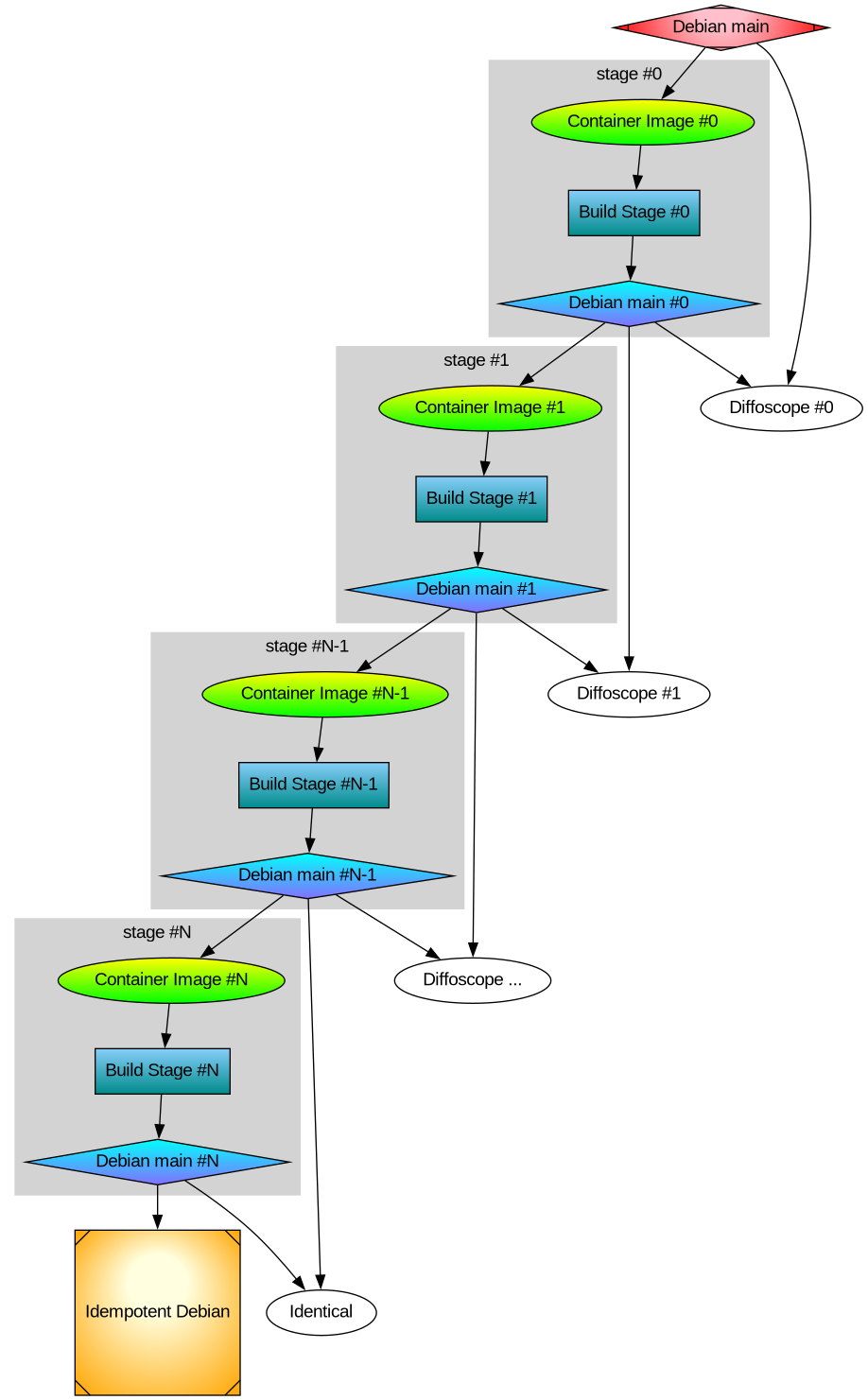
After thinking about multi-stage Debian rebuilds I wanted to implement the idea. Recall my illustration:
Earlier I rebuilt all packages that make up the difference between Ubuntu and Trisquel. It turned out to be a 42% bit-by-bit identical similarity. To check the generality of my approach, I rebuilt the difference between Debian and Devuan too. That was the debdistreproduce project. It only had to orchestrate building up to around 500 packages for each distribution and per architecture. Differential reproducible rebuilds doesn t give you the full picture: it ignore the shared package between the distribution, which make up over 90% of the packages. So I felt a desire to do full archive rebuilds. The motivation is that in order to trust Trisquel binary packages, I need to trust Ubuntu binary packages (because that make up 90% of the Trisquel packages), and many of those Ubuntu binaries are derived from Debian source packages. How to approach all of this? Last year I created the debdistrebuild project, and did top-50 popcon package rebuilds of Debian bullseye, bookworm, trixie, and Ubuntu noble and jammy, on a mix of amd64 and arm64. The amount of reproducibility was lower. Primarily the differences were caused by using different build inputs. Last year I spent (too much) time creating a mirror of snapshot.debian.org, to be able to have older packages available for use as build inputs. I have two copies hosted at different datacentres for reliability and archival safety. At the time, snapshot.d.o had serious rate-limiting making it pretty unusable for massive rebuild usage or even basic downloads. Watching the multi-month download complete last year had a meditating effect. The completion of my snapshot download co-incided with me realizing something about the nature of rebuilding packages. Let me below give a recap of the idempotent rebuilds idea, because it motivate my work to build all of Debian from a GitLab pipeline. One purpose for my effort is to be able to trust the binaries that I use on my laptop. I believe that without building binaries from source code, there is no practically feasible way to trust binaries. To trust any binary you receive, you can de-assemble the bits and audit the assembler instructions for the CPU you will execute it on. Doing that on a OS-wide level this is unpractical. A more practical approach is to audit the source code, and then confirm that the binary is 100% bit-by-bit identical to one that you can build yourself (from the same source) on your own trusted toolchain. This is similar to a reproducible build. My initial goal with debdistrebuild was to get to 100% bit-by-bit identical rebuilds, and then I would have trustworthy binaries. Or so I thought. This also appears to be the goal of reproduce.debian.net. They want to reproduce the official Debian binaries. That is a worthy and important goal. They achieve this by building packages using the build inputs that were used to build the binaries. The build inputs are earlier versions of Debian packages (not necessarily from any public Debian release), archived at snapshot.debian.org. I realized that these rebuilds would be not be sufficient for me: it doesn t solve the problem of how to trust the toolchain. Let s assume the reproduce.debian.net effort succeeds and is able to 100% bit-by-bit identically reproduce the official Debian binaries. Which appears to be within reach. To have trusted binaries we would only have to audit the source code for the latest version of the packages AND audit the tool chain used. There is no escaping from auditing all the source code that s what I think we all would prefer to focus on, to be able to improve upstream source code. The trouble is about auditing the tool chain. With the Reproduce.debian.net approach, that is a recursive problem back to really ancient Debian packages, some of them which may no longer build or work, or even be legally distributable. Auditing all those old packages is a LARGER effort than auditing all current packages! Doing auditing of old packages is of less use to making contributions: those releases are old, and chances are any improvements have already been implemented and released. Or that improvements are no longer applicable because the projects evolved since the earlier version. See where this is going now? I reached the conclusion that reproducing official binaries using the same build inputs is not what I m interested in. I want to be able to build the binaries that I use from source using a toolchain that I can also build from source. And preferably that all of this is using latest version of all packages, so that I can contribute and send patches for them, to improve matters. The toolchain that Reproduce.Debian.Net is using is not trustworthy unless all those ancient packages are audited or rebuilt bit-by-bit identically, and I don t see any practical way forward to achieve that goal. Nor have I seen anyone working on that problem. It is possible to do, though, but I think there are simpler ways to achieve the same goal. My approach to reach trusted binaries on my laptop appears to be a three-step effort: How to go about achieving this? Today s Debian build architecture is something that lack transparency and end-user control. The build environment and signing keys are managed by, or influenced by, unidentified people following undocumented (or at least not public) security procedures, under unknown legal jurisdictions. I always wondered why none of the Debian-derivates have adopted a modern GitDevOps-style approach as a method to improve binary build transparency, maybe I missed some project? If you want to contribute to some GitHub or GitLab project, you click the Fork button and get a CI/CD pipeline running which rebuild artifacts for the project. This makes it easy for people to contribute, and you get good QA control because the entire chain up until its artifact release are produced and tested. At least in theory. Many projects are behind on this, but it seems like this is a useful goal for all projects. This is also liberating: all users are able to reproduce artifacts. There is no longer any magic involved in preparing release artifacts. As we ve seen with many software supply-chain security incidents for the past years, where the magic is involved is a good place to introduce malicious code. To allow me to continue with my experiment, I thought the simplest way forward was to setup a GitDevOps-centric and user-controllable way to build the entire Debian archive. Let me introduce the debdistbuild project. Debdistbuild is a re-usable GitLab CI/CD pipeline, similar to the Salsa CI pipeline. It provide one build job definition and one deploy job definition. The pipeline can run on GitLab.org Shared Runners or you can set up your own runners, like my GitLab riscv64 runner setup. I have concerns about relying on GitLab (both as software and as a service), but my ideas are easy to transfer to some other GitDevSecOps setup such as Codeberg.org. Self-hosting GitLab, including self-hosted runners, is common today, and Debian rely increasingly on Salsa for this. All of the build infrastructure could be hosted on Salsa eventually. The build job is simple. From within an official Debian container image build packages using dpkg-buildpackage essentially by invoking the following commands.
sed -i 's/ deb$/ deb deb-src/' /etc/apt/sources.list.d/*.sources
apt-get -o Acquire::Check-Valid-Until=false update
apt-get dist-upgrade -q -y
apt-get install -q -y --no-install-recommends build-essential fakeroot
env DEBIAN_FRONTEND=noninteractive \
    apt-get build-dep -y --only-source $PACKAGE=$VERSION
useradd -m build
DDB_BUILDDIR=/build/reproducible-path
chgrp build $DDB_BUILDDIR
chmod g+w $DDB_BUILDDIR
su build -c "apt-get source --only-source $PACKAGE=$VERSION" > ../$PACKAGE_$VERSION.build
cd $DDB_BUILDDIR
su build -c "dpkg-buildpackage"
cd ..
mkdir out
mv -v $(find $DDB_BUILDDIR -maxdepth 1 -type f) out/
The deploy job is also simple. It commit artifacts to a Git project using Git-LFS to handle large objects, essentially something like this:
if ! grep -q '^pool/**' .gitattributes; then
    git lfs track 'pool/**'
    git add .gitattributes
    git commit -m"Track pool/* with Git-LFS." .gitattributes
fi
POOLDIR=$(if test "$(echo "$PACKAGE"   cut -c1-3)" = "lib"; then C=4; else C=1; fi; echo "$DDB_PACKAGE"   cut -c1-$C)
mkdir -pv pool/main/$POOLDIR/
rm -rfv pool/main/$POOLDIR/$PACKAGE
mv -v out pool/main/$POOLDIR/$PACKAGE
git add pool
git commit -m"Add $PACKAGE." -m "$CI_JOB_URL" -m "$VERSION" -a
if test "$ DDB_GIT_TOKEN:- " = ""; then
    echo "SKIP: Skipping git push due to missing DDB_GIT_TOKEN (see README)."
else
    git push -o ci.skip
fi
That s it! The actual implementation is a bit longer, but the major difference is for log and error handling. You may review the source code of the base Debdistbuild pipeline definition, the base Debdistbuild script and the rc.d/-style scripts implementing the build.d/ process and the deploy.d/ commands. There was one complication related to artifact size. GitLab.org job artifacts are limited to 1GB. Several packages in Debian produce artifacts larger than this. What to do? GitLab supports up to 5GB for files stored in its package registry, but this limit is too close for my comfort, having seen some multi-GB artifacts already. I made the build job optionally upload artifacts to a S3 bucket using SHA256 hashed file hierarchy. I m using Hetzner Object Storage but there are many S3 providers around, including self-hosting options. This hierarchy is compatible with the Git-LFS .git/lfs/object/ hierarchy, and it is easy to setup a separate Git-LFS object URL to allow Git-LFS object downloads from the S3 bucket. In this mode, only Git-LFS stubs are pushed to the git repository. It should have no trouble handling the large number of files, since I have earlier experience with Apt mirrors in Git-LFS. To speed up job execution, and to guarantee a stable build environment, instead of installing build-essential packages on every build job execution, I prepare some build container images. The project responsible for this is tentatively called stage-N-containers. Right now it create containers suitable for rolling builds of trixie on amd64, arm64, and riscv64, and a container intended for as use the stage-0 based on the 20250407 docker images of bookworm on amd64 and arm64 using the snapshot.d.o 20250407 archive. Or actually, I m using snapshot-cloudflare.d.o because of download speed and reliability. I would have prefered to use my own snapshot mirror with Hetzner bandwidth, alas the Debian snapshot team have concerns about me publishing the list of (SHA1 hash) filenames publicly and I haven t been bothered to set up non-public access. Debdistbuild has built around 2.500 packages for bookworm on amd64 and bookworm on arm64. To confirm the generality of my approach, it also build trixie on amd64, trixie on arm64 and trixie on riscv64. The riscv64 builds are all on my own hosted runners. For amd64 and arm64 my own runners are only used for large packages where the GitLab.com shared runners run into the 3 hour time limit. What s next in this venture? Some ideas include: What do you think?

26 April 2025

John Goerzen: Memoirs of the Early Internet

The Internet is an amazing place, and occasionally you can find things on the web that have somehow lingered online for decades longer than you might expect. Today I ll take you on a tour of some parts of the early Internet. The Internet, of course, is a network of networks and part of its early (and continuing) promise was to provide a common protocol that all sorts of networks can use to interoperate with each other. In the early days, UUCP was one of the main ways universities linked with each other, and eventually UUCP and the Internet sort of merged (but that s a long story). Let s start with some Usenet maps, which were an early way to document the UUCP modem links between universities. Start with this PDF. The first page is a Usenet map (which at the time mostly flowed over UUCP) from April of 1981. Notice that ucbvax, a VAX system at Berkeley, was central to the map. ucbvax continued to be a central node for UUCP for more than a decade; on page 5 of that PDF, you ll see that it asks for a Path from a major node (eg, ucbvax, devcax, harpo, duke) . Pre-Internet email addresses used a path; eg, mark@ucbvax was duke!decvax!ucbvax!mark to someone. You had to specify the route from your system to the recipient on your email To line. If you gave out your email address on a business card, you would start it from a major node like ucbvax, and the assumption was that everyone would know how to get from their system to the major node. On August 19, 1994, ucbvax was finally turned off. TCP/IP had driven UUCP into more obscurity; by then, it was mostly used by people without a dedicated Internet connection to get on the Internet, rather than an entire communication network of its own. A few days later, Cliff Frost posted a memoir of ucbvax; an obscurbe bit of Internet lore that is fun to read. UUCP was ad-hoc, and by 1984 there was an effort to make a machine-parsable map to help automate routing on UUCP. This was called the pathalias project, and there was a paper about it. The Linux network administration guide even includes a section on pathalias. Because UUCP mainly flowed over phone lines, long distance fees made it quite expensive. In 1985, the Stargate Project was formed, with the idea of distributing Usenet by satellite. The satellite link was short-lived, but the effort eventually morphed into UUNET. It was initially a non-profit, but eventually became a commercial backbone provider, and later ISP. Over a long series of acquisitions, UUNET is now part of Verizon. An article in ;login: is another description of this history. IAPS has an Internet in 1990 article, which includes both pathalias data and an interesting map of domain names to UUCP paths. As I was pondering what interesting things a person could do with NNCPNET Internet email, I stumbled across a page on getting FTP files via e-mail. Yes, that used to be a thing! I remember ftpmail@decwrl.dec.com. It turns out that page is from a copy of EFF s (Extended) Guide to the Internet from 1994. Wow, what a treasure! It has entries such as A Slice of Life in my Virtual Community, libraries with telnet access, Gopher, A Statement of Principle by Bruce Sterling, and I could go on. You can also get it as a PDF from Internet Archive. UUCP is still included with modern Linux and BSD distributions. It was part of how I experienced the PC and Internet revolution in rural America. It lacks modern security, but NNCP is to UUCP what ssh is to telnet.

25 April 2025

Simon Josefsson: GitLab Runner with Rootless Privilege-less Capability-less Podman on riscv64

I host my own GitLab CI/CD runners, and find that having coverage on the riscv64 CPU architecture is useful for testing things. The HiFive Premier P550 seems to be a common hardware choice. The P550 is possible to purchase online. You also need a (mini-)ATX chassi, power supply (~500W is more than sufficient), PCI-to-M2 converter and a NVMe storage device. Total cost per machine was around $8k/ 8k for me. Assembly was simple: bolt everything, connect ATX power, connect cables for the front-panel, USB and and Audio. Be sure to toggle the physical power switch on the P550 before you close the box. Front-panel power button will start your machine. There is a P550 user manual available. Below I will guide you to install the GitLab Runner on the pre-installed Ubuntu 24.04 that ships with the P550, and configure it to use Podman in root-less mode and without the --privileged flag, without any additional capabilities like SYS_ADMIN. Presumably you want to migrate to some other OS instead; hey Trisquel 13 riscv64 I m waiting for you! I wouldn t recommend using this machine for anything sensitive, there is an awful lot of non-free and/or vendor-specific software installed, and the hardware itself is young. I am not aware of any riscv64 hardware that can run a libre OS, all of them appear to require non-free blobs and usually a non-mainline kernel.
apt-get install minicom
minicom -o -D /dev/ttyUSB3
#cmd: ifconfig
inet 192.168.0.2 netmask: 255.255.240.0
gatway 192.168.0.1
SOM_Mac0: 8c:00:00:00:00:00
SOM_Mac1: 8c:00:00:00:00:00
MCU_Mac: 8c:00:00:00:00:00
#cmd: setmac 0 CA:FE:42:17:23:00
The MAC setting will be valid after rebooting the carrier board!!!
MAC[0] addr set to CA:FE:42:17:23:00(ca:fe:42:17:23:0)
#cmd: setmac 1 CA:FE:42:17:23:01
The MAC setting will be valid after rebooting the carrier board!!!
MAC[1] addr set to CA:FE:42:17:23:01(ca:fe:42:17:23:1)
#cmd: setmac 2 CA:FE:42:17:23:02
The MAC setting will be valid after rebooting the carrier board!!!
MAC[2] addr set to CA:FE:42:17:23:02(ca:fe:42:17:23:2)
#cmd:
apt-get install openocd
wget https://raw.githubusercontent.com/sifiveinc/hifive-premier-p550-tools/refs/heads/master/mcu-firmware/stm32_openocd.cfg
echo 'acc115d283ff8533d6ae5226565478d0128923c8a479a768d806487378c5f6c3 stm32_openocd.cfg' sha256sum -c
openocd -f stm32_openocd.cfg &
telnet localhost 4444
...
echo 'ssh-ed25519 AAA...' > ~/.ssh/authorized_keys
sed -i 's;^#PasswordAuthentication.*;PasswordAuthentication no;' /etc/ssh/sshd_config
service ssh restart
parted /dev/nvme0n1 print
blkdiscard /dev/nvme0n1
parted /dev/nvme0n1 mklabel gpt
parted /dev/nvme0n1 mkpart jas-p550-nvm-02 ext2 1MiB 100% align-check optimal 1
parted /dev/nvme0n1 set 1 lvm on
partprobe /dev/nvme0n1
pvcreate /dev/nvme0n1p1
vgcreate vg0 /dev/nvme0n1p1
lvcreate -L 400G -n glr vg0
mkfs.ext4 -L glr /dev/mapper/vg0-glr
Now with a reasonable setup ready, let s install the GitLab Runner. The following is adapted from gitlab-runner s official installation instructions documentation. The normal installation flow doesn t work because they don t publish riscv64 apt repositories, so you will have to perform upgrades manually.
# wget https://s3.dualstack.us-east-1.amazonaws.com/gitlab-runner-downloads/latest/deb/gitlab-runner_riscv64.deb
# wget https://s3.dualstack.us-east-1.amazonaws.com/gitlab-runner-downloads/latest/deb/gitlab-runner-helper-images.deb
wget https://gitlab-runner-downloads.s3.amazonaws.com/v17.11.0/deb/gitlab-runner_riscv64.deb
wget https://gitlab-runner-downloads.s3.amazonaws.com/v17.11.0/deb/gitlab-runner-helper-images.deb
echo '68a4c2a4b5988a5a5bae019c8b82b6e340376c1b2190228df657164c534bc3c3 gitlab-runner-helper-images.deb' sha256sum -c
echo 'ee37dc76d3c5b52e4ba35cf8703813f54f536f75cfc208387f5aa1686add7a8c gitlab-runner_riscv64.deb' sha256sum -c
dpkg -i gitlab-runner-helper-images.deb gitlab-runner_riscv64.deb
Remember the NVMe device? Let s not forget to use it, to avoid wear and tear of the internal MMC root disk. Do this now before any files in /home/gitlab-runner appears, or you have to move them manually.
gitlab-runner stop
echo 'LABEL=glr /home/gitlab-runner ext4 defaults,noatime 0 1' >> /etc/fstab
systemctl daemon-reload
mount /home/gitlab-runner
Next install gitlab-runner and configure it. Replace token glrt-REPLACEME below with the registration token you get from your GitLab project s Settings -> CI/CD -> Runners -> New project runner. I used the tags riscv64 and a runner description of the hostname.
gitlab-runner register --non-interactive --url https://gitlab.com --token glrt-REPLACEME --name $(hostname) --executor docker --docker-image debian:stable
We install and configure gitlab-runner to use podman, and to use non-root user.
apt-get install podman
gitlab-runner stop
usermod --add-subuids 100000-165535 --add-subgids 100000-165535 gitlab-runner
You need to run some commands as the gitlab-runner user, but unfortunately some interaction between sudo/su and pam_systemd makes this harder than it should be. So you have to setup SSH for the user and login via SSH to run the commands. Does anyone know of a better way to do this?
# on the p550:
cp -a /root/.ssh/ /home/gitlab-runner/
chown -R gitlab-runner:gitlab-runner /home/gitlab-runner/.ssh/
# on your laptop:
ssh gitlab-runner@jas-p550-01
systemctl --user --now enable podman.socket
systemctl --user --now start podman.socket
loginctl enable-linger gitlab-runner gitlab-runner
systemctl status --user podman.socket
We modify /etc/gitlab-runner/config.toml as follows, replace 997 with the user id shown by systemctl status above. See feature flags documentation for more documentation.
...
[[runners]]
environment = ["FF_NETWORK_PER_BUILD=1", "FF_USE_FASTZIP=1"]
...
[runners.docker]
host = "unix:///run/user/997/podman/podman.sock"
Note that unlike the documentation I do not add the privileged = true parameter here. I will come back to this later. Restart the system to confirm that pushing a .gitlab-ci.yml with a job that uses the riscv64 tag like the following works properly.
dump-env-details-riscv64:
stage: build
image: riscv64/debian:testing
tags: [ riscv64 ]
script:
- set
Your gitlab-runner should now be receiving jobs and running them in rootless podman. You may view the log using journalctl as follows:
journalctl --follow _SYSTEMD_UNIT=gitlab-runner.service
To stop the graphical environment and disable some unnecessary services, you can use:
systemctl set-default multi-user.target
systemctl disable openvpn cups cups-browsed sssd colord
At this point, things were working fine and I was running many successful builds. Now starts the fun part with operational aspects! I had a problem when running buildah to build a new container from within a job, and noticed that aardvark-dns was crashing. You can use the Debian aardvark-dns binary instead.
wget http://ftp.de.debian.org/debian/pool/main/a/aardvark-dns/aardvark-dns_1.14.0-3_riscv64.deb
echo 'df33117b6069ac84d3e97dba2c59ba53775207dbaa1b123c3f87b3f312d2f87a aardvark-dns_1.14.0-3_riscv64.deb' sha256sum -c
mkdir t
cd t
dpkg -x ../aardvark-dns_1.14.0-3_riscv64.deb .
mv /usr/lib/podman/aardvark-dns /usr/lib/podman/aardvark-dns.ubuntu
mv usr/lib/podman/aardvark-dns /usr/lib/podman/aardvark-dns.debian
My setup uses podman in rootless mode without passing the privileged parameter or any add-cap parameters to add non-default capabilities. This is sufficient for most builds. However if you try to create container using buildah from within a job, you may see errors like this:
Writing manifest to image destination
Error: mounting new container: mounting build container "8bf1ec03d967eae87095906d8544f51309363ddf28c60462d16d73a0a7279ce1": creating overlay mount to /var/lib/containers/storage/overlay/23785e20a8bac468dbf028bf524274c91fbd70dae195a6cdb10241c345346e6f/merged, mount_data="lowerdir=/var/lib/containers/storage/overlay/l/I3TWYVYTRZ4KVYCT6FJKHR3WHW,upperdir=/var/lib/containers/storage/overlay/23785e20a8bac468dbf028bf524274c91fbd70dae195a6cdb10241c345346e6f/diff,workdir=/var/lib/containers/storage/overlay/23785e20a8bac468dbf028bf524274c91fbd70dae195a6cdb10241c345346e6f/work,volatile": using mount program /usr/bin/fuse-overlayfs: unknown argument ignored: lazytime
fuse: device not found, try 'modprobe fuse' first
fuse-overlayfs: cannot mount: No such file or directory
: exit status 1
According to GitLab runner security considerations, you should not enable the privileged = true parameter, and the alternative appears to run Podman as root with privileged=false. Indeed setting privileged=true as in the following example solves the problem, and I suppose running podman as root would too.
[[runners]]
[runners.docker]
privileged = true
Can we do better? After some experimentation, and reading open issues with suggested capabilities and configuration snippets, I ended up with the following configuration. It runs podman in rootless mode (as the gitlab-runner user) without --privileged, but add the CAP_SYS_ADMIN capability and exposes the /dev/fuse device. Still, this is running as non-root user on the machine, so I think it is an improvement compared to using --privileged and also compared to running podman as root.
[[runners]]
[runners.docker]
privileged = false
cap_add = ["SYS_ADMIN"]
devices = ["/dev/fuse"]
Still I worry about the security properties of such a setup, so I only enable these settings for a separately configured runner instance that I use when I need this docker-in-docker (oh, I meant buildah-in-podman) functionality. I found one article discussing Rootless Podman without the privileged flag that suggest isolation=chroot but I have yet to make this work. Suggestions for improvement are welcome. Happy Riscv64 Building! Update 2025-05-05: I was able to make it work without the SYS_ADMIN capability too, with a GitLab /etc/gitlab-runner/config.toml like the following:
[[runners]]
  [runners.docker]
    privileged = false
    devices = ["/dev/fuse"]
And passing --isolation chroot to Buildah like this:
buildah build --isolation chroot -t $CI_REGISTRY_IMAGE:name image/
I ve updated the blog title to add the word capability-less as well. I ve confirmed that the same recipe works on podman on a ppc64el platform too. Remaining loop-holes are escaping from the chroot into the non-root gitlab-runner user, and escalating that privilege to root. The /dev/fuse and sub-uid/gid may be privilege escalation vectors here, otherwise I believe you ve found a serious software security issue rather than a configuration mistake.

24 April 2025

Jonathan McDowell: Local Voice Assistant Step 1: An ATOM Echo voice satellite

Back when I setup my home automation I ended up with one piece that used an external service: Amazon Alexa. I d rather not have done this, but voice control is extremely convenient, both for us, and guests. Since then Home Assistant has done a lot of work in developing the capability of a local voice assistant - 2023 was their Year of Voice. I ve had brief looks at this in the past, but never quite had the time to dig into setting it up, and was put off by the fact a lot of the setup instructions were just Download our prebuilt components . While I admire the efforts to get Home Assistant fully packaged for Debian I accept that s a tricky proposition, and settle for running it in a venv on a Debian stable container. Voice requires a lot more binary components, and I want to have voice satellites in more than one location, so I set about trying to understand a bit better what I was deploying, and actually building the binary bits myself. This is the start of a write-up of that. I ll break it into a bunch of posts, trying to cover one bit in each, because otherwise this will get massive. Let s start with some requirements: My house server is an AMD Ryzen 7 5700G, so my expectation was that I d have enough local processing power to be able to do this. That turned out to be a valid assumption - speech to text really has come a long way in recent years. I m still running Home Assistant 2024.3.3 - the last one that supports (but complains about) Python 3.11. Trixie has started the freeze process, so once it releases I ll look at updating the HA install. For now what I have has turned out to be Good Enough, but I know there have been improvements upstream I m missing. Finally, before I get into the details, I should point out that if you just want to get started with a voice assistant on Home Assistant and don t care about what s under the hood, there are a bunch of more user friendly details on Home Assistant s site itself, and they have pre-built images you can just deploy. My first step was sorting out a voice satellite . This is the device that actually has a microphone and speaker and communicates with the main Home Assistant setup. I d seen the post about a $13 voice assistant, and as a result had an ATOM Echo sitting on my desk I hadn t got around to setting up. Here, we ignore a bit about delving into exactly what s going on under the hood, even if we re compiling locally. This is a constrained embedded device and while I m familiar with the ESP32 IDF build system I just accepted that using ESPHome and letting it do it s thing was the quickest way to get up and running. It is possible to do this all via the web with a pre-built image, but I wanted to change the wake word to Hey Jarvis rather than the default Okay Nabu , and that was a good reason to bother doing a local build. We ll get into actually building a voice satellite on Debian in later posts. I started with the default upstream assistant config and tweaked it a little for my setup:
diff of my configuration tweaks
$ diff -u m5stack-atom-echo.yaml assistant.yaml
--- m5stack-atom-echo.yaml    2025-04-18 13:41:21.812766112 +0100
+++ assistant.yaml  2025-01-20 17:33:24.918585244 +0000
@@ -1,7 +1,7 @@
 substitutions:
-  name: m5stack-atom-echo
+  name: study-atom-echo
   friendly_name: M5Stack Atom Echo
-  micro_wake_word_model: okay_nabu  # alexa, hey_jarvis, hey_mycroft are also supported
+  micro_wake_word_model: hey_jarvis  # alexa, hey_jarvis, hey_mycroft are also supported
 
 esphome:
   name: $ name 
@@ -16,15 +16,26 @@
     version: 4.4.8
     platform_version: 5.4.0
 
+# Enable logging
 logger:
+
+# Enable Home Assistant API
 api:
+  encryption:
+    key: "TGlrZVRoaXNJc1JlYWxseUl0Rm9vbGlzaFBlb3BsZSE="
 
 ota:
   - platform: esphome
-    id: ota_esphome
+    password: "itsnotarealthing"
 
 wifi:
+  ssid: "My Wifi Goes Here"
+  password: "AndThePasswordGoesHere"
+
+  # Enable fallback hotspot (captive portal) in case wifi connection fails
   ap:
+    ssid: "Study-Atom-Echo Fallback Hotspot"
+    password: "ThisIsRandom"
 
 captive_portal:

(I note that the current upstream config has moved on a bit since I first did this, but I double checked the above instructions still work at the time of writing. I end up pinning ESPHome to the right version below due to that.) It turns out to be fairly easy to setup ESPHome in a venv and get it to build + flash the image for you:
Instructions for building + flashing ESPHome to ATOM Echo
noodles@sevai:~$ python3 -m venv esphome-atom-echo
noodles@sevai:~$ . esphome-atom-echo/bin/activate
(esphome-atom-echo) noodles@sevai:~$ cd esphome-atom-echo/
(esphome-atom-echo) noodles@sevai:~/esphome-atom-echo$  pip install esphome==2024.12.4
Collecting esphome==2024.12.4
  Using cached esphome-2024.12.4-py3-none-any.whl (4.1 MB)
 
Successfully installed FontTools-4.57.0 PyYAML-6.0.2 appdirs-1.4.4 attrs-25.3.0 bottle-0.13.2 defcon-0.12.1 esphome-2024.12.4 esphome-dashboard-20241217.1 freetype-py-2.5.1 fs-2.4.16 gflanguages-0.7.3 glyphsLib-6.10.1 glyphsets-1.0.0 openstep-plist-0.5.0 pillow-10.4.0 platformio-6.1.16 protobuf-3.20.3 puremagic-1.27 ufoLib2-0.17.1 unicodedata2-16.0.0
(esphome-atom-echo) noodles@sevai:~/esphome-atom-echo$ esphome compile assistant.yaml 
INFO ESPHome 2024.12.4
INFO Reading configuration assistant.yaml...
INFO Updating https://github.com/esphome/esphome.git@pull/5230/head
INFO Updating https://github.com/jesserockz/esphome-components.git@None
 
Linking .pioenvs/study-atom-echo/firmware.elf
/home/noodles/.platformio/packages/toolchain-xtensa-esp32@8.4.0+2021r2-patch5/bin/../lib/gcc/xtensa-esp32-elf/8.4.0/../../../../xtensa-esp32-elf/bin/ld: missing --end-group; added as last command line option
RAM:   [=         ]  10.6% (used 34632 bytes from 327680 bytes)
Flash: [========  ]  79.8% (used 1463813 bytes from 1835008 bytes)
Building .pioenvs/study-atom-echo/firmware.bin
Creating esp32 image...
Successfully created esp32 image.
esp32_create_combined_bin([".pioenvs/study-atom-echo/firmware.bin"], [".pioenvs/study-atom-echo/firmware.elf"])
Wrote 0x176fb0 bytes to file /home/noodles/esphome-atom-echo/.esphome/build/study-atom-echo/.pioenvs/study-atom-echo/firmware.factory.bin, ready to flash to offset 0x0
esp32_copy_ota_bin([".pioenvs/study-atom-echo/firmware.bin"], [".pioenvs/study-atom-echo/firmware.elf"])
==================================================================================== [SUCCESS] Took 130.57 seconds ====================================================================================
INFO Successfully compiled program.
(esphome-atom-echo) noodles@sevai:~/esphome-atom-echo$ esphome upload --device /dev/serial/by-id/usb-Hades2001_M5stack_9552AF8367-if00-port0 assistant.yaml 
INFO ESPHome 2024.12.4
INFO Reading configuration assistant.yaml...
INFO Updating https://github.com/esphome/esphome.git@pull/5230/head
INFO Updating https://github.com/jesserockz/esphome-components.git@None
 
INFO Upload with baud rate 460800 failed. Trying again with baud rate 115200.
esptool.py v4.7.0
Serial port /dev/serial/by-id/usb-Hades2001_M5stack_9552AF8367-if00-port0
Connecting....
Chip is ESP32-PICO-D4 (revision v1.1)
Features: WiFi, BT, Dual Core, 240MHz, Embedded Flash, VRef calibration in efuse, Coding Scheme None
Crystal is 40MHz
MAC: 64:b7:08:8a:1b:c0
Uploading stub...
Running stub...
Stub running...
Configuring flash size...
Auto-detected Flash size: 4MB
Flash will be erased from 0x00010000 to 0x00176fff...
Flash will be erased from 0x00001000 to 0x00007fff...
Flash will be erased from 0x00008000 to 0x00008fff...
Flash will be erased from 0x00009000 to 0x0000afff...
Compressed 1470384 bytes to 914252...
Wrote 1470384 bytes (914252 compressed) at 0x00010000 in 82.0 seconds (effective 143.5 kbit/s)...
Hash of data verified.
Compressed 25632 bytes to 16088...
Wrote 25632 bytes (16088 compressed) at 0x00001000 in 1.8 seconds (effective 113.1 kbit/s)...
Hash of data verified.
Compressed 3072 bytes to 134...
Wrote 3072 bytes (134 compressed) at 0x00008000 in 0.1 seconds (effective 383.7 kbit/s)...
Hash of data verified.
Compressed 8192 bytes to 31...
Wrote 8192 bytes (31 compressed) at 0x00009000 in 0.1 seconds (effective 813.5 kbit/s)...
Hash of data verified.
Leaving...
Hard resetting via RTS pin...
INFO Successfully uploaded program.

And then you can watch it boot (this is mine already configured up in Home Assistant):
Watching the ATOM Echo boot
$ picocom --quiet --imap lfcrlf --baud 115200 /dev/serial/by-id/usb-Hades2001_M5stack_9552AF8367-if00-port0
I (29) boot: ESP-IDF 4.4.8 2nd stage bootloader
I (29) boot: compile time 17:31:08
I (29) boot: Multicore bootloader
I (32) boot: chip revision: v1.1
I (36) boot.esp32: SPI Speed      : 40MHz
I (40) boot.esp32: SPI Mode       : DIO
I (45) boot.esp32: SPI Flash Size : 4MB
I (49) boot: Enabling RNG early entropy source...
I (55) boot: Partition Table:
I (58) boot: ## Label            Usage          Type ST Offset   Length
I (66) boot:  0 otadata          OTA data         01 00 00009000 00002000
I (73) boot:  1 phy_init         RF data          01 01 0000b000 00001000
I (81) boot:  2 app0             OTA app          00 10 00010000 001c0000
I (88) boot:  3 app1             OTA app          00 11 001d0000 001c0000
I (96) boot:  4 nvs              WiFi data        01 02 00390000 0006d000
I (103) boot: End of partition table
I (107) esp_image: segment 0: paddr=00010020 vaddr=3f400020 size=58974h (362868) map
I (247) esp_image: segment 1: paddr=0006899c vaddr=3ffb0000 size=03400h ( 13312) load
I (253) esp_image: segment 2: paddr=0006bda4 vaddr=40080000 size=04274h ( 17012) load
I (260) esp_image: segment 3: paddr=00070020 vaddr=400d0020 size=f5cb8h (1006776) map
I (626) esp_image: segment 4: paddr=00165ce0 vaddr=40084274 size=112ach ( 70316) load
I (665) boot: Loaded app from partition at offset 0x10000
I (665) boot: Disabling RNG early entropy source...
I (677) cpu_start: Multicore app
I (677) cpu_start: Pro cpu up.
I (677) cpu_start: Starting app cpu, entry point is 0x400825c8
I (0) cpu_start: App cpu up.
I (695) cpu_start: Pro cpu start user code
I (695) cpu_start: cpu freq: 160000000
I (695) cpu_start: Application information:
I (700) cpu_start: Project name:     study-atom-echo
I (705) cpu_start: App version:      2024.12.4
I (710) cpu_start: Compile time:     Apr 18 2025 17:29:39
I (716) cpu_start: ELF file SHA256:  1db4989a56c6c930...
I (722) cpu_start: ESP-IDF:          4.4.8
I (727) cpu_start: Min chip rev:     v0.0
I (732) cpu_start: Max chip rev:     v3.99 
I (737) cpu_start: Chip rev:         v1.1
I (742) heap_init: Initializing. RAM available for dynamic allocation:
I (749) heap_init: At 3FFAE6E0 len 00001920 (6 KiB): DRAM
I (755) heap_init: At 3FFB8748 len 000278B8 (158 KiB): DRAM
I (761) heap_init: At 3FFE0440 len 00003AE0 (14 KiB): D/IRAM
I (767) heap_init: At 3FFE4350 len 0001BCB0 (111 KiB): D/IRAM
I (774) heap_init: At 40095520 len 0000AAE0 (42 KiB): IRAM
I (781) spi_flash: detected chip: gd
I (784) spi_flash: flash io: dio
I (790) cpu_start: Starting scheduler on PRO CPU.
I (0) cpu_start: Starting scheduler on APP CPU.
[I][logger:171]: Log initialized
[C][safe_mode:079]: There have been 0 suspected unsuccessful boot attempts
[D][esp32.preferences:114]: Saving 1 preferences to flash...
[D][esp32.preferences:143]: Saving 1 preferences to flash: 0 cached, 1 written, 0 failed
[I][app:029]: Running through setup()...
[C][esp32_rmt_led_strip:021]: Setting up ESP32 LED Strip...
[D][template.select:014]: Setting up Template Select
[D][template.select:023]: State from initial (could not load stored index): On device
[D][select:015]: 'Wake word engine location': Sending state On device (index 1)
[D][esp-idf:000]: I (100) gpio: GPIO[39]  InputEn: 1  OutputEn: 0  OpenDrain: 0  Pullup: 0  Pulldown: 0  Intr:0 
[D][binary_sensor:034]: 'Button': Sending initial state OFF
[C][light:021]: Setting up light 'M5Stack Atom Echo 8a1bc0'...
[D][light:036]: 'M5Stack Atom Echo 8a1bc0' Setting:
[D][light:041]:   Color mode: RGB
[D][template.switch:046]:   Restored state ON
[D][switch:012]: 'Use listen light' Turning ON.
[D][switch:055]: 'Use listen light': Sending state ON
[D][light:036]: 'M5Stack Atom Echo 8a1bc0' Setting:
[D][light:047]:   State: ON
[D][light:051]:   Brightness: 60%
[D][light:059]:   Red: 100%, Green: 89%, Blue: 71%
[D][template.switch:046]:   Restored state OFF
[D][switch:016]: 'timer_ringing' Turning OFF.
[D][switch:055]: 'timer_ringing': Sending state OFF
[C][i2s_audio:028]: Setting up I2S Audio...
[C][i2s_audio.microphone:018]: Setting up I2S Audio Microphone...
[C][i2s_audio.speaker:096]: Setting up I2S Audio Speaker...
[C][wifi:048]: Setting up WiFi...
[D][esp-idf:000]: I (206) wifi:
[D][esp-idf:000]: wifi driver task: 3ffc8544, prio:23, stack:6656, core=0
[D][esp-idf:000]: 
[D][esp-idf:000][wifi]: I (1238) system_api: Base MAC address is not set
[D][esp-idf:000][wifi]: I (1239) system_api: read default base MAC address from EFUSE
[D][esp-idf:000][wifi]: I (1274) wifi:
[D][esp-idf:000][wifi]: wifi firmware version: ff661c3
[D][esp-idf:000][wifi]: 
[D][esp-idf:000][wifi]: I (1274) wifi:
[D][esp-idf:000][wifi]: wifi certification version: v7.0
[D][esp-idf:000][wifi]: 
[D][esp-idf:000][wifi]: I (1286) wifi:
[D][esp-idf:000][wifi]: config NVS flash: enabled
[D][esp-idf:000][wifi]: 
[D][esp-idf:000][wifi]: I (1297) wifi:
[D][esp-idf:000][wifi]: config nano formating: disabled
[D][esp-idf:000][wifi]: 
[D][esp-idf:000][wifi]: I (1317) wifi:
[D][esp-idf:000][wifi]: Init data frame dynamic rx buffer num: 32
[D][esp-idf:000][wifi]: 
[D][esp-idf:000][wifi]: I (1338) wifi:
[D][esp-idf:000][wifi]: Init static rx mgmt buffer num: 5
[D][esp-idf:000][wifi]: 
[D][esp-idf:000][wifi]: I (1348) wifi:
[D][esp-idf:000][wifi]: Init management short buffer num: 32
[D][esp-idf:000][wifi]: 
[D][esp-idf:000][wifi]: I (1368) wifi:
[D][esp-idf:000][wifi]: Init dynamic tx buffer num: 32
[D][esp-idf:000][wifi]: 
[D][esp-idf:000][wifi]: I (1389) wifi:
[D][esp-idf:000][wifi]: Init static rx buffer size: 1600
[D][esp-idf:000][wifi]: 
[D][esp-idf:000][wifi]: I (1399) wifi:
[D][esp-idf:000][wifi]: Init static rx buffer num: 10
[D][esp-idf:000][wifi]: 
[D][esp-idf:000][wifi]: I (1419) wifi:
[D][esp-idf:000][wifi]: Init dynamic rx buffer num: 32
[D][esp-idf:000][wifi]: 
[D][esp-idf:000]: I (1441) wifi_init: rx ba win: 6
[D][esp-idf:000]: I (1441) wifi_init: tcpip mbox: 32
[D][esp-idf:000]: I (1450) wifi_init: udp mbox: 6
[D][esp-idf:000]: I (1450) wifi_init: tcp mbox: 6
[D][esp-idf:000]: I (1460) wifi_init: tcp tx win: 5760
[D][esp-idf:000]: I (1471) wifi_init: tcp rx win: 5760
[D][esp-idf:000]: I (1481) wifi_init: tcp mss: 1440
[D][esp-idf:000]: I (1481) wifi_init: WiFi IRAM OP enabled
[D][esp-idf:000]: I (1491) wifi_init: WiFi RX IRAM OP enabled
[C][wifi:061]: Starting WiFi...
[C][wifi:062]:   Local MAC: 64:B7:08:8A:1B:C0
[D][esp-idf:000][wifi]: I (1513) phy_init: phy_version 4791,2c4672b,Dec 20 2023,16:06:06
[D][esp-idf:000][wifi]: I (1599) wifi:
[D][esp-idf:000][wifi]: mode : sta (64:b7:08:8a:1b:c0)
[D][esp-idf:000][wifi]: 
[D][esp-idf:000][wifi]: I (1600) wifi:
[D][esp-idf:000][wifi]: enable tsf
[D][esp-idf:000][wifi]: 
[D][esp-idf:000][wifi]: I (1605) wifi:
[D][esp-idf:000][wifi]: Set ps type: 1
[D][esp-idf:000][wifi]: 
[D][wifi:482]: Starting scan...
[D][esp32.preferences:114]: Saving 1 preferences to flash...
[D][esp32.preferences:143]: Saving 1 preferences to flash: 1 cached, 0 written, 0 failed
[W][micro_wake_word:151]: Wake word detection can't start as the component hasn't been setup yet
[D][esp-idf:000][wifi]: I (1646) wifi:
[D][esp-idf:000][wifi]: Set ps type: 1
[D][esp-idf:000][wifi]: 
[W][component:157]: Component wifi set Warning flag: scanning for networks
 
[I][wifi:617]: WiFi Connected!
 
[D][wifi:626]: Disabling AP...
[C][api:026]: Setting up Home Assistant API server...
[C][micro_wake_word:062]: Setting up microWakeWord...
[C][micro_wake_word:069]: Micro Wake Word initialized
[I][app:062]: setup() finished successfully!
[W][component:170]: Component wifi cleared Warning flag
[W][component:157]: Component api set Warning flag: unspecified
[I][app:100]: ESPHome version 2024.12.4 compiled on Apr 18 2025, 17:29:39
 
[C][logger:185]: Logger:
[C][logger:186]:   Level: DEBUG
[C][logger:188]:   Log Baud Rate: 115200
[C][logger:189]:   Hardware UART: UART0
[C][esp32_rmt_led_strip:187]: ESP32 RMT LED Strip:
[C][esp32_rmt_led_strip:188]:   Pin: 27
[C][esp32_rmt_led_strip:189]:   Channel: 0
[C][esp32_rmt_led_strip:214]:   RGB Order: GRB
[C][esp32_rmt_led_strip:215]:   Max refresh rate: 0
[C][esp32_rmt_led_strip:216]:   Number of LEDs: 1
[C][template.select:065]: Template Select 'Wake word engine location'
[C][template.select:066]:   Update Interval: 60.0s
[C][template.select:069]:   Optimistic: YES
[C][template.select:070]:   Initial Option: On device
[C][template.select:071]:   Restore Value: YES
[C][gpio.binary_sensor:015]: GPIO Binary Sensor 'Button'
[C][gpio.binary_sensor:016]:   Pin: GPIO39
[C][light:092]: Light 'M5Stack Atom Echo 8a1bc0'
[C][light:094]:   Default Transition Length: 0.0s
[C][light:095]:   Gamma Correct: 2.80
[C][template.switch:068]: Template Switch 'Use listen light'
[C][template.switch:091]:   Restore Mode: restore defaults to ON
[C][template.switch:057]:   Optimistic: YES
[C][template.switch:068]: Template Switch 'timer_ringing'
[C][template.switch:091]:   Restore Mode: always OFF
[C][template.switch:057]:   Optimistic: YES
[C][factory_reset.button:011]: Factory Reset Button 'Factory reset'
[C][factory_reset.button:011]:   Icon: 'mdi:restart-alert'
[C][captive_portal:089]: Captive Portal:
[C][mdns:116]: mDNS:
[C][mdns:117]:   Hostname: study-atom-echo-8a1bc0
[C][esphome.ota:073]: Over-The-Air updates:
[C][esphome.ota:074]:   Address: study-atom-echo.local:3232
[C][esphome.ota:075]:   Version: 2
[C][esphome.ota:078]:   Password configured
[C][safe_mode:018]: Safe Mode:
[C][safe_mode:020]:   Boot considered successful after 60 seconds
[C][safe_mode:021]:   Invoke after 10 boot attempts
[C][safe_mode:023]:   Remain in safe mode for 300 seconds
[C][api:140]: API Server:
[C][api:141]:   Address: study-atom-echo.local:6053
[C][api:143]:   Using noise encryption: YES
[C][micro_wake_word:051]: microWakeWord:
[C][micro_wake_word:052]:   models:
[C][micro_wake_word:015]:     - Wake Word: Hey Jarvis
[C][micro_wake_word:016]:       Probability cutoff: 0.970
[C][micro_wake_word:017]:       Sliding window size: 5
[C][micro_wake_word:021]:     - VAD Model
[C][micro_wake_word:022]:       Probability cutoff: 0.500
[C][micro_wake_word:023]:       Sliding window size: 5
[D][api:103]: Accepted 192.168.39.6
[W][component:170]: Component api cleared Warning flag
[W][component:237]: Component api took a long time for an operation (58 ms).
[W][component:238]: Components should block for at most 30 ms.
[D][api.connection:1446]: Home Assistant 2024.3.3 (192.168.39.6): Connected successfully
[D][ring_buffer:034]: Created ring buffer with size 2048
[D][micro_wake_word:399]: Resetting buffers and probabilities
[D][micro_wake_word:195]: State changed from IDLE to START_MICROPHONE
[D][micro_wake_word:107]: Starting Microphone
[D][micro_wake_word:195]: State changed from START_MICROPHONE to STARTING_MICROPHONE
[D][esp-idf:000]: I (11279) I2S: DMA Malloc info, datalen=blocksize=1024, dma_buf_count=4
[D][micro_wake_word:195]: State changed from STARTING_MICROPHONE to DETECTING_WAKE_WORD

That s enough to get a voice satellite that can be configured up in Home Assistant; you ll need the ESPHome Integration added, then for the noise_psk key you use the same string as I have under api/encryption/key in my diff above (obviously do your own, I used dd if=/dev/urandom bs=32 count=1 base64 to generate mine). If you re like me and a compulsive VLANer and firewaller even within your own network then you need to allow Home Assistant to connect on TCP port 6053 to the ATOM Echo, and also allow access to/from UDP port 6055 on the Echo (it ll send audio from that port to Home Assistant, then receive back audio to the same port). At this point you can now shout Hey Jarvis, what time is it? at the Echo, and the white light will turn flashing blue (indicating it s heard the wake word). Which means we re ready to teach Home Assistant how to do something with the incoming audio.

23 April 2025

Michael Prokop: Lessons learned from running an open source project for 20 years @ GLT25

Time flies by so quickly, it s >20 years since I started the Grml project. I m giving a (german) talk about the lessons learned from 20 years of running the Grml project this Saturday, 2025-04-26 at the Grazer Linuxtage (Graz/Austria). Would be great to see you there!
22 April 2025

Melissa Wen: 2025 FOSDEM: Don't let your motivation go, save time with kworkflow

2025 was my first year at FOSDEM, and I can say it was an incredible experience where I met many colleagues from Igalia who live around the world, and also many friends from the Linux display stack who are part of my daily work and contributions to DRM/KMS. In addition, I met new faces and recognized others with whom I had interacted on some online forums and we had good and long conversations. During FOSDEM 2025 I had the opportunity to present about kworkflow in the kernel devroom. Kworkflow is a set of tools that help kernel developers with their routine tasks and it is the tool I use for my development tasks. In short, every contribution I make to the Linux kernel is assisted by kworkflow. The goal of my presentation was to spread the word about kworkflow. I aimed to show how the suite consolidates good practices and recommendations of the kernel workflow in short commands. These commands are easily configurable and memorized for your current work setup, or for your multiple setups. For me, Kworkflow is a tool that accommodates the needs of different agents in the Linux kernel community. Active developers and maintainers are the main target audience for kworkflow, but it is also inviting for users and user-space developers who just want to report a problem and validate a solution without needing to know every detail of the kernel development workflow. Something I didn t emphasize during the presentation but would like to correct this flaw here is that the main author and developer of kworkflow is my colleague at Igalia, Rodrigo Siqueira. Being honest, my contributions are mostly on requesting and validating new features, fixing bugs, and sharing scripts to increase feature coverage. So, the video and slide deck of my FOSDEM presentation are available for download here. And, as usual, you will find in this blog post the script of this presentation and more detailed explanation of the demo presented there.

Kworkflow at FOSDEM 2025: Speaker Notes and Demo Hi, I m Melissa, a GPU kernel driver developer at Igalia and today I ll be giving a very inclusive talk to not let your motivation go by saving time with kworkflow. So, you re a kernel developer, or you want to be a kernel developer, or you don t want to be a kernel developer. But you re all united by a single need: you need to validate a custom kernel with just one change, and you need to verify that it fixes or improves something in the kernel. And that s a given change for a given distribution, or for a given device, or for a given subsystem Look to this diagram and try to figure out the number of subsystems and related work trees you can handle in the kernel. So, whether you are a kernel developer or not, at some point you may come across this type of situation: There is a userspace developer who wants to report a kernel issue and says:

  • Oh, there is a problem in your driver that can only be reproduced by running this specific distribution. And the kernel developer asks:
  • Oh, have you checked if this issue is still present in the latest kernel version of this branch?
But the userspace developer has never compiled and installed a custom kernel before. So they have to read a lot of tutorials and kernel documentation to create a kernel compilation and deployment script. Finally, the reporter managed to compile and deploy a custom kernel and reports:
  • Sorry for the delay, this is the first time I have installed a custom kernel. I am not sure if I did it right, but the issue is still present in the kernel of the branch you pointed out.
And then, the kernel developer needs to reproduce this issue on their side, but they have never worked with this distribution, so they just created a new script, but the same script created by the reporter. What s the problem of this situation? The problem is that you keep creating new scripts! Every time you change distribution, change architecture, change hardware, change project - even in the same company - the development setup may change when you switch to a different project, you create another script for your new kernel development workflow! You know, you have a lot of babies, you have a collection of my precious scripts , like Sm agol (Lord of the Rings) with the precious ring. Instead of creating and accumulating scripts, save yourself time with kworkflow. Here is a typical script that many of you may have. This is a Raspberry Pi 4 script and contains everything you need to memorize to compile and deploy a kernel on your Raspberry Pi 4. With kworkflow, you only need to memorize two commands, and those commands are not specific to Raspberry Pi. They are the same commands to different architecture, kernel configuration, target device.
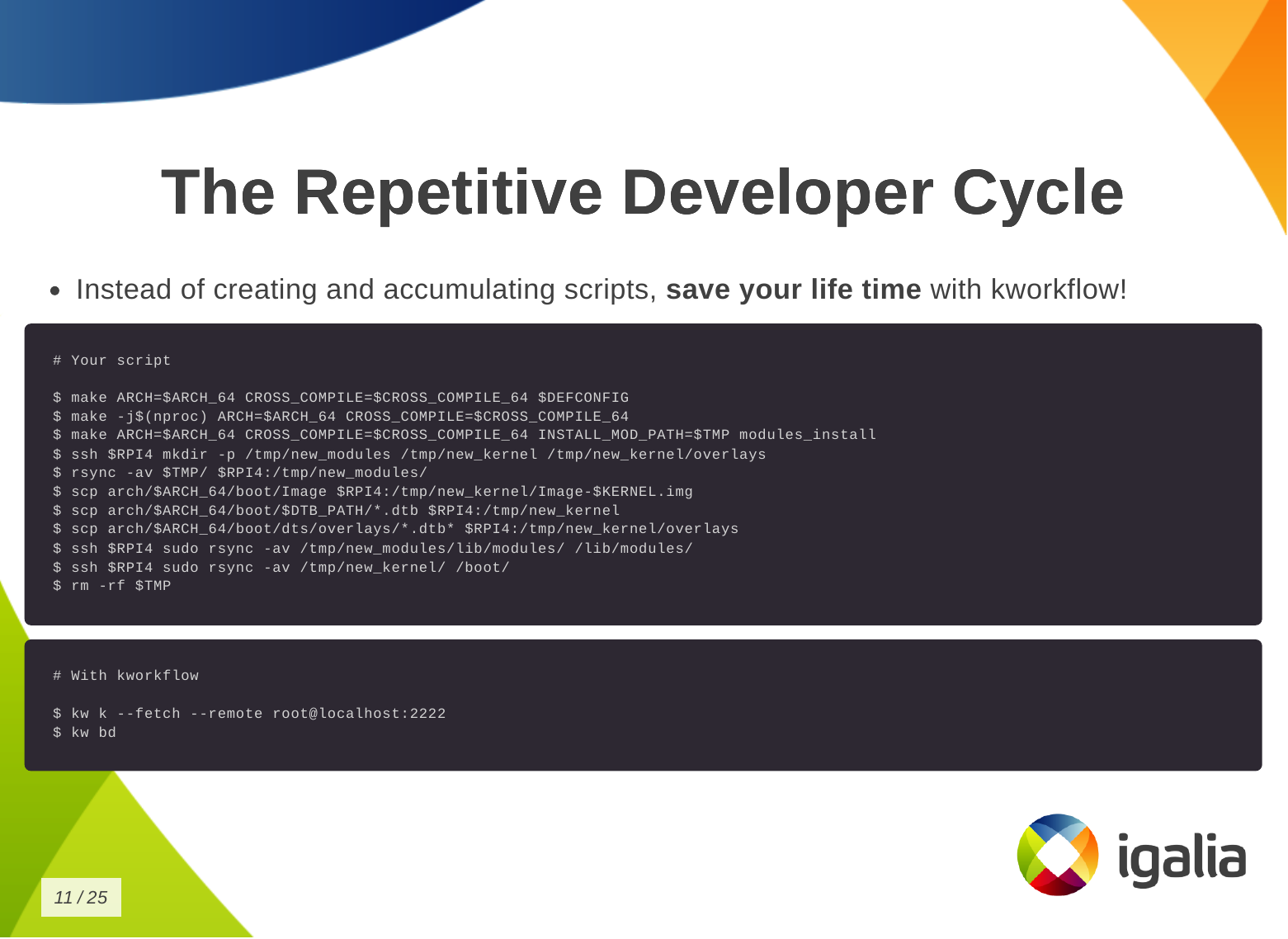

What is kworkflow? Kworkflow is a collection of tools and software combined to:
  • Optimize Linux kernel development workflow.
  • Reduce time spent on repetitive tasks, since we are spending our lives compiling kernels.
  • Standardize best practices.
  • Ensure reliable data exchange across kernel workflow. For example: two people describe the same setup, but they are not seeing the same thing, kworkflow can ensure both are actually with the same kernel, modules and options enabled.
I don t know if you will get this analogy, but kworkflow is for me a megazord of scripts. You are combining all of your scripts to create a very powerful tool.
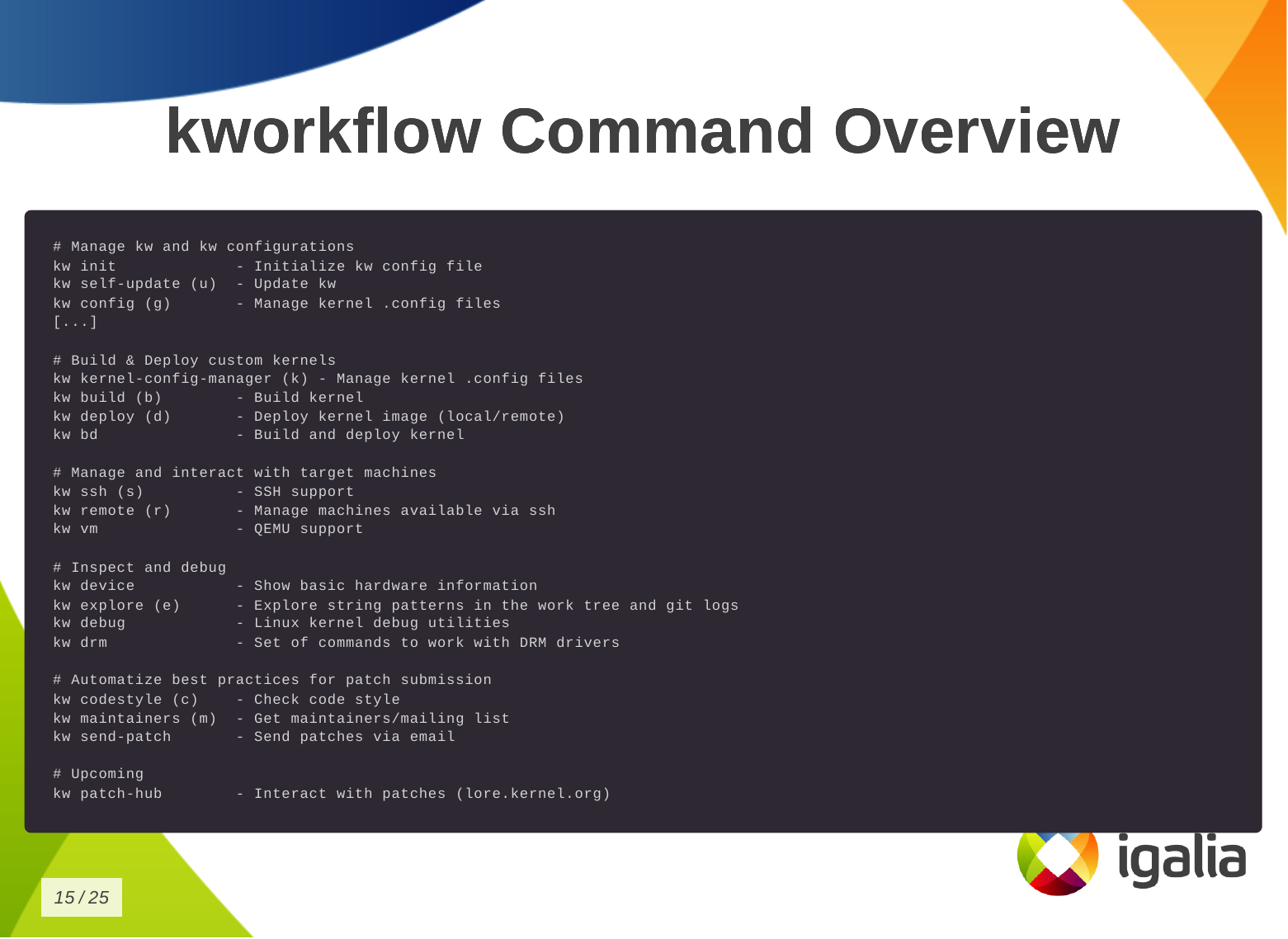
What is the main feature of kworflow? There are many, but these are the most important for me:
  • Build & deploy custom kernels across devices & distros.
  • Handle cross-compilation seamlessly.
  • Manage multiple architecture, settings and target devices in the same work tree.
  • Organize kernel configuration files.
  • Facilitate remote debugging & code inspection.
  • Standardize Linux kernel patch submission guidelines. You don t need to double check documentantion neither Greg needs to tell you that you are not following Linux kernel guidelines.
  • Upcoming: Interface to bookmark, apply and reviewed-by patches from mailing lists (lore.kernel.org).
This is the list of commands you can run with kworkflow. The first subset is to configure your tool for various situations you may face in your daily tasks.
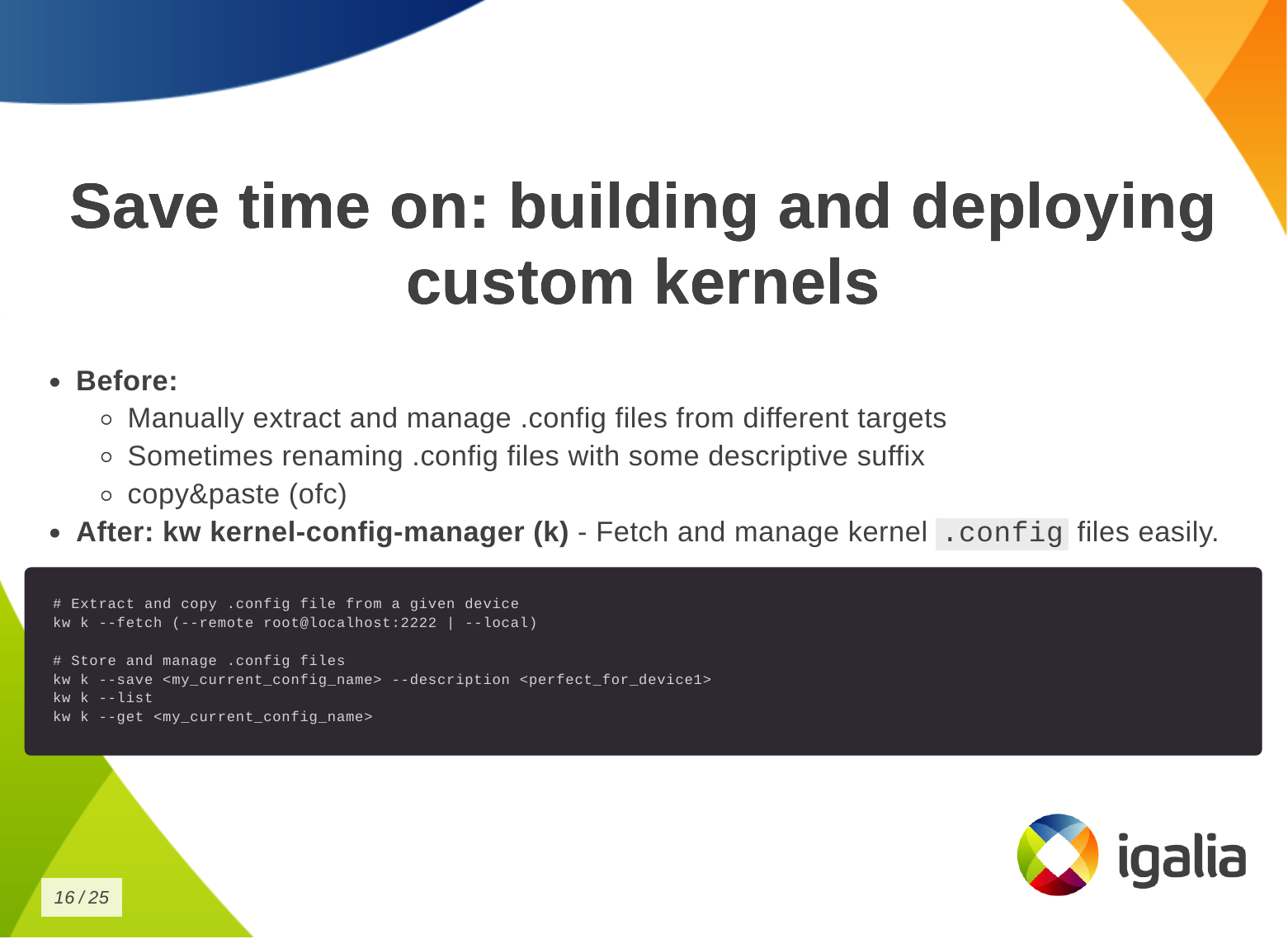
# Manage kw and kw configurations
kw init             - Initialize kw config file
kw self-update (u)  - Update kw
kw config (g)       - Manage kernel .config files
The second subset is to build and deploy custom kernels.
# Build & Deploy custom kernels
kw kernel-config-manager (k) - Manage kernel .config files
kw build (b)        - Build kernel
kw deploy (d)       - Deploy kernel image (local/remote)
kw bd               - Build and deploy kernel
We have some tools to manage and interact with target machines.
# Manage and interact with target machines
kw ssh (s)          - SSH support
kw remote (r)       - Manage machines available via ssh
kw vm               - QEMU support
To inspect and debug a kernel.
# Inspect and debug
kw device           - Show basic hardware information
kw explore (e)      - Explore string patterns in the work tree and git logs
kw debug            - Linux kernel debug utilities
kw drm              - Set of commands to work with DRM drivers
To automatize best practices for patch submission like codestyle, maintainers and the correct list of recipients and mailing lists of this change, to ensure we are sending the patch to who is interested in it.
# Automatize best practices for patch submission
kw codestyle (c)    - Check code style
kw maintainers (m)  - Get maintainers/mailing list
kw send-patch       - Send patches via email
And the last one, the upcoming patch hub.
# Upcoming
kw patch-hub        - Interact with patches (lore.kernel.org)

How can you save time with Kworkflow? So how can you save time building and deploying a custom kernel? First, you need a .config file.
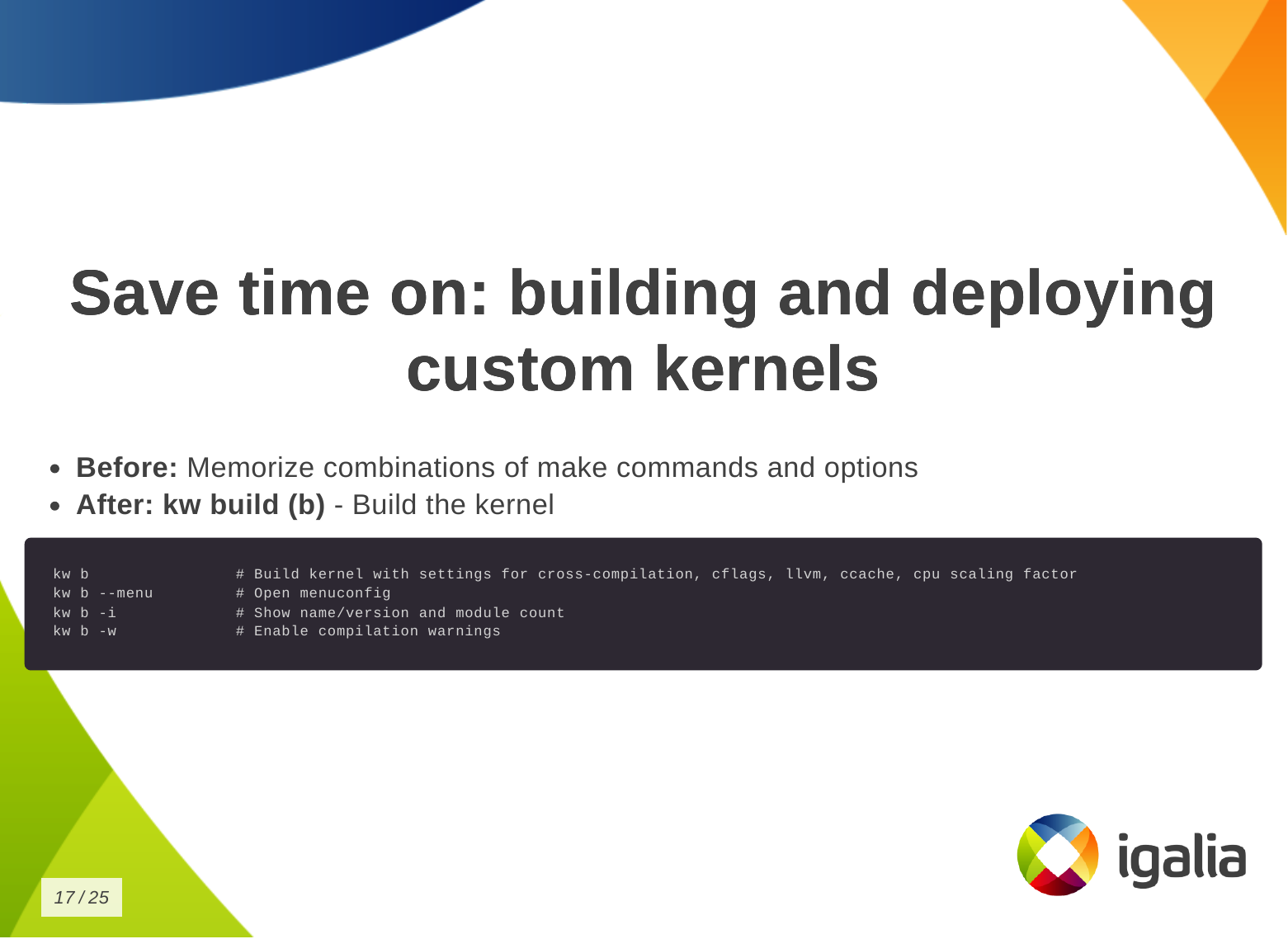
  • Without kworkflow: You may be manually extracting and managing .config files from different targets and saving them with different suffixes to link the kernel to the target device or distribution, or any descriptive suffix to help identify which is which. Or even copying and pasting from somewhere.
  • With kworkflow: you can use the kernel-config-manager command, or simply kw k, to store, describe and retrieve a specific .config file very easily, according to your current needs.
Then you want to build the kernel:
  • Without kworkflow: You are probably now memorizing a combination of commands and options.
  • With kworkflow: you just need kw b (kw build) to build the kernel with the correct settings for cross-compilation, compilation warnings, cflags, etc. It also shows some information about the kernel, like number of modules.
Finally, to deploy the kernel in a target machine.
  • Without kworkflow: You might be doing things like: SSH connecting to the remote machine, copying and removing files according to distributions and architecture, and manually updating the bootloader for the target distribution.
  • With kworkflow: you just need kw d which does a lot of things for you, like: deploying the kernel, preparing the target machine for the new installation, listing available kernels and uninstall them, creating a tarball, rebooting the machine after deploying the kernel, etc.
You can also save time on debugging kernels locally or remotely.
  • Without kworkflow: you do: ssh, manual setup and traces enablement, copy&paste logs.
  • With kworkflow: more straighforward access to debug utilities: events, trace, dmesg.
You can save time on managing multiple kernel images in the same work tree.
  • Without kworkflow: now you can be cloning multiple times the same repository so you don t lose compiled files when changing kernel configuration or compilation options and manually managing build and deployment scripts.
  • With kworkflow: you can use kw env to isolate multiple contexts in the same worktree as environments, so you can keep different configurations in the same worktree and switch between them easily without losing anything from the last time you worked in a specific context.
Finally, you can save time when submitting kernel patches. In kworkflow, you can find everything you need to wrap your changes in patch format and submit them to the right list of recipients, those who can review, comment on, and accept your changes. This is a demo that the lead developer of the kw patch-hub feature sent me. With this feature, you will be able to check out a series on a specific mailing list, bookmark those patches in the kernel for validation, and when you are satisfied with the proposed changes, you can automatically submit a reviewed-by for that whole series to the mailing list.
Demo Now a demo of how to use kw environment to deal with different devices, architectures and distributions in the same work tree without losing compiled files, build and deploy settings, .config file, remote access configuration and other settings specific for those three devices that I have.

Setup
  • Three devices:
    • laptop (debian x86 intel local)
    • SteamDeck (steamos x86 amd remote)
    • RaspberryPi 4 (raspbian arm64 broadcomm remote)
  • Goal: To validate a change on DRM/VKMS using a single kernel tree.
  • Kworkflow commands:
    • kw env
    • kw d
    • kw bd
    • kw device
    • kw debug
    • kw drm

Demo script In the same terminal and worktree.

First target device: Laptop (debian x86 intel local)
$ kw env --list # list environments available in this work tree
$ kw env --use LOCAL # select the environment of local machine (laptop) to use: loading pre-compiled files, kernel and kworkflow settings.
$ kw device # show device information
$ sudo modinfo vkms # show VKMS module information before applying kernel changes.
$ <open VKMS file and change module info>
$ kw bd # compile and install kernel with the given change
$ sudo modinfo vkms # show VKMS module information after kernel changes.
$ git checkout -- drivers
Second target device: RaspberryPi 4 (raspbian arm64 broadcomm remote)
$ kw env --use RPI_64 # move to the environment for a different target device.
$ kw device # show device information and kernel image name
$ kw drm --gui-off-after-reboot # set the system to not load graphical layer after reboot
$ kw b # build the kernel with the VKMS change
$ kw d --reboot # deploy the custom kernel in a Raspberry Pi 4 with Raspbian 64, and reboot
$ kw s # connect with the target machine via ssh and check the kernel image name
$ exit
Third target device: SteamDeck (steamos x86 amd remote)
$ kw env --use STEAMDECK # move to the environment for a different target device
$ kw device # show device information
$ kw debug --dmesg --follow --history --cmd="modprobe vkms" # run a command and show the related dmesg output
$ kw debug --dmesg --follow --history --cmd="modprobe -r vkms" # run a command and show the related dmesg output
$ <add a printk with a random msg to appear on dmesg log>
$ kw bd # deploy and install custom kernel to the target device
$ kw debug --dmesg --follow --history --cmd="modprobe vkms" # run a command and show the related dmesg output after build and deploy the kernel change

Q&A Most of the questions raised at the end of the presentation were actually suggestions and additions of new features to kworkflow. The first participant, that is also a kernel maintainer, asked about two features: (1) automatize getting patches from patchwork (or lore) and triggering the process of building, deploying and validating them using the existing workflow, (2) bisecting support. They are both very interesting features. The first one fits well the patch-hub subproject, that is under-development, and I ve actually made a similar request a couple of weeks before the talk. The second is an already existing request in kworkflow github project. Another request was to use kexec and avoid rebooting the kernel for testing. Reviewing my presentation I realized I wasn t very clear that kworkflow doesn t support kexec. As I replied, what it does is to install the modules and you can load/unload them for validations, but for built-in parts, you need to reboot the kernel. Another two questions: one about Android Debug Bridge (ADB) support instead of SSH and another about support to alternative ways of booting when the custom kernel ended up broken but you only have one kernel image there. Kworkflow doesn t manage it yet, but I agree this is a very useful feature for embedded devices. On Raspberry Pi 4, kworkflow mitigates this issue by preserving the distro kernel image and using config.txt file to set a custom kernel for booting. For ADB, there is no support too, and as I don t see currently users of KW working with Android, I don t think we will have this support any time soon, except if we find new volunteers and increase the pool of contributors. The last two questions were regarding the status of b4 integration, that is under development, and other debugging features that the tool doesn t support yet. Finally, when Andrea and I were changing turn on the stage, he suggested to add support for virtme-ng to kworkflow. So I opened an issue for tracking this feature request in the project github. With all these questions and requests, I could see the general need for a tool that integrates the variety of kernel developer workflows, as proposed by kworflow. Also, there are still many cases to be covered by kworkflow. Despite the high demand, this is a completely voluntary project and it is unlikely that we will be able to meet these needs given the limited resources. We will keep trying our best in the hope we can increase the pool of users and contributors too.

18 April 2025

Sven Hoexter: Trixie Upgrade and X11 Clipboard Manager Madness

Due to my own laziness and a few functionality issues my "for work laptop" is still using a 15+ year old setup with X11 and awesome. Since trixie is now starting its freeze, it's time to update that odd machine as well and look at the fallout. Good news: It's mostly my own resistance to change which required some kick in the back to move on. Clipboard Manager Madness For the past decade or so I used parcellite which served me well. Now that is no longer available in trixie and I started to look into one of the dead end streets of X11 related tooling, searching for an alternative. Parcellite Seems upstream is doing sporadic fixes, but holds GTK2 tight. The Debian package was patched to be GTK3 compatible, but has unfixed ftbfs issues with GCC 14. clipit Next I checked for a parcellite fork named clipit, and that's when it started to get funky. It's packaged in Debian, QA maintained, and recently received at least two uploads to keep it working. Installed it and found it's greeting me with a nag screen that I should migrate to diodon. The real clipit tool is still shipped as a binary named clipit.real, so if you know it you can still use it. To achieve the nag screen it depends on zenity and to ease the migration it depends on diodon. Two things I do not really need. Also the package description prominently mentions that you should not use the package. diodon The nag screen of clipit made me look at diodon. It claims it was written for the Ubuntu Unity desktop, something where I've no idea how alive and relevant it still is. While there is still something on launchpad, it seems to receive sporadic commits on github. Not sure if it's dead or just feature complete. Interim Solution: clipit Settled with clipit for now, but decided to fork the Debian package to remove the nag screen and the dependency on diodon and zenity (package build). My hope is to convert this last X11 setup to wayland within the lifetime of trixie. I also contacted the last uploader regarding a removal of the nag screen, who then brought in the last maintainer who added the nag screen. While I first thought clipit is somewhat maintained upstream, Andrej quickly pointed out that this is not really the case. Still that leaves us in trixie with a rather odd situation. We ship now for the second stable release a package that recommends to move to a different tool while still shipping the original tool. Plus it's getting patched by some of its users who refuse to migrate to the alternative envisioned by the former maintainer. VirtualBox and moving to libvirt I always liked the GUI of VirtualBox, and it really made desktop virtualization easy. But with Linux 6.12, which enables KVM by default, it seems to get even more painful to get it up and running. In the past I just took the latest release from unstable and rebuild that one on the current stable. Currently the last release in unstable is 7.0.20, while the Linux 6.12 fixes only started to appear in VirtualBox 7.1.4 and later. The good thing is with virt-manager and the whole libvirt ecosystem there is a good enough replacement available, and it works fine with related tooling like vagrant. There are instructions available on how to set it up. I can only add that it makes sense to export VAGRANT_DEFAULT_PROVIDER=libvirt in your .bashrc to make that provider change permanent.

Next.

Previous.