Search Results: "andy"

28 September 2017

Russell Coker: Process Monitoring

Since forking the Mon project to etbemon [1] I ve been spending a lot of time working on the monitor scripts. Actually monitoring something is usually quite easy, deciding what to monitor tends to be the hard part. The process monitoring script ps.monitor is the one I m about to redesign. Here are some of my ideas for monitoring processes. Please comment if you have any suggestions for how do do things better. For people who don t use mon, the monitor scripts return 0 if everything is OK and 1 if there s a problem along with using stdout to display an error message. While I m not aware of anyone hooking mon scripts into a different monitoring system that s going to be easy to do. One thing I plan to work on in the future is interoperability between mon and other systems such as Nagios. Basic Monitoring
ps.monitor tor:1-1 master:1-2 auditd:1-1 cron:1-5 rsyslogd:1-1 dbus-daemon:1- sshd:1- watchdog:1-2
I m currently planning some sort of rewrite of the process monitoring script. The current functionality is to have a list of process names on the command line with minimum and maximum numbers for the instances of the process in question. The above is a sample of the configuration of the monitor. There are some limitations to this, the master process in this instance refers to the main process of Postfix, but other daemons use the same process name (it s one of those names that s wrong because it s so obvious). One obvious solution to this is to give the option of specifying the full path so that /usr/lib/postfix/sbin/master can be differentiated from all the other programs named master. The next issue is processes that may run on behalf of multiple users. With sshd there is a single process to accept new connections running as root and a process running under the UID of each logged in user. So the number of sshd processes running as root will be one greater than the number of root login sessions. This means that if a sysadmin logs in directly as root via ssh (which is controversial and not the topic of this post merely something that people do which I have to support) and the master process then crashes (or the sysadmin stops it either accidentally or deliberately) there won t be an alert about the missing process. Of course the correct thing to do is to have a monitor talk to port 22 and look for the string SSH-2.0-OpenSSH_ . Sometimes there are multiple instances of a daemon running under different UIDs that need to be monitored separately. So obviously we need the ability to monitor processes by UID. In many cases process monitoring can be replaced by monitoring of service ports. So if something is listening on port 25 then it probably means that the Postfix master process is running regardless of what other master processes there are. But for my use I find it handy to have multiple monitors, if I get a Jabber message about being unable to send mail to a server immediately followed by a Jabber message from that server saying that master isn t running I don t need to fully wake up to know where the problem is. SE Linux One feature that I want is monitoring SE Linux contexts of processes in the same way as monitoring UIDs. While I m not interested in writing tests for other security systems I would be happy to include code that other people write. So whatever I do I want to make it flexible enough to work with multiple security systems. Transient Processes Most daemons have a second process of the same name running during the startup process. This means if you monitor for exactly 1 instance of a process you may get an alert about 2 processes running when logrotate or something similar restarts the daemon. Also you may get an alert about 0 instances if the check happens to run at exactly the wrong time during the restart. My current way of dealing with this on my servers is to not alert until the second failure event with the alertafter 2 directive. The failure_interval directive allows specifying the time between checks when the monitor is in a failed state, setting that to a low value means that waiting for a second failure result doesn t delay the notification much. To deal with this I ve been thinking of making the ps.monitor script automatically check again after a specified delay. I think that solving the problem with a single parameter to the monitor script is better than using 2 configuration directives to mon to work around it. CPU Use Mon currently has a loadavg.monitor script that to check the load average. But that won t catch the case of a single process using too much CPU time but not enough to raise the system load average. Also it won t catch the case of a CPU hungry process going quiet (EG when the SETI at Home server goes down) while another process goes into an infinite loop. One way of addressing this would be to have the ps.monitor script have yet another configuration option to monitor CPU use, but this might get confusing. Another option would be to have a separate script that alerts on any process that uses more than a specified percentage of CPU time over it s lifetime or over the last few seconds unless it s in a whitelist of processes and users who are exempt from such checks. Probably every regular user would be exempt from such checks because you never know when they will run a file compression program. Also there is a short list of daemons that are excluded (like BOINC) and system processes (like gzip which is run from several cron jobs). Monitoring for Exclusion A common programming mistake is to call setuid() before setgid() which means that the program doesn t have permission to call setgid(). If return codes aren t checked (and people who make such rookie mistakes tend not to check return codes) then the process keeps elevated permissions. Checking for processes running as GID 0 but not UID 0 would be handy. As an aside a quick examination of a Debian/Testing workstation didn t show any obvious way that a process with GID 0 could gain elevated privileges, but that could change with one chmod 770 command. On a SE Linux system there should be only one process running with the domain init_t. Currently that doesn t happen in Stretch systems running daemons such as mysqld and tor due to policy not matching the recent functionality of systemd as requested by daemon service files. Such issues will keep occurring so we need automated tests for them. Automated tests for configuration errors that might impact system security is a bigger issue, I ll probably write a separate blog post about it.

10 September 2017

Adnan Hodzic: Secure traffic to ZNC on Synology with Let s Encrypt

I ve been using IRC since late 1990 s, and I continue to do so to this day due to it (still) being one of the driving development forces in various open source communities. Especially in Linux development and some of my acquintances I can only get in touch with via IRC :) My Setup On my Synology NAS I run ZNC (IRC bouncer/proxy) to which I connect using various IRC clients (irssi/XChat Azure/AndChat) from various platforms (Linux/Mac/Android). In this case ZNC serves as a gateway and no matter which device/client I connect from, I m always connected to same IRC servers/chat rooms/settings when I left off. This is all fine and dandy, but connecting from external networks to ZNC means you will hand in your ZNC credentials in plain text. Which is a problem for me, even thought we re only talking about IRC bouncer/proxy. With that said, how do we encrypt external traffic to our ZNC? HowTo: Chat securely with ZNC on Synology using Let s Encrypt SSL certificate For reference or more thorough explanation of some of the steps/topics please refer to: Secure (HTTPS) public access to Synology NAS using Let s Encrypt (free) SSL certificate

Requirements:

1: DNS setup Create A record for sub/domain you d like to use to connect to your ZNC and point it to your Synology NAS external (WAN) IP. For your reference, subdomain I ll use is: irc.hodzic.org 2: Create Let s Encrypt certificate
DSM: Control Panel > Security > Certificates > Add
Followed by:
Add a new certificate > Get a certificate from Let's Encrypt
Followed by adding domain name A record was created for in Step 1, i.e: Get a certificate from Let's Encrypt for irc.hodzic.org After certificate is created, don t forget to configure newly created certificate to point to correct domain name, i.e: Configure Let's Encrypt Certificate 3: Install ZNC In case you already have ZNC installed, I suggest you remove it and do a clean install. Mainly due to some problems with package in past, where ZNC wouldn t start automatically on boot which lead to creating projects like: synology-znc-autostart. In latest version, all of these problems have been fixed and couple of new features have been added. ZNC can be installed using Synology s Package Center, if community package sources are enabled. Which can simply be done by adding new package sources:
Name: SynoCommunity
Location: http://packages.synocommunity.com
Enable Community package sources in Synology Package Center To successfuly authenticate newly added source, under General tab, Trust Level should be set to Any publisher As part of installation process, ZNC config will be run with most sane/useful options and admin user will be created allowing you access to ZNC webadmin. 4: Secure access to ZNC webadmin Now we want to bind our sub/domain created in Step 1 to ZNC webadmin, and secure external access to it. This can be done by creating a reverse proxy. As part of this, you need to know which port has been allocated for SSL in ZNC Webadmin, i.e: ZNC Webadmin > Global settings - Listen Ports In this case, we can see it s 8251. Reverse Proxy can be created in:
DSM: Control Panel > Application Portal > Reverse Proxy > Create
Where sub/domain created in Step 1 needs to be point to ZNC SSL port on localhost, i.e: Reverse proxy: irc.hodzic.org setup ZNC Webadmin is now available via HTTPS on external network for the sub/domain you setup as part of Step 1, or in my case: ZNC webadmin (HTTPS) As part of this step, in ZNC webadmin I d advise you to create IRC servers and chatrooms you would like to connect to later. Step 5: Create .pem file from LetsEncrpyt certificate for ZNC to use On Synology, Let s Encrypt certificates are stored and located on:
/usr/syno/etc/certificate/_archive/
In case you have multiple certificates, based on date your certificate was created, you can determine in which directory is your newly generated certificated stored, i.e:
drwx------ 2 root root 4096 Sep 10 12:57 JeRh3Y
Once it s determined which certifiate is the one we want use, generate .pem by running following: sudo cat /usr/syno/etc/certificate/_archive/JeRh3Y/ privkey,cert,chain .pem > /usr/local/znc/var/znc.pem After this restart ZNC: sudo /var/packages/znc/scripts/start-stop-status stop && sudo /var/packages/znc/scripts/start-stop-status start 6: Configure IRC client In this example I ll use XChat Azure on MacOS, and same procedure should be identical for HexChat/XChat clients on any other platform. Altough all information is picked up from ZNC itself, user details will need to be filled in. In my setup I automatically connect to freenode and oftc networks, so I created two for local network and two for external network usage, later is the one we re concentrating on. On General tab of our newly created server, hostname for our server should be the sub/domain we ve setup as part of Step 1 , and port number should be the one we defined in Step 4 , SSL checkbox must be checked. Xchat Azure: Network list - General tab On Connecting tab Server password field needs to be filled in following format:
johndoe/freenode:password
Where, johndoe is ZNC username. freenode is ZNC network name, and password is ZNC password. Xchat Azure: Network list - Connecting tab freenode in this case must first be created as part of ZNC webadmin configuration, mentioned in step 4 . Same case is for oftc network configuration. As part of establishing the connection, information about our Let s Encrypt certificate will be displayed, after which connection will be established and you ll be automatically logged into all chatrooms. Happy hacking!

31 August 2017

Chris Lamb: Free software activities in August 2017

Here is my monthly update covering what I have been doing in the free software world in August 2017 (previous month):
Reproducible builds

Whilst anyone can inspect the source code of free software for malicious flaws, most software is distributed pre-compiled to end users. The motivation behind the Reproducible Builds effort is to allow verification that no flaws have been introduced either maliciously or accidentally during this compilation process by promising identical results are always generated from a given source, thus allowing multiple third-parties to come to a consensus on whether a build was compromised. I have generously been awarded a grant from the Core Infrastructure Initiative to fund my work in this area. This month I:
  • Presented a status update at Debconf17 in Montr al, Canada alongside Holger Levsen, Maria Glukhova, Steven Chamberlain, Vagrant Cascadian, Valerie Young and Ximin Luo.
  • I worked on the following issues upstream:
    • glib2.0: Please make the output of gio-querymodules reproducible. (...)
    • gcab: Please make the output reproducible. (...)
    • gtk+2.0: Please make the immodules.cache files reproducible. (...)
    • desktop-file-utils: Please make the output reproducible. (...)
  • Within Debian:
  • Categorised a large number of packages and issues in the Reproducible Builds "notes" repository.
  • Worked on publishing our weekly reports. (#118, #119, #120, #121 & #122)

I also made the following changes to our tooling:
diffoscope

diffoscope is our in-depth and content-aware diff utility that can locate and diagnose reproducibility issues.

  • Use name attribute over path to avoid leaking comparison full path in output. (commit)
  • Add missing skip_unless_module_exists import. (commit)
  • Tidy diffoscope.progress and the XML comparator (commit, commit)

disorderfs

disorderfs is our FUSE-based filesystem that deliberately introduces non-determinism into directory system calls in order to flush out reproducibility issues.

  • Add a simple autopkgtest smoke test. (commit)


Debian
Patches contributed
  • openssh: Quote the IP address in ssh-keygen -f suggestions. (#872643)
  • libgfshare:
    • SIGSEGV if /dev/urandom is not accessible. (#873047)
    • Add bindnow hardening. (#872740)
    • Support nodoc build profile. (#872739)
  • devscripts:
  • memcached: Add hardening to systemd .service file. (#871610)
  • googler: Tidy long and short package descriptions. (#872461)
  • gnome-split: Homepage points to domain-parked website. (#873037)

Uploads
  • python-django 1:1.11.4-1 New upstream release.
  • redis:
    • 4:4.0.1-3 Drop yet more non-deterministic tests.
    • 4:4.0.1-4 Tighten systemd/seccomp hardening.
    • 4:4.0.1-5 Drop even more tests with timing issues.
    • 4:4.0.1-6 Don't install completions to /usr/share/bash-completion/completions/debian/bash_completion/.
    • 4:4.0.1-7 Don't let sentinel integration tests fail the build as they use too many timers to be meaningful. (#872075)
  • python-gflags 1.5.1-3 If SOURCE_DATE_EPOCH is set, either use that as a source of current dates or the UTC-version of the file's modification time (#836004), don't call update-alternatives --remove in postrm. update debian/watch/Homepage & refresh/tidy the packaging.
  • bfs 1.1.1-1 New upstream release, tidy autopkgtest & patches, organising the latter with Pq-Topic.
  • python-daiquiri 1.2.2-1 New upstream release, tidy autopkgtests & update travis.yml from travis.debian.net.
  • aptfs 2:0.10-2 Add upstream signing key, refer to /usr/share/common-licenses/GPL-3 in debian/copyright & tidy autopkgtests.
  • adminer 4.3.1-2 Add a simple autopkgtest & don't install the Selenium-based tests in the binary package.
  • zoneminder (1.30.4+dfsg-2) Prevent build failures with GCC 7 (#853717) & correct example /etc/fstab entries in README.Debian (#858673).

Finally, I reviewed and sponsored uploads of astral, inflection, more-itertools, trollius-redis & wolfssl.

Debian LTS

This month I have been paid to work 18 hours on Debian Long Term Support (LTS). In that time I did the following:
  • "Frontdesk" duties, triaging CVEs, etc.
  • Issued DLA 1049-1 for libsndfile preventing a remote denial of service attack.
  • Issued DLA 1052-1 against subversion to correct an arbitrary code execution vulnerability.
  • Issued DLA 1054-1 for the libgxps XML Paper Specification library to prevent a remote denial of service attack.
  • Issued DLA 1056-1 for cvs to prevent a command injection vulnerability.
  • Issued DLA 1059-1 for the strongswan VPN software to close a denial of service attack.

Debian bugs filed
  • wget: Please hash the hostname in ~/.wget-hsts files. (#870813)
  • debian-policy: Clarify whether mailing lists in Maintainers/Uploaders may be moderated. (#871534)
  • git-buildpackage: "pq export" discards text within square brackets. (#872354)
  • qa.debian.org: Escape HTML in debcheck before outputting. (#872646)
  • pristine-tar: Enable multithreaded compression in pristine-xz. (#873229)
  • tryton-meta: Please combine tryton-modules-* into a single source package with multiple binaries. (#873042)
  • azure-cli:
  • fwupd-tests: Don't ship test files to generic /usr/share/installed-tests dir. (#872458)
  • libvorbis: Maintainer fields points to a moderated mailing list. (#871258)
  • rmlint-gui: Ship a rmlint-gui binary. (#872162)
  • template-glib: debian/copyright references online source without quotation. (#873619)

FTP Team

As a Debian FTP assistant I ACCEPTed 147 packages: abiword, adacgi, adasockets, ahven, animal-sniffer, astral, astroidmail, at-at-clojure, audacious, backdoor-factory, bdfproxy, binutils, blag-fortune, bluez-qt, cheshire-clojure, core-match-clojure, core-memoize-clojure, cypari2, data-priority-map-clojure, debian-edu, debian-multimedia, deepin-gettext-tools, dehydrated-hook-ddns-tsig, diceware, dtksettings, emacs-ivy, farbfeld, gcc-7-cross-ports, git-lfs, glewlwyd, gnome-recipes, gnome-shell-extension-tilix-dropdown, gnupg2, golang-github-aliyun-aliyun-oss-go-sdk, golang-github-approvals-go-approval-tests, golang-github-cheekybits-is, golang-github-chzyer-readline, golang-github-denverdino-aliyungo, golang-github-glendc-gopher-json, golang-github-gophercloud-gophercloud, golang-github-hashicorp-go-rootcerts, golang-github-matryer-try, golang-github-opentracing-contrib-go-stdlib, golang-github-opentracing-opentracing-go, golang-github-tdewolff-buffer, golang-github-tdewolff-minify, golang-github-tdewolff-parse, golang-github-tdewolff-strconv, golang-github-tdewolff-test, golang-gopkg-go-playground-validator.v8, gprbuild, gsl, gtts, hunspell-dz, hyperlink, importmagic, inflection, insighttoolkit4, isa-support, jaraco.itertools, java-classpath-clojure, java-jmx-clojure, jellyfish1, lazymap-clojure, libblockdev, libbytesize, libconfig-zomg-perl, libdazzle, libglvnd, libjs-emojify, libjwt, libmysofa, libundead, linux, lua-mode, math-combinatorics-clojure, math-numeric-tower-clojure, mediagoblin, medley-clojure, more-itertools, mozjs52, openssh-ssh1, org-mode, oysttyer, pcscada, pgsphere, poppler, puppetdb, py3status, pycryptodome, pysha3, python-cliapp, python-coloredlogs, python-consul, python-deprecation, python-django-celery-results, python-dropbox, python-fswrap, python-hbmqtt, python-intbitset, python-meshio, python-parameterized, python-pgpy, python-py-zipkin, python-pymeasure, python-thriftpy, python-tinyrpc, python-udatetime, python-wither, python-xapp, pythonqt, r-cran-bit, r-cran-bit64, r-cran-blob, r-cran-lmertest, r-cran-quantmod, r-cran-ttr, racket-mode, restorecond, rss-bridge, ruby-declarative, ruby-declarative-option, ruby-errbase, ruby-google-api-client, ruby-rash-alt, ruby-representable, ruby-test-xml, ruby-uber, sambamba, semodule-utils, shimdandy, sjacket-clojure, soapysdr, stencil-clojure, swath, template-glib, tools-analyzer-jvm-clojure, tools-namespace-clojure, uim, util-linux, vim-airline, vim-airline-themes, volume-key, wget2, xchat, xfce4-eyes-plugin & xorg-gtest. I additionally filed 6 RC bugs against packages that had incomplete debian/copyright files against: gnome-recipes, golang-1.9, libdazzle, poppler, python-py-zipkin & template-glib.

29 August 2017

Holger Levsen: 20170829-qubes-os

"Qubes OS from the POV of a Debian developer" and "Qubes OS user meetup at Bornhack" I wrote the following while on my way home from Bornhack which was an awesome hacking camp on the Danish island of Bornholm, where about 200 people gathered for a week, with a nice beach in walking distance (and a not too cold Baltic Sea) and vegan and not so vegan grills, to give some hints why it was awesome. (Actually it was mostly awesome due to the people there, not the things, but anyway ) And there were of course also talks and workshops, and one was a Qubes OS users meetup, which amazingly was attended by 20 Qubes OS users (and some Qubes OS users present were even missing), so in other words: Qubes OS had a >10% user base at this event! And I even found one heads user! ;-) At DebConf17 I gave a talk titled "Qubes OS from the POV of a Debian developer" and while the video was immediatly available (thanks to the DebConf videoteam!) I've also now put my slides for it online. Since then, I learned a few things: I'm looking forward to more Qubes OS user meetups in future!

19 August 2017

Arturo Borrero Gonz lez: Running Suricata 4.0 with Debian Stretch

debian-suricata logo Do you know what s happening in the wires of your network? There is a major FLOSS player in the field of real time intrusion detection (IDS), inline intrusion prevention (IPS) and network security monitoring (NSM). I m talking about Suricata, a mature, fast and robust network threat detection engine. Suricata is a community driven project, supported by the Open InfoSec Foundation (OISF). For those who doesn t know how Suricata works, it usually runs by loading a set of pre-defined rules for matching different network protocols and flow behaviours. In this regards, Suricata has been always ruleset-compatible with the other famous IDS: snort. The last major release of Suricata is 4.0.0, and I m uploading the package for Debian stretch-backports as I write this line. This means the updated package should be available for general usage after the usual buildds processing ends inside the Debian archive. You might be wondering, How to start using Suricata 4.0 with Debian Stretch? First, I would recommend reading the docs. Please checkout: My recommendation is to run Suricata from stretch-backports or from testing, and just installing the package should be enough to get the environment up and running:
% sudo aptitude install suricata
You can check that the installation was good:
% sudo systemctl status suricata
  suricata.service - Suricata IDS/IDP daemon
   Loaded: loaded (/lib/systemd/system/suricata.service; enabled; vendor preset: enabled)
   Active: active (running) since Sat 2017-08-19 12:50:49 CEST; 44min ago
     Docs: man:suricata(8)
           man:suricatasc(8)
           https://redmine.openinfosecfoundation.org/projects/suricata/wiki
 Main PID: 1101 (Suricata-Main)
    Tasks: 8 (limit: 4915)
   CGroup: /system.slice/suricata.service
            1101 /usr/bin/suricata -D --af-packet -c /etc/suricata/suricata.yaml --pidfile /var/run/suricata.pid
ago 19 12:50:44 nostromo systemd[1]: Starting Suricata IDS/IDP daemon...
ago 19 12:50:47 nostromo suricata[1032]: 19/8/2017 -- 12:50:47 - <Notice> - This is Suricata version 4.0.0 RELEASE
ago 19 12:50:49 nostromo systemd[1]: Started Suricata IDS/IDP daemon.
You can interact with Suricata using the suricatasc tool:
% sudo suricatasc -c uptime
 "message": 3892, "return": "OK" 
And start inspecting the generated logs at /var/log/suricata/ The default configuration, in file /etc/suricata/suricata.yaml, comes with some preconfigured values. For a proper integration into your enviroment, you should tune the configuration file, define your networks, network interfaces, running modes, and so on (refer to the upstream documentation for this). In my case, I tested suricata by inspecting the traffic of my laptop. After installation, I only had to switch the network interface:
[...]
# Linux high speed capture support
af-packet:
  - interface: wlan0
[...]
After a restart, I started seeing some alerts:
% sudo systemctl restart suricata
% sudo tail -f /var/log/suricata/fast.log
08/19/2017-14:03:04.025898  [**] [1:2012648:3] ET POLICY Dropbox Client Broadcasting [**] \
	[Classification: Potential Corporate Privacy Violation] [Priority: 1]  UDP  192.168.1.36:17500 -> 255.255.255.255:17500
One of the main things when running Suricata is to keep your ruleset up-to-dated. In Debian, we have the suricata-oinkmaster package which comes with some handy options to automate your ruleset updates using the Oinkmaster software. Please note that this is a Debian-specific glue to integrate and automate Suricata with Oinkmaster. To get this funcionality, simply install the package:
% sudo aptitude install suricata-oinkmaster
A daily cron-job will be enabled. Check suricata-oinkmaster-updater(8) for more info. By the way, Did you know that Suricata can easily handle big loads of traffic? (i.e, 10Gbps). And I heard some scaling works are in mind to reach 100Gpbs. I have been in charge of the Suricata package in Debian for a while, several years already, with the help of some other DD hackers: Pierre Chifflier (pollux) and Sascha Steinbiss (satta), among others. Due to this work, I believe the package is really well integrated into Debian, ready to use and with some powerful features. And, of course, we are open to suggestions and bug reports. So, this is it, another great stuff you can do with Debian :-)

6 August 2017

Daniel Silverstone: STM32 and RTFM

I have been working with STM32 chips on-and-off for at least eight, possibly closer to nine years. About as long as ST have been touting them around. I love the STM32, and have done much with them in C. But, as my previous two posts may have hinted, I would like to start working with Rust instead of C. To that end, I have been looking with great joy at the work which Jorge Aparicio has been doing around Cortex-M3 and Rust. I've had many comments in person at Debconf, and also several people mention on Twitter, that they're glad more people are looking at this. But before I can get too much deeper into trying to write my USB stack, I need to sort a few things from what Jorge has done as demonstration work.

Okay, this is fast, but we need Ludicrous speed All of Jorge's examples seem to leave the system clocks in a fairly default state, excepting turning on the clocks to the peripherals needed during the initialisation phase. Sadly, if we're going to be running the USB at all, we need the clocks to run a tad faster. Since my goal is to run something moderately CPU intensive on the end of the USB too, it makes sense to try and get our STM32 running at maximum clock speed. For the one I have, that's 72MHz rather than the 8MHz it starts out with. Nine times more cycles to do computing in makes a lot of sense. As I said above, I've been doing STM32 in C a lot for many years; and fortunately I have built systems with the exact chip that's on the blue-pill before. As such, if I rummage, I can find some old C code which does what we need...
    /* Enable HSE */
    RCC_HSEConfig(RCC_HSE_ON);
    /* Wait till HSE is ready */
    HSEStartUpStatus = RCC_WaitForHSEStartUp();
    if (HSEStartUpStatus == SUCCESS)
     
      /* Enable Prefetch Buffer */
      FLASH_PrefetchBufferCmd(FLASH_PrefetchBuffer_Enable);
      /* Flash 2 wait state */
      FLASH_SetLatency(FLASH_Latency_2);
      /* HCLK = SYSCLK */
      RCC_HCLKConfig(RCC_SYSCLK_Div1);
      /* PCLK2 = HCLK */
      RCC_PCLK2Config(RCC_HCLK_Div1);
      /* PCLK1 = HCLK/2 */
      RCC_PCLK1Config(RCC_HCLK_Div2);
      /* ADCCLK = PCLK2/6 */
      RCC_ADCCLKConfig(RCC_PCLK2_Div6);
      /* PLLCLK = 8MHz * 9 = 72 MHz */
      RCC_PLLConfig(RCC_PLLSource_HSE_Div1, RCC_PLLMul_9);
      /* Enable PLL */
      RCC_PLLCmd(ENABLE);
      /* Wait till PLL is ready */
      while (RCC_GetFlagStatus(RCC_FLAG_PLLRDY) == RESET)
       
      /* Select PLL as system clock source */
      RCC_SYSCLKConfig(RCC_SYSCLKSource_PLLCLK);
      /* Wait till PLL is used as system clock source */
      while (RCC_GetSYSCLKSource() != 0x08)
       
     
This code, rather conveniently, uses an 8MHz external crystal so we can almost direct-port it to the blue-pill Rust code and see how we go. If you're used to the CMSIS libraries for STM32, then you won't completely recognise the above since it uses the pre-CMSIS core libraries to do its thing. Library code from 2008 and it's still good on today's STM32s providing they're in the right family :-) A direct conversion to Rust, using Jorge's beautifully easy to work with crates made from svd2rust results in:
    fn make_go_faster(rcc: &RCC, flash: &FLASH)  
        rcc.cr.modify( _, w  w.hseon().enabled());
        while !rcc.cr.read().hserdy().is_ready()  
        flash.acr.modify( _, w  w.prftbe().enabled());
        flash.acr.modify( _, w  w.latency().two());
        rcc.cfgr.modify( _, w  w
                        .hpre().div1()
                        .ppre2().div1()
                        .ppre1().div2()
                        // .adcpre().bits(8)
                        .pllsrc().external()
                        .pllxtpre().div1()
                        .pllmul().mul9()
        );
        rcc.cr.modify( _, w  w.pllon().enabled());
        while rcc.cr.read().pllrdy().is_unlocked()  
        rcc.cfgr.modify( _,w  w.sw().pll());
        while !rcc.cfgr.read().sws().is_pll()  
     
Now, I've not put the comments in which were in the C code, because I'm being very lazy right now, but if you follow the two together you should be able to work it through. I don't have timeouts for the waits, and you'll notice a single comment there (I cannot set up the ADC prescaler because for some reason the SVD is missing any useful information and so the generated crate only carries an unsafe function (bits()) and I'm trying to steer clear of unsafe for now. Still, I don't need the ADC immediately, so I'm okay with this. By using this function in the beginning of the init() function of the blinky example, I can easily demonstrate the clock is going faster since the LED blinks more quickly. This function demonstrates just how simple it is to take bit-manipulation from the C code and turn it into (admittedly bad looking) Rust with relative ease and without any of the actual bit-twiddling. I love it.

Mess with time, and you get unexpected consequences Sadly, when you mess with the clock tree on a microcontroller, you throw a lot of things out of whack. Not least, by adjusting the clock frequency up we end up adjusting the AHB, APB1, and APB2 clock frequencies. This has direct consequences for peripherals floating around on those busses. Fortunately Jorge thought of this and while the blue-pill crate hard-wires those frequencies to 8MHz, they are, at least, configurable in code in some sense. If we apply the make_go_faster() function to the serial loopback example, it simply fails to work because now the bus which the USART1 peripheral is connected to (APB2) is going at a different speed from the expected power-on default of 8MHz. If you remember from the function, we did .hpre().div1() which set HCLK to 72MHz, then .ppre1().div2() which sets the APB1 bus clock to be HCLK divided by 2, and .ppre2().div1() which sets APB2 bus clock to be HCLK. This means that we'd need to alter src/lib.rs to reflect these changes in the clock frequences and in theory loopback would start working once more. It'd be awkward to try and demonstrate all that to you since I only have a phone camera to hand, but if you own a blue-pill then you can clone Jorge's repo and have a go yourself and see that I'm not bluffing you. With all this done, it'll be time to see if we can bring the USB peripheral in the STM32 online, and that will be the topic of my next post in this discovery series.

1 August 2017

Paul Wise: FLOSS Activities July 2017

Changes

Issues

Review

Administration
  • Debian: fsck/reboot a buildd, reboot a segfaulting buildd, report/fix broken hoster contact, ping hoster about down machines, forcibly reset backup machine, merged cache patch for network-test.d.o, do some samhain dances, fix two stunnel services, update an IP address in LDAP, fix /etc/aliases on one host, reboot 1 non-responsive VM
  • Debian mentors: security updates, reboot
  • Debian wiki: whitelist several email addresses
  • Debian build log scanner: deploy my changes
  • Debian PTS: deploy my changes
  • Openmoko: security updates & reboots

Communication
  • Ping Advogato users on Planet Debian about updating/removing their feeds since it shut down
  • Invite deepin to the Debian derivatives census
  • Welcome Deepin to the Debian derivatives census
  • Inquire about the status of GreenboneOS, HandyLinux

Sponsors All work was done on a volunteer basis.

Russell Coker: QEMU for ARM Processes

I m currently doing some embedded work on ARM systems. Having a virtual ARM environment is of course helpful. For the i586 class embedded systems that I run it s very easy to setup a virtual environment, I just have a chroot run from systemd-nspawn with the --personality=x86 option. I run it on my laptop for my own development and on a server my client owns so that they can deal with the hit by a bus scenario. I also occasionally run KVM virtual machines to test the boot image of i586 embedded systems (they use GRUB etc and are just like any other 32bit Intel system). ARM systems have a different boot setup, there is a uBoot loader that is fairly tightly coupled with the kernel. ARM systems also tend to have more unusual hardware choices. While the i586 embedded systems I support turned out to work well with standard Debian kernels (even though the reference OS for the hardware has a custom kernel) the ARM systems need a special kernel. I spent a reasonable amount of time playing with QEMU and was unable to make it boot from a uBoot ARM image. The Google searches I performed didn t turn up anything that helped me. If anyone has good references for getting QEMU to work for an ARM system image on an AMD64 platform then please let me know in the comments. While I am currently surviving without that facility it would be a handy thing to have if it was relatively easy to do (my client isn t going to pay me to spend a week working on this and I m not inclined to devote that much of my hobby time to it). QEMU for Process Emulation I ve given up on emulating an entire system and now I m using a chroot environment with systemd-nspawn. The package qemu-user-static has staticly linked programs for emulating various CPUs on a per-process basis. You can run this as /usr/bin/qemu-arm-static ./staticly-linked-arm-program . The Debian package qemu-user-static uses the binfmt_misc support in the kernel to automatically run /usr/bin/qemu-arm-static when an ARM binary is executed. So if you have copied the image of an ARM system to /chroot/arm you can run the following commands like the following to enter the chroot: cp /usr/bin/qemu-arm-static /chroot/arm/usr/bin/qemu-arm-static
chroot /chroot/arm bin/bash Then you can create a full virtual environment with /usr/bin/systemd-nspawn -D /chroot/arm if you have systemd-container installed. Selecting the CPU Type There is a huge range of ARM CPUs with different capabilities. How this compares to the range of x86 and AMD64 CPUs depends on how you are counting (the i5 system I m using now has 76 CPU capability flags). The default CPU type for qemu-arm-static is armv7l and I need to emulate a system with a armv5tejl. Setting the environment variable QEMU_CPU=pxa250 gives me armv5tel emulation. The ARM Architecture Wikipedia page [2] says that in armv5tejl the T stands for Thumb instructions (which I don t think Debian uses), the E stands for DSP enhancements (which probably isn t relevant for me as I m only doing integer maths), the J stands for supporting special Java instructions (which I definitely don t need) and I m still trying to work out what L means (comments appreciated). So it seems clear that the armv5tel emulation provided by QEMU_CPU=pxa250 will do everything I need for building and testing ARM embedded software. The issue is how to enable it. For a user shell I can just put export QEMU_CPU=pxa250 in .login or something, but I want to emulate an entire system (cron jobs, ssh logins, etc). I ve filed Debian bug #870329 requesting a configuration file for this [1]. If I put such a configuration file in the chroot everything would work as desired. To get things working in the meantime I wrote the below wrapper for /usr/bin/qemu-arm-static that calls /usr/bin/qemu-arm-static.orig (the renamed version of the original program). It s ugly (I would use a config file if I needed to support more than one type of CPU) but it works. #include <stdio.h>
#include <unistd.h>
#include <stdlib.h> int main(int argc, char **argv)

if(setenv("QEMU_CPU", "pxa250", 1))

printf("Can't set $QEMU_CPU\n");
return 1;

execv("/usr/bin/qemu-arm-static.orig", argv);
printf("Can't execute \"%s\" because of qemu failure\n", argv[0]);
return 1;

2 July 2017

Bits from Debian: New Debian Developers and Maintainers (May and June 2017)

The following contributors got their Debian Developer accounts in the last two months: The following contributors were added as Debian Maintainers in the last two months: Congratulations!

30 June 2017

Chris Lamb: Free software activities in June 2017

Here is my monthly update covering what I have been doing in the free software world (previous month):
Reproducible builds

Whilst anyone can inspect the source code of free software for malicious flaws, most software is distributed pre-compiled to end users. The motivation behind the Reproducible Builds effort is to allow verification that no flaws have been introduced either maliciously or accidentally during this compilation process by promising identical results are always generated from a given source. Multiple third-parties then can come to a consensus on whether a build was compromised or not. I have generously been awarded a grant from the Core Infrastructure Initiative to fund my work in this area. This month I:
  • Chaired our monthly IRC meeting. (Summary, logs, etc.)
  • Presented at Hong Kong Open Source Conference 2017.
  • Presented at LinuxCon China.
  • Submitted the following patches to fix reproducibility-related toolchain issues within Debian:
    • cracklib2: Ensuring /var/cache/cracklib/src-dicts are reproducible. (#865623)
    • fontconfig: Ensuring the cache files are reproducible. (#864082)
    • nfstrace: Make the PDF footers reproducible. (#865751)
  • Submitted 6 patches to fix specific reproducibility issues in cd-hit, janus, qmidinet, singularity-container, tigervnc & xabacus.
  • Submitted a wishlist request to the TeX mailing list to ensure that PDF files are reproducible even if generated from a difficult path after identifying underlying cause. (Thread)
  • Categorised a large number of packages and issues in the Reproducible Builds notes.git repository.
  • Worked on publishing our weekly reports. (#110, #111, #112 & #113)
  • Updated our website with 13 missing talks (e291180), updated the metadata for some existing talks (650a201) and added OpenEmbedded to the projects page (12dfcf0).

I also made the following changes to our tooling:
diffoscope

diffoscope is our in-depth and content-aware diff utility that can locate and diagnose reproducibility issues.


strip-nondeterminism

strip-nondeterminism is our tool to remove specific non-deterministic results from a completed build.

  • Add libarchive-cpio-perl with the !nocheck build profile. (01e408e)
  • Add dpkg-dev dependency build profile. (f998bbe)


Debian My activities as the current Debian Project Leader are covered in my "Bits from the DPL" email to the debian-devel-announce mailing list. However, I:
Debian LTS

This month I have been paid to work 16 hours hours on Debian Long Term Support (LTS). In that time I did the following:
  • "Frontdesk" duties, triaging CVEs, etc.
  • Issued DLA 974-1 fixing a command injection vulnerability in picocom, a dumb-terminal emulation program.
  • Issued DLA 972-1 which patches a double-free vulnerability in the openldap LDAP server.
  • Issued DLA 976-1 which corrects a buffer over-read vulnerability in the yodl ("Your Own Document Language") document processor.
  • Issued DLA 985-1 to address a vulnerability in libsndfile (a library for reading/writing audio files) where a specially-crafted AIFF file could result in an out-of-bounds memory read.
  • Issued DLA 990-1 to fix an infinite loop vulnerability in the expat, an XML parsing library.
  • Issued DLA 999-1 for the openvpn VPN server if clients used a HTTP proxy with NTLM authentication, a man-in-the-middle attacker could cause the client to crash or disclose stack memory that was likely to contain the proxy password.

Uploads
  • bfs (1.0.2-1) New upstream release, add basic/smoke autopkgtests.
  • installation-birthday (5) Add some basic autopkgtest smoke tests and correct the Vcs- Git,Browser headers.
  • python-django:
    • 1:1.11.2-1 New upstream minor release & backport an upstream patch to prevent a test failure if the source is not writable. (#816435)
    • 1:1.11.2-2 Upload to unstable, use !nocheck profile for build dependencies that are only required for tests and various packaging updates.

I also made the following non-maintainer uploads (NMUs):
  • kluppe (0.6.20-1.1) Fix segmentation fault caused by passing a truncated pointer instead of a GtkType. (#863421)
  • porg (2:0.10-1.1) Fix broken LD_PRELOAD path for libporg-log.so. (#863495)
  • ganeti-instance-debootstrap (0.16-2.1) Fix "illegal option for fgrep" error by using "--" to escape the search needle. (#864025)
  • pavuk (0.9.35-6.1) Fix segmentation fault when opening the "Limitations" window due to pointer truncation in src/gtkmulticol.[ch]. (#863492)
  • timemachine (0.3.3-2.1) Fix two segmentation faults in src/gtkmeter.c and gtkmeterscale.c caused by passing a truncated pointers using guint instead of a GtkType. (#863420)
  • jackeq (0.5.9-2.1) Fix another segmentation fault caused by passing a truncated pointer instead of a GtkType. (#863416)

Debian bugs filed
  • debhelper: Don't run dh_installdocs if nodoc is specified in DEB_BUILD_PROFILES? (#865869)
  • python-blessed: Non-determistically FTBFS due to unreliable timing in tests. (#864337)
  • apt: Please print a better error message if zero certificates are loaded from the system CA store. (#866377)

21 June 2017

Joey Hess: DIY professional grade solar panel installation

I've installed 1 kilowatt of solar panels on my roof, using professional grade eqipment. The four panels are Astronergy 260 watt panels, and they're mounted on IronRidge XR100 rails. Did it all myself, without help. house with 4 solar panels on roof I had three goals for this install:

  1. Cheap but sturdy. Total cost will be under $2500. It would probably cost at least twice as much to get a professional install, and the pros might not even want to do such a small install.
  2. Learn the roof mount system. I want to be able to add more panels, remove panels when working on the roof, and understand everything.
  3. Make every day a sunny day. With my current solar panels, I get around 10x as much power on a sunny day as a cloudy day, and I have plenty of power on sunny days. So 10x the PV capacity should be a good amount of power all the time.
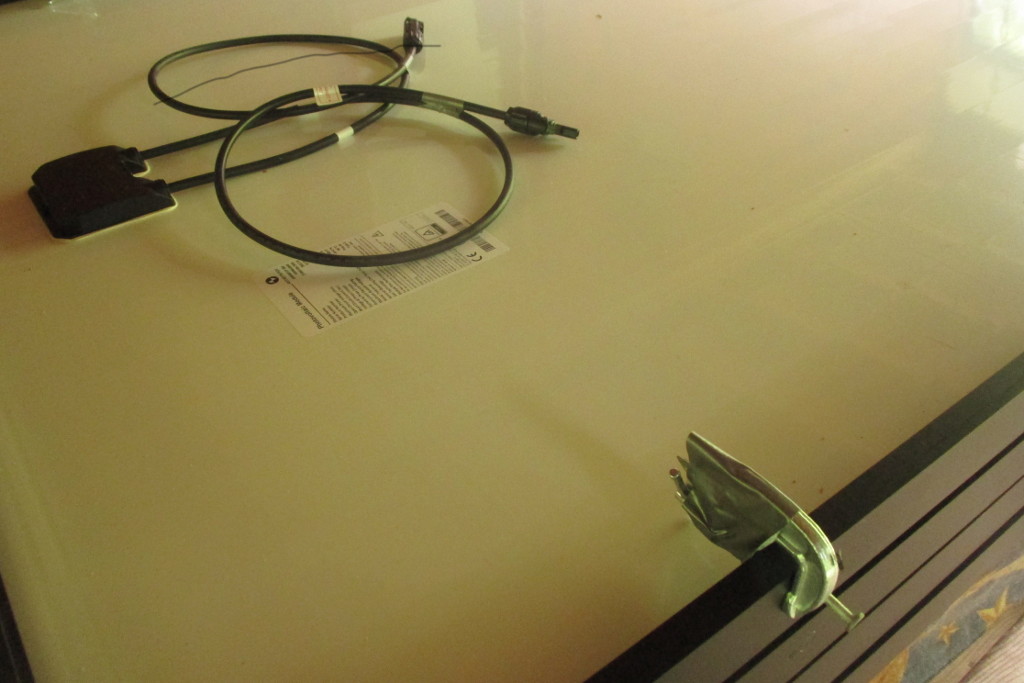
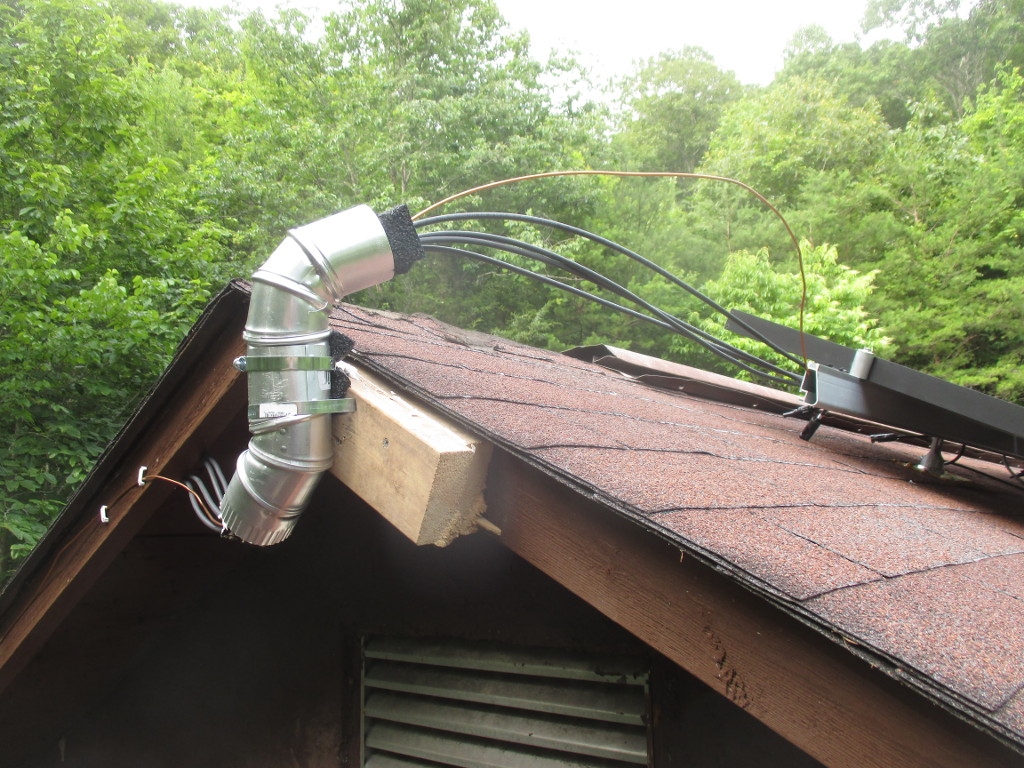
My main concerns were, would I be able to find the rafters when installing the rails, and would the 5x3 foot panels be too unweildly to get up on the roof by myself. I was able to find the rafters, without needing a stud finder, after I removed the roof's vent caps, which exposed the rafters. The shingles were on straight enough that I could follow the lines down and drilled into the rafter on the first try every time. And I got the rails on spaced well and straight, although I could have spaced the FlashFeet out better (oops). My drill ran out of juice half-way, and I had to hack it to recharge on solar power, but that's another story. Between the learning curve, a lot of careful measurement, not the greatest shoes for roofing, and waiting for recharging, it took two days to get the 8 FlashFeet installed and the rails mounted. Taking a break from that and swimming in the river, I realized I should have been wearing my water shoes on the roof all along. Super soft and nubbly, they make me feel like a gecko up there! After recovering from an (unrelated) achilles tendon strain, I got the panels installed today. Turns out they're not hard to handle on the roof by myself. Getting them up a ladder to the roof by yourself would normally be another story, but my house has a 2 foot step up from the back retaining wall to the roof, and even has a handy grip beam as you step up. roof next to the ground with a couple of cinderblock steps The last gotcha, which I luckily anticipated, is that panels will slide down off the rails before you can get them bolted down. This is where a second pair of hands would have been most useful. But, I macguyvered a solution, attaching temporary clamps before bringing a panel up, that stopped it sliding down while I was attaching it. clamp temporarily attached to side of panel I also finished the outside wiring today. Including the one hack of this install so far. Since the local hardware store didn't have a suitable conduit to bring the cables off the roof, I cobbled one together from pipe, with foam inserts to prevent chafing. some pipe with 5 wires running through it, attached to the side of the roof While I have 1 kilowatt of power on my roof now, I won't be able to use it until next week. After ordering the upgrade, I realized that my old PWM charge controller would be able to handle less than half the power, and to get even that I would have needed to mount the fuse box near the top of the roof and run down a large and expensive low-voltage high-amperage cable, around OO AWG size. Instead, I'll be upgrading to a MPPT controller, and running a single 150 volt cable to it. Then, since the MPPT controller can only handle 1 kilowatt when it's converting to 24 volts, not 12 volts, I'm gonna have to convert the entire house over from 12V DC to 24V DC, including changing all the light fixtures and rewiring the battery bank...

9 May 2017

Olivier Berger: Installing a Docker Swarm cluster inside VirtualBox with Docker Machine

I ve documented the process of installing a Docker Swarm cluster inside VirtualBox with Docker Machine. This allows experimenting with Docker Swarm, the simple docker container orchestrator, over VirtualBox. This allows you to play with orchestration scenarii without having to install docker on real machines. Also, such an environment may be handy for teaching if you don t want to install docker on the lab s host. Installing the docker engine on Linux hosts for unprivileged users requires some care (refer to docs about securing Docker), as the default configuration may allow learners to easily gain root privileges (which may or not be desired). See more at http://www-public.telecom-sudparis.eu/~berger_o/docker/install-docker-machine-virtualbox.html

7 April 2017

Dirk Eddelbuettel: #3: Follow R-devel

Welcome to the third post in the rarely relevant R recommendation series, or R4 for short. Today will be brief, but of some importance. In order to know where R is going next, few places provide a better vantage point than the actual ongoing development. A few years ago, I mentioned to Duncan Murdoch how straightforward the setup of my CRANberries feed (and site) was. After all, static blog compilers converting textual input to html, rss feed and whatnot have been around for fifteen years (though they keep getting reinvented). He took this to heart and built the (not too pretty) R-devel daily site (which also uses a fancy diff tool as it shows changes in NEWS) as well as a more general description of all available sub-feeds. I follow this mostly through blog aggregations -- Google Reader in its day, now Feedly. A screenshot is below just to show that it doesn't have to be ugly just because it is on them intertubes:
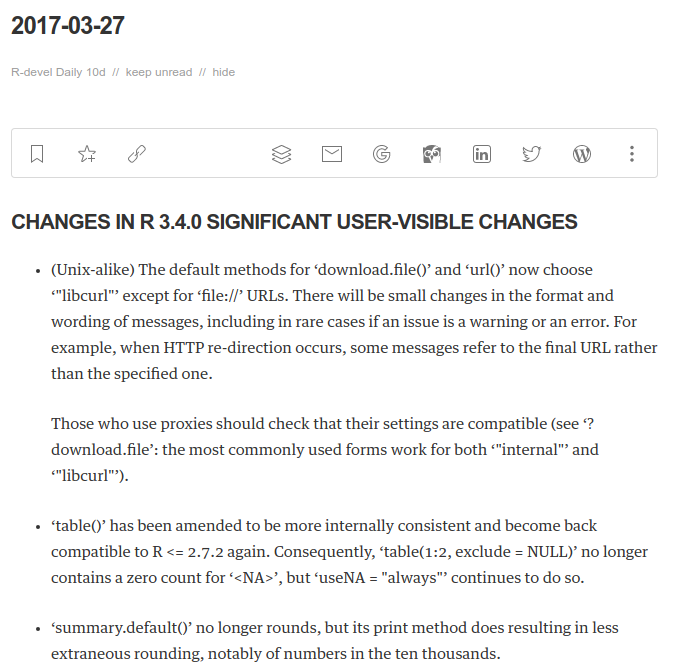
This shows a particularly useful day when R-devel folded into the new branch for what will be the R 3.4.0 release come April 21. The list of upcoming changes is truly impressive and quite comprehensive -- and the package registration helper, focus of posts #1 and #2 here, is but one of these many changes. One function I learned about that day is tools::CRAN_package_db(), a helper to get a single (large) data.frame with all package DESCRIPTION information. Very handy. Others may have noticed that CRAN repos now have a new top-level file PACKAGES.rds and this function does indeed just fetch it--which you could do with a similar one-liner in R-release as well. Still very handy. But do read about changes in R-devel and hence upcoming changes in R 3.4.0. Lots of good things coming our way.

This post by Dirk Eddelbuettel originated on his Thinking inside the box blog. Please report excessive re-aggregation in third-party for-profit settings.

1 February 2017

Hideki Yamane: How to check your package for FTBFS with clang

GCC 7 doesn't go into Debian9, but gcc maintainers now file FTBFS bugs for it.

Also you can check packages via building with clang easily. I've already prepared pbuilder (and cowbuilder) build hook script for it. So, if you want to check a package with clang 4.0,

$ mkdir ~/hookdir
$ ln -s /usr/share/doc/pbuilder/examples/D65various-compiler-support ~/pbuilder-hookdir
(modify your pbuilderrc as adding 1 line like below)
HOOKDIR=/home/henrich/pbuilder-hookdir
$ sudo CHOOSE_COMPILER="clang-4.0" cowbuilder --build yourpackage_1.0-1.dsc

That's all - it's handy, isn't it? Please try it to make your package more healthy :)

31 January 2017

Elizabeth Ferdman: 8 Week Progress Update for PGP Clean Room

During the last few weeks, I learned about internationalization in bash and did a lot of refactoring/decomposing of the UI code, making the code a lot more DRY. Internationalization This intro to Internationalization in Bash from the Linux Journal and this Slackware doc put me on the road to internationalizing the UI code I had written thus far. Instead of hardcoding strings into the whiptail commands, like this:
PRIMARY_UID=$(whiptail --inputbox "$PRIMARY_UID_TEXT_EN" 8 78 --title "$PRIMARY_UID_TITLE_EN" 3>&1 1>&2 2>&3)
I set up a Message Catalog in a Portable Object file for English: en.po. The .po file contains msgid-msgstr key-value pairs:
msgid "EXPIRY_TEXT"
msgstr ""
"Please specify how long the key should be valid.\n"
"\t   0 = key does not expire\n"
"\t <n> = key expires in n days\n"
"\t<n>w = key expires in n weeks\n"
"\t<n>m = key expires in n months\n"
"\t<n>y = key expires in n years"
msgid "PRIMARY_UID_TITLE"
msgstr "Primary UID"
To make these .po files usable in a script, use the Linux utility msgfmt to turn .po files into Message Object files:
mkdir -p $HOME/project/locale/en_US/LC_MESSAGES/
msgfmt -o $HOME/project/locale/en_US/LC_MESSAGES/ui-strings.mo po/en.po
Now that we have a Message Object file, we can access the key value pairs in a script using the gettext command. Pass the name of the msgid as a string to get back the localized natural language string:
whiptail_yesno()  	
	whiptail --yesno "$(gettext $1)" $DIMENS --title "$(gettext $2)"
	return $?
if whiptail_yesno "ENCR_SUBKEY_YESNO_TEXT" "ENCR_SUBKEY_YESNO_TITLE"; then
...
In order for this to work, though, it s important to export some environmental variables before running gettext. Mine look like:
export TEXTDOMAINDIR=$HOME/gpg-helper-scripts/locale
export TEXTDOMAIN=ui-strings
export LANG=en_US.UTF-8
Refactoring/Reorganizing
gpg-helper-scripts/
  gpg/
       create_keys.sh
       add_uids.py
  whiptail/
       main_menu.sh
       gen_keys.sh
       smartcard_init.sh
       whiptail_helper.sh
  po/
       en.po
  locale/
       en_US/LC_MESSAGES/ui-strings.mo
  details/
       gpg-algos
       smartcard-workflow
  init.sh
  README.md
While setting up whiptail functions I learned that one does not simply return values in bash. With the help of another Linux Journal article, I came up with:
whiptail_password()  
	__resultvar=$1	
	result=$(whiptail --passwordbox "$(gettext $2)" $DIMENS --title "$(gettext $3)" 3>&1 1>&2 2>&3)
	eval $__resultvar="'$result'"
 
to store user input as variables while keeping the code DRY. I also looked a little bit at Google s Shell Style Guide, gave my files better names and organized the directory structure. GPG I was curious about the correct abbreviations, key lengths and usages for all of the gpg2.1.16 supported algorithms so I created a reference in details/gpg-algos that will come in handy for validating the user s input for different types of keys. Moving Forward Now that the code is much more readable, I can think more about the UI and the options that I want to include:
Lots more options could be added here.. Let me know your ideas. Thanks for reading!

23 January 2017

Sam Hartman: Cudos to GDB Contributors

I recently diagnosed a problem in Debian's pam-p11 package. This package allegedly permits logging into a computer using a smart card or USB security token containing an ssh key. If you know the PIN and have the token, then your login attempt is authorized against the ssh authorized keys file. This seems like a great way to permit console logins as root to machines without having a shared password. Unfortunately, the package didn't work very well for me. It worked once, then all future attempts to use it segfaulted. I'm familiar with how PAM works. I understand the basic ideas behind PKCS11 (the API used for this type of smart card), but was completely unfamiliar with this particular PAM module and the PKCS11 library it used. The segfault was in an area of code I didn't even expect that this PAM module would ever call. Back in 1994, that would have been a painful slog. Gdb has improved significantly since then, and I'd really like to thank all the people over the years who made that possible. I was able to isolate the problem in just a couple of hours of debugging. Here are some of the cool features I used: Anyway, with just a couple of hours and no instrumentation of the code, I managed to track down how a bunch of structures were being freed as an unexpected side effect of one of the function calls. Neither I nor the author of the pam-p11 module expected that (although it is documented and does make sense in retrospect). Good tools make life easier.

21 January 2017

Clint Adams: Strangers with candy

This.
Posted on 2017-01-21
Tags: barks

19 January 2017

Matthew Garrett: Android apps, IMEIs and privacy

There's been a sudden wave of people concerned about the Meitu selfie app's use of unique phone IDs. Here's what we know: the app will transmit your phone's IMEI (a unique per-phone identifier that can't be altered under normal circumstances) to servers in China. It's able to obtain this value because it asks for a permission called READ_PHONE_STATE, which (if granted) means that the app can obtain various bits of information about your phone including those unique IDs and whether you're currently on a call.

Why would anybody want these IDs? The simple answer is that app authors mostly make money by selling advertising, and advertisers like to know who's seeing their advertisements. The more app views they can tie to a single individual, the more they can track that user's response to different kinds of adverts and the more targeted (and, they hope, more profitable) the advertising towards that user. Using the same ID between multiple apps makes this easier, and so using a device-level ID rather than an app-level one is preferred. The IMEI is the most stable ID on Android devices, persisting even across factory resets.

The downside of using a device-level ID is, well, whoever has that data knows a lot about what you're running. That lets them tailor adverts to your tastes, but there are certainly circumstances where that could be embarrassing or even compromising. Using the IMEI for this is even worse, since it's also used for fundamental telephony functions - for instance, when a phone is reported stolen, its IMEI is added to a blacklist and networks will refuse to allow it to join. A sufficiently malicious person could potentially report your phone stolen and get it blocked by providing your IMEI. And phone networks are obviously able to track devices using them, so someone with enough access could figure out who you are from your app usage and then track you via your IMEI. But realistically, anyone with that level of access to the phone network could just identify you via other means. There's no reason to believe that this is part of a nefarious Chinese plot.

Is there anything you can do about this? On Android 6 and later, yes. Go to settings, hit apps, hit the gear menu in the top right, choose "App permissions" and scroll down to phone. Under there you'll see all apps that have permission to obtain this information, and you can turn them off. Doing so may cause some apps to crash or otherwise misbehave, whereas newer apps may simply ask for you to grant the permission again and refuse to do so if you don't.

Meitu isn't especially rare in this respect. Over 50% of the Android apps I have handy request your IMEI, although I haven't tracked what they all do with it. It's certainly something to be concerned about, but Meitu isn't especially rare here - there are big-name apps that do exactly the same thing. There's a legitimate question over whether Android should be making it so easy for apps to obtain this level of identifying information without more explicit informed consent from the user, but until Google do anything to make it more difficult, apps will continue making use of this information. Let's turn this into a conversation about user privacy online rather than blaming one specific example.

comment count unavailable comments

16 January 2017

Maria Glukhova: APK, images and other stuff.

2 more weeks of my awesome Outreachy journey have passed, so it is time to make an update on my progress. I continued my work on improving diffoscope by fixing bugs and completing wishlist items. These include:

Improving APK support I worked on #850501 and #850502 to improve the way diffoscope handles APK files. Thanks to Emanuel Bronshtein for providing clear description on how to reproduce these bugs and ideas on how to fix them. And special thanks to Chris Lamb for insisting on providing tests for these changes! That part actually proved to be little more tricky, and I managed to mess up with these tests (extra thanks to Chris for cleaning up the mess I created). Hope that also means I learned something from my mistakes. Also, I was pleased to see F-droid Verification Server as a sign of F-droid progress on reproducible builds effort - I hope these changes to diffoscope will help them!

Adding support for image metadata That came from #849395 - a request was made to compare image metadata along with image content. Diffoscope has support for three types of images: JPEG, MS Windows Icon (*.ico) and PNG. Among these, PNG already had good image metadata support thanks to sng tool, so I worked on .jpeg and .ico files support. I initially tried to use exiftool for extracting metadata, but then I discovered it does not handle .ico files, so I decided to use a bigger force - ImageMagick s identify - for this task. I was glad to see it had that handy -format option I could use to select only the necessary fields (I found their -verbose, well, too verbose for the task) and presenting them in the defined form, negating the need of filtering its output. What was particulary interesting and important for me in terms of learning: while working on this feature, I discovered that, at the moment, diffoscope could not handle .ico files at all - img2txt tool, that was used for retrieving image content, did not support that type of images. But instead of recognizing this as a bug and resolving it, I started to think of possible workaround, allowing for retrieving image metadata even after retrieving image content failed. Definetely not very good thinking. Thanks Mattia Rizzolo for actually recognizing this as a bug and filing it, and Chris Lamb for fixing it!

Other work

Order-like differences, part 2 In the previous post, I mentioned Lunar s suggestion to use hashing for finding order-like difference in wide variety of input data. I implemented that idea, but after discussion with my mentor, we decided it is probably not worth it - this change would alter quite a lot of things in core modules of diffoscope, and the gain would be not really significant. Still, implementing that was an important experience for me, as I had to hack on deepest and, arguably, most difficult modules of diffoscope and gained some insight on how they work.

Comparing with several tools (work in progress) Although my initial motivation for this idea was flawed (the workaround I mentioned earlier for .ico files), it still might be useful to have a mechanism that would allow to run several commands for finding difference, and then give the output of those that succeed, failing if and only if they all have failed. One possible case when it might happen is when we use commands coming from different tools, and one of them is not installed. It would be nice if we still used the other and not the uninformative binary diff (that is a default fallback option for when something goes wrong with more clever comparison). I am still in process of polishing this change, though, and still in doubt if it is needed at all.

Side note - Outreachy and my university progress In my Outreachy application, I promised that if I am selected into this round, I will do everything I can to unload the required time period from my university time commitements. I did that by moving most of my courses to the first half of the academic year. Now, the main thing that is left for me to do is my Master s thesis. I consulted my scientific advisors from both universities that I am formally attending (SFEDU and LUT - I am in double degree program), and as a result, they agreed to change my Master s thesis topic to match my Outreachy work. Now, that should have sounded like an excellent news - merging these activities together actually mean I can allocate much more time to my work on reproducible builds, even beyond the actual internship time period. That was intended to remove a burden from my shoulders. Still, I feel a bit uneasy. The drawback of this decision lies in fact I have no idea on how to write scientific report based on pure practical work. I know other students from my universities have done such things before, but choosing my own topic means my scientific advisors can t help me much - this is just out of their area of expertise. Well, wish me luck - I m up to the challenge!

6 January 2017

Elena 'valhalla' Grandi: Candy from Strangers

Candy from Strangers

A few days ago I gave a talk at ESC https://www.endsummercamp.org/ about some reasons why I think that using software and especially libraries from the packages of a community managed distribution is important and much better than alternatives such as pypi, nmp etc. This article is a translation of what I planned to say before forgetting bits of it and luckily adding it back as an answer to a question :)

When I was young, my parents taught me not to accept candy from strangers, unless they were present and approved of it, because there was a small risk of very bad things happening. It was of course a simplistic rule, but it had to be easy enough to follow for somebody who wasn't proficient (yet) in the subtleties of social interactions.

One of the reasons why it worked well was that following it wasn't a big burden: at home candy was plenty and actual offers were rare: I only remember missing one piece of candy because of it, and while it may have been a great one, the ones I could have at home were also good.

Contrary to candy, offers of gratis software from random strangers are quite common: from suspicious looking websites to legit and professional looking ones, to platforms that are explicitly designed to allow developers to publish their own software with little or no checks.

Just like candy, there is also a source of trusted software in the Linux distributions, especially those lead by a community: I mention mostly Debian because it's the one I know best, but the same principles apply to Fedora and, to some measure, to most of the other distributions. Like good parents, distributions can be wrong, and they do leave room for older children (and proficient users) to make their own choices, but still provide a safe default.

Among the unsafe sources there are many different cases and while they do share some of the risks, they have different targets with different issues; for brevity the scope of this article is limited to the ones that mostly concern software developers: language specific package managers and software distribution platforms like PyPi, npm and rubygems etc.

These platforms are extremely convenient both for the writers of libraries, who are enabled to publish their work with minor hassles, and for the people who use such libraries, because they provide an easy way to install and use an huge amount of code. They are of course also an excellent place for distributions to find new libraries to package and distribute, and this I agree is a good thing.

What I however believe is that getting code from such sources and using it without carefully checking it is even more risky than accepting candy from a random stranger on the street in an unfamiliar neighbourhood.

The risk aren't trivial: while you probably won't be taken as an hostage for ransom, your data could be, or your devices and the ones who run your programs could be used in some criminal act causing at least some monetary damage both to yourself and to society at large.

If you're writing code that should be maintained in time there are also other risks even when no malice is involved, because each package on these platform has a different policy with regards to updates, their backwards compatibility and what can be expected in case an old version is found to have security issues.

The very fact that everybody can publish anything on such platforms is both their biggest strength and their main source of vulnerability: while most of the people who publish their libraries do so with good intentions, attacks have been described and publicly tested, such as the fun typo-squatting http://incolumitas.com/2016/06/08/typosquatting-package-managers/ one (archived on http://web.archive.org/web/20160801161807/http://incolumitas.com/2016/06/08/typosquatting-package-managers) that published harmless malicious code under common typos for famous libraries.

Contrast this with Debian, where everybody can contribute, but before they are allowed full unsupervised access to the archive they have to establish a relationship with the rest of the community, which includes meeting other developers in real life, at the very least to get their gpg keys signed.

This doesn't prevent malicious people from introducing software, but raises significantly the effort required to do so, and once caught people can usually be much more effectively prevented from repeating it than a simple ban on an online-only account can do.

It is true that not every Debian maintainer actually does a full code review of everything that they allow in the archive, and in some cases it would be unreasonable to expect it, but in most cases they are at least reasonably familiar with the code to do at least bug triage, and most importantly they are in an excellent position to establish a relationship of mutual trust with the upstream authors.

Additionally, package maintainers don't work in isolation: a growing number of packages are being maintained by a team of people, and most importantly there are aspects that involve potentially the whole community, from the fact that new packages that enter the distribution are publicity announced on a mailing list to the various distribution-wide QA efforts.

Going back to the language specific distribution platforms, sometimes even the people who manage the platform themselves can't be fully trusted to do the right thing: I believe everybody in the field remembers the npm fiasco https://lwn.net/Articles/681410/ where a lawyer letter requesting the removal of a package started a series of events that resulted in potentially breaking a huge amount of automated build systems.

Here some of the problems were caused by some technical policies that caused the whole ecosystem to be especially vulnerable, but one big issue was the fact that the managers of the npm platform are a private entity with no oversight from the user community.

Here not all distributions are equal, but contrast this with Debian, where the distribution is managed by a community that is based on a social contract https://www.debian.org/social_contract and is governed via democratic procedures established in its https://www.debian.org/devel/constitution.

Additionally, the long history of the distribution model means that many issues have already been met, the errors have already been done, and there are established technical procedures to deal with them in a better way.

So, shouldn't we use language specific distribution platforms at all? No! As developers we aren't children, we are adults who have the skills to distinguish between safe and unsafe libraries just as well as the average distribution maintainer can do. What I believe we should do is stop treating them as a safe source that can be used blindly and reserve that status to actual trustful sources like Debian, falling back to the language specific platforms only when strictly needed, and in that case:

actually check carefully what we are using, both by reading the code and by analysing the development and community practices of the authors;
if possible, share that work by becoming ourselves maintainers of that library in our favourite distribution, to prevent duplication of effort and to give back to the community whose work we get advantage from.

Edit: fixed broken typosquatting url

Next.

Previous.