
I spent last week at the
Ubuntu Developer Summit in Belgium, where we kicked off the 10.10 development cycle.
Due to our time-boxed release cycle, not everything discussed here will necessarily appear in Ubuntu 10.10, but this should provide a reasonable overview of the direction we re taking.
Presentations
While most of our time at UDS is spent in small group meetings to discuss specific topics, there are also a handful of presentations to convey key information and stimulate creative thinking.
A few of the more memorable ones for me were:
- Mark Shuttleworth talked about the desktop, in particular the introduction of the new Unity shell for Ubuntu Netbook Edition
- Fanny Chevalier presented Diffamation, a tool for visualizing and navigating the history of a document in a very flexible and intuitive way
- Rick Spencer talked about the development process for 10.10 and some key changes in it, including a greater focus on meeting deadlines for freezes (and making fewer exceptions)
- Stefano Zacchiroli, the current Debian project leader, gave an overview of how Ubuntu and Debian developers are working together today, and how this could be improved. He has posted a summary on the debian-project mailing list.
The talks were all recorded, though they may not all be online yet.
Foundations
The Foundations team provides essential infrastructure, tools, packages and processes which are central to the development of all Ubuntu products. They make it possible for the desktop and server teams to focus on their areas of expertise, building on a common base system and development procedures.
Highlights from their
track:
- Early on in the week, they conducted a retrospective to discuss how things went during the 10.04 cycle and how we can improve in the future
- One of their major projects has been about revision control for all of Ubuntu s source code, and they talked last week about what s next
- We re aiming to provide btrfs as an install-time option in 10.10
- In order to keep Ubuntu moving forward, the foundations team is always on the lookout for stale bits which we don t need to keep around anymore. At UDS, they discussed culling unattended packages, retiring the IA64 and SPARC ports and other spring cleaning
- There was a lot of discussion about Upstart, including its further development, implications for servers, desktops and the kernel, and the migration of server init scripts to upstart jobs
- After maintaining two separate x86 boot loaders for years, it looks like we may be ready to replace isolinux with GRUB2 on Ubuntu CDs
Desktop
The desktop team manages both Desktop Edition and Netbook Edition, on a mission to provide a top-notch experience to users across a range of client computing devices.
Highlights from their
track:
- A key theme for 10.10 is to help developers to create applications for Ubuntu, by providing a native development environment, improving Quickly, improving desktopcouch, making it easier to get started with desktopcouch, and enabling developers to deliver new applications to Ubuntu users continuously
- With more and more touch screen devices appearing, Ubuntu will grow some new features to support touch oriented applications
- The web browser is a staple application for Ubuntu, and as such we are always striving for the best experience for our users. The team is looking ahead to Chromium, using apport to improve browser bug reports, and providing a web-oriented document capability via Zoho
- Building on work done in 10.04, we will aim to make simple things simple for basic photo editing
- Security-conscious users may rest easier knowing that the X window system will run without root privileges where kernel modesetting is supported
Server/Cloud
The server team is charging ahead with making Ubuntu the premier server OS for
cloud computing environments.
Highlights from their
track:
- Providing more powerful tools for managing Ubuntu in EC2 and Ubuntu Enterprise Cloud infrastructure, including boot-time configuration, image and instance management, and kernel upgrades
- Improving Ubuntu Enterprise Cloud by adding new Eucalyptus features (such as LXC container support, monitoring, rapid provisioning, and load balancing. If you ever wanted to run a UEC demo from a USB stick, that s possible too.
- Providing packaged solutions for cloud building blocks such as hadoop and pig, Drupal, ehcache, Spring, various NOSQL databases, web frameworks, and more
- Providing turn-key solutions for free software applications like Alfresco and Kolab
- Making Puppet easier to deploy, easier to configure, and easier to scale in the cloud
ARM
Kiko Reis gave a talk introducing ARM and the corresponding opportunity for Ubuntu. The ARM team ran a full
track during the week on all aspects of their work, from the technical details of the kernel and toolchain, to the assembly of a complete port of Netbook Edition 10.10 for several ARM platforms.
Kernel
The kernel team provided essential input and support for the above efforts, and also held their own
track where they selected 2.6.35 as their target version, agreed on a variety of
changes to the Ubuntu kernel configuration, and created a plan for providing
backports of newer kernels to LTS releases to support deployment on newer hardware.
Security
Like the kernel team, the security team provided valuable input into the technical plans being developed by other teams, and also organized a
security track to tackle some key security topics such as
clarifying the duration of maintenance for various collections of packages, and the ongoing development of
AppArmor and Ubuntu s
AppArmor profiles.
QA
The QA team focuses on testing, test automation and bug management throughout the project. While quality is everyone s responsibility, the QA team helps to coordinate these activities across different teams, establish common standards, and maintain shared infrastructure and tools.
Highlights from their
track include:
Design
The design team organized a track at UDS for the first time this cycle, and
team manager Ivanka Majic gave a presentation to help explain its purpose and scope.
Toward the end of the week, I joined in a round table discussion about some of the challenges faced by the team in engaging with the Ubuntu community and building support for their work. This is a landmark effort in mating professional design with free software community, and there is still much to learn about how to do this well.
Community
The community
track discussed the usual line-up of events, outreach and advocacy programs, organizational tools, and governance housekeeping for the 10.10 cycle, as well as goals for improving the translation of Ubuntu and related resources into many languages.
One notable project is an initiative to aggressively
review patches submitted to the bug tracker, to show our appreciation for these contributions by processing them more quickly and completely.


 I'm happy to conclude quoting the acknowledgments section of the
paper:
Acknowledgments



 The DPL vote is over. I did not win, apparently. Let me start off by
thanking the other candidates for running, and congratulating Stefano
for winning.
My own results aren't too bad; I beat 'none of the above' by a
comfortable margin of almost 10 to 1, and ended up defeating
Charles Plessy by a slightly smaller margin. My margin to NOTA was far
better than during the previous DPL election that I participated in,
though I did end up defeating more than half of the other candidates
back then, which I didn't this time around. All in all, not enough to
win, but enough to conclude that I might have a chance some other time.
Margarita and Stefano were just better candidates this time around.
My own vote was:
 I ve been AWOL for most of the debian project leader election campaigns this year, but I still want to vote, so I ve been dredging the emails on the last day. Maybe someone still has to vote and reads this, or maybe it ll help someone to interpret the result.
What I ve done this year is to make a quick tally of platform points and campaign answers that I liked and disliked for each candidate, then total them up to get an order. If anyone gets a negative (more dislikes than likes), then I ll rank them below NOTA.
Platforms:


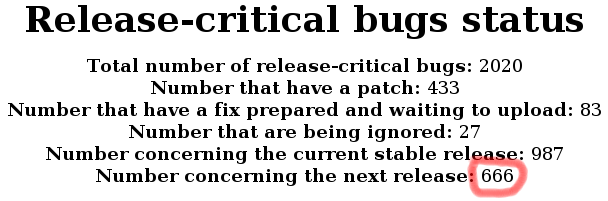
 After fixing some bugs this week, I ve noticed they ve been one per day (on average) so I think I m joining