Search Results: "Dirk Eddelbuettel"

14 January 2025

Dirk Eddelbuettel: RProtoBuf 0.4.23 on CRAN: Mulitple Updates

A new maintenance release 0.4.23 of RProtoBuf arrived on CRAN earlier today, about one year after the previous update. RProtoBuf provides R with bindings for the Google Protocol Buffers ( ProtoBuf ) data encoding and serialization library used and released by Google, and deployed very widely in numerous projects as a language and operating-system agnostic protocol. This release brings a number of contributed PRs which are truly appreciate. As the package dates back fifteen+ years, some code corners can be crufty which was addressed in several PRs, as were two updates for ongoing changes / new releases of ProtoBuf itself. I also made the usual changes one does to continuous integrations, README badges and URL as well as correcting one issue the checkbashism script complained about. The following section from the NEWS.Rd file has full details.

Changes in RProtoBuf version 0.4.23 (2022-12-13)
  • More robust tests using toTextFormat() (Xufei Tan in #99 addressing #98)
  • Various standard packaging updates to CI and badges (Dirk)
  • Improvements to string construction in error messages (Michael Chirico in #102 and #103)
  • Accommodate ProtoBuf 26.x and later (Matteo Gianella in #104)
  • Accommodate ProtoBuf 6.30.9 and later (Lev Kandel in #106)
  • Correct bashism issues in configure.ac (Dirk)

Thanks to my CRANberries, there is a diff to the previous release. The RProtoBuf page has copies of the (older) package vignette, the quick overview vignette, and the pre-print of our JSS paper. Questions, comments etc should go to the GitHub issue tracker off the GitHub repo.

This post by Dirk Eddelbuettel originated on his Thinking inside the box blog. If you like this or other open-source work I do, you can sponsor me at GitHub.

12 January 2025

Dirk Eddelbuettel: Rcpp 1.0.14 on CRAN: Regular Semi-Annual Update

rcpp logo The Rcpp Core Team is once again thrilled, pleased, and chuffed (am I doing this right for LinkedIn?) to announce a new release (now at 1.0.14) of the Rcpp package. It arrived on CRAN earlier today, and has since been uploaded to Debian. Windows and macOS builds should appear at CRAN in the next few days, as will builds in different Linux distribution and of course r2u should catch up tomorrow too. The release was only uploaded yesterday, and as always get flagged because of the grandfathered .Call(symbol) as well as for the url to the Rcpp book (which has remained unchanged for years) failing . My email reply was promptly dealt with under European morning hours and by the time I got up the submission was in state waiting over a single reverse-dependency failure which is also spurious, appears on some systems and not others, and also not new. Imagine that: nearly 3000 reverse dependencies and only one (spurious) change to worse. Solid testing seems to help. My thanks as always to the CRAN for responding promptly. This release continues with the six-months January-July cycle started with release 1.0.5 in July 2020. This time we also need a one-off hotfix release 1.0.13-1: we had (accidentally) conditioned an upcoming R change on 4.5.0, but it already came with 4.4.2 so we needed to adjust our code. As a reminder, we do of course make interim snapshot dev or rc releases available via the Rcpp drat repo as well as the r-universe page and repo and strongly encourage their use and testing I run my systems with these versions which tend to work just as well, and are also fully tested against all reverse-dependencies. Rcpp has long established itself as the most popular way of enhancing R with C or C++ code. Right now, 2977 packages on CRAN depend on Rcpp for making analytical code go faster and further. On CRAN, 13.6% of all packages depend (directly) on Rcpp, and 60.8% of all compiled packages do. From the cloud mirror of CRAN (which is but a subset of all CRAN downloads), Rcpp has been downloaded 93.7 million times. The two published papers (also included in the package as preprint vignettes) have, respectively, 1947 (JSS, 2011) and 354 (TAS, 2018) citations, while the the book (Springer useR!, 2013) has another 676. This release is primarily incremental as usual, generally preserving existing capabilities faithfully while smoothing our corners and / or extending slightly, sometimes in response to changing and tightened demands from CRAN or R standards. The move towards a more standardized approach for the C API of R once again to a few changes; Kevin did once again did most of these PRs. Other contributed PRs include G bor permitting builds on yet another BSD variant, Simon Guest correcting sourceCpp() to work on read-only files, Marco Colombo correcting a (surprisingly large) number of vignette typos, I aki rebuilding some documentation files that tickled (false) alerts, and I took care of a number of other maintenance items along the way. The full list below details all changes, their respective PRs and, if applicable, issue tickets. Big thanks from all of us to all contributors!

Changes in Rcpp release version 1.0.14 (2025-01-11)
  • Changes in Rcpp API:
    • Support for user-defined databases has been removed (Kevin in #1314 fixing #1313)
    • The SET_TYPEOF function and macro is no longer used (Kevin in #1315 fixing #1312)
    • An errorneous cast to int affecting large return object has been removed (Dirk in #1335 fixing #1334)
    • Compilation on DragonFlyBSD is now supported (G bor Cs rdi in #1338)
    • Use read-only VECTOR_PTR and STRING_PTR only with with R 4.5.0 or later (Kevin in #1342 fixing #1341)
  • Changes in Rcpp Attributes:
    • The sourceCpp() function can now handle input files with read-only modes (Simon Guest in #1346 fixing #1345)
  • Changes in Rcpp Deployment:
    • One unit tests for arm64 macOS has been adjusted; a macOS continuous integration runner was added (Dirk in #1324)
    • Authors@R is now used in DESCRIPTION as mandated by CRAN, the Rcpp.package.skeleton() function also creates it (Dirk in #1325 and #1327)
    • A single datetime format test has been adjusted to match a change in R-devel (Dirk in #1348 fixing #1347)
  • Changes in Rcpp Documentation:
    • The Rcpp Modules vignette was extended slightly following #1322 (Dirk)
    • Pdf vignettes have been regenerated under Ghostscript 10.03.1 to avoid a false positive by a Windows virus scanner (I aki in #1331)
    • A (large) number of (old) typos have been corrected in the vignettes (Marco Colombo in #1344)

Thanks to my CRANberries, you can also look at a diff to the previous release Questions, comments etc should go to the rcpp-devel mailing list off the R-Forge page. Bugs reports are welcome at the GitHub issue tracker as well (where one can also search among open or closed issues).

This post by Dirk Eddelbuettel originated on his Thinking inside the box blog. If you like this or other open-source work I do, you can sponsor me at GitHub.
10 January 2025

Dirk Eddelbuettel: nanotime 0.3.11 on CRAN: Polish

Another minor update 0.3.11 for our nanotime package is now on CRAN. nanotime relies on the RcppCCTZ package (as well as the RcppDate package for additional C++ operations) and offers efficient high(er) resolution time parsing and formatting up to nanosecond resolution, using the bit64 package for the actual integer64 arithmetic. Initially implemented using the S3 system, it has benefitted greatly from a rigorous refactoring by Leonardo who not only rejigged nanotime internals in S4 but also added new S4 types for periods, intervals and durations. This release covers two corner case. Michael sent in a PR avoiding a clang warning on complex types. We fixed an issue that surfaced in a downstream package under sanitizier checks: R extends coverage of NA to types such as integer or character which need special treatment in non-R library code as they do not know . We flagged (character) formatted values after we had called the corresponding CCTZ function but that leaves potentiall undefined values (from R s NA values for int, say, cast to double) so now we flag them, set a transient safe value for the call and inject the (character) representation "NA" after the call in those spots. End result is the same, but without a possibly slap on the wrist from sanitizer checks. The NEWS snippet below has the full details.

Changes in version 0.3.11 (2025-01-10)
  • Explicit Rcomplex assignment accommodates pickier compilers over newer R struct (Michael Chirico in #135 fixing #134)
  • When formatting, NA are flagged before CCTZ call to to not trigger santizier, and set to NA after call (Dirk in #136)

Thanks to my CRANberries, there is a diffstat report for this release. More details and examples are at the nanotime page; code, issue tickets etc at the GitHub repository and all documentation is provided at the nanotime documentation site.

This post by Dirk Eddelbuettel originated on his Thinking inside the box blog. If you like this or other open-source work I do, you can now sponsor me at GitHub.

9 January 2025

Dirk Eddelbuettel: inline 0.3.21: Minor Polish

A fresh minor release of the inline package got to CRAN today, following on the November release which had marked the first release in three and half years. inline facilitates writing code in-line in simple string expressions or short files. The package was used quite extensively by Rcpp in the very early days before Rcpp Attributes arrived on the scene providing an even better alternative for its use cases. inline is still used by rstan and a number of other packages. In the November release we accommodated upcoming R-devel changes on setting R_NO_REMAP by conditioning on the release version. It turns that this does not get when the #define independently so this needed a small refinement which this version brings. No other changes were made. The NEWS extract follows and details the changes some more.

Changes in inline version 0.3.21 (2025-01-08)
  • Refine use of Rf_warning in cfunction setting -DR_NO_REMAP ourselves to get R version independent state

Thanks to my CRANberries, you can also look at a diff to the previous release. Questions, comments etc should go to the rcpp-devel mailing list off the R-Forge page. Bugs reports are welcome at the GitHub issue tracker as well (where one can also search among open or closed issues).

This post by Dirk Eddelbuettel originated on his Thinking inside the box blog. If you like this or other open-source work I do, you can now sponsor me at GitHub.

8 January 2025

Dirk Eddelbuettel: RcppGetconf 0.0.4 on CRAN: Updates

A minor package update, the first in over six years, for the RcppGetconf package for reading system configuration not unlike getconf from the libc library is now on CRAN The changes are all minor package maintenance items of keeping URLs, continuous integration, and best practices current. We had two helper scripts use bash in their shebangs, and we just got dinged in one of them. Tedious as this can at times seem, it ensures CRAN packages do in fact compile just about anywhere which is a Good Thing (TM) so we obliged and updated the package with that change and all the others that had accumulated over six years. No interface or behaviour changes, just maintenance as one does at times. The short list of changes in this release follows:

Changes in inline version 0.0.4 (2025-01-07)
  • Dynamically linked compiled code is now registered in NAMESPACE
  • The continuous integration setup was update several times
  • The README was updated with current badges and URLs
  • The DESCRIPTION file now uses Authors@R
  • The configure and cleanup scripts use /bin/sh

Courtesy of my CRANberries, there is also a diffstat report of changes relative to the previous release. More about the package is at the local RcppGetconf page and the GitHub repo.

This post by Dirk Eddelbuettel originated on his Thinking inside the box blog. If you like this or other open-source work I do, you can now sponsor me at GitHub.

21 December 2024

Dirk Eddelbuettel: anytime 0.3.11 on CRAN: Maintenance

A follow-up release 0.3.11 to the recent 0.3.10 release release of the anytime package arrived on CRAN two days ago. The package is fairly feature-complete, and code and functionality remain mature and stable, of course. anytime is a very focused package aiming to do just one thing really well: to convert anything in integer, numeric, character, factor, ordered, input format to either POSIXct (when called as anytime) or Date objects (when called as anydate) and to do so without requiring a format string as well as accomodating different formats in one input vector. See the anytime page, or the GitHub repo for a few examples, and the beautiful documentation site for all documentation. This release simply skips one test file. CRAN labeled an error M1mac yet it did not reproduce on any of the other M1 macOS I can access (macbuilder, GitHub Actions) as this appeared related to a local setting of timezone values I could not reproduce anywwhere. So the only way to get rid of the fail is to not to run the test. Needless to say the upload process was a little tedious as I got the passive-aggressive not responding treatment on a first upload and the required email answer it lead to. Anyway, after a few days, and even more deep breaths, it is taken care of and now the package result standing is (at least currently) pristinely clean. The short list of changes follows.

Changes in anytime version 0.3.11 (2024-12-18)
  • Skip a test file

Courtesy of my CRANberries, there is also a diffstat report of changes relative to the previous release. The issue tracker tracker off the GitHub repo can be use for questions and comments. More information about the package is at the package page, the GitHub repo and the documentation site.

This post by Dirk Eddelbuettel originated on his Thinking inside the box blog. If you like this or other open-source work I do, you can now sponsor me at GitHub.

17 December 2024

Dirk Eddelbuettel: BH 1.87.0-1 on CRAN: New Upstream

Boost Boost is a very large and comprehensive set of (peer-reviewed) libraries for the C++ programming language, containing well over one hundred individual libraries. The BH package provides a sizeable subset of header-only libraries for (easier, no linking required) use by R. It is fairly widely used: the (partial) CRAN mirror logs (aggregated from the cloud mirrors) show over 38.5 million package downloads. Version 1.87.0 of Boost was released last week following the regular Boost release schedule of April, August and December releases. As before, we packaged it almost immediately and started testing following our annual update cycle which strives to balance being close enough to upstream and not stressing CRAN and the user base too much. The reverse depends check revealed six packages requiring changes or adjustments. We opened issue #103 to coordinate the issue (just as we did in previous years). Our sincere thanks to Matt Fidler who fixed two packages pretty much immediately. As I had not heard back from the other maintainers since filing the issue, I uploaded the package to CRAN suggesting that the coming winter break may be a good opportunity for the four other packages to catch up. CRAN concurred, and 1.87.0-1 is now available there. There are no other changes apart from cosmetics in the DESCRIPTION file. For once, we did not add any new Boost libraries. The short NEWS entry follows.

Changes in version 1.87.0-1 (2024-12-17)
  • Upgrade to Boost 1.87.0, patched as usual to comment-out diagnostic suppression messages per the request of CRAN
  • Switched to Authors@R

Via my CRANberries, there is a diffstat report relative to the previous release. Comments and suggestions about BH are welcome via the issue tracker at the GitHub repo.

This post by Dirk Eddelbuettel originated on his Thinking inside the box blog. If you like this or other open-source work I do, you can now sponsor me at GitHub.

16 December 2024

Dirk Eddelbuettel: #45: Some r-ci Updates

market monitor Welcome to post 45 in the $R^4 series! We introduced r-ci here in post #32 here nearly four years ago. It has found pretty widespread use and adoption, and we received a few kind words then (in the linked issue) and also more recently (in a follow-up comment) from which we merrily quote:
[ ] almost 3 years later on and I have had zero problems with this CI setup. For people who want reliable R software, resources like these are invaluable.
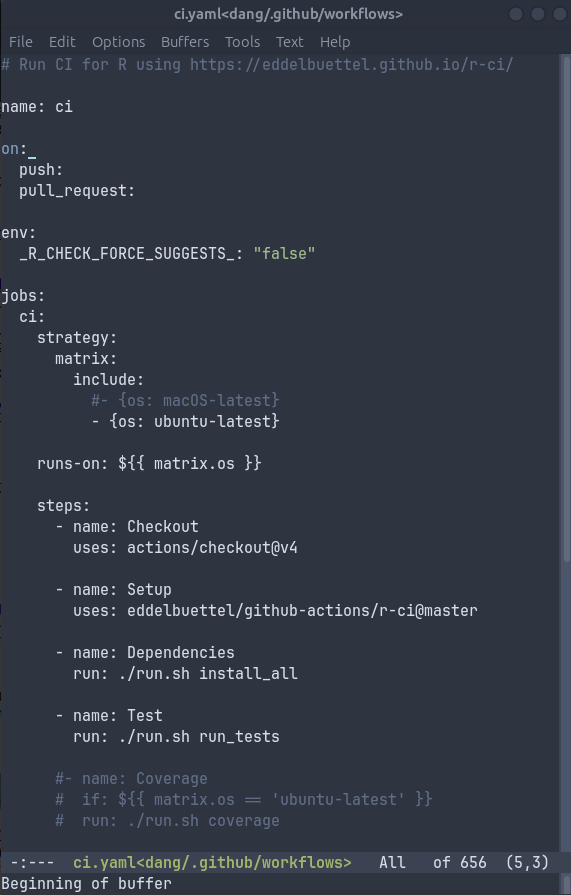
And while we followed up with post #41 about r2u for simple continuous integration, we may not have posted when we based r-ci on r2u (for the obvious Linux usage case). So let s make time now for a (comparitively smaller) update, and an update usage examples. We made two changes in the last few days. One is a (obvious in hindsight) simplification. Given that the bootstrap step was always executed, and needed no parameters, we pulled it into a new aggregated setup simply called r-ci that includes it so that it can be omitted as a step in the yaml file. Second, we recently needed Fortran on macOS too, and realized it was not installed by default so we just added that too. With that a real and used example is now as simple as the screenshot to the left (and hence one paragraph shorter). The trained eye will no doubt observe that there is nothing specific to a given repo. And that is basically the key feature: we can simply copy this file around and get fast and easy and reliable CI by taking advantage of the underlying robustness of r2u solving all dependency automagically and reliably. The option to enable macOS is also solid and compelling as the GitHub runners are fast (but more expensive in how the count against the limit of minutes so again a tradeoff to make), as is the option to run coverage if one so desires. Some of my repos do too. Take a look at the r-ci website which has more examples for the other supported CI servics it can used with, and feel free to ask questions as issue in the repo.

This post by Dirk Eddelbuettel originated on his Thinking inside the box blog. If you like this or other open-source work I do, you can now sponsor me at GitHub. Please report excessive re-aggregation in third-party for-profit settings.

12 December 2024

Dirk Eddelbuettel: #44: r2u For ML and MLops Talk

Welcome to the 44th post in the $R^4 series. A few weeks ago, and following an informal call for talks by James Lamb, I had an opportunity to talk about r2u to the Chicago ML and MLops meetup groups. You can find the slides here. Over the last 2 1/2 years, r2u has become a widely-deployed mechanism in a number of settings, including (but not limited to) software testing via continuous integration, deployment on cloud servers besides of course to more standard use on local laptops or workstation. 30 million downloads illustrate this. My thesis for the talk was that this extends equally to ML(ops) where no surprises, no hickups automated deployments are key for large-scale model training, evaluation and of course production deployments. In this context, I introduce r2u while giving credit both to what came before it, the existing alternatives (or competitors for mindshare if one prefers that phrasing), and of course what lies underneath it. The central takeaway, I argue, is that r2u can and does take advantage of a unique situation in that we can join the package manager task for the underlying (operating) system and and the application domain, here R and its unique CRAN repository network. Other approaches can, and of course do, provide binaries, but by doing this outside the realm of the system package manager can only arrive at a lesser integration (and I show a common error arising in that case). So where r2u is feasible, it dominates the alternatives (while the alternatives may well provide deployment on more platforms which, even when less integrated, may be of greater importance for some). As always, it all depends. But the talk, and its slides, motivate and illustrate why we keep calling r2u by its slogan of r2u: Fast. Easy. Reliable. Pick All Three.

This post by Dirk Eddelbuettel originated on his Thinking inside the box blog. If you like this or other open-source work I do, you can now sponsor me at GitHub. Please report excessive re-aggregation in third-party for-profit settings.

Dirk Eddelbuettel: RcppCCTZ 0.2.13 on CRAN: Maintenance

A new release 0.2.13 of RcppCCTZ is now on CRAN. RcppCCTZ uses Rcpp to bring CCTZ to R. CCTZ is a C++ library for translating between absolute and civil times using the rules of a time zone. In fact, it is two libraries. One for dealing with civil time: human-readable dates and times, and one for converting between between absolute and civil times via time zones. And while CCTZ is made by Google(rs), it is not an official Google product. The RcppCCTZ page has a few usage examples and details. This package was the first CRAN package to use CCTZ; by now several others packages (four the last time we counted) include its sources too. Not ideal, but beyond our control. This version include most routine package maintenance as well as one small contributed code improvement. The changes since the last CRAN release are summarised below.

Changes in version 0.2.13 (2024-12-11)
  • No longer set compilation standard as recent R version set a sufficiently high minimum
  • Qualify a call to cctz::format (Michael Quinn in #44)
  • Routine updates to continuous integration and badges
  • Switch to Authors@R in DESCRIPTION

Courtesy of my CRANberries, there is a diffstat report relative to to the previous version. More details are at the RcppCCTZ page; code, issue tickets etc at the GitHub repository. If you like this or other open-source work I do, you can sponsor me at GitHub.

This post by Dirk Eddelbuettel originated on his Thinking inside the box blog. Please report excessive re-aggregation in third-party for-profit settings.

8 December 2024

Dirk Eddelbuettel: pinp 0.0.11 on CRAN: Maintenance

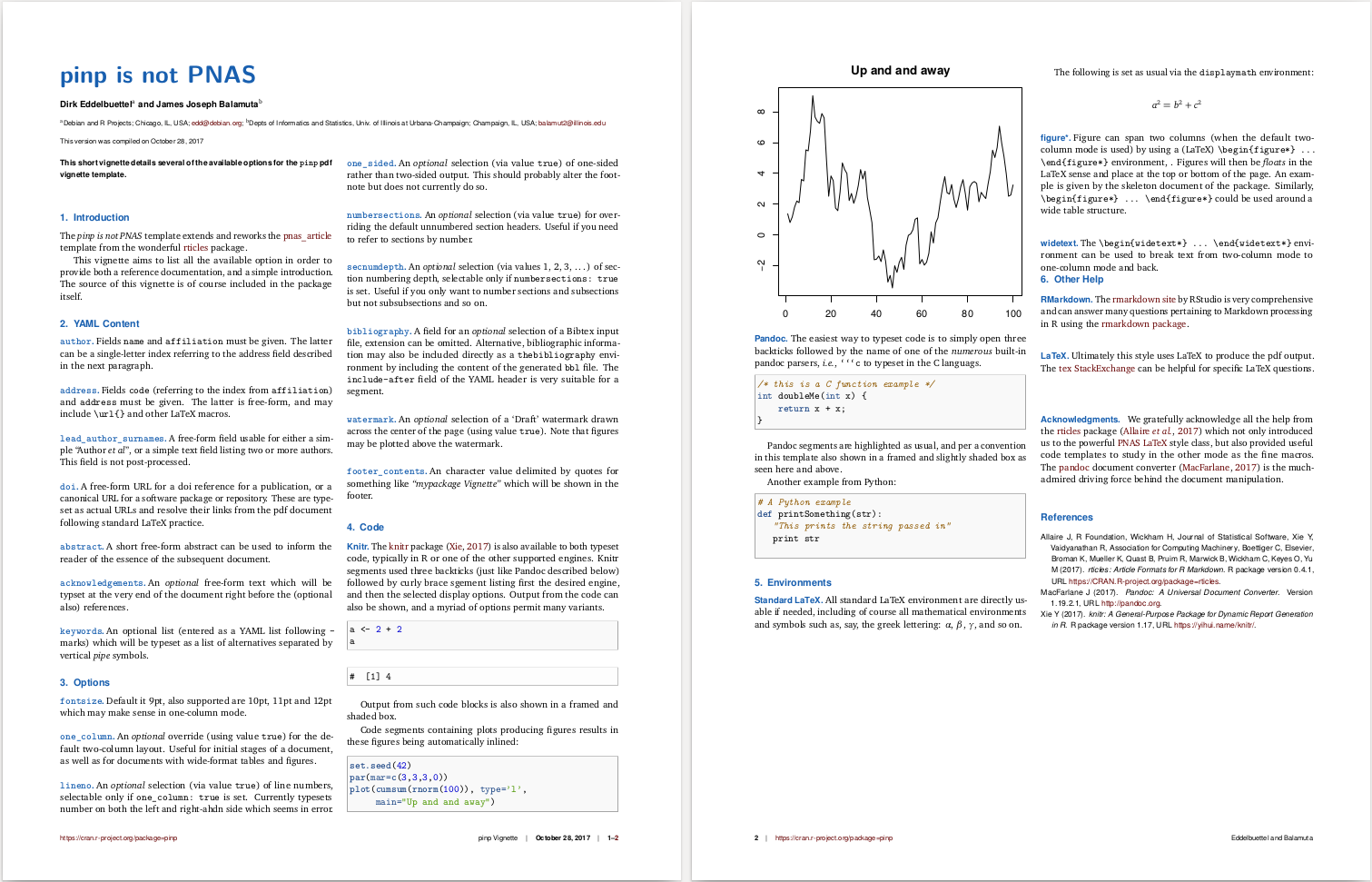
A new version of our pinp package arrived on CRAN today, and is the first release in four years. The pinp package allows for snazzier one or two column Markdown-based pdf vignettes, and is now used by a few packages. A screenshot of the package vignette can be seen below. Additional screenshots are at the pinp page. pinp vignette This release contains no new features or new user-facing changes but reflects the standard package and repository maintenance over the four-year window since the last release: updating of actions, updating of URLs and addressing small packaging changes spotted by ever-more-vigilant R checking code. The NEWS entry for this release follows.

Changes in pinp version 0.0.11 (2024-12-08)
  • Standard package maintenance for continuous integration, URL updates, and packaging conventions
  • Correct two minor nags in the Rd file

Courtesy of my CRANberries, there is a diffstat report relative to previous release. More detailed information is on the ping page. For questions or comments use the issue tracker off the GitHub repo. If you like this or other open-source work I do, you can sponsor me at GitHub.

This post by Dirk Eddelbuettel originated on his Thinking inside the box blog. Please report excessive re-aggregation in third-party for-profit settings.

6 December 2024

Dirk Eddelbuettel: RcppArmadillo 14.2.2-1 on CRAN: Small Upstream Fixes

armadillo image Armadillo is a powerful and expressive C++ template library for linear algebra and scientific computing. It aims towards a good balance between speed and ease of use, has a syntax deliberately close to Matlab, and is useful for algorithm development directly in C++, or quick conversion of research code into production environments. RcppArmadillo integrates this library with the R environment and language and is widely used by (currently) 1197 other packages on CRAN, downloaded 37.5 million times (per the partial logs from the cloud mirrors of CRAN), and the CSDA paper (preprint / vignette) by Conrad and myself has been cited 605 times according to Google Scholar. Conrad released a minor version 14.2.2 yesterday. This followed a bit of recent work a few of us did in the ensmallen and mlpack repositories following the [14.2.0 release]. Use of (member functions) .min(index) and .max(index) was deprecated in Armadillo in favor of .index_mix() and .index_max(). By now ensmallen and mlpack have been updated at CRAN. To add some spice, CRAN emailed that the (very much unreleased as of now, but coming likely next spring) gcc-15 was unhappy with RcppArmadillo due to some Armadillo code. This likely related to the listed gcc-15 C++ change about Qualified name lookup failure into the current instantiation . Anyway, Conrad fixed it within days and that change too is part of this new version (as is a small behaviour normalization between the two indexing methods that matters in case of ties, this was in 14.2.1). The changes since the last CRAN release are summarised below.

Changes in RcppArmadillo version 14.2.2-1 (2024-12-05)
  • Upgraded to Armadillo release 14.2.2 (Smooth Caffeine)
    • Workarounds for regressions in pre-release versions of GCC 15
    • More selective detection of symmetric/hermitian matrices by various functions

Changes in RcppArmadillo version 14.2.1-1 (2024-11-24) (GitHub Only)
  • Upgraded to Armadillo release 14.2.1 (Smooth Caffeine)
    • Fix for index_min() and index_max() to ensure that the first index of equal extremum values is found

Courtesy of my CRANberries, there is a diffstat report relative to previous release. More detailed information is on the RcppArmadillo page. Questions, comments etc should go to the rcpp-devel mailing list off the Rcpp R-Forge page. If you like this or other open-source work I do, you can sponsor me at GitHub.

This post by Dirk Eddelbuettel originated on his Thinking inside the box blog. Please report excessive re-aggregation in third-party for-profit settings.

4 December 2024

Dirk Eddelbuettel: corels 0.0.5 on CRAN: Maintenance

An updated version of the corels package is now on CRAN! The Certifiably Optimal RulE ListS (Corels) learner provides interpretable decision rules with an optimality guarantee a nice feature which sets it apart in machine learning. You can learn more about corels at its UBC site. The changes concern mostly maintenance for both the repository (such as continunous integration setup, badges, documentation links, ) and the package level (such as removing the no-longer-requiring C++ compilation standard setter now emitting a NOTE at CRAN.

This post by Dirk Eddelbuettel originated on his Thinking inside the box blog. Please report excessive re-aggregation in third-party for-profit settings.

2 December 2024

Dirk Eddelbuettel: anytime 0.3.10 on CRAN: Multiple Enhancements

A new release of the anytime package arrived on CRAN today the first is well over four years. The package is fairly feature-complete, and code and functionality remain mature and stable, of course. anytime is a very focused package aiming to do just one thing really well: to convert anything in integer, numeric, character, factor, ordered, input format to either POSIXct (when called as anytime) or Date objects (when called as anydate) and to do so without requiring a format string as well as accomodating different formats in one input vector. See the anytime page, or the GitHub repo for a few examples, and the beautiful documentation site for all documentation. This release slowly matured over four years. It combines a number of strictly internal repository maintenance such as changes to continuous integration with small enhancements (adding for example some new formats, responding better to an error condition, dealing with logical input as an error) with a relaxation of the C++ compilation standard. While we once needed C++11, it is now a constraint as as R itself is quite proactive (the last two releases defaulted already to C++17, suitable compiler permitting) we can now relax this constraint. The documentation site is new, as some other small changes. See the full list of changes which follows.

Changes in anytime version 0.3.10 (2024-12-02)
  • A new documentation site was added.
  • Continuous Integration now uses run.sh from r-ci with bspm
  • Logical input vectors are now recognised as an error (#121)
  • Additional dot-separated format '%Y.%m.%d' is supported
  • Other small updates were made throughout the package
  • No longer set a C++ compilation standard as the default choices by R are sufficient for the package
  • Switch Rcpp include file to Rcpp/Lightest
  • We recommend ~/.R/Makevars compiler flag options -Wno-ignored-attributes -Wno-nonnull -Wno-parentheses
  • The tinytest runner was simplified
  • NA values from conversion now trigger a warning

Courtesy of my CRANberries, there is also a diffstat report of changes relative to the previous release. The issue tracker tracker off the GitHub repo can be use for questions and comments. More information about the package is at the package page, the GitHub repo and the documentation site. If you like this or other open-source work I do, you can now sponsor me at GitHub.

This post by Dirk Eddelbuettel originated on his Thinking inside the box blog. Please report excessive re-aggregation in third-party for-profit settings.

29 November 2024

Dirk Eddelbuettel: RcppAPT 0.0.10: Maintenance

A new version of the RcppAPT package arrived on CRAN earlier today. RcppAPT connects R to the C++ library behind the awesome apt, apt-get, apt-cache, commands (and their cache) which powering Debian, Ubuntu and other derivative distributions. RcppAPT allows you to query the (Debian or Ubuntu) package dependency graph at will, with build-dependencies (if you have deb-src entries), reverse dependencies, and all other goodies. See the vignette and examples for illustrations. This release moves the C++ compilation standard from C++11 to C++17. I had removed the setting for C++11 last year as compilation by compiler default worked well enough. But the version at CRAN still carried, which started to lead to build failures on Debian unstable so it was time for an update. And rather than implicitly relying on C++17 as selected by the last two R releases, we made it explicit. Otherwise a few of the regular package and repository updates have been made, but no new code or features were added The NEWS entries follow.

Changes in version 0.0.10 (2024-11-29)
  • Package maintenance updating continuous integration script versions as well as coverage link from README, and switching to Authors@R
  • C++ compilation standards updated to C++17 to comply with libapt-pkg

Courtesy of my CRANberries, there is also a diffstat report for this release. A bit more information about the package is available here as well as at the GitHub repo. If you like this or other open-source work I do, you can now sponsor me at GitHub.

This post by Dirk Eddelbuettel originated on his Thinking inside the box blog. Please report excessive re-aggregation in third-party for-profit settings.

18 November 2024

Dirk Eddelbuettel: RcppArmadillo 14.2.0-1 on CRAN: New Upstream Minor

armadillo image Armadillo is a powerful and expressive C++ template library for linear algebra and scientific computing. It aims towards a good balance between speed and ease of use, has a syntax deliberately close to Matlab, and is useful for algorithm development directly in C++, or quick conversion of research code into production environments. RcppArmadillo integrates this library with the R environment and language and is widely used by (currently) 1191 other packages on CRAN, downloaded 37.2 million times (per the partial logs from the cloud mirrors of CRAN), and the CSDA paper (preprint / vignette) by Conrad and myself has been cited 603 times according to Google Scholar. Conrad released a minor version 14.2.0 a few days ago after we spent about two weeks with several runs of reverse-dependency checks covering corner cases. After a short delay at CRAN due to a false positive on a test, a package failing tests we also failed under the previous version, and some concern over new deprecation warnings _whem using the headers directly as _e.g. mlpack R package does we are now on CRAN. I noticed a missing feature under large 64bit word (for large floating-point matrices) and added an exporter for icube going to double to support the 64-bit integer range (as we already did, of course, for vectors and matrices). Changes since the last CRAN release are summarised below.

Changes in RcppArmadillo version 14.2.0-1 (2024-11-16)
  • Upgraded to Armadillo release 14.2.0 (Smooth Caffeine)
    • Faster handling of symmetric matrices by inv() and rcond()
    • Faster handling of hermitian matrices by inv(), rcond(), cond(), pinv(), rank()
    • Added solve_opts::force_sym option to solve() to force the use of the symmetric solver
    • More efficient handling of compound expressions by solve()
  • Added exporter specialisation for icube for the ARMA_64BIT_WORD case

Courtesy of my CRANberries, there is a diffstat report relative to previous release. More detailed information is on the RcppArmadillo page. Questions, comments etc should go to the rcpp-devel mailing list off the Rcpp R-Forge page. If you like this or other open-source work I do, you can sponsor me at GitHub.

This post by Dirk Eddelbuettel originated on his Thinking inside the box blog. Please report excessive re-aggregation in third-party for-profit settings.

11 November 2024

Dirk Eddelbuettel: RcppSpdlog 0.0.19 on CRAN: New Upstream, New Features

Version 0.0.19 of RcppSpdlog arrived on CRAN early this morning and has been uploaded to Debian. RcppSpdlog bundles spdlog, a wonderful header-only C++ logging library with all the bells and whistles you would want that was written by Gabi Melman, and also includes fmt by Victor Zverovich. You can learn more at the nice package documention site. This releases updates the code to the version 1.15.0 of spdlog which was released on Saturday, and contains fmt 11.0.2. It also contains a contributed PR which allows use std::format under C++20, bypassing fmt (with some post-merge polish too), and another PR correcting a documentation double-entry. The NEWS entry for this release follows.

Changes in RcppSpdlog version 0.0.19 (2024-11-10)
  • Support use of std::format under C++20 via opt-in define instead of fmt (Xanthos Xanthopoulos in #19)
  • An erroneous duplicate log=level documentation level was removed (Contantinos Giachalis in #20)
  • Upgraded to upstream release spdlog 1.15.0 (Dirk in #21)
  • Partially revert / simplify src/formatter.cpp accomodating both #19 and previous state (Dirk in #21)

Courtesy of my CRANberries, there is also a diffstat report. More detailed information is on the RcppSpdlog page, or the package documention site. If you like this or other open-source work I do, you can sponsor me at GitHub.

This post by Dirk Eddelbuettel originated on his Thinking inside the box blog. Please report excessive re-aggregation in third-party for-profit settings.

10 November 2024

Dirk Eddelbuettel: inline 0.3.20: Mostly Maintenance

A new release of the inline package got to CRAN today marking the first release in three and half years. inline facilitates writing code in-line in simple string expressions or short files. The package was used quite extensively by Rcpp in the very early days before Rcpp Attributes arrived on the scene providing an even better alternative for its use cases. inline is still used by rstan and a number of other packages. This release was tickled by changing in r-devel just this week, and the corresponding please fix or else email I received this morning. R_NO_REMAP is now the default in r-devel, and while we had already converted most (old-style) calls into the API to using the now mandatory Rf_ prefix, the package contained few remaining cases in examples as well as one in code generation. The release also contains a helpful contributed PR making an error message a little clearer, plus several small and common maintenance changed around continuous integration, package layout and the repository. The NEWS extract follows and details the changes some more.

Changes in inline version 0.3.20 (2024-11-10)
  • Error message formatting is improved for compileCode (Alexis Derumigny in #25)
  • Switch to using Authors@R, other general packaging maintenance for continuous integration and repository
  • Use Rf_ in a handful of cases as R-devel now mandates it

Thanks to my CRANberries, you can also look at a diff to the previous release Questions, comments etc should go to the rcpp-devel mailing list off the R-Forge page. Bugs reports are welcome at the GitHub issue tracker as well (where one can also search among open or closed issues). If you like this or other open-source work I do, you can sponsor me at GitHub.

This post by Dirk Eddelbuettel originated on his Thinking inside the box blog. Please report excessive re-aggregation in third-party for-profit settings.

2 November 2024

Dirk Eddelbuettel: Rcpp 1.0.13-1 on CRAN: Hot Fix

rcpp logo A hot-fix release 1.0.13-1, consisting of two small PRs relative to the last regular CRAN release 1.0.13, just arrived on CRAN. When we prepared 1.0.13, we included a change related to the tightening of the C API of R itself. Sadly, we pinned an expected change to comes with next (minor) release 4.4.2 rather than now next (normal aka major) release 4.5.0 . And now that R 4.4.2 is out (as of two days ago) we accidentally broke building against the header file with that check. Whoops. Bugs happen, and we are truly sorry but this is now addressed in 1.0.13-1. The normal (bi-annual) release cycle will resume with 1.0.14 slated for January. As you can see from the NEWS file of the development branch, we have a number of changes coming. You can safely access that release candidate version, either off the default branch at github or via r-universe artifacts. The list below details all changes, as usual. The only other change concerns the now-mandatory use of Authors@R.

Changes in Rcpp release version 1.0.13-1 (2024-11-01)
  • Changes in Rcpp API:
    • Use read-only VECTOR_PTR and STRING_PTR only with with R 4.5.0 or later (Kevin in #1342 fixing #1341)
  • Changes in Rcpp Deployment:
    • Authors@R is now used in DESCRIPTION as mandated by CRAN

Thanks to my CRANberries, you can also look at a diff to the previous release Questions, comments etc should go to the rcpp-devel mailing list off the R-Forge page. Bugs reports are welcome at the GitHub issue tracker as well (where one can also search among open or closed issues). If you like this or other open-source work I do, you can sponsor me at GitHub.

This post by Dirk Eddelbuettel originated on his Thinking inside the box blog. Please report excessive re-aggregation in third-party for-profit settings.

30 October 2024

Dirk Eddelbuettel: gcbd 0.2.7 on CRAN: More Mere Maintenance

Another pure maintenance release 0.2.7 of the gcbd package is now on CRAN. The gcbd proposes a benchmarking framework for LAPACK and BLAS operations (as the library can exchanged in a plug-and-play sense on suitable OSs) and records result in local database. Its original motivation was to also compare to GPU-based operations. However, as it is both challenging to keep CUDA working packages on CRAN providing the basic functionality appear to come and go so testing the GPU feature can be challenging. The main point of gcbd is now to actually demonstrate that yes indeed we can just swap BLAS/LAPACK libraries without any change to R, or R packages. The configure / rebuild R for xyz often seen with xyz being Goto or MKL is simply plain wrong: you really can just swap them (on proper operating systems, and R configs see the package vignette for more). But nomatter how often we aim to correct this record, it invariably raises its head another time. This release accommodates a CRAN change request as we were referencing the (now only suggested) package gputools. As hinted in the previous paragraph, it was once on CRAN but is not right now so we adjusted our reference. CRANberries also provides a diffstat report for the latest release. If you like this or other open-source work I do, you can sponsor me at GitHub.

This post by Dirk Eddelbuettel originated on his Thinking inside the box blog. Please report excessive re-aggregation in third-party for-profit settings.

Next.

Previous.