Search Results: "Aigars Mahinovs"

3 March 2007

Adrian von Bidder: Platforms: random thoughts

These are some random thoughts based on a not very thorough reading of candidate platforms of the DPL Election 2007, and my subjective view of the candidates based on the mailing traffic I remember reading. Wouter Verhelst: Has quite a broad Debian-background, the platform also seems to share quite a bit of my view of where Debian's problems are at the moment. Doesn't propose a course of action right now, not sure how to judge that. Not sure if I remember Wouter being heavily involved in flamewars, but I do remember reading quite a few of his emails in discussions with interest. broad Debian-background, the platform also seems to share quite a bit of my view of where Debian's problems are at the moment. Doesn't propose a course of action right now, not sure how to judge that. Not sure if I remember Wouter being heavily involved in flamewars, but I do remember reading quite a few of his emails in discussions with interest. broad Debian-background, the platform also seems to share quite a bit of my view of where Debian's problems are at the moment. Doesn't propose a course of action right now, not sure how to judge that. Not sure if I remember Wouter being heavily involved in flamewars, but I do remember reading quite a few of his emails in discussions with interest. broad Debian-background, the platform also seems to share quite a bit of my view of where Debian's problems are at the moment. Doesn't propose a course of action right now, not sure how to judge that. Not sure if I remember Wouter being heavily involved in flamewars, but I do remember reading quite a few of his emails in discussions with interest. Aigars Mahinovs: Quoting from his platform: “My goal of running for DPL is not to be DPL, but to get a few concepts closer to real life.” So don't run for DPL, but start doing these things you're thinking about. Not being DPL has the advantage that you don't have to spend time on DPL stuff that would detract you from these goals. Speaking about your goals: (i) No release: I've thought about that, too, but I feel this would quickly make Debian irrelevant. (ii) $HOME configuration files organisation: take it up with the upstream developers of all the application. I think this is a very good idea, but freedesktop.org would be a better platform. (iii) Old Maintainer Process: Idea looking for a problem. (iv) Dropping Trademarks: not sure what to think about this. Gustavo Franco: Some focus on the desktop, and a constructive attitude towards Ubuntu, both positive in my book. (The first one primarily because on servers Linux is already quite well established, while the desktop is where more work is still to be done. Not because servers are less important.) His goals: (i) Core teams: as with Wouter, he sees that people and what goes on between them are where the problems are. (ii) Release goals: I think building the release based on release goals could be a driving force, but this is more RM area than DPL. (iii) Adding features to the bts doesn't need DPL powers. (iii) New developers: certainly an area that still needs attention, but the intended course is not entirely clear to me. (iv) NEW queue: same. (v) CTTE: Not sure what the idea behind this is. (vi) Groups: yes, but again not entirely clear what and how. (vii) Backports: yes, new versions of some software should go into Debian (stable) faster. Officially supporting backports or something else, I don't know, but this is an area where a DPL could pull together the RMs, security team(s), backports.org people etc. (viii) Universal OS: is this about more media coverage or about more face to face meetings? Both are good, but we should set clear goals beforehand. (ix) Much work is needed, especially in the area of buildd management (meaning: the processes and people behind it!). Does Gustavo have previous involvement here? (x) Vendors, Website, Publicity: This is more or less all about media coverage and popularity. Much needed, but as Debian as it is will never be able to commit to a public official opinion of anything, we'll need to think hard about what to do here. (xi) NMU: I don't see a great need for action here, personally. Overall: this platform contains too much material, I fear trying to tackle all these areas will lead to a burned out DPL within three months and little actually getting anywhere. Sven Luther: It's true that it always needs at least two people for a flamewar. But having a DPL who is always ready to provide one side of an argument is not a good idea. Sam Hocevar: Everything is high-level on his platform. Both good and bad. Not sure how to rate this platform, but I see myself nodding along. Learn from other OSs is good, but I hope he also means active cooperation and not just passive let's see how they do it. Steve McIntyre: Should have won 2006. Certainly did a lot of both behind-the-scenes work and some good communication. The platform lacks mention of relations between Debian and the outside world, which is an area where I feel some work is missing (and where the DPL as the only person with a official role also known outside Debian can make a difference), and also lacks mention of legal problems (trademarks and patents) where I'm not sure how solid Debian's work is. Additional argument in favor of Steve: Having a 2IC and promoting him to DPL the year after might be a good idea overall. Maybe we should actually elect the 2IC and only have a confirmation vote to promote him to DPL? Raphaël Hertzog: I like the DPL board idea. I also like how Raphaël focuses, in his platform, on the DPL board idea and some selected problems. On the other hand, the platform is wholly focused inward, outside relations are important, too ! Anthony Towns: Not sure what to think of the current DPL. I think he had good ideas, and I still think the original “spend Debian funds for the release”-idea was not that bad, but seeing how it all worked out was very, very painful for too many people. The platform seems pretty much empty, so I guess ajt won't have my vote this time. Simon Richter: Maybe I miss something, but I only see “don't repeat the dunc-tank flamefest” in his platform, which seems a bit thin. His observation that the real power of the DPL is to get everybody's attention may be partly true, though, even if this power will be spent as soon as a DPL, trying to mediate, lets himself be drawn into the flamewar instead (I don't accuse Simon that he ultimately will do this, but I fear that it happens all too quickly). Now what? I really don't have the time to thoroughly follow the campaigning, but I'll certainly have a look at the rebuttals, and perhaps somebody will do some summary. So the ballot below will certainly change. (You might also be able to buy the vote if you're rich enough ;-)
 [ 1 ] Wouter Verhelst
 [ 5 ] Aigars Mahinovs
 [ 3 ] Gustavo Franco
 [ 6 ] Sven Luther
 [ 3 ] Sam Hocevar
 [ 1 ] Steve McIntyre
 [ 2 ] Raphaë Hertzog
 [ 5 ] Anthony Towns
 [ 4 ] Simon Richter
 [ 5 ] NOTA

14 February 2007

Bastian Venthur: DPL 2007, Current Candidates

For those who don’t follow -vote regularly, it seems like we have currently four official nominations for this year’s DPL vote: and two pending ones: A totally unrelated note: If you want to get really frustrated and angry but don’t feel like participating in Debian’s infamous flamefests — try to learn to juggle a 5 ball cascade. This will keep you busy for several months without getting on everybody’s (well, everybody but your neighbor’s) nerves. Update: Ooops, I forgot Wouter — thanks Alexander.

9 February 2007

Aigars Mahinovs: DPL

Because something mangled my signature along the way (I suspect it was GMail), I also post it here along with a GPG signed text file:
I hereby nominate myself for the position of Debian Project Leader in the DPL elections of 2007.

5 February 2007

Aigars Mahinovs: Home folder organisation

After last post about a FHS amendment to address the structure of user’s home folders, I received a lot of comments and there is one very significant thing that can be changed in the proposal - instead of having $HOME/ .data .cache .config /appname structure, to change that to a mandatory $HOME/.library/appname/ cache config … . This version still has all the benefits of the first solution (configuration for an application can be easily identified and erase, and all cache can easily be excluded from backups using “$HOME/.library/*/cache” regexp) and also has additional benefits, main of which is the ability to later introduce the concept of user installed packages. The idea is that it would be possible to support having /bin, /lib and /share subdirectories in these application directories thus making an ability for the whole application to e packed in a single directory and allowing the application to be installed simply by unpacking this directory. I admit that much of this is glanced over from MacOS X world, but I do not think that it diminishes the idea itself.
Some problems appear there - support of these distributed bin folders, support of separate lib folders, handling of application plugins, handling of dependencies, handling of the application menu, upgrading notifications for the user software vs. system software. But nothing there that can not be solved. I feel that this can bring together FHS and LSB by providing something of an API for software being installed by users. Having no registry of the software in this solution allows for some interesting things, for example having multiple versions of one program just by renaming the application folder.
A lot of specification work is required here, therefore I proposed a workshop on this topic in Debconf7. I hope to have something that everyone can agree on and maybe even some code by then, so that after Debconf7 there can be a formal policy amendment proposal. So there are two questions:
  1. Is there something better in $HOME/.cache/appname vs. $HOME/.library/appname/cache ? Any other trade-offs that I have forgot?
  2. What do you think about the further idea of users having the ability to install software in their home folders or remove such software in a very simple fashion?

2 February 2007

Aigars Mahinovs: A must

It is really a must have - my blog gets mentioned on the DWN for the first time and at the same time (or even a bit earlier) the electricity cuts to the building where my server is co-located. And it takes a couple of days for the local administrator to get from all that chaos to turning my server back on. Perfect timing :P.

12 January 2007

Erich Schubert: Configuration file mess

Aigars Mahinovs mentioned that it would be nice if applications would not clutter the home directory with their config files as much. I agree a lot. Dotfiles for configuration suck badly. If you start a new application (or if you are in an early stage and have a small userbase), please follow the Freedesktop.org XDG base directory specification. I.e. use .config/applicationname instead of .applicationname for configuration files (unless an overriding environment variable is set), and .local/share/applicationname for data files. And for cache files, use .cache/applicationname (anyone writing a patch for firefox?) What I'd also like to propose is to reduce the number of different configuration file syntaxes. It sucks having to find out which syntax an application uses again and again, because every application is different. We probably won't be able to convince everybody on one format, but we could maybe cut it down to, like 3 formats, please? There is no reason that one application needs to start comments with "#" and another with ";" while a third application uses "//" but doesn't allow "/* comment */"... A small set of syntaxes (preferrably with standardized parsers) should be good enough for just about every application: If we had just these few syntaxes and an appropriate schema description language, we could write generic configuration file editors. That would be very nice. Also we avoid having config file parser bugs by using libraries, and if someone prefers using e.g. gconf or dconf, this could be handled by the library, transparently for the application. (Note that many application lack error handling when writing their configuration files, especially when the disc is full... - they really should be using a library. IIRC xchat also has some bugs of this kind, I remember having tried to patch some of them once when we were preparing for the sarge release, just to find out that there might be many more of them...)

10 January 2007

Aigars Mahinovs: FHS extension for user home folders

Justification. Currently there is a huge mess of files and folders that start with a “.” in any users home folder. There is no structure or policy on how applications should choose file and folder names for data that needs to be stored in users home directory. Additionally there is no established consistency between Gnome, KDE and most other applications. Gnome application have part of their configuration information in gconf folder and other part in a gnome subfolder. KDE applications have a complex structure under .kde/. And most other applications either have one file directly in users home folder or have their own dot-folder there. Problems. There are two major problems with current ad-hoc approach:
  1. Namespace pollution of users home space. In any desktop system “ls -al” in the home folder would be a very lengthy affair. Moreeven this namespace is folded - KDE and Gnome apps live in their own subfolders.
  2. Lack of structure in folders makes it much harder to properly understand their purpose. For example, if a user has misconfigured an application and would like to reset it to default settings, it currently could be hard to figure out how to do that. Especially without losing his data in that application.
Proposal. I propose to implement a policy on where an application can store data and configuration information in users home folder. Such specification would be proposed as an extension for FHS, first implemented in Debian and then promoted for inclusion upstream and in other distributions. Structure. I propose a following structure for a users home folder: Benefits The main benefit for such system for me is twofold: So, any suggestions on the idea and on where this should be best discussed?

7 November 2006

Aigars Mahinovs: Im blue!

Me and a Blue Man
In the last day of Lastguru’s visit, I convinced him to go to The Blue Man group performance in the New London Theatre. The performance was just great - a combination of rhythmic music, dramatic light and a hilarious comedy show. Just wonderful!
There was a lot of classic Blue Man moments - weird looks, colour-splashing drums, rock concert movements, textual and emotional sketches with the audience and the great “You Are LATE!” intermission. It really was 100 minutes of pure fun.
And best of all, on the exit I was given a special ticket with which I can get back in again for free if I bring a friend - yay!

5 November 2006

Aigars Mahinovs: Game On!

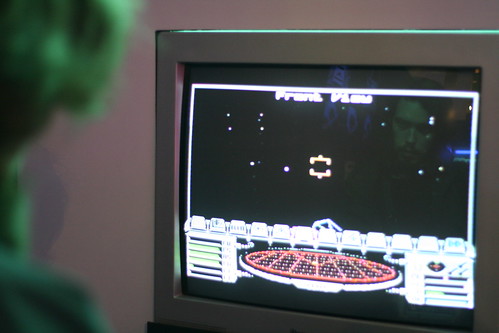
For the last couple weeks I have been concentrating on things related to my studies and on some events related to it. I posted pictures from these events on my Flickr photostream: a colleague from the institute finished his PhD and we had a goodbye dinner, my supervisor invited me to his son’s first birthday party. Also my friends Bunja and lastguru came to UK. With one I took photos of a night playground and squirrels and with other one some photos of the Eye and Babbage’s brain. However the main theme of this post is the Game On! exhibition in the London’s Science Museum. They have the best games playable there starting with the classic Pong, Lara Croft, Bomberman, Mortal Combat and up to Halo 2 on XBox 360. Even my non-gamer friend lastguru found a thing to drool upon - his childhood obsession: Elite. Elite! Update: Almost forgot to mention - the exhibition is great: it shows the evolution of gaming and allows to experience the most important games again and it also brings a huge amount of joy to anyone who has ever played these games before - the return to childhood is imminent. I never expected that something as simple as the original Pong can be so exciting in a good company. Very recommended!

18 October 2006

Aigars Mahinovs: Did I miss anything?

Catching up on blogs, emails and Debian mailing lists I see that nothing really important has happened while I was off-line: the dunc-tank caboodle escalated and died down when the majority voted that it was not worth the commotion, some people got upset at some other people and decided stop working on Debian because of that, Mozilla went even more bonkers about its trademarks. The dunk-tank scandal ended just like I thought it would. As one could imply from my eternal unstable concept, I do not see making releases as a the main thing that Debian contributes to the society - it is more about the integration and cross-empowerment of all the packages that Debian has. In that context, making a release is a not the most important job in Debian, but it need to be done from time to time. Release management combines technical and social challenges - there is not much of novelty in it (I imagine). So, from this perspective, there is nothing bad in money being paid to do this mundane and hard work, if we really, really need to release in a specific time frame (IMHO the only reason to release Debian in 2006, as opposed to 2008, is the Lars tattoo bet). If we return to “release when its ready” paradigm and aim for about one release every 2-3 years (and I see nothing really wrong with that) then paying release manager will not be needed. Money is about getting things done on a schedule. It does not make things good (or bad). It does not make thing important (or not). It make things go by the schedule (unless you pay by the hour). It is the obvious solution to releasing Debian in December. Now two questions need to be answered - will it work? and do we really want to release in December? The second thing - in any group of 1000 people anyone can easily find a lot of people that he would not love/not respect/disagree with/disregard/hate and be unable to work with. It is no reason to stop working on Debian, unless one does it only to be universally loved. It is inevitable that we will need to learn to do what we like to do without paying attention to the irritations. And about the trademarks - in Debconf 5 in Helsinki I was giving a talk at the Debian Day, just after I helped to win the first big fight against software patents in EU, and Branden (who was GPL at the time) asked me what do I think Debian should do about its trademarks. Both then and now I strongly think that trademarks and any other litigation inducing concepts (except enforcement of GPL) have no place whatsoever in free software. I think Debian should lead the way and give up the “Debian” trademark. And Mozilla should follow the lead. So what if there is a pron site “Debian chicks”? You will not solve that with litigation anyway (at least not in a year or two) and why should we really care? So what if some one make a distro and calls it SuperDebian? If someone will really think that it is related to Debian but better (especially despite warnings to the contrary), then that someone will really deserve to get the trojan planted in that distro. And again, against a well prepared criminal, litigation will not help much. So, did I miss anything?

Aigars Mahinovs: Finally back

All the time since the Debian I18N conference in Extremadura I was moving around, staying in temporary places having temporary accesses to restricted Internet connections. Finally yesterday I got everything back - a permanent place to stay and a good permanent and unrestricted Internet connection there. Now I just need to compensate for the productivity loss that it is causing me :) P.S. There have been two bugfix releases of SBackup since my last blog post about it - bugs such as “having no regexes skips all files” and “always do incremental upgrades because we can not count” are fixed. Priority of SBackup process is reduced and configuration files are managed explicitly.
27 September 2006

Aigars Mahinovs: Howard worldwide

I am hooked. I love to listen to Howard Stern. Up to now I have been doing it quietly by downloading it from P2P ever since I heard about him from a 60 minutes appearance just before moving to satellite radio on 1st January of 2006. Finally Sirius started transmitting their radio stations to the Internet (for a fee). 13$ a month is not cheap for Internet radio (that is common to be gratis), but Howard Stern makes up for every penny of that with 5 hours of great talk show 4 days a week. And the dozens of other channels are just bonus. If I were in the coverage zone of the Sirius satellite, I would get a receiver and look forward to the Stiletto, but as I am in UK, I have to make do with the Bittorrents shared by a highschool janitor and now with live streams from Sirius.com for 13$ per month. Luckily, the streaming works perfectly in Linux. (I did have to supply a USA address when registering, so I gave them the address of Google headquarters :) ) One more case where a gratis P2P downloads create a devoted fan and generate a sale. Now I am just relaxing and enjoying channels 100 - Howard, 9 - The Pulse, 12 - Super Shuffle and 33 - Area 33.

26 September 2006

Aigars Mahinovs: Bug hugging?

Hmm, I wonder if in the bug squashing parties one can eliminate bugs by hard random hugging?

9 September 2006

Aigars Mahinovs: Debian Extremadura I18N meeting 2006 photos

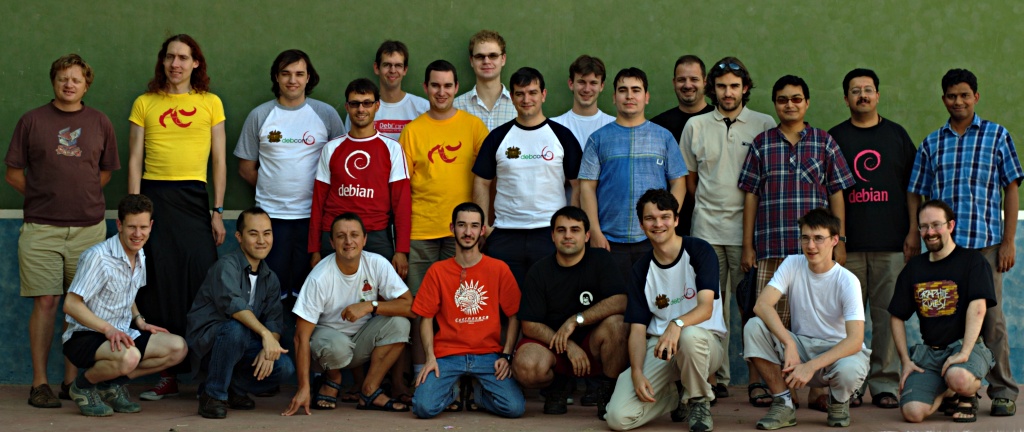
The I18N meeting in Extremadura is almost over - tomorrow everyone is leaving to the airport at different times. So, enjoy the group photo of the meeting. And if you click the photo, that will bring you to a Frickr photoset that contains all the other good photos that I took at this meeting. Enjoy!

Aigars Mahinovs: Extremadura and nuclear ban

The i18n work session in Extremadura is in the last day now and photos and impressions are accumulating. In the mean time I am translating some packages to Latvian and I discovered that the only place I can find a comprehensive list of officially translated country name to Latvian is a translation of the Comprehensive Nuclear Test-Ban Treaty of 2001.

3 September 2006

Aigars Mahinovs: Another type of bounty

It would be very good to have a bounty that would pay 100$ to anyone who would find and implement a way to reduce memory use of a fully running Debian Linux + Gnome system (optionally, with all Gnome apps loaded) by one megabyte (as indicated by RAM used in a swapless system - (cache+buffers)) in a way that does not reduce functionality or heavily compromise runtime speed and would be accepted into upstream Gnome. We need sponsors! That would be one great long term investment in Desktop Linux.

2 September 2006

Aigars Mahinovs: Eternal unstable?

More and more early adopters choose to use Ubuntu instead of Debian. Ubuntu has newer versions of the software that matters (XOrg, FF, OOO, Gnome,…) than the stable Debian or, sometimes than even the unstable Debian. Early adopters are the users that are most eager to try new shiny things, do not scream too much if those things break and seem to make good bug reporters. They are the key second level - just below the developers and above most users in the pyramid of software development and use. They are also the people that have a tendency to become developers. That is why I have this feeling that capturing early adopters is essential to development of a thriving free software community. How can that be done? I do not know, but I have an idea that might just work. What I envision is a merger of development processes of Debian, Ubuntu, Knoppix, Skolelinux and all other Debian derrived distributions. The base for this merger would be an eternal unstable line where all developers would be encouraged to put the newest and greatest software - THE place to be if you want to be on the bleeding edge. I see this unstable line being much newer then Debian unstable, but retaining similar level of quality (how? it is a good question). Then there would be a set of tools available to splice packages from this unstable line into a stabilisation and stable branches for each distribution. The tools would be the same for all distributions and the packages would be the same for all distributions, the difference between distributions would be achieved by the way that the packages and their specific versions are chosen, patches applied for a particular distribution and in some ways by the assembly of the final release media. The proper Debian releases in this context would be no different then Ubuntu releases but will be created using different criteria and at different times. The tools must be powerful enough so that release preparations of any distribution (including Debian proper) would not need to slow down the progress of the flow of new features into the eternal unstable line. The infrastructure needed to operate such complex system would be immense. It would need to have some similarities to the systems Debian uses for distribution, release and bug management, it would need to have some similarities to Ubuntu’s Launchpad (just free, understandable, usable and well documented), and I think that it would also need to have some similarities to Gentoo’s Portage system (distros do want to recompile packages with different options and with their own library versions). It would also help if this unstable line could still hold few parallel versions of one package - like the latest release and the cvs version. (However I am pressed to even imagine all the complexities this would bring into apt and bug reporting/debugging.) I think that such structure will not only concentrate the scarce resource that are the early adopters in a place that will benefit all distributions, but will also provide extra dimensionality for social and technical growth for The Debian Project. The Debian Project will turn from a single great distribution to a swarm of wonderful distributions with a strong central spine - the eternal unstable line. An additional benefit to this will be that it will be possible to fork Debian if social pressures require that (like it happened with gcc vs. eggc) for the benefit of all free software users. Like, for example, the David’s steering commitee whould not disturb the Debian main line until it has been proven to work - it could be formed, it could set goals for a branch and feel in total control of their release goals and methods. After the steering commitee makes a successful release, it would be only a matter of a political decision of whether to call that release Debian proper or not. Note: As always this is just an uniformed rant of a relatively passive DD who is blissfully ignorant of pretty much everything, so please tell me if and why it can or can not be done. P.S. While I am in such writelly mood, I should probably write that free software advocacy article for a new journal that I promised them a month ago. P.P.S. If the system is written with it in mind, then each user’s computer could theoretically be a separate distribution which keeps a splice of Debian unstable line (or any subline) with local modifications and possible local compilation options. If done right, this could also provide a ground for merging up with Gentoo. P.P.P.S. After reading trough logs of several bugs on the Launchpad, I have a feeling that Ubuntu is being flooded by much more bugreports then Cannonical is designed to handle (especially for free). I am not pointing fingers here, I am just suggesting that it is another facet of the same problem and that this idea of mine could reduce this load and let Ubuntu developers concentrate on what they really want to do.

Aigars Mahinovs: Wrong partition ordering

If you have a hard drive with two or more logical partitions in one extended partition and then proceed to erase the first of those logical partitions (in GParted), then you will soon discover that the number of the second logical partition changed (from sda6 to sda5 in my case). If you then try to create a partition in the free space and launch cfdisk, you will notice that there is no free space where it should have been. If you then manage to get to GParted and create a partition there, then do not relax, as your perils are not yet over. Upon reboot you will find that the logical partition that is in the beginning of the logical partition got a new number (sda7 in my case) and the your valuable second logical partition is still numbered wrongly (it was sda5 instead of expected sda6). Even more so, if you try to fix it with cfdisk, it bails out with a fatal error of overlapping extended partitions. The fix is to start fstab, press “x” for advanced operations and press “f” to reorder the partitions according to the order on disk (do not forget to enter “w” to write the changes). That fixed the problem. But I have no idea who to bug for this wonderful Mongolian Clusterf*ck of Partition Numbering. And that is only a tiny preview of the immense fun I am having right now by trying out installations of Debian etch and Ubuntu edgy on my Dell M1710. If you want a stable desktop on this computer right now - use Ubuntu Dapper (with nvidia binary drivers). You will have much unneeded fun with IPW3945 wifi and the NVidia video card drivers otherwise.

29 August 2006

Aigars Mahinovs: Die C

I am not a good coder. In my mind a coder is determined by how much he loves C (or, in clinical cases, assembler). I hate C and avoid it whenever I can, because I am always off-by-one, and often even in more then one place, which make debugging even more .. fun. :( Currently I am coding an application that is centred around use of artificial neural networks (more precisely a multilayer perceptron). The NN part must be done in C for speed and memory usage (imagine adding and multiplying hundreds of millions of floating values just for one operation .. and having to do that for 10 000 times for training .. while holding the whole data set in RAM, because you access every single value of it every second). With that in mind I engineered my system in such a way that the C part can be reduced to a couple simple operations that I can adapt from examples of the NN library. And still I barely wrote those pieces. Working with MySQL in C is pure pain, for example. The rest of the system is in Python and I must say that Python is a godsend by itself, without even comparing it to C. I am now so used to Python when I was debugging my C program, I automatically wrote a chunk of Python into it and was very surprised when it did not work. With that in mind, to ease the pain for further generations of neural network researchers, I will (someday) find some time and write Python wrappers for the nice and cool Lightweight Neural Network C library that I am currently using here. BTW: I found that SourceForge is packed full with great software projects, but it is very hard to find those projects in Google. Morale - seeking for good free software? wajig (or apt-get) it! then sourceforge it! then freshmeat it! and only then google it.

25 August 2006

Aigars Mahinovs: I called it!

Ryanair finally sued the UK government for 3 million pounds for the air traffic disruptions, just like I called it!
Now they only need to team up with British Airways (who demand their money from goverment’s BAA) and all the other affected airlines, so that the court doesn’t just dismiss it right away. Also it would be nice if Ryanair rallied the people to halp them - demonstration in front of the courthouse and bumper stickers saying “Keep Britain Flying!” and “Keep US Flying!” (along with t-shirts, umbrellas and sports style water bottles) would also help to rally public support.

Next.

Previous.