Search Results: "ed"

26 July 2011

Matthew Garrett: Further adventures in EFI booting

Many people still install Linux from CDs. But a growing number install from USB. In an ideal world you'd be able to download one image that would let you do either, but it turns out that that's quite difficult. Shockingly enough, it's another situation where the system firmware exists to make your life difficult.

Booting a hard drive is pretty easy. The BIOS reads the first 512 bytes off the drive, copies them to RAM and executes them. That code is then responsible for either starting your bootloader or identifying the currently active partition and jumping to its boot sector, but before too long you're in a happy place where you're executing whatever you want to. Life is good. So you'd think that CDs would work in a similar way. The ISO 9660 format even leaves a whole 32KB at the start of a filesystem, which is enough space for a pretty awesome bootloader. But no. This is not how CDs work. That would be far too easy.

Let's imagine we're back in the 90s. People want to be able to boot off CD without needing a boot floppy to do so. And you're a PC vendor with a BIOS that's been lovingly[1] forced into a tiny piece of flash and which has to execute out of an almost as tiny piece of RAM if you want your users to be able to play any games. Letting boot code read arbitrary content off the CD would mean adding a new set of interrupt hooks, and that's going to be even more complicated because CDs have a sector size of 2K while hard drives are 512 bytes[2] and who's going to pay to implement this and for the extra flash and RAM and look surely there has to be another way?

So, of course, another way was found. The El Torito specification defines a way for shoving a reference to some linear blocks into the ISO 9660 header. The BIOS reads those blocks into memory and then redirects either the floppy or hard drive access interrupts (depending on the El Torito type) to that region. The boot code can then proceed as if it had been read off a floppy without all the trouble of actually putting a floppy in the machine, and the extra code required in the system BIOS is minimal.

USB sticks, however, are treated as hard drives. The BIOS won't look for El Torito images on them. Instead, it'll try to execute a boot sector. That isn't there on a CD image. Sigh.

A few years ago a piece of software called isohybrid popped up and solved this problem nicely. isohybrid is a companion to isolinux, which itself is a bootloader that fits into an El Torito image and can then load your kernel and installer from CD. isohybrid takes an ISO image, adds an x86 boot sector and partition table and does some more fiddling to turn a valid ISO image into one that can be copied directly onto a USB stick and booted. The world suddenly becomes a better place.

But that's BIOS. EFI makes this easier, right? Right?

No. EFI does not make this easier.

Despite EFI being a modern firmware for the modern world[3], EFI implementations are not required to be able to understand ISO 9660. In fact, I've never seen one that does. FAT is all the spec requires, and FAT is typically all you get. Nor will EFI just execute some arbitrary boot code from the start of the CD. So, how does EFI boot off CD?

El Torito. Obviously.

It's not quite as bad as it sounds, merely almost as bad as it sounds. While the typical way of using El Torito for a long time was to use floppy or hard drive emulation, it also supports a "No emulation" mode. It also supports setting a type flag for your media, which means you can distinguish between images intended for BIOS booting and EFI booting. But the fact remains that your CD has to include an embedded FAT partition that then contains a bootloader that's able to read ISO 9660 because your firmware is too inept to handle that itself[4].

How about USB sticks? Thankfully, booting these on EFI doesn't require any boot sectors at all. Instead you just have to have a partition table, a FAT partition and a bootloader in a well known location in that FAT partition. The required partition is, in fact, identical to the one you need in an El Torito image. And so this is where we start introducing some extra hacks.

Like I said earlier, isohybrid fakes up an MBR and adds some boot code that points at the actual bootloader. It needs to do a little more on EFI. The first problem is that the isohybrid MBR partition has to cover the entire ISO 9660 filesystem on the USB stick so that the operating system can access it later, but the El Torito FAT image is inside that partition. A lot of MBR-based code becomes very unhappy if you try to set up a partition that's a subset of another partition. So we can't really use MBR. On to GPT.

GPT, or the GUID Partition Table, is the EFI era's replacement for MBR partitions. It has two main advantages over MBR - firstly it can cover partitions larger than 2TB without having to increase sector size, and secondly it doesn't have the primary/logical partition horror that still makes MBR more difficult than it has any right to be. The format is pretty simple - you have a header block 1 logical block into the media (so 512 bytes on a typical USB stick), and then a pointer to a list of partitions. There's then a secondary table one block from the end of the disk, which points at another list of partitions. Both blocks have multiple CRCs that guarantee that neither the header nor the partition list have been corrupted. It turns out to be a relatively straightforward modification of isohybrid to get it to look for a secondary EFI image and construct a GPT entry pointing at it. This works surprisingly well, and media prepared this way will boot EFI machines if burned to a CD or written to a USB stick.

There's a few quirks. Macs will show two boot icons for these CDs[6], one marked "EFI Boot" and one helpfully marked "Windows"[7], with the latter booting the BIOS El Torito image. That's a little irritating, but not insurmountable. The other issue is that older Macs won't look for boot loaders in the legacy locations. This is where things start getting horrible.

Back in the old days, Apple boot media used to have a special "blessed" folder. Attempting to boot would involve the firmware looking for such a folder and then using that to start itself up. Any folder in the filesystem could be blessed. Modern hardware doesn't use boot folders, but does use boot files. For an HFS+ filesystem, the inode of the bootloader is written to a specific offset in the filesystem superblock and the firmware simply finds that inode and executes it. And this appears to be all that older Macs support.

So, having written a small tool to bless an HFS+ partition, I tried the obvious first step of burning a CD with three El Torito images (one BIOS, one FAT, one HFS+). It failed. While Refit could see the bootloader in the HFS+ image, the firmware appeared to have no interest at all in booting off it. Yet Apple install media would boot. What was the difference?

The difference, obviously, was that these earlier Macs don't appear to support El Torito booting. The Apple install media contained an Apple partition map.

The Apple partition map (APM) is Apple's legacy partition table format. Apple mostly dropped it when they went to x86, where it's retained for two purposes. The first is for drives that need to be shared between Intel Macs and PPC ones. The second seems to be for their install DVDs. Some further playing revealed that burning a CD with an APM entry pointing at the HFS+ filesystem on the CD gave me a boot icon. Problem solved?

Not really. Remember how I earlier mentioned that ISO 9660 leaves 32KB at the start of the image, and that an isohybrid image then writes an MBR and boot sector in the first 512 bytes of that, and the GPT header starts 512 bytes into a drive? That means that it's easy to produce an ISO that has both a boot sector, MBR partition table and GPT. None of them overlap. APM, on the other hand, has a header that's located at byte 0 of the media, overlapping with the boot sector. And it has a partition listing that's located at sector 1, overlapping with the GPT. Is all lost?

No. Merely sanity.

The first thing to remember is that the boot sector is just raw assembler. It's a byte stream that's executed by the CPU. And there's a lot of things you can tell a CPU to do that result in nothing happening. Peter Jones pointed out that the only bits of the AFP header you actually need are the letters "ER", followed by the sector size as a two byte big endian integer. These disassemble to harmless instructions, so we can simply move the boot code down a little and stick these at the beginning. A PC that executes it will read straight through the bizarre (but harmless) Apple bytes and then execute the real boot code.

The second thing that's important here is that we were just given the opportunity to specify the sector size. The GPT is only relevant when the image is written to a USB stick, so assumes a sector size of 512 bytes. So when the GPT starts one sector into the drive, it's actually starting 512 bytes into the drive. APM also starts one sector into the drive, but we can simply put a different sector size into the header and suddenly we're able to choose where that's going to be. 2K seems like a good choice, and so the firmware will now look for the header at byte 2048.

That's still in them middle of the GPT partition listing, though. Except we can avoid that as well. GPT lets you specify where the partition listing starts and doesn't require it to be immediately after the header. So we can offset the partition listing to, say, byte 8192 and leave a hole for the Apple partition map.

And, shockingly, this works. Setting up a CD this way gives a boot icon on old Macs. On new Macs, it gives three - one for legacy boot, one for EFI boot via FAT and one for EFI boot via HFS. Less than ideal, but eh. The one remaining problem is that this doesn't work for USB sticks (the firmware sees the GPT and ignores the APM), so we also need to add a GPT entry for the HFS+ partition. Job done.

So, it is possible to produce install media that will work if burned to CD or written to a USB stick. It's even possible to produce a version that will work on Macs, as long as you're willing to put up with three partition tables and an x86 boot sector that doubles as an APM header. And patches to isohybrid to do all of this will be turning up as soon as I tidy the code to the point where it works without having to hack in offsets by hand.

[1] Insert some other adverb here if you feel like it
[2] Why yes, 15 years later BIOSes still tend to assume 512 bytes. Which is why your 4K sector disk is much harder to work with than you'd like it to be.
[3] Ever noticed how the modern world involves a great deal of suffering, misery and death? EFI fits into that world perfectly.
[4] Obviously if you want your media to be bootable via both BIOS and EFI you need to produce a CD with two El Torito images. BIOS systems should ignore the image that says it's for EFI, and EFI systems should ignore the BIOS one. Some especially creative BIOS authors[5] have decided that users shouldn't have their choices limited in such a way, and so pop up a screen that says:
1.
2.
Select CD-ROM boot type:

and wait for the user to press a key. The lack of labels after the numbers is not a typographical error on my part.
[5] Older (pre-2009, and some 2009 models) Apple hardware has this bug if a dual-El Torito CD is booted via the BIOS compatibility layer. This is especially unfortunate because said machines often fail to provide a working keyboard emulation at this stage, resulting in you being stuck forever at an impressively unhelpful screen. This isn't a Linux bug, since it's happening before we've run any of our code at all. It's not even limited to Linux. 64-bit install media for Vista SP1, Windows 7 and Server 2008 all have similar El Torito layout and all trigger the same bug on Apple hardware. Apple's aware of this, and has resolved the issue by declaring that these machines don't support 64 bit Windows.
[6] Even further investigation reveals that Apple will show you as many icons as there are El Torito images, which is a rare example of Apple giving the user the freedom to brutally butcher their extremities if they so desire
[7] "Windows" is Apple code for "Booting via BIOS compatibility". The Apple boot menu will call any filesystem with a BIOS boot sector Windows.

Wouter Verhelst: The things I find myself doing today.

Building debian-installer for m68k ...which requires localechooser ...which build-depends on python-lxml (amongst other things) ...which is uninstallable ...which contains some pythonesque source files that are converted into 6.7M C files (by something called "Cython") ...which is then compiled against python2.6. That takes somewhere between half an hour and one hour on this ARAnyM emulated box (I haven't timed, actually). ...a step which is then repeated for python2.7, and possibly more (I haven't gotten that far yet). ...and this file is located in a directory with dozens more of those pythonesque source files Looks like this is going to take a while. I should probably look into getting distcc set up.

Petter Reinholdtsen: Perl modules used by FixMyStreet which are missing in Debian/Squeeze

The Norwegian FiksGataMi site is build on Debian/Squeeze, and this platform was chosen because I am most familiar with Debian (being a Debian Developer for around 10 years) because it is the latest stable Debian release which should get security support for a few years. The web service is written in Perl, and depend on some perl modules that are missing in Debian at the moment. It would be great if these modules were added to the Debian archive, allowing anyone to set up their own FixMyStreet clone in their own country using only Debian packages. The list of modules missing in Debian/Squeeze isn't very long, and I hope the perl group will find time to package the 12 modules Catalyst::Plugin::SmartURI, Catalyst::Plugin::Unicode::Encoding, Catalyst::View::TT, Devel::Hide, Sort::Key, Statistics::Distributions, Template::Plugin::Comma, Template::Plugin::DateTime::Format, Term::Size::Any, Term::Size::Perl, URI::SmartURI and Web::Scraper to make the maintenance of FixMyStreet easier in the future. Thanks to the great tools in Debian, getting the missing modules installed on my server was a simple call to 'cpan2deb Module::Name' and 'dpkg -i' to install the resulting package. But this leave me with the responsibility of tracking security problems, which I really do not have time for.

Joachim Breitner: SAT-solving the testing transition problem

It is half-time for me at DebCamp/DebConf11 in Banja Luka, Bosnia-Herzegovina, and that is a good time to write about my work so far. I started with some finger exercises, such as the HTML copying for gnome-terminal (as blogged previously) and cosmetic changes to the buildd.debian.org/status website. After that, I began my main project: A SAT-based solver for the testing transition problem. In Debian, new software first enters a repository called unstable, where it is tested. Once some requirements are fulfilled (package has been in unstable for usually at least 10 days and has no new release critical bugs), it is entitled to enter the repository called testing, which will eventually form a new stable Debian release. But some packages need to migrate together, usually because either requires the new version of the other. Also, no packages in testing ought to become uninstallable by some seemingly unrelated change. The software that decides these things is called britney. It is sufficiently good in making sure nothing bad happens, but not smart enough to figure out what to do in case more than two packages need to migrate simultaneously. My goal is to improve this. Now, the the various requirements can all be expressed as predicative formulas, and a lot of research has been going into writing good solvers for such problems, called SAT-solvers. Hence my plan was to only specify what we expect from a testing migration, but leave the search for a solution to such a general purpose and highly optimized program. My initial progress was good and I had some result after two days of hacking, and the approach is promising. Because the data sets are pretty large (1.5GB of input data, the final SAT problem has 1.8 million clauses with 250.000 variables), so I learned quite a bit about profiling and optimizing Haskell programs, and that parsec is slower than working with BS.lines and BS.split to parse simple input. I also used the FFI to use dpkg code directly to compare Debian version numbers. At some point I noticed that I actually want to solve PMAX-SAT problems: Given two set of clauses, hard clauses and soft clauses, find a variable assignment that fulfills the hard clauses and as many of the soft clauses as possible. Unfortunately, there are no fast Free PMAX-SAT solvers around. The ones that I found and that were fast enough that I could use them, msuncore by Joao Marques-Silva at the University College Dublin and MiniMaxSat by Federico Heras at the Universitat Polit cnica de Catalunya, are only available as statically linked binaries. It is a shame that this is acceptable by the academic community; imagine mathematicians would stop including the proofs in their papers, and only share their theorems. So if you happen to have written a PMAX-SAT solver and can solve this instance (in weighted DIMACS format) in less than five minutes, and want to brag that the Debian project is using your code, then please release it under a Free license (e.g. GPL or BSD) and tell me about it! The code of my SAT-based solver is, of course, available, though slightly unpolished. Parts of it (notably the interface to picosat and the PMAX-SAT solvers) might be of general interest and I plan to put them on Hackage as a separate license. Update: I have contacted the authors of the SAT solvers mentioned above, and they have reconfirmed that they have no intention of releasing the source. Now I put my hope in maxsatz2009 by Chumin LI, which is GPL but was not able to cope with my large instance directly; I think I need to change the memory management.

Flattr this post

John Goerzen: Jacob and the Amazing Technicolor Adding Machine

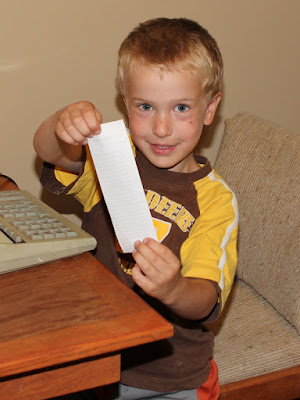
Jacob has been eagerly awaiting this day for at least, well, 2 days now. This morning he started asking questions. All day long he has been wondering how long until the big event. And that event is the arrival of the UPS truck carrying a special $8 package for him. And in that $8 package is not a DVD, or a book, or a toy, but rather 12 rolls of adding machine tape (totaling 1/3 of a mile). Oh yes, our four-year-old can hardly contain his excitement over office supplies. Let me back up a bit to explain. I am always on the lookout for a certain kind of toy. The sort of thing that you don t find in the toy section of a store. The sort of thing that is interesting and engages the curiosity of our boys, that most people would consider would toss, and that usually costs less than $5. Along those lines, Jacob has an old manual typewriter he can use, he and I built a switchbox full of switches and light bulbs that the boys love to play with, we built him a command-line-only PC out of spare parts, the boys have some radios they can use, and one day I salvaged a decades-old adding machine that was going to be thrown out. Jacob liked it he enjoys number and letter games and had some fun, but didn t zealously engage with it until just a few days ago. He sat down at his table and started making cards . He will print out a bunch of numbers, making a strip a couple of feet long, and then say, Dad, I made another card for you! We will then happily accept the card and he will continue making more. Here he is, holding up one of his cards: Jacob had a ton of fun making them, and Oliver wanted in on the action too. Oliver was somewhat interested in the adding machine, but not as much as Jacob, and Jacob didn t want to share. So somehow they decided that Oliver would run and get cards from Jacob and then take them to whatever parent Jacob said. Today Jacob said, Dad, the Oliver delivery service will bring you a card! Saturday morning we had some time to hang around and play, so we played some adding machine tape games. I tucked some long cards under my waistband, and the boys happily chased me all over the house trying to get them back. We also decorated: And here is what the room looked like after some cleanup: That orange bucket on the desk is my card bucket where I can put all the cards he gives me. He even helpfully empties it out into the recycle bin when there are too many old cards in it! But then tragedy struck it was out of paper! I ordered a 12-roll pack off Amazon, and boy was it a long couple of days until it arrived. Today before the UPS truck got here, I showed him how we could feed old paper through and print on the back side an incredible innovation, it seemed! Terah had a conversation with him earlier that went like this: Terah: Jacob, we need to clean up the house. Jacob: Why? Terah: Because some people are coming over. Jacob: Who is OH YES! The UPS delivery man! Yes, let s clean! Terah: Ah, well yes he will be here too, but your great uncle and aunt are coming. Jacob: Oh yay! And the UPS man! It is hard to describe Jacob s excitement when the package arrived. I quickly opened it up, and at his great uncle s prompting, he counted to see if he really did get 12 rolls of paper. IT IS TWELVE ROLLS! YAY! And then we quickly installed it in the machine and off he went. At his great uncle s prompting, he started writing a J on each card . This meant Jacob , or maybe he d put two J s, meaning To John From Jacob , or perhaps the two J s meant To Terah From Jacob he d always have to clue us in. Anyhow, for an $8 investment in paper this has brought hours of joy to our boys. Even though Jacob isn t yet really using it to perform arithmetic, it is setting him up to enjoy that sort of thing and encouraging his curiosity. Both good things.

Benjamin Mako Hill: Lawn Scrabble

The Acetarium, where I live, runs what we like to think of as the world's smallest artistic residency program by hosting artists, social scientists, hackers, and free software and free culture folks for periods of 1-3 months. Our most recently graduated resident, Noah, built a lawn scrabble set on the Media Lab ShopBot and held a Scrabble picnic this weekend with some former Acetarium residents and others. I don't really like playing Scrabble, so you can see me working on an essay (and verifying words) in the background. /copyrighteous/images/lawn_scrabble_01.jpg

/copyrighteous/images/lawn_scrabble_02.jpg Thanks to Ben Schwartz as I yoinked these pictures from his blog.

25 July 2011

Andrea Veri: Backup your Gmail in a few easy steps!

I ve actually spent a few hours searching around for a good backup solution for my mailbox until I decided to stick with getmail. What you ll be able to achieve after reading this HowTo and deploying the following setup is:
  1. A full backup of your e-mail DATA in the Mbox format. (yes, Gmail s labels / folders as well)
  2. Prevent getmail to mark all mails as read after delivering them. (this was a pretty bad issue since getmail was marking all my mails as read even if I did not access my e-mail at all)
  3. Keep your backups up-to-date with the latest content from your mailbox. (by default getmail grabs all the DATA from your mailbox and fills up the Mbox / Maildir content keeping deleted mails. So let s say I deleted a mail two days ago, well it ll still appear on today s backups. This behaviour is definitely unwanted)
I ll now move to explain a few details about my new configuration but before moving to tweak getmail s main config file, please do the following change on _retrieverbases.py* :
return self._getmsgpartbyid(msgid, (RFC822) ) to return self._getmsgpartbyid(msgid, (BODY.PEEK[]) )
When done grab the following getmailrc and adapt it to your needs**:
[retriever]
type = SimpleIMAPSSLRetriever ## or SimplePOP3SSLRetriever.
server = imap.gmail.com ## or pop.gmail.com for POP3.
username = example@gmail.com
password = password ## so-called Gmail s labels should be listed one by one here for getmail to retrieve mail from them successfully. mailboxes = ( INBOX , [Gmail]/Sent mail ,
ubuntu , gnome/example , linux/example ) [destination]
type = Mboxrd
path = ~/.getmail/backup.mbox [options]
delivered_to = false ## No delivered_to header added automatically.
received = false ## No received header added automatically.
verbose = 2 ## getmail will print messages about each of its actions.
When done we should go ahead setting up getmail s directories and config file:
mkdir $HOME/.getmail cp $HOME/getmailrc $HOME/.getmail/ ## Adapt $HOME/getmailrc to whatever dir you put that file into.
But pretty much all the remaining work will be done by a small shell script I wrote:
#!/bin/sh WORKDIR=$HOME/.getmail
date= date +%d-%m-%Y_%H:%M if [ ! -f $WORKDIR/backup.mbox ]
then
touch $WORKDIR/backup.mbox
fi getmail > $WORKDIR/getmail.log
OUT=$?
if [ $OUT -eq 0 ]
then
mkdir -p $WORKDIR/backups/ && mv $WORKDIR/backup.mbox $WORKDIR/backups/backup_$date.mbox ;
else [ $OUT -eq 1 ]
exit 1
fi ## Cleanup older than 3 days backups
find $WORKDIR/backups/* -mtime +3 -exec rm ;
cd $WORKDIR && rm -rf oldmail-* ;
This script will:
  1. Run getmail using the getmailrc config file you previously worked on.
  2. If the above command will be successful, it ll create a backups dir into $HOME/.getmail and move the latest Mbox file there appending a date and time to its name. (by doing this we are sure next getmail run will happen on an empty backup.mbox file, thus it will just contain the latest content from your mailbox)
  3. It ll re-create a backup.mbox file on $HOME/.getmail to avoid the next getmail run to fail.
  4. In the end, it ll clean up older than 3 days backups to avoid a too crowded backups folder. (it removes the oldmail file as well since it is useless in our case)
In the end set up a cronjob that will run the above script and generate the backups for you every one hour:
0 * * * * $HOME/.getmail/getmail_run.sh > /dev/null
Feel free to let me know if you ve encountered any issue while following the above HowTo. Enjoy! * /usr/share/getmail4/getmailcore/_retrieverbases.py on line 901. ** More documentation about the getmailrc file and syntax can be found on getmail s documentation page.

Matthew Garrett: OSCON

Last night, Tim O'Reilly posted about O'Reilly's desire to ensure that conferences they run are free of harassment and as welcoming to as much of the community as possible. This comes on the back of a brief campaign by various people concerned that the absence of such a policy at one of the largest open source conferences was a problem. O'Reilly turned out to be highly responsive, and it's a credit to everyone involved that this got worked out in such a short space of time.

OSCON's an interesting conference. First, it's huge. There's upwards of 15 simultaneous tracks in the main conference. It covers a huge range of topics, from Linux to pretty much any piece of open source middleware you can think of, to web technologies to hardware hacking to free culture. It's a cross section of pretty much everything that can plausibly be described as open source. As such, the demographics are very different to a typical Linux conference, or even a typical single-field technical conference such as PyCon. We may have discussed these issues at length in the Linux community, but that's such a small part of the OSCON audience that it's not surprising that awareness is lower.

Which means this is a pretty big deal. Sexual harassment isn't something that's limited to Linux conferences. It's prevalent throughout the entire open source world. Having a conference that represents a broader part of that world than any other accept that this is a genuine problem is a massive step towards raising awareness of it in the wider community.

Michal Čihař: Linux hardware support

Remembering not so far away history, I'm always a bit afraid when I'm about to use new hardware with Linux. It used to be troublesome to make some devices work. After getting Linux based phone last week, I've also received new notebook, where I want to run Debian as well. I expected various troubles, but surprisingly everything works like a charm without single line of configuration. Wireless networking, docking station, card reader, webcam, fingerprint reader and so on. All I had to do is to pull SSD out of old X60 notebook and put it into new X220. The only (though unnecessary) change was installation of 64-bit kernel (I currently see no big benefit in migrating to 64-bit userspace) and everything is working. Can your operating system do this? Thanks to all people who have helped in this.

Filed under: Debian English Linux 2 comments Flattr this!

David Welton: Why I prefer text to video

Videos are becoming more and more common on the internet, and for some things, like mentos and diet pepsi, they're hard to beat. For things I'm seriously interested in, though, I prefer text. Here's why:

Matthew Garrett: Contributor License Agreement corner cases

If you don't have any interest in tedious licensing discussion then I recommend not reading this. It's not going to be a great deal of fun.

Having said that:

I'm looking at the Canonical Individual Contributor License Agreement (pdf here). In contrast to the previous copyright assignment, it merely grants a broad set of rights to Canonical, including the right to relicense the work under any license they choose. Notably, it does not transfer copyright to Canonical. The contributor retains copyright.

So here's a thought experiment. Canonical release a project under the GPLv3. I produce a significant modification to it. It's now clearly a derived work of Canonical's project, so I have to distribute it under the GPLv3. I have no right to distribute it under a proprietary license. I sign the CLA and provide my modification to Canonical. The grant I give them includes giving them permission to relicense my work under any license they choose. As copyright holders to the original work, they may also change the license of that work. But, notably, I have not granted them copyright to my work. I continue to hold that.

Now someone else decides to extend the functionality that I added. By doing so they are creating a work that's both a derivative work of Canonical's code and also a derivative work of my code. How can they sign the CLA? I granted Canonical the right to grant extra permissions on my work. I didn't grant anyone else that right.

This wasn't a problem with the copyright assignment case, because as copyright holders Canonical could simply grant that permission to all downstream recipients. But Canonical aren't the copyright holder, and unless they explicitly relicense my work I don't see any way that they can accept derivatives of it. The only way I can see this working is if all Canonical code is actually distributed under an implicit license that's slightly more permissive than the GPLv3. But there's nothing saying that it is at present.

Now, I'm obviously not a lawyer. I may be entirely wrong about the above. But asymmetric CLAs introduce an additional level of complexity into the entire process of contributing that make it even more difficult for a potential contributor to become involved. I've spent far more time than most worrying about licenses and even I don't understand exactly what I'm giving up, which is ironic given that a stated aim is usually that they increase certainty about licensing. Is the opportunity to relicense really worth alienating people who would otherwise be doing free work for you?

Michal Čihař: Confused with N950 development options

As the main reason why I got Nokia N950 is that I promised to write some applications for that, I started to look deeply at available options how to write them. Unfortunately there are too many options and all documentation I've found is pretty confusing. The short story is that you should use Qt for user interface. However it is not that easy as it looks, you can use regular Qt, which can be run on the phone, but looks ugly in the end (maybe I did something wrong, but it did look completely different to anything else running in the phone). You can use Qt Quick, which is easy to write (simple UI definition and JavaScript variant for code), but it does not seem to support much of the widgets. And then there is Meego Touch library, which seems like a best option, however not mentioned at all on Nokia developer website. Looks like I need to learn few more things before actually starting to code.

Filed under: English Meego 7 comments Flattr this!

Thorsten Glaser: DebConf

Sitting in , , (Banja Luka, Republika Srpska, Bosna i Hercegovina) let s just say the country is pretty nice. People are okay, the beer is not called Nektar by accident, and the Mark (subunit Fennig, funnily enough) is worth 1 DM. Price niveau is below Germany (even when we had the DM) in some things, below or at modern European in others. In short, very affordable. They don t accept paper money though, it s really hard to get coins in most places, and they only want those. The food is okay, and my hotel is very luxurious. It s also got LAN. The weather is not so nice at the moment though: raining a lot, and expecting 30 C too-hot sun in two days. And there are still no Geocaches in the area. Anyway, DebConf is going on, I m acclimating and trying to get people, faces, nicknames and realnames connected. And accents. (And pronunciation of names for example, Ian differs totally from what I d use.) We even have working wire network (LAN) most of the time ;-) We re indeed still working on resurrecting m68k, but that s no news. More on that later, I d say.

Kenshi Muto: backport debian-installer gets a power of cdimage.debian.org

With Steve's kind help, I got a place to put my backport debian-installer images at Debian official CD host cdimage.debian.org. Although http://kmuto.jp/debian/d-i/ remains as the site of primary information, you can download or rsync every files from http://cdimage.debian.org/cdimage/unofficial/backports/ directly also. Please DO NOT fill any bugs about these images to Debian BTS. They are unofficial, even are provided by Debian official host ;-P

Wouter Verhelst: m68k revival

If you thought Debian/m68k was dead and buried and where happy about it, I'm sorry to disappoint you. The reason m68k had died out slightly was not that we'd lost interest, or that we'd been kicked out of the archive, or anything of the sorts, as I've seen people believe. Instead, the reasons were fully technical: glibc past some particular version needs TLS (thread-local storage) support, which hadn't been implemented for m68k yet, and nobody within the Debian/m68k team had the expertise to work on this. That was all. Not so long ago, some people within RedHat had started doing a TLS implementation for m68k, however. This was paid for by one of their customers who needed the ColdFire to work, and therefore it was focused mostly on ColdFire. However, ColdFire is close enough to plain old m68k that it was possible to port this TLS support to plain old without too much effort. Unfortunately, most of our machines were pretty much nonfunctional by that time; so in order to get things to work, we'd have to Not quite impossible, but still a lot of work that would need someone to put in quite an amount of time. This wasn't something that people in the m68k port could invest; and I'm also not sure we had the necessary skills amongst the team to do the necessary porting. So the work lay there, and it wasn't being done. Until one Thorsten Glaser, author of a shell called 'mksh' that I hadn't heard of until then, came along, and noted that his mksh package wasn't being built for m68k. Upon investigating, he discovered, as expected, that the port was almost dead. Now most people would leave it at that and decide that they couldn't build for an architecture that wasn't being maintained anymore and that would be perfectly fine but not Thorsten. On the brink of death, he almost single-handedly revived the m68k port, and got stuff to work to such an extent that it is now again possible to build a working and fairly up-to-date Linux/m68k ARAnyM virtual machine. As I'm typing this, my ARAnyM instance is checking out the d-i repository (so I can start building d-i), and building sudo at the same time. Let's see what comes from this.

Steve McIntyre: Unofficial backport CDs now hosted on cdimage.debian.org

For several years, Kenshi Muto has been doing some awesome work on updated/backported Debian CDs, producing CDs with support for newer hardware and newer features. I've used them myself in the past to help get awkward machines working, and I know they are a great resource for lots of other Debian users. We've discussed things in the last few weeks, and agreed that it would be useful to host his images on cdimage.debian.org. The best place to look now is http://cdimage.debian.org/cdimage/unofficial/backports/. These are unofficial images, so please don't report bugs in the Debian BTS for them.

Craig Small: Scary Functions: rawmemchr

Recently I received a bug report for psmisc that basically supplied a patch so psmisc works in a cygwin environment. Nothing terribly exciting in that and the changes are pretty uncontroversial. One of the changes is in that instead of using rawmemchr to find the end of the string, cygwin doesn t have that function and so it is replaced by strchr. I ve not seen the function rawmemchr before so I had a closer look. Initially I was a little worried, rawmemchr tries to find the given byte starting at a given pointer but unlike strchr it doesn t stop unless it finds the character. I think the only time this function is safe, or is no more evil than anything else, is when you are searching for the NUL character which is what fuser in psmisc does. Still, the string being checked is coming from getcwd which requires a string or buffer length so perhaps it would be better to use memchr which is a little slower but has a maximum length parameter. If you have code that uses this function, you may just want to check how it is being used because it seems like an old bad gets function that plagued a lot of programs.

Anand Kumria: Licence stupidity in 2011.

As amazing as it is, there are still people who simply do not understand Free Software licences (but actually generate Free Software). Consider this gem.
A project that is released as GPL cannot be used in any commercial product without the product itself also being offered as open source.
What? You mean like the Linux kernel? A GPL'd product used in many commercial products? Even worse, he conflates "open source" with Free Software. For shame, Kenneth Reitz, for shame.

24 July 2011

Chris Lamb: Calculating requests per second with pv

Miss apachetop under nginx or lighttpd? You can use pv to get a quick-and-dirty readout for almost any daemon:
sudo tail -F /var/log/nginx/access.log   pv -lr >/dev/null
[54.7/s ]
grep can naturally be used to filter the results.

Tore S. Bekkedal: Ut ya: English version

If a single man can display so much hatred
think only of how much love we all can display together.

Stine Renate H heim

I wrote a Norwegian post explaining my experience at Ut ya. I had taken this blog for dead, and had entirely forgotten that it was syndicated on Planet Debian. I don t want to let Google Translate make this disaster any worse than it is the translation of bullets into balls being particularly bad so the international attention the massacre has garnered in consideration, I am writing an English translation of my experiences. I feel somehow duty-bound to make people aware of what happened, but I don t want to get into anything else but a sober description of the events and some very brief reflections. There are many details I have chosen to omit. Others have written their experiences of the events at Ut ya. I wanted to write mine down as well, and get it out there . Partly, I want to write this down because I m unsure if I will remember all the details at a later point in time, although I think I d prefer it if I couldn t. I m also writing this because people are asking about my experiences and it s much better to have an URL to give them, lest I have to keep going through the same spiel over and over again. Our former Prime Minister and current labour movement demigod Gro Harlem Brundtland had recently left the island. I had been the cameraman for a video interview of her talking about Ut ya, and I was in the media group room encoding the video into a file suitable for YouTube, when someone else in the room startled and said that Twitter was full of messages about a loud explosion in Oslo. As the newspapers brought us information about the extent of the damages, a consensus arose that an informational meeting was in order. As soon as the current round of talks finished, we were gathered into the main hall. The meeting was duly held, and after the statement was made that a TV feed would be made available, I took it upon myself as the local alpha geek to make it happen. Of course, the situation caused both the wireless network and the GPRS networks to become totally unusable. As I was waiting for someone to set up a password, I took the opportunity to face the consequences of having eaten two bits of a microwavable dish called Hold-It the local equivalent of a Hot Pocket and went to the toilet. As I was in there, I first heard agitated shouting, then screams, then gunshots coming from just outside the toilets. More than anything else, it sounded like a toy gun. I was convinced that someone was making a joke in incredibly bad taste and I stormed out of the booth with the intent of halting it. As I tore the door open, I saw two of my comrades hiding in a recessed corner. Their facial expressions left absolutely no doubt that this was no toy. They signalled for me to get back in the booth. I closed the door, did a mental double-take in utter, complete confusion, and opened it again. They were still signalling. Had they not stood there, I would have run straight into the gunman; they saved my life. I looked out into the hallway, and I made eye contact with a young boy lying in a pool of blood. He was motioning for me to help him. I heard more gunshots from inside the building and retreated back inside. As I was trying to think through my next move, I realized that the decidedly insubstantial wood-fiber door would not resist any kind of bullets. I made my way out into the hallway, with the intent of escaping outside. At that point, I was of course not aware that there was an intention to kill as many as possible, so I thought that the open spaces outside would be a place of relative safety. Of course, this proved to be wrong and my life was probably saved a second time by one of the caf volunteers taking me into a hard-to-spot employee s bathroom. We sat there for ninety minutes. Always ready to make a run for it, ready for just about anything. A peculiar group dynamic arose with these two people with whom I had barely previously spoken. We came to share a strange sense of common destiny and gallows humour. One of them had seen the shooter and described the police uniform. I perceived it to be realistic that we were the only ones aware of the wounded outside the toilet. I tried to reach the emergency services, but all their lines were busy; the terror attack in Oslo had probably clogged their lines. I finally got through to the fire services, who could inform me that the police did know about the situation and were on their way. This was to take 90 minutes and by the time we evacuated, the young boy outside my door had perished. The despair I first saw in his eyes as I passed him, fleeing from one room to the other and the empty, blank stare as we left, are burned into me and they are images I will never in my life forget. Finally, the real police arrived. We walked out. I chose the path through the minor conference hall something I now regret. The sight was simply beyond my capacity to describe fully, and so terrifying that I barely remember the sight only the terror it struck in me. There were several people bunched up in a corner, a big amorphous heap of bodies. Some were conscious and yelled at me not to do anything that could startle the police, others lay still. Their bodies were all covered in blood, and a thick pool of blood extended at least a half-metre in all directions around them. The policeman across the hall was screaming orders at me, but he was screaming so loudly that I couldn t make out his words at first. We were first moved into the camp newspaper s offices. There were about eight of us there, I think, in addition to one girl who lay wounded. Towards the end she was drifting in and out of consciousness. We covered her with sweaters to keep her warm and one of us tried to at least temper her bleeding. The bullet had missed her heart, but by the entry wound it was clear that it was not by far. I do not know who this girl was or how she is now. I sat behind and never saw her face. The wounded were evacuated first. I don t remember how long we remained; I had lost all concept of time. In spite of protests from the group who knew him, one kid was put in handcuffs. At the time I didn t understand why, and the policeman seemed to say something almost to the effect that there was no reason for it at all. I didn t see when they undid his cuffs, but I remember thinking that this treatment made a terrible experience even worse for him. I tried my best to comfort him but knew it would be little help. Later, when things stabilised a little, we were told that he was handcuffed because he had come from an unsecured area. The police was extremely good at carefully explaining what was happening and why; this was a big help and I am grateful for it. Eventually we were moved out into the main corridor of the building, where we joined up into a group of about fifty. Only when I saw the two people who saved my life did any emotion other than mild confusion arise. I broke down shivering in tears in one of their arms. After a few seconds, I came back to my senses and realised that this was not the time. I quickly gathered myself, got the shaking under control, and sat down. We were given some chocolate and soda from the kiosk. I remember making an offhand remark that an inability to find joy in free candy was a sure sign of a bad situation. We all laughed out loud. Gallows humour is a coping mechanism, but in retrospect one almost feels guilty for it. We were shown out in a single file with hands above our heads. I remember an intense concern that someone would slip in the steep, muddy slope and create a misunderstanding. Outside, there were more bodies. Some under improvised covers a tarpaulin from the waffle stand, the deflated bouncy castle but some simply lay there. Everyone I met displayed a courage, a mental discipline and unity of purpose far beyond anything one would ever wish to expect from people this young. Everyone conducted themselves with an attitude that could almost be described as stiff upper lip . Safely across the fjord we were offered blankets. I was asked if I was aware of any injuries, and asked to lift my shirt and show my abdominal region. We were shown into the bus which took us to the hotel used by the survivors and their family. I simply cannot describe in any words the relief I felt when I was able to embrace my living comrades. It was completely unlike anything I had ever felt before in my life. The euphoric feeling was tempered only by the realisation that there would be many I could never see again, comrades whom I had taken great pride in calling my friends, with futures in the service of all mankind, futures I had previously found such great joy in pondering and guessing about. The feeling which continues to upset me the most, is the feeling that so many of my comrades left behind grieving families and friends. Torn away senselessly. I do not know how much more than this relatively sober account of the events on Ut ya I can muster. I would, however, like to offer some reflections. First of all, from the bottom of my heart, I want to thank the police who saved the lives of so many still on the island, the holidaymakers who took aboard swimmers into their boats and the rescue services staffed primarily by volunteers who have spared no effort in trying to soften the blow as much as they can. The opportunity to spend time with those comrades who underwent the same experience as myself has also been an immeasurable aid. I was also so relieved to find my very closest friend among the survivors, which has also been an indescribable help. If I can name a single positive in this tragedy: Had he arrived with his automatic weapon fifteen or twenty minutes prior, he would have arrived during the informational meeting, at a time when the major hall was absolutely jam-packed the death toll would be many times what it ended up being. I am agonisingly aware of the meager comfort this provides to those who have been bereft of their closest, but I do find some solace in this. We cannot sweep under a rug that this was without question! a political attack on the labour movement. But it is thankfully also an attack which has been perceived by everyone as an attack on the Norwegian society, and on a symbol of the wide recruitment to the participatory democracy which lies at our very national soul. I cannot thank the Norwegian people, and indeed the people in other nations who have offered their condolences, enough for their shows of support and shared grief. It really has been a tremendous help to me knowing that so many people feel with us. I also want to thank from the bottom of my heart the rock-steadiness of everyone in both the national and local wings of the Labour Party and Labour Youth in supporting us, and the political milieu in general for their resolute steadfastness saving me from losing yet more that I cherish; our freedoms in a participatory democracy. Our Party has lost many of its very brightest youngsters. Personally I feel an angry spite, a deep restless urge to get the wheels of society going again. I want to show his kind that we will not be broken. We re stronger than that. I will not be frightened into silence and passivity. I want to remember the dead, and honor them by carrying on our common work. I want to end this with a request to everyone who reads this, echoing a statement I read by one of my good friends and comrades: Please, don t let me see any messages of hatred, wishes for the death penalty, anything like that. If anyone should be of the belief that anything will improve by murdering this sad little person, they would be profoundly wrong. All attention now should be plowed into caring for those victims and their relatives who did not share my luck, and not giving an audience to a perpetrator who wants one. Tore Sinding Bekkedal

Next.

Previous.