Search Results: "ag"

3 November 2010

Andrew McMillan: Something a little different

During my recent trip to Massachusetts for CalConnect XIX I passed back via New York, surfing a few nights on the couch at the Washington Cube Garden1. This was just enough time for my new Davis VantagePro2 to arrive by UPS ground (phew!) causing me much consternation, as the box was about twice as wide as I expected it to be. On opening it I discovered that the reason for the size was the physical dimensions of the rain gauge, leading me to realise that I had actually bought exactly what I wanted: a high quality weather station. Also leading me to wonder how the hell I was going to get it halfway around the world with me the next day. Unfortunately that extra wide carrying case was in no way going to fit inside my suitcase. Fortunately it came with a handle. And those wonderful people at Air New Zealand gave me a Koru Gold upgrade for a 50th birthday present, so it was time to put it to the test... Travelling on the subway out to JFK was it's own little adventure, but I made it out to terminal 5 and wandered around a bit before concluding I needed to be in terminal 7. Once I was in the right place I found the fancy people's check in counter and the nice lady there was only too happy for me to carry it to New Zealand, though she did aver that perhaps the security scanners would be dubious. Not a hitch there though: I guess they're used to letting everything through that's not specifically denied, so weather stations are fine because nobody would be silly enough to even think of doing that... Being Koru Gold really helped at this point though, because it enabled me to queue jump use the priority boarding line when getting onto the plane, and every airline in the US seems to have gone all-out for this "checked baggage costs more" approach, so the planes all fly with empty baggage holds and totally overstuffed overhead lockers. If this progresses I shouldn't wonder that the planes will get so top-heavy they roll over, but through the miracles of priority boarding I was able to commandeer all the locker space I needed before anyone else had even made it past row 40. I confess that I was a little worried that it wouldn't be quite such plain sailing getting through LAX. I mean we all know what reputation this delightful little exit port has. In the event it was totally anitclimactic. If it has a handle on it, and it's about the same size and shape as a largish carryon then it's fine. There have been no recorded stabbings with wind vanes anyway - at least on aeroplanes - so clearly they are perfectly safe. Finally back in my country of birth, thinking I was home free, I breathed a sigh of relief transferred my bags and nipped off to the Koru lounge for a much needed shower and change of clothes after I snuck the station through another scanner. By now the handle had broken, so it was looking decidedly more 'box' like and less 'carryon' like, and when I eventually rolled up at the gate with my boarding pass the attendant made a valiant attempt to relieve me of it, but she was too slow and I danced around her and swanned up the gangway to take my seat. I was slow, this time, having missed the first boarding call, and all overhead lockers were crammed full. There was no seat in front of me to put the weather station under. Fortunately a nearby cupboard proved fit for purpose and it was secreted there and we were underway. At this point the guy two seats over said "didn't I see that weather station in New York?". Of course being bright yellow does make it a little conspicuous I guess, and I'm not renowned for my own inconspicuousness myself. So that's how I got my new weather station home, and you can see right away that doing things the easy way would never even occur to me. Possibly this is why I run Linux: there just isn't enough challenge when you run a different operating system. On Windows someone has always written a program for your new weather station, and a Mac user wouldn't be seen dead with it because it's black and beige and comes in a bright yellow box! So now I had to find some code to write. I looked around and very rapidly discovered that some software called vproweather was available, which would happily talk to my weather station and download the data from it, write web pages, stuff it into a MySQL database and so forth. All, obviously, far too easy, so I thought aha! I could convert that to PostgreSQL, and then I would be happy and relax with the thought of a job well done. So I downloaded the code in question an impressive several hundred kb of C code, cranked open a text editor and started to crawl through it and see where I could add the magic pixie dust to make it work with PostgreSQL. But it was not to be. My eyes glazed over or scales fell from them or something, and I realised that this particular edifice was beyond my help. Back to square one. I downloaded the Vantage Serial Protocol docs from the Davis Instruments website did some quick googling and decided I should write a module to talk this protocol. And I should write it in Perl (it was a Thursday, and Perl always seems more sensible on a Thursday, and not because of Douglas Adams, either). I beavered away into the night. Rain threatened, so I raced outside and installed the new weather station on the roof in the hopes that it's magnificent rain collector would collect. I raced back inside and was able to count the first (and so far, only) tip of the bucket. And so I now release upon the world Davis::VantagePro my first perl module. Well, the first one I care to share with the world, anyway. I have stressed it with very little testing, lumbered it with no planning or design whatsoever and so I feel it only fair that I should cast it upon the world with very little thought for it's survival or existential goals.

1 I seem to recall one night we came up with some fantastic names for Micah & Biella's Washington Square apartment, but I couldn't remember any of the good ones and had to slap a new one on there. I should also mention my stay at the Acetarium in Boston, which was a fabulous few days, but it would pad this blog post needlessly, and I've already done that.

Michal Čihař: Migrating documentation to Sphinx

While working on my new website, I've decided also to put documentation for Python modules into more pleasant format and use Sphinx for that. As it can include docstrings automatically and writing text in rst is really easy, after few minutes, the photo-uploader documentation got migrated to photo-uploader manual, which indeed looks nicer that old man page + epydoc generated stuff.

Filed under: Photo-Uploader 2 comments Flattr this

Raphaël Hertzog: Wiki page to share Debian presentations and associated templates

After having created my Debian presentation template, I wanted to share it so that future speakers can reuse my work. Surely there should be a place for this. I quickly found Ubuntu s dedicated wiki page, and for Debian the relevant place was on the website. However looking at that page, it s obvious that the website is not the proper place: the page has not been updated with new talks since 2005. It s just to much burden for any speaker. A wiki page is much more convenient in that regard. Switching to the wiki means we loose translations but that s still better than an outdated translated page on the website. So I went ahead, I created http://wiki.debian.org/Presentations and I filed a bug against www.debian.org to suggest to move the content to the wiki (see #601337) and to leave a link pointing to the new wiki page. So the content of the website needs to be injected into the wiki. This is an easy task for someone that wishes to start contributing to Debian. Thus it s your task. Once completed send a mail to 601337@bugs.debian.org to inform the webmasters that the wiki part of the work has been completed. They just have to drop the old pages and replace them with links to the wiki. PS: If you have given a Debian talk recently, please put your slides online and link to them on the new wiki page.

Flattr this Share/Bookmark 9 comments Support my work

Dirk Eddelbuettel: inline 0.3.7

A bug-fix release 0.3.7 of inline is now on CRAN and at Debian. It fixes a minor bug: when package.skeleton() was called to convert one or more functions created with this package into a package, the corner case of just a single submitted function failed. This is now corrected. Otherwise this release is unchanged from the previous release 0.3.6 from August.

Matt Zimmerman: Weathering the Ubuntu brainstorm

In our first few years, Ubuntu experienced explosive growth, from zero to millions of users. Because Ubuntu is an open project, these people don t just use Ubuntu, but can see what s happening next and influence it through suggestions and contributions. The volume of suggestions quickly became unmanageable through ad hoc discussion, because the volume of feedback overwhelmed the relatively few people who were actively developing Ubuntu.

Ubuntu Brainstorm logo In order to better manage user feedback at this scale, Ubuntu Brainstorm was created in 2008. It s a collaborative filtering engine which allows anyone to contribute an idea, and have it voted on by others. Since then, it s been available to Ubuntu developers and leaders as an information source, which has been used in various ways. The top ideas are printed in the Ubuntu Weekly Newsletter each week. We experimented with producing a report each release cycle and sharing it with the developer community. People have been encouraged to take these suggestions to the Ubuntu Developer Summits. We continue to look for new and better ways to process the feedback provided by the user community. Most recently, I asked my colleagues on the Ubuntu Technical Board in a meeting whether we should take responsibility for responding to the feedback available in Ubuntu Brainstorm. They agreed that this was worth exploring, and I put forward a proposal for how it might work. The proposal was unanimously accepted at a later meeting, and I m working on the first feedback cycle now. In short, the Technical Board will ensure that, every three months, the highest voted topics on Ubuntu Brainstorm receive an official response from the Ubuntu project. The Technical Board won t respond to all of them personally, but will identify subject matter experts within the project, ask them to write a short response, and compile these responses for publication. My hope is that this approach will bring more visibility to common user concerns, help users understand what we re doing with their feedback, and generally improve transparency in Ubuntu. We ve already selected the topics for the first iteration based on the most popular items of the past six months, and are organizing responses now. Please visit brainstorm.ubuntu.com and cast your votes for next time!

Lucas Nussbaum: Triaging X Strike Force bugs with UDD Bugs Search

Thanks to the work of Julien Viard de Galbert, UDD Bugs Search just gained the ability to help the triaging of X Strike Force bugs. He worked on the patch by installing his own copy of bugs.cgi on alioth. Don t hesitate to do the same with your team!

Dirk Eddelbuettel: Rcpp 0.8.8

A bug-fix release 0.8.8 of Rcpp is now available. It is awaiting processing at CRAN, and will be uploaded to Debian once processed at CRAN. In the meantime, sources are available from my local directory here. This release follows on the heels of 0.8.7, but contains fixes for a few small things Romain and I had noticed over the last two weeks since releasing 0.8.7 and contains only a small number of new tweaks. The NEWS entry follows below:
0.8.8   2010-11-01
    o   New syntactic shortcut to extract rows and columns of a Matrix. 
        x(i,_) extracts the i-th row and x(_,i) extracts the i-th column. 
    
    o   Matrix indexing is more efficient. However, faster indexing is
        disabled if g++ 4.5.0 or later is used.
    o   A few new Rcpp operators such as cumsum, operator=(sugar)
    o   Variety of bug fixes:
        - column indexing was incorrect in some cases
        - compilation using clang/llvm (thanks to Karl Millar for the patch)
        - instantation order of Module corrected
        - POSIXct, POSIXt now correctly ordered for R 2.12.0 
As always, even fuller details are on the Rcpp Changelog page and the Rcpp page which also leads to the downloads, the browseable doxygen docs and zip files of doxygen output for the standard formats. A local directory has source and documentation too. Questions, comments etc should go to the rcpp-devel mailing list off the R-Forge page

Tim Retout: Flattr-y will get you nowhere

Dato pointed out on my post yesterday that I had omitted to link to the Ikea catalogue. And then it hit me - I am completely failing to monetize this blog! (Sadly, Ikea aren't in a position to give me any kickbacks right now.) Since my money would be spent on innovative Swedish design in any case, I present a new microdonations system: Flattr-pack. I'll add a "Flattr-pack this!" button to everything I write, and then you can send me furniture with one easy click. Unlike other systems, this has the advantage that no one will be taking a 10% cut of your donations. Awesome! Or maybe not. For those who don't know what I'm on about, Flattr is a website that lets you donate small amounts of money to other websites. It has been proposed to use this site to support free and open source software (FOSS). Now a quick modern anthropology lesson: in a 1998 essay titled "Homesteading the Noosphere", Eric Raymond conjectured that FOSS society is a gift economy; your reputation is proportional to how much you give away. At first sight, microdonations drop neatly into this system; after all, the users are giving money away, right? And yet somehow, I don't think those users are gaining much in terms of reputation. Not in the same way as if they reported bugs, say; joined a localization team; or even just turned up to conferences and volunteered to sit on the front desk. Both types of activity could be described as "donations" - but in one case, the donation benefits the whole community around the project, and in the other it goes to just a few top developers. It's a plain old exchange economy in disguise. I do hope that those users are not dissuaded from making the more generous donations just because it's more convenient to whip out a credit card. That would not be in their long-term interests, or those of the community as a whole. I fear this scheme could also incentivize some oddly inefficient behaviour; writing blog entries purely for their donation potential, say, or even content-free search-engine optimization posts. Speaking entirely personally, I do not plan to join in.

2 November 2010

Sam Hartman: Review of Git DPM

I ve been looking at git dpm. It s a tool for managing Debian packages in git. The description promises the world: use of git to maintain both a set of patches to some upstream software along with the history of those patches both at the same time. It also promises the ability to let me share my development repositories. The overhead is much less than topgit. My feelings are mixed. It does deliver on its promise to allow you to maintain your upstream patches and to use git normallyish. It produces nice quilt patch series. In order to understand the down side, it s necessary to understand a bit about how it works. It maintains your normal branch roughly the way you do things today. There s also a branch that is rebased often that is effectively the quilt series. It starts from the upstream and has a commit for every patch in your quilt series containing exactly the contents of that patch. This branch is merged into your debian branch when you run git dpm update-patches. The down side is that it makes the debian branch kind of fragile. If you commit an upstream change to the Debian branch it will be reverted by the next git dpm update-patches. The history will not be lost, but unless you have turned that change into a commit along your patches branch, git dpm update-patches will remove the change without warning. This can be particularly surprising if the change in question is a merge from the upstream branch. In that case, the merged in changes will all be lost, but since the tip of the upstream branch is in your history, then future merges will not bring them back. If you either also merge your changes into the patches branch, or tell git dpm about a new upstream, then the changes will reappear at the next git dpm update-patches. The other fragility is that rebasing your debian branch can have really unpleasant consequences. The problem is that rebase removes merge commits: it assumes that the only changes introduced by merge commits are resolution of conflicts. However, git dpm synthesizes merge commits. In particular, it takes the debian directory from your debian branch, plus the upstream sources from your upstream branch, plus all the patches you applied and calls that your new debian branch. There s also a metadata file that contains pointers to the upstream branch and the quilt patch series branch. In addition, debian/patches gets populated. Discarding this commit completely would simply roll you back to the previous state of your patches. However, this loses history! There is no reference that is left pointing to the patches branch; the only reason it is still referenced is that it s a parent of the commit rebase is throwing away. This isn t really all that unusual; if you merged in any branch, deleted the branch and rebased away both the merge and the commits from the branch, you d lose history. I do find it a bit easier to do with git dpm. However, it s more likely that you ll manage to rebase and keep the commits from the patches branch. In particular, if the horizon of your rebase includes a merge of the patches branch,then for every patch that involves changes to the debian branch from the point where rebase starts rewriting history, you will see a commit included by your rebase. My suspicion is that this commit is more likely to generate conflicts than usual because it s a patch on top of the upstream sources being applied to a partially patched debian branch. However I have not fully worked through things: it may be that such a patch is exactly as likely to cause conflicts as it would in a git dpm update-patches operation. If that succeeds and you do not manage to fail to pick one of these commits, you ll end up with roughly the same debian sources you started with. There are two key exceptions: the git dpm metadata file is not updated and your debian/patches is not consistent with your sources. The first means you re in the state of the previous paragraph: git dpm update-patches will blow away your changes. The second means that any source package you produce is going to be kind of funky if not out right broken. It is possible to recover from git dpm plus rebase. I think if you git dpm checkout-patches, then cherry pick the patch related commits from your debian branch that were introduced by the rebase, then git dpm update-patches, you ll be in a sane state. Obviously you could also recover by finding the pre-rebase commit and resetting there. I m assuming though that you actually needed to rebase for some reason. Of course git dpm does involve a space penalty. You generate a commit for every patch in your quilt series for every version of the upstream sources you deal with. Also, you will introduce and store every version of the quilt series directly in your debian directory. The extra commits probably aren t a big deal: the blobs probably delta compress well. I m not sure though that the quilt patch blobs will compress well with other things. In my opinion the ability to get nice quilt patches is well worth the space penalty. In conclusion, git dpm is a sharp tool. Actually, I think that s understating things. Git dpm involves a bunch of rotating blades. You stick your face and foot between the blades, and if you use it correctly, there s exactly enough clearance that nothing gets damaged and you get some fairly neat results. Other outcomes are available. I m still trying to evaluate if it is worth it. I think the tradeoff might be different for something like the krb5 package which is maintained by two very experienced maintainers than say for Shibboleth which seems to involve several more maintainers. I m not sure that there is much git dpm can do to make things better. Even detecting loss-of-foot events might be kind of tricky.

Josselin Mouette: Mini Debconf Paris 2010

Several people asked me for the slides I presented Saturday at the Mini Debconf. Until they are available on the Debconf website, here they are: Despite having gone completely overboard with the timing (let me apologize again to the organizers), the talk seems to have gathered quite some interest. Several people looked surprised to learn Debian is used on such a large scale.

Enrico Zini: Using the apt-xapian-index catalogedtime plugin

Using the apt-xapian-index catalogedtime plugin apt-xapian-index has recently gained a catalogedtime plugin, which stores the timestamp of when the package was first cataloged. At first glance this does not mean much, so I'll explain with an example. aptitude can show a list of "New Packages": those packages that it sees now for the first time. It is a very useful feature, but you cannot ask it "what packages became available during last week?" With the catalogedtime plugin, the apt xapian index can now answer that question. You can also sort package results by "newness", or implement a user interface with some sort of "newness timeline" package filter option. Of course you will find documentation about it in /var/lib/apt-xapian-index/README, since the index is self-documenting. As usual in my apt-xapian-index posts, here is a code example:
#!/usr/bin/python
# coding: utf-8
# Show packages that were NEW in the last N days
# (C) 2010 Enrico Zini <enrico@enricozini.org>
# License: WTFPL version 2 (http://sam.zoy.org/wtfpl/)
import axi
import xapian
import time
import sys
class App:
    def __init__(self, days):
        self.db = xapian.Database(axi.XAPIANINDEX)
        # Read the contents of /var/lib/apt-xapian-index/values
        self.values, self.descs = axi.readValueDB()
        # Find the value ID for the catalogedtime timestamps
        self.cattime_vid = self.values["catalogedtime"]
        # Filter packages first seen more than than X days ago
        self.query = xapian.Query(xapian.Query.OP_VALUE_GE, self.cattime_vid,
                    xapian.sortable_serialise(time.time() - 86400*days))
    def main(self):
        # Perform the query
        self.enquire = xapian.Enquire(self.db)
        self.enquire.set_query(self.query)
        # Sort by cataloged time
        self.enquire.set_sort_by_value(self.cattime_vid, True)
        # Print the first 200
        matches = self.enquire.get_mset(0, 200)
        for m in matches:
            name = m.document.get_data()
            val = m.document.get_value(self.cattime_vid)
            fval = xapian.sortable_unserialise(val)
            tm = time.localtime(fval)
            timestr = time.strftime("%c", tm)
            print "%s %s" % (timestr, name)
if __name__ == "__main__":
    try:
        days = int(sys.argv[1])
    except:
        print >>sys.stderr, "Usage: %s days" % sys.argv[0]
        sys.exit(1)
    app = App(days)
    app.main()
    sys.exit(0)
Enjoy!

Julien Danjou: Transparent GIF support in Emacs 24

Last week, I wrote a couple of patches to add support for transparency when Emacs is displaying GIF images. Until now, it was displaying the color used to define transparency in the file data. Now it displays the image correctly by using the frame color as the transparency color, like it's done for other image formats. The patches have not been merged yet, but will probably be soon. Flattr this

Francois Marier: RAID1 alternative for SSD drives

I recently added a solid-state drive to my desktop computer to take advantage of the performance boost rumored to come with these drives. For reliability reasons, I've always tried to use software RAID1 to avoid having to reinstall my machine from backups should a hard drive fail. While this strategy is fairly cheap with regular hard drives, it's not really workable with SSD drives which are still an order of magnitude more expensive.

The strategy I settled on is this one:This setup has the benefit of using a very small SSD to speed up the main partition while keeping all important data on the larger mirrored drives.

Resetting the SSDThe first thing I did, given that I purchased a second-hand drive, was to completely erase the drive and mark all sectors as empty using an ATA secure erase. Because SSDs have a tendency to get slower as data is added to them, it is necessary to clear the drive in a way that will let the controller know that every byte is now free to be used again.

There is a lot of advice on the web on how to do this and many tutorials refer to an old piece of software called Secure Erase. There is a much better solution on Linux: issuing the commands directly using hdparm.

Partitioning the SSDOnce the drive is empty, it's time to create partitions on it. I'm not sure how important it is to align the partitions to the SSD erase block size on newer drives, but I decided to follow Ted Ts'o's instructions anyways.

Another thing I did is leave 20% of the drive unpartitioned. I've often read that SSDs are faster the more free space they have so I figured that limiting myself to 80% of the drive should help the drive maintain its peak performance over time. In fact, I've heard that extra unused unpartitionable space is one of the main differences between the value and extreme series of Intel SSDs. I'd love to see an official confirmation of this from Intel of course!

Keeping the RAID1 array in sync with the SSDOnce I added the solid-state drive to my computer and copied my root partition on it, I adjusted my fstab and grub settings to boot from that drive. I also setup the following cron job (running twice daily) to keep a copy of my root partition on the old RAID1 drives (mounted on /mnt):
nice ionice -c3 rsync -aHx --delete --exclude=/proc/* --exclude=/sys/* --exclude=/tmp/* --exclude=/home/* --exclude=/mnt/* --exclude=/lost+found/* --exclude=/data/* /* /mnt/

Tuning the SSDFinally, after reading this excellent LWN article, I decided to tune the SSD drive (/dev/sda) by adjusting three things:


Is there anything else I should be doing to make sure I get the most out of my SSD?

Theodore Ts'o: I have the money shot for my LCA presentation


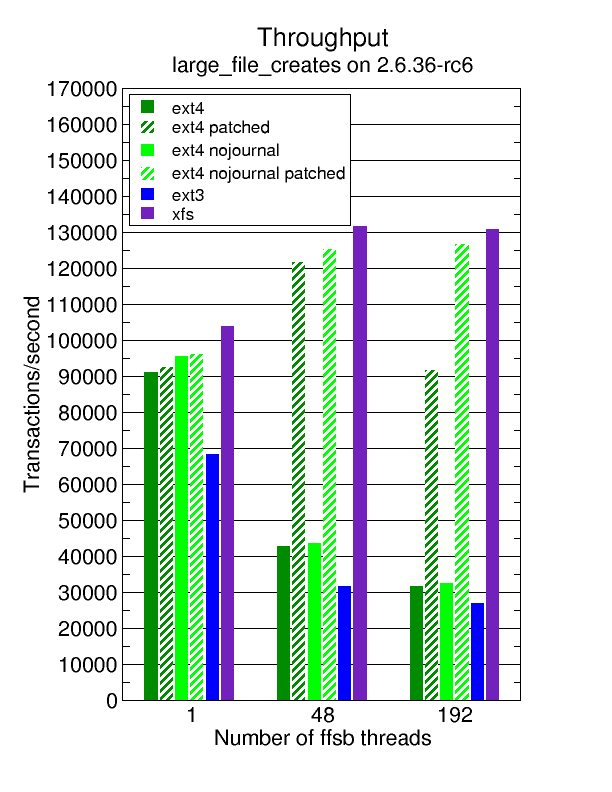
Thanks to Eric Whitney s benchmarking results, I have my money shot for my upcoming 2011 LCA talk in Brisbane, which will be about how to improve scalability in the Linux kernel, using the case study of the work that I did to improve scalability via a series of scalability patches that were developed during 2.6.34, 2.6.35, and 2.6.36 (and went into the the kernel during subsequent merge window). These benchmarks were done on a 48-core AMD system (8 sockets, 6 cores/socket) using a 24 SAS-disk hardware RAID array. Which is the sort of system which XFS has traditionally shined on, and for which ext3 has traditionally not scaled very well at. We re now within striking distance of XFS, and there s more improvements to ext4 which I have planned that should help its performance even further. This is the kind of performance improvement that I m totally psyched to see! No related posts.

Theodore Ts'o: I have the money shot for my LCA presentation


Thanks to Eric Whitney s benchmarking results, I have my money shot for my upcoming 2011 LCA talk in Brisbane, which will be about how to improve scalability in the Linux kernel, using the case study of the work that I did to improve scalability via a series of scalability patches that were developed during 2.6.34, 2.6.35, and 2.6.36 (and went into the kernel during subsequent merge window). These benchmarks were done on a 48-core AMD system (8 sockets, 6 cores/socket) using a 24 SAS-disk hardware RAID array. Which is the sort of system which XFS has traditionally shined on, and for which ext3 has traditionally not scaled very well at. We re now within striking distance of XFS, and there s more improvements to ext4 which I have planned that should help its performance even further. This is the kind of performance improvement that I m totally psyched to see! No related posts.

1 November 2010

Biella Coleman: The Anthropology of Hackers

I meant to blog about this a long time ago but it slipped past me. Here is my course on hackers described in The Atlantic . I ma not teaching it this year but will do so next year. I actually include a lot more than what is in the syllabus (much to the chagrin of my students).

Tim Retout: Boxes

Today I bought two Ikea boxes. Possibly the best 8 I have ever spent - I still have a load of bits of paper to sort out, but now they're all hidden from sight in a sleek, black and chrome rivet-effect container. More than simply reclaiming my sofa from the piles of notes, they seem to point to a higher truth; they fit their purpose in a way that is hard to articulate, like some platonic Form. Taking complexity, and making it manageable; but more than that, elegant. At some point, I lost the ability to explain to my friends and family what it is I spend my spare time doing. I feel isolated; I cannot express what motivates me, or even what it is I do. In fact, sometimes I can't even describe it to myself. Perhaps I never could. I don't believe that you can buy happiness; but if I surround myself with metaphors, maybe I can buy clarity.

Adnan Hodzic: I want Xperia X10 Android 2.1 update now!

Story I bought Xperia X10i this summer during DebConf10 in NYC, I loved this phone from very beginning however what bothered me was that it was still stuck on outdated Android 1.6. To get your own custom Android on it, wasn t quite possible because no one managed to hack bootloader even though some of the guys at XDA where getting pretty close. Long story made short, Sony Ericsson has finally release their Android 2.1 update, but made it available only for Nordic region, they explained it all on their blog where they also sent a message for paranoid users as they called them. I thought, if I gave it all this time I can wait a little bit longer, but then one of my friends (@sahinovic) gave me a good pointer to go in right direction with using custom ROM, Nordic for example? So this is where I got my idea. I want 2.1 update now! Please note steps below will get you Android 2.1 update, but AFAIK you ll also lose your warranty 1. Root your phone If you don t have your phone rooted, this can now be done in single click. Get X10 Root and follow instructions on screen. 2. Edit system/default.prop Get Root Explorer, mount r/w (upper right corner), edit system/default.prop Lines you re concentrating on are 1 and 3 Let s say they are:
ro.semc.version.cust=1237-0333
ro.product.name=X10_1237-0333
Edit them to look like:
ro.semc.version.cust=1234-8465
ro.product.name=X10_1234-8465
Save the file and it s gonna create automatic backup of original file. 3. Get the updates using SEUS Turn off your phone, launch SEUS, plugin in the USB cable while holding back button, SEUS is going to tell you have updates for your phone Smile Follow on screen instructions. Enjoy the update Smile Conclusion X10 is a pretty sweet phone, but with it being so closed, it also closes a lot of doors to hacking it and playing with it, great example would be this update itself, since right now Android 2.1 update is an outdated one. However 2.1 update brings new life into it, just as it s a brand new phone, it s more responsive and much much faster. And do take a backup before this update, because I lost everything from my contacts to internet settings, but all files on my sd card remained intact. If you want to discuss anything regarding this topic please do so in comment area below or find me on Twitter.

Rapha&#235;l Hertzog: 5 free software to support with Flattr

Flattr FOSS LogoIt s already the fourth issue of Flattr FOSS: it means 20 different projects using Flattr that I presented you. Here are the 5 suggestions for November:
  1. Redshift is a small utility that adjusts the color temperature of your screen to make it less aggressive on your eyes, in particular during evening/nights. It uses the time of the day and the geographic location to know whether it s night or day. I discovered it this summer and I liked it, although I m not running it permanently.
  2. Noscript is a Firefox plugin to control what sites can execute javascript, flash and other plugins. All those are creating supplementary security risks and you browse safer if you allow only some sites to run them. This is the number one entry on Flattr in the opensource category, it recently took the place of dpkg.
  3. phyMyAdmin is a web interface to manage MySQL databases. If you have such a database on a web-hosting service, you have likely already seen it in action. It s an award-winning software with a 12 year history, it s not so common for PHP applications. :-)
  4. Chromium maintenance in Debian. Chromium is a rapidly-evolving & complex software and Giuseppe Iuculano has been tirelessly working on packaging it. Almost alone within Debian. He deserves kudos for his work even though he reused work made by Fabien Tassin on the Ubuntu package.
  5. Dulwich is a pure-Python implementation of the Git file formats and protocols. It s an important building block for interoperability between Bazaar and Git: bzr-git (a Bazaar plugin providing Git integration) is notably using it. Given the large usage of bzr in Ubuntu and the popularity of Git world-wide, it s important to have such gateways.
This article is part of the Flattr FOSS project.
Update: mentioned the work of Fabien Tassin on the chromium package within Ubuntu.

Flattr this Share/Bookmark 6 comments Support my work

Russell Coker: Communication Shutdown and Autism

The AEIOU Foundation The AEIOU Foundation [1] is a support and advocacy organisation for people on the Autism Spectrum, note that they clearly say Autism Spectrum Disorder (ASD) on their About page, some of what they write would be less wrong if it was claimed to apply to only non-verbal Autistics or people claimed to be Low Functioning Autistic (LFA). But in regard to the Autism Spectrum they just don t seem to know much about it, a lot of their web pages seem to be based on the assumption that anyone who is on the Spectrum will be lucky if they can ever live independently. However it seems that most people who can be diagnosed with an ASD have typical social skills by the standards of the IT industry and can get by without any special assistance. The entire site seems to be written about people on the Spectrum by people who know little of their experiences and contains hardly any information that matches what I ve read from various people on the Spectrum (of course there are a wide range of experiences that differ greatly). They have a link to Autism Related Sites which starts with Autism Speaks (the Wikipedia page about Autism Speaks is worth reading note the section about immunisation research which has been repeatedly debunked and the section about legal action against a young autistic blogger). There are many good reasons why Autism Speaks is so widely hated among people on the Spectrum. I think that recommending Autism Speaks is a sign of willful ignorance of almost everything related to Autism. In their page about describing Autism to NTs they say Imagine if you suddenly woke up in a foreign country, did not speak the language and had no way of effectively communicating with the people around you . I ve been diagnosed with Asperger Syndrome by a psychologist who considers that to be the same as High Functioning Autism (HFA) and I ve visited more than a few countries. I find the comparison of the Autistic experience to visiting another country to be so strange that I don t even know where I would begin if I was to comment on where it went wrong. Finally they have a scrolling bar listing their advertisers at the bottom of ever single page on their site. If someone was going to design a web site specifically to annoy people on the Spectrum then such a scrolling banner would be a good place to start. Now they probably do some good things to help families with children on the Spectrum. But their ability to do good is really hindered by the lack of input from people on the spectrum, Rachel Cohen-Rottenberg (leader of the Vermont Chapter of the Autistic Self Advocacy Network) wrote an interesting post about AEIOU and noted that none of the people who run AEIOU are Autistic [2]. The Communication Shutdown Someone got the idea that Neuro-Typical people (NTs) should try and understand what it s like to be on the Spectrum which is a reasonable idea. But they decided that the way to do so is to have them refrain from Internet based socialisation and not use Facebook and Twitter for one day. It seems to me that most people on the Spectrum primarily socialise via the Internet, so ceasing Internet based socialisation is likely to make their experience less like that of people on the Spectrum. I m getting a mental image of a bunch of NTs deciding to go to a night-club for their Internet free evening and then imagining that they are somehow empathising with the experience of people who can never enjoy a night-club. As an aside, a web site which has anything at all related to disabilities shouldn t rely on Flash the Communication Shutdown site totally fails in this regard. No Stereotypes Here has an interesting analysis of this situation, among other things they comment on the irony of having someone ask them to stop using twitter as part of this campaign [3]. One thing that they suggest is for NTs to have a day without any communication at all. Some Suggestions for People who Want to Understand As a communication exercise, try going shopping without speaking, just use hand gestures. For bonus points try doing so in a foreign country where you don t know the language so you need bidirectional non-verbal communication with some luck you can complete a transaction without the shopkeeper realising that you are a foreigner. This won t actually give you much of the Autistic experience, but it s a good exercise in understanding how communication works. Someone who wanted to know the down-side of being on the Spectrum could find a sports bar where most patrons support one team and then enter the bar while wearing a jersey indicating support for an opposing team. I don t recommend doing this because it really wouldn t be fun, but for a quick approximation of the experience it would probably work well. It seems to me that paying $5 to a charity and then boasting about doing so on your Facebook page for a day is an easy thing to do. A harder task would be to spend a day reading about the experiences of the people in question and then giving $5 to a charity that is well regarded by the target group. Another possible way of gaining some understanding would be to have a party where everyone brings their laptop and uses only electronic communication no speaking at all. This is in fact fairly close to what some of the Geekier (possibly Autistic) members of the IT community do.

Next.

Previous.