Search Results: "ag"

6 November 2010

Josselin Mouette: Is HP run by a bunch of idiots?

My wife has been pestering me for months to get a replacement for our dead Epson inkjet printer (which didn t last long, mind you). To avoid the nightmare of printer support, which, unless you buy a high-end professional printer which does everything plus the coffee, is usually somewhere between disaster and works sometimes , we spent a long time on manufacturers websites to choose wisely the model. We chose the HP Laserjet P1102, which, according to HP, has a full support level and is even part of their recommended models. Yet, after plugging it in, it took me quite some time to understand why it would behave as a brick instead of a printer. First, I thought it was a bug in hplip. Then, I soon discovered that the printer advertised itself as a storage device instead of a printer. What, a buggy firmware? Thanks to a random question on Launchpad I discovered it s not a bug, it s a feature. It s named HP Smart Install and it turns out it s yet another stupid idea to support OSes that are too dumb to detect your printers automatically: the printer advertises itself as a CD drive, until you install the driver that will make it switch back to being a printer. What happens to those who don t want this feature that turns your printer into a 10 kg, read-only USB drive? Well, HP has a solution in the Smart Install FAQ:
25. Can I turn HP Smart Install off or on?
Yes. You can use the HP Smart Install utility to disable/enable HP Smart Install. The utility is stored on the software CD, in the UTIL folder. SIUtility.exe is for 32-bit operating systems and SIUtility64.exe is for 64-bit operating systems.
Bunch of idiots. If I buy a 100 printer, it s not so that I have to buy a 100 operating system just to activate it.

Thorsten Glaser: Debian/m68k progress, MirBSD notes

I m almost finished with sort of re-bootstrapping Debian/m68k (I can use etch-m68k as well as what was in unstable at the moment as dependencies, so it was not that much, still, 305 binary packages build from 84 source packages, most for unstable (very few for unreleased, with very responsive maintainers, thanks all, who will include the patches in their next uploads) is a bit including rebuilds with newer versions, more patches, more testing or newer dependencies installed. I ll probably upload on Sunday evening, as I ll be off for 2-4 days at least from then (see below). Ingo tried to test on real hardware, but as Murphy wants a hard disc failed we ll still try to get something done over the weekend. If you want to have a look, see my repository index (sources.txt contains a sample sources.list file, 0-NOTE.txt some hints, including the right debootstrap/cowbuilder magic and speed tricks). I ll need to learn how to use LVM and set up a buildd now I ve not been in much of a hacking mood recently all these visits to the dentist leave me in unrest and disturb my equilibrium. Hence, not much activity even in mksh even if there was need, almost none in MirBSD. This is only temporary, but I won t attend OpenRheinRuhr, or, if I come at all, it ll be for socialising only and probably only one day. Benny s done with his Doctor (in France, no idea whether it s one in Germany as well) of Chemistry and has returned to hacking some (World of) Google-Go(o) code. I expect MirBSD activity to slowly raise once we can come back. Please accept our apologies.

Russell Coker: Unparliamentary Language and Free Software

I ve just read the Wikipedia page about Unparliamentary Language [1]. I recommend that everyone read it, if only for the amusement value, among other things it links to incidents where elected representatives acted in a way that would be expected of primary school children. The general concept of having rules about Unparliamentary Language is that MPs are permitted to say anything in Parliament without the risk of being sued or prosecuted, but certain things are inappropriate the most common example is directly accusing another MP of lying. One of the main aims of rules against Unparliamentary Language is to prevent attacks on the honor of another member. Having just witnessed a mailing list discussion go widely off track when a free software project was denigrated, it seems to me that we could do with some similar guidelines for mailing list discussions. The aim would be not to just prevent excessive attacks on the honor of other members but to also protect the honor of the free software projects. So for example one might recommend not using a particular program because of design decisions which seem dubious or a bad security history, but saying it s crap would be considered to be inappropriate. Not that rejecting a program based on design decisions or a history of security flaws would be uncontroversial, but at least that gives objective issues to discuss so if there is a debate it will educate some of the lurkers. Note that I m not claiming to be better than other people in this regard, I ve described software as crap on more than a few occasions. But I will try to avoid such things in future. Finally does anyone have a good suggestion for a Free Software equivalent to the term Unparliamentary Language ? It seems that to a large extent the support of certain ideas depends on having a catchy name and I can t think of one.

Jurij Smakov: DVD media for SunBlade 1000

This might save someone a good deal of sifting through ancient posts on obscure forums: if you wonder why your SunBlade 1000 workstation refuses to boot off a freshly burned DVD, keep in mind that the standard-issue DVD drive in those machines (typically Toshiba SD-M1401) is pretty picky about the DVD media type used. Trying to boot off DVD-R discs invariably failed for me with a "read failed" error, while the same image burned onto a DVD+R blank worked like a charm.

5 November 2010

Craig Small: Book: Surface Detail

Oh yes, another Iain M. Banks story is out and I had to read it right away. I wasn't disappointed either.

It's another one of his Sci Fi books in the world, or worlds of The Culture. I wasn't disappointed and it was interesting to see him flesh out more of his universe in this book. Like a lot of his books, there are several sub-threads within the main story with no real obvious connection between them all.

Transferring your "mind state" from the grey mushy stuff you have in your head into a computer isn't new in this series. Even the concept of the dead "living" in a computer is not that unique. What has been introduced is the "hells". A computer simulation of hell where people who go against some societies rules end up if they're bad enough.

Now some civilizations think this is great, it keeps their population on the straight and narrow. As they know there really is a hell for them if they break whatever rules they have on the planet. Other civilizations think they are abhorrent and want to shut them down.

Hence the "virtual wars" where the two sides fight in simulators, winner gets to keep the hells running or shut them down, depending who you are. But now one side is thinking of taking it outside the simulation, to attacking in "the real".

And this change to "the real" and the political mess that makes is the main story. There are plenty of twists as you'd expect. A lot of decisions made where you're not sure if the "right" thing was done but more importantly it was a very enjoyable read.

One thing, if you are the sort of person who reads the last page first, do not do it on this book! The surprise on the last line was worth it.

Vincent Sanders: Keeping kindling dry

I, along with a great number of people I know, now posses a 3rd generation Kindle. It seems Amazon have found a feature set and price point which makes this device a winning solution.

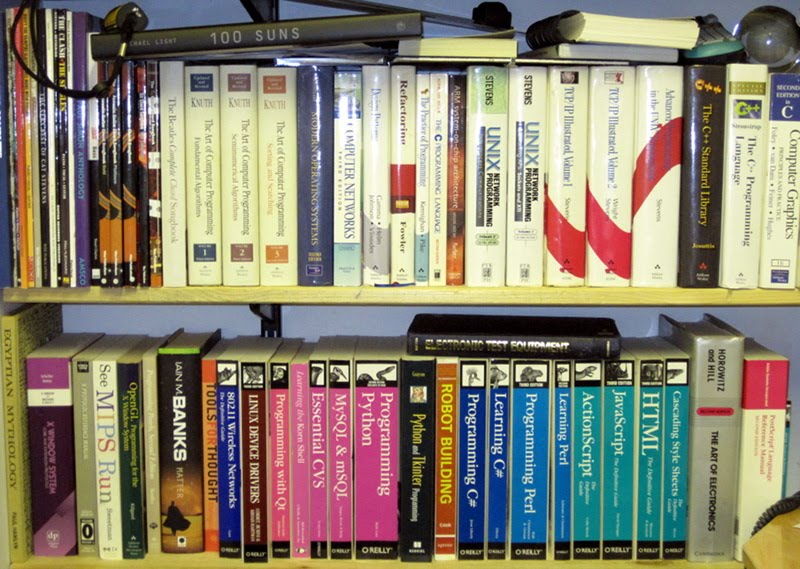
My bookshelf complete with covered kindle
I did look at a huge number of alternatives like the Sony PRS600 and others but they were all more expensive than the 110 for the Kindle and did not have enough features to make a compelling argument for spending more.

Yes it has DRM. Yes it "only" supports PDF, MOBI and mp3. Yes it will not win any style or usability awards. But I went into this eyes open the device is "good enough".

The device lets me read books from a reasonable display. The integration with amazon.com is so seamless it poses a serious danger to my bank account. I should expand on that last point :-) Amazon have got the whole spending money for a book thing executed so well that you do not think twice about a couple of pounds here and there, this soon adds up. I have set myself a rigid budget.

My main complaints are really just niggles:

  • Another different USB connector! Wahh, I thought everyone had agreed on mini USB? seems that I now have to have yet another lead for micro USB

  • The commercial book selection is a bit limited and missing a surprising number of popular titles. Some of this appears to be the publishers and authors simply clinging to their old business model. I fear some of them might not survive and early indications are they are behaving like the music industry did...Guys you are selling an infinite good a scarcity model is going to fail!

  • The price of some of the books is absurd...they are asking hardback prices for the electronic edition! Seriously? how on earth can that possibly be justified? I can see that a hardback book with its print run could cost 5 per physical item (going from hulu print on demand prices as a worst case) plus shipping and stocking fees. So how can you possibly justify charging the same price for a pile of bits where none of that applies? Also the pile of bits cannot be lent or sold, not impressed.

  • eBook formatting is generally dreadful. I do not know who is mastering these books but they need to do a better job. If they tried to pull this in the physical editions they would get a seriously large number of returns.

  • I still have to pay for whispernet delivery fees even though, because its the wi-fi model, I am providing the bandwidth myself. I can see that differentiating between 3G and wi-fi delivery is a bit hard for them though.
However my one and only real complaint with the offering as a whole is the astronomical asking price for the leather cover. The cover is currently 25% of the price of the kindle itself! ( 30 cover 110 kindle) which is just silly. It is a pretty nice cover and the clever clip attachment means it does offer an integrated solution to protecting your kindle, but not 30 nice.

Kindle in a sock cover
So my lovely wife (her kindle was bought with the cover) made me a sock for mine. This is great for casual round the house usage to stop me scuffing the screen but was a bit lightweight for protecting the kindle when out and about.

One day last week I had an idea. I would make my own protective cover by crafting something I had wanted to do for ages. And the (unoriginal I am sure) project of a hollowed out book for housing my kindle was implemented.


My hollowed out book kindle cover
A quick Google later and I had a set of plausible instructions to follow. I used possibly the most out of date book ever (published 1981) on electronic test equipment, partly because it was a ex library sell off book which cost 10pence back in 1995 but mainly because it was the right size to just enclose the kindle without adding to much size.

I learnt a couple of things doing this:
  • Do not let your pva (white) glue mix get too runny, you want it fluid enough to be easily absorbed but not watery - this is important because otherwise the paper absorbs too much water and crinkles
  • Do not use a book where the binding has gone bad already and select a "clean" book. The spine of this book was yellowed and cracking before I started. This means the book spine simply cracks open at the hollowed out bit and it is very obvious.
  • Work out where the "solid" part at the back is going to be and treat that separately so you get a nice solid base at the back of the hole. In mine its not all stuck together and is a bit wavy. Do be sure you left enough depth for the kindle though.
  • Take your time and be careful with the glue, it is amazing how obvious even a simple splash of glue in the wrong place is. Use a small brush for this a paint brush is fast but sloppy.
  • Measure carefully and cut only a few pages at a time, it takes a bit longer but looks much better. Also I did not drill the corners of my hole which means they are a little scruffy.
  • Use the sharpest thinnest knife you can, this really helps. I started with a small stanley knife but switching to my hobby scalpel gave much better results.
  • If you have some, use woodworking clamps to clamp a bit of timber (I had some offcuts of shelving) around the book to compress it while the glue dries. Do not clamp the spine if you can avoid it. This method ensures:
    1. Heavy things do not fall off the book while it dries.
    2. An even strong pressure is applied.
    3. The book does not warp or bend while the glue dries
All in all I kinda like the results and I think I will try again with a more modern book where the spine is not so broken to begin with.

Dominique Dumont: Test CPANPLUS install on a Debian system

Hello I m a Perl author working on a Debian unstable system. The great thing about Debian is that a lot of Perl modules are available though Debian packages. I follow Debian way of life to the point that I no longer install my modules (under development) with sudo make install (or its Module::Build equivalent). I ve often been bitten by weird test errors due to old version of module lingering in /usr/local. Now, I always create Debian package of my modules under development with dh-make-perl. This way, I avoid installing Perl module in /usr/local and my developement versions are cleaned up when actual package are availalble through Debian unstable. () This method has an unfortunate side effect: I never test installation the CPAN way. And Config::Model did fail to install with CPANPLUS. Now here s a way to create a barebone Debian chroot with cowbuilder to test CPANPLUS installation. First create a new chroot: $ sudo cowbuilder --create --distribution sid

Loging into this chroot (the bindmount option is necessary for cpanp to work correctly) : $ sudo cowbuilder --login --bindmounts /dev

In the chroot: Run cpan to configure CPAN: # cpan

Hit return to configure CPAN automatically. Then install your module: # cpanp i Config::Model

Or, if your module is not yet uploaded: # cpanp i http://<path-to-tar.gz>

Once you quit, the chroot is restored to its barebone state. Et voila. I tested full installation with dependencies the CPAN way without mucking up my system. Many thanks to Christian Kuelker of Cipux project for his comments that enable me to improve Config::Model All the best

Sandro Tosi: "multi-strace"

Thanks to a colleague, we hereby present the multi-strace:
strace $(pgrep httpd awk ' print "-p " $1 ' tr '\n' ' ')
(it's left as exercise to the reader to understand what it does) if you want to save the output and the play with it, just add '-o <file>'.

Welcome, new handy tool!

Rapha&#235;l Hertzog: Managing distribution-specific patches with a common source package

In the comments of the article explaining how to generate different dependencies on Debian and Ubuntu with a common source package, I got asked if it was possible to apply a patch only in some distribution. And indeed it is. The source package format 3.0 (quilt) has a neat feature for this. Instead of unconditionally using debian/patches/series to look up patches, dpkg-source first tries to use debian/patches/vendor.series (where vendor is ubuntu, debian, etc.). Note that dpkg-source does not stack patches from multiple series file, it uses a single series file, the first that exists. So what s the best way to use this? Debian should always provide debian/patches/series, they are supposed to provide the default set of patches to use. Any derivative cooperating with Debian can maintain their own series files within the common VCS repository used for package maintenance. They can drop Debian-specific patches (say branding patches for example), and they can add their own on top of the remaining Debian patches. It s worth noting that it s the job of the maintainers to keep both series files in sync when needed. dpkg-source offers no way to have stacked series files (or dependencies between them). If you want to use quilt to edit an alternate series file, you can temporarily set the QUILT_SERIES environment variable to vendor.series . Just make sure to start from a clean state, i.e. no patches applied. Otherwise quilt will be confused by the sudden mismatch between the series file and its internal data (stored in the .pc directory).
Found it useful? Click here to see how you can encourage me to provide more articles like this one.

Flattr this Share/Bookmark No comment Support my work

Alexander Reichle-Schmehl: Release Critical Bug report for Week 44

The bug webinterface of the Universal Debian Database currently knows about the following release critical bugs:
In Total:664
Affecting Squeeze:261
Squeeze only:60
Remaining to be fixed in Squeeze:201
Of these 201 bugs, the following tags are set:
Pending in Squeeze:8
Patched in Squeeze:34
Duplicates in Squeeze:22
Can be fixed in a security Update:12
Contrib or non-free in Squeeze:8
Otherwise fixed in Squeeze:21
Ignoring all the above (multiple tags possible), 127 bugs need to be fixed by Debian Contributors to get Debian 6.0 Squeeze released. However, with the view of the Release Managers, 160 need to be dealt with for the release to happen. Please see Interpreting the release critical bug statistics for an explanation of the different numbers.

Christian Perrier: Russian debconf translations complete in testing

The Russian l10n team is the first team to reach one of our translators' Grails: all debconf templates translations are now fully translated in Russian, in testing. Russian is the first language to reach this ever (I formerly announced 100% completion for a few languages, but that was in unstable: we never tracked testing up to now). It means that, in theory, on can do a full installation of all packages in squeeze (in case some crazy folks want to do this!) and always be prompted in Russian. French and German are lagging very close to this, the only missing bit being the udev package, which had two consecutive urgent uploads that couldn't include a full translation coordination. For these, we're indeed waiting for another udev upload, but I already nagged Marco about this..:-) Portuguese should make it, though I still have to track 7 packages for it. Swedish is only missing 2 packages. I'm less sure that Czech and Spanish (the other two teams working hard on 100% completion) will make it.

4 November 2010

Peter Eisentraut: pipefail

It is widely considered good style to include
set -e
near the beginning of a shell script so that it aborts when there is an uncaught error. The Debian policy also recommends this.

Unfortunately, this doesn't work in pipelines. So if you have something like
some_command   sed '...'
a failure of some_command won't be recognized.

By default, the return status of a pipeline is the return status of the last command. So that would be the sed command above, which is usually not the failure candidate you're worried about. Also, the definition of set -e is to exit immediately if the return status of the last pipeline is nonzero, so the exit status of some_command isn't considered there.

Fortunately, there is a straightforward solution, which might not be very well known. Use
set -o pipefail
With pipefail, the return status of a pipeline is "the value of the last (rightmost) command to exit with a non-zero status, or zero if all commands exit successfully". So if some_command fails, the whole pipeline fails, and set -e kicks in. So you need to use set -o pipefail and set -e together to get this effect.

This only works in bash, so if you're trying to write scripts that conform to POSIX or some other standard, you can't use it. (There are usually other ways to discover failures in pipelines in other shells, but none are as simple as this one, it appears.) But if you are writing bash anyway, you should definitely use it. And if you're not using bash but use a lot of pipelines in your scripts, you should perhaps consider using bash.

(Hmm, it looks like there could be a number of latent bugs in the existing Debian package maintainer scripts, because this issue appears to be widely ignored.)

Julien Danjou: Icon category support in Org-mode

My latest patch for Org mode has been accepted by Carsten today. It adds support for custom category icons in all views, like agenda or todo. You just need to configure org-agenda-category-icon-alist and it will work out of the box. Flattr this

Michal &#268;iha&#345;: What things to flattr?

With increasing popularity of Flattr (114,057 has gone through the Flattr system in two months), several people start to recommend what things to flattr. I'm not going into this business, however they seem so find interesting things for me so you might like it as well. The Flattr Free and Open Source Software by Rapha l Hertzog is actually thing which has attracted me to the Flattr. It collects recommendations how to tag your free software on Flattr and each month it publishes five recommendations which projects to flattr. The other thing I've noticed is list made each month by Evgeni Golov, which I've mostly noticed because increasing popularity of phpMyAdmin on Flattr, because he was really fast in advertising it :-).

Filed under: Debian Phpmyadmin 5 comments Flattr this

Jaldhar Vyas: All Hail Aqua Buddha!

My fellow Republicans and I got a nice early Diwali present on Tuesday. ~65 seats in the House ~6 in the senate, ~18 governorships and control of ~20 state legislatures. (Some races haven't been formally called yet.) A few disappointments though. no majority in the Senate and Harry Reid and Barney Frank were not defeated. Still overall its an election to celebrate. Here are a few thoughts. The Election System Is An Embarassment Once again there are several races where the outcome is in doubt because of technical problems with voting. Whatever politics we have, can we agree that it is damn stupid that we still can't get something as simple as counting ballots right? Prediction: The 2012 Republican presidential candidate will come from the Tea Party. While I may be a Republican, I am also a Cosmopolitan East Coast Elitist so the Tea Party didn't move me much. There were a couple of cases (NY and DE atleast) where their candidates were subpar and cost us victory but the best of the new Republicans also came out of this movement. I would rather vote for one of them than Romney, Huckabee, McCain, Gingrich etc. (With the exception of Sarah Palin who is just too polarizing I'm afraid.) The Tea Party itself will subside in a few years as all populist movements do. (Ask the Hope'n'changers.) Young People Are Dumb Part of leftist mythology is the idea that one day "the kids" are going to rise up against the mean old corporate overlords. It ain't going to happen. There was a huge upsurge in first time voters in 2008 but that was because Obama was a novelty act not because they had suddenly discovered the merits of Keynesianism. Now Obama is old and busted so they won't vote anymore. (Not until they have kids and a mortgage sometime in the future.) They'll spend time make cool ironic signs for the Rally to Promote Comedy Central but even the prospect of legalizing pot won't get them to the polling booths in sufficient numbers to defeat the oldies. Why? Because young people are dumb. Prediction: War With Iran If you're President Obama what do you do now? Bipartisanship? Yeah right. Look at what happened to Rep. Cao of Louisiana, the only Republican to vote for Obamacare and one of only two GOP congressmen to lose on Tuesday. Obama actively campaigned for his challenger. Any of the new Republicans who try and compromise with the President will end up under the bus sooner or later as they well know. The President could go full retard with the socialism (progressivism, liberalism whatever. It's all the same.) All his initiatives will be shot down but he can claim to be a martyr to the party of No. (Who will be joined in the Senate by Lieberman and whatever centrist Democrats who are up for reelection in 2012.) But this seems to be the path to a one-term presidency to me. Maybe that's what he wants. He could retire comfortably to the deanship of some Ivy League law school and make a lucrative killing on the rubber chicken circuit. But lets assume he wants to get back in the White House in 2012. One way to get back in touch with the voters is to start getting serious about foreign policy which has either been a joke (Remember the reset button?) a travesty or just copied from the Bush administration. In particular the Obama administration has completely failed in stopping Iran from gaining nuclear technology, sponsoring terrorism in Iraq, Afghanistan and Lebanon, and oppressing its own people. War with Iran would enhance his standing with Conservatives (hey it works for me!) most liberals would go along with it and the extreme Code Pink type loonies can safely be ignored. I say it happens before November 2012.

Andrew Pollock: [life] Zoe at six months

Today, Zoe is six months old. The last three months certainly feel like they've taken their time, but a lot has happened. Developmentally, she's doing great. She's now in the 70th percentile for height (up from around the 25th percentile), and 31st percentile for weight (up from the 25th percentile). She cut her bottom front teeth a few days ago. Crawling is imminent, I'd say. She can already scoot around in reverse, and by a combination of shuffling and rolling, doesn't seem to be having problems moving around the floor. We started her on solids at five months, and she's taken like a duck to water to pureed pumpkin, sweet potato, beans, zucchini, apple, pear, banana and avocado. Speaking of water, she's also decided she likes to drink water from our glasses whenever she sees us doing it. Hilarity usually ensues, closely followed by a change of outfit. She's sleeping well, only waking up once a night under normal circumstances, and that wake-up is getting later and later. She loves her baths. She usually lets out a series of loud sighs as soon as we put her in the bath. She got her first cold a couple of weeks ago. It coincided with her first day in ad hoc daycare, but Sarah and I were both sick as well, so I think it's more likely that she caught the cold from us than from daycare. She's still battling it, but it hasn't really bothered her all that much. She's just a bit snotty. The NoseFrida has been very handy for dealing with this. She had her six month shots today, and seems to be tolerating them fairly well. Sarah says she hardly even cried when she got them. She continues to be a remarkably happy baby. She always wakes up with a smile, she really only fusses if we keep here away for more than a couple of hours, or haven't fed her on time. Even with this current cold she has, she's still stayed very happy. We feel incredibly lucky to have such a wonderful baby. The next big adventure is to try a babysitter. Zoe and me in early October

Gintautas Miliauskas: Living a monastic life for 10 days

About a month ago, at the end of August, I finished a 10-day Vipassana meditation course. This was probably one of the more extreme activities I have ever participated in, and it's well worth a blog post. I found out about the course in a ridiculously trivial way, by following a link in a Reddit comment (I wonder if I could track down that comment...). The website referenced by the comment contained (almost) no new-agey mumbo-jumbo and looked legit in general. I also appreciated the fact that this was a relatively serious and intensive course, which should be enough to form a reasonably founded opinion on meditation in general. When learning sporadically, in small bits, it is hard to say whether the material itself is no good, or you just do not understand it yet and need to study more; I was quite skeptical towards the practice, but wanted to give it fair trial. I was quite impressed that there was a course available in Lithuania, a few hours by train from where I live. Finally, the course was free (by tradition Vipassana is taught without monetary compensation). I went ahead and signed up for a standard introductory 10-day course. Vipassana (also called insight meditation) is a meditation technique allegedly coming back from Gautama Buddha himself (well, all the traditions like to claim that origin...). It has been experiencing a renaissance, partly due to an organization set up by a meditation teacher S. N. Goenka which has founded meditation centers all over the world. The essence of Vipassana is a method of teaching your mind to act instead of merely reacting to outside stimuli such as pain, anger of other people or hardships. The technique provided is to monitor your sensations, watch them with equanimity and suspend any reaction, and slowly it sinks in that all things are temporary and you can choose what to react to and how. That's the basic idea; I don't want to go deep into exposition of Vipassana as there is plenty of information about that (also at the same time the information is almost useless because you have to experience it to really understand it). Instead, I will sure some of the more personal remarks and experiences. The course took place in an cottage near Kretinga, housing around 50 people. The living conditions were absolutely great, and this would have been a true holiday if not for the regime and the rules. The day would start very early, at 4 AM (ending at around 9:30 PM), and we'd do about 12 hours of meditation in total inbetween, with occasional breaks, but the most gruesome part is that no communication at all was allowed with anyone except the manager of the camp (and the teacher during a specified time). That gets to you after a few days, but still, there are people around you, so it's bearable; on the other side, the senses (touch, smell) become very acute. The food was taken care of by volunteers (students who have finished the course), and I could say it was quite good actually. The goal, of course, was to keep the environment from interfering with meditation, and I think it was done very well. The presentation of the actual technique also did not disappoint. Each day a new step would be introduced, with the whole day to practice before moving on. Looking back, the pacing worked well. Every day in the evening there were lectures on theory. They were somewhat informative, but also sometimes annoyingly primitive and verbose. The little mistakes, holes in logic and slight doses of mumbo-jumbo almost drove me nuts by the middle of the course, until I learned not to react to them. Despite the shortcomings of presentation, the simplicity and lucidity of the practice and lightness of theoretical baggage really appealed to me. The whole organisation in general gave the impression of complete transparency, with no strings attached, no financial interests in play and no agitation for further involvement. While there are many meditation techniques, I am happy that I've gone with Vipassana in particular for one reason: Vipassana meditation uses no artificial tools to help you concentrate, such as mantras, visualisations, counting, etc. Such methods make concentration much easier, but they also create a dependence on the methods themselves. I appreciate the purity of Vipassana in this regard. Not everything in the practice is roses though. First, a particular worldview supported by Vipassana is presented as "scientific" and supposedly "the right way to live", and if even if you don't agree, "the truth" of Vipassana will become obvious to you with time. This is a distinctive mark of ideologies. The thing that makes everything break is the reincarnation, which is generally assumed as true, even if it's not shoved down the student's throat. Every rationalization of a world view has a "white lie" (usually related to the concept of eternity somehow) at the core, and in this context reincarnation is it. Given what we know now about the relationship between the mind and the body, reincarnation is absolutely ridiculous and completely untenable, and that breaks all "moral" reasoning for practicing meditation as opposed to doing something else. I'm not the first to bring up this problem, there's plenty of material about it online. The second slippery idea is that the concept of "negative happiness" is central in Vipassana, that is: happiness is defined as lack of suffering. This point is not that unreasonable actually, from personal experience I could indeed call the state of non-suffering happiness, but there is definitely something missing when compared to the state of mind when I'm truly, positively happy. Whether you consider that something important or not, it's definitely there. Third, Vipassana suggests that it is only you who is at fault when your inner state is disturbed; the world affects you as much as you let it, and in order to find happiness you should learn to control the "interface" rather than the outside world, which will usually not behave as you want. This may be correct, but sometimes it could just be easier to fix the world rather than change yourself, and I have the suspicion that it this is much more frequently the case in the modern world compared to the pre-modern environment. (This is one of the points which break when reincarnation is rejected, as with reincarnation you have the whole eternity to fix yourself.) While the complaints are serious, they do not mean complete rejection of Vipassana but rather integration among the various other techniques available. The actual meditation technique is still great for gaining and maintaining mental composure, reducing anxiety and improving well-being. Now, if I could only get used to meditating regularly... If you have the chance, I highly recommend you try out an introductory 10-day course. There is little to lose and a lot to gain. And if you do go ahead, I have two hints. First, do not even think about leaving the course before it's over. Any hardships are temporary and will be overcome quickly. Second, use the time with the teacher, those interactions were very helpful to me. Also, given the "noble silence", talking to someone once in a while will not hurt.

3 November 2010

Julien Viard de Galbert: Working on X isn t that hard !

First, Hello Planet Debian ! Some words about me I m a new member of the X Strike Force, the debian team responsible for packaging Xorg. I basically stepped in with the openchrome driver.
I also have wider interest in free software or open source in general, but you can have a look at the rest of my blog, so I won t bother you with too much details. More about X Talking with various attendant at MiniDebConf Paris, I got the impression that people think working on Xorg is hard. I must say: It s not ! First debian work is mostly packaging, and the developers of the applications we package (debian call them upstream) are pretty responsive, so you won t be on your own.
Most of the work is preparing the packages for their new release, place them in experimental first, and ask for testers.
Then people test and the real work start: we receive bug reports.
Sometime seeing the report, it s easy to point the user to test some other version, do some change, remove some old libraries in /usr/local/lib.
Sometime we need to ask for more information. I said we, but for now unless it s about openchrome, I can t help much, but I follow the bugs on the X mailing list and learn from others response, I think I ll be able to help soon. An other way to help: TXBW I m sure you ve read about RCBW, kudos to every one posting some and to every BSP attendant.
But if you thought X was hard, you certainly find the remaining RC bugs too hard (Or if not, you might want some distraction with an easier task). So I have a proposition for you: Triage X Bugs of the Week (TXBW) As Lucas told on his blog I ve proposed him a patch to help triaging X bugs using UDD. And he accepted it, Thanks ! So here is the link I m using: XSF unstable bugs sorted by date.
But remember the udd database is not live data, if you close a bug, it won t disappear immediately.
Also please read the X Strike Force Bug Closing Procedure before starting. To conclude my TXBW data (well TXB of the Day so to speak) I hope this can be a success like the RCBW initiative is.
Currently there are hundreds of X bugs, more that a half are at least one year old so they deserve to be triaged ! The X Strike Force (still) needs you !

Tim Retout: Gnash from git

Gnash has moved from bzr to git, at least for the moment - Savannah's bzr setup is slow and unlikely to improve, so the choice is git or Launchpad, apparently. (Thinking selfishly, I'm a lot more familiar with git than with bzr, so I hope it stays this way.) My instructions from July have changed only slightly:
git clone git://git.sv.gnu.org/git/gnash
cd gnash
./autogen.sh
./configure --enable-renderer=agg \
            --enable-media=GST \
            --enable-gui=gtk \
            --with-plugins-install=system
make
sudo make install
sudo make install-plugins
Buried near the end of the bug reports wiki page is a useful tip for debugging - export GNASH_OPTIONS=writelauncher before starting the browser, and gnash will write out the instructions for starting a local copy. In practise, these instructions seem to appear as a file called /tmp/gnash-debug-1.sh, and that will reference a file matching /tmp/gnash-cookies.* - so don't bother trying to dig through the debug log. With this tip, it's possible to get the browser out of the loop, and focus on debugging gnash (which should be enough for most problems). At least, that's what I hope - I've spent the last hour or so just figuring this stuff out. Hmpf.

Scott Kitterman: Liquor and Guessing

Those of us who work in technical areas like to believe that because we are engaging in technical endeavors rather than social endeavors, our work is defined and predictable. This hints that we know the future. I think Scott Adams captured the thought well:
We should not be so cocky. While the technical world is more structured and predictable than other areas, it has its limits too. One can only see so far down into complexity before predictability is lost in the detail. That s where we get so called Heisenbugs . Looking out to the future we can only see so far as well. Recently I ve been reading The Black Swan. It is a useful reminder that the future isn t as linear and predictable as we d like to pretend it is. One idea that has stuck in my head is the idea that in order to take something into account that one will know in the future in one s predictions, one must already know it. There is an inherent limit to how far we can see. How is this relevant to distribution developers? Each time we set off to develop a new release, we make an assessment of how to best expend the available resources (our own, our company s, our group of people we can talk into doing stuff) to make things better . We do the best we can, but we must always be mindful of the fact that we press forward using our best engineering judgement, but as we look into the future, eventually this is all just liquor and guessing too.

Next.

Previous.