Search Results: "will"

12 October 2006

Erich Schubert: Future of AJAX

While everybody is still crazy about AJAX - how will its future look like? Using it is currently a major PITA, and you'll most likely have the user download a 200k Javascript file just to make it useable for you as a programming language. JavaScript lacks so much that current programming languages offer out of the box. This includes especially some comprehensive standard library (Java, C# and Python are all great here), a compact syntax for common data structures (e.g. set operations in Python or stream operations in C++ with <<) and of course: interfaces! Security restrictions of the browsers - intentional security restrictions to avoid cross site scripting attacks - make interfacing between different javascript applications rather cumbersome, if at all possible. And the only way to have "private" functions in JavaScript is also more of a hack (abusing closures) than a native feature of the language. What I'd like to see in the next generation of JavaScript - and browsers should start implementing that rather soon, so we'll be able to use it in some 5 years - are proper interfaces especially for cross-site applications, information hiding, an extensive standard libary, a short syntax for XML processing and common data structures and pretty much all that every javascript toolkit reimplements again and again. Oh, and the result shouldn't be Java yet, but still an embedded scripting language. ;-)

David Welton: Practical Agile?

At work, we've decided we need a little bit more process, so I'm going to attempt to lead our small group of programmers in that direction. We have a vague feeling that since there aren't many of us, we need to keep things as lightweight and practical as possible, and that something "agile" would probably be the best direction. Beyond having read a bit here and there, I've never had any direct contact with "agile" in the wild. We don't want a rigid methodology so much as a set of guidelines and, perhaps, tools that help us track time and projects. It all needs to impose very low overhead - because an imperfect tool that gets used is far better than something very fancy that gets ignored when people get in a rush. So... advice? I'm willing to get a book or two, but I have a sneaking suspicion that many of them are quite inflated with respect to their core concepts which could likely be summed up in a few pages. Anyone have any practical guides for small shops that want to try and reduce the chaos level just a bit?

Evan Prodromou: 19 Vend miaire CCXV

I went back out to the site of Ignition 2006 today. We left the event early due to pouring rain and general bad unhappiness, with a strategic retreat to a loft in Old Town Montreal to have fun, hang out, and wear costumes that weren't covered with mud. But we left some equipment on site, and I went out to get it today, and whoooooo boy was it a mess. We tarped everything up and left up protective canopies when we left, but I guess the wind really got into this cache of stuff in the last couple of weeks, because the canopies were blown all over the place, bent, bruised, and generally indignant. Most of the tarped equipment was still tarped and dry, but there was one corner of one tarp that had come up, and everything under it was wet. Fortunately it wasn't anything important -- empty bottles, a barbecue, and some folding tables. The drive out to the site was great. It's a piece of land owned by my friend Sherman Samuel, just north of wt:Mansonville in the wt:Eastern Townships. The leaves on the trees have just about turned, so there's starting to be some bare trees and the last sharp colors of the trees. It's melancholy and beautiful -- great October weather. I was able to cram everything into the Sleek Black Tux (my just-made-up name for the Hyundai Tuscon we drive), but the drive back was pretty rough. The smell of all that camping equipment put up wet and left in the forest for a couple of weeks was... well... pretty gamy. Like really, really old towels. We call that smell "meefy", and that's pretty much what the car smells like now. Meefy. When I got home, Maj and Amita convinced me not to unload the car, but to come inside and watch the Battlestar Galactica season premiere on tape, and drink red wine and have warm split-pea soup. Allllll right. tags:

Lars, you well-informed and chaste commentator I agree with Lars: Eric is doing the right thing. I understand what the Mozilla Foundation is doing, and it's more than likely the right thing for them to do. I understand what Eric is doing with Gnuzilla, and it also seems like the right thing to do. Debian and Mozilla can be friends and yet not use the same name for the software. That's OKAY. tags:

Freedom It sounds like, at least briefly, China has unblocked Wikipedia. It's interesting to see if this will continue, and what it will mean for future policies towards China by other Web sites. Unlike Google, Yahoo, and MSN, the Wikimedia Foundation has steadfastly refused to censor its content to meet Chinese government standards. If the WMF can stand up to China and win, what does that mean for other Web sites in the future? tags:

Ian Murdock

David Berlind: “Perhaps the best solution I’ve seen that does roughly the same thing and that makes synchronization between the local and network-based storage (and just requires a low-overhead local HTTP server) is Userland’s Radio blogging solution (credit to Dave Winer). More and more, solution providers will recognize the genius in that design as they look to deal with the offline problem as elegantly as possible given today’s constraints.”

11 October 2006

Ian Murdock: Google platform getting offline support?

The following phrase jumped out at me from a post Rafe Needleman made earlier today about Google Docs & Spreadsheets:
Google is going to “take a shot” at a disconnected version, for users who want to access files when they are offline.
While I was digging around trying to figure out where he got this, Garett Rogers posted his own discovery:
As you probably know, I really like to dig through source code and sometimes I find things. […] I will start with the most interesting piece of code I found. Google is working on a solution that will allow you to install Writely on your local machine:
    if (location.host.indexOf("localhost") > -1)
     
      if (location.host.indexOf("Prefactor") > -1)
        return "http://localhost:8180/Prefactor/" + page + paramString;
      else
        return "http://localhost:8180/Docster/" + page + paramString;
      else
      return "http://" + location.host + "/" + page + paramString;
This is absolutely huge news. Regular readers of my blog know that I view Google’s lack of an offline story (in all but a few areas anyway) as its biggest hole, particularly when stacked against Microsoft, where that’s arguably its greatest strength. So, the fact that Google is working on this is big news is itself. I’m also intrigued by the method they’re apparently using, namely a localhost web server, rather than a thick client or persistent storage via a browser extension. I’ve been thinking for a long time about the offline problem, and I’ve come to the conclusion that localhost web servers (which I first saw used to great effect in Radio Userland—credit where credit is due) are the ideal solution. Thick clients play to Microsoft’s strength (not to mention the OS issue), so that’s not the best approach. And the notion of adding persistent storage to the browser opens up a host of cross browser compatibility problems. And while it may be possible to come up with a standard API that works across Firefox, IE, and other browsers, such a standard is likely years away, particularly given that we haven’t even begun the “competing implementations battle it out” phase yet.

Benjamin Mako Hill: Who Gets To Be on Planet Debian?

I've been spending more time that I want to in the last week talking about should or should not be on Planet Debian. In particular, there is some disagreement on what should happen to the blogs of people who resign from the project. In the interest of my own sanity, here is the text I just posted on the wiki page that talks about Planet Debian:
Planet Debian is for any active and directly involved participant in the Debian development community. Inclusion in Planet should reflect a relationship that already exists -- it is not meant to create one. Inclusion is not restricted to people who are currently Debian developers nor are ex-developers necessarily barred from inclusion. Defining activity and direct involvement is tough and there are many ways of participating in Debian (e.g., packaging, translations, administration, etc). I am happy to consider all of these types of involvement for the purposes of inclusion in Planet. In terms of deciding what is enough activity, I am daunted by the fact that there has been academic research on the difficulties of deciding what an active member in Debian is. As a result I will continue to rely primarily on what blog owners themselves feel unless the evidence available to me points to the contrary. Planet participants should include feeds that provide stable permanent URLs so that they do not flood planet repeatedly and should include content in English only. An inability to do either of these will be grounds for exclusion from Planet until this can be fixed.
In the past, I've made incorrect assumptions about whether people did or did not want to be included in Planet. I've apologized to those involved. In the future, I will ask people that appear inactive to me or that have resigned from the project if they feel that they still qualify under the terms above. If I approach you about inclusion in Planet, please don't be offended or assume that I, or the project, doesn't want you on Planet. There are feeds in Planet Debian that annoy me but I have yet to remove a feed from Planet that I dislike.

Thijs Kinkhorst: The plan for SquirrelMail 2.0

Ingo J rgensmann wonders - quite rightly - when SquirrelMail 1.5 (our development branch) will become stable. Our current big project is making the entire interface templatable; that is, to separate code and layout, so it gets easy to modify the appearance. As with many open source projects, SquirrelMail started out as a small hobby project in the previous millennium, and grew and grew until it is where it's now: a giant hunk of code with stuff bolted on top, on the side and in between, and where HTML output is integrated in about every function. Work on templating had a slow start but is progressing well now; when it works acceptably we'll release 1.5.2-DEVEL, followed by perhaps a version or two more and then 2.0 Release Candidate 1 planned for the first quarter of 2007. As always, any help will make it go faster... :)

10 October 2006

Randall Donald: Buggy Bug

So while I was trying to fix my RC bug this long weekend I found out it no longer exists, the problem I mean. libGL.so now points to libGL.so.1 which will exist. This now raises another problem as this is probably not the behaviour sought when nvidia-glx is installed. Fortunately the way I was going to fix the RC bug can be slightly modified to cure this issue.

Alexander Sack: IceLizard application names

It might be obvious for most that follow recent discussions, but here are the names of our IceLizard applications, as we will probably ship in etch: Now we need some artwork … there is a great draft site in ubuntu wiki that looks quite promising: https://wiki.ubuntu.com/IceWeaselIcon Of course, no guarantees :-)

9 October 2006

Holger Levsen: Suhosin - php hardened

I wonder if anyone can give me advice on Suhosin - a quick search did not reveal many or rather any howtos or debian packages. Did anyone try to patch Suhosin into the current debian php4 or 5 packages and succeeded? Or does (almost) no one care?

And yes, I will look at it myself. But I just got curious now and have no time today. Anybody else interested in getting Suhosin apt-gettable?

Martin-&#201;ric Racine: ALSA pitfalls ... and a bounty ... or two

Daniel Jacobowitz writes about problems he's having getting proper ALSA support for his desktop computer. Boy, does that sound familiar! I myself have three computers that are partially or totally unsupported on ALSA:
  • Apple iMac rev.D a.k.a. 333MHz G3 tray-loading iMac. Partially supported by snd-powermac, except that some controls are inverted and other controls just plain don't work. Probably something as simple as the wrong offset in the bitmap used to select the control on which to act. Bug filed in the ALSA BTS. No reaction. Anyhow, sound support for Apple products is being migrated to snd-aop, which was written from scratch using a modular architecture that enables easily adding support for new sound chips. Nice idea, except that no effort is being put towards supporting pre-G4 products... Back when Ubuntu appeared on the Linux scene, Mark Shuttleworth agreed to pay a 500$ bounty to whoever made ALSA work on all PowerMac variants. Nobody took it, as far as I know. Those who are interested in taking on this challenge might wanna check my wiki page for our summary of the ALSA PowerMac situation.
  • HP 9000 series model 712. Recently supported, thanks to someone on the PA-RISC Linux mailing list having a go at coding it. Never merged by upstream ALSA, though. It's been a while since I gave it a try but, last time, only output worked.
  • AMD Geode SCx200. There is no snd-scx200 driver at all. Bug filed in the ALSA BTS. The issue of sound support on early Geode products was also mentioned on the Linux kernel mailing list, during the big OSS cleanup discussion so, at least, some people are aware of the issue. It so happens that the Geode SC is used in a number of popular embedded boards, such as the Soekris and yet, nobody tried porting the old OSS drivers available on AMD's Geode driver source page. Odd.
As we can see, there's plenty of ALSA support remaining to be coded, ported or cleaned up, and some people are willing to pay for the results. Who's gonna grab it?

Isaac Clerencia: Anti-bullfighting demo

More than a thousand people took part in the anti-bullfighting demo that every year takes place in Zaragoza. (Spanish) For those who are not familiar with bullfighting, it’s basically a Spanish shameful tradition, where six bulls are released one at a time to a bullfighting arena. There the bulls are tortured to death, first they’re stabbed on the neck by horse-mounted lancers, then they got planted in their back several harpoon-pointed sticks, and after half an hour of torture and agony, the bullfighter definitely murders the bull with a sword. Does it sound disgusting, cruel and sadist? It definitely is, and I’ve skipped the worst details. (yeah, I’ve got sick just writing this) We gathered at a square near the bullfighting arena, and then we headed towards it shouting stuff like “torture is neither art nor culture” (as bullfighting defenders usually say that “bullfighting is a central part of Spanish culture”), “murderers”, “torturers”, “sadists”, “you’re cavemen, evolve!”, “if you wanna see blood, slit your wrist” or “you should be ashamed of how you are raising your children” (to people who brought little (5 or 6 years old) children to the bullfight arena). The demo lasted about two hours and was completely peaceful, which is a great thing IMHO, as it clearly shows which side despises violence and which one loves it. There have been several good news for the anti-bullfighting movement last years, like several Catalonian towns declaring bullfighting illegal, Barcelona declaring itself an anti-bullfighting city (although it doesn’t have the legislative power to really ban bullfighting), demos in lots of cities and increase in people attending them. If Bullfighting seems doomed, but we still will have to push for a few years to really bury it. Even if you are not Spanish you can still help abolish bullfighting by taking part in anti-bullfight demos in front of Spanish embassies (there were 17 of them this summer), boycotting travel agents that promote bullfighting, …

Daniel Jacobowitz: ALSA: Disasters, frustration, hacking, progress, and education

I have had, ever since I got my current desktop, been frustrated with ALSA support for it. The machine is an Shuttle SN25P (with ice1724 onboard 7.1 sound card); it's otherwise very nice. I've had it for a bit over a year. When I got it, I lost several long weekends to hacking on ALSA and peering through asoundrc files, gstreamer and gnome-control-center source code, and other such things. There were two basic problems. One was that no matter what I did, I couldn't get the back speakers to play independent channels. Generally they mirrored the front speakers. The other was they adjusted volume based on the headphone mixer, rather than the master mixer - especially aggravating because muting the master mixer left my music still pouring out of the rear speakers! I filed a bug in the ALSA tracker, but didn't get much feedback, and eventually gave up. Last week, someone else seconded the bug. A helpful fellow responded and pointed us to a couple of basics, like the ALSA datasheet archive (very handy, since as far as I can tell a lot of them aren't available elsewhere, at least without NDAs). We spent some time poring over those. One of the interesting things I learned this weekend: there's a bunch of independent chips involved in onboard sound, in my case three. One seems to do communication between the computer and the analog-digital convertor, another handles the actual conversion (AC97 compatible in this case), and a third (I think...) handles the remaining two channels for 7.1 support since the second one only seems to do six. Digression time. Unfortunately one of the things he asked us to check was physical connections between the chips, and whether there was an onboard EEPROM... and somehow, in lightly applying enough compressed air to dislodge the dust, I got something wedged into the fan of my video card. Which began making a horrible rattling noise. And then when I attempted to clean it, I made it even worse. So at this point in my Saturday afternoon I had to go out and buy another one. The new one is marginally crappier than the old one, which was also pretty cheap, but the new one has the advantage of not needing a fan at all. Digression part two. While I was at the store, I picked up a Slug. I haven't unboxed it yet or gotten a drive for it, but I think I will in a week or two, and see if I can pick up some of Martin's excellent work in running Debian on one. I see that the IXP ethernet driver isn't working at the moment, maybe I can give Lennert a hand... At this point it was clear ALSA had eaten my weekend. So I came back to finish the job. The other reporter of the bug noticed a very interesting bit in the manual for the VT1617A (Via-manufactured AC97 codec) - which affected volume control and routing for the rear surround channels. I poked around in the kernel driver for a while, and discovered that the similar VT1616 chip exposed that bit as an ALSA mixer control (boolean switch)! So, wiring the two together was the next logical step. And suddenly I'd made a world of progress. I could hear things out the back speakers. Apparently - as far as I can tell anyway - no one has good solutions to this problem. I fumbled around with it for a while, wrote two more ALSA patches, and got manual configuration to use a software volume control (the "softvol" plugin) and mute switch which govern all channels. But I'm taking a break from that while I fish around for how this works on other chipsets. It's so immensely awkward that I can't believe there's no standard solution. I mean, is wanting your volume control to affect all your speakers such a rare thing? Anyway, this paragraph summarizes about six hours of beating my head on the wall. Most of this was at the asoundrc format, which is immensely picky, underdocumented, and seems like it really oughtn't to be needed at all. But apparently it is. During the course of this I got to learn how different applications decide which volume control to use, which was exciting in an exasperating and insanity inducing sort of way. You see, ALSA exports basically everything on the card as a "mixer control". There's some things which recognize volume controls by name, and some basic sorting by usefulness. xmms allows you to select any one control to use for its volume slider, which is nice. The GNOME mixer applet allows you to select any arbitrary _set_ of volume controls for the panel applet, which is even nicer. But it's at this point that, both last time and this time, I gave up in general rage. You see, the mixer applet is completely disconnected from the other and more useful way I deal with volume - the hotkeys on my keyboard, which GNOME also handles. But those go to gnome-settings-daemon, and a bunch of code labelled "acme". And this just adjusts the volume on the track which gstreamer (the GNOME audio management libraries) have marked as "MASTER", and that's done based on the order ALSA supplies the controls, which is done by a name-based sorting deep within the bowels of the ALSA library (it's in mixer/simple_none.c). And if you have two with similar enough names, it slaves them together. And nothing has a higher priority than the hardware supplied "Master Playback" controls. The best I could manage was to get the software volume control listed right after the master (in which case it wouldn't get adjusted at all), or adjusted in lockstep with the real master channel (which causes the front speakers to drop at a different rate from the rear speakers, messing up depth). Like last time, this was the point at which I gave up for the weekend. But this time I've learned a lot more and made a whole lot more progress! And written more of it down, so hopefully I have to rediscover less of it next time. I really was going to do a bunch of other things this weekend... but it just didn't happen.

Kenshi Muto: i386 d-i image for Sarge, with kernel 2.6.18 (early test release)

Last week Pascal, who is a friend of bubulle, asked me how he could make ISO image with kernel 2.6.18 for Sarge. Timely I'd like to have a kernel 2.6.18 image for myself also (I bought Core2Duo machine. It has VIA VT8237A SATA controller isn't supported before 2.6.18), I made it. You can take it from the usual place; sarge-custom-1008.iso for i386.

Matt Brown: Per Client VLANs with Madwifi

I’ve written a patch for the madwifi-ng driver to separate each associated client into a unique VLAN. The patch only makes sense for use when the driver is in master mode being controlled by hostapd. Using this patch with WPA2/RSN you can acheive complete layer 2 isolation between associated clients. The patch does not support placing multiple clients in the same VLAN. Full layer 2 isolation requires that there is no broadcast or multicast traffic transmitted from the access point. To enforce this the patch mangles outgoing broadcast / multicast packets to be directed only to the node associated with the VLAN that the packet was received from. Clients can still send/recieve broadcast and multicast traffic without problems if you bridge them onto another layer 2 network. You must fully understand the consequences of this before using the patch. In the worst case scenario if you bridged the VLANs for each client together onto a common L2 network you will cause every broadcast/multicast packet sent onto that L2 network to be transmitted by the access point as a unicast packet to each associated client. If you have a lot of broadcast/multicast packets this is going to significantly reduce the performance of your network. This is a somewhat contrived situation as there is no point creating the VLANs in the first place if you’re just planning to bridge them back together, but I use it to illustrate the risks this patch can introduce if you don’t understand it properly. At this stage I’m not convinced that the patch is actually useful, and I’m not going to be proposing it for inclusion in the driver. You’re welcome to use it if you find it useful. Please let me know how you are using it and any problems that you run into. I don’t guarantee that I can provide support or assistance though :P The Patch How the patch works
One of the primary constraints I had in writing this patch was that the clients using the access point are not required to do anything special. From their point of view they are simply associated to a standard AP running 802.1x with WPA2. There are no 802.1q packets “on the air”. All of the VLAN functionality is handled within the driver itself. Inside the driver there is a node table listing every node that is associated. The patch adds an entry to each node record specifying a VLAN id for that client. By default this id is automatically assigned when a node associates, but it can be modified by wriiting to the /proc/net/madwifi/<iface>/sta_vlan file. As packets are moved between the kernel and the actual physical card by the driver 802.1q tags are added and removed as appropriate to ensure that the kernel sees every node in it’s own VLAN. The VLAN tagging code in the driver ignores EAPOL frames so that they are always sent to the base device where hostapd is listening. Userspace Setup
By default per node VLANs are disabled and have to be explicitly enabled

echo 1 > /proc/sys/net/<iface>/per_node_vlan

And you almost certainly want to stop the driver from bridging packets between clients

iwpriv <iface> ap_bridge 0

Then it’s simply a matter of creating the appropriate VLANs on the base interface using the standard Linux VLAN tools, eg:

vconfig add <iface> 4
Final Comments
I’ve tested the code fairly extensive and it works fine for me. It’s not particularly clean and the mangling of broadcast/multicast packets is a messy hack. You can achieve a very similar situation using PPPoE from the client to the Access Point without having to patch the driver to support per node VLANs.

Martin-&#201;ric Racine: Linutop - Internet for the masses

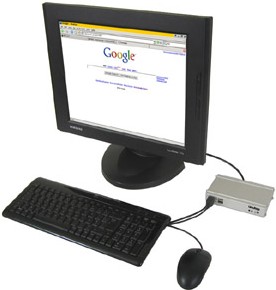
I promised last week that I would be telling more on October 1st, about the mysterious Project X that I had been sporadically blogging about over the last few months. Better late than never, so here's the story: Casablanca I met Morocco-based French entrepreneur Laurent Bervas via his blog in January 2006, while looking for countries nearby EU with a promising ICT market, because of growing obstacles in getting work in my field, due to my not being an EU national. By the time the situation had reached the ridiculous extreme that friends were continuously loosing juicy recruitment bonuses, simply because their employer's HR department had issues with hiring non-EU nationals despite EU policies that clearly favor foreigners married to an EU national I figured that I ought to do something creative and see which of the countries bordering with EU might offer interesting opportunities. Laurent was blogging about all the exciting opportunities he kept on seeing, since he relocated to Morocco to conquer the high-end Real Estate market. One day, he wrote about Morocco becoming a rising figure in the outsourcing business for the Francophone market, which prompted me to contact him. After a couple of weeks of discussion, he cautiously dropped his idea for a niche market he had spotted: a simple Linux-based set top box to surf the Internet. He then asked if I would be interested in developing it and in launching a startup with him to promote it. I gladly accepted. Startup That's when Laurent decided to introduce me to an old friend of his, Fr d ric Baille, who spent several years at Compaq, culminating with a role in the team that launched the iPaq. Fred's help was instrumental in defining the market positioning of our product. Laurent and I discussed the product features at length over IM and immediately agreed that the OS would be based on Free Software. That left the hardware part unresolved... or so did Laurent think. Years ago, I briefly worked in the management team of an Estonian data security startup. This gave me the opportunity to network with several movers and shakers of the Estonian ICT. Among them was a promising ASIC and industrial design startup that produced really cool Thin Client hardware. The answer to our hardware needs, I figured, could easily be fulfilled by them. My idea of contracting the hardware to Estonia was initially received with skepticism, so I made a simple proposal: why don't we hold the inception meeting in Tallinn and meet with the potential hardware supplier at the same time? Fred and Laurent accepted, so we spent part of April 2006 there, with me acting both as their friendly tourist guide and as the middleman for the introductions. Fred and Laurent immediately fell in love with Tallinn's designer bars, omnipresent WiFi network and blond-a-plenty. Most of all, their visit at our potential hardware supplier gave them the answers they needed: Estonia is IT. Overview The hardware we selected is built around the AMD Geode LX, a nifty Pentium-compatible single-chip computer. It comes equipped with VGA output and four USB 2.0 ports, along with high-quality audio via 1/8" input and output jacks, plus a built-in encryption engine. We added 100baseT Ethernet connectivity (with provision for other networking options) to that, to complete the platform. For the software part, we used ingredients from Debian's Etch release, focusing on a configuration that would enable easy access to the most popular applications for home and small business use: Instant Messenger (Gaim), Multimedia player (Totem), PDF reader (Evince), Web browser (Firefox), word processor (AbiWord). The result is this: Press Coverage The editorial team at IT-Neeger (an A-level Estonian ICT blog) immediately scooped the story [in Estonian] and it produced such a strong response that the traditional Estonian media contacted the IT-Neeger team to write a feature article (stay tuned for details). The local Slashdot, Minut.EE, also reported [in Estonian] on the IT-Neeger article. Thus, myself and Laurent Bervas spent the better part of this week being blogged, interviewed and podcasted by a variety of Estonian and French publications, which is how I only got around blogging this bit tonight. Marketing Contrary to our competitors, we fully intend on keeping this platform open, so our initial market will actually be Free Software developers with a penchant for innovation. As such, our first 50 units are exclusively intended for interested developers who want to improve upon our initial idea and participate in defining the final product. Inquiries are welcome!

Adam Rosi-Kessel: Absurd Copyright Law Case of the Day

I’m visiting my parents’ house in Vermont, where they finally got cable after the provider agreed to dig up the ground and run a mile or so of cable to their house in return for a two year subscription agreement. (I think after two years the cable company will almost have broken even on the cost of the installation). Having been absent myself from the cable world for some time, I am impressed by the variety of interactive and “on demand” options. My parents’ low-end package includes dozens of free on-demand movies and music videos, as well as built-in easy-to-use tivo-like functionality. The on-demand music videos show one brief ad before the video — it seems the tradeoff is that if you are really going to watch the ad, they can get more money and show you fewer ads. (Or, maybe I’m wrong — if it’s one ad per video, I suppose that would be more ads, but it feels like fewer because of the “on demand” nature. I guess it’s a perceptual trick.) Anyway, getting to the title of this entry. Anybody in the field of intellectual property these days has got to find Weird Al Yankovic’s music video for Don’t Download This Song (warning, myspace page, authorized by Weird Al!) (or, here) (warning, YouTube page, also authorized by Weird Al!) at least a little amusing. If you haven’t watched it, see it now. The opening verse goes like this:
Once in a while maybe you will feel the urge
To break international copyright law
By downloading MP3s from file sharing sites
Like Morpheus or Grokster, or Limeware or Kazaa
But deep in your heart you know the guilt would drive you mad
And the shame would leave a perminant scar
Cuz you’d start out stealing songs, then you’re robbing liquor stores
And selling crack and running over school kids with your car
On the cable video-on-demand channel, however, the names of all the filesharing services (Morpheus, Grokster, Limewire, and Kazaa), are all replaced with beeps, as if they were vulgarities unfit for broadcast. Or cable. If you had never seen the video online, you’d actually be likely to think this was another Weird Al joke — that he can’t even sing the names of (the mostly now defunct) filesharing services publicly. But I’m pretty sure the video was censored by the cable provider or distributor and the irony is wholly unintended. There are a couple of possibilities here. One is that the distributor was trying to avoid inducement liability under the Supreme Court’s decision in MGM v. Grokster. Could a funny song about filesharing actually meet the inducement standard? I sure hope not. The other possibility is that the distributor just found the references too abhorrent to leave in — basically the equivalent of the seven dirty words banned from broadcast TV and radio. Either way, if Weird Al were dead, I’m sure he’d be spinning in his grave. We’re lucky he’s still kicking. (“case” is kind of a misnomer for the title here, but is included for consistency).

8 October 2006

Russell Coker: started growing a beard


At LCA in January this year there was an auction at the end (an LCA tradition), and most people were feeling very relaxed and happy after plenty of good food and drink and bid with reckless abandon (another LCA tradition).

To help things along a few of us volunteered to do various things if various amounts of money were reached. The full list is here.

Anyway my contribution is to grow a beard for the next LCA. Recently I had been thinking that it was about time to start, and this morning I discovered that I had misplaced my shaver, so I start today. I had wanted to get a clean-shaven picture for the first blog entry, but things didn't work out for that. The above picture is two days of growth (members of my local LUG are probably used to seeing me look like this).

I will strart by blogging a picture every day, and then start to space them out as it grows. The apparent results of beard growth should exponentially decrease over time so the rate of pictures would best be based on the log of the time.

Uwe Hermann: Unmaintained GNU packages need new maintainer: a2ps, fontutils, thales

I stumbled over this page on gnu.org yesterday, which says that the a2ps, fontutils, and thales packages are in need of new maintainers. Especially a2ps has often been very useful to me, so I instantly added it to the Unmaintained Free Software wiki (the other two will follow soon). It would be nice if someone could take over these packages, fix some bugs, and generally keep them in shape. I don't like seeing such useful programs die.

Biella Coleman: My Reading

So people may be wondering, How does Biella pass her time in the vast, desolate Canadian north? Thankfully there are many things to do in Edmonton proper, but I have delved quite a bit into reading so I thought I would take a break and give small reviews of the books I have read or am reading as they are all quite good. I am trying to be more systematic about my reading habits so I am back to using citeulike. I am adding anything new I read and then as I go back to I have already read (for articles), I am adding them to the list also. I hope this pays off in the future! I started the reading bash with a book that was recommended to me over a year ago while I was still in Chicago: The Fugitive’s Property: Law and the Poetics of Personhood as it deals with the bread and butter of my own work, intellectual property, liberalism, market capitalism, and American history. I found the introduction enlivening and was sufficiently interested to continue on. I think there is not a lot of innovative work in the field of intellectual property (only because it has been covered very well) and to bring together slavery/the fugitive person and intellectual property under the same analytical lens, seems productive. Best looks at how the legal treatment of the slave and that of IP, hold striking parallels for their highly fugitive (formal) nature, driven and intensified by the legal/market framework that makes personhood into property. There is a lot of good stuff in there (including a fantastic discussion on legal positivism) but in the end, the labor it took to sift through some really obtuse prose was too much for me. I can’t remember the last time I languished under the heavy weight of language that was far too ornate and under sentences that just lacked clarity. This was compounded by the fact that he assumed you knew a fair bit about slave history, which I did not. My drive also escaped me and while I hope to return to it later, I took a break and turned to more readbale material. After such heavy linguistic ornateness, I needed an antidote, QUICK, and I knew exactly where to go: William Sewell and his book I had on my shelf also nearly for a year: The Logics of History. Along with being a first rate historian he is like that black instrument popularized in the 1980s by the likes of Herbie Hancock, and Brian Eno, he is a synthesizer with an amazing ability to write clearly. Being the synthesizer that he is, he is skilled at connecting the dots between various theoretical topics like event, structure, and agency, making the theoretical implications so crystal clear you feel happy to have entered into a field (the social sciences that is) that feels awfully arcane and pointless at times. I left Stehpen Best, which was like leaving a cluttered medieval castle and into a simply decorated room filled nothing with good theoretical feng shui (I think about writing in spatial terms more than ever). He just makes reading fun, even when the topics can be less than enthralling. Many of the essays were published previously and I had read a number of them, such as his famous essay on structure and agency. What I appreciated along with the great writing, was that he takes serious the question of plurality of social life within the net of various social, economic, political determinants. So while he assumes the existence of structure (and turns Marshall Sahlins to establish), he also is quick to show that structure, like a cultural system, can only act as partial (and unexpected determinants of social life) because of the existence and presence of events (which is really Sahlins great masterful point) but more importantly because of the plurality of structures… This was perhaps on the the central motifs in my dissertation; while I placed hacking within the cultural lineage of liberalism, in no way is this the only cultural system that hackers operate through and with; they move through a cultural domain more intrinsic to their own praxis, not to mention other systems of value that reverberate more widely among the digerati… And it is this movement between social positions that allows for forms of reflexivity and social change. I primarily used Bakhtin to make this point but now I got Sewell to add to this mix. Here is a nice passage from the book that makes this point:
I would argue that a multiple conception of structures would make subjects cultural creativity easier to explain. If the cultural structures by which subjectivities are formed are multiple, then so are the subjectivities… Because persons, symbols, and objects of cultural reference overlap between structural realms, structurally generated rules, emotions, categories, and senses of self can potentially be transposed from one situation to another. Indeed, if actors commonly have the experience of negotiating and renegotiating the relationships between noncongruent cultural structures, it follows they should have some intellectual distance on the structural categories themselves, that they should be able to view one set of cultural categories from the point of view of others that are differently organized, to compare and critizise categories and categorical logics, to work out ways of harmonization or odering the seemingly contradictory demands of different cultural schemes. A multiple conception of structure, consequently makes human creativity and reflection an integral element in the theory of history, not a philosophically prior metaphysical assumption. p. 213
And here is a more engaged review that is a little more critical than my very short comments. As part of a reading group organized by my tireless supervisor, I am also reading The Cultural Locations of Disability written by two of the most prolific scholars in the field, Sharon Snyder and David Mitchell. Since I am a novice in field it is hard for me to judge the two chapters we have so far read but it is a total total total treat reading a book slowly with a group of other folks from a vast range of departments. So far I appreciate the larger arguments presented in the introduction. For example, they point to two broad categories—capitalism and modernity/enlightenment– as driving forces in a new wave of obsession with the disabled. So while capitalism’s insistence on measuring the worth of humans through an abstract and actual ability to labor, marginalizes those who cannot offer their constant labor power (and makes them an “odd” cultural object), modernity–in its desire to march forward to the mysterious plane of progress, offers a technological promise to eradicate what it designates as deviant or primitive. As they nicely sum up: In a culture that endlessly assures itself that it is on the verge of conquering Nature once and for all, along with its own primitive instincts and the persistent domains of have-nots, disability is referenced with respect to these idealized visions. As a vector of human variability, disabled bodies both represent a throwback to human prehistory and serve as the barometer of a future without deviancy. p. 31 I, think, however, they should have also included some discussion of liberalism, which in many ways, was the legal and philosophical engine that helped to naturalize capitalism not to mention it also offered a vision of person, in which self-development, expression, and discrete autonomy was deeply cherished. Seen in this liberal light, disability becomes also a type of tragedy that can be resolved though new technological interventions they discuss under the guise of modernity. I have just started Michelle Murphy’s Sick Building Syndrome and the Problem of Uncertainty: Environmental Politics, Technoscience, and Women Workers, which promises to be quite a tour de force into the contentious politics of uncertainty and the play of perceptibility and imperceptibility that surround one of many many syndromes sick building syndrome that now are part and parcel of the medical and patient advocacy field. Along with this I read and finished Andrew Lakoff’s Pharmaceutical Reason: Knowledge and Value in Global Psychiatry, which will make for great teaching, and has one of the nicest discussions on the way in which psychiatry’s insecure status among the other medical science was one of the driving forces toward embracing the new scientism of the 1980s that coincided with new more general neoliberal trends. Another nice move about the ethnography is that he was able to clarify some of the trends and rationalities of American and European psychiatry by examining how it was received and resisted among more psychoanalytical Argentinian therapists. Very classicial anthropological lens in that sesne. Finally I am in the middle of Play Money: Or, How I Quit My Day Job and Made Millions Trading Virtual Loop and I will say more about it when I am done, which should be soon as I am tearing through it evern night. I have been waiting for this book for a long while now because Dibbell is part of that trinity (Steven Levy, Bruce Sterling, Julian Dibbell) that offers some of the best writing on hackers, the internet, and virtual worlds. And this book continues in that tradition of providing a fantastic read, a vivid ethnographic picture of the topic at hand, along with key insights into the nature of economies, money, and plau within (and outside of) virtual landscapes. What I respect about Julian Dibbell is that he took a long time to get this book out. He started the research in 2003 and then spent a few years writing up. I think there is a lot of pressure to get any material or book on “virtual whatever” out there as quick as possible but for the most part I think that is a mistake. You need to let these things brew a long while or else they won’t acquire that taste of a finished product.

Next.

Previous.