Search Results: "uli"

1 February 2007

Julien Danjou: mod_defensible 1.2

I just released mod_defensible 1.2 and uploaded it to Debian. Just have to wait that the NEW queue is processed. In the meantime packages are available here.

David Nusinow: Bits From The XSF

This has been a little overdue, but here it is. Lots of less than glamorous stuff has been going on in the XSF, and a few more exciting things are in the pipeline.

Among the less glamorous stuff, our resident release junkie/alpha porter, Steve Langasek, fixed #392500 which was our major RC bug on the alpha arch. Aside from that bug, there's been a whole host of bug triage by our newest team member, Brice Goglin. Brice has taken on the unenviable task of going through the massive list of bugs owned by the XSF. I've been traditionally less than responsible about handling bug reports like I should, and Brice is dealing with the mess I've left behind. Before he started, we were at over 2000 outstanding bugs, and as of this writing we're down to 1646 bugs, which is a huge amount of work. Hopefully this will go a long way towards making our little corner of the BTS usable for mere mortals. Aside from that, there's been an enormous amount of small cleanups and bug fixes by the whole team, most notably Julien Cristau (who's been doing more actual release management than yours truly), Thierry Redding, and Drew Parsons. Perhaps most important among these are miscellaneous last minute driver fixes that will enable a fair number of people to actually run Etch without backports. Michel D nzer has continued to be his usual awesome self, responding to the tough DRI bugs that the rest of us are terrified to approach.

Some of the more exciting stuff from a user perspective has been the various updates and new packaging going on. Thierry has taken on mesa, which is an incredibly daunting task, and he's done and incredible job of it so far. He and Julien cooperated on getting the newest mesa release, 6.5.2, in to experimental. That's a huge step on the way to getting the 7.2 release in to the archive. Thierry has also packaged up the newest compiz and some additional plugins ported from beryl, both of which are waiting in NEW right now for our overworked ftp masters to find time to have a look at them. Speaking of beryl, we also have that more or less complete and packaged. Our second-newest XSF member, Shawn Starr, has taken on beryl, and done a great job of getting the packages ready for experimental. They came back from review with a few minor comments, so he's busy getting those last issues resolved, so beryl should be winging its way over to NEW again for re-review soon. Finally, Josh Triplett and Jamie Sharp, who are both Debian and XCB developers, have put XCB in to experimental for you to test and play with. Expect to hear more about this when the Lenny development cycle starts.

The other huge thing that's been going on, and what I've been devoting most of my time to (aside from reading all the mail from Brice's bug triage), is transitioning the XSF over to git. Thierry has written major chunk of infrastructure to help move us over. I've done most of the conversion locally, and have been putting things up on git.debian.org as I go. As of now, we've got a very large chunk of X in git now, and using svn for those bits is officially closed. I'm hoping to complete the move in the next two weeks or so. If you want the above software that's not yet in the archive (beryl, compiz, compiz-extra, etc) you can clone it from the git repositories and build away. The other major thing that I've been doing is writing up a XSF git policy. This required a lot of input from the team, and we had to come up with a reasonable way of working the archive so that we could easily work with an upstream that was also using git, which as far as I know is a unique situation right now. It's in pretty good shape right now and we're just starting to put it in to real use. I've proposed a talk for Debconf on the XSF roadmap for Lenny, and I'll be sure to talk about our experiences using git if it gets accepted. In addition, we've all been learning the ins and outs of git, which is a whole other post in itself. I think that the XSF will end up being a really good resource for people in Debian who are looking to use git, as we'll have a lot of real world experience with a tool that relatively few people actually seem to know. Since I think git usage will only grow in the future, hopefully this will end up being valuable for Debian as a whole.

28 January 2007

Evan Prodromou: 8 Pluvi se CCXV

I got some email from Dan Brickley on Friday asking for some help getting the MediaWiki OpenID extension working. It looks like the FOAF wiki now allows you to login with OpenID. Cool beans on that! tags:

Wikicalc Speaking of people whose names match the production "Dan Brick*", Dan Bricklin just releases WikiCalc 1.0. WikiCalc is an awesome piece of software that provides shared spreadsheets with a Wiki flavor. I'm interested in using it for some new projects, so I'm really glad Dan's worked so hard on it. Congratulations to him and to sponsor SocialText for such good work. tags:

Lucinda I'm excited to see that one of my favorite people in Montreal has set up a blog. Lucinda Catchlove is a Montreal writer, and also a good friend with a clear voice and an honest opinion. I'm looking forward to seeing what her blog will have to offer. tags:

Google in Montreal It's probably not an overstatement to say that Montreal's digerati are a-twitter with gossip that Google will be opening a small office in Montreal (note: link in French). It's only space for a dozen or so people in downtown, but more tantalizing is the prospect that they're shopping for commercial real estate capable of handling 200-300 employees. The blogosph re (or is it the blogod me...? I get those confused all the time) here is pretty excited about the news, but a post by star podcaster Julien Smith has been more controversial. In Montreal... Needs... Brains... he says that he thinks the Montreal tech scene isn't as dynamic and interdependent as in other cities. He thinks the city needs a Google office as a shot-in-the-arm for developing our technology culture. I don't believe that this is the case. Montreal has a vibrant tech scene with a lot of cross-pollination. There are a lot of formal and informal venues for discussion in Montreal. We have the monthly Yulblog and Wiki Wednesday, last year's BarCampMontreal and the upcoming BarCampMontreal2, as well as RoCoCo. There's also the quarterly Montreal Creative Commons Salon. On the informal side, Seb Paquet's had a few group lunches with some of the most interesting people in town, and le Sans Fil gives us great hotspots like La ka and L'Utopik for serendipitous or on-purpose path-crossings. I guess my main point is that Montreal's got a great Scene, and I don't think it needs a big infusion of Googloids to make it better. Is there more that could be done? Sure. I think we need to get a Web Montag going to pull together the various sub-cultures forming. And we should probably be using SAT more -- it's a great space. But I think we're doing pretty good overall. Side notes: Hugh MacGuire has a quick list of Montreals doing stuff, and Robin Millette has some ideas about Montreal Action. tags:

24 January 2007

Julien Blache: pommed moved over to Alioth

Just a quick note for pommed users, we have switched over to Alioth now, so if you have a working copy of the svn repository, you may want to svn switch it:

svn switch --relocate \
http://svn.technologeek.org/repos/mbpeventd/trunk \
svn://svn.debian.org/pommed/trunk
If you have a login on Alioth, you can of course use svn+ssh://.

22 January 2007

Julien Danjou: DeFuBu contest #6

Bug Welcome to this 6th issue of the DeFuBu contest, the monthly (even if I'm late) championship of the funniest bug reported to the Debian BTS. The challengers How the vote has been done Three Debian related people voted for these bugs, Mohammed Adn ne Trojette, Pierre Habouzit and Florent Bayle Full ranking Bugs Challengers The winners Notes To participate, simply drop me an email with a bug number. About DeFuBu
21 January 2007

Julien Blache: ftpmasters slowly implementing source-only uploads ?

A couple of weeks ago, ftpmasters decided to reject arm uploads that aren’t signed by either a buildd or one of the blessed arm porters. Yesterday they decided to do the same thing for alpha. So, dear ftpmasters, are you slowly implementing source-only uploads, or are you only preventing Debian Developers from doing their work (which would obviously violate the Constitution) ?

20 January 2007

Julien Blache: Once again, XFS saves the day

The server hosting this blog just suffered what can only be described as catastrophic hardware failure, thanks to the crap that are Maxtor hard drives, Dell CERC 1.5 RAID controllers and the Linux driver for those (aacraid). So, the machine got shut down for a moment on thursday night, just the time to move the rack around in the datacenter, and one of the disks did not come back in one piece. But it did come back online after a reboot, prompting an array rebuild by the controller which took 12.5 hours for 250 GB (RAID 1). And the drive failed again 10 minutes after the rebuild was completed, confusing both the controller and the driver. At that point I could still log into the machine, but any command would trigger nice I/O errors all over the place. Fortunately, the FS got shut down by XFS automatically on I/O errors and I haven’t lost a single bit of data. The machine came back just fine with the faulty drive removed. And you thought a RAID controller would help in this case. Obviously this one doesn’t. I need to mention that we’ve observed this behaviour on another machine before this incident, we have another machine suffering from a faulty drive in just the same way, so this isn’t an isolated case and it’s reproducible.

19 January 2007

Julien Danjou: mod_defensible 1.1

Hopla, a new version of mod_defensible. I added a custom page in order to explain to the client why it is forbidden to access to the page. In the mean time, my webserver load dropped to somewhat 20% less than without this module.

Julien Danjou: sysrqd 9

I just released sysrqd 9th version. This version include a little page for Neil McGovern: never go in swap and allow to bind to a specific IP address.

Miriam Ruiz: More about my analysis of usplash

After my post from yesterday, I’ve been able to find out what my problem with usplash is about, although I’m stiill working in a proper solution to it. It seems that when the root filesystem is changed, programs must react accordingly. The proposed sequence for the usage of pivot_root is something like the following: To be able to analyze the exact starting sequence of the system stored in the initrd.img, we must expand its contents to a directory using cpio. Some time ago, initrd.img used to be a filesystem that used cramfs, minix or ext2 filesystems, but not anymore for the newer Debian systems. The script that is responsible for setting up the system at start is called init and is currently a shell program. Having a look at it, I found out that a temporarily environment variable is set, designing the place in which the real root filesystem will be temporarily mounted before switching it to the root filesystem: rootmnt=/root At some point later, /sys and /proc filesystems, that were mounted in their respective directories at the beginning, are moved to $ rootmnt /sys and $ rootmnt /proc to be set in their final destination directories: mount -n -o move /sys $ rootmnt /sys, and later mount -n -o move /proc $ rootmnt /proc At the end of the script, the system switches to the real root filesystem: exec run-init $ rootmnt $ init “$@” $ rootmnt /dev/console >$ rootmnt /dev/console I’ve changed my code so that /proc/… files I used are open from the very beginning, and kept open until the end of the execution of usplash, and it seems to work. I’ve also been able to write a debug log for it, storing it in /dev/.initramfs/, which is a directory that is kept in that place all the time, so that whatever is stored there is available after the soot switch. That is the directory that usplash uses to store its FIFO nodes: usplash_fifo and usplash_outfifo. Maybe I can find a way to store core files there after a SEGFAULT error, setting the proper parameters with ulimit and /proc/sys/kernel/core_pattern. All I need to find out now is how to be able to reach the contents of /etc/… after the final rootsystem is mounted. I’ll tell you when I’ve solved that.

17 January 2007

Edd Dumbill: External SATA storage for the Macbook Pro

Here's a mini-review of my new external storage arrangements for the Macbook Pro.Thanks to my music collection, an appetite for shooting photos in RAW format, and general untidiness I'm not exactly blessed with spare space. Something had to be done.
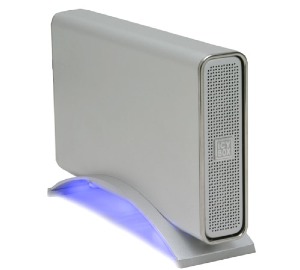
The solution I came up with was an IcyBox IB-360StUS-BL external SATA/USB2 enclosure, wired to a Sonnet Tempo Express 34 SATA adapter. Icybox HD enclosure
Icybox IB-360StUS-BL enclosureEnclosure The IcyBox is such an affordable little box that it seems silly not to have one to hand as a precaution, especially given the cheapness of hard drives these days. The enclosure is convection cooled, so has no noisy fan, and is an a reasonably attractive alumnium package that fits in with the look of the Macbook Pro quite well. The blue LED is switchable, just in case you don't want that bling look on your desktop.Inside the enclosure there's both PATA and SATA connectors. I chose to use a SATA drive, a Samsung HD400LJ. There are two headers for connecting a SATA drive. One goes to the USB 2 adapter, one straight to the outside of the enclosure for wiring to a SATA port on the computer.Four screws secure the hard drive in its tray. The tray then slides into the frame and is secured by four screws in the base. I didn't find it that easy to get these in, but they seemed secure enough once screwed in.The IcyBox comes with plenty of cables, including a SATA-SATA cable, a bracket to relocate an internal SATA port to the PCI card cover on a regular PC, and a USB cable. The power supply is of the external brick sort. SATA adapterThe other half of the equation is the Sonnet Tempo Express 34 SATA adapter. This fits into the Macbook Pro's Express Card port — you knew that something had to eventually, eh? The Tempo card features two eSATA ports, which are of a different design to the  SATA ports featured on the Icybox. This means you need to buy an eSATA-SATA cable. You can either spend $20 on one from Sonnet themselves, or get a cheaper unbranded one for about the tenth of the price: just make sure its reasonably well shielded.Once plugged in, the external drive shows up on the Mac as a SCSI device, and behaves like any removable media. As such, it needs to be unmounted from the desktop before you eject the Tempo card.The only bug with the Tempo card I've found is that things don't seem to work that well if you boot the machine with the card inserted. The very helpful people from Sonnet tell me this is an issue with the underlying Silicon Image chipset, and they're working on sorting it out. (I was very impressed with the technical knowledge, friendliness and speed of response from Sonnet's support department.)PerformanceI'm no benchmarking guru, but it's clear that the external Samsung HD400LJ outperforms my internal 7200rpm SATA drive on the Macbook Pro. Brief experiments with XBench suggested that this performance boost was probably between 20 and 40%. It's certainly vastly preferable to the performance hit you get when you use a USB or Firewire 400 drive with the MBP.ConclusionIt's early days yet, but I'm happy with my new setup. The extra port on the Tempo adapter allows for the connection of another drive, or if I use Sonnet's own products, up to 10 drives! I feel happier knowing the disk isn't competing for attention with all the other USB gadgets I have plugged in. The other big plus point for me is the quietness of the Icybox/Samsung combination.Links: 

16 January 2007

Julien Danjou: I KID YOU NOT!

c

Julien Danjou: Creating a FLAN

I have several servers around the Internet, and one of my need is to have VPN between them to access various data and services, like SNMP or NFS. I used to build VPN with OpenVPN between some of them. My main problem was that I had to set up IP interfaces at each end, build multiple tunnels or make some routing, and... that was not what I wanted, too complicated. I took a deeper look in OpenVPN and found a solution: I created a FLAN No, not a cake, a Faked LAN! This is so easy and powerful that I beat myself to not have though about that before. I did it with 3 servers for now, this is how it works: on each server I create an interface named if-remote hostname which is a tap (Ethernet) interfaces connected to the remote host. On server1, I have two interfaces, if-server2 and if-server3 which are like direct wired connection to the remote host, and I can do Ethernet on them. When each server has its link up, I create an Ethernet bridge. In this bridge, I put the two interfaces connected to the remote servers. This finally build something like that for each server:
server1 -- eth0
  \ 
 if-bridge 192.168.4.88
    \  \_ if-server2 -- VPN -- if-server1 -- if-bridge 192.168.4.89 -- server2
     \_ if-server3 -- VPN -- if-server-1 -- if-bridge 192.168.4.90 -- server3
Obviously, you will have a loop in your faked Ethernet LAN, so you'll have to active STP in order to have a working LAN. And it works. The main advantage with this solution is that each server has only one IP on this virtual network, and there's no connection problem if one of your host is down: STP will rebuild the network in a transparent way. The main problem is that you may have to set up a lot of link if you want a full redundancy. I think I'll setup only two links between each server, because it maybe too painfull otherwise. You can also do some optimization if you need, because the current bridge implementation in Linux is so powerful that you can put cost on interfaces for your bridge, or define which bridge should be the root of your tree. Have fun!

15 January 2007

Dirk Eddelbuettel: Too hot to Handel

We went to see a performance of Too hot too Handel [1], a Gospel/Blues/Jazz/Rock rendition of the Messiah, at the Auditorium Theater on Saturday. Two choirs comprising 120 singers, a full jazz (big) band with drums, electric and acoustic bass, electric organ, piano and about twenty brass instruments as well as an equal number of strings in the symphonic section, plus vocalists Rob Dixon (tenor), Victor Trent Cook (counter tenor) and Alfreda Burke (soprena) made for a very full sound in this beautiful theater. For apparent scheduling problems, the performance was moved from the Christmas season (in which Haendel's original Messiah is rather popular) to the Martin Luther King birthday weekend, which is appropriate enough. Even though quite a few seats were empty, the musicians had little problem to get the audience onto their feat with a fine performance, and a rousing finale. Recommended. [1] Not sure where the Umlaut went missing there. Oh well.

Edd Dumbill: Conference roundup: XTech, ETech, OSCON

A brief update concerning the conferences with which I am involved.XTech 2007, of which I'm chair, is progressing well. We've had a large number of submissions and the review process is proceeding apace. Speakers will be notified on February 2nd, and we hope to publish the schedule very soon after. Now's the time to think about joining us in Paris, May 15-18th.
The O'Reilly Emerging Technologies Conference, aka ETech 2007, for which I'm a member of the program committee, is now open for registration. Be in San Diego this March to connect with the brightest cultivators of tomorrow's tech.Also from O'Reilly, the 2007 Open Source Convention is now open for proposals. OSCON needs no introduction from me, I'm sure. I've been on the program committee for some years now, brooding over Linux, XML and other topics. Deadline for proposal submission is February 5th.

Julien Danjou: Kicking out Web spammers with DNSBL

Every project has its story. Every war has its winner, and its casualties. They were 20 millions men, fighting for their freedom. And you'll never know their story. Because during last week, I was looking why my Web server was so heavily loaded. And I discovered that my blog was attacked by spammers trying to post comments. They were stopped by a great plug-in named spamplemousse, which use spam keywords and DNSBL to drop spam comments.
However, this plug-in is written in PHP, like the rest of my blog, so it loads Apache and MySQL in a way that is no more acceptable: the page have still to be rendered for this !@#$ spammers. Consequently, I decided to write a Apache 2.x module which will just drop a 403 Forbidden error page in the spammers' head using DNSBL servers. Here it is, and it is called mod_defensible. I'm using it since 3 days now, and I got some pretty interesting result and less load on my Web server, so c'est tout bon[1].
Notes [1] It's all good

14 January 2007

Julien Blache: Oh, the irony

Daniel Baumann writing a packaging & sponsoring guide, advertising it on -mentors just after having demonstrated his gaps in basic packaging knowledge on the very same list (not even mentioning the kqemu debacle on -release a couple of days ago). Somebody please tell me it’s only a bad dream. Wait, if this was a dream, I could have kicked his ass already. Damn.

12 January 2007

Erich Schubert: RDF representation of packages?

I wonder if we should do some RDF representation of packages - especially including dependency data. That way we can maybe use some RDF reasoners to query our data, and maybe extract some interesting information. On the other hand, people with interest in RDF to use our real-world data for their experiments, and maybe we get something back from them. There is a couple of package metadata we currently are not tracking inside the actual archive, but in different places. Including licensing information (debian/copyright), homepage location (on packages.qa.debian.org), download location (debian/watch) - it would be nice to aggregate these into some RDF store, and export them somehow. For most of the package information (especially dependency information), we'll have to write our own ontology (I wonder if we can map version numbers to some standard rule language, or if applications will need an external reasoner to process them?); for some things we can reuse the FOAF (Friend-of-a-friend) or DOAP (Description of a project) ontologies. The first is rather common for describing people, people-people and people-thing relationships; the latter was designed for describing opensource projects (but won't be directly applicable to packages of a project). I've blogged about my RDF export of Debtags data before; the canonical first step would actually have been to export the package data, and enrich it with the Debtags collected data... Note that RDF is designed in a way that you can have one site provide metadata for another site. For example, the Debtags RDF export contains "category" information for Debian packages, but does not contain e.g. the description of the packages it talks about via an URI. So there is nothing wrong from a RDF point of view of keeping e.g. the licensing, watch or homepage data separate. For the Google Summer of Code, there was a proposal including "collaborative repository of meta-informations about source packages (CRMI)"; but the first part of the proposal, the "distribution wide tracker tool (DWTT)" showed to be a bigger task than expected. But maybe we'll still see CRMI at some point, and maybe we can have it provide an RDF export of data (using a semantic wiki might be a good starting point for CRMI maybe?). [P.S. this blog posting maybe belongs more into the en/linux/debian category. But only the xml category is also syndicated on planet.XMLhack, and I want this post to go there to reach more RDF users. I really need to switch my blog to some software which supports tagging...]

10 January 2007

Erich Schubert: Linux distributions to be illegal in Germany?

The biggest party in Bavaria and part of the current german government, CSU, has announced that they want to make the "production and distribution of killer-games" illegal in germany. They claim it's because of a recent highschool shooting (no fatalities except the shooter; there was one other highschool shooting in germany a few years ago with 16 fatalities. Yes, that is 17 fatalities in over 40 years, the 42 years old amok runner back then didn't play killer games, I guess, although he used a flame thrower...). This would make the production and distribution in Germany unlawful, since we include games such as overkill, tremulous and openarena. Other distributions such as SuSE probably include some games that classify as "killer games" as well. Also note that "distribution" is a rather wide term. Does it apply to web sites? ISPs? If there is an online killer game, is the ISP "distributing" it? Polticians (especially those from CSU/CDU/SPD) are such a bunch of idiots. Please do NOT ever again vote for CSU. Software patents, killer games, "Problemfrauen & Schadbären", surveillance cameras and other surveillance, military inside germany (note that in desaster cases such as the flooding some years ago we could already deploy soldats without extra laws), shooting down of civilian airplanes, transrapid, reducing math and natural sciences in highschools, "google earth threatens worldcup security", police installing trojans on home PCs (because criminals don't install virus scanners?), kicking "irritating" students out of school, study fees, ... Often they make George W. Bush look like a genius, don't they? They don't do any important stuff, but just say whatever a majority people might want to hear. They waste our money (Transrapid). They destroy our biggest resource (changes in school system and university system, which will reduce average knowledge in germany a lot). They do lots of stupid things, which heavily invade privacy or public safety (military, surveillance) with no benefits in safety and many of which even where only stopped because they violated our constitution. Do not vote for them! [Updates: Daniel, sorry for posting a non-english post to planet. I again put it into the wrong category; I intended to do a longer post (this one) in english later on. For clarification: CSU is the sister party of CDU, these parties have an arrangement not to compete by region and are closely affiliated. On the nation-wide level they have a joint list, which often is called CDUCSU. So they're not just an "affiliate", but a strong part of the ruling party. Holger Levsen pointed out we are likely going to violate some laws much earlier by distributing ("hacker-") tools such as nmap, ettercap or whireshark.]

Daniel Burrows: The US isn't the only country with crazy politicians

[UPDATE 2007-10-01 22:43: It appears that Erich wrote an expanded and better-translated post while I was at work]

Erich Schubert writes that
Nach aktuellen Pl nen der CSU w re der Vertrieb von Debian GNU/Linux illegal.

Auch zahlreiche andere Distributionen w hren wohl davon betroffen: Alle, die sogenannte "Killerspiele" vertreiben...

For non-German speakers, I provide the following approximate translation:
CSU wants to make Debian illegal

The current plans of the CSU [Christian Social Union] will make the distribution of Debian GNU/Linux illegal.

In addition, many other distributions will be affected: specifically, those that distribute so-called "killer games"...

For instance, Overkill (Debian also includes, e.g., Tremulous and OpenArena, which are based on the Quake3 engine and have 3d graphics...)

(hopefully I got the gist of Erich's post without mangling it too badly!)

What I don't know is how serious this is. The CDU (Christian Democratic Union) is IIRC the current ruling party in Germany; however, according to Wikipedia, the CSU is some sort of local affiliate in Bavaria. Does it have the clout to get this proposal made into law?

Next.

Previous.