Russ Allbery: Review: Legends & Lattes
| Series: | Legends & Lattes #1 |
| Publisher: | Tor |
| Copyright: | 2022 |
| ISBN: | 1-250-88609-0 |
| Format: | Kindle |
| Pages: | 293 |
| Series: | Legends & Lattes #1 |
| Publisher: | Tor |
| Copyright: | 2022 |
| ISBN: | 1-250-88609-0 |
| Format: | Kindle |
| Pages: | 293 |
$sudo apt update (updates the index files of apt and tells you how many packages are upgradable). IIRC, every 4-5 hours there is an index runs that basically catches any new debian packages. You can see the index generated dynamically each time you run the above command in /var/lib/apt/lists $ sudo debdelta-upgrade Now the debdelta algorithim goes to work. Debdelta has its own mirror. I think sometime after the indexes are updated, debdelta does it own run, probably an hour or two later. The algorithim sees how big the diff between the two packages and generates a delta. If the generated delta (diff.) between the old and the new is less than 70% then the generated delta is kept or otherwise thrown. The delta is kept in debdelta mirror. You can from 1 day history how big it is. And AFAIK, it is across all the hardware and platforms that Debian supports. My issue has been simply that debdelta just doesn t work and even after debdelta-upgrade I am forced to get all the files from the server. Have shared more details here.
3. The last step is $ sudo aptitude upgrade or $ sudo aptitude install and give package names if you know some packages are broken or non-resolvable or have some bugs.
RISC I had shared about RISC chips couple of weeks back. One of the things that I had forgotten to share that Android is also supporting RISC-V few months back. How I forgot that crucial bit of info. is beyond me. There are number of RISC-V coming out in the next few months to early 2024. One of the more interesting boards that came up in 2021/2022 was HiFive Unmatched. The problem is that the board although interesting on specs is out of reach of most Indians. I am sure most people would be aware of the chicken and egg problem and that is where it is. Pricing will be key component. If they get the pricing right and are able to produce in good numbers, we might see more of these boards soon. At least with Android that issue gets somewhat resolved. There is possibility that we may see more Android set-top boxes and whatnot paired with RISC paving more money for RISC development and a sort of virtuous cycle. While I m in two minds, I decide not to share what chips are coming unless and until we know what the pricing is, otherwise they just become part of a hype cycle. But it s definitely something to watch out for. One of the more interesting articles that I read last week also tells how Linux has crossed 3% desktop space and his views on the same. I do very much agree with his last paragraph but at the same time biased as am an old time desktop user. I just don t find myself happy on small factor keyboards. I will leave the rest for some other time depending how things happen.

| Series: | October Daye #13 |
| Publisher: | DAW |
| Copyright: | 2019 |
| ISBN: | 0-7564-1255-2 |
| Format: | Kindle |
| Pages: | 355 |
Like each month, have a look at the work funded by Freexian s Debian LTS offering.
Over the years, the Debian GNU/kFreeBSD
port has gone through various
phases. After many years of development, it was released as technology
preview with the release of
Squeeze and eventually became an
official architecture with the release of
Wheezy. However it ceased being an
official architecture a couple of years later with the release of Jessie,
although a
jessie-kfreebsd
suite was available in the official archive. Some years later, it was moved to
the debian-ports
archive, where it
slowly regressed over the years. The development totally has now been stopped
for over a year,
and the port has been
removed from the
debian-ports archive. It's time to say it goodbye!
I feel a touch of nostalgia as I was deeply involved in the Debian GNU/kFreeBSD
port for nearly a decade, starting in 2006. There are many different reasons to
like GNU/kFreeBSD ranging from political to technical considerations.
Personally, I liked the technical aspect, as the FreeBSD kernel, at that time,
was ahead of the Linux kernel in term of features: jails, ZFS, IPv6 stateful
firewalling, and at a later point superpages. That said it was way behind for
hardware support and to the best of my knowledge this remains unchanged.
Meanwhile, the Linux kernel development accelerated in the latter stages of the
2.6.x series, and eventually closed the feature gap. At some point, I began to
lose interest, and also to lack time, and slowly stepped away from its
development.
Welcome to the June 2023 report from the Reproducible Builds project
In our reports, we outline the most important things that we have been up to over the past month. As always, if you are interested in contributing to the project, please visit our Contribute page on our website.
We are very happy to announce the upcoming Reproducible Builds Summit which set to take place from October 31st November 2nd 2023, in the vibrant city of Hamburg, Germany.
Our summits are a unique gathering that brings together attendees from diverse projects, united by a shared vision of advancing the Reproducible Builds effort. During this enriching event, participants will have the opportunity to engage in discussions, establish connections and exchange ideas to drive progress in this vital field. Our aim is to create an inclusive space that fosters collaboration, innovation and problem-solving. We are thrilled to host the seventh edition of this exciting event, following the success of previous summits in various iconic locations around the world, including Venice, Marrakesh, Paris, Berlin and Athens.
If you re interesting in joining us this year, please make sure to read the event page] which has more details about the event and location. (You may also be interested in attending PackagingCon 2023 held a few days before in Berlin.)
This month, Vagrant Cascadian will present at FOSSY 2023 on the topic of Breaking the Chains of Trusting Trust:
Corrupted build environments can deliver compromised cryptographically signed binaries. Several exploits in critical supply chains have been demonstrated in recent years, proving that this is not just theoretical. The most well secured build environments are still single points of failure when they fail. [ ] This talk will focus on the state of the art from several angles in related Free and Open Source Software projects, what works, current challenges and future plans for building trustworthy toolchains you do not need to trust.Hosted by the Software Freedom Conservancy and taking place in Portland, Oregon, FOSSY aims to be a community-focused event: Whether you are a long time contributing member of a free software project, a recent graduate of a coding bootcamp or university, or just have an interest in the possibilities that free and open source software bring, FOSSY will have something for you . More information on the event is available on the FOSSY 2023 website, including the full programme schedule.
Marcel Fourn , Dominik Wermke, William Enck, Sascha Fahl and Yasemin Acar recently published an academic paper in the 44th IEEE Symposium on Security and Privacy titled It s like flossing your teeth: On the Importance and Challenges of Reproducible Builds for Software Supply Chain Security . The abstract reads as follows:
The 2020 Solarwinds attack was a tipping point that caused a heightened awareness about the security of the software supply chain and in particular the large amount of trust placed in build systems. Reproducible Builds (R-Bs) provide a strong foundation to build defenses for arbitrary attacks against build systems by ensuring that given the same source code, build environment, and build instructions, bitwise-identical artifacts are created.However, in contrast to other papers that touch on some theoretical aspect of reproducible builds, the authors paper takes a different approach. Starting with the observation that much of the software industry believes R-Bs are too far out of reach for most projects and conjoining that with a goal of to help identify a path for R-Bs to become a commonplace property , the paper has a different methodology:
We conducted a series of 24 semi-structured expert interviews with participants from the Reproducible-Builds.org project, and iterated on our questions with the reproducible builds community. We identified a range of motivations that can encourage open source developers to strive for R-Bs, including indicators of quality, security benefits, and more efficient caching of artifacts. We identify experiences that help and hinder adoption, which heavily include communication with upstream projects. We conclude with recommendations on how to better integrate R-Bs with the efforts of the open source and free software community.A PDF of the paper is now available, as is an entry on the CISPA Helmholtz Center for Information Security website and an entry under the TeamUSEC Human-Centered Security research group.
comp.unix.programming. Larry notes that it starts with Jayan asking about comparing binaries that might have difference in their embedded timestamps (that is, perhaps, Foreshadowing diffoscope, amiright? ) and goes on to observe that:
The antagonist is David Schwartz, who correctly says There are dozens of complex reasons why what seems to be the same sequence of operations might produce different end results, but goes on to say I totally disagree with your general viewpoint that compilers must provide for reproducability [sic]. Dwight Tovey and I (Larry Doolittle) argue for reproducible builds. I assert Any program especially a mission-critical program like a compiler that cannot reproduce a result at will is broken. Also it s commonplace to take a binary from the net, and check to see if it was trojaned by attempting to recreate it from source.
SOURCE_DATE_EPOCH environment variable [ ], Chris Lamb made it easier to parse our summit announcement at a glance [ ], Mattia Rizzolo added the summit announcement at a glance [ ] itself [ ][ ][ ] and Rahul Bajaj added a taxonomy of variations in build environments [ ].
27 reviews of Debian packages were added, 40 were updated and 8 were removed this month adding to our knowledge about identified issues. A new randomness_in_documentation_generated_by_mkdocs toolchain issue was added by Chris Lamb [ ], and the deterministic flag on the paths_vary_due_to_usrmerge issue as we are not currently testing usrmerge issues [ ] issues.
bullseye, bookworm, trixie and sid , but he also mentioned amongst many changes that not only are the non-free images being built (and are reproducible) but that the live images are generated officially by Debian itself. [ ]
CFLAGS environment variable. [ ]
F-Droid added 21 new reproducible apps in June, resulting in a new record of 145 reproducible apps in total. [ ]. (This page now sports missing data for March May 2023.) F-Droid contributors also reported an issue with broken resources in APKs making some builds unreproducible. [ ]
Bernhard M. Wiedemann published another monthly report about reproducibility within openSUSE
bcachefs (sort find / filesys)build-compare (reports files as identical)build-time (toolchain date)cockpit (merged, gzip mtime)gcc13 (gcc13 toolchain LTO parallelism)ghc-rpm-macros (toolchain parallelism)golangcli-lint (date)gutenprint (date+time)mage (date (golang))mumble (filesys)pcr (date)python-nss (drop sphinx .doctrees)python310 (merged, bisected+backported)warpinator (merged, date)xroachng (date)elinks.multipath-tools.mkdocstrings-python-handlers.fribidi.jtreg7.python-bitstring (forwarded upstream).gradle-kotlin-dsl.libsdl-console.kawari8.freetds.gbrowse.bglibs.advi.afterstep.simstring.manderlbot.erlang-proper.comedilib.libint.newlib.binutils-msp430.c-munipack.python-marshmallow-sqlalchemy.mplayer.menu.mini-buildd.pnetcdf.liblopsub.wcc.shotcut.icu.libapache-poi-java.atf.valgrind.
The Reproducible Builds project operates a comprehensive testing framework (available at tests.reproducible-builds.org) in order to check packages and other artifacts for reproducibility. In June, a number of changes were made by Holger Levsen, including:
amd64, armhf, and i386 architectures to Debian bookworm, with the exception of the Jenkins host itself which will be upgraded after the release of Debian 12.1. In addition, Mattia Rizzolo updated the email configuration for the @reproducible-builds.org domain to correctly accept incoming mails from jenkins.debian.net [ ] as well as to set up DomainKeys Identified Mail (DKIM) signing [ ]. And working together with Holger, Mattia also updated the Jenkins configuration to start testing Debian trixie which resulted in stopped testing Debian buster. And, finally, Jan-Benedict Glaw contributed patches for improved NetBSD testing.
#reproducible-builds on irc.oftc.net.
rb-general@lists.reproducible-builds.org
I m six months into my journey of building a business which means its time to reflect and review the goals I set for the year.


Contributing to Debian
is part of Freexian s mission. This article
covers the latest achievements of Freexian and their collaborators. All of this
is made possible by organizations subscribing to our
Long Term Support contracts and
consulting services.
A personal reflection on how I moved from my Debian home to find two new homes with Trisquel and Guix for my own ethical computing, and while doing so settled my dilemma about further Debian contributions.
Debian s contributions to the free software community has been tremendous. Debian was one of the early distributions in the 1990 s that combined the GNU tools (compiler, linker, shell, editor, and a set of Unix tools) with the Linux kernel and published a free software operating system. Back then there were little guidance on how to publish free software binaries, let alone entire operating systems. There was a lack of established community processes and conflict resolution mechanisms, and lack of guiding principles to motivate the work. The community building efforts that came about in parallel with the technical work has resulted in a steady flow of releases over the years.
From the work of Richard Stallman and the Free Software Foundation (FSF) during the 1980 s and early 1990 s, there was at the time already an established definition of free software. Inspired by free software definition, and a belief that a social contract helps to build a community and resolve conflicts, Debian s social contract (DSC) with the free software community was published in 1997. The DSC included the Debian Free Software Guidelines (DFSG), which directly led to the Open Source Definition.
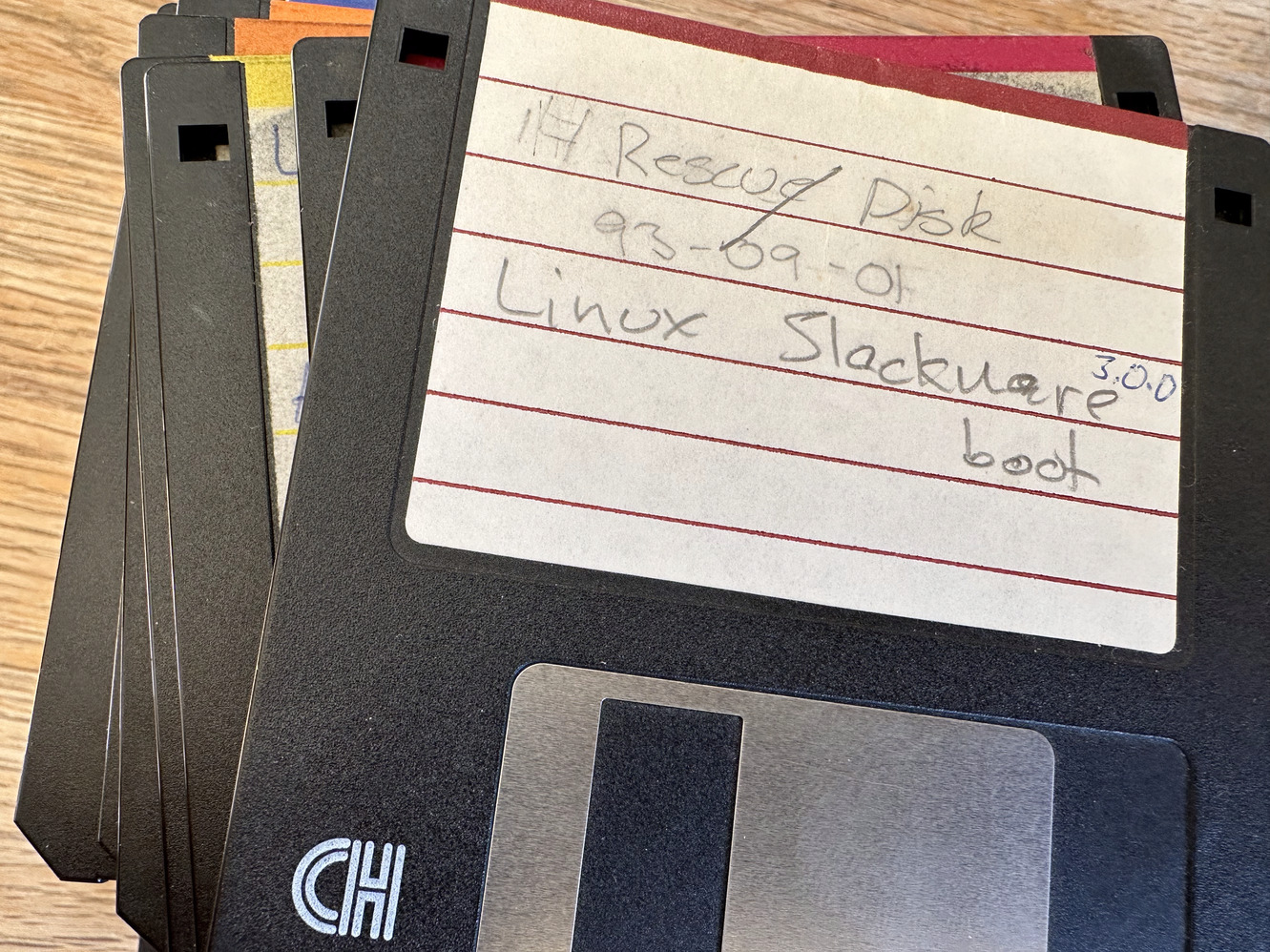
One of my earlier Slackware install disk sets, kept for nostalgic reasons.contrib/non-free section and permitting use of the bug tracker to help resolve issues with non-free works. This is all explained in the social contract. There has always been a clear boundary between free and non-free work, and there has been a commitment that the Debian system itself would be 100% free.
The concern that RedHat Linux was not 100% free software was not critical to me at the time: I primarily (and happily) ran GNU tools on Solaris, IRIX, AIX, OS/2, Windows etc. Running GNU tools on RedHat Linux was an improvement, and I hadn t realized it was possible to get rid of all non-free software on my own primary machine. Debian realized that goal for me. I ve been a believer in that model ever since. I can use Solaris, macOS, Android etc knowing that I have the option of using a 100% free Debian.
While the inclusive approach towards non-free software invite and deserve criticism (some argue that being inclusive to non-inclusive behavior is a bad idea), I believe that Debian s approach was a successful survival technique: by being inclusive to and a compromise between free and non-free communities, Debian has been able to stay relevant and contribute to both environments. If Debian had not served and contributed to the free community, I believe free software people would have stopped contributing. If Debian had rejected non-free works completely, I don t think the successful Ubuntu distribution would have been based on Debian.
I wrote the majority of the text above back in September 2022, intending to post it as a way to argue for my proposal to maintain the status quo within Debian. I didn t post it because I felt I was saying the obvious, and that the obvious do not need to be repeated, and the rest of the post was just me going down memory lane.
The Debian project has been a sustainable producer of a 100% free OS up until Debian 11 bullseye. In the resolution on non-free firmware the community decided to leave the model that had resulted in a 100% free Debian for so long. The goal of Debian is no longer to publish a 100% free operating system, instead this was added: The Debian official media may include firmware . Indeed the Debian 12 bookworm release has confirmed that this would not only be an optional possibility. The Debian community could have published a 100% free Debian, in parallel with the non-free Debian, and still be consistent with their newly adopted policy, but chose not to. The result is that Debian s policies are not consistent with their actions. It doesn t make sense to claim that Debian is 100% free when the Debian installer contains non-free software. Actions speaks louder than words, so I m left reading the policies as well-intended prose that is no longer used for guidance, but for the peace of mind for people living in ivory towers. And to attract funding, I suppose.
So how to deal with this, on a personal level? I did not have an answer to that back in October 2022 after the vote. It wasn t clear to me that I would ever want to contribute to Debian under the new social contract that promoted non-free software. I went on vacation from any Debian work. Meanwhile Debian 12 bookworm was released, confirming my fears. I kept coming back to this text, and my only take-away was that it would be unethical for me to use Debian on my machines. Letting actions speak for themselves, I switched to PureOS on my main laptop during October, barely noticing any difference since it is based on Debian 11 bullseye. Back in December, I bought a new laptop and tried Trisquel and Guix on it, as they promise a migration path towards ppc64el that PureOS do not.
While I pondered how to approach my modest Debian contributions, I set out to learn Trisquel and gained trust in it. I migrated one Debian machine after another to Trisquel, and started to use Guix on others. Migration was easy because Trisquel is based on Ubuntu which is based on Debian. Using Guix has its challenges, but I enjoy its coherant documented environment. All of my essential self-hosted servers (VM hosts, DNS, e-mail, WWW, Nextcloud, CI/CD builders, backup etc) uses Trisquel or Guix now. I ve migrated many GitLab CI/CD rules to use Trisquel instead of Debian, to have a more ethical computing base for software development and deployment. I wish there were official Guix docker images around.
Time has passed, and when I now think about any Debian contributions, I m a little less muddled by my disappointment of the exclusion of a 100% free Debian. I realize that today I can use Debian in the same way that I use macOS, Android, RHEL or Ubuntu. And what prevents me from contributing to free software on those platforms? So I will make the occasional Debian contribution again, knowing that it will also indirectly improve Trisquel. To avoid having to install Debian, I need a development environment in Trisquel that allows me to build Debian packages. I have found a recipe for doing this:
# System commands:
How to sustainably deliver a 100% free software binary distributions seems like an open question, and the challenges are not all that different compared to the 1990 s or early 2000 s. I m hoping Debian will come back to provide a 100% free platform, but my fear is that Debian will compromise even further on the free software ideals rather than the opposite. With similar arguments that were used to add the non-free firmware, Debian could compromise the free software spirit of the Linux boot process (e.g., non-free boot images signed by Debian) and media handling (e.g., web browsers and DRM), as Debian have already done with appstore-like functionality for non-free software (Python pip). To learn about other freedom issues in Debian packaging, browsing Trisquel s helper scripts may enlight you.
Debian s setback and the recent setback for RHEL-derived distributions are sad, and it will be a challenge for these communities to find internally consistent coherency going forward. I wish them the best of luck, as Debian and RHEL are important for the wider free software eco-system. Let s see how the community around Trisquel, Guix and the other FSDG-distributions evolve in the future.
The situation for free software today appears better than it was years ago regardless of Debian and RHEL s setbacks though, which is important to remember! I don t recall being able install a 100% free OS on a modern laptop and modern server as easily as I am able to do today.
Happy Hacking!
Addendum 22 July 2023: The original title of this post was Coping with non-free Debian, and there was a thread about it that included feedback on the title. I do agree that my initial title was confrontational, and I ve changed it to the more specific Coping with non-free software in Debian. I do appreciate all the fine free software that goes into Debian, and hope that this will continue and improve, although I have doubts given the opinions expressed by the majority of developers. For the philosophically inclined, it is interesting to think about what it means to say that a compilation of software is freely licensed. At what point does a compilation of software deserve the labels free vs non-free? Windows probably contains some software that is published as free software, let s say Windows is 1% free. Apple authors a lot of free software (as a tangent, Apple probably produce more free software than what Debian as an organization produces), and let s say macOS contains 20% free software. Solaris (or some still maintained derivative like OpenIndiana) is mostly freely licensed these days, isn t it? Let s say it is 80% free. Ubuntu and RHEL pushes that closer to let s say 95% free software. Debian used to be 100% but is now slightly less at maybe 99%. Trisquel and Guix are at 100%. At what point is it reasonable to call a compilation free? Does Debian deserve to be called freely licensed? Does macOS? Is it even possible to use these labels for compilations in any meaningful way? All numbers just taken from thin air. It isn t even clear how this can be measured (binary bytes? lines of code? CPU cycles? etc). The caveat about license review mistakes applies. I ignore Debian s own claims that Debian is 100% free software, which I believe is inconsistent and no longer true under any reasonable objective analysis. It was not true before the firmware vote since Debian ships with non-free blobs in the Linux kernel for example.
sudo apt-get install debhelper git-buildpackage debian-archive-keyring
sudo wget -O /usr/share/debootstrap/scripts/debian-common https://sources.debian.org/data/main/d/debootstrap/1.0.128%2Bnmu2/scripts/debian-common
sudo wget -O /usr/share/debootstrap/scripts/sid https://sources.debian.org/data/main/d/debootstrap/1.0.128%2Bnmu2/scripts/sid
# Run once to create build image:
DIST=sid git-pbuilder create --mirror http://deb.debian.org/debian/ --debootstrapopts "--exclude=usr-is-merged" --basepath /var/cache/pbuilder/base-sid.cow
# Run in a directory with debian/ to build a package:
gbp buildpackage --git-pbuilder --git-dist=sid
The phrase "Root of Trust" turns up at various points in discussions about verified boot and measured boot, and to a first approximation nobody is able to give you a coherent explanation of what it means[1]. The Trusted Computing Group has a fairly wordy definition, but (a) it's a lot of words and (b) I don't like it, so instead I'm going to start by defining a root of trust as "A thing that has to be trustworthy for anything else on your computer to be trustworthy".
Something that can never be fixed
I have had the pleasure to have Poha in many ways. One of my favorite ones is when people have actually put tadka on top of Poha. You do everything else but in a slight reverse order. The tadka has all the spices mixed and is concentrated and is put on top of Poha and then mixed. Done right, it tastes out of this world. For those who might not have had the Indian culinary experience, most of which is actually borrowed from the Mughals, you are in for a treat.
One of the other things I would suggest to people is to ask people where there can get five types of rice. This is a specialty of South India and a sort of street food. I know where you can get it Hyderabad, Bangalore, Chennai but not in Kerala, although am dead sure there is, just somehow have missed it. If asked, am sure the Kerala team should be able to guide.
That s all for now, feeling hungry, having dinner as have been sharing about cooking.

On a slightly sad note, Foxconn is withdrawing from the joint venture it had with Vedanta.
import java.util.*;
import java.text.*;
class simpleTest
public static void main(String args[])
Calendar cal = Calendar.getInstance();
System.out.println("TIME ZONE :"+ cal.getTimeZone().getDisplayName());
vagrant@vm:~$ sudo timedatectl set-timezone America/Aruba
vagrant@vm:~$ timedatectl
[..]
Time zone: America/Aruba (AST, -0400)
[..]
vagrant@vm:~$ java test.java
TIME ZONE :Central European Standard Time
vagrant@vm:~$ ls -alh /etc/localtime
lrwxrwxrwx 1 root root 35 Jul 10 14:41 /etc/localtime -> ../usr/share/zoneinfo/America/Arubavagrant@vm:~$ echo America/Aruba sudo tee /etc/timezone
America/Aruba
vagrant@vm:~$ java test.java
TIME ZONE :Atlantic Standard Timedpkg-reconfigure tzdata updates this file as well, so using timedatectl
only won t be enough (at least not on Debian based systems which run java based
applications.)
"m.homeserver":
"base_url": "https://luv.asn.au"
"jitsi":
"preferredDomain": "jitsi.perthchat.org"
"im.vector.riot.jitsi":
"preferredDomain": "jitsi.perthchat.org"
Also the URL https://luv.asn.au/.well-known/matrix/server for other servers to know where to connect:
"m.server": "luv.asn.au:8448"If the base_url or the m.server points to a name that isn t configured then you need to add it to the web server configuration. See section 3.1 of the documentation about well known Matrix client fields [3]. The SE Linux specific parts of the configuration are to run the following commands as Bookworm and Bullseye SE Linux policy have support for Synapse:
setsebool -P httpd_setrlimit 1 setsebool -P httpd_can_network_relay 1 setsebool -P matrix_postgresql_connect 1To configure apache you have to enable proxy mode and SSL with the command a2enmod proxy ssl proxy_http and add the line Listen 8443 to /etc/apache2/ports.conf and restart Apache. The command chmod 700 /etc/matrix-synapse should probably be run to improve security, there s no reason for less restrictive permissions on that directory. In the /etc/matrix-synapse/homeserver.yaml file the macaroon_secret_key is a random key for generating tokens. To use the matrix.org server as a trusted key server and not receive warnings put the following line in the config file:
suppress_key_server_warning: trueA line like the following is needed to configure the baseurl:
public_baseurl: https://luv.asn.au:8448/To have Synapse directly accept port 8448 connections you have to change bind_addresses in the first section of listeners to the global listen IPv6 and IPv4 addresses. The registration_shared_secret is a password for adding users. When you have set that you can write a shell script to add new users such as:
#!/bin/bash # usage: matrix_new_user USER PASS synapse_register_new_matrix_user -u $1 -p $2 -a -k THEPASSWORDYou need to set tls_certificate_path and tls_private_key_path to appropriate values, usually something like the following:
tls_certificate_path: "/etc/letsencrypt/live/www.luv.asn.au-0001/fullchain.pem" tls_private_key_path: "/etc/letsencrypt/live/www.luv.asn.au-0001/privkey.pem"For the database section you need something like the following which matches your PostgreSQL setup:
name: "psycopg2"
args:
user: WWWWWW
password: XXXXXXX
database: YYYYYYY
host: ZZZZZZ
cp_min: 5
cp_max: 10
You need to run psql commands like the following to set it up:
create role WWWWWW login password 'XXXXXXX'; create database YYYYYYY with owner WWWWWW ENCODING 'UTF8' LOCALE 'C' TEMPLATE 'template0';For the Apache configuration you need something like the following for the port 8448 web server:
<VirtualHost *:8448> SSLEngine on ... ServerName luv.asn.au; AllowEncodedSlashes NoDecode ProxyPass /_matrix http://127.0.0.1:8008/_matrix nocanon ProxyPassReverse /_matrix http://127.0.0.1:8008/_matrix AllowEncodedSlashes NoDecode ProxyPass /_matrix http://127.0.0.1:8008/_matrix nocanon ProxyPassReverse /_matrix http://127.0.0.1:8008/_matrix </VirtualHost>Also you must add the ProxyPass section to the port 443 configuration (the server that is probably doing other more directly user visible things) for most (all?) end-user clients:
ProxyPass /_matrix http://127.0.0.1:8008/_matrix nocanonThis web page can be used to test listing rooms via federation without logging in [4]. If it gives the error Can t find this server or its room list then you must set allow_public_rooms_without_auth and allow_public_rooms_over_federation to true in /etc/matrix-synapse/homeserver.yaml. The Matrix Federation Tester site [5] is good for testing new servers and for tests after network changes. Clients The Element (formerly known as Riot) client is the most common [6]. The following APT repository will allow you to install Element via apt install element-desktop on Debian/Buster.
deb https://packages.riot.im/debian/ default mainThe Debian backports repository for Buster has the latest version of Quaternion, apt install quaternion should install that for you. Quaternion doesn t support end to end encryption (E2EE) and also doesn t seem to have good support for some other features like being invited to a room. My current favourite client is Schildi Chat on Android [7], which has a notification message 24*7 to reduce the incidence of Android killing it. Eventually I want to go to PinePhone or Librem 5 for all my phone use so I need to find a full featured Linux client that works on a small screen. Comparing to Jabber I plan to keep using Jabber for alerts because it really does instant messaging, it can reliably get the message to me within a matter of seconds. Also there are a selection of command-line clients for Jabber to allow sending messages from servers. When I first investigated Matrix there was no program suitable for sending messages from a script and the libraries for the protocol made it unreasonably difficult to write one. Now there is a Matrix client written in shell script [8] which might do that. But the delay in receiving messages is still a problem. Also the Matrix clients I ve tried so far have UIs that are more suited to serious chat than to quickly reading a notification message. Bridges Here is a list of bridges between Matrix and other protocols [9]. You can run bridges yourself for many different messaging protocols including Slack, Discord, and Messenger. There are also bridges run for public use for most IRC channels. Here is a list of integrations with other services [10], this is for interacting with things other than IM systems such as RSS feeds, polls, and other things. This also has some frameworks for writing bots. More Information The Debian wiki page about Matrix is good [11]. The view.matrix.org site allows searching for public rooms [12].
I use a LUKS-encrypted USB stick to store my GPG and SSH keys, which acts as a
backup and portable key setup when working on different laptops. One
inconvenience with LUKS-encrypted USB sticks is that you need to enter the
password every time you want to mount the device, either through a Window
Manager like KDE or using the cryptsetup luksOpen command. Fortunately, many
laptops nowadays come equipped with TPM2 modules, which can be utilized to
automatically decrypt the device and subsequently mount it. In this post, we'll
explore the usage of systemd-cryptenroll for this purpose, along with udev
rules and a set of scripts to automate the mounting of the encrypted USB.
First, ensure that your device has a TPM2 module. You can run the following
command to check:
sudo journalctl -k --grep=tpm2
Jul 08 18:57:32 bhairava kernel: ACPI: SSDT 0x00000000BBEFC000 0003C6 (v02
LENOVO Tpm2Tabl 00001000 INTL 20160422) Jul 08 18:57:32 bhairava kernel:
ACPI: TPM2 0x00000000BBEFB000 000034 (v03 LENOVO TP-R0D 00000830
PTEC 00000002) Jul 08 18:57:32 bhairava kernel: ACPI: Reserving TPM2 table
memory at [mem 0xbbefb000-0xbbefb033]
systemd-cryptenroll --tpm2-device=list
blog git:(master) systemd-cryptenroll --tpm2-device=list
PATH DEVICE DRIVER
/dev/tpmrm0 MSFT0101:00 tpm_tis
blog git:(master)
LUKS header information for /dev/sdb1
Version: 1
Cipher name: aes
Cipher mode: xts-plain64
Hash spec: sha256
Payload offset: 4096
sudo cryptsetup convert --type luks2 /dev/sdb1
Version: 2
Epoch: 4
Metadata area: 16384 [bytes]
Keyslots area: 2064384 [bytes]
UUID: 000b2670-be4a-41b4-98eb-9adbd12a7616
Label: (no label)
Subsystem: (no subsystem)
Flags: (no flags)
sudo systemd-cryptenroll --tpm2-device=/dev/tpmrm0 --tpm2-pcrs="0+7" /dev/sdb1
sudo /usr/lib/systemd/systemd-cryptsetup attach GPG_USB "/dev/sdb1" - tpm2-device=auto
lsblk
NAME MAJ:MIN RM SIZE RO TYPE MOUNTPOINTS
sda 8:0 0 223.6G 0 disk
sda1 8:1 0 976M 0 part /boot/efi
sda2 8:2 0 222.6G 0 part
root 254:0 0 222.6G 0 crypt /
sdb 8:16 1 7.5G 0 disk
sdb1 8:17 1 7.5G 0 part
GPG_USB 254:1 0 7.5G 0 crypt /media/vasudev/GPG_USB
ACTION=="add", KERNEL=="sd*", ENV DEVTYPE =="partition", ENV ID_BUS =="usb", ENV SYSTEMD_WANTS ="mount-gpg-usb@$env DEVNAME .service"
ACTION=="remove", KERNEL=="sd*", ENV DEVTYPE =="partition", ENV ID_BUS =="usb", RUN+="/usr/local/bin/umount_enc_usb.sh '%E ID_FS_UUID '"
#!/bin/bash
set -x
if [[ "$#" -ne 1 ]]; then
echo "$(basename $0) <device>"
exit 1
fi
device_uuid="$(blkid --output udev $1 grep ID_FS_UUID= cut -d= -f2)"
if [[ "$device_uuid" == 000b2670-be4a-41b4-98eb-9adbd12a7616 ]]; then
# Found our device, let's trigger systemd-cryptsetup
/usr/lib/systemd/systemd-cryptsetup attach GPG_USB "$1" - tpm2-device=auto
[[ -d /media/vasudev/GPG_USB ]] (mkdir -p /media/vasudev/GPG_USB/ && chown vasudev:vasudev /media/vasudev/GPG_USB)
mount /dev/mapper/GPG_USB /media/vasudev/GPG_USB
else
echo "Not the interested device. Ignoring."
exit 0
fi
#!/bin/bash
if [[ "$#" -ne 1 ]]; then
echo "$(basename $0) <fsuuid>"
exit 1
fi
if [[ "$1" == "000b2670-be4a-41b4-98eb-9adbd12a7616" ]]; then
# Our device is removed, let's close the luks mapping
[[ -e /dev/mapper/GPG_USB ]] && cryptsetup luksClose /dev/mapper/GPG_USB
else
echo "Not our device."
exit 0
fi
[Unit]
Description=Mount the encrypted USB device service
[Service]
Type=simple
ExecStart=/usr/local/bin/mount_enc_usb.sh
Note
This can be even done for LUKS2 encrypted root disk but will need some tweaking in initramfs.
Welcome to the 40th post in the $R^4 series. This
one will just be a very brief illustration of r2u use in what might be
an unexpected place: Google
Colab. Colab has a strong bent towards Jupyter and Python but has
been supporting R compute kernels for some time (by changing what they
call the runtime ). And with a little exploration one can identify
these are (currently, as of July 2023) running Ubuntu 20.04 aka
focal .
Which is of course one of two system supported by our lovely r2u project (with the
other being the newer 22.04 aka jammy ). And I mostly tweeted / tooted
about r2u since the its
introduction in #37. And gave basically just a mention in passing in
faster
feedback post #38 as well as the faster
feedback in ci post #39). So a brief recap may be in order. In
essence, r2u makes all
of CRAN available as
full-fledged Ubuntu binaries with complete and full dependencies which
are then installed directly and quickly via apt. Which, to
top it of, are accessed directly from R via
install.packages() so no special knowledge or sauce needed.
We often summarize it as fast, easy, reliable: what is not to
like .
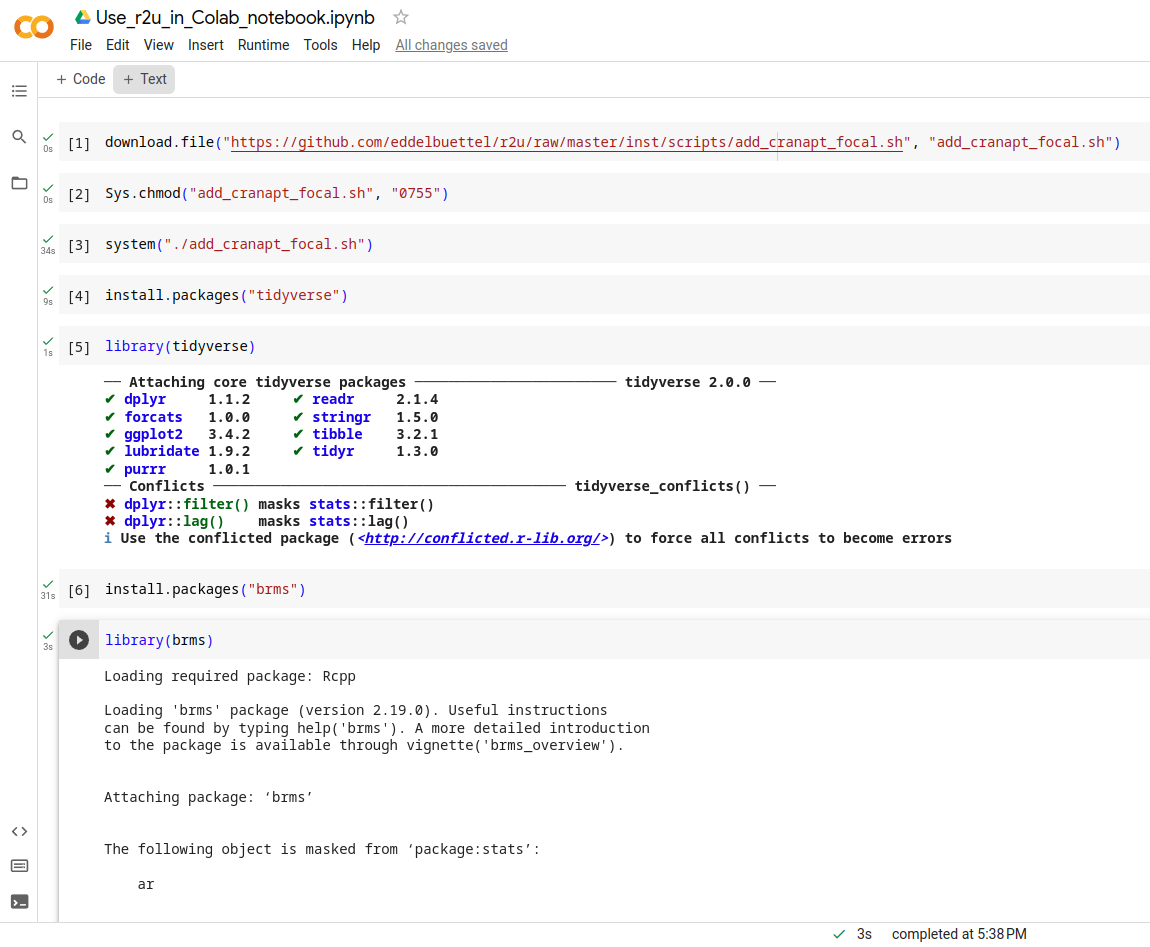
And, as we established in a few minutes of probing, it also works in
the focal -based Colab session. The screen shot shows the basic step of
fetching the setup script (for plain Ubuntu focal system) from r2u, making it executable
and running it. Total time: 34 seconds. And after that we see the pure
magic of install.packages("tidyverse") installing
all of it in nine seconds. Additionally, we add the
brms package in thirty-one seconds cia
install.packages("brms"). Both load just fine and echo
their current values.
r2u on colab focal
download.file("https://github.com/eddelbuettel/r2u/raw/master/inst/scripts/add_cranapt_focal.sh",
"add_cranapt_focal.sh")
Sys.chmod("add_cranapt_focal.sh", "0755")
system("./add_cranapt_focal.sh")
install.packages("tidyverse")
library(tidyverse)
install.packages("brms")
library(brms)rocker/r2u:jammy.
More information about r2u is at its site, and we
answered some question in issues, and at stackoverflow. More questions
are always welcome!
If you like this or other open-source work I do, you can now sponsor me at
GitHub.
This post by Dirk Eddelbuettel originated on his Thinking inside the box blog. Please report excessive re-aggregation in third-party for-profit settings.
# create a profile firejail --build=xterm.profile xterm # now this run can only do what the previous run did firejail --profile=xterm.profile xtermNote that firejail is SETUID root so can potentially reduce system security and it has had security issues in the past. In spite of that it can be good for allowing a trusted user to run programs with less access to the system. Also it is a good way to start learning about such things. I don t think it s a good solution for what I want to do. But I won t rule out the possibility of using it at some future time for special situations. Bubblewrap I tried out firejail with the browser Epiphany (Debian package epiphany-browser) on my Librem5, but that didn t work as Epiphany uses /usr/bin/bwrap (bubblewrap) for it s internal sandboxing (here is an informative blog post about the history of bubblewrap AKA xdg-app-helper which was developed as part of flatpak [5]). The Epiphany bubblewrap sandbox is similar to the situation with Chrome/Chromium which have internal sandboxing that s incompatible with firejail. The firejail man page notes that it s not compatible with Snap, Flatpack, and similar technologies. One issue this raises is that we can t have a namespace based sandboxing system applied to all desktop apps with no extra configuration as some desktop apps won t work with it. Bubblewrap requires setting kernel.unprivileged_userns_clone=1 to run as non-root (IE provide the normal and expected functionality) which potentially reduces system security. Here is an example of a past kernel bug that was exploitable by creating a user namespace with CAP_SYS_ADMIN [6]. But it s the default in recent Debian kernels which means that the issues have been reviewed and determined to be a reasonable trade-off and also means that many programs will use the feature and break if it s disabled. Here is an example of how to use Bubblewrap on Debian, after installing the bubblewrap run the following command. Note that the new-session option (to prevent injecting characters in the keyboard buffer with TIOCSTI) makes the session mostly unusable for a shell.
bwrap --ro-bind /usr /usr --symlink usr/lib64 /lib64 --symlink usr/lib /lib --proc /proc --dev /dev --unshare-pid --die-with-parent bashHere is an example of using Bubblewrap to sandbox the game Warzone2100 running with Wayland/Vulkan graphics and Pulseaudio sound.
bwrap --bind $HOME/.local/share/warzone2100 $HOME/.local/share/warzone2100 --bind /run/user/$UID/pulse /run/user/$UID/pulse --bind /run/user/$UID/wayland-0 /run/user/$UID/wayland-0 --bind /run/user/$UID/wayland-0.lock /run/user/$UID/wayland-0.lock --ro-bind /usr /usr --symlink usr/bin /bin --symlink usr/lib64 /lib64 --symlink usr/lib /lib --proc /proc --dev /dev --unshare-pid --dev-bind /dev/dri /dev/dri --ro-bind $HOME/.pulse $HOME/.pulse --ro-bind $XAUTHORITY $XAUTHORITY --ro-bind /sys /sys --new-session --die-with-parent warzone2100Here is an example of using Bubblewrap to sandbox the Debian bug reporting tool reportbug
bwrap --bind /tmp /tmp --ro-bind /etc /etc --ro-bind /usr /usr --ro-bind /var/lib/dpkg /var/lib/dpkg --symlink usr/sbin /sbin --symlink usr/bin /bin --symlink usr/lib64 /lib64 --symlink usr/lib /lib --symlink /usr/lib32 /lib32 --symlink /usr/libx32 /libx32 --proc /proc --dev /dev --die-with-parent --unshare-ipc --unshare-pid reportbugHere is an example shell script to wrap the build process for Debian packages. This needs to run with unshare-user and specifying the UID as 0 because fakeroot doesn t work in the container, I haven t worked out why but doing it through the container is a better method anyway. This script shares read-write the parent of the current directory as the Debian build process creates packages and metadata files in the parent directory. This will prevent the automatic signing scripts which is a feature not a bug, so after building packages you have to sign the .changes file with debsign. One thing I just learned is that the Debian build system Sbuild can use chroots for building packages for similar benefits [7]. Some people believe that sbuild is the correct way of doing it regardless of the chroot issue. I think it s too heavy-weight for most of my Debian package building, but even if I had been convinced I d still share the information about how to use bwrap as Debian is about giving users choice.
#!/bin/bash set -e BUILDDIR=$(realpath $(pwd)/..) exec bwrap --bind /tmp /tmp --bind $BUILDDIR $BUILDDIR --ro-bind /etc /etc --ro-bind /usr /usr --ro-bind /var/lib/dpkg /var/lib/dpkg --symlink usr/bin /bin --symlink usr/lib64 /lib64 --symlink usr/lib /lib --proc /proc --dev /dev --die-with-parent --unshare-user --unshare-ipc --unshare-net --unshare-pid --new-session --uid 0 --gid 0 $@Here is an informative blog post about using Bubblewrap with Seccomp (BPF) [8]. In a future post I ll write about how to get this sort of thing going but I ll just leave the URL here for people who want to do it on their own. The source for the flatpak-run program is the only example I could find of using Seccomp with Bubblewrap [9]. A lot of that code is worth copying for application sandboxing, maybe the entire program. Unshare The unshare command from the util-linux package has a large portion of the Bubblewrap functionality. The things that it doesn t do like creating a new session can be done by other utilities. Here is an example of creating a container with unshare and then using cgroups with it [10]. systemd --user Recent distributions have systemd support for running a user session, the Arch Linux Wiki has a good description of how this works [11]. The units for a user are .service files stored in /usr/lib/systemd/user/ (distribution provided), ~/.local/share/systemd/user/ (user installed applications in debian a link to ~/.config/systemd/user/), ~/.config/systemd/user/ (for manual user config), and /etc/systemd/user/ (local sysadmin provided) Here are some example commands for manipulating this:
# show units running for the current user systemctl --user # show status of one unit systemctl --user status kmail.service # add an environment variable to the list for all user units systemctl --user import-environment XAUTHORITY # start a user unit systemctl --user start kmail.service # analyse security for all units for the current user systemd-analyze --user security # analyse security for one unit systemd-analyze --user security kmail.serviceHere is a test kmail.service file I wrote to see what could be done for kmail, I don t think that kmail is the app most needing to be restricted it is in more need of being protected from other apps but it still makes a good test case. This service file took it from the default risk score of 9.8 (UNSAFE) to 6.3 (MEDIUM) even though I was getting the error code=exited, status=218/CAPABILITIES when I tried anything that used capabilities (apparently due to systemd having some issue talking to the kernel).
[Unit] Description=kmail [Service] ExecStart=/usr/bin/kmail # can not limit capabilities (code=exited, status=218/CAPABILITIES) #CapabilityBoundingSet=~CAP_SYS_TIME CAP_SYS_PACCT CAP_KILL CAP_WAKE_ALARM CAP_DAC_OVERRIDE CAP_DAC_READ_SEARCH CAP_FOWNER CAP_IPC_OWNER CAP_LINUX_IMMUTABLE CAP_IPC_LOCK CAP_SYS_MODULE CAP_SYS_TTY_CONFIG CAP_SYS_BOOT CAP_SYS_CHROOT CAP_BLOCK_SUSPEND CAP_LEASE CAP_MKNOD CAP_CHOWN CAP_FSETID CAP_SETFCAP CAP_SETGID CAP_SETUID CAP_SETPCAP CAP_SYS_RAWIO CAP_SYS_PTRACE CAP_SYS_NICE CAP_SYS_RESOURCE CAP_NET_ADMIN CAP_NET_BIND_SERVICE CAP_NET_BROADCAST CAP_NET_RAW CAP_SYS_ADMIN CAP_SYSLOG # also 218 for ProtectKernelModules PrivateDevices ProtectKernelLogs ProtectClock # MemoryDenyWriteExecute stops it displaying message content (bad) # needs @resources and @mount to startup # needs @privileged to display message content SystemCallFilter=~@cpu-emulation @debug @raw-io @reboot @swap @obsolete SystemCallArchitectures=native UMask=077 NoNewPrivileges=true ProtectControlGroups=true PrivateMounts=false RestrictNamespaces=~user pid net uts mnt cgroup ipc RestrictSUIDSGID=true ProtectHostname=true LockPersonality=true ProtectKernelTunables=true RestrictAddressFamilies=~AF_PACKET RestrictRealtime=true ProtectSystem=strict ProtectProc=invisible PrivateUsers=true [Install]When I tried to use the TemporaryFileSystem=%h directive (to make the home directory a tmpfs the most basic step in restricting what a regular user application can do) I got the error (code=exited, status=226/NAMESPACE) . So I don t think the systemd user setup competes with bubblewrap for restricting user processes. But if anyone else can start where I left off and go further then that will be interesting. Systemd-run The following shell script runs firefox as a dynamic user via systemd-run, running this asks for the root password and any mechanism for allowing that sort of thing opens potential security holes. So at this time while it s an interesting feature I don t think it is suitable for running regular applications on a phone or Linux desktop.
#!/bin/bash
# systemd-run Firefox with DynamicUser and home directory.
#
# Run as a non-root user.
# Or, run as root and change $USER below.
SANDBOX_MINIMAL=(
--property=DynamicUser=1
--property=StateDirectory=openstreetmap
# --property=RootDirectory=/debian_sid
)
SANDBOX_X11=(
# Sharing Xorg always defeats security, regardless of any sandboxing tech,
# but the config is almost ready for Wayland, and there's Xephyr.
# --property=LoadCredential=.ICEauthority:/home/$USER/.ICEauthority
--property=LoadCredential=.Xauthority:/home/$USER/.Xauthority
--property=Environment=DISPLAY=:0
)
SANDBOX_FIREFOX=(
# hardware-accelerated rendering
--property=BindPaths=/dev/dri
# webcam
# --property=SupplementaryGroups=video
)
systemd-run \
"$ SANDBOX_MINIMAL[@] " "$ SANDBOX_X11[@] " "$ SANDBOX_FIREFOX[@] " \
bash -c '
export XAUTHORITY="$CREDENTIALS_DIRECTORY"/.Xauthority
export ICEAUTHORITY="$CREDENTIALS_DIRECTORY"/.ICEauthority
export HOME="$STATE_DIRECTORY"/home
firefox --no-remote about:blank
'
Qubes OS
Here is an interesting demo video of QubesOS [12] which shows how it uses multiple VMs to separate different uses. Here is an informative LCA presentation about Qubes which shows how it asks the user about communication between VMs and access to hardware [13]. I recommend that everyone who hasn t seen Qubes in operation watch the first video and everyone who isn t familiar with the computer science behind it watch the second video. Qubes appears to be a free software equivalent to NetTop as far as I can tell without ever being able to use NetTop.
I don t think Qubes is a good match for my needs in general use and it definitely isn t a good option for phones (VMs use excessive CPU on phones). But it s methods for controlling access have some ideas that are worth copying.
File Access XDG Desktop Portal
One core issue for running sandboxed applications is to allow them to access files permitted by the user but no other files. There are two main parts to this problem, the easier one is to have each application have it s own private configuration directory which can be addressed by bind mounts, MAC systems, running each application under a different UID or GID, and many other ways.
The hard part of file access is to allow the application to access random files that the user wishes. For example I want my email program, IM program, and web browser to be able to save files and also to be able to send arbitrary files via email, IM, and upload to web sites. But I don t want one of those programs to be able to access all the files from the others if it s compromised. So only giving programs access to arbitrary files when the user chooses such a file makes sense.
There is a package xdg-desktop-portal which provides a dbus interface for opening files etc for a sandboxed application [14]. This portal has backends for KDE, GNOME, and Wayland among others which allow the user to choose which file or files the application may access. Chrome/Chromium is one well known program that uses the xdg-desktop-portal and does it s own sandboxing. To use xdg-desktop-portal an application must be modified to use that interface instead of opening files directly, so getting this going with all Internet facing applications will take some work. But the documentation notes that the portal API gives a consistent user interface for operations such as opening files so it can provide benefits even without a sandboxed environment.
This technology was developed for Flatpak and is now also used for Snap. It also has a range of APIs for accessing other services [15].
Flatpak
Flatpack is a system for distributing containerised versions of applications with some effort made to improve security. Their development of bubblewrap and xdg-desktop-portal is really good work. However the idea of having software packaged with all libraries it needs isn t a good one, here s a blog post covering some of the issues [16].
The web site flatkill.org has been registered to complain about some Flatpak problems [17]. They have some good points about the approach that Flatpak project developers have taken towards some issues. They also make some points about the people who package software not keeping up to date with security fixes and not determining a good security policy for their pak. But this doesn t preclude usefully using parts of the technology for real security benefits. If parts of Flatpak like Bubblewrap and xdg-portal are used with good security policies on programs that are well packaged for a distribution then these issues would be solved.
The Flatpak app author s documentation about package requirements [18] has an overview of security features that is quite reasonable. If most paks follow that then it probably isn t too bad. I reviewed the manifests of a few of the recent paks and they seemed to have good settings. In the amount of time I was prepared to spend investigating this I couldn t find evidence to support the Flatkill claim about Flatpaks granting obviously inappropriate permissions. But the fact that the people who run Flathub decided to put a graph of installs over time on the main page for each pak while making the security settings only available by clicking the Manifest github link, clicking on a JSON or YAML file, and then searching for the right section in that shows where their priorities lie.
The finish-args section of the Flatpak manifest (the section that describes the access to the system) seems reasonably capable and not difficult for users to specify as well as being in common use. It seems like it will be easy enough to take some code from Flatpak for converting the finish-args into Bubblewrap parameters and then use the manifest files from Flathub as a starting point for writing application security policy for Debian packages.
Snap
Snap is developed by Canonical and seems like their version of Flatpak with some Docker features for managing versions, the Getting Started document is worth reading [19]. They have Connections between different snaps and the system where a snap registers a plug that connects to a socket which can be exposed by the system (EG the camera socket) or another snap. The local admin can connect and disconnect them. The connections design reminds me of the Android security model with permitting access to various devices.
The KDE Neon extension [20] has been written to add Snap support to KDE. Snap seems quite usable if you have an ecosystem of programs using it which Canonical has developed. But it has all the overheads of loopback mounts etc that you don t want on a mobile device and has the security issues of libraries included in snaps not being updated.
A quick inspection of an Ubuntu 22.04 system I run (latest stable release) has Firefox 114.0.2-1 installed which includes libgcrypt.so.20.2.5 which is apparently libgcrypt 1.8.5 and there are CVEs relating to libgcrypt versions before 1.9.4 and 1.8.x versions before 1.8.8 which were published in 2021 and updated in 2022. Further investigation showed that libgcrypt came from the gnome-3-38-2004 snap (good that it doesn t require all shared objects to be in the same snap, but that it has old versions in dependencies). The gnome-3-38-2004 snap is the latest version so anyone using the Snap of Firefox seems to have no choice but to have what appears to be insecure libraries.
The strict mode means that the Snap in question has no system access other than through interfaces [21].
SE Linux and Apparmor
The Librem5 has Apparmor running by default. I looked into writing Apparmor policy to prevent Epiphany from accessing all files under the home directory, but that would be a lot of work. Also at least one person has given up on maintaining an Epiphany profile for Apparmor because it changes often and it s sandbox doesn t work well with Apparmor [22]. This was not a surprise to me at all, SE Linux policy has the same issues as Apparmor in this regard.
The Ubuntu Security Team Application Confinement document [23] is worth reading. They have some good plans for using AppArmor as part of solving some of these problems. I plan to use SE Linux for that.
Slightly Related Things
One thing for the future is some sort of secure boot technology, the LCA lecture Becoming a tyrant: Implementing secure boot in embedded devices [24] has some ideas for the future.
The Betrusted project seems really interesting, see Bunnie s lecture about how to create a phone size security device with custom OS [25]. The Betrusted project web page is worth reading too [26]. It would be ironic to have a phone as your main PC that is the same size as your security device, but that seems to be the logical solution to several computing problems.
Whonix is a Linux distribution that has one VM for doing Tor stuff and another VM for all other programs which is only allowed to have network access via the Tor VM [27].
Xpra does for X programs what screen/tmux do for text mode programs [28]. It allows isolating X programs from each other in ways that are difficult to impossible with a regular X session. In an ideal situation we could probably get the benefits we need with just using Wayland, but if there are legacy apps that only have X support this could help.
Conclusion
I think that currently the best option for confining desktop apps is Bubblewrap on Wayland. Maybe with a modified version of Flatpak-run to run it and with app modifications to use the xdg-portal interfaces as much as possible. That should be efficient enough in storage space, storage IO performance, memory use, and CPU use to run on phones while giving some significant benefits.
Things to investigate are how much code from Flatpak to use, how to most efficiently do the configuration (maybe the Flatpak way because it s known and seems effective), how to test this (and have regression tests), and what default settings to use. Also BPF is a big thing to investigate.
Release 0.6.33 of the digest package
arrived at CRAN today and has
been uploaded to Debian
already.
digest
creates hash digests of arbitrary R objects (using the md5,
sha-1, sha-256, sha-512,
crc32, xxhash32, xxhash64,
murmur32, spookyhash, blake3, and
crc32c algorithms) permitting easy comparison of R language
objects. It is a mature and widely-used (with 58.6 million downloads
just on the partial cloud mirrors of CRAN which keep logs) as many tasks
may involve caching of objects for which it provides convenient
general-purpose hash key generation to quickly identify the various
objects.
This release corrects a bad bug we accidentally introduced in release
0.6.32 a little under two weeks ago. As described we added
crc32c and aimed for the simple portable approach (given
that the accelerated version is now availble in our package
crc32c) but overlooked one setting which promptly
broked compilation on M1/M2/Arm64 (which we do not have access too,
sadly). This was actually reported in issue
#189 on the very day 0.6.32 was released and even before we got to
blog about its announcement so that we could even mention it in the third
paragraph there.
This fix was a one-liner, and was committed hours later. Now, as it
sometimes happens, processing the new upload at CRAN
took some time. They appeared to be down the next day not processing
anything. Once opened again, they reported changes to worse as can be
seen in reverse-dependency checks. Turns out those were false positive
( it happens ) but then the package lingered a little longer and quite a
lot of folks chimed in at in issue
#189. I have now learned that there were in fact some temporary
hardware issues in one of the CRAN locations, so it all had a reason but
most importantly it is all better now. My apologies for the temporary
breakage, we attempted to address it swiftly but sometimes things beyond
our control (and reach) do slow things down. Now new and fixed binaries
should appear in the next few days.
My CRANberries
provides the usual summary of changes to the previous
version. For questions or comments use the issue tracker
off the GitHub
repo.
If you like this or other open-source work I do, you can now sponsor me at
GitHub.
This post by Dirk Eddelbuettel originated on his Thinking inside the box blog. Please report excessive re-aggregation in third-party for-profit settings.
The Rcpp Core Team is delighted to announce that the newest release
1.0.11 of the Rcpp package arrived on
CRAN and in Debian earlier today. Windows and
macOS builds should appear at CRAN in the next few days, as will builds
in different Linux distribution and of course at r2u. The release was
finalized three days ago, but given the widespread use and extended
reverse dependencies at CRAN it
usually takes a few days to be processed. This release continues with
the six-months January-July cycle started with release
1.0.5 in July 2020. As a reminder, we do of course make interim
snapshot dev or rc releases available via the Rcpp drat repo and strongly
encourage their use and testing I run my systems with these versions
which tend to work just as well, and are also fully tested against all
reverse-dependencies.
Rcpp has long established itself
as the most popular way of enhancing R with C or C++ code. Right now,
2720 packages on CRAN depend on
Rcpp for making analytical code go
faster and further, along with 251 in BioConductor. On CRAN, 13.7% of
all packages depend (directly) on Rcpp, and 59.6% of all compiled packages
do. From the cloud mirror of CRAN (which is but a subset of all CRAN
downloads), Rcpp has been downloaded
72.5 million times. The two published papers (also included in the
package as preprint vignettes) have, respectively, 1678 (JSS, 2011) and 259 (TAS, 2018)
citations, while the the book (Springer useR!,
2013) has another 588.
This release is incremental as usual, generally preserving existing
capabilities faithfully while smoothing our corners and / or extending
slightly, sometimes in response to changing and tightened demands from
CRAN or R standards.
The full list below details all changes, their respective PRs and, if
applicable, issue tickets. Big thanks from all of us to all
contributors!
Thanks to my CRANberries, you can also look at a diff to the previous release. Questions, comments etc should go to the rcpp-devel mailing list off the R-Forge page. Bugs reports are welcome at the GitHub issue tracker as well (where one can also search among open or closed issues); questions are also welcome underChanges in Rcpp version 1.0.11 (2023-07-03)
- Changes in Rcpp API:
Rcpp:::CxxFlags()now quotes only non-standard include path on linux (Lukasz in #1243 closing #1242).- Two unit tests no longer accidentally bark on stdout (Dirk and I aki in #1245).
- Compilation under C++20 using clang++ and its standard library is enabled (Dirk in #1248 closing #1244).
- Use backticks in a generated
.Call()statement inRcppExports.R(Dirk #1256 closing #1255).- Switch to
system2()to capture standard error messages in error cases (I aki in #1259 and #1261 fixing #1257).- Changes in Rcpp Documentation:
- Changes in Rcpp Deployment:
- A test for
qnormnow uses the more accurate value from R 4.3.0 (Dirk in #1252 and #1260 fixing #1251).- Skip tests with path issues on Windows (I aki in #1258).
- Container deployment in continuous integrations was improved. (I aki and Dirk in #1264, Dirk in #1269).
- Several files receives minor edits to please
R CMD checkfrom r-devel (Dirk in #1267).
rcpp
tag at StackOverflow which also allows searching among the
(currently) 2994 previous questions.
If you like this or other open-source work I do, you can sponsor me at
GitHub.
This post by Dirk Eddelbuettel originated on his Thinking inside the box blog. Please report excessive re-aggregation in third-party for-profit settings.
Next.