Search Results: "tg"

19 March 2006

David Pashley: PostgreSQL User Administration

Over the weekend, I managed to revive my main desktop machine, which as spent the last 15 months turned off under a desk because it was showing some odd behaviour and didn't have time to fix it. I've upgraded it to the latest sid and given it to my girlfriend to use instead of the Windows machine she had been using. She appears to have fallen in love with tuxpaint. :) In the process of setting it up I discovered printconf, which automatically sets up parallel and USB printers under cups. Plugged in my printer, went to print in firefox and there was the printer. These things just get easier and easier. Gone are the days when you spent hours writing a printcap entry for your printer. One thing I would like is for DBus support in CUPS so I know when the print job has finished. Just finished writing an article on PostgreSQL user administration. Go read it.

17 March 2006

Dirk Eddelbuettel: Small fix for beancounter 0.8.5

Yesterday I announced version 0.8.5 of beancounter. My testing over the last few days must have been with a, ahem, preceding version as the daily cronjob today promptly aborted when some of the data came with incomplete fields. [ This is common for e.g. mutual funds which do not have high, low, or open values but just closes and previous close. ] This quick patch fixes the issue by inserting proper undef values which PostgreSQL groks much better. A revised beancounter version 0.8.6 should be forthcoming in a few days. My apologies for any inconveniences caused.

16 March 2006

Martin Michlmayr: debian-installer beta2 supports the Linksys NSLU2 (ARM)

While ARM is a very important platform, support for it in Debian has faced a number of problems recently: there was no developer accessible machine for a long time (they're two now), buildds sometimes have a hard time keeping up, etc. Most importantly, there are not enough people actively involved in the ARM port. We need more people doing debian-installer and kernel work, and track other ARM related issues. One reason why few people are working on ARM is probably the lack of a cheap platform that can be used for development. Fortunately, this problem has now been addressed. Over the last few months, I worked (in collaboration of the NSLU2-Linux project) on debian-installer support for the Linksys NSLU2, a sub $100 device with 32 MB RAM, Ethernet (which unfortunately needs a non-free driver) and two USB ports. You can attach a USB disk and run a full Debian system on this device. While there have been some instructions on the web about how to get Debian going on the NSLU2, basic support for the device is now included in debian-installer. In other words, you can do a user-friendly installation and it will just work. Here are instructions. Future work In the future, the NSLU2-Linux people and I will add more support for other ARM based consumer devices, such as Network Attached Storage (NAS) devices (basically a hard drive with a CPU/RAM and Ethernet, sometimes also including wireless; in other words, a perfect platform for Debian). On a related note, I'm also working on getting debian-installer going on a number of MIPS based consumer devices, such as the Netgear WGT634U wireless router. However, this work has not reached the maturity of NSLU2 support yet. There is a status overview and TODO list. Acknowledgements

15 March 2006

Jonathan McDowell: Mmmmm. Munin.

I've been using MRTG for many years now to draw pretty graphs. It's a bit inflexible though and I'd written a kludgy script or two to graph things that wanted more than 2 lines, or that I wanted to dynamically configure. I'd been on the looking for something simple that would do this all for me and replace my MRTG + scripts setup. All of what I'd seen seemed a bit complicated to get up and running, and what I had was BALGE, so I hadn't really looked that hard. At the start of the week, however, I got pointed at someone else's stats page, generated by Munin. The graphs were presented in a nice clear format rather than a million levels down a tree, and all the graphs for a host were on one page for at at-a-glance view. Of course there's a Debian package, so I thought I'd try it out. Very quickly I was up and running with my local machine being monitored. A little extra work and I had SNMP monitoring of my switch, allowing me to ditch MRTG. Slightly more work and I had my UPS being graphed too. Finally I installed snmpd on my wgt634u running OpenWRT and had that sorted too. Excellent. A lot less work than I expected and a much nicer setup than before. I'm sure there are other good options out there, but I found this one worked for me. Oh, and while I was at it I discovered mbrowse, an SNMP MIB browser. I think I'd rather have something that showed me the values read from the device in tree form, but I still found it quite handy.

12 March 2006

Mirco Bauer: Mono 1.1.8.1, Debian/Etch, CLI Policy, CLI Applications Update

Mono 1.1.8.1 was uploaded to Debian/Unstable on Wednesday and is now waiting in the NEW queue (because of the new packages like mono-classlib-1.0/2.0 which I blogged already about).
I also uploaded the packages to debian.meebey.net (versioned as preview packages), which are the same packages, so if you can't wait use the preview repository please. I just filed all removal requests that are needed to get Mono into Debian/Etch, when those are processed, it should go in. Also the CLI Policy draft is almost complete to be official, it defines basic rules now which are required for an user friendly, unified and stable CLI integration in Debian with Mono (and other CLRs like dotGNU) and CLI applications.
With the CLI Policy and Mono in Debian/Etch soon, the Mono Debian Plan is almost complete, only backports for Debian/Sarge are left then. On those I will work when the 1.1.8.1 packages are in the archive and some other packages are updated to the latest version (like Gtk# 1.0.10 and MonoDoc 1.0.7). Currently the following CLI applications are in Debian/Unstable:
MonoDevelop, MonoDoc, Muine, Blam, F-Spot, Tomboy, Nant, Kurush and last but not least IKVM Upcoming CLI applications going in Debian soon or later:
NUnit, NDoc, GFax, Sonance, Beagle and Smuxi Ready to use preview packages we have for:
GFax and MonoDevelop with Boo support
They are on debian.meebey.net, you can use:
deb http://debian.meebey.net/$package ./
or to get all:
deb http://debian.meebey.net/ ./ I personally think this is a big list of CLI applications being in Debian already (or go in when the packages are ready), it shows that Mono/CLI/C# is accepted in the opensource development community!

11 March 2006

Axel Beckert: Tag clouds not being tag clouds

I recently stumbled over two nice things just looking like a very impressive tag cloud without being one. The first thing is a screenshot of a drugstore.com newsletter which seemed to make some bloggers to scent a marketing conspiracy against bloggers since bloggers tend to jump on everything looking like a tag cloud. (Well, doesn’t this posting prove this theory? ;-) The second thing is semantically closer to a tag cloud: a search term cloud. Well, if that isn’t an idea for a new Blosxom plugin? ;-)

9 March 2006

Clint Adams: Cabal wars

Joey Schulze conspiciously omits the reason that James Troup gave him in response to his recent request to become an ftpmaster. I'm betting that it has to do with separation of duties. Joey is already a member of the Debian System Administration team. Having a member of DSA also be in ftpmaster would be very dangerous and is not a risk that Debian should ever take. Who knows what could happen?

Kenshi Muto: Debian-Installer + 2.6.15 kernel for AMD64/EM64T

Although I was still busy, I tried to build d-i image for AMD64/EM64T (x86_64) today. To do try & error, I rented DELL SC430 EM64T machine from my friend DD Shigeo (Thanks!). This machine is really good showcase to demonstrate how we can support tricky machines. In short, official Sarge d-i can't work on this machine. Using backported kernel 2.6.15 and other things, I succeeded to build experimental installer.
  1. Download mini.iso (small CD image to launch network installer) or netboot.tar.gz (for TFTP boot) from here. (I've tested only netboot.tar.gz version)
  2. When installer asks a mirror site, set "osdn.debian.or.jp" as host and "/~kmuto/sarge-amd64" as directory.
  3. If you meet "no disk" error, go another virtual terminal (Alt+F2) and run "modprobe ata_piix". Then back installer screen (Alt+F1).
  4. Remains are as same as normal installer. Choose other official mirror at 2nd stage.
Known bugs: I'm trying to make auto-build script also. Although it's still under developemnt, you can see svn repository; http://kmuto.jp/svn/d-i/sarge/

5 March 2006

Uwe Hermann: HOWTO: Anonymous communication with Tor - some hints and some pitfalls [Update]

Warning: Very long post ahead. You have been warned! What? Tor is a Free Software project (revised BSD license), developed by Roger Dingledine and Nick Mathewson, which creates an infrastructure for anonymous TCP communication. From the project website:
Tor is a toolset for a wide range of organizations and people that want to improve their safety and security on the Internet. Using Tor can help you anonymize web browsing and publishing, instant messaging, IRC, SSH, and other applications that use the TCP protocol. Tor also provides a platform on which software developers can build new applications with built-in anonymity, safety, and privacy features. Tor aims to defend against traffic analysis, a form of network surveillance that threatens personal anonymity and privacy, confidential business activities and relationships, and state security. Communications are bounced around a distributed network of servers called onion routers, protecting you from websites that build profiles of your interests, local eavesdroppers that read your data or learn what sites you visit, and even the onion routers themselves.
Tor also allows you to set up and/or use a so-called Tor hidden service, i.e., a server which offers some service (a website, ssh access, or similar) without revealing its IP to its users. Why? Why would you want to use Tor? Well, because you probably don't want anybody (neither state agencies, nor companies, nor "hackers", nor any other individuals or groups) to be able to record, analyze, and (ab)use information about your web browsing habits, or any other communication habits. For instance, you don't want Google to have a complete search-profile of you, which — even worse — might some day get in the hands of other parties. In the days of massive data retention you don't want all your electronic traces to be recorded, stored for ages, analyzed, and data-mined for dubious reasons and with even more dubious results and false conclusions drawn which might negatively affect you. If you're a human rights activist in China, you want anonymous communication. If you're a whistleblower, you want anonymous communication. The list is endless. For securing your communications, so that nobody is able to sniff your emails, your chat messages, your passwords, your private documents and conversations, you use encryption. For communicating anonymously you can use Tor. Combine both, and you have secure and anonymous communication. In case you're wondering whether criminals might abuse Tor, read the Tor Abuse FAQ. Short answer: yes, but if you're willing to break the law, you already have anonymity (open access points, stolen/prepaid mobile phones, etc.). You don't need Tor to do bad things if you're a criminal. If you're one of those horrible "oh, but I don't have anything to hide" guys, consider this: Say you have a drug/alcohol problem and want to visit an anti-drugs/anti-alcohol website or forum for help. Would you want the whole world, your neighbors, your co-workers, your boss, to know that, or would you rather want to keep that a secret? Say you have AIDS and want to get information on the web? Or, to make the example even more dramatic: Would you want some random guys to be able to watch you while you fuck your wife? No? So you have something to hide after all, right? My point is: Everyone has something to hide, even more, it is a basic human right to have the ability to hide something. It's called privacy. How? Tor implements a form of onion routing to, basically, push encrypted data through multiple Tor nodes (servers), before it reaches the final destination (e.g. a website). The result is that neither the website owner, nor a local eavesdropper, nor any single Tor server knows who requested that specific website, hence you are communicating anonymously. For more technical details, read the Tor overview and the Tor documentation pages. In order to use Tor, you have to install and run a local Tor client/daemon (this is not necessarily a Tor server!). On Debian, type apt-get install tor, on other systems you can get the respective binary packages or download the sources and compile Tor yourself. Usually Tor is used together with Privoxy, a configurable HTTP proxy which sanitizes your web-browsing experience by removing nasty banner ads, pop-ups, JavaScript, webbugs, cookies etc. etc. So: apt-get install privoxy. After installing and starting Tor and Privoxy, you can now configure your webbrowser to use Privoxy as an HTTP proxy (see below), and Privoxy will in turn use Tor to anonymize your communication if you add "forward-socks4a / localhost:9050 ." to your /etc/privoxy/config. Anonymizing various applications Most (but not all) of the following information is also covered in the very useful Torify HOWTO in the Tor wiki (I will add the missing information there, ASAP). As I'm pretty paranoid, I have checked every single of these configurations with Ethereal to ensure that the traffic is really anonymized. However, if you are paranoid, you shouldn't trust me, but rather test this stuff for yourself! Warning: DNS Leaks:
The biggest problem with many applications is that they leak DNS requests. That is, although they use Tor to anonymize the traffic, they first send a DNS request untorified in order to get the IP address of the target system. Then they communicate "anonymously" with that target. The problem: any eavesdropper with more than three brain cells can conclude what website you visited, if they see that you send a DNS request for rsf.org, followed by some "anonymous" Tor traffic. The solution: use Tor together with Privoxy, that prevents DNS leaks. Many non-HTTP-based applications are usually torified using a small tool called torify (e.g. by typing torify fetchmail), but often this approach has DNS leaking problems, see below. You might also want to check out toraliases, a small shell script you can source from your ~/.bashrc file. It defines some functions and aliases which transparently direct the traffic of some (but not all!) programs through Tor. Applications which cannot easily be torified Anything not using TCP usually cannot be torified, as Tor only works for TCP. Pitfalls to be aware of More information More information is available in the Tor documentation, the Tor wiki, and especially in the Tor FAQ. In addition, there's an IRC channel on Freenode (#tor), some slides and a video (torrent) about Tor you might find interesting. If you would like to help, you can run a Tor server, donate some money, or volunteer to do other things (code, debug, document, translate, and more). That's it for now. I'm very grateful for comments and suggestions, especially for hints on how to anonymize more applications. Also, if you notice any dumb mistakes I made, please leave a comment. Update 2006-03-07: Fixed typos, added link to the toraliases project (thanks Benjamin Schieder).

2 March 2006

Jordi Mallach: L MIDDLE DOT in X.Org

English (Queen's English) is the only real language.
After this required short announcement by our main sponsor, Daniel Stone, lets go ahead and explain something of interest to the many Catalan X.Org users out there. Ivan and I have been looking at the issues that block a GNU/Linux user from using the compound geminate L, , instead of the more usual L L spelling. The and characters are unfortunately not included in ISO-8859-1, so fonts were the first big problem we faced. When modern X desktops started using True Type fonts by default, the de-facto free font in most distributions became Bitstream Vera as soon as they were licensed under a Free Software license back in 2003. Bitstream did not include the Unicode glyphs U+013F and U+0140, but some time after, chatting with daf, I learned he was working on Olwen, a Vera extension which would add proper Welsh coverage. He promptly added the Catalan glyphs, but Olwen never got widely exposed in distributions. Luckily, things are changing lately. Due to the lack of bugfixes or new releases of Vera, the list of Vera derivatives like Olwen started growing. The DejaVu project is building a font family, based on Vera, which merged many of these smaller purpose Vera derivatives, including Olwen. DejaVu, is, as far as I know, slowly replacing Bitstream Vera as the standard free, high quality true type font in free desktops. With the font blocker easily solvable now, the next problem was making the input easy. Some terminals, such as GNOME's or rxvt, allow you to insert Unicode typing a Unicode code point. The Spanish layouts don't provide a shortcut for it though, and if you try to do Level3-Shift+l, you'll get a Polish character, , that is of no use in neither Catalan, Spanish, Galician, Basque or other languages in the Spanish state. We wanted to replace that with , but when we had a look at it last Saturday night during our stay in Bruxelles, we couldn't find what the name for Unicode's U+0140/U+013F was in XKB-speak. So, as I said, on Sunday I went looking for Daniel and Keith to see if we would be clued up. The solution is easy: there is no name mapping, but you can use Unicode in 0x100XXXX notation directly in your X config file to make it work. He tried in his laptop, and why not, generated a patch for X.Org 7.0's xkeyboard-config. Daniel can't be that good, so he forced me to spread lies about the English language in this blog entry if we wanted the patch committed. :) Support for X.Org 6.8 and 6.9 isn't planned, unless you bribe your X maintainer to add a tiny patch. This has been implemented as an "es" keyboard extension (named cat ) because other systems don't have that feature in the Spanish layout, and X.Org wants to remain compatible with the rest. We'll have to add a
        Option          "XkbVariant"     "cat"
option to our keyboard section in xorg.conf. If you're not using X.Org 7.0, you might want to try:
xmodmap -e "keycode 46 = l L U140 U13f U140 U13f"
but I don't know if that'll work in all systems. To test in your keyboard, that'll probably be AltGr+l or AltGR+L . What we need to do now is to add support for the character in more fonts, alternative spellings for words using the ela geminada (ie, col labora and co labora ) in dictionaries, wordlists..., and of course, teach users about the avalability of this, and promote its usage.

27 February 2006

Erich Schubert: Spam fun

Todays PhD comic is very funny. Another spam fun I like a lot is Make p*nis fast - combining the usual enlargement stuff with pyramid schemes. On a completely unrelated note, a german bird flu joke:
Treffen sich ein B r, ein L we und ein Huhn.
Sagt der B r: "Wenn ich br lle, zittert der ganze Wald." Meint der L we: "Das ist garnichts, wenn ich br lle, zittert die ganze Savanne!"
Daraufhin das Huhn: "Wenn ich huste, zittert die ganze Welt."
Translation:
A bear, a lion and a chicken meet.
The bear says: "When I bellow, the whole forest is afraid.". The lion tops: "When I roar, the whole savannah goes into cover."
The chicken: "When I cough, the whole world panics."

23 February 2006

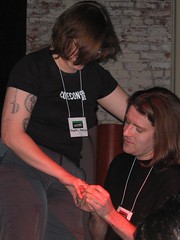
Simon Law: CodeCon 2006, Day 2


House
Originally uploaded by sfllaw.
I woke up to a breakfast of pancakes, cooked by the wonderful [info]riseorbleed. I don't know about you but waking up to a hot breakfast is heavenly. After some morning ablutions, we hailed a cab and along the way we chatted with the cabbie as I looked out the window. Luxor cabbies are really nice, every time I travelled with them, they had some interesting story to tell and big, broad smiles. Smiling is the way to fatter tips! The weather in San Francisco is supposed to be rather variable. You know how that is, rain one minute and then sun the next. Well, the entire time I was there, it was bright and sunny and gorgeous. San Francisco really put on her best to charm me and she really succeeded. I didn't think that postcard-perfect pictures were possible, but I saw them everywhere. I was happy to walk around without needing a winter coat. And everyone else smirked at how happy I was. Daniel seemed to have recovered from the previous night's revelry. His talk on delta was excellent because he's a very good public speaker. Which is good, because he gave two presentations at CodeCon. When I talked to him on Thursday night, he seemed a little embarassed at how successful delta had become since it such a simple piece of software. But people like GCC use it to fare down their bug reports to the lines of code that reproduce its bugs. Rob and Tristan sidled up to my bar and asked me if I could get them some juice. For their laptops. They were working on their presentation all the way until the last minute, which involved a drunken Tristan stumbling around on stage. Except that Tristan doesn't drink, so his imitation was quite poor. They were presenting Djinni, which is their implementation of a fast simulated-annealing algorithm that takes also pressure into account. Sadly, they didn't explain their algorithm but their talk was entertaining nevertheless.

Shoes
Originally uploaded by sfllaw.
At lunch, Spider snuck me out of the building and she showed me around San Francisco. She pointed out the Eagle Tavern with a glimmer in her eye. I think she's trying to corrupt me. Or she's trying to pimp me out. Then we went to Stompers where she tried on some boots. We were stymied, however, by the fact that a very annoying woman and her husband were trying on every single pair of boots in the entire store. iGlance is a real-world video-conferencing and screen-sharing application that has some fairly good usability built into it. It also has a fairly sensible privacy model and does some NAT punching to boot. Although it's only got a Win32 port for now, it's free software so someone will fix it up. Sometime in the afternoon, the beautiful and fair [info]wealhtheow came behind the bar and surprised me with a hug and a sandwich! I was happy with the random hug from a new friend, but the sandwich was wonderful. I had not eaten lunch on Friday so I was very grateful. She put a huge smile on my face. I munched on the sandwich while listening to the OASIS talk. This technology is a locality-aware server-selection resolver, which is pretty good for distributing servers around the world and finding the fastest one. They implement this as a DNS redirector so that lookups are transparent to normal Internet software. This made me feel a little bad for [info]holdenk, whose SelfDirectedProject happens to be on a very similar topic. It does, however, validate his approach. [info]maradydd's presentation about Query by Example was up next. She did a very good introduction to data-mining, which segued into her hack on PostgreSQL where you can specify examples of things you want to search for. That is not how SQL normally works, where you specify constraints. With QBE, you just specify things similiar to what you want, and things similar to what you don't want.

Proposal
Originally uploaded by sfllaw.
I was chatting with Rob Pascual when I noticed Len lining up in the Q&A; queue. Suddenly, my ears perked up as I sensed something important was going to happen. So I pulled out my camera, stepped on some toes, and got into position. When it was his turn at the microphone, he started saying random stuff that wasn't question at all! Something cheesy like how Meredith had changed his life and how he wanted to be with her. Then he got up on stage and asked The Question. It was beautiful. The audience broke out into cheers and applause, except for the heartless bastards beside me. But who cares about them? This was such an awesome occurance that an interview was taped. After teardown, some people were going to head to a franchise Mexican restaurant. Spider insisted that I get real food, so we walked down to the Mission. We made a detour to Good Vibrations which is a San Francisco landmark if ever there was one. I swear that she's trying to corrupt me. Anyway, as we were walking out, I must have mentioned that I was from Canada. Because Cohen, a Torontonian, came out of nowhere and introduced himself to us. Well, what was I to do but to invite my fellow countryman to dinner? So we set off to find a Taqueria that served nopales. This failed since Californians don't seem to like eating cactus. Instead, we went to Pancho Villa where I ate enchiladas and salsa verde and guacamole and churros and I was so very happy! We bid farewell to Cohen after exchanging contact information and tried to find everyone else. Unfortunately, we couldn't reach anyone by cellphone, so we sat around dejected for a while. Then we realised that we could go to Annie's Social Club where an event was happening. This turned out to be a good and a bad idea.

Taqueria
Originally uploaded by sfllaw.
It was a good idea because we found everyone at CodeCon. It was a bad idea because Annie's Social Club double-booked us with bad karaoke! And then were quite rude when we complained. And then kicked out John Gilmore. So I just want to say that Annie's Social Club hates geeks and freedom. So Len hailed a black stretch limousine, we all climbed into it, invited some reporters along and moved the entire party to the XYZ bar. The XYZ staff were very awesome, accommodating an extra hundred patrons and getting an extra bartender. And they were very nice about it. Unfortunately, the bar was full, so I had to lead a bunch of introverts in the fine art of taking over an establishment. We walked in, started talking, I encouraged people to sit down in empty spots on the couches. They did a very admirable job of taking over the back. I got the stunningly adorable [info]akashayi a seat and a drink, before I taked to the people sitting with us. They were a couple who had moved from Florida to San Francisco, and a man from New York who was quite the boor. The man in the couple knew the New Yorker and seemed quite embarassed about him. After twenty minutes of conversation, they excused themselves and bid us good night. This gave us plenty of seating space to talk about geeky things until the manager kindly kicked us out. I made sure Akasha got safely to her hostel and then took a taxi back to the guest room. It was quite the challenge to direct the cab driver, since I had lost the directions back, but I managed!

22 February 2006

Clint Adams: The Judgment Game

Sometimes, when there are what one might term charged discussions , I like to play a little game. I sample a few of the people who are shooting their mouths off and check to see how they're contributing to a certain project about which I might have some opinions. In some cases, I find that they are not worthless blowhards as one might conclude from the inanity of their speech and actions, but actual contributors who just happen to be terribly, terribly incorrect. In other cases, I discover that they have shown a grave lack of judgment in prioritization. Let's stereotype some of the charming winners. The worthless blowhard: This person has a contribution-to-noise ratio that is infinitesimal small. Perhaps he believes that by expressing himself, he is making the world a better place. Perhaps he thinks that his opinions matter. He is mistaken. The arrogant egoist: This person also does very little. She believes herself to be supremely qualified to dictate the way in which others make their contributions, or at least moreso than the people who are actually doing the work. She is quite often mistaken, and should be ashamed of being such a control freak. The catamite trainer: This is a version of the arrogant egoist who betters the world by taking on an apprentice. The Master supervises the Apprentice's contributions, and continues to dictate how things should be done despite being unwilling to actually contribute himself. One notable difference between this and a respectable mentorship relationship is that the Apprentice is aware that he is more qualified to make these decisions than the Master, but feels that it would be socially inappropriate to shake off the yoke of oppression. He is mistaken. The possessive stoner: This is someone who is lax in her responsibilities but means to correct these deficiencies as soon as humanly possible. If anyone offers to help her, she says, No! I'll do it myself this weekend. Then she does something else. The offer is repeated a month later, and she replies, No! This weekend for sure, Rocky! Two years later, people are still fuming that the work hasn't been done. She is a flake. On a completely different subject, let's talk about Debian. I recommend the expulsion of anyone who posts more than 5 mailing-list emails or newsgroup articles in a 24-hour period. I recommend the expulsion of anyone who finds out about Debian votes by reading Slashdot. I recommend the expulsion of anyone who reads Slashdot. I recommend the expulsion of anyone with subpar personal hygiene. I recommend the expulsion of anyone in Project Scud. I recommend the expulsion of anyone who employs statistics in a dishonest manner. I recommend the expulsion of anyone who tries to impose the values of a particular subculture that is not Debian on an international project. I recommend the expulsion of anyone who uses cdbs. I recommend the expulsion of anyone who likes tarball-in-tarball. I recommend the expulsion of anyone who makes lists. I recommend the expulsion of anyone who contributes more to Gentoo, Mandriva, Red Hat, SuSE, Ubuntu, or Xandros than to Debian. I recommend the expulsion of anyone who ever wrote an autobiography. I recommend the expulsion of Mos Def and Talib Kweli: best expulsion in hip-hop. Y-O.

20 February 2006

Dirk Eddelbuettel: New beancounter release 0.8.4

Once more, a new beancounter version went out to Debian, CPAN and my beancounter pages here along with an announcement via the Freshmeat beancounter page. This version contains only a few mundane fixes, and one behavioural change. We no longer set the host argument (via Perl's DBI) if the host variable equals localhost. This way, we default to socket communication which is easier on less experienced users who are struggling to make either one of the MySQL or PostgreSQL backends network-aware (as sockets-only is the more secure default for both). We also added a check for empty currency symbols, and realigned one output screen to 79 columns.

18 February 2006

Zak B. Elep: Looking Back on the Bicol Open Source Forum

Whew! Wow! Yay! :D It’s been just a couple of days since the Bicol Open Source Forum was held at the Aquinas University, but I can’t just seem to forget it. It’s been a rocking experience, and I wished it were a bit longer: Thanks a lot to Joseph Cadag and Josephina Abilay of DOST/RITECC for organizing the event and bringing FOSS to the attention of many Bicolanos :-) I look forward for another event like this soon: from what I hear there would be an even bigger one set for July. I guess I should be pinging Marilize of Ubuntu now to reserve some flyers and CDs… …but right now, on the the Dapper upgrade! Break my Breezy and lemme have my jigsaw puzzle :P

17 February 2006

Uwe Hermann: Motorola A780 - My Shiny New Linux-Based Smartphone

Motorola A780
Motorola A780 Accessories It seems that I have become quite a gadget-whore lately. I'm spending all my money buying one gadget after the other, no end in sight... Anyways, I finally got one of those fabulous Motorola A780, a Linux-based smartphone. Getting one turned out to be way more complicated (and expensive!) than what I thought it would be. In the beginning, all sounded quite good: my cell phone contract with o2 is two years old soon, so I can get a new (cheap) cell phone. Stupidly enough, o2 doesn't offer the A780 in their shops and there seems to be no way to order one either (they do offer other Motorola phones, though). After asking the same questions in different o2 shops multiple times (and almost giving up), I accidentally saw the A780 in the local Saturn (a German electronics store). And indeed, they sell the phone, and they can even prolong my contract with o2 (there's a dedicated o2 employee working in the Saturn store), so that I can profit in the form of a cheaper phone. Or at least that's the theory... In practive, however, I have a student-contract (saves me some bucks) which has the stupid "feature" that it can only be prolonged in o2 shops. Guess what, the Saturn guys cannot give me the A780 as they can't prolong my contract, and the o2 shop simply doesn't have the A780 at all. Argh! After grumbling, asking around, googling, and even more grumbling, I finally decided to do the following: I got a new "dummy" o2 contract in the Saturn (yes, I'll have to pay that for 2 years) which enables me to get the A780 and to get it cheaper. I'll keep using my old contract and my old SIM card for simplicity and leave the new one untouched. If you take into account the money I'll spend on the new contract it doesn't save me too much money, but at least it's distributed across two years... I'll terminate my (new) o2 contract tomorrow, to make sure I don't forget about it (I don't want to have it any longer than the 2 years I'm forced to live with)... Stupid, stupid world we live in. Nobody should be required to perform such "hacks" in order to get the phone he/she wants... Enough ranting now, here's some juicy details about the phone: For details on the hardware see this wiki page. The only thing which I'm missing is WLAN, but once USB host support works (the hardware does support it), you can easily use a WLAN USB dongle... I'm pretty sure I'll be having lots of fun with this thing, and I'll quite probably be contributing to the OpenEZX project, which was started by Harald Welte (of gpl-violations.org fame) and tries to create the first 100% Free Software GSM-phone using the Motorola A780 and similar phones. Judging from these blog posts by Harald, running your own 2.6 kernel on the phone is not too unrealistic anymore, and telnetting into the phone (via USBnet) seems to work fine already... Expect more spammingblog posts about the A780 in future...

14 February 2006

Zak B. Elep: Speaking, Packaging, and Writing, All in One Week

Two days from now, I’ll be pushing for Legaspi to be a speaker for the Bicol Open Source Forum. I’m going to talk about general FOSS and Linux stuff. I’ll also meet up with fellow Ubuntero Irvin Piraman and give away some Ubuntu CDs together :D . If you’re anywhere near Aquinas University, drop me a line. On the Debian side, my updates for opendchub and dbacl have hit Sid, thanks to the great Florian Ragwitz :) I’ve still yet to see ecb, xshisen, and rccp sponsored though :( I’ve seen some hope for ecb, thanks to Bart Martens, who was very helpful and put the updated URL for the latest ecb source package on the ITA. As for the writing, I’m now doing some final school reports for the year-ender. Ooh, just a month more, and here comes summer!!! I just hope there’s something like a local Google Summer of Code…

10 February 2006

Michael Janssen: Pet peeve number 1

Okay, something bugs me, and it's somewhat irrational, and somewhat rational. I totally hate really long URLs needed to "verify" that the sign-up is valid. There are more than one type of these, sometimes they are required to continue into the site, sometime just for extra features, but they are more often that not, very long. Now, I don't like long URLs in general in emails, because there are many services which allow you to shorten them for public use. Recently I signed up for 30 boxes and they sent me this monstrosity:

http://30boxes.com/signup.php?action=finishSignup&d=aSDFJKLa43da
safjdAL5RLKj4afjrafa45J5kljtyTGJrALKJgFKLsaj5klJ4jkljakljdkalflk
fASJKjdfa4r23890fdfjskl342390fakjlei309dk390ujkal39032kd03j9djd9

Okay, so lets look at this rationally for a bit. How many unique strings can they have from that huge behemoth of an identifier. There are 145 characters. They are using the entire uppercase (26), lowercase (26) and numbers (10), so there are a total of 62 unique symbols for each spot. That gives us a total of 62145 different strings. That's

78848779858160540639233408124436328679807474352650645474403652978
77812230999983634922053904324829205441837830921209410767866820350
39259149646534571887966722870103317751633817974743087029882020930
78213775489032524047364643001443429901072761743321026356976812032

different combinations. In scientific notation, thats 7.8 × 10259. Just for comparison, the entire number of atoms in the universe is high-balled at 6 × 1079 (on this page). That's more than a googol of identifiers for EACH ATOM, EVERYWHERE. Isn't naming each atom once enough? Then you would only need 45 characters, which would nicely fit in one line of my email client if you just shortened your "finishSignup" to "fS" and action to "a". As a bonus, it also saves you approximately 117 bytes of bandwidth per email. UPDATE: Apparently it has ALL the information, in addition to being completely too long. I replaced it with random crap.

7 February 2006

Erich Schubert: On "encrypting" (read: obfuscating) P2P: Please don't!

Recently there was a discussion on whether BitTorrent should get some encryption (or obfuscation, more likely) added. Right now, you can filter out BitTorrent traffic with the following iptables command (note: this needs iptables 1.3.4 and a recent kernel):
iptables -I OUTPUT -j DROP -m string --string "BitTorrent protocol" --algo bm --from 0 --to 100
(Note: match is not optimized, the range of 0 to 100 and algo bm is arbitrary) The nice thing is, that this match is very unlikely to match non-Bittorrent traffic. Linux users can use it to filter out all BitTorrent traffic or mark it for speed restrictions. Network operators are very interested in filtering this traffic: it slows down more important traffic (and if you are e.g. using stochastic fair queing, the large number of connections for P2P filesharing will make it get a larger share than other apps!) and can cause costs. If you have mobile users, who e.g. connect their laptop to your network, they will occasionally use BitTorrent at home, and forget to disable it when they connect to your network. That's really bad, it happens and it's not like this is intentional "malbehaviour" or "sabotage"! So back to the original topic - obfuscating BitTorrent traffic. Let me explain what network operators might do when BitTorrent can't be slowed or filtered any more (Note that this already applies to some services such as Skype or Kazaa as far as I know): First of all, they might decide to filter all connections to non-standard ports. This effectively eliminates (most of) filesharing - but also e.g. Skype and some IM and chat services. Basically any non-standard service. (Note that "professional" VoIP services using SIP may still be whitelisted). Secondly, they could decide to slow down all connections to non-standard ports. This would make filesharing, Skype, IM etc. still possible, but for example file transfers via IM will be really slow. No video via Skype, probably, depending on the limits set in traffic shaping. Thirdly, they could disable all outgoing connections and require you to use proxies for that. Then you need to enable/disable your proxy all the time when switching networks, and you'll only be able to use a limited set of services. Again, Telephony via SIP is still technically possible, using a SIP proxy or by whitelisteing major SIP providers. Skype is no longer possible. IM needs whitelisting, and will likely be blocked, too. None of these options are very favourable for the users. So please do not support "obfuscated" Protocols such as Kazaa or Skype, or an obfuscated variant of BitTorrent. Stick with stuff administrators can set up policies for - and be nice to your admins. Tunneling via non-standard ports, hiding services will only get you into trouble, and probably even make innocent other users suffer. After all, filesharing - especially illegal downloading movies and music - is not THAT important, is it? So please make the important services not suffer from it. Thank you. Oh, and please use SIP, not Skype. Because your admin can whitelist your SIP provider if you tell him you need it for work or setup a proxy for that - and with Skype, he might be afraid that you become a supernode and cause high traffic costs. And then there is a much larger software choice for SIP, including many OpenSource solutions, including PBX software such as Asterisk.

5 February 2006

David Pashley: SQL::Translator

Today, I discovered SQL::Translator, which seems to have some very interesting use cases. Basically, it is a perl module for translating a database schema from one of a number of formats and turning it into another format. Parsers include: Output formats include: Several things spring to mind with this:
  1. Defining your Schema in XML and using SQL::Translator to convert it into SQL for several databases and a set of classes for Class::DBI, which would make your application immediately target any of the supported databases.
  2. Documenting an existing database for which you've lost existing documentation by pointing it at a running database instance and outputting HTML page and, thanks to the Diagram output module, visual representation of the structure.
  3. Convert one database from product to another. Point it at a MySQL database and generate SQL for postgresql. If you generated some Class::DBI stuff you could possibly quickly write a script to copy data too.
  4. Using the sqlt-diff script, compare you current SQL to what is running on the database and generate a SQL script to upgrade the database structure using ALTER TABLE etc. Presumably you'd need to convert any data yourself, but is still a time saver for large databases.
I'm sure other people could think of some interesting uses for this. Having looked at the Class::DBI stuff, I think it could do with some improvements. I can't see a way to set the class names, although I haven't spent that much time looking and it insists on having all the classes in one file. Also the XML and YAML formats generated are rather verbose and I haven't looked to see how much I could cut them down to use as the source definition. I suspect that I can make it a lot shorter and rely on sensible defaults. My initial reason for wanting to use SQL::Translator is that Class::DBI::Pg has a large start up time and isn't really suitable for CGI use if you have a complex database. This might be mitigated by using mod_perl, but in the mean time I was hoping I could speed up startup by telling Class::DBI my column names, rather than it querying the database. SQL::Translator should allow me to save duplicating the database structure, whilst allowing me to support multiple backend databases. If I get this working, I'll write up a short HOWTO.

Next.

Previous.