Search Results: "pm"

1 March 2016

Stein Magnus Jodal: February contributions

The following is a short summary of my open source work in February, just like in previous months.

Debian

Mopidy
  • Released Mopidy-Spotify 2.3.1: Works around search being broken in libspotify by using the Spotify Web API for the search functionality, and nothing else.
  • Wrapped up and released Mopidy 2.0 release. This was a quite large release that ports to GStreamer 1.x and adds support for gapless playback. It was uploaded to Debian in time to be part of Ubuntu 16.04 LTS.
  • Released Mopidy-Spotify 3.0.0: A couple of small compatibility fixes to work with Mopidy 2.x and GStreamer 1.x.
  • Updates to packages not in Debian, only at apt.mopidy.com:
    • Uploaded mopidy-spotify-tunigo 1.0.0-0mopidy1. Far down the chain, it depends on libspotify, which is not in Debian.
    • Uploaded mopidy-spotify 2.0.0-0mopidy1.
  • Updated homebrew-mopidy with lots of new releases:
    • Mopidy 2.0.0
    • Mopidy-Dirble 1.3.0
    • Mopidy-SoundCloud 2.0.2
    • Mopidy-Spotify 2.3.0, 2.3.1 and 3.0.0
    • python-backports-abc 0.4
    • python-backports-ssl-match-hostname 3.5.0.1
    • python-certifi 2015.11.20.1
    • python-cffi 1.5.0 and 1.5.2
    • python-requests 2.9.1
    • python-singledispatch 3.4.0.3
    • python-six 1.10.0
    • python-tornado 4.3
  • Rebased my feature/py3-compat branch on top of Mopidy 2.0.
  • Planned breaking changes for Mopidy 3.0: unbundling of Mopidy.js, removal of deprecated core APIs, model APIs, audio APIs and removal of the http/static_dir config.
  • Planned breaking changes to modernize Mopidy.js: change default calling convention to by-position-or-by-name, replace When.js with ES6 Promise, replace Bane.js with EventEmitter, and replace Buster.js with Karma+Mocha.

Comics
  • Started working on the upgrade to Django 1.8. Most deps are upgraded. The major remaining pieces is to upgrade django-registration from 0.8 to 2.0 and to replace the years-old vendored copy of django-invitation (singular) with django-invitations (plural).

29 February 2016

Chris Lamb: Free software activities in February 2016

Here is my monthly update covering a large part of what I have been doing in the free software world (previously):
Debian
  • Updated travis.debian.net a hosted script to easily test and build Debian packages on the Travis CI continuous integration platform to support:
    • Automatic bumping of the version number in debian/changelog based on TRAVIS_BUILD_NUMBER. (#14)
    • Security repositories. Thanks to Stefan Jenkner for the initial pull request. These are additionally now enabled by default. (#15)
    • The backports repositories. (#13)
  • Applied #812830 and #812830 from James Clark to the Debian Archive Kit to improve the interface of various webpages it generates.
  • Updated the SSL certificate for try.diffoscope.org, a hosted version of the diffoscope in-depth and content-aware diff utility. Thanks to Bytemark for sponsoring the hardware.
  • Worked on my slides for Reproducible Builds - fulfilling the original promise of free software, to be presented at FOSSASIA '16.
My work in the Reproducible Builds project was also covered in more depth in Lunar's weekly reports (#40, #41, #42, #43)
LTS

This month I have been paid to work 18 hours on Debian Long Term Support (LTS). In that time I did the following:
  • "Frontdesk" duty for the week of 22nd 28th, triaging CVEs, etc.
  • Proofread announcements, etc. for the upcoming migration to wheezy-lts.
  • Issued DLA 417-1 for xdelta3 to fix a buffer overflow that allowed arbitrary code execution from input files.
  • Issued DLA 420-1 for libmatroska, correcting a heap information leak.
  • Issued DLA 428-1 for websvn fixing a cross-site scripting vulnerability.
  • Issued DLA 429-1 for pixman fixing a buffer overflow issue.
  • Issued DLA 430-1 & DLA 431-1 for libfcgi and libfcgi-perl respectfully, fixing a remote denial-of-service (DoS) vulnerability.

Uploads
  • redis (2:3.0.7-2) Correcting my SOURCE_DATE_EPOCH reproducibility patch as the conditional was accidentally inverted. Thanks to Reiner Herrmann (deki).
  • disque (1.0~rc1-5) Making the parallel SOURCE_DATE_EPOCH patch change and additionally tidying the packaging after introducing procps as a build-dependency.


RC bugs


I also filed 137 FTBFS bugs against aac-tactics, angular.js, astyle, bcftools, blacs-mpi, bogofilter, boxes, caldav-tester, ccdproc, ckeditor, coq-float, cqrlog, dasher, django-recurrence, dspdfviewer, eclipse-egit, ess, etcd, felix-latin, fio, flexml, funny-manpages, gap-atlasrep, garmin-plugin, gitlab, gnome-mines, graphicsmagick, haskell-nettle, healpy, hg-git, hunspell, hwloc, ijs, ipset, janest-core-extended, jpathwatch, kcompletion, kcompletion, keyrings.alt, kodi-pvr-hts, kodi-pvr-vdr-vnsi, libcommons-compress-java, libgnome2-wnck-perl, libkate, liblrdf, libm4ri, libnet-server-mail-perl, libsis-jhdf5-java, libspectre, libteam, libwnck, libwnckmm, libxkbcommon, lombok, lombok-patcher, mako, maven-dependency-analyzer, mopidy-mpris, mricron, multcomp, netty-3.9, numexpr, ocaml-textutils, openimageio, openttd-openmsx, osmcoastline, osmium-tool, php-guzzle, php-net-smartirc, plexus-component-metadata, polari, profitbricks-client, pyentropy, pynn, pyorbital, pypuppetdb, python-aioeventlet, python-certifi, python-hglib, python-kdcproxy, python-matplotlib-venn, python-mne, python-mpop, python-multipletau, python-pbh5tools, python-positional, python-pydot-ng, python-pysam, python-snuggs, python-tasklib, r-cran-arm, r-cran-httpuv, r-cran-tm, rjava, ros-geometry-experimental, ros-image-common, ros-pluginlib, ros-ros-comm, rows, rr, ruby-albino, ruby-awesome-print, ruby-default-value-for, ruby-fast-gettext, ruby-github-linguist, ruby-gruff, ruby-hipchat, ruby-omniauth-crowd, ruby-packetfu, ruby-termios, ruby-thinking-sphinx, ruby-tinder, ruby-versionomy, ruby-zentest, sbsigntool, scikit-learn, scolasync, sdl-image1.2, signon-ui, sisu-guice, sofa-framework, spykeutils, ssreflect, sunpy, tomcat-maven-plugin, topmenu-gtk, trocla, trocla, tzdata, verbiste, wcsaxes, whitedune, wikidiff2, wmaker, xmlbeans, xserver-xorg-input-aiptek & zeroc-icee-java.

FTP Team

As a Debian FTP assistant I ACCEPTed 107 packages: androguard, android-platform-dalvik, android-platform-development, android-platform-frameworks-base, android-platform-frameworks-native, android-platform-libnativehelper, android-platform-system-core, android-platform-system-extras, android-platform-tools-base, android-sdk-meta, apktool, armci-mpi, assertj-core, bart, bind9, caja, caldav-tester, clamav, class.js, diamond, diffoscope, django-webpack-loader, djangocms-admin-style, dnsvi, esptool, fuel-astute, gcc-6-cross, gcc-6-cross-ports, gdal, giella-core, gnupg, golang-github-go-ini-ini, golang-github-tarm-serial, gplaycli, gradle-jflex-plugin, haskell-mountpoints, haskell-simple, hurd, iceweasel, insubstantial, intellij-annotations, jetty9, juce, keyrings.alt, leptonlib, libclamunrar, libdate-pregnancy-perl, libgpg-error, libhtml5parser-java, libica, libvoikko, linux, llvm-toolchain-3.8, lombok-patcher, mate-dock-applet, mate-polkit, mono-reference-assemblies, mxt-app, node-abab, node-array-equal, node-array-flatten, node-array-unique, node-bufferjs, node-cors, node-deep-extend, node-original, node-setimmediate, node-simplesmtp, node-uglify-save-license, node-unpipe, oar, openjdk-8, openjdk-9, pg8000, phantomjs, php-defaults, php-random-compat, php-symfony-polyfill, pnetcdf, postgresql-debversion, pulseaudio-dlna, pyconfigure, pyomo, pysatellites, python-fuelclient, python-m3u8, python-pbh5tools, python-qtpy, python-shellescape, python-tunigo, pyutilib, qhull, r-cran-rjsonio, r-cran-tm, reapr, ruby-fog-dynect, scummvm-tools, symfony, talloc, tesseract, twextpy, unattended-upgrades, uwsgi, vim-command-t, win-iconv, xkcdpass & xserver-xorg-video-ast. I additionally REJECTed 4 packages.

Norbert Preining: Debian/TeX Live full update 20160223

Only one week has passed since the last Debian/TeX Live update, and there is already a new one? The explanation is simple: consolidation of packages and preparation for 2016. The update comprises of uploads of texlive-base, texlive-lang, texlive-extra, texlive-bin, musixtex, pmx, m-tx, xmltex, jadetex. Besides the usual changes it brings a merge back in of several hitherto separately packaged packages. Debian - TeX Live 2015 The details are as follows: Furthermore, since some packages ship binaries, texlive-bin has been updated to build the new binaries, too. Lots of changes, but in the long run I see less work and better upgrades. Especially keeping the music-related packages uptodate was a bit a pain, and using the standard TeX Live update mechanisms looks much more promising. And, not to forget, a few more new and updated packages: New packages bibletext, cochineal, hyphen-occitan, libertinegc, lroundrect, miama, mparrows, scrlttr2copy, visualpstricks. Updated packages animate, babel-friulan, babel-russian, bxjscls, caption, celtic, cmtiup, crimson, crossrefware, droit-fr, dvips, fibeamer, fira, fithesis, forest, geschichtsfrkl, gost, hobby, hyperxmp, hyphen-base, hyph-utf8, inconsolata, ipaex-type1, mcf2graph, media9, reledmac, roundrect, showhyphens, spath3, splitindex, unicode-data. Enjoy.

Daniel Silverstone: Kicad hacking - Intra-sheet links and ERC

This is a bit of an odd posting since it's about something I've done but is also here to help me explain why I did it and thus perhaps encourage some discussion around the topic within the Kicad community...
Recently (as you will know if you follow this blog anywhere it is syndicated) I have started playing with Kicad for the development of some hardware projects I've had a desire for. In addition, some of you may be aware that I used to work for a hardware/software consultancy called Simtec, and there I got to play for a while with an EDA tool called Mentor Designview. Mentor was an expensive, slow, clunky, old-school EDA tool, but I grew to understand and like the workflow. I spent time looking at gEDA and Eagle when I wanted to get back into hardware hacking for my own ends; but neither did I really click with. On the other hand, a mere 10 minutes with Kicad and I knew I had found the tool I wanted to work with long-term. I designed the beer'o'meter project (a flow meter for the pub we are somehow intimately involved with) and then started on my first personal surface-mount project -- SamDAC which is a DAC designed to work with our HiFi in our study at home. As I worked on the SamDAC project, I realised that I was missing a very particular thing from Mentor, something which I had low-level been annoyed by while looking at other EDA tools -- Kicad lacks a mechanism to mark a wire as being linked to somewhere else on the same sheet. Almost all of the EDA tools I've looked at seem to lack this nicety, and honestly I miss it greatly, so I figured it was time to see if I could successfully hack on Kicad. Kicad is written in C++, and it has been mumble mumble years since I last did any C++, either for personal hacking or professionally, so it took a little while for that part of my brain to kick back in enough for me to grok the codebase. Kicad is not a small project, taking around ten minutes to build on my not-inconsiderable computer. And while it beavered away building, I spent time looking around the source code, particularly the schematic editor eeschema. To skip ahead a bit, after a couple of days of hacking around, I had a proof-of-concept for the intra-sheet links which I had been missing from my days with Mentor, and some ERC (electrical rules checking) to go alongside that to help produce schematics without unwanted "sharp corners". In total, I added: I forked the Kicad mirror on Github and pushed my own branch with this work to my Kicad fork. All of this is meant to allow schematic capture engineers to more clearly state their intentions regarding what they are drawing. The intra-sheet link could be thought of like a no-connect element, except instead of saying "this explicitly goes nowhere" we're saying "this explicitly goes somewhere else on this sheet, you can go look for it". Obviously, people who dislike (or simply don't want to use) such intra-sheet link elements can just disable that ERC tickybox and not be bothered by them in the least (well except for the toolbar button and menu item I suppose). Whether this work gets accepted into Kicad, or festers and dies on the vine, it was good fun developing it and I'd like to illustrate how it could help you, and why I wrote it in the first place:

A contrived story
Note, while this story is meant to be taken seriously, it is somewhat contrived, the examples are likely electrical madness, but please just think about the purpose of the checks etc.
To help to illustrate the feature and why it exists, I'd like to tell you a somewhat contrived story about Fred. Fred is a schematic capture engineer and his main job is to review schematics generated by his colleagues. Fred and his colleagues work with Kicad (hurrah) but of late they've been having a few issues with being able to cleanly review schematics. Fred's colleagues are not the neatest of engineers. In particular they tend to be quite lazy when it comes to running busses, which are not (for example) address and data busses, around their designs and they tend to simply have wires which end in mid-space and pick up somewhere else on the sheet. All this is perfectly reasonable of course, and Kicad handles it with aplomb. Sadly it seems quite error prone for Fred's workplace. As an example, Fred's colleague Ben has been designing the power supply for a particular board. As with most power supplies, plenty of capacitors are needed to stabilise the regulators and smooth the output. In the example below, the intent is that all of the capacitors are on the FOO net. Contrived problem example 1 Sadly there's a missing junction and/or slightly misplaced label in the upper section which means that C2 and C3 simply don't join to the FOO net. This could easily be missed, but the ERC can't spot it at all since there's more than one thing on each net, so the pins of the capacitors are connected to something. Fred is very sad that this kind of problem can sometimes escape notice by the schematic designer Ben, Fred himself, and the layout engineer, resulting in boards which simply do not work. Fred takes it upon himself to request that the strict wiring checks ERC is made mandatory for all designs, and that the design engineers be required to use intra-sheet link symbols when they have signals which wander off to other parts of the sheet like FOO does in the example. Without any further schematic changes, strict wiring checks enabled gives the following points of ERC concern for Ben to think about: Contrived problem example 2 As you can see, the ERC is pointing at the wire ends and the warnings are simply that the wires are dangling and that this is not acceptable. This warning is very like the pin-not-connected warnings which can be silenced with an explicit no-connect schematic element. Ben, being a well behaved and gentle soul, obeys the design edicts from Fred and seeks out the intra-sheet link symbols, clearing off the ERC markers and then adding intra-sheet links to his design: Contrived problem example 3 This silences the dangling end ERC check, which is good, however it results in another ERC warning: Contrived problem example 4 This time, the warning for Ben to deal with is that the intra-sheet links are pointless. Each exists without a companion to link to because of the net name hiccough in the top section. It takes Ben a moment to realise that the mistake which has been made is that a junction is missing in the top section. He adds the junction and bingo the ERC is clean once more: Contrived problem example 5 Now, this might not seem like much gain for so much effort, but Ben can now be more confident that the FOO net is properly linked across his design and Fred can know, when he looks at the top part of the design, that Ben intended for the FOO net to go somewhere else on the sheet and he can look for it.

Why do this at all? Okay, dropping out of our story now, let's discuss why these ERC checks are worthwhile and why the intra-sheet link schematic element is needed.
Note: This bit is here to remind me of why I did the work, and to hopefully explain a little more about why I think it's worth adding to Kicad...
Designers are (one assumes) human beings. As humans we (and I count myself here too) are prone to mistakes. Sadly mistakes are often subtle and could easily be thought of as deliberate if the right thought processes are not followed carefully when reviewing. Anyone who has ever done code review, proofread a document, or performed any such activity, will be quite familiar with the problems which can be introduced by a syntactically and semantically valid construct which simply turns out to be wrong in the greater context. When drawing designs, I often end up with bits of wire sticking out of schematic sections which are not yet complete. Sadly if I sleep between design sessions, I often lose track of whether such a dangling wire is meant to be attached to more stuff, or is simply left because the net is picked up elsewhere on the sheet. With intra-sheet link elements available, if I had intended the latter, I'd have just dropped such an element on the end of the wire before I stopped for the day. Also, when drawing designs, I sometimes forget to label a wire, especially if it has just passed through a filter or current-limiting resistor or similar. As such, even with intra-sheet link elements to show me when I mean for a net to go bimbling off across the sheet, I can sometimes end up with unnamed nets whose capacitors end up not used for anything useful. This is where the ERC comes in. By having the ERC complain if a wire dangles -- the design engineer won't forget to add links (or check more explicitly if the wire is meant to be attached to something else). By having junctions which don't actually link anything warned about, the engineer can't just slap a junction blob down on the end of a wire to silence that warning, since that doesn't mean anything to a reviewer later down the line. By having the ERC warn if a net has exactly one intra-sheet link attached to it, missing net names and errors such as that shown in my contrived example above can be spotted and corrected. Ultimately this entire piece of work is about ensuring that the intent of the design engineer is captured clearly in the schematic. If the design engineer meant to leave that wire dangling because it's joining to another bit of wire elsewhere on the sheet, they can put the intra-sheet links in to show this. The associated ERC checks are there purely to ensure that the validation of this intent is not bypassed accidentally, or deliberately, in order to make the use of this more worthwhile and to increase the usefulness of the ERC on designs where signals jump around on sheets where wiring them up directly would just create a mess.

27 February 2016

Joey Hess: documentation first

I write documentation first and code second. I've mentioned this from time to time (previously, previously) but a reader pointed out that I've never really explained why I work that way. It's a way to make my thinking more concrete without diving all the way into the complexities of the code right away. So sometimes, what I write down is design documentation, and sometimes it's notes on a bug report[1], but if what I'm working on is user-visible, I start by writing down the end user documentation. Writing things down lets me interact with them as words on a page, which are more concrete than muddled thoughts in the head, and much easier to edit and reason about. Code constrains to existing structures; a blank page frees you to explore and build up new ideas. It's the essay writing process, applied to software development, with a side effect of making sure everything is documented. Also, end-user documentation is best when it doesn't assume that the user has any prior knowledge. The point in time when I'm closest to perfect lack of knowledge about something is before I've built it[2]. So, that's the best time to document it. I understand what I'm trying to tell you better now that I've written it down than I did when I started. Hopefully you do too.
[1] I'll often write a bug report down even if I have found the bug myself and am going to fix it myself on the same day. (example) This is one place where it's nice to have bug reports as files in the same repository as the code, so that the bug report can be included in the commit fixing it. Often the bug report has lots of details that don't need to go into the commit message, but explain more about my evolving thinking about a problem. [2] Technically I'm even more clueless ten years later when I've totally forgotten whatever, but it's not practical to wait. ;-)

24 February 2016

Michal Čihař: Introducing motranslator

Since several years ago we've been using php-gettext in phpMyAdmin, but it's about time to change it. The change will not be that big, we're just moving to own fork of that library :-). You probably ask why to fork? You will probably guess it easily, but to name some reasons: So I've taken existing php-gettext codebase and turned that into motranslator and now 0.1 release of it is out. The recommended way to install it is from Packagist and it has no additional dependencies. What changes you can expect? First of all it supports all current PHP versions. It also performs way better - in my tests loading of mo file is 4-5 times faster and memory consumption went down about 10 percent. You can additionally use object API instead of traditional function based. On the other side some features we don't need were removed - there is no support for using native Gettext, it doesn't do any encoding conversion (assuming that UTF-8 is on both sides these days) and it doesn't support delayed loading of messages. The last change means that it's not suitable for applications with huge MO files. Any feedback is welcome, the code is still fresh and probably needs some polishing.
Filed under: English phpMyAdmin 0 comments

Norbert Preining: Switching from iOS to Android

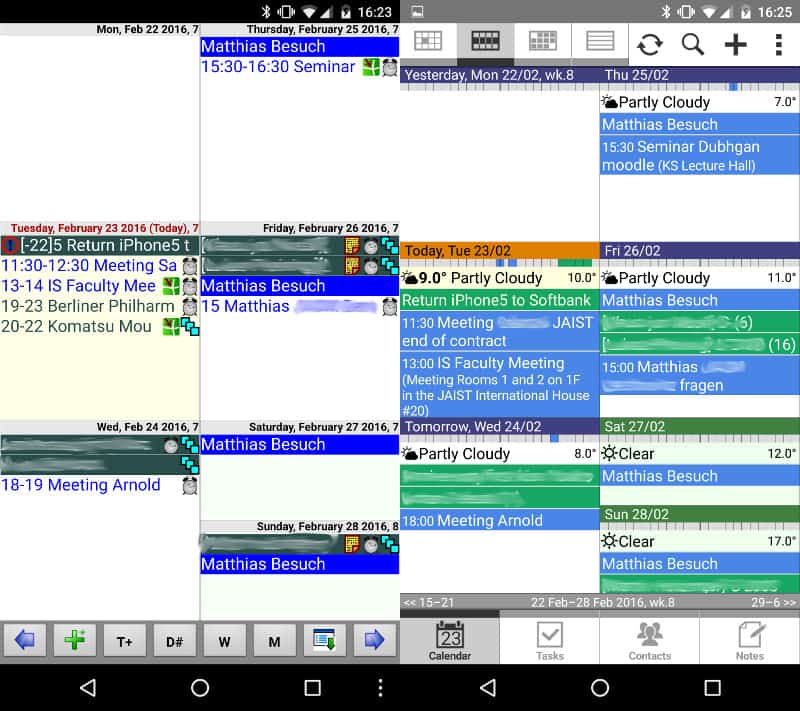
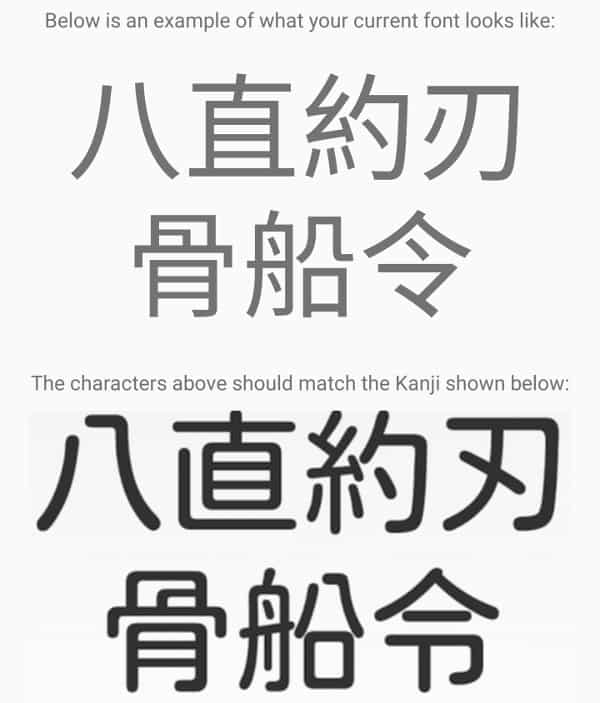
This article starts a series of blogs on my ventures into Android land after having used iOS devices for 6 years. I have never been a strong believer in the Apple ecosystem, and my trials to convince myself to MacBooks and MacPros always ended with installing Linux on them, so I guess I wasn t really the ideal target for iOS. Thus, my iOS devices were also permanently in jailbroken state, otherwise I would feel amputated. But as much as I disliked the lock-in and closed environment of the iOS world, it was from the user perspective surprisingly well done and smooth. So it was with a certain level of tension when I finally switched to Linux^WAndroid. android-ios If you don t want to read on, here the preliminary conclusion: Why didn t I do it earlier! But before we go into details, let me start with my background: History of my devices Originally I was a big opponent of smart phones and preferred the Unix-way, one device for one thing. So I had a normal phone and (various) Palm devices (Tungsten X, Tungsten C, and above all my beloved Handera TRGpro). I loved the Palm world and considered it superior to the then smart phone world, until I came to Japan, where the challenge of a proper input method for Japanese and proper Japanese support posed a big hurdle. The Palm devices had a stick and written input fields, but Japanese input was practically impossible and a huge pain. Searching for a word in Japanese was more hurdle then looking it up in a printed dictionary. In addition, I needed a phone in Japan, so I plunged into the smart phone world and got myself a iPhone (3g). What a world did open for me: easy typing of Japanese, dictionaries, on-the-fly translation, woooow! And above all, I discovered my most beloved and till now one of my most important programs: Flashcards Deluxe. Thanks, and I have to say to 80% thanks to this program my Japanese learning speed has accelerated considerably. There is nothing more important for me than getting drilled in a systematic way. But I derail, anyway, having Flashcard Deluxe on the iPhone within rather short time I had about 10000 or more flashcards created, and moving on to a different architecture (Android) was for quite some time practically impossible without loosing years of statistics and learning, so I renewed my contract after 2 years together with a iPhone 4s. Another two years passed, and these years brought an Android version of Flashcards Deluxe, as well as Dropbox syncing, so I had no excuse anymore to remain in iOS land, wouldn t it be for an iPhone 5s that was passed to me near the end of my forth year, so I again extended the contract for two years. Finally, after 6 years of iPhone devices, this January I finally decided it is time to switch to Android. After lots of thinking, comparing, and requesting advice from good friends with more experience in the smart phone market I went for a Google Nexus 6p. Google Nexus 6p I will not repeat the specs of this phone as they are widely available on the net. My original plan was a Samsung S6, but after consultation with an expert I decided for an original Google phone for better security support. That left me with the option between a Nexus 5x and 6p, and due to prize differences (prizes of mobiles are ridiculously strange in Japan) I went for the 6p instead of the 5x. One point that made the decision for this slight too big device easy was the fact that it uses a great AMOLED display. Moving the data Since I was using Google Calendar and Google Contacts already on the iPhone, moving to the Android phone was far less a hassle than I thought. My contacts and events showed up without a hiccup. Most of the usual apps are nowadays available on both iOS and Android, so the most difficult thing was remembering all the passwords to log into the applications again (SNS like G+, FB, Twitter etc). The same is more or less true for messengers of all kinds (Line, WhatsApp, Threema, etc), but here one is advised to check with the respective web site first to make sure one does not loose all of the important data. Line for example is a stupid ***** that deletes all previous chats on the old phone and does not make them available on the new one. WhatsApp can be converted with a special conversion program. Threema, too allows for transfer of ids. Move of applications After that came the hunt for replacement applications for those that are not available as is on Android: Mail At first like probably everyone I used the shipped GMail program. It might be good for Google Mail accounts, but for anything else it is just a real pain. Thus, I have searched a bit and finally settled (for now) for K-9 Mail: it is open source, open development, feature rich, and more a hackers type email program, perfectly suited to me. There is a commercial variant called K@-Mail that says that it improves the user interface and some usability items as well as features, but I didn t see much of an advantage over the original version (which is completely free) and in fact some of my accounts didn t work at all. So I remain with K9 Mail and I think this is a good decision. Calendar Managing Calendars is one of the most important task for me. I have been a fervent supporter of DateBk4, DateBk 5, and DateBk 6 on the original Palm series, and when I left the Palm World it was with great pain that I had to loose DateBk. Not only because it was a simply fantastic calendar program that allowed me to keep track of all my climbing routes, festivities, in a much more advanced way than any other Calendering application, but also because the programmer of the DateBk series is running the Dewar Wildlife Trust, a Gorilla rescue group and a lot of the money he makes from the app sales is going to rescue Gorillas. With the switch to iOS this option was gone, and I first used the built-in calendar application (which is so weak) and later and for long time Pocket Informant Pro. This is a very good program and probably the only one that can compete with DateBk with respect to functionality and usefulness. During the time of me being locked in in iOS I realized that the world has moved on and a new version of DateBk series for Java was developed, called Pimlical. First only available on Windows, it became later available also on Android and Linux, too. The following screen shot puts Pimlical on the left, and Pocket Informant on the right. I will write a more detailed comparison in future, in short: PInformant is more streamlined and polished, Pimlical has more configuration option. Practically everything can be adjusted to one s need, and in addition there is also a Desktop application that sync either with Google and the phone, or only with the phone if you want to live off the grid. pimlical-pinformant So nowadays on Android I have both Pocket Informant Pro as well as Pimlical, but after a short time I have now switched practically exclusively to Pimlical. Notes Here there is pain HUGE PAIN!!! iOS has an excellent applications for notes, called simply Notebooks. This little pearl was my work horse for everything (more or less) memorable. From poems and song texts to bus time tables, from PDF to GIFs, from MarkDown to HTML, everything could be saved into Notebooks, displayed, edited, ordered. And above all it had automatic background sync with Dropbox. So I could drop new files into the respective sub-folder of my Dropbox folder and could be sure I have the files available on my phone when I leave for a trip. And there is a huge bag of features that I haven t even tapped into! Android is unfortunately not on the list of supported architectures of Notebooks. So I searched far and wide, and without any success. There are all kind of notes, flash colors, overly simple, fast and slow, stylish and plain, but none of them did even provide half of the features of Notebooks. None, not even half. I still hope I might find the ultimate notes application, or even better would be an Android version of the original Notebooks application (but this is not high on the developers todo list), but for now I am in despair The Rest As I said, most apps are nowadays available on both platforms, so there is not much more to do than download the respective Android app and log in again. That worked very nice across practically all apps. Things I don t like (i.e., which are broken!) on Android Although a very convenient system and perfectly made to fit my taste, there are some things that are a huge pain (and a big shame on Google to not being able to fix that for long time!): Japanese fonts when the device is in English interface language In case you are a foreigner living in Japan and want your Android phone in English, but still read emails, news, etc in Japanese, then Android provides you with the worst, namely Chinese fonts: chinese-japanese-mix This is a well known problem and I have blogged about fixing the very same problem on Linux (Debian), and the solution is a simple reshuffling in the fontconfig configuration files. There is even an application for it in the Google store, Kanji Fix, but it needs a rooted device (which I haven t done till now my failure!). I can only hope that Google fixes this completely stupid problem in a future version. The Me problem Another of these beasty problems: The Android Contacts application has an entry for Me , which unfortunately, no idea why, cannot be linked with my normal me in the list of contacts. There are reports all over the Internet, strange suggestions, and no real solution. Again, a simple thing that should work but doesn t. Invisible Images folder in MTP mode A more annoying problem is that the camera folder under Photos does not show up when connecting the device in MTP mode to my computer, and as consequence me being unable to copy photos from the device to my computer. The solution I am using at the moment is moving the photos with a file manager to a new folder which is visible during MTP communcation, and copy the photos from there. But this, too, should be something trivial, but alas, despite a lot of posts on the internet I couldn t find a proper solution. Google Music As written somewhere else, Google Music has switched from 5 star system to up/down system, which is a huge pain and PITA. Things I do like (or I discovered) on Android There are some things I haven t been used/tried on iOS they might be possible which I really like: Yubikey Neo support I will write about this in a different blog, but nowadays I have my GPG keys on an hardware token (Yubikey Neo) and the application OpenKeychain on Android works nicely with both K9 Mail and via NFC with my Yubikey. That is a great tool! Bluetooth streaming Bluetooth on iOS devices was always a bit broken for me, so connecting my phone to my old car radio I needed radio transmitter that was connected to the cable port of the iPhone. With Android I use a Bluetooth Radio device (receives data via bluetooth, and sends music out via radio waves for a car stereo to receive them). Now if my monthly data limit wouldn t be that low  Debian on Android Yes, you can have a full Debian system running in your terminal on Android. There are several applications providing this feature, and I am rather surprised how smooth it works. Conclusion My preliminary conclusion is that the switch to Android at this time was perfectly timed, and from the technological side I should have done much earlier. In future blogs I will discuss particular instances of this transition in more details. If you have any suggestion for me, in particular for a good notes taking application, please let me know!
23 February 2016

Steinar H. Gunderson: Multithreaded OpenGL driver quality

Multithreaded OpenGL is tricky, both for application programmers and drivers. Based on some recent experience with developing an application that would like to run on all three major desktop GPU vendors, allow me to present my survey with sample size 1. I'll let you draw your own conclusions: Curiously, somewhat similar to an Intel/Mesa bug I reported back in July, and which has no response yet. Update: The NVIDIA driver is now up to exposing three bugs in my code. One of them even came with a textual error message when running with a debug context (in apitrace).

Alessio Treglia: Analog thinking: the boldness to be creative

The binary code, although necessary for major social and technological developments, is annihilating the Homo Technologicus, stifling his innate freedom for analog connections.

Rodin1The first widespread use of the binary code was the Morse code alphabet. For decades, this communication system allowed to transmit information over long distances, between ships in the ocean and the mainland, between one continent and another, and today its use is still active in emergency situations. In its disarming simplicity (connect or interrupt two electrical wires), this system proved to be the shortest way to transcribe an alphabet.

Then, the Boolean algebra (binary) represented the language of communication between humans and computers, enabling the translation of instructions and commands towards the processing unit (microprocessor / CPU). This determined the Big Bang of the computers and the technological era

<Read More...>

Michal &#268;iha&#345;: Weekly phpMyAdmin contributions 2016-W07

As the flow of incoming bugs for upcoming 4.6.0 has slowed down a bit it was more time for code cleanups and related tasks. But it's also time where potential Google Summer of Code students come to our organization and want to get involved. On the cleanup side the biggest was change to remove embedded PHP libraries which are available on Packagist from our Git and use Composer to manage the dependencies. This change will happen in 4.7.0, so it's still some time ahead, but it's already in our master branch. There still some third party libraries which we use and can not be installed using Composer, so we keep these for now. Besides the usual bug fixing stuff, I've noticed that we lack issues which can be easily understood and fixed by potential Google Summer of Code. We require them to get involved before the program starts, so that we can see they are capable of useful contributions and also to see how they behave if asked for patch improvements. To fix this deficit we're prepared few small cleanup or refactoring tasks, where the students can show their skills. All handled issues:

Filed under: English phpMyAdmin 2 comments

21 February 2016

Lunar: Reproducible builds: week 43 in Stretch cycle

What happened in the reproducible builds effort between February 14th and February 20th 2016:

Toolchain fixes Yaroslav Halchenko uploaded cython/0.23.4+git4-g7eed8d8-1 which makes its output deterministic. Original patch by Chris Lamb. Didier Raboud uploaded pyppd/1.0.2-3 to experimental which now serialize PPD deterministically. Lunar submitted two patches for lcms to add a way for clients to set the creation date/time in profile headers and initialize all bytes when writing named colors.

Packages fixed The following packages have become reproducible due to changes in their build dependencies: dbconfig-common, dctrl-tools, dvdwizard, ekg2, expeyes, galternatives, gpodder, icewm, latex-mk, libiio, lives, navit, po4a, tasksel, tilda, vdr-plugin-infosatepg, xaos. The following packages became reproducible after getting fixed: Some uploads fixed some reproducibility issues, but not all of them: Unknown status:
  • tomcat7/7.0.68-1 by Emmanuel Bourg (test suite fails in test environment).
Patches submitted which have not made their way to the archive yet:
  • #814840 on tor by Petter Reinholdtsen: use the UTC timezone when calling asciidoc.
  • #815082 on arachne-pnr by Dhole: use the C locale to format the changelog date.
  • #815192 on manpages-de by Reiner Herrmann: tell grep to always treat the input as text so that it works with non-UTF-8 locales.
  • #815193 on razorqt by Reiner Herrmann: tell grep to always treat the input as text so that it works with non-UTF-8 locales.
  • #815250 on jacal by Reiner Herrmann: use the C locale to format the build date.
  • #815252 on colord by Lunar: remove extra timestamps when generating CMF and spectra and implement support for SOURCE_DATE_EPOCH.

reproducible.debian.net Two new package sets have been added: freedombox and freedombox_build-depends. (h01ger)

diffoscope development diffoscope version 49 was released on February 17th. It continues to improve handling of debug symbols for ELF files. Their content will now be compared separately to make them more readable. The search for matching debug packages is more efficient by looking only for .deb files in the same parent directory. Alongside more bug fixes, support for ICC profiles has been added, and libarchive is now also used to read metadata for ar archives.

strip-nondeterminism development Reiner Herrmann added support to normalize Gettext .mo files.

Package reviews 170 reviews have been removed, 172 added and 54 updated in the previous week. 34 new FTBFS bugs have been opened by Chris Lamb, h01ger and Reiner Herrmann. New issues added this week: lxqt_translate_desktop_binary_file_matched_under_certain_locales, timestamps_in_manpages_generated_by_autogen. Improvements to the prebuilder script: avoid ccache, skip disorderfs hook if device nodes cannot be created, compatibility with grsec trusted path execution (Reiner Herrmann), code cleanup (Esa Peuha).

Misc. Steven Chamberlain highlighted reproducibility problems due to differences in how Linux and FreeBSD handle permissions for symlinks. Some possible ways forward have been discussed on the reproducible-builds mailing list. Bernhard M. Wiedemann reported on some reproducibility tests made on OpenSuse mentioning the growing support for SOURCE_DATE_EPOCH. If you are eligible for Outreachy or Google Summer of Code, consider spending the summer working on reproducible builds!

Vincent Sanders: Stack 'em, pack 'em and rack 'em.

As you may be aware I have a bit of a problem with Single Board Computers in that I have a lot of them. Keeping them organised has turned into a bit of a problem.

cluttered shelf of SBC
I designed clip cases for many of these systems giving me a higher storage density on my rack shelves and built a power supply to reduce the cabling complexity. These helped but I still ended up with a cluttered shelf full of SBC.

I decided I would make a rack enclosure to hold the SBC, I was limited to material I could easily CNC machine which limited me to acrylic plastics or wood.

laser cutting the design, viewed through heavily tinted filterInitially I started with the idea of housing the individual boards in a toast rack arrangement. This would mean that the enclosure would have to be at least 2U high to fit the boards all the existing cases would have to be discarded. This approach was dropped when the drawbacks of having no flexibility and only being able to fit the units that were selected at design time became apparent (connector cutouts and mounting hole placement.

Instead I changed course to try and incorporate the existing cases which already solved the differing connector and mounting placement problem and gave me a uniform size to consider. Once I had this approach the design came pretty quickly. I used a tube girder construction 1U in height to get as much strength as possible from the 3mm acrylic plastic I would use.

laser cut pieces arranged for assembly still with protective film on
The design was simply laser cut from sheet stock and fastened together with M3 nut and bolts. Once I corrected the initial design errors (I managed to get almost every important dimension wrong on the first attempt) the result was a success.

working prototype resting on initial version
The prototype is a variety of colours because makespace ran out of suitably sized clear acrylic stock but the colouring has no effect on the result other than aesthetical. The structure gives a great deal of rigidity and there is no sagging or warping, indeed testing on the prototype got to almost 50Kg loading without a failure (one end clamped and the other end loaded at 350mm distance)

I added some simple rotating latches at the front which keep the modules held in place and allow units to be removed quickly if necessary.

rack slots installed and in use
Overall this project was successful and I can now pack five SBC per U neatly. It does limit me to using systems cased in my "slimline" designs (68x30x97mm) which currently means the Raspberry Pi B+ style and the Orange Pi PC.

Once small drawback is access to I/O and power connectors. These need to be right angled and must be unplugged before unit removal which can be a little fiddly. Perhaps a toast rack design of cases would have given easier connector access but I am happy with this trade off of space for density.

As usual the design files are freely available, perhaps they could be useful as a basis for other laser cut rack enclosure designs.

20 February 2016

Mark Brown: Expedient ABIs

The biggest change we ve seen in the Linux kernel for ARM over the past few years has been the transition to providing descriptions of the hardware in systems via device tree. This splits out the description of the devices in the system that can t be automatically enumerated from the kernel into a separate binary instead of being part of the kernel binary. Currently for most systems that are actively used upstream the device tree source code is kept in the kernel but the goal is to allow people to use device trees that are distributed separately to the kernel, especially device trees that are shipped as part of the board firmware. This is something that other platforms have done for a long time, PowerPC Macs and Sun SPARC systems use device tree as the mechanism for describing the hardware to the operating system. One consequence of this desire to allow the kernel and device tree to be shipped separately is that the device tree becomes an ABI. This is a really big change for people working in the embedded and consumer electronics areas where ARM has been most widely deployed, it means that any descriptions of the hardware need to be something that can stand the test of time. Anything we release is something we have to expect to carry code for indefinitely. When everything was done as part of the kernel binary we could easily do something that doesn t quite represent the hardware with the intention of replacing it later, now it is much harder to do that. An example of this is the SAW in Qualcomm SoCs. This is a block in the SoC which provides control of some regulators used for the CPU cores in the PMIC in very low power states and also allows the CPU to control the regulator with fast memory mapped registers rather than the slower buses used to control the PMIC. Unfortunately it doesn t fully replace direct access to the PMIC, it supports a subset of the control we need for the PMIC but not all of it. We could represent the SAW as an independent regulator but from a system integration point of view it is functioning as an extra control interface for the external PMIC and if we want to use the extra functionality that is only available via direct access to the PMIC we need to consider that and represent the SAW as an extension of it. If we don t need that extra PMIC functionality at the current time this means we need to do some extra work to make sure we describe the PMIC before we can use the SAW even if we have no intention to use anything other than the SAW. Now, few if any people are actually using the device tree as an ABI at present so those working on enabling platforms often forget about the requirement and find it an obstacle to getting things done they have pressure to get things done, they don t have quite the same pressure to make sure that attention is paid to device tree compatibility so it can easily get forgotten. Over time this may change, especially if people start to take advantage of the device tree as an ABI that become more and more important, but for now if we want to enable that in the future it s something we have to actively think about and work on, accepting that this means we won t always be able to do the most expedient thing.

19 February 2016

Petter Reinholdtsen: Creating, updating and checking debian/copyright semi-automatically

Making packages for Debian requires quite a lot of attention to details. And one of the details is the content of the debian/copyright file, which should list all relevant licenses used by the code in the package in question, preferably in machine readable DEP5 format. For large packages with lots of contributors it is hard to write and update this file manually, and if you get some detail wrong, the package is normally rejected by the ftpmasters. So getting it right the first time around get the package into Debian faster, and save both you and the ftpmasters some work.. Today, while trying to figure out what was wrong with the zfsonlinux copyright file, I decided to spend some time on figuring out the options for doing this job automatically, or at least semi-automatically. Lucikly, there are at least two tools available for generating the file based on the code in the source package, debmake and cme. I'm not sure which one of them came first, but both seem to be able to create a sensible draft file. As far as I can tell, none of them can be trusted to get the result just right, so the content need to be polished a bit before the file is OK to upload. I found the debmake option in a blog posts from 2014. To generate using debmake, use the -cc option:
debmake -cc > debian/copyright
Note there are some problems with python and non-ASCII names, so this might not be the best option. The cme option is based on a config parsing library, and I found this approach in a blog post from 2015. To generate using cme, use the 'update dpkg-copyright' option:
cme update dpkg-copyright
This will create or update debian/copyright. The cme tool seem to handle UTF-8 names better than debmake. When the copyright file is created, I would also like some help to check if the file is correct. For this I found two good options, debmake -k and license-reconcile. The former seem to focus on license types and file matching, and is able to detect ineffective blocks in the copyright file. The latter reports missing copyright holders and years, but was confused by inconsistent license names (like CDDL vs. CDDL-1.0). I suspect it is good to use both and fix all issues reported by them before uploading. But I do not know if the tools and the ftpmasters agree on what is important to fix in a copyright file, so the package might still be rejected. The devscripts tool licensecheck deserve mentioning. It will read through the source and try to find all copyright statements. It is not comparing the result to the content of debian/copyright, but can be useful when verifying the content of the copyright file. Are you aware of better tools in Debian to create and update debian/copyright file. Please let me know, or blog about it on planet.debian.org. As usual, if you use Bitcoin and want to show your support of my activities, please send Bitcoin donations to my address 15oWEoG9dUPovwmUL9KWAnYRtNJEkP1u1b. Update 2016-02-20: I got a tip from Mike Gabriel on how to use licensecheck and cdbs to create a draft copyright file
licensecheck --copyright -r  find * -type f    \
  /usr/lib/cdbs/licensecheck2dep5 > debian/copyright.auto
He mentioned that he normally check the generated file into the version control system to make it easier to discover license and copyright changes in the upstream source. I will try to do the same with my packages in the future. Update 2016-02-21: The cme author recommended against using -quiet for new users, so I removed it from the proposed command line.

18 February 2016

Matthew Garrett: Canonical, Ubuntu and why I seem so upset about them all the time

I had no access to the internet for most of my childhood. Nobody in my area knew anything about programming. I learned a great deal from a number of CDs that included free software source code and archives of project mailing lists. When I got to university, I learned even more by being able to develop a Debian-based OS for use in our computer facilities. That gave me the experience and knowledge that I needed to become involved in Debian development, which in turn gave me the background required to be able to help Ubuntu become the first free software operating system to work out of the box on modern laptops. From there, I've been able to build my career around developing free software.


Ubuntu can be translated as "I am who I am because of who we all are". I am who I am because people made the choice to release their software under licenses that permitted examination, modification and redistribution. I am who I am because I was able to participate in communities that took advantages of those freedoms to produce new and better software. I am who I am because when my priorities differed from those of existing communities, it was still possible for me to benefit from their work and for them to benefit from mine.

Free software doesn't mean that the software is entirely free of restrictions. While a core aspect is the right to distribute modified versions of code, it has never been fundamental to free software that you be able to do so while still claiming that the code is the original version. Various approaches have been taken to make it possible for users to distinguish modified versions, ranging from simply including license terms that require modified versions be marked as such, to licenses that require that you change the name of the package if you modify it. However, what's probably the most effective approach has been to apply trademark law to the problem. Mozilla's trademark policy is an example of this - if you modify the code in ways that aren't approved by Mozilla, you aren't entitled to use the trademarks.

A requirement that you avoid use of trademarks in an infringing way is reasonable. Mozilla products include support for building with branding disabled, which makes it very straightforward for a user to build a modified version of Firefox that can be redistributed without any trademark issues. Red Hat have a similar policy for Fedora and RHEL[1] - you simply replace the packages that contain the branding and you're done.

Canonical's IP policy around Ubuntu is fundamentally different. While Mozilla make it clear that you simply no longer have a right to use the trademarks under trademark law, Canonical appear to require that you remove all trademarks entirely even if using them wouldn't be a violation of trademark law. While Mozilla restrict the redistribution of modified binaries that include their trademarks, Canonical insist that you rebuild everything even if the package doesn't contain any trademarks. And while Mozilla give you a single build option that creates binaries that conform with their trademark requirements, Canonical will refuse to tell you what you have to do.

When asked about this at SCALE earlier this year, Mark Shuttleworth claimed that Ubuntu's policy was consistent with that of other projects. This is inaccurate. Nobody else requires that you rebuild every package before you can redistribute it in a modified distribution - such a restriction is a violation of freedom 2 of the Free Software Definition, and as a result the binary distributions of Ubuntu are not free software. Nobody else refuses to discuss whether you're required to remove non-infringing trademarks in order to be able to redistribute. Nobody else responds to offers to make it easier for users to produce non-infringing derivatives with a flat refusal.

Mark claims that I'm only raising this issue because I work for a competitor and wish to harm Canonical. Nothing could be further from the truth. I began discussing this before working for my current employers - my previous employers had no meaningful market overlap with Canonical at all. The reason I care is because I care about free software. I care about people being able to derive new and interesting things from existing code. I care about a small team of people being able to take Ubuntu and make something better in the same way that Ubuntu did with Debian. I care about ensuring that users receive the freedom to do this without having to jump through a significant number of hoops in the process. Ubuntu has been a spectacularly successful vehicle for getting free software into the hands of users. Mark's generosity in funding this experiment has undoubtedly made the world a better place. Canonical employs a large number of talented developers writing high quality software, many of whom I'm fortunate enough to be able to call friends. And Canonical are squandering that by restricting the rights of their users and alienating the free software community.

I want others to be who they are because of my work and the work of all the others like me. Anything that makes that more difficult saddens me, and so I do what I can to fix it. I criticise Canonical's policies in the hope that we, as a community, can convince Canonical to agree that this kind of artificial barrier to modification hurts us more than it helps them. In many ways, Canonical remain one of our best hopes for broadening the reach of free software, and this is why it's unfortunate that they do so in a way that makes it more difficult for people to have the same experiences that I did.

[1] While it's easy to turn a trademark infringing version of RHEL into a non-infringing one, Red Hat don't provide publicly available binary packages for RHEL. If you get hold of them somehow you're entitled to redistribute them freely, but Red Hat's subscriber agreement indicates that if you do this as a Red Hat customer you will lose access to further binary updates - a provision that I find utterly repugnant. Its inclusion reduces my respect for Red Hat and my enthusiasm for working with them, and given the official Red Hat support for CentOS it appears to make no sense whatsoever. Red Hat should drop it.

comment count unavailable comments

16 February 2016

Daniel Pocock: FOSSASIA 2016, pgDay Asia 2016 and MiniDebConf Singapore

The FOSSASIA 2016 conference is taking place next month, 18-20 March at the Science Centre Singapore. The FOSSASIA community has also offered to host a MiniDebConf Singapore 2016 and pgDay Asia 2016. With sufficient interest from volunteers and participants, these events could do a lot to raise the profile of free software in the region. Applications from speakers and exhibition tables are still possible using the form. Real-time communications technology at FOSSASIA 2016 We are currently discussing a Real-time lounge and demo area for FOSSASIA, hopefully with a live linkup to the FSF's LibrePlanet 2016 in Boston. FOSSASIA have invited a number of developers to speak about SIP, XMPP, WebRTC and peer-to-peer communications solutions. Hopefully exact attendance and scheduling can be publicised soon. Sponsors needed Bringing leading free software developers to Singapore is not easy and further sponsorship is needed to ensure all the speakers who would like to participate can get there. If you or your organization can help with funding or accommodation please make contact. Google Summer of Code If you want to be selected for Google Summer of Code 2016 and you live in Singapore or a neighbouring country, FOSSASIA could be a great opportunity to meet potential mentors, hack on things together and talk about project ideas. Free software development is a community activity and the more you engage with the community, the more confident mentors are likely to be about selecting you. Questions and contact For general questions about FOSSASIA 2016 and Singapore, please ask the FOSSASIA mailing list. For questions about the MiniDebConf, see debconf-discuss and for pgDay Asia, please join the pgday-asia mailing list or otherwise try pgsql-general or the seasiapug regional list.

Michal &#268;iha&#345;: Weekly phpMyAdmin contributions 2016-W06

As we're getting closer to release of new major release (4.6.0), the focus moves to the bug fixing. Most of the fixed issues came from our error reporting server, which collects error reports from the installations. Vast majority if bugs were affecting older releases as well, so these were fixed for upcoming 4.5.5 as well. Besides bugfixing there was also some cleanups in the master branch - shared code for processing sprites and covering it by tests and removed caching of MySQL server information as that didn't bring any speed improvements and lead to cache consistency issues. All handled issues:

Filed under: English phpMyAdmin 0 comments

13 February 2016

Mart n Ferrari: Why I am not touching node.js

Dear node.js/node-webkit people, what's the matter with you? I wanted to try out some stuff that requires node-webkit. So I try to use npm to download, build and install it, like CPAN would do. But then I see that the nodewebkit package is just a stub that downloads a 37MB file (using HTTP without TLS) containing pre-compiled binaries. Are you guys out of your minds? This is enough for me to never again get close to node.js and friends. I had already heard some awful stories, but this is just insane. Update: This was a rage post, and not really saying anything substantial, but I want to quote here the first comment reply from Christian as I think it is much more interesting:
I see a recurring pattern here: developers create something that they think is going to simplify distributing things by quite a bit, because what other people have been doing is way too complicated[tm]. In the initial iteration it usually turns out to have three significant problems:
  • a nightmare from a security perspective
  • there's no concern for stability, because the people working on it are devs and not people who have certain reliability requirements
  • bundling other software is often considered a good idea, because it makes life so much easier[tm]
Given a couple of years they start to catch up where the rest of the world (e.g. GNU/Linux distributions) is - at least to some extent. And then their solution is actually of a similar complexity compared to what is in use by other people, because they slowly realize that what they're trying to do is actually not that simple and that other people who have done things before were not stupid and the complexity is actually necessary... Just give node.js 4 or 5 more years or so, then you won't be so disappointed. ;-) I've seen this pattern over and over again:

  • the Ruby ecosystem was a catastrophe for quite some time (just ask e.g. the packages of Ruby software in distributions 4 or 5 years ago), and only now would I actually consider using things written in Ruby for anything productive
  • docker and vagrant were initially not designed with security in mind when it came to downloading images - only in the last one or two years have there actually been solutions available that even do the most basic cryptographic verification
  • the entire node.js ecosystem mess you're currently describing
Then the next new fad comes along in the development world and everything starts over again. The only thing that's unclear is what the next hype following this pattern is going to be.
And I also want to quote myself with what I think are some things you could do to improve this situation:
  1. You want to make sure your build is reproducible (in the most basic sense of being re-buildable from scratch), that you are not building upon scraps of code that nobody knows where they came from, or which version they are. If possible, at the package level don't vendor dependencies, depend on the user having the other dependencies pre-installed. Building should be a mainly automatic task. Automation tools then can take care of that (cpan, pip, npm).
  2. By doing this you are playing well with distributions, your software becomes available to people that can not live on the bleeding edge, and need to trust the traceability of the source code, stability, patching of security issues, etc.
  3. If you must download a binary blob, for example what Debian non-free does for Adobe Flashplayer, then for the love of all that is sacred, use TLS and verify checksums!
8 comments

11 February 2016

Jose M. Calhariz: Preview of amanda 3.3.8-1, second try.

I found a bug in amanda-3.3.8 that was quickly fixed by upstream. Please upgrade to this version. The updates will go to collab-maint.The debs files for jessie are here: amanda-common_3.3.8-1_cal1_i386.deb amanda-server_3.3.8-1_cal1_i386.deb amanda-client_3.3.8-1_cal1_i386.deb Here comes the changelog:
amanda (1:3.3.8-1~cal1) unstable; urgency=low
  * New Upstream version
    * Changes for 3.3.8
      * s3 devices
          New NEARLINE S3-STORAGE-CLASS for Google storage.
          New AWS4 STORAGE-API
      * amcryptsimple
          Works with newer gpg2.
      * amgtar
          Default SPARSE value is NO if tar < 1.28.
          Because a bug in tar with some filesystem.
      * amstar
          support include in backup mode.
      * ampgsql
          Add FULL-WAL property.
      * Many bugs fix.
    * Changes for 3.3.7p1
      * Fix build in 3.3.7
    * Changes for 3.3.7
      * amvault
          new --no-interactivity argument.
          new --src-labelstr argument.
      * amdump
          compute crc32 of the streams and write them to the debug files.
      * chg-robot
          Add a BROKEN-DRIVE-LOADED-SLOT property.
      * Many bugs fix.
  * Refreshed patches.
  * Dropped patches that were applied by the upstream: fix-misc-typos,
    automake-add-missing, fix-amcheck-M.patch,
    fix-device-src_rait-device.c, fix-amreport-perl_Amanda_Report_human.pm
  * Change the email of the maintainer.
  * "wrap-and-sort -at" all control files.
  * swig is a new build depend.
  * Bump standard version to 3.9.6, no changes needed.
  * Replace deprecated dependency perl5 by perl, (Closes: #808209), thank
    you Gregor Herrmann for the NMU.
  * New patch fix-amgtar-exclude to fix amgtar when the exclude file don't
    exist.
 -- Jose M Calhariz <jose@calhariz.com>  Thu, 11 Feb 2016 17:52:08 +0000

10 February 2016

Guido G nther: Debian Fun in January 2016

Debian LTS January was the ninth month I contributed to Debian LTS under the Freexian umbrella. In total I spent 13 hours working on: There was no progress on using the same nss in all suites. This will continue in February as does the Squeeze-lts Wheezy forward porting. Other Debian stuff

Next.

Previous.