Search Results: "evo"

1 March 2007

Benjamin Mako Hill: The Revolution Will Be Colorful

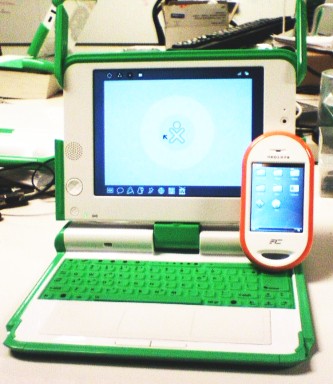
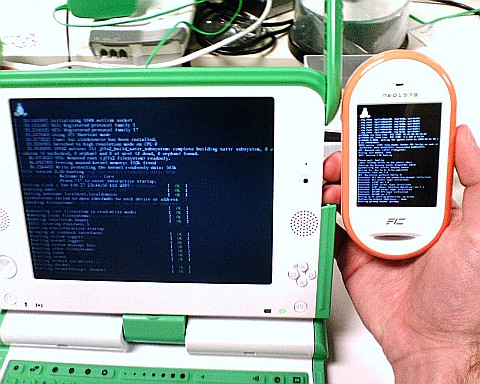
I forgot to mention the coolest thing about the last Ubucon in my summary. I heard that my friend Sean Moss-Pultz (the person who started the OpenMoko project) would be in New York the week of Ubucon so I managed to contact him and get him to drop by on his way to the airport so we could have lunch. To my surprise, he had one of the early versions of the free-phone for me (I wasn't expecting one for several weeks). I had brought my OLPC XO so, for the first time ever (as far as we know) we managed to get the two coolest, and most important, technology platform projects in the world together. While the XO and OpenMoko share a commitment to freedom, the similarities between the projects are, in fact, also skin deep. If we all work hard, we can look forward to a future that is free. Apparently, it's also white with bright trim.
/copyrighteous/images/xo_plus_openmoko-03-boot.jpg
/copyrighteous/images/xo_plus_openmoko-01.jpg
Apologies for the pictures taken from my current inferior, both ethically and technically, mobile phone.

28 February 2007

Ross Burton: Tasks 0.2

Tasks 0.2 is ready to roll. Tasks is a simple To Do manager, using GTK+ and libecal (part of Evolution Data Server). No great new features over 0.1, but several bug fixes. Now that I've been putting off categories by fixing up code, I'll have to them. Tasks For 0.3 I invite a dedicated member of gnome-i18n to be the first person to send a patch to i18n the source and provide a translation. Fame and glory can be yours!

27 February 2007

Josselin Mouette: Le grand retour

With each new GNOME versions, the icon themes from gnome-themes-extras are becoming less useful. The desktop and applications needs evolve, and the default theme is growing, providing more and more icons the icon themes can't provide. Because of that, the desktop is looking less consistent when using those icon themes. With GNOME 2.16 and the move to the Tango naming scheme, it is even worse as most icons got renamed. As upstream isn't touching this package anymore, I have decided to rework it entirely, and to migrate it to the new naming scheme. It was a very tedious task, but the result is much better than what I expected. To my surprise, I found the freedesktop.org icon naming specification to be a very good document that brings much simplicity to icon themes. Especially, the MIME types specification makes it much simpler to provide only a few icons, and the default theme contains much fewer icons than before. The result is in the pkg-gnome alioth repository, and uploaded to experimental. As Clearlooks is good but not great, I appreciate much the grand retour of Gorilla and Nuvola, the best themes ever, on my desktop. They are now more tightly integrated to the desktop than ever before. What now? First, I'd like people to test the themes. There are 6 of them and I don't use all of them. Please report inconsistencies, obviously missing icons, or wrongly named ones. You can also help by making new icons. Just grab inkscape, open icons, and make the changes. It's much easier than you could expect, especially if you start by combining existing icons. The icon naming specification will show you which icons can be useful additions. Some translations are also completely wrong, please don't hesitate to send me updates.

Edd Dumbill: OpenID and microformats support on XTech site

Thanks in no small part to the advocacy of Simon Willison, I've just OpenID-enabled the XTech web site. OpenID log in box on Expectnation Users can now create their accounts using an OpenID, or associate an OpenID with an existing account. A single-sign on solution like OpenID solves an important problem for us, as most people tend to interact with our conference web sites in only one or two time periods each year. While we've gone to the trouble of making retrieving a password easy, there's still the mental burden on the user of setting up the account and noting it down somewhere. As a measure of the impact of this on me personally: I habitually save registration confirmation emails in a certain mail folder. Since 1997 I have collected no fewer than 572 of these, and I'm sure some have been missed! One other cool thing about OpenID is that finally I can get the identity I wish to have. No longer do I have to be a compulsive early adopter of every service just to get the name edd. (Well, as long as said service integrates OpenID of course!) Personal branding is an important attractive aspect of OpenID.ImplementationImplementing OpenID using the Ruby ruby-openid gem was quite straightforward, as was the logical integration into our user models. I've not been the only one following this path recently, as illustrated by this post on Rails OpenID integration from Dan Webb.The harder problem of deploying OpenID lies in making the user interface work well: ultimately that will have a huge influence over its uptake. We've made a decent first go of it in Expectnation, but I'm sure we'll evolve and improve it over time. The main puzzling thing is how obvious to make the OpenID facility, given its relatively small take-up right now. We don't want to confuse normal users too much by using it. Microformats When I did my behind-the-scenes piece on the building of the XTech schedule last week, one feature I didn't discuss was the support for microformats we have in the schedule and on the session pages. If you use a tool such as Operator, you can easily save talk times to your calendar while reading the schedule.
XTech schedule microformats I'm personally a little late to the microformats party. Being a fan of pragmatic RDF, I didn't see much need for microformats right away. However, with tools like Operator I can honestly say that the use of microformats does enhance the XTech schedule.My impressions of microformats (in particular hCalendar and hCard) from using them are mixed. One the plus side, it was very easy to do. On the negative side, I found them restrictive in the sense that for the metadata to be present in the hCalendar object, it needs to be part of the HTML presentation.So, while microformats are meant to be about making human readable data useful for computers, they can have a tail-wagging effect on the human markup. Let me elaborate. In the conference schedule there is a grid overview. For readability here we want to keep the details down to a minimum in each box. There is definitely no need to repeat the date of each presentation when you can see there's a grid per day.But also we want to have microformats available in the page so users can use the grid to pick off talks to add to their calendar. The only details you currently get from the microformat are those you physically include inside the div marked as vevent. This means we can't embed the full details, such as the talk description. It also means I indulge in some dubious markup practices (an empty abbr element) in order to get the date and time into each hCalendar object.It seems to me that this could be ameliorated by more intelligent user agent behaviour. Each of my hCalendar events is given a URL. At the end of that URL is a full description of the event, using microformats. So, as long as I reference the URL in a summary page, the user agent can beetle off and pull down the full information, in much the same sort of way that FOAF uses the rdfs:seeAlso property.So, remove the expectation that microformats provide complete data, and I'm sold.Other schedule features: iCal, Upcoming.org
Of course, we have iCalendar support in the XTech schedule, so you can subscribe conventionally using iCal, Evolution or a similar program. Aaron Straup Cope took the iCalendar, and uploaded each event into Upcoming.org. If you look at the upcoming events tagged xtech07, you see the results of his work.This foreshadows some of the social elements we plan to add to Expectnation itself: indicating your intent to attend a talk, and adding comments to it. As a program chair I'm finding this quite fascinating to watch.

26 February 2007

Evan Prodromou: 7 Vent se CCXV

I'm excited to see that wikiHow now lets people log in with OpenID, and also provides identities to all wikiHow users. (I'm not sure what wikiHow project members are called -- my best guess is "wikiHowards", but I'm pretty sure that's not right.) wikiHow is a great company, and the people I know there -- Jack and Travis -- are personable and smart. I think wikiHow is a great example of a conscientious company participating well in Open Content and the wiki world; I think implementing OpenID is one example of their good wikizenship. One of the things I really wanted with implementing the MediaWiki OpenID extension was that we'd get really portable identity across wikis; that someone who'd established a reputation on Wikipedia could expect some respect for that reputation on Wikevent or Wikioutdoors or whatever. I think there's some danger to that model -- so many wikis today are implemented on wiki farms like Wikia or Pbwiki. I think some wiki farm companies see value in corraling their users into only using wikis on their servers, rather than in participating in the larger wikisphere. (You can occasionally even see this attitude in the Wikimedia community, although obviously that community is more self-governing and evolved about Free Culture and peer-to-peer processes.) That attitude is short-sighted, and wiki hosting companies that insist on maintaining identity silos are probably going to pay for it in the future. It's a competitive market; people have a lot of choice, and nobody wants to be fenced in. If there's been one lesson of Web 2.0, it's that openness is a competitive advantage. Good karma pays off in intense customer loyalty. And, yes, I'll stop using wiki-prefixed neologisms now. Sorry about that. Anyways, I'm really glad to hear that wikiHow is joining the OpenID network. I hope it continues to work well for them. tags:

Rands in Repose I continue to find it mind-boggling that this gay alien is also a well-known blogger about software. Yeah, I know, I know, Jerkcity guys: they're just cartoon characters. They're not people. But still. In ancient times, I did an interview with Rands for Pigdog Journal. I guess that's a long time ago, though. tags:

Not quite spongeworthy So, there was an article in Slate about Wikipedia biographies over the weekend about how saddy-sad it is when your biography is deleted from Wikipedia (and how writing an article about Wikipedia can save that biography quite well). I've seen a lot of such breast-beating in blogs and such lately. I think it's important for folks to remember that Wikipedia is an encyclopedia, not a wiki-about-everything. Some people, places, and things meet an encyclopedia's requirements for notability (see Wikipedia:Notability (people)); others don't. That's just the way it is. But just because your bio isn't on Wikipedia, doesn't mean you can't have an Open Content, wiki bio preserved for posterity. I've written about WikiBios before, but I have to insist that it's one of the most awe-inspiring projects I've seen: a biography for every human. Every human. That's all they do. Yeah, their sample text is a little bit trivial, but I think looking beyond that, you can see a pretty amazing possibility for a project. Maybe Timothy Noah and all the other people who are teetering on the edge of being spongeworthy for Wikipedia should take some time to build out their WikiBios page. Get friends, colleagues and family to contribute, and really build out a high-quality bio. If at some period in the future WP deigns to include them, then the bio is right there -- GFDL-licensed, no less. Anyways, here's Evan Prodromou's WikiBio. Feel free to fill it out. tags:

BarCampAustin While I'm thinking about BarCamps -- I'm a little nervous about my presentation at DemoCampMontreal1 -- I'm finding out that BarCampAustin is going to be the same week as South-by-Southwest Interactive 2007. Which, really, makes a lot of sense. I'm going to try to show up for Friday morning -- it'll be interesting to bounce back and forth between SxSW and a BarCamp. tags:

25 February 2007

Ross Burton: Lack of Tasks/Evolution Synergy

I'd noticed back when Dates was started the libecal was failing to notify Dates when events in Evolution changed, and vice versa. This was magically fixed when Dates moved over to ESource, so I didn't continue investigating it. However, Tasks doesn't use ESource yet and people had noticed that if you add items to Tasks, they don't appear in Evolution or the panel. This is a major problem, so I build EDS and debugged the problem. Turns out that the system tasks store is at ~/.evolution/tasks/local/system/ but when using ESource it is at ~/.evolution/tasks/local/system (note the lack of a slash) and as backends are looked up using literal string comparisons, these don't get the same backend so you don't get change notifications, and even worse modifying the task list with one application will overwrite the other's changes. Luckily the fix was trivial, and I hope that it gets reviewed soon.

23 February 2007

Ross Burton: Tasks 0.1

I've just tagged and rolled a Tasks 0.1 tarball. Tasks is a simple To Do manager, using GTK+ and libecal (part of Evolution Data Server). It isn't very featureful at the moment, but it's progressing nicely: I'm using it already. Tasks I'll be adding this to the OpenedHand Projects site shortly, but for now here is a tarball.

MJ Ray: Debian: Links for 2007-02-23

While we're fixing some network problems, here is a musical interlude^W^Wset of links...
Explaining Debian at parties
'Do not try to convince people to try it out or you will become a support hotline. Instead, tell them about LUGs and mailing lists (and how cool it can be) and put the challenge on them: "if you try it, those are your support channels. Are you up for it?"'
Index of /~joerg/templates
Explanations of some common reasons for getting REJECT from ftp-master.
gravityboy: Politics
"If we're going to make interactions between developers more civil and friendly and less personally hostile then we need a different kind of stick. Maybe a carrot of sorts is in order too?"
Consensus and community review in open source and open standards Decentralized Information Group (DIG) Breadcrumbs
'this is quite a stretch with respect to the normal dictionary meaning of "consensus"'
Social Drag
How many Debian Developers are dressed in Social Drag?
debian Gender Research
More research to add to the surveys page
#354950 - ITP: gauche-readline -- A readline-like library for the Gauche Scheme implementation - Debian Bug report logs
Contemplating sponsoring again.
The joys of English cuisine are abomination in God's sight Ted Walther's Private Diary
Blast from debian past: Ted Walther's gullibility for stereotyping is an abomination in God's sight and those foods are hardly typical English. For instance, the only one on his PS list that I've eaten recently is flapjack (not flapjacks, which is something else and not English AFAIK) and I can only remember eating five of the list in the last year. Also, the linked site seems to concentrate on processed pap from multinationals and supermarkets, rather than real trad English food. Example: "Yorkshire puddings are basically a bread type product. You can use them in place of dinner rolls." Why not make 'em a bit harder, cook 'em a bit longer and you can use them for cobbling the street instead? Yorkshire pudding should be a baked batter with a soft middle and a crisp puffy edge. Nothing like bread. And don't get me started about the pasties. Honestly, if you learn about food from such sources, no wonder you'd think it an abomination.
Re: Position Statement to the Dunc-Tanc "experiment"
"had somebody wanted to kill (or inflict maximum damage) to the project, he couldn't have done any better than the current DPL"
Releas-o-meter
Interesting idea - why no cron-run copy on the web?
EUPL v 1.0 revokable ?
One that may appear in a future 'bits from debian-legal' - it seems the EU are popularising a type of termination clause. Yay.
Future of Debian Weekly News
As I hoped, Joey is explicitly calling for sponsorship for DWN production.
DPL 2007, Current Candidates
still don't have a title is keeping a list of DPL candidates, so I won't put one up this year.
#411041 - request for debian-l10n-persian mailing list - Debian Bug report logs
Tell all your persian-speaking friends to show their support!
Interprete I cite, you cite, I rant
Lack of references is a problem on lists like debian-legal where explaining everything again can drive you insane and still not convince some people.
Lucas Nussbaum's Blog State of software for Suspend to RAM/Disk ?
More tips on the "Will I Work Or Not?" suspend problems.
only on debian-devel - she.geek.nz
> Am I mistaken or this is a flame on how to flame ?

21 February 2007

Gunnar Wolf: Back from [VAC]?

On January 13, I sent a mail to debian-private saying I'd be on a semi-vacation until around February 10 - And yes, for over a month I've basically not touched my packaging, and for around three months my general profile in Debian has been really low. I sent this message because the Institute I work at moved, and I got the task of taking care of everything related with electrons flows carrying information (namely, voice and data networks).
It's not that I'm really-really-back now - Work is still too absorbing, users still come too often to me expecting me to solve their problems. I can often try to do so on the data network, but I'm far from even having access to the voice equipment (I've done my hardest effort not to get such access, because that'd instantly turn me into the phone operator for life). However, for the first time in many weeks, today I had some quiet time, I catched up with some mailing lists, and... Well, I expect to work on my QA page.
Boy, team-maintainership rules! pkg-perl friends, thanks for saving me from the creepy bugs sometimes too often. I expect to pick up work I haven't even looked at since I committed to doing so with the pkg-ruby-extras team as well, specifically, getting mongrel in shape and into Debian, despite our deep differences with its author. This will make Rails roll smoother and faster in Debian. And of course, there is Debconf. After last year's burnout, I think I recovered - I'm not a core organizator anymore, but I'm back to work my way to Edimburgh ;-)
As for my local activities (Mexican Free Software conferences, meetings and people): Partly because so I decided and partly because so it happened, I've been off the hook with the local community since before Debconf 6. Before, because I was too busy to think about anything besides it, and after, because I was burnt out and somewhat bitter at several facts. I've been to few regional or local conferences, also because I knew that between last October and today I'd be too tied up at work. But last week we had both CONSOL and BarCamp Mexico. Somehow I managed to be at both (well, at CONSOL I was only enough time to do my two talks, for which I miraculously managed to get prepared, and BarCamp was during the weekend). Both were very positive for me, and I'm willing again to find some time to devote to promoting and developing Free Software in our country.
Oh! One more note: Thanks to Sergio Mendoza for pushing me and for co-discussing on the subject, we are getting small but tangible results pointing to a Debian-UNAM project. Not much to see yet, besides having received the domain authority, which for now just means a nicer name for Nisamox, Mexico's main (and only long-running) full Debian mirror.

16 February 2007

MJ Ray: SPI: eVoting and other links

Elections, for Profit
Basic problems in the e-voting systems of Denver, Colorado, USA
German people: do you care about democracy and your right to vote? Uwe Hermann
I wonder what happened to this petition?
The Open Rights Group : Taking the lid off e-voting
So, given that e-voting is known buggy and considered harmful, what does the UK do? Follows the other sheep into the abyss, looking ahead as little as possible. Here's ORG's explanation of the situation.
Open Voting Foundation @ SPI
Open Voting Foundation sounds like it should be a project to stop the spread of the e-voting problem, but it isn't.
European Commission endorses open source - ZDNet UK
A lengthy EC report (is there any sort besides lengthy?) summarises the benefits of free software. I think one important way that more partner organisations can help SPI-like groups is by helping to inform about this sort of local development.
LWN: The end of the Fedora Foundation
When you see that Red Hat can't/won't start a foundation around its distributions, you realise what an amazing thing SPI is.
2007-02-16
Agenda for this evening's board meeting. I seem to be having difficulty staying connected.

15 February 2007

Jordi Mallach: Tunisia

Last month, Bel n and I managed to secure our trip to Tunisia on the very last moment. So, planning trips on the very last moment isn't nothing new around this place, but we made a big effort to take things to the limit. I can't remember why exactly, but on January 31 we were *so* close to fucking everything up before it started, when we packed our stuff just a pair of hours before having to leave to the train station. My luggage was prepared in a rush, so while I think I took everything I thought I'd need, I didn't really select my clothes too much. The idea was to have our suitcases mostly empty to bring back stuff from the markets: smoking cachimbas, lamps, leather stuff, etc. At that time I didn't know that would end up being a great strategy. Anyway, like 9 minutes before the train's departure we were stuck in Nuevo Centro without a taxi and at that point I really had lost hope about being on time. For some reason, there were no taxis in the area, when it's normally a place where there's tons of them. Suddenly one appeared, we rushed in and I asked the taxi driver to please fly to the station. Happily, we got an incredible green wave around the avenues, he drove us at like 80 Km/h and we even had to wait for a few minutes at the station. In Barcelona, we prepared our small New Year's Eve dinner with my cousin Laia and Marc, and while the plan was to go to sleep pretty early to be in good shape to go to the airport next morning, the bottles of wine and cava emptied quite fast, and around 4:30 we were quite drunk when we decided it was enough. When some annoying sound woke us up next morning, it was really late, so we again rushed out to the empty streets of Barcelona, sneaked into a regional train, without knowing it was the only way to get in time in El Prat airport, and after some initial confusion trying to find the travel's agency desk in the wrong terminal, we managed to check into our flight, being the very last to do so. With all the rush, I couldn't get some clothes from my suitcase transfered into my hand luggage, which I really wanted to do after my nice lost luggage experience during Debconf 5 in Helsinki. Anyway, chances are small that your luggage gets lost, right? But of course, Murphy is always vigilant, and this was a great opportunity to fuck me up. After a short but horrible (due to our really bad hangover) to Tunis/Carthage airport, we were in the long security/passport check. When Bel n picked up her bag and mine didn't appear, I tried to tell myself hey, it'll appear, no worries! . After 15 minutes, the stupid suitcase was nowhere to be found. Apparently, another two pieces of luggage had the same luck, which made us contact a group of four Uruguayans who were missing one of them. Nothing too terrible; it'll surely come on tomorrow's flight. After reclaiming our lost luggage, we went out to the parking where a bus was waiting for us, and on the way there, the six of us nearly fell into the first Tunisian scam, involving a dude selling jasmine flowers at 2 each. The bus took us down to Jasmine Hammamet, the most touristic place in Tunisia. Valencians might have an easy imagining the atrocity of the area by picturing what twice Marina d'Or plus Benidorm including Terra M tica would look like. Kilometres and kilometres of a disgusting Who can build the most horrible giant hotel right next to the beach contest. So it was pretty clear we had to spend as little time as possible in the area. We soon learned about how transport works in Tunisia. The cheapest is to use the public busses and the luagge collective taxis, we soon found out. Our first morning there, our guide Rejeb, working for Iberojet and Solplan touroperators, gave a talk where he advised us against travelling alone, specially around the South, while he offered organised trips around the country for every day of the week. Although we expected this danger! speech, we decided to book the two day trip to the South and Great South of the country, basically because it was the best way to see many places in a short time, even if it meant having limited time in each destination. We wandered around Jasmine Hammamet and discovered Carthage Land, sort of a Disneyland set in the age of Anibal and Carthage's empire, which was inside a newly built medina complex. This was a really bad place to practice the art of haggling, as the place was so desert, merchants really tried hard to get you buy something. Again, we were close to fucking up after our first negotiation, but we finally decided we weren't so interested. Lucky, we later found out the price was outrageous. Sadly, we spent way too much time in that tourist trap, and we found it was too late to go to the real Hammamet town to see a real medina and real stuff, so we had a long walk around the immense beach until sunset. On Wednesday, we did organise a bit with the Uruguayans and some others we had met: Mar a and Santi Kuchi Kuchy , Cristina and Pedro and an Argentinian family, and managed to hire a van driver to drive us all over the North. For quite a good price, we were taken to a few ruin sites in Carthago, now mostly a residential area, and it was really impressive. While the condition of many of the remainings is not optimal, it was exciting to see things which had been built by Phoenicians and Romans 2,000 years ago. I really enjoyed the remainings of the Antonine thermal baths of the city. It had been a huge building right next to the sea; one of the standing columns helps figuring out how big it had been. Right next to this site, the Presidential Palace dominated the whole gulf. Military places are treated zealously in Tunisia, and it is against the law to take pictures of any bit of it, not even a barbwire of the fence. The Palace had a great Tunisian flag waving over it, and many signs advised you against taking pictures in that direction. I couldn't resist.


The ruins of the Roman Antonine Baths After Carthage, we went to Sidi Bou Said, a small touristic town, which had the peculiarity and beauty of having all windows and doors painted in a beautiful light blue colour. Our last stop for the day was in Tunis, where we visited the most amazing medina of the whole week. Unlike the new medina in Jasmine Hammamet, this one was literally packed with people going up and down the maze of very narrow streets. Every few metres you'd come across a new, attractive smell coming from the few salons de th or spice, leather or perfume shops. Here we finally started developing our haggling skills, and managed to get a few items for reasonable amounts.


Streets of Sidi Bou Said Back at our hotel, everyone tried to get a quick dinner and go early to bed, as next morning we were taking a bus for our trip around the South. There was time to call yet another time to the Airport, to find out that one of the luggage pieces had been found. While there was no news about my suitcase, we shared a taxi to the airport to pick the found suitcase, and see if mine was actually there by any chance. Unluckily, it wasn't, so I wouldn't have any clothes for the desert visit. Some people in the group were kind enough to lend me some t-shirts and pants. For my underwear, I actually resorted to using some of Bel n's (no kidding, it was way too sexy :P), while mine dried up after some manual washing. The alarm clock went off at 5:15 or so, and soon after we were ready in the hall with our small bags. When the bus was ready to pick us up, the guide said we weren't allowed in, as we weren't on the list. WTF? We were nearly the first ones to book and pay for it! So he finally let us in, for a short while, until he realised there was no space for everyone, so he demanded that we got off. Of course, we didn't, and a long and very disgusting argument started between the guide, us and a few people who had seen us pay for our trip, and were trying to support us. To make a long story short, we ended up stepping down when I noticed the bus driver calling the police, and after Rejeb, our guide, told us the other bus would be waiting for us at the travel agency if we quickly took a taxi there. We of course knew that was a fantasy to get the bus moving, but dealing with the police at 6:30AM wasn't on my list of activities for the day, so we finally gave up to let the rest of the people get in time to their visits, as they were very tightly scheduled to make everything fit in two days. Nobody was waiting for us at the travel agency, but we were promised our money back, which did happen in the evening; our plans for Thursday and Friday were a bit broken though, and the rest of the morning was spent looking for alternatives. When we had managed to book a new trip in a different agency for Saturday, we took the bus to Nabeul, the capital of the province, well known for their medina specialised in pottery. In Nabeul, we lived a tourist trap which I found to be quite original. Not having walked 3 metres into the city walls, some young dude stops us and tells us that he knows us, as he works in the restaurant of our hotel . I totally didn't remember his face at all, but why not? So he quickly tells us Nabeul has good carpet workshops, and her sister is working in one which is regulated by the Government, and you can only visit two days a week. Coincidentally, Thursday is one of them! So he literally grabs us by the arm and takes us to one of the streets perpendicular to the main market street, and we enter a carpet shop. To the right, his sister probably being like 45 years older, is knitting a nice carpet on the loom. And a few seconds after, we're taken upstairs, where a Teletienda show starts before us. Without being asked if we want to buy a carpet, some other dude starts to unroll carpets and more carpets before us, talking in some very basic Spanish. While we're offered jasmine tea, which is really nice, Ali the brother quickly excuses himself and vanishes, leaving us with the salesman, which continues unrolling more and more before us, now helped by someone else. When 10 minutes later we convince them that we won't buy any carpet, he asks a donative for his young employee, who has unrolled and will now roll back a zillion carpets. Back in the hotel, we have dinner with a pair of Catalans from our flight, and when we tell us about the carpet place, they tell us they went over the same story like one hour before us! On Friday, we got some advice on other places to visit, and decided to go up to Cape Bon and visit Kerkuan, the only important remainings of a Punic city which, when conquered by the Romans, was destroyed to the grounds, but not rebuilt on top (they were busy with Carthage). Romans did an excellent job when destroying cities, and the result is a site which still lets you see perfectly how a small town (around 1,500) looked like 2,000 years ago.


Ruins of a Kerkuan neighbourhood, with their red bathrooms nearly intact To reach Kerkuan we had taken the bus up to Nabeul and then our first luagge to Kelibia, where we took a taxi (after no less than half an hour arguing in French with the taxi driver to settle on a rate for a ride to Kerkuan and then to the tip of the Cape in El Haouaria. Luagges are undoubtedly the best way to travel medium distances for very little money, while getting mixed with locals. During our ride up North, we chatted with a nursing student from Kelibia who was going back to her town for the weekend. She was really open, like most of the people we found in Tunisia, and we ended up exchanging our post addresses; we still need to send her a postcard from Val ncia soonish. This area wasn't so touristic, so the roads, while totally acceptable, weren't as good as the highway from Tunis to Sfax we were used to. We had seen some bits of the local driving skills , but the luagge driver performed some of the most extreme overtakings I've ever seen. These happened every three of four minutes, so after a while I was actually amused about what was going on. We would overtake two lorries on one go when there was absolutely no visibility; if things went too far, people would just slow down to let the overtaker get back into his lane on time, and those coming ahead would just use their headlamps to make them know it was just a bit too close. The taxi driver, annoyed at us, took us to Kerkuan but didn't wait for us; he immediately left, leaving us without any transportation in the middle of nowhere. After a visit at the site, we walked around 2.5 kilometres back to the main road, where we decided it was too late and risky to continue the journey up to El Haouaria, so we waited on the road gutter for a taxi. The first one which stopped was, to our surprise, the same bastard who left us one hour before, who stopped, laughing at us a little. Luckily some other taxi came by in the correct direction, and soon forgot about that man. After a taxi, luagge and bus ride, we were back in Hammamet, and the desert group had already got back from the two day trip. We were asked over and over what happened, what did we do, etc. People who hadn't talked to us before would come over and see; we were really surprised about the warm welcome we had. After dinner, we improvised a customes party, and many people managed to dress up in Tunisian/arabic fashions using bed sheets and so on. We had to wake up at 5AM next morning, but didn't go to bed until 2AM. Nothing could go wrong this time. We had our tickets, we had confirmed we would be going on Sunday the night before, so at 6:15, our new guide came in, and came straight towards me. He said something in German, and after I told him I spoke absolutely no German, he said huh, well you know the bus is full of Germans, and my indications will be in German? . Pretty incredible, but again a fuckup by the agency. My ticket said, clearly: Sahara safari. Bus + 4x4. (ALL). Turns out ALL meant Allemand, not everything included , although we had requested English pretty clearly. This was quite a minor problem though, after having no clothes for a whole week and having been left behind two days before. I think we were really lucky getting that German group, though. We were only 16 people on the minibus, making the stops a lot faster than the normal ones, where 55 persons need to get out and in of the bus. We had our own Routard guide for Tunisia, so we could read about the places we were about to visit before getting ther. Also, I surprisingly knew much of what our guide was talking about, just missing the details he talked about oil production in Tunisia compared to Spain's, among other topics . When the landscape was becoming drier and drier, Bel n and I spotted something dark far away ahead in the completely straight road. As it became bigger, I started thinking it might be the #1 place to visit for me in Tunisia: El Djem's impressive Roman amphitheatre. When we got off the bus, I was totally excited. Before me, the walls of an incredibly well preserved, huge Roman building; in fact, the best Roman ruins in the whole continent. El Djem's amphitheatre was the third biggest of the Roman empire with 35,000 seats, only surpased by Rome's and Capua's. It remained mostly intact until the 17th century, when some of its stones were used to build the city and some of the treasures taken to the Great Mosque of Kairouan, but when it took more damage was during two consequent wars, when the Turks didn't have many problems to blow part of the wall away using cannons to end up a siege of the city.


The Roman amphitheatre of El Djem The underground tunnels are intact, and it's difficult to not have flashes of Gladiator while walking under the arena's trapdoors. Sadly, there was little time to spend there, and we had to continue the journey after just 45 minutes. I would have spent half of the day there. From here, the landscape truly started to get drier and more desertic. The south of Tunisia is a giant olive field, until you reach the Great South, where it's dry enough that the only thing that grows in the land are rocks. Hours later we arrived in Matm ta, the very famous troglodyte village of small holes in the ground. Although I was curious about being there, watching how organised and massive tourism has destroyed these Berber's ways of life dissapointed me greatly. Our guide stopped the bus in one of the pits, which was decorated with white and light blue. In the first room, an old woman was grinding something in a small, stone mill. The dwellers of the few pits still used by their original inhabitants now make a living by letting people into their homes and getting dinar as a payment for taking photographs. What the woman was doing was just a bit of theatre, part of the show. After this first room, we got into the middle of the pit, which had a series of other passages to some rooms, some of which were simply open so we could get in and have a look. I felt a little bit like violating someone's privacy, and wondered how much the house had changed in the last years.


Inside a troglodyte underground house in Matm ta After our visit, we continued up the mountains of Matm ta, and after going by a giant "WELCOME TO MATMATA" sign drawn in white in the middle of a mountain, Hollywood style (!), we stopped for a brief photo-stop (sic). Indeed, the view was quite impressive, and is universally famous as one of the filming spots of Tatoonie scenes in Star Wars: A New Hope. Speaking of famous places, a few minutes later we stopped at the top of one of the hills, were we'd have lunch in the Hotel Sidi Driss, a place of pilgrimage for Star Wars fans, as it was the troglodyte pit which served as the Skywalker's home. The place is full of references to the film saga, and one of the open pits is full of set pieces stuck into the walls. We were served couscous, which wasn't bad, but was cooked and served in the most genuine fast-food fashion. Everyone there gets couscous to eat, apparently, and it's the same in many other touristic places in the area.


Matm ta's lunar landscape From here, our journey headed straight West, in the middle of the rocky desert, until after some time, you could start to see lines of palm tree branches planted here and there, a sign that rocks would soon disappear, being replaced by sand and dunes. As when we were approaching El Djem, at some point a huge, dark spot appeared on the horizon. Douz, probably named after some 12th French batallion which stayed there, is a small town in the very limit of the Sahara desert, built right next to a huge oasis, exclusively dedicated to palm tree plantations, making dates production a big source of income, along with, of course tourism. The travel agencies use Douz as the starting point for several-day trips into the desert, camel rides and stuff like this. Our guide offered us getting a camel and carriage ride in Tozeus for 20 dinar, but Bel n and I declined. He didn't seem to be too happy about it, and had no problem commenting this in German and Arab with the driver (Spanisch and Spanien were clear to me). We learned that the agency (or the guide) makes around 3 Dinar for everyone who contracts the camel rides, after speaking to one native young kid who worked in the camel place. While our German trip mates got dressed in berber fashion, we opted to walk into the desert and play around in the sand on our own. I discovered a few desert insects which were unlike anything I've seen anywhere, and their diminute trails were all over the dunes. Looking West, the view was astonishing, with only thousands of kilometres of yellow dunes ahead us.


The evening sun over the dunes After they came back, we were taken to our hotel, which was really impressive. After leaving our stuff in our room, we headed back to the desert, which was like 300 metres away, to see the sunset over the Great Dune . There's a street which literally serves as the frontier between the rocky ground and the sand desert. From there, you could see many lines of palm tree branches, which are planted by locals in a futile attempt to stop the inexorable advance of the desert. Women in Douz and other towns in the desert limit spend their days sweeping the entrances to their homes, as sand gets in really fast. A small village next to Douz even had to be abandoned and rebuilt in some other place, with the old one being finally devoured by the dunes. When it got dark, we still had some time to kill before dinner, and we discovered a hammam in our hotel. I got in, and saw there was a bored young man inside. He informed us about the prices, and after some short deliberation, we realised we'd spent half of the camel money in some Arab relaxation; while I got a really cool massage, Bel n enjoyed a Turkish bath. I spoke to the guy for a while, and he said not that many people used that hammam. He actually handed the list of services since 2002, which easily fitted in one piece of paper. People don't know what they are missing; he explained that most of the hotel's clients just showed no interest in the baths. I wonder how Fins or Norwegians would react, given their sauna culture. The dinner and breakfast in that hotel was absolutely awesome, and I actually ate too much to have an easy sleep. Next morning we had to be ready at 5:30. That's pushing my limits. The bus started crossing the Chott Jerid when it was still quite dark. The chotts are dry, salt lakes in the middle of the desert, which during some seasons do get some water, sometimes from the underground. The Chott Jerid is the biggest of the three chotts in the area, and the views are fantastic. It's like a giant, totally flat muddy sea which reflects light creating dangerous mirages of oasis-like dark patterns. Before the construction of the recent road that links Douz and Tozeur, crossing the chott was so risky that many people died in the attempt. We had the unique opportunity to see the sun rise over the salty horizon.


Sunrise at the Chott Jerid Again, on our way to Tozeur, we were offered a carriage ride for ten dinar, and again we declined. The guide then asked us if we had no money or what. So in Tozeur we basically wanted to walk around the oasis fields, and ended up talking most of the time with some old man who sold drums and desert roses. On a 4x4, we went up North to Chebika, a really cool town with a small oasis of thermal water, which I guess was around 40 C. The short walk to the wall where the oasis surfaced was packed with children who insistently begged for money or offered necklaces and other items. It was difficult to make them understand you didn't want anything. We then went up the mountain behind Chebika through a road which had its own piece of history. It seems that during WWII, Rommel suffered an Allied siege in Chebika, with a range of mountains behind their backs. The Allies gave him one month to surrender, and he took his time to answer. During that time, he ordered his engineers to design and build a road which would let them escape Chebika through the steep mountains, and they managed. When the ultimatum expired, the Allies apparently found out Chebika had been abandoned by the Germans, including tanks and most of their equipment. So, on the way up, a few kilometres away from the Algerian border, there was another typical visit to the biggest oasis waterfall in Tunisia, which was several metres high.


The oasis at Chebika Our Sahara trip would soon end, and after lunch we headed Northeast on our way to Hammamet. On our way back, we stopped in Kairouan, one of the key Islam pilgrimace spots, with the Great Mosque as the biggest attraction. Unluckily, as we arrived after lunch, we didn't had a chance to see it. Apparently it is really impressive. We haggled a bit for a pair of babouches and a small leather couch in the medina. We came back to our hotel around 7, and found most of the people around the hall. After the obligatory update on how it went, we went to bed as we were exhausted, and of course we had to get up really early to head to the airport. The airport was at that early time of the morning a total chaos, and while people stood in the checkin lines, I tried to find out what was going on with my still lost luggage. I went back to the lost luggage window, which would be closed for 5 more minutes. When they finally opened, they told me once again they had no clue about what was going on with my luggage. I finally understood they had no clue: my tracking number wasn't in their database. I asked them if I could have a look at the unreclaimed luggage storage room. They kindly opened a small door for me, and invited me to go inside and have a look. The view was gross: hundreds of lost bags all over the place. As I was in a bit of a hurry (I actually had to get back to Barcelona), I asked him where to find the bags of one week ago, and he nearly bursted into laugher. Okay, I had to look all over the place, scanning every piece of luggage in an attempt to spot mine. There were bags of absolutely every type in there. In one of the corridors, I sensed a disgusting smell, and figured out some poor guy may have food or something in one of their lost bags, which was rotting in that horrible room. So wrong: soon after I found myself nearly stepping on a puddle of shit, as if someone had literally dumped it right there. Oh my... luckily my search was nearly over and unsuccessful, and I got back to Barcelona with the hope of finding my bag in El Prat. After looking in their two storage rooms I realised I'd probably not see the luggage again, which is a real pain in the ass. A few hours of train later we were back in Val ncia, with a feeling of having spent 3 or 4 weeks in Tunisia, not just 8 days. Really a great place to visit, not only for their cultural treasures, both current and ancient, but for the openness of their people. I hope I'll be back at some point!
13 February 2007

David Welton: Trawling for reading material

Yep, time to stock up on some new books. I'm interested in: That's certainly a broad range, but the reason I'm writing here, is that I'm looking for books other people like me considered a good read, and not just an idea I can glean from the wikipedia summary of the book. Yoav seems to share some of my tastes, for instance. Some of the books I'm considering: What I've already read, and would recommend to others: http://www.dedasys.com/freesoftware/ (under 'Recommended reading')

11 February 2007

Evan Prodromou: 22 Pluvi se CCXV

Interesting point from Network World entitled Wikipedia: On the skids?. Apparently Florence Devouard, chairperson of the Wikimedia Foundation board, said that the recent US$1M donations round will only cover a portion of the site's US$5M operating expenses. I find the numbers a little funny -- according to the Wikimedia Foundation finance report, operating expenses for 2006 were around US$800K. I realize that the site's traffic has nearly doubled since this time last year, and that they're hiring more full time staffers, but that still puts the project's expenses at under US$2M. I'm not sure I understand how the US$5M number was calculated. I think the Wikimedia Foundation could be a much bigger and globally more important organization. With advertising on Wikipedia, to the tune of an estimated US$100M, the Wikimedia Foundation would have enough money to support its Web site and tens of millions more to buy Open Content paperback books for poor children in developing countries. tags:

6 February 2007

Miriam Ruiz: About the NM process

There’s a huge problem with the educational system as we know it. It doesn’t teach people how to think, to be creative, or even to improve their knowledge. When a kid goes to school, the first thing they learn is that the answers they must give are not what they consider to be truth, but what they think the teachers want to hear. When you’re in high school, or at university, you have the inner feeling that you must behave, or else. I had personal problems with a teacher at university, and learnt that you’re helpless in that situation. The motto would be that if you want to finish university, you should take care about getting on with the teachers. The result are submissive citizens that won’t face authority even if they know they’re right, in order to avoid problems. One of the best things in Debian is that is revolutionary, belief-guided. People do what they feel they should do, according to their own beliefs, and mostly don’t care about having trouble with the “authority”. That’s something I really like a lot, and respect. Of course that is also the source of multiple fights and disagreements, but usually the result of those is a better solution that whatever could be achieved by an authority imposition from the power-handling people. I like the revolutionary face of Debian as much as I like the technical one, and wouldn’t like losing it. The NM process is Debian’s “university”. It’s the process in which new generations of developers will enter the project. Therefore, whatever is done with it will highly influence middle-term evolution of Debian. Of course, the NM process must assure that people becoming developers have enough technical skills, and also that they’re ideologically aligned with the Social Contract. Otherwise it wouldn’t make sense. What should be taken care about is that the NM process don’t filter side thinking, creativeness, confrontation with authority or the will to make a better world. I wouldn’t like an NM process that promoted the same submissive values that the educational system does.

Julien Danjou: DeFuBu contest #7

Bug Welcome to this 7th issue of the DeFuBu contest, the monthly championship of the funniest bug reported to the Debian BTS. The challengers How the vote has been done Four Debian related people voted for these bugs, Emmanuel Bouthenot, Mohammed Adn ne Trojette, Julien Louis and Jade Alglave. Full ranking Bugs Challengers The winners Notes To participate, simply drop me an email with a bug number. About DeFuBu

5 February 2007

Mike Hommey: Google Keywords

I’ve done this exercise a long time ago, but I think last time was before the first post with Wordpress. So here it is: my improbable (or not) best of search engines keywords for january (provided by webalizer). “ ” - !
“debian fundamentalism” - where ?
“asa dotzler troll” - did Blake Ross post here ?
“could have agree with you anymore” - all your opinion are belong to you
“do i need firefox if i have iceweasel” - firewhat ?
“your name in firefox 2″ - I know
“lifelike androids” - paranoid ones are better
“dumb ass” - still ?
“blitzer blog” - wrong address
“a lot of horse facts” - i don’t know what to say
“damage harddisk instantly” - drop your laptop from the 10th floor
“iceape vs iceweasel” - none of the above
“do you like the american accent” - no
“facts about the horse” - what is it with the horse ?
“feliz a o nuevo happy new year ” - Bonne ann e !
“free mozilla firefox” - as in beer ?
“icebrowser community edition” - nice one
“normal life” - what is it ?
“shake laptop crash hard drive” - shake it the other way
“trademark versus copyright”, “trademark vs copyright”, “trademark vs copyright vs gpl”, “trademark vs reserved”, “trademarked and copyrighted logo”, “registered trade mark vs copyright” - ask mozilla, they are knowledgeable
“what should stop working” - you
“what is a patent” - something I hate (I’ll tell you stories about that soonish)
“why does debian call firefox iceweasel”, “why does debian name firefox iceweasel”, “why iceweasel debian instead firefox” - because we can’t call/name it firefox
“will flashplayer work with iceweasel” - why not ?

David Pashley: Last.fm Events in Google Calendar

If you use Last.fm, you may have got around to using their events feature where you can search for events near you and mark yourself attending those events. I was manually entering the information into my google calendar, which was a pain. Fortunately, being one of those hip, friendly web2.0 websites, Last.fm allows you to get your data out in all sorts of useful ways, including you event calendar as an iCal file. Google being useful, allow you to display external iCal files in your calendar. Can you see where I'm going with this? To get this up, log into you Google calendar, go to "Manage Calendars", then "Add Calendar", then "Public Calendar Address". Finally type in the url of your last.fm iCal file, which will be http://ws.audioscrobbler.com/1.0/user/dpash/events.ics, although obviously you need to change dpash to your particular last.fm username. Now, you only need to mark yourself attending a gig to have it show up in your Google calendar. You can use something like this to get it into your Evolution calendar.

2 February 2007

Ross Burton: Contacts 0.3

I've just released Contacts 0.3. This release doesn't have a lot of visible features, but the use of Glade was removed and we have more translations. More importantly, it's also available for the Nokia N800! Grab your Application Catalogue installation lines from maemo.o-hand.com and install Dates and Contacts on your N800 today! Contacts doesn't yet have a Maemo port so it isn't totally integrated, but as both Contacts and the N800 addressbook use evolution-data-server, your contacts are shared. NP: Skalpel, Skalpel

1 February 2007

David Nusinow: Bits From The XSF

This has been a little overdue, but here it is. Lots of less than glamorous stuff has been going on in the XSF, and a few more exciting things are in the pipeline.

Among the less glamorous stuff, our resident release junkie/alpha porter, Steve Langasek, fixed #392500 which was our major RC bug on the alpha arch. Aside from that bug, there's been a whole host of bug triage by our newest team member, Brice Goglin. Brice has taken on the unenviable task of going through the massive list of bugs owned by the XSF. I've been traditionally less than responsible about handling bug reports like I should, and Brice is dealing with the mess I've left behind. Before he started, we were at over 2000 outstanding bugs, and as of this writing we're down to 1646 bugs, which is a huge amount of work. Hopefully this will go a long way towards making our little corner of the BTS usable for mere mortals. Aside from that, there's been an enormous amount of small cleanups and bug fixes by the whole team, most notably Julien Cristau (who's been doing more actual release management than yours truly), Thierry Redding, and Drew Parsons. Perhaps most important among these are miscellaneous last minute driver fixes that will enable a fair number of people to actually run Etch without backports. Michel D nzer has continued to be his usual awesome self, responding to the tough DRI bugs that the rest of us are terrified to approach.

Some of the more exciting stuff from a user perspective has been the various updates and new packaging going on. Thierry has taken on mesa, which is an incredibly daunting task, and he's done and incredible job of it so far. He and Julien cooperated on getting the newest mesa release, 6.5.2, in to experimental. That's a huge step on the way to getting the 7.2 release in to the archive. Thierry has also packaged up the newest compiz and some additional plugins ported from beryl, both of which are waiting in NEW right now for our overworked ftp masters to find time to have a look at them. Speaking of beryl, we also have that more or less complete and packaged. Our second-newest XSF member, Shawn Starr, has taken on beryl, and done a great job of getting the packages ready for experimental. They came back from review with a few minor comments, so he's busy getting those last issues resolved, so beryl should be winging its way over to NEW again for re-review soon. Finally, Josh Triplett and Jamie Sharp, who are both Debian and XCB developers, have put XCB in to experimental for you to test and play with. Expect to hear more about this when the Lenny development cycle starts.

The other huge thing that's been going on, and what I've been devoting most of my time to (aside from reading all the mail from Brice's bug triage), is transitioning the XSF over to git. Thierry has written major chunk of infrastructure to help move us over. I've done most of the conversion locally, and have been putting things up on git.debian.org as I go. As of now, we've got a very large chunk of X in git now, and using svn for those bits is officially closed. I'm hoping to complete the move in the next two weeks or so. If you want the above software that's not yet in the archive (beryl, compiz, compiz-extra, etc) you can clone it from the git repositories and build away. The other major thing that I've been doing is writing up a XSF git policy. This required a lot of input from the team, and we had to come up with a reasonable way of working the archive so that we could easily work with an upstream that was also using git, which as far as I know is a unique situation right now. It's in pretty good shape right now and we're just starting to put it in to real use. I've proposed a talk for Debconf on the XSF roadmap for Lenny, and I'll be sure to talk about our experiences using git if it gets accepted. In addition, we've all been learning the ins and outs of git, which is a whole other post in itself. I think that the XSF will end up being a really good resource for people in Debian who are looking to use git, as we'll have a lot of real world experience with a tool that relatively few people actually seem to know. Since I think git usage will only grow in the future, hopefully this will end up being valuable for Debian as a whole.

22 January 2007

MJ Ray: Cooperatives SW

Cooperatives SW is the regional council of cooperatives and mutuals in South-West England (Gloucs, Bristol, Wilts, Somerset, Dorset, Devon, Cornwall and the Isles). I attend on behalf of the small workers' cooperative partnership that I work for. At the 2006 AGM I was elected to its steering group and today (2007-01-22) is my first meeting. I'll be going along and learning about how coops are communicating and marketing in the region, and hopefully something about the nuts and bolts of structural funding. I think that's what BASIS bids are. I'll be travelling to the meeting by train on First Great Western, who have hit the headlines this morning because of a mass protest against overcrowding on the Bristol-Bath route. It'll be extremely unusual if there's any overcrowding on daytime Bristol-Taunton trains. I'll bike to the easiest station, but I can't remember whether I can take my bike on these trains. Update: The above was blog 128 on the BBC's First Post blog. Firstly, funny to be a power of 2. Secondly, the name just makes me think of hot grits and Natalie Portman.

Next.

Previous.