Search Results: "ed"

19 August 2011

Vincent Bernat: jchroot: chroot with more isolation

Linux 2.6.24, released more than three years ago, introduced two very interesting features: PID and network namespaces. They allow to create a process that does not share the same PID namespace or the same network namespace than other processes. Those namespaces are then inherited by the children (unless they are assigned new namespaces).

PID & mount namespaces A PID namespace is a view of the processes running on the system. Each PID namespace will have its own numbering of the processes contained in its namespace (including the namespace of the children). Other processes are hidden and therefore, it is not possible to issue any operation requiring a PID on them, like kill(2). Moreover, the process that was created first in a namespace will get PID 1. If it gets killed, the namespace is destroyed and all other processes contained in this namespace are killed as well. systemd, a system and service manager for Linux, targeted as a replacement for the old SysV init, uses could use this feature to launch daemons in their own PID namespace and keep track of them without relying on their cooperation. When it needs to kill a daemon, it just kills the process with PID 1 (which has another PID in the global namespace) and the kernel will do the hard work of killing all processes that were started in this namespace. You can get more details about this namespace in the manual page of clone(2) (search for CLONE_NEWPID). UPDATED: In fact, systemd does not use PID namespaces but cgroups to group processes together. There is no PID numbering here but spawned processes are all enclosed into one cgroup and therefore can be killed easily. For example, here is the result of pstree -p inside a PID namespace:
root@guybrush:/# pstree -p
bash(1) pstree(8)
         sleep(7)
The PID of sleep is 7. In the global namespace, it is 31762 instead. But it is the same processus!
root@guybrush:/# ps -eo pid,command   grep sleep
31762 sleep 1000
Linux have also supported mount namespaces since a long time. Each process can have its own mount points that will be visible only by processes in the same namespace or in children namespaces. When the namespace is destroyed (when no process left), the kernel will do the cleanup itself.

chroot A common way to test experimental software or do packaging work is to build a chroot: debootstrap is used to build a new complete system inside a directory and chroot allows to enter into this new system. Tools like schroot can become handy if you need to do that often. Unfortunately, you only get an isolated filesystem. When you start launching daemons and mounting partitions, you need to keep track of all your actions to undo them. Quitting the chroot will not kill any daemon nor unmount any partition. Extending an existing tool, like schroot to use PID and mount namespaces seems the best way to prevent such problems. I have filed bug #637870 for this purpose. However, this is not as simple as it seems since schroot allows to run a process into an existing session. When the session is a chroot, this is quite easy: just chroot into the same root filesystem and launch the process here. With other kind of namespaces, you need to use a new system call, setns(), to change the current namespace of the running process. However, some bits are still missing. First, the GNU C Library does not implement the appropriate wrapper. Second, Linux (as of 3.0) does not contain the support to change the PID namespace of a running process yet. Other tools exist, like lxc (aka Linux Containers). However, it is more targeted at providing a complete container. I have reported that lxc-execute is not able to spawn a standalone shell but got no luck. UPDATED: systemd ships with systemd-nspawn which was exactly what I needed. However, it requires systemd. Otherwise, it seems less basic than the alternative that I describe below (some sensible mount points are setup, the console is correctly configured, signals are correctly transmitted, ). If you use systemd, look at it!

jchroot Building a chroot clone using namespaces is quite easy. The only difficulty is the use of clone(2). Here is a sketch:
int main()  
  pid_t pid;
  int ret;
  long stack_size = sysconf(_SC_PAGESIZE);
  void *stack = alloca(stack_size) + stack_size;
  /* New process with its own PID/IPC/NS namespace */
  pid = clone(step2,
              stack,
              SIGCHLD   CLONE_NEWPID   CLONE_NEWIPC  
              CLONE_NEWNS   CLONE_FILES,
              NULL);
  /* Wait for the child to terminate */
  while (waitpid(pid, &ret, 0) < 0 && errno == EINTR)
    continue;
  return WIFEXITED(ret)?WEXITSTATUS(ret):EXIT_FAILURE;
 
static int step2(void *a)  
  /* Mount /proc as an example */
  mount("proc", "/proc", "proc", 0, "");
  /* Chroot */
  chroot("/srv/debian");
  chdir("/");
  /* Drop privileges */
  setgid(1000);
  setgroups(0, NULL);
  setuid(1000);
  /* Exec shell */
  execl("/bin/bash", "/bin/bash", NULL);
 
Add command flags, error handling and fstab parsing for the definition of mount points and you get jchroot. Here is an example of use:
$ cat fstab
proc     /proc  proc    defaults                  0  0
sys      /sys   sysfs   defaults                  0  0
/home    /home  none    bind,rw                   0  0
/dev/pts /dev/pts none  bind,rw                   0  0
/var/run /var/run tmpfs rw,nosuid,noexec,mode=755 0  0
/etc/resolv.conf /etc/resolv.conf none bind,ro    0  0
$ sudo jchroot -f fstab -n test /srv/debian/squeeze /bin/bash
# hostname
test
# ps auxww
USER       PID %CPU %MEM    VSZ   RSS TTY      STAT START   TIME COMMAND
root         1  0.0  0.0  19480  1888 pts/1    S    15:18   0:00 /bin/bash
root         3  0.0  0.0  16536  1184 pts/1    R+   15:18   0:00 ps auxww
# /etc/init.d/postgresql start
Starting PostgreSQL 9.0 database server: main.
# exit
$ ps auxwwc   grep postgres
$
I hope that jchroot won t live for too long and that its features will be integrated into regular chroot tools. I was thinking at proposing a patch for chroot(8). Anyone knows if this would have a chance to be accepted?

Matthew Palmer: Stream of Consciousness

This forum post on requiring formal letters of resignation made me smile:
HR does silly stuff like this all the time. Somebody s following some policy that was created because somebody verbally resigned nine years ago and then wanted to come back and some executive said where s their letter and HR said we don t have one and the exec said that s not good and we oughta not be doing stuff to help people leave unless they re really leaving and HR said okay we ll have a policy and the exec said that s good. And the exec s not there anymore.
I ll leave everyone to make their own conclusions as to why I was reading that particular thread.

18 August 2011

Thorsten Glaser: How not to create DEB files

Once upon a time, there was Deb and Ian. That was about exactly 18 years ago. We don t talk about the 0.939000 format any more, but they eventually settled on:

	$ ar rc pkg_1.0_all.deb debian-binary control.tar.gz data.tar.gz
	$ hexdump -C pkg_1.0_all.deb   head
	00000000  21 3c 61 72 63 68 3e 0a  64 65 62 69 61 6e 2d 62   !<arch>.debian-b 
	00000010  69 6e 61 72 79 20 20 20  31 33 31 33 36 38 33 35   inary   13136835 
	00000020  32 39 20 20 31 30 30 36  20 20 32 30 30 20 20 20   29  1006  200    
	00000030  31 30 30 36 34 34 20 20  34 20 20 20 20 20 20 20   100644  4        
	00000040  20 20 60 0a 32 2e 30 0a  63 6f 6e 74 72 6f 6c 2e      .2.0.control. 
	00000050  74 61 72 2e 67 7a 20 20  31 33 31 33 36 38 33 35   tar.gz  13136835 
	00000060  32 39 20 20 31 30 30 36  20 20 32 30 30 20 20 20   29  1006  200    
	00000070  31 30 30 36 34 34 20 20  31 33 39 31 20 20 20 20   100644  1391     
	00000080  20 20 60 0a 1f 8b 08 00  00 00 00 00 00 03 ed 59      ............Y 
	00000090  eb 6f db 36 10 f7 d7 f0  af b8 3a 5e 9b 74 b1 f5   .o.6......:^.t.. 
 

By then, systems were a.out(5), and everything was good. (Of course, if you look at the mtimes, you ll notice I faked this. But it s really equivalent to the real thing.

But oh horror! GNU binutils, not always everyone s friend, switched from using BSD style Unix Archiver libraries in ar(1) to SYSV style libraries on elf(5) systems:

	$ ar rc on-elf debian-binary control.tar.gz data.tar.gz
	$ hexdump -C on-elf   head
	00000000  21 3c 61 72 63 68 3e 0a  64 65 62 69 61 6e 2d 62   !<arch>.debian-b 
	00000010  69 6e 61 72 79 2f 20 20  31 33 31 33 36 38 33 35   inary/  13136835 
	00000020  32 39 20 20 31 30 30 36  20 20 32 30 30 20 20 20   29  1006  200    
	00000030  31 30 30 36 34 34 20 20  34 20 20 20 20 20 20 20   100644  4        
	00000040  20 20 60 0a 32 2e 30 0a  63 6f 6e 74 72 6f 6c 2e      .2.0.control. 
	00000050  74 61 72 2e 67 7a 2f 20  31 33 31 33 36 38 33 35   tar.gz/ 13136835 
	00000060  32 39 20 20 31 30 30 36  20 20 32 30 30 20 20 20   29  1006  200    
	00000070  31 30 30 36 34 34 20 20  31 33 39 31 20 20 20 20   100644  1391     
	00000080  20 20 60 0a 1f 8b 08 00  00 00 00 00 00 03 ed 59      ............Y 
	00000090  eb 6f db 36 10 f7 d7 f0  af b8 3a 5e 9b 74 b1 f5   .o.6......:^.t.. 
 

Can you spot the difference?

Of course, ELF is what you want , so there is little choice. Unix Archiver libraries are system dependent, and no format has ever been normed, but DEB files use it as format so what is one to do?

	$ GNUTARGET=a.out-i386-linux ar rc with-aout \
	> debian-binary control.tar.gz data.tar.gz
	$ md5sum pkg_1.0_all.deb with-aout on-elf
	248f78d42f8ca8f2a3560f9800b2bf01  pkg_1.0_all.deb
	248f78d42f8ca8f2a3560f9800b2bf01  with-aout
	09eca70c9b11b6b55bbadcab5c3201fb  on-elf
 

OK, and what do I do on my Debian/m68k system?

ar(1) uses bfd, and GNU binutils can not only forcibly set the target emulation but also show them:

debian_m68k$ ar -h 2>&1 grep '^ar: supported targets'
ar: supported targets: elf32-m68k a.out-m68k-linux elf32-little elf32-big plugin srec symbolsrec verilog tekhex binary ihex trad-core
debian_i386$ ar -h 2>&1 grep '^ar: supported targets'
ar: supported targets: elf32-i386 a.out-i386-linux pei-i386 elf32-little elf32-big elf64-x86-64 elf32-x86-64 pei-x86-64 elf64-l1om elf64-k1om elf64-little elf64-big plugin srec symbolsrec verilog tekhex binary ihex trad-core
debian_i386$ ar -h 2>&1 grep '^ar: supported targets' # binutils-multiarch
ar: supported targets: elf32-i386 a.out-i386-linux pei-i386 elf32-little elf32-big elf64-alpha ecoff-littlealpha elf64-little elf64-big elf32-littlearm elf32-bigarm elf32-hppa-linux elf32-hppa elf64-x86-64 elf32-x86-64 elf64-l1om elf64-k1om elf64-ia64-little elf64-ia64-big pei-ia64 elf32-m68k a.out-m68k-linux coff-m68k versados ieee a.out-zero-big elf32-tradbigmips elf32-tradlittlemips ecoff-bigmips ecoff-littlemips elf32-ntradbigmips elf64-tradbigmips elf32-ntradlittlemips elf64-tradlittlemips elf32-powerpc aixcoff-rs6000 elf32-powerpcle ppcboot elf64-powerpc elf64-powerpcle aixcoff64-rs6000 aix5coff64-rs6000 elf32-s390 elf64-s390 elf32-shbig-linux elf32-sh-linux elf32-sh64-linux elf32-sh64big-linux elf64-sh64-linux elf64-sh64big-linux elf32-sparc a.out-sparc-linux elf64-sparc a.out-sunos-big pei-x86-64 elf32-m32r-linux elf32-m32rle-linux elf32-spu plugin srec symbolsrec verilog tekhex binary ihex trad-core
mirbsd_i386$ ar -h 2>&1 grep '^ar: supported targets'
ar: supported targets: elf32-i386 coff-a29k-big a.out.adobe aix5coff64-rs6000 a.out-zero-big a.out-mips-little epoc-pe-arm-big epoc-pe-arm-little epoc-pei-arm-big epoc-pei-arm-little coff-arm-big coff-arm-little a.out-arm-netbsd pe-arm-big pe-arm-little pei-arm-big pei-arm-little b.out.big b.out.little efi-app-ia32 efi-app-ia64 elf32-avr elf32-big elf32-bigarc elf32-bigarm elf32-bigarm-symbian elf32-bigarm-vxworks elf32-bigmips elf32-cr16c elf32-cris elf32-crx elf32-d10v elf32-d30v elf32-dlx elf32-fr30 elf32-frv elf32-frvfdpic elf32-h8300 elf32-hppa-linux elf32-hppa-netbsd elf32-hppa elf32-i370 elf32-i386-freebsd elf32-i386-vxworks elf32-i860-little elf32-i860 elf32-i960 elf32-ia64-hpux-big elf32-ip2k elf32-iq2000 elf32-little elf32-littlearc elf32-littlearm elf32-littlearm-symbian elf32-littlearm-vxworks elf32-littlemips elf32-m32r elf32-m32rle elf32-m32r-linux elf32-m32rle-linux elf32-m68hc11 elf32-m68hc12 elf32-m68k elf32-m88k elf32-mcore-big elf32-mcore-little elf32-mn10200 elf32-mn10300 elf32-msp430 elf32-nbigmips elf32-nlittlemips elf32-ntradbigmips elf32-ntradlittlemips elf32-openrisc elf32-or32 elf32-pj elf32-pjl elf32-powerpc elf32-powerpc-vxworks elf32-powerpcle elf32-s390 elf32-sh elf32-shbig-linux elf32-shl elf32-shl-symbian elf32-sh-linux elf32-shl-nbsd elf32-sh-nbsd elf32-sh64 elf32-sh64l elf32-sh64l-nbsd elf32-sh64-nbsd elf32-sh64-linux elf32-sh64big-linux elf32-sparc elf32-tradbigmips elf32-tradlittlemips elf32-us-cris elf32-v850 elf32-vax elf32-xstormy16 elf32-xtensa-be elf32-xtensa-le elf64-alpha-freebsd elf64-alpha elf64-big elf64-bigmips elf64-hppa-linux elf64-hppa elf64-ia64-big elf64-ia64-hpux-big elf64-ia64-little elf64-little elf64-littlemips elf64-mmix elf64-powerpc elf64-powerpcle elf64-s390 elf64-sh64 elf64-sh64l elf64-sh64l-nbsd elf64-sh64-nbsd elf64-sh64-linux elf64-sh64big-linux elf64-sparc elf64-tradbigmips elf64-tradlittlemips elf64-x86-64 mmo pe-powerpc pei-powerpc pe-powerpcle pei-powerpcle a.out-cris demo64 ecoff-bigmips ecoff-biglittlemips ecoff-littlemips ecoff-littlealpha coff-go32 coff-go32-exe coff-h8300 coff-h8500 a.out-hp300hpux a.out-i386 a.out-i386-bsd coff-i386 a.out-i386-freebsd a.out-i386-lynx coff-i386-lynx msdos a.out-i386-netbsd i386os9k pe-i386 pei-i386 coff-i860 coff-Intel-big coff-Intel-little ieee coff-m68k coff-m68k-un a.out-m68k-lynx coff-m68k-lynx a.out-m68k-netbsd coff-m68k-sysv coff-m88kbcs a.out-m88k-mach3 a.out-m88k-openbsd mach-o-be mach-o-le mach-o-fat coff-maxq pe-mcore-big pe-mcore-little pei-mcore-big pei-mcore-little pe-mips pei-mips a.out-newsos3 nlm32-alpha nlm32-i386 nlm32-powerpc nlm32-sparc coff-or32-big a.out-pc532-mach a.out-ns32k-netbsd a.out-pdp11 pef pef-xlib ppcboot aixcoff64-rs6000 aixcoff-rs6000 coff-sh-small coff-sh coff-shl-small coff-shl pe-shl pei-shl coff-sparc a.out-sparc-little a.out-sparc-linux a.out-sparc-lynx coff-sparc-lynx a.out-sparc-netbsd a.out-sunos-big sym a.out-tic30 coff-tic30 coff0-beh-c54x coff0-c54x coff1-beh-c54x coff1-c54x coff2-beh-c54x coff2-c54x coff-tic80 a.out-vax-bsd a.out-vax-netbsd a.out-vax1k-netbsd versados vms-alpha vms-vax coff-w65 coff-we32k coff-z8k elf32-am33lin elf32-ms1 srec symbolsrec tekhex binary ihex netbsd-core

Wow. While binutils share no single supported working target, they can be built multiarch, or (on MirBSD) with --enable-targets=all --enable-64-bit-bfd. Doesn t help if you want to stay portable: GNUTARGET=srec is common on all Debian (sid) binutils versions (single or multiarch), but errors out on older binutils. The a.out-* targets are not common. Sure, you could hack around things, but this is tedious. If you follow things or know me a little, you might already have guessed that I wouldn t let that stand.

pax(1) to the rescue. On MirBSD, we use paxtar, which has cpio(1) and tar(1) front-ends and supports multiple formats (4 cpio and 2 tar variants) and has already been extended a lot and is lovingly called paxmirabilis (mirabilos peace in Latin) it has options to anonymise archives: set uid and gid to zero, set mtime to zero, (for ustar) only write the numeric uid and gid to the archive, (for cpio formats) serialise inodes and device information, write content of hardlinked files only once (breaks partial extraction but saves a lot of space, e.g. 2 MiB off the Grml initrd.gz). And, recently, the ability to append a trailing slash to pathnames of ustar members which are directories (GNU tar does it and I thought some Debian utilities check for it). So why not (the -M dist and fakeroot set the uid/gid to 0)

	$ find debian-binary control.tar.gz data.tar.gz   \
	> mircpio -oHar -Mdist >with-mircpio
	$ mirpax -w -M dist -f with-mirpax -x ar \
	> debian-binary control.tar.gz data.tar.gz
	$ mirtar -M dist -A -cf with-mirtar \
	> debian-binary control.tar.gz data.tar.gz
	$ GNUTARGET=a.out-i386-linux fakeroot ar rc with-aout-ar \
	> debian-binary control.tar.gz data.tar.gz
	$ md5sum with-*
	a466e2fd57cdee141fe585a43245548f  with-aout-ar
	a466e2fd57cdee141fe585a43245548f  with-mircpio
	a466e2fd57cdee141fe585a43245548f  with-mirpax
	a466e2fd57cdee141fe585a43245548f  with-mirtar
 

Voil . I got it, and even appending is possible. It supports the BSD format with special focus on DEB files, and deals with long filenames, but not symbol or filename tables (used by ranlib(1) or strange formats, respectively, but since we don t create *.a files to use with some native linker/binder/loader, we don t need that anyway).

On extraction (oh, and listing!) it deals with SYSV style filenames as well.

	$ mirtar tvf on-elf
	-rw-r--r--  1 tg       tg          4 Aug 18 16:05 debian-binary
	-rw-r--r--  1 tg       tg       1391 Aug 18 16:05 control.tar.gz
	-rw-r--r--  1 tg       tg      18135 Aug 18 16:05 data.tar.gz
	$ mirtar tvf with-aout
	-rw-r--r--  1 tg       tg          4 Aug 18 16:05 debian-binary
	-rw-r--r--  1 tg       tg       1391 Aug 18 16:05 control.tar.gz
	-rw-r--r--  1 tg       tg      18135 Aug 18 16:05 data.tar.gz
 

One of the real benefits is that you can use the front-ends interchangably for example, mirtar tzf foo.cpio.gz would work (which GNU tar can t do), and mircpio s ustar implementation, unlike GNU cpio s, is not horribly broken. Of course, there are some drawbacks: it s not GNU tar or GNU cpio, so there are absolutely zero --long-options. Some of their features are missing (but tar s -O is implemented now), so it s no replacement (but very well usable alongside it). The format called pax, committee-designed to replace ustar, isn t yet supported ironically, but that s on the TODO.

So, what do you think?

	tg@frozenfish:~/Debs/dists/sid/wtf/Pkgs/mircpio $ ll *.deb
	-rw-r--r-- 2 tg freewrt 78140 Aug 17 11:04 mircpio_20110817-0wtf2_amd64.deb
	-rw-r--r-- 3 tg freewrt 72262 Aug 17 11:00 mircpio_20110817-0wtf2_i386.deb
	-rw-r--r-- 1 tg freewrt 67446 Aug 17 18:21 mircpio_20110817-0wtf2_m68k.deb
 

Should I upload this to Debian proper? As for the licence: 3-clause UCB (and 2-clause BSD, which is a subset of it), so no problem. I m asking because the other package which I had been using for a long time and not uploaded, jupp, got uploaded recently (during DebConf) on user input (people wondered why it did not yet exist in Debian proper). I guess the old saying if it s not in Debian, it doesn t exist holds true in many parts of the OSS world. It s up to date wrt. standards btw, and lintian-clean save for two pedantic-class warnings (no upstream changelog file, no homepage link) which aren t fulfillable (could link this wlog entry as homepage). If you know Alioth you re familiar with the software formerly known as SourceForge, formerly known as GForge, currently known as FusionForge. My employer both uses it and contributes to it, we run an adapted (mostly themed, prototyping new functions that often end up in FusionForge itself, and backporting functions from FF to our production codebase ) version.

I ve backported the extratabs plugin to appease project managers and other non-technical people while we move our codebase to FF 5.1, and I did so on an installed version of the plugin rather than the source because the latter was tightly integrated with rather heavy packaging style changes.

	[ ]
	dh_builddeb
	# create fusionforge-plugin-extratabs binary package
	toplev=$$(pwd); cd plugins/fusionforge-plugin-extratabs; \
	p=$$(print -r -- $$(sed -n '/^Package: /s///p' C/control   head -1)); \
	v=$$(print -r -- $$(sed -n '/^Version: /s///p' C/control   head -1)); \
	a=$$(print -r -- $$(sed -n '/^Architecture: /s///p' C/control   head -1)); \
	d=$$ p _$$ v _$$ a .deb; \
	rm -f $$toplev/../$$d control.tar.gz data.tar.gz; \
	(cd control; find .   fgrep -v /.svn   sort   \
	    mircpio -oC512 -Hustar -M0x0B -Mgslash)   gzip -n9 >control.tar.gz; \
	(cd data; find .   fgrep -v /.svn   sort   \
	    mircpio -oC512 -Hustar -M0x0B -Mgslash)   gzip -n9 >data.tar.gz; \
	mirtar -M dist -Acf $$toplev/../$$d debian-binary cont*gz dat*gz; \
	rm -f control.tar.gz data.tar.gz; \
	cd $$toplev; dpkg-distaddfile $$d non-free/devel optional
 

The hardest part of extending debian/rules with that was to get the autobuild and dpkg-distaddfile call right. This works, even though I d call it a temporary kludge. (No need to tell me I should have used && I know. And I only shell out to mksh(1) because the inner part was already there from before, when I still used ar(1). This was slightly edited for the wlog.) In the meanwhile, apt-extracttemplates can deal with SYSV style filenames in DEB files on Debian sid, but not on Kubuntu hardy, which some people are using as Desktop OS still

Thorsten Glaser: FrOSCon 2011

This year without our friends from Grml, but The MirOS Project (all two active developers and our Booth Babe gecko2@) will of course attend FrOSCon, nicknamed Froschkon, again. We ll have a pre-event meal time at my favourite Jugoslawian Restaurant on Friday (20:00 CEST) contact me privately for the co rdinates if interested. On Saturday and Sunday we ll staff a booth and answer questions about the many projects we have (more or less) running, including but not limited to paxmirabilis (aka MirCPIO), The MirBSD Korn Shell aka mksh(1), jupp the editor, and developers private projects such as slowly undermining Debian or Google-Go. While slow we are still working on World Domination. And teaching people good shell programming by example code. We might even bring CDs, but I m still working on the ISO last night s build aborted because the OS grew a bit making the floppy image not fit any more. (Solution, drop ping(8) and rtsol(8), but re-add sf(4) and bce(4) now that they fit again.)

Thorsten Glaser: Not a good idea

Sometimes, when you develop WUIs (Web UI), you really have to test them against a variety of browsers, not all of which are available for the operating system installed on peoples desktop PCs, or working in Wine. (For theming QA, Wine is also a #FAIL, but for technical QA, MSIE 1.5, 3.0, 5.02, 5.5, 6.0 work fine, and MSIE 7.0 can be used under rare circumstances.) In these cases, you use VMs running certain operating systems. One VM had an interesting idea of which hardware you can safely remove a couple of days ago when I was hacking it anyway: Safely Remove  the RAM controller?

Thorsten Glaser: ??? ??? or mira meets d-i

(originally published on 2011-01-26, but reposting so the people on Pl net Debian can have some fun) While helping a cow-orker setting up an encrypted hard disc (basically, putting / and swap into LVM inside cryptsetup, and /boot outside), mirabilos managed to discover an entirely new side of Kubuntu 10.10 on his voyage Warped
wo noch nie ein Debian Developer zuvor gewesen ist oder? (Only a reboot helped at that point. Earlier, the dialogue box was shown only once, but upon re-entry of the partitioning clickibunti d-i tool, neither button did anything save redrawing this interesting, informative and intuitive error message.)

Jo Shields: Why we mustn t allow smartphones to become a 2 or 3 horse race

A very popular refrain on tech sites is that the high street cannot support multiple competing phone ecosystems. It s a reasonable position to take. Do phone stores want to train their employees on six or seven different OSes? Do consumers understand the differences, and should they need to? Do app developers want to rewrite their app six or seven times? The obvious answer to all of these is no . Stores only want to train their employees once, developers want to write their app once. Choice is bad, because choice is complicated. You can have it in any colour, so long as it s black. The problem is, we need those competing efforts, for the entire market to increase in quality. Until the iPhone appeared on the market, Google s nascent mobile phone OS looked more like a poor man s Blackberry OS than what ended up shipping on the HTC Dream and later devices. Windows Phone 7 didn t ship with any multitasking at all and now the Mango update will be incorporating a multitasking model largely thieved from WebOS. iOS only just got support for updating the phone s firmware without being plugged into a host PC via USB, something which a few Android devices and all WebOS devices have always supported. Consider, for comparison, the web browser market. It would be easiest if there was only one web browser but that browser would quickly stagnate and cause pain, the way Internet Explorer 6 did when it had almost the entire market. It wasn t until upstarts like Firefox and Opera and Chrome and more started showing off their unique ideas that the entire pack started improving including IE, with IE9 supporting most of the features that the competition introduced. Every smartphone shipping today has something to offer that other devices don t and every smartphone OS shipping today has something to offer that other OSes don t. iOS has the widest app catalog. Android is Open Source (FSVO Open ). WebOS has the best multitasking, and Just Type . Windows Phone 7 offers a drastic new user interface paradigm. Blackberry OS is built for messaging tasks, and has the best sysadmin control. Symbian is well, okay, sometimes there s a time to let go but the same applies for web browsers too. Smartphones are communication devices that people use every day of their lives, and every consumer has different needs we shouldn t try to push them into an ill-fitting category, just to satisfy ourselves that it s probably only possible for three mobile platforms to succeed in the mass-market . For some people, Blackberry OS really *is* the best choice, and no matter how much you pretend, an iPhone would enhance their lives. And as for the app question tough shit. Plenty of app developers only target iOS even though Android is overtaking in the market, and if they really want to reach as many people as possible, then use a cross-platform framework like PhoneGap or some of Xamarin s products. Single-ecosystem apps are a low-effort push to reach as many people possible with minimal investment, and the only way to satisfy that class of developer is to eliminate ALL competition in the marketplace iOS-only devs are this decade s IE6-only devs. Everyone is entitled to their opinion, but I for one am sick of all the tales of doom and gloom that immediately surround any effort which isn t iOS or pure Android. We have a marketplace of ideas, which we should be celebrating, and not dumping on. I m eagerly awaiting delivery of my HP Pre 3, with all the unique possibilities it offers me which simply another Android device wouldn t have. And the big difference between WebOS and Nokia s Maemo/MeeGo efforts, for those who are still doubtful, is HP haven t spent years trying to deliberately sabotage the platform. Give it time. If I m wrong, the worst-case scenario is being lumbered with an awesome phone.

Rapha&#235;l Hertzog: People behind Debian: Peter Palfrader, Debian System Administrator

You might not know who Peter is because he s not very visible on Debian mailing lists. He s very active however and in particular on IRC. He was an admin of the OFTC IRC network at the time Debian switched from Freenode to OFTC. Nowadays he s a member of the Debian System Administration team who runs all the debian.org servers. If you went to a Debconf you probably met him since he s always looking for new signatures of his GPG key. He owns the best connected key in the PGP web of trust. He also wrote caff a popular GPG key signing tool. Raphael: Who are you? Peter: I m Peter Palfrader, also known as weasel. I m in my early 30s, born and raised in Innsbruck, Austria and am now living and working in Salzburg, Austria. In my copious free time, other than help running Debian s servers I also help maintaining the Tor project s infrastructure. Away from the computer I enjoy reading fiction (mostly English language Science Fiction and Fantasy), playing board games and going to the movies. Weather permitting, I also occasionally do some cycling. Raphael: How did you start contributing to Debian? Peter: I installed my first Debian the week slink came out. That was Debian 2.1 for the youngsters, in early 1999. The one thing I immediately liked about slink was that Debian s pppd supported RAS authentication which my university s dial-up system required. No way I d go back to SuSE 5.3 when I had working Internet with my Debian box. :) During that year I started getting involved in the German language Debian channel on IRCnet which got me in contact with some DDs. Christian Kurz (<shorty>) was working on Debian QA at the time and he asked my help in writing a couple of scripts. Some of that work, debcheck, still produces parts of the qa.d.o website, tho the relevance of that nowadays is probably negligible. While trying to learn more Perl earlier, I had written a program to produce syntax highlighted HTML for code snippets in various languages. I didn t really know what I was doing but it kinda worked, and probably still does since I still get mail from users every now and then. I figured that it would be really nice if people could just get my software together with Debian. According to code2html s Debian changelog the initial release of the package was done on a weekday at 2:30 in the morning early in 2000, and if my memory serves me correctly, shorty uploaded it shortly afterwards. I started packaging a couple of other piece of software and in the same year I sent my mail to the debian account managers to register my intent to become a DD. No new developers where being accepted at that time since the DAMs wanted to overhaul the entire process so I wasn t surprised to not get any immediate reply. Of course what the silence also meant was that the mail had been lost, but I only learned of that later when I took all my courage to ask DAM about the status of application a couple months later. Once that was sorted out I was assigned an AM, did the usual dance, and got my account late in November 2000. Raphael: Four years ago, the Debian System Administration team was a real bottleneck for the project and personal conflicts made it almost impossible to find solutions. You were eager to help and at some point you got dropped as a new member in that team. Can you share your story and how you managed the transition in the difficult climate at that time? Peter: Ah, that was quite the surprise for an awful lot of people, me included. Branden Robinson, who was our DPL for the 2005-2006 term, tried to get some new blood added to DSA who were at the time quite divided. He briefly talked to me on IRC some time in summer 2005, telling me I had come recommended for a role on the sysadmin team . In the course of these 15 minutes he outlined some of the issues he thought a new member of DSA would face and asked me if I thought I could help. My reply was cautiously positive, saying that I didn t want to step on anybody s toes but maybe I could be of some assistance. And that was the first and last of it, until some fine November day two years later I got an email from Phil Hands saying I ve just added you to the adm group, and added you to the debian-admin@d.o alias. and welcome on board . *blink* What!? My teammates at the time were James Troup (elmo), Phil Hands (fil), Martin Joey Schulze and Ryan Murray (neuro). The old team, while apparently not on good terms with one another, was however still around to do heavy lifting when required. I still remember when on my first or second day on the team two disks failed in the raid5 of ftp-master.debian.org aka ries. Neuro did the reinstall once new disks had arrived at Brown University. I m sure I d have been way out of my league had this job fallen to me. Fortunately my teammates were all willing and able to help me find whatever pieces of information existed that might help me learn how debian.org does its stuff. Unfortunately a lot of it only existed in various heads, or when lucky, in one of the huge mbox archives of the debian-admin alias or list. Anyway, soon I was able to get my hands dirty with upgrading from sarge to etch, which had been released about half a year earlier. Raphael: I know the DSA team has accomplished a lot over the last few years. Can you share some interesting figures? Peter: Indeed we have accomplished a lot. In my opinion the most important of these accomplishment is that we re actually once again a team nowadays. A team where people talk to one another and where nobody should be a SPoF. Since this year s debconf we are six people in the admin team: Tollef Fog Heen (Mithrandir) and Faidon Liambotis (paravoid) joined the existing members: Luca Filipozzi, Stephen Gran, Martin Zobel-Helas, and myself. Growing a core team, especially one where membership comes with uid0 on all machines, is not easy and that s why I m very glad we managed to actually do this step. I also think the infrastructure and our workflows have matured well over the last four years. We now have essential monitoring as a matter of course: Nagios not only checks whether all daemons that should be running are in fact running, but it also monitors hardware health of disks, fans, etc. where possible. We are alerted of outstanding security updates that need to be installed and of changes made to our systems that weren t then explicitly acked by one of us. We have set up a centralized configuration system, puppet, for some of our configuration that is the same, or at least similar, on all our machines. Most, if not all, pieces of software, scripts and helpers that we use on debian.org infrastructure is in publicly accessible git repositories. We have good communication with other teams in Debian that need our support, like the ftp folks or the buildd people. As for figures, I don t think there s anything spectacular. As of the time of our BoF at this year s DebConf, we take care of approximately 135 systems, about 100 of them being real iron, the other virtual machines (KVM). They are hosted at over 30 different locations, tho we are trying to cut down on that number, but that s a long and difficult process. We don t really collect a lot of other figures like web hits on www.debian.org or downloads from the ftp archive. The web team might do the former and the latter is pretty much impossible due to the distributed nature of our mirrors, as you well know. Raphael: The DSA team has a policy of eating its own dog food, i.e. you re trying to rely only on what s available in Debian. How does that work out and what are the remaining gaps? Peter: Mostly Debian, the OS, just meets our needs. Sure, the update frequency is a bit high, we probably wouldn t mind a longer release cycle. But on the other hand most software is recent enough. And when it s not, that s easy to fix with backports. If they aren t on backports.debian.org already, we ll just put them there (or ask somebody else to prepare a backport for us) and so everybody else benefits from that work too. Some things we need just don t, and probably won t, exist in Debian. These are mainly proprietary hardware health checks like HP s tools for their servers, or various vendors programs to query their raid controller. HP actually makes packages for their stuff which is very nice, but other things we just put into /usr/local, or if we really need it on a number of machines, package ourselves. The push to cripple our installers and kernels by removing firmware was quite annoying, since it made installing from the official media next to impossible in some cases. Support for working around these limitations has improved with squeeze so that s probably ok now. One of the other problems is that especially on embedded platforms most of the buildd work happens on some variation of development boards, usually due to increased memory and hard disk requirements than the intended market audience. This often implies that the kernel shipped with Debian won t be usable on our own debian.org machines. This makes keeping up with security and other kernel fixes way more error prone and time intensive. We keep annoying the right people in Debian to add kernel flavors that actually boot on our machines, and things are getting better, so maybe in the future this will no longer be a problem. Raphael: If you could spend all your time on Debian, what would you work on? Peter: One of the things that I think is a bit annoying for admins that maintain machines all over the globe is mirror selection. I shouldn t have to care where my packages come from, apt-get should just fetch them from a mirror, any mirror, that is close by, fast and recent. I don t need to know which one it was. We have deployed geodns for security.debian.org a while ago, and it seems to work quite well for the coarse granularity we desired for that setup, but geodns is an ugly hack (I think it is a layer violation), it might not scale to hundreds or thousands of mirrors, and it doesn t play well with DNSSEC. What I d really like to see is Debian support apt s mirror method that I think (and I apologize if I m wronging somebody) Michael Vogt implemented recently. The basic idea is that you simply add deb mirror://mirror.debian.org/ or something like that to your sources.list, and apt goes and asks that server for a list of mirrors it should use right now. The client code exists, but I don t know how well tested it is. What is missing is the server part. One that gives clients a mirror, or list of mirrors, that are close to them, current, and carry their architecture. It s probably not a huge amount of work, but at the same time it s also not entirely trivial. If I had more time on my hands this is something that I d try to do. Hopefully somebody will pick it up. Raphael: What motivates you to continue to contribute year after year? Peter: It s fun, mostly. Sure, there are things that need to be done regularly that are boring or become so after a while, but as a sysadmin you tend to do things once or twice and then seek to automate it. DSA s users, i.e. DDs, constantly want to play with new services or approaches to make Debian better and often they need our support or help in their endeavors. So that s a constant flow of interesting challenges. Another reason is that Debian is simply where some of my friends are. Working on Debian with them is interacting with friends. I not only use Debian at debian.org. I use it at work, I use it on my own machines, on the servers of the Tor project. When I was with OFTC Debian is what we put on our machines. Being a part of Debian is one way to ensure what Debian releases is actually usable to me, professionally and with other projects. Raphael: Is there someone in Debian that you admire for their contributions? Peter: That s a hard one. There are certainly people who I respect greatly for their technical or other contributions to Debian, but I don t want to single anybody out in particular. I think we all, everyone who ever contributed to Debian with code, support or a bug report, can be very proud of what we are producing one of the best operating systems out there.
Thank you to Peter for the time spent answering my questions. I hope you enjoyed reading his answers as I did. Subscribe to my newsletter to get my monthly summary of the Debian/Ubuntu news and to not miss further interviews. You can also follow along on Identi.ca, Twitter and Facebook.

No comment Liked this article? Click here. My blog is Flattr-enabled.

Lars Wirzenius: Oh Amazon...

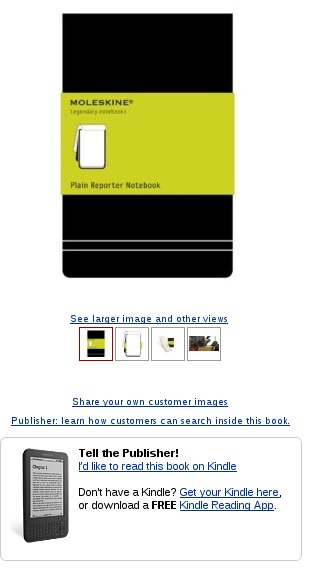
I was considering buying a notebook. Here's part of the page on Amazon: In other words: I wonder if the warranty of Kindles covers writing on the screen in ink.
Alexander Reichle-Schmehl: The Debian archive is getting bigger every day

When Debian squeeze was released in February, it was shipped with slightly less than 30'000 packages. So it was just a matter of time till we also break that border. However, I was quite surprised when I checked the numbers lately and noticed that by now we not only broke the 30'000 packages border but also the 35'000 package! Right now there are 35403 packages available for installation in Debian's unstable branch for the amd64 / 64-Bit-PC architecture! Wow!

Asheesh Laroia: OpenHatch round two: the non-profit

For the past year or two, readers of asheesh.org (including those on Planet Debian) have been hearing on and off about OpenHatch, a project that began in Atlanta two summers ago. The OpenHatch website has been a place to find out how new contributors can get involved in free software. Lately, I've discovered how much fun it is to help people get involved. I've also discovered oodles of enthusiasm for learning more about joining an open source project. So I've been transitioning OpenHatch to be more of a non-profit and to work on more of those outreach events, and particularly I've been transitioning my life to support me (self-funded) working on that effort full-time for a year. If there's one thing I learned while creating a startup under incubation, it was how to save money. The OpenHatch blog has the rest of the story. Here's a taste:
I m writing to announce three big changes for the project. First, OpenHatch is changing its organizational structure to reflect our not-for-profit goals. Second, we ll emphasize our new work beyond the website, building and promoting outreach events that bring new people into the free software community. Finally, I am taking a year to do that full-time as the project lead of OpenHatch in Somerville, MA.
This change has been a long-time coming, and it's thanks to so many people who have given advice and feedback along the way. One special shout-out goes to Bradley Kuhn, who told me in March 2010 that OpenHatch should be a non-profit. I hope you'll read more.

Wouter Verhelst: Happy Birthday, Debian!

Okay, I'm a few days late, but still. The 16th of August is Debian's birthday. It was on the 16th of August, 1993, that Ian Murdock announced the 'imminent' release of "the Debian Linux Release". As such, this year Debian celebrates its 18th birthday. It's incredible, but this means that if Debian was a person, it could now legally drink hard liquor. At least in some jurisdictions. What's more incredible is that I just realized that, since I've been involved with Debian for over 10 years, I've actually got first-hand experience for more than half Debian's lifetime. Time sure flies.

17 August 2011

Joey Hess: summer trips wrapup

Finally back from a solid month away. For the past three days I've been coding, which feels good after all that time away.

Tanguy Ortolo: Booting with UEFI

A combat boot I have just bought a new motherboard, a ASRock E350M1/USB3 with and embedded AMD E350 processor. I was mostly interested in trying the embedded GPU and the UEFI firmware (UEFI is simply the name of EFI 2). According to ASRock's marketing, the main benefit of that UEFI is its graphical interface that allows to use the mouse to configure the board. I cannot agree with that, because I think it is perfectly possible to implement that with a BIOS (and I think some BIOSes actually do it), and it is pointless anyway. For me, the main benefits are a faster and cleaner boot (no idea why it should be faster, but it is).The EFI boot process EFI seems to suffer from some (many?) design errors, but I find its boot process more clean and flexible than the old BIOS one:
  1. It starts with a boot manager which is similar to the temporary boot device selection menu of most recent BIOSes.
  2. When you have selected the device to boot from, it looks into its EFI System partition, identified by its type GUID, as FAT file system, and executes a boot loader from a file at a specific path: /efi/boot/bootx64.efi (on amd64 platforms) by default, specially for removable devices.
  3. Once the boot loader is loaded, the boot process continues as usual and is no longer specific to EFI (although the ABI used by the boot loader is specific, of course).
It is worth mentioning that the boot manager configuration, which lies in the EFI NVRAM, can be accessed and modified from an operating system, to add random entries for loading a boot loader at any path accessible from the boot manager (you will not be able to load a file from an Ext4 file system, for instance). GRUB on EFI To be able to install GRUB on EFI you need an EFI System partition, formatted in FAT and mounted on /boot/efi. GRUB will simply install itself on /boot/efi/efi/debian/grubx64.efi (on Debian) according to the EFI Specification, and use efibootmgr to create a new boot manager entry called debian and pointing to it. Tricks Well, for me, it did not work. The debian boot option failed, saying that this was not a bootable disk. I managed to get an EFI Shell, by putting Tianocore's shell into a FAT-formatted USB stick as /boot/efi/efi/boot/bootx64.efi. Using this DOS-smelling shell, I found that the directory /efi was unusable: it was listed, but any command trying to access to it failed. The reason was quite tricky, caused by a broken FAT implementation. With FAT, the file system label is stored both in the file system header and as a bogus root directory entry (yes, this sounds completely crazy). As I labelled my EFI System partition as EFI , there was such a bogus entry for this name: I think ASUS' implementation of FAT was taking it for the /efi directory. It took me hours to finally find the cause of this problem and fix it be re-formatting the partition with a new label (re-labelling may have been sufficient but I wanted to be safe).

16 August 2011

Craig Small: Debian turns 18

In Australia, 18 means you can do things like vote and drink. While most don t get terribly excited about the first, the second usually happens on your 18th. And so 18 years ago Ian Murdock brought together the new debian distribution. I ve been along for the ride for 14 of those 18 years and it certainly has been a fun time and what a lot of differences it has been since then. Debian is not only one of the best distributions around, but has an important place in ensuring there IS a Free Software distribution. So raise your glasses (mine s the one with the chilled filtered water, its 8am after all) and wish Happy Birthday to Debian, may you have many more. And if you d like some calorie-free cake, hope over to DUG s site where they have been busy making Debian Birthday Cakes. Just looking at that yummyness won t be too bad for you, unless it makes you hungry now.

Ritesh Raj Sarraf: File System corruption and Recovery

So this is the 2nd time I ran into a problem like this again. My FAT32 file system on the external USB HDD, all of a sudden, started reporting:

00:47:32 rrs@champaran:/tmp$ sudo dosfsck /dev/sdb1
dosfsck 3.0.9, 31 Jan 2010, FAT32, LFN
Logical sector size is zero.

I had been taking a lot of care to ensure that I don't run into situation like this. No body likes losing data. The good part is that I've been lucky enough that, even without backups (now who's gonna backup a backup disk), I have recovered all my data. All thanks to Christophe GRENIER for Testdisk.read more

Erich Schubert: Documenting fat-jar licenses

Dear Lazyweb,
What is the appropriate way to document the individual licenses of a fat jar (a jar archive that includes the program along with all its dependencies)?
I've been living in the happy world of Linux distributions, where one would just package the dependencies independently (or just specify which existing packages you use, actually, since most is already packaged by helpful other developers). But for the non-Linux people, a fat jar seems to be important so they can double-click it to run the application.
When building larger Java applications, you end up using a couple of external code such as various Apache Commons and Apache Batik. I'm currently including all their LICENSE.txt files in a directory named "legal", and I'm trying to make it as obvious as possible which license applies to which parts of the jar archive. Is there any best-practice of doing this? I don't want to reinvent the wheel; it'd also like to avoid any common legal pitfalls, obviously.
Feel free to respond either using the Disqus comment function or by email via erich () debian org

Alexander Reichle-Schmehl: Happy Birthday!

birthday card Happy Birthday, Debian! Should you have the time, take a look at http://thank-you.debian.net/ and thank some package maintainers or other teams. Also it's not to late to organise a spontaneous DebianDay Party in your city! Picture by Valessio Brito licensed under the terms of the GPLv2. Source available at http://valessiobrito.info/d18th/.

John Goerzen: Being Helpful

After a couple of recent storms, we had some large branches down in our yard. Today was a new milestone: it was the first time out boys helped me clean up storm damage. We all trooped outside, and for a minute, the boys kind of ran around while I found a saw. We needed to saw off a few branches that were down but still connected. I did one. Jacob wanted to try, but it was a little too hard. But on the second one, which went a little easier, he helped out and with my guidance actually did some sawing. He was very proud of his work. Then we got into the pickup always a highlight for the boys, even if we only drove it around on the yard. I brought it up close and started loading brush onto it. Jacob went around finding whatever pieces of wood he could carry, and happily threw them onto the pickup. Oliver, on the other hand, meticulously picked up smaller pieces of wood and carefully set them on the rear tire then shoved them off the back. This really annoyed Jacob because Oliver wasn t doing it right, so Jacob kept trying to find the wood Oliver was dropping. And then, of course, they got to play in the pickup bed. Next it was off to the brush pile (also on our yard) to unload our 5ft high pile. I got the really heavy stuff mostly off. I told the boys they could throw whatever they wanted off the pickup. Jacob threw things onto the brush pile, and Oliver, who doesn t really have any aim yet, just threw things and enjoyed trying to figure out where they went. But the big highlight came when the boys got to sit in the back while I pulled the truck a few feet forward and the rest of the brush just fell off the end all by itself ! I complimented both of them on their good work they both really did contribute. Terah commented that when they came in, they both kind of strutted in, looking very tall, proud, and like they did some Good Work with their dad. And later, when Terah said to Oliver, Dad tells me that you were very helpful, Oliver, Jacob overheard and came running in to say, I was very helpful too!

15 August 2011

Matt Zimmerman: Building a personal data locker

If you were building a digital container to store your personal data, what would it look like? Personal data being information associated with you: your contacts, your photos, the web pages you ve visited, the places you ve been, the messages you ve sent and received, and so on. In short, your stuff. Here s my personal wish list of technical requirements: Of course, this isn t merely an academic exercise, as my new day job at Singly is about building exactly this type of system. With a technical team including Jeremie Miller of Jabber and XMPP fame, our goal is to develop a personal data platform which meets these criteria and more. There s a lot of work to do, but today, you can check out the code and run a locker of your own, which can sync in data from Facebook, Twitter, Google, Foursquare, Github and dozens of other services. It s a bit of a bear to set up, particularly if you don t already have API keys for these services, but that s fairly normal at this early stage of development. If you try it, or have thoughts about what we re doing, please let me know in the comments.

Next.

Previous.

