Search Results: "ag"

29 November 2010

Axel Beckert: Useful but Unknown Unix Tools: colored cal(endar)

Another thing I regard as useful on the commandline are colors. (Others commonly refer to my color preferences as eye cancer, but that s not relevant here. ;-) Colors help to easily distinguish between relevant and non-relevant things or to separate different things. One colored command line program I use nearly everyday is the colored fork of bsdmainutils s well know (or at least better known) cal program whose output looks like this:
$ cal
    November 2010    
Su Mo Tu We Th Fr Sa
    1  2  3  4  5  6
 7  8  9 10 11 12 13
14 15 16 17 18 19 20
21 22 23 24 25 26 27
28 29 30
$ 
Since the colored fork calls itself still cal (as the Debian source package is called), to avoid conflicts with bsdmainutils s cal, the binary package and the binary itself are called ccal (short for colored cal) and its output looks like this:
$ ccal
    November 2010     
 Mo Tu We Th Fr Sa Su 
  1  2  3  4  5  6  7 
  8  9 10 11 12 13 14 
 15 16 17 18 19 20 21 
 22 23 24 25 26 27 28 
 29<30>               
                      
$ 
ccal also use the locale definitions (LC_TIME), if available, that s why the one screenshot is Sun-Sat and the other one is Mon-Sun. According to the man page, ccal has some more improvements over the classic cal: If displaying the single-month format, ccal will look for a date file (the default file or whatever you specify with the -d option). If found, ccal will read the file, looking for special date descriptions for that month which will be displayed to the right of the calendar. By default, up to 24 appointments (number may be changed with -m) may be displayed per month. If the current date happens to fall on one of these special dates, it will be flagged by an asterisk. If there is room, appointments for the next month may also be displayed (next month s dates having definitions like 2nd Thursday will be skipped). But I must admit, I don t use that feature. I just use it as on-demand calendar sheet. The colored screenshot above is btw. generated with Adam Borowski s ansi2html which popped up after I published my Intent to package aha (for Ansi HTML Adapter), the first ANSI colors to HTML converter I found on the net. (And yes I searched for it because of this and some yet to come blog postings. No spoilers here though. ;-) While capturing colored output of ls and some other tools was easy, it needed a little hack to capture ccal s output, because if you pipe ccal output to anything, it drops its colors. Always. The solution was to run it in GNU Screen, log the output and then pipe the log file through aha or ansi2html :
$ screen -c /dev/null -L ccal; cat screenlog.0   ansi2html > ccal.html
Probably the output of every program which drops colors when writing to a pipe instead of a terminal can be fetched that way. Update, 2:04 CET: As Adam Borowski points out in message 62 of #605380, script is the better tool for making tools believe they talk to a terminal:
$ script -q /dev/null -c "ccal"   ansi2html
Catching the output of a whole year s calender ( ccal 2011 ) failed with GNU screen though, as it was truncated on the 24th of September by GNU screen (as it was already truncated in the screenlog.0), so no screenshot of that for the moment. And with script, I d get the whole output, but would have to manually fix the styles so they don t get posted literally to Planet Debian. So look for yourself how the output of ccal 2011 looks like by installing ccal. ;-)

David Paleino: Using Git tutorial for Debian-Women

On the 25th of November I held a training session for the Debian Women project, about Using Git. A transcript of the session is available. The session took 2,5 hours, more than I really expected (one hour less), but I had many questions asked. There were ~160 attendants, but many of those asking questions seem to have missed that this was a "basic" session, for people who never used it. All in all, it was a great experience. While preparing the talk, I had the chance to re-read some forgotten manpages, which clarified some points, so it was really useful for me as well :) Given the kind of questions I had, it would be nice to have an "Advanced Git" session, maybe in January-February. Any volunteers? I'll sure be attending it :) FYI, the next session will be held by POX (Piotr O arowski) next Thursday (Dec, 2). It will be about Python libraries/application packaging, you'll have to read the introductory session as a pre-requisite.

Theodore Ts'o: Google has a problem retaining great engineers? Bullcrap.

Once again, there s been another story about how Google is having trouble retaining talent. Despite all Eric Schmidt s attempts to tell folks that Google s regretted attrition rate has not changed in seven years, this story just doesn t want to seem to die. (And those stories about Google paying $3.5 million and $7 million to keep an engineer from defecting to Facebook? As far as I know, total bull. I bet it s something made up by some Facebook recruiter who needed to explain how she let a live prospect get away. :-) At least for me, the complete opposite is true. There are very few companies where I can do the work that I want to do, and Google is one of them. A startup is totally the wrong place for me. Why? Because if you talk to any venture capitalist, a startup has one and only one reason to exist: to prove that it has a scalable, viable business model. Take diapers.com for example. As Business Week described, while they were proving that they had a business model that worked, they purchased their diapers at the local BJ s and shipped them via Fedex. Another startup, Chegg, proved its business model by using Amazon.com to drop ship text books to their first customers. (The venture capitalist Mark Maples talked about this in a brilliant talk at the Founders Showcase; the Chegg example starts around 20:50 minutes in, but I d recommend listening to the whole thing, since it s such a great talk.) You don t negotiate volume discounts with textbook publishers, or build huge warehouses to hold all of the diapers that you re going to buy until you prove that you have a business model that works. Similarly, you don t work on great technology at a startup. Startups, by and large, aren t about technology at least, not the Web 2.0 startups like Facebook, Foursquare, Twitter, Groupon, etc. They are about business model discovery. So if you are fundamentally a technologist at heart, whose heart sings when you re making a better file system, or fixing a kernel bug, you re not going to be happy at a startup. At least, not if the startup is run competently. If you have the heart of an entrepreneur, and you are willing to roll the dice (since 9 out of 10 startups go belly up; those are the ones that failed to find a viable business model), then sure, go for a startup. And understand that your job will be to make something that works well at a small scale, quick, dirty, and cheap. If that means using some proprietary software, then that s what you should do. Hopefully you ll get lucky and win the IPO lottery. But if your primary interest is to doing great engineering work, then you want go to company that has a proven business model. Google has enough scale that I can sleep well knowing that improvements I am making to Linux and the ext4 file system are saving enough money for the company that Google is making a profit on me. That is, the value Google is getting out of my work is worth many multiples of my total compensation. And that s a position that every engineer should strive for, since that s how you can be confident that you will remain gainfully employed. The fact that I can do what I love, and go to conferences, and all of my work is open source that s just total icing on the cake. :-) No related posts.

MJ Ray: What Price Networking?

How much would you pay to participate in a social network and what would you expect for that? On the web, I m used to some social networks being available for free. Usefulness and size varies massively, but there s quite a choice of them. There s a price to access them (computer, internet access, time) but once you ve paid that, there are free-to-use networks. Offline, a lot of networking opportunities cost money and not just access costs (travel, time). Especially business networks. OK, there are paid business networks online too, but some of the biggest ones have some long-term free access level, to try to entice people to upgrade. Offline, it seems like the reverse: there are some free networks and some that have short-term free access, but the norm seems to be pay-to-play. Often you get nothing except entry for the basic subscription, but at least our co-op usually prefers networks where we re proper members with some say in how things are run. Not that democracy always works. One networking organisations made a mistake in posting out ballot papers that means we can t vote in its leadership election. This isn t the first administrative problem we ve suffered and their last decent event was at least a year ago, too. At what point should we quit? I think I ll try to address this through the membership democracy first. In this recession, some of our offline networks are reviewing their prices. In one case, a network which was free is going to become one of our more expensive annual subscriptions if we renew. If I look at it as a simple does this bring in enough work to pay for itself? decision then probably it won t. How much value do you attach to being there and to being visible, though?

Vincent Sanders: Mobile Telecommunication Luddite

Actually I can not really be called a Luddite because I am not really against telecommunication progress nor do I fear it will negatively effect my employment...but the title sounded good? ;-)
Anyhow, I have a strange relationship with mobile phones. My ability to have a functioning device has historically limited their usefulness to me.

Because of my low usage and odd attitude for a techie I have always used PAYG for my personal phone. Work may have provided me with a device with a contract for being on-call etc. but in general its been PAYG all the way. My first phone was a Nokia 1610 back in the late nineties, second user after my employer at the time contract upgraded and had a load of "leftovers". I paid 50quid for it and bought a ten quid SIM and ten pounds credit.

My phones
The standing joke among my friends for the next decade has been that whatever provider I moved to they would go out of business within the year. I went through about eight providers in ten years. And for the first six the same tenner credit went with me! Each time the PAYG provider folded etc. I would be moved on to someone new with a tenners credit and a new SIM and number.

After Easy Mobile closed they did not have an option of a new provider with credit and the "recommended" provider was very poor, so this time I shopped around and went with Tesco mobile but remembered to take my number, which did at least stop my colleagues making fun of me for another move.

During this period my phones were no better than my providers. I bought a Nokia 1100 and used other peoples leftovers. Culminating in Daniel Silverstone taking pity on me and giving me his Sony Ericsson K800 at the end of his contract, despite acquiring an ADP1 and a G1 (both have which have dropped dead) this is the phone I have been using for three years now.

Due to my dreadful relationship I did not get the most from the technology and felt like I was missing out. Over the last few years to try and address this I have set myself a target of having a phone physically with me, turned on and in credit at all times. This I have finally managed for a whole six month stretch and as a reward I have bought myself a nice Android based smartphone on contract with T-Mobile.

I have done all the administrative things to port the number so no-one will need to alter their address books :-)

After only a few days of usage I have already discovered why the combination of smart phone and decent contract are so appealing. The freedom to just call and text and use the internet wherever you are without stopping to worry if you have enough credit is a wonderful thing. And decent hardware with the guarantee that if it breaks all I have to do is go into the store and they give me a new one.

I went for the HTC Wildfire instead of the Desire on cost grounds (100 pounds up front instead of 290) which seems perfectly reasonable hardware performance wise. My one and only niggle is T-mobile have nobbled the media player so it only plays some mp3s and not oggs or flacs. No real challenge, just a bit disappointing that vendurs seem to think they need to fiddle.


Adnan Hodzic: DebConf11 final and official dates

If you thought you saw this post already, you re right, since this is our second time announcing official DebConf11 dates. First time announced dates can be found on: DebConf11 official dates deprecated (Nov 29th update)
Official and Final DebConf11 dates in Banja Luka, Bosnia and Herzegovina are:
DebCamp: 17 23 July 2011
DebConf: 24 30 July 2011

On behalf of whole DebConf11 team I would like to apologize to everybody who already organized and booked their vacation after initial announcement, reasons why these dates were altered can be found on debconf-team discussion on Let s decide DebConf11 final dates .
These dates will be announced on Debian website as official announcment as well.
See you in Bosnia? Smile

http://wiki.debconf.org/wiki/DebConf11/BanjaLuka

Lars Wirzenius: Manpage tutorial

I wrote a quick tutorial on writing manual pages: http://liw.fi/manpages/, so I can point people at one I like when I get into my next argument on whether manual pages are impossible to write by hand or not.

Russell Coker: The Sad State of Shopping in Australia

Paul Wayper has written a blog post criticising the main chains of grocery stores in Australia [1]. That is the cartel of Coles and Woolworths (which was formerly known as Safeway in some parts of Australia), and the German newcomer Aldi.While he does make some good points I think he was a little harsh on Aldi. As a portion of the stock on shelves (by quantity stocked, shelf space, number of products, or almost any other metric) it seems that Aldi easily beats every other decent sized grocery chain for the portion of the stock being organic food. Aldi also has a very high portion of their stock being fair-trade also probably beating the other chains handily. Having organic fair-trade food sold in bulk at low prices is a really good thing!Paul criticises the lack of range on offer in the major chains. Aldi has the smallest range as their entire business model is based around offering a small range of products in a relatively small store at very low prices. That dramatically decreases the amount of stock that they have and therefore decreases the amount that is spoiled and the expense of storing and tracking it all. I wonder if the success of Aldi can drive other stores to getting a better range of products. Why buy a small range of products from Coles or Woolworths when you can get a similar small range from Aldi at low prices that the business models of Coles and Woolworths can t match? This may even drive consumers to buying core products (bread, milk, pasta, etc) and some basic luxury products (cooking wine, basic chocolate, cheap soda, etc) from Aldi and then buying other products from specialist stores. This might result in more delicatessens!Aldi also has a weekly selection of special items. For example selling snow boots etc just before winter starts. In most parts of Australia we don t see snow much and a cheap pair of snow boots is a good investment for the one day a year that most people spend at the snow. These specials provide real benefits to consumers although not to the Australian economy.Paul complains about own brand products. But for some products such as sugar you will get the same product from home brand as from other brands (there aren t really many options for sugar) and it ll probably end up being Australian just due to economics.When you buy big-name products you are mostly paying for marketing. For some things there are real taste differences (such as Coke for me), but for lots of things there are no difference, so I m happy to buy own brand . Generally not paying for marketing is a good thing.I totally agree with Paul s point about buying Australian to help the local economy and also to avoid the transmission of diseases. Any treaty which forces us to accept the import of products from countries that have diseases that can be transmitted to Australian crops should be voided. It seems that the WTO is specifically designed to benefit corporations at the expense of member countries and their citizens.Paul gave a positive review to IGA, I wasn t impressed with my local IGA the last time I visited it. But I ll give it another go.

Rapha&#235;l Hertzog: How to find the right Debian packages: high-level search interface

The Debian archive is known to be one of the largest software collections available in the free software world. With more than 16,000 source packages and 30,000 binary packages, users sometimes have trouble finding packages that are relevant to them. Debian developer Enrico Zini has been working on infrastructure to solve this problem. During the recent mini-debconf Paris, Enrico gave a talk presenting what he has been working on in the last few years, which hasn t gotten yet the attention it deserves . Enrico is known in the Debian community for the introduction of debtags, a system used to classify all packages using facets. Each facet describes a specific kind of property: type of user-interface, programming language it s written in, type of document manipulated, purpose of the software, etc. His most recent work builds on that. It is available in Debian and Ubuntu in the apt-xapian-index package. Its purpose is to allow advanced queries over the database of available packages. Users of apt-xapian-index He started by presenting some early users of the infrastructure. The most widely know is Ubuntu s software center. Its search feature provides results almost instantly thanks to apt-xapian-index. But it is a very simple interface that doesn t exploit many of the advanced features provided by the apt-xapian-index. Another early adopter, making use of some more advanced features, is GoPlay!. It s a graphical user interface to find games. It makes use of debtags to classify games so that you can browse, for example, all 3D action/arcade games related to cars. GoPlay has even been extended to be a more generic debtags based package browser and the package now also provides GoLearn!, GoAdmin!, GoNet!, GoOffice!, GoSafe!, and GoWeb!. Fuss-launcher is an application launcher and not a package browser, but by using apt-xapian-index, it s able to reuse information provided at the package level to make it easier to find installed applications. Package descriptions tend to be more verbose than those embedded in .desktop files. Enrico also showed another nice feature to the audience: if you drag a document onto its window, it will show you a list of applications that can open it. Last but not least, apt-xapian-index provides a command line search tool that is vastly superior to the traditional apt-cache search: it s axi-cache search (axi stands for apt-xapian-index). Enrico compared the output of a search on the letter r . While apt-cache spits out an infinite list of packages containing this letter somewhere in the description, axi-cache only listed packages related to GNU R. He also demonstrated the contextual tab completion. It makes it easy to use debtags and to refine your search. Once you have typed a first keyword, the tab-completion for the second one only contains keywords or debtags that are actually able to provide more restrictive results. Advanced queries with logical operations (AND, OR, NOT, XOR) are also supported. Features of the backend Enrico then dived into the internals. Xapian s search engine is at the root of this infrastructure. He likes it because it s a simple library (i.e. no daemon) and it has nice Python bindings. While apt-xapian-index s core work is to index the descriptions of all the packages, it actually stores much more and can be easily extended with plugins (written in Python). For instance, the information stored encompasses: He already has plans to store more: adding popularity contest data (see wishlist bugs #602180 and #602182) will make it possible to sort query results in a useful way. The most widely used applications are good choices when it comes to community support, and they are likely of better quality due to the larger user base. Adding timestamps of the last installation/upgrade/removal, will make it easier to pin-point a regression to a specific package update. The generated index is world-readable and can be used from any application provided it can use the Xapian library which is written in C++ but has bindings for Perl, Python, PHP, Java, Tcl, C#, and Ruby. Call for experimentation Enrico believes that many useful applications have yet to be invented on top of apt-xapian-index s features. He s calling for experimentation and asking for new ideas. The only practical limit that he has encountered is the size of the index: currently it varies between 50 Mb (Debian unstable without translation) and 70 Mb (Debian stable/testing/unstable with one translation). He would like it to not grow over 100 Mb since it s installed by default (due to aptitude recommending it) and he s not comfortable with the idea of using more than 20% of the disk footprint of a basic install just for this service. That s why the index was configured to not store the position of the terms: it s thus not possible to find out packages whose description contains the word statistical immediately followed by the word computing . You can however find those which have both terms somewhere in their description. Enrico wondered if apt-xapian-index offers too much freedom. That could explain why few people experimented with it despite his numerous blog posts with code samples and information on how to get started using it. But it s not difficult to imagine use cases for this data. It could be used to extend tools like rc-alert or wnpp-alert, for example. They provide a long list of Debian packages that are looking for some help and are installed on the machine. With apt-xapian-index, it would be possible to restrict the results to the set of packages written in a specific programming language or for a particular desktop environment. The more likely explanation is that too few people know about the tool. There are many more itches to scratch where apt-xapian-index s features could be very useful, and my guess is that Enrico s wishes will eventually come true.
This article was first published in Linux Weekly News. Click here to subscribe to my newsletter and keep up with the Debian/Ubuntu news thanks to my monthly digest.

No comment Liked this article? Click here. My blog is Flattr-enabled.

Keith Packard: Altos0.8

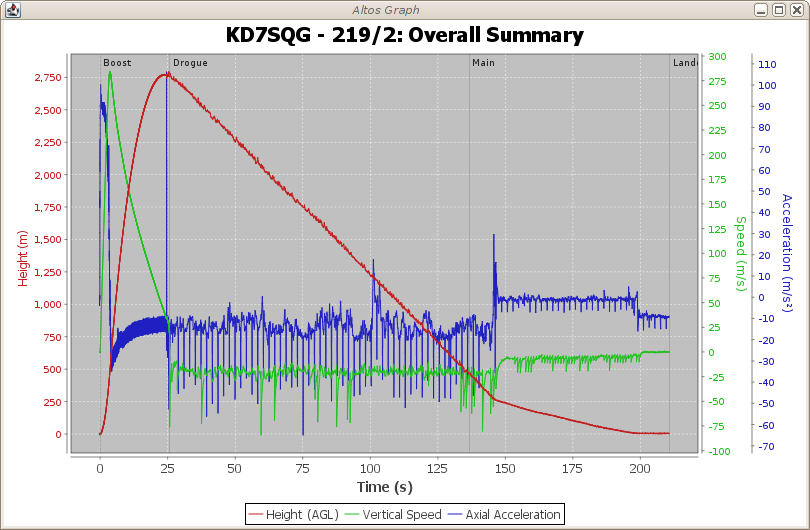
AltOS 0.8 New Software and Firmware for Altus Metrum Devices Bdale and I are pleased to announce the release of AltOS version 0.8. AltOS is the core of the software for all of the Altus Metrum products. It consists of cc1111-based microcontroller firmware and Java-based ground station software. AltosUI New Features in the AltusMetrum Ground Station AltOS version 0.8 contains significant upgrades to the ground station software, AltosUI: Continuing Features AltOS version 0.8 continues to provide the following features: AltOS Firmware Update AltOS version 0.8 contains a minor firmware update for TeleMetrum to resolve an issue with main deployment. A mis-feature in the igniter firing code would delay main deployment by 2 seconds in some cases. Thanks to our contributors! We had a lot of help with this release: Future Plans A number of features are implemented or in process in the sources available in our publicly visible repository that are not part of the current stable release. There are any number of additions that could be made to this list; feel free to send along ideas that you ve got. Of course, all of this software is licensed under the GNU General Public License, so you can get the source and hack on it in the comfort of your own home.

Bdale Garbee: AltOS 0.8 Released

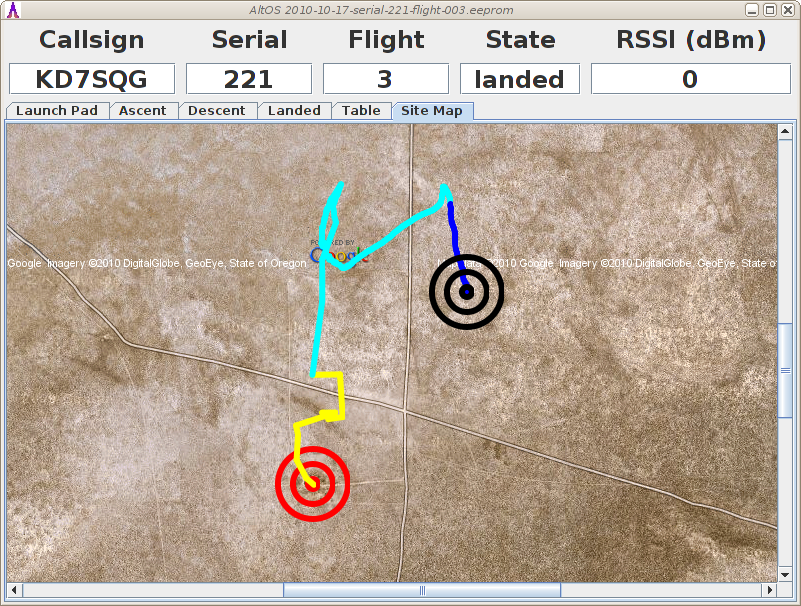
Keith and I just released version 0.8 of AltOS, the open source firmware and software system associated with our TeleMetrum hobby rocket avionics system. The AltosUI ground station user interface is significantly improved, with lots of new features including a much cleaner view of what's happening during different stages of the flight experience, a post-flight data plotting interface with pan and zoom, and a very cool live view of where the rocket is overlayed on data from Google Maps! All existing TeleMetrum owners are encouraged to download, install, and begin using this new version immediately.

28 November 2010

Benjamin Mako Hill: Doppelg nger

/copyrighteous/images/food_network_mako-small.png It's funny, I don't remember donning a cape and making an apperance on the food network.

Gregor Herrmann: RC bugs 2010/46 - 2010/47

this time my report on my work on RC bugs contains the list of what I did during the bug squashing party in bern. thanks to the nice guys from switzerland, france, & italy for the great time, & especially to gaudenz for organising the meeting!

Axel Beckert: Useful but Unknown Unix Commandline Options of cat

Yesterday in Harald K nig s commandline talk at LinuxDay.at, I first heard of cat s -e option, and noticed that cat has quite some interesting options. From the man page of cat:
-A, --show-all
equivalent to -vET
-b, --number-nonblank
number nonempty output lines
-e
equivalent to -vE
-E, --show-ends
display $ at end of each line
-n, --number
number all output lines
-s, --squeeze-blank
suppress repeated empty output lines
-t
equivalent to -vT
-T, --show-tabs
display TAB characters as ^I
-v, --show-nonprinting
use ^ and M- notation, except for LFD and TAB
Some examples made on an UTF-8 terminal:
user@host:demo $ cat bla
            
abc
user@host:demo $ cat -Ab bla
     1  M-CM-$  M-CM-6  M-CM-<^IM-CM-^_   $
$
$
     2  abc$
user@host:demo $ cat -Ens bla
     1              $
     2	$
     3  abc$
user@host:demo $ 
I hope this blog posting will reduce the percentage of useless uses of cat by raising the amount of useful uses of cat . :-)

Biella Coleman: The Existential Philsophy of Procrastination

out of cous The New Yorker has a very nice piece about the follies and foibles of procrastination. I really identified with it, especially the ruminations of multiple/divided selves (I do feel more like Biella s instead of Biella especially during moments of extreme procrastination). The heart of the piece has to do with the existential face of procrastination, which the author nails with this quote by Mark Kingwell:
Procrastination most often arises from a sense that there is too much to do, and hence no single aspect of the to-do worth doing. . . . Underneath this rather antic form of action-as-inaction is the much more unsettling question whether anything is worth doing at all
This reminds me of another one of my favorite (and kinda distributing but also kinda liberating) quotes by Henry Miller:
Life has to be given a meaning because of the obvious fact that it has no meaning
Finally, the most humorous bit in the article had to do with Victor Hugo, who apparently, to stave off distraction, would write in the nude and then make what sounds like his man servant hide his clothes so he could not go outside. Reminds me that prior to the Internet, there were certainly other ways to squander time. For now, I encourage some procrastination: read it and you might get some insight as to this habit, which seems to afflict so many.

Lars Wirzenius: Debian VM image creation tool?

It is Sunday, and I was bored, and wanted to experiment a bit with a possible future direction for piuparts. To do that, I needed to create a virtual machine image with Debian installed in it. I failed. I failed, because I am not familiar with all the stuff I need to be to pull this off. More shame to me. There's a lot of possible ways to do this, and I tried a few, but ran out of time before I could exhaust all opportunities. Somewhere out there is probably the magic rune I am looking for, and if so, please point it out to me. I might want to get back to this problem say day, and having a working rune would simplify things a lot. Here are things I tried: I did not try running debian-installer with a pre-seed file under kvm. I might try that some day, but today I did not get there yet. Ideally, I would like to build the image without running things inside a VM, just so it is as independent of specific VM technologies as possible. Quite a lot of people want to create virtual machine images easily. It would be really nifty to have a tool like this:
vmdebootstrap squeeze foo.img http://cdn.debian.net/debian 
It would be a fairly low-level tool, just like debootstrap is, but having just one place where all the trickiness to create the initial image happens would simplify the overall complexity of other tools. Making it simple to use would allow other stuff to be easily built on top of the new tool. For example, piuparts could use it to create a VM image in which to run tests, rather than using chroot, which would allow more code paths to be tested. But I'm not ready to write the tool today, alas.

Martin Meredith: New VPS & Shameless Plug

Due to the fact that my previous VPS was well out of date (Ubuntu Intrepid!!!) I m currently in the process of moving everything to a new server. I ve had lots of fun re-setting up my email and it s now very shiny and easy for me to use :) (I ll be writing a tutorial at some point in the near future) Other than that I d like to give a quick shameless plug to my VPS provider, Bitfolk. They re awesome, and have a great policy for Migrating to a new VPS. flattr this!

Dirk Eddelbuettel: Rcpp 0.8.9

A new release 0.8.9 of Rcpp is now available at CRAN and has just been uploaded to Debian. As always, sources are also available from my local directory here. This release comes a few weeks after the preceding 0.8.8 release and continues with a number of enhancements mostly to what we call Rcpp modules, our even-easier C++/R integration which follow some ideas from Boost.Python. Our corresponding Rcpp-modules vignette has been updated too. The NEWS entry follows below:
0.8.9   2010-11-27
    o   Many improvements were made to in 'Rcpp modules':
        - exposing multiple constructors
        - overloaded methods
        - self-documentation of classes, methods, constructors, fields and 
          functions.
        - new R function "populate" to facilitate working with modules in 
          packages. 
        - formal argument specification of functions.
        - updated support for Rcpp.package.skeleton.
        - constructors can now take many more arguments.
        
    o   The 'Rcpp-modules' vignette was updated as well and describe many
        of the new features
    o   New template class Rcpp::SubMatrix<rtype> and support syntax in Matrix
        to extract a submatrix: 
        
           NumericMatrix x = ... ;
        
           // extract the first three columns
           SubMatrix<realsxp> y = x( _ , Range(0,2) ) ; 
        
           // extract the first three rows
           SubMatrix<realsxp> y = x( Range(0,2), _ ) ; 
        
           // extract the top 3x3 sub matrix
           SubMatrix<realsxp> y = x( Range(0,2), Range(0,2) ) ; 
    o   Reference Classes no longer require a default constructor for
        subclasses of C++ classes    
    o   Consistently revert to using backticks rather than shell expansion
        to compute library file location when building packages against Rcpp
        on the default platforms; this has been applied to internal test
        packages as well as CRAN/BioC packages using Rcpp
Thanks to CRANberries, there is also a diff to the previous release 0.8.8: As always, even fuller details are on the Rcpp Changelog page and the Rcpp page which also leads to the downloads, the browseable doxygen docs and zip files of doxygen output for the standard formats. A local directory has source and documentation too. Questions, comments etc should go to the rcpp-devel mailing list off the R-Forge page

Christian Perrier: [life] a pique...

Yesterday night, we were at Stade de France to witness the debacle of the French national rugby team against Australia (16-59). 7 tries to 1. For someone who loves rugby and knows the high level of players we have in France (Top 14 is a collection of great games every week), it hurts. Maybe, next time, there will be a little more Toulouse players on the field and a little less people who have nothing to do there (should I name a few? Andreu, Huget, Porical...). The only good point of that game was (as usual) the scrum first row (at least during one hour...then even there we got crushed by the Australians). French winter was even here to help, but apparently the yellow/green folks didn't really care. Australia has a really impressive team, particularly their back line. We'll be having hard times in RWC in New Zealand next year. Big round of aplause at the end of the game for that team. For our team: a pique.....fort!

Jaldhar Vyas: The YUI Package Needs Your Help

The Yahoo! User Interface toolkit Debian package is buggy due to being rather neglected by me of late. Luckily it seems most of the bugs can be solved by removing flash files for which no source is provided and rebuilding the rest. Today, I finally got around to doing that. The problem is it doesn't seem to be possible to build YUIs .swf files from the actionscript files upstream provides with the tools available in Debian. Actually, I don't know if its a problem with the tools or me not knowing what the hell you're supposed to do with actionscript files. If you do know about such things, please take a look at the work in progress (git://git.debian.org/git/pkg-javascript/yui.git) and get in touch with me.

Next.

Previous.