This post is a small
follow-up on
yesterday's post about the Linux graphics stack. I'm still keeping to
high level stuff and won't dig too deep, but
a
few questions arose (others reached me by e-mail), so, here we go.
Gallium3D is a framework, initially developed by Tungsten Graphics, which
were bought by VMware. The idea behind Gallium3D is, that many functions can be
shared between drivers for different
GPUs and that the effort to support
a new platform/system is for classic drivers pretty high. With Gallium3D
you just need a state tracker and a target. The state tracker is code, that
gives the pipeline of Gallium3D drivers access to a platform/system, like
OpenGL or X on various operating systems. A target is the required as glue
between a state tracker and the actual driver. For example: there is a state
tracker for video playback acceleration (the recently added
g3dvl). The
state tracker itself offers the interface and common functions (with some help
from the auxilliary stuff) between the Gallium3D pipeline and the userland
libraries like
libvdpau1. Targets like
vdpau-[DRIVER] glue
the driver and the state tracker together.
The winsys part of Gallium3D is a similar concept but it abstracts the
windowing system on the target platform away (e.g. Wayland, X or
GDI).
I didn't write about the proprietary drivers yesterday, as I don't consider
them a real part of the Linux graphics stack, more like parasites, and didn't
want to encourage anyone to use them (yes, I know, there are some cases in
which you might be better off with them, but generally I'd avoid them). Anyway,
I got some questions about those (some by e-mail, the other I'm aware off, can
be found behind the link at the beginning of this entry). So, where do the
proprietary drivers come in? They are basically the entire stack in a closed
form, plugging into the public interfaces of the Kernel (whether that's legal
is
disputed), some other parts like X (by building a
DDX) and building their own
libGL.
Especially the last part can be a cause for a lot of pain, when you don't
use the proprietary driver packages offered by the distribution (e.g. Debian's
fglrx packages divert the
libGL and restore the default one
on unistallation, with the vendor build scripts and tools this is not really
guaranteed, which might leave you with a broken OpenGL setup).
Another question was, why Mesa was lacking support for a recent OpenGL
version (i.e. 4.x). In my opinion there are a few reasons, though I don't
really feal like the best person to answer this. The first are design issues by
some internal representations (e.g. missing integer support in the intermediate
representations). The second is the available number of developers being able
to implement new OpenGL functions. Apart from a not all too clear specification
the Mesa code base is huge (even if you ignore most of the drivers), which makes
it difficult for new developers to start coding away. Then you need an
understanding of how modern GPUs operate to find good solutions for the problems
faced. If you want to get an idea for this, take a look at
Zack Rusin's or
Alex
Deucher's blog. Then, there is a sad split of developers, on the one hand
we've got the Gallium3D-using developers on the other we've got the ones
staying with the classic driver model. This means, that you have to implement e.g.
GLSL extensions for
TGSI and Mesa's
IR respectivly. There
might be other reasons, I'm totally missing, but this should give you some
insight into why it takes so long, to get current OpenGL versions supported.
I hope this clears some of the remaining questions, if not, feel free to
write me an
e-mail, but please remember, that this is not an
in-depth analysis.
 I've said it before: I think MySQL is a toy, and I want as little to
do with it as possible.
Unfortunately, since the KDE PIM suite depends on akonadi, which
depends on a database, which was initially implemented against MySQL,
not having MySQL installed on a Debian machine if you want to use the
KDE PIM suite, for the longest time, wasn't even possible. Today it is,
but it requires some manual steps:
 I recently bought a
 This was the second most rainy day of the year, so far. 28 hours of solid
rain and counting. Good time to take stock of the water situation here at the
cabin after a year's experience.
The springs were as seasonal as I'd feared. After running strongly
all Spring, the main spring ebbed and died in the Summer months. By mid-July
there was no remaining source of potable water. If I had not been away so
much over the summer it would have been worse. As it was, I needed
only twenty gallons of water hauled from neighbor Lee's well.
The large cistern was filled in a single night during the most rainy period
this Spring, and provided wash water for two months of the summer, and that
only lowered it by a quarter. So I could have been less sparing with it,
and not relied so much on rain water catchment for supplimental wash water.
Today I replaced the pump, so I can use the pressure tank and have running
water in the house. I could have done this earlier, but what can I say; I
enjoy hauling buckets of water, when it doesn't involve breaking ice.
In the winter when there's firewood to haul instead, I'll enjoy the
indoor plumbing.
Also today, I may have finally fixed the pipe to the large cistern
properly, so it won't only fill at the heaviest rain times. Along with the
ability to cross-pump water from the small to the large cistern, it should
be easier to keep it filled, and I might be able to reduce the turbidity
enough that it's potable eventually. Will see.
I don't live in a dry region, but this is a relatively dry place for the
area. It's been interesting to get a taste of what it'd be like to live
somewhere where water is actually scarce.
 This is just a quick post to remind myself in the morning, as soon as I've made it I intend to turn my computer off and leave it off until I can re-organize my office.
I've been using mutt for my email for the past few years. Nothing compares to the flexibility of procmail/sieve for organizing server-side mail, and then mutt is ideal for reading them.
With the addition of the mutt-patched sidebar mode you can even go for a few days before realizing you're not in a graphical environment. But one thing I do long for is the ability to execute scripts at various times.
Thus far I've not actually planned what I'd like to do, but as a starting point imagine being able to execute a hook when new mail arrives? Or when you send a message matching a pattern in some fashion?
There are some things out there, such as the various hacks which are designed to abort sending a message if you mention "See attachment" in a message body but fail to add one before sendign the message. These hacks generally abuse the sendmail configuration such that they're extremely ad-hoc and hard to chain/nest.
I've mellowed out over the years and I have no interest in attempting to write a mail-client (though at the same time how hard can it be? Just restrict yourself to using inotify on ~/Maildir and offload delivery to exim and you're almost done? I guess the hard part is the UI, though I do like the mutt + sidebar layout. Write the whole thing in some scripty language?)
I'll re-examine notmuch and gnus over the next week or two, but I suspect both will continue to disappoint in various ways.
Anyway, for the moment I'm just pondering. But threading is an obvious concern. Most current mutt hooks relate to the local folder, or the local message. If I were viewing a message in one directory and a new mail notification fired for a delivery to both ~/Maildir and ~/Maildir/.people.foo I'd need to either serialise them or thread them.
Ponder ponder.
In other news I've been doing more photography recently. Nothing cohesive except for my recent experiment with shooting a "street-girl" outdoors in falling light, but that was an interesting challenge and the results were sufficient to make me want to try shooting outdoors in an organized fashion again. (Some random images have been linked to from my wee
 I'm in the middle of setting up new build machines for the armhf
port (see
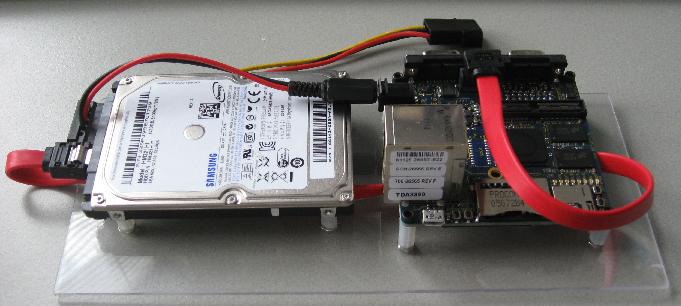 All of these machines are Freescale i.MX53 Quickstart (aka "loco")
development boards. They include a 1GHz i.MX53 CPU (based around the
ARM Cortex A8, one of the ARMv7-A family). They have 1GB of RAM and
native SATA. They're lovely little machines, measuring just 3 inches
square. To mount them usefully in a machine room, I've mounted each
board with a 320GB notebook hard drive and the necessary cabling onto
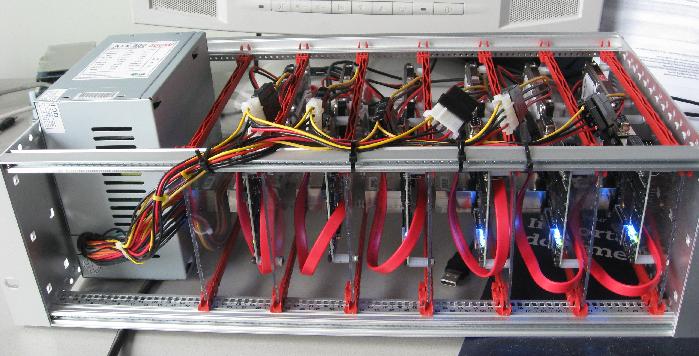
a small perspex card as you can see here. Then we can fit 6 such
machines and a normal PC-style ATX PSU into a 3U mini-rack. Well,
it almost fits - the power supply pokes out a little so we'll
need 4U of space when we come to mount it.
 The Quickstart boards have been sponsored
by
 I'm not very good with dates. For the last two years now, Joshua's anniversary
has snuck up on me and caught me by surprise.
I don't think that I'd really appreciated until this year that we lost him on
the Labor Day long weekend. I'll have to remember that for next year so I don't
forget.
I don't know what my problem was this year. I just didn't realise that it
was this early in September that we lost him. Last year I was just too
exhausted from dealing with a new baby to realise when his anniversary was,
and I felt terrible for missing it.
This year, I just felt terrible for not realising when it was, but at least
Sarah pointed it out before the fact.
For added irony, the 4th of September this year is Father's Day in Australia.
Yesterday, I was looking at photos of Joshua to remember him, and
 Both Bash and Zsh use several startup scripts: profile, bashrc, zlogin, zshrc, etc.
The existence of several startup scripts exists to allow you to apply
specific actions for interactive or login shells. For instance, you may want to
set up a fancy colour prompt or to enable a powerful completion system for
interactive shells only, as it would be pointless to apply it to non-interactive
shells (that is, for shell scripts). Or you may want to display a joke and the
weather forecast at login, but not each time you spawn a shell by other
means.Common
Both Bash and Zsh first execute a system-wide file, then the corresponding
user-specific one. For instance, /etc/profile then
~/.profile. For simplicity I shall only mention the
files' base names.
Bash
At startup, depending on the case:
 Am I online or not?
There is a summary at the end for the quick readers.
It is in many modern applications important to be able to more or less gracefully handle if the application user is online or not. For example, there is no need to try to fetch emails if the device (computer, phone, tablet, laptop, ) doesn t have network (wifi, cable, umts, ip over avian carriers, ..).
KDE has of course made nice functionality for this, and here I will try to describe how to make your app network status aware and what to be aware of in the process.
Solid background
All this is going on in Solid, using two parts of Solid and a bit of KDE s infrastructure:
 While
 I bought a new PC a few weeks ago and I then decided to renew a bit my Desktop, my Mutt and my Irssi setup. I ve been spending several hours cleaning up old scripts, logs and configuration files but the result definitely seems to reward me the right way. But here they come a few screenshots:
Desktop


 This is my monthly summary of my Debian related activities. If you re among the people who
 Dpkg work
When I came back from Debconf, I merged my implementation of
 Vacation
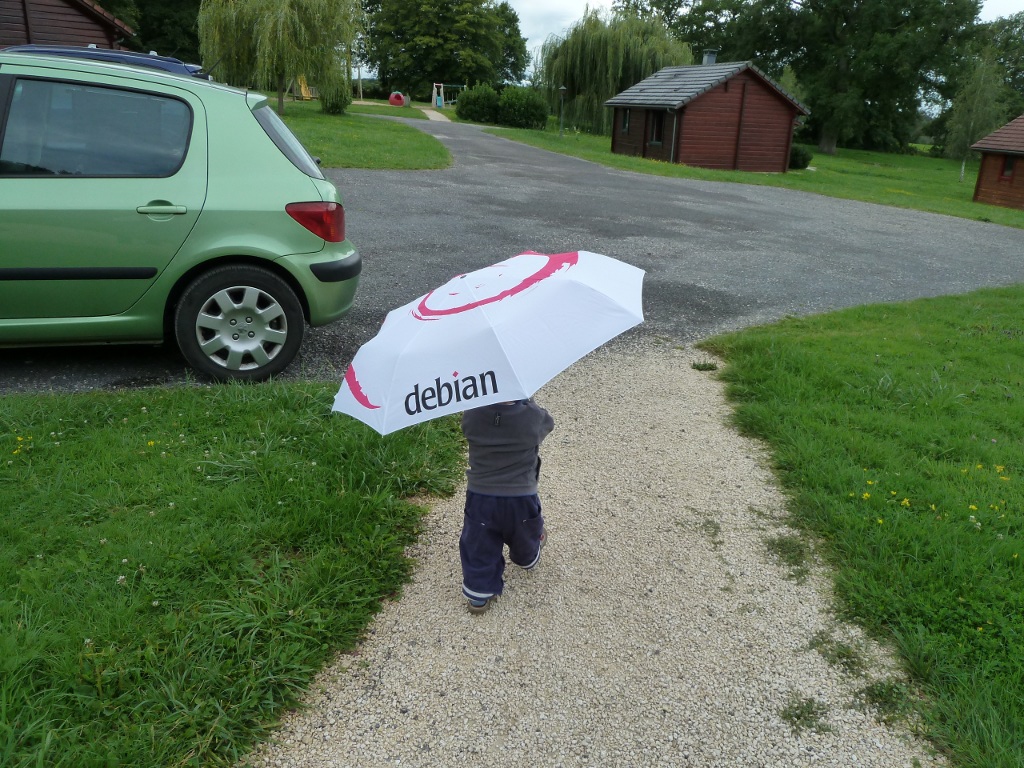
That s not so much compared to usual but to my defense I also took 2 weeks of vacation with my family. But somehow even in vacation I can t really forget Debian. Here s my son: