Search Results: "sten"

19 July 2013

Michal Čihař: Speed improvements in Weblate

Yesterday, I've spent some time trying to improve speed of translation import in Weblate. It got annoyingly slow while adding new features and I felt there has to be some area for improvements even with all the features. I was testing on development server with debug stuff enabled (what slows down things quite a lot already) and first import took about 30 seconds. Quick look revealed that for linked repositories, the link lookup happens too often, so some caching could be used. This has saved about 3 seconds... With offloaded indexing (what is anyway only useful setup for production use), every reindex request was checking whether there is already one before creating new one. In most cases there is none before, so it's simply faster to try to create one and ignore error in case it is already there. We're now 5 seconds faster. Another big resource consumer are quality checks. They provide useful feedback to translators, but it means that quite a lot of code needs to be executed for every single string. First thing I've realized is that unit check state is recalculated everytime regardless the fact whether there was any change, what was easy to fix. The other speed issue is in consistency check - it does too complex SQL query, which usually does not match anything. Converting this to much simpler one (which will in most cases still have no results) improves performance for usual path while having minimal impact for the real checking. Another 4 seconds down on my test import. Last thing which I changed is way how per translation statistics are updated. In past this required quite a lot of queries, but yesterday I've realized this can be much reduced. During test suite run on PostgreSQL, I saw that it's not that easy - PostgreSQL does not allow to sum boolean fields, but fortunately this can be fixed as well. This has saved about 2 seconds. In the end the tested import took 16 seconds instead of original 30 and issued 2500 SQL queries instead of 5000 at the beginning. I hope you will enjoy regained speed of imports :-).

Filed under: English Weblate 0 comments Flattr this!

18 July 2013

Thorsten Glaser: mksh/Win32

Michael Langguth and Scalaris AG asked me to publish the mksh/Win32 Beta 14 source and binary archive, and it is with joy I m doing this. Checksums and Hashes Just a few words on it (more in the README.1st file included): this is a port of The MirBSD Korn Shell R39 to the native WinAPI; it s not quite got the full Unix feel (especially as it targets the Weihenstephan unxutils instead of a full Interix or Cygwin environment) but doesn t need a full POSIX emulation layer either. It s intended to replace MKS ksh and the MKS Toolkit. Source for the compatibility library is also included under The MirOS Licence; we aim at publishing it as OSI Certified Open Source Software like mksh itself. (There is a situation with dlmalloc/nedmalloc being resolved, and the icon is derived from the BSD d mon which is a protected unregistered trademark, but we re not Mozilla and allow distro packages to keep using it ) Rebasing it on a newer mksh(1) followed by (partial) integration into the main source code is a goal. Have fun trying it out and hacking on it. It s currently built with -DMKSH_NOPROSPECTOFWORK (so coprocesses and a few other minor things won t work), but a SIGCHLD emulation is being worked on but if you want to help out, I m sure it s welcome, just come on IRC or post on the mailing list, and I ll forward things to Michael as needed. Reports on testing with other toolchain and OS versions are also welcome.

15 July 2013

Joey Hess: guesting on GitMinutes

Last Friday, I spent and hour and a half clamping a landline phone to the side of my head, while also wearing a headset. I was recording an interview on the GitMinutes podcast about git-annex. I've been listening to GitMinutes for a while, ever since I heard git-annex was mentioned on it. Actually, I think it's come up in 4 or 5 interviews on the podcast. Most notably with core git dev Peff King, who had some interesting things to say, for sure. I responded to that in my interview, and we covered quite a wide amount of stuff in reasonable depth in just over an hour. Thomas is quite a good host and great at drawing stuff out, and it's nice to not need to worry about going into too much technical depth. (Although I didn't get a chance to explain the automatic union merging used to maintain the git-annex branch.) This is the first podcast I've been in, and I've always worried about audio quality if I was in one. That is, I'd want it to be really good, and probably end up annoying the host. ;) For this one, we settled on using my land line call, which went through some Skype thing to get the Europe, and mixing in a local recording I made with a not too great headset. I think the result is pretty good, considering. You can listen to the whole thing here, if you dare! (1 hour 8 minutes) http://episodes.gitminutes.com/2013/07/gitminutes-16-joey-hess-on-git-annex.html (Special bonus guest: The songbird that lives on my porch.)
git-annex fundraising campaign update: Initial goal reached in a mere seven hours. I will be developing git-annex fulltime for at least the next three months! Gone to stretch goal. Also it made the top of Hacker News: thread

Daniel Pocock: Linux init-systems

Several value-added init systems have emerged in recent times. Most notably, Upstart has become the default on Ubuntu while systemd is now default in Fedora. Let's not forget the crusade to move beyond traditional init was given a big boost back in 2005 by Sun's introduction of SMF on Solaris 10 some years before the main Linux solutions gained prominence. Debian is currently debating whether to use one of these alternatives as a default. My own position on the matter is not decided, but I do feel that some of the debates are asking the wrong questions. Some of the most interesting issues here are likely to have ramifications for other distributions. My experience with systemd I've come across systemd in my efforts to package reSIProcate on Fedora. One of the challenges I came across was trying to both create a /var/run/repro directory and telling systemd to launch the process as a non-root user. I tried using the ExecStartPre directive in the systemd manifest to invoke mkdir. Unfortunately, it runs as the non-root user too and could not create the PID directory. The conventional init script doesn't suffer this problem. In the end, I have patched the repro binary to start as root and drop privileges itself, but that was only when it became apparent that we need to do that for WebRTC support (listening on port 443). While most daemons have the ability to drop privileges, there will be edge cases like this that need more than just a systemd manifest. Maintainers who encounter such issues may have to give feedback to the systemd and Upstart upstreams and give them the opportunity to provide generalized solutions. Then again, the most generalized solution would be another scripting language and then we'd be back where we started. The reason to change and the reason not to Some people have argued that Debian should change simply because other distributions did so. This is not a compelling technical argument alone. The fragmentation of init-alternatives is not something that makes upstreams excited either. It would be interesting to see if Upstart and systemd could agree on a common manifest format - maybe even a format that could be parsed by a wrapper from SysV init. Then Debian wouldn't really have to give up support for kFreeBSD and other non-Linux kernel efforts. A slight alternative to this approach would be using a system like cmake to read a single service XML manifest and spit out permutations readable by each of the different init schemes. It has also been well argued that the simple and well known solution of scripts is much less complicated to understand and maintain and is extremely stable. Wishlist items for all distributions While I don't know which solution is the best, one thing I do believe is that if there is a change and if it is going to be disruptive to maintainers and users then it should aim to bring in as many benefits as possible to offset the pain and encourage people to support the migration effort. Some of the potential road-map items are not only possible for Debian but could also become part of other platforms. Here are some of the issues that came to my mind:
  • Better support for starting multiple instances of a single process
  • Support for distributed solutions, for example, making sure that process A only starts on host 1 after process B on host 2
  • Support for clustering, for example, making sure that at least 2 instances of process A are running across 3 hosts.
  • Automated integration with monitoring and fault recovery systems: for example, can Nagios (or another tool) automatically detect whether a particular process should be running and whether it is running? Given that init-replacements typically need to start processes in the correct order, can they share that dependency information with Nagios to avoid manual/duplicated dependency mappings? Can Nagios restart the process without any manual scripting? Can this all be enabled for all processes on a given system in a plug-and-play manner?
  • Scheduler interaction: can and should any of the above, particularly the dependency mappings, be integrated with scheduling? For example, should some cron jobs be deferred when MySQL is down?
What other potential improvements do people feel to be worthwhile?

14 July 2013

Dirk Eddelbuettel: Go home, Feedly, you're drunk!

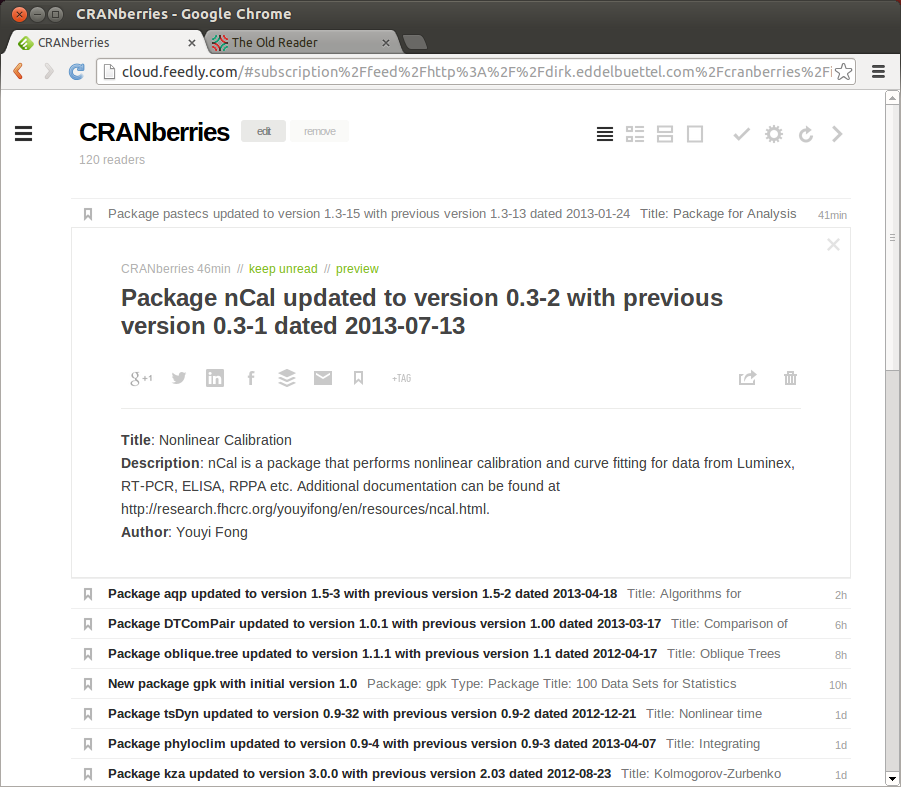
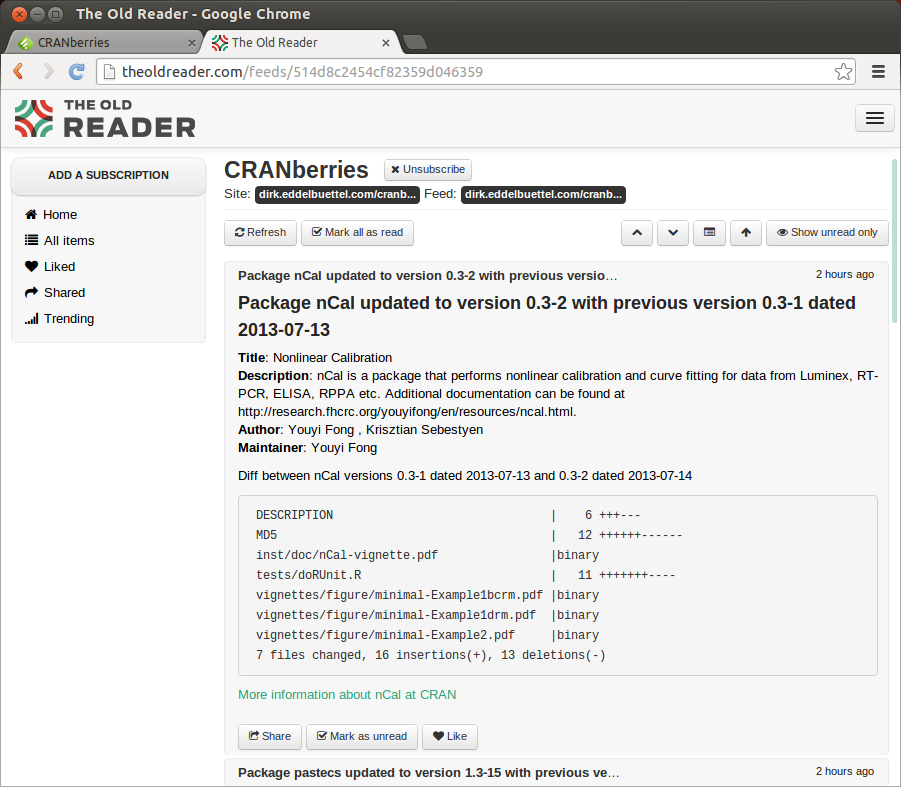
With the demise of Google Reader, many of us have scrambled to find alternatives which cover many/most of the features we were used to. For me, synchronised access from web and mobile counts quite high, and I want the (Android) mobile experience to be pretty pleasant too. So with that, and like many other folks, I had shifted over to Feedly. And before I carry on, let me say that Feedly actually does pretty well. They handled the onslaught of new users; they also listened and changed their UI a little to be more compact and Reader-alike And most importantly, it mostly just works. Until it doesn't. Around the time Feedly shifted folks to their own cloud-based backend, posts from my very own CRANberries aggregator of CRAN package changes for R started to show only truncated posts. See this screenshot from reading Feedly: Feedly truncates the CRANberries post and compare it with this one from TheOldReader: OldReader shows the full CRANberries post which contains the diffstat output, nicely marked up and all. Now, it so happens that I am the creator of the very RSS feed I am consuming here, and I wrote it so that I could read the very diffstat output that is now missing. And I know full well that neither the code, nor the hosting (on my own box), nor any other aspect changed. Before confirming this via TheOldReader, I looked at the RSS output, and I tried other frontend and apps --- and it became clear that the bug seems to be at the Feedly cloud storage level. And trying to be a good sport, I submitted a bug report / suggestion, but to no avail (apart from two other chiming in that they see this elsewhere too). Given that I am the coder behind the feed that is displayed in a truncated manner, I am aware that I am using a code stack that is stale (the original Blosxom static web generator) yet which has not posed another problem anywhere in the decade I used it. Nor does the CRANberries feed pose a problem when aggregated and viewed via the TheOldReader code path, or for that matter via Planet R which also carries (parts of) CRANberries. So for now, I have to either pivot out of the CRANberries RSS reading in Feedly and go directly to the webpage (fine, but cumbersome and in need of a working connection) or use a second subscription mechanism. I appreciate what the TheOldReader folks are doing---presumably with a minor fraction of the resources available to Feedly---and may hang with them for now. But it would be awfully nice if Feedly could sleep off its hangover and fix this. In which case I'd be much happier recommending its service.

Nicolas Dandrimont: Bootstrapping fedmsg for Debian

As you might (or might not) know, this summer, I have taken on mentoring of a GSoC project by Simon Chopin (a.k.a. laarmen) which goal is to bring fedmsg, the Fedora Infrastructure message bus, to Debian. Most of the work I ll be talking about here is Simon s work, please send all the praise towards him (I can take the blame, though). What is this about? As the project proposal states, the idea is to provide Debian with a unified, real-time, and open mechanism of communication between its services. This communication bus would allow anyone, anywhere, to start consuming messages and reacting to events happening in Debian s infrastructure: When we told upstream about our plan of adapting fedmsg to work on Debian, they were thrilled. And they have been very supportive of the project. How is the project going? Are you excited? I know I m excited. yep, he's excited too Well, the general idea was easy enough, but the task at hand is a challenge. First of all, fedmsg has a lot of (smallish) dependencies, most of them new to Debian. Thanks to Simon s work during the bonding period, and thanks to paultag s careful reviews, the first batch of packages (the first dependency level, comprising kitchen, bunch, m2ext, grapefruit, txws, txzmq and stomper) is currently sitting in the NEW queue. The four remaining packages (fabulous, moksha.common, moksha.hub and fedmsg proper) are mostly ready, waiting in the Debian Python Module Team SVN repository for a review and sponsorship. While we re waiting for the packages to trickle into Debian, Simon is not twiddling his thumbs. Work has taken place on a few fronts: fedmsging mentors.debian.net Package backports mentors.debian.net was chosen because I m an admin and could do the integration quickly. That involved backporting the eleven aforementioned packages, plus zeromq3 and python-zmq (that only have TCP_KEEPALIVE on recent versions), to wheezy, as that s what the mentors.d.n host is running. (Also, python-zmq needs a new-ish cython to build so I had to backport that too). Thankfully, those were no-changes backports, that were easily scripted, using a pbuilder hook to allow the packages to depend on previously built packages. I have made a wheezy package repository available here. It s signed with my GnuPG key, ID 0xB8E5087766475AAF, which should be fairly well connected. Code changes After Simon s initial setup of debexpo (which is not an easy task), the code changes have been fairly simple (yes, this is just a proof of concept). You can see them on top of the live branch on debexpo s sources. I finally had the time to make them live earlier this week, and mentors.debian.net has been sending messages on Debian s fedmsg bus ever since. Deployment mentors.d.n sends its messages on five endpoints, tcp://mentors.debian.net:3000 through tcp://mentors.debian.net:3004. That is one endpoint per WSGI worker, plus one for the importer process(es). You can tap in directly, by following the instructions below. debmessenger Debmessenger is the stop-gap email-to-fedmsg bridge that Simon is developing. The goal is to create some activity on the bus without disrupting or modifying any infrastructure service. It s written in hy, and it leverages the existing Debian-related python modules to do its work, using inotify to react when a mail gets dropped in a Maildir. Right now, it s supposed to understand changes mails (received from debian-devel-changes) and bugs mail (from debian-bugs-dist). I ll work on deploying an instance of debmessenger this weekend, to create some more traffic on the bus. Reliability of the bus I suggested using fedmsg as this was something that already existed, and that solved a problem identical to the one we wanted to tackle (open interconnection of a distribution s infrastructure services). Reusing a piece of infrastructure that already works in another distro means that we can share tools, share ideas, and come up with solutions that we might not have considered when working alone. The drawback is that we have to either adapt to the tool s idiosyncrasies, or to adapt the tool to our way of working. One of the main points raised by DSA when the idea of using fedmsg was brought up, was that of reliability. Debian s infrastructure is spread in datacenters (and basements :D ) all over the world, and thus faces different challenges than Fedora s infrastructure, which is more tightly integrated. Therefore, we have to ensure that a critical consumer (say, a buildd) doesn t miss any message it would need for its operation (say, that a package got accepted). There has been work upstream, to ensure that fedmsg doesn t lose messages, but we need to take extra steps to make sure that a given consumer can replay the messages it has missed, should the need arise. Simon has started a discussion on the upstream mailing list, and is working on a prototype replay mechanism. Obviously, we need to test scenarios of endpoints dropping off the grid, hence the work on getting some activity on the bus. How can I take a look? a.k.a. Another one rides the bus A parisian bus built in 1932 (Picture Yves-Laurent Allaert, CC-By-SA v2.5 / GFDL v1.2 license) So, the bus is pretty quiet right now, as only two kinds of events are triggering messages: a new upload to mentors.debian.net, and a new comment on a package there. Don t expect a lot of traffic. However, generating some traffic is easy enough: just login to mentors.d.n, pick a package of mine (not much choice there), or a real package you want to review, and leave a comment. poof, a message appears. For the lazy Join #debian-fedmsg on OFTC, and look for messages from the debmsg bot. Current example output:

01:30:25 <debmsg> debexpo.voms-api-java.upload (unsigned) --
02:03:16 <debmsg> debexpo.ocamlbricks.comment (unsigned) --
(definitely needs some work, but it s a start) Listening in by yourself You need to setup fedmsg. I have a repository of wheezy packages and one of sid packages, signed with my GnuPG key, ID 0xB8E5087766475AAF. You can add them to a file in /etc/apt/sources.list.d like this:
deb http://perso.crans.org/dandrimont/fedmsg-<sid wheezy>/ ./
Then, import my GnuPG key into apt (apt-key add), update your sources (apt-get update), and install fedmsg (apt-get install python-fedmsg). The versions are << to anything real, so you should get the real thing as soon as it hits the archive. Finally, in /etc/fedmsg.d/endpoints.py, you can comment-out the Fedora entries, and add a Debian entry like this:
    "debian": [
        "tcp://fedmsg.olasd.eu:9940",
    ],
fedmsg.olasd.eu runs a fedmsg gateway connected to the mentors.d.n endpoints, and thus forwards all the mentors messages. It ll be connected to debmessenger as soon as it s running too. To actually see mesages, disable validate_signatures in /etc/fedmsg.d/ssl.py, setting it to False. The Debian messages aren t signed yet (it s on the roadmap), and we don t ship the Fedora certificates so we can t authenticate their messages either. Finally, you can run fedmsg-tail --really-pretty in a terminal. As soon as there s some activity, you should get that kind of output (color omitted):
 
  "i": 1, 
  "msg":  
    "version": "2.0.9-1.1", 
    "uploader": "Emmanuel Bourg <ebourg@apache.org>"
   , 
  "topic": "org.debian.dev.debexpo.voms-api-java.upload", 
  "username": "expo", 
  "timestamp": 1373758221.491809
 
Enjoy real-time updates from your favorite piece of infrastructure! What s next? While Simon continues working on reliability, and gets started on message signing according to his schedule, I ll take a look at deploying the debmessenger bridge, and making the pretty-printer outputs useful for our topics. There will likely be some changes to the messages sent by debexpo, as we got some feedback from the upstream developers about making them work in the fedmsg tool ecosystem (datanommer and datagrepper come to mind). You can tune in to Simon s weekly reports on the soc-coordination list, and look at the discussions with upstream on the fedora messaging-sig list. You can also catch us on IRC, #debian-soc on OFTC. We re also hanging out on the upstream channel, #fedora-apps on freenode.

12 July 2013

Justus Winter: Hi, I'm the one who wrote umount...

Everyone enjoys ASCII screenshots as much as I do, right? So here is the Hurd booting with my mtab-prototype bound to /run/mtab:
INIT: version 2.88 booting
Using makefile-style concurrent boot in runlevel S.
Activating swap...done.
Checking root file system...fsck from util-linux 2.20.1
hd2 : tray open or drive not ready
end_request: I/O error, dev 02:00, sector 0
/dev/hd0s1: clean, 44292/181056 files, 287759/723200 blocks
done.
Activating lvm and md swap...(default pager): Already paging to partition hd0s5!
done.
Checking file systems...fsck from util-linux 2.20.1
hd2 : tray open or drive not ready
end_request: I/O error, dev 02:00, sector 0
done.
Cleaning up temporary files... /tmp.
Mounting local filesystems...done.
Activating swapfile swap...(default pager): Already paging to partition hd0s5!
done.
Cleaning up temporary files....
Configuring network interfaces...inetutils-ifconfig: invalid arguments
ifup: failed to open pid file /run/network/ifup-/dev/eth0.pid: No such file or directory
Internet Systems Consortium DHCP Client 4.2.2
Copyright 2004-2011 Internet Systems Consortium.
All rights reserved.
For info, please visit https://www.isc.org/software/dhcp/
can't create /var/lib/dhcp/dhclient./dev/eth0.leases: No such file or directory
Listening on Socket//dev/eth0
Sending on   Socket//dev/eth0
DHCPDISCOVER on /dev/eth0 to 255.255.255.255 port 67 interval 4
DHCPREQUEST on /dev/eth0 to 255.255.255.255 port 67
DHCPOFFER from 10.0.2.2
DHCPACK from 10.0.2.2
can't create /var/lib/dhcp/dhclient./dev/eth0.leases: No such file or directory
bound to 10.0.2.15 -- renewal in 42550 seconds.
done.
Cleaning up temporary files....
Setting up X socket directories... /tmp/.X11-unix /tmp/.ICE-unix.
INIT: Entering runlevel: 2
Using makefile-style concurrent boot in runlevel 2.
Starting enhanced syslogd: rsyslogd.
Starting deferred execution scheduler: atd.
Starting periodic command scheduler: cron.
Starting system message bus: dbusFailed to set socket option"/var/run/dbus/system_bus_socket": Protocol not available.
Starting OpenBSD Secure Shell server: sshd.
GNU 0.3 (debian) (console)
login:
As you can see, the boot process looks quite clean. In particular, there are no issues left with Debians initscripts. The remaining noise comes from: This is accomplished by my mtab translator prototype. It's work in progress, but I have reworked and broken up my initial prototype. My initial prototype only patched libdiskfs, one of three libraries translator authors can use to write filesystem-like translators. I have made the necessary changes to the other two libraries and patched up any loose ends. This is the translator in action:
% fsysopts /run/mtab
/hurd/mtab /
% cat /run/mtab
/dev/hd0s1 / ext2fs writable,no-inherit-dir-group,store-type=typed 0 0
none /dev/ttyp0 /hurd/term name,/dev/ptyp0,type,pty-master 0 0
none /run /hurd/tmpfs writable,no-suid,no-exec,no-inherit-dir-group,no-sync,size=80484K 0 0
none /run/lock /hurd/tmpfs writable,no-suid,no-exec,no-inherit-dir-group,no-sync,size=5M 0 0
none /run/shm /hurd/tmpfs writable,no-suid,no-exec,no-inherit-dir-group,no-sync,size=259480K 0 0
I also patched the sysvinit package. My version includes and switches to runsystem.sysv that uses /sbin/init to start the system. It also carries all the necessary workarounds for the remaining sysvinit related issues. The resulting Debian/Hurd system is very nice, it is getting more and more similar to what a Debian user would expect: I have rebuild the hurd and sysvinit package and uploaded them into an apt repository:
deb http://teythoon.cryptobitch.de/gsoc/heap/debian unstable main
Please use unstable for now. Also make sure that you have a recovery plan for your Debian/Hurd installation if anything goes wrong. For your convenience there's a seed tarball containing packages with the appropriate sources.list.d snippets and the repository key: https://teythoon.cryptobitch.de/gsoc/heap/debian/seed.tar Currently /hurd/console is not started (I'll add a init script for that later), but for now you have to start a getty on the console. Make sure that your /etc/inittab contains a line like this:
7:2345:respawn:/sbin/getty 38400 console
The patched initscripts package contains the runsystem.sysv file and uses the Debian alternatives system to replace the runsystem.gnu variant. It also switches to the appropriate halt and reboot utilities. If you install the package, you must use halt-hurd or reboot-hurd to halt or reboot the system. Running halt or reboot is not harmful though, it just doesn't work. So here I am. I've been coding for the Hurd for four weeks now, and suddenly I'm the guy who wrote umount. My point is, if you ever wanted to work on an operating system, you might want to consider working on the Hurd. It the Debian/Hurd port is very decent and (according to #debian-hurds "Debian GNU/Hurd Doomsday-o-meter") 78.44% of all Debian packages are available, so you've got a familiar environment. Also, if your solution is right and your code is reasonably clean, it is not that hard to get your changes accepted. The list of open issues is long and might contain something that interests you. You could be the one implementing a read-ahead solution to massively improve Hurds overall performance. Also since Hurd is just a Hird of Unix replacing daemons running on-top the GNU Mach microkernel, most of the functionality lies within userspace processes. This makes the whole system very extensible and quite easy to work with. For an overview over the Hurd, see this page. Next week I'll focus on improving my mtab prototype, improving the sysvinit patches and upstreaming the ones that are ready. As always, in case I run out of stuff to do, I'll pick something from my list of issues, most likely the network related issues. In completely unrelated news, my Debian/Linux workstation died with a kernel panic while I was writing this blog entry. It's a good thing Emacs honors "save early, save often". M-x insert-monolithic-kernel-rant-here. This is it for this week, thanks for your attention :)

11 July 2013

Matt Zimmerman: Scaling Human Systems: From individual achievement to teamwork

This is part 4 in a series on organizational design and growth. What it means

Getting things done together, as a team, achieving more than the sum of our individual efforts. Why it s important

Once a company reaches a certain size, perhaps with a substantial customer base and ambitious goals for the future, it takes a lot more momentum to move it forward. No one person can do it alone. From product delivery, to strategic decision making, to customer service, no single individual has all of the knowledge, skills or time necessary to perform these functions at the scale and velocity necessary to make real progress. Cooperation is not just a good idea: it s essential to success.

The most important system we re building is the company itself: a system of people working together to achieve common goals. Old status quo

In a startup, everyone embodies the spirit of the pioneer: passion, fortitude, individualism, daring, and the willingness to do whatever it takes to reach the goal. Individuals wear many hats: engineering, product management, marketing, customer support. We often don t even think of them as distinct disciplines. Projects often depend on the resoluteness of a single Jill-of-all-trades to drive them to completion, and the culture may reward this kind of heroism. Thanks to the relatively small scale of the company and its customer base, one person working independently can effect significant change without much risk. If what was delivered wasn t good enough, it could be discarded with no great loss. New status quo

In a growing company, we still need a variety of different disciplines in order to reach our goals, in fact more than ever. A successful product needs to be conceived, validated, designed, built, documented, adopted, supported, and we need to confirm that it satisfies customers over time. These elements are all essential, and each requires deep knowledge, expertise and practice. Good engineering + mediocre product management + inept marketing = total failure. It s not realistic to expect one person to do all of these things and deliver consistently good results, but consistently good results are exactly what we need. The solution is to organize for individuals to do what they do best, and cooperate effectively together. We also need to manage risk more carefully: our customers are depending on us. We have a lot more to lose now, and need to learn how to maintain forward progress while continuing to meet our customers expectations. Delivering sub-par products would damage our reputation and erode their trust. Most of all, we need to be getting better at all of this over time, faster than our competition. Behaviors that help

Obstacles that get in the way

10 July 2013

Gerfried Fuchs: Caravan Palace

And now for something completely different. No, this blog entry isn't about the great Monty Python's, even though they definitely deserve to be brought to the attention of the still unenlightened. This is about something completely different music style wise. This is about Caravan Palace. I was recently introduced to this band, and I must say, they definitely have the swing. Just listen to them and feel your feed starting to move along. I hope you like the selection because I just started listening to them. They might not be the best options, but should get you started to get a feeling for the band. Like always, enjoy!

/music permanent link Comments: 0 Flattr this

7 July 2013

Thorsten Glaser: MirWarm

zz z Time for more neighbours cat posts, apparently. It s warm, so the cat s sleeping outside. Not disturbed by much. Me envious. Too warm to go to the ice salon (bike s in repair, car s hot enough to boil eggs on it, public transport not better).

5 July 2013

Justus Winter: mount, umount and mtab

This week was all about getting mount into shape, addind umount and hacking up a prototype for the mtab issue. With all my patches to mount the boot log looks like this:
INIT: version 2.88 booting
Using makefile-style concurrent boot in runlevel S.
Activating swap...done.
Checking root file system...fsck from util-linux 2.20.1
hd2 : tray open or drive not ready
end_request: I/O error, dev 02:00, sector 0
ext2fs_check_if_mount: Can't check if filesystem is mounted due to missing mtab file while determining whether /dev/hd0s1 is mounted.
/dev/hd0s1: clean, 44101/181056 files, 283413/723200 blocks
done.
Cleaning up temporary files... /tmp.
/etc/rcS.d/S06mtab.sh: 48: /etc/rcS.d/S06mtab.sh: cannot open /proc/mounts: No such file
Activating lvm and md swap...(default pager): Already paging to partition hd0s5!
done.
Checking file systems...fsck from util-linux 2.20.1
hd2 : tray open or drive not ready
end_request: I/O error, dev 02:00, sector 0
done.
Mounting local filesystems...done.
Activating swapfile swap...(default pager): Already paging to partition hd0s5!
done.
df: Warning: cannot read table of mounted file systems: No such file or directory
Cleaning up temporary files....
Configuring network interfaces...inetutils-ifconfig: invalid arguments
ifup: failed to open pid file /run/network/ifup-/dev/eth0.pid: No such file or directory
Internet Systems Consortium DHCP Client 4.2.2
Copyright 2004-2011 Internet Systems Consortium.
All rights reserved.
For info, please visit https://www.isc.org/software/dhcp/
can't create /var/lib/dhcp/dhclient./dev/eth0.leases: No such file or directory
Listening on Socket//dev/eth0
Sending on   Socket//dev/eth0
DHCPDISCOVER on /dev/eth0 to 255.255.255.255 port 67 interval 7
DHCPREQUEST on /dev/eth0 to 255.255.255.255 port 67
DHCPOFFER from 10.0.2.2
DHCPACK from 10.0.2.2
can't create /var/lib/dhcp/dhclient./dev/eth0.leases: No such file or directory
bound to 10.0.2.15 -- renewal in 42107 seconds.
done.
Cleaning up temporary files....
Setting up X socket directories... /tmp/.X11-unix /tmp/.ICE-unix.
INIT: Entering runlevel: 2
Using makefile-style concurrent boot in runlevel 2.
Starting enhanced syslogd: rsyslogd.
Starting deferred execution scheduler: atd.
Starting periodic command scheduler: cron.
Starting system message bus: dbusFailed to set socket option"/var/run/dbus/system_bus_socket": Protocol not available.
Starting OpenBSD Secure Shell server: sshd.
GNU 0.3 (debian) (console)
login:
As you can see, mountall.sh works fine now (it's the line about mounting local filesystems). This is a list of issues I tackled this week: Note that even though I've implemented umount, it doesn't actually work yet. That is because umount needs a mtab file or /proc/mounts to do anything, because you can either invoke umount with the mount point or the device and umount needs an mtab style file to figure out whether the argument is referring to the former or the latter. So the next big issue is the mtab issue. There is some information about that in the Hurd wiki, it even is a gsoc project idea of its own: http://www.gnu.org/software/hurd/community/gsoc/project_ideas/mtab.html But I need this now, this cannot wait for another gsoc. The implementation outlined by that page consists roughly of: If this hypothetical mtab translator is bound to say /proc/mounts this would solve all our problems:
% settrans -ca /proc/mounts /hurd/mtab /
As this involves adding a RPC procedure and keeping a list of passive and active translators, this involves some design decisions. As discussed in #hurd I hacked up a prototype and post it for review: http://lists.gnu.org/archive/html/bug-hurd/2013-07/msg00022.html As soon as I get the necessary feedback on this issue, I will get the implementation up to speed. Until then, I will pick another item from my status list, most probably the ifupdown issue. Speaking of feedback, all of my patches I sent last week were merged at the appropriate locations. That was really quick, many thanks for that :) While working on the mount issues, I frequently looked at the implementation of Linux' and FreeBSD's mount to see how --types is handled there. I must admit that I was not to keen about the idea of writing c again, but I was positively surprised by the code I've seen from Hurd so far. As Hurd is the operating system of the GNU system, its code is free to use any GNU extension to libc and gcc including nice stuff like nested functions. If you look at the different mount implementations, you'll find the Hurd version to be the most modern and clean one imho:
Linux
http://sources.debian.net/src/util-linux/2.20.1-5.4/mount/mount.c
FreeBSD
http://sources.debian.net/src/freebsd-utils/9.0%2Bds1-11/sbin/mount/mount.c
Hurd
http://sources.debian.net/src/hurd/20130620-1/utils/mount.c
See you next week :)

4 July 2013

Daniel Pocock: My Linux server IPv6 deployment approach

I previously discussed the ease of deploying IPv6 for Linux servers. Whether it is Debian, Fedora or another distribution the IPv6 stack should "just work" these days. However, for maintaining a production network with minimum risk of interruption, there are a few extra things to be aware of during IPv6 deployment. Here I present a rough set of steps that can be followed, usually with minimal or no downtime, to deploy IPv6. The steps are in the order that they should be used in practice Plenty of other web sites already explain the theory of IPv6 networks or practical configuration detail (like how to set a static IPv6 address in Debian). This page ignores all of that detail and looks at the overall project strategy. Borrow the last decimal octet (or host bits) of IPv4 addresses As mentioned in my earlier blog:
  • Of the 128 bits in IPv6 addresses, most sites now use a fixed 64 bit netmask for all their subnets. This is the practice encouraged by RFC 4291.
  • Therefore, there are always more bits in the 64-bit "host" portion of the address than in the host portion of any 32-bit IPv4 address.
  • Consequently, it is possible to just borrow the host portion (typically the last octet for a class-C network) and use it as the host portion of an IPv6 address
IPv4 address Host portion of address IPv6 address
192.168.1.5/24 5 2001:1234:567::5
Gotcha: remember that the IPv4 addresses are usually written in decimal while IPv6 addresses, including the example above, are hex. This doesn't really matter in practice unless the addresses are being manipulated by code that is sensitive to the host bits. For all other intents and purposes, it just makes it easy to read the addresses and associate them with IPv4. A completely valid alternative is to use the full IPv4 address as the host portion of the IPv6 address. For example, if the IPv4 address = 192.168.1.5, the IPv6 address may be 2001:1234:567::192.168.1.5. This approach is slighly more verbose and is completely valid. Which approach you use is at your discretion. Create reverse mappings (PTR records) in DNS Just as IPv4 has the in-addr.arpa zone and telephone numbers have the e164.arpa zone (for ENUM), IPv6 addresses have a reverse mapping zone too: ip6.arpa The recommended way to proceed is to create reverse mappings for all hosts that have IPv4 reverse mappings. Some services may be using reverse lookups for authentication (e.g. MySQL will check this for any user who has a "Host" restriction defined). This is why it is recommended to create all the reverse mappings very early in the IPv6 program, before any hosts start making connections over IPv6. Create extra A records in DNS It's possible that some applications will be more stubborn about IPv6 adoption than others. For example, if you have a host called wolf.example.org and it hosts a mail server, web server, DNS server and XMPP server all using the name wolf then all those server processes will have to support IPv6 connectivity from the moment you add an AAAA record. A good practice is to create independent DNS A records (such as ns1.example.org and mail.example.org) for each application (not just CNAME records). Existing CNAME records can be converted to A records and converted back to CNAME records after the IPv6 deployment is 100% complete. Duplicate firewall entries Duplicate all IPv4 firewall entries to create an IPv6 firewall For many types of network, this is a trivial (although possibly tedious) task. There are some small gotchas:
  • There is no NAT. Any firewall entries for NAT need to be reviewed: for source NAT, it is necessary to use a mechanism like connection tracking to protect workstations that previously had asymmetrical access to the public Internet. For destination NAT, see the TPROXY feature in ip6tables
  • IPsec works slightly differently. Rules for AH and ESP packets can't simply be duplicated for IPv6, they need further tweaks or warnings will be generated.
  • IPv6 makes some ICMP packages mandatory. If IPv4 ICMP is completely blocked, you still need to enable the IPv6 ICMP (or at least the subset of ICMP packets that are mandatory).
For more comments about firewalling IPv6, please see my earlier blog on the subject Put the IPv6 addresses on the hosts Add the necessary records to the appropriate place, for example, the /etc/network/interfaces files on Debian/Ubuntu style systems. For hosts that have multiple addresses on a single interface, it is often desirable to ensure that outbound connections always appear to come from just one of the addresses. This can be achieved using the preferred_lft option when configuring the non-default addresses. For example, if configuring three addresses on eth0:
ip addr add dev eth0 preferred_lft 0 2001:1234:567::10/64
ip addr add dev eth0  2001:1234:567::11/64
ip addr add dev eth0 preferred_lft 0 2001:1234:567::12/64
In the example above, all outgoing IPv6 connections will appear to come from 2001:1234:567::11/64 Important: this is only a very shallow discussion of the issues around source addresses. If it doesn't provide a valid solution for you, there are many dedicated articles about this specific topic, madduck's blog looks at it for firewalls and tunnels but the concepts are valid for any type of multi-homed host Review listening processes with netstat Now that hosts have IPv6 addresses, it is worthwhile looking through the output of
netstat -nlp
to see which processes have bound to both IPv4 and IPv6 addresses and which processes remain stuck on IPv4 only. For processes that are only listening on IPv4 or only bound to a specific address (rather than 0.0.0.0), it is a good idea to investigate the way they are configured and find out if they will support IPv6. Review the monitoring infrastructure (Nagios, Ganglia, etc) Now is a good time to review the monitoring infrastructure. Make sure that tools like Nagios are testing the services using their dedicated DNS names and not the host names. For example, if the host wolf.example.org runs an LDAP server accessible as ldap1.example.org, make sure Nagios is configured to poll ldap1.example.org. Look at the check_v46 wrapper for Nagios and similar solutions to make sure that Nagios is testing both the IPv4 and IPv6 version of each service. Just as developers use unit testing as part of test-driven development workflows, administrators deploying IPv6 can use the monitoring framework to validate the progress of their IPv6 program. Check for ACLs Do any server processes use IP-based ACLs to control access? For example, an Apache web server may be using an IP ACL to restrict access to some pages. MySQL or Postgres databases may have IP ACLs defined for some users or databases. When hosts start using IPv6 to connect to services, their IPv6 source addresses won't pass the ACL and services may be inaccessible. Therefore, it is worthwhile checking for such ACLs early on. Prepare DNS servers first Preparing the DNS servers first is a good step. The DNS servers should be configured to accept queries over IPv6. Once the DNS servers are listening on IPv6 addresses, go ahead and do some of the following:
  • Insert IPv6 AAAA records for the name servers in their own zone files. As mentioned in the previous tip, the name server records should have their own independent A records already with names such as ns1.example.org. Consequently, no other application should notice when the AAAA record is created.
  • Create IPv6 glue records for any name servers that have IPv4 glue records
Configure secondary name servers to poll over IPv6 Configure the secondary nameservers to poll the primary nameserver using it's new IPv6 address. Update resolv.conf on all hosts Now that DNS servers are listening on IPv6, it is possible to put IPv6 nameserver addresses in /etc/resolv.conf on all the other hosts. Configure and test other low-level services Although services such as LDAP and MySQL may not be exposed to public Internet users, they are an essential foundation for many other applications to run. Make sure all these low level services are accessible over IPv6. Test them. After testing each of these services, it is OK to go ahead and create the AAAA records for the service. Configure and test other services Continue testing each service is accessible over it's IPv6 address and then add the necessary AAAA record. This includes all the high level services now, such as mail and web servers. Configure and test hostnames Finally, start adding AAAA records associated with hostnames to the DNS zone. Now it should be possible to ssh or ping6 the hostnames using IPv6. You may also want to add the IPv6 address of each host into it's own /etc/hosts file at this stage.

2 July 2013

Lars Wirzenius: Consistency in backups

A backup run takes time. During a backup run the live data may change. This can mean that the snapshot of the live data may not be internally consistent. For example, suppose you're writing an e-mail when the backup starts automatically. If the timing goes wrong in exactly the right way, the backup might capture both the draft e-mail you were writing when the backup started, and the sent e-mail, when you finished the draft and sent the mail before the backup ended. Or, worse, the backup might miss both the draft and the sent e-mail. The next backup run will, certainly, get the sent e-mail, but what if you have a disaster before that happens? Internal consistency of data can be quite difficult to achive. Some programs, such as MySQL, don't do a good job of keeping the data consistent on-disk, making it difficult for the backup program to get a proper setup. (In that case, a standard trick is to "dump" or "export" the data in a consistent form, and back that up instead.) In an ideal situation, when the backup starts, the system would have a way to tell all running programs to store all their state on disk in a recoverable manner (save all open documents, dump data base content, etc), and once that is done, the backup program creates a snapshot of the filesystem. Unfortunately, I don't know of any operating system that can request consistent state from running applications. Snapshotting, however, is easy-peasy. It can be achieved by the filesystem (e.g., btrfs), or using LVM. Doing the snapshots requires root privileges, but that can probably be arranged. However, snapshotting like this, without getting all programs to commit their state to disk first, is not a guarantee of consistency. A thorough way to be consistent is to shut down the computer, and then reboot it into a special backup mode (similar to single-user mode), where no services or applications are running. However, this is, for most people, much too heavyweight a procedure to be worth it. Does consistency really matter? It matters a lot when the live data is being changed actively and consistency of the data is critical. For example, a bank's database of the amount of money in each account is quite critical: if data is not backed up consistently, money can be lost or created spontaneously, and that's probably a bad thing. Most people, however, don't need to worry a lot, and merely need to be aware of the issue, and perhaps mitigate it by backing up when the computer is mostly idle, and run backups often enough. Oh dear. This blog post contains too few jokes. I seem to have run out of jokes to make, so that will conclude this series of blog posts. I hope it was useful to some.

28 June 2013

Daniel Leidert: Idea: A new toy (ein neues Spielzeug) ... HP Microserver N54L

Ich fertige regelm ig Backups meiner Systeme an. Diese werden auf der Systemplatte meines Notebooks abgelegt und via rsync auf mobilen Speicher dupliziert. Hierzu verwende ich eine USB-Festplatte. Diese enth lt auch Medien-Dateien und wird regelm ig an den Fernseher angeschlossen. Prinzipiell halte ich meine Daten daher f r sicher. Aber vor kurzem stie ich an die Grenzen ihrer Kapazit t. Schon l nger habe ich nach einer Alternative gesucht, nicht zuletzt da heute viel gr ere Festplatten m glich sind und mein Laptop ber einen eSATA-Anschluss verf gt, der schneller als USB2.0 ist. Meine bevorzugte Variante war ein FANTEC DB-ALU3e Geh use mit einer WD Red WD20EFRX 2TB (5400 RPM) Festplatte, die f r den 24/7 Betrieb zertifiziert ist (und zudem ber eine ausgezeichnete Reputation verf gt). Die Kombination lief sehr gut und schnell, sieht edel aus, ben tigt aber eine externe Stromversorgung. Ich kann Sie als Speicherl sung absolut empfehlen. Allerdings hatte ich zu diesem Zeitpunkt noch weitere Anspr che, die mit der o.g. L sung nicht zu befriedigen sind. So trage ich mich bereits l nger mit dem Gedanken an ein RAID-1-NAS. Au erdem spiegelt sich die Beanspruchung meiner Notebook-Festplatte durch das Pakete-Bauen f r Debian im S.M.A.R.T.-Status wieder. Daher wollte ich diese Arbeit an einen robusten lokalen buildd-Boliden abgeben und habe ber den Kauf eines g nstigen Rechners nachgedacht. Ein NAS verbraucht aber deutlich weniger Strom als ein Desktop-Rechner. Also wie l sst sich ein buildd und ein energiesparendes NAS vereinen? Per Zufall stie ich bei einem lokalen H ndler auf den HP ProLiant MicroServer N40L. Das Angebot klang super und so entschied ich mich zum Kauf meines neuen Spielzeuges: ein HP ProLiant MicroServer N54L, der zuk nftig folgende Aufgaben verrichten soll:
Datensicherung
Die Sicherung der Daten erfolgt cron-gesteuert auf den RAID-Verbund in eine gesonderte (verschl sselte) Partition. Der S.M.A.R.T.-Status der Festplatten wird via smartd berwacht. Sollte eine Platte kaputt gehen, bestehen gute Aussichten, die Daten zu retten. Eine zuk nftige Option w re auch noch ein RAID-6 Verbund.
NAS / File-Server
Das Ger t verf gt ber bis zu 6 SATA Anschl sse. Davon werden vier standardm ig via Wechselrahmen belegt. Die mitgelieferte 250GB Festplatte wird vorerst das Betriebssystem aufnehmen und an den drei verbleibenden Anschl ssen werden zun chst drei WD Red WD20EFRX 2TB (5400 RPM) Festplatten als RAID-5-Verbund f r den notwendigen Platz sorgen. Letzterer l sst sich ohne Erweiterung nur via Software-Raid und mdadm realisieren.
buildd
Betriebssystem wird Debian GNU/Linux. Der Hauptspeicher wird auf mindestens 8GB ECC-Ram aufger stet.
HTPC (XBMC)
Der Microserver l sst sich nicht als Massenspeicher an einen Fernseher anschlie en. Daher soll vorr. XBMC in Verbindung mit einem USB3.0 BR/DVD-Player den Server zum Entertainment-Ger t erheben.
Das ganze soll m glichst wenig Strom verbrauchen und leise sein. Zum Anschluss an das lokale Netzwerk habe ich mich f r WLAN entschieden, da kein Gigabit-Ethernet vorhanden ist. Folgende Teile ben tige ich f r "meinen" Server:
Server
HP ProLiant N54L MicroServer mit Turion II Neo 2,2 GHz, 2GB RAM/250GB HDD - ca. 200 EUR (lokal)
Bel ftung / Lautst rke
Scythe Slip Stream Geh usel fter 120mm 800RPM 11dB - ca. 9 EUR (SY1225SL12L)
Scythe Slip Stream Geh usel fter 120mm 500RPM 7,5dB - ca. 8 EUR (SY1225SL12SL)
Netzwerk
TP-Link TL-WN722N(C) 150Mbps USB-Adapter - ca. 15 EUR (TL-WN722N(C))
File-Server
3x WD Red WD20EFRX 2TB 5400 RPM SATA600 f r NAS 24/7 - ca. 95 EUR / St. (WD20EFRX)
buildd
8GB (2x4GB) Kingston ValueRAM DDR3-1333 CL9 ECC Modul RAM-Kit - ca. 85 EUR (KVR1333D3E9SK2/8G)
16GB (2x8GB) Kingston ValueRAM DDR3-1333 CL9 ECC Modul RAM-Kit - ca. 145 EUR (KVR1333D3E9SK2/16G)
HTPC
Sapphire Radeon HD 5450/6450/6570/6670/7750 PCIe 16x Low-Profile passiv/aktiv - ca. 25..100 EUR (11166-45-20G, 11190-09-20G, 11191-27-20G, 11191-02-20G, 11192-18-20G, 11202-10-20G)
SILVERSTONE PCIe 1x USB3.0 2xInt 2xExt - ca. 21 EUR (SST-EC04-P)
Logitech K400 od. Keysonic ACK-540RF - ca. 40 EUR (920-003100 bzw. ACK-540 RF)
BR/DVD-Player od. Brenner mit USB3.0 Anschluss - 50..100 EUR
LCD-Mod
LDC Display Modul mind. 4x20 - ca. 10 EUR
Interessant ist auch noch die Option einer echten RAID-Karte. Ich stie dabei auf die IBM ServeRAID M1015 (46M0831) und diesen Hinweis. Kauft man stattdessen den "Schl ssel" zur Freischaltung des vollen Funktionsumfanges, dann bezahlt man (lokal) zus tzlich ca. 150 EUR! Aber das nur BTW. N tzliche Links:

Vincent Bernat: lan o: a task launcher powered by cgroups

A few months ago, I was looking for a piece of software to spawn long-running tasks on behalf of some daemon with the benefit of the tasks not being interrupted when this daemon is restarted. Here are the specifications: The last requirement explains why tasks are not spawned directly by the daemon requesting them: its complexity or the way it needs to be operated may need frequent restarts. Even if it is possible to re-execute a daemon while keeping its children, like stateful re-exec support in Upstart, this is quite difficult: internal state should be serialized and restored. Part of this state can be contained into a third-party library. While Upstart or systemd seemed to be good candidates for this purpose, I didn t find a straightforward way to run arbitrary tasks without any privilege1. Here comes lan o2. It is a very simple task launcher. It can run any tasks, stop them and check if they are still running. It leverages cgroups in recent Linux kernels and avoids the use of any daemon.

Quick tour Before looking at how lan o works, let s have a look at how it can be used. To avoid usage conflicts, each task is run in the context of a namespace that needs to be initialized:
$ sudo lanco testns init -u $(id -un) -g $(id -gn)
This is the only command that needs to be run as root. Subsequent ones can be run as a normal user. Let s run some task:
$ lanco testns run first-task openssl speed aes
$ lanco testns check first-task && echo "Still running"
Still running
$ lanco testns ls
testns
   first-task
      28456 openssl speed aes 
  
The output of the task is logged into a file:
$ head -3 /var/log/lanco-testns/task-first-task.log
Doing aes-128 cbc for 3s on 16 size blocks: 8678442 aes-128 cbc's in 2.85s
Doing aes-128 cbc for 3s on 64 size blocks: 2478283 aes-128 cbc's in 2.99s
Doing aes-128 cbc for 3s on 256 size blocks: 628105 aes-128 cbc's in 3.00s
If the task is too long, we can kill it:
$ lanco testns run first-task openssl speed aes
$ lanco testns stop first-task
You cannot run a task that already exists or kill a task that does not exist:
$ lanco testns run first-task openssl speed aes
2013-06-09T22:50:34 [WARN/run] task first-task is already running
$ lanco testns stop second-task
2013-06-09T22:50:45 [WARN/stop] task second-task is not running
Thanks to the use of cgroups, lan o is able to track multiple processes even when they are forking away3:
$ lanco testns run second-task sh -c \
>  "while true; do (sleep 30 &)& sleep 1; done"
$ lanco testns ls
testns
   first-task
      28456 openssl speed aes 
   second-task
      29572 sh -c while true; do (sleep 30 &)& sleep 1; done 
      29575 sleep 30 
      29593 sleep 30 
      29596 sleep 30 
      29599 sleep 30 
      29622 sleep 30 
      29644 sleep 1 
      29645 sleep 30 
  
$ lanco testns stop second-task
$ lanco testns check second-task   echo "Killed!"
Killed!
Also, there is a top-like command (lanco testns top): lanco top

Using cgroups Control groups (cgroups) is a mechanism to partition a set of tasks and their future children into hierarchical groups with a set of parameters.

Hierarchy Let s start with the hierarchical stuff first. To create a new hierarchy, you have to mount the cgroup filesystem on some empty directory. Usually, cgroups hierarchies are setup in /sys/fs/cgroups which is a tmpfs filesystem:
# mount -t tmpfs tmpfs /sys/fs/cgroup -o nosuid,nodev,noexec,relatime,mode=755
Now, we can create our first hierarchy:
# cd /sys/fs/cgroup
# mkdir my-first-hierarchy
# mount -t cgroup cgroup my-first-hierarchy -o name=my-first-hierarchy,none
# ls -1 my-first-hierarchy
cgroup.clone_children
cgroup.event_control
cgroup.procs
notify_on_release
release_agent
tasks
We ll see later the purpose of none. The most interesting file is tasks. It contains the PIDs of all processes in our group. Since there are currently no sub-group, all processes are part of it. Let s create a sub-group and attach a process to it:
# mkdir first-child
# cd first-child
# ls -1
cgroup.clone_children
cgroup.event_control
cgroup.procs
notify_on_release
tasks
# echo $$ > tasks
# cat tasks
23184
23311
# cat /proc/$$/cgroup 
9:name=my-first-hierarchy:/first-child
8:perf_event:/
7:blkio:/
6:net_cls:/
5:freezer:/
4:devices:/
3:cpuacct,cpu:/
2:cpuset:/
1:name=systemd:/user/bernat/1
We have added our shell to the new cgroup. Moreover, all its children will also be part of this group. This explains why we have two tasks: the shell and cat. The last command is quite interesting: for each hierarchy, it shows which cgroup the task belongs to. For a given hierarchy, each task is exactly in one group. The most useful features of lan o are done using just this: a namespace is a named hierarchy and each task is enclosed into a cgroup so it can be tracked properly.

Subsystems A subsystem makes use of the task grouping provided by cgroups to assign resources to a set of tasks. Each available subsystem can only be in one hierarchy, so the usual way to setup things is to assign a hierarchy for each subsystem4. Let s have a look at the cpuset subsystem: it allows to assign tasks to specific CPUs and memory nodes (for NUMA systems). Let s suppose we have 4 cores and we want to assign the first core to common system tasks and the three remaining ones to nginx:
# cd /sys/fs/cgroup
# mkdir cpuset
# mount -t cgroup cgroup cpuset -o cpuset
# echo 0-3 > cpuset/cpuset.cpus
# echo 0 > cpuset/cpuset.mems
# mkdir cpuset/system
# echo 0 > cpuset/system/cpuset.cpus
# echo 0 > cpuset/system/cpuset.mems
# for task in $(cat cpuset/tasks); do
>    echo $task > cpuset/system/tasks
> done
# mkdir cpuset/nginx
# echo 1-3 > cpuset/nginx/cpuset.cpus
# echo 0 > cpuset/nginx/cpuset.mems
# for task in $(pidof nginx); do
>    echo $task > cpuset/nginx/tasks
> done
The first mount is not needed if something else (like systemd) has setup the appropriate subsystem. Now, even if some system process is going crazy, it won t affect the performance of your webserver. The kernel comes with a more complete documentation if you need additional details on cgroups. There are high level tools to manipulate them, like the tools provided by libcg, but they are currently quite buggy and invasive.

Use in lan o Here are the features used by lan o:
  • For each namespace, a specific named hierarchy is created.
  • By setting the appropriate permissions on the hierarchy, an unprivileged user can create subgroups.
  • Each submitted task has its own sub-group for tracking purpose.
  • Actions can be executed when a task terminates by using the release agent mechanism5.
  • The cpuacct subsystem is used to track CPU usage: a group is created in this subsystem for this purpose.

  1. Both systemd and Upstart are difficult to run without being PID 1 and without being root. They both support user sessions but this requires to use them as PID 1 as well. I discovered later than runit would have been a good fit: it does not require to be PID 1, it does not need to be run as root and the service directory can be specified by an environment variable. It could have been tweaked to meet the above requirements.
  2. Lan o means launcher in esperanto. The unusual diacritic on the letter c is not present in many web fonts, so the rendering may be a little odd.
  3. Linux cgroups do not provide any facility to kill a whole group. We need to iterate through the processes and kill them one by one. lan o does not try to freeze processes before killing them and therefore may be inefficient against violent fork bombs.
  4. The cpu and cpuacct subsystems are the notable exception. There seems to be little use to keep them in separate hierarchies, so they are part of the same hierarchy.
  5. Unfortunately, only one global release agent per hierarchy can be used. Since lan o provides with the ability to execute an arbitrary command when a task terminates, the command needs to be stored on the filesystem for the release agent of the namespace to execute it.

Justus Winter: Getting into the mood - my second week

tl; dr version: shutdown works, Debian GNU/Hurd booting using sysvinit:
Loading GNU Mach ...
Loading the Hurd ...
GNU Mach 1.3.99-486
AT386 boot: physical memory map from 0x0 to 0x9f400
AT386 boot: physical memory map from 0x100000 to 0x1fffe000
AT386 boot: physical memory from 0x0 to 0x1fffe000
Enabling FXSR
pcibios_init : BIOS32 Service Directory structure at 0xfcff0
pcibios_init : BIOS32 Service Directory entry at 0xfc7ba
pcibios_init : PCI BIOS revision 2.10 entry at 0xfc78c
Probing PCI hardware.
ide: Intel 82371 PIIX3 (dual FIFO) DMA Bus Mastering IDE
    Controller on PCI bus 0 function 9
ide: BM-DMA feature is not enabled (BIOS), enabling
    ide0: BM-DMA at 0xc100-0xc107
    ide1: BM-DMA at 0xc108-0xc10f
hd0: got CHS=762/128/63 CTL=c8 from BIOS
hd0: QEMU HARDDISK, 3001MB w/256kB Cache, CHS=762/128/63, DMA
hd2: QEMU DVD-ROM, ATAPI CDROM drive
ide0 at 0x1f0-0x1f7,0x3f6 on irq 14
ide1 at 0x170-0x177,0x376 on irq 15
Floppy drive(s): fd0 is 1.44M
FDC 0 is a S82078B
probing scsi 5/22: Adapteco1542FInvalidiaddresseforishpnt.with 1542.
Invalid address for shpnt with 1542.
probing scsi 18/22:AWesternxDigitalAWD-7000nFailed9initialization of WD-7000 SCSI card!
probing eata on/1f0EATA0:Daddress 0x1f04in3use, skipping probe.
probing eata on 170EATA0: address 0x170 in use, skipping probe.
probing scsi 21/22: Iomega7parport ZIP drive ppa: Version 1.42
ppa: Probing port 03bc
ppa: Probing port 0378
ppa:         SPP port present
ppa:         PS/2 bidirectional port present
ppa: Probing port 0278
done
scsi : 0 hosts.
scsi : detected total.
Partition check (DOS partitions):
 hd0: hd0s1 hd0s2 < hd0s5 >
lpr0: at atbus0, port = 378, spl = 6, pic = 7.
2omultibootxmodulesd/execl$(exec-task=task-create)ne=$ kernel-command-line  --host-priv-port=$ host-port  --device-master-port=$ device-port  --exec-server-task=$ exec-task  -T typed $ root  $(task-create) $(task-resume)               task loaded: ext2fs --readonly --multiboot-command-line=root=device:hd0s1 console=com0 --host-priv-port=1 --device-master-port=2 --exec-server-task=3 -T typed device:hd0s1
task loaded: exec /hurd/exec
start ext2fs: Hurd server bootstrap: ext2fs[device:hd0s1] exec init proc auth
INIT: version 2.88 booting
Using makefile-style concurrent boot in runlevel S.
Activating swap...done.
Checking root file system...fsck from util-linux 2.20.1
hd2 : tray open or drive not ready
end_request: I/O error, dev 02:00, sector 0
ext2fs_check_if_mount: Can't check if filesystem is mounted due to missing mtab file while determining whether /dev/hd0s1 is mounted.
/dev/hd0s1: clean, 43930/181056 files, 281248/723200 blocks
done.
Cleaning up temporary files... /tmp.
/etc/rcS.d/S06mtab.sh: 48: /etc/rcS.d/S06mtab.sh: cannot open /proc/mounts: No such file
Activating lvm and md swap...(default pager): Already paging to partition hd0s5!
done.
Checking file systems...fsck from util-linux 2.20.1
hd2 : tray open or drive not ready
end_request: I/O error, dev 02:00, sector 0
done.
Mounting local filesystems...mount: invalid option -- 'O'
Try  mount --help' or  mount --usage' for more information.
failed.
Activating swapfile swap...(default pager): Already paging to partition hd0s5!
done.
df: Warning: cannot read table of mounted file systems: No such file or directory
Cleaning up temporary files....
Configuring network interfaces...inetutils-ifconfig: invalid arguments
ifup: failed to open pid file /run/network/ifup-/dev/eth0.pid: No such file or directory
Internet Systems Consortium DHCP Client 4.2.2
Copyright 2004-2011 Internet Systems Consortium.
All rights reserved.
For info, please visit https://www.isc.org/software/dhcp/
can't create /var/lib/dhcp/dhclient./dev/eth0.leases: No such file or directory
Listening on Socket//dev/eth0
Sending on   Socket//dev/eth0
DHCPDISCOVER on /dev/eth0 to 255.255.255.255 port 67 interval 6
DHCPREQUEST on /dev/eth0 to 255.255.255.255 port 67
DHCPOFFER from 10.0.2.2
DHCPACK from 10.0.2.2
can't create /var/lib/dhcp/dhclient./dev/eth0.leases: No such file or directory
bound to 10.0.2.15 -- renewal in 38544 seconds.
done.
Cleaning up temporary files....
Setting up X socket directories... /tmp/.X11-unix /tmp/.ICE-unix.
INIT: Entering runlevel: 2
Using makefile-style concurrent boot in runlevel 2.
Starting enhanced syslogd: rsyslogd.
Starting deferred execution scheduler: atd.
Starting periodic command scheduler: cron.
Starting system message bus: dbusFailed to set socket option"/var/run/dbus/system_bus_socket": Protocol not available.
Starting OpenBSD Secure Shell server: sshd.
GNU 0.3 (debian) (console)
login:
This is the result of: This yields a surprisingly functional Debian/Hurd system with sysvinit. There are still lot's of loose ends, I populated my status page with them. I spent quite some time in #hurd on freenode and Pino Toscano offered to send me some old notes of his about the sysvinit issue. This turned out to be most helpful as his notes were about plugging sysvinits init into the boot process. This was the next logical thing to do for me, so first thing Monday morning I just put his runsystem.sysv file with some very minor tweaks (my version) into my overlay and had a working system in front of my eyes. That certainly was a nice way to start a week of work :), so many thanks again Pino! For your convenience I've created an overlay with all necessary changes and recompiled binaries. Be careful though, you might want to backup /sbin/reboot first or you won't be able to reboot your system! Of course my tool does that for you, and I've managed to create a reasonably small (253 mb) image thanks to the zerofree tool, the process of compacting images is implemented in hurdtest as the compact subcommand. I also added sysvinit specific tests. So if you want to try hurdtest, download the image and unxz it, my tool expects the image to be in the current working directory and be named image.qcow2. Download and untar an overlay and execute:
% hurdtest -logfile log -sysvinit overlay path/to/second-week-overlay
If you specify -logfile you can execute tail -f path/to/log to see what the VM is printing to the console in real time. The sysvinit specific tests demonstrate that indeed sysvinit is managing the system and that e. g. init 0 or shutdown -r now works. There are at least three major problems that I will need to tackle for this project: I think the last issue is what I'm going to look at next week. There's information about this in the Hurd wiki and I've spoken with Richard Braun about it and he drilled me to think about the hurdish way to solve this. I think I've got a pretty good picture of how to implement this in my head and am eager to give it a go. This will involve adding a function to Hurds filesystem interface that allows one to query an active translator about his mount options and "source" and about all active and passive translators that are attached to one of its nodes. This is where the fun actually begins. This is changing an integral part of an operating system, but this is okay since it is just another program written in c, operating in userspace. But hey I know that, that's just c and if something goes wrong (and it always does) I fire up gdb and have a look. And mind you, I'm running all this as an unprivileged user, no need to jeopardize the entire system for that. Besides implementing /proc/mounts I will also add -O, --test-opts to mount, and -v, --verbose to swapo n,ff . PS: My blog is still not properly registered to planet.d.o. I asked planet@ about that, but got no response. Any help? I never imagined blogging being so stressful, I care about losing potential readers :/

Russ Allbery: Review: This Alien Shore

Review: This Alien Shore, by C.S. Friedman
Publisher: DAW
Copyright: 1998
Printing: July 1999
ISBN: 0-88677-799-2
Format: Mass market
Pages: 564
Jamisia is an orphan taken in by the Shido corporation, but she has a fairly comfortable and happy life in Shido Station. She lives in the care of her tutor, has friends, has something that feels like a relatively normal life. Then the station is attacked and destroyed by a rival corporation and she barely escapes in a one-person lifeboat, sent inexplicably by her tutor with a fake identity to rendezvous with a spaceship heading for the up-and-out. That begins a long and quite confusing flight away from everything she's known, and a discovery that her life is far more complicated than she thought. Meanwhile, far from the backwater of corporate tyranny that Earth has become, a new computer virus is wreaking havoc on Guild outpilots. The Guild navigate the ainniq: a sort of subspace that allows ships to slip between nodes without regard to distance. This is the only acceptable method of interstellar travel now that humans know that the more conventional Hausman Drive causes massive genetic mutations, and only Guerans have the secret of navigating it safely. But a virus of a sophistication no one has seen before appears to be targeting outpilot brains through their implants. This Alien Shore is told in two threads but multiple characters and viewpoints. Jamisia (yes, I stumbled over that name the entire book) spends nearly the whole book running while discovering that her head is a very complicated place for very bad reasons. Meanwhile, various other people (most notably the careful and meticulous Kio Masada) are analyzing and tracing the virus, which is of deep concern to the powers that be in the Guaran-controlled network of human colonies. The threads do come together eventually, helped by a young and much more impulsive hacker named Phoenix who is also on the trail of the virus, but it takes much longer than I expected. The book is a bit of cyberpunk, a bit of space opera, and is stuffed to the brim with world-building ideas. There's always something that feels slightly emotionally off about C.S. Friedman novels. Her characters are a bit too intense, a bit too full of primary colors and inherent natures. They don't do a lot of changing; they're just a little too much purely themselves to feel quite accurate. Sometimes it matters and sometimes it doesn't. This is one of the books where it mostly doesn't, partly because it's full of such an amazing variety of characters, and partly because Friedman does a great job adding situational complexity by playing them off of each other and showing them through each other's eyes. Pyschological realism, though, this isn't, nor would I look to Friedman for that. That's somewhat unfortunate given how central psychology is to this book. The focus that slowly emerges from this novel is the whole-hearted embrace of psychological difference as a force for creativity, power, and perspective. Acceptance, respect for, and integration of difference borders on a religious belief for Guerans, which makes this book one of the most wholeheartedly inclusive stories (at least for psychology) I've read. I loved that message enough to overlook the fact that those psychological differences are not treated with much subtlety. The most central of the differences (a very mild spoiler, but one that's essentially given away on the back cover and that is easy to guess early in the book) is multiple personalities. Sadly, I thought that was also the least successful. Friedman treats the topic respectfully and as a difficult asset, which I liked, but it's bog-standard fictional multiple personalities. The presentation owes much more to popular fiction than to the reality of disassociative identity, and the notes that Friedman hits (and the characteristics that the multiples embody) are predictable. However, her second major psychological idea is simply brilliant. The Guerans have developed a coding system for people to communicate their psychological profile to anyone who sees them, and all of the Gueran characters in the novel actively engage with that system and make extensive use of it. Friedman hints at a great deal of subtlety: a wealth of primary patterns (many of which are described in quite enjoyable animal metaphors as chapter epigraphs), secondary patterns that can be layered underneath, and a complex interaction of base patterns and patterns for daily mood. Here, I think Friedman's mild tendency towards archetypal characters helps, since it makes the psychological coding system clearer for the reader. I wish it had been more central to the story and explained further, although I can see the risk of turning the novel into an RPG sourcebook. (Although, now that I mention it, I would love to read an RPG sourcebook for this universe.) The other point for which I have to give Friedman huge credit is that at least half of the book is about a computer virus, the analysis of that virus, and the hacking culture of her future universe, and at no point during the story did I want to start throwing things. There are no completely unbelievable magic computer programs, the sense of movement of data and virtual presence through computer networks seemed vaguely plausible and less steeped in unrealistic VR metaphors, the sense of aesthetics of code is captured remarkably well for a story of this sort, and Friedman even brings some variety to her computer-savvy characters. There are a few mildly stereotyped young hackers (although even those have a tendency to have more depth than the stereotype), but Friedman also populates her electronic world with the other types you rarely see in these novels: thoughtful, brilliant, but meticulous researchers, competent technicians who don't engage as much on the aesthetic aspects, and even moderately-intelligent users who pay attention to the computers their lives are built around. I could actually believe in both these people and the software they use with only the suspension of disbelief required for any future SF. That's not to say there are no flaws, quibbles, or places where computers probably won't ever work that way. But that's part of what makes me so impressed. Friedman is still using computers and hacking in the direct service of a fairly typical SF plot to achieve specific dramatic ends and to create a mystery. She's not building the story around actual technology; she's staying fairly close to the sort of technology and plots that a lot of cyberpunk and hacking novels have. And yet she manages not to make the computing entirely stupid or unbelievable. It's existence proof that an SF author can pay attention to experts and research without compromising the story they want to tell. I want to take this book and smack Robert Sawyer upside the head with it. This is a great idea book with a heavily computer-driven plot strand that I quite enjoyed. It is, however, not without its flaws. The virus-hunting part of the plot is significantly more interesting than Jamisia's flight, particularly given that she keeps running, and running, and running, encountering various people who seem important and end up not being important at all. It takes more than half the book before anything particularly interesting happens to her; up until then, I was dragging myself through her segments so that I could get back to Masada and the other Guerans. She's also annoyingly dim about some things. I figured out what the deep secret in her brain was within the first four or five chapters (it's entirely obvious from the political structure of Friedman's universe), and I have no idea why it took everyone else so long to figure it out. There is also, as mentioned, the slightly off feeling of the characters that I find typical of Friedman, and a cut-throat power struggle at the heart of the book that just didn't have enough psychological believability to fully engage me. But the ideas are wonderful: technology-driven political structures, corporate-controlled states, ideological clashes, lots of believable cultural interactions, and a neat two-option interstellar travel system (even if the nature of the Hausman Drive damage bears no resemblence to any genetic science known to our reality). And that's on top of a wonderful visual language of psychology and discussions of computer security that I actually enjoyed reading. Friedman's the sort of author who won't be to everyone's tastes. You have to have some tolerance for her tendency to write grand clashes of power between highly flawed, aggressively emotional people. Sometimes you have to put up with rather a lot of setup. But I really liked this novel. I suspect I'm editing out a lot of the boring bits in my memory, but I fondly remember that edited version as a ton of fun. Rating: 8 out of 10

Matt Zimmerman: Scaling Human Systems: Making and keeping commitments

This is part 3 in a series on organizational design and growth. What it means

Taking responsibility for action, and following through. Every time. Why it s important

Commitments are a cornerstone of collaborative teamwork. Knowing what to expect from others makes it possible to plan beyond your own work. If you aren t sure whether a task will be completed, you carry that uncertainty as low-grade anxiety, which accumulates and creates cognitive load. You may even spend extra time checking back to make sure the need has been met. Old status quo

Most work happens without an explicit commitment at all. Consistency is highly variable from one individual, team or circumstance to another. Tasks fall through the cracks, and we may not even realize it until much later. New status quo

When something needs to get done, someone agrees to take responsibility for it. When this happens, everyone involved can trust that it will get done. When exceptions happen, we acknowledge them, and seek to understand what happened so that we can do better in the future. Behaviors that help

Obstacles that stand in our way Further reading

26 June 2013

Russ Allbery: Review: River of Stars

Review: River of Stars, by Guy Gavriel Kay
Publisher: Roc
Copyright: April 2013
ISBN: 0-451-46497-4
Format: Hardcover
Pages: 639
In Under Heaven, Guy Gavriel Kay applied his style of slightly fantastic alternate history to Tang Dynasty China and wrote possibly the best book of his career. In River of Stars, he takes the unusual step of revisiting one of his historical worlds, something I don't think he's done explicitly apart from the Sarantime Mosaic duology. River of Stars is set in the same land of Kitai, Kay's alternate China, four centuries later. It's a stand-alone novel, not a sequel, but the effects of the events of the earlier book are deeply felt on the structure of society. Under Heaven was one of my favorite books of all time, so you can imagine how eagerly I've been awaiting this book ever since it was announced. It starts, once again, in the distant regions of Kitai, this time with a boy. Ren Daiyan is the second son of a minor clerk in a backwater town with a very atypical dream for someone of his social rank: to win back the lost provinces of Kitai from the Xiaolu and restore the glory of the empire as the center of the world. One sees little hope for this dream in a world where no one with any choice in the matter would let their sons join the discredited and suspected army. And, as River of Stars opens, it's become much less likely since the town's only teacher has closed his school and left. As with Under Heaven, the unfolding of Daiyan's life is full of surprises, all of which should be enjoyed in the flow of the story. Here, I think the cover flap even gives away too much information, despite only mentioning events at the start of the book, since the incident that it recounts has much more impact without being spoiled. I recommend avoiding any plot summary and just reading, and therefore will avoid giving any more details. River of Stars, in another echo of its predecessor novel, has a second, female protagonist. Lin Shan is the daughter of a scholar on the edges of imperial court life, a man who has quietly but persistently refused to educate her differently than he would have educated a son. This matters in the time of this novel. Kitai has turned more conservative, turned away from the roles of women in public life seen (in their limited ways) in Under Heaven, and has pressed women into new roles of formal modesty. Shan has been set up for a difficult life. But she's also brilliant, careful, and canny, making use of opportunties, and manages to make several extraordinary friends within the power structures of the court. It's impossible not to compare this novel to Under Heaven, but that's an unfair standard to which to hold any novel. So I will say up front that, at least for me, River of Stars does not capture quite the same magic. Shen Tai was a brilliant protagonist, and his unwanted journey into the circles of power was the perfect palette on which to mix personal integrity with sweeping politics. It used history as a backdrop for a novel that was always grounded in Shen Tai's modest ambitions and quiet integrity. Neither Daiyan nor Shen are that character, nor is River of Stars that book. This novel is far more political from the start, concerned directly with issues of governance, court intrigue, and military maneuvers. Even with Shen to ground the story, the personal is the political and the events of history have been moved to center stage. I've seen Kay approach a history both ways, and I prefer when he uses history as backdrop rather than focus. I find it easier to identify and celebrate with the protagonists when their journies are less caught up in grand events. When, as here, the personal becomes the political, it creates a darker tone. The stakes are higher, and there is little separable individual triumph to blunt the tragic moments. That said, Kay remains at the height of his form. Once again, this novel contains some of the best conversations I have ever read. I'm not sure what Kay is doing that other novelists aren't. It may be that he is discarding some realism in favor of presenting the purified essence of sharp and dangerous exchanges (more on that in a bit). But there are several conversations here that read like the distilled essence of a high-stakes, insightful exchange between fearsomely intelligent adversaries: steeped in strategy, carefully managed for effect, and full of thrilling rhetorical tightropes. There are also moments that literally sent shivers up my spine: moments when the story changes, and lives change, in ways that I was not expecting at all. The story is beautifully stage-managed, imbuing every moment with a feeling of a broader resonance. I do have to warn, as with all Kay but particularly recent writing, that this is done openly and explicitly via an omniscient and very obvious narrative voice. Kay writes in the style of high fantasy in which the narrator is nearly a character in the story, one who foreshadows events and shares observations directly with the reader. Some people dislike that style inherently, and if so, Kay may not be for you. I love it when it's done well, and I don't think anyone does it better than Kay. I feel like I'm in the hands of a master storyteller who is carefully crafting the story to preserve surprise and suspense and who knows exactly where he wants the story to go. That's fitting, since one of the major themes of this book is stories and legends, and how they are shaped by events but then come to shape events in turn. River of Stars is partly about the construction of stories in the way that Under Heaven was partly about poetry. Some of the characters try to control the setting and subject matter, some use stories as a way to focus their personal motivation, and some use them to define their lives. But stories also shape politics because they can define popular reaction and the limits of the possible. This theme is subtle through much of the book, but the more I thought about it the more I noticed it woven through the story. Unfortunately, and very unusually for one of Kay's novels, the journey was intense but the destination was mildly unsatisfying. I don't want to give away any detail of the plot, so this is necessarily vague, but while I intellectually appreciate the themes that I think Kay was exploring, I think River of Stars lacks the powerful catharsis that I normally get from his novels. This for me returns to the focus on the politics over the personal (which is in some ways another of the themes of the novel). The catharsis in a novel for me begins and ends with the characters, and these characters didn't have quite enough independence from the broader sweep of events. Another theme of the novel is the degree to which every character is operating within tight constraints. This also showed up in Under Heaven, but Under Heaven was full of characters who subverted and manipulated those constraints. In River of Stars, they are more often suffocating. Shen is my favorite character, and I think the strongest character in the novel, because she manages to work around the most constraints and has the most personal story. But the roles into which she's forced remain smothering and push her out of the center of the action. Her life is full of lovely details (I particularly liked her domestic situation, which shows a family model that I think was far more common in reality than it has been in fiction and one that I would like to see portrayed far more often), but she simply doesn't have realistic room, within the society portrayed here, to maneuver to the catharsis I was looking for. One other, minor note: as in Tigana, but more blatantly, unusual sexual desires make an appearance linked with the closest thing this story has to a villain. (In this case, femdom BDSM, although shown so glancingly that I suspect some readers will not pick up on what's being described.) It was neither unrealistic nor out of character, but there is a moment of nastiness that caught me by surprise and bothered me. I hope eventually to see alternative sexuality show up in a Kay novel without the negative linkages. It's not quite characterization by stereotype (I think Kay was going for a deeper point about the constrained roles available to women), but it's close enough to not work for me. I'm spending a lot of words on what didn't quite work for me, but that's because it's complex to explain, not because this is a bad story. Rather the opposite: it's an excellent novel that I didn't enjoy quite as much as its predecessor for reasons that are very individual to me. It's quite likely that those with different narrative preferences or different tolerances for certain emotional tones in novels will have a far different reaction. The quality of the writing is quite high, provided that you don't mind Kay's intrusive narrator, and several moments in this novel made me catch my breath in wonder. If you like Kay, read this; it's very much worth your time. If you're new to Kay, I would start with Under Heaven, which is near the top of my list of novels to recommend to anyone. Then read this, since seeing how the world develops and how the events of the previous novel change and shape subsequent politics is fascinating. It's not quite at the same level, but it's very much worth reading on its own terms. Rating: 9 out of 10

Matt Zimmerman: Scaling Human Systems: From implicit to explicit

This is part 2 in a series on organizational design and growth. What it means Carefully communicating about what s going on, and making fewer assumptions about what others know or think. Why it s important As companies grow, many new people join who don t have as much shared context. Many employees will also interact less frequently with each other, as we may not be able to maintain the same level of relationship with everyone. When we make assumptions about what our co-workers know, think or feel, we will increasingly be making errors of judgment. By replacing these tacit assumptions with explicit communication, we can help avoid mistakes and support cooperation within and between teams. Explicit communication is a vital tool for coming to agreement: by putting an agreement into words, we stand a better chance of understanding what we re agreeing to, and can change it together. Old status quo We take a lot for granted. We know quality when we see it, but can t explain it. New team members are expected to learn through osmosis or trial and error. Expectations are often ambiguous. Procedures live in our heads, and evolve in ad hoc fashion. New status quo We exercise care and thoughtfulness in our internal communications, telling others clearly what we expect and what they can expect from us. Key information and procedures are written down, and can be instantly shared with as many people as needed. We change them whenever we need to, and everyone concerned stays in the loop. Behaviors that help Obstacles that hold us back

Next.

Previous.