Search Results: "nate"

12 March 2020

Dirk Eddelbuettel: RInside 0.2.16

A new release 0.2.16 of RInside arrived on CRAN and in Debian today. This comes almost exactly one year after the previous release 0.2.15. RInside provides a set of convenience classes which facilitate embedding of R inside of C++ applications and programs, using the classes and functions provided by Rcpp. This release brings one new feature, contributed by Lance Bachmeier (with some additional post-processing by me). It adds the ability to embed and call R from C programs and applications. The interface is more limited as we do not get Rcpp for automagic conversion. But this offers the door to a number of applications supporting plain C interface, and the new examples directory for example shows one for ruby. We may add others. The short list of changes since the last release were:

Changes in RInside version 0.2.16 (2020-03-12)
  • RInside is now embeddable (with a reduced interface) from C applications thanks to Lance Bachmeier (who is now co-author) plus some polish by Dirk in #43)
  • Added R_SESSION_INIIALIZED to list of excluded variables.
  • Added simple diagnostics function to have a registered function.

CRANberries also provides a short report with changes from the previous release. More information is on the RInside page. Questions, comments etc should go to the rcpp-devel mailing list off the Rcpp R-Forge page, or to issues tickets at the GitHub repo. If you like this or other open-source work I do, you can now sponsor me at GitHub. For the first year, GitHub will match your contributions.

This post by Dirk Eddelbuettel originated on his Thinking inside the box blog. Please report excessive re-aggregation in third-party for-profit settings.

11 March 2020

Axel Beckert: Backup over Tor with BackupPC

I have a Raspberry Pi at my parents home. They have internet access via some ISP using Carrier Grade NAT (CGN). Hence their home router is not reachable via IPv4 from the outside, they do have IPv6 and the devices can also be made accessible via IPv6 via the local router. Did that, was able to access my Raspberry Pi over IPv6 and SSH from the outside. So doing backup of that Raspberry Pi with BackupPC from the outside was a walk in the park. Unfortunately the IPv6 prefix seems to change occasionally and the router only allows to configure explicit IPv6 addresses in firewall rules so after a prefix change the configured rules no more match the devices IPv6 addresses. Meh. So there were multiple possibilities to work around these restrictions and access a devices behind the router: Enabling a Tor Hidden Service for port 22 is a no-brainer and was done most quickly (actually it already was in place as I already suspected that an IPv6 prefix change might happen) and I so far was too lazy to replace it with something more proper. But my backup was relying on direct SSH access via IPv6. So I needed to get that working over Tor, too. Here s what was needed for the host named sherpa (named after the Fiberfab Sherpa) to be backed up via Tor: That s it basically. Of course you also need to have the SSH public host key in the .ssh/known_hosts file also for the .onion hostname. And the Tor Hidden Service needs to be configured on the target device. But that s left as exercise for the reader. There s a lot of documentation about that on the internet, including slides and video recordings of talks and live demos I gave about this topic in German. Ah, and in case you might think that s unfair and misuse of the resources of the Tor Project: No, I explicitly asked and they said more or less any additional traffic helps to make it more difficult to analyse Tor traffic or to track Tor users and is hence welcome. Addendum: The last direct full backup of that Raspberry Pi (5.5 GB) took around 32 minutes. The first full backup over Tor (8.7 GB) took 341 minutes. Seems much slower, but there might be other factors as well: Most backups which ran last night were running at only 0.85 MB/s to 1 MB/s, probably because too many backups were running in parallel after a recent backup server downtime with file system check the backup server was probably the bottleneck. The backup of the Raspberry Pi over Tor ran at 0.42 MB/s, so about half the speed of the other backups. (Will probably add some more notes if I have more statistics over time.)

7 March 2020

Matthias Klumpp: Introducing the MetaInfo Creator

This year s FOSDEM conference was a lot of fun one of the things I always enjoy most about this particular conference (besides having some of the outstanding food you can get in Brussels and meeting with friends from the free software world) is the ability to meet a large range of new people who I wouldn t usually have interacted with, or getting people from different communities together who otherwise would not meet in person as each bigger project has their own conference (for example, the amount of VideoLAN people is much lower at GUADEC and Akademy compared to FOSDEM). It s also really neat to have GNOME and KDE developers within reach at the same place, as I care about both desktops a lot. An unexpected issue This blog post however is not about that. It s about what I learned when talking to people there about AppStream, and the outcome of that. Especially when talking to application authors but also to people who deal with larger software repositories, it became apparent that many app authors don t really want to deal with the extra effort of writing metadata at all. This was a bit of a surprise to me, as I thought that there would be a strong interest for application authors to make their apps look as good as possible in software catalogs. A bit less surprising was the fact that people apparently don t enjoy reading a large specification, reading a long-ish intro guide with lots of dos and don ts or basically reading any longer text at all before being able to create an AppStream MetaInfo/AppData file describing their software. Another common problem seems to be that people don t immediately know what a reverse-DNS ID is, the format AppStream uses for uniquely identifying each software component. So naturally, people either have to read about it again (bah, reading!  ) or make something up, which occasionally is wrong and not the actual component-ID their software component should have. The MetaInfo Creator It was actually suggested to me twice that what people really would like to have is a simple tool to put together a MetaInfo file for their software. Basically a simple form with a few questions which produces the final file. I always considered this a nice to have, but not essential feature, but now I was convinced that this actually has a priority attached to it. So, instead of jumping into my favourite editor and writing a bunch of C code to create this make MetaInfo file form as part of appstreamcli, this time I decided to try what the cool kids are doing and make a web application that runs in your browser and creates all metadata there. So, behold the MetaInfo Creator! If you click this link, you will end up at an Angular-based web application that will let you generate MetaInfo/AppData files for a few component-types simply by answering a set of questions. The intent was to make this tool as easy to use as possible for someone who basically doesn t know anything about AppStream at all. Therefore, the tool will: For the Meson feature, the tool simply can not generate a use this and be done script, as each Meson snippet needs to be adjusted for the individual project. So this option is disabled by default, but when enabled, a few simple Meson snippets will be produced which can be easily adjusted to the project they should be part of. The tool currently does not generate any release information for a MetaInfo file at all, This may be added in future. The initial goal was to have people create any MetaInfo file in the first place, having projects also ship release details would be the icing on the cake. I hope people find this project useful and use it to create better MetaInfo files, so distribution repositories and Flatpak repos look better in software centers. Also, since MetaInfo files can be used to create an inventory of software and to install missing stuff as-needed, having more of them will help to build smarter software managers, create smaller OS base installations and introspect what software bundles are made of easily. I welcome contributions to the MetaInfo Creator! You can find its source code on GitHub. This is my first web application ever, the first time I wrote TypeScript and the first time I used Angular, so I d bet a veteran developer more familiar with these tools will cringe at what I produced. So, scratch that itch and submit a PR!  Also, if you want to create a form for a new component type, please submit a patch as well. C developer s experience notes for Angular, TypeScript, NodeJS This section is just to ramble a bit about random things I found interesting as a developer who mostly works with C/C++ and Python and stepped into the web-application developer s world for the first time. For a project like this, I would usually have gone with my default way of developing something for the web: Creating a Flask-based application in Python. I really love Python and Flask, but of course using them would have meant that all processing would have had to be done on the server. One the one hand I could have used libappstream that way to create the XML, format it and validate it, but on the other hand I would have had to host the Python app on my own server, find a place at Purism/Debian/GNOME/KDE or get it housed at Freedesktop somehow (which would have taken a while to arrange) and I really wanted to have a permanent location for this application immediately. Additionally, I didn t want people to send the details of new unpublished software to my server. TypeScript I must say that I really like TypeScript as a language compared to JavaScript. It is not really revolutionary (I looked into Dart and other ways to compile $stuff to JavaScript first), but it removes just enough JavaScript weirdness to be pleasant to use. At the same time, since TS is a superset of JS, JavaScript code is valid TypeScript code, so you can integrate with existing JS code easily. Picking TS up took me much less than an hour, and most of its features you learn organically when working on a project. The optional type-safety is a blessing and actually helped me a few times to find an issue. It being so close to JS is both a strength and weakness: On the one hand you have all the JS oddities in the language (implicit type conversion is really weird sometimes) and have to basically refrain from using them or count on the linter to spot them, but on the other hand you can immediately use the massive amount of JavaScript code available on the web. Angular The Angular web framework took a few hours to pick up there are a lot of concepts to understand. But ultimately, it s manageable and pretty nice to use. When working at the system level, a lot of complexity is in understanding how the CPU is processing data, managing memory and using the low-level APIs the operating system provides. With the web application stuff, a lot of the complexity for me was in learning about all the moving parts the system is comprised of, what their names are, what they are, and what works with which. And that is not a flat learning curve at all. As C developer, you need to know how the computer works to be efficient, as web developer you need to know a bunch of different tools really well to be productive. One thing I am still a bit puzzled about is the amount of duplicated HTML templates my project has. I haven t found a way to reuse template blocks in multiple components with Angular, like I would with Jinja2. The documentation suggests this feature does not exist, but maybe I simply can t find it or there is a completely different way to achieve the same result. NPM Ecosystem The MetaInfo Creator application ultimately doesn t do much. But according to GitHub, it has 985 (!!!) dependencies in NPM/NodeJS. And that is the bare minimum! I only added one dependency myself to it. I feel really uneasy about this, as I prefer the Python approach of having a rich standard library instead of billions of small modules scattered across the web. If there is a bug in one of the standard library functions, I can submit a patch to Python where some core developer is there to review it. In NodeJS, I imagine fixing some module is much harder. That being said though, using npm is actually pretty nice there is a module available for most things, and adding a new dependency is easy. NPM will also manage all the details of your dependency chain, GitHub will warn about security issues in modules you depend on, etc. So, from a usability perspective, there isn t much to complain about (unlike with Python, where creating or using a module ends up as a fight the system event way too often and the question which random file do I need to create now to achieve what I want? always exists. Fortunately, Poetry made this a bit more pleasant for me recently). So, tl;dr for this section: The web application development excursion was actually a lot of fun, and I may make more of those in future, now that I learned more about how to write web applications. Ultimately though, I enjoy the lower-level software development and backend development a bit more. Summary Check out the MetaInfo Creator and its source code, if you want to create MetaInfo files for a GUI application, console application, addon or service component quickly.

6 March 2020

Reproducible Builds: Reproducible Builds in February 2020

Welcome to the February 2020 report from the Reproducible Builds project. One of the original promises of open source software is that distributed peer review and transparency of process results in enhanced end-user security. However, whilst anyone may inspect the source code of free and open source software for malicious flaws, almost all software today is distributed as pre-compiled binaries. This allows nefarious third-parties to compromise systems by injecting malicious code into ostensibly secure software during the various compilation and distribution processes. The motivation behind the reproducible builds effort is to provide the ability to demonstrate these binaries originated from a particular, trusted, source release: if identical results are generated from a given source in all circumstances, reproducible builds provides the means for multiple third-parties to reach a consensus on whether a build was compromised via distributed checksum validation or some other scheme. In this month s report, we cover:

If you are interested in contributing to the project, please visit our Contribute page on our website.

Media coverage & upstream news Omar Navarro Leija, a PhD student at the University Of Pennsylvania, published a paper entitled Reproducible Containers that describes in detail the workings of a new user-space container tool called DetTrace:
All computation that occurs inside a DetTrace container is a pure function of the initial filesystem state of the container. Reproducible containers can be used for a variety of purposes, including replication for fault-tolerance, reproducible software builds and reproducible data analytics. We use DetTrace to achieve, in an automatic fashion, reproducibility for 12,130 Debian package builds, containing over 800 million lines of code, as well as bioinformatics and machine learning workflows.
There was also considerable discussion on our mailing list regarding this research and a presentation based on the paper will occur at the ASPLOS 2020 conference between March 16th 20th in Lausanne, Switzerland. The many virtues of Reproducible Builds were touted as benefits for software compliance in a talk at FOSDEM 2020, debating whether the Careful Inventory of Licensing Bill of Materials Have Impact of FOSS License Compliance which pitted Jeff McAffer and Carol Smith against Bradley Kuhn and Max Sills. (~47 minutes in). Nobuyoshi Nakada updated the canonical implementation of the Ruby programming language a change such that filesystem globs (ie. calls to list the contents of filesystem directories) will henceforth be sorted in ascending order. Without this change, the underlying nondeterministic ordering of the filesystem is exposed to the language which often results in an unreproducible build. Vagrant Cascadian reported on our mailing list regarding a quick reproducible test for the GNU Guix distribution, which resulted in 81.9% of packages registering as reproducible in his installation:
$ guix challenge --verbose --diff=diffoscope ...
2,463 store items were analyzed:
  - 2,016 (81.9%) were identical
  - 37 (1.5%) differed
  - 410 (16.6%) were inconclusive
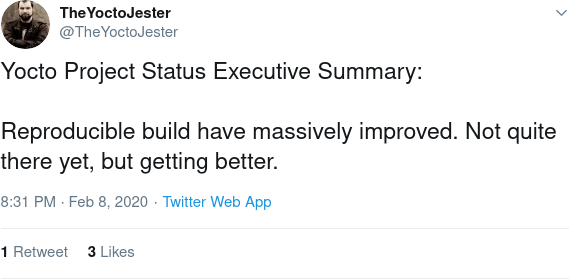
Jeremiah Orians announced on our mailing list the release of a number of tools related to cross-compilation such as M2-Planet and mescc-tools-seed. This project attemps a full bootstrap of a cross-platform compiler for the C programming language (written in C itself) from hex, the ultimate goal being able to demonstrate fully-bootstrapped compiler from hex to the GCC GNU Compiler Collection. This has many implications in and around Ken Thompson s Trusting Trust attack outlined in Thompson s 1983 Turing Award Lecture. Twitter user @TheYoctoJester posted an executive summary of reproducible builds in the Yocto Project: Finally, Reddit user tofflos posted to the /r/Java subreddit asking about how to achieve reproducible builds with Maven and Chris Lamb noticed that the Linux kernel documentation about reproducible builds of it is available on the kernel.org homepages in an attractive HTML format.

Distribution work

Debian Chris Lamb created a merge request for the core debian-installer package to allow all arguments and options from sources.list files (such as [check-valid-until=no] , etc.) in order that we can test the reproducibility of the installer images on the Reproducible Builds own testing infrastructure. (#13) Thorsten Glaser followed-up to a bug filed against the dpkg-source component that was originally filed in late 2015 that claims that the build tool does not respect permissions when unpacking tarballs if the umask is set to 0002. Matthew Garrett posted to the debian-devel mailing list on the topic of Producing verifiable initramfs images as part of a wider conversation on being able to trust the entire software stack on our computers. 59 reviews of Debian packages were added, 30 were updated and 42 were removed this month adding to our knowledge about identified issues. Many issue types were noticed and categorised by Chris Lamb, including:

openSUSE In openSUSE, Bernhard M. Wiedemann published his monthly Reproducible Builds status update as well as provided the following patches:

Software development

diffoscope diffoscope is our in-depth and content-aware diff-like utility that can locate and diagnose reproducibility issues. It is run countless times a day on our testing infrastructure and is essential for identifying fixes and causes of nondeterministic behaviour. Chris Lamb made the following changes this month, including uploading version 137 to Debian:
  • The sng image utility appears to return with an exit code of 1 if there are even minor errors in the file. (#950806)
  • Also extract classes2.dex, classes3.dex from .apk files extracted by apktool. (#88)
  • No need to use str.format if we are just returning the string. [ ]
  • Add generalised support for ignoring returncodes [ ] and move special-casing of returncodes in zip to use Command.VALID_RETURNCODES. [ ]

Other tools disorderfs is our FUSE-based filesystem that deliberately introduces non-determinism into directory system calls in order to flush out reproducibility issues. This month, Vagrant Cascadian updated the Vcs-Git to specify the debian packaging branch. [ ] reprotest is our end-user tool to build same source code twice in widely differing environments and then checks the binaries produced by each build for any differences. This month, versions 0.7.13 and 0.7.14 were uploaded to Debian unstable by Holger Levsen after Vagrant Cascadian added support for GNU Guix [ ].

Project documentation & website There was more work performed on our documentation and website this month. Bernhard M. Wiedemann added a Java Gradle Build Tool snippet to the SOURCE_DATE_EPOCH documentation [ ] and normalised various terms to unreproducible [ ]. Chris Lamb added a Meson.build example [ ] and improved the documentation for the CMake [ ] to the SOURCE_DATE_EPOCH documentation, replaced anyone can with anyone may as, well, not everyone has the resources, skills, time or funding to actually do what it refers to [ ] and improved the pre-processing for our report generation [ ][ ][ ][ ] etc. In addition, Holger Levsen updated our news page to improve the list of reports [ ], added an explicit mention of the weekly news time span [ ] and reverted sorting of news entries to have latest on top [ ] and Mattia Rizzolo added Codethink as a non-fiscal sponsor [ ] and lastly Tianon Gravi added a Docker Images link underneath the Debian project on our Projects page [ ].

Upstream patches The Reproducible Builds project detects, dissects and attempts to fix as many currently-unreproducible packages as possible. We endeavour to send all of our patches upstream where appropriate. This month, we wrote a large number of such patches, including: Vagrant Cascadian submitted patches via the Debian bug tracking system targeting the packages the Civil Infrastructure Platform has identified via the CIP and CIP build depends package sets:

Testing framework We operate a fully-featured and comprehensive Jenkins-based testing framework that powers tests.reproducible-builds.org. This month, the following changes were made by Holger Levsen: In addition, Mattia Rizzolo added an Apache web server redirect for buildinfos.debian.net [ ] and reverted the reshuffling of arm64 architecture builders [ ]. The usual build node maintenance was performed by Holger Levsen, Mattia Rizzolo [ ][ ] and Vagrant Cascadian.

Getting in touch If you are interested in contributing to the Reproducible Builds project, please visit our Contribute page on our website. However, you can get in touch with us via:

This month s report was written by Bernhard M. Wiedemann, Chris Lamb and Holger Levsen. It was subsequently reviewed by a bunch of Reproducible Builds folks on IRC and the mailing list.

Mike Gabriel: My Work on Debian LTS (February 2020)

In February 2020, I have worked on the Debian LTS project only for 5.75 hours (of 20 hours planned). I gave back 12 hours to the pool and reduced my availability to 8 hours per month. Unfortunately, last month I got too distracted by other interesting and challenging projects, and also by some intense personal topics. I herewith send my apology to all LTS team members and all Debian LTS users for not having completed my planned LTS workload. LTS Work light+love
Mike

4 March 2020

Norbert Preining: Okular and restoration of tabs (plus Debian packages)

I have the need to restore my okular tab setup on restart, since I often have quite a lot of pdfs open to view at the same time. Unfortunately, the current okular doesn t provide this feature. There is a merge request by one of the main authors of okular, but it doesn t work for me in a stand-alone setup, that is not running KDE but only Okular. I developed a much simpler fix for the restoration problem (because most of the code is already there!), see this merge request, which although not perfect for sure does the trick for me. I have recently updated Okular for Debian in my private repository, which maybe has triggered an update of the maintainers of Okular to update the package in the main repository, too. Thanks a lot to the maintainers for their work. But since it does not contain my own tab-restore patches, I still provide NMU versioned Okular packages in my private repo:
deb https://www.preining.info/debian unstable main
deb-src https://www.preining.info/debian unstable main
and the git changes to it in this git repo. Enjoy.

2 March 2020

Noah Meyerhans: Buster in the AWS Marketplace

When buster was first released back in early July of last year, the cloud team was in the process of setting up some new accounts with AWS to be used for AMI publication. For various reasons, the accounts we used for pre-buster releases were considered unsuitable for use long term, and the buster release was considered to be a good logical point to make the switch. Unfortunately, issues within the bureaucracy of both SPI/Debian and AWS delayed the complete switch to the new accounts. We have been publishing buster AMIs using a new account since September of 2019, but we have not been able to list them with the AWS Marketplace. This has reduced the visibility and discoverability of the AMIs and lead to numerous questions on the mailing lists and other forums. I m happy to announce today that the issues blocking Marketplace publication have finally been resolved, and buster is officially available in the AWS Marketplace. Please use it, please leave us ratings and reviews in the Marketplace, and most importantly, please feel welcome to contribute to the Debian cloud team. As always, if you d rather get the latest details from the Debian wiki, they re available, or you can query the AWS API directly, e.g. using the awscli command as follows:
$ aws ec2 describe-images --owner 136693071363 \
--region us-east-1 --output json \
--query "Images[?Architecture=='arm64']   [?starts_with(Name, 'debian-10-')]   max_by([], &Name)"
 
"Architecture": "arm64",
"CreationDate": "2020-02-10T19:04:55.000Z",
"ImageId": "ami-031d1abcdcbbfbd8f",
"ImageLocation": "136693071363/debian-10-arm64-20200210-166",
"ImageType": "machine",
"Public": true,
"OwnerId": "136693071363",
"State": "available",
"BlockDeviceMappings": [
 
"DeviceName": "/dev/xvda",
"Ebs":  
"Encrypted": false,
"DeleteOnTermination": true,
"SnapshotId": "snap-0d8459c1e3fe12486",
"VolumeSize": 8,
"VolumeType": "gp2"
 
 
],
"Description": "Debian 10 (20200210-166)",
"EnaSupport": true,
"Hypervisor": "xen",
"Name": "debian-10-arm64-20200210-166",
"RootDeviceName": "/dev/xvda",
"RootDeviceType": "ebs",
"SriovNetSupport": "simple",
"VirtualizationType": "hvm"
 
Hopefully this helps reduce some of the confusion around the availability of the buster AMIs. Next up, GovCloud!

Antoine Beaupr : Moving dconf entries to git

I've been managing my UNIX $HOME repository with version control for almost two decades now (first under CVS, then with git). Once in a while, I find a little hack to make this work better. Today, it's dconf/gsettings, or more specifically, Workrave that I want to put in git. I noticed my laptop was extremely annoying compared with my office workstation and realized I never figured out how to write Workrave's configuration to git. The reason is that its configuration is stored in dconf, a binary database format, but, blissfully, I had forgotten about this and tried to figure out where the heck its config was. I was about to give up when I re-remembered this, when I figured I would just do a quick search ("dconf commit to git") and that brought me to Josh Triplett's Debconf 14 talk about this exact topic. The slides are... a little terse, but I could figure out the gist of it. The key is to change the DCONF_PROFILE environment to point to a new config file (say in your .bashrc):
export DCONF_PROFILE=$HOME/.config/dconf/profile
That file (~/.config/dconf/profile) should be created with the following content:
user-db:user
service-db:keyfile/user
  1. The first line is the default: store everything in this huge binary file.
  2. The second is the magic: it stores configuration in a precious text file, in .config/dconf/user.txt specifically.
Then the last step was to migrate config between the two. For that I need a third config file, a DCONF_PROFILE that has only the text database so settings are forcibly written there, say ~/.config/dconf/profile-edit:
service-db:keyfile/user
And then I can migrate my workrave configuration with:
gsettings list-recursively org.workrave   while read schema key val ; do DCONF_PROFILE=~/.config/dconf/profile-edit gsettings set "$schema" "$key" "$val" ; done
Of course, a bunch of those settings are garbage and do not differ from the default. Unfortuantely, there doesn't seem to be a way to tell gsettings to only list non-default settings, so I had to do things by hand from there, by comparing my generated config with:
DCONF_PROFILE=/dev/null gsettings list-recursively org.workrave
I finally ended up with the following user.txt, which is now my workrave config:
[org/workrave/timers/daily-limit]
snooze=1800
limit=25200
[org/workrave/timers/micro-pause]
auto-reset=10
snooze=150
limit=900
[org/workrave/timers/rest-break]
auto-reset=600
snooze=1800
limit=10800
[org/workrave/breaks/micro-pause]
max-preludes=0
That's a nice setup: "YOLO" settings end up in the binary database that I don't care about tracking in git, and a precious few snowflakes get tracked in a text file. Triplett also made a command to change settings in the text file, but I don't think I need to bother with that. It's more critical to copy settings between the two, in my experience, as I rarely have this moment: "oh I know exactly the key setting I want to change and i'll write it down". What actually happens is that I'm making a change in a GUI and later realize it should be synchronized over. (It looks like Triplett does have a tool to do those diffs and transitions, but unfortunately git://joshtriplett.org/git/home doesn't respond at this time so I can't find that source code.) (Update: that git repository can be downloaded with:
git clone https://joshtriplett.org/git/home
It looks like dconfc is designed to copy settings between the two databases. So my above loop would be more easily written as:
dconf dump /org/workrave/   DCONF_PROFILE=~/.config/dconf/profile-edit dconf load /org/workrave/
Certainly simplifies things. dconfd is also nice although it relies on the above dconfe script which makes it (IMHO) needlessly hard to deploy.) Now if only Firefox bookmarks were reasonable again...

29 February 2020

Chris Lamb: Free software activities in February 2020

Here is my monthly update covering what I have been doing in the free software world during February 2020 (previous month): For the Tails privacy-oriented operating system, I uploaded the following packages to Debian:
Reproducible builds One of the original promises of open source software is that distributed peer review and transparency of process results in enhanced end-user security. However, whilst anyone may inspect the source code of free and open source software for malicious flaws, almost all software today is distributed as pre-compiled binaries. This allows nefarious third-parties to compromise systems by injecting malicious code into ostensibly secure software during the various compilation and distribution processes. The motivation behind the Reproducible Builds effort is to provide the ability to demonstrate these binaries originated from a particular trusted source release: if identical results are generated from a given source in all circumstances, reproducible builds provides the means for multiple third-parties to reach a consensus on whether a build was compromised via distributed checksum validation or some other scheme. The initiative is proud to be a member project of the Software Freedom Conservancy, a not-for-profit 501(c)(3) charity focused on ethical technology and user freedom. Conservancy acts as a corporate umbrella allowing projects to operate as non-profit initiatives without managing their own corporate structure. If you like the work of the Conservancy or the Reproducible Builds project, please consider becoming an official supporter. This month, I: In our tooling, I also made the following changes to diffoscope, our in-depth and content-aware diff utility that can locate and diagnose reproducibility issues, including uploading version 137 to Debian:
Debian I submitted a Request for Package (RFP) bug for hsd, a blockchain-based top-level domain DNS protocol implementation that underpins Handshake and worked on some initial packaging. (#952472)
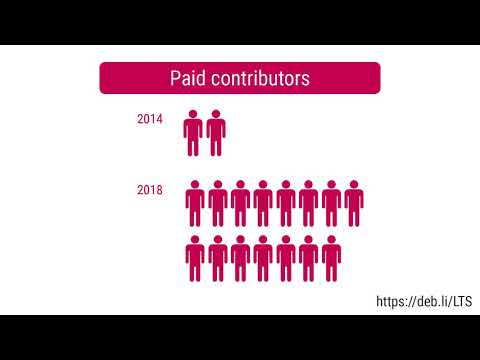
Debian LTS This month I have worked 18 hours on Debian Long Term Support (LTS) and 12 hours on its sister Extended LTS project. You can find out more about the project via the following video:
Uploads Finally, I made a non-maintainer upload of adminer (4.7.6-1) on behalf of Alexandre Rossi.

23 November 2017

Sean Whitton: Using Propellor to provision your Debian development laptop

sbuild is a tool used by those maintaining packages in Debian, and derived distributions such as Ubuntu. When used correctly, it can catch a lot of categories of bugs before packages are uploaded. It does this by building the package in a clean environment, and then running the package through the Lintian, piuparts, adequate and autopkgtest tools. However, configuring sbuild so that it makes use of all of these tools is cumbersome. In response to this complexity, I wrote a module for the Propellor configuration management system to prepare a system such that a user can just go ahead and run the sbuild(1) command. This module is useful on one s development laptop if you need to reinstall your OS, you don t have to look up the instructions for setting up sbuild again. But it s also useful on throwaway build boxes. I can instruct propellor to provision a new virtual machine to build packages with sbuild, and all the different tools mentioned above will be connected together for me. I just uploaded Propellor version 5.1.0 to Debian unstable. The version overhauls the API and internals of the Sbuild module to take better advantage of Propellor s design. I won t get into those details in this post. What I d like to do is demonstrate how you can set up sbuild on your own machines, using Propellor. Getting started with Propellor apt-get install propellor, and then propellor --init. You ll be offered two setups, options A and B. I suggest starting with option B. If you never use Propellor for anything other than provisioning sbuild, you can stick with option B. If this tutorial makes you want to check out more features of Propellor, you might consider switching to option A and importing your old configuration. Open ~/.propellor/config.hs. You will see something like this:

-- The hosts propellor knows about.
hosts :: [Host]
hosts =
        [ mybox
        ]
-- An example host.
mybox :: Host
mybox = host "mybox.example.com" $ props
        & osDebian Unstable X86_64
        & Apt.stdSourcesList
        & Apt.unattendedUpgrades
        & Apt.installed ["etckeeper"]
        & Apt.installed ["ssh"]
        & User.hasSomePassword (User "root")
        & File.dirExists "/var/www"
        & Cron.runPropellor (Cron.Times "30 * * * *")
You ll want to customise this so that it reflects your computer. My laptop is called iris, so I might replace the above with this:
-- The hosts propellor knows about.
hosts :: [Host]
hosts =
        [ iris
        ]
-- My laptop.
iris :: Host
iris = host "iris.silentflame.com" $ props
        & osDebian Testing X86_64
The list of lines beginning with & are the properties of the host iris. Here, I ve removed all properties except the osDebian property, which informs propellor that iris runs Debian testing and has the amd64 architecture. The effect of this is that Propellor will not try to change anything about iris. In this tutorial, we are not going to let Propellor configure anything about iris other than setting up sbuild. (The osDebian property is a pure info property, which means that it tells Propellor information about the host to which other properties might refer, but it doesn t itself change anything about iris.) Telling Propellor to configure sbuild First, add to the import lines at the top of config.hs the lines:
import qualified Propellor.Property.Sbuild as Sbuild
import qualified Propellor.Property.Schroot as Schroot
to enable use of the Sbuild module. Here is the full config for iris, which I ll go through line-by-line:
-- The hosts propellor knows about.
hosts :: [Host]
hosts =
        [ iris
        ]
-- My laptop.
iris :: Host
iris = host "iris.silentflame.com" $ props
        & osDebian Testing X86_64
        & Apt.useLocalCacher
        & sidSchrootBuilt
        & Sbuild.usableBy (User "spwhitton")
        & Schroot.overlaysInTmpfs
        & Cron.runPropellor (Cron.Times "30 * * * *")
  where
        sidSchrootBuilt = Sbuild.built Sbuild.UseCcache $ props
                & osDebian Unstable X86_64
                & Sbuild.update  period  Daily
                & Sbuild.useHostProxy iris
Running Propellor to configure your laptop propellor iris.silentflame.com. In this configuration, you don t need to worry about whether the hostname iris.silentflame.com actually resolves to your laptop. However, it must be possible to ssh root@localhost. This should be enough that spwhitton can:
$ sbuild -A --run-lintian --run-autopkgtest --run-piuparts foo.dsc
Further configuration It is easy to add new schroots; for example, for building backports:
        ...
        & stretchSchrootBuilt
        ...
  where
        ...
        stretchSchrootBuilt = Sbuild.built Sbuild.UseCcache $ props
                & osDebian (Stable "stretch") X86_64
                & Sbuild.update  period  Daily
                & Sbuild.useHostProxy iris
You can also add additional properties to configure your chroot. Perhaps on your LAN you need sbuild to install packages via https, and you already have an apt cacher available. You can replace the apt-cacher-ng configuration like this:
  where
        sidSchrootBuilt = Sbuild.built Sbuild.UseCcache $ props
                & osDebian Unstable X86_64
                & Sbuild.update  period  Daily
                & Apt.mirror "https://foo.mirror/debian/"
                & Apt.installed ["apt-transport-https"]
Thanks Thanks to Propellor s author, Joey Hess, for help navigating Propellor s type system while performing the overhaul included in version 5.1.0. Also for a conversation at DebConf17 which enabled this work by clearing some misconceptions of mine.

Russ Allbery: Holiday haul

Catching up on accumulated book purchases. I'm going to get another burst of reading time over the holidays (and am really looking forward to it). Alfred Bester The Stars My Destination (sff)
James Blish A Case of Conscience (sff)
Leigh Brackett The Long Tomorrow (sff)
Algis Budrys Who? (sff)
Frances Hardinge Fly By Night (sff)
Robert A. Heinlein Double Star (sff)
N.K. Jemisin The Obelisk Gate (sff)
N.K. Jemisin The Stone Sky (sff)
T. Kingfisher Clockwork Boys (sff)
Ursula K. Le Guin City of Illusions (sff)
Ursula K. Le Guin The Complete Orsinia (historical)
Ursula K. Le Guin The Dispossessed (sff)
Ursula K. Le Guin Five Ways to Forgiveness (sff)
Ursula K. Le Guin The Left Hand of Darkness (sff)
Ursula K. Le Guin Planet of Exile (sff)
Ursula K. Le Guin Rocannon's World (sff)
Ursula K. Le Guin The Telling (sff)
Ursula K. Le Guin The World for Word Is Forest (sff)
Fritz Leiber The Big Time (sff)
Melina Marchetta Saving Francesca (mainstream)
Richard Matheson The Shrinking Man (sff)
Foz Meadows An Accident of Stars (sff)
Dexter Palmer Version Control (sff)
Frederick Pohl & C.M. Kornbluth The Space Merchants (sff)
Adam Rex True Meaning of Smekday (sff)
John Scalzi The Dispatcher (sff)
Julia Spencer-Fleming In the Bleak Midwinter (mystery)
R.E. Stearns Barbary Station (sff)
Theodore Sturgeon More Than Human (sff)
I'm listing the individual components except for the Orsinia collection, but the Le Guin are from the Library of America Hainish Novels & Stories two-volume set. I had several of these already, but I have a hard time resisting a high-quality Library of America collection for an author I really like. Now I can donate a bunch of old paperbacks. Similarly, a whole bunch of the older SF novels are from the Library of America American Science Fiction two-volume set, which I finally bought since I was ordering Library of America sets anyway. The rest is a pretty random collection of stuff, although several of them are recommendations from Light. I was reading through her old reviews and getting inspired to read (and review) more.

20 November 2017

Reproducible builds folks: Reproducible Builds: Weekly report #133

Here's what happened in the Reproducible Builds effort between Sunday November 5 and Saturday November 11 2017: Upcoming events On November 17th Chris Lamb will present at Open Compliance Summit, Yokohama, Japan on how reproducible builds ensures the long-term sustainability of technology infrastructure. We plan to hold an assembly at 34C3 - hope to see you there! LEDE CI tests Thanks to the work of lynxis, Mattia and h01ger, we're now testing all LEDE packages in our setup. This is our first result for the ar71xx target: "502 (100.0%) out of 502 built images and 4932 (94.8%) out of 5200 built packages were reproducible in our test setup." - see below for details how this was achieved. Bootstrapping and Diverse Double Compilation As a follow-up of a discussion on bootstrapping compilers we had on the Berlin summit, Bernhard and Ximin worked on a Proof of Concept for Diverse Double Compilation of tinycc (aka tcc). Ximin Luo did a successful diverse-double compilation of tinycc git HEAD using gcc-7.2.0, clang-4.0.1, icc-18.0.0 and pgcc-17.10-0 (pgcc needs to triple-compile it). More variations are planned for the future, with the eventual aim to reproduce the same binaries cross-distro, and extend it to test GCC itself. Packages reviewed and fixed, and bugs filed Patches filed upstream: Patches filed in Debian: Patches filed in OpenSUSE: Reviews of unreproducible packages 73 package reviews have been added, 88 have been updated and 40 have been removed in this week, adding to our knowledge about identified issues. 4 issue types have been updated: Weekly QA work During our reproducibility testing, FTBFS bugs have been detected and reported by: diffoscope development Mattia Rizzolo uploaded version 88~bpo9+1 to stretch-backports. reprotest development reproducible-website development theunreproduciblepackage development tests.reproducible-builds.org in detail Misc. This week's edition was written by Ximin Luo, Bernhard M. Wiedemann, Chris Lamb and Holger Levsen & reviewed by a bunch of Reproducible Builds folks on IRC & the mailing lists.

Dirk Eddelbuettel: RcppEigen 0.3.3.3.1

A maintenance release 0.3.3.3.1 of RcppEigen is now on CRAN (and will get to Debian soon). It brings Eigen 3.3.* to R. The impetus was a request from CRAN to change the call to Rcpp::Rcpp.plugin.maker() to only use :: as the function has in fact been exported and accessible for a pretty long time. So now the usage pattern catches up. Otherwise, Haiku-OS is now supported and a minor Travis tweak was made. The complete NEWS file entry follows.

Changes in RcppEigen version 0.3.3.3.1 (2017-11-19)
  • Compilation under Haiku-OS is now supported (Yu Gong in #45).
  • The Rcpp.plugin.maker helper function is called via :: as it is in fact exported (yet we had old code using :::).
  • A spurious argument was removed from an example call.
  • Travis CI now uses https to fetch the test runner script.

Courtesy of CRANberries, there is also a diffstat report for the most recent release.

This post by Dirk Eddelbuettel originated on his Thinking inside the box blog. Please report excessive re-aggregation in third-party for-profit settings.

Dirk Eddelbuettel: RcppClassic 0.9.9

A maintenance release RcppClassic 0.9.9 is now at CRAN. This package provides a maintained version of the otherwise deprecated first Rcpp API; no new projects should use it. Per a request from CRAN, we changed the call to Rcpp::Rcpp.plugin.maker() to only use :: as the function has in fact been exported and accessible for a pretty long time. So now the usage pattern catches up. Courtesy of CRANberries, there are changes relative to the previous release. Questions, comments etc should go to the rcpp-devel mailing list off the R-Forge page.

This post by Dirk Eddelbuettel originated on his Thinking inside the box blog. Please report excessive re-aggregation in third-party for-profit settings.

17 November 2017

Jonathan Carter: I am now a Debian Developer

It finally happened On the 6th of April 2017, I finally took the plunge and applied for Debian Developer status. On 1 August, during DebConf in Montr al, my application was approved. If you re paying attention to the dates you might notice that that was nearly 4 months ago already. I was trying to write a story about how it came to be, but it ended up long. Really long (current draft is around 20 times longer than this entire post). So I decided I d rather do a proper bio page one day and just do a super short version for now so that someone might end up actually reading it. How it started In 1999 no wait, I can t start there, as much as I want to, this is a short post, so In 2003, I started doing some contract work for the Shuttleworth Foundation. I was interested in collaborating with them on tuXlabs, a project to get Linux computers into schools. For the few months before that, I was mostly using SuSE Linux. The open source team at the Shuttleworth Foundation all used Debian though, which seemed like a bizarre choice to me since everything in Debian was really old and its boot-floppies installer program kept crashing on my very vanilla computers.
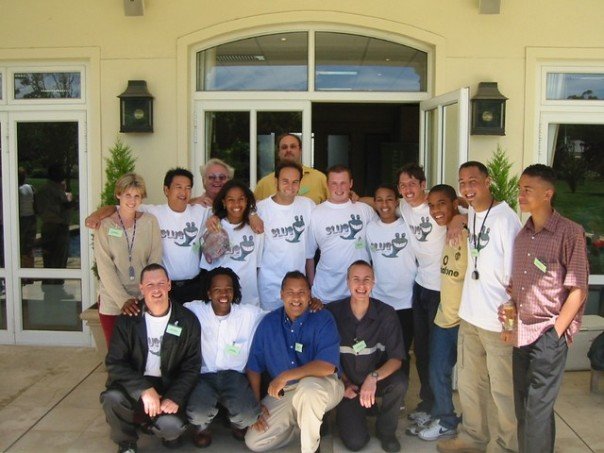
SLUG (Schools Linux Users Group) group photo. SLUG was founded to support the tuXlab schools that ran Linux.

My contract work then later turned into a full-time job there. This was a big deal for me, because I didn t want to support Windows ever again, and I didn t ever think that it would even be possible for me to get a job where I could work on free software full time. Since everyone in my team used Debian, I thought that I should probably give it another try. I did, and I hated it. One morning I went to talk to my manager, Thomas Black, and told him that I just don t get it and I need some help. Thomas was a big mentor to me during this phase. He told me that I should try upgrading to testing, which I did, and somehow I ended up on unstable, and I loved it. Before that I used to subscribe to a website called freshmeat that listed new releases of upstream software and then, I would download and compile it myself so that I always had the newest versions of everything. Debian unstable made that whole process obsolete, and I became a huge fan of it. Early on I also hit a problem where two packages tried to install the same file, and I was delighted to find how easily I could find package state and maintainer scripts and fix them to get my system going again. Thomas told me that anyone could become a Debian Developer and maintain packages in Debian and that I should check it out and joked that maybe I could eventually snap up highvoltage@debian.org . I just laughed because back then you might as well have told me that I could run for president of the United States, it really felt like something rather far-fetched and unobtainable at that point, but the seed was planted :) Ubuntu and beyond

Ubuntu 4.10 default desktop Image from distrowatch

One day, Thomas told me that Mark is planning to provide official support for Debian unstable. The details were sparse, but this was still exciting news. A few months later Thomas gave me a CD with just warty written on it and said that I should install it on a server so that we can try it out. It was great, it used the new debian-installer and installed fine everywhere I tried it, and the software was nice and fresh. Later Thomas told me that this system is going to be called Ubuntu and the desktop edition has naked people on it. I wasn t sure what he meant and was kind of dumbfounded so I just laughed and said something like Uh ok . At least it made a lot more sense when I finally saw the desktop pre-release version and when it got the byline Linux for Human Beings . Fun fact, one of my first jobs at the foundation was to register the ubuntu.com domain name. Unfortunately I found it was already owned by a domain squatter and it was eventually handled by legal. Closer to Ubuntu s first release, Mark brought over a whole bunch of Debian developers that was working on Ubuntu over to the foundation and they were around for a few days getting some sun. Thomas kept saying Go talk to them! Go talk to them! , but I felt so intimidated by them that I couldn t even bring myself to walk up and say hello. In the interest of keeping this short, I m leaving out a lot of history but later on, I read through the Debian packaging policy and really started getting into packaging and also discovered Daniel Holbach s packaging tutorials on YouTube. These helped me tremendously. Some day (hopefully soon), I d like to do a similar video series that might help a new generation of packagers. I ve also been following DebConf online since DebConf 7, which was incredibly educational for me. Little did I know that just 5 years later I would even attend one, and another 5 years after that I d end up being on the DebConf Committee and have also already been on a local team for one.

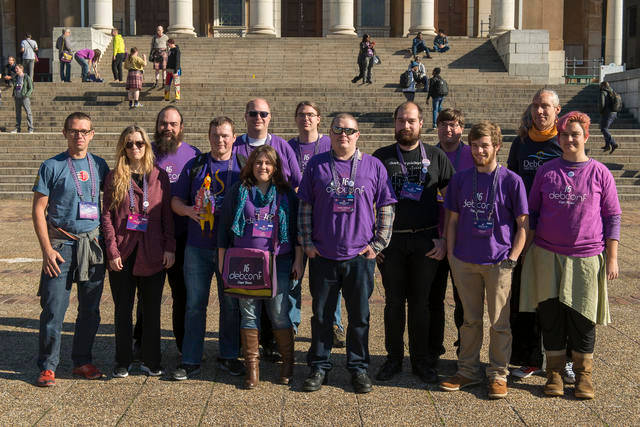
DebConf16 Organisers, Photo by Jurie Senekal.

It s been a long journey for me and I would like to help anyone who is also interested in becoming a Debian maintainer or developer. If you ever need help with your package, upload it to https://mentors.debian.net and if I have some spare time I ll certainly help you out and sponsor an upload. Thanks to everyone who have helped me along the way, I really appreciate it!

Norbert Preining: ScalaFX: Problems with Tables abound

Doing a lot with all kinds of tables in ScalaFX, I stumbled upon a bug in ScalaFX that, with the help of the bug report, I was able to circumvent. It is a subtle bug where types are mixed between scalafx.SOMETHING and the corresponding javafx.SOMETHING.
In one of the answers it is stated that:
The issue is with implicit conversion from TableColumn not being located by Scala. I am not clear why this is happening (maybe a Scala bug).
But the provided work-around at least made it work. Until today I stumbled onto a (probably) just another instance of this bug, but where the same work-around does not help. I am using TreeTableViews and try to replace the children of the root by filtering out one element. The code I use is of course very different, but here is a reduced and fully contained example, based on the original bug report and adapted to use a TreeTableView:
import scalafx.Includes._
import scalafx.scene.control.TreeTableColumn._
import scalafx.scene.control.TreeItem._
import scalafx.application.JFXApp.PrimaryStage
import scalafx.application.JFXApp
import scalafx.scene.Scene
import scalafx.scene.layout._
import scalafx.scene.control._
import scalafx.scene.control.TreeTableView
import scalafx.scene.control.Button
import scalafx.scene.paint.Color
import scalafx.beans.property. ObjectProperty, StringProperty 
import scalafx.collections.ObservableBuffer
// TableTester.scala
object TableTester extends JFXApp  
  val characters = ObservableBuffer[Person](
    new Person("Peggy", "Sue", "123", Color.Violet),
    new Person("Rocky", "Raccoon", "456", Color.GreenYellow),
    new Person("Bungalow ", "Bill", "789", Color.DarkSalmon)
  )
  val table = new TreeTableView[Person](
    new TreeItem[Person](new Person("","","",Color.Red))  
      expanded = true
      children = characters.map(new TreeItem[Person](_))
     )  
    columns ++= List(
      new TreeTableColumn[Person, String]  
        text = "First Name"
        cellValueFactory =  
          _.value.value.value.firstName
         
        prefWidth = 180
       ,
      new TreeTableColumn[Person, String]()  
        text = "Last Name"
        cellValueFactory =  
          _.value.value.value.lastName
         
        prefWidth = 180
       
    )
   
  stage = new PrimaryStage  
    title = "Simple Table View"
    scene = new Scene  
      content = new VBox()  
        children = List(
          new Button("Test it")  
            onAction = p =>  
              val foo: ObservableBuffer[TreeItem[Person]] = table.root.value.children.map(p =>  
                val bar: TreeItem[Person] = p
                p
               )
              table.root.value.children = foo
             
           ,
          table)


// Person.scala
class Person(firstName_ : String, lastName_ : String, phone_ : String, favoriteColor_ : Color = Color.Blue)  
  val firstName = new StringProperty(this, "firstName", firstName_)
  val lastName = new StringProperty(this, "lastName", lastName_)
  val phone = new StringProperty(this, "phone", phone_)
  val favoriteColor = new ObjectProperty(this, "favoriteColor", favoriteColor_)
  firstName.onChange((x, _, _) => System.out.println(x.value))
 
With this code what one gets on compilation with the latest Scala and ScalaFX is:
[error]  found   : scalafx.collections.ObservableBuffer[javafx.scene.control.TreeItem[Person]]
[error]  required: scalafx.collections.ObservableBuffer[scalafx.scene.control.TreeItem[Person]]
[error]               val foo: ObservableBuffer[TreeItem[Person]] = table.root.value.children.map(p =>  
[error]                                                                                          ^
[error] one error found
And in this case, adding import statements didn t help, what a pity. Unfortunately this bug is open since 2014 with a helpwanted tag and nothing is going on. I guess I have to try to dive into the source code of ScalaFX

16 November 2017

Michal Čihař: New projects on Hosted Weblate

Hosted Weblate provides also free hosting for free software projects. The hosting requests queue has grown too long, so it's time to process it and include new project. This time, the newly hosted projects include: If you want to support this effort, please donate to Weblate, especially recurring donations are welcome to make this service alive. You can do that easily on Liberapay or Bountysource.

Filed under: Debian English SUSE Weblate

Colin Watson: Kitten Block equivalent for Firefox 57

I ve been using Kitten Block for years, since I don t really need the blood pressure spike caused by accidentally following links to certain UK newspapers. Unfortunately it hasn t been ported to Firefox 57. I tried emailing the author a couple of months ago, but my email bounced. However, if your primary goal is just to block the websites in question rather than seeing kitten pictures as such (let s face it, the internet is not short of alternative sources of kitten pictures), then it s easy to do with uBlock Origin. After installing the extension if necessary, go to Tools Add-ons Extensions uBlock Origin Preferences My filters, and add www.dailymail.co.uk and www.express.co.uk, each on its own line. (Of course you can easily add more if you like.) Voil : instant tranquility. Incidentally, this also works fine on Android. The fact that it was easy to install a good ad blocker without having to mess about with a rooted device or strange proxy settings was the main reason I switched to Firefox on my phone.

12 November 2017

Ben Armstrong: The Joy of Cat Intelligence

As a cat owner, being surprised by cat intelligence delights me. They re not exactly smart like a human, but they are smart in cattish ways. The more I watch them and try to sort out what they re thinking, the more it pleases me to discover they can solve problems and adapt in recognizably intelligent ways, sometimes unique to each individual cat. Each time that happens, it evokes in me affectionate wonder. Today, I had one of those joyful moments. First, you need to understand that some months ago, I thought I had my male cat all figured out with respect to mealtimes. I had been cleaning up after my oafish boy who made a watery mess on the floor from his mother s bowl each morning. I was slightly annoyed, but was mostly curious, and had a hunch. A quick search of the web confirmed it: my cat was left-handed. Not only that, but I learned this is typical for males, whereas females tend to be right-handed. Right away, I knew what I had to do: I adjusted the position of their water bowls relative to their food, swapping them from right to left; the messy morning feedings ceased. I congratulated myself for my cleverness. You see, after the swap, as he hooked the kibbles with his left paw out of the right-hand bowl, they would land immediately on the floor where he could give them chase. The swap caused the messes to cease because before, his left-handed scoops would land the kibbles in the water to the right; he would then have to scoop the kibble out onto the floor, sprinkling water everywhere! Furthermore, the sodden kibble tended to not skitter so much, decreasing his fun. Or so I thought. Clearly, I reasoned, having sated himself on the entire contents of his own bowl, he turned to pilfering his mother s leftovers for some exciting kittenish play. I had evidence to back it up, too: he and his mother both seem to enjoy this game, a regular fixture of their mealtime routines. She, too, is adept at hooking out the kibbles, though mysteriously, without making a mess in her water, whichever way the bowls are oriented. I chalked this up to his general clumsiness of movement vs. her daintiness and precision, something I had observed many times before. Come to think of it, lately, I ve been seeing more mess around his mother s bowl again. Hmm. I don t know why I didn t stop to consider why And then my cat surprised me again. This morning, with Shadow behind my back as I sat at my computer, finishing up his morning meal at his mother s bowl, I thought I heard something odd. Or rather, I didn t hear something. The familiar skitter-skitter sound of kibbles evading capture was missing. So I turned and looked. My dear, devious boy had squished his overgrown body behind his mother s bowls, nudging them ever so slightly askew to fit the small space. Now the bowl orientation was swapped back again. Stunned, I watched him carefully flip out a kibble with his left paw. Plop! Into the water on the right. Concentrating, he fished for it. A miss! He casually licked the water from his paw. Another try. Swoop! Plop, onto the floor. No chase now, just satisfied munching of his somewhat mushy kibble. And then it dawned on me that I had got it somewhat wrong. Yes, he enjoyed Chase the Kibble, like his mom, but I never recognized he had been indulging in a favourite pastime, peculiarly his own I had judged his mealtime messes as accidents, a very human way of thinking about my problem. Little did I know, it was deliberate! His private game was Bobbing for Kibbles. I don t know if it s the altered texture, or dabbling in the bowl, but whatever the reason, due to my meddling, he had been deprived of this pleasure. No worries, a thwarted cat will find a way. And that is the joy of cat intelligence.

8 November 2017

Neil McGovern: Software Freedom Law Center and Conservancy

Before I start, I would like to make it clear that the below is entirely my personal view, and not necessarily that of the GNOME Foundation, the Debian Project, or anyone else. There s been quite a bit of interest recently about the petition by Software Freedom Law Center to cancel the Software Freedom Conservancy s trademark. A number of people have asked my views on it, so I thought I d write up a quick blog on my experience with SFLC and Conservancy both during my time as Debian Project Leader, and since. It s clear to me that for some time, there s been quite a bit of animosity between SFLC and Conservancy, which for me started to become apparent around the time of the large debate over ZFS on Linux. I talked about this in my DebConf 16 talk, which fortunately was recorded (ZFS bit from 8:05 to 17:30).
This culminated in SFLC publishing a statement, and Conservancy also publishing their statement, backed up by the FSF. These obviously came to different conclusions, and it seems bizarre to me that SFLC who were acting as Debian s legal counsel published a position that was contrary to the position taken by Debian. Additionally, Conservancy and FSF who were not acting as counsel mirrored the position of the project. Then, I hear of an even more confusing move that SFLC has filed legal action against Conservancy, despite being the organisation they helped set up. This happened on the 22nd September, the day after SFLC announced corporate and support services for Free Software projects. SFLC has also published a follow up, which they say that the act is not an attack, let alone a bizarre attack , and that the response from Conservancy, who view it as such was like reading a declaration of war issued in response to a parking ticket . Then, as SFLC somehow find the threat of your trademark being taken away as something other than an attack, they also state: Any project working with the Conservancy that feels in any way at risk should contact us. We will immediately work with them to put in place measures fully ensuring that they face no costs and no risks in this situation. which I read as a direct pitch to try and pull projects away from Conservancy and over to SFLC. Now, even if there is a valid claim here, despite the objections that were filed by a trademark lawyer who I have a great deal of respect for (disclosure: Pam also provides pro-bono trademark advice to my employer, the GNOME Foundation), the optics are pretty terrible. We have a case of one FOSS organisation taking another one to court, after many years of them being aware of the issue, and when wishing to promote a competing service. At best, this is a distraction from the supposed goals of Free Software organisations, and at worst is a direct attempt to interrupt the workings of an established and successful umbrella organisation which lots of projects rely on. I truly hope that this case is simply dropped, and if I was advising SFLC, that s exactly what I would suggest, along with an apology for the distress. Put it this way if SFLC win, then they re simply displaying what would be viewed as an aggressive move to hold the term software freedom exclusively to themselves. If they lose, then it shows that they re willing to do so to another 501(c)3 without actually having a case. Before I took on the DPL role, I was under the naive impression that although there were differences in approach, at least we were coming to try and work together to promote software freedoms for the end user. Unfortunately, since then, I ve now become a lot more jaded about exactly who, and which organisations hold our best interests at heart. (Featured image by Nick Youngson CC-BY-SA-3.0 http://nyphotographic.com/)

Next.

Previous.