Search Results: "hug"

29 April 2008

Steve Kemp: Offer me everything I ask for

I installed Debian upon a new desktop machine yesterday, via a PXE network boot. It was painless. Getting xen up and running, with a 32-bit guest and a 64-bit guest each running XDMCP & VNC was also pretty straightforward. There is a minor outstanding problem with the 32-bit xen guest though; connecting to it from dom0, via XDMCP, I see only a blank window - no login manager running. GDM appears painlessly when I connect via VNC. The relevent configuration file looks like this:
# /etc/gdm/gdm.conf
[security]
AllowRoot=true
AllowRemoteRoot=true
[xdmcp]
Enable=true
The same configuration on the 64-bit guest works OK for both cases. (I like to use XDMCP for accessing the desktop of Xen guests, since it means that I get it all full-screen, and don't have to worry about shortcuts affecting the host system and not the guest - as is the case if you're connecting via VNC, etc). Weirdness. Help welcome; I'm not 100% sure where to look Anyway, once again, a huge thank you to the Debian Developers, bug submitters, and anybody else involved peripherally (such as myself!) with Debian! I love it when a plan comes together. SSL ObRandom: Where is the cheapest place to get an SSL certificate, for two years, which will work with my shiny Apache2 install? Somebody, rightly, called me for not having SSL available as an option on my mail filtering website. I've installed a self-signed certificate just now, but I will need to pay the money and buy a "real" one shortly. So far completessl.com seems to be high in the running: For double-bonus points they accept Paypal which most of my customers pay with .. ObQuote: The Princess Bride

Aigars Mahinovs: The Andromeda Strain 2008

When I heard that there will be a miniseries based on “The Andromeda Strain” book, I was very exited. That was one of my favorite sci-fi books in my childhood. After watching the miniseries I must conclude that this is another book perverted and trivialized by Hollywood. SPOILERS AHEAD! They created some crazy pseido-sci-fi idea that humans from the future sent Andromeda back from the future via a wormhole in a container that contained a message which was then picked up by a satellite that was sent up to investigate the wormhole. No wormhole was there in the book. The book had a much more modest idea - a Scoop satellite was to skim the outer layers of the atmosphere for mutations of common Earth bacteria for military purposes when it was impacted my a micrometeorite carrying the Andromeda. Much more probable, no need to involve wormholes, time travel, ASCII messages, eco-terrorists and a sub-plot on conservation of marine species. Due to extreme modernization of the script, the whole subplot of the teletype mechanical failure was omitted. Andromeda was made sentient instead and communicated via ’some kind of inductive field’ to shoot down a fighter jet and activate a nuke. The survivors and their pH levels got barely a glance. Also the amount of destruction was obviously too low for the movie, so the Andromeda was made to mutate more, spread out of containment easily and even make a flock of birds attack a squad of solders ‘Hitchcock style’. Disgustingly cheap scriptwriting. Huge chunks of plot were ripped out (searching for the micro-meteorite impact crater with different lenses, central core security) and the two hours were filled with Rembo style journalism vs. black ops, selfless president and scenes of animals eating each other and dieing. At the end they ran out of budget and just made it look like presence of Andromeda made air and water bright red so that people would have something to run away from in fear. Oh and the scientists are allowed to freely talk about the event after it’s done. Yeah, right. In my book this movie rates very close to the infamous “The Core” with the only difference that they managed to fuck up a really good book. Do not watch it and read the book instead.

Craig Sanders: poll: package my vhosting system for debian?

There was a discussion today on the LUV-main mailing list about apache virtual hosting. Someone suggested mod_vhost_alias which is OK for a simple solution, but pretty limited. IMO, there are much better ways of doing it. Specifically, generating config fragments for each virtual host. I wrote such a system years ago, and have always thought “I should package it up for debian”. There’s a moderate amount of work involved in doing so, and probably an even larger amount of support work afterwards. Worst of all, I’d have to write - or con someone else into writing - documentation for it (it’s easy enough to use that you can be SHOWN how to use it in 10 minutes, but that isn’t good enough for a distributed package). I guess the point of this blog post is to find out if there’s sufficient interest to make it worth the effort. Feel free to comment or email me about it. If anyone wants to look at the code, i can tar it up easily enough, and even write some simple/minimalist instructions. anyway, here’s (a slightly edited version of) what i posted to LUV-main: Preamble I looked into apache’s mod_vhost stuff years ago, but IMO it’s just too inflexible and limited to be of much use. It’s fine if ALL your vhosts are identical…but not if you need different settings on some or all of them. As soon as you need a custom setting for one vhost, you have to step outside mod_vhost_alias and roll-your-own anyway. which means you now have two different methods of configuring your vhosts. Instead, I’ve used my own vhosting system for years (long before mod_vhost), on dozens of servers…the largest of which had over 500 vhosts on it - the biggest problem was the enormous number of file handles the apache processes needed for log files. After tweaking the kernel file-max etc limits, it actually worked without problem but I always intended to rewrite that bit of it to use a log splitter daemon, perhaps vlogger or similar. Unfortunately, I a) left that job before I had time to implement it, and b) never did figure out a good way to handle the error logs because apache doesn’t prefix the vhost name to ErrorLog output like it does for CustomLog outout (best compromise was to just have one combined error log rather than one per vhost….most web programmers/website operators never look at the error logs anyway. Personally, I find it invaluable, most people don’t even seem to think of looking at it) Synopsis of Operation 1. Creating a new vhost is a 3-step operation:
  1. create a user (with adduser), optionally with a postgres or mysql account of the same name.
  2. edit /etc/virtuals/virtual-hosts.conf, copy/paste/edit one line
  3. run “make”
In step 2, hardly anything needs to be changed from one vhost to another - in the most common case, just the account’s login name, and the domain name. There are a number of different “flags” that can be set for each vhost in this file - ssl, cgi, mason, htdig, webcheck, aliases, group, samba, canonify (use mod_rewrite to redirect back to the site’s canonical name), and more. The Makefile runs perl scripts to generate the apache config fragment (and other config fragments - e.g. for htdig and samba), add/remove any IP addresses if needed (usually not, with name-based vhosts), set up the home directory structure, copy in any sample files (e.g. html forms and images for htdig), and reloads apache. It also checks in any changes to svn (or RCS. easily modified to use other revision control systems). On machines which are part of a load-balanced setup, it even ssh-es into other machines in the array, runs “svn update” and “make” to ensure that the vhost is operational on the other machines too. Finally, it concatenates all the active config fragments into one large file because apache reloads a LOT faster if it doesn’t have to load hundreds of little config files. 2. Removing a vhost is as simple as editing virtual-hosts.conf and commenting out or deleting the line, then running make again. virtual-hosts.conf The virtual-hosts.conf file is extremely useful. It gives me a single authoritative source of all the relevant details about EVERY vhost running on a machine. These details can be used by other scripts (e.g. cron jobs to run webalizer, analog, htdig indexing, webcheck, etc; cgi scripts to display a list of vhosts on the machine with clickable links, and more). This single config file makes the whole system easily extensible: write a new script to parse the config file, and loop through each entry, performing some relevant operation. e.g. run webalizer for every vhost, dumping the output under ~/public_html/LOGS/ (with optional .htaccess file to control access). Adding optional generation of samba shares for each vhost was quite easy. In theory, it wouldn’t be hard to put a GUI or web front-end on to it. Oddly enough, i’ve never bothered. And I’m not inclined to bother now (but wouldn’t object if anyone else did) Database? no, thanks I’ve occasionally thought about putting this config data into a database, but the benefits just aren’t anywhere near good enough to outweigh vi and all the benefits of text file configuration (especially comments!) Packaging? And, of course, one of these days, i should package it all up for debian. I’ve been saying that for years, and just haven’t got around to it. It wouldn’t take a huge amount of work to do so, there are only a few small things i need to do to automate the installation, things that i just do by hand in a few minutes when installing on a new box. Before packaging it, I also want to automate the adduser part of the process, as well as creation of postgres or mysql accounts. Most importantly, I ought to separate the code from the templates in the config fragment generator scripts, so that the local sysadmin can edit them without having to edit the scripts….OK, all up not a tiny job but not particularly big either….just big enough to be ignored on my TODO list for years. I’d definitely have to change the config file format from the current one-line (colon separated fields) to using a .ini style file. I’ve wanted to do that for a while but have inertially-resisted it so far because the one-line format is so convenient…unfortunately, I’ve added so many flags and features over the years that it’s seriously ugly - probably scary to someone who doesn’t know it already (i.e. anyone outside of the set of “me + a handful of other people”). I estimate this would take about a days worth of hacking I’d also take the opportunity to clean up some of the cruft :-) Essential Design Criteria BTW, one crucial design criteria for my system is that it should *NEVER* under any circumstances overwrite any hand-edited changes. This is implemented in a number of ways. First, it takes an md5sum of each vhost’s config fragment when it generates it. If/when the script is run again, it only re-generates the config fragment if the md5sum hasn’t changed. If it has changed, it generates the updated fragment as “.new” for manual merging if required. Secondly, when generating conf fragments it looks for specially named files in a directory for extra stuff to add before the <VirtualHost> line, between the <VirtualHost>…</VirtualHost> lines, and/or after the </VirtualHost> line. This is to provide another location to put custom changes for each vhost while still retaining the ability to have improvements/new features to the script automatically applied to existing vhosts. The reason for this is that I utterly loathe and despise allegedly “easy” configuration tools that blow away custom hand-edited changes. I hate them so much that this was THE major incentive for developing my own vhosting system. In Use I’ve been using my system for over 10 years now. It grew out of earlier bits and pieces, but the current incarnation has been working since 1999, with the occasional new feature or update (e.g. to add support for apache2 as well as apache1, and minor changes to adapt to changes in debian’s apache packaging). There are also a handful of ISPs and several small businesses around Australia running it because they’ve hired me to set up their web servers. Finally… My vhosting system isn’t a system for people who are scared of or dislike command-lines or text-file configs. It’s a system for people who love them, but want an easy way to automate a dull, repetitive task. Such automation is easy for CLI tools, and next to impossible for web/GUI tools. Syndicated from Craig Sanders' Errata: Miscellaneous Thoughts poll: package my vhosting system for debian?

28 April 2008

Joerg Jaspert: New overlord

Please all welcome our new Overlord. Christoph Berg AKA Myon just joined the DAM team. Official delegation mail from Sledge is available here.. :) It won’t change much in the short term (there is no huge backlog right now), but should sure help the team for the long term. Always good to have three people for such a job. Now, is someone yelling German Cabal? NoNo, we aren’t there yet! :) Comments: 0

26 April 2008

Jeff Bailey: Update; Video; Chain Letter; Hacking

Hey'all! Another update of the moment:

Physio is going amazingly well. I feel like my neck / shoulder mobility is close to what it was pre-surgery. My strength is still lagging behind, and I'm doing hefty 3 pound bicep curls! Woohoo! Not so much for my arms, but for my back, which still has to support my arms doing this. I'm also doing 45 pound dips, and some exercises with a yellow theraband. Walking is really tiring me out at all anymore, no matter what distance I walk. As I'm reducing my pain meds, I am starting to get sore, though. Hopefully in the next week that will stabilise. Next Monday I get an ultrasound of some internal organs (I can't remember which, sorry) that will see if I have a non-drug related cause for the ongoing nausea. But so far a pill every day or two seems to be keeping it at bay.

I've posted two more videos of Leif up on YouTube. I have a bunch to sift through, but hopefully there's at least one more good one in the set. I haven't uploaded the pictures yet because I hate f-spot so much. (Ask my sometime why I think it was called f-spot)

I got a fun chain letter from someone asking everyone to boycott Esso and Shell for the rest of the year to force gas prices to come back down the sub dollar-per-litre. This was my reply:


I like high gas prices, though. I want the prices to go much higher.

Every time the prices go up, there are more cyclists on the road, and
the air gets a bit clearer.

If it were $10/litre, then almost noone would drive. We'd all be on
bicycles. Then it we be so much safer to be on a bike.

I can't wait for the day.


What do y'all think?

And on the hacking front, I actually dusted off CVS and fixed some autotools bits in GNU Sysutils so that David could fix a compile bug. I don't know if this round of activity will spur us into doing more. But it's possible. So maybe in another.. Oh, I dunno. decade or so we'll have a full GNU replacement for util-linux that's portable and everything. =)

I might get off my ass and hack on my reimplementation of Galactic Bloodshed through the month of May. I miss that game in a strange pathetic way.

Heading into my last month of off-work recovery time, I'm surprised at how good I feel. I haven't replied to alot of emails I've gotten from folks, even from before the surgery. I'm starting to make headway on the emails, though. Thanks for your patience!

Hugs all!

Theodore Ts'o: Donald Knuth: I trust my family jewels only to Linux

Andrew Binstock interviewed Donald Knuth recently, and one of the more amusing tidbits was this:
I currently use Ubuntu Linux, on a standalone laptop it has no Internet connection. I occasionally carry flash memory drives between this machine and the Macs that I use for network surfing and graphics; but I trust my family jewels only to Linux.
More seriously, I found his comments about about multi-core computers to be very interesting:
I might as well flame a bit about my personal unhappiness with the current trend toward multicore architecture. To me, it looks more or less like the hardware designers have run out of ideas, and that they re trying to pass the blame for the future demise of Moore s Law to the software writers by giving us machines that work faster only on a few key benchmarks! I won t be surprised at all if the whole multithreading idea turns out to be a flop, worse than the “Itanium” approach that was supposed to be so terrific until it turned out that the wished-for compilers were basically impossible to write. Let me put it this way: During the past 50 years, I ve written well over a thousand programs, many of which have substantial size. I can t think of even five of those programs that would have been enhanced noticeably by parallelism or multithreading. Surely, for example, multiple processors are no help to TeX…. I know that important applications for parallelism exist rendering graphics, breaking codes, scanning images, simulating physical and biological processes, etc. But all these applications require dedicated code and special-purpose techniques, which will need to be changed substantially every few years.
This is a very interesting issue, because it raises the question of what next-generation CPU’s need to do in order to be successful. Given that it is no longer possible to just double the clock frequency every 18 months, should CPU architects just start doubling the number of cores every 18 months instead? Or should they try to concentrate a lot more computing power into an individual core, and optimize for a fast and dense interconnect between the CPU’s? The latter is much more difficult, and the advantage of doing the first is that it’s really easy for marketing types to use some cheesy benchmark such as SPECint to help sell the chip, but then people find out that it’s not very useful in real life. Why? Because programmers have proven that they have a huge amount of trouble writing programs that take advantage of these very large multicore computers. Ultimately, I suspect that we will need a radically different way of programming in order to take advantage of these systems, and perhaps a totally new programming language before we will be able to use them. Professor Knuth is highly dubious that the later approach will work, and while I hope he’s wrong (since I suspect the hardware designers are starting to run out of ideas, so it’s time software engineers started doing some innovating), he’s a pretty smart guy, and he may well be right. Of course, another question is whether what would we do with all of that computing power? Whatever happened to the predictions that computers would be able to support voice or visual recognition? And of course, what about the power and cooling issues for these super-high-powered chips? All I can say is, the next couple of years is going to be interesting, as we try to sort out all of these issues.

22 April 2008

Joerg Jaspert: FTPMaster

[Warning, long post ahead. If you aren’t interested in Debian or it’s internals or my work - skip it. :) ] So as you might have read here, I got the delegation of the debadmin AKA FTPMaster group lately. I’ve got some pressure to not accept this delegation, but the response to my blog post about it had been extremely positive, everyone said I should not deny it. Knowing to have such a support within Debian is something I really appreciate, making it worth to spent time on my various jobs. Now, lets take this and write a little about what happened since I gained that extra group: Work I did since then: The above should nicely sum up my work in the past few days. Most of it pretty trivial, but still things that have to be done. I plan to keep doing things, slowly going from the trivial stuff to more complicated ones, but there is lots of stuff ahead. Some ideas, and this is a very incomplete list just from my head, there are tons of things that one could do, include Now, do you have any time to kill? Do you want to help? Some things you could do:

21 April 2008

Andrew Pollock: [life/americania] Four days in San Diego...

...is just not enough time to see the place properly. I took Friday and Monday off, and Thursday night a week ago, Sarah and I flew down to San Diego for a bit of a "Yay, we've achieved normality" escape. We'd intended to go to SeaWorld on Friday, vege out for two days, go to San Diego Zoo on Monday, then fly home on Monday night. Well we did SeaWorld and the zoo as planned, but lazing around the pool never happened, we ended up running ourselves ragged exploring San Diego all day Saturday and Sunday instead. We stayed at The Dana on Mission Bay, which we picked because it was the closest to SeaWorld. The accommodation was more like a motel than a hotel. There were numerous two-storey buildings across a fairly sprawling area. It had frontage onto what I presume was Mission Bay, and also had a Marina attached to it, so the outlook was quite nice. It also had free WiFi, so we could upload photos throughout the stay. The food offerings were pretty good, and reasonably priced as well. SeaWorld was really good. It's been a long time since I've been to the Australian equivalent, but I don't remember it as being as interactive. San Diego's SeaWorld had a Bay Ray feeding area, where you could purchase food (small whole fish), and hand-feed the Bat Rays. That was pretty cool. It took a bit of a courage to leave your hand in the water, palm up, with something the size of sardine dangling between your fingers and let these huge rays literally swim right over your hand so they could suck the fish from between your fingers. There was also a dolphin feeding area, where you could purchase some small fish again, and give the dolphins a pat on the head and then throw them a fish. I really love dolphins, and one day I'd like to be able to swim with them. The main attraction of SeaWorld is the various shows that they do. I think we caught all of the different ones. The killer whales are just amazing. There were a few different programs where for an additional fee, you could swim with various animals. Dolphins and Beluga whales seemed to be the ones we noticed in particular. There were a few oddities, though: The park is owned by a beer company, so there was a part where you could go and get free samples. Two per person per day (I think on the honour system). At least at the food outlet where we bought lunch (they don't allow you to bring in any food or drink from the outside "for the safety of the animals", so they have a nice monopoly on catering) every kid's meal came in a commemorative Shamu blue plastic lunch pail - whether you wanted it or not. There were two empty ones left on the table that Sarah and I sat down at. The lady cleaning up the tables asked us if we wanted them, and we said no, and she promptly chucked them out with the trash. This just struck me as a terrible waste. They obviously cost money and energy to produce, and they're just going to end up in landfill. They could have been washed and reused instead. I felt this was very hypocritical for a park that was trying to send people away with a message about conservation. Other than this nitpick, I thought SeaWorld was really great. It was a good size, and it was doable in one day, in their normal opening hours. I guess it'd be a bit slower with kids. Photos from the day are here. The next two days we spent exploring San Diego. The hotel was conveniently located on an MTS loop, which ran surprising frequently for a weekend (at least compared to public transit in the Bay Area), so we bought day passes on Saturday and Sunday and used it to get to the Old Town transit centre. On Saturday we explored Old Town, which was a historic preservation of how San Diego looked "back in the day". In the afternoon, we also bought 48-hour tickets for the red double-decker "hop on, hop off" tour bus, and did one of the two loops that it offered. The next day, we caught the loop in the opposite direction, and checked out Mission Beach, which was probably the best beach I've seen in California so far (although the water was still far too cold), saw some pretty cool alternative accommodation (possibly for next time), and did part of the other loop on the tour bus, getting off at the USS Midway. This massive retired aircraft carrier is permanently moored at San Diego, and for a fee, you can crawl all over most of it. It was very interesting, and gave a good insight into the life of a sailor. We blew a good 4 hours or so here, and ran out of time to see the entire thing (we didn't make it onto the "island" part of the ship, which we were a bit bummed about). We then caught the trolley back to Old Town, and grabbed a beer at a pub that sold it by the yard glass and half yard glass. We opted for the half yard glass, since the full yard glass seemed a bit unwieldly, and we thought it looked like a hell of a lot of beer, but the half yard glass, whilst also looking like a lot of beer, was only about one and a half pints. We then grabbed some dinner at one of the very authentic looking Mexican restaurants (they had women out the front, almost on the sidewalk making fresh tortillas on the spot) and headed back home. Photos from our exploration are here. On the last day, we went to the San Diego Zoo (which every time I read the URL for, I read it as "Sandie go Zoo!"). This zoo is purportedly the best zoo in the country, but it really didn't blow my socks off. We seemed to have a really hard time navigating the place, and spent a lot of the day walking around in circles trying to find various exhibits. It's also in a bit of a valley, so the circles tended to be up and down hills, which was tiring. I really don't think we were very efficient at all in our coverage of the place. The other thing that I personally found annoying was the cages. The wire was very close together, which made it really hard to take photos, because the camera would keep focusing on the wire, instead of what was behind it. I guess this is why God invented manual focus, but that made it very hard to photograph big cats stalking their cages. The photos we did manage to get are here. Overall, we had a great time in San Diego, and it seems we didn't really scratch the surface. I'd like to go back again and see Balboa Park, the Gaslamp district, and I thought there were more naval vessels that you could look at, but I might be mistaken. Definitely a very nice city.

20 April 2008

Pablo Lorenzzoni: So... it's over

And fisl9.0 is over. This was a great one not only because of its size, but there were so many things at stake that I am positively surprised such a few went wrong. We ve got a lot to think until next one To begin with, there s a major difference between this inter-fisl time: we already know where next s going to be and how much it ll cost us. The event-center cost, as you can imagine, is the most expensive part of our budget, and knowing that in advance, I believe, will play an important role in our planning. Also, we got more time to plan for the next one: it ll be in June, not April, as usual. Moving back to PUCRS (from FIERGS) as fisl s event-center now I can say was scaring me to death. PUCRS is smaller and we were foreseeing a huge event. Guess what! The event was bigger than first imagined, and PUCRS held it without major drawbacks. Sure, lectures were crowded but they were already crowded at FIERGS anyway The expo had more people than FIERGS, but I am sure our sponsors did not think that was a problem ;-) Of course, not everything went OK I think we had two important problems to solve for next fisl: our network must be born already correctly configured for the streaming, and our wireless infrastructure must be stronger. The first one I already wrote about and I think it had to to with the inexperience of the network people this year: apparently they ve put everything under a crappy load-balancing and while this might work for web-surfing or sending small amounts of data, it just hurts anything that should be continuously transfered, like real-time videos. Here is a piece of advice: network planning involves the right amount of everything (the right amount of cables, the right amount of bandwidth, the right amount of uplinks), including the right amount of configuration! I think our network problems were more a case of overconfiguration than one of lack of skills. The problem with the wi-fi is deeper. Maybe I don t completely understand the technology (and people handling it were not very helpful). How do you manage an event like fisl in the wireless front? PUCRS have provided us with enough wi-fi to hold 1500 concurrent connections (so they say), and have reported we never had more than 400 concurrent connections and yet, as many people have reported, to connect our laptops was a hassle. I don t have a laptop, but I ve seem a lot of my friends trying to connect with no luck. During the second day, PUCRS wi-fi technicians told us that the problem was the Access-Points people brought to fisl (according to them there were more than 30) that were, somehow, messing with the channels they were using. So we reserved some channels to PUCRS and asked people to use other ones. I tend to believe that the majority of the people listened to our appeal and reconfigured their Access-Points but no improvement were reported. So, either PUCRS cannot hold more than 400 concurrent connections in their wi-fi system, or there s some other problem we ve not identified. What is the right thing to do? To forbid people to bring their own Access-Points? No way I am going to see the day fisl organizing committee will disallow people to carry their own communication devices!! There must be a better solution I think I am going to study wi-fi at least not to be easily fooled around by this messing the channels crap (please, comment to this article if you have any ideas). Finally, people are dreaming of a 10-thousand people fisl next year. I think it s not more than a dream but hey! When we made the first fisl, there were only 300 people it has been a 9-year long dream Maybe that 10-thousand one will come true, as the previous ones did. I will just add one more problem to our list: the first day long lines to get people s badges must be addressed in a creative way Thanks to all that came to fisl. See you next year!

19 April 2008

Benjamin Mako Hill: Penguicon 6

I've been on the road quite a bit lately. During my manic travel, I have been rather lax about blogging many of my recent talks. After a talk at CHI in Florence on the 7th and a talk at LUG Radio Live USA last Sunday, I'm in Troy, Michigan for Penguicon. It's an incredible combination of a science fiction and a free software/open source conference and it's a huge amount of fun. This morning I gave my Laptop Liberation talk and tonight I'll be helping judge the Open Source-ry Masquerade costume contest -- the very contest were Tron Guy premiered his now famous costume! Tomorrow I'll be giving my Revealing Errors talk which I premiered last Sunday at the LUG Radio event and which I'm really excited about. If you're around and at the event please find me and introduce yourself! If you're in the area, I may have some free time tomorrow night. Don't hesitate to get in contact.

Evan Prodromou: 30 Germinal CCXVI

So, I'm really getting into the podcasts lately. I got myself a personal music player (one of these) in winter, and I've been using it to listen to podcasts while I run. Earideas has been a huge help in finding new podcasts to listen to. I've kind of graduated from the best of earideas feed, which covers a wide variety of podcasts, and I'm trying to dig into things that really matter to me. Three things in particular, of course: wine, parenting, and Open Source/Open Content. I've found a good number of podcasts on the first two subjects, but only a few on the last. Right now I listen to: So, what else is out there for Free, Libre, Open kinda people? Any podcast suggestions? tags:

18 April 2008

Pablo Lorenzzoni: fisl9.0: 2nd day

They ve came down with a participant number for fisl9.0: 7417. That s it over SEVEN THOUSAND! I was told it s still an estimate, since they haven t merged the databases yet (anyway, that s the official number so far). This fisl is huge! One more picture of the crowd, just for the record: Now everything is fine. TVSL went online with no problems (once the network was fixed) and remained broadcasting the event the whole day long. All was so fine that one can think it s even boring! I spent half the day attending our company booth and the other half trying to help the organizing committee. While walking around, two linux-driven home-made robots called my attention. The first one serves water to the guy in front of it: The other one just walks around: On the Debian side of the trench , I met Jo o Eriberto Mota Filho, Debian Developer wannabe who asked me to sign his key. I ve seem he before, since he s a frequent speaker at fisl and welcome him as a future developer. Meanwhile I was reminded by faw that I still owe him my signature since DebConf4!! I signed so many keys in the KSP we held then, that one or two might have been missed I intend to fix that RSN ;-)

Mart&iacute;n Ferrari: I am finally a DD!

*Ahem*... I'm soooo excited! After 884 days, I just became a DD. It was almost two years and a half of much work, learning, patience, struggling to keep the morale up, and more work. In fact, Debian is already taking almost all my free time since months ago, something I don't regret at all. I was able to do most of the things I wanted to do, even without an account, including: DebConf organisation, team-maintaining packages (sorry pkg-perl folks, dc8 didn't leave me much time lately), some QA work, coding tools, etc. But this small feat has a huge symbolic importance to me, now the project as a whole is recognising me as a full member; many people already did individually, but sometimes you need the "official" stuff. So thanks to all the people that helped me during the way (sorry for the omissions!): maxy, for introducing me to Debian, marga for encouraging me to apply to NM —and all the moral support—, des for the help and the sarcasm, damog for being my first AM, even if we had our problems, ana for being my second AM and being so supportive, the Perl-lings for being such a nice bunch of people to work with and to learn from. Thanks also to all the nice people I've met along the way (dudes!), you make Debian a nicer place. Update: There was another paragraph that I butchered after noticing that the actual process in the last 24 hours was different than what I thought. But anyway, my thanks to Sam, Myon and Ganneff for their respective help in this process. Also, I don't want to forget to thank Ganneff for the trust he'd put on me during this time. Tags: Planet Lugfi, Planet Debian, Debian

17 April 2008

Pablo Lorenzzoni: Wow! Fisl exploded!

I have never seem so many people at fisl. Seriously! All the rooms were crowded, all the time same as the expo and the user-group area. Our official counter were stopped at 6667 participants, but that is just because we ve taken the registration database off-line in order to process new registrations on-site. By the end of fisl all the numbers will be summed up, but I heard rumors of 7 thousand people! Awesome! I spent this first day mostly in the TVSL room. We ve had problems with the network all day long. PUCRS technicians and our link providers personnel were trying to figure out where the problem seems to be. Being stuck with a non-functioning stuff, to me this day was mostly a sequence of frustrating attempts to get over the blockage. By the end of the day I was told that they were close to a solution It reminded me of our second year trying to stream fisl, as was best told by Fluendo s Thomas ... This just leads me to an unavoidable conclusion: our network sucks! I had to hear from a Brazilian friend who lives in Europe how wonderful her Gigabit network is grrrrrrr Bored as I was, I went walking around. That, surely, were the best part of fisl so far: meeting old friends. I had the most pleasant chat (yet quick) with Otavio Salvador and Felipe van de Wiel, both friends of long time. I took some pictures of the crowd: And, since I was not available in the morning, when the huge crowd was arriving, I took a picture of a picture taken by Marlon of this initial moments: (It is not really clear in this picture, but beyond the red gates there were as many people as inside)

Matthew Garrett

This week I'm in Mountain View for the X Developers' Conference, where I gave a presentation on things graphics drivers have to care about in order to make suspend/resume work reliably. Various people suggested that I write up an explanation of the current situation, along with some best practices for manufacturers.

One of the major differences between the ACPI specification and the older APM specification is that saving and restoring hardware state is generally left up to the operating system, with the firmware playing a much more passive role. Linux is now able to handle this state restoration for the majority of hardware, but we still have issues with graphics. Modern graphics hardware can be hugely complicated, which to a large extent we've been able to ignore because the platform will initialise it on boot. Many X drivers know how to switch a card from text mode to graphics mode (and vice-versa), but that's not adequate.

What can make this situation even more awkward is that the ACPI specification makes no guarantees about what state the hardware comes up in. It may still be in PCI D3. It may be powered up, but the registers may all be zeroed. It's even valid for the hardware to come up in text mode. A driver has to be able to deal with all of these situations.

So far, we've mostly tried to deal with this situation by running chunks of the video BIOS with applications like vbetool. This is hacky and often works badly - in some cases, it won't work at all (nvidia rewrite the entry point to their video BIOS after boot, in order to prevent situations where someone attempts to POST the card and it tries to jump to bits of the system BIOS that no longer exist). The only long-term option is for the kernel to handle the graphics suspend/resume. There's several levels at which this can be supported:
Since 2.6.25, i915 and later Intel hardware can manage basic mode reprogramming without requiring any external assistance. The radeon kernel modesetting code is also heading in this direction, and we ought to be able to manage something there before too long. The nouveau developers are heading towards the stage of being able to do native mode programming, so there's some hope of progress there as well.

It's not all plain sailing, though. Vendors can wire up hardware in different ways. AMD and Nvidia hardware provides scripts in the ROM that, in theory, abstract this away. The downside to this is that we'll have to put the interpreters for these scripts in kernel space, though this is probably needed for kernel modesetting work anyway. Even then, it's possible that we'll need workarounds for specific pieces of hardware that don't quite behave as we expect them to.

As far as making graphics work over suspend/resume, we have a pretty good idea where we are now (failing on anything other than modern Intel hardware), where we need to be in the future (triumph, huge success, cake) and how to get there (?). However, hardware manufacturers can still help.
Chipset vendors:Tell us how to reinitialise your hardware. If that involves parsing BIOS tables, then please let us know how to do that. Expecting us to jump into your ROM and execute x86 code is ok if that's genuinely the only way to do it, but for any modern hardware that's clearly not the case.
System vendors:Try not to alter your system behaviour too wildly. Requiring magic register writes in order to light up the VGA output does not classify as value add. Please don't have your firmware program text mode directly - we're trying to get away from that. And do not attempt to detect that you're running on Linux and alter your system behaviour. If it's possible for you to tell that you're not running on Windows, that's a bug in Linux. If you rely on that bug, you will break. I'm not joking here in the slightest. The closest thing to a "standard" interface between an OS and the hardware is whatever Windows does, and we're basically aiming for bug-for-bug compatibility there.

Gunnar Wolf: Dear lazyweb: Large volumes strategy?

Wouter, you seem to enjoy using huge filesystem volumes. So, dear lazyweb...
I have a 500GB disk for my users' home partitions - they mainly use it to back up their desktop data, but I do expect them to give it more usage. Anyway - I am currently using around 350GB of it, leaving the rest still unpartitioned. I have switched over to ReiserFS, as online resizing it is way faster than online resizing ext3 - it's basically instantaneous.
It seems I do belong to the old sysadmin school, and I value highly the reliability that comes from not having filesystems too large for their own good - After all, recovering from failure in 10GB is way more probable than doing the same in 100 or 1000, isn't it? But then again, it's just impractical to create /home/samba/ 1,2,3,4,5,6,7,8,9 / and randomly split users' directories inside them. Most users won't use more than a couple MB, but some users (legitimately!) back up tens of GB... It's hard for me to anticipate their needs.
Does any of you have scary stories regarding huge volumes? Or any data supporting the idea that I'm just too old fashioned and that half a TB is a good partition size?
Note that I _am_ holding full backups :)
[update]: So I'm undoubtley an old fart? Everybody seems to have partitions larger than me. Ok, I will stop crying...

16 April 2008

Wouter Verhelst: Actually, you can

Uwe Hermann and Russell Coker talked about resizing ext3 volumes in several scenarios. While they point out interesting things (i.e., the fact that you can resize stuff without losing data), they both get the important bits wrong. Uwe, you can do online resizing. Just use
resize2fs <device-node>
. The kernel will notice that the device is mounted, and perform an online resize. This takes slightly longer than an offline resize, but (a) you don't need to do the fsck, and (b) you can still write and otherwise use the file system while the resize is in progress, so the net result is that you win time, especially if the file system in question is huge (I've done things like resize a 700+G LVM volume by 50-100G, which takes half a minute or so; an fsck will take seriously longer). Russell, resizing the LVM volume on which the root filesystem lives used to deadlock the kernel in the old days, but that bug has been fixed since around Linux 2.6.13. I've done online resizes of the LVM volume (and ext3 filesystem) of my root filesystem many times since then, both on some of my home systems and on huge customer boxes, and never encountered any problems. I really love LVM, especially on servers. /home is full? lvresize -L +5G /dev/<hostname>/home && resize2fs /dev/<hostname>/home, and we can work again.

Simon McVittie: Implementing D-Bus services with telepathy-glib

16:46 < epmf> tp-glib is made of magic

—#telepathy, 2008-04-15

Rob pointed out today that I'd been promising to blog about telepathy-glib for several months and still haven't done so. I think there's too much to cover in one blog post, so I'll start with the oldest part - implementing a service (typically a Telepathy connection manager).

While telepathy-glib is (obviously) intended for Telepathy implementors, I think the ideas we've been implementing are likely to be useful for any D-Bus API, particularly flexible/complex APIs where an object implements many interfaces.

Introduction to telepathy-glib telepathy-glib started out as a collection of code extracted from our XMPP connection manager, telepathy-gabble, but at some point it grew beyond that into a wrapper around/partial replacement for dbus-glib. We've been quite pleased with it, really :-) My first major round of work on telepathy-glib, during the first half of 2007, was to split it out from telepathy-gabble (versions up to 0.5.9 were released as part of Gabble 0.5.x tarballs, in fact), leading to the release of the 0.6.x stable branch in late September. This was very helpful for implementing connection managers - Salut, Idle and telepathy-sofiasip (our connection managers for link-local XMPP, IRC and SIP) all started off by forking/cargo-culting from Gabble, and achieved huge code reductions by porting to telepathy-glib. Also, Will Thompson used it in his Summer of Code project, telepathy-haze, to go from nothing to a working and useful Telepathy implementation based on libpurple in a matter of a few months. The second major round of work, which I'll discuss in a later article, added client code to telepathy-glib, obsoleting the older/worse libtelepathy and allowing client programs like Empathy and telepathy-stream-engine to be written using telepathy-glib. In the process, I accidentally reinvented DBusGProxy :-) More details to come later!
Some background: service-side code generation
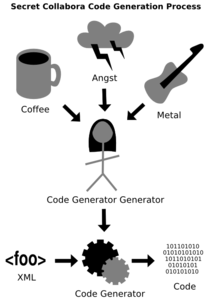
The secret Collabora code-generation process

(credit: daf)

Supporting D-Bus in the GObject world has always involved quite a lot of code generation. The core API of dbus-glib is heavily reliant on varargs functions, which aren't type-safe and are easy to get wrong. dbus-glib contains a program called dbus-binding-tool, which is meant to generate reasonably sane GObject APIs for D-Bus objects. Unfortunately, it seems to be intended to generate a whole GObject at a time. Early versions of telepathy-gabble used dbus-binding-tool plus a script called gengobject.py to generate API stubs for the exported objects; developers then filled in the blanks, and hey presto, we had a GObject on D-Bus. This was fine up to a point, but had a couple of major drawbacks. Whenever we changed the D-Bus API (quite common during the early development of Telepathy), there was a very laborious and error-prone merging process. We ended up with the following process:
  • copy the D-Bus introspection XML from the telepathy-spec repository into a directory xml/pristine (actually, the canonical form for the spec was Python for a while, and we had a script that exported a contrived object onto D-Bus and introspected itself to get the XML - but that's another story!)
  • preprocess the introspection XML to add the dbus-glib CFunctionName annotation, resulting in a directory xml/modified
  • run dbus-binding-tool and a Python script gengobject.py to generate C source in xml/src
  • three-way-diff the old version of xml/src, the new version of xml/src, and the real C code in src to create a new version of src
  • pray that the diff process hadn't randomly exchanged functions' implementations
  • update the resulting code in src so it worked
  • check the whole mess back into darcs
  • hope that nobody else had made changes that would result in darcs conflicts
If you haven't yet gathered, this was a bit of a nightmare. Also, it was very easy to return the wrong thing from a method without noticing - because all the APIs were varargs, the compiler didn't notice, and the first we'd know about it was a mysterious segfault under certain circumstances.
How telepathy-glib fixes code generation telepathy-glib improves on this by taking advantage of this innocuous-looking feature in dbus-glib:
commit 355ef78d98d6fc65715845d56232199162cab12a
Author: Steve Frécinaux <steve istique net>
Date:   Thu Aug 17 11:48:20 2006 +0200
    Interface support for bindings.
Instead of running dbus-binding-tool or creating GObjects with D-Bus interfaces, we put the entire Telepathy spec through glib-ginterface-gen.py, a distant descendant of Gabble's gengobject.py. For each interface in the spec, we generate a GInterface that mirrors the D-Bus interface. Any GObject that implements the GInterface automatically gets the D-Bus interface if it's exported onto D-Bus. There are a few non-obvious refinements, though:
  • The signature of the method implementation is always in the mode that dbus-glib calls "asynchronous", where the method implementation can either send a reply message before or after it returns. For "slow" methods, this is the only thing you can do. For instance, many Telepathy D-Bus methods can't return anything until some TCP round-trips to the server have happened. This is also the only thing you can do if you want to extract extra information, like the sender's unique name, from the method-call message (dbus-glib's "synchronous" API doesn't allow this to be done). For "fast" methods, sending a reply message before returning is just as easy as using the "synchronous" API (it's just a difference of syntax), and has an API consistent with that of the "slow" methods, making it easier for service authors.

  • The layout of the GInterface vtable is private, and (auto-generated) accessor functions are used to fill in implementations. This means our ABI doesn't change just because we re-ordered functions in the spec.

  • If no implementation is provided for a method, we just raise an appropriate error (org.freedesktop.Telepathy.Errors.NotImplemented), rather than suffering an assertion failure. This means we can safely add methods to an interface.

  • While we're generating code anyway, we generate some static inline wrapper functions which wrap dbus_g_method_return(), to have type-safe method returns. You can easily check that a method replies with correct types, by checking that the implementation of Foo() replies by calling tp_svc_some_interface_return_from_foo().

  • Similarly, we generate wrapper functions to emit signals, to get type-safe signal emission.

Not all interfaces are stable enough to be included in telepathy-glib's stable API and ABI, so some of our other projects include a copy of the telepathy-glib code-generation tools, and generate their own "mini-telepathy-glib" (traditionally in a /extensions/ directory) for their implementation-specific (drafts of) interfaces. This isn't yet as polished as it ought to be (mainly because we don't want to freeze the augmented-introspection-XML format that we write the Telepathy spec in, because it's rather ad-hoc and hackish in places) but it works quite well in practice. To see what this looks like in practice, have a look at the examples in telepathy-glib, or at a Telepathy connection manager like telepathy-gabble.
Mixins and base classes Another feature of telepathy-glib which makes life easier for connection manager authors is that it provides "mixins" and base classes which implement some of the GInterfaces. There's absolutely nothing magic about the base classes - they don't have any access to private implementation details of the GInterfaces, they just implement them like everyone else does. The "mixins" are only slightly more magical - they store some extra state inside the structures representing GObjects and their classes, and use it to provide default implementations of some or all of the methods on a particular interface (or two interfaces, in the case of the new TpMessageMixin). I'll leave it up to Rob to explain those in greater detail, since I seem to remember that he invented them :-P The examples and regression tests in telepathy-glib are quite good examples of how these work in practice.

15 April 2008

Lars Wirzenius: Stolen laptop, call home!

The Finnish computer magazine Tietokone has an article on stolen laptops calling home and the police using this to track down thieves. The article reads like a press release from the proprietary software company mentioned in the article, although perhaps that's just because it only mentions that one company. However, the main point is that by having the stolen laptop report its IP number, police can trace it and recover it. In the interest of helping Unix users have similar protection, I provide you with the following crontab snippet:
*/15 * * * * wget -q -O /dev/null http://your.home.page/call-home; true
That page does not need to exist, you just need to be able to access the httpd logs for the web server it accesses to be able to find out the IP number. By using a distinctive URL, you make it easier to grep. Perhaps someone would like to turn that into a Debian package? Add some debconf magic to specify the URL to access, and it should be easily usable. For all the people without a web site of their own, perhaps there would be people interested in operating a server people could use for that. (There's some privacy issues involved, but it's an opt-in thing, obviously, so that lessens them.) Now, to be fair, the proprietary software package mentioned does more than my cron job. For example, they can take control of the system remotely, and wipe it out and make it inoperable. Personally, I don't want that, since it's a huge security risk, but if that kind of thing interests you, you could enhance the cron job a bit. For example, it could download the file and verify that it's GnuPG signed with your key, and if so, execute it as a shell script. One of the risks with this is that if anyone ever happens to get a copy of a file you've made like that, say, your web hosting provider, they can put it there whenever they want to, and boom goes your laptop. I'm sure there are ways around that, but if you want the system, you'll have to solve that yourself.

Alexis Sukrieh: Backup Manager 0.7.7 is released

Yes I know, it’s like a year since the last development release of Backup Manager has been published, I should be ashamed of such a huge idleness. But actually, If you ask me, I’m not. Instead of writing long lines of haiku to apologize for being so late at releasing, here is an illustrated reason why it was so loooong. Good things come to those who wait

Next.

Previous.