Search Results: "edd"

11 November 2013

Simon Josefsson: Using Replicant on Samsung Galaxy S III

For the last half-year I have used CyanogenMod on an Nexus 4 as my main phone. Recently the touch functionality stopped working on parts of the display, and the glass on the back has started to crack. It seems modern phones are not built to last. For comparison, before the N4 I used a Nokia N900 for around 3 years without any hardware damages (in my drawer now, still working). A few weeks ago I started looking for a replacement. My experience with CyanogenMod had been good, but the number of proprietary blobs on the N4 concerned me. Finding something better wasn t easy though, so I m documenting my experience here. My requirements were, briefly, that I wanted a phone that I could buy locally that had a free software community around it that produced a stable environment. I have modest requirements for things I wouldn t give up on: telephony, data connection (3G), email (IMAP+SMTP), chat (XMPP), and a web browser. I like the philosophy and openness around the Firefox OS but the more I have read about it, it seems unlikely that it would deliver what I need today. In particular none of the devices capable of running Firefox OS appealed to me, and the state of email reading seemed unclear. I m sure I ll revisit Firefox OS as an alternative for me in the future.

As I had been happy with CyanogenMod, but concerned about its freeness, it felt natural to move on and test the more free software friendly project Replicant. Replicant only supports a small number of devices. After talking with people in the #replicant IRC channel, it seemed the Samsung S3 would be a decent choice for me. The Samsung S2 would have worked as well, but it cost almost as much as the S3 where I looked. Despite the large number of Samsung S3 devices out there, it seems the prices even for used devices are high (around 2500 SEK in Sweden, ~380 USD). I ended up buying a brand new one for 3200 SEK (~500 USD) which felt expensive, especially after recalling the recent $199 sale for Nexus 4. Noticing that brand new Nexus 4 devices are still over 3000 SEK in Sweden comforted me a bit. I would have preferred a more robust phone, like the CAT B15, but the state of free software OSes on them seem unclear and I wanted something stable. So, enough about the background, let s get started. Building and installing Replicant on the device was straight forward. I followed the Replicant Samsung S3 Build instructions to build my own images. The only issue I had was that I had not set JAVA_HOME and the defaults were bad; make sure to set JAVA_HOME before building. I built everything on my Lenovo X201 running Debian Wheezy, with OpenJDK 6 as the Java implementation. Installing the newly built firmware was easy, I just followed the installation process documentation. I made sure to take a clockworkmod backup to an external SD card before wiping the old system. To get a really clean new device, I also re-formated /sdcard inside clockworkmod; I noticed there were some traces left of the old system there. I spent about one week testing various configurations before settling on something I could use daily. A fair amount of time was spent looking into backup and restore options for Android devices. My idea was that I would take a backup of the apps I ran on the N4 and transfer them to the S3. The Android Debug Bridge (adb) has a backup/restore command, however it (intentionally) ignores apps marked as allowBackup=false which a number of apps has. It doesn t seem possible to override that settings so much for the freedom to backup your own device. I then discovered oandbackup. It can backup your entire system, saving each app (together with associated data) into a separate directory, for simple review and inspection before restore. You can do batch backups and batch restore. I couldn t get it to automatically restore things, though, which would be neat for really automated re-installations (there is an open issue about this feature). After noticing that some apps did not like being moved from the N4 (running Android 4.2) to the S3 (running 4.0), I ended up installing most apps from scratch on a freshly installed Replicant. I use oandbackup to the external SD card so that I can quickly restore my phone. For backup/restore of SMS/MMS and Call Log, I use SMS Backup+ against my own IMAP server. Camera pictures are synced manually using adb when I am connected to my laptop. There is a number of apps that deserve to be mentioned because they are what I use on a daily basis. All of them come via the free software market F-Droid. For email (IMAP/SMTP), I use K-9 Mail which is feature rich but still easy to use. For chat, I use Xabber. I use NewsBlur s free software app to read RSS flows. For two-factor authentication, I use Google Authenticator. I haven t evaluated different PDF viewers, but the first one I tried (APV PDF Viewer) has worked fine so far. Handling a a synchronized address book and calendar deserve its own blog post because it is a challenging topic, but briefly, I m currently using a combination of aCal and DAVdroid. Finally, since Replicant is still work in progress, some words about stability and notes on what doesn t work. This is probably the most interesting part if you are considering running Replicant on an S3 yourself. Overall system stability is flawless, I hadn t had any crash or problem with the fundamental functionality (telephony, 3G, Camera). People have said graphics feels a bit laggy, but I cannot compare with the stock ROM and it doesn t get in the way of daily use. First some notes about non-free aspects: Some other observations: I am quite happy with the setup so far, and I will continue to use it as my primary phone. flattr this!

29 October 2013

Dirk Eddelbuettel: Rcpp 0.10.6

A new maintenance release 0.10.6 of Rcpp is now on the CRAN network for GNU R; binaries for Debian have been uploaded as well. This version ties up a number of smaller loose ends, but also adds a few new things, particularly John's new exposeClass. Details are as usual in the NEWS extract below, and also in the ChangeLog file in the package and on the Rcpp Changelog page.
Changes in Rcpp version 0.10.6 (2013-10-27)
  • Changes in Rcpp API:
    • The function exposeClass takes a description of the constructors, fields and methods to be exposed from a C++ class, and writes C++ and R files in the package. Inherited classes can be dealt with, but require data type information. This approach avoids hand-coding module files.
    • Two missing is<>() templates for CharacterVector and CharacterMatrix have been added, and some tests for is_na() and is_finite() have been corrected thanks to Thomas Tse.
  • Changes in R code:
    • Export linking helper function LdFlags as well as RcppLdFlags.
    • Function Rcpp.package.skeleton() no longer passes a namespace argument on to package.skeleton()
  • Changes in R setup:
    • Raise requirement for R itself to be version 3.0.0 or later as needed by the vignette processing
  • Changes in Rcpp attributes:
    • sourceCpp now correctly binds to Rtools 3.0 and 3.1
Thanks to CRANberries, you can also look at a diff to the previous release 0.10.5. As always, even fuller details are on the Rcpp Changelog page and the Rcpp page which also leads to the downloads, the browseable doxygen docs and zip files of doxygen output for the standard formats. A local directory has source and documentation too. Questions, comments etc should go to the rcpp-devel mailing list off the R-Forge page

This post by Dirk Eddelbuettel originated on his Thinking inside the box blog. Please report excessive re-aggregation in third-party for-profit settings.

Soeren Sonnenburg: Shogun Toolbox Version 3.0 released!

Dear all, we are proud to announce the 3.0 release of the Shogun Machine-Learning Toolbox. This release features the incredible projects of our 8 hard-working Google Summer of Code students. In addition, you get other cool new features as well as lots of internal improvements, bugfixes, and documentation improvements. To speak in numbers, we got more than 2000 commits changing almost 400000 lines in more than 7000 files and increased the number of unit tests from 50 to 600. This is the largest release that Shogun ever had! Please visit http://shogun-toolbox.org/ to obtain Shogun. News Here is a brief description of what is new, starting with the GSoC projects, which deserve most fame: Screenshots Everyone likes screenshots. Well, we have got something better! All of the above projects (and more) are now documented in the form of IPython notebooks, combining machine learning fundamentals, code, and plots. Those are a great looking way that we chose to document our framework from now on. Have a look at them and feel free to submit your use case as a notebook! FGM.html GMM.html HashedDocDotFeatures.html LMNN.html SupportVectorMachines.html Tapkee.html bss_audio.html bss_image.html ecg_sep.html gaussian_processes.html logdet.html mmd_two_sample_testing.html The web-demo framework has been integrated into our website, go check them out. Other changes We finally moved to the Shogun build process to CMake. Through GSoC, added a general clone and equals methods to all Shogun objects, and added automagic unit-testing for serialisation and clone/equals for all classes. Other new features include multiclass LDA, and probability outputs for multiclass SVMs. For the full list, see the NEWS. Workshop Videos and slides In case you missed the first Shogun workshop that we organised in Berlin last July, all of the talks have been put online. Shogun in the Cloud As setting up the right environment for shogun and installing it was always one of the biggest problems for the users (hence the switching to CMake), we have created a sandbox where you can try out shogun on your own without installing shogun on your system! Basically it's a web-service which give you access to your own ipython notebook server with all the shogun notebooks. Of course you are more than welcome to create and share your own notebooks using this service! *NOTE*: This is a courtesy service created by Shogun Toolbox developers, hence if you like it please consider some form of donation to the project so that we can keep up this service running for you. Try shogun in the cloud. Thanks The release has been made possible by the hard work of all of our GSoC students, see list above. Thanks also to Thoralf Klein and Bj rn Esser for the load of great contributions. Last but not least, thanks to all the people who use Shogun and provide feedback. S ren Sonnenburg on behalf of the Shogun team (+ Viktor Gal, Sergey Lisitsyn, Heiko Strathmann and Fernando Iglesias)

Eddy Petri&#537;or: The stupidest trend in laptop design is...

... numpads on laptop keyboards.
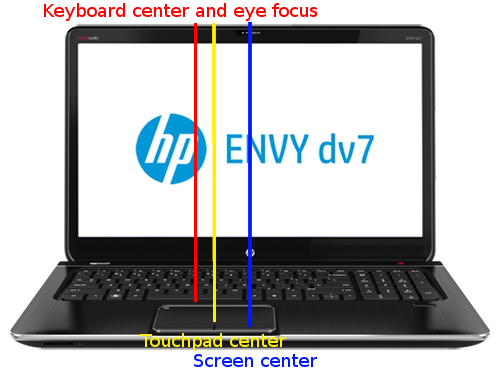
Just because a very, very, very restricted segment of the population is into accounting or other jobs needing frequent numeric input, almost all laptop manufacturers feel the stupid urge to place a numpad on laptops with screens over 14''.

Reasons why a numpad on a laptop is a bad idea:
The numpad forces eye focus and users' hands to be way off center.
The touchpad looks as if it was thrown to the side by accident
Note how the designer tried to offset the misalignment forced
by the numpad by "positioning" the touchpad closer to center,
but not in line with the space bar (and the keyboard)

Without numpad the position is almost perfect!
The symmetry of the laptop improves on the design.
Notice how the touchpad is also centered.


What's worse is that most resellers do not have filters for this particular mis-feature, so you can't easily exclude laptops corrupted by this horrendous idea.

So, if you're a laptop designer, please stop putting numpads on laptops.

It will make for better looking laptops and you'll have the opportunity to be the one stating the obvious: numpads are generally useless! Even on desktop keyboards!

28 October 2013

Dirk Eddelbuettel: Kurt Elling at Dominican University

Some catchup blogging: Kurt Elling was back in town on October 19, and not just in Chicago but quite literally in our little 'burb as the headliner for this season's concerts at Domiminican University. They had done us the favour of inviting Dianne Reeves back in March 2009, but this was clearly going to be a real treat. And I managed to snatch four front row (!!) tickets as soon as I heard about it, and the show once again didn't disappoint. Elling was as usual accompanied by his long-time collaborator Laurence Hobgood on piano, as well as local heros Clark Sommers on bass and John McLean on guitar. This time, Quincy Davies was on drums. And this band is realiably excellent, as is Elling in any live setting. The set was dominated by pieces from his most recent record and augmented by a few other standout pieces. There is a pretty rich set of live music by Elling on YouTube, see for example On Broadway (which was part of the set in a wonderfully fast and funked-up variant), Golden Lady (from the previous album, and also played live this time) or for example this wonderful version of You Send Me (also part of the concert). I snatched a photo or two (while at least turning my flash off, unlike the weird gal to my left, but I digress) and posted one on Google+. Kurt Elling will be back in Chicago at the Green Mill in early January. Expect to me there, and I hope to see you too!

This post by Dirk Eddelbuettel originated on his Thinking inside the box blog. Please report excessive re-aggregation in third-party for-profit settings.

26 October 2013

Russ Allbery: Review: Why We Fail

Review: Why We Fail, by Victor Lombardi
Publisher: Rosenfeld Media
Copyright: 2013
ISBN: 1-933820-17-9
Format: Kindle
Pages: 248
Subtitled Learning from Experience Design Failures, Why We Fail is a case study book. It defines experience design, discusses the usefulness of analyzing failure, and then walks through ten marketplace failures attributed to failures of user experience (as opposed to engineering or user interface) and tries to draw some conclusions about those failures and how they could have been prevented. Lombardi then presents a more general (if fairly simple) framework for iterative experience design, along with some discussion of how that approach could have helped in these cases. Hardware and software designs can work properly but still fail with users and customers because the overall experience isn't right. Sometimes this is because something else got there first with more market share and people got used to it, sometimes it's because a system is too complicated, sometimes it's too simple, sometimes it's just uninspiring. Most of the news media coverage and many of the blog posts on this topic look to inspirational examples of successes. Lombardi points out here that successes can be accidental and failures are often more informative, a concept already common in many more mature areas of engineering. His hope, with Why We Fail, is to push a broader industry practice of taking apart and analyzing the failures. User experience design is still in its infancy, since many of the complex interactions now possible in modern hardware and software have just recently crossed into levels of complexity that qualify as experiences rather than interactions, and could benefit from more rigor. The concept sounds great. The approach in Why We Fail is at least interesting; Lombardi tells good stories, and I think they do tell some useful lessons. Drawing general principles is harder, which is always the weakness of case-study books. Lombardi's own attempt doesn't go far beyond a familiar mantra of the scientific method, small and responsive teams, cross-functional teams with flexibility to address a whole range of technical and business issues, and honest and forthright analysis of and iteration after failure. All of this is doubtless good advice; none of it should surprise anyone with even a smattering of engineering background or familiarity with current software design philosophy. The heart of the book is in the stories, and I did like that Lombardi captured a wide range of different designs. Included are embedded systems (BMW's iDrive), traditional software packages, web services of various types, and even a protocol (OAuth). Some were vaguely familiar and some were not familiar at all, although I don't follow UI and UX discussions to any large extent. In each case, Lombardi gives a short but effective introduction to the problem space and the product, walks through the design choices, and then talks about the failure. Usefully, he doesn't stop with the failure but continues the story through the reaction of the company to the failure and any subsequent actions they took, which in some cases contain their own useful lessons. All of this, I should note, is a bit far afield of my own area of expertise (architectural building blocks and sub-surface components without as much direct interaction with the user), so I'm not the best person to judge the quality and originality of the analysis. But I liked Lombardi's approach and his analysis of multiple possible failure causes, and all of his conclusions seemed quite plausible and sensible given the case studies as described. I'm best-qualified to judge the chapter on OAuth, since I've worked extensively on web authentication systems, and his analysis of the challenges and user experiences in that case closely match my own. I didn't notice any significant errors, which is hopefully a good sign for the rest of the book. As one might expect from a short book about a complex field aimed mostly at starting a conversation, there isn't much here that's earth-shattering, nor are there simple extractable principles that will make your experience designs better. As always, the takeaway boils down to "invest time and resources into this and try to think about it systematically," which of course is true of every possible axis of improvement for any product. (The challenge is usually where to spend those limited resources.) I will also note in passing that Lombardi assumes an entirely market-driven metric for success, and all of the case studies are exclusively commercial not unexpected, since that's where most of the money and a lot of the resources are, but not that helpful for bespoke work where the nature of the problem is subtlely different. But, despite the expected shortcomings and the inherent weakness of the case study approach to analysis, which tries to pluralize anecdote to get data I enjoyed this book. I also got at least one useful trick out of it: the premortem, to look for potential failure points in the experience before rolling out, or even designing, the product. It's a fairly light-weight book, but I think it's moderately inspirational, and I wholeheartedly concur with Lombardi on the merits of failure analysis as an engineering approach. Rating: 7 out of 10

24 October 2013

Dirk Eddelbuettel: Introducing the CRAN Repository Policy Watch

CRAN is the repository network for R. It is a resounding success with (as of right now) almost 5000 packages, and growth rate which has been estimated (cf John Fox's keynote at useR! a few years ago) to be near 40% per year. We as R community members owe a great deal of thanks to the CRAN maintainers, and the R Core team. The tight integration between the language and the contributed code repository is unique among programming languages, and one of the many reasons why CRAN has been such a success and driver of growth and adoption for R. And the amount of work the CRAN maintainers put into this is substantial, and we owe them. Yet there is some friction between the repo maintainers, and the community of developers. There have numerous discussions on the main developer list about various aspect of how CRAN maintains the impeccable quality of the code in the archive. One particular aspect which has bugging (at least me) is the lack of communication when policy changes are made. It would be trivial to posts a set of changes to the developer list, and I suggested as much. Only to be soundly ignored. But changes to text (or html) files can monitored rather easily, and when such changes occur an alert can be sent. So I cooked up rather simple system for this which I called the CRAN Policy Watch. In essence, a simple cronjob monitors changes, and records new versions in a Github repo (which you can follow or star). Alternatively, the cronjob now also tweets from the @CRANPolicyWatch account which I invite everyone to subscribe to as well. If someone knows of a simple tool to summarize diffs of html or text files in static html pages, I'd be interested to expand the service to some github.io pages. Alernatively I could also just commit to a single file too and let Github summarize the changes. This was an itch I needed to scratch, and I hope some other people will fine this useful too.

19 October 2013

Dirk Eddelbuettel: New BH release 1.51.1-3

A new release of the BH package is now on CRAN and its mirrors. BH provides (a subset of) the Boost library for C++, particularly the (large) parts delivered as pure template headers not requiring linking. When this package is installed, an R package developer can deploy it at build-time via a simple LinkingTo: BH declaration (which, despite the title affects only compilation, not linking; don't ask...). This frees developers from having to include the (sizeable) Boost headers in their packages, and provides (parts of) Boost as part of the R build system. A short example of using this BH package with Rcpp is provided in this Rcpp Gallery post; a number of other Boost-related posts are also available. This release expands the scope of the package by a quite bit as shown in the NEWS entry:
Changes in version 1.51.0-3 (2013-10-19)
The other change is that I am now acting as maintainer taking over from Jay who has headed the initial creation and first releases after he, Mike and I had talked about this for way too long without actually doing anything about it. Thanks for getting everything rolling, Jay! Comments and suggestions are welcome via the mailing list or issue tracker available via the package page at R-Forge.

Dirk Eddelbuettel: Yes another Herbie Hancock concert

Hadn't mentioned yet that I saw Herbie Hancock last Friday at the CSO / Symphony Center. That's about the fourth time I have him according to this blog (September 2007,March 2005, April 2004) and I think I saw him two more times when I lived in France, and maybe once while I was in Canada. This time, the format was a horn-free quintet with Lionel Loueke on guitar, James Genus on bass, Vinnie Colaiuta on drums and Zakir Hussain on tabla. Hancock himself played mostly keyboards / synthesizer, even when he used the full piano as input. Overall the concert was little uneven--Hancock himself alluded to the fact that the five hadn't really practised together. At times they were rolling: the opening was a very rhythmic version of his very old standard Watermelon Man; the encore was a very rocking version of his best-selling pop-fusion hit Rockit. In between, it was sometimes wanting. Still, all five are tremendous artists and I also had a fabulous seat as shown in this Google+ post with a picture of Hancock's setup, including multiple screens. But they did not really connect with audience as a whole, and by the time the encore rolled around, the house was pretty empty.

13 October 2013

Dirk Eddelbuettel: Chicago Marathon 2013

A gorgeous day in Chicago for the 37th annual Chicago Marathon. Today was the seventh time I ran this race. I had sat out last fall, and ran a smaller local race (well enough for a BQ). But the last time I ran Chicago I mused that maybe next time I'd train more. I tried, but it didn't quite work with a minor injury dragging on a little. Just like in 2010. And so it continues: it is my home course, and the course I have run the most and know the best. Yet it is the one where I have the greatest difficulty coming in with a time that is good enough for Boston. I knew that today wasn't going to be that day, so I aimed lower to just run even splits (ie running about equal halfs). But even that failed: After 1:44 for the first half I lost a good ten minutes to finish at 3:40:42. Oh well. There is always next year... But it was a simply sunningly fabulous day, and the race was once again very, very well put together. We were worried about extra security: not a real issue. The streets were lined with people and even Lisa and Julia managed to cheer me on at mile 13 (still smiles), mile 19 (grimacing, about to fall apart) and 25 (hanging in). And Anna was working the mile 18 water stop. The worst where miles 20 to 22 when I walked a fair bit. The race results have details; maybe I'll update the chart I made in prior years. One minor FAIL was a wait at the end for gear check. That was pathetic. I guess the folks manning the stand didn't keep bags sorted well enough so lines were long, and slow. Oh well -- the rest was fine, and it remains one of the nicest marathon races. Oh, and the other FAIL was that my Nexus 4 phone couldn't hold a charge til I was done. What's up with that? The running tracker traced me til around mile 20, and then the phone shut down for lack of juice. Disappointing too. But hey, it spares you, dear reader, the look of some bad post-race selfies...

8 October 2013

Petter Reinholdtsen: Skolelinux / Debian Edu 7.1 install and overview video from Marcelo Salvador

The other day I was pleased and surprised to discover that Marcelo Salvador had published a video on Youtube showing how to install the standalone Debian Edu / Skolelinux profile. This is the profile intended for use at home or on laptops that should not be integrated into the provided network services (no central home directory, no Kerberos / LDAP directory etc, in other word a single user machine). The result is 11 minutes long, and show some user applications (seem to be rather randomly picked). Missed a few of my favorites like celestia, planets and chromium showing the Zygote Body 3D model of the human body, but I guess he did not know about those or find other programs more interesting. :) And the video do not show the advantages I believe is one of the most valuable featuers in Debian Edu, its central school server making it possible to run hundreds of computers without hard drives by installing one central LTSP server. Anyway, check out the video, embedded below and linked to above: Are there other nice videos demonstrating Skolelinux? Please let me know. :)

4 October 2013

Rapha&#235;l Hertzog: My Free Software Activities in September 2013

This is my monthly summary of my free software related activities. If you re among the people who made a donation to support my work (86.18 , thanks everybody!), then you can learn how I spent your money. Otherwise it s just an interesting status update on my various projects. Package Tracking System^U Distro Tracker Marko Lalic implemented quite a few interesting features in the last weeks of the Google Summer of Code (support of teams most notably). Unfortunately he didn t deploy (yet) the latest changes on pts.debian.net. Given the good work he made over the summer, I marked him as successful in his GSOC. Hopefully he will stick around and continue to contribute, he promised to try to handle some mass renaming that we agreed upon. Effectively, after much bike-shedding, I decided that the software would be called Distro Tracker . Once those last-minute cleanups are done, I plan to request tracker.debian.org to Debian System Administrators. This means that it will be deployed in parallel to the current PTS at least until we re at feature parity in the new codebase. The new codebase should be much more easy to get started with, so I should do some promotion and invite people to contribute to it possibly by writing some short how to get started documentation. I started by creating a dedicated wiki page: http://wiki.debian.org/qa.debian.org/distro-tracker
Misc packaging I got two REJECTs from ftpmasters this month (one for galette, one for dolibarr). I took care of fixing the various issues in galette and the package has been promptly accepted afterwards. For dolibarr, I mentored the upstream maintainer about the various problems and got him to fix it. It took a bit more time and the package is thus still in NEW. I packaged wordpress 3.6, and then wordpress 3.6.1 (security update). python-django also had multiple security updates this month, I took care of one or two uploads but Luke Faraone dealt with most of them (including backports to Squeeze!). I packaged Publican 3.6.1 and uploaded dh-linktree 0.4 to fix a FTBFS issue introduced with Perl 5.18. Of anecdotal importance, but I also filed bug #721849 after seeing how much energy was spent to ensure debian/rules didn t contain an improper copyright statement. Thanks See you next month for a new summary of my activities.

No comment Liked this article? Click here. My blog is Flattr-enabled.

30 September 2013

Dirk Eddelbuettel: RcppArmadillo 0.3.920.1

Along with the Rcpp 0.10.5 release yesterday, a new minor release 0.3.920.1 of RcppArmadillo came out. It is based on Conrad's Armadillo 3.920.0 plus a minor fix, and uses some of the new Rcpp features. Both package is now on CRAN and also in Debian. This releases contains both a nice set of new Armadillo features as well as some nice additions to RcppArmadillo, due again mostly to Romain. Some of the changes tie into the changes changes in Rcpp 0.10.5 as for example the ability to pass const and const ref more efficiently (and we seem to have forgotten an entry in the NEWS file). The complete list of changes is below.
Changes in RcppArmadillo version 0.3.920.1 (2013-09-27)
  • Upgraded to Armadillo release Version 3.920.1 (Agencia Nacional Stasi)
    • faster .zeros()
    • faster round(), exp2() and log2() when using C++11
    • added signum function: sign()
    • added move constructors when using C++11
    • added 2D fast Fourier transform: fft2()
    • added .tube() for easier extraction of vectors and subcubes from cubes
    • added specification of a fill type during construction of Mat, Col, Row and Cube classes, eg. mat X(4, 5, fill::zeros)
  • Initial implementation of wrap<subview>
  • Improved implementation of as<>() and wrap() for sparse matrices
  • Converted main vignette from LaTeX style minted to lstlisting which permits builds on CRAN; removed set BuildVignettes: FALSE.
Courtesy of CRANberries, there is also a diffstat report for the most recent release As always, more detailed information is on the RcppArmadillo page. Questions, comments etc should go to the rcpp-devel mailing list off the R-Forge page.

29 September 2013

Dirk Eddelbuettel: Rcpp 0.10.5

A new version of Rcpp is now on the CRAN network for GNU R; binaries for Debian have been uploaded as well. Once more, this release brings a large number of exciting changes to Rcpp. Some concern usability, some bring new features, some increase performance; see below for the detailed list. We have now released three updates on a quarterly cycle; if we keep this up the next version ought to be ready at the end of December. As in the past, we tested the release rather rigorously by checking against all packages I could (relatively easily) built on my server: this time it successfully passed \code R CMD check for all 107 packages I can build locally out of a total of 136 packages. (Two failed: one for an error in \code Makevars , and one for the need of an X11 server during tests; this may get addressed in the in test script next time). As all of these 107 packages passed, we do not expect any issues with dependent packages. Should there be issues we would appreciate a note, preferably with reproducible code, to the rcpp-devel mailing list. The complete NEWS entry for 0.10.4 is below; more details are in the ChangeLog file in the package and on the Rcpp Changelog page.
Changes in Rcpp version 0.10.5 (2013-09-28)
  • Changes in R code:
    • New R function demangle that calls the DEMANGLE macro.
    • New R function sizeof to query the byte size of a type. This returns an object of S3 class bytes that has a print method showing bytes and bits.
  • Changes in Rcpp API:
    • Add defined(__sun) to lists of operating systems to test for when checking for lack of backtrace() needed for stack traces.
    • as<T*>, as<const T*>, as<T&> and as<const T&> are now supported, when T is a class exposed by modules, i.e. with RCPP_EXPOSED_CLASS
    • DoubleVector as been added as an alias to NumericVector
    • New template function is<T> to identify if an R object can be seen as a T. For example is<DataFrame>(x). This is a building block for more expressive dispatch in various places (modules and attributes functions).
    • wrap can now handle more types, i.e. types that iterate over std::pair<const KEY, VALUE> where KEY can be converted to a String and VALUE is either a primitive type (int, double) or a type that wraps. Examples :
      • std::map<int, double> : we can make a String from an int, and double is primitive
      • boost::unordered_map<double, std::vector<double> >: we can make a String from a double and std::vector<double> can wrap itself
      Other examples of this are included at the end of the wrap unit test file (runit.wrap.R and wrap.cpp).
    • wrap now handles containers of classes handled by modules. e.g. if you expose a class Foo via modules, then you can wrap vector<Foo>, ... An example is included in the wrap unit test file.
    • RcppLdFlags(), often used in Makevars files of packages using Rcpp, is now exported from the package namespace.
  • Changes in Attributes:
    • Objects exported by a module (i.e. by a RCPP_MODULE call in a file that is processed by sourceCpp) are now directly available in the environment. We used to make the module object available, which was less useful.
    • A plugin for openmp has been added to support use of OpenMP.
    • Rcpp::export now takes advantage of the more flexible as<>, handling constness and referenceness of the input types. For users, it means that for the parameters of function exported by modules, we can now use references, pointers and const versions of them. The file Module.cpp file has an example.
    • No longer call non-exported functions from the tools package
    • No longer search the inline package as a fallback when loading plugins for the the Rcpp::plugins attribute.
  • Changes in Modules:
    • We can now expose functions and methods that take T& or const T& as arguments. In these situations objects are no longer copied as they used to be.
  • Changes in sugar:
    • is_na supports classes DatetimeVector and DateVector
  • Changes in Rcpp documentation:
    • The vignettes have been moved from inst/doc/ to the vignettes directory which is now preferred.
    • The appearance of the vignettes has been refreshed by switching to the Bistream Charter font, and microtype package.
  • Deprecation of RCPP_FUNCTION_*:
    • The macros from the preprocessor_generated.h file have been deprecated. They are still available, but they print a message in addition to their expected behavior.
    • The macros will be permanently removed in the first Rcpp release after July 2014.
    • Users of these macros should start replacing them with more up-to-date code, such as using 'Rcpp attributes' or 'Rcpp modules'.
Thanks to CRANberries, you can also look at a diff to the previous release 0.10.4. As always, even fuller details are on the Rcpp Changelog page and the Rcpp page which also leads to the downloads, the browseable doxygen docs and zip files of doxygen output for the standard formats. A local directory has source and documentation too. Questions, comments etc should go to the rcpp-devel mailing list off the R-Forge page

28 September 2013

Daniel Kahn Gillmor: RIP Cookiepuss

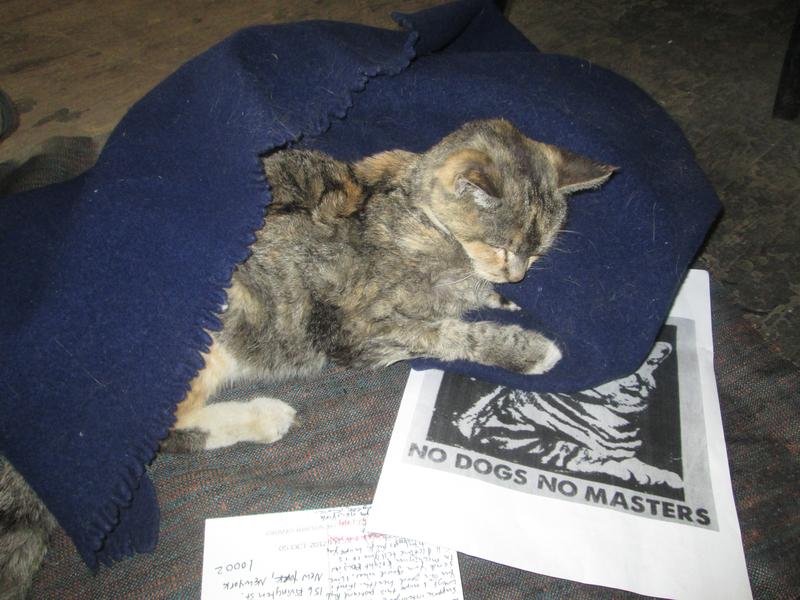
Yesterday, i said a sad goodbye to an old friend at ABC No Rio. Cookiepuss was a steadfast companion in my volunteer shifts at the No Rio computer center, a cranky yet gregarious presence. I met her soon after moving to New York, and have hung out with her nearly every week for years. [Cookiepuss -- No Dogs No Masters] She had the run of the building at ABC No Rio, and was friends with all sorts of people. She was known and loved by punks and fine artists, by experimental musicians and bike mechanics, computer geeks and librarians, travelers and homebodies, photographers, screenprinters, anarchists, community organizers, zinesters, activists, performers, and weirdos of all stripes. For years, she received postcards from all over the world, including several from people who had never even met her in person. In her younger days, she was a ferocious mouser, and even as she shrank with age and lost some of her teeth she remained excited about food. She was an inveterate complainer; a pants-shredder; a cat remarkably comfortable with dirt; a welcoming presence to newcomers and a friendly old curmudgeon who never seemed to really hold a grudge even when i had to do horrible things like help her trim her nails. After a long life, she died having said her goodbyes, and surrounded by people who loved her. I couldn't have asked for better, but I miss her fiercely.
17 September 2013

Julien Danjou: Python 3.4 single dispatch, a step into generic functions

I love to say that Python is a nice subset of Lisp, and I discover that it's getting even more true as time passes. Recently, I've stumbled upon the PEP 443 that describes a way to dispatch generic functions, in a way that looks like what CLOS, the Common Lisp Object System, provides. What are generic functions If you come from the Lisp world, this won't be something new to you. The Lisp object system provides a really good way to define and handle method dispatching. It's a base of the Common Lisp object system. For my own pleasure to see Lisp code in a Python post, I'll show you how generic methods work in Lisp first. To begin, let's define a few very simple classes.
(defclass snare-drum ()
())

(defclass cymbal ()
())

(defclass stick ()
())

(defclass brushes ()
())

This defines a few classes: snare-drum, symbal, stick and brushes, without any parent class nor attribute. These classes compose a drum kit, and we can combine them to play sound. So we define a play method that takes two arguments, and returns a sound (as a string).
(defgeneric play (instrument accessory)
(:documentation "Play sound with instrument and accessory."))

This only defines a generic method: it has no body, and cannot be called with any instance yet. At this stage, we only inform the object system that the method is generic and can be then implemented with various type of arguments. We'll start by implementing versions of this method that knows how to play with the snare-drum.
(defmethod play ((instrument snare-drum) (accessory stick))
"POC!")

(defmethod play ((instrument snare-drum) (accessory brushes))
"SHHHH!")

Now we just defined concrete methods with code. They also takes two arguments: instrument which is an instance of snare-drum and accessory that is an instance of stick or brushes. At this stage, you should note the first difference with object system as built into language like Python: the method isn't tied to any class in particular. The methods are generic, and any class can implement them, or not. Let's try it.
* (play (make-instance 'snare-drum) (make-instance 'stick))
"POC!"

* (play (make-instance 'snare-drum) (make-instance 'brushes))
"SHHHH!"

* (play (make-instance 'cymbal) (make-instance 'stick))
debugger invoked on a SIMPLE-ERROR in thread
#<THREAD "main thread" RUNNING 1002ADAF23 >:
There is no applicable method for the generic function
#<STANDARD-GENERIC-FUNCTION PLAY (2)>
when called with arguments
(#<CYMBAL 1002B801D3 > #<STICK 1002B82763 >).

Type HELP for debugger help, or (SB-EXT:EXIT) to exit from SBCL.

restarts (invokable by number or by possibly-abbreviated name):
0: [RETRY] Retry calling the generic function.
1: [ABORT] Exit debugger, returning to top level.

((:METHOD NO-APPLICABLE-METHOD (T)) #<STANDARD-GENERIC-FUNCTION PLAY (2)> #<CYMBAL 1002B801D3 > #<STICK 1002B82763 >) [fast-method]

As you see, the function called depends on the class of the arguments. The object systems dispatch the function calls to the right function for us, depending on the arguments classes. If we call play with instances that are not know to the object system, an error will be thrown. Inheritance is also supported and the equivalent (but more powerful and less error prone) equivalent of Python's super() is available via (call-next-method).
(defclass snare-drum () ())
(defclass cymbal () ())

(defclass accessory () ())
(defclass stick (accessory) ())
(defclass brushes (accessory) ())

(defmethod play ((c cymbal) (a accessory))
"BIIING!")

(defmethod play ((c cymbal) (b brushes))
(concatenate 'string "SSHHHH!" (call-next-method)))

In this example, we define the stick and brushes classes as subclass of the accessory class. The play method defined will return the sound BIIING! regardless of the accessory instance that is used to play the cymbal. Except in the case where it's a brushes instance; only the most precise method is always called. The (call-next-method) function is used to call the closest parent method, in this case that would be the method returning _"BIIING!".
* (play (make-instance 'cymbal) (make-instance 'stick))
"BIIING!"

* (play (make-instance 'cymbal) (make-instance 'brushes))
"SSHHHH!BIIING!"

Note that CLOS is also able to dispatch on object instances themself by using the eql specializer. But if you're really curious about all features CLOS provides, I suggest you read the brief guide to CLOS by Jeff Dalton as a starter. Python implementation Python implements a simpler equivalence of this workflow with the singledispatch function. It will be provided with Python 3.4 as part of the functools module. Here's a rough equivalence of the above Lisp program.
import functools

class SnareDrum(object): pass
class Cymbal(object): pass
class Stick(object): pass
class Brushes(object): pass

@functools.singledispatch
def play(instrument, accessory):
raise NotImplementedError("Cannot play these")

@play.register(SnareDrum)
def _(instrument, accessory):
if isinstance(accessory, Stick):
return "POC!"
if isinstance(accessory, Brushes):
return "SHHHH!"
raise NotImplementedError("Cannot play these")

We define our four classes, and a base play function that raises NotImplementedError, indicating that by default we don't know what to do. We can then write specialized version of this function with a first instrument, the SnareDrum. We then check for the accessory type that we get, and return the appropriate sound or raise NotImplementedError again if we don't know what to do with it. If we run it, it works as expected:
>>> play(SnareDrum(), Stick())
'POC!'
>>> play(SnareDrum(), Brushes())
'SHHHH!'
>>> play(Cymbal(), Brushes())
Traceback (most recent call last):
File "<stdin>", line 1, in <module>
File "/home/jd/Source/cpython/Lib/functools.py", line 562, in wrapper
return dispatch(args[0].__class__)(*args, **kw)
File "/home/jd/sd.py", line 10, in play
raise NotImplementedError("Cannot play these")
NotImplementedError: Cannot play these
>>> play(SnareDrum(), Cymbal())
Traceback (most recent call last):
File "<stdin>", line 1, in <module>
File "/home/jd/Source/cpython/Lib/functools.py", line 562, in wrapper
return dispatch(args[0].__class__)(*args, **kw)
File "/home/jd/sd.py", line 18, in _
raise NotImplementedError("Cannot play these")
NotImplementedError: Cannot play these

The singledispatch module looks through the classes of the first argument passed to the play function, and calls the right version of it. The first defined version of the play function is always run for the object class, so if our instrument is a class that we did not register for, this base function will be called. For whose eager to try and use it, the singledispatch function is provided Python 2.6 to 3.3 through the Python Package Index. Limitations First, as you noticed in the Lisp version, CLOS provides a multiple dispatcher that can dispatch on the type of any of the argument defined in the method prototype, not only the first one. Unfortunately, Python dispatcher is named singledispatch for this good reason: it only knows to dispatch on the first argument. Guido van Rossum wrote a short article about the subject that he called multimethod a few years ago. Then, there's no way to call the parent function directly. There's no equivalent of the (call-next-method) from Lisp nor the super() function that allows to do that in Python class system. This means you will have to use various trick to bypass this limitation. So while I am really glad that Python is going toward that direction, as it's a really powerful way to enhance an object system, it really lacks a lot of more advanced features that CLOS provides out of the box. Though, improving this could be an interesting challenge. Especially to bring more CLOS power to Hy. :-)
The Hacker Guide to Python
A book I'm writing that will be launched soon, talking about designing Python applications, state of the art, and various Python tips. If you want to be the first to hear about the launch, subscribe now.

15 September 2013

Dirk Eddelbuettel: RProtoBuf 0.3.1

Two months to the day after the previous 0.3.0 release of RProtoBuf, we are happy to announce a maintenance release 0.3.1 which has now arrived on CRAN. RProtoBuf provides GNU R bindings for the Google Protobuf data encoding library used and released by Google. Once again, Murray lead this release and added a number improvements. The NEWS file entry follows:
Changes in RProtoBuf version 0.3.1 (2013-09-13)
  • Added support for setting and getting 64-bit integer types as character strings of decimal integers to work around R's lack of native 64-bit integer types.
  • Added better error handling, documentation, and tests to the extensions support (getExtension and setExtension).
  • Add support to P for returning extension descriptors.
  • Improved error messages to include field names when invalid fields are specified to protocol buffer messages with new, update, etc.
  • Improved configure to detect and pass -std=c++0x if it is available to enable long long 64-bit integer support in Rcpp.
  • Improved configure in the case when pkg-config is not available or does not know about the google protocol buffer includes.
  • Replaced newly deprecated Rcpp macros with a simplified macro functionality to avoid warnings on the latest development version of Rcpp.
CRANberries also provides a diff to the previous release 0.3.0. More information is at the RProtoBuf page which has a draft package vignette, a 'quick' overview vignette and a unit test summary vignette. Questions, comments etc should go to the rprotobuf mailing list off the RProtoBuf page at R-Forge.

3 September 2013

Rapha&#235;l Hertzog: Finding a new name for the Package Tracking System

The Google Summer of Code rewriting the Package Tracking System is approaching its end and I m starting to think about deploying it on debian.org. Its scope has expanded over the years and the rewritten PTS will continue this trend by bringing some new features for teams (like the possibility to subscribe to all packages of a team). I believe that its current hostname (and name) doesn t reflect properly the role of the PTS. Add to this the fact that there s still some work left to be done to reach feature-parity with the current PTS, I m considering deploying it in parallel to the current PTS under a new name. Package Tracking System is also a bit too long for a name, and sounds more like a description than a name But if I get rid of packages.qa.debian.org and Package Tracking System , how should we call the new PTS? :-) The PTS is a sort of central place that brings together information from many parts of Debian. It s currently mainly a consumer/dispatcher of information but I expect to integrate some of the external services that are useful for all Debian derivatives, and it will thus become more and more a producer of first-hand information as well. To replace packages.qa.debian.org, Stefano Zacchiroli suggested me hub.debian.org and I must say I like it, it s short and relatively close to what the PTS actually is (and reminds me of DEP-2 the new PTS will be an asset to make it a reality). My other ideas were devel.debian.org, inside.debian.org, watch.debian.org, track.debian.org, do you have better suggestions? what s your preference? Finding a better name is harder, but there s room to build on the hub concept and similar images. I would like a full name that s not too long and an associated abbreviation/short name for the top-level Python package (currently we use pts for that Python package). Can you come up with something original and satisfactory? My latest thoughts end up with DistroHub as full name and dhub as Python package name. Still boring So, dear lazy web, I heard that we re good at bikeshedding in Debian, so can you come up with something better? Share your suggestions in the comments!

31 comments Liked this article? Click here. My blog is Flattr-enabled.

Julien Danjou: Announcing The Hacker Guide to Python

I've been hacking on Python for a lot of years now, on various project. For the last two years, I've beenheavily involved in OpenStack, which makes an heavy usage of Python. Once you start working with a hundred of hackers, on several software and libraries representing more than half a million source lines of Python, things change. The scalability, testing and deployment problems inherent to a cloud platform meddle with everything in designing components. During these two years working on OpenStack development, I've learned a lot on Python from astounding Python hackers. From general architecture and design principles to various tips and tricks of the language. It seemed to me like a good opportunity to share what I learnt doing so with others so you can benefit from it in other projects. I've started working a book, entitled "The Hacker Guide to Python", where I will try to share what I learnt while working with Python. The book is still a work in progress at this stage, but if you'd like to get in touch and keep updated on its advancement, you can subscribe in the following form or from the book homepage.
The Hacker Guide to Python
A book I'm writing that will be launched soon, talking about designing Python applications, state of the art, and various Python tips. If you want to be the first to hear about the launch, subscribe now.

2 September 2013

Steve Kemp: So that forum?

So that forum I mentioned? I've setup a test-installation at: What does this forum offer? A cross between hacker news and reddit. If the admin of the forums enables it you can create arbitrary tags, and then view them. For example: It's also very fast, and reasonably easy to customize. Which is good, because the current layout is nasty. Things I like: Not much more to say really; except I've setup a test install and if you wish to login/register and post spam feel free.

Next.

Previous.

