Search Results: "bab"

30 March 2016

Mike Gabriel: Pushing X.org Git repos to Github et al.

TL;DR; If you want to know why cloning several of the X.org repositories to Github or GitLab instances fails and how this can be worked around, you may want to continue reading. Why we stumbled over this issue... As a joint effort of the Arctica Project, TheQVD and X2Go, Ulrich Sibiller and I are currently preparing a build workflow for the nxagent X-server (version 3) [1] that allows building nxagent against the modular X.org 7.0 (using autoconf and automake) rather than the monolithic build workflow of X.org 6.9 (using ancient imake). Our goal is to rewind all X.org components required for building nxagent back to a state where nxagent successfully builds and runs. Then we will go through various, (probably) monthly cycles of Our first hurdle... After Ulrich now has a functioning nxagent-against-X.org-7.0-workflow locally, we want to get everything into the Arctica Project's Github namespace. Which fails...
[mike@minobo xorg.upstream]$ git clone https://anongit.freedesktop.org/git/xorg/lib/libX11.git
Cloning into 'libX11'...
remote: Counting objects: 18520, done.
remote: Compressing objects: 100% (3441/3441), done.
remote: Total 18520 (delta 15094), reused 18325 (delta 14954)
Receiving objects: 100% (18520/18520), 5.98 MiB   549.00 KiB/s, done.
Resolving deltas: 100% (15094/15094), done.
Checking connectivity... done.
[mike@minobo xorg.upstream]$ cd libX11/
[mike@minobo libX11 (master)]$ git remote rename origin upstream 
[mike@minobo libX11 (master)]$ git remote add origin git@github.com:ArcticaProject/libX11.git
[mike@minobo libX11 (master)]$ git push --mirror origin 
Counting objects: 18520, done.
Delta compression using up to 4 threads.
Compressing objects: 100% (3301/3301), done.
remote: error: object 70d5e4d45dd7bf1e05b099cb5a4dd529344084f0: missingSpaceBeforeDate: invalid author/committer line - missing space before date
remote: fatal: Error in object
error: pack-objects died of signal 13
error: failed to push some refs to 'git@github.com:ArcticaProject/libX11.git'
This issue should be a known issue at X.org / Mesa upstream [2]. The underlying problem occurs with Git 2.5 and above... If you run git-fsck from Git (>= 2.5) against several of the X.org Git repositories, you will stumble over the above issue. For libX11.git, we see these errors reported when running git-fsck from current Debian unstable:
mike@sid:~/xorg/libX11.git$ git fsck 
Checking object directories: 100% (256/256), done.
error in tag 70d5e4d45dd7bf1e05b099cb5a4dd529344084f0: missingSpaceBeforeDate: invalid author/committer line - missing space before date
error in tag a3bfe698090a5d41f1e9acb1b57a049085d6b04e: missingSpaceBeforeDate: invalid author/committer line - missing space before date
error in tag c1fc8c9aec1bc92d03d08d5e986dd40b194a7a3e: missingSpaceBeforeDate: invalid author/committer line - missing space before date
error in tag d4c27f7e7d8e2ea32418f341ad85c33f3b76862d: missingSpaceBeforeDate: invalid author/committer line - missing space before date
error in tag 79780379aee21bf4d4bcb046a3b54774893ea6b1: missingSpaceBeforeDate: invalid author/committer line - missing space before date
error in tag a638de80ec20dc1de625cd323ed19a6646fecf2e: missingSpaceBeforeDate: invalid author/committer line - missing space before date
error in tag f6a6414e4e52a971a35fd118c350567e2383d034: missingSpaceBeforeDate: invalid author/committer line - missing space before date
error in tag b5c6810e21be2e7ccfac8f0539d46bf75dbe50a0: missingSpaceBeforeDate: invalid author/committer line - missing space before date
error in tag 86cec9d20428cc190ec7278a0abe481b180288ac: missingSpaceBeforeDate: invalid author/committer line - missing space before date
error in tag ac912988091574790c7cffbbc2c60b8c59f8fcef: missingSpaceBeforeDate: invalid author/committer line - missing space before date
error in tag 2d01674092951cd3284b3b099978b2436ea468ad: missingSpaceBeforeDate: invalid author/committer line - missing space before date
error in tag 922d0534154668918eaa09a36cc5cd53fc6b71b7: missingSpaceBeforeDate: invalid author/committer line - missing space before date
error in tag 8ef91b9cc0a4a7b0361f6b40b3f735221c8272cb: missingSpaceBeforeDate: invalid author/committer line - missing space before date
error in tag 1516173727005a87aa501e1ad708d72e6ae6e753: missingSpaceBeforeDate: invalid author/committer line - missing space before date
error in tag 77c9e63a3abff1593ccbed249b2c3ae7f68e1833: missingSpaceBeforeDate: invalid author/committer line - missing space before date
error in tag 58044c7087137ce2b521297dbb31934ccaedc94e: missingSpaceBeforeDate: invalid author/committer line - missing space before date
error in tag 2e0d061c6830891dcc856a04aac900e5bb6d0779: missingSpaceBeforeDate: invalid author/committer line - missing space before date
error in tag 2f58c7cc4cbf3d30927f6301039b6bf018ed38fd: missingSpaceBeforeDate: invalid author/committer line - missing space before date
error in tag 77fc2e1e26019c3ba92275d249fe1979570255d2: missingSpaceBeforeDate: invalid author/committer line - missing space before date
error in tag 9b2e06fa262f23dbcbbccd42be6477e08a452268: missingSpaceBeforeDate: invalid author/committer line - missing space before date
error in tag 7f99410bb9cc9f7cbbc2d43d8ad044771a6eec0a: missingSpaceBeforeDate: invalid author/committer line - missing space before date
error in tag 99b59b83f126b4abb9da89f577a5b8147d543c25: missingSpaceBeforeDate: invalid author/committer line - missing space before date
error in tag 97170c33f99761acd932f968e21d6d7664e7ba80: missingSpaceBeforeDate: invalid author/committer line - missing space before date
error in tag b39966d452127c992987d082f69321f950ae4c39: missingSpaceBeforeDate: invalid author/committer line - missing space before date
error in tag 05e20c3bd8ac6b7e873607db73894486a4ac0519: missingSpaceBeforeDate: invalid author/committer line - missing space before date
error in tag f478497b5a3e9d6b92237e0f408c9f0f18108f52: missingSpaceBeforeDate: invalid author/committer line - missing space before date
error in tag c5ed936f28ce70c8932e33d67a6e06d140e35ba8: missingSpaceBeforeDate: invalid author/committer line - missing space before date
error in tag 2b6beba295a6ff997dfe15a732c95ae6577fa735: missingSpaceBeforeDate: invalid author/committer line - missing space before date
error in tag 32edbb1e9c5b7d1c6f8639dab85e5368d303df7f: missingSpaceBeforeDate: invalid author/committer line - missing space before date
error in tag 490fbe2afb9ffc7057c0eb150f7cdd4d4fa8686c: missingSpaceBeforeDate: invalid author/committer line - missing space before date
error in tag fc605ac48bd7d675d6d04162a0f3bfebe27f2037: missingSpaceBeforeDate: invalid author/committer line - missing space before date
error in tag 6289ecc26d1d505f395c59da744a9354d7aad2a2: missingSpaceBeforeDate: invalid author/committer line - missing space before date
error in tag 8c9c30dac72aebd1a2c31a55a47c0ac11bc328db: missingSpaceBeforeDate: invalid author/committer line - missing space before date
error in tag 3b7aa57994924be0dad693e837559d9ee900299c: missingSpaceBeforeDate: invalid author/committer line - missing space before date
error in tag b02ad9a8ec96e3c1027ca71289aeef5b8748e17e: missingSpaceBeforeDate: invalid author/committer line - missing space before date
error in tag 4402ab1a86226a9cd0ce84fb8147b1c4958c684d: missingSpaceBeforeDate: invalid author/committer line - missing space before date
error in tag bb02b4fbde316644c771d28d5edeeb9b213a6d6a: missingSpaceBeforeDate: invalid author/committer line - missing space before date
error in tag 95b6462c70213b562c9d2b8726eda706edc9c456: missingSpaceBeforeDate: invalid author/committer line - missing space before date
error in tag a99fea43ad53907623f269942c55237c238645e0: missingSpaceBeforeDate: invalid author/committer line - missing space before date
error in tag 0c417ce98a6cf927ce7a1359b198b2bb746c707e: missingSpaceBeforeDate: invalid author/committer line - missing space before date
error in tag ce3ff6b102f360fc9dcd3a85361f44da054de0b1: missingSpaceBeforeDate: invalid author/committer line - missing space before date
error in tag 2fb7b16b38a365c5009bd170d4463634c1f3de26: missingSpaceBeforeDate: invalid author/committer line - missing space before date
error in tag 95570f484bfde5fc2ed8548cb17b87d8114a2866: missingSpaceBeforeDate: invalid author/committer line - missing space before date
error in tag d6e5895c104cfe0d135494a605013dd2910a93a1: missingSpaceBeforeDate: invalid author/committer line - missing space before date
error in tag 49be7144523c4a56afcb389a9aa021d167710d2c: missingSpaceBeforeDate: invalid author/committer line - missing space before date
error in tag 020353d1b982ac938d229039ca13bfea5793fcd9: missingSpaceBeforeDate: invalid author/committer line - missing space before date
error in tag 991792d4f8477ab65ad4d8a0245c9a3bbb1f0294: missingSpaceBeforeDate: invalid author/committer line - missing space before date
error in tag e8037555efe299a7143370b485f754f6b08ffac7: missingSpaceBeforeDate: invalid author/committer line - missing space before date
error in tag 4fdc8e36a5022f3e32d5567305d8e9cde4011f1a: missingSpaceBeforeDate: invalid author/committer line - missing space before date
error in tag 9c93a19a76163328e30a7306bb0babe3175fb9a2: missingSpaceBeforeDate: invalid author/committer line - missing space before date
error in tag 9f90bf4424250f80340b3e2803d343c74d2adb0b: missingSpaceBeforeDate: invalid author/committer line - missing space before date
error in tag 2e7a8c7974777e3e869de9013025dc3f61633e1e: missingSpaceBeforeDate: invalid author/committer line - missing space before date
error in tag 59b7c06da2a64d72668394e9239e3dfe8a5cff59: missingSpaceBeforeDate: invalid author/committer line - missing space before date
error in tag 0263c4f684faa9a5126a0db524d5d35be7277e52: missingSpaceBeforeDate: invalid author/committer line - missing space before date
error in tag 1514e654c1a9b346cbfca5a81f6d331f106242aa: missingSpaceBeforeDate: invalid author/committer line - missing space before date
error in tag 6aa83ec3d1d82ee332cedcf4e99d3cbd56e73edd: missingSpaceBeforeDate: invalid author/committer line - missing space before date
Checking objects: 100% (18523/18523), done.
What actually is going wrong here... When looking at one of those tags (luckily, only tags are affected), we see that something's not ok with the date string of the tag (I am not a Git plumber, so sorry for being superficial here):
mike@sid:~/xorg/libX11.git$ git show 2fb7b16b38a365c5009bd170d4463634c1f3de26
tag XORG-RELEASE-1-TM-MERGE
Tagger: Alan Coopersmith 
Date:   Thu Jan 1 00:00:00 1970 +0000
        ^^^^^^^^^^^^^^^^^^^^^^^^^^^^^
commit 84adc60cae8e944777563501dd633622a28bdb3b
Author: Alan Coopersmith 
Date:   Sat Mar 27 07:08:16 2004 +0000
    Fix typo (IsModiferKey should be IsModifierKey)
[... not quoting the diff for the above commit ...]
How to work around that issue... We then got the idea that we could redo those tags with the date string derived from the commit that this tag points at. This can be scripted (credits go to an unnamed person in Ulrich's surrounding!!!):
mike@sid:~/xorg/libX11$ cat repair.sh
#!/bin/bash
set -x
git fsck 2>&1   tee git-fsck.log   grep "error in tag"   sed -r -e 's/error in tag ([0-9a-f]+):.*/\1/p'   while read broken; do
         echo $broken
         commit=$(git rev-parse $ broken ^ commit )
         tag=$(git cat-file tag $broken   sed -n 's/^tag //p')
         tag_msg=$(git cat-file tag $broken   sed -n '/^$/,$p'   tail -n +2)
         export GIT_COMMITTER_NAME="$(git log -1 --format='%cn' $commit)"
         export GIT_COMMITTER_EMAIL="$(git log -1 --format='%ce' $commit)"
         export GIT_COMMITTER_DATE="$(git log -1 --format='%cD' $commit)"
         git tag -a -f -m "$tag_msg" $tag $commit
done
# drop all old content...
git reflog expire --expire=all --all
git gc --prune=all
# no more errors should be reported...
git fsck
Copy this repair.sh into the Git repo itself and let the script walk over your tags. After this script has been applied you can push the X.org Git repo with broken tags redone to Git hosters like Github or GitLab. light+love,
Mike [1] https://github.com/ArcticaProject/nx-libs
[2] https://lists.freedesktop.org/archives/mesa-dev/2016-February/106268.html

Julien Danjou: The OpenStack Schizophrenia

When I started contributing to OpenStack, almost five years ago, it was a small ecosystem. There were no foundation, a handful of projects and you could understand the code base in a few days. Fast forward 2016, and it is a totally different beast. The project grew to no less than 54 teams, each team providing one or more deliverable. For example, the Nova and Swift team each one produces one service and its client, whereas the Telemetry team produces 3 services and 3 different clients. In 5 years, OpenStack went to a few IaaS projects, to 54 different teams tackling different areas related to cloud computing. Once upon a time, OpenStack was all about starting some virtual machines on a network, backed by images and volumes. Nowadays, it's also about orchestrating your network deployment over containers, while managing your application life-cycle using a database service, everything being metered and billed for. This exponential growth has been made possible with the decision of the OpenStack Technical Committee to open the gates with the project structure reform voted at the end of 2014. This amendment suppresses the old OpenStack model of "integrated projects" (i.e. Nova, Glance, Swift ). The big tent, as it's called, allowed OpenStack to land new projects every month, growing from the 20 project teams of December 2014 to the 54 we have today multiplying the number of projects by 2.7 in a little more than a year. Amazing growth, right? And this was clearly a good change. I sat at the Technical Committee in 2013, when projects were trying to apply to be "integrated", after Ceilometer and Heat were. It was painful to see how the Technical Committee was trying to assess whether new projects should be brought in or not. But what I notice these days, is how OpenStack is still stuck between its old and new models. On one side, it accepted a lot of new teams, but on the other side, many are considered as second-class citizens. Efforts are made to continue to build an OpenStack project that does not exist anymore. For example, there is a team trying to define what's OpenStack core, named DefCore. That is looking to define which projects are, somehow, actually OpenStack. This leads to weird situations, such as having non-DefCore projects seeing their doc rejected from installation guides. Again, I reiterated my proposal to publish documentation as part of each project code to solve that dishonest situation and put everything on a level playing field Some cross-projects specs are also pushed without implication of all OpenStack projects. For example, The deprecate-cli spec which proposes to deprecate command-line interface tools proposed by each project had a lot of sense in the old OpenStack sense, where the goal was to build a unified and ubiquitous cloud platform. But when you now have tens of projects with largely different scopes, this start making less sense. Still, this spec was merged by the OpenStack Technical Committee this cycle. Keystone is the first project to proudly force users to rely on openstack-client, removing its old keystone command line tool. I find it odd to push that specs when it's pretty clear that some projects (e.g. Swift, Gnocchi ) have no intention to go down that path. Unfortunately, most specs pushed by the Technical Committee are in the realm of wishful thinking. It somehow makes sense, since only a few of the members are actively contributing to OpenStack projects, and they can't by themselves implement all of that magically. But OpenStack is no exception in the free software world and remains a do-ocracy. There is good cross-project content in OpenStack, such as the API working group. While the work done should probably not be OpenStack specific, there's a lot that teams have learned by building various HTTP REST API with different frameworks. Compiling this knowledge and offering it as a guidance to various teams is a great help. My fellow developer Chris Dent wrote a post about what he would do on the Technical Committee. In this article, he points to a lot of the shortcomings I described here, and his confusion between OpenStack being a product or being a kit is quite understandable. Indeed, the message broadcasted by OpenStack is still very confusing after the big tent openness. There's no enough user experience improvement being done. The OpenStack Technical Committee election is opened for April 2016, and from what I read so far, many candidates are proposing to now clean up the big tent, kicking out projects that do not match certain criteria anymore. This is probably a good idea, there is some inactive project laying around. But I don't think that will be enough to solve the identity crisis that OpenStack is experiencing. So this is why, once again this cycle, I will throw my hat in the ring and submit my candidacy for OpenStack Technical Committee.

Colin Watson: Re-signing PPAs

Julian has written about their efforts to strengthen security in APT, and shortly before that notified us that Launchpad s signatures on PPAs use weak SHA-1 digests. Unfortunately we hadn t noticed that before; GnuPG s defaults tend to result in weak digests unless carefully tweaked, which is a shame. I started on the necessary fixes for this immediately we heard of the problem, but it s taken a little while to get everything in place, and I thought I d explain why since some of the problems uncovered are interesting in their own right. Firstly, there was the relatively trivial matter of using SHA-512 digests on new signatures. This was mostly a matter of adjusting our configuration, although writing the test was a bit tricky since PyGPGME isn t as helpful as it could be. (Simpler repository implementations that call gpg from the command line should probably just add the --digest-algo SHA512 option instead of imitating this.) After getting that in place, any change to a suite in a PPA will result in it being re-signed with SHA-512, which is good as far as it goes, but we also want to re-sign PPAs that haven t been modified. Launchpad hosts more than 50000 active PPAs, though, a significant percentage of which include packages for sufficiently recent Ubuntu releases that we d want to re-sign them for this. We can t expect everyone to push new uploads, and we need to run this through at least some part of our usual publication machinery rather than just writing a hacky shell script to do the job (which would have no idea which keys to sign with, to start with); but forcing full reprocessing of all those PPAs would take a prohibitively long time, and at the moment we need to interrupt normal PPA publication to do this kind of work. I therefore had to spend some quality time working out how to make things go fast enough. The first couple of changes (1, 2) were to add options to our publisher script to let us run just the one step we need in careful mode: that is, forcibly re-run the Release file processing step even if it thinks nothing has changed, and entirely disable the other steps such as generating Packages and Sources files. Then last week I finally got around to timing things on one of our staging systems so that we could estimate how long a full run would take. It was taking a little over two seconds per archive, which meant that if we were to re-sign all published PPAs then that would take more than 33 hours! Obviously this wasn t viable; even just re-signing xenial would be prohibitively slow. The next question was where all that time was going. I thought perhaps that the actual signing might be slow for some reason, but it was taking about half a second per archive: not great, but not enough to account for most of the slowness. The main part of the delay was in fact when we committed the database transaction after processing each archive, but not in the actual PostgreSQL commit, rather in the ORM invalidate method called to prepare for a commit. Launchpad uses the excellent Storm for all of its database interactions. One property of this ORM (and possibly of others; I ll cheerfully admit to not having spent much time with other ORMs) is that it uses a WeakValueDictionary to keep track of the objects it s populated with database results. Before it commits a transaction, it iterates over all those alive objects to note that if they re used in future then information needs to be reloaded from the database first. Usually this is a very good thing: it saves us from having to think too hard about data consistency at the application layer. But in this case, one of the things we did at the start of the publisher script was:
def getPPAs(self, distribution):
    """Find private package archives for the selected distribution."""
    if (self.isCareful(self.options.careful_publishing) or
            self.options.include_non_pending):
        return distribution.getAllPPAs()
    else:
        return distribution.getPendingPublicationPPAs()
def getTargetArchives(self, distribution):
    """Find the archive(s) selected by the script's options."""
    if self.options.partner:
        return [distribution.getArchiveByComponent('partner')]
    elif self.options.ppa:
        return filter(is_ppa_public, self.getPPAs(distribution))
    elif self.options.private_ppa:
        return filter(is_ppa_private, self.getPPAs(distribution))
    elif self.options.copy_archive:
        return self.getCopyArchives(distribution)
    else:
        return [distribution.main_archive]
That innocuous-looking filter means that we do all the public/private filtering of PPAs up-front and return a list of all the PPAs we intend to operate on. This means that all those objects are alive as far as Storm is concerned and need to be considered for invalidation on every commit, and the time required for that stacks up when many thousands of objects are involved: this is essentially accidentally quadratic behaviour, because all archives are considered when committing changes to each archive in turn. Normally this isn t too bad because only a few hundred PPAs need to be processed in any given run; but if we re running in a mode where we re processing all PPAs rather than just ones that are pending publication, then suddenly this balloons to the point where it takes a couple of seconds. The fix is very simple, using an iterator instead so that we don t need to keep all the objects alive:
from itertools import ifilter
def getTargetArchives(self, distribution):
    """Find the archive(s) selected by the script's options."""
    if self.options.partner:
        return [distribution.getArchiveByComponent('partner')]
    elif self.options.ppa:
        return ifilter(is_ppa_public, self.getPPAs(distribution))
    elif self.options.private_ppa:
        return ifilter(is_ppa_private, self.getPPAs(distribution))
    elif self.options.copy_archive:
        return self.getCopyArchives(distribution)
    else:
        return [distribution.main_archive]
After that, I turned to that half a second for signing. A good chunk of that was accounted for by the signContent method taking a fingerprint rather than a key, despite the fact that we normally already had the key in hand; this caused us to have to ask GPGME to reload the key, which requires two subprocess calls. Converting this to take a key rather than a fingerprint gets the per-archive time down to about a quarter of a second on our staging system, about eight times faster than where we started. Using this, we ve now re-signed all xenial Release files in PPAs using SHA-512 digests. On production, this took about 80 minutes to iterate over around 70000 archives, of which 1761 were modified. Most of the time appears to have been spent skipping over unmodified archives; even a few hundredths of a second per archive adds up quickly there. The remaining time comes out to around 0.4 seconds per modified archive. There s certainly still room for speeding this up a bit. We wouldn t want to do this procedure every day, but it s acceptable for occasional tasks like this. I expect that we ll similarly re-sign wily, vivid, and trusty Release files soon in the same way.

29 March 2016

Vincent Fourmond: Release 0.14.1 of ctioga2

With the (relatively, sorry) recent switch to ruby2.3 as default Ruby version, I realized that my plotting program ctioga2 crashed with ruby 2.3 (due to a rather ugly lazy hack). I have just fixed this in release 0.14.1. Update as usual with:
~ gem update ctioga2
If you're not using Ruby 2.3, you probably don't need to update soon, though. Enjoy !

28 March 2016

Rhonda D'Vine: Ich bin was ich bin

As my readers probably are well aware, I wrote my transgender coming out poem Mermaids over 10 years ago, to make it clear to people how I define, what I am and how I would hope they could accept me. I did put it publicly into my blog so I could point people to it. And I still do so regularly. It still comes from the bottom of my heart. And I am very happy that I got the chance to present it in a Poetry Slam last year, it was even recorded and uploaded to YouTube. There is just one thing that I was also told over the time every now and then by some people that I would have liked to understand what's going on: Why is it in English, my English isn't that good. My usual response was along the lines of that the events that triggered me writing it were in an international context and I wanted to make sure that they understood what I wrote. At that time I didn't realize that I am cutting out a different group of people from being able to understand what's going on inside me. So this year there was a similar event: the Flawless Poetry Slam which touched the topics of Feminist? Queer? Gender? Rolemodels? - Let's talk about it. I took that as motivation to finally write another text on the topic, and this time in German. Unfortunately though I wasn't able to present it that evening, I wasn't drawn for the lineup. But, I was told that there was another slam going on just last wednesday, so I went there ... and made it onto the stage! And this is the text that I presented there. I am uncertain how well online translators work for you, but I hope you get the core points if you don't understand German:

Ich bin was ich bin
F nf Worte mit wahrem Sinn:
Ich bin was ich bin Du denkst: "Mann im Rock?
Das ist ja wohl l cherlich,
der ist sicher schwul." "Fingernagellack?
Na da schau ich nicht mehr hin,
wer will das schon seh'n." Jedoch liegst du falsch,
Mit all deinen Punkten, denn:
Ich bin was ich bin. Ich bin Transgender
Und erlebe mich selber,
ich bin eine Frau. "Haha, eine Frau?
Wem willst du das weismachen?
Heb mal den Rock hoch!" Und wie ist's bei dir?
Was ist zwischen den Beinen?
Geht mich das nichts an? Warum fragst du mich?
Da ist's dann in Ordnung?
Oder vielleicht nicht? Ich bin was ich bin
F nf Worte mit ernstem Sinn:
Ich bin was ich bin Ich steh weiblich hier
Und das hier ist mein K rper
Mein Geschlecht ist's auch Oberfl chlichkeit
Das ist mein gr tes Problem
Schl gt mir entgegen Wenn ich mich ffne
Verst ndnis fast berall
Es wird akzeptiert Doch gelegentlich
und das schmerzt mich am meisten
sagt doch mal wer "er" Von Fremden? Egal
Doch hab ich mich ge ffnet
Ist es eine Qual "Ich seh dich als Mann"
Da ist, was es transportiert
Akzeptanz? Dahin Meine Pronomen
Wenn ihr ber mich redet
sind sie, ihr, ihres Ich leb was ich leb
F nf Worte mit tiefem Sinn:
Ich bin was ich bin "Doch, wie der erst spricht!
Ich meinte, wie sie denn spricht!
Das ist nicht normal." Ich schreib hier Haikus:
Japanische Gedichtsform
Mit fixem Versmars Sind f nf, sieben, f nf
Silben in jeder Zeile
Haikus sind simpel Probier es mal aus
Transportier eine Message
Es macht auch viel Spa Wortwahl ist wichtig
Ein guter Thesaurus hilft
Sei kurz und pr gnant Ich sag was ich sag
F nf Worte mit klugem Sinn:
Ich bin was ich bin Doch ich schweife ab
Verst ndnis fast berall?
Wird es akzeptiert? Erstaunlicherweise
Doch ich bin auch was and'res
Und hier geht's bergab Eine Sache gibt's
Die erw h'n ich besser nicht
f r die steck ich ein "Deshalb bin ich hier"
So der Titel eines Lieds
verfasst von Thomas D "Wenn ich erkl re
warum ich mich wie ern hr"
So weit komm ich nicht Man erw hnt Vegan
Die Intoleranz ist da
Man ist unten durch "Mangelerscheinung!"
"Das Essen meines Essens!"
Akzeptanz ade Hab 'ne Theorie:
Vegan sein: 'ne Entscheidung
Transgender sein nicht Mensch f hlt sich dann schlecht
dass bei sich selbst die Kraft fehlt
und greift damit an "Ich k nnte das nicht"
Ich verurteile dich nicht
Iss doch was du willst Ich zwing es nicht auf
Aber R cksicht w r schon fein
Statt nur Hohn und Schm h Ich ess was ich ess
F nf Worte zum nachdenken:
Ich bin was ich bin
Hope you get the idea. The audience definitely liked it, the jury wasn't so much on board but that's fine, it's five random people and it's mostly for fun anyway. Later that night though some things happened that didn't make me feel so comfortable anymore. I went to the loo, waiting in line with the other ladies, a bit later the waitress came along telling me "the men's room is over there". I told her that I'm aware of that and thanked her, which got her confused and said something along the lines of "so you are both, or what?" but went away after that. Her tone and response wasn't really giving me much comfort, though none of the other ladies in the line did look strangely.
But the most disturbing event after that was to find out about North Carolina signed the bathroom bill making it illegal for trans people to use the bathroom for their gender and insisting on using the one for the gender they were assigned at birth. So men like James Sheffield are now forced to go to the lady's restroom, or face getting arrested. Brave new world. :/ So, enjoy the text and don't get too wound up by stupid laws and hope for time to fix people's discriminatory minds for fixing issues that already are regulated: Assaults are assaults and are already banned. Arguing with people might get assaulted and thus discriminating trans people is totally missing the point, by miles.

/personal permanent link Comments: 2 Flattr this

Lars Wirzenius: Obnam user survey, 2016

In January and February of 2016 I ran an Obnam user survey. I'm not a statistician, but here is my analysis of the results. Executive summary: Obnam is slow, buggy, and the name is bad. But they'd like to buy stickers and t-shirts. Method I wrote up a long list of questions about things I felt were of interest to me. I used Google Forms to collect responses, and exported them as a CSV file, and analysed based on that. I used Google Forms, even though it is not free software, as it was the easiest service I got to work that also seemed it'd be nice for people to use. I could have run the survey using Ikiwiki, but it wouldn't have been nearly as nice. I could have found and hosted some free software for this, but that would have been much more work. Most questions had free form text responses, and this was both good and bad. It was good, because many of the responses included things I could never have expected. It was bad, because it took me a lot more time and effort to process those. I think next time I'll keep the number of free text responses down. For some of the questions, I hand-processed the responses to a more or less systematic form, in order to count things with a bit of code. For others, I did not, and show the full list of responses (I'm lazy, we don't need a survey to determine that). The responses See http://code.liw.fi/obnam/survey-2016.html for the responses, after hand-processing. For the questions for which it makes sense, a script has tabulated the various responses and calculated percentages. I haven't produced graphs, as I don't know how to do that easily. (Maybe next time I'll enlist the help of statisticians.) Conclusions

27 March 2016

Lunar: Reproducible builds: week 48 in Stretch cycle

What happened in the reproducible builds effort between March 20th and March 26th:

Toolchain fixes
  • Sebastian Ramacher uploaded breathe/4.2.0-1 which makes its output deterministic. Original patch by Chris Lamb, merged uptream.
  • Rafael Laboissiere uploaded octave/4.0.1-1 which allows packages to be built in place and avoid unreproducible builds due to temporary build directories appearing in the .oct files.
Daniel Kahn Gillmor worked on removing build path from build symbols submitting a patch adding -fdebug-prefix-map to clang to match GCC, another patch against gcc-5 to backport the removal of -fdebug-prefix-map from DW_AT_producer, and finally by proposing the addition of a normalizedebugpath to the reproducible feature set of dpkg-buildflags that would use -fdebug-prefix-map to replace the current directory with . using -fdebug-prefix-map. As succesful result of lobbying at LibrePlanet 2016, the --clamp-mtime option will be featured in the next Tar release. This option is likely to be used by dpkg-deb to implement deterministic mtimes for packaged files.

Packages fixed The following packages have become reproducible due to changes in their build dependencies: augeas, gmtkbabel, ktikz, octave-control, octave-general, octave-image, octave-ltfat, octave-miscellaneous, octave-mpi, octave-nurbs, octave-octcdf, octave-sockets, octave-strings, openlayers, python-structlog, signond. The following packages became reproducible after getting fixed: Some uploads fixed some reproducibility issues, but not all of them: Patches submitted which have not made their way to the archive yet:
  • #818742 on milkytracker by Reiner Herrmann: sorts the list of source files.
  • #818752 on tcl8.4 by Reiner Herrmann: sort source files using C locale.
  • #818753 on tk8.6 by Reiner Herrmann: sort source files using C locale.
  • #818754 on tk8.5 by Reiner Herrmann: sort source files using C locale.
  • #818755 on tk8.4 by Reiner Herrmann: sort source files using C locale.
  • #818952 on marionnet by ceridwen: dummy out build date and uname to make build reproducible.
  • #819334 on avahi by Reiner Herrmann: ship upstream changelog instead of the one generated by gettextize (although duplicate of #804141 by Santiago Vila).

tests.reproducible-builds.org i386 build nodes have been setup by converting 2 of the 4 amd64 nodes to i386. (h01ger)

Package reviews 92 reviews have been removed, 66 added and 31 updated in the previous week. New issues: timestamps_generated_by_xbean_spring, timestamps_generated_by_mangosdk_spiprocessor. Chris Lamb filed 7 FTBFS bugs.

Misc. On March 20th, Chris Lamb gave a talk at FOSSASIA 2016 in Singapore. The very same day, but a few timezones apart, h01ger did a presentation at LibrePlanet 2016 in Cambridge, Massachusetts. Seven GSoC/Outreachy applications were made by potential interns to work on various aspects of the reproducible builds effort. On top of interacting with several applicants, prospective mentors gathered to review the applications. Huge thanks to Linda Naeun Lee for the new hackergotchi visible on Planet Debian.

25 March 2016

Guido G nther: More sandboxing

More sandboxing When working on untrusted code or data it's impossible to predict what happens when one does a:

bundle install --path=vendor
or
npm install
Does this phone out your private SSH and GPG keys? Does a
evince Downloads/justdownloaded.pdf
try to exploit the PDF viewer? While you can run stuff in separate virtual machines this can get cumbersome. libvirt-sandbox to the rescue! It allows to sandbox applications using libvirt's virtualization drivers. It took us a couple of years (The ITP is from 2012) but we finally have it in Debian's NEW queue. When libvirt-sandbox creates a sandbox it uses your root filesystem mounted read only by default so you have access to all installed programs (this can be changed with the --root option though). It can use either libvirt's QEMU or LXC drivers. We're using the later in the examples below: So in order to make sure the above bundler call has no access to your $HOME you can use:
sudo virt-sandbox \
   -m ram:/tmp=10M \
   -m ram:$HOME=10M \
   -m ram:/var/run/screen=1M \
   -m host-bind:/path/to/your/ruby-stuff=/path/to/your/ruby-stuff \
   -c lxc:/// \
   -S $USER \
   -n rubydev-sandbox \
   -N dhcp,source=default \
   /bin/bash
This will make your $HOME unaccessible by mounting a tmpfs over it and using separate network, ipc, mount, pid and utc namespaces allowing you to invoke bundler with less worries. /path/to/your/ruby-stuff is bind mounted read-write into the sandbox so you can change files there. Bundler can fetch new gems using libvirt's default network connection. And for the PDF case:
sudo virt-sandbox \
  -m ram:$HOME=10M \
  -m ram:/dev/shm=10M \
  -m host-bind:$HOME/Downloads=$HOME/Downloads \
  -c lxc:/// \
  -S $USER \
  -n evince-sandbox \
  --env="DISPLAY=:0" \
  --env="XAUTHORITY=$XAUTHORITY" \
  /usr/bin/evince Downloads/justdownloaded.pdf
Note that the above example shares /tmp with the sandbox in order to give it access to the X11 socket. A better isolation can probably be achieved using xpra or xvnc but I haven't looked into this yet. Besides the command line program virt-sandbox there's also the library libvirt-sandbox which makes it simpler to build new sandboxing applications. We're not yet shipping virt-sandbox-service (a tool to provision sandboxed system services) in the Debian packages since it's RPM distro specific. Help on porting this to Debian is greatly appreciated.

22 March 2016

Ben Hutchings: I'm super, thanks for asking!

Some of you (but though probably not many) will know that I've suffered from depression at times. It has made it very difficult for me to do my job, to keep my home in order, even to have real conversations. Many important tasks seemed to require more energy than I had, and every setback left me feeling hopeless. I have sought treatment on several occasions, with very limited results. Certainly I would get better eventually, but it was hard to tell whether this had anything to do with the medication or therapy I received. And even while I felt better, I still didn't feel particularly happy or hopeful except when going to my favourite social events like DebConf. As I was recovering from the 'flu a weeks ago, I realised that I was feeling enthusiastic and energetic for no particular reason. Obviously I was recovering from physical illness, but that was brief. I had also just started a new project at work, but it isn't that exciting (at this stage) and I'm already aware of plenty of problems with it. So nothing external seemed to have changed to make me feel better, and yet my mood was so high that I worried that my illness could have changed to bipolar disorder and that I was entering a manic phase. Thankfully, I'm not behaving manically. I have been doing a lot more shopping than usual, but almost the first purchase was a whiteboard to maintain the to-do list that I had been keeping rather unreliably in my head, and mostly I've been buying things off that list - that I've intended to get for months or years. It's just been so long since I could feel generally positive and optimistic about my life - outside of any special event - that I didn't immediately recognise this state of mind as normality. It's now been two three weeks since my recovery, and I still feel so much better: As I feel better in myself I also find myself less self-centred and more able to focus on other people's needs, particularly my wife Nattie. Frankly I've been an asshole pretty often while I was depressed, so I apologise to those who've been the brunt of that. I hope you'll find me more pleasant to deal with from now on. There's lots more I could write, but I'll end this entry now and maybe say more at a later date.

20 March 2016

Norbert Preining: Debian/TeX Live 2015.20160320-1 and biber 2.4-1

About one month has passed and here is the usual updated of TeX Live packages for Debian, this time also with an update to biber to accompany the updated version of biblatex. This will be (probably) the last upload before TeX Live 2015 gets frozen in preparation for 2016. After the freeze there will be some time of piece, and updates will got to experimental with the new binaries. Debian - TeX Live 2015 From the list of updated and new packages I want to mention that biblatex has been updated together with biber, and most biblatex styles should already by updated to work with the new biblatex, too. From the new packages one has in particular caught my attention: prooftrees. As I am writing a lot of proofs in my research, I am happy to see new package dealing with this, especially because this package is built on top of the excellent package forest (which in turn uses tikz), allowing for very compact proofs. Updated packages aastex, abntex2, academicons, acro, amsmath, animate, archaeologie, asciilist, babel, babel-french, babel-friulan, babel-russian, babel-spanish, beamertheme-metropolis, bibexport, biblatex, biblatex-apa, biblatex-bookinarticle, biblatex-caspervector, biblatex-chem, biblatex-fiwi, biblatex-gost, biblatex-manuscripts-philology, biblatex-nature, biblatex-philosophy, biblatex-phys, biblatex-publist, biblatex-realauthor, biblatex-science, bxjscls, cabin, caption, cbfonts-fd, celtic, chemmacros, computational-complexity, crimson, csplain, datetime2-english, diagbox, disser, droit-fr, dtk, dvips, ejpecp, emisa, factura, fibeamer, fithesis, forest, gost, hobby, hyperxmp, inconsolata, lualatex-math, mandi, mcf2graph, media9, nameauth, ocgx2, parades, pdftex, pkuthss, poetrytex, ptex, reledmac, roundrect, showhyphens, siunitx, spath3, splitindex, suftesi, tcolorbox, tetex, tex4ht, texinfo, texlive-scripts, thuthesis, titlesec, turabian-formatting, unicode-data, uptex, velthuis, venndiagram, xassoccnt, xint, xsavebox. New packages beamercolorthemeowl, bibletext, cochineal, formation-latex-ul, gobble, keyvaltable, lroundrect, luatex85, mathpartir, miama, multidef, parades, pgfornament, prooftrees, visualpstricks, visualtikz, xsavebox, ycbook. Enjoy.

16 March 2016

Enrico Zini: Postprocessing files saved by vim

Processing vim buffers through an external program on save, is a technique that is probably in use, and that I have not found documented anywhere, so here we go. Skip to the details for the entertaining example. I wanted to integrate egt with TaskWarrior so that every time I am editing an egt project file in vim, if I write a line in a certain way then a new taskwarrior task is created. Also, I have never written a vim plugin, and I don't want to dive into another rabbit hole just yet. Lynoure brought to my attention that taskwiki processes things when the file is saved, so I thought that I can probably get a long way by piping the file from vim into egt and reading it back before saving. I created a new egt annotate command that reads a project file, tweaks it, and then prints it out; I opened a project file in vim; I typed :%!egt annotate %:p --stdin and saw that it could be done. I find the result quite fun: I type 15 March: 18:00-21:00 in a log in egt, save the file, and it becomes 15 March: 18:00-21:00 3h. I do something in TaskWarrior, save the file in egt, and the lines that are TaskWarrior tasks update with the new task states. Details Here's a step by step example of how to hook into vim in this way. First thing, create a filter script that processes text files in some way. Let's call this /usr/local/bin/pyvimshell:
#!/usr/bin/python3
import sys
import subprocess
for line in sys.stdin:
    print(line.rstrip(), file=sys.stdout)
line = line.strip()
if line == "$":
    pass
elif line.startswith("$"):
    out = subprocess.check_output(["sh", "-c", line[1:].strip()], universal_newlines=True)
    sys.stdout.write(out)
    if not out.endswith("\n"):
        sys.stdout.write("\n")
    print("$ ", file=sys.stdout)
Then let's create a new filetype in ~/.vim/filetype.vim for our special magic text files:
if exists("did_load_filetypes")
  finish
endif
augroup filetypedetect
  au! BufNewFile,BufRead *.term setf SillyShell
augroup END
If you create a file example.term, open it in vim and type :set ft it should say SillyShell. Finally, the hook in ~/.vim/after/ftplugin/SillyShell.vim:
function! SillyShellRun()
    :%!/home/enrico/dev/egt/pyvimshell
    :$
endfunction
autocmd BufWritePre,FileWritePre <buffer> :silent call SillyShellRun()
Now you can create a file example.term, open it in vim, type $ ls, save it, and suddenly you have a terminal with infinite scrollback. For egt, I actually want to preserve my cursor position across saves, and egt also needs to know the path to the project file, so here is the egt version of the hook:
function! EgtAnnotate()
    let l:cur_pos = getpos(".")
    :%!egt annotate --stdin %:p
    call setpos(".", l:cur_pos)
endfunction
autocmd BufWritePre,FileWritePre <buffer> :silent call EgtAnnotate()
I find this adorably dangerous. Have fun.

15 March 2016

Joerg Jaspert: Removing checksums

And as just announced on d-d-a, I m trying to break all the tools dealing with the (Debian) archive. Or something like it. But its about time to get rid of MD5Sum checksums, and SHA1 can go with it directly. As it is only in experimental for now, we can test and see what still breaks. I hope it won t be too much, so we can get it over all the archive (minus the stable stuff, of course). For some reason, what I like most in this change is the following python code that ended up in our InRelease file generation tool:
import apt_pkg
# Note: suite.checksums being an array with possible values of md5sum, sha1, sha256
hashfuncs = dict(zip([x.upper().replace('UM', 'um') for x in suite.checksums],
                      [getattr(apt_pkg, "%s" % (x)) for x in [x.replace("sum", "") + "sum" for x in suite.checksums]]))
Though I m sure this can be done in much more readable ways, it s doing what we need, but heck, took me a while to get it. But probably the change to get rid of gzip will be much more challenging / hard to get through. Lets see, in the few minutes after my mail, I already got some notices about possible breakage here. Fortunately those indices and the release file stuff are nicely seperated settings, so if it turns out we only take the checksums drop for now into the other suites, thats doable.

Petter Reinholdtsen: Making battery measurements a little easier in Debian

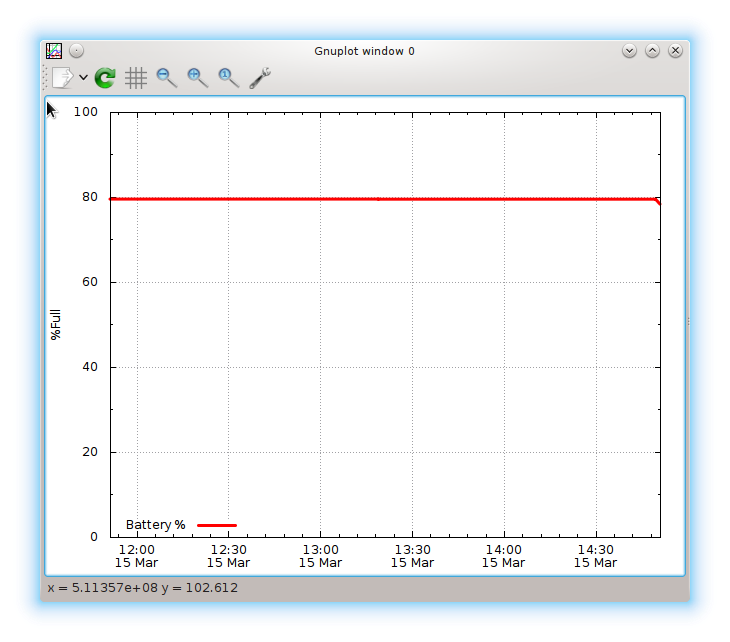
Back in September, I blogged about the system I wrote to collect statistics about my laptop battery, and how it showed the decay and death of this battery (now replaced). I created a simple deb package to handle the collection and graphing, but did not want to upload it to Debian as there were already a battery-stats package in Debian that should do the same thing, and I did not see a point of uploading a competing package when battery-stats could be fixed instead. I reported a few bugs about its non-function, and hoped someone would step in and fix it. But no-one did. I got tired of waiting a few days ago, and took matters in my own hands. The end result is that I am now the new upstream developer of battery stats (available from github) and part of the team maintaining battery-stats in Debian, and the package in Debian unstable is finally able to collect battery status using the /sys/class/power_supply/ information provided by the Linux kernel. If you install the battery-stats package from unstable now, you will be able to get a graph of the current battery fill level, to get some idea about the status of the battery. The source package build and work just fine in Debian testing and stable (and probably oldstable too, but I have not tested). The default graph you get for that system look like this:

My plans for the future is to merge my old scripts into the battery-stats package, as my old scripts collected a lot more details about the battery. The scripts are merged into the upstream battery-stats git repository already, but I am not convinced they work yet, as I changed a lot of paths along the way. Will have to test a bit more before I make a new release. I will also consider changing the file format slightly, as I suspect the way I combine several values into one field might make it impossible to know the type of the value when using it for processing and graphing. If you would like I would like to keep an close eye on your laptop battery, check out the battery-stats package in Debian and on github. I would love some help to improve the system further.
13 March 2016

Vincent Sanders: I changed my mind, Erase and rewind

My recent rack design turned out to simply not be practical. It did not hold all the SBC I needed it to and most troubling accessing connectors was impractical. I was forced to remove the enclosure from the rack and go back to piles of SBC on a shelf.

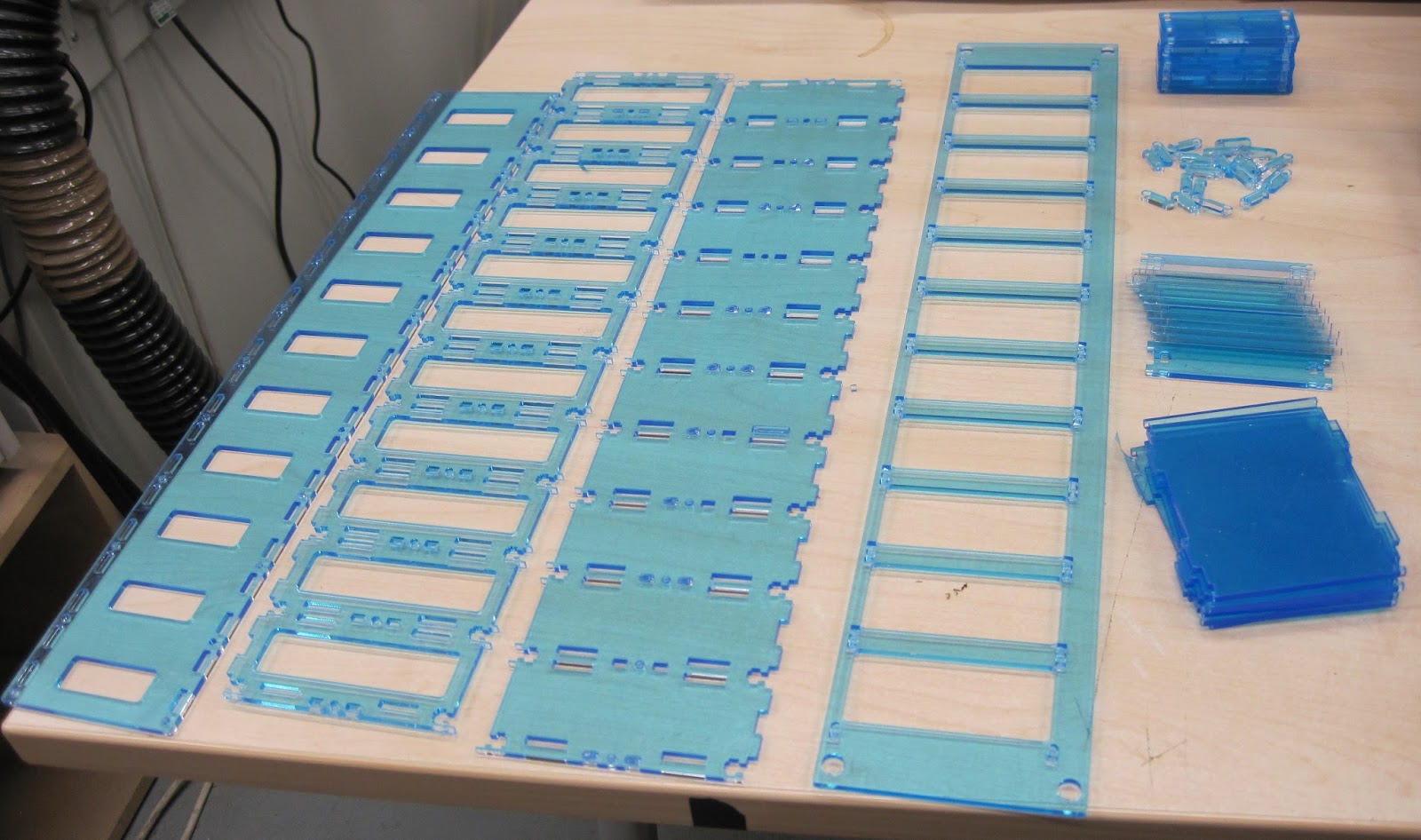
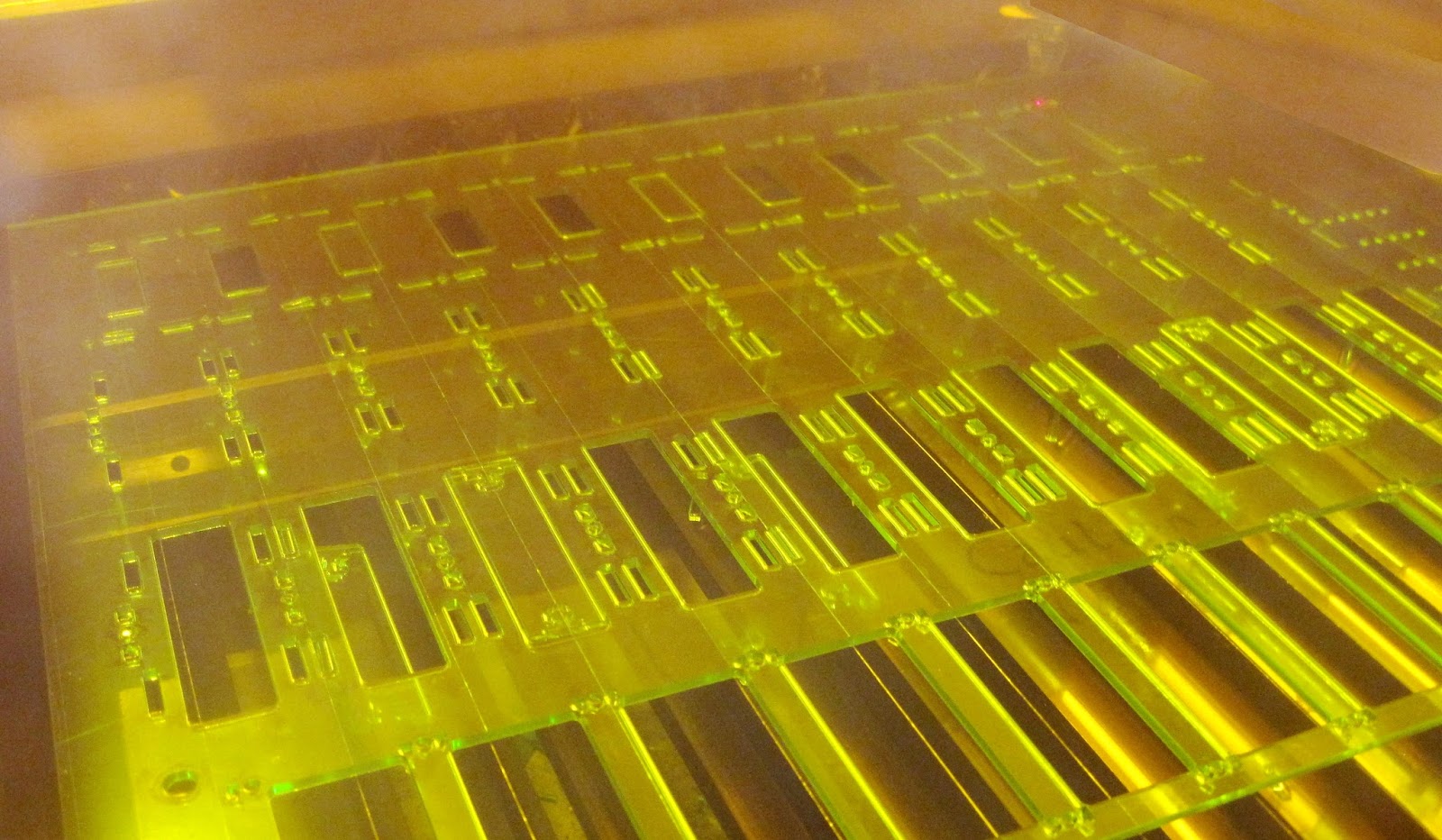
View of the acrylic being laser cut through the heavily tinted window
This sent me back to the beginning of the design process. The requirement for easy access to connectors had been compromised on in my first solution because I wanted a compact 1U size. This time I returned to my initial toast rack layout but retaining the SBC inside their clip cases.

By facing the connectors downwards and providing basic cable management the design should be much more practical.

My design process is to use the QCAD package to create layered 2D outlines which are then converted from DXF into toolpaths with Lasercut CAM software. The toolpaths are then uploaded to the laser cutter directly from the PC running Lasercut.

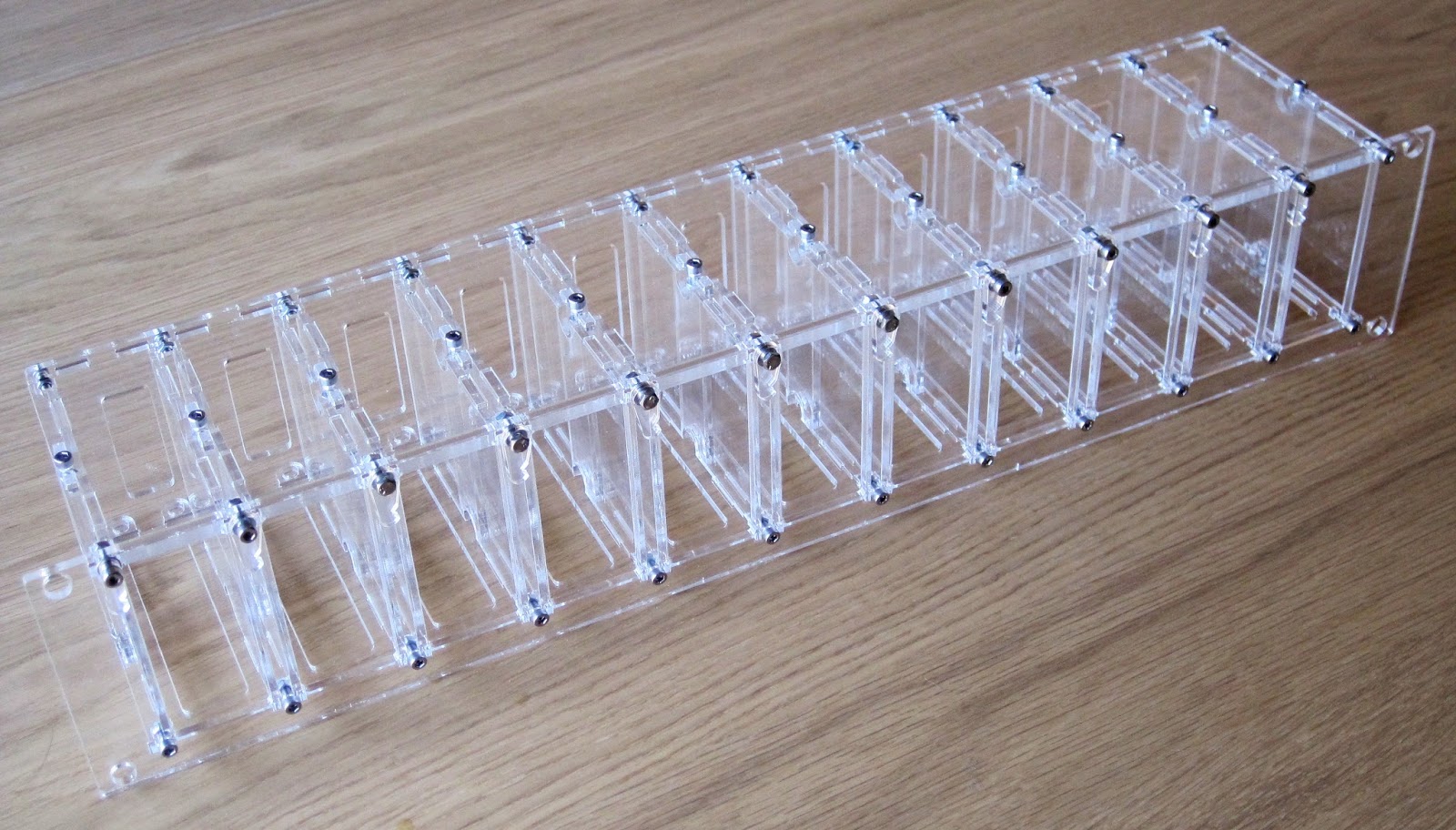
Assembled sub rack enclosureDespite the laser cutters being professional grade systems the Lasercut software is a continuous cause of issues for many users, it is the only closed source piece of software in the production process and it has a pretty poor user interface. On this occasion my main issue with it was my design was quite large at 700mm by 400mm which caused the software to crash repeatedly. I broke the design down into two halves and this allowed me to continue.

Once I defeated the software the design was laser cut from 3mm clear extruded acrylic. The assembled is secured with 72 off M3 nuts and bolts. The resulting construction is very strong and probably contains much more material than necessary.

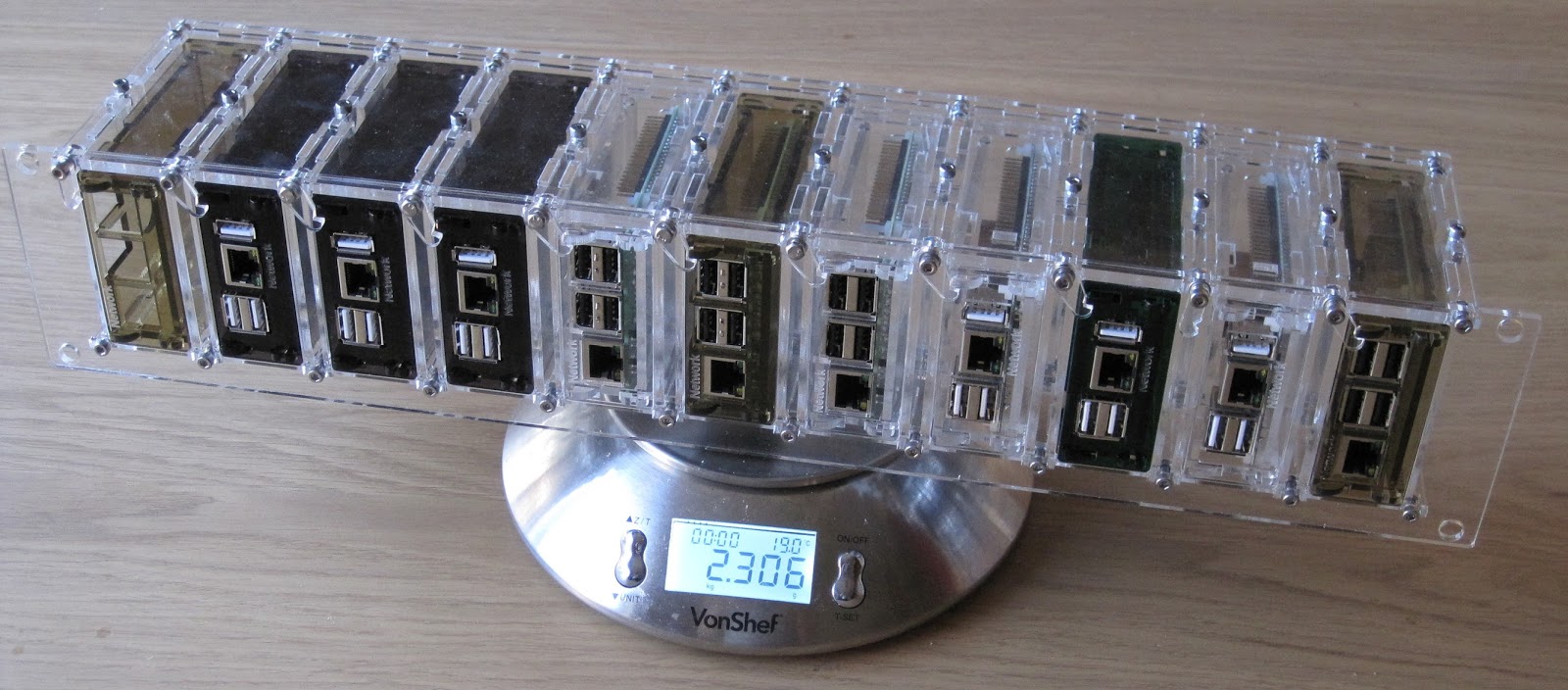
One interesting thing I discovered is that in going from a 1U enclosure holding 5 units to a 2U design holding 11 units I had increased the final weight from 320g to 980g and when all 11 SBC are installed that goes up to a whopping 2300g. Fortunately this is within the mechanical capabilities of the material but it is the heaviest thing I have ever constructed from 3mm acrylic.

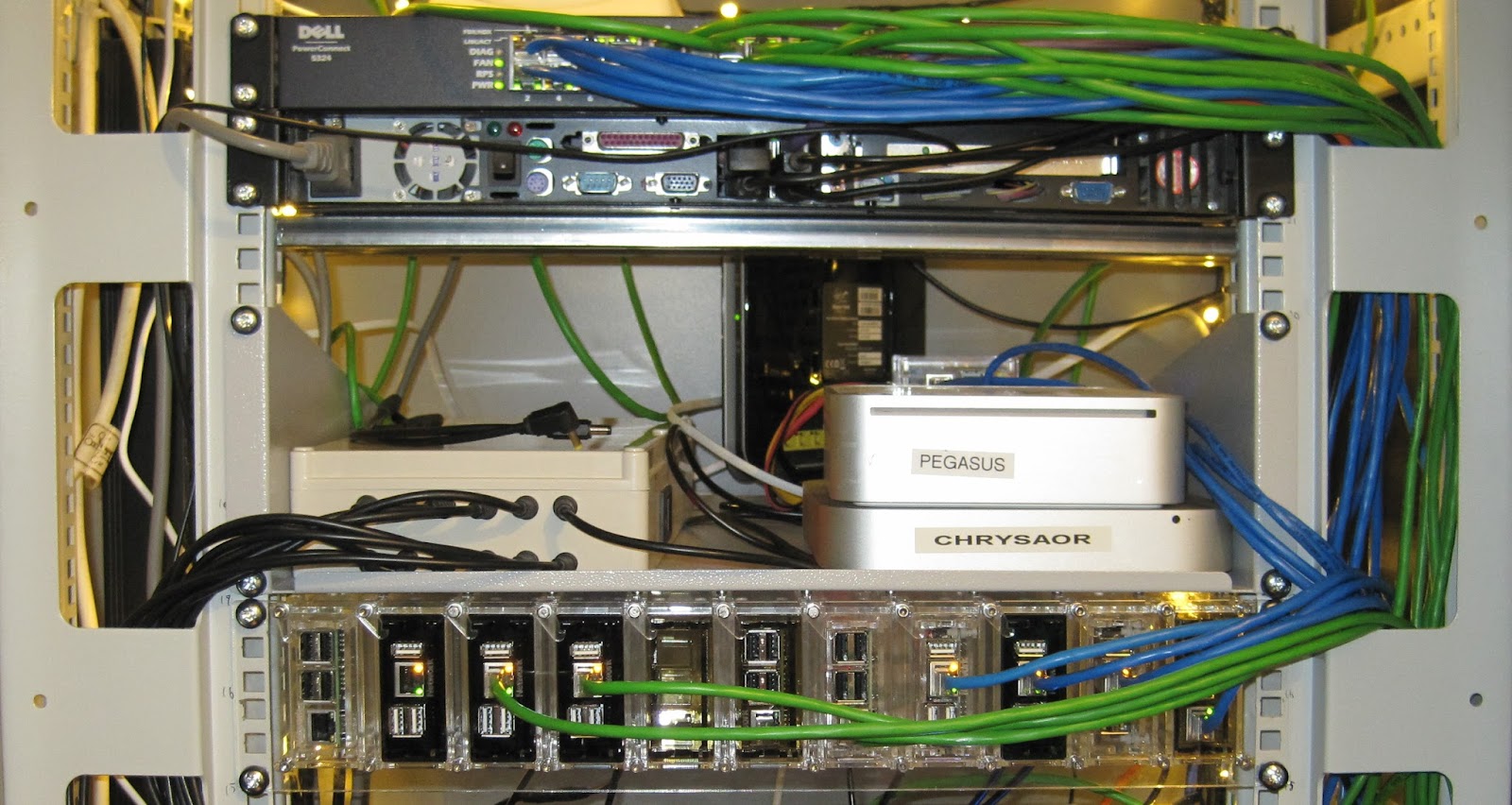
bolted into the rack and operatingOnce installed in the rack with all SBC inserted and connected this finally actually works and provides a practical solution. The self is finally clear of SBC and has enough space for all the other systems I need to accommodate for various projects.

As usual the design files are all freely available though I really cannot see anyone else needing to replicate this.

Antoine Beaupr : State of Mapping on the Debian Desktop

TL;DR: Mapbox Studio classic is not as good as Tilemill, Mapbox studio is very promising, but you still need to signup for access, and kosmtik seems to be working right now. Use kosmtik and help getting it in Debian.

The requirement I have been following the development of fascinating tools from the Development seed people, now seemingly all focused on the Mapbox brand. They created what seemed to me a revolutionary desktop tool called Tilemill. Tilemill allowed you to create custom map stylesheets on your desktop to outline specific areas or patterns or "things". My interest was to create outdoor maps - OSM has pretty good biking maps, but no generic outdoor tiles out there (I need stuff for skiing, canoeing, biking)... Mapbox has Mapbox outdoors but that's a paid plan as well. Oh and there's a place to download Garmin data files especially made for outdoors as well, and that could be loaded in Qmapshack, but they don't have coverage in Canada at all. Besides, I would like to print maps, I know, crazy... So I have been looking forward to seeing Tilemill packaged in Debian given how annoying it is to maintain Node apps (period). Unfortunately, by the time Debian people figured out all the Node dependencies, the Tilemill project stopped and has been stalled since 2012. It seems the Mapbox people have now been working on other products, and in the meantime, the community, scratching their heads, just switched to other projects.

Overview of alternatives I wrote this long post to the Debian bugtrackers to try to untangle all of this, but figured this would be interesting to a wider community than the narrow group of people working on Javascript packages, so I figured I would send this on Debian planet. So Here's a summary of what happened so far, after Tilemill development stopped. Hang on to your tiles boys and girls, there's a lot going on!

Mapbox Studio classic Mapbox people have released a new product in September 2014 named Mapbox studio classic. The code is still freely available and seems to be a fork of tilemill. Mapbox classic still has releases on github, last one is from November 2015. It looks like Mapbox studio classic has some sort of Mapbox.com lock-in, and there are certainly new copyright issues, if only with the bundled fonts, but it could probably be packaged after addressing those issues. There is an ITP for Mapbox Studio classic as well.

Mapbox Studio Then there's Mapbox Studio, which is a full rewrite of Mapbox Studio classic. You need to "signup" somehow to get access, even though parts of the code are free, namely the Mapbox GL studio project. It is an interesting project because it aims to make all this stuff happen in a web browser, which means it "should" work everywhere. Unfortunately for us, it means it doesn't work anywhere without a signup form, so that's out for me at least. There is an [ITP for Mapbox-studio][] yet it is unclear to me what that one means because the source code to Mapbox-studio doesn't seem to be available, as far as i can tell (and the ITP doesn't say either). That is actually the ITP for Mapbox studio classic.

Kosmtik The Openstreetmap-carto developers have mostly switched to kosmtik instead of Mapbox. Kosmtik is another Node desktop app that seems fairly lightweight and mostly based on plugins. Ross has an ITP for kosmtik. The package is waiting on other node dependencies to be uploaded (yes, again).

The future of Tilemill And there's still this RFP for tilemill, which should probably be closed now because the project seems dead and plenty of alternatives exist. I wonder if node some dependencies that were packaged for Tilemill actually now need to be removed from Debian, because they have become useless leaf packages... I am leaving the Tilemill RFP open for someone to clean that up.

CartoCSS Oh, and finally one could mention another Mapbox project, Carto, a command line CSS tools that implements some sort of standard CSS language that all those tools end up using to talk to Mapnik, more or less. There are no RFPs for that.

10 March 2016

Lunar: Reproducible builds: week 45 in Stretch cycle

What happened in the reproducible builds effort between February 28th and March 5th:

Toolchain fixes
  • Antonio Terceiro uploaded gem2deb/0.27 that forces generated gemspecs to use the date from debian/changelog.
  • Antonio Terceiro uploaded gem2deb/0.28 that forces generated gemspecs to have their contains file lists sorted.
  • Robert Luberda uploaded ispell/3.4.00-5 which make builds of hashes reproducible.
  • C dric Boutillier uploaded ruby-ronn/0.7.3-4 which will make the output locale agnostic. Original patch by Chris Lamb.
  • Markus Koschany uploaded spring/101.0+dfsg-1. Fixed by Alexandre Detiste.
Ximin Luo resubmitted the patch adding the --clamp-mtime option to Tar on Savannah's bug tracker. Lunar rebased our experimental dpkg on top of the current master branch. Changes in the test infrastructure are required before uploading a new version to our experimental repository. Reiner Herrmann rebased our custom texlive-bin against the latest uploaded version.

Packages fixed The following 77 packages have become reproducible due to changes in their build dependencies: asciidoctor, atig, fuel-astute, jekyll, libphone-ui-shr, linkchecker, maven-plugin-testing, node-iscroll, origami-pdf, plexus-digest, pry, python-avro, python-odf, rails, ruby-actionpack-xml-parser, ruby-active-model-serializers, ruby-activerecord-session-store, ruby-api-pagination, ruby-babosa, ruby-carrierwave, ruby-classifier-reborn, ruby-compass, ruby-concurrent, ruby-configurate, ruby-crack, ruby-css-parser, ruby-cucumber-rails, ruby-delorean, ruby-encryptor, ruby-fakeweb, ruby-flexmock, ruby-fog-vsphere, ruby-gemojione, ruby-git, ruby-grack, ruby-htmlentities, ruby-jekyll-feed, ruby-json-schema, ruby-listen, ruby-markerb, ruby-mathml, ruby-mini-magick, ruby-net-telnet, ruby-omniauth-azure-oauth2, ruby-omniauth-saml, ruby-org, ruby-origin, ruby-prawn, ruby-pygments.rb, ruby-raemon, ruby-rails-deprecated-sanitizer, ruby-raindrops, ruby-rbpdf, ruby-rbvmomi, ruby-recaptcha, ruby-ref, ruby-responders, ruby-rjb, ruby-rspec-rails, ruby-rspec, ruby-rufus-scheduler, ruby-sass-rails, ruby-sass, ruby-sentry-raven, ruby-sequel-pg, ruby-sequel, ruby-settingslogic, ruby-shoulda-matchers, ruby-slack-notifier, ruby-symboltable, ruby-timers, ruby-zip, ticgit, tmuxinator, vagrant, wagon, yard. The following packages became reproducible after getting fixed: Some uploads fixed some reproducibility issues, but not all of them: Patches submitted which have not made their way to the archive yet:
  • #816209 on elog by Reiner Herrmann: use printf instead of echo which is shell-independent.
  • #816214 on python-pip by Reiner Herrmann: removes timestamp from generated Python scripts.
  • #816230 on rows by Reiner Herrmann: tell grep to always treat the input as text.
  • #816232 on eficas by Reiner Herrmann: use printf instead of echo which is shell-independent.
Florent Daigniere and bancfc reported that linux-grsec was currently built with GRKERNSEC_RANDSTRUCT which will prevent reproducible builds with the current packaging.

tests.reproducible-builds.org pbuilder has been updated to the last version to be able to support Build-Depends-Arch and Build-Conflicts-Arch. (Mattia Rizzolo, h01ger) New package sets have been added for Subgraph OS, which is based on Debian Stretch: packages and build dependencies. (h01ger) Two new armhf build nodes have been added (thanks Vagrant Cascadian) and integrated in our Jenkins setup with 8 new armhf builder jobs. (h01ger)

strip-nondeterminism development strip-nondeterminism version 0.016-1 was released on Sunday 28th. It will now normalize the POT-Creation-Date field in GNU Gettext .mo files. (Reiner Herrmann) Several improvements to the packages metadata have also been made. (h01ger, Ben Finney)

Package reviews 185 reviews have been removed, 91 added and 33 updated in the previous week. New issue: fileorder_in_gemspec_files_list. 43 FTBFS bugs were reported by Chris Lamb, Martin Michlmayr, and gregor herrmann.

Misc. After merging the patch from Dhiru Kholia adding support for SOURCE_DATE_EPOCH in rpm, Florian Festi opened a discussion on the rpm-ecosystem mailing list about reproducible builds. On March 4th, Lunar gave an overview of the general reproducible builds effort at the Internet Freedom Festival in Valencia.

8 March 2016

Tassia Camoes Araujo: Some impressions of a flourishing community bits from the MiniDebConf Curitiba @ Montreal

Last month I more-or-less accepted an invitation that got me scared at first, panicking after a while. Why do I put myself in such an uncomfortable position? Well, I think that s how we grow up ;-) I was first contacted to talk about women participation in Debian, which I kindly refused, but I said I would maybe talk about motivating new contributors, possibly with some more friends that would maybe join me at the stage. I need to confess that at that moment I had no idea (ok, a vague idea ) about what I was going to talk. So I promptly emailed some Debian friends, shared the invitation, shared some thoughts, got feedbacks, got encouragement, and we finally made it! talk_transmission For the video conference we used mconf.org which worked super well (the downside is that it requires flash, maybe you could help them get rid of it?). I had also recorded a backup video with vokoscreen, just in case Murphy would decide to go to Curitiba but everything worked well. We a single moment with connection issues, but the torrent user kindly released the bandwidth The main point I made in the talk is that Debian as a Universal Operating System is still an utopia, especially when we extend our understanding of universality to our contributors. And as an utopia, it serves to make us walk! The more we advance, the more it gets further away, so we need to keep walking. Another important point was that diversity is not an issue that touches only woman. My audience was full of Portuguese native speakers, from a third world country, a few women, many more man, a couple of DDs, some longtime contributors, some newbies, and most of them are also part of minorities in our community. I bet many of them has already felt like a weed growing surrounded by concrete at least once in their lifetimes Solidarity towards our utopia was my final message. Just for fun, and to make a recap of our conversation at the end, I made a list of 10 steps that we could all give to contribute to a more universal Debian: 1. Read our Social Contract and make sure we are all at the same page
2. Improve Debian documentation
3. Remember that diversity does not concern only women
4. Keep an eye on minority groups and show solidarity
5. Be open and alert to the needs of newbies
6. Help Debian teams to be prepared to welcome new contributors
7. Reserve part of our time to integrate new members to the community
8. Promote hands-on meetings (local and remote)
9. Promote peer-mentoring among newbie contributors
10. Do not see Debian members as special beings, we are all humans! You can check my slides or the video of the live transmission if you want to see more. In case you can not follow the audio, I d be happy to provide subtitles (but I probably won t work on that if I don t receive have any request). And if you invite me to another conference, we can have a similar chat at with your community. Note: in person is more fun ;-) Finally, I d like to thank the participants of the mini-DebConf, those that followed this session and those who were practicing how to package on the other room, Paulo Santana and all the local organization team for the invitation, Ana Guerrero and Laura Arjona for the remote support and feedback, Andreas Tille for the efforts in integrating new contributors, Christian Perrier for the developer statistics, Val ssio for being in the audience and the Debian Project for the inspiration. What we had we Brazil this weekend was a taste of a flourishing and welcoming community, I am proud and honored to be part of it!

7 March 2016

Holger Levsen: 20160307-TorDevMeeting and InternetFreedomFestival

Some impressions from the TorDevMeeting and the Internet Freedom Festival (IFF) in Valencia Overheard at the Tor Dev meeting in Valencia, from people speaking about online identities: "You were on top of the list of the people I thought were you." It was really good to be there as my plan to meet people and work on torbrowser-launcher issues worked out nicely: in total seven bugs got fixed upstream and resulted in an torbrowser-launcher upload to sid after the meeting. So now only three bugs are open in sid and it's clear how to fix #811499 in stable so that torbrowser-launcher doesn't stop working on May 3rd 2016. So yay. At the IFF we also had a small reproducible builds Debian meeting, where I took these raw notes: (please ask for clarifications, how to help or correct me if you think other things are blockers right now as well!) Too bad IFF was not really well known in advance amongst some local free software advocates, I hope this improves next year!

3 March 2016

Simon Richter: Why sysvinit?

As most distributions have switched to systemd as default "init", some people have asked why we actually keep sysvinit around, as it's old and crusty, and systemd can do so much more. My answer is: systemd and sysvinit solve entirely different problems, and neither can ever replace the other fully. The big argument in favour of systemd is integration: when you keep everything in one process, it is easy to make sure that components talk to each other. That is nice, but kind of misses the point: integration could be done via IPC as well, and systemd uses a lot of it to separate privileges anyway. The tighter integration comes from something else: the configuration format. Where sysvinit uses a lot of shell scripts ("imperative" format), systemd uses explicit keywords ("descriptive" format), and this is the important design decision here: descriptive formats cannot do anything unanticipated, neither good nor bad. This is important for UI programmers: if there is a button that says "if I close the lid switch, suspend the laptop", then this needs to be connected to functionality that behaves this way, and this connection needs to work in both directions, so the user will find the active setting there when opening the dialog. So, we need to limit ourselves to a closed set of choices, so the UI people can prepare translations. This is the design tradeoff systemd makes: better integration in exchange for less flexibility. Of course, it is simple to allow "custom" actions everywhere, but that starts to break the "well-integrated" behaviour. There is an old blog post from Joey Hess about how to implement a simple alarm clock, using systemd, and this shows both how powerful and how limited the system is. On one hand, the single line WakeSystem=true takes care of the entire dependency chain attached to making sure the system is actually on -- when the system is going to suspend mode, some program needs to determine that there are scheduled jobs that should wake up the system, determined which of these is the next one, program the wakeup time into the hardware and only then allow the suspend to continue. On the other hand, the descriptive framework already breaks down in this simple example, because the default behaviour of the system is to go to sleep if the lid switch is closed, and the easiest way to fix this is to tell systemd to ignore the lid switch while the program is running. The IPC permissions disallow scheduled user jobs from setting this, so a "custom" action is taken that sets up the "ignore the lid switch" policy, changes to an unprivileged user, and runs the actual job. So, it is possible to get back flexibility, but this is traded for integration: while the job is running, any functionality that the "suspend laptop when the lid is closed" button had, is broken. For something simple as a switch on a personal laptop that breaks if the user configures something that is non-standard, that is acceptable. However, the keywords in the service unit files, the timer files, etc. are also part of a descriptive framework, and the services using them expect that the things they promise are kept by the framework, so there is a limit to how many exceptions you can grant. SystemV init really comes from the other direction here. Nothing is promised to init scripts but a vague notion that they will be run with sufficient privileges. There is no dependency tracking that ensures that certain services will always start before others, just priorities. You can add a dependency system like insserv if you like and make sure that all the requirements for it to work (i.e. services declaring their dependencies) are given, and there is a safe fallback of not parallelizing so we can always play it safe. Because there is so little promised to scripts, writing them becomes a bit tedious -- all of them have a large case statement where they parse the command line, all of them need to reimplement dropping privileges and finding the PID of a running process. There are lots of helpers for the more common things, like the LSB standard functions for colorful and matching console output, and Debian's start-stop-daemon for privilege and PID file handling, but in the end it remains each script's responsibility. Systemd will never be able to provide the same flexibility to admins while at the same time keeping the promises made in the descriptive language, and sysvinit will never reach the same amount of easy integration. I think it is fairly safe to predict both of these things, and I'd even go a step further: if any one of them tried, I'd ask the project managers what they were thinking. The only way to keep systems as complex as these running is to limit the scope of the project. With systemd, the complexity is kept in the internals, and it is important for manageability that all possible interactions are well-defined. That is a huge issue when writing adventure games, where you need to define interaction rules for each player action in combination with each object, and each pair of objects that can be combined with the "Use" action. Where adventure games would default to "This doesn't seem to work." or "I cannot use this.", this would not be a helpful error message when we're trying to boot, so we really need to cut down on actions and object types here. Sysvinit, on the other hand, is both more extreme in limiting the scope to very few actions (restart, wait, once) and only one object type (process that can be started and may occasionally terminate) in the main program, and a lot more open in what scripts outside the main program are allowed to do. The prime example for this is that the majority of configuration takes place outside the inittab even -- a script is responsible for the interface that services are registered by dropping init scripts into specific directories, and scripts can also create additional interfaces, but none of this is intrinsic to the init system itself. Which system is the right choice for your system is just that: your choice. You would choose a starting point, and customize what is necessary for your computer to do what you want it to do. Here's the thing: most users will be entirely happy with fully uncustomized systemd. It will suspend your laptop if you close the lid, and even give your download manager veto power. I fully support Debian's decision to use systemd as the default init for new installs, because it makes sense to use the default that is good for the vast majority of users. However, my opening statement still stands: systemd can never support all use cases, because it is constrained by its design. Trying to change that would turn it into an unmaintainable mess, and the authors are right in rejecting this. There are use cases that define the project, and use cases that are out of scope. This is what we need sysvinit for: the bits that the systemd project managers rightfully reject, but that are someone's use case. Telling these users to get lost would be extremely bad style for the "universal operating system." For example, if someone needs a service that asks a database server for a list of virtual machines to start, runs each in its private network namespace that is named after replacing part of the virtual machine name with the last two octets of the host machine's IP address, then binds a virtual Ethernet device into the network namespace and sets up a NAT rule that allows devices to talk to the public Internet and a firewall rule to stop VMs from talking to each other. Such a beast would live outside of systemd's world view. You can easily start it, but systemd would not know how to monitor it (as long as there is some process still running, is that a good sign), not know how to shut down one instance, not know how to map processes to instances and so on. SystemV init has the advantage here that none of these things are defined by the system, and as long as my init script has some code to handle "status", I can easily check up on my processes with the same interface I'd use for everything else. This requires me to have more knowledge of how the init system works, that is true, however I'd also venture that the learning curve for sysvinit is shallower. If you know shell scripting, you can understand what init scripts do, without memorizing special rules that govern how certain keywords interact, and keeping track of changes to these rules as the feature set is expanded. That said, I'm looking at becoming the new maintainer of the sysvinit package so we can continue to ship it and give our users a choice, but I'd definitely need help, as I only have a few systems left that won't run properly with systemd because of its nasty habit to keep lots of code in memory where sysvinit would unload it after use (by letting the shell process end), and these don't make good test systems. The overall plan is to set up a CI system that Ideally, I'd like to reach a state where we can actually ensure that the default configuration is somewhat similar regardless of which init system we use, and that it is possible to install with either (this is a nasty regression in jessie: bootstrapping a foreign-architecture system broke). This will take time, and step one is probably looking at bugs first -- I'm grateful for any help I can get here, primarily I'd like to hear about regressions via bug reports. tl;dr: as a distribution, we need both systemd and sysvinit. If you suggest that systemd can replace sysvinit, I will probably understand that you think that the systemd maintainers don't know project management. I'm reluctantly looking at becoming the official maintainer because I think it is important to keep around.

Simon Richter: UI Design is Hard, Let's Go Shopping

As I have a few hours of downtime on the train, I'm working on one of my favourite KiCad features again: the pin table. This silently appeared in the last KiCad release -- when you have a schematic component open in the editor, there is a new icon, currently on the right of the toolbar, that brings up a table of all pins. Currently, I have the pin number, name and type in the table (as well as the coordinates on the grid, but that's probably not that useful). For the release, this table is read-only, but can at least be useful for proofreading: left mouse click on a column header sorts (as would be expected), and right mouse click on a column header creates a grouping (i.e. all pins that have the same value in this column are collapsed into a single row). The latter is entirely unintuitive, but I have no idea how to show the user that this option exists at all. The good old DirectoryOpus on Amiga had a convention that buttons that had right-click functionality had an earmark to indicate that a "backside" exists, but that is a fairly obscure UI pattern, and would be hard to reproduce across all platforms. I could make the right click drop down a menu instead of immediately selecting this column for grouping -- at least this way it would be explained what is happening, but advanced users may get annoyed at the extra step. I could add a status bar with a hint, but that will always cost me screen space, and this only papers over the issue. I could add a menu with sorting/grouping options, which would allow novice and intermediate users to find the function, but that still does not hint at the shortcut, and the functions to set the sorting would have to be disabled on Linux because wxGTK cannot set the sort column from a program. For editing, another problem turns up in the collapsed rows: what should editing do when we are basically editing multiple pins at once. The most useful mapping would be: However, I'd like to later on introduce multiple-function pins, which would add multiple (partially) exclusive pin names per pin number, which would change the semantics: At the moment, I'm mostly inclined to have separate modes for "grouped by pin number" and "grouped by pin name" -- these modes could be switched by the current grouping column, but that is neither intuitive, nor does it provide a full solution (because grouping by pin type is also supported). Time to look at the use cases: At 32C3, I've implemented a quick completeness check, consisting of a summary line that collapses the pin number column into a comma-separated list of ranges (where a range is defined as consecutive numbers in the last group of digits). I wonder if there is a group of developers with an UI focus who are happy about solving problems like these...

Next.

Previous.