Search Results: "az"

16 July 2014

Juliana Louback: Become an Open-source Contributor Video Conference

A couple weeks ago I was contacted by Yehuda Korotkin through one of the Debian mailing lists. Yehuda is a tech professor at one of Israel s leading colleges for women. He proposed a video conference to present the open source community to his class and explain how they can contribute to open source projects. I volunteered to participate and last Monday (July 14th 2014) we had our virtual meeting, which I hope was the first of many. Shauna G. also participated from Boston, making it a Israel - USA - Brazil meetup. Pretty impressive, eh? The conference was hosted on Google Hangouts, the video is available for viewing here. Run time is around 2.5 hours so to save you time I ve kindly posted a summary of the conference! To be frank, I look ghastly half the time so I d much prefer that you read this post. First there was a Q&A period which was more of a discussion panel, followed by a hands-on session where the girls made their first contribution to an open source project. Here s the gist of it: Q&A Hands on For the practical part of our conference, Yehuda s students contributed to Jscommunicator s Issue #5 which requests i18n support for major languages. JSCommunicator is a SIP communication tool developed in HTML and JavaScript, currently supporting audio/video calls and SIP SIMPLE instant messaging. First we set up Github in their local machines and forked the Jscommunicator repo. We learned the basic git commands needed to push changes to their remote repositories and to create a pull requests. This is explained in further detail here. At the end of the conference with nearly an hour overtime due to my tendency to be overly verbose, Yehuda s class made their first contribution with a Hebrew translation for Jscommunicator! All in all, it was great to virtually meet Yehuda and his epic students who all seemed very clever engineers. I m looking forward to our next meetup once I gain some time-management skills.

13 July 2014

Steve Kemp: A brief twitter experiment

So I've recently posted a few links on Twitter, and I see followers clicking them. But also I see random hits. Tonight I posted a link to http://transient.email/, a domain I use for "anonymous" emailing, specifically to see which bots hit the URL. Within two minutes I had 15 visitors the first few of which were:
IP User-Agent Request
199.16.156.124Twitterbot/1.0;GET /robots.txt
199.16.156.126Twitterbot/1.0;GET /robots.txt
54.246.137.243python-requests/1.2.3 CPython/2.7.2+ Linux/3.0.0-16-virtualHEAD /
74.112.131.243Mozilla/5.0 ();GET /
50.18.102.132Google-HTTP-Java-Client/1.17.0-rc (gzip)HEAD /
199.16.156.125Twitterbot/1.0;GET /robots.txt
185.20.4.143Mozilla/5.0 (compatible; TweetmemeBot/3.0; +http://tweetmeme.com/)GET /
23.227.176.34MetaURI API/2.0 +metauri.comGET /
74.6.254.127Mozilla/5.0 (compatible; Yahoo! Slurp; http://help.yahoo.com/help/us/ysearch/slurp);GET /robots.txt
So what jumps out? The twitterbot makes several requests for /robots.txt, but never actually fetches the page itself which is interesting because there is indeed a prohibition in the supplied /robots.txt file. A surprise was that both Google and Yahoo seem to follow Twitter links in almost real-time. Though the Yahoo site parsed and honoured /robots.txt the Google spider seemed to only make HEAD requests - and never actually look for the content or the robots file. In addition to this a bunch of hosts from the Amazon EC2 space made requests, which was perhaps not a surprise. Some automated processing, and classification, no doubt. Anyway beer. It's been a rough weekend.

Dimitri John Ledkov: Hacking on launchpadlib

So here is a quick sample of my progress playing around with launchpadlib using lp-shell from lptools:
In [1]: lp
Out[1]: <launchpadlib.launchpad.Launchpad at 0x7f49ecc649b0>

In [2]: lp.distributions
Out[2]: <launchpadlib.launchpad.DistributionSet at 0x7f49ddf0e630>

In [3]: lp.distributions['ubuntu']
Out[3]: <distribution at https://api.launchpad.net/1.0/ubuntu>

In [4]: lp.distributions['ubuntu'].display_name
Out[4]: 'Ubuntu'

In [5]: lp.distributions['ubuntu'].summary
Out[5]: 'Ubuntu is a complete Linux-based operating system, freely available with both community and professional support.'

In [7]: import sys; print(sys.version)
3.4.1 (default, Jun 9 2014, 17:34:49)
[GCC 4.8.3]

There is not much yet, but it's a start. python3 port of launchpadlib is coming soon. It has been attempted a few times before and I am leveraging that work. Porting this stack has proven to be the most difficult python3 port I have ever done. But there is always python-libvirt that still needs porting ;-)

Some of above is just merge proposals against launchpadlib & lazr.restfulclient, and requires not yet packaged modules in the archive. When trying it out, I'm still getting a lot of run-time asserts and things that haven't been picked up by e.g. pyflakes3 and has not been unit-tested yet.

10 July 2014

Paul Tagliamonte: Dell XPS 13

More hardware adventures. I got my Dell XPS13. Amazing. The good news: This MacBook Air clone is clearly an Air competitor, and easily slightly better in nearly every regard except for the battery.
The bad news is that the Intel Wireless card needs non-free (I ll be replacing that shortly), and the touchpad s driver isn t totally implemented until Kernel 3.16. I m currently building a 3.14 kernel with the patch to send to the kind Debian kernel people. We ll see if that works. Ubuntu Trusty already has the patch, but it didn t get upstreamed. That kinda sucks. It also shipped with UEFI disabled, and was defaulting to boot in legacy mode. It shipped with Ubuntu, a bit disappointed to not see Ubuntu keys on the machine. Touchscreen works; in short -stunning. I think I found my new travel buddy. Debian unstable runs great, stable had some issues.

6 July 2014

Ian Campbell: Setting absolute date based Amazon S3 bucket lifecycles with curl

For my local backup regimen I use flexbackup to create a full backup twice a year and differential/incremental backups on a weekly/monthly basis. I then upload these to a new amazon S3 bucket for each half year (so each bucket corresponds to the a full backup plus the associated differentials and incrementals). I then set the bucket's lifecycle to archive to glacier (cheaper offline storage) from the month after that half year has ended (reducing costs) and to delete it a year after the half ends. It used to be possible to do this via the S3 web interface but the absolute date based options seem to have been removed in favour of time since last update, which is not what I want. However the UI will still display such lifecycles if they are configured and directs you to the REST API to set them up. I had a look around but couldn't any existing CLI tools to do this directly but I figured it must be possible with curl. A little bit of reading later I found that it was possible but it involved some faff calculating signatures etc. Luckily EricW has written Amazon S3 Authentication Tool for Curl (AKA s3curl) which automates the majority of that faff. The tool is "New BSD" licensed according to that page or Apache 2.0 license according to the included LICENSE file and code comments. Setup Following the included README setup ~/.s3curl containing your id and secret key (I called mine personal which I then use below). Getting the existing lifecycle Retrieving an existing lifecycle is pretty easy. For the bucket which I used for the first half of 2014:
$ s3curl --id=personal -- --silent http://$bucket.s3.amazonaws.com/?lifecycle   xmllint --format -
<?xml version="1.0" encoding="UTF-8"?>
<LifecycleConfiguration xmlns="http://s3.amazonaws.com/doc/2006-03-01/">
  <Rule>
    <ID>Archive and Expire</ID>
    <Prefix/>
    <Status>Enabled</Status>
    <Transition>
      <Date>2014-07-31T00:00:00.000Z</Date>
      <StorageClass>GLACIER</StorageClass>
    </Transition>
    <Expiration>
      <Date>2015-01-31T00:00:00.000Z</Date>
    </Expiration>
  </Rule>
</LifecycleConfiguration>
See GET Bucket Lifecycle for details of the XML. Setting a new lifecycle The desired configuration needs to be written to a file. For example to set the lifecycle for the bucket I'm going to use for the second half of 2014:
$ cat s3.lifecycle
<LifecycleConfiguration>
  <Rule>
    <ID>Archive and Expire</ID>
    <Prefix/>
    <Status>Enabled</Status>
    <Transition>
      <Date>2015-01-31T00:00:00.000Z</Date>
      <StorageClass>GLACIER</StorageClass>
    </Transition>
    <Expiration>
      <Date>2015-07-31T00:00:00.000Z</Date>
    </Expiration>
  </Rule>
</LifecycleConfiguration>
$ s3curl --id=personal --put s3.lifecycle --calculateContentMd5 -- http://$bucket.s3.amazonaws.com/?lifecycle
See PUT Bucket Lifecycle for details of the XML.

Russell Coker: Desktop Publishing is Wrong

When I first started using computers a word processor was a program that edited text. The most common and affordable printers were dot-matrix and people who wanted good quality printing used daisy wheel printers. Text from a word processor was sent to a printer a letter at a time. The options for fancy printing were bold and italic (for dot-matrix), underlines, and the use of spaces to justify text. It really wasn t much good if you wanted to include pictures, graphs, or tables. But if you just wanted to write some text it worked really well. When you were editing text it was typical that the entire screen (25 rows of 80 columns) would be filled with the text you were writing. Some word processors used 2 or 3 lines at the top or bottom of the screen to display status information. Some time after that desktop publishing (DTP) programs became available. Initially most people had no interest in them because of the lack of suitable printers, the early LASER printers were very expensive and the graphics mode of dot matrix printers was slow to print and gave fairly low quality. Printing graphics on a cheap dot matrix printer using the thin continuous paper usually resulted in damaging the paper a bad result that wasn t worth the effort. When LASER and Inkjet printers started to become common word processing programs started getting many more features and basically took over from desktop publishing programs. This made them slower and more cumbersome to use. For example Star Office/OpenOffice/LibreOffice has distinguished itself by remaining equally slow as it transitioned from running on an OS/2 system with 16M of RAM in the early 90 s to a Linux system with 256M of RAM in the late 90 s to a Linux system with 1G of RAM in more recent times. It s nice that with the development of PCs that have AMD64 CPUs and 4G+ of RAM we have finally managed to increase PC power faster than LibreOffice can consume it. But it would be nicer if they could optimise for the common cases. LibreOffice isn t the only culprit, it seems that every word processor that has been in continual development for that period of time has had the same feature bloat. The DTP features that made word processing programs so much slower also required more menus to control them. So instead of just having text on the screen with maybe a couple of lines for status we have a menu bar at the top followed by a couple of lines of toolbars , then a line showing how much width of the screen is used for margins. At the bottom of the screen there s a search bar and a status bar. Screen Layout By definition the operation of a DTP program will be based around the size of the paper to be used. The default for this is A4 (or Letter in the US) in a portrait layout (higher than it is wide). The cheapest (and therefore most common) monitors in use are designed for displaying wide-screen 16:9 ratio movies. So we have images of A4 paper with a width:height ratio of 0.707:1 displayed on a wide-screen monitor with a 1.777:1 ratio. This means that only about 40% of the screen space would be used if you don t zoom in (but if you zoom in then you can t see many rows of text on the screen). One of the stupid ways this is used is by companies that send around word processing documents when plain text files would do, so everyone who reads the document uses a small portion of the screen space and a large portion of the email bandwidth. Note that this problem of wasted screen space isn t specific to DTP programs. When I use the Google Keep website [1] to edit notes on my PC they take up a small fraction of the screen space (about 1/3 screen width and 80% screen height) for no good reason. Keep displays about 70 characters per line and 36 lines per page. Really every program that allows editing moderate amounts of text should allow more than 80 characters per line if the screen is large enough and as many lines as fit on the screen. One way to alleviate the screen waste on DTP programs is to use a landscape layout for the paper. This is something that all modern printers support (AFAIK the only printers you can buy nowadays are LASER and ink-jet and it s just a big image that gets sent to the printer). I tried to do this with LibreOffice but couldn t figure out how. I m sure that someone will comment and tell me I m stupid for missing it, but I think that when someone with my experience of computers can t easily figure out how to perform what should be a simple task then it s unreasonably difficult for the vast majority of computer users who just want to print a document. When trying to work out how to use landscape layout in LibreOffice I discovered the Web Layout option in the View menu which allows all the screen space to be used for text (apart from the menu bar, tool bars, etc). That also means that there are no page breaks! That means I can use LibreOffice to just write text, take advantage of the spelling and grammar correcting features, and only have screen space wasted by the tool bars and menus etc. I never worked out how to get Google Docs to use a landscape document or a single webpage view. That s especially disappointing given that the proportion of documents that are printed from Google Docs is probably much lower than most word processing or DTP programs. What I Want What I d like to have is a word processing program that s suitable for writing draft blog posts and magazine articles. For blog posts most of the formatting is done by the blog software and for magazine articles the editorial policy demands plain text in most situations, so there s no possible benefit of DTP features. The ability to edit a document on an Android phone and on a Linux PC is a good feature. While the size of a phone screen limits what can be done it does allow jotting down ideas and correcting mistakes. I previously wrote about using Google Keep on a phone for lecture notes [2]. It seems that the practical ability of Keep to edit notes on a PC is about limited to the notes for a 45 minute lecture. So while Keep works well for that task it won t do well for anything bigger unless Google make some changes. Google Docs is quite good for editing medium size documents on a phone if you use the Android app. Given the limitations of the device size and input capabilities it works really well. But it s not much good for use on a PC. I ve seen a positive review of One Note from Microsoft [3]. But apart from the fact that it s from Microsoft (with all the issues that involves) there s the issue of requiring another account. Using an Android phone requires a Gmail account (in practice for almost all possible uses if not in theory) so there s no need to get an extra account for Google Keep or Docs. What would be ideal is an Android editor that could talk to a cloud service that I run (maybe using WebDAV) and which could use the same data as a Linux-X11 application. Any suggestions?

Matthew Palmer: Witness the security of this fully DNSSEC-enabled zone!

After dealing with the client side of the DNSSEC puzzle last week, I thought it behooved me to also go about getting DNSSEC going on the domains I run DNS for. Like the resolver configuration, the server side work is straightforward enough once you know how, but boy howdy are there some landmines to be aware of. One thing that made my job a little less ordinary is that I use and love tinydns. It s an amazingly small and simple authoritative DNS server, strong in the Unix tradition of do one thing and do it well . Unfortunately, DNSSEC is anything but small and simple and so tinydns doesn t support DNSSEC out of the box. However, Peter Conrad has produced a patch for tinydns to do DNSSEC, and that does the trick very nicely. A brief aside about tinydns and DNSSEC, if I may Poor key security is probably the single biggest compromise vector for crypto. So you want to keep your keys secure. A great way to keep keys secure is to not put them on machines that run public-facing network services (like DNS servers). So, you want to keep your keys away from your public DNS servers. A really great way of doing that would be to have all of your DNS records somewhere out of the way, and when they change regenerate the zone file, re-sign it, and push it out to all your DNS servers. That happens to be exactly how tinydns works. I happen to think that tinydns fits very nicely into a DNSSEC-enabled world. Anyway, back to the story. Once I d patched the tinydns source and built updated packages, it was time to start DNSSEC-enabling zones. This breaks down into a few simple steps:
  1. Generate a key for each zone. This will produce a private key (which, as the name suggests, you should keep to yourself), a public key in a DNSKEY DNS record, and a DS DNS record. More on those in a minute. One thing to be wary of, if you re like me and don t want or need separate Key Signing and Zone Signing keys. You must generate a Key Signing key this is a key with a flags value of 257. Doing this wrong will result in all sorts of odd-ball problems. I wanted to just sign zones, so I generated a Zone Signing key, which has a flags value of 256. Big mistake. Also, the DS record is a hash of everything in the DNSKEY record, so don t just think you can change the 256 to a 257 and everything will still work. It won t.
  2. Add the key records to the zone data. For tinydns, this is just a matter of copying the zone records from the generated key into the zone file itself, and adding an extra pseudo record (it s all covered in the tinydnssec howto).
  3. Publish the zone data. Reload your BIND config, run tinydns-sign and tinydns-data then rsync, or do whatever it is PowerDNS people do (kick the database until replication starts working again?).
  4. Test everything. I found the Verisign Labs DNSSEC Debugger to be very helpful. You want ticks everywhere except for where it s looking for DS records for your zone in the higher-level zone. If there are any other freak-outs, you ll want to fix those because broken DNSSEC will take your domain off the Internet in no time.
  5. Tell the world about your DNSSEC keys. This is simply a matter of giving your DS record to your domain registrar, for them to add it to the zone data for your domain s parent. Wherever you d normally go to edit the nameservers or contact details for your domain, you probably want to do to the same place and look for something about DS or Domain Signer records. Copy and paste the details from the DS record in your zone into there, submit, and wait a minute or two for the records to get published.
  6. Test again. Before you pat yourself on the back, make sure you ve got a full board of green ticks in the DNSSEC Debugger. if anything s wrong, you want to rollback immediately, because broken DNSSEC means that anyone using a DNSSEC-enabled resolver just lost the ability to see your domain.
That s it! There s a lot of complicated crypto going on behind the scenes, and DNSSEC seems to revel in the number of acronyms and concepts that it introduces, but the actual execution of DNSSEC-enabling your domains is quite straightforward.

4 July 2014

Rapha&#235;l Hertzog: My Free Software Activity in June 2014

This is my monthly summary of my free software related activities. If you re among the people who made a donation to support my work (168.17 , thanks everybody!), then you can learn how I spent your money. Otherwise it s just an interesting status update on my various projects. Debian LTS After having put in place the infrastructure to allow companies to contribute financially to Debian LTS, I spent quite some time to draft the announce of the launch of Debian LTS (on a suggestion of Moritz M hlenhoff who pointed out to me that there was no such announce yet). I m pretty happy about the result because we managed to mention a commercial offer without generating any pushback from the community. The offer is (in my necessarily biased opinion) clearly in the interest of Debian but still the money doesn t go to Debian so we took extra precautions. When I got in touch with the press officers, I included the Debian leader in the discussion and his feedback has been very helpful to improve the announce. He also officially acked the press release to give some confidence to the press officers that they were doing the right thing. Lucas also pushed me to seek public review of the draft press release, which I did. The discussion was constructive and the draft got further improved. The news got widely relayed, but on the flip side, the part with the call for help got almost no attention from the press. Even Linux Weekly News skipped it! On the Freexian side, we just crossed 10% of a full-time position (funded by 6 companies) and we are in contact with a few other companies in discussion. But we re far from our goal yet so we will have to actively reach out to more companies. Do you know companies who are still running Debian 6 servers ? If yes, please send me the details (name + url + contact info if possible) to deblts@freexian.com so that I can get in touch and invite them to contribute to the project. Distro Tracker In the continuation of the Debian France game, I continued to work together with Joseph Herlant and Christophe Siraut on multiple improvements to distro tracker in order to prepare for its deployment on tracker.debian.org (which I just announced \o/). Debian France Since the Debian France game was over, I shipped the rewards. 5 books have been shipped to: Misc Debian work I orphaned sql-ledger and made a last upload to change the maintainer to Debian QA (with a new upstream version). After having been annoyed a few times by dch breaking my name in the changelog, I filed #750855 which got quickly fixed. I disabled a broken patch in quilt to fix RC bug #751109. I filed #751771 when I discovered an incorrect dependency on ruby-uglifier (while doing packaging work for Kali Linux). I tested newer versions of ruby-libv8 on armel/armhf on request of the upstream author. I had reported him those build failures (github ticket here). Thanks See you next month for a new summary of my activities.

One comment Liked this article? Click here. My blog is Flattr-enabled.

3 July 2014

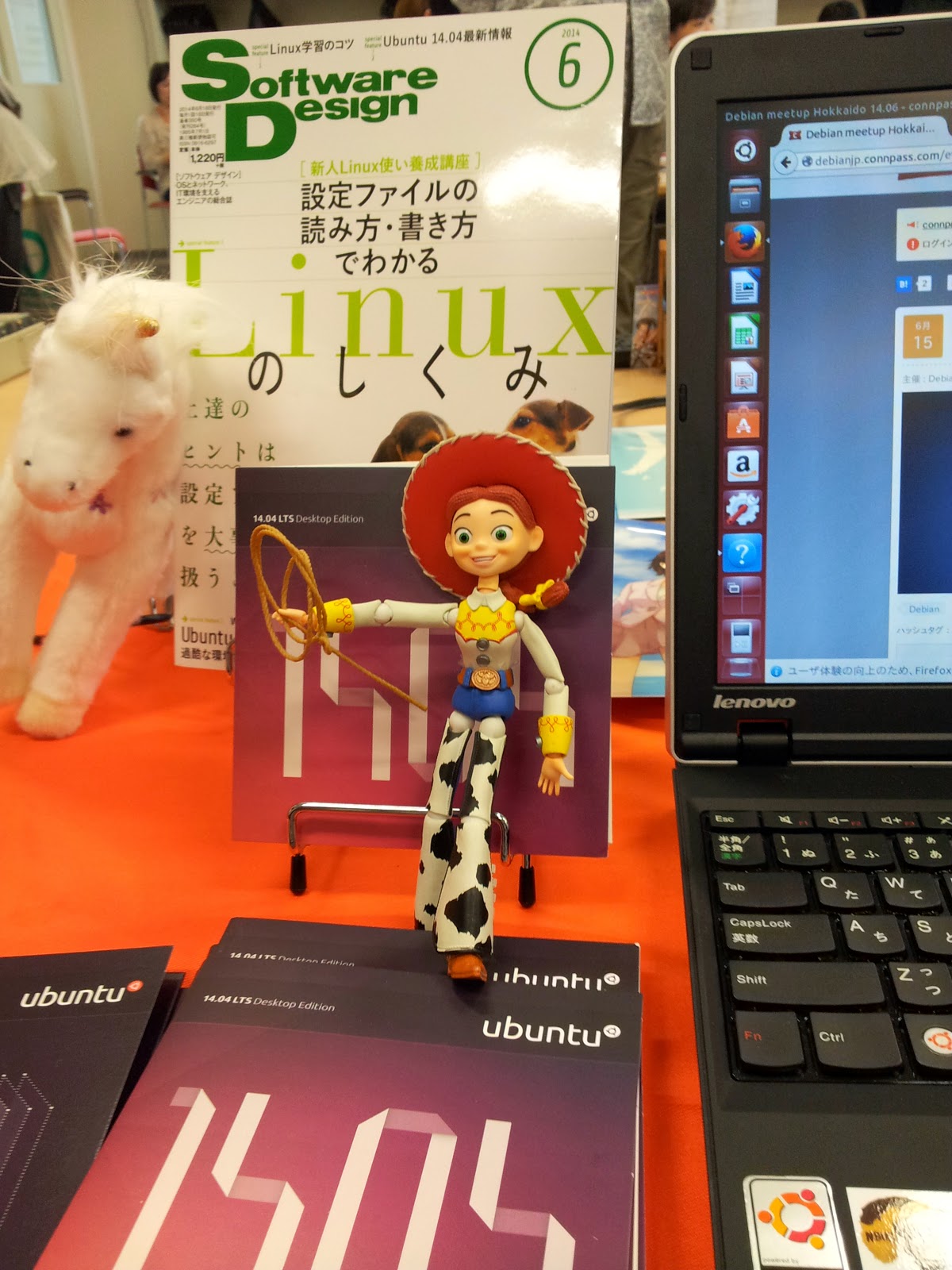
Hideki Yamane: Open Source Conference 2014 Hokkaido

Oh, time flies... (= I'm lazy)

14th June, I've participated to OSC (Open Source Conference) 2014 Hokkaido in Sapporo, Hokkaido (sorry openSUSE folks, OSC does not mean openSUSE Conference ;) OSC has 10 years history in Japan, so don't blame me...)

Hokkaido is northan island of Japan (it has 4 major islands - Hokkaido, Honshu, Shikoku and Kyushu), takes 1.5 hours from Tokyo (HND-CTS) and debian-mirror.sakura.ne.jp is also there.

As always, we show the Debian booth with Debian lovers, Squeeze, Woody and Jessie.


And I gave talk about Debian a little,
mostly how it is developed and distribute, and shapes in Jessie at that time (PDF/odf is my page on Debian Wiki as usual).

Does Cowgirl Dream of Red Swirl? from Hideki Yamane


After that, Enjoyed food, beer (sure! :) and chatting in party.


Folks, see you in #osc15do again!

Wouter Verhelst: Docking and Undocking with LVM

I have a number of USB hard disks. Like, I suppose, mostly everyone who reads this blog. Unlike many people who do, however, for whatever reason I decided to create LVM volumes on most of my USB hard disks. The unfortunate result is that these now contain a lot of data with a somewhat less than efficient partitioning system. I don't really care much, but it's somewhat annoying, not in the least because disconnecting an LVM device isn't as easy as it used to be; originally you could just run the lvm2 init script with the stop argument, but that isn't the case anymore today. That is, you can run that, but it won't help you because all that does, effectively, is exit 0. So what do you do instead? This: Voila, your LVM volume group is no longer available, and you've not suffered data loss. Kewl. Note: I don't know what the lvm2 init script used to do. I suspect there's another way which doesn't require the --refresh step. I don't think it matters all that much, though. This works, and is safe. That being said, comments are welcome...

1 July 2014

Russ Allbery: Review: Ancillary Justice

Review: Ancillary Justice, by Ann Leckie
Series: Imperial Radch #1
Publisher: Orbit
Copyright: 2013
ISBN: 0-316-24662-X
Format: Trade paperback
Pages: 416
As Ancillary Justice opens, Breq is on an icy planet trying to track down a person who has gone rather thoroughly to ground. As her search continues, the reader slowly learns the context of that search, which is only the latest step of a long and quixotic exercise in private determination. She was set on her path by events twenty years previous, told in interleaved flashbacks, that have left her greatly diminished and thrust outside of any of the context of her over thousand years of life. Breq was Justice of Toren, a starship and AI that possessed thousands of ancillaries, human bodies slaved to her mind. Now only this one remains, and nothing exists of her former life other than this goal. It's always hard to write a review of a book that I loved this much. I want to find some way to grab the reader and shake them and say "you have to read this!" without giving away any of the delicious details. That's particularly difficult with Ancillary Justice, since one of the delights of this book is the slow unfolding of not only the plot but the background and motivations behind the plot. There is so much beneath the surface of Breq's methodical intent, and discovering all the nuances is utterly delightful. This is also a book that is very deeply concerned with identity, and which does one of the best jobs I've seen in science fiction of showing a non-human first-person protagonist: close enough to human to permit identification and comprehension, but far enough away for delightful sparks of unexpected insight or thought-provoking difference. Breq is a ship, and AIs are central to this story, so the comparison that comes immediately to mind is with Iain M. Banks. Leckie's role for ship AIs is much different than the structure of Banks's Culture, but I think this is still an apt comparison. Like Banks, Leckie is writing large-scale space opera dominated by a meddling empire that follows some familiar human patterns but not others. Banks's Culture takes a less direct approach with its meddling; the Radch has a more Roman attitude towards preventative conquest and citizenship. But both deal with large-scale issues of politics, culture, and conquest. Both also write excellent AIs, but I think Leckie is more successful than Banks at giving her AIs inhuman properties and creating a sense of eerie alienness that sometimes fades almost entirely and sometimes comes sharply to the surface. The first-person perspective helps considerably there. But where Ancillary Justice truly shined for me is in the interpersonal relationships, and in the insight they provided into character and motive. At the start of the book, Breq finds a drug addict dying in the cold and rescues her, bringing her along on her search for lack of a better option. Breq's relationship with Seivarden is complex, difficult for both of them, badly asymmetric at the start, and develops into something brilliant. At the start of the book, Seivarden is easy to dislike, and Breq's tone is refreshingly bracing and forthright. But through the course of the book Seivarden grows into something much more, in a way that I found both believable and incredibly compelling. And Leckie does this without falling into any of the typical relationship patterns, without introducing artificial romance (or, indeed, any romance at all, which is an excellent choice here), and without compromising the personalities of either character. It's masterfully done. One of the most amazing things about this book to me is that it's a first novel. I never would have guessed that from reading it. It's beautifully paced, the characterization is deep and compelling, and Leckie avoids any sign of the typical first-novel problem of stuffing the book with too much Stuff. Ancillary Justice is a capable and confident novel that builds a compelling world and even more compelling characters. I liked it more than I like most of the Culture novels, which is saying quite a lot, but Leckie offers much of the same scope with deeper and more personal characterization and a tighter plot. I haven't yet remarked on one aspect of this book that every other review seems to remark on: its treatment of gender. The Radch do not recognize or care about gender distinctions, and therefore Breq struggles throughout the book with proper gender labeling in much the same way that a native English speaker tends to struggle with grammatical gender when learning a Romance language, except with more social consequences. Leckie has chosen to represent this in the novel by having Breq refer to everyone uniformly as "she." This has its pluses and minuses: it still supports a binary gender concept where a gender-neutral pronoun might not, but given all the negative reaction this book got just for using "she," a gender-neutral pronoun might be a bridge too far for a lot of readers. I thought it created a nice bit of alienation, a way of forcing the reader to look at gender markers from the outside and a way to point out how arbitrary many of them are. It was also interesting to see how surprised I was at various points in the book when it became obvious that some person Breq had been calling "she" in the first-person narration turned out, from story context, to probably be male. That said, I think this part of the book is overblown in reviews. It's often the first thing people mention, but while it was a nice side bit of world-building, I don't think it's that central to the story. I'm particularly baffled by the handful of people who complained about it, since it's not intrusive and it quickly fades into the background apart from occasional necessary shifts of mental image. (It does create the impression of a world containing only women, but I found that a nice change from the more common impression in space opera of a world containing only men.) Ancillary Justice has already won the Nebula and Arthur C. Clarke awards and tied for the BSFA award for best novel, and I'm happy to report that it deserves all of those. I haven't yet read all of the other Hugo nominees, but it's hard to imagine a world in which it won't top my ballot. This is a fantastic novel, by far the best thing I've read so far this year. I'm delighted that it's the first book of a trilogy, since I'm not done with either the world or the characters yet, but it stands well on its own and reaches a satisfying conclusion. I recommend it to everyone, but particularly to anyone who likes Banks, intelligent ships, or who is looking for thoughtful and complex space opera. Followed by Ancillary Sword. Rating: 10 out of 10

30 June 2014

Russell Coker: Links June 2014

Russ Albery wrote an insightful blog post about trust, computer security, and training programmers [1]. He makes a good case that social problems in our community decrease the availability of skilled people to write and audit security code. The Lawfare blog has an insightful article by Dan Geer about Heartbleed as a Metaphor [2]. He makes some good points about security and design, ways of potentially solving some flaws and problems with the various solutions. Eben Moglen wrote an insightful article for The Guardian about the way that the NSA spying is a direct threat to democracy [3] The TED blog has an interesting interview with Kitra Cahana about her work living with and photographing nomads in the US [4]. I was surprised to learn that there s an active nomad community in the US based on the culture that started in the Great Depression. Apparently people are using Youtube to learn about nomad culture before joining. Dave Johnson wrote an interesting Salon article about why CEOs make 300* as much money as workers [5]. Note that actually contributing to the financial success of the company is not one of the reasons. Maia Szalavitz wrote an interesting Slate article about Autism and Anorexia [6]. Apparently some people on the Autism Spectrum are mis-diagnosed with Anorexia due to food intolerance. Groups of four professors have applied for the job of president and vice-chancellor of the University of Alberta [7]. While it was a joke to apply in that way, 1/4 of the university president s salary is greater than the salary of a professor and the university would get a team of 4 people to do the job so it would really make sense to hire them. Of course the university could just pay a more reasonable salary for the president and hire an extra 3 professors. But the same argument applies for lots of highly paid jobs. Is a CEO who gets paid $10M per annim really going to do a better job than a team of 100 people who are paid $100K? Joel on Software wrote an insightful article explaining why hiring 1/200 applicants doesn t mean you hire the top 0.5% of workers [8]. He suggests that the best employees almost never apply through regular channels so an intern program is the only way to get a chance of hiring the best people. Chaotic Idealism has an interesting article on some of the bogus claims about autism and violence [9]. Salon has an interesting articleby Lindsay Abrams about the way the food industry in the US lobbies for laws to prevent employees from reporting animal cruelty or contamination of the food supply and how drones will now be used for investigative journalism [10]. Jacobin Mag has an interesting article by Geoff Shullenberger about the Voluntariat , the people who volunteer their time to help commercial organisations [11]. I don t object to people voluntarily helping companies, but when they are exploited or when the company also requires voluntary help from the government it becomes a problem. We need some legislation about this. Laura Hudson wrote an insightful article about how Riot Games solved their online abuse problem [12]. There are ideas in this that can apply to all online communities. Matt LeMay wrote an interesting article for Medium titled What (Else) Can Men Do? Grow The Fuck Up [13]. It s a general commentary on the treatment of women in geek communities (and most other places). Foz Meadows wrote an insightful analysis of the attempts of bigots to influence science-fiction [14]. If I had more spare time I d read some of the books by bigoted authors on the Sad Puppy Slate (from a library of course) and see if they lack talent in the same way that Orson Scott Card does. Racialicious has an interesting article by Phenderson Djeli Clark about the horrible racism and bigotry of H.P. Lovecraft [15]. I have only read two HP Lovecraft stories, one was mediocre and the other (The Horroe at Red Hook) was quite poor largely due to his inability to write about non-white people. Grace Wyler wrote an insightful article for Vice magazine about the right-wing terrorists in the US killing cops [16]. Paul Rosenberg wrote an interesting and amusing (for people outside the US) article about the gun crazies in the US [17]. Maybe the gun crazies should have a loaded assault rifles and tequila party to follow up on their gun appreciation day . A US TV show made a 4 minute clip of some of the stupid things that Tony Abbott has done [18]. Tony is almost as stupid as Dubya.

Russ Allbery: Review: The Knowledge

Review: The Knowledge, by Lewis Dartnell
Publisher: Penguin
Copyright: 2014
ISBN: 0-698-15165-8
Format: Kindle
Pages: 328
The cover pitch for The Knowledge is that technological civilization has collapsed. A war, an asteroid, a pandemic, or some other catastrophic event has ended life as we know it. Survivors have recovered enough to stabilize the population, but all the industry and infrastructure that supports the modern world has been crippled and the knowledge lost. What do they need to know to rebuild the world? (The subtitle, How to Rebuild Our World from Scratch, is deceptive. Dartnell spends a lot of time talking about what could be scavenged from the ruins after an event like a pandemic that leaves buildings and tools intact.) This brief description may bring several incorrect ideas to mind, so a few clarifications are in order. First, this is not a book about how to survive an apocalypse, or how to stabilize society afterwards. Dartnell skips over anything related to basic survival or politics, and this book would only be of limited interest to preppers. Rather, it is focused on the key concepts and key processes that underlie much of what makes up our civilization, and how those processes can be bootstrapped and recreated, hopefully much more quickly than the thousands of years they took to develop the first time around. Second, as much as I think Dartnell would have liked it to be, The Knowledge is not an instruction manual. There's just too much involved in modern machinery, metallurgy, chemistry, and other necessary science and engineering. What it is instead is a tour of the most important ideas, basic processes, and approaches that can lead to creation of an industrial economy. This means it's also a tour of the most critical technology and discoveries that we rely on for day-to-day living. Each idea presented here is a bare sketch, and would require extensive research and experimentation to put into practice. The Knowledge is not a scientific encyclopedia. Rather, it's a collection of signposts and suggested directions along with some suggestions about sequencing, with special emphasis on the ideas that were unintuitive or surprising, or which took humans much longer to stumble across than would have been necessary. I will say up front that I am quite dubious about the stated goal of this book. I'm not sure if it would be of significant assistance to people who found themselves in the circumstances that Dartnell postulates, and I'm also not sure it would be as difficult as Dartnell supposes to reconstruct these details from a good library, although the point is well-taken that most modern industrial techniques would be unavailable to a civilization starting from scratch and many historic techniques are no longer practiced and therefore not well-documented. But this book does not have to succeed at its stated goal to be worth reading. The Knowledge provides a fascinating insight into the way our current capabilities developed, other paths that development could have followed, and what building blocks are vital for the industry that we rely on. If you are like me, the first thing The Knowledge will remind you of is Minecraft, particularly with some of the mods (such as TerraFirmaCraft) that add more realistic detail to the technological bootstrapping. It's a treasure trove for anyone who might be working on that sort of mod or game. Dartnell tries to cover as much of the spectrum of technology as possible, from farming through medicine, from basic materials to industrial chemistry, and from electrical power through transportation. Each chapter necessarily covers only the highlights, the most vital technologies and the early priorities, and many of those are relatively vague pointers. But that's enough for a fascinating orientation. It's also full of memorable trivia: the huge variety of uses to which wood can be put, the difficulty in re-establishing production of industrial acids, the shelf life of gasoline, the global seed vault within the Arctic Circle, and the importance of a long-threaded screw for a lathe, just to name a few examples. In short, The Knowledge may or may not be a practical aid in rebuilding the world, but it's a lot of fun to read and full of tidbits that are fun to think about or pass on to others. It's also a great orientation in applied technology. The Knowledge is particularly fascinating if you have any interest in the simplified recreation of technological and industrial processes, such as in Minecraft and similar games. For authors of Minecraft mods who are aiming for realism, it might even be required reading. I'd love to see more mods based heavily on the approaches described in this book. The Knowledge also conveys, better than any book or course I've seen, an intuitive feel for the amazing complexity and ingenuity underlying industrial technology. I pre-ordered a copy of this book as soon as I heard about it, and I was not disappointed. Despite my certainty that I would be one of the early casualties in any general social collapse, I thoroughly enjoyed reading it, and would like to read it again at some point. Recommended, albeit with the caveat that I do not have the background required to verify any of the facts in this book, and am assuming that Dartnell has done his research properly. Rating: 9 out of 10

29 June 2014

Paul Tagliamonte: Apple and Debian: A tragic love story

One which ends in tears, I m afraid. A week or so ago, I got an MacBook Air 13 (MacBook Air 6-2), to take with me when I head out to local hack sessions, and when I travel out of state for short lengths of time. My current Thinkpad T520i is an amazing machine, and will remain my daily driver for a while to come. After getting it, I unboxed the machine, and put in a Debian install USB key. I wiped OSX (without even booting into it) and put Debian on the drive. To my dismay, it didn t boot up after install. Using the recovery mode of the disk, I chrooted in and attempted an upgrade (to ensure I had an up-to-date GRUB). I couldn t dist-upgrade, the terminal went white. After C-c ing the terminal, I saw something about systemd s sysvinit shim, so I manually did a purge of sysvinit and install of systemd. I hear this has been resolved now. Thanks :) My machine still wasn t booting, so I checked around. Turns out I needed to copy over the GRUB EFI blob to a different location to allow it to boot. After doing that, I could boot Debian whilst holding Alt. After booting, things went great! Until I shut my lid. After that point, my screen was either 0% bright (absolutely dark) or 100% (facemeltingly bright). I saw mba6x_bl, which claims to fix it, and has many happy users. If you re in a similar suggestion, I highly suggest looking at it. Unfortunately, this caused my machine to black out on boot and I couldn t see the screen at all anymore. A rescue disk later, and I was back. Annoyingly, the bootup noise s volume is stored in NVRAM, which gets written out by OSX when it shuts down. After consulting the inimitableMatthew Garrett, I was told the NVRAM can be hacked about with by mounting efivarfs on /sys/firmware/efi/efivars type efivarfs. Win! After hitting enter, I got a kernel panic and some notes about hardware assertions failing. That s when I returned my MacBook and got a Dell XPS 13.
This is a problem, folks. If I can t figure out how to make this work, how can we expect our users? Such a shame the most hardware on the planet gets no support, locking it s users into even less freedom.

Russ Allbery: Review: The Wilding

Review: The Wilding, by C.S. Friedman
Series: In Conquest Born #2
Publisher: DAW
Copyright: 2004
Printing: July 2005
ISBN: 0-7564-0202-6
Format: Mass market
Pages: 551
In Conquest Born is a rather odd space opera, featuring an interstellar war between two great empires that culminates in an intensely personal struggle between leaders of the two sides. It has one of the most intensely misogynistic societies in science fiction (the villains, yes, but weirdly ambiguous villains), genetic breeding programs for telepaths, and a host of unlikable but oddly fascinating characters. I thought it was weaker on re-read than I remembered it being originally, but it's still singular enough in memory that I wanted to read the sequel. The Wilding picks up in the same universe a century and a half later. I expected more of a direct connection to the plot of In Conquest Born, but I think this book could be read on its own. (This is good, given how the plot of In Conquest Born tends to slip out of my memory, despite how unique the book is.) The Azeans and the Braxins are, of course, still at war, an on-again, off-again affair that neither side seems likely to ever win. But the Azeans have forbidden psychic powers and driven all psychics underground, if they still exist at all. They are supposedly too unstable to be allowed in the carefully constructed Azean society. Tathas is Braxin, but not from the ruling Braxan tribe. He is caught practicing old rituals of his native tribe and escapes sentence of death by going on the Wilding, an ancient practice of leaving Braxin culture to find new genetic material and bring it back to strengthen their species. Or, put in less euphemistic terms, to find and rape a woman and bring back the resulting child, although apparently retrieving a genetic sample would also work. Did I mention the misogynistic society part? Still there. Zara, the other primary protagonist, is an Azean mediator who, as the book is opening, starts developing psychic powers. This is a rather serious problem that gets her suspended from her job. Her check of her own genetic records (the old-school SF obsession with eugenics is also still there) leads to the discovery that she's an identical twin, whose sister was kidnapped as an infant under mysterious circumstances and apparently by underground psychics. Zara decides to go in search of her. As with In Conquest Born, this book is full of deeply unpleasant societies and world views. Also as with In Conquest Born, I don't think Friedman intends any of them to be held up as examples of correct politics or behavior. What makes both of these books unusual is that neither she nor the characters seem to be making any attempt to construct a third alternative that would be better. The secret society of psychics has a different appeal, but it's not clear the characters would want to be part of it either, and it's quite possible that they're still responsible for a lot of the crap that's going on in the galaxy. The book feels like it ought to be political, as these societies are clearly broken and deeply abusive (the Braxins more obviously than the Azeans, but they're both creepy), but it mostly isn't. Instead, The Wilding is focused on individual people trying to make their way in this world. Those people come from varying strata of these societies. Zara and Tathas are there throughout; other characters crop up briefly with their own viewpoints and then often go away again or are killed. I think Friedman is going for a story of raw emotion and a tight focus on individual actions, with little in the way of clean morality or broader morals. And yet... the final act of the protagonists in the book is a political act that seems aimed at making the universe a better place. In a way, this is a very cynical book: there is a tremendous amount of manipulation and political maneuvering, and it's hard to see any cause here that one can fully support. This is all rather similar to In Conquest Born, but what held the previous book together was its backbone of obsessive vengeance and the spectacle of two intelligent people from utterly different societies locked in all-out emotional and physical combat. The Wilding doesn't have that. It has characters with strong motives and strong emotions, but none of them are the sort of epic, transcendent emotions that propel mythic heroes at each other. This is a more prosaic and personal book, which means the drama isn't strong and sweeping enough to make the reader forget the deep unpleasantness that's going on around them. The Wilding feels less like a clash of titans and more like personal quests for identity against a universe full of awful people and worse systems. It also retains, in the Braxin, aggressive male-dominant sexuality just this side of a Gor novel, but here that feels seedier and even more squirm-inducing than it did in In Conquest Born. The Wilding is even more ambiguous about the ethics of that sexual and misogynistic abusiveness; Tathas partly gives it up, but this is presented more as an accommodation to another culture than as a real engagement with the inherent abusiveness of Braxin society. I still have no idea whether and to whom I would recommend In Conquest Born. I'm less torn about The Wilding: don't bother. It's a lesser work in all respects, it shares some of the problems with too many characters and an occasionally incoherent plot, and I had even more trouble with the horrible societies Friedman creates than I did in the previous book. And it doesn't have the same counterbalance of epic, uncontrolled emotions and characters who seem to transcend the story they're in. Instead, it feels more like a story of damaged people in an awful universe who are meddling through as best they can while being manipulated by the people with real power. It got more depressing the more I thought about it, and the ending doesn't salvage the story. Rating: 4 out of 10

23 June 2014

Steve Kemp: So I accidentally ... a service.

This post is partly introspection, and partly advertising. Skip if it either annoys you. Back in February I was thinking about what to do with myself. I had two main options "Get a job", and "Start a service". Because I didn't have any ideas that seemed terribly interesting I asked people what they would pay for. There were several replies, largely based "infrastructure hosting" (which was pretty much 50/50 split between "DNS hosting", and project hosting with something like trac, redmine, or similar). At the time DNS seemed hard, and later I discovered there were already at least two well-regarded people doing DNS things, with revision control. So I shelved the idea, after reaching out to both companies to no avail. (This later lead to drama, but we'll pretend it didn't.) Ultimately I sought and acquired gainful employment. Then, during the course of my gainful employment I was exposed to Amazons Route53 service. It looked like I was going to be doing many things with this, so I wanted to understand it more thoroughly than I did. That lead to the creation of a Dynamic-DNS service - which seemed to be about the simplest thing you could do with the ability to programatically add/edit/delete DNS records via an API. As this was a random hack put together over the course of a couple of nights I didn't really expect it to be any more popular than anything else I'd deployed, and with the sudden influx of users I wanted to see if I could charge people. Ultimately many people pretended they'd pay, but nobody actually committed. So on that basis I released the source code and decided to ignore the two main missing features - lack of MX records, and lack of sub-sub-domains. (Isn't it amazing how people who claim they want "open source" so frequently mean they want something with zero cost, they can run, and never modify and contribute toward?) The experience of doing that though, and the reminder of the popularity of the original idea made me think that I could do a useful job with Git + DNS combined. That lead to DNS-API - GitHub based DNS hosting. It is early days, but it looks like I have a few users, and if I can get more then I'll be happy. So if you want to to store your DNS records in a (public) GitHub repository, and get them hosted on geographically diverse anycasted servers .. well you know where to go: Github-based DNS hosting.

22 June 2014

Gunnar Wolf: Yo tampoco / #yotampoco / neither do I A bit of local action

Only a very short summary in English: I am Mexican. I am Jewish. I am almost completely disconnected from the local Jewish communities. And understanding the local Jewish communities is hard. There is a very interesting and brave campaign, recently started, called Neither do I The Mexican Jewish gay activist group Guimel, started off with this video (with English subtitles, if you are interested in following along). But how did I learn about this very bold initiative? By getting a hateful spam, inviting people to join a hate campaign. Right, the hate mail is not calling to violence, but it is based on premises as stupid as everybody's right not to include (to begin with). So, the least I can do about this is to share both said hate mail and publicly denounce my shock on reading this nonsense nowadays. And, also in Spanish (I know many people following me don't understand it Sorry, it would just take too long, and after all, it's mainly for local "consumption"), this is the reply I sent to them (and to the other recipients). Sorry in advance to the Spanish speakers for my exabrupts :) This was written "as is", without much prior thought, and quite angry about what I had just read.
Buf... Expresiones como esta, que hacen evidente la cerraz n de tanta gente en las comunidades jud as, justifican claramente por qu tantos nos hemos ido abriendo, integr ndonos a la sociedad circundante. Me da verg enza ser asociado como jud o a comunidades donde se defienden estos puntos de vista; si bien yo no soy de la comunidad Monte Sinai (como resultar obvio por mi nombre), para la sociedad en su conjunto s soy un jud o (as , a secas: Jud o). Mucho nos hemos quejado colectivamente a lo largo de los siglos acerca de la discriminaci n, de que seamos considerado la "basura" del mundo, los "apestados". Y es precisamente esa actitud, ante todo y en todo momento, lo que me ha llevado a alejarme del juda smo. Soy un ser humano m s, con una historia personal nica, con una historia cultural compartida pero tambi n nica, con algunas elecciones y algunas caracter sticas que me son inherentes nicas. Algo de eso no le gusta a alguien? Por motivos racionales o irracionales? No lo puedo ni pienso evitar. Pero el que una comunidad completa sea llamada a ignorar, humillar, alienar a sus hijos, por una estupidez as de anacr nica (en el caso que lo presenta el video al que hacen referencia, y a la gente que valientemente ha conformado Guimel) me parece que simplemente va m s all de toda estupidez. Piensen bien antes de adherirse a esta campa a de odio. Substituyan la sexualidad por cualquier otra raz n en la que somos minor a. No les da asco vivir con un vendedor de telas? Con un jud o apestoso? Y s , aqu ya estoy yo tambi n dejando ir a esos demonios... que hay que mantener bajo control. Porque somos hombres y mujeres de nuestro siglo, y porque el mundo y las nuevas generaciones merecen nuestro mejor esfuerzo para ir colectivamente destruyendo la estupidez de nuestros ancestros. Seamos m s racionales. Dejemos el odio, dejemos los prejuicios. Aceptemos a los diferentes, porque todos queremos que nos acepten. Porque todos somos diferentes.
AttachmentSize
tambien.txt8.55 KB

20 June 2014

Steve Kemp: The perils of the cloud..

Recently two companies have suffed problems due to compromised AWS credentials: I'm just about to commit to using Amazon for hosting DNS for paying customers, so this is the kind of thing that makes me paranoid. I'll be storing DNS-data in Git, and if the zones were nuked on the Amazon-side I could re-upload them, but users would be dead regardless - because they'd need to update the nameservers in whois before the re-uploaded data would be useful. I suspect I need to upload to two DNS providers, to get more redundency. Currently I have a working system which allows me to push DNS records to a Git repository, and that seamlessly triggers a DNS update (i.e. A webhook trigged by github/bitbucket/whatever). Before I publish anything I need to write more code, more documentation, and agree on pricing details. Then I'll setup a landing-page at http://dns-api.com/. I've been challenged to find paying customers before launching, and thus far have two, which is positive. The DHCP.io site has now been freed. I'm no longer going to try to commercialize it, instead I will only offer the Git-based product as a commercial service. On that basis I upped the service so users could manage up to five names per account, more if you mail me privately and beg ;) (ObRandom: Google does hosted DNS with an API. They're expensive. I'm surprised I'd not heard of them doing this.)

Russell Coker: Expectations of Skill and Time

On many occasions I ve seen discussions about the background knowledge that people are expected to have to contribute to FOSS projects. Often the background knowledge is quite different from the core skills related to their contributions (EG documentation mark-up skills required for coding work or knowledge of code required for writing documentation). One argument in favor of requiring such skills is of the form anyone who s good at one aspect of the project can learn skills for the other areas . Another is of the form anyone who has time to contribute in one area has time to learn all the other areas, anyone who doesn t want to learn is being lazy . I think it s reasonable that someone who is considering donating their time to a project would want to start doing something productive immediately. If someone has to spend many hours learning how things work before contributing anything of value they may decide that it s not a good use of their time or just not fun. Also if the project is structured to require a lot of background knowledge then that will increase the amount of time that long-term contributors spend teaching newbies which is another way of sucking productive energy out of a project. I don t think it s lazy to want to avoid learning unusual tools before starting a project. Firstly there is the issue of wanting to make productive use of your time. If you have a day for FOSS contributions and you can choose between spending 6 hours learning an environment for one project or 1 hour for another project then there s a choice of 2 hours or 7 hours of productive work. Someone who has the luxury of being able to spend several days a month on FOSS projects might think it s lazy to want to make effective use of 1 day, but there are a lot of people out there who are really busy and can only spend a few days a YEAR contributing, spending half a day learning an obscure development environment or documentation system can take a significant amount of someone s yearly time for such work. To make things even worse some of the best programmers are the ones who have little free time. For documentation MediaWiki (the software behind Wikipedia and Wikia.com) has a lot going for it. While it s arguable that it s not the best Wiki software out there (many people have wanted to argue this with me even though I don t care) it s obvious that MediaWiki is the most widely used Wiki software. If you have documentation stored in MediaWiki then most people who have any exposure to the IT industry, the FOSS community, or the Internet in general will already have experience using it. Also Wikipedia serves as a large example of what can be done with MediaWiki, there have been more than a few occasions when I have looked at Wikipedia for examples of how to layout text. Some people might think I m lazy for never reading the MediaWiki documentation, but again I ve got lots of other things to do and don t want to spend a lot of time learning about MediaWiki instead of doing more useful things like creating content. Project source code should be as consistent as possible. While large projects may have lots of modules and dependencies it s best to try and keep them all in one place. If your project depends on libraries of code from other sources then it s helpful to distribute copies of those libraries from the same location as the project source particularly when the project depends on development versions of libraries. Then if there s any mismatch between versions of libraries it will be a clear unambiguous bug that can be reported or fixed instead of being an issue that requires checks of what versions everyone is using. One thing we should aim for in FOSS projects is to get the long tail of contributions. If someone spends a day fixing bugs in a dozen projects to get their own system working as desired then it would be good if they could submit patches without excessive effort at the same time. This doesn t just apply to FOSS development, it also applies to a large extent to any collaborative project on the Internet. For example if I was to start a Wiki for fans of a sci-fi series wikia would be the first option I d consider because most potential contributors know it. Proprietary Software Development I ve seen all the same problems when developing proprietary software. The difference is that money and morale is wasted instead of contributions. Often in commercial projects managers choose products that have a good feature list without considering whether all their staff need to be retrained. Programmers can usually train themselves so it s often a hidden cost, the training is paid for in lost development time (both directly in time spent learning and indirectly when people make mistakes). One significant advantage of using free software on Windows is that programmers can play with it on their own. For example I ve never done a fresh installation of SourceSafe or ClearCase, but if I was going to work on a project that involved Git or Subversion on Windows then I could play with it and learn without risking disruption to the rest of the team. If commercial software is to be used then being common and relatively cheap is a significant advantage. MS SourceSafe offers significant benefits over most version control software on Windows simply because the vast majority of Windows developers have already used it and because it s cheap and easy to setup a test instance if necessary. I don t care about the success or failure of proprietary software projects in general (I only care when I m paid to care). I also don t expect that people read my blog with the aim of getting advice on running successful proprietary software development projects. This section is merely to illustrate the general nature of such wasted effort on collaborative projects and I should put my observations of failing proprietary software development projects to use. Debian Some Debian Developers are having a discussion about such things at the moment. That discussion inspired me to write this post. But I m mostly writing about my experience over the course of 20+ years working in the IT industry and contributing to FOSS projects not in a direct response to the Debian discussion (most of which I haven t yet read).

17 June 2014

Tiago Bortoletto Vaz: Little garden project

After three years living in Montr al we're still amazed by the fact that here we have er... seasons!! I believe that things have a special beauty when they don't last the time we want them to last, and seasons are all about it! (some people will exclude winter here) Anyways, taking pictures may give them more lifetime without compromising too much their beauty. And sharing them here and there is somewhat sharing our happiness, which might be a good balance in the end :)
/images/01.JPG

At the time we moved the garden was just a single white thing...

/images/02.JPG

then we realized that it provided some chairs, a table and a compost container, yay!

/images/03.JPG

But the grey ground was something to be fixed...

/images/04.JPG

so we hacked it and got some land :)

/images/05.JPG

Few months later and it's finally becoming chard, beets, carrots, spinach, berries, cheries, okra, tomatoes, basil, potatoes, sage, agastache and a saskatoon berry tree!

Next.

Previous.