Search Results: "angel"

5 September 2007

John Goerzen: Long enough in the country?

Perhaps this conversation is a sign that we've been in the country for awhile:

"Terah, if you ever drive the pickup..."

"Why would I ever do that?"

"I don't know, but if you ever do, I just want you to know something. The reason there's a towel connecting the brake pedal to the steering wheel..."

At this point I had to wait for her laughter to die down.

"As I was saying, the reason there's a towel connecting the brake pedal to the steering wheel is that, unless you park facing uphill, the brake lights stay on all the time and will drain the battery."

More laughter followed.

I didn't even have the chance to tell her to remove the towel before she starts the truck. Oh well, guess she'll figure it out.

On the other hand, perhaps this is a sign that we haven't been in the country long enough:

Today as I went to lunch, I saw a long, narrow, light gray line across the door on my car. I was pretty annoyed that somebody would have pulled keys or something across it to do that. But as I got closer, I realized it was just a spider web. Terah and I park our cars a few feet apart, and every week or so there will be a spider web connecting the two of them when we go out in the morning.

3 September 2007

Russell Coker: Photography and Censorship at APEC

World News Australia reports that Police forced three tourists to delete photos of a fence. Apparently the officers in question believed that such photos would be a threat to security. It’s interesting to note that the first sentence of the World News Australia report is “Officials say police who forced three tourists to delete photos of a huge security fence erected in Sydney for the APEC summit were not over-reacting” while later in the article it says “The police action against the tourists may have been “over the top” but was necessary, said New South Wales state Transport Minister John Watkins“. So which was it? Was it “over the top” or was it “not over-reacting“. Strangely the World News Australia web site shows a picture of the fence. If this fence is so secret then why are the pictures being published so that millions of people will see it? For that matter why even try censoring the pictures. Censoring the pictures effectively issues a challenge to everyone who has a digital camera and plenty of spare time (which means most university students among others) to get the best photos of the fence (feel free to leave comments with the URLs for your best pics). While this is happening protesters from Real Action On Climate Change have been protesting at the Loy Yang power station, according to their blog posts it seems that they were partially inspired by the APEC meeting. It seems that APEC leaders are keen on nuclear power. If they really believe that nuclear power is safe then maybe they should have their meeting at Maralinga. There would be little effort or expense required to secure Maralinga and it wouldn’t disrupt a major city. :-# But seriously if they wanted a secure location for a meeting with no protesters then an aircraft carrier would make an ideal location. The people who need to attend the meeting could get flown to a carrier that’s off-shore in the territorial waters of one of the countries concerned with a full battle group to deter any other ships from entering the area. It is reported that Sydney whores are expecting to do a lot of business during the APEC meeting. Maybe this is the reason why they wanted to have their meetings Sydney (which is rumoured to have the best brothels in Australia). I wonder if they are planning for a future APEC meeting in Bangkok…

31 August 2007

John Goerzen: The Story of One Barn

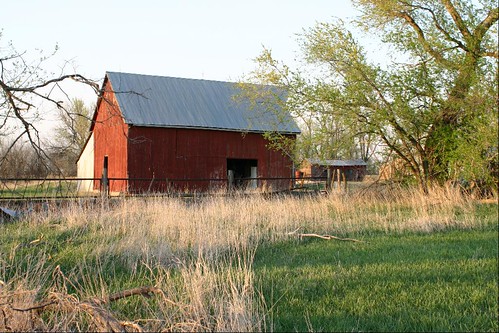
img_2575

About 80 years ago, a Kansas family -- the Janzens -- built this barn.

About 60 years ago, my grandparents moved onto the farm. Their cattle were kept right here. I remember Grandpa's red tractor being parked in the barn.

So many memories have this barn in the background. We had a visit from one of the Janzens that lived here as a child. He had fond memories of this building. My dad and his siblings once played in the deep snow in front of this barn.

Here's one memory from those times:

078.jpg

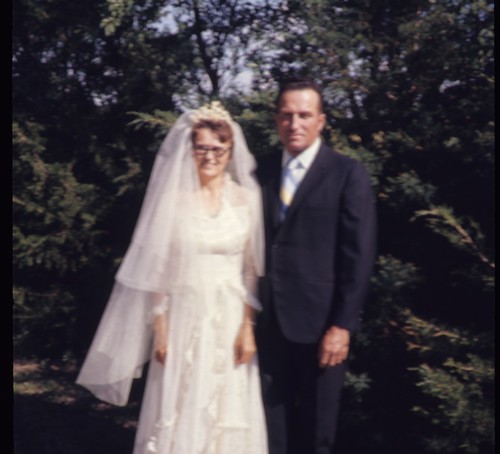
That's my grandma and grandpa on their 25th anniversary in 1970. It was a working barn back then, so they probably weren't standing right next to it for this picture, if you get my drift. But they were on the yard.

About 25 years ago, Grandma lost her battle with cancer. At some point or another, Grandpa had eased out of farming, so the barn had a lot less activity. I remember exploring his outbuildings when I got bored at family gatherings. And I used to mow the lawn next to it every summer when Grandpa went off to be a cook at a camp. I didn't mind mowing next to the barn. But I always tried to go past one corner of the house as fast as I could, because there were wasp and hornet nests right there.

About 7 years ago, it was time for Grandpa to move off the farm. It was getting to be too much to keep up the old house, the barn, the yard, and deal with things like freezing water pipes and water getting in through the windows. He moved to an independent-living duplex in town. He was always worried about what would happen to the farm. Over the next few years, the farm would sometimes be vacant, sometimes have renters. Some renters did some work on the house, but the barn sat. Grandpa would eventually move into the nursing home because of his Parkinson's.

Two and a half years ago, Grandpa passed away. I shared some memories from Grandpa's place at the funeral.

But what of the house, the farm now? Renters went, and it sat empty. Nothing was in great shape, and the house needed a lot of work. Perhaps the whole place would be leveled and turned back into the prairie that it once was, or used as farmland. Perhaps someone would have an interest someday.

A year and a half ago, Jacob was on the way. Terah and I had occasionally thought of buying Grandpa's place, but we never talked about it seriously. We figured that we better finally decide what we're doing, before we have a baby around, or a child in school. So in April 2006, we went out to the farm and checked it out. The picture at the top of this post is from that visit. Terah and I checked out the house, the barns, the granary, the pasture, and the creek. As we walked past one of the barns, a pigeon flew out. Terah jumped with a shout. I grew up around barns and didn't really notice it. In the big red barn, besides Grandpa's tractor, we found some remnants from years ago: some old bales, corn cobs that raccoons had found long ago, several generations of electric fencers, old appliances.

And we decided to go for it and buy the farm. This was right at a year after Grandpa died.

The family always liked to get together for Easter. What would happen for 2006? Well, they decided to have a picnic out at the farm. It was vacant, and a bit eerie. Yet they knew that we were working on buying the place and moving in. All but one took a last look through the house before our renovations began. The one person who didn't was my great aunt, Grandma's sister. She said, "I haven't been in this house for years. I remember how it looked back then. I don't want to remember how it looks now, run down like this. So I'm not going in. But once you have it all fixed up, THEN I'll go in!"

In June of 2006, we bought the farm.

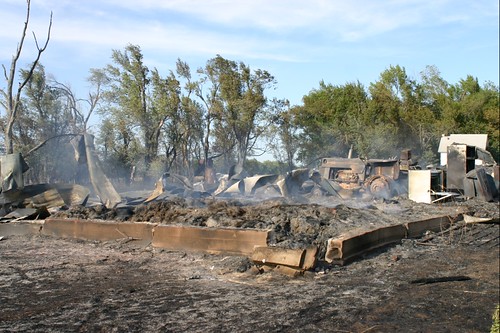
One month later, we lost this barn, and two other buildings, to a fire at our yard. This is what the beautiful red barn looked like that sad afternoon last year:

IMG_3630.JPG

As I wrote back then, nobody got hurt, the barn was insured, but "somehow, despite all these things, it still feels like we lost a little bit of Grandpa today."

2006 was a hot, dry summer. We had a patch of debris, then a patch of dirt, where the barn once stood.

7 months ago, Terah, Jacob, and I moved out to the farm. For the first time in 80 years, someone could stand in the farmhouse in the evening, look to the west, and see the colorful Kansas sunset over the pasture; the trees down by the creek; and even the neighbor's barn off in the distance. It was a beautiful sight, but it was also sad; that's not the view we had expected.

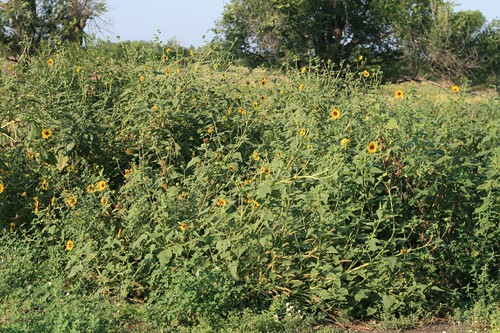
But then a surprise. This spring and summer, plants started coming up where none had grown for 80 years. But only where this barn stood -- not where the other two buildings were.

We watched as they grew tall. I'm sure decades of animals hanging out there were well appreciated by the plants.

As they grew, it looked like we might be seeing Terah's favorite flower: wild Kansas sunflowers.

And sure enough, they were.

Last weekend, Terah, Jacob, and I went out to the old barn. I took some pictures of its new appearance.

img_3429.jpg

This one stands where Grandpa's tractor used to be parked.

img_3401.jpg

And here we see a lifetime of flowers, from the old and withering, to the young just about ready to bloom.

img_3462.jpg

At the edge of the sunflowers, there's an old plow next to them. Though you might think it's barn-colored.

img_3411.jpg

Animals continue to be attracted to the area. Here's one of the smaller visitors.

img_3447.jpg

And here's a picture of almost the whole patch, right where the barn used to stand. I still mow right up to it.

I still miss the old barn. But somehow it still seems to be full of surprises and worth exploring. I wonder what next year will bring.

And I wonder if, a few years from now, Jacob will tell his friends about mowing right up to the sunflower patch, going fast to try to avoid any trouble with the bees.

30 August 2007

John Goerzen: Technology

Two days ago, I was out by the road digging a hole for our mailbox.

Along comes a guy on a tractor. The tractor was built in maybe the 1960s. It had no cab, and was loud, as tractors are. Attached to the back was a mower. It had long since lost any part of paint that was on it, and appeared to be made of rust.

The farmer driving this tractor was wearing a bluetooth earpiece for his cellphone.

(I don't think there would be any way to use a phone while driving that tractor due to the noise, but hey.)

Now, the rest of the story...

This being rural Kansas, the farmer saw me and stopped to chat, turning off the tractor first, of course. He introduced himself as "that crazy guy from south of town", and of course had a pretty good idea of who I was. After all, he's lived around here for decades and knew my grandpa.

I told him why I was digging the hole for the mailbox. There's going to be a second house down our mile, so now the post office will actually deliver to a mailbox at our driveway, rather than one almost a mile away. I thought he looked confused, so I pointed down the road and said that's our mailbox on the corner.

"Oh, I know. I probably shouldn't say this, but I knew when you moved in because I checked your mailbox one day and it didn't have 40-year-old ads piling up anymore."

We chatted a few more minutes, about the neighbor's goats, how annoying it is that he can't get DSL, why he wishes he could still use DOS instead of Windows. Then he went off towards home.

He had stopped his tractor in the middle of the road. But it wasn't a problem. Nobody drove by that whole time anyway.

Russell Coker: Identifying the Distribution of a Linux System

I just needed to test something so I mounted the filesystem of one of my Xen domains in the Dom0 and chroot’d into it (I didn’t need the overhead of running a DomU for a quick test). Then strangely I found that my chroot environment had no apt-get and no dpkg installed. After a small amount of thought I realised that I had accidentally mounted the filesystem for a Fedora image instead of a Debian image. It seems to me that it might be a good idea for distributions to have shell scripts replacing the package tools for other distributions. For example dpkg on a Fedora box could be a shell script that runs echo “This system is running Fedora, you want to use rpm instead of dpkg”. Such a command would have saved me a couple of minutes of thinking. This may sound trivial, but if you consider the number of people who make such mistakes (and the even larger number of people who don’t realise that there is even more than one package tool in existence) then wasting a few K of disk space on every system to help them seems like a good idea. The minimum size of new hard drives that you can purchase seems to be 36G nowadays. So it’s not as if this would really cost anything. Please leave comments to tell me if I’m being sensible or silly. If the idea is regarded as good I’ll start filing bug reports.

29 August 2007

John Goerzen: Desktop Linux: Gnome

I had been intending to write an entire series of posts about our corporate switch to Linux on the Desktop. To date, I wrote only one introducing the project and our reasons for switching from Windows. That was back in April.

Today I'd like to start talking about it all some more.

We have standardized on Gnome for our desktops. Given the Windows background of our user base, it was pretty much a given that we would have to use either Gnome or KDE. Something like fvwm or a non-integrated environment just wouldn't be a good option.

We evaluated both Gnome and KDE. The very "clean" appearance of Gnome was a nice thing for us. KDE seemed to be to "chatty", talked about entering in audiocd:/ when it shouldn't have needed to, and generally violated the KISS and principle of least surprise too often. That said, I continue to run KDE for my personal desktop because Gnome just doesn't have the flexibility that KDE does. It is too bad that Gnome has gone on this remove functionality kick, and KDE hasn't gotten the KISS religion yet.

Anyway, Gnome worked well for the most part. We have set some defaults in gconf for things like panel icons. We also set a few mandatory defaults. I fixed a couple of bugs in the vfs system related to nfs4 support, which manifested themselves as icons for files newly saved to the desktop never showing up.

We wanted to present a customized menu to people based on what their job function is. That is, we are using a single system image, so all apps will be installed on all machines. But we didn't want people to have to see a ton of software that they don't use. That was easily enough accomplished for custom apps by creating desktop files with mode 0640 and setting the group to the set of people that should see the program on their menu. We removed a few stock programs (such as the terminal) from the menu as well, using dpkg-statoverride. That was also quite easily done. However, I will say that the entire Gnome XDG menu thing is woefully under-documented.

We use Firefox for the standard web browser. It is integrated well enough with Gnome and we have no problems there, aside from sites that are IE-only. We solve that with a Windows terminal server, which I'll discuss later.

Our network printing was already based on Cups. The individual machines are set up as Cups clients only, which works fine. We did find, however, that gnome-cups-manager automatically installs a tray monitor for cups. This monitor puts little printer icons on the tray when printers are in use. Unfortunately, it figures out which printers are in use by polling the server, and it is turned on by default out of the box, with no good way to disable it short of dpkg-statoverriding it to 0000. You can imagine that hundreds of users times dozens of printers times numerous polls per minute created quite the load on the server. This was a really braindead design and the people that wrote it should have known better. It is also quite useless to have icons coming on for all the printers on the network, which on some networks could be thousands, and not even on the same continent as the user.

Printing is generally a bit iffy in Gnome. They seem to be transitioning between about 3 different printing toolkits, all of which have different print dialog boxes with different supported features and different ways of selecting printers. One chief annoyance is that the print box in evince (the document/PDF viewer) does not let people access printer-specific features such as hole punching and stapling. So we installed gtklp and xpdf for people. The people that print heavy PDFs are huge fans of gtklp these days; it's a nicer solution than we had in Windows. Nobody really likes evince. We also have had some trouble with evince generating PostScript output that some printers can't grok. It sounds like all this should be much better in newer versions of Gnome, which if true, would be welcome news.

The Gnome screenshot tool makes it easy to save off a screenshot to a file, or to drag it into an email, but it is difficult to print it (you have to save it first). That was a common complaint around here, so I wrote a little wrapper around xwd and gtklp for printing screenshots. People really like that because gtklp gives them lots of options about orientation and size of the image if they want it, or a simple "Print" button to click if they don't care. We set a gconf default to bind this to Ctrl-PrintScr and it works well. KDE's screenshot tool is much more capable, and if we were using KDE, we wouldn't have had any problem with screenshots.

The bottom line on Gnome is that we, and are users, are happy with it after we've made these customizations. But we have had to do more customization that we should have. I still think that Gnome has been better for our users than KDE, but I do wonder how long we'll be able to survive with our "no KDE libraries" policy, as people want ksnapshot, kolour, etc.

Russell Coker: A Strange Attempt to Trick Google

I just noticed that my post about LED Headlights in an Audi Sports Car was linked from audi.host4blogs.com. Strangely they took some of the words from my post, added some other apparently random words to make it look like a response, and then linked to my post. Having summaries of my blog posts appear on splogs is nothing new. I don’t have any objection to it normally as summaries will in a small way promote my blog as long as they are intelligible. The host4blogs.com site has a couple of other car blogs that link to each other with content of the same quality. I guess I can’t file a DMCA take-down request as the text is not a summary of mine. I hope that Google will start taking action against the sploggers soon.

28 August 2007

Alexis Sukrieh: Perl Console 0.3 released

A new version of PerlConsole is available. As you can see in the changelog, lots of goodness with this release comes to you (~/.perlconsolerc rules, thanks to S. Zachariah Sprackett for his patch). After reading the source code of Devel::REPL and learning from it (this is really a great library, congrats to mst) I decided not to orphan Perl Console. Yes, that was a possibility as Devel::REPL provides anything you need to build a console (and comes with “re.pl” which actually is a console itself). I decided not to give it up for one reason: Devel::REPL is great, and better written than Perl Console (it supports plugins and profiles and is Moose-based) but, it’s slow. When you launch it, you have to wait a couple of seconds before the console prompts you. This is because of Moose I suppose. I know that’s not blocker as a console is a development tool, but I feel like some of PerlConsole’s users would like to have the choice between a full featured, extensible and Moose-base console that’s slow, and a light one that is basic in design and implementation. I backported one of the most interesting plugin of Devel::REPL to PerlConsole, being the console’s lexical environement. Devel::REPL did a great thing there, using Lexical::Persistence to simulate a namespace in the console. Feel free to give your feedback about this, I wonder if there’s still an audience for PerlConsole when Devel::REPL is in the town. I think so, maybe I’m wrong, then tell me.

22 August 2007

Norbert Tretkowski: Updated policy

Thanks to Alexander Wirt we now have an updated backports.org policy, please take a look at his mail to our mailinglist if you are responsible for one or more backports. The two most important changes are a new version number scheme and the now required inclusion of more changelog entries in the changes file.

Neil Williams: dpkg-cross 1.99+2.0.0pre1 in NEW

(I had to omit some of the smaller changes - it should all be in the ChangeLog but ask if you spot something major that I haven't mentioned here.)

IMPORTANT! dpkg-cross_1.99+2.0.0pre1 will BREAK things!
(hence it is going into experimental)

  1. BREAKAGES!
    The changes in dpkg-cross are so extensive that apt-cross and emdebian-tools are broken. Current SVN for emdebian-tools builds 0.3.9 which works with pre1. There is a branch of apt-cross (apt-nc-cross) that builds 0.2.9 which works with dpkg-cross pre1. HOWEVER apt-cross 0.2.9 has VERY limited functionality (even --get is incomplete) so dpkg-cross pre1 should only be installed in a chroot or on a system that does not need apt-cross or emdebian-tools. There's little point adding a NEWS.Debian comment on this because it would be too late but Conflicts: are in place:
    Conflicts: apt-cross ( 0.2.9), emdebian-tools ( 0.3.9)
    (The watchful will note that the previous Conflict on pkg-config has been dropped because the conflicting version is no longer in stable or oldstable.)
    The dpkg-cross pre-releases will all go into experimental and no upload will be made to unstable until apt-cross 0.2.9 is available as a package in Emdebian and is also ready to go into Debian as v0.3.0. emdebian-tools needs less changes, some of which can be done AFTER dpkg-cross 2.0.0 reaches unstable.
    I anticipate at least three pre-releases, maybe more.

  2. REMOVED PERL FILE:
    /usr/share/perl5/dpkg-cross.pl
    Replaced by:
    use Debian::DpkgCross;
    There are some functions not universally exported but which can be brought in manually:
    gccross : use Debian::DpkgCross qw(simplify_path);
    dpkg-shlibdeps : use Debian::DpkgCross qw(dpkgcross_application);
    dpkg-buildpackage : use Debian::DpkgCross qw(setup_cross_env);
    The universally exported functions are:
    read_config setup get_architecture create_tmpdir convert_path get_keepdeps get_removedeps get_config get_version detect_arch convert_ld_library_path get_tool rewrite_pkg_name dump_debug_data check_arch

  3. Perl changes:
    use strict;
    use warnings;

    All scripts and the new module are now fully strict and -w compliant. Some perl modules have also been added to the dependency list.

  4. MAKEFLAGS are no longer exported!
    This is a big change and could affect a lot of packages but the honest
    reason is this:
    We should not be exporting MAKEFLAGS ourselves. (in the context of debian-embedded) Packages that were buggy with MAKEFILES are now non-buggy and packages that relied on MAKEFLAGS are now buggy.
    CDBS packages have a single line fix in debian/rules:
    DEB_CONFIGURE_SCRIPT_ENV =
    I'll be filing a bug in due course.
    This allows packages like libx11-6 to build internal tools using CC_FOR_BUILD (set to gcc) and run them to make certain generated source files during the cross-build. I expect it to also work for fontconfig. This method is far preferable to either creating patches for the generated content or trying to replicate the generation process in an interpreted language.

  5. New function:
    &read_config();
    &setup();


    $config = &get_config;
    get_config is new because the configuration is now an internal variable within the module and is not in scope for the scripts. It is a hash table:
    $config 'crossbase' = $crossbase;
    $config 'crossprefix' = $crossprefix;
    $config 'crossdir' = $crossdir;
    $config 'crossbin' = $crossbin;
    $config 'crosslib' = $crosslib;
    $config 'crosslib64' = $crosslib64;
    $config 'crossinc' = $crossinc;
    $config 'crossroot' = $crossroot;

    The values from the two config files:
    $conffile = "/etc/dpkg-cross/cross-compile";
    my $home = File::HomeDir->my_home;
    $private_conffile = "$ home /.dpkg-cross/cross-compile";

    are read in using Config::Auto which removes all the syntax problems of the previous bespoke parser. Comments are ignored as before.
    Everything you specify in either of the config files is now available within the module but only "recognised" options are exported. Config file values are merged - data from /etc/ is read first and data from /home/ is overlaid so that any data not in /home/ comes from /etc/ and any data from /etc/ is overwritten if it also exists in /home/
    @removedeps and @keepdeps need to be sorted out still.

  6. REMOVED CONFFILES:
    /etc/dpkg-cross/cross-config.common obsolete
    /etc/dpkg-cross/cross-config.gnu obsolete
    /etc/dpkg-cross/cross-config.linux obsolete
    /etc/dpkg-cross/cross-config.w32 obsolete
    /etc/dpkg-cross/crosstools obsolete

  7. TESTING
    Ah, yes, testing. So far, only two packages have been tested. I plan to test more tomorrow. Please check for regressions and other brokenness and report via the BTS. (I may forget if it's only done via the debian-embedded list.) Please tag all pre1 issues 'experimental'. Ta.

  8. Speaking of bugs - 6 closed so far, a few more possible. I would like
    to close all but one of the current dpkg-cross bugs. (I'm not sure how
    to fix #285569 )

  9. Debian::DpkgCross.3 manpage - new but horribly incomplete.

  10. %pkgvars - currently disabled. I will merge scope: into the existing %config which then leaves no place for %pkgvars or crosstools but this is pending for pre2.

  11. debug output.
    You now get two debug files in /tmp/:
    gccross2.log : Details the environment, %config and check process of the last call (the last failed call if the build breaks).
    dpkg-cross2.log : Actually misnamed, this is a dpkg-buildpackage log file that contains %config, PATH changes, $ENV changes and the contents of the gccross temporary directory for the last build, including variables set and modified via the module. I'll change the name in pre2.
    The debug output is meant for debian-embedded, not other users. To this end, I'm experimenting with debian/buscript which could go into /usr/share/bugs/ to prompt users reporting bugs for the content of these logs and other configuration details, exactly as with apt. If this works, I'll ditch the idea of turning --debug off and leave it enabled for all builds.
    debian/bugscript is not enabled in pre1. There again, because the module is a new package, pre1 will spend some time in the NEW queue. All changes for pre1 are now in CVS so it should be easy for everyone to build their own packages until pre1 clears NEW and enters experimental. Just be careful where you install dpkg-cross_1.99+2.0.0pre1_all.deb !!!
    (And remember: install libdebian-dpkgcross-perl_1.99+2.0.0pre1_all.deb)

21 August 2007

Russell Coker: Music Videos

I’ve been thinking about music videos recently while compiling a list of my favourite videos of all time. It seems that YouTube has changed things through the re-mixes of videos and the ability of anyone to publish for a mass-market (although without the possibility of directly making money from it). Also today all new PCs (and most PCs that are in use) are capable of being used for video editing and the compute power needed for 80’s and 90’s quality special effects is also commonly available (in most cases good art doesn’t need more technical quality than that). So anyone can produce videos (and a quick search of YouTube reveals that many people are producing videos for their favourite songs). I think that we need a music video for the Free Software Song. One possibility is to base it on the 1984 Apple advert (because it’s the free software community that is opposing Big Brother not Apple). I think it would be good to have multiple versions of the Free Software Song (with matching videos), there could be the version for young children, the Hip-Hop version, the Punk version, etc. Also I think that there is potential for the creation of other songs for the free software community. One possible way of doing this would be to have a contest for producing music and videos. Maybe a conference such as LCA or OLS could have the judging for such a contest. I would be prepared to donate some money towards the prize pool and I’m sure that other individuals and organisations would also be prepared to do so. If I get some positive feedback on this idea I’ll investigate how to run such a contest. Here are my favourite videos of the moment. Please let me know of any videos that you think I would like based on this list.
  • Smashing Pumpkins:
    Ava Adore, interesting way of changing scenes, and a very artistic and strange video (matches the song)
  • Duran Duran (who incidentally named their group after a character in Barbarella: Queen of the Galaxy - strangely the spelling is different though):
  • Too Much Information - they should re-do this and include a reference to the Internet in the lyrics. ;)
  • Wild Boys - Mad Max 3 as a film clip

  • UNKLE:
    • Eye for an Eye - strange and disturbing, as any serious art that is related to war must be
  • Rabbit in Your Headlights - surprising end, I wonder if anyone was injured trying to emulate this clip

  • Nine Inch Nails:
    Head Like a Hole, strange and a bit bizarre at times. Not the greatest of my favourite clips but the music makes up for it.
  • Queen:
    • I Want to Break Free, strangely amusing and very artistic


  • Chemical Brothers:
    • Let Forever Be - my favourite clip of all time. Fractally weird, you can watch it dozens of times and still be missing things.
  • Setting Sun - the world would be a better place if more cops could dance like that! Also is it just me or does the drummer guy look like a Narn from Babylon 5?
  • Out of Control - surprise ending. I would appreciate it if someone who knows the non-English language (probably Spanish) in the clip could point me to a translation.
  • Star Guitar - a real work of art but no plot and I didn’t enjoy the music, I recommend watching it once
  • The Golden Path - I used to wonder whether office work was really so grim in the 60s and 70s, but then I worked for a financial company recently…

  • Fat Boy Slim:
    Praise You - why can’t reality TV be this good?
  • Falco:
    Rock Me Amadeus - let’s represent two totally diffent cultures (bikers and Austraian high society) in a film clip, silly but amusing
  • Madonna:
    Like A Prayer - I wonder how many racist organizations banned that
  • A-Ha:
    Take On Me - mixing multiple art forms (in this case film and animation) can work really well. Beat Kill Bill to the idea by a couple of decades.
  • Robert Palmer:
    Simply Irresistable - pity that they didn’t hire more women who can dance or at least put the dancers in front of the models. It’s interesting to note that one of the models appears to be actually playing a guitar.
  • Garbage:
  • Michael Jackson:
    Billie Jean - class is timeless.
  • 20 August 2007

    Kartik Mistry: TODOs

    * Debian: - Create pkg-festival at alioth, New ‘long pending’ upstream release for Festival/Speech-tools - Xosview 1.8.3, Ayttm 0.5.0-6 (Yeah, its GTK2 Port is out!!) - Bugs - Debian@Foss.in/2007 - T&S II * “Real life”: - Kavin@home - As above - As above ;)

    Cameron Dale: DebTorrent Release 0.1.4 (and apt-transport-debtorrent 0.1.0)

    The next release of DebTorrent is now available. This release includes new functionality for communicating with APT using a new transport method specifically designed for debtorrent, and many bug fixes. The major changes in this release are all in the communication between APT and DebTorrent. The HTTP server in DebTorrent that listens for APT requests has been upgraded to support HTTP/1.1 persistent connections and pipelining, which allows APT to have multiple outstanding requests for files. This is useful as DebTorrent suffers from the typical bittorrent slow start, so requesting multiple files at a time helps to speed up the download considerably. Though better, HTTP/1.1 is not ideal for DebTorrent however, as a maximum of 10 outstanding requests is maintained by APT's http method, and files must still be returned in the order they were requested (which is not ideal for bittorrent-type downloading since downloads occur randomly). To further improve the APT communication I have modified APT's http method to create a debtorrent method. This new debtorrent transport for APT is packaged separately as apt-transport-debtorrent, and once installed APT can be told to use it by replacing "http://" with "debtorrent://" in your sources.list file. This method sends all requests it receives immediately to DebTorrent, and will receive responses from DebTorrent in any order. You can find this new method on the Alioth project, or in my personal repository (only amd64 and i386 versions are currently available). Unfortunately, the story doesn't end here. The APT code responsible for sending requests to the method also limits the maximum number of outstanding requests that it will send to the method to 10, which is not really necessary since all existing methods limit the requests they send out themselves. I have therefore patched the current APT code to increase this limit to 1000 (a one line change), and released this patched version as 0.7.6-0.1. You can find this patched version in my personal repository (again, only for i386 and amd64). I have tested it with the other methods available and it causes no problems, and I hope to get the change included in the regular APT code soon. To sum up: The last DebTorrent version (0.1.3.1) is currently in the NEW queue, and judging by the length of it, will be there for about another week. After DebTorrent is added to the archive, I will be upgrading it to this new version. I also hope to get the new apt-transport-debtorrent package into the NEW queue soon. This brings to an end the Google Summer of Code (which this project was created as a part of), but development of DebTorrent will of course continue (probably a little slower). The next major change will be the addition of unique piece numbers, which is almost complete but needs to be extensively tested. I'd like to thank Anthony Towns, Steve McIntyre, and Michael Vogt for their help over the last 4 months, and also the many others who sent me encouraging emails or engaged in interesting discussions about this project. It's the people who make a project like this a fun and memorable thing to do. Here's the changelog for the new DebTorrent release:

    17 August 2007

    John Goerzen: Time: Failing Our Geniuses

    An interesting article on Time today: Failing Our Geniuses about how the most talented students are being sidelined by current education policy. Some choice bits:

    Since well before the Bush Administration began using the impossibly sunny term "no child left behind," those who write education policy in the U.S. have worried most about kids at the bottom, stragglers of impoverished means or IQs. But surprisingly, gifted students drop out at the same rates as nongifted kids--about 5% of both populations leave school early. Later in life, according to the scholarly Handbook of Gifted Education, up to one-fifth of dropouts test in the gifted range.

    It can't make sense to spend 10 times as much to try to bring low-achieving students to mere proficiency as we do to nurture those with the greatest potential.

    We take for granted that those with IQs at least three standard deviations below the mean (those who score 55 or lower on IQ tests) require "special" education. But students with IQs that are at least three standard deviations above the mean (145 or higher) often have just as much trouble interacting with average kids and learning at an average pace. Shouldn't we do something special for them as well?

    In a no-child-left-behind conception of public education, lifting everyone up to a minimum level is more important than allowing students to excel to their limit. It has become more important for schools to identify deficiencies than to cultivate gifts. Odd though it seems for a law written and enacted during a Republican Administration, the social impulse behind No Child Left Behind is radically egalitarian. It has forced schools to deeply subsidize the education of the least gifted, and gifted programs have suffered. The year after the President signed the law in 2002, Illinois cut $16 million from gifted education; Michigan cut funding from $5 million to $500,000. Federal spending declined from $11.3 million in 2002 to $7.6 million this year.

    John Goerzen: Linux Hardware Support Better Than Windows

    Something I often hear from people that talk about Linux on the desktop is this: people want to be able to go to the store, buy hardware, and be confident that it will Just Work.

    I would like to point out that things are rarely this simple on Windows. And, in fact, things are often simpler on Linux these days.

    Here's the example that prompted this post.

    I have a computer that's about 4 years old. It's my main desktop machine at home. It was still fast enough for me, but has been developing all sorts of weird behaviors. Certain USB ports stopped working altogether a few months ago. Then it started hanging during POST whenever I'd try to reboot -- but would still boot OK about 80% of the time after a power cycle. Then it started randomly losing contact with my USB mouse until a reboot. And the last straw was when the display started randomly going out. I've told everyone that my machine has cancer and is slowly dying.

    The case is a pretty nice full tower -- solid and sturdy. I have an 160GB IDE drive in it. So I figured I will upgrade the motherboard, CPU, RAM, and add a 500GB SATA drive since they're so cheap these days and I'm running out of space. I'd also have to buy a new video card since my old one was AGP and the new motherboard only has PCI Express for video. So about $700 later from Newegg (I got a Core 2 Duo E6750), the parts arrived.

    I spent some time installing it all. The motherboard had only one IDE channel, and I didn't have any IDE cable long enough to connect both the IDE hard disk and the optical drive, so I popped in an old Maxtor/Promise PCI Ultra133 controller I had sitting around to use with the DVD burner.

    Now, to recap, the hardware that the OS would see as new/different is: CPU, RAM, IDE controller, SATA controller, Promise IDE controller, integrated NIC, sound, video.

    Then the magic smoke test.

    I turned on the machine. Grub appeared. Linux started booting.

    Even though I had switched from the default Debian "supports everything" kernel to a K7 kernel, it still booted.

    And every single piece of hardware was supported immediately. There was no "add new hardware" wizard that popped up, no "I've found new hardware" boxes. It just worked, silently, with no need to tell me anything or have me click on anything.

    Only one piece required configuration: the NIC, thanks to some udev design flaws (it got renamed from eth0 to eth1 by udev). That took 20 seconds. Debian saw the IDE HDD, the SATA drive, the Promise controller, the DVD burner, the video card, the sound, and it all worked automatically. And Debian is not even a distro that occurs to a lot of people when they think of great hardware support.

    Now let's turn to Windows.

    The Windows Nightmare

    I have a legal copy of Windows XP Home that was preinstalled on the machine when I got it. I resized its partition down to about 20GB so that I could use 140GB for Linux. I use it rarely, primarily for gaming, and I've bought about 3 games in the last 4 years. I usually disconnect the network when I boot to Windows, though I do keep it current with updates.

    I did some research on what Windows was going to do when I replace the hardware. The general consensus from people on the 'net is that you can't just replace a motherboard and expect everything to be happy. There were generally three different approaches suggested: 1) don't even try, just reinstall; 2) do a rescue install after you move over; and 3) use sysprep. The rescue install has to be done by booting from an XP install CD, then picking a rescue install option somewhere. It will overwrite your installed Windows with the version from the CD. That means that I'd have to re-apply SP2, though bits of it that didn't get overwritten would still be on the hard disk, and who knows what would happen to the registry.

    Option #3 was to download sysprep (must have the Genuine Disadvantage ActiveX to get the free download from MS). Sysprep is designed to be used just prior to taking an image with ghost for replication. It removes the hardware-specific config (but not the drivers), as well as the product key, from the machine, but otherwise leaves it untouched. On the next boot, you get the "Welcome to XP" wizard.

    One other strike against #2 is that Compaq "helpfully" didn't ship any install CDs with the machine. Under Windows, they did have a "create rescue CD" tool, which burned 7 CDs for me. But they are full Compaq-specific CDs, not one of them an XP CD, *AND* they check on boot to see if you're using the same Compaq motherboard, and exit if not. Highly useless.

    So I went with sysprep. Before my new hardware even arrived, I downloaded the Windows drivers for all of it. I burned them to a CD, and installed as many as I could on the system in advance. About half of them refused to install since the new hardware wasn't there yet. I then took a raw image of the partition with dd, just in case. Finally, right before I swapped the hardware, I ran sysprep and let it shut down the machine.

    So after the new hardware was installed came the adventure.

    Windows booted to the "welcome to XP" thingy. The video, keyboard, mouse, and IDE HDD worked. That's about it.

    I went through the "welcome to XP wizard". But the network didn't work yet, so I couldn't activate it. So I popped my handy driver CD in the drive. But what's this? Windows doesn't recognize the DVD drive because it doesn't have drivers for this Promise controller that came out in, what, 2001? Sigh. Downloaded the drivers with the imac, copy them to a CF card, plug the USB CF reader into Windows.

    While I was doing that, about 6 "found new hardware" dialogs got queued up. Not one of them could actually find a driver for my hardware, but that didn't prevent Windows from making me click through them all.

    So, install Promise driver from CF card, reboot. Click through new hardware dialogs again. Install network driver, reboot, click through dialogs. Install sound driver. Install Intel "chipset" driver, click through dialogs. Reboot. Install SATA driver. Reboot.

    So the hardware appears to all be working by this point, though I have a Creative volume control (from the old hardware) and a Realtek one in the tray. Minor annoyance to deal with later.

    Now I have to re-activate XP. I dutifully key in the magic string from the sticker on my case. Surprise surprise, the Internet-based activation fails because my hardware is different. So I have to call the 800 number. I have to read in 7 blocks of 6 digits, one block at a time. Then I answer some questions: have I activated Windows before, have I changed hardware, was the old hardware defective (yes, yes, and yes). Then I get 7 blocks of 6 digits read to me. Finally Windows is activated. PHEW! Why they couldn't ask those questions with the online tool is beyond me.

    Anyhow. Linux took me 20 seconds to get working. Windows, about 2 hours, plus another 2 hours for prep and research.

    I did zero prep for Linux. I made one config change (GUI users could have just configured their machine to use eth1).

    Other cool Linux HW features

    Say you buy a new printer and want to get it set up. On Windows, you insert the CD, let it install 200MB of print drivers plus ads plus crap plus add something to your taskbar plus who knows what else. Probably reboot. Then the printer might actually print.

    On Debian, you plug in the printer to the USB port. You type printconf. 5 seconds later, your printer works.

    I have been unpleasantly surprised lately by just how difficult hardware support in Windows really is, especially since everyone keeps saying how good it is. It's not good. Debian's is better, in my opinion.
    16 August 2007

    MJ Ray: Vuelta a Burgos

    Eurosport are broadcasting the Vuelta a Burgos at 19 east until Saturday. This can be an interesting race for seeing how well the ProTour teams are recovering from the Tour de France, ready for the Vuelta a Espa a. Barloworld's TdF revelation Juan Mauricio Soler has a 17-second lead into tomorrow's individual time trial. The 69th Volta a Portugal finished yesterday with an ~50-minute individual time trial that saw the lead change hands and Xavier Tondo of LA/MSS take the General Classification by a little under a minute. RTP's coverage was strangely subdued. It seemed like they only had cameras around the finish line, not on motorbikes following the riders. The bad weather may have caused that, though. Meanwhile, the Deutschland-Tour 2007 is broadcast to Europe until Saturday on ARD at 19 east and 13 east. Gerald Ciolek of T-Mobile won his second stage in a row today, while CSC's ever-popular Jens Voigt remains in yellow. Individual time trial there too tomorrow. ARD's coverage has been very swish so far this year. Widescreen with informative graphics, although the commentary is still a bit subdued for my taste. Overall, it's a shame there's not more airtime given to it.

    John Goerzen: There's a redneck joke here somewhere

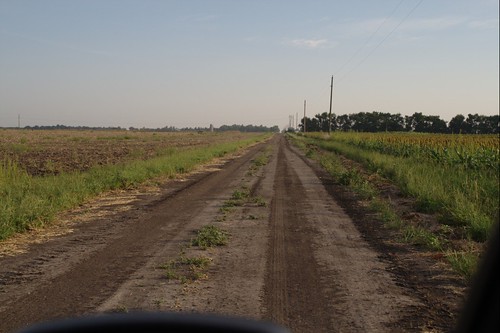
    Back when I was in high school, I heard a Jeff Foxworthy CD once. He had this "you might be a redneck if" routine. We resemble one of his comments: "If the directions to your house include 'turn off the paved road', you might be a redneck."

    What if the road -- the county road, not our driveway, mind you -- has weeds growing down the middle? And you can tell that the county maintainer has been by recently because there are fewer, and shorter, weeds than before?

    img_3383.jpg

    11 August 2007

    Cameron Dale: DebTorrent BugFix Release 0.1.3.1

    Here's a new release of DebTorrent, containing only bug fixes. This release fixes 2 bugs, one minor, and one serious. The serious bug would probably have caused anyone using a recent (0.7) version of APT to experience hangs with APT saying "waiting for headers". If you had this issue and you're using APT 0.7, please update to this new version. If you had this issue with an older version of APT, please report it as a bug. Agian, if you do find any bugs or have any problems, please submit them to the DebTorrent mailing list, or come and find me (camrdale) on IRC in the #debtorrent channel on OFTC. Here's the changelog:

    9 August 2007

    Eddy Petrișor: small commits

    Update: I have been informed that git and mercurial have support for the hunk commit feature, excellent! See the comments section if you want to know the details. IIRC, The last time someone talked about this feature was when John Gorzen analyzed his options for another VCS (still now I can't find any reference to this issue).


    Lars, darcs allows this and, as a supplement that is missing from any other VCS I know, is the ability to select individually changes in a file. That means you can commit only some of the changes affecting a file and leave others for later commits.

    So for this diff:

    $ darcs diff -u
    diff -rN -u old-asd/asdnbfnd new-asd/asdnbfnd
    --- old-asd/asdnbfnd 2007-08-08 18:12:17.000000000 +0300
    +++ new-asd/asdnbfnd 2007-08-08 18:12:17.000000000 +0300
    @@ -1,3 +1,3 @@
    -#!/bin/ash
    +#!/bin/sh

    -echo "intentionaol spelling error"
    +echo "intentional spelling error"

    you can do this:

    $ darcs rec -m "spelling correction"
    hunk ./asdnbfnd 1
    -#!/bin/ash
    +#!/bin/sh
    Shall I record this change? (1/?) [ynWsfqadjkc], or ? for help: n
    hunk ./asdnbfnd 3
    -echo "intentionaol spelling error"
    +echo "intentional spelling error"
    Shall I record this change? (2/?) [ynWsfqadjkc], or ? for help: y
    Finished recording patch 'spelling correction'

    $ darcs rec -m "make the script run on posix shell"
    hunk ./asdnbfnd 1
    -#!/bin/ash
    +#!/bin/sh
    Shall I record this change? (1/?) [ynWsfqadjkc], or ? for help: y
    Finished recording patch 'make the script run on posix shell'

    Of course, being able to unrecord/uncommit or to rollback is a nice thing to have.

    Next.

    Previous.