Search Results: "agi"

29 January 2017

Elena 'valhalla' Grandi: One Liberated Laptop

One Liberated Laptop

Immagine/fotohttp://social.gl-como.it/photos/valhalla/image/5a480cd2d5842101fc8975d927d030f3

After many days of failed attempts, yesterday @Diego Roversi finally managed to setup SPI on the BeagleBone White , and that means that today at our home it was Laptop Liberation Day!

We took the spare X200, opened it, found the point we were on in the tutorial installing libreboot on x200 https://libreboot.org/docs/install/x200_external.html, connected all of the proper cables on the clip and did some reading tests of the original bios.

Immagine/fotohttp://social.gl-como.it/photos/valhalla/image/77e61745d9c43833b7c0a4a919d17222

While the tutorial mentioned a very conservative setting (512kHz), just for fun we tried to read it at different speed and all results up to 16384 kHz were equal, with the first failure at 32784 kHz, so we settled on using 8192 kHz.

Then it was time to customize our libreboot image with the right MAC address, and that's when we realized that the sheet of paper where we had written it down the last time had been put in a safe place somewhere

Luckily we also had taken a picture, and that was easier to find, so we checked the keyboard map , followed the instructions to customize the image https://libreboot.org/docs/hcl/gm45_remove_me.html#ich9gen, flashed the chip, partially reassembled the laptop, started it up and a black screen, some fan noise and nothing else.

We tried to reflash the chip (nothing was changed), tried the us keyboard image, in case it was the better tested one (same results) and reflashed the original bios, just to check that the laptop was still working (it was).

It was lunchtime, so we stopped our attempts. As soon as we started eating, however, we realized that this laptop came with 3GB of RAM, and that surely meant "no matching pairs of RAM", so just after lunch we reflashed the first image, removed one dimm, rebooted and finally saw a gnu-hugging penguin!

We then tried booting some random live usb key https://tails.boum.org/ we had around (failed the first time, worked the second and further one with no changes), and then proceeded to install Debian.

Running the installer required some attempts and a bit of duckduckgoing: parsing the isolinux / grub configurations from the libreboot menu didn't work, but in the end it was as easy as going to the command line and running:


linux (usb0)/install.amd/vmlinuz
initrd (usb0)/install.amd/initrd.gz
boot


From there on, it was the usual debian installation and a well know environment, and there were no surprises. I've noticed that grub-coreboot is not installed (grub-pc is) and I want to investigate a bit, but rebooting worked out of the box with no issue.

Next step will be liberating my own X200 laptop, and then if you are around the @Gruppo Linux Como area and need a 16 pin clip let us know and we may bring everything to one of the LUG meetings

yes, white, and most of the instructions on the interwebz talk about the black, which is extremely similar to the white except where it isn't

wait? there are keyboard maps? doesn't everybody just use the us one regardless of what is printed on the keys? Do I *live* with somebody who doesn't? :D

the breadboard in the picture is only there for the power supply, the chip on it is a cheap SPI flash used to test SPI on the bone without risking the laptop :)

disclaimer: it worked for us. it may not work on *your* laptop. it may brick it. it may invoke a tentacled monster, it may bind your firstborn son to a life of servitude to some supernatural being. Whatever happens, it's not our fault.

(edit: added tags)

#coreboot #libreboot

27 January 2017

Russ Allbery: Review: Summer in Orcus

Review: Summer in Orcus, by T. Kingfisher
Publisher: Red Wombat Studio
Copyright: 2016
ASIN: B01N26G2I0
Format: Web serial
Pages: 268
In September, Ursula Vernon started posting Summer in Orcus as a web serial, funded by her Patreon supporters. The entire story is now complete and available on-line for free, which is how I read it, but it's also available as an ebook from the expected places if you prefer to read it that way. The ebook publication lists T. Kingfisher as the author, Vernon's pen name for her books for adults. While I would have been happy to read this book as a kid, it does have one fairly gruesome chapter, which is probably the reason for that choice. Summer is eleven, and her mother loves her very much. So much so that she's never allowed to do anything even slightly risky, and she spends quite a lot of her time and emotional energy reassuring her mother, dealing with the burden of that suffocating love, and helping her through her bad days. Then, one day, a house with giant chicken feet walks into the alley behind her house. Summer in Orcus is a portal fantasy. It's the story of how Summer meets Baba Yaga and asks for her heart's desire, finds herself in the magical country of Orcus, and is desperately moved by the plight of a frog tree. It has a talking weasel and a werehouse and antelope women who are not to be trusted, and it's about Summer making friends her mother would never have approved of and learning what she's capable of, and about doing what one can to put things right. Even though it may appear that way at times, Summer in Orcus is not really a book about large things. It's not a saving the world sort of portal fantasy. And it's not really a wish fulfillment portal fantasy, because heart's desires are complicated and subtle. It's a story about being scared and tired and lost, and about making friends, and doing the things one can do rather than learning how to be a completely different person. The plot itself is not particularly complex, but the joy of this story is in all the small things. Vernon's writing is an absolute delight. Summer in Orcus is packed with sentences and paragraphs that I just want to read again and again and quote at people.
Summer had never had a father, and wasn t entirely sure what you did with one, and certainly her mother never had anything good to say about the one Summer didn t have.
Or:
The house lifted its back end up and inched forward a little, like a dog wanting to play. This must have made the floors tilt inside, because Summer heard a banging and sliding of furniture and Baba Yaga yelled, "Fool house! I ll trade you in for one with turtle feet and a three-car garage!" The house sank back down, but wiggled forward a little more, until the front door was only a few feet away.
Vernon mentions in her author notes at the end that Summer in Orcus started as a place to put a whole bunch of fragmentary ideas that she'd come up with but that didn't seem to fit into other stories, and it does have a bit of a grand tour feel to it. But unlike a lot of grand tour figures, the protagonist is not at all bland. Summer is entirely believable and very sympathetic, torn between wanting a grand adventure and being afraid of circumstance and danger entirely outside of her limited experience. She channels the reader's awe and delight, but is still very much her own person, trying to figure out who she wants to be and believe in without the stifling presence of her mother. The tour nature of the story does mean that some things weren't explored as deeply as I would have liked. I would dearly love to read more about the dogs, for instance. I also have to admit that Zultan's motives never made sense to me, even after they were explained, and I found him an odd and weirdly random character to the end. But Glorious is, well, glorious, and I utterly adored the bits with the Forester. The ending is highly unusual for a story of this sort, and I thought it was wonderful, with a great symbolic tie back to the start of the story. The aftermath is even better, including Summer standing firm against one of the tropes of portal fantasies that I dislike the most. This is a great story, with some excellent writing. If you're anything like me, once you read the first chapter you won't want to stop (and since it's all available on the web for free, there's no reason to stop). Recommended. Rating: 8 out of 10

26 January 2017

John Goerzen: What is happening to America?

I still remember vividly my first visit to Europe, back in 2010. I had just barely gotten off a plane in Hamburg and on to a bus to Lubeck, and struck up a conversation with a friendly, well-educated German classical musician next to me. We soon started to discuss politics and religion. Over the course of the conversation, in response to his questions, I explained I had twice voted against George W. Bush, that I opposed the war in Iraq for many reasons, that I did thought there was an ethical imperative to work to defeat climate change, that I viewed health care as an important ethical and religious issue, that I thought evolution was well-established, and that I am a Christian. Finally, without any hint of insult intended, and rather a lot of surprise written all over his face, he said: Wow. You re an American, and a Christian, and you re so . normal! This, it seems to me, has a lot to do with Trump. Ouch It felt like a punch to the gut. The day after the election, having known that a man that appeared to stand for everything that honorable people are against won the election, like people all around the world, I was trying to make sense of how could this happen? As I ve watched since, as he stacks government with wealthy cronies with records nearly as colorful as his own, it is easy to feel even more depressed. Based on how Trump spoke and acted, it would be easy to conclude that the deplorables won the day that he was elected by a contingent of sexists or racists ascendent in power. But that would be too simple an explanation. This is, after all, the same country that elected Barack Obama twice. There are a many people that voted twice for a black man, and then for Trump. Why? Racism, while doubtless a factor, can t explain it all. How Trump could happen Russ Allbery made some excellent points recently:
[Many Americans are] hurt, and they re scared, and they feel like a lot of the United States just slammed the door in their faces. The status quo is not working for people. Technocratic government by political elites is not working for people. Business as usual is not working for people. Minor tweaks to increasingly arcane systems is not working for people. People are feeling lost in bureaucracy, disaffected by elections that do not present a clear alternate vision, and depressed by a slow slide into increasingly dismal circumstances. Government is not doing what we want it to do for us. And people are getting left behind. The left in the United States (of which I m part) has for many years been very concerned about the way blacks and other racial minorities are systematically pushed to the margins of our economy, and how women are pushed out of leadership roles. Those problems are real. But the loss of jobs in the industrial heartland, the inability of a white, rural, working-class man to support his family the way his father supported him, the collapse of once-vibrant communities into poverty and despair: those problems are real too. The status quo is not working for anyone except for a few lucky, highly-educated people on the coasts. People, honestly, like me, and like many of the other (primarily white and male) people who work in tech. We are one of the few beneficiaries of a system that is failing the vast majority of people in this country.
Russ is, of course, right. The Democrats have been either complicit in policies damaging to many, or ineffective in preventing them. They have often appeared unconcerned with the plight of people outside cities (even if that wasn t really the case). And it goes deeper. When s the last time you visited Kansas? I live in Kansas. The nearest paved road is about a 3-mile drive from my home. The nearest town, population 600, is a 6-mile drive. My governor whom I did not vote for cut taxes on the wealthy so much that our excellent local schools have been struggling for years. But my community is amazing, full of loving and caring people, the sort of people who you know you ll be living with for 40 years, and so you make sure you get along well with. I have visited tourist sites in Berlin, enjoyed an opera and a Broadway show in New York, taken a train across the country to Portland, explored San Francisco. I ve enjoyed all of them. Many rural people do get out and experience the world. I have been in so many conversations where I try to explain where I live to people that simply cannot fathom it. I have explained how the 18 acres I own is a very small amount where I am. How, yes, I do actually have electricity and Internet. How a bad traffic day is one where I have to wait for three cars to go past before turning onto the paved road. How I occasionally find a bull in my front yard, how I can walk a quarter mile and be at the creek on the edge of my property, how I can get to an airport faster than most New Yorkers and my kids can walk out the front door and play in a spot more peaceful than Central Park, and how all this is way cheaper than a studio apartment in a bad part of San Francisco. It is rare indeed to see visitors actually traveling to Kansas as a destination. People have no concept of the fact that my mechanic would drop everything and help me get my broken-down car to the shop for no charge, that any number of neighbors or uncles would bring a tractor and come plow the snow off my 1/4-mile driveway out of sheer kindness, that people around here really care for each other in a way you don t see in a city. There are people that I know see politics way differently than me, but I know them to be good people. They would also do anything for a person in need, no matter who they are. I may find the people that they vote for to be repugnant, but I cannot say I ve looked this person in the eyes and they are nothing but deplorable. And so, people in rural areas feel misunderstood. And they are right. Some perspectives on Trump As I ve said, I do find Trump to be deplorable, but not everyone that voted for him is. How, then, do people wind up voting for him? The New Yorker had an excellent story about a man named Mark Frisbie, owner of a welding and fab shop. The recession had been hard on his business. His wife s day-care center also closed. Health care was hard to find, and the long, slow decline had spanned politicians of every stripe. Mark and his wife supposedly did everything they were supposed to: they worked hard, were honest, were entrepreneurial, and yet he had lost his business, his family house, his health coverage, everything. He doesn t want a handout. He wants to be able to earn a living. Asked who he d vote for, he said, Is none of the above an option? The Washington Post had another insightful article, about a professor from Madison, WI interviewing people in rural areas. She said people would often say: All the decisions are made in Madison and Milwaukee and nobody s listening to us. Nobody s paying attention, nobody s coming out here and asking us what we think. Decisions are made in the cities, and we have to abide by them. She pushed back, hard, on the idea that Trump supporters are ignorant, and added that liberals that push that line of thinking are only making the problem worse. I would agree; seeing all the talk about universities dis-inviting speakers that don t hew to certain political views doesn t help either. A related article talks about the lack of empathy for Trump voters. And then we have a more recent CNN article: Where Tump support and Obamacare use soar together, explaining in great detail how it can be logical for someone to be on Obamacare but not like it. We can all argue that the Republicans may have as much to do with that as anything, but the problem exists. And finally, a US News article makes this point:
His supporters realize he s a joke. They do not care. They know he s authoritarian, nationalist, almost un-American, and they love him anyway, because he disrupts a broken political process and beats establishment candidates who ve long ignored their interests. When you re earning $32,000 a year and haven t had a decent vacation in over a decade, it doesn t matter who Trump appoints to the U.N., or if he poisons America s standing in the world, you just want to win again, whoever the victim, whatever the price. According to the Republican Party, the biggest threat to rural America was Islamic terrorism. According to the Democratic Party it was gun violence. In reality it was prescription drug abuse and neither party noticed until it was too late.
Are we leaving people out? All this reminded me of reading about Donald Knuth, the famous computer scientist and something of the father of modern computing, writing about his feelings of trepidation about sharing with his university colleagues that he was working on a project related to the Bible. I am concerned about the complaints about the PC culture , because I think it is good that people aren t making racist or anti-semitic jokes in public anymore. But, as some of these articles point out, in many circles, making fun of Christians and conservatives is still one of the accepted targets. Does that really help anything? (And as a Christian that is liberal, have all of you that aren t Christians so quickly forgotten how churches like the Episcopals blazed the way for marriage equality many years ago already?) But they don t get a free pass I have found a few things, however, absolutely scary. One was an article from December showing that Trump voters actually changed their views on Russia after Trump became the nominee. Another one from just today was a study on how people reacted when showed inauguration crowd photos. NPR ran a story today as well, on how Trump is treating journalists like China does. Chilling stuff indeed. Conclusion So where does this leave us? Heading into uncertain times, for sure, but perhaps just maybe with a greater understanding of our neighbors. Perhaps we will all be able to see past the rhetoric and polarization, and understand that there is something, well, normal about each other. Doing that is going to be the only way we can really take our country back.

25 January 2017

Urvika Gola: Outreachy- Week 4 & 5 Progress

Working with Preferences, AudioManager, RingtoneManager in Android. Sometimes the noise can get too much. Imagine all the people around you at work or in a classroom. All of them have at least one cell phones. Even if they were all to make a tiny blip, the noise would be irritating and disruptive. To avoid devices from interrupting the non-digital life, applications often provide settings that allow users to modify app volumes. My task this week was to enable/disable silent mode in Lumicall. To provide settings for your application, instead of using multiple Views, Preference APIs should be used. Each preference appears as an item in a list and provides the appropriate UI for users to modify the setting. In Lumicall, when settings menu from the menubar is selected, a preference screen is displayed showing various setting options, where I appended a Configure Silent Mode option. The UI for the preference screen is expected to be in Src->xml folder under the name preferences.xml

silentSnippet from Lumicall s preference.xml for Configure Silent Mode preference screen.
In Lumicall, whenever a SIP message comes in, RingtoneManager Class is used to generate a notification sound & AudioManager Class is used to generate sound for incoming encrypted calls. The difference between the two is that, AudioManager provides access to volume and ringer mode control. Ringer modes like, Normal, silent and vibration. Whereas RingtoneManager provides access to ringtones, notification. So to add a simple -disable/enable silent mode- functionality, I decided to use a CheckboxPreference. For the same goal, a better looking widget would be a SwitchPreference, but It does not work properly with DarkThemes which Lumicall uses. So I decided to use a simple Checkbox instead. The result of all the settings are saved as key value pairs in the default SharedPreferences file which can be retrieved to make changes in the app based on the settings modified by the user.
Every preference has a key and the result associated with it.
To fetch the result from the SharedPreferences file-
boolean silentflag=PreferenceManager.getDefaultSharedPreferences(ctx).getBoolean(org.sipdroid.sipua.ui.Settings.PREF_SILENT_MODE, org.sipdroid.sipua.ui.Settings.DEFAULT_SILENT_MODE); Note, the arguments in getBoolean function is (Key, DefaultValue). Don t forget to pass the Context object, ctx in the statement. I wasted a lot of time figuring that one out and created a non-optimal-working way which I eventually had to remove cos I figured out how to retrieve the result value. frustrated
To add a second method of setting silent mode, i.e where the user can enter his work days/time, I wanted to display an activity with required widgets .
To display an activity on a when a preference is selected, intent tags are used. (See the above snippet)
Note that the target package in the intent tags is not the package name of where the java file of the activity is to be found.It s the package name which is your applicationID. Now this activity, like any other activity in android is a combination of an xml and java file.
1. My xml file contains the widgets for user to enter two set of time value in HH:MM format. i.e.the start and end time during which user requires application notifications to be silent it also contains checkboxes for user to select multiple days of the week. 2. The java file associated with this does the following:
2.1 Comparing the Real Time with User s Specified Start and End time
2.2 Checking the current day of the week with the days marked by the user in the checkboxes I have used inbuilt Calendar class and Date class to accomplish this. All done I felt quite proud but this.. this was something that tested my patience and endurance!
As I continue my work, I will keep sharing! Please keep reading!
U


22 January 2017

Shirish Agarwal: Debian contributions and World History

Beware, this would be slightly longish. Debian Contributions In the last couple of weeks, was lucky to put up a patch against debian-policy which had been bothering me for a long-long time. The problem statement is simple, man-pages historically were made by software engineers for software-engineers. The idea, probably then was you give the user some idea of what the software does and the rest the software engineer would garner from reading the source-code. But over period of time, the audience has changed. While there are still software engineers who use GNU/Linux for the technical excellence, the man-pages have not kept up with this new audience who perhaps are either not technically so sound that or they do not want to take the trouble to reading the source-code to understand how things flow. An example or examples in a man-page gives us (the lesser mortals) some insight as how the command works, how the logic flows. A good example of a man-page is the ufw man-page
EXAMPLES
Deny all access to port 53: ufw deny 53 Allow all access to tcp port 80: ufw allow 80/tcp Allow all access from RFC1918 networks to this host: ufw allow from 10.0.0.0/8
ufw allow from 172.16.0.0/12
ufw allow from 192.168.0.0/16 Deny access to udp port 514 from host 1.2.3.4: ufw deny proto udp from 1.2.3.4 to any port 514 Allow access to udp 1.2.3.4 port 5469 from 1.2.3.5 port 5469: ufw allow proto udp from 1.2.3.5 port 5469 to 1.2.3.4 port 5469
Now if we had man-pages like the above which give examples, then the user at least can try to accomplish whatever s/he is trying to do. I truly believe not having examples in a man-page kills 50% of your audience and people who could potentially use your tool. Personal wishlist The only thing (and this might be my failure) is we need a good way to search through a man-page. The only way I know is using / and try to give a pattern. Lots of times it fails because I, the user doesn t know the exact keyword which the documenter was using. What would be nice, great if we do have some sort of parser where I tell it, $this is what I m looking for and the parser tries the pattern + all its synonyms and whatever seems to be most relevant passage from the content, in this case a manpage it tells me. It would make my life a lot easier while at the same time force people to document more and more. I dunno if there has been any research or study of the relationship between good documentation and popularity of a program. I know there are lots of different tiny bits which make or break a program, one of which would definitely be documentation and in that a man-page IF it s a command-line tool. A query on Quora gives some indication https://www.quora.com/How-comprehensible-do-you-find-Unix-Linux-Man-pages although the low response rate tells its own story. there have been projects like man2html and man2pdf and others which try to make the content more accessible to people who are not used to the man-page interface but till you don t have Examples the other things can work only so far. Also if anybody talks about X project which claims to solve this problem they will have to fight manpages who have been around like forever. As can be seen in the patch, did some rookie mistakes as can be seen. I also filed a lintian bug at the same time. Hope the patch does get merged at some point in debian-policy and then a check introduced in lintian in some future release. I do agree with anarcat s assertion that it should be at the level of the manpage missing level. I am no coder but finding 14,000 binary packages without a manpage left me both shocked and surprised. I came to know about manpage-alert from the devscripts package to know which all binary packages that have been installed but not have man-pages. I hope to contribute a manpage or two if I across a package I m somewhat comfortable with. I have made a beginning of sorts by running manpage alert and putting the output in a .txt file which I would grep through manually and see if something interesting jumps at me. The learning garnered from putting the patch to the debian package resulted in another patch but this time for an upstream project altogether. As can be seen all are just baby-steps that even a non-coder can take. Another couple of bugs I filed which were fixed were of a sim called unknown-horizons . A 2D realtime strategy simulation. I had filed three bugs, two of which were fixed in 2 days, the 3rd I hope is also fixed soonish. Lastly, I spent most of the week-end poring over packages who have left files in /etc/bash_completion.d/ . I spent almost 4-5 odd hours as each package in question as well as entries found in /etc/bash-completion.d/$filename I had to find which package it belonged to first

[$] dpkg -S /etc/bash_completion.d/git-prompt
git: /etc/bash_completion.d/git-prompt
I know that dpkg-query also does the same
[$] dpkg-query -S /etc/bash_completion.d/git-prompt
git: /etc/bash_completion.d/git-prompt
But I am used to plain dpkg although do know that dpkg-query can do lot more intimate searching in various ways than dpkg can. Once the package name was established, first simulate the purge [$] sudo aptitude -s purge git

[sudo] password for shirish:
The following packages will be REMOVED:
git p
0 packages upgraded, 0 newly installed, 1 to remove and 14 not upgraded.
Need to get 0 B of archives. After unpacking 29.5 MB will be freed.
The following packages have unmet dependencies:
libgit-wrapper-perl : Depends: git but it is not going to be installed
git-extras : Depends: git (>= 1.7.0) but it is not going to be installed
bup : Depends: git but it is not going to be installed
git-remote-gcrypt : Depends: git but it is not going to be installed
git-svn : Depends: git (> 1:2.11.0) but it is not going to be installed
Depends: git ( 1:2.11.0) but it is not going to be installed
Depends: git (= 1:1.8.1) but it is not going to be installed
git-core : Depends: git (> 1:1.7.0.2) but it is not going to be installed
The following actions will resolve these dependencies:
Remove the following packages:
1) bup [0.29-2 (now, testing, unstable)]
2) fdroidserver [0.7.0-1 (now, testing, unstable)]
3) git-annex [6.20161012-1 (now, testing)]
4) git-core [1:2.11.0-2 (now, testing, unstable)]
5) git-extras [4.2.0-1 (now, testing, unstable)]
6) git-remote-gcrypt [1.0.1-1 (now, testing, unstable)]
7) git-repair [1.20151215-1 (now, unstable)]
8) git-svn [1:2.11.0-2 (now, testing, unstable)]
9) gitk [1:2.11.0-2 (now, testing, unstable)]
10) libgit-wrapper-perl [0.047-1 (now, testing, unstable)]
11) python3-git [2.1.0-1 (now, testing, unstable)]
12) svn2git [2.4.0-1 (now, testing, unstable)] Leave the following dependencies unresolved:
13) devscripts recommends libgit-wrapper-perl
14) dh-make-perl recommends git
15) fdroidserver recommends git
16) git-annex recommends git-remote-gcrypt (>= 0.20130908-6)
17) gplaycli recommends fdroidserver
18) python-rope recommends git-core
Accept this solution? [Y/n/q/?] q
Abandoning all efforts to resolve these dependencies.
Abort.
Then I made a note of all the packages being affected, saw purging all of them wouldn t call others (the Package dependency Hell), made the purge and then reinstalled anew. The reason I did this is that many a times during upgrade, either during update/upgrade sometimes the correct action doesn t happen. To take the git s example itself, there were two files git-extras and git-prompt which were in /etc/bash_completion.d/ both of which were showing their source as git. Purging git and installing git afresh removed git-extras file and git-prompt is the only one remaining. While blogging about the package, did try to grep through changelog.Debian.gz and changelog.gz in git

[shirish@debian] - [/usr/share/doc/git] - [10046]
[$] zless changelog.gz
and similarly

[shirish@debian] - [/usr/share/doc/git] - [10046]
[$] zless changelog.Debian.gz
But failed to find any mention of the now gone git-extras. Doing this with all the packages took considerable time as didn t want to deal with any potential fallout later on. For instance, ufw (uncomplicated firewall) also had an entry in /etc/bash_completion.d/, hence before purging ufw, took backup of all the rules I have made, did a successful simulation

[$] sudo aptitude -s purge ufw gufw


The following packages will be REMOVED:
gufw p ufw p
0 packages upgraded, 0 newly installed, 2 to remove and 14 not upgraded.
Need to get 0 B of archives. After unpacking 4,224 kB will be freed.
Note: Using 'Simulate' mode.
Do you want to continue? [Y/n/?] y
Would download/install/remove packages.
purged the packages, reinstalled it and then re-added all the rules. Doing it all for various sundry packages, had to do it manually as there is no one size fits all solution. A sensitive one was grub which still has an entry in /etc/bash_completion.d/grub. Doing it wrong could have resulted in a non-bootable situation. There are workarounds for that, but it would have taken quite a bit of time, energy, notes and bit of recall factor what I did the last time something like that happened. Doing it manually, being present meant I could do it rightly the first time. So, was it worth it It would be if the package maintainers do the needful and the remaining entries are moved out of /etc/bash_completion.d/ to /usr/share/bash-completions and some to my favourite /usr/share/zsh/vendor-completions/ for instance

[shirish@debian] - [/usr/share/zsh/vendor-completions] - [10064]
[$] ll -h _youtube-dl
-rw-r--r-- 1 root root 3.2K 2016-12-01 08:48 _youtube-dl But trying to get all or even major packages to use zsh-completions would be hard work and would take oodles of time and this concerns upstream stuff, also very much outside what I was sharing. World History Before, during and even after South-African experience, I was left wondering why India and South Africa, two countries who had similar histories at least the last couple of hundred years or more, the final result of Independence was so different for both the countries. It took me quite sometime to articulate that in a form of question , while the answers were interesting, from what little I know of India itself, if I were an Englishman I would never leave Hindustan . What the people answering failed to take into account was that in that era it was Hindustan or un-divided India.
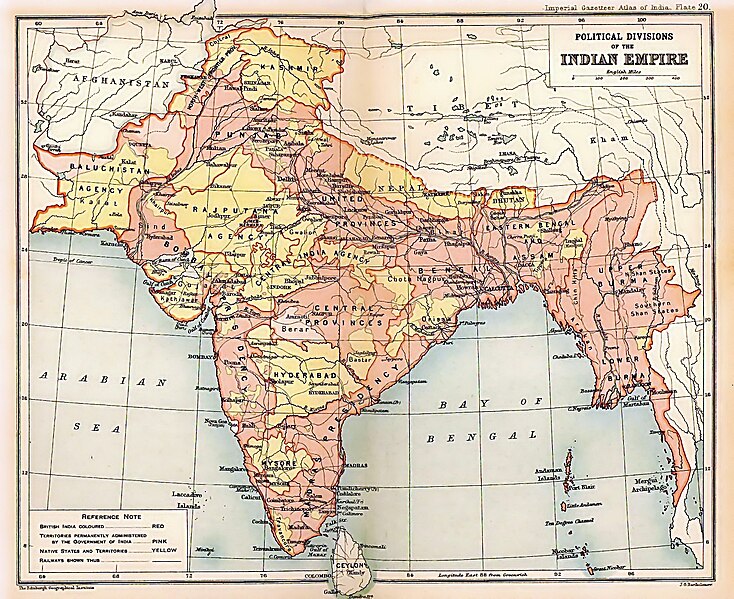
Pre-partition map of India

Pre-partition map of India

This map can be found at https://commons.wikimedia.org/wiki/File:British_Indian_Empire_1909_Imperial_Gazetteer_of_India.jpg and is part of quite a few Indian articles. I would urge people to look at the map in-depth. Except for the Central India Agency and Central India Provinces, most of the other regions were quite comfortable weather-wise. Hence I can t help but feel the assertion that Britishers didn t like India (as to live here) slightly revolting. See the excerpt/take on Dale Kennedy s The Magic Mountains: Hill Stations and the British Raj. Berkeley: University of California Press, 1996. xv + 264 pp. . A look at the list of hill stations of divided India is enough to tell that there were lot of places which either were founded by the Britishers or they chose to live there. And this is not all, there are supposed to lot of beautiful places even in Pakistan, especially in North East Frontier, Swat for instance. While today it s infamous for Taliban and Islamic Terrorism, there was a time it was known for its beauty.
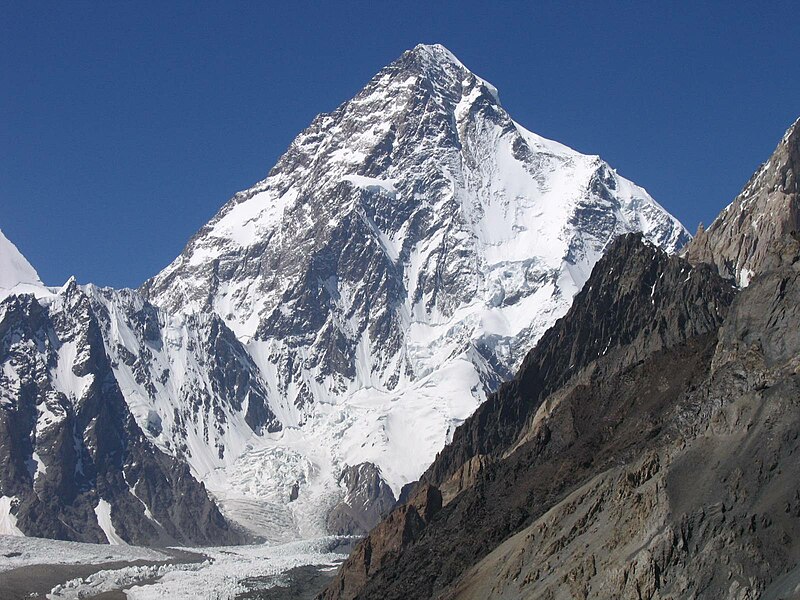
The second most difficult mountain in the world - K2, Pakistan

The second most difficult mountain in the world K2, Pakistan

Trivia After Everest, K2 is the smaller one although whatever I have read of people s accounts, most people who ascended all 14 8,000 metre peaks say K2 is technically more tougher than Everest and after Everest has the highest casualty rate. Also places like the disputed North half of Pakistan Occupied Kashmir, Gilgit Baltistan, Extreme northern Punjab of Pakistan , Northern half of Khyber-Pakhtunkhawa province and Northern Balochistan all of these places would have been more than conducive to the Britishers as it is near to the British climate (snow and pleasant weather all year round). It really is a pity that Pakistan chose to become a terrorist state where it could have become one of the more toured places of Asia. I really feel nauseous and sad at the multiple chances that Pakistan frittered away, it could have been something else.
Filed under: Miscellenous Tagged: #bash-completion, #British Raj, #contributions, #debian, #debian-policy, #Debian-QA, #Hill Stations, #India Independance Movement, #lintian, #obsolete-conffiles, #unknown-horizons, #weather, #World History, adequate, Pakistan, tourism

19 January 2017

Daniel Pocock: Which movie most accurately forecasts the Trump presidency?

Many people have been scratching their heads wondering what the new US president will really do and what he really stands for. His alternating positions on abortion, for example, suggest he may simply be telling people what he thinks is most likely to win public support from one day to the next. Will he really waste billions of dollars building a wall? Will Muslims really be banned from the US? As it turns out, several movies provide a thought-provoking insight into what could eventuate. What's more, these two have a creepy resemblance to the Trump phenomenon and many of the problems in the world today. Countdown to Looking Glass On the classic cold war theme of nuclear annihilation, Countdown to Looking Glass is probably far more scary to watch on Trump eve than in the era when it was made. Released in 1984, the movie follows a series of international crises that have all come to pass: the assassination of a US ambassador in the middle east, a banking crisis and two superpowers in an escalating conflict over territory. The movie even picked a young Republican congressman for a cameo role: he subsequently went on to become speaker of the house. To relate it to modern times, you may need to imagine it is China, not Russia, who is the adversary but then you probably won't be able to sleep after watching it. cleaning out the swamp? The Omen Another classic is The Omen. The star of this series of four horror movies, Damien Thorn, appears to have a history that is eerily reminiscent of Trump: born into a wealthy family, a series of disasters befall every honest person he comes into contact with, he comes to control a vast business empire acquired by inheritance and as he enters the world of politics in the third movie of the series, there is a scene in the Oval Office where he is flippantly advised that he shouldn't lose any sleep over any conflict of interest arising from his business holdings. Did you notice Damien Thorn and Donald Trump even share the same initials, DT?

18 January 2017

Reproducible builds folks: Reproducible Builds: week 90 in Stretch cycle

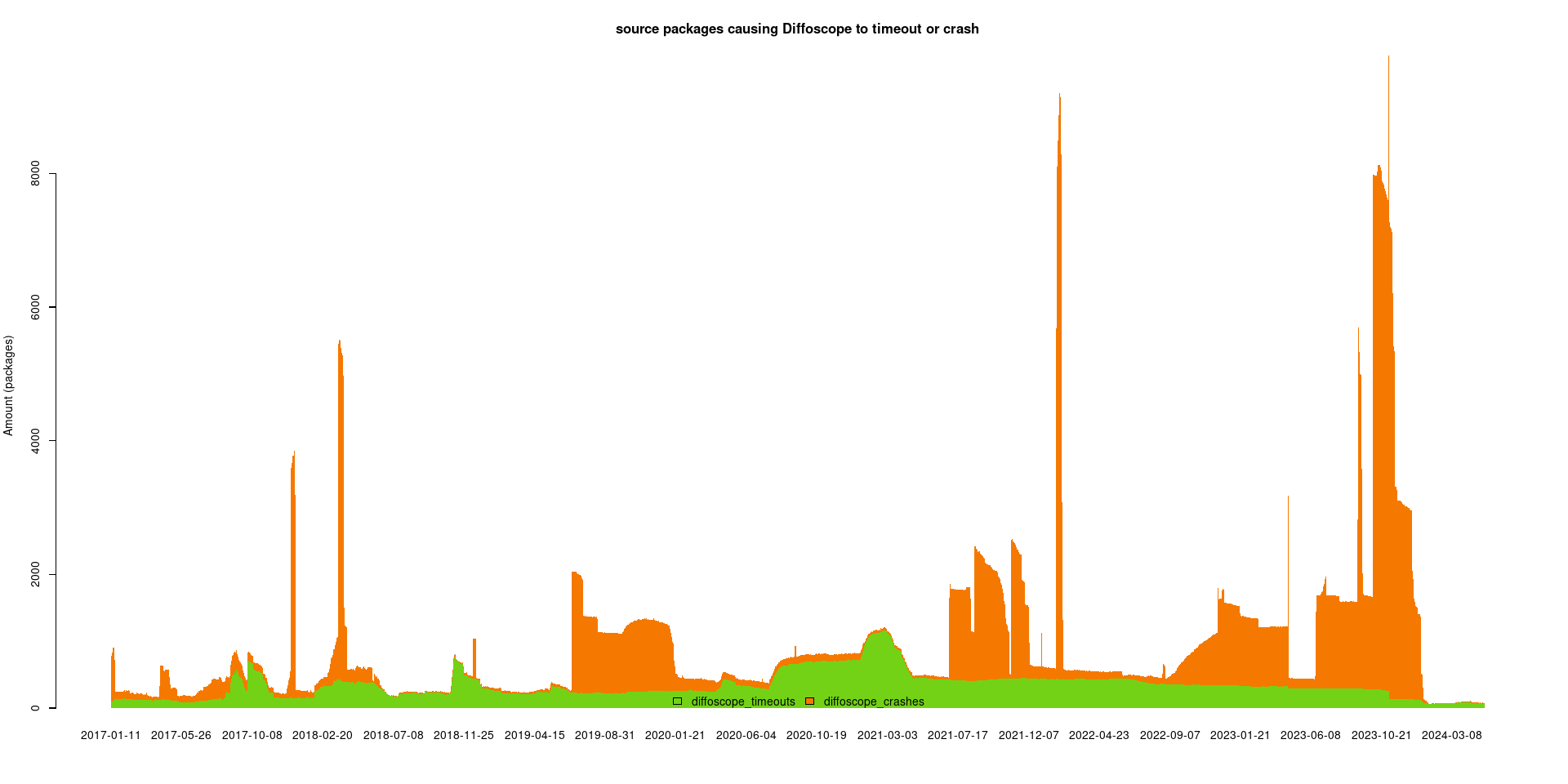
What happened in the Reproducible Builds effort between Sunday January 8 and Saturday January 14 2017: Upcoming Events Reproducible work in other projects Reproducible Builds have been mentioned in the FSF high-priority project list. The F-Droid Verification Server has been launched. It rebuilds apps from source that were built by f-droid.org and checks that the results match. Bernhard M. Wiedemann did some more work on reproducibility for openSUSE. Bootstrappable.org (unfortunately no HTTPS yet) was launched after the initial work was started at our recent summit in Berlin. This is another topic related to reproducible builds and both will be needed in order to perform "Diverse Double Compilation" in practice in the future. Toolchain development and fixes Ximin Luo researched data formats for SOURCE_PREFIX_MAP and explored different options for encoding a map data structure in a single environment variable. He also continued to talk with the rustc team on the topic. Daniel Shahaf filed #851225 ('udd: patches: index by DEP-3 "Forwarded" status') to make it easier to track our patches. Chris Lamb forwarded #849972 upstream to yard, a Ruby documentation generator. Upstream has fixed the issue as of release 0.9.6. Alexander Couzens (lynxis) has made mksquashfs reproducible and is looking for testers. It compiles on BSD systems such as FreeBSD, OpenBSD and NetBSD. Bugs filed Chris Lamb: Lucas Nussbaum: Nicola Corna: Reviews of unreproducible packages 13 package reviews have been added and 13 have been removed in this week, adding to our knowledge about identified issues. 1 issue type has been added: Weekly QA work During our reproducibility testing, the following FTBFS bugs have been detected and reported by: diffoscope development Bugs in diffoscope in the last year Many bugs were opened in diffoscope during the past few weeks, which probably is a good sign as it shows that diffoscope is much more widely used than a year ago. We have been working hard to squash many of them in time for Debian stable, though we will see how that goes in the end reproducible-website development tests.reproducible-builds.org Misc. This week's edition was written by Ximin Luo, Chris Lamb and Holger Levsen and reviewed by a bunch of Reproducible Builds folks on IRC & the mailing lists.

16 January 2017

Maria Glukhova: APK, images and other stuff.

2 more weeks of my awesome Outreachy journey have passed, so it is time to make an update on my progress. I continued my work on improving diffoscope by fixing bugs and completing wishlist items. These include:

Improving APK support I worked on #850501 and #850502 to improve the way diffoscope handles APK files. Thanks to Emanuel Bronshtein for providing clear description on how to reproduce these bugs and ideas on how to fix them. And special thanks to Chris Lamb for insisting on providing tests for these changes! That part actually proved to be little more tricky, and I managed to mess up with these tests (extra thanks to Chris for cleaning up the mess I created). Hope that also means I learned something from my mistakes. Also, I was pleased to see F-droid Verification Server as a sign of F-droid progress on reproducible builds effort - I hope these changes to diffoscope will help them!

Adding support for image metadata That came from #849395 - a request was made to compare image metadata along with image content. Diffoscope has support for three types of images: JPEG, MS Windows Icon (*.ico) and PNG. Among these, PNG already had good image metadata support thanks to sng tool, so I worked on .jpeg and .ico files support. I initially tried to use exiftool for extracting metadata, but then I discovered it does not handle .ico files, so I decided to use a bigger force - ImageMagick s identify - for this task. I was glad to see it had that handy -format option I could use to select only the necessary fields (I found their -verbose, well, too verbose for the task) and presenting them in the defined form, negating the need of filtering its output. What was particulary interesting and important for me in terms of learning: while working on this feature, I discovered that, at the moment, diffoscope could not handle .ico files at all - img2txt tool, that was used for retrieving image content, did not support that type of images. But instead of recognizing this as a bug and resolving it, I started to think of possible workaround, allowing for retrieving image metadata even after retrieving image content failed. Definetely not very good thinking. Thanks Mattia Rizzolo for actually recognizing this as a bug and filing it, and Chris Lamb for fixing it!

Other work

Order-like differences, part 2 In the previous post, I mentioned Lunar s suggestion to use hashing for finding order-like difference in wide variety of input data. I implemented that idea, but after discussion with my mentor, we decided it is probably not worth it - this change would alter quite a lot of things in core modules of diffoscope, and the gain would be not really significant. Still, implementing that was an important experience for me, as I had to hack on deepest and, arguably, most difficult modules of diffoscope and gained some insight on how they work.

Comparing with several tools (work in progress) Although my initial motivation for this idea was flawed (the workaround I mentioned earlier for .ico files), it still might be useful to have a mechanism that would allow to run several commands for finding difference, and then give the output of those that succeed, failing if and only if they all have failed. One possible case when it might happen is when we use commands coming from different tools, and one of them is not installed. It would be nice if we still used the other and not the uninformative binary diff (that is a default fallback option for when something goes wrong with more clever comparison). I am still in process of polishing this change, though, and still in doubt if it is needed at all.

Side note - Outreachy and my university progress In my Outreachy application, I promised that if I am selected into this round, I will do everything I can to unload the required time period from my university time commitements. I did that by moving most of my courses to the first half of the academic year. Now, the main thing that is left for me to do is my Master s thesis. I consulted my scientific advisors from both universities that I am formally attending (SFEDU and LUT - I am in double degree program), and as a result, they agreed to change my Master s thesis topic to match my Outreachy work. Now, that should have sounded like an excellent news - merging these activities together actually mean I can allocate much more time to my work on reproducible builds, even beyond the actual internship time period. That was intended to remove a burden from my shoulders. Still, I feel a bit uneasy. The drawback of this decision lies in fact I have no idea on how to write scientific report based on pure practical work. I know other students from my universities have done such things before, but choosing my own topic means my scientific advisors can t help me much - this is just out of their area of expertise. Well, wish me luck - I m up to the challenge!

15 January 2017

Sam Hartman: Musical Visualization of Network Traffic

I've been working on a fun holiday project in my spare time lately. It all started innocently enough. The office construction was nearing its end, and it was time for my workspace to be set up. Our deployment wizard and I were discussing. Normally we stick two high-end monitors on a desk. I'm blind; that seemed silly. He wanted to do something similarly nice for me, so he replaced one of the monitors with excellent speakers. They are a joy to listen to, but I felt like I should actually do something with them. So, I wanted to play around with some sort of audio project.
I decided to take a crack at an audio representation of network traffic. The solaris version of ping used to have an audio option, which would produce sound for successful pings. In the past I've used audio queues to monitor events like service health and build status.
It seemed like you could produce audio to give an overall feel for what was happening on the network. I was imagining a quick listen would be able to answer questions like:

  1. How busy is the network

  2. How many sources are active

  3. Is the traffic a lot of streams or just a few?

  4. Are there any interesting events such as packet loss or congestion collapse going on?

  5. What's the mix of services involved


I divided the project into three segments, which I will write about in future entries:

I'm fairly happy with what I have. It doesn't represent all the items above. As an example, it doesn't directly track packet loss or retransmissions, nor does it directly distinguish one service from another. Still, just because of the traffic flow, rsync sounds different from http. It models enough of what I'm looking for that I find it to be a useful tool. And I learned a lot about music and Linux audio. I also got to practice designing discrete-time control functions in ways that brought back the halls of MIT.

Mehdi Dogguy: Debian from 10,000 feet

Many of you are big fans of S.W.O.T analysis, I am sure of that! :-) Technical competence is our strongest suit, but we have reached a size and sphere of influence which requires an increase in organisation.

We all love our project and want to make sure Debian still shines in the next decades (and centuries!). One way to secure that goal is to identify elements/events/things which could put that goal at risk. To this end, we've organized a short S.W.O.T analysis session at DebConf16. Minutes of the meeting can be found here. I believe it is an interesting read and is useful for Debian old-timers as well as newcomers. It helps to convey a better understanding of the project's status. For each item, we've tried to identify an action.

Here are a few things we've worked on:
During next DebConf, we can review the progress that has been made on each item and discuss new ones. In addition to this session acting as a health check, I see it as a way for the DPL to discuss, openly and publicly, about the important changes that should be implemented in the project and imagine together a better future.

In the meantime, everyone should feel free to pick one item from the list and work on it. :-)

14 January 2017

Russ Allbery: Review: Enchanters' End Game

Review: Enchanters' End Game, by David Eddings
Series: The Belgariad #5
Publisher: Del Rey
Copyright: December 1984
Printing: February 1990
ISBN: 0-345-33871-5
Format: Mass market
Pages: 372
And, finally, the conclusion towards which everything has been heading, and the events for which Castle of Wizardry was the preparation. (This is therefore obviously not the place to start with this series.) Does it live up to all the foreshadowing and provide a satisfactory conclusion? I'd say mostly. The theology is a bit thin, but Eddings does a solid job of bringing all the plot threads together and giving each of the large cast a moment to shine. Enchanters' End Game (I have always been weirdly annoyed by that clunky apostrophe) starts with more of Garion and Belgarath, and, similar to the end of Castle of Wizardry, this feels like them rolling on the random encounter table. There is a fairly important bit with Nadraks at the start, but the remaining detour to the north is a mostly unrelated bit of world-building. Before this re-read, I didn't remember how extensive the Nadrak parts of this story were; in retrospect, I realize a lot of what I was remembering is in the Mallorean instead. I'll therefore save my commentary on Nadrak gender roles for an eventual Mallorean re-read, since there's quite a lot to dig through and much of it is based on information not available here. After this section, though, the story leaves Garion, Belgarath, and Silk for nearly the entire book, returning to them only for the climax. Most of this book is about Ce'Nedra, the queens and kings of the west, and what they're doing while Garion and his small party are carrying the Ring into Mordor er, you know what I mean. And this long section is surprisingly good. We first get to see the various queens of the west doing extremely well managing the kingdoms while the kings are away (see my previous note about how Eddings does examine his stereotypes), albeit partly by mercilessly exploiting the sexism of their societies. The story then picks up with Ce'Nedra and company, including all of the rest of Garion's band, being their snarky and varied selves. There are some fairly satisfying set pieces, some battle tactics, some magical tactics, and a good bit of snarking and interplay between characters who feel like old friends by this point (mostly because of Eddings's simple, broad-strokes characterization). And Ce'Nedra is surprisingly good here. I would say that she's grown up after the events of the last book, but sadly she reverts to being awful in the aftermath. But for the main section of the book, partly because she's busy with other things, she's a reasonable character who experiences some actual consequences and some real remorse from one bad decision she makes. She's even admirable in how she handles events leading up to the climax of the book. Eddings does a good job showing every character in their best light, putting quite a lot of suspense (and some dramatic rescues) into this final volume, and providing a final battle that's moderately interesting. I'm not sure I entirely bought the theological ramifications of the conclusion (the bits with Polgara do not support thinking about too deeply), but the voice in Garion's head continues to be one of the better characters of the series. And Errand is a delight. After the climax, the aftermath sadly returns to Eddings's weird war between the sexes presentation of all gender relationships in this series, and it left me with a bit of a bad taste in my mouth. (There is absolutely no way that some of these relationships would survive in reality.) Eddings portrays nearly every woman as a manipulative schemer, sometimes for good and sometimes for evil, and there is just so much gender stereotyping throughout this book for both women and men. You can tell he's trying with the queens, but women are still only allowed to be successful at politics and war within a very specific frame. Even Polgara gets a bit of the gender stereotyping, although she remains mostly an exception (and one aspect of the ending is much better than it could have been). Ah well. One does not (or at least probably should not) read this series without being aware that it has some flaws. But it has a strange charm as well, mostly from its irreverence. The dry wise-cracking of these characters rings more true to me than the epic seriousness of a lot of fantasy. This is how people behave under stress, and this is how quirky people who know each other extremely well interact. It also keeps one turning the pages quite effectively. I stayed up for several late nights finishing it, and was never tempted to put it down and stop reading. This is not great literature, but it's still fun. It wouldn't sustain regular re-reading for me, but a re-read after twenty years or so was pretty much exactly the experience I was hoping for: an unchallenging, optimistic story with amusing characters and a guaranteed happy ending. There's a place for that. Followed, in a series sense, by the Mallorean, the first book of which is The Guardians of the West. But this is a strictly optional continuation; the Belgariad comes to a definite end here. Rating: 7 out of 10

13 January 2017

Elena 'valhalla' Grandi: Modern XMPP Server

Modern XMPP Server

I've published a new HOWTO on my website 'http://www.trueelena.org/computers/howto/modern_xmpp_server.html':

http://www.enricozini.org/blog/2017/debian/modern-and-secure-instant-messaging/ already wrote about the Why (and the What, Who and When), so I'll just quote his conclusion and move on to the How.

I now have an XMPP setup which has all the features of the recent fancy chat systems, and on top of that it runs, client and server, on Free Software, which can be audited, it is federated and I can self-host my own server in my own VPS if I want to, with packages supported in Debian.


How

I've decided to install https://prosody.im/, mostly because it was recommended by the RTC QuickStart Guide http://rtcquickstart.org/; I've heard that similar results can be reached with https://www.ejabberd.im/ and other servers.

I'm also targeting https://www.debian.org/ stable (+ backports); as I write this is jessie; if there are significant differences I will update this article when I will upgrade my server to stretch. Right now, this means that I'm using prosody 0.9 (and that's probably also the version that will be available in stretch).

Installation and prerequisites

You will need to enable the https://backports.debian.org/ repository and then install the packages prosody and prosody-modules.

You also need to setup some TLS certificates (I used Let's Encrypt https://letsencrypt.org/); and make them readable by the prosody user; you can see Chapter 12 of the RTC QuickStart Guide http://rtcquickstart.org/guide/multi/xmpp-server-prosody.html for more details.

On your firewall, you'll need to open the following TCP ports:


The latter two are needed to enable some services provided via http(s), including rich media transfers.

With just a handful of users, I didn't bother to configure LDAP or anything else, but just created users manually via:

prosodyctl adduser alice@example.org

In-band registration is disabled by default (and I've left it that way, to prevent my server from being used to send spim https://en.wikipedia.org/wiki/Messaging_spam).

prosody configuration

You can then start configuring prosody by editing /etc/prosody/prosody.cfg.lua and changing a few values from the distribution defaults.

First of all, enforce the use of encryption and certificate checking both for client2server and server2server communications with:


c2s_require_encryption = true
s2s_secure_auth = true


and then, sadly, add to the whitelist any server that you want to talk to and doesn't support the above:


s2s_insecure_domains = "gmail.com"


virtualhosts

For each virtualhost you want to configure, create a file /etc/prosody/conf.avail/chat.example.org.cfg.lua with contents like the following:


VirtualHost "chat.example.org"
enabled = true
ssl =
key = "/etc/ssl/private/example.org-key.pem";
certificate = "/etc/ssl/public/example.org.pem";


For the domains where you also want to enable MUCs, add the follwing lines:


Component "conference.chat.example.org" "muc"
restrict_room_creation = "local"


the "local" configures prosody so that only local users are allowed to create new rooms (but then everybody can join them, if the room administrator allows it): this may help reduce unwanted usages of your server by random people.

You can also add the following line to enable rich media transfers via http uploads (XEP-0363):


Component "upload.chat.trueelena.org" "http_upload"

The defaults are pretty sane, but see https://modules.prosody.im/mod_http_upload.html for details on what knobs you can configure for this module

Don't forget to enable the virtualhost by linking the file inside /etc/prosody/conf.d/.

additional modules

Most of the other interesting XEPs are enabled by loading additional modules inside /etc/prosody/prosody.cfg.lua (under modules_enabled); to enable mod_something just add a line like:


"something";

Most of these come from the prosody-modules package (and thus from https://modules.prosody.im/ ) and some may require changing when prosody 0.10 will be available; when this is the case it is mentioned below.


@Gruppo Linux Como @LIFO

11 January 2017

Steinar H. Gunderson: 3G-SDI signal support

I had to figure out what kinds of signal you can run over 3G-SDI today, and it's pretty confusing, so I thought I'd share it. For the reference, 3G-SDI is the same as 3G HD-SDI, an extension of HD-SDI, which is an extension of the venerable SDI standard (well, duh). They're all used for running uncompressed audio/video data of regular BNC coaxial cable, possibly hundreds of meters, and are in wide use in professional and semiprofessional setups. So here's the rundown on 3G-SDI capabilities: And then there's dual-link 3G-SDI, which uses two cables instead of one and there's also Blackmagic's proprietary 6G-SDI , which supports basically everything dual-link 3G-SDI does. But in 2015, seemingly there was also a real 6G-SDI and 12G-SDI, and it's unclear to me whether it's in any way compatible with Blackmagic's offering. It's all confusing. But at least, these are the differences from single-link to dual-link 3G-SDI: 4K? I don't know. 120fps? I believe that's also a proprietary extension of some sort. And of course, having a device support 3G-SDI doesn't mean at all it's required to support all of this; in particular, I believe Blackmagic's systems don't support alpha at all except on their single 12G-SDI card, and I'd also not be surprised if RGB support is rather limited in practice.
Enrico Zini: Modern and secure instant messaging

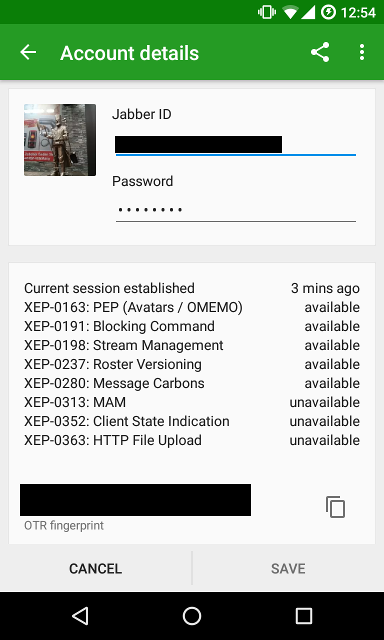
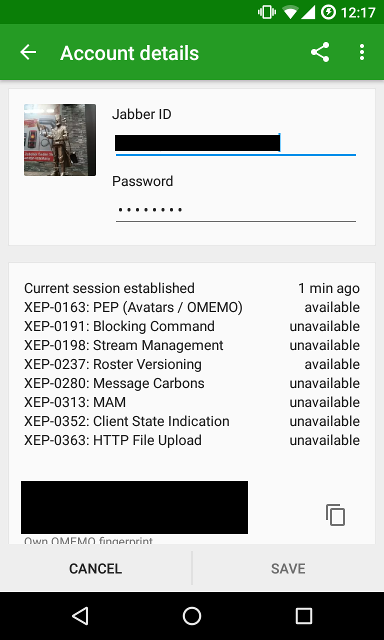
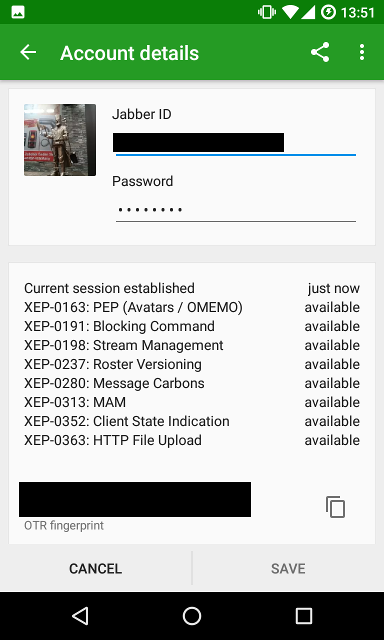
Conversations is a really nice, actively developed, up to date XMPP client for Android that has the nice feature of telling you what XEPs are supported by the server one is using: Initial server features Some days ago, me and Valhalla played the game of trying to see what happens when one turns them all on: I would send her screenshots from my Conversations, and she would poke at her Prosody to try and turn things on: After some work Valhalla eventually managed to get all features activated, purely using packages from Jessie+Backports: All features activated The result was a chat system in which I could see the same conversation history on my phone and on my laptop (with gajim)(https://gajim.org/), and have it synced even after a device has been offline, We could send each other rich media like photos, and could do OMEMO encryption (same as Signal) in group chats. I now have an XMPP setup which has all the features of the recent fancy chat systems, and on top of that it runs, client and server, on Free Software, which can be audited, it is federated and I can self-host my own server in my own VPS if I want to, with packages supported in Debian. Valhalla has documented the whole procedure. If you make a client for a protocol with lots of extension, do like Conversations and implement a status page with the features you'd like to have on the server, and little green indicators showing which are available: it is quite a good motivator for getting them all supported.
9 January 2017

Sean Whitton: jan17vcspkg

There have been a two long threads on the debian-devel mailing list about the representation of the changes to upstream source code made by Debian maintainers. Here are a few notes for my own reference. I spent a lot of time defending the workflow I described in dgit-maint-merge(7) (which was inspired by this blog post). However, I came to be convinced that there is a case for a manually curated series of patches for certain classes of package. It will depend on how upstream uses git (rebasing or merging) and on whether the Debian delta from upstream is significant and/or long-standing. I still think that we should be using dgit-maint-merge(7) for leaf or near-leaf packages, because it saves so much volunteer time that can be better spent on other things. When upstream does use a merging workflow, one advantage of the dgit-maint-merge(7) workflow is that Debian s packaging is just another branch of development. Now consider packages where we do want a manually curated patch series. It is very hard to represent such a series in git. The only natural way to do it is to continually rebase the patch series against an upstream branch, but public branches that get rebased are not a good idea. The solution that many people have adopted is to represent their patch series as a folder full of .diff files, and then use gbp pq to convert this into a rebasing branch. This branch is not shared. It is edited, rebased, and then converted back to the folder of .diff files, the changes to which are then committed to git. One of the advantages of dgit is that there now exists an official, non-rebasing git history of uploads to the archive. It would be nice if we could represent curated patch series as branches in the dgit repos, rather than as folders full of .diff files. But as I just described, this is very hard. However, Ian Jackson has the beginnings of a workflow that just might fit the bill.

8 January 2017

Jonas Meurer: debian lts report 2016.12

Debian LTS report for December 2016 December 2016 was my fourth month as a Debian LTS team member. I was allocated 12 hours. Unfortunately I turned out to have way less time for Debian and LTS work than expected, so I only spent 5,25 hours of them for the following tasks:

Jonas Meurer: debian lts report 2016 12

Debian LTS report for December 2016 December 2016 was my fourth month as a Debian LTS team member. I was allocated 12 hours. Unfortunately I turned out to have way less time for Debian and LTS work than expected, so I only spent 5,25 hours of them for the following tasks:

6 January 2017

Mark Brown: OpenTAC sprint

This weekend Toby Churchill kindly hosted a hacking weekend for OpenTAC myself, Michael Grzeschik, Steve McIntyre and Andy Simpkins got together to bring up the remaining bits of the hardware on the current board revision and get some of the low level tooling like production flashing for the FTDI serial ports on the board up and running. It was a very productive weekend, we verified that everything was working with only few small mods needed for the board . Personally the main thing I worked on was getting most of an initial driver for the EMC1701 written. That was the one component without Linux support and allowed us to verify that the power switching and measurement for the systems under test was working well. There s still at least one more board revision and quite a bit of software work to do (I m hoping to get the EMC1701 upstream for v4.8) but it was great to finally see all the physical components of the system working well and see it managing a system under test, this board revision should support all the software development that s going to be needed for the final board. Thanks to all who attended, Pengutronix for sponsoring Michael s attendance and Toby Churchill for hosting! Team at work
Group photo

4 January 2017

Dominique Dumont: New with cme: a GUI to configure Systemd services

Hello Systemd is powerful, but creating a new service is a task that require creating several files in non obvious location (like /etc/systemd/system or ~/.local/share/systemd/user/). Each file features 2 or more sections (e.g. [Unit], [Service]). And each section supports a lot of parameters. Creating such Systemd configuration files can be seen as a daunting task for beginners. cme project aims to make this task easier by providing a GUI that: For instance, on my laptop, the command cme edit systemd-user shows 2 custom services ( free-imap-tunnel@ and gmail-imap-tunnel@ ) with: cme_edit_systemd_001 The GUI above shows the units for my custom systemd files:
$ ls ~/.config/systemd/user/
free-imap-tunnel@.service
free-imap-tunnel.socket
gmail-imap-tunnel@.service
gmail-imap-tunnel.socket
sockets.target.wants
and the units installed by Debian packages:
$ find /usr/lib/systemd/user/ -maxdepth 1 \
  '(' -name '*.service' -o -name '*.socket' ')' \
  -printf '%f\n'  sort  head -15
at-spi-dbus-bus.service
colord-session.service
dbus.service
dbus.socket
dirmngr.service
dirmngr.socket
glib-pacrunner.service
gpg-agent-browser.socket
gpg-agent-extra.socket
gpg-agent.service
gpg-agent.socket
gpg-agent-ssh.socket
obex.service
pulseaudio.service
pulseaudio.socket
The screenshot above shows the content of the service defined by the following file:
$ cat ~/.config/systemd/user/free-imap-tunnel@.service
[Unit]
Description=Tunnel IMAPS connections to Free with Systemd
[Service]
StandardInput=socket
# no need to install corkscrew
ExecStart=-/usr/bin/socat - PROXY:127.0.0.1:imap.free.fr:993,proxyport=8888
Note that empty parameters are not shown because the hide empty value checkbox on top right is enabled. Likewise, cme is able to edit system files like user files with sudo cme edit systemd: cme_edit_systemd_001 For more details on how to use the GUI to edit systemd files, please see: Using a GUI may not be your cup of tea. cme can also be used as a validation tool. Let s add a parameter with an excessive value to my service:
$ echo "CPUShares = 1000000" >> ~/.local/share/systemd/user/free-imap-tunnel@.service
And check the file with cme:
$ cme check systemd-user 
cme: using Systemd model
loading data
Configuration item 'service:"free-imap-tunnel@" Service CPUShares' has a wrong value:
        value 1000000 > max limit 262144
ok, let s fix this with cme. The wrong value can either be deleted:
$ cme modify systemd-user 'service:"free-imap-tunnel@" Service CPUShares~'
cme: using Systemd model
Changes applied to systemd-user configuration:
- service:"free-imap-tunnel@" Service CPUShares: '1000000' -> ''
Or modified:
$ cme modify systemd-user 'service:"free-imap-tunnel@" Service CPUShares=2048'
cme: using Systemd model
Changes applied to systemd-user configuration:
- service:"free-imap-tunnel@" Service CPUShares: '1000000' -> '2048'
You can also view the specification of a service using cme:
$ cme dump systemd-user 'service:"free-imap-tunnel@"'---
Service:
  CPUShares: 2048
  ExecStart:
    - '-/usr/bin/socat -  PROXY:127.0.0.1:imap.free.fr:993,proxyport=8888'
  StandardInput: socket
Unit:
  Description: Tunnel IMAPS connections to Free with Systemd
The output above matches the content of the service configuration file:
$ cat ~/.local/share/systemd/user/free-imap-tunnel@.service
## This file was written by cme command.
## You can run 'cme edit systemd-user' to modify this file.
## You may also modify the content of this file with your favorite editor.
[Unit]
Description=Tunnel IMAPS connections to Free with Systemd
[Service]
StartupCPUWeight=100
CPUShares=2048
StartupCPUShares=1024
StandardInput=socket
# no need to install corkscrew now
ExecStart=-/usr/bin/socat -  PROXY:127.0.0.1:imap.free.fr:993,proxyport=8888
Last but not least, you can use cme shell if you want an interactive ui but cannot use a graphical interface:
$ cme shell systemd-user 
cme: using Systemd model
 >:$ cd service:"free-imap-tunnel@"  Service  
 >: service:"free-imap-tunnel@" Service $ ll -nz Exec*
name        type   value                                                             
 
ExecStart   list   -/usr/bin/socat -  PROXY:127.0.0.1:imap.free.fr:993,proxyport=8888
 >: service:"free-imap-tunnel@" Service $ ll -nz
name               type      value                                                             
 
StartupCPUWeight   integer   100                                                               
CPUShares          integer   2048                                                              
StartupCPUShares   integer   1024                                                              
StandardInput      enum      socket                                                            
ExecStart          list      -/usr/bin/socat -  PROXY:127.0.0.1:imap.free.fr:993,proxyport=8888
 >: service:"free-imap-tunnel@" Service $ set CPUShares=1024
 >: service:"free-imap-tunnel@" Service $ ll -nz CPUShares 
name        type      value
 
CPUShares   integer   1024 
 >: service:"free-imap-tunnel@" Service $ quit
Changes applied to systemd-user configuration:
- service:"free-imap-tunnel@" Service CPUShares: '2048' -> '1024'
write back data before exit ? (Y/n)
Currently, only service, socket and timer units are supported. Please create a bug report on github if you need more. Installation instructions are detailed at the beginning of Managing Systemd configuration with cme wiki page. As all softwares, cme probably has bugs. Please report any issue you might have with it. For more information: All in all, systemd is quite complex to setup. I hope I made a little bit easier to deal with. All the best
Tagged: config-model, configuration, Perl, systemd

Raphaël Hertzog: My Free Software Activities in December 2016

My monthly report covers a large part of what I have been doing in the free software world. I write it for my donors (thanks to them!) but also for the wider Debian community because it can give ideas to newcomers and it s one of the best ways to find volunteers to work with me on projects that matter to me. Debian LTS I was allocated 10 hours to work on security updates for Debian 7 Wheezy. During this time I did the following: Misc packaging With the strong freeze approaching, I had some customer requests to push packages into Debian and/or to fix packages that were in danger of being removed from stretch. While trying to bring back uwsgi into testing I filed #847095 (libmongoclient-dev: Should not conflict with transitional mongodb-dev) and #847207 (uwsgi: FTBFS on multiple architectures with undefined references to uwsgi_* symbols) and interacted on some of the RC bugs that were keeping the package out of testing. I also worked on a few new packages (lua-trink-cjson, lua-inotify, lua-sandbox-extensions) that enhance hindsight in some use cases and sponsored a rozofs update in experimental to fix a file conflict with inn2 (#846571). Misc Debian work Debian Live. I released two live-build updates. The second update added more options to customize the grub configuration (we use it in Kali to override the theme and add more menu entries) both for EFI boot and normal boot. Misc bugreports. #846569 on libsnmp-dev to accomodate the libssl transition (I noticed the package was not maintained, I asked for new maintainers on debian-devel). #847168 on devscripts for debuild that started failing when lintian was failing (unexpected regression). #847318 on lintian to not emit spurious errors for kali packages (which was annoying with the debuild regression above). #847436 for an upgrade problem I got with tryton-server. #847223 on firefoxdriver as it was still depending on iceweasel instead of firefox. Sponsorship. I sponsored a new version of asciidoc (#831965) and of ssldump 0.9b3-6 (for libssl transition). I also uploaded a new version of mutter to fix #846898 (it was ready in SVN already). Distro Tracker Not much happening, I fixed #814315 by switching a few remaining URLs to https. I merged patches from efkin to fix the functional test suite (#814315), that was a really useful contribution! The same contributer started to tackle another ticket (#824912) about adding an API to retrieve action items. This is a larger project and needs some thoughts. I still have to respond to him on his latest patches (after two rounds already). Misc stuff I updated the letsencrypt-sh salt formula for version 0.3.0 and added the possibility to customize the hook script to reload the webserver. The @planetdebian twitter account is no longer working since twitterfeed.com closed doors and the replacement (dlvr.it) is unhappy about the RSS feed of planet.debian.org. I filed bug #848123 against planet-venus since it does not preserve the isPermalink attribute in the guid tag Thanks See you next month for a new summary of my activities.

No comment Liked this article? Click here. My blog is Flattr-enabled.

Next.

Previous.