Search Results: "ag"

11 July 2024

Petter Reinholdtsen: More than 200 orphaned Debian packages moved to git, 216 to go

In April, I started migrating orphaned Debian packages without any version control system listed in debian/control to git. This morning, my Debian QA page finally reached 200 QA packages migrated. In reality there are a few more, as the packages uploaded by someone else after my initial upload have disappeared from my QA uploads list. As I am running out of steam and will most likely focus on other parts of Debian moving forward, I hope someone else will find time to continue the migration to bring the number of orphaned packages without any version control system down to zero. Here is the updated recipe if someone want to help out. To locate packages to work on, the following one-liner can be used:
PGPASSWORD="udd-mirror" psql --port=5432 --host=udd-mirror.debian.net \
  --username=udd-mirror udd -c "select source from sources \
   where release = 'sid' and (vcs_url ilike '%anonscm.debian.org%' \
   OR vcs_browser ilike '%anonscm.debian.org%' or vcs_url IS NULL \
   OR vcs_browser IS NULL) AND maintainer ilike '%packages@qa.debian.org%' \
   order by random() limit 10;"
Pick a random package from the list and run the latest edition of the script debian-snap-to-salsa with the package name as the argument to prepare a git repository with the existing packaging. This will download old Debian packages from snapshot.debian.org. Note that very recent uploads will not be included, so check out the package on tracker.debian.org. Next, run gbp buildpackage --git-ignore-new to verify that the package build as it should, and then visit https://salsa.debian.org/debian/ and make sure there is not already a git repository for the package there. I also did git log -p debian/control and look for vcs entries to check if the package used to have a git repository on Alioth, and see if it can be a useful starting point moving forward. If all this check out, I created a new gitlab project below the Debian group on salsa, push the package source there and upload a new version. I tend to also ensure build hardening is enabled, if it prove to be easy, and check if I can easily fix any lintian issues or bug reports. If the process took more than 20 minutes, I dropped it and moved on to another package. If I found patches in debian/patches/ that were not yet passed upstream, I would send an email to make sure upstream know about them. This has proved to be a valuable step, and caused several new releases for software that initially appeared abandoned. :) As usual, if you use Bitcoin and want to show your support of my activities, please send Bitcoin donations to my address 15oWEoG9dUPovwmUL9KWAnYRtNJEkP1u1b.

Russ Allbery: podlators v6.0.0

podlators is the collection of Perl modules and front-end scripts that convert POD documentation to *roff manual pages or text, possibly with formatting intended for pagers. This release continues the simplifications that I've been doing in the last few releases and now uniformly escapes - characters and single quotes, disabling all special interpretation by *roff formatters and dropping the heuristics that were used in previous versions to try to choose between possible interpretations of those characters. I've come around to the position that POD simply is not semantically rich enough to provide sufficient information to successfully make a more nuanced conversion, and these days Unicode characters are available for authors who want to be more precise. This version also drops support for Perl versions prior to 5.12 and switches to semantic versioning for all modules. I've added a v prefix to the version number, since that is the convention for Perl module versions that use semantic versioning. This release also works around some changes to the man macros in groff 1.23.0 to force persistent ragged-right justification when formatted with nroff and fixes a variety of other bugs. You can get the latest release from CPAN or from the podlators distribution page.

10 July 2024

Petter Reinholdtsen: Some notes from the 2024 LinuxCNC Norwegian developer gathering

The Norwegian The LinuxCNC developer gathering 2024 is over. It was a great and productive weekend, and I am sad that it is over. Regular readers probably still remember what LinuxCNC is, but her is a quick summary for those that forgot? LinuxCNC is a free software system for numerical control of machines such as milling machines, lathes, plasma cutters, routers, cutting machines, robots and hexapods. It eats G-code and produce motor movement and other changes to the physical world, while reading sensor input. I am not quite sure about the total head count, as not all people were present at the gathering the entire weekend, but I believe it was close to 10 people showing their faces at the gathering. The "hard core" of the group, who stayed the entire weekend, were two from Norway, two from Germany and one from England. I am happy with the outcome from the gathering. We managed to wrap up a new stable LinuxCNC release 2.9.3 and even tested it on real hardware within minutes of the release. The release notes for 2.9.3 are still being written, but should show up on on the project site in the next few days. We managed to go through around twenty pull requests and merge then into either the stable release (2.9) or the development branch (master). There are still around thirty pull requests left to process, so we are not out of work yet. We even managed to fix/improve a slightly worn lathe, and experiment with running a mechanical clock using G-code. The evening barbeque worked well both on Saturday and Sunday. It is quite fun to light up a charcoal grill using compressed air. Sadly the weather was not the best, so we stayed indoors most of the time. This gathering was made possible partly with sponsoring from both Redpill Linpro, Debian and NUUG Foundation, and we are most grateful for the support. I would also like to thank the local school for lending us some furniture, and of course the rest of the members of the organizers team, Asle and Bosse, for their countless contributions. The gathering was such success that we want to do it again next year. We plan to organize the next Norwegian LinuxCNC developer gathering at the end of June next year, the weekend Friday 27th to Sunday 29th of June 2025. I recommend you reserve the dates on your calendar today. Other related communities are also welcome to join in, for example those working on systems like FreeCAD and opencamlib, as I am sure we have much in common and sharing experiences would be very useful to all involved. We are of course looking for sponsors for this gathering already. The total budget for this gathering was around NOK 25.000 (around EUR 2.300), so our needs are quite modest. Perhaps a machine or tools company would like to help out the free software manufacturing community by sponsoring food, lodging and transport for such gathering?

Russell Coker: Computer Adavances in the Last Decade

I wrote a comment on a social media post where someone claimed that there s no computer advances in the last 12 years which got long so it s worth a blog post. In the last decade or so new laptops have become cheaper than new desktop PCs. USB-C has taken over for phones and for laptop charging so all recent laptops support USB-C docks and monitors with USB-C docks built in have become common. 4K monitors have become cheap and common and higher than 4K is cheap for some use cases such as ultra wide. 4K TVs are cheap and TVs with built-in Android computers for playing internet content are now standard. For most use cases spinning media hard drives are obsolete, SSDs large enough for all the content most people need to store are cheap. We have gone from gigabit Ethernet being expensive to 2.5 gigabit being cheap. 12 years ago smart phones were very limited and every couple of years there would be significant improvements. Since about 2018 phones have been capable of doing most things most people want. 5yo Android phones can run the latest apps and take high quality pics. Any phone that supports VoLTE will be good for another 5+ years if it has security support. Phones without security support still work and are quite usable apart from being insecure. Google and Samsung have significantly increased their minimum security support for their phones and the GKI project from Google makes it easier for smaller vendors to give longer security support. There are a variety of open Android projects like LineageOS which give longer security support on a variety of phones. If you deliberately choose a phone that is likely to be well supported by projects like LineageOS (which pretty much means just Pixel phones) then you can expect to be able to actually use it when it is 10 years old. Compare this to the Samsung Galaxy S3 released in 2012 which was a massive improvement over the original Galaxy S (the S2 felt closer to the S than the S3). The Samsung Galaxy S4 released in 2013 was one of the first phones to have FullHD resolution which is high enough that most people can t easily recognise the benefits of higher resolution. It wasn t until 2015 that phones with 4G of RAM became common which is enough that for most phone use it s adequate today. Now that 16G of RAM is affordable in laptops running more secure OSs like Qubes is viable for more people. Even without Qubes, OS security has been improving a lot with better compiler features, new languages like Rust, and changes to software design and testing. Containers are being used more but we still aren t getting all the benefits of that. TPM has become usable in the last few years and we are only starting to take advantage of what it can offer. In 2012 BTRFS was still at an early stage of development and not many people wanted to use it in production, I was using it in production then and while I didn t lose any data from bugs I did have some downtime because of BTRFS issues. Now BTRFS is quite solid for server use. DDR4 was released in 2014 and gave significant improvements over DDR3 for performance and capacity. My home workstation now has 256G of DDR4 which wasn t particularly expensive while the previous biggest system I owned had 96G of DDR3 RAM. Now DDR5 is available to again increase performance and size while also making DDR4 cheap on the second hand market. This isn t a comprehensive list of all advances in the computer industry over the last 12 years or so, it s just some things that seem particularly noteworthy to me. Please comment about what you think are the most noteworthy advances I didn t mention.

Freexian Collaborators: Debian Contributions: YubiHSM packaging, unschroot, live-patching, and more! (by Stefano Rivera)

Debian Contributions: 2024-06 Contributing to Debian is part of Freexian s mission. This article covers the latest achievements of Freexian and their collaborators. All of this is made possible by organizations subscribing to our Long Term Support contracts and consulting services.

YubiHSM packaging, by Colin Watson Freexian is starting to use YubiHSM devices (hardware security modules) as part of some projects, and we wanted to have the supporting software directly in Debian rather than needing to use third-party repositories. Since Yubico publish everything we need under free software licences, Colin packaged yubihsm-connector, yubihsm-shell, and python-yubihsm from https://developers.yubico.com/, in some cases based partly on the upstream packaging, and got them all into Debian unstable. Backports to bookworm will be forthcoming once they ve all reached testing.

unschroot by Helmut Grohne Following an in-person discussion at MiniDebConf Berlin, Helmut attempted splitting the containment functionality of sbuild --chroot-mode=unshare into a dedicated tool interfacing with sbuild as a variant of --chroot-mode=schroot providing a sufficiently compatible interface. While this seemed technically promising initially, a discussion on debian-devel indicated a desire to rely on an existing container runtime such as podman instead of using another Debian-specific tool with unclear long term maintenance. None of the existing container runtimes meet the specific needs of sbuild, so further advancing this matter implies a compromise one way or another.

Linux live-patching, by Santiago Ruano Rinc n In collaboration with Emmanuel Arias, Santiago is working on the development of linux live-patching for Debian. For the moment, this is in an exploratory phase, that includes how to handle the different patches that will need to be provided. kpatch could help significantly in this regard. However, kpatch was removed from unstable because there are some RC bugs affecting the version that was present in Debian unstable. Santiago packaged the most recent upstream version (0.9.9) and filed an Intent to Salvage bug. Santiago is waiting for an ACK by the maintainer, and will upload to unstable after July 10th, following the package salvaging rules. While kpatch 0.9.9 fixes the main issues, it still needs some work to properly support Debian and the Linux kernel versions packaged in our distribution. More on this in the report next month.

Salsa CI, by Santiago Ruano Rinc n The work by Santiago in Salsa CI this month includes a merge request to ease testing how the production images are built from the changes introduced by future merge requests. By default, the pipelines triggered by a merge request build a subset of the images built for production, to reduce the use of resources, and because most of the time the subset of staging images is enough to test the proposed modifications. However, sometimes it is needed to test how the full set of production images is built, and the above mentioned MR helps to do that. The changes include documentation, so hopefully this will make it easier to test future contributions. Also, for being able to include support for RISC-V, Salsa CI needs to replace kaniko as the tool used to build the images. Santiago tested buildah, but there are some issues when pushing built images for non-default platform architectures (i386, armhf, armel) to the container registry. Santiago will continue to work on this to find a solution.

Miscellaneous contributions
  • Stefano Rivera prepared updates for a number of Python modules.
  • Stefano uploaded the latest point release of Python 3.12 and the latest Python 3.13 beta. Both uncovered upstream regressions that had to be addressed.
  • Stefano worked on preparations for DebConf 24.
  • Stefano helped SPI to reconcile their financial records for DebConf 23.
  • Colin did his usual routine work on the Python team, upgrading 36 packages to new upstream versions (including fixes for four CVEs in python-aiohttp), fixing RC bugs in ipykernel, ipywidgets, khard, and python-repoze.sphinx.autointerface, and packaging zope.deferredimport which was needed for a new upstream version of python-persistent.
  • Colin removed the user_readenv option from OpenSSH s PAM configuration (#1018260), and prepared a release note.
  • Thorsten Alteholz uploaded a new upstream version of cups.
  • Nicholas Skaggs updated xmacro to support reproducible builds (#1014428), DEP-3 and DEP-5 compatibility, along with utilizing hardening build flags. Helmut supported and uploaded package.
  • As a result of login having become non-essential, Helmut uploaded debvm to unstable and stable and fixed a crossqa.debian.net worker.
  • Santiago worked on the Content Team activities for DebConf24. Together with other DebConf25 team members, Santiago wrote a document for the head of the venue to describe the project of the conference.

9 July 2024

Simon Josefsson: Towards Idempotent Rebuilds?

After rebuilding all added/modified packages in Trisquel, I have been circling around the elephant in the room: 99% of the binary packages in Trisquel comes from Ubuntu, which to a large extent are built from Debian source packages. Is it possible to rebuild the official binary packages identically? Does anyone make an effort to do so? Does anyone care about going through the differences between the official package and a rebuilt version? Reproducible-build.org s effort to track reproducibility bugs in Debian (and other systems) is amazing. However as far as I know, they do not confirm or deny that their rebuilds match the official packages. In fact, typically their rebuilds do not match the official packages, even when they say the package is reproducible, which had me surprised at first. To understand why that happens, compare the buildinfo file for the official coreutils 9.1-1 from Debian bookworm with the buildinfo file for reproducible-build.org s build and you will see that the SHA256 checksum does not match, but still they declare it as a reproducible package. As far as I can tell of the situation, the purpose of their rebuilds are not to say anything about the official binary build, instead the purpose is to offer a QA service to maintainers by performing two builds of a package and declaring success if both builds match. I have felt that something is lacking, and months have passed and I haven t found any project that address the problem I am interested in. During my earlier work I created a project called debdistreproduce which performs rebuilds of the difference between two distributions in a GitLab pipeline, and display diffoscope output for further analysis. A couple of days ago I had the idea of rewriting it to perform rebuilds of a single distribution. A new project debdistrebuild was born and today I m happy to bless it as version 1.0 and to announces the project! Debdistrebuild has rebuilt the top-50 popcon packages from Debian bullseye, bookworm and trixie, on amd64 and arm64, as well as Ubuntu jammy and noble on amd64, see the summary status page for links. This is intended as a proof of concept, to allow people experiment with the concept of doing GitLab-based package rebuilds and analysis. Compare how Guix has the guix challenge command. Or I should say debdistrebuild has attempted to rebuild those distributions. The number of identically built packages are fairly low, so I didn t want to waste resources building the rest of the archive until I understand if the differences are due to consequences of my build environment (plain apt-get build-dep followed by dpkg-buildpackage in a fresh container), or due to some real difference. Summarizing the results, debdistrebuild is able to rebuild 34% of Debian bullseye on amd64, 36% of bookworm on amd64, 32% of bookworm on arm64. The results for trixie and Ubuntu are disappointing, below 10%. So what causes my rebuilds to be different from the official rebuilds? Some are trivial like the classical problem of varying build paths, resulting in a different NT_GNU_BUILD_ID causing a mismatch. Some are a bit strange, like a subtle difference in one of perl s headers file. Some are due to embedded version numbers from a build dependency. Several of the build logs and diffoscope outputs doesn t make sense, likely due to bugs in my build scripts, especially for Ubuntu which appears to strip translations and do other build variations that I don t do. In general, the classes of reproducibility problems are the expected. Some are assembler differences for GnuPG s gpgv-static, likely triggered by upload of a new version of gcc after the original package was built. There are at least two ways to resolve that problem: either use the same version of build dependencies that were used to produce the original build, or demand that all packages that are affected by a change in another package are rebuilt centrally until there are no more differences. The current design of debdistrebuild uses the latest version of a build dependency that is available in the distribution. We call this a idempotent rebuild . This is usually not how the binary packages were built originally, they are often built against earlier versions of their build dependency. That is the situation for most binary distributions. Instead of using the latest build dependency version, higher reproducability may be achieved by rebuilding using the same version of the build dependencies that were used during the original build. This requires parsing buildinfo files to find the right version of the build dependency to install. We believe doing so will lead to a higher number of reproducibly built packages. However it begs the question: can we rebuild that earlier version of the build dependency? This circles back to really old versions and bootstrappable builds eventually. While rebuilding old versions would be interesting on its own, we believe that is less helpful for trusting the latest version and improving a binary distribution: it is challenging to publish a new version of some old package that would fix a reproducibility bug in another package when used as a build dependency, and then rebuild the later packages with the modified earlier version. Those earlier packages were already published, and are part of history. It may be that ultimately it will no longer be possible to rebuild some package, because proper source code is missing (for packages using build dependencies that were never part of a release); hardware to build a package could be missing; or that the source code is no longer publicly distributable. I argue that getting to 100% idempotent rebuilds is an interesting goal on its own, and to reach it we need to start measure idempotent rebuild status. One could conceivable imagine a way to rebuild modified versions of earlier packages, and then rebuild later packages using the modified earlier packages as build dependencies, for the purpose of achieving higher level of reproducible rebuilds of the last version, and to reach for bootstrappability. However, it may be still be that this is insufficient to achieve idempotent rebuilds of the last versions. Idempotent rebuilds are different from a reproducible build (where we try to reproduce the build using the same inputs), and also to bootstrappable builds (in which all binaries are ultimately built from source code). Consider a cycle where package X influence the content of package Y, which in turn influence the content of package X. These cycles may involve several packages, and it is conceivable that a cycle could be circular and infinite. It may be difficult to identify these chains, and even more difficult to break them up, but this effort help identify where to start looking for them. Rebuilding packages using the same build dependency versions as were used during the original build, or rebuilding packages using a bootsrappable build process, both seem orthogonal to the idempotent rebuild problem. Our notion of rebuildability appears thus to be complementary to reproducible-builds.org s definition and bootstrappable.org s definition. Each to their own devices, and Happy Hacking! Addendum about terminology: With idempotent rebuild I am talking about a rebuild of the entire operating system, applied to itself. Compare how you build the latest version of the GNU C Compiler: it first builds itself using whatever system compiler is available (often an earlier version of gcc) which we call step 1. Then step 2 is to build a copy of itself using the compiler built in step 1. The final step 3 is to build another copy of itself using the compiler from step 2. Debian, Ubuntu etc are at step 1 in this process right now. The output of step 2 and step 3 ought to be bit-by-bit identical, or something is wrong. The comparison between step 2 and 3 is what I refer to with an idempotent rebuild. Of course, most packages aren t a compiler that can compile itself. However entire operating systems such as Trisquel, PureOS, Ubuntu or Debian are (hopefully) a self-contained system that ought to be able to rebuild itself to an identical copy. Or something is amiss. The reproducible build and bootstrappable build projects are about improve the quality of step 1. The property I am interested is the identical rebuild and comparison in step 2 and 3. I feel the word idempotent describes the property I m interested in well, but I realize there may be better ways to describe this. Ideas welcome!

Russ Allbery: Review: Raising Steam

Review: Raising Steam, by Terry Pratchett
Series: Discworld #40
Publisher: Anchor Books
Copyright: 2013
Printing: October 2014
ISBN: 0-8041-6920-9
Format: Trade paperback
Pages: 365
Raising Steam is the 40th Discworld novel and the third Moist von Lipwig novel, following Making Money. This is not a good place to start reading the series. Dick Simnel is a tinkerer from a line of tinkerers. He has been obsessed with mastering the power of steam since the age of ten, when his father died in a steam accident. That pursuit took him deeper into mathematics and precision, calculations and experiments, until he built Iron Girder: Discworld's first steam-powered locomotive. His early funding came from some convenient family pirate treasure, but turning his prototype into something more will require significantly more resources. That is how he ends up in the office of Harry King, Ankh-Morpork's sanitation magnate. Simnel's steam locomotive has the potential to solve some obvious logistical problems, such as getting fish from the docks of Quirm to the streets of Ankh-Morpork before it stops being vaguely edible. That's not what makes railways catch fire, however. As soon as Iron Girder is huffing and puffing its way around King's compound, it becomes the most popular attraction in the city. People stand in line for hours to ride it over and over again for reasons that they cannot entirely explain. There is something wild and uncontrollable going on. Vetinari is not sure he likes wild and uncontrollable, but he knows the lap into which such problems can be dumped: Moist von Lipwig, who is already getting bored with being a figurehead for the city's banking system. The setup for Raising Steam reminds me more of Moving Pictures than the other Moist von Lipwig novels. Simnel himself is a relentlessly practical engineer, but the trains themselves have tapped some sort of primal magic. Unlike Moving Pictures, Pratchett doesn't provide an explicit fantasy explanation involving intruding powers from another world. It might have been a more interesting book if he had. Instead, this book expects the reader to believe there is something inherently appealing and fascinating about trains, without providing much logic or underlying justification. I think some readers will be willing to go along with this, and others (myself included) will be left wishing the story had more world-building and fewer exclamation points. That's not the real problem with this book, though. Sadly, its true downfall is that Pratchett's writing ability had almost completely collapsed by the time he wrote it. As mentioned in my review of Snuff, we're now well into the period where Pratchett was suffering the effects of early-onset Alzheimer's. In that book, his health issues mostly affected the dialogue near the end of the novel. In this book, published two years later, it's pervasive and much worse. Here's a typical passage from early in the book:
It is said that a soft answer turneth away wrath, but this assertion has a lot to do with hope and was now turning out to be patently inaccurate, since even a well-spoken and thoughtful soft answer could actually drive the wrong kind of person into a state of fury if wrath was what they had in mind, and that was the state the elderly dwarf was now enjoying.
One of the best things about Discworld is Pratchett's ability to drop unexpected bits of wisdom in a sentence or two, or twist a verbal knife in an unexpected and surprising direction. Raising Steam still shows flashes of that ability, but it's buried in run-on sentences, drowned in cliches and repetition, and often left behind as the containing sentence meanders off into the weeds and sputters to a confused halt. The idea is still there; the delivery, sadly, is not. This is the first Discworld novel that I found mentally taxing to read. Sentences are often so overpacked that they require real effort to untangle, and the untangled meaning rarely feels worth the effort. The individual voice of the characters is almost gone. Vetinari's monologues, rather than being a rare event with dangerous layers, are frequent, rambling, and indecisive, often sounding like an entirely different character than the Vetinari we know. The constant repetition of the name any given character is speaking to was impossible for me to ignore. And the momentum of the story feels wrong; rather than constructing the events of the story in a way that sweeps the reader along, it felt like Pratchett was constantly pushing, trying to convince the reader that trains were the most exciting thing to ever happen to Discworld. The bones of a good story are here, including further development of dwarf politics from The Fifth Elephant and Thud! and the further fallout of the events of Snuff. There are also glimmers of Pratchett's typically sharp observations and turns of phrase that could have been unearthed and polished. But at the very least this book needed way more editing and a lot of rewriting. I suspect it could have dropped thirty pages just by tightening the dialogue and removing some of the repetition. I'm afraid I did not enjoy this. I am a bit of a hard sell for the magic fascination of trains I love trains, but my model railroad days are behind me and I'm now more interested in them as part of urban transportation policy. Previous Discworld books on technology and social systems did more of the work of drawing the reader in, providing character hooks and additional complexity, and building a firmer foundation than "trains are awesome." The main problem, though, was the quality of the writing, particularly when compared to the previous novels with the same characters. I dragged myself through this book out of a sense of completionism and obligation, and was relieved when I finished it. This is the first Discworld novel that I don't recommend. I think the only reason to read it is if you want to have read all of Discworld. Otherwise, consider stopping with Snuff and letting it be the send-off for the Ankh-Morpork characters. Followed by The Shepherd's Crown, a Tiffany Aching story and the last Discworld novel. Rating: 3 out of 10

8 July 2024

Thorsten Alteholz: My Debian Activities in June 2024

FTP master This month I accepted 270 and rejected 23 packages. The overall number of packages that got accepted was 279.

Debian LTS This was my hundred-twentieth month that I did some work for the Debian LTS initiative, started by Raphael Hertzog at Freexian. During my allocated time I uploaded or worked on: This month handling of the CVE of cups was a bit messy. After lifting the embargo of the CVE, a published patch did not work with all possible combinations of the configuration. In other words, in cases of having only one local domain socket configured, the cupsd did not start and failed with a strange error. Anyway, upstream published a new set of patches, which made cups work again. Unfortunately this happended just before the latest point release for Bullseye and Bookworm, so that the new packages did not make it into the release, but stopped in the corresponding p-u-queues: stable-p-u and old-p-u. I also continued to work on tiff and last but not least did a week of FD and attended the monthly LTS/ELTS meeting. Debian ELTS This month was the seventy-first ELTS month. During my allocated time I tried to upload a new version of cups for Jessie and Stretch. Unfortunately this was stopped due to an autopkgtest error, which I could not reproduce yet. I also wanted to finally upload a fixed version of exim4. Unfortunately this was stopped due to lots of CI-jobs for Buster. Updates for Buster are now also availble from ELTS, so some stuff had to prepared before the actual switch end of June. Additionally everything was delayed due to a crash of the CI worker. All in all this month was rather ill-fated. At least the exim4 upload will happen/already happened in July. I also continued to work on an update for libvirt, did a week of FD and attended the LTS/ELTS meeting. Debian Printing This month I uploaded new upstream or bugfix versions of: This work is generously funded by Freexian! Debian Astro This month I uploaded a new upstream or bugfix version of: All of those uploads are somehow related to /usr-move. Debian IoT This month I uploaded new upstream or bugfix versions of: Debian Mobcom The following packages have been prepared by the GSoC student Nathan: misc This month I uploaded new upstream or bugfix versions of: Here as well all uploads are somehow related to /usr-move

Dirk Eddelbuettel: RcppArmadillo 14.0.0-1 on CRAN: New Upstream

armadillo image Armadillo is a powerful and expressive C++ template library for linear algebra and scientific computing. It aims towards a good balance between speed and ease of use, has a syntax deliberately close to Matlab, and is useful for algorithm development directly in C++, or quick conversion of research code into production environments. RcppArmadillo integrates this library with the R environment and language and is widely used by (currently) 1158 other packages on CRAN, downloaded 35.1 million times (per the partial logs from the cloud mirrors of CRAN), and the CSDA paper (preprint / vignette) by Conrad and myself has been cited 587 times according to Google Scholar. Conrad released a new major upstream version 14.0.0 a couple of days ago. We had been testing this new version extensively over several rounds of reverse-dependency checks across all 1100+ packages. This revealed nine packages requiring truly minor adjustments which eight maintainers made in a matter of days; all this was coordinated in issue #443. Following the upload, CRAN noticed one more issue (see issue #446) but this turned out to be local to the package. There are also renewed deprecation warnings with some Armadillo changes which we will need to address one-by-one. Last but not least with this release we also changed the package versioning scheme to follow upstream Armadillo more closely. The set of changes since the last CRAN release follows.

Changes in RcppArmadillo version 14.0.0-1 (2024-07-05)
  • Upgraded to Armadillo release 14.0.0 (Stochastic Parrot)
    • C++14 is now the minimum recommended C++ standard
    • Faster handling of compound expressions by as_scalar(), accu(), dot()
    • Faster interactions between sparse and dense matrices
    • Expanded stddev() to handle sparse matrices
    • Expanded relational operators to handle expressions between sparse matrices and scalars
    • Added .as_dense() to obtain dense vector/matrix representation of any sparse matrix expression
    • Updated physical constants to NIST 2022 CODATA values
  • New package version numbering scheme following upstream versions
  • Re-enabling ARMA_IGNORE_DEPRECATED_MARKE for silent CRAN builds

Courtesy of my CRANberries, there is a diffstat report relative to previous release. More detailed information is on the RcppArmadillo page. Questions, comments etc should go to the rcpp-devel mailing list off the Rcpp R-Forge page. If you like this or other open-source work I do, you can sponsor me at GitHub.

This post by Dirk Eddelbuettel originated on his Thinking inside the box blog. Please report excessive re-aggregation in third-party for-profit settings.

Russ Allbery: rra-c-util 11.0.0

rra-c-util is my collection of utility and test functions that I keep synchronized between my packages. The big change in this release is that I've switched to semantic versions, which I plan to do for all of my packages, and I've started using scriv to manage a Markdown change log. We've been using scriv for a while at work, so I have finally gotten on board the change log fragment train rather than assuming linear commits. This release also raises the minimum Perl version for all of the Perl support code to 5.12 so that I can use semantic versions for all modules, and updates the perltidy configuration with lots of improvements from Julien LIE. There are also the normal variaty of bug fixes and more minor improvements. You can get the latest version from the rra-c-util distribution page.

Russ Allbery: Review: Beyond Control

Review: Beyond Control, by Kit Rocha
Series: Beyond #2
Publisher: Kit Rocha
Copyright: December 2013
ASIN: B00GIA4GN8
Format: Kindle
Pages: 364
Beyond Control is science fiction erotica (dystopian erotic romance, per the marketing) and a direct sequel to Beyond Shame. These books shift protagonists with each volume and enough of the world background is explained that you could start here, but there are significant spoilers for the previous book. I read this book as part of the Beyond Series Bundle (Books 1-3), which is what the sidebar information is for. This is one of those reviews that I write because I'm stubborn about reviewing all the books I read, not because it's likely to be useful to anyone. There are also considerably more spoilers for the shape of the story than I normally include, so be warned. The Beyond series is erotica. Specifically, so far, consensual BDSM erotica with bisexuality but otherwise typical gender stereotypes. The authors (Kit Rocha is a pen name for Donna Herren and Bree Bridges) are women, so it's more female gaze than male gaze, but by erotica I don't mean romance with an above-average number of steamy scenes. I mean it felt like half the book by page count was descriptions of sex. This review is rather pointless because, one, I'm not going to review the sex that's the main point of the book, and two, I skimmed all the sex and read it for the story because I'm weird. Beyond Shame got me interested in these absurdly horny people and their post-apocalyptic survival struggles in the outskirts of a city run by a religious surveillance state, and I wanted to find out what happened next. Besides, this book promised to focus on my favorite character from the first novel, Lex, and I wanted to read more about her. Beyond Control uses a series pattern that I understand is common in romance but which is not often seen in SFF (my usual genre): each book focuses on a new couple adjacent to the previous couple, while the happily ever after of the previous couple plays out in the background. In this case, it also teases the protagonists of the next book. I can see why romance uses this structure: it's an excuse to provide satisfying interludes for the reader. In between Lex and Dallas's current relationship problems, one gets to enjoy how well everything worked out for Noelle and how much she's grown. In Beyond Shame, Lex was the sort-of partner of Dallas O'Kane, the leader of the street gang that is running Sector Four. (Picture a circle surrounding the rich-people-only city of Eden. That circle is divided into eight wedge-shaped sectors, which provide heavy industries, black-market pleasures, and slums for agricultural workers.) Dallas is an intensely possessive, personally charismatic semi-dictator who cultivates the image of a dangerous barbarian to everyone outside and most of the people inside Sector Four. Since he's supposed to be one of the good guys, this is more image than reality, but it's not entirely disconnected from reality. This book is about Lex and Dallas forming an actual relationship, instead of the fraught and complicated thing they had in the first book. I was hoping that this would involve Dallas becoming less of an asshole. It unfortunately does not, although some of what I attributed to malice may be adequately explained by stupidity. I'm not sure that's an improvement. Lex is great, just like she was in the first book. It's obvious by this point in the series that she does most of the emotional labor of keeping the gang running, and her support is central to Dallas's success. Like most of the people in this story, she has a nasty and abusive background that she's still dealing with in various ways. Dallas's possessiveness is intensely appealing to her, but she wants that possessiveness on different terms than Dallas may be willing to offer, or is even aware of. Lex was, I thought, exceptionally clear about what she wanted out of this relationship. Dallas thinks this is entirely about sex, and is, in general, dumber than a sack of hammers. That means fights. Also orgies, but, well, hopefully you knew what you were getting into if you picked up this book. I know, I know, it's erotica, that's the whole point, but these people have a truly absurd amount of sex. Eden puts birth control in the water supply, which is a neat way to simplify some of the in-story consequences of erotica. They must be putting aphrodisiacs in the water supply as well. There was a lot of sector politics in this book that I found way more interesting than it had any right to be. I really like most of these people, even Dallas when he manages to get his three brain cells connected for more than a few minutes. The events of the first book have a lot of significant fallout, Lex continues being a badass, the social dynamics between the women are very well-done (and pass the Bechdel test yet again even though this is mostly traditional-gender-role erotica), and if Dallas had managed to understand what he did wrong at a deeper-than-emotional level, I would have rather enjoyed the non-erotica story parts. Alas. I therefore wouldn't recommend this book even if I were willing to offer any recommendations about erotica (which I'm not). I was hoping it was going somewhere more rewarding than it did. But I still kind of want to read another one? I am weirdly fascinated with the lives of these people. The next book is about Six, who has the potential to turn into the sort of snarky, cynical character I love reading about. And it's not that hard to skim over the orgies. Maybe Dallas will get one additional brain cell per book? Followed by Beyond Pain. Rating: 5 out of 10

7 July 2024

Dirk Eddelbuettel: RcppSimdJson 0.1.12 on CRAN: Maintenance

A new maintenance release 0.1.12 of the RcppSimdJson package is now on CRAN. RcppSimdJson wraps the fantastic and genuinely impressive simdjson library by Daniel Lemire and collaborators. Via very clever algorithmic engineering to obtain largely branch-free code, coupled with modern C++ and newer compiler instructions, it results in parsing gigabytes of JSON parsed per second which is quite mindboggling. The best-case performance is faster than CPU speed as use of parallel SIMD instructions and careful branch avoidance can lead to less than one cpu cycle per byte parsed; see the video of the talk by Daniel Lemire at QCon. This release responds to another CRAN request, this time to accomodate compilation under C++20 with g++-14. As this was alreadt addressed upstream in simdjson it was simply a matter of upgrading to the current upstream which Daniel did in a PR. The (once again very short) NEWS entry for this release follows.

Changes in version 0.1.12 (2024-07-05)
  • Updated benchmarks now include 'yyjsonr'
  • simdjson was upgraded to version 3.95 (Daniel in #92 fixing #91)
  • Additional small update for C++20 compilation under g++-14

Courtesy of my CRANberries, there is also a diffstat report for this release. For questions, suggestions, or issues please use the issue tracker at the GitHub repo. If you like this or other open-source work I do, you can now sponsor me at GitHub.

This post by Dirk Eddelbuettel originated on his Thinking inside the box blog. Please report excessive re-aggregation in third-party for-profit settings.

Russ Allbery: DocKnot v8.0.0

DocKnot is my static web site generator, with additional features for managing software releases and package documentation. This release switches to semantic versioning for the Perl modules, hence the v prefix to the version number. This appears to be the standard in the Perl world for indicating that the version follows the semantic versioning standard. That also required adding support to DocKnot for release tarballs whose version string starts with v. I plan to convert all of my Perl modules to semantic versioning in their next releases. The main change in this release is that it incorporates my old faq2html script that was previously used to convert text documents to HTML for publication. This code was imported into DocKnot and integrated with the rest of the package, so text documents can now be referenced by *.spin pointers rather than the (now-deprecated) *.faq files. The long delay in the release is because I was hoping to refactor the faq2html code to work as a proper module with no global state and to follow my current Perl coding guidelines before releasing a version of DocKnot containing it, but the refactoring is taking forever and support for v-prefixed versions was blocking other releases, so I'm releasing it in a less-than-ideal state and hoping to fix it later. There are also a few other bug fixes and improvements, the most notable of which is probably that the footer on generated web pages now points properly to the DocKnot distribution page rather than my old spin page. You can get the latest version from CPAN or from the DocKnot distribution page.

Niels Thykier: Improving packaging file detection in Debian

Debian packaging consists of a directory (debian/) containing a number of "hard-coded" filenames such as debian/control, debian/changelog, debian/copyright. In addition to these, many packages will also use a number of optional files that are named via a pattern such as debian/ PACKAGE .install. At a high level the patterns looks deceptively simple. However, if you start working on trying to automatically classify files in debian/ (which could be helpful to tell the user they have a typo in the filename), you will quickly realize these patterns are not machine friendly at all for this purpose.
The patterns deconstructed To appreciate the problem fully, here is a primer on the pattern and all its issues. If you are already well-versed in these, you might want to skip the section. The most common patterns are debian/package.stem or debian/stem and usually the go to example is the install stem ( a concrete example being debian/debhelper.install). However, the full pattern consists of 4 parts where 3 of them are optional.
  • The package name followed by a period. Optional, but must be the first if present.
  • The name segment followed by a period. Optional, but must appear between the package name (if present) and the stem. If the package name is not present, then the name segment must be first.
  • The stem. Mandatory.
  • An architecture restriction prefixed by a period. Optional, must appear after the stem if present.
To visualize it with [foo] to mark optional parts, it looks like debian/[PACKAGE.][NAME.]STEM[.ARCH] Detecting whether a given file is in fact a packaging file now boils down to reverse engineering its name against this pattern. Again, so far, it might still look manageable. One major complication is that every part (except ARCH) can contain periods. So a trivial "split by period" is not going to cut it. As an example:
debian/g++-3.0.user.service
This example is deliberately crafted to be ambiguous and show this problem in its full glory. This file name can be in multiple ways:
  • Is the stem service or user.service? (both are known stems from dh_installsystemd and dh_installsystemduser respectively). In fact, it can be both at the same time with "clever" usage of --name=user passed to dh_installsystemd.
  • The g++-3.0 can be a package prefix or part of the name segment. Even if there is a g++-3.0 package in debian/control, then debhelper (until compat 15) will still happily match this file for the main package if you pass --name=g++-3.0 to the helper. Side bar: Woe is you if there is a g++-3 and a g++-3.0 package in debian/control, then we have multiple options for the package prefix! Though, I do not think that happens in practice.
Therefore, there are a lot of possible ways to split this filename that all matches the pattern but with vastly different meaning and consequences.
Making detection practical To make this detection practical, lets look at the first problems that we need to solve.
  1. We need the possible stems up front to have a chance at all. When multiple stems are an option, go for the longest match (that is, the one with most periods) since --name is rare and "code golfing" is even rarer.
  2. We can make the package prefix mandatory for files with the name segment. This way, the moment there is something before the stem, we know the package prefix will be part of it and can cut it. It does not solve the ambiguity if one package name is a prefix of another package name (from the same source), but it still a lot better. This made its way into debhelper compat 15 and now it is "just" a slow long way to a better future.
A simple solution to the first problem could be to have a static list of known stems. That will get you started but the debhelper eco-system strive on decentralization, so this feels like a mismatch. There is also a second problem with the static list. Namely, a given stem is only "valid" if the command in question is actually in use. Which means you now need to dumpster dive into the mess that is Turning-complete debhelper configuration file known as debian/rules to fully solve that. Thanks to the Turning-completeness, we will never get a perfect solution for a static analysis. Instead, it is time to back out and instead apply some simplifications. Here is a sample flow:
  1. Check whether the dh sequencer is used. If so, use some heuristics to figure out which addons are used.
  2. Delegate to dh_assistant to figure out which commands will be used and which debhelper config file stems it knows about. Here we need to know which sequences are in use from step one (if relevant). Combine this with any other sources for stems you have.
  3. Deconstruct all files in debian/ against the stems and known package names from debian/control. In theory, dumpster diving after --name options would be helpful here, but personally I skipped that part as I want to keep my debian/rules parsing to an absolute minimum.
With this logic, you can now:
  • Provide typo detection of the stem (debian/foo.intsall -> debian/foo.install) provided to have adequate handling of the corner cases (such as debian/*.conf not needing correction into debian/*.config)
  • Detect possible invalid package prefix (debian/foo.install without foo being a package). Note this has to be a weak warning unless the package is using debhelper compat 15 or you dumpster dived to validate that dh_install was not passed dh_install --name foo. Agreed, no one should do that, but they can and false positives are the worst kind of positives for a linting tool.
  • With some limitations, detect files used without the relevant command being active. As an example, the some integration modes of debputy removes dh_install, so a debian/foo.install would not be used.
  • Associate a given file with a given command to assist users with the documentation look up. Like debian/foo.user.service is related to dh_installsystemduser, so man dh_installsystemduser is a natural start for documentation.
I have added the logic for all these features in debputy though the documentation association is currently not in a user facing command. All the others are now diagnostics emitted by debputy in its editor support mode (debputy lsp server) or via debputy lint. In the editor mode, the diagnostics are currently associated with the package name in debian/control due to technical limitations of how the editor integration works. Some of these features will the latest version of debhelper (moving target at times). Check with debputy lsp features for the Extra dh support feature, which will be enabled if you got all you need. Note: The detection is currently (mostly) ignoring files with architecture restrictions. That might be lifted in the future. However, architecture restricted config files tend to be rare, so they were not a priority at this point. Additionally, debputy for technical reasons ignores stem typos with multiple matches. That sadly means that typos of debian/docs will often be unreported due to its proximity to debian/dirs and vice versa.
Diving a bit deeper on getting the stems To get the stems, debputy has 3 primary sources:
  1. Its own plugins can provide packager provided files. These are only relevant if the package is using debputy.
  2. It is als possible to provide a debputy plugin that identifies packaging files (either static or named ones). Though in practice, we probably do not want people to roll their own debputy plugin for this purpose, since the detection only works if the plugin is installed. I have used this mechanism to have debhelper provide a debhelper-documentation plugin to enrich the auto-detected data and we can assume most people interested in this feature would have debhelper installed.
  3. It asks dh_assistant list-guessed-dh-config-files for config files, which is covered below.
The dh_assistant command uses the same logic as dh to identify the active add-ons and loads them. From there, it scans all commands mentioned in the sequence for the PROMISE: DH NOOP WITHOUT ...-hint and a new INTROSPECTABLE: CONFIG-FILES ...-hint. When these hints reference a packaging file (as an example, via pkgfile(foo)) then dh_assistant records that as a known packaging file for that helper. Additionally, debhelper now also tracks commands that were removed from the sequence. Several of the dh_assistant subcommand now use this to enrich their (JSON) output with notes about these commands being known but not active.
The end result With all of this work, you now get:
$ apt satisfy 'dh-debputy (>= 0.1.43~), debhelper (>= 13.16~), python3-lsprotocol, python3-levenshtein'
# For demo purposes, pull two known repos (feel free to use your own packages here)
$ git clone https://salsa.debian.org/debian/debhelper.git -b debian/13.16
$ git clone https://salsa.debian.org/debian/debputy.git -b debian/0.1.43
$ cd debhelper
$ mv debian/debhelper.install debian/debhelper.intsall
$ debputy lint
warning: File: debian/debhelper.intsall:1:0:1:0: The file "debian/debhelper.intsall" is likely a typo of "debian/debhelper.install"
    File-level diagnostic
$ mv debian/debhelper.intsall debian/debhleper.install
$ debputy lint
warning: File: debian/debhleper.install:1:0:1:0: Possible typo in "debian/debhleper.install". Consider renaming the file to "debian/debhelper.debhleper.install" or "debian/debhelper.install" if it is intended for debhelper
    File-level diagnostic
$ cd ../debputy
$ touch debian/install
$ debputy lint --no-warn-about-check-manifest
warning: File: debian/install:1:0:1:0: The file debian/install is related to a command that is not active in the dh sequence with the current addons
    File-level diagnostic
As mentioned, you also get these diagnostics in the editor via the debputy lsp server feature. Here the diagnostics appear in debian/control over the package name for technical reasons. The editor side still needs a bit more work. Notably, changes to the filename is not triggered automatically and will first be caught on the next change to debian/control. Likewise, changes to debian/rules to add --with to dh might also have some limitations depending on the editor. Saving both files and then triggering an edit of debian/control seems to work reliable but ideally it should not be that involved. The debhelper side could also do with some work to remove the unnecessary support for the name segment with many file stems that do not need them and announce that to debputy. Anyhow, it is still a vast improvement over the status quo that was "Why is my file silently ignored!?".

Russ Allbery: Review: Welcome to Boy.Net

Review: Welcome to Boy.Net, by Lyda Morehouse
Series: Earth's Shadow #1
Publisher: Wizard's Tower Press
Copyright: April 2024
ISBN: 1-913892-71-9
Format: Kindle
Pages: 355
Welcome to Boy.Net is a science fiction novel with cyberpunk vibes, the first of a possible series. Earth is a largely abandoned wasteland. Humanity has survived in the rest of the solar system and spread from Earth's moon to the outer planets. Mars is the power in the inner system, obsessed with all things Earth and effectively run by the Earth Nations' Peacekeeping Force, the ENForcers. An ENForcer soldier is raised in a creche from an early age, implanted with cybernetic wetware and nanite enhancements, and extensively trained to be an elite fighting unit. As befits a proper military, every ENForcer is, of course, male. The ENForcers thought Lucia Del Toro was a good, obedient soldier. They also thought she was a man. They were wrong about those and many other things. After her role in an atrocity that named her the Scourge of New Shanghai, she went AWOL and stole her command ship. Now she and her partner/girlfriend Hawk, a computer hacker from Luna, make a living with bounty hunting jobs in the outer system. The ENForcers rarely cross the asteroid belt; the United Miners see to that. The appearance of an F-class ENForcer battle cruiser in Jupiter orbit is a very unpleasant surprise. Lucia and Hawk hope it has nothing to do with them. That hope is dashed when ENForcers turn up in the middle of their next job: a bounty to retrieve an AI eye. I first found Lyda Morehouse via her AngeLINK cyberpunk series, the last of which was published in 2011. Since then, she's been writing paranormal romance and urban fantasy as Tate Hallaway. This return to science fiction is an adventure with trickster hackers, throwback anime-based cowboy bars, tense confrontations with fascist thugs, and unexpected mutual aid, but its core is a cyberpunk look at the people who are unwilling or unable to follow the rules of social conformity. Gender conformity, specifically. Once you understand what this book is about, Welcome to Boy.Net is a great title, but I'm not sure it serves its purpose as a marketing tool. This is not the book that I would have expected from that title in isolation, and I'm a bit worried that people who would like it might pass it by. Inside the story, Boy.Net is the slang term for the cybernetic network that links all ENForcers. If this were the derogatory term used by people outside the ENForcers, I could see it, but it's what the ENForcers themselves call it. That left me with a few suspension of disbelief problems, since the sort of macho assholes who are this obsessed with male gender conformance usually consider "boys" to be derogatory and wouldn't call their military cybernetic network something that sounds that belittling, even as a joke. It would be named after some sort of Orwellian reference to freedom, or something related to violence, dominance, brutality, or some other "traditional male" virtue. But although this term didn't work for me as world-building, it's a beautiful touch thematically. What Morehouse is doing here is the sort of concretized metaphor that science fiction is so good at: an element of world-building that is both an analogy for something the reader is familiar with and is also a concrete piece of world background that follows believable rules and can be manipulated by the characters. Boy.Net is trying to reconnect to Lucia against her will. If it succeeds, it will treat the body modifications she's made as damage and try to reverse all of them, attempting to convert her back to the model of an ENForcer. But it is also a sharp metaphor for how gender roles are enforced in our world: a child assigned male is connected to a pervasive network of gender expectations and is programmed, shaped, and monitored to match the social role of a boy. Even if they reject those expectations, the gender role keeps trying to reconnect and convert them back. I really enjoyed Morehouse's handling of the gender dynamics. It's an important part of the plot, but it's not the only thing going on or the only thing the characters think about. Lucia is occasionally caught by surprise by well-described gender euphoria, but mostly gender is something other people keep trying to impose on her because they're obsessed with forcing social conformity. The rest of the book is a fun romp with a few memorable characters and a couple of great moments with unexpected allies. Hawk and Lucia have an imperfect but low drama relationship that features a great combination of insight and the occasional misunderstanding. It's the kind of believable human relationship that I don't see very much in science fiction, written with the comfortable assurance of an author with over a dozen books under her belt. Some of the supporting characters are also excellent, including a non-binary deaf hacker that I wish had been a bit more central to the story. This is not the greatest science fiction novel I've read, but it was entertaining throughout and kept me turning the pages. Recommended if you want some solar-system cyberpunk in your life. Welcome to Boy.Net reaches a conclusion of sorts, but there's an obvious hook for a sequel and a lot of room left for more stories. I hope enough people buy this book so that I can read it. Rating: 7 out of 10

6 July 2024

Dirk Eddelbuettel: binb 0.0.7 on CRAN: Maintenance

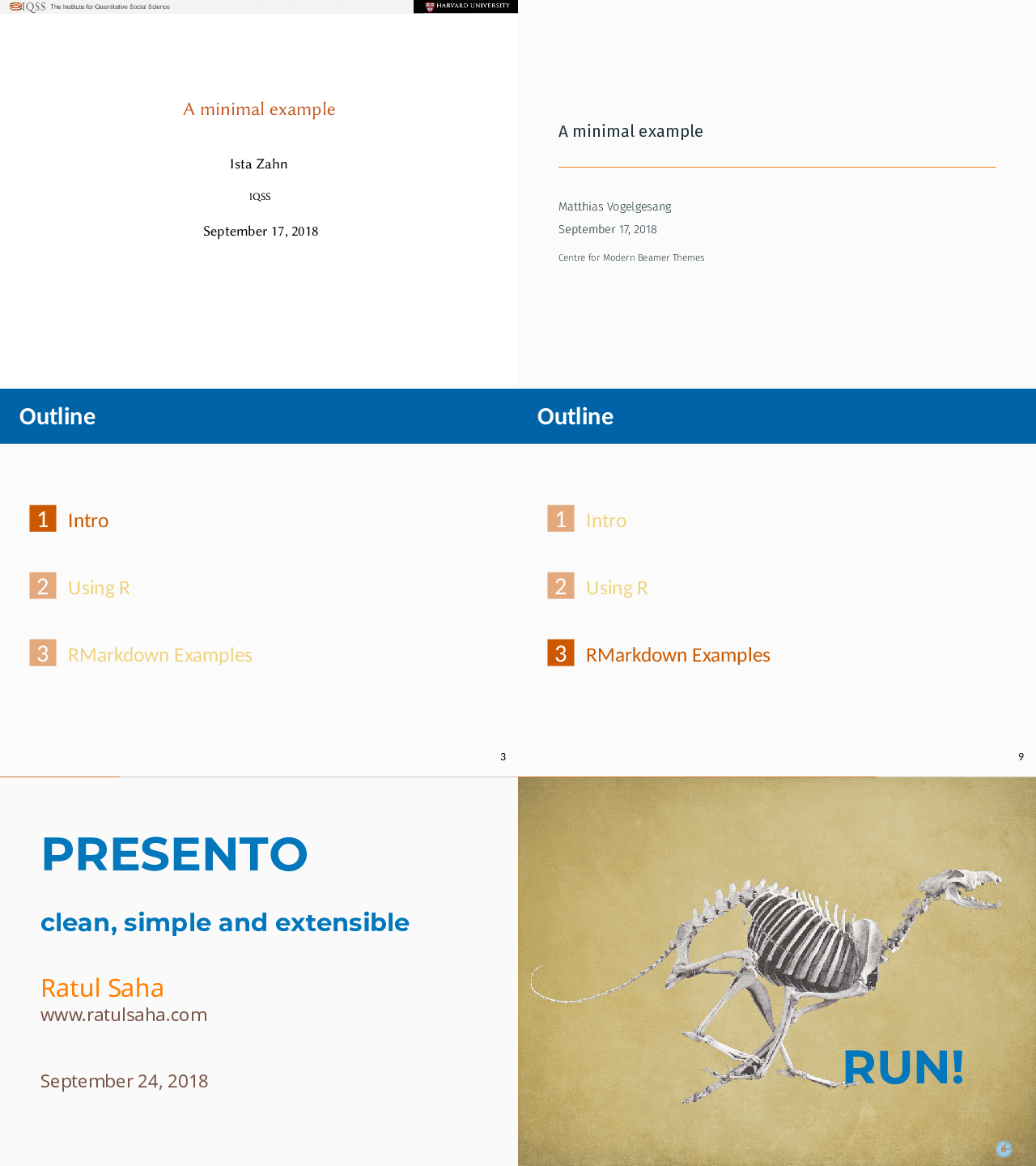
The seventh release of the binb package, and first in four years, is now on CRAN. binb regroups four rather nice themes for writing LaTeX Beamer presentations much more easily in (R)Markdown. As a teaser, a quick demo combining all four themes is available; documentation and examples are in the package. This release contains a CRAN-requested fix for a just-released new pandoc version which deals differently with overflowing bounding boxes from graphics; an added new LaTeX command is needed. We also polished continuous integration and related internals a few times but this does not contain directly user-facing changes in the package.

Changes in binb version 0.0.7 (2024-07-06)
  • Several rounds of small updates to ge continuous integration setup.
  • An additional LaTeX command needed by pandoc (>= 3.2.1) has been added.

CRANberries provides a summary of changes to the previous version. For questions or comments, please use the issue tracker at the GitHub repo. If you like this or other open-source work I do, you can now sponsor me at GitHub.

This post by Dirk Eddelbuettel originated on his Thinking inside the box blog. Please report excessive re-aggregation in third-party for-profit settings.

5 July 2024

Sahil Dhiman: Atleast Not Written by an AI

I keep on going back and correcting bootload of grammatical and other errors in my posts here. I somewhat feel embarrassed how such mistakes slip through when I was proofreading. Back then it was all good and suddenly this mistake cropped up in my text, which everyone might have already noticed by now. A thought just stuck around that. Those mistakes signify that the text is written by a real human, and humans makes mistakes. :) PS - Even LanguageTool (non-premium) couldn t identify those errors.

Reproducible Builds (diffoscope): diffoscope 272 released

The diffoscope maintainers are pleased to announce the release of diffoscope version 272. This version includes the following changes:
[ Chris Lamb]
* Move away from using DSA OpenSSH keys in tests; support has been removed
  in OpenSSH 9.8p1. (Closes: reproducible-builds/diffoscope#382)
* Move to assert_diff helper in test_openssh_pub_key.py
* Update copyright years.
You find out more by visiting the project homepage.

4 July 2024

Arturo Borrero Gonz lez: Wikimedia Toolforge: migrating Kubernetes from PodSecurityPolicy to Kyverno

Le ch teau de Val re et le Haut de Cry en juillet 2022 Christian David, CC BY-SA 4.0, via Wikimedia Commons This post was originally published in the Wikimedia Tech blog, authored by Arturo Borrero Gonzalez. Summary: this article shares the experience and learnings of migrating away from Kubernetes PodSecurityPolicy into Kyverno in the Wikimedia Toolforge platform. Wikimedia Toolforge is a Platform-as-a-Service, built with Kubernetes, and maintained by the Wikimedia Cloud Services team (WMCS). It is completely free and open, and we welcome anyone to use it to build and host tools (bots, webservices, scheduled jobs, etc) in support of Wikimedia projects. We provide a set of platform-specific services, command line interfaces, and shortcuts to help in the task of setting up webservices, jobs, and stuff like building container images, or using databases. Using these interfaces makes the underlying Kubernetes system pretty much invisible to users. We also allow direct access to the Kubernetes API, and some advanced users do directly interact with it. Each account has a Kubernetes namespace where they can freely deploy their workloads. We have a number of controls in place to ensure performance, stability, and fairness of the system, including quotas, RBAC permissions, and up until recently PodSecurityPolicies (PSP). At the time of this writing, we had around 3.500 Toolforge tool accounts in the system. We early adopted PSP in 2019 as a way to make sure Pods had the correct runtime configuration. We needed Pods to stay within the safe boundaries of a set of pre-defined parameters. Back when we adopted PSP there was already the option to use 3rd party agents, like OpenPolicyAgent Gatekeeper, but we decided not to invest in them, and went with a native, built-in mechanism instead. In 2021 it was announced that the PSP mechanism would be deprecated, and removed in Kubernetes 1.25. Even though we had been warned years in advance, we did not prioritize the migration of PSP until we were in Kubernetes 1.24, and blocked, unable to upgrade forward without taking actions. The WMCS team explored different alternatives for this migration, but eventually we decided to go with Kyverno as a replacement for PSP. And so with that decision it began the journey described in this blog post. First, we needed a source code refactor for one of the key components of our Toolforge Kubernetes: maintain-kubeusers. This custom piece of software that we built in-house, contains the logic to fetch accounts from LDAP and do the necessary instrumentation on Kubernetes to accommodate each one: create namespace, RBAC, quota, a kubeconfig file, etc. With the refactor, we introduced a proper reconciliation loop, in a way that the software would have a notion of what needs to be done for each account, what would be missing, what to delete, upgrade, and so on. This would allow us to easily deploy new resources for each account, or iterate on their definitions. The initial version of the refactor had a number of problems, though. For one, the new version of maintain-kubeusers was doing more filesystem interaction than the previous version, resulting in a slow reconciliation loop over all the accounts. We used NFS as the underlying storage system for Toolforge, and it could be very slow because of reasons beyond this blog post. This was corrected in the next few days after the initial refactor rollout. A side note with an implementation detail: we stored a configmap on each account namespace with the state of each resource. Storing more state on this configmap was our solution to avoid additional NFS latency. I initially estimated this refactor would take me a week to complete, but unfortunately it took me around three weeks instead. Previous to the refactor, there were several manual steps and cleanups required to be done when updating the definition of a resource. The process is now automated, more robust, performant, efficient and clean. So in my opinion it was worth it, even if it took more time than expected. Then, we worked on the Kyverno policies themselves. Because we had a very particular PSP setting, in order to ease the transition, we tried to replicate their semantics on a 1:1 basis as much as possible. This involved things like transparent mutation of Pod resources, then validation. Additionally, we had one different PSP definition for each account, so we decided to create one different Kyverno namespaced policy resource for each account namespace remember, we had 3.5k accounts. We created a Kyverno policy template that we would then render and inject for each account. For developing and testing all this, maintain-kubeusers and the Kyverno bits, we had a project called lima-kilo, which was a local Kubernetes setup replicating production Toolforge. This was used by each engineer in their laptop as a common development environment. We had planned the migration from PSP to Kyverno policies in stages, like this:
  1. update our internal template generators to make Pod security settings explicit
  2. introduce Kyverno policies in Audit mode
  3. see how the cluster would behave with them, and if we had any offending resources reported by the new policies, and correct them
  4. modify Kyverno policies and set them in Enforce mode
  5. drop PSP
In stage 1, we updated things like the toolforge-jobs-framework and tools-webservice. In stage 2, when we deployed the 3.5k Kyverno policy resources, our production cluster died almost immediately. Surprise. All the monitoring went red, the Kubernetes apiserver became irresponsibe, and we were unable to perform any administrative actions in the Kubernetes control plane, or even the underlying virtual machines. All Toolforge users were impacted. This was a full scale outage that required the energy of the whole WMCS team to recover from. We temporarily disabled Kyverno until we could learn what had occurred. This incident happened despite having tested before in lima-kilo and in another pre-production cluster we had, called Toolsbeta. But we had not tested that many policy resources. Clearly, this was something scale-related. After the incident, I went on and created 3.5k Kyverno policy resources on lima-kilo, and indeed I was able to reproduce the outage. We took a number of measures, corrected a few errors in our infrastructure, reached out to the Kyverno upstream developers, asking for advice, and at the end we did the following to accommodate the setup to our needs: I have to admit, I was briefly tempted to drop Kyverno, and even stop pursuing using an external policy agent entirely, and write our own custom admission controller out of concerns over performance of this architecture. However, after applying all the measures listed above, the system became very stable, so we decided to move forward. The second attempt at deploying it all went through just fine. No outage this time When we were in stage 4 we detected another bug. We had been following the Kubernetes upstream documentation for setting securityContext to the right values. In particular, we were enforcing the procMount to be set to the default value, which per the docs it was DefaultProcMount . However, that string is the name of the internal variable in the source code, whereas the actual default value is the string Default . This caused pods to be rightfully rejected by Kyverno while we figured the problem. I sent a patch upstream to fix this problem. We finally had everything in place, reached stage 5, and we were able to disable PSP. We unloaded the PSP controller from the kubernetes apiserver, and deleted every individual PSP definition. Everything was very smooth in this last step of the migration. This whole PSP project, including the maintain-kubeusers refactor, the outage, and all the different migration stages took roughly three months to complete. For me there are a number of valuable reasons to learn from this project. For one, the scale is something to consider, and test, when evaluating a new architecture or software component. Not doing so can lead to service outages, or unexpectedly poor performances. This is in the first chapter of the SRE handbook, but we got a reminder the hard way This post was originally published in the Wikimedia Tech blog, authored by Arturo Borrero Gonzalez.

Samuel Henrique: Debian's curl now supports HTTP3

tl;dr Starting with curl 8.0.0-2, you can now use HTTP3.
curl --http3-only https://example.com
Or, if you would like to try it out in a container:
podman run debian:unstable apt install --update -y curl && curl --http3-only https://example.com
(in case you haven't noticed, apt now has the --update option for the upgrade and install commands, although not available on stable yet)

Availability
  • Debian unstable - Since 2024-07-02
  • Debian testing - Since 2024-07-18
  • Debian 12/bookworm backports - Expected by the end of August 2024.
  • Debian 12/bookworm - Due to the mechanisms we have in place to make sure Debian stable is in fact stable, we will never be able to ship this in the regular repository. Users can make use of the backports repositories instead.
  • Debian derivatives - Rolling releases will get it by the time it's on Debian testing (e.g.: Kali Linux). Stable derivatives only in their next major release.

The challenge HTTP3 is fresh new, well... not really, but at least fresh enough that I'm not aware of any other Linux distribution supporting it on curl, the reason is likely two-fold:
  1. OpenSSL is not there yet OpenSSL still doesn't have proper HTTP3 support, and given that OpenSSL is so widely used, almost every curl distributor/packager will build curl with it and thus changing the TLS backend to something else is risky. Unfortunately, proper support for the OpenSSL libcurl is unlikely to come anytime before the end of this year, the OpenSSL performance is not good enough yet as of version 3.3. Daniel Stenberg has written about the state of this multiple times, most recently at HTTP/3 in curl mid 2024, if you're interested, I suggest reading through his other posts as well. Some might have noticed that nginx does support HTTP3 through OpenSSL, although when you look closely, it's not exactly perfect:
    An SSL library that provides QUIC support is recommended to build nginx, such as BoringSSL, LibreSSL, or QuicTLS. Otherwise, the OpenSSL compatibility layer will be used that does not support early data.
    As you can see, they don't recommend using OpenSSL, and when doing so, you don't get complete support.

  2. HTTP3 support for GnuTLS/nghttp3/ngtcp2 is recent The non-experimental support arrived back in October 2023, and so that's when I started seriously planning for this. curl has been working on HTTP3 support for years, and so it did support other TLS backends before that, but out of them, the one most feasible for a distribution to ship would be GnuTLS, which gets HTTP3 support through ngctp2 and nghttp3.

How it was done The Debian curl package has historically shipped at least two variants of libcurl, an OpenSSL and a GnuTLS one. The OpenSSL libcurl can't support HTTP3 for the reasons explained above, but the GnuTLS libcurl can (with ngtcp2 and nghtp3). Debian packages can choose which version of libcurl to link against (without having to modify any upstream source code). Debian's "git" package being a famous example of a package that links against the GnuTLS libcurl. Enabling HTTP3 on curl was done in three steps:
  1. Make sure all required dependencies fulfill the minimum requirements.
  2. Enable HTTP3 for GnuTLS libcurl.
  3. Change the libcurl used by the curl CLI, from OpenSSL to GnuTLS.
curl's HTTP3 support requires a somewhat recent version of nghttp3 and updating that required a transition (due to the SONAME bump), while we've also had months of freeze for transitions due to the time_t transition. After the dependencies were in place, enabling HTTP3 for the GnuTLS libcurl was straightforward. Then, for the last part, we had to switch the TLS backend used by the curl CLI. Doing the swap is also quite easy on the packaging level, but we have to consider the chances of this change breaking our users' environments.

Ensuring there are no breakages The first thing to consider regarding breakages is that this change is not going to be pushed directly to the current Debian stable releases, it will be present in the next stable release (13/trixie) but the current one will stick to the version that's already shipped. Secondly, we have to consider the risk of losing the ability to use certain parameters from the curl CLI which could be limited to the OpenSSL backend. During curl-up 2024, the curl developers pointed out the existence of a page that lists the TLS related options and the backends they work with. Analysing that page, ignoring all of the options that are suffixed with "BLOB" (only pertinent to the library, not the CLI), the only one left which is attention worthy is CURLOPT_ECH.
This experimental feature requires a special build of OpenSSL, as ECH is not yet supported in OpenSSL releases. In contrast ECH is supported by the latest BoringSSL and wolfSSL releases.
As it turns out, Encrypted Client Hello is experimental and it's not supported by the vanilla OpenSSL. This was enough of an investigation for me to go ahead with the change. Noting that even in the worst case scenario (we find a horrible regression), we can rollback without having affected a single stable release. Now that the package is on Debian unstable, the CI tests (autopkgtest) of every package that depends on curl is currently running, the results are compared against the migration-reference (in this case, the curl CLI with OpenSSL, before the change). If everything goes right, curl with HTTP3 support will migrate to Debian testing in around 5 days. If we spot any issues, we'll have to solve them first and it's going to be hard to predict how long it takes, although it's fair to expect less than a month.

Feedback Feel free to join the Matrix room for the Debian curl maintainers:
https://matrix.to/#/#debian-curl-maintainers:matrix.org

Acknowledgements It took us a bit longer than expected to be able to enable HTTP3, nonetheless it's still early enough to be excited about. A lot of people were crucial to make this happen. I should recognize in the first place, obviously, the curl developers and the developers of the supporting libraries: GnuTLS, nghttp3, ngtcp2. Participating in the curl-up 2024 conference helped me get motivated to push this through, besides becoming aware of the right documentation to research for impact. On the Debian side, Sakirnth Nagarasa <sakirnth> was responsible for updating and taking care of the transition for nghttp3 and ngtcp2. Also on the Debian side, I've got loads of help and support from the co-maintainers of the curl package: Sergio Durigan Junior <sergiodj> and Carlos Henrique Lima Melara <charles>.

Changes since publication

2024-07-18
  • Update date of availability for Debian testing and expected date for bookworm backports.
  • We have historically spoken Portuguese in the room but we'll switch to English in case anyone joins.

Next.

Previous.