Search Results: "will"

1 December 2006

Michael Janssen: These are just a couple of my cravings

Food has always been a source of contention for me when I am trying to lose weight. I never want to restrict the types of food - I've spent a long time working out what I like and dislike. One of the benefits of the Hacker's Diet isn't all that concerned with what food you eat, but simply that you get a certain amount of calories, it gives you a lot of choices for dining. The first time I was on it, I used ramen and rice to keep me fed. Those worked well because I was basically broke and the rice filled up the stomach just fine.

There are a lot of diets out there, and it's easy to try one or the other just to get completely fed up with the lack of diet-allowed food that you actually like to eat. I believe that this is a major reason that most diets fail, and why there are so many of them - after all, Atkins might work great for the people who don't have a jonesing for a bunch of fries every once in a while. If you're looking for a diet right now, think about the kinds of foods that you won't be willing to give up. There are diets out there for every type of favorite food nowadays, just walk down the fitness and health section of your local bookstore. I'm convinced that the final word is going to be a calorie deficiency. After all, what is dieting but controlled starvation?

This time dieting has been slightly different, but not very much. I've been trying to buy pre-packaged food more than normal, because it's easy to find calorie counts for them - right on the box. Lately I've been eating some TV-dinner like things, which clock in at about 400 calories a piece. This means that I'm eating 4-5 of them a day, which is like an extra bonus because eating more smaller meals is supposed to help keep the metabolism up. The maxx market economy of these meals is amazing - you can easily get 7-8 for $10, making my daily expense very low. They are also not completely horrible for you - most have some vegetables and protein and starch of some sort. There is also a decent variety, so it's hard to get bored of the same old stuff. I've also switched some of the eating out to a more healthy fast food sub place, which has the extra bonus of also being cheaper.

This Week (Nov 24 - Nov 30):
Minimum: 334.0 (-1.0) (Nov 29)
Maximum: 337.0 (-2.0) (Nov 26)
Average: 335.0 (-1.8) (135.0 to goal)
Exercise Calories: 3172 on 6 days
Average Calories per session: 528.9

Joachim Breitner: Personal Podcast Charts

I don t have a TV here in Ghana (and I don t miss it at all), but some audio-visual content consumption from time to time is nice. Therefore, I started to subscribe to various Podcasts, using the comfortable Democracy Player. Here are my regulars , also see my list of German podcasts.BrickfilmsSome like lego. Some like stop motion animation. I like both. Therefore, I am a big fan of lego movies, and the brickfilms blogcast delivers the best ones directly to me. Unfortunately, does not get posted to very often.Olde EnglishMy sense of humer is not every one else s. Therefore, I guess not everyone will enjoy the sketches of the Olde English comedy group. I could try to list some of my favorites episodes, like One picture every day , but discover that for yourself.BSODInteresting, highly technical hour-long podcast covering interesting topics such as how the telefone system works (and what funny things you can do with it), bulding a infra-red remote control gun that will control your (or anyone s) TV from quite a distance and similar topics. It could cover a bit more software topics, and less Windows based things and personally, I think the Bastard Sons of Dial-Up put slightly too much emphasize on bad language and underground-activists-like appearance. But that might be genuine, and the content is of good quality, so it is worth watching.The Tech JunkiesOnly three episodes so far, but these two guy are doing great and funny things with electronics (such as testing what happens when you plug a speaker into the power outlet). They also have covered lock picking, and I especially enjoyed seeing a bump key in action, as so far I only read about that technique.Player 1 vs. Player 2A two-guy talk show about computer games. Slightly oriented towards old and console games, but still interesting for most gamers, I d say. They have not released a new episode for almost a year now, I hope that they will start sending again some day.

Joachim Breitner: Personal Videocast Charts

I don t have a TV here in Ghana (and I don t miss it at all), but some audio-visual content consumption from time to time is nice. Therefore, I started to subscribe to various Videocasts, using the comfortable Democracy Player. Here are my regulars , also see my list of German podcasts.BrickfilmsSome like lego. Some like stop motion animation. I like both. Therefore, I am a big fan of lego movies, and the brickfilms bodcast delivers the best ones directly to me. Unfortunately, does not get posted to very often.Olde EnglishMy sense of humer is not every one else s. Therefore, I guess not everyone will enjoy the sketches of the Olde English comedy group. I could try to list some of my favorites episodes, like One picture every day , but discover that for yourself.BSODInteresting, highly technical hour-long videocast covering interesting topics such as how the telefone system works (and what funny things you can do with it), bulding a infra-red remote control gun that will control your (or anyone s) TV from quite a distance and similar topics. It could cover a bit more software topics, and less Windows based things and personally, I think the Bastard Sons of Dial-Up put slightly too much emphasize on bad language and underground-activists-like appearance. But that might be genuine, and the content is of good quality, so it is worth watching.The Tech JunkiesOnly three episodes so far, but these two guy are doing great and funny things with electronics (such as testing what happens when you plug a speaker into the power outlet). They also have covered lock picking, and I especially enjoyed seeing a bump key in action, as so far I only read about that technique.Player 1 vs. Player 2A two-guy talk show about computer games. Slightly oriented towards old and console games, but still interesting for most gamers, I d say. They have not released a new episode for almost a year now, I hope that they will start sending again some day.

30 November 2006

Ben Armstrong: A pcsx mythgame player using xautomation

Scripting a gui tester for Tuxpaint with xautomation was fun and quite useful too, but really only appeals to developers. Today I found use for xautomation that will appeal to sys admins and users: hacking around a user interface that refuses to work the way it ought to. I wanted to add another mythgame player, this time for the pcsx-df Playstation emulator. Unfortunately, I couldn’t pass it a CD image from the command line. It seems to know only how to do two things: run a game file, or run a real CD. My best guess is that it doesn’t know its plugins until the GUI starts, so it is unaware that it ought to be able to use the cdrmooby plugin to load the specified image when it is parsing the command line. After a brief and fruitless grep through the source, it dawned on me that I could put xautomation to work for me to do the job in much less time. Here is the resulting startpcsx script, which sucessfully operates as my pcsx mythgame player.
#!/bin/bash
slowtype ()  
   echo "$@"   sed -re 's/(.)/\"str \1\"\n\"usleep 15\"\n/g'
 
pcsx &
xte "sleep 2" "keydown Control_R" "key o" "keyup Control_R" "sleep 1" 
slowtype "$@"   xargs xte
xte "key Return" 
The hard part was that pcsx is afflicted by one of my pet peeves, a typeahead find that cannot be disabled. As a result, if you make xte type at full speed into the open file dialog, the filepath comes out all jumbled up. This happens because the filepath is constantly being redrawn as xte types characters, so the cursor isn’t always at the end of the line. The usleep 15 allows the cursor to reach the end of the line before typing the next character. Of course, this is truly a hack, subject to variations in timing between systems, so if you use it, you may have to tweak the sleep and usleep values. But it works well enough as a workaround until pcsx-df is fixed to accept a CD image on the command line.

Benjamin Mako Hill: Digital Disobedience

/copyrighteous/images/steal_music_bubble.jpg
I am helping to organize and host an event called Digital Disobedience on cyberactivism and culture jamming this Friday with Harvard Free Culture. The event will explore the interplay between technology, activism, and cultural critique. Here are the details if you are local to Cambridge/Boston and would like to drop by:
Digital Disobedience
Cyberactivism and Culture Jamming
Friday, December 1, 18:00
Science Center 110, Harvard University
The event will feature talks by: The format will be interactive with short presentations from the speakers and then break-out groups to discuss thoughts and questions with the presenters. A few people have voiced a desire to do some culture jamming of our own afterward. My birthday is the next day so maybe we can have that turn into a little bit of a celebration.

Evan Prodromou: 8 Frimaire CCXV

I'm a small, petty person. I know I am. I should probably be really happy that the newest Eye of Gnome has such great image cataloging and review functionality. It's a nice step forward in usability from the mishmash of image-viewing-and-cataloging-and-such tools in earlier versions of Gnome. But, I'm not. I'm left-handed, and when I take portrait-style snapshots I turn my little camera 90 in the opposite direction from 85-95% of the human population. Which normally is neither here nor there, but... when I'm going through my camera images on my computer, and turning the portrait-mode ones so they're aligned correctly, there's a hotkey in EoG to turn a picture clockwise, but not one to turn it counterclockwise. Why? I smell anti-left-hander conspiracy. In conclusion, I hope I've proven that no matter how great a tool becomes, someone will always find something to whine about it. tags:

My wife is a winner Maj just won NaNoWriMo. Go Maj! tags:

29 November 2006

Gustavo Franco: get the facts

Every time Microsoft manufactures a Zune, Universal receives US$1. Universal is now pointing its finger to Apple (due to the iPods). Considering for a moment the tax isn't insane. What about ask Philips, Sony and Toshiba some bucks due to the cd/dvd recorders? In a way it will be funny watch the lawsuits floating but in the end of the day we (the consumers) will pay.

Windows Vista (RTM, build 6000) installer doesn't proceed if you've less than 512mb of ram. No, i'm not kidding. I thought 64kb was enough. :)

Russell Coker: Hans Reiser

According to this article in the San Francisco Chronicle Hans Reiser pled "not guilty" to the charge of murdering his wife. This isn't particularly exciting news as all previous indications were that he was going to do so.

However one noteworthy fact from the article is that they are setting up an education fund for his children. Regardless of whether Hans is convicted or not, his children will still be in a bad situation and in need of assistance. While there are plenty of other worthy charities needing donations, if you are considering donating towards a Linux related cause then you might want to consider the children of a kernel coder.

Adam Rosi-Kessel: Meme Propagation Experiment

Via Steve via Chris Young, an experiment entitled Measuring The Speed of Meme: An Experiment in which You Will Participate, Or Else…. Sure, I’ll bite. What’s to lose?

Wouter Verhelst: Grep.be (and related)

Yes, my domain has been off the net for quite a few days now. This was related to the Internet connection that's in front of most of that domain being down. I'm quite very extremely unhappy about that. It's not as if that connection is a cheap one, and I would've expected a slightly better service for the price I'm paying. As it turned out, it wasn't my ISP's fault, but then still. Of course, it's all working again now, and I'm a bit happier. I will start thinking about making sure this connection is no longer an SPOF, however. That should help...

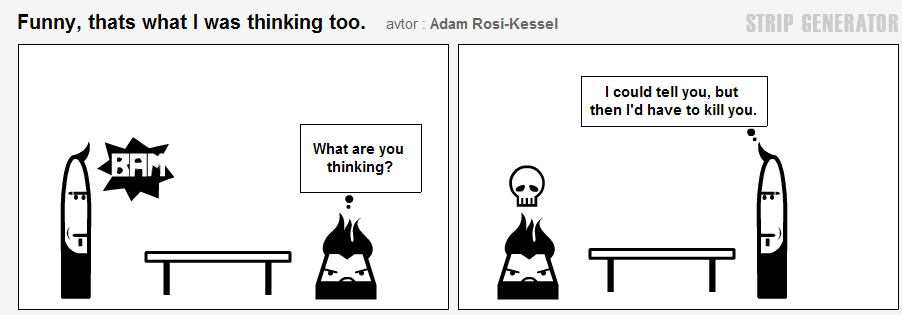
Adam Rosi-Kessel: Funny, That's What I Was Thinking Too

In the “what will they think of next to do with Flash” category: this curiously addictive yet slovakian slovenian Comic Strip Generator: (The strip generator automatically removed the apostrophe in the title of this strip I made.) No explanation as far as I can tell on who owns the copyright in the source material or the derivative works.

Eric Warmenhoven: Breeders

As I said a while back, Lisa and I had been in the process of finding and buying a new house. A few months ago, we found one, and moved. We left behind a bit of our furniture that we have had since we were in college, and since then have been in a rather involved process of finding furniture that we’re willing to live with for the next few decades or so. It’s been a rather painless process for me, since Lisa’s been doing all of it. I just have to stay alert for when new things show up. I still tend to miss lamps. We were in the process of selling our townhouse; but after a few months we only had two offers, and both were significantly below our asking price. So we’ve taken it off the market for now, but will list it again in the spring. Fortunately for us it’s paid off, so other than property tax, it isn’t too big of an expense. We considered renting it but have friends who did that and their experience has convinced us that we’ll never rent anything ever. Also, a couple months ago, after we moved, we found out that Lisa’s pregnant. We’re both really excited about it. We had been married for just less than a year when we found out, which doesn’t seem like a long enough time, but we had been together for seven years prior to that. So it seemed like a good time for us. We have our third ultrasound in a couple weeks when hopefully we’ll find out the baby’s gender. Lisa’s hoping for a girl, but she thinks it’s going to be a boy; I think it’s going to be a girl. Everything seems to be going well so far, and Lisa’s starting to show a little. We haven’t started doing any of the baby-related things yet, like picking names, or setting up a nursery and buying a ton of crap that will probably end up being mostly unused. We did receive our first baby-related gift from my grandmother though, and Lisa’s grandmother is busy knitting booties and blankets. One of these days we’ll probably head over to Babies R Us and set up a baby registry, but probably not until after the new year.

28 November 2006

Enrico Zini: live-cd-on-removable-disk2

Live CD on a removable disk, the Debian way In [live-cd-on-removable-disk] at some point I wrote:
Enrico's note: do we have anything in Debian that we can install and just does that?
Here are the answers: Sven Mueller writes:
Well, Enrico, a tool I really grew fond of, which auto-configures X on Debian systems is xdebconfigurator, it lacks being auto-run on each system start, which I consider a feature on normal systems, but for your proposed usage (i.e. a portable USB-storage based Debian system), it would certainly be the right thing. Essentially, it never failed on me. Except for VMware virtual machines, where all it did wrong was that it proposed too high resolutions which resulted from my dual-screen Windows setup I ran VMware on. You might want to give it a try.
Tollef Fog Heen writes:
I added the support in casper for doing this almost a year ago and it has saved me lots of debugging time. Booting the live CD that way is almost as fast as booting an installed system. If you couple this with using the persistent storage support in casper, you can get the configure-on-boot support together with persistency. In a later update, slh is quited saying that xresprobe doesn't work on AMD64. This is wrong, I wrote that support based on code by Matthew Garret a little more than nine months ago. I wouldn't recommend incorporating it in new-written code, but rather use libx86
And finally, Marco Amadori writes:
Without needing to look for tools external to Debian, there is already the Debian Live software in sid: live-package, that creates a live system, and casper, that generates an initramfs that can configure a Debian system on the fly. So far there is no hard disk target for live-package, but the "Iso" target can already do the job quite well. At boot time, Casper's initramfs scans all the block devices, so it works also for USB keys and hard drives. To obtain a hard drive image, you just need to invoke "make-live" with the options to have the required software, then copy the content of the iso (or of the directory ./debian-live/binary) on a partition and install the boot loader. This is what the future "HD" target of live-package will do; so far it can only build ISO and Netboot images.

Daniel Jacobowitz: Triumph over emacs at last

I do about half my text editing in joe, and half of it in emacs. It's just what I've gotten used to; for a year or two I used primarily joe, and I gradually migrated until I did most of my programming in emacs instead, but I still do random text files in joe. I've been gradually trying to migrate to emacs; not least because upgrading joe has gotten to be such a pain. I use jpico rather than joe, you see. But I started using it a long time ago, probably around when joe 2.8 was current in Debian. And the jpico key bindings keep changing! Which is infuriating, so I keep having to rewrite my keybindings to stay mostly the way I like them. I like that emacs is such a smart editor. Especially since it defaults to all sorts of nice GNU-ish settings and most of my C is for GNU projects. But when I work on other things, I have to learn how to make it either disable smarts or use appropriate ones, so in self defence I keep learning new things about emacs... One things I've been annoyed at before is the binding for scroll-other-window. You can split a window into two (C-x 2). I often do that while writing a changelog up top of a patch file, whether I'm using joe or emacs at the moment. An advantage of emacs is that you can scroll the window that the cursor isn't in, paging down through the text you're describing while keeping the cursor where you're writing. But it's bound by default to C-M-v and C-S-M-v (control-meta and control-shift-meta). Hard to hit C-M-v, and impossible to enter C-S-M-v; you can not distinguish Control and Control-Shift in a vt100 terminal (like, say, inside of screen). Fortunately, you say, it's also bound to M-next and M-prior (meta-page down and meta-page up)? Well, yes... but... you can't type that either at a terminal. Normally. I can now though. Fixing it took two parts. First, I discovered that Meta-next sent the same sequence as plain next, in my xterms. I think I've convinced myself this is a bug in xterm. My keymap, which is a pretty standard pc(pc105)+us+altwin(meta_win), has Super_L and Hyper_L bound to modifier 4 along with Meta_L and Meta_R. xterm sees these strange keys and decides that mod4 must be some sort of "other" modifier, in code that looks like it's for handling num lock. Fortunately, I can work around this easily. I don't have a Super or Hyper key, so I deleted the bindings by adding this to my .xsession:
  xmodmap -e 'remove mod4 = Super_L'
  xmodmap -e 'remove mod4 = Hyper_L'
UPDATE: This will be fixed in xterm #223, since Thomas Dickey agreed it was a bug. Next, I discovered that emacs didn't recognize the sequence produced after that fix. It didn't recognize C-next or A-next either. So I added this to my .emacs:
  ; Key magic.  Emacs nor terminfo normally have bindings for these.
  ; The meta binding in particular takes a bit of X magic also; see
  ; the xmodmap call in /.xsession.
  (define-key function-key-map "\e[6;5~" '[C-next])
  (define-key function-key-map "\e[6;9~" '[M-next])
  (define-key function-key-map "\e[6;3~" '[A-next])
  (define-key function-key-map "\e[5;5~" '[C-prior])
  (define-key function-key-map "\e[5;9~" '[M-prior])
  (define-key function-key-map "\e[5;3~" '[A-prior])
That really should be conditionalized on the terminal type, but I didn't want to mess with it any more. And now it works. Woohoo!

MJ Ray: Business: Cooperatives SW

I attended the Cooperatives SW annual meeting in Taunton on Monday 27 November because it covers the new home of Turo Technology. Sadly, headline speaker Dame Pauline Green was unable to attend, but someone else from Cooperatives UK (I think it was John Goodman, but I can't find a name in my notes) gave the keynote presentation about the current state of the cooperatives and current trends. Among the figures, there was the pretty astonishing Global 300 which lists the biggest 300 cooperatives and mutuals in the world. The list contains some names I didn't expect and also some names in different positions than I expected. Some things are less surprising: almost every country has agricultural cooperatives and the UK (with mutual insurers, building societies and credit unions) and France are particularly strong in financial cooperatives. Apparently, the Global 300 will be updated as and when results are published, so watch that space. More items from the Cooperatives SW meeting soon.

Gunnar Wolf: Are Debian people real Free Software zealots?

Wow... The amount of press/coverage inside the FS community (not necessarily good press) the Ubuntu people are receiving lately is huge. I smell the possibility where Canonical might face what many people call the ugly side of Debian - But what we, the insiders, call it the most important part of it: Our people's devotion to the Free Software ideals. Of course, even inside Debian there are all kind of opinions (to the point that Debian's main activity seems at times to be debating rather than coding), but the general perception is that we are the fundamentalist zealots.
It's only funny to imagine what lies ahead. No, I'm not talking (for people not following planet.debian.org) about Ubuntu's latest big media scandal, although it might share some connections. Apparently, Canonical wants to grow and bring more people in. And, of course, being a commercial desktop-oriented distribution, being flashy (or in their words, going for the bling) is needed to keep up with the Joneses.
This time, it starts (for me) with Scott's interesting and worthy posting regarding the future of binary blobs and clearly non-free drivers inside Ubuntu. In short: Scott explains why Ubuntu will apparently sacrifice some of its ideals for (what I read as) some extra popularity, and states he is not too happy with it. This, of course, has triggered a load of postings - not necessarily in chronological order, but: Mako, also an Ubuntite, asks people (users, developers) to tell their opinions on this - But he is not at all happy with the direction this might take. Many Ubuntu enthusiasts are voicing their opinions in Wiki form. I guess that Joey's peace of mind comes also because of this discussion (although I'm only stretching my views).
...There is always the debate of whether Ubuntu is good or bad for Debian, as Norbert points out. I've tried to stay away from it, quoting one of Luis Echeverr a's famous it's neither good nor bad, it's just the opposite. I do think the two systems will eventually diverge too much - But I'm not at all involved in Ubuntu, and I refuse to back my claims ;-)
The point of this posting is: When forming Canonical, obviously Mark wanted to gather the best of the best, people who knew their way developing and coordinating an eminently Free and high-quality distribution, but without the distraction of 1000+ developers trying to pull the whole distribution their way. By being the boss, he can ensure a single vision (and not a multitude of egos) drives the excellent work of talented hackers. However, there might be a subtle mistake: Maybe his team are too Debianites? Maybe they will show they are as strongly Free Software (and not Opensource) oriented as they were when they joined Debian? Maybe, even with the unlimited powers that being a SABDFL gives, Mark and the Ubuntu technical committee/community council will have to concede on not having the latest and flashiest, just to keep his elite team happily working?
I'm not, of course, blaming them for selling their principles - Of all the commercially-oriented Linux distributions, Ubuntu is clearly the one that stays closer to what I'd like. And it's not by mere chance that it derives and keeps in constant sync (at least until now) with Debian. Still... This has the potential to make a big dent on their structure and vision.

Daniel Burrows: Digging for Conspiracies?

While I appreciate the research and legal commentary over at Groklaw, the tendency of PJ and the regular posters to imagine vast conspiracies makes me more than a little uneasy. Yesterday I came across a truly jaw-dropping example that would be offensive if it wasn't so laughable; and since I happen to know more about the situation, I felt I should comment on it:


I have some questions about this group, BELUG, who did the article, I gather. There is no info on the site to be more informed. Anyone in the Seattle LUG know anything about this new group in Bellevue, 5 mins. from Bill Gates' house?

...

I don't like to be a cynic, and maybe they are a Linux user group, but if so, maybe the Seattle LUG can give them a hand.


Of course, we all know that the Microsoft corporate campus has an enormous mind-control ray mounted on Building 1 that turns everyone living on the Eastside of Seattle into mindless Gates-worshipping zombies. Part of Bill's personal security plan, dontchaknow. That's why BELUG starts every meeting with a round of "All Hail Gates, Lord of All That Is Electrified".


She goes on to complain about "major confusion" in their description of free software. At a quick read, I can only see two glaring problems with this page: first, they describe free software as being both "free in a monetary sense" and able to be sold (which is actually true but sounds like a contradiction without more explanation that they don't provide); later, there's some weird wooly-headed stuff about revolutionizing entire economies and societies. I don't know what they're talking about, but they certainly can't be accused of lacking enthusiasm.

Finally, she quotes a section of the FAQ that suggests that Microsoft professionals should learn Linux and vice versa, since the world is heterogenous and getting more so. I don't think that's controversial, so I think she must be referring to this question:


Q: Why does BELUG dislike Microsoft?

A: That is a complete misunderstanding. BELUG does not dislike Microsoft. Microsoft is our neighbor, and many of our friends and relatives work there. Both Microsoft's headquarters and Bill Gates' house are located just minutes away, and Microsoft's world sales headquarters is currently under construction nearly adjacent to BELUG's meeting location. BELUG merely believes in friendly competition and that competition can benefit everyone, including Microsoft. This is what a free market economy and the American system is (supposed to be) all about, and this is what has helped make the U.S. a great country.


The statement that Microsoft is nearby is nothing but geographical fact (I could walk about fifteen minutes from my apartment and be on the MS campus; does that make me an MS mole?).

As for the rest, I really don't see anything to complain about. I know some people like to rhetorically shred Microsoft at every opportunity, but if you're trying to attract members in Microsoft's hometown, it's wise to keep your comments polite. It's also true that Microsoft benefits from competition (even if they don't see it that way); I don't think it's a coincidence that their products started sucking drastically less as OSX and Linux became reasonable alternatives to Windows. And the fact that we can have friendly competition (as opposed to the cut-throat, take-no-prisoners style that's popular in some quarters) is exactly one of things I like about Linux. You will notice, however, that the Q&A carefully doesn't mention what sort of competition Microsoft engages in. I think anyone who knows anything about the company knows the answer to that one.


Here's the kicker, though: I actually attended a BELUG meeting a few months ago. It seemed pretty much like what I'd expect from a small group of volunteers: one guy gave a talk about hooking ALSA up to a digital audio receiver, another guy showed off a Unix kernel he had written for classic MacOS (it ran as a user process and presented a Unix-like interface to the Mac), someone passed around cookies, and people talked a bit about using Linux and so on.

The poor quality of the Web site and the lack of a mailing list probably reflect the fact that there are a handful of people organizing the thing who all have day jobs and other committments, not some vast Microsoft conspiracy to undermine Linux from the inside by setting up fake LUGs. PJ never said they were fakes outright, but it was a clear subtext of her comment, and the Groklaw regulars who replied knew exactly what she was getting at. If she really thinks they might be fakes, then I think she needs to take a break from watching SCO (which could make anyone paranoid and suspicious) and enjoy the holiday season instead.

John Goerzen: Renovation: Weeks 19-22

It's been a few weeks since my last house update.

I've posted some new photos of the project.

The new insulation has been sprayed. It's a foam type of insulation that dries solid. It not only acts as an insulator, but also as a sealant, filling in little cracks that could let air in and out of the house. In some places it is up to 12 inches thick -- mostly in the attic.

After that, work on the drywall began. By this point, it's pretty much done and interior painting should be starting this week. After the painting, the next thing will be the floor restoration.

Concrete work got started last week. The porches are being re-built now, and in the photo below, you can see the forms starting to be in place for them.

So the appearance of the interior has changed dramatically over the past few weeks, mainly because there are now walls there.

Here's the usual sample photo:

MJ Ray: Bad Accessibility Loses Sales

Argos are a total pain. Their web site is unnecessarily complicated. If you want to do the basic action of buying something then you need to have a browser with all the trimmings and relaxed security, but even then, you might not be able to find what you want where you want to buy it. When will people wake up to the fact that Sometimes amateurish websites just put you off entirely... [Digital-Scurf Ramblings] Odeon seem to have finally got its act together - I don't agree with their priorities, as the extra investment in the web site seems to have been balanced by reducing newspaper advertising, but I can finally find film information with any browser I've tried so far. Does that leave Argos as Britain's Biggest Bad Online Retailer?

Matthew Palmer: VLAN adventures

Have you ever had a need for a large number of "real" network interfaces on a Linux box? For security reasons, you don't just want to hook everyone up to a single switch and use virtual interfaces (because it's too easy for one of the connected devices to play silly buggers with his neighbours). Up to a certain point, you can stuff more NICs into a box, and when it fills up you can switch to those outrageously expensive 2- and 4-port NICs. But eventually you're going to run out of space[1] or money. At that point, you need something more interesting. For me, this week, that "more interesting" has been Ethernet VLANs. Linux Journal has a good intro to the technical aspects of how to setup VLANs and Linux. VLANs are some crazy stuff. They're implemented by wrapping a little number around every Ethernet frame indicating which VLAN the packet is "on", and the switch (you need a higher-end device, appropriately configured) makes sure that packets don't roam onto ports they're not meant to be on. For a single switch, this isn't very interesting, and you don't really need an IEEE standard to make it work -- just a lot of little jumpers. However, VLANs are mostly useful on larger networks, which tend to use more than one switch. So you need a way for your VLANs to roam amongst your switches -- hence the packet tagging. You stick the tag onto the packets and fling them off to another switch, and packets coming in with the tag are corraled into their VLAN. Naturally, you don't want end-user devices whacking their own VLAN tags onto packets (untrusted data, and all that), so you define most of your ports as being "untagged". Packets that come in on these ports are treated as regular ethernet frames and tagged with the appropriate VLAN ID, and packets that go out have their VLAN IDs stripped before being sent. (This implies that you can tunnel VLANs in VLANs, and I'm pretty sure that is doable in most switches, modulo some nasty problems that can, and probably will, occur). The ports that aren't designated "untagged" spit out tagged packets -- and this is where my interest lies. Like most every other computer-related standard, Linux can decipher and work with VLAN tags (the 8021q module is what you're looking for). You just load up the module, hook your NIC into the appropriate port on your very expensive switch, define your VLAN tags with vconfig, and suddenly you've got vlanN interfaces, which map to real RJ-45 ports, and you can hang network devices off these and get lots and lots of "real" network interfaces on your Linux router. It's all so simple, right? Nothing ever is, of course. The trials and tribulations I've had over the past two days have included: Thankfully, once all those dramas were done, the whole thing just kind of fell into place, and now I've got a machine which has up to 2048(ish) network interfaces (with huge, glaring caveats on that upper bound, of course). With a bit of luck, the live installation in a couple of days will go smoothly. You can stop sniggering now.
1. In this case, there wasn't a lot of space to begin with, as it's a 1RU box I'm working on, and the 4-port NIC didn't want to place nice with me for some reason anyway.

Next.

Previous.