Search Results: "tb"

30 June 2016

Chris Lamb: Free software activities in June 2016

Here is my monthly update covering a large part of what I have been doing in the free software world (previously):
Debian My work in the Reproducible Builds project was covered in our weekly reports. (#58, #59 & #60)
Debian LTS

This month I have been paid to work 18 hours on Debian Long Term Support (LTS). In that time I did the following:
  • "Frontdesk" duties, triaging CVEs, etc.
  • Extended the lts-cve-triage.py script to ignore packages that are not subject to Long Term Support.

  • Issued DLA 512-1 for mantis fixing an XSS vulnerability.
  • Issued DLA 513-1 for nspr correcting a buffer overflow in a sprintf utility.
  • Issued DLA 515-1 for libav patching a memory corruption issue.
  • Issued DLA 524-1 for squidguard fixing a reflected cross-site scripting vulnerability.
  • Issued DLA 525-1 for gimp correcting a use-after-free vulnerability in the channel and layer properties parsing process.

Uploads
  • redis (2:3.2.1-1) New upstream bugfix release, plus subsequent upload to the backports repository.
  • python-django (1.10~beta1-1) New upstream experimental release.
  • libfiu (0.94-5) Misc packaging updates.


RC bugs

I also filed 170 FTBFS bugs against a7xpg, acepack, android-platform-dalvik, android-platform-frameworks-base, android-platform-system-extras, android-platform-tools-base, apache-directory-api, aplpy, appstream-generator, arc-gui-clients, assertj-core, astroml, bamf, breathe, buildbot, cached-property, calf, celery-haystack, charmtimetracker, clapack, cmake, commons-javaflow, dataquay, dbi, django-celery, django-celery-transactions, django-classy-tags, django-compat, django-countries, django-floppyforms, django-hijack, django-localflavor, django-markupfield, django-model-utils, django-nose, django-pipeline, django-polymorphic, django-recurrence, django-sekizai, django-sitetree, django-stronghold, django-taggit, dune-functions, elementtidy, epic4-help, fcopulae, fextremes, fnonlinear, foreign, fort77, fregression, gap-alnuth, gcin, gdb-avr, ggcov, git-repair, glance, gnome-twitch, gnustep-gui, golang-github-audriusbutkevicius-go-nat-pmp, golang-github-gosimple-slug, gprbuild, grafana, grantlee5, graphite-api, guacamole-server, ido, jless, jodreports, jreen, kdeedu-data, kdewebdev, kwalify, libarray-refelem-perl, libdbusmenu, libdebian-package-html-perl, libdevice-modem-perl, libindicator, liblrdf, libmail-milter-perl, libopenraw, libvisca, linuxdcpp, lme4, marble, mgcv, mini-buildd, mu-cade, mvtnorm, nose, octave-epstk, onioncircuits, opencolorio, parsec47, phantomjs, php-guzzlehttp-ringphp, pjproject, pokerth, prayer, pyevolve, pyinfra, python-asdf, python-ceilometermiddleware, python-django-bootstrap-form, python-django-compressor, python-django-contact-form, python-django-debug-toolbar, python-django-extensions, python-django-feincms, python-django-formtools, python-django-jsonfield, python-django-mptt, python-django-openstack-auth, python-django-pyscss, python-django-registration, python-django-tagging, python-django-treebeard, python-geopandas, python-hdf5storage, python-hypothesis, python-jingo, python-libarchive-c, python-mhash, python-oauth2client, python-proliantutils, python-pytc, python-restless, python-tidylib, python-websockets, pyvows, qct, qgo, qmidinet, quodlibet, r-cran-gss, r-cran-runit, r-cran-sn, r-cran-stabledist, r-cran-xml, rgl, rglpk, rkt, rodbc, ruby-devise-two-factor, ruby-json-schema, ruby-puppet-syntax, ruby-rspec-puppet, ruby-state-machine, ruby-xmlparser, ryu, sbd, scanlogd, signond, slpvm, sogo, sphinx-argparse, squirrel3, sugar-jukebox-activity, sugar-log-activity, systemd, tiles, tkrplot, twill, ucommon, urca, v4l-utils, view3dscene, xqilla, youtube-dl & zope.interface.

FTP Team

As a Debian FTP assistant I ACCEPTed 186 packages: akonadi4, alljoyn-core-1509, alljoyn-core-1604, alljoyn-gateway-1504, alljoyn-services-1504, alljoyn-services-1509, alljoyn-thin-client-1504, alljoyn-thin-client-1509, alljoyn-thin-client-1604, apertium-arg, apertium-arg-cat, apertium-eo-fr, apertium-es-it, apertium-eu-en, apertium-hbs, apertium-hin, apertium-isl, apertium-kaz, apertium-spa, apertium-spa-arg, apertium-tat, apertium-urd, arc-theme, argus-clients, ariba, beast-mcmc, binwalk, bottleneck, colorfultabs, dh-runit, django-modeltranslation, dq, dublin-traceroute, duktape, edk2, emacs-pdf-tools, eris, erlang-p1-oauth2, erlang-p1-sqlite3, erlang-p1-xmlrpc, faba-icon-theme, firefox-branding-iceweasel, golang-1.6, golang-defaults, golang-github-aelsabbahy-gonetstat, golang-github-howeyc-gopass, golang-github-oleiade-reflections, golang-websocket, google-android-m2repository-installer, googler, goto-chg-el, gr-radar, growl-for-linux, guvcview, haskell-open-browser, ipe, labplot, libalt-alien-ffi-system-perl, libanyevent-fcgi-perl, libcds-savot-java, libclass-ehierarchy-perl, libconfig-properties-perl, libffi-checklib-perl, libffi-platypus-perl, libhtml-element-library-perl, liblwp-authen-oauth2-perl, libmediawiki-dumpfile-perl, libmessage-passing-zeromq-perl, libmoosex-types-portnumber-perl, libmpack, libnet-ip-xs-perl, libperl-osnames-perl, libpodofo, libprogress-any-perl, libqtpas, librdkafka, libreoffice, libretro-beetle-pce-fast, libretro-beetle-psx, libretro-beetle-vb, libretro-beetle-wswan, libretro-bsnes-mercury, libretro-mupen64plus, libservicelog, libtemplate-plugin-datetime-perl, libtext-metaphone-perl, libtins, libzmq-ffi-perl, licensecheck, link-grammar, linux, linux-signed, lua-busted, magics++, mkalias, moka-icon-theme, neutron-vpnaas, newlisp, node-absolute-path, node-ejs, node-errs, node-has-flag, node-lodash-compat, node-strip-ansi, numba, numix-icon-theme, nvidia-graphics-drivers, nvidia-graphics-drivers-legacy-304xx, nvidia-graphics-drivers-legacy-340xx, obs-studio, opencv, pacapt, pgbackrest, postgis, powermock, primer3, profile-sync-daemon, pyeapi, pypandoc, pyssim, python-cutadapt, python-cymruwhois, python-fisx, python-formencode, python-hkdf, python-model-mommy, python-nanomsg, python-offtrac, python-social-auth, python-twiggy, python-vagrant, python-watcherclient, python-xkcd, pywps, r-bioc-deseq2, r-bioc-dnacopy, r-bioc-ensembldb, r-bioc-geneplotter, r-cran-adegenet, r-cran-adephylo, r-cran-distory, r-cran-fields, r-cran-future, r-cran-globals, r-cran-htmlwidgets, r-cran-listenv, r-cran-mlbench, r-cran-mlmrev, r-cran-pheatmap, r-cran-pscbs, r-cran-r.cache, refind, relatorio, reprotest, ring, ros-ros-comm, ruby-acts-as-tree, ruby-chronic-duration, ruby-flot-rails, ruby-numerizer, ruby-u2f, selenium-firefoxdriver, simgrid, skiboot, smtpping, snap-confine, snapd, sniffles, sollya, spin, subuser, superlu, swauth, swift-plugin-s3, syncthing, systemd-bootchart, tdiary-theme, texttable, tidy-html5, toxiproxy, twinkle, vmtk, wait-for-it, watcher, wcslib & xapian-core.

Russell Coker: Coalitions

In Australia we are about to have a federal election, so we inevitably have a lot of stupid commentary and propaganda about politics. One thing that always annoys me is the claim that we shouldn t have small parties. We have two large parties, Liberal (right-wing, somewhat between the Democrats and Republicans in the US) and Labor which is somewhat similar to Democrats in the US. In the US the first past the post voting system means that votes for smaller parties usually don t affect the outcome. In Australia we have Instant Runoff Voting (sometimes known as The Australian Ballot ) which has the side effect of encouraging votes for small parties. The Liberal party almost never wins enough seats to make government on it s own, it forms a coalition with the National party. Election campaigns are often based on the term The Coalition being used to describe a Liberal-National coalition and the expected result if The Coalition wins the election is that the leader of the Liberal party will be Prime Minister and the leader of the National party will be the Deputy Prime Minister. Liberal party representatives and supporters often try to convince people that they shouldn t vote for small parties and that small parties are somehow undemocratic , seemingly unaware of the irony of advocating for The Coalition but opposing the idea of a coalition. If the Liberal and Labor parties wanted to form a coalition they could do so in any election where no party has a clear majority, and do it without even needing the National party. Some people claim that it s best to have the major parties take turns in having full control of the government without having to make a deal with smaller parties and independent candidates but that s obviously a bogus claim. The reason we have Labor allying with the Greens and independents is that the Liberal party opposes them at every turn and the Liberal party has a lot of unpalatable policies that make alliances difficult. One thing that would be a good development in Australian politics is to have the National party actually represent rural voters rather than big corporations. Liberal policies on mining are always opposed to the best interests of farmers and the Liberal policies on trade aren t much better. If The Coalition wins the election then the National party could insist on a better deal for farmers in exchange for their continued support of Liberal policies. If Labor wins more seats than The Coalition but not enough to win government directly then a National-Labor coalition is something that could work. I think that the traditional interest of Labor in representing workers and the National party in representing farmers have significant overlap. The people who whinge about a possible Green-Labor alliance should explain why they aren t advocating a National-Labor alliance. I think that the Labor party would rather make a deal with the National party, it s just a question of whether the National party is going to do what it takes to help farmers. They could make the position of Deputy Prime Minister part of the deal so the leader of the National party won t miss out.

29 June 2016

Wouter Verhelst: Debcamp NBD work

I had planned to do some work on NBD while here at debcamp. Here's a progress report:
Task Concept Code Tested
Change init script so it uses /etc/nbdtab rather than /etc/nbd-client for configuration
Change postinst so it converts existing /etc/nbd-client files to /etc/nbdtab
Change postinst so it generates /etc/nbdtab files from debconf
Create systemd unit for nbd based on /etc/nbdtab
Write STARTTLS support for client and/or server
The first four are needed to fix Debian bug #796633, of which "writing the systemd unit" was the one that seemed hardest. The good thing about debcamp, however, is that experts are aplenty (thanks Tollef), so that part's done now. What's left: If I manage to get all of the above to work and there's time left, I'll have a look at implementing STARTTLS support into nbd-client and nbd-server. A spec for that exists already, there's an alternative NBD implementation which has already implemented it, and preliminary patches exist for the reference implementation, so it's known to work; I just need to spend some time slapping the pieces together and making it work. Ah well. Good old debcamp.

28 June 2016

Reproducible builds folks: First steps towards getting containers working

Author: ceridwen The 0.1 alpha release of reprotest has been accepted into Debian unstable and is available for install at packages.debian.org or through apt. I've been working on redesigning reprotest so that it runs commands through autopkgtest's adt_testbed interface. For the most part, I needed to replace explicit calls to Python standard library functions for copying files and directories with calls to adt_testbed.Testbed.command() with copyup and copydown, and to use Testbed.execute() and Testbed.check_exec() to run commands instead of subprocess. To test reprotest on the actual containers requires having containers constructed for this purpose. autopkgtest has a test that builds a minimal chroot. I considered doing something like this approach or using BusyBox. However, I have a Python script that mocks a build process, which requires having Python available in the container, and while I looked into busybox-python and MicroPython to keep the footprint small, I decided that for now this would take too much work and decided to go straight to the autopkgtest recommendations for building containers, mk-sbuild and vmdebootstrap. (I also ended up discovering a bug in debootstrap.) This means that to get the tests run requires some manual setup at the moment. In the long run, I'd like to improve that, but it's not an immediate priority. While working on adding tests for the other containers supported by autopkgtest, I also converted to py.test so that I could use fixtures and parametrization to run the Cartesian product of each variation with each container. With tests written, I started trying to verify that my new code worked. One problem I encountered while trying to debug was that I wasn't getting full error output. In VirtSubproc.check_exec(), execute_timeout() acts something like a Popen() call:
(status, out, err) = execute_timeout(None, timeout, real_argv,
                                     stdout=stdout, stderr=subprocess.PIPE)
if status:
    bomb("%s%s failed (exit status %d)" %
         ((downp and "(down) " or ""), argv, status))
if err:
    bomb("%s unexpectedly produced stderr output  %s'" %
         (argv, err))
The problem with this is that if the call returns a non-zero exit code, which is typical for program failures, stderr doesn't get included in the error message. I changed the first if-block to:
if status:
    bomb("%s%s failed (exit status %d)\n%s" %
         ((downp and "(down) " or ""), argv, status, err))
Another example is that autopkgtest calls schroot with the --quiet flag, which in one case was making schroot fail without any output due to a misconfiguration. I'm still trying to find and eliminate more places where errors are silenced. autopkgtest was designed to be installed with Debian's packaging system, which handles arbitrary files and directory layouts. Unfortunately, setuptools is completely different in a way that doesn't work well with autopkgtest's design. (I'm sure this is partly because setuptools has to support all the different major OSes that run Python, including Windows.) As I discussed last week, autopkgtest has Python scripts in virt/ that are executed by subprocess calls in adt_testbed. Because these scripts import files from lib/, there needs to be an __init__.py in virt/ to make it into a package and a sys.path hack in each script to allow it to find modules in lib/. Unfortunately, setuptools will not install this structure. First, setuptools will not install any file without a .py extension into a package. Theoretically, this is fixable, the files in virt/ are Python scripts so I could rename them. (Theoretically, there's supposed to be some workaround involving MANIFEST.in or package_data in setup.py, but I have yet to find any documentation or explanation giving a method for installing non-Python files inside a Python package.) Second, however, setuptools does not preserve the executable bit when installing package files. The obvious workaround, changing the subprocess calls so that they invoke python virt/foo.py rather than virt/foo.py requires changing all the internal calls in the autopkgtest code, which I'm loathe to do for fear of breaking it. (It's not clear to me I can easily find all of the calls, for starters.) There are about three solutions to this I see at the moment, all of them difficult. The first involves using either the scripts keyword or console_scripts entry point in setup.py, as explained here. The scripts keyword is supposed to preserve the executable bit according to this StackExchange question, but I haven't verified this myself, and like everything to do with setuptools I don't trust anything anyone says about it without testing it myself. It also has the disadvantage of dumping them all into the common scripts directory. Using console_scripts involves rewriting all of them to have an executable function I can refer to in setup.py. I worry that this would be both fragile and break existing expectations in the rest of the autopkgtest code, but it might be the best solution. The third solution involves refactoring of all the autopkgtest code to import the code in the scripts rather than running it through subprocess calls. I'm reluctant to do this because I think it's almost certain to break things that will require significant work to fix. Getting setuptools to install the autopkgtest code correctly is one blocker for the next release. Another is that autopkgtest's handling of errors during the build process involves closing the adt_testbed.Testbed so it won't take further commands. Unfortunately, this handling runs before any cleanup code I write to run outside it, which means that at the moment errors during the build will result in things like disorderfs being left mounted. The last release blocker is that adt_testbed doesn't have any way to set a working directory when running commands. For instance, the virt/schroot script always calls schroot with --directory=/. I thought about trying to use absolute paths, but decided this was unintuitive and impractical. For the user, this would mean that instead of running something simple like make in the correct directory, they would have to run make --file=/absolute/path/to/Makefile or something similar, making all paths absolute. I worry that some build scripts wouldn't handle this correctly, either: for instance, running python setup.py from a different directory can have different effects because Python's path is initialized to contain the current directory. Changing this is going to require going deeper into the autopkgtest code than I'd hoped. I intend to try to resolve these three issues over the next week and then prepare the next release, though how much progress I make depends on how thorny they turn out to be.

26 June 2016

Iustin Pop: Random things of the week - brexit and the pretzel

Random things of the week In no particular order (mostly). Coming back from the US, it was easier dealing with the jet-lag this time; doing sports in the morning or at noon and eating light on the evening helps a lot. The big thing of the week, that has everybody talking, is of course brexit. My thoughts, as written before on a facebook comment: Direct democracy doesn't really work if it's done once in a blue moon. Wikipedia says there have been thirteen referendums in UK since 1975, but most of them (10) on devolution issues in individual countries, and only three were UK-wide referendums (quoting from the above page): the first on membership of the European Economic Community in 1975, the second on adopting the Alternative vote system in parliamentary elections in 2011, and the third one is the current one. Which means that a referendum is done every 13 years or so. At this frequency, people are not a) used to inform themselves on the actual issues, b) believing that your vote actually will change things, and most likely c) not taking the "direct-democracy" aspect seriously (thinking beyond the issue at hand and how will it play together with all the rest of the political decisions). The result is what we've seen, leave politicians already backpedalling on issues, and confusion that yes, leave votes actually counted. My prognosis for what's going to happen: We'll see what happens though. Reading comments on various websites still make me cringe at how small some people think: "independence" from the EU when the real issue is EU versus the other big blocks US, China, in the future India; and "versus" not necessarily in a conflict sense, but simply as negotiating power, economic treaties, etc. Back to more down-to-earth things: this week was quite a good week for me. Including commutes, my calendar turned out quite nice: Week calendar The downside was that most of those were short runs or bike sessions. My runs are now usually 6.5K, and I'll try to keep to that for a few weeks, in order to be sure that bone and ligaments have adjusted, and hopefully keep injuries away. On the bike front, the only significant thing was that I did as well the Zwift Canyon Ultimate Pretzel Mission, on the last day of the contest (today): 73.5Km in total, 3h:27m. I've done 60K rides on Zwift before, so the first 60K were OK, but the last ~5K were really hard. Legs felt like logs of wood, I was only pushing very weak output by the end although I did hydrate and fuel up during the ride. But, I was proud of the fact that on the last sprint (about 2K before the end of the ride), I had ~34s, compared to my all-time best of 29.2s. Was not bad after ~3h20m of riding and 1300 virtual meters of ascent. Strava also tells me I got 31 PRs on various segments, but that's because I rode on some parts of Watopia that I never rode before (mostly the reverse ones). Overall, stats for this week: ~160Km in total (virtual and real, biking and running), ~9 hours spent doing sports. Still much lower than the amount of time I was playing computer games, so it's a net win Have a nice start of the week everyone, and keep doing what moves you forward!

22 June 2016

Andrew Cater: How to share collaboratively

Following on:

When contributing to mailing lists and fora:
When contributing bug reports:
When adding to / modifying FLOSS software:
When writing new FLOSS software / "freeing" prior commercial/closed code under a FLOSS licence
If you are required to sign a contributor license agreement [CLA]
Always remember in all of this: just because you understand your code and your working practices doesn't mean that anyone else will.
There is no automatic right to contribution nor any necessary assumption or precondition that collaborators will come forward.
Just because you love your own code doesn't mean that it merits anyone else's interest or that anyone else should value it thereby
"Just because it scratches your itch doesn't mean that it scratches anyone else's - or that it's actually any good / any use to anyone else"

21 June 2016

Matthew Garrett: I've bought some more awful IoT stuff

I bought some awful WiFi lightbulbs a few months ago. The short version: they introduced terrible vulnerabilities on your network, they violated the GPL and they were also just bad at being lightbulbs. Since then I've bought some other Internet of Things devices, and since people seem to have a bizarre level of fascination with figuring out just what kind of fractal of poor design choices these things frequently embody, I thought I'd oblige.

Today we're going to be talking about the KanKun SP3, a plug that's been around for a while. The idea here is pretty simple - there's lots of devices that you'd like to be able to turn on and off in a programmatic way, and rather than rewiring them the simplest thing to do is just to insert a control device in between the wall and the device andn ow you can turn your foot bath on and off from your phone. Most vendors go further and also allow you to program timers and even provide some sort of remote tunneling protocol so you can turn off your lights from the comfort of somebody else's home.

The KanKun has all of these features and a bunch more, although when I say "features" I kind of mean the opposite. I plugged mine in and followed the install instructions. As is pretty typical, this took the form of the plug bringing up its own Wifi access point, the app on the phone connecting to it and sending configuration data, and the plug then using that data to join your network. Except it didn't work. I connected to the plug's network, gave it my SSID and password and waited. Nothing happened. No useful diagnostic data. Eventually I plugged my phone into my laptop and ran adb logcat, and the Android debug logs told me that the app was trying to modify a network that it hadn't created. Apparently this isn't permitted as of Android 6, but the app was handling this denial by just trying again. I deleted the network from the system settings, restarted the app, and this time the app created the network record and could modify it. It still didn't work, but that's because it let me give it a 5GHz network and it only has a 2.4GHz radio, so one reset later and I finally had it online.

The first thing I normally do to one of these things is run nmap with the -O argument, which gives you an indication of what OS it's running. I didn't really need to in this case, because if I just telnetted to port 22 I got a dropbear ssh banner. Googling turned up the root password ("p9z34c") and I was logged into a lightly hacked (and fairly obsolete) OpenWRT environment.

It turns out that here's a whole community of people playing with these plugs, and it's common for people to install CGI scripts on them so they can turn them on and off via an API. At first this sounds somewhat confusing, because if the phone app can control the plug then there clearly is some kind of API, right? Well ha yeah ok that's a great question and oh good lord do things start getting bad quickly at this point.

I'd grabbed the apk for the app and a copy of jadx, an incredibly useful piece of code that's surprisingly good at turning compiled Android apps into something resembling Java source. I dug through that for a while before figuring out that before packets were being sent, they were being handed off to some sort of encryption code. I couldn't find that in the app, but there was a native ARM library shipped with it. Running strings on that showed functions with names matching the calls in the Java code, so that made sense. There were also references to AES, which explained why when I ran tcpdump I only saw bizarre garbage packets.

But what was surprising was that most of these packets were substantially similar. There were a load that were identical other than a 16-byte chunk in the middle. That plus the fact that every payload length was a multiple of 16 bytes strongly indicated that AES was being used in ECB mode. In ECB mode each plaintext is split up into 16-byte chunks and encrypted with the same key. The same plaintext will always result in the same encrypted output. This implied that the packets were substantially similar and that the encryption key was static.

Some more digging showed that someone had figured out the encryption key last year, and that someone else had written some tools to control the plug without needing to modify it. The protocol is basically ascii and consists mostly of the MAC address of the target device, a password and a command. This is then encrypted and sent to the device's IP address. The device then sends a challenge packet containing a random number. The app has to decrypt this, obtain the random number, create a response, encrypt that and send it before the command takes effect. This avoids the most obvious weakness around using ECB - since the same plaintext always encrypts to the same ciphertext, you could just watch encrypted packets go past and replay them to get the same effect, even if you didn't have the encryption key. Using a random number in a challenge forces you to prove that you actually have the key.

At least, it would do if the numbers were actually random. It turns out that the plug is just calling rand(). Further, it turns out that it never calls srand(). This means that the plug will always generate the same sequence of challenges after a reboot, which means you can still carry out replay attacks if you can reboot the plug. Strong work.

But there was still the question of how the remote control works, since the code on github only worked locally. tcpdumping the traffic from the server and trying to decrypt it in the same way as local packets worked fine, and showed that the only difference was that the packet started "wan" rather than "lan". The server decrypts the packet, looks at the MAC address, re-encrypts it and sends it over the tunnel to the plug that registered with that address.

That's not really a great deal of authentication. The protocol permits a password, but the app doesn't insist on it - some quick playing suggests that about 90% of these devices still use the default password. And the devices are all based on the same wifi module, so the MAC addresses are all in the same range. The process of sending status check packets to the server with every MAC address wouldn't take that long and would tell you how many of these devices are out there. If they're using the default password, that's enough to have full control over them.

There's some other failings. The github repo mentioned earlier includes a script that allows arbitrary command execution - the wifi configuration information is passed to the system() command, so leaving a semicolon in the middle of it will result in your own commands being executed. Thankfully this doesn't seem to be true of the daemon that's listening for the remote control packets, which seems to restrict its use of system() to data entirely under its control. But even if you change the default root password, anyone on your local network can get root on the plug. So that's a thing. It also downloads firmware updates over http and doesn't appear to check signatures on them, so there's the potential for MITM attacks on the plug itself. The remote control server is on AWS unless your timezone is GMT+8, in which case it's in China. Sorry, Western Australia.

It's running Linux and includes Busybox and dnsmasq, so plenty of GPLed code. I emailed the manufacturer asking for a copy and got told that they wouldn't give it to me, which is unsurprising but still disappointing.

The use of AES is still somewhat confusing, given the relatively small amount of security it provides. One thing I've wondered is whether it's not actually intended to provide security at all. The remote servers need to accept connections from anywhere and funnel decent amounts of traffic around from phones to switches. If that weren't restricted in any way, competitors would be able to use existing servers rather than setting up their own. Using AES at least provides a minor obstacle that might encourage them to set up their own server.

Overall: the hardware seems fine, the software is shoddy and the security is terrible. If you have one of these, set a strong password. There's no rate-limiting on the server, so a weak password will be broken pretty quickly. It's also infringing my copyright, so I'd recommend against it on that point alone.

comment count unavailable comments

Reproducible builds folks: Reproducible builds: week 60 in Stretch cycle

What happened in the Reproducible Builds effort between June 12th and June 18th 2016: Media coverage GSoC and Outreachy updates Weekly reports by our participants: Toolchain fixes With this upload of texlive-bin we decided to stop keeping our patched fork of as most of the patches for SOURCE_DATE_EPOCH support had been integrated upstream already, and the last one (making FORCE_SOURCE_DATE default to 1) had been refused. So, we are now going to let the archive be rebuilt against unstable's texlive-bin and see how many packages will become unreproducible with this change; once enough data will be collected we will ponder whether FORCE_SOURCE_DATE should be exported by helper tools (such as debhelper) or manually exported by every package that needs it. (For those wondering: we still recommend to follow SOURCE_DATE_EPOCH always and don't recommend other projects to implement FORCE_SOURCE_DATE ) With the drop of texlive-bin we now have only three modified packages in our experimental repository. Reproducible work in other projects Packages fixed The following 12 packages have become reproducible due to changes in their build dependencies: django-floppyforms flask-restful hy jets3t kombu llvm-toolchain-3.8 moap python-bottle python-debtcollector python-django-debug-toolbar python-osprofiler stevedore The following packages have become reproducible after being fixed: Some uploads have fixed some reproducibility issues, but not all of them: Uploads with reproducibility fixes that currently fail to build: Patches submitted that have not made their way to the archive yet: Package reviews 36 reviews have been added, 12 have been updated and 31 have been removed in this week. 17 FTBFS bugs have been reported by Chris Lamb, Santiago Vila and Dominic Hargreaves. diffoscope development Satyam worked on argument completion (#826711) for diffoscope. strip-nondeterminism development Mattia Rizzolo uploaded strip-nondeterminism 0.019-1~bpo8+1 to jessie-backports. reprotest development Ceridwen filed an Intent To Package (ITP) bug for reprotest as #827293. tests.reproducible-builds.org Misc. This week's edition was written by Mattia Rizzolo, Reiner Herrmann, Ed Maste and Holger Levsen and reviewed by a bunch of Reproducible builds folks on IRC.

Russ Allbery: Review: Furiously Happy

Review: Furiously Happy, by Jenny Lawson
Publisher: Flatiron
Copyright: September 2015
ISBN: 1-250-07700-1
Format: Hardcover
Pages: 329
Jenny Lawson, who blogs as The Bloggess, is best known for a combination of being extremely funny and being extremely open about her struggles with mental illness (a combination of anxiety and depression, alongside a few other problems). Her first book primarily told the story of her family, childhood, and husband. Furiously Happy is a more random and disconnected book, but insofar as it has a theme, it's about surviving depression, anxiety, and other manifestations of your brain being an asshole. I described Lawson's previous book, Let's Pretend This Never Happened, as the closest thing I've found to a stand-up comedy routine in book form. Furiously Happy is very similar, but it lacks the cohesiveness of a routine. Instead, it feels like a blog collection: a pile of essays with only some vague themes and not a lot of continuity from essay to essay. This doesn't surprise me. Second books are very different than first books, particularly second books by someone whose writing focus is not writing books, and particularly for non-fiction. I feel like Let's Pretend This Never Happened benefited from drawing on Lawson's full life experience to form the best book she could write. When that became wildly popular, everyone of course wanted a second book, including me. But when the writing is this personal, the second book is, out of necessity, partly leftovers. Lawson's recent experiences don't generate as much material as her whole life up to the point of the first book. That said, there is a bit of a theme, and the title fits it. Early in the book, Lawson describes how, after the death of a friend and a bout of depression, she decided to be furiously, vehemently happy to get back at the universe, to spite its attempts to destroy her mood. It's one of the best bits in this book. The surrounding philosophy is about embracing the moment, enjoying the hell out of everything that one can enjoy, and taking a lot of chances. A lot of the stories in this book come after the beginning of Lawson's fame and popularity. She has book tours, a vacation tour of Australia, and a community of people from her blog. That, of course, doesn't make the depression and anxiety any better; indeed, it provides a lot of material for her anxiety to work with. Lawson talks a lot about surviving, about how important that community is to her, about not believing your brain when it lies to you. This isn't as uniformly funny as her first book, and sometimes it feels a bit too much like an earnest pep talk. But there are also moments of insightful life philosophy mixed into the madcap adventures and stream-of-consciousness wild associations. Lawson also does for anxiety what Allie Brosh does for depression: make the severe form of it relatable to people who have not suffered from it. I was particularly struck by her description of flying: the people around her are getting nervous and anxious as the plane starts to take off, and she's finally able to relax because her anxiety focused on all the things she had to do in order to get onto the right plane at the right time. Once she didn't have to make any decisions or do anything other than sit in one place, her anxiety let go. I don't have any type of clinical anxiety, but I was able to identify with that moment of relief and its contrast with anxiety in a deeper way than with other descriptions. Furiously Happy is a bit more serious and earnest, and I'm not sure it worked as well. I liked Lawson's first book better; this felt more like a blog archive. But she's still funny, entertaining, and delightful, and I'm happy to support her with a book purchase. Start with either her blog or Let's Pretend This Never Happened if you're new to Lawson, but if you're already a fan, here's more of her writing. Rating: 7 out of 10

20 June 2016

Joey Hess: twenty years of free software -- part 1 ikiwiki

I'm forty years old. I've been developing free software for twenty years. A decade ago, I wrote a series of posts about my first ten years of free software, looking back over projects I'd developed. These retrospectives seem even more valuable in retrospect; there are things in the old posts that jog my memory, and other details I've forgotten by now. So, I'm doing it again. Over the next two weeks (with a week off in the middle for summer vacation), I'll be writing one post each day about a free software project I've developed in the past decade.

We begin with Ikiwiki. I started it 10 years ago, and still use it to this day; it's the engine that builds this website, and nearly all my other websites, as well as wikis and websites belonging to tons and tons of other projects, like NetBSD, X.org, Freedesktop.org, FreedomBox and many other users. Indeed I'm often reading a website and find myself wondering "hey.. is this using Ikiwiki?", and glance at the html and find that yes, it is. So, Ikiwiki is a reasonably successful and widely used peice of software, at least in its niche. More important to me, it was a static site generator before we knew what those were. It wasn't the first, but it broke plenty of new ground. I'm particularly proud of the way it combines a wiki with blogging support seamlessly, and the incremental updating of the static pages including updating wikilinks and backlinks. Some of these and other features are still pretty unique to Ikiwiki despite the glut of other static site generators available now. Ikiwiki is written in Perl, which was great for getting lots of other contributions (including many of its 113 plugins), but has also held it back some lately. There are less Perl programmers these days. And over the past decade, concurrency has become very important, but Ikiwiki's implementation is stubbornly single threaded, and multithreading such a Perl program is a losing propoisition. I occasionally threaten to rewrite it in Haskell, but I doubt I will. Ikiwiki has several developers now, and I'm the least active of them. I stepped back because I can't write Perl very well anymore, and am mostly very happy with how Ikiwiki works, so only pop up now and then when something annoys me. Next: twenty years of free software -- part 2 etckeeper

Reproducible builds folks: Reorganizing the autopkgtest code

Author: ceridwen The very-first alpha-quality release of reprotest is now in Debian's NEW package queue, so it should soon be available for install through apt. I've spent most of the past week reverse-engineering autopkgtest, with some help from the maintainer, Martin Pitt. As its name suggests, autopkgtest is a tool for running Debian/Ubuntu package tests. The key overlap with reprotest is that it can create containers (what the autopkgtest documentation calls "virtualization servers" or "virt-servers") and then run tests in them. While reprotest builds packages and diffs binaries instead, the process of copying source trees and executing commands is much the same, so I can reuse a lot of the code. As I outlined last week, autopkgtest is composed of a main command-line program and other command-line programs chroot, lxd, schroot, null, schroot, and qemu, which live in a directory virt/. (I've followed autopkgtest 4.0 in dropping the adt-virt- prefix and other name conventions.) Autopkgtest's directory structure looks like:
autopkgtest/
    lib/
        adt_testbed.py
        adtlog.py
        VirtSubproc.py
    runner/
    setup-commands/
    ssh-setup/
    tests/
    tools/
    virt/
        chroot
        lxc
        lxd
        null
        qemu
        schroot
        ssh
Reprotest's directory structure looks like:
reprotest/
    reprotest/
    __init__.py
        lib/
            adt_testbed.py
            adtlog.py
            VirtSubproc.py
        runner/
        tools/
        virt/
            chroot
            lxc
            lxd
            null
            qemu
            schroot
            ssh
    tests/
Autopkgtest doesn't contain any __init__.py files, which means that from the perspective of Python none of its components are Python packages. To enable the various components of autopkgtest test to import each other as implicit namespace packages, there's a lot of explicit sys.path mutation code in the various files like sys.path.insert(0, '/usr/share/autopkgtest/python') and sys.path.insert(0, os.path.join(os.path.dirname(os.path.dirname(os.path.abspath(__file__))), 'lib')). For my design goals, there are two problems with this. First, setuptools makes it very, very difficult to distribute code that isn't in Python packages, so this approach more or less doesn't work with PyPi at all. Second, different OSes have different directory layouts for Python packages, so an absolute path like /usr/share/autopkgtest/python isn't portable. The main code of reprotest at the moment lives in its __init__.py. The autopkgtest CLI of the main runner is specific to running tests, so my entry point is going to be adt_testbed. My first attempt to refactor this involved putting an empty __init__.py in lib/ to turn into a package so that I could import the modules in the files in lib/ using code like from reprotest.lib import adtlog. This works fine for the files in lib/ and makes adt_testbed importable in the main __init__.py. However, the executables in virt/, which are invoked by subprocess calls in adt_testbed.py, also need to import modules from lib/ for the various adtlog functions and the timeout functions in VirtSubproc. After some trial-and-error, by replacing the sys.path mutations in virt/ with sys.path.insert(0, os.path.dirname(os.path.dirname(os.path.dirname(os.path.abspath(__file__))))), I managed to get the executables to run, though I still need to verify that this works for both PyPi and apt. I'm not sure if this is the best solution, so I may end up doing some kind of larger refactoring, either changing all the subprocess calls in adt_testbed so they work with reprotest.virt as a subpackage or reorganizing the rest of the code somehow. It's still not clear to me why autopkgtest uses its own special logging module rather than the standard library's logging module. I thought it might have something to do with combining the logging from a process and its subprocesses, but because the Python subprocesses are importing their own instances of the adtlog module, this isn't the case. Another problem related to logging and debugging is that the programs in virt/ interact through stdin and stdout, which means that I haven't been able to use simple prints to help work out their state during execution. Now that I have adt_testbed working, my next step is to change the code I've already written so that instead of executing commands directly, it executes them through the autopkgtest interface.

18 June 2016

Debian Java Packaging Team: Wheezy LTS and the switch to OpenJDK 7

Wheezy's LTS period started a few weeks ago and the LTS team had to make an early support decision concerning the Java eco-system since Wheezy ships two Java runtime environments OpenJDK 6 and OpenJDK 7. (To be fair, there are actually three but gcj has been superseded by OpenJDK a long time ago and the latter should be preferred whenever possible.) OpenJDK 6 is currently maintained by Red Hat and we mostly rely on their upstream work as well as on package updates from Debian's maintainer Matthias Klose and Tiago St rmer Daitx from Ubuntu. We already knew that both intend to support OpenJDK 6 until April 2017 when Ubuntu 12.04 will reach its end-of-life. Thus we had basically two options, supporting OpenJDK 6 for another twelve months or dropping support right from the start. One of my first steps was to ask for feedback and advice on debian-java since supporting only one JDK seemed to be the more reasonable solution. We agreed on warning users via various channels about the intended change, especially about possible incompatibilities with OpenJDK 7. Even Andrew Haley, OpenJDK 6 project lead, participated in the discussion and confirmed that, while still supported, OpenJDK 6 security releases are "always the last in the queue when there is urgent work to be done". I informed debian-lts about my findings and issued a call for tests later. Eventually we decided to concentrate our efforts on OpenJDK 7 because we are confident that for the majority of our users one Java implementation is sufficient during a stable release cycle. An immediate positive effect in making OpenJDK 7 the default is that resources can be relocated to more pressing issues. On the other hand we were also forced to make compromises. The switch to a newer default implementation usually triggers a major transition with dozens of FTBFS bugs and the OpenJDK 7 transition was no exception. I pondered about the usefulness of fixing all these bugs for Wheezy LTS again and focussing on runtime issues instead and finally decided that the latter was both more reasonable and more economic. Different from regular default Java changes, users will still be able to use OpenJDK 6 to compile their packages and the security impact for development systems is in general neglectable. More important was to avoid runtime installations of OpenJDK 6. I identified eighteen packages that strictly depended on the now obsolete JRE and fixed those issues on 4 May 2016 together with an update of java-common and announced the switch to OpenJDK 7 with a Debian NEWS file. If you are not a regular reader of Debian news and also not subscribed to debian-lts, debian-lts-announce or debian-java, remember 26 June 2016 is the day when OpenJDK 7 will be made the default Java implementation in Wheezy LTS. Of course there is no need to wait. You can switch right now:

sudo update-alternatives --config java

15 June 2016

Reproducible builds folks: Reproducible builds: week 59 in Stretch cycle

What happened in the Reproducible Builds effort between June 5th and June 11th 2016: Media coverage Ed Maste gave a talk at BSDCan 2016 on reproducible builds (slides, video). GSoC and Outreachy updates Weekly reports by our participants: Documentation update - Ximin Luo proposed a modification to our SOURCE_DATE_EPOCH spec explaining FORCE_SOURCE_DATE. Some upstream build tools (e.g. TeX, see below) have expressed a desire to control which cases of embedded timestamps should obey SOURCE_DATE_EPOCH. They were not convinced by our arguments on why this is a bad idea, so we agreed on an environment variable FORCE_SOURCE_DATE for them to implement their desired behaviour - named generically, so that at least we can set it centrally. For more details, see the text just linked. However, we strongly urge most build tools not to use this, and instead obey SOURCE_DATE_EPOCH unconditionally in all cases. Toolchain fixes Packages fixed The following 16 packages have become reproducible due to changes in their build-dependencies: apertium-dan-nor apertium-swe-nor asterisk-prompt-fr-armelle blktrace canl-c code-saturne coinor-symphony dsc-statistics frobby libphp-jpgraph paje.app proxycheck pybit spip tircd xbs The following 5 packages are new in Debian and appear to be reproducible so far: golang-github-bowery-prompt golang-github-pkg-errors golang-gopkg-dancannon-gorethink.v2 libtask-kensho-perl sspace The following packages had older versions which were reproducible, and their latest versions are now reproducible again after being fixed: The following packages have become reproducible after being fixed: Some uploads have fixed some reproducibility issues, but not all of them: Patches submitted that have not made their way to the archive yet: Package reviews 68 reviews have been added, 19 have been updated and 28 have been removed in this week. New and updated issues: 26 FTBFS bugs have been reported by Chris Lamb, 1 by Santiago Vila and 1 by Sascha Steinbiss. diffoscope development strip-nondeterminism development disorderfs development tests.reproducible-builds.org Misc. Steven Chamberlain submitted a patch to FreeBSD's makefs to allow reproducible builds of the kfreebsd installer. Ed Maste committed a patch to FreeBSD's binutils to enable determinstic archives by default in GNU ar. Helmut Grohne experimented with cross+native reproductions of dash with some success, using rebootstrap. This week's edition was written by Ximin Luo, Chris Lamb, Holger Levsen, Mattia Rizzolo and reviewed by a bunch of Reproducible builds folks on IRC.

Steve Kemp: So I should document the purple server a little more

I should probably document the purple server I hacked together in Perl and mentioned in my last post. In short it allows you to centralise notifications. Send "alerts" to it, and when they are triggered they will be routed from that central location. There is only a primitive notifier included, which sends data to the console, but there are sample stubs for sending by email/pushover, and escalation. In brief you create alerts by sending a JSON object via HTTP-POST. These objects contain a bunch of fields, but the two most important are: When an update is received any existing alert has its values updated, which makes heartbeat alerts trivial. Send a message with: "id": "heartbeat", "raise": "+5m", .. The existing alert will be updated each time such a new event is submitted, which means that the time at which that alert will raise will be pushed back by five minutes. If you send this every 60 seconds then you'll get informed of an outage five minutes after your server explodes (because the "+5m" will have been turned into an absolute time, and that time will eventually become in the past - triggering a notification). Alerts are keyed on the source IP which sent the submission and the id field, meaning you can send the same update from multiple hosts without causing any problems. Notifications can be viewed in a reasonably pretty Web UI, so you can clear raised-alerts, see the pending ones, and suppress further notifications on something that has been raised. (By default notifications are issued every sixty seconds, until the alert is cleared. There is support for only raising an alert once, which is useful for services you might deliver events via, such as pushover which will repeat themselves.) Anyway this is a fun project, which is a significantly simplified and less scalable version of a project which is open-sourced already and used at Bytemark.

Andrew Shadura: Migrate to systemd without a reboot

Yesterday I was fixing an issue with one of the servers behind kallithea-scm.org: the hook intended to propagage pushes from Our Own Kallithea to Bitbucket stopped working. Until yesterday, that server was using Debian s flavour of System V init and djb s d montools to keep things running. To make the hook asynchronous, I wrote a service to be managed to d montools, so that concurrency issued would be solved by it. However, I didn t implement any timeouts, so when last week wget froze while pulling Weblate s hook, there was nothing to interrupt it, so the hook stopped working since d montools thought it s already running and wouldn t re-trigger it. Killing wget helped, but I decided I need to do something with it to prevent the situation from happening in the future. I ve been using systemd at work for the last year, so I am now confident I m happier with systemd than with d montools, so I decided to switch the server to systemd. Not surprisingly, I prepared unit files in about 5 minutes without having to look into the manuals again, while with d montools I had to check things every time I needed to change something. The tricky thing was the switch itself. It is a virtual server, presumably running in Xen, and I don t have access to the console, so if I bork break something, I need to summon Bradley Kuhn or someone from Conservancy, who s kindly donated the server to the project. In any case, I decided to attempt to upgrade without a reboot, so that I have more options to roll back my changes in the case things go wrong. After studying the manpages of both systemd s init and sysvinit s init, I realised I can install systemd as /sbin/init and ask already running System V init to re-exec. However, systemd s init can t talk to System V init, so before installing systemd I made a backup on it. It s also important to stop all running services (except probably ssh) to make sure systemd doesn t start second instances of each. And then: /tmp/init u and we re running systemd! A couple of additional checks, and it s safe to reboot. Only when I did all that I realised that in the case of systemd not working I d probably not be able to undo my changes if my connection interrupted. So, even though at the end it worked, probably it s not a good idea to perform such manipulations when you don t have an alternative way to connect to the server :)

Russ Allbery: Review: Matter

Review: Matter, by Iain M. Banks
Publisher: Orbit
Copyright: February 2008
ISBN: 0-316-00536-3
Format: Hardcover
Pages: 593
Sursamen is an Arithmetic, Mottled, Disputed, Multiply Inhabited, Multi-million Year Safe, and Godded Shellworld. It's a constructed world with multiple inhabitable levels, each lit by thermonuclear "suns" on tracks, each level supported above the last by giant pillars. Before the recorded history of the current Involved Species, a culture called the Veil created the shellworlds with still-obscure technology for some unknown purpose, and then disappeared. Now, they're inhabited by various transplants and watched over by a hierarchy of mentor and client species. In the case of Sursamen, both the Aultridia and the Oct claim jurisdiction (hence "Disputed"), and are forced into an uneasy truce by the Nariscene, a more sophisticated species that oversees them both. On Sursamen, on level eight to be precise, are the Sarl, a culture with an early industrial level of technology in the middle of a war of conquest to unite their level (and, they hope, the next level down). Their mentors are the Oct, who claim descendance from the mysterious Veil. The Deldeyn, the next level down, are mentored by the Aultridia, a species that evolved from a parasite on Xinthian Tensile Aranothaurs. Since a Xinthian, treated by the Sarl as a god, lives in the heart of Sursamen (hence "Godded"), tensions between the Sarl and the Aultridians run understandably high. The ruler of the Sarl had three sons and a daughter. The oldest was killed by the people he is conquering as Matter starts. The middle son is a womanizer and a fop who, as the book opens, watches a betrayal that he's entirely unprepared to deal with. The youngest is a thoughtful, bookish youth pressed into a position that he also is not well-prepared for. His daughter left the Sarl, and Sursamen itself, fifteen years previously. Now, she's a Special Circumstances agent for the Culture. Matter is the eighth Culture novel, although (like most of the series) there's little need to read the books in any particular order. The introduction to the Culture here is a bit scanty, so you'll have more background and understanding if you've read the previous novels, but it doesn't matter a great deal for the story. Sharp differences in technology levels have turned up in previous Culture novels (although the most notable example is a minor spoiler), but this is the first Culture novel I recall where those technological differences were given a structure. Usually, Culture novels have Special Circumstances meddling in, from their perspective, "inferior" cultures. But Sursamen is not in Culture space or directly the Culture's business. The Involved Species that governs Sursamen space is the Morthanveld: an aquatic species roughly on a technology level with the Culture themselves. The Nariscene are their client species; the Oct and Aultridia are, in turn, client species (well, mostly) of the Nariscene, while meddling with the Sarl and Deldeyn. That part of this book reminded me of Brin's Uplift universe. Banks's Involved Species aren't the obnoxious tyrants of Brin's universe, and mentoring doesn't involve the slavery of the Uplift universe. But some of the politics are a bit similar. And, as with Uplift, all the characters are aware, at least vaguely, of the larger shape of galactic politics. Even the Sarl, who themselves have no more than early industrial technology. When Ferbin flees the betrayal to try to get help, he ascends out of the shellworld to try to get assistance from an Involved species, or perhaps his sister (which turns out to be the same thing). Banks spends some time here, mostly through Ferbin and his servant (who is one of the better characters in this book), trying to imagine what it would be like to live in a society that just invented railroads while being aware of interstellar powers that can do practically anything. The plot, like the world on which it's set, proceeds on multiple levels. There is court intrigue within the Sarl, war on their level and the level below, and Ferbin's search for support and then justice. But the Sarl live in an artifact with some very mysterious places, including the best set piece in the book: an enormous waterfall that's gradually uncovering a lost city on the level below the Sarl, and an archaeological dig that proceeds under the Deldeyn and Sarl alike. Djan Seriy decides to return home when she learns of events in Sarl, originally for reasons of family loyalty and obligation, but she's a bit more in touch with the broader affairs of the galaxy, including the fact that the Oct are acting very strangely. There's something much greater at stake on Sursamen than tedious infighting between non-Involved cultures. As always with Banks, the set pieces and world building are amazing, the scenery is jaw-dropping, and I have some trouble warming to the characters. Dramatic flights across tower-studded landscapes seeking access to forbidden world-spanning towers largely, but don't entirely, make up for not caring about most of the characters for most of the book. This did change, though: although I never particularly warmed to Ferbin, I started to like his younger brother, and I really liked his sister and his servant by the end of the book. Unfortunately, the end of Matter is, if not awful, at least exceedingly abrupt. As is typical of Banks, we get a lot of sense of wonder but not much actual explanation, and the denouement is essentially nonexistent. (There is a coy epilogue hiding after the appendices, but it mostly annoyed me and provides only material for extrapolation about the characters.) Another SF author would have written a book about the Xinthian, the Veil, the purpose of the shellworlds, and the deep history of the galaxy. I should have known going in that Banks isn't that sort of SF author, but it was still frustrating. Still, Banks is an excellent writer and this is a meaty, complex, enjoyable story with some amazing moments of wonder and awe. If you like Culture novels in general, you will like this. If you like set-piece-heavy SF on a grand scale, such as Alastair Reynolds or Kim Stanley Robinson, you probably like this. Recommended. Rating: 8 out of 10

14 June 2016

Joey Hess: second system

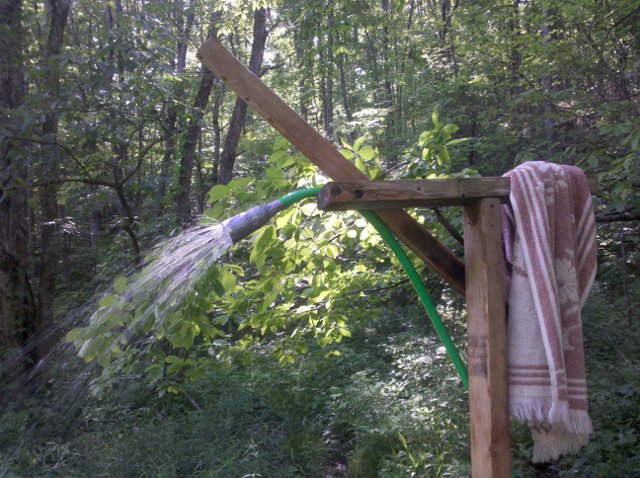
Five years ago I built this, and it's worked well, but is old and falling down now.
mark I outdoor shower
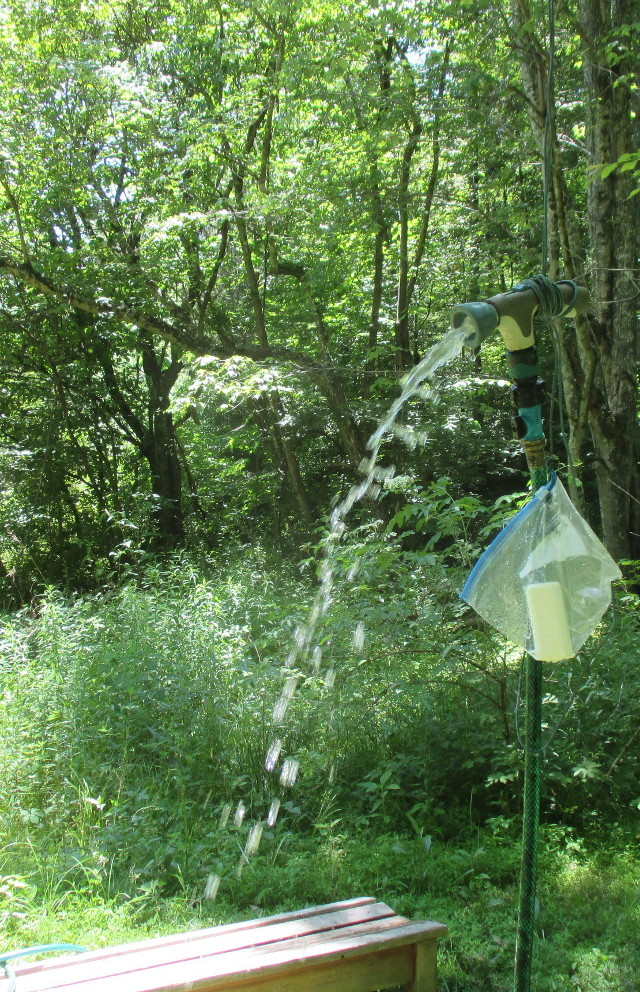
The replacement is more minimalist and like any second system tries to improve on the design of the first. No wood to rot away, fully adjustable height. It's basically a shower swing, suspended from a tree branch.
mark II outdoor shower
Probably will turn out to have its own new problems, as second systems do.

12 June 2016

Iustin Pop: Elsa Bike Trophy 2016 my first bike race!

Elsa Bike Trophy 2016 my first bike race! So today, after two months of intermittent training using Zwift and some actual outside rides, I did my first bike race. Not of 2016, not of 2000+, but like ever. Which is strange, as I learned biking very young, and I did like to bike. But as it turned out, even though I didn't like running as a child, I did participate in a number of running events over the years, but no biking ones. The event Elsa Bike Trophy is a mountain bike event cross-country, not downhill or anything crazy; it takes part in Estavayer-le-Lac, and has two courses - one 60Km with 1'791m altitude gain, and a smaller one of 30Km with 845m altitude gain. I went, of course, for the latter. 845m is more than I ever did in a single ride, so it was good enough for a first try. The web page says that this smaller course est nerveux, technique et ne laisse que peu de r pit . I choose to think that's a bit of an exaggeration, and that it will be relatively easy (as I'm not too skilled technically). The atmosphere there was like for the running races, with the exception of bike stuff being sold, and people on very noisy rollers. I'm glad for my trainer which sounds many decibels quieter The long race started at 12:00, and the shorter one at 12:20. While waiting for the start I had to concerns in mind: whether I'm able to do the whole course (endurance), and whether it will be too cold (the weather kept moving towards rain). I had a small concern about the state of the course, as it was not very nice weather recently, but a small one. And then, after one hour plus of waiting, go! Racing, with a bit of "swimming" At first thing went as expected. Starting on paved roads, moving towards the small town exit, a couple of 14% climbs, then more flat roads, then a nice and hard 18% short climb (I'll never again complain about < 10%!), then entering the woods. It became quickly apparent that the ground in the forest was in much worse state than I feared. Much worse as in a few orders of magnitude. In about 5 minutes after entering the tree cover, my reasonably clean, reasonably light bike became a muddy, heavy monster. And the pace that until then went quite OK became walking pace, as the first rider that didn't manage to keep going up because the wheel turned out of the track blocked the one behind him, which had to stop, and repeat until we were one line (or two, depending on how wide the trail was) of riders walking their bikes up. While on dry ground walking your bike up is no problem, or hiking through mud with good hiking shoes is also no problem, walking up with biking shoes is a pain. Your foot slides and you waste half of your energy "swimming" in the mud. Once the climb is over, you get on the bike, and of course the pedals and cleats are full of heavy mud, so it takes a while until you can actually clip in. Here the trail version of SPD was really useful, as I could pedal reasonably well without being clipped-in, just had to be careful and push too hard. Then maybe you exit the trail and get on paved road, but the wheels are so full of mud that you still are very slow (and accelerate very slowly), until the shed enough of the mud to become somewhat more "normal". After a bit of this "up through mud, flat and shedding mud", I came upon the first real downhill section. I would have been somewhat confident in dry ground, but I got scared and got off my bike. Better safe than sorry was the thing for now. And after this is was a repetition of the above: climb, sometimes (rarely) on the bike, most times pushing the bike, fast flat sections through muddy terrain where any mistake of controlling the bike can send the front wheel flying due to the mud being highly viscous, slow flat sections through very liquid mud where it definitely felt like swimming, or any dry sections. My biggest fear, uphill/endurance, was unfounded. The most gains I made were on the dry uphills, where I had enough stamina to overtake. On flat ground I mostly kept order (i.e. neither being overtaken nor overtaking), but on downhill sections, I lost lots of time, and was overtaken a lot. Still, it was a good run. And then, after about 20 kilometres out of the 30, I got tired enough of getting off the bike, on the bike, and also tired mentally and not being careful enough, that I stopped getting off the bike on downhills. And the feeling was awesome! It was actually much much easier to flow through the mud and rocks and roots on downhill, even when it was difficult (for me) like 40cm drops (estimated), than doing it on foot, where you slide without control and the bike can come crashing down on you. It was a liberating feel, like finally having overcome the mud. I was soo glad to have done a one-day training course with Swiss Alpine Adventure, as it really helped. Thanks Dave! Of course, people were still overtaking me, but I also overtook some people (who were on foot; he he, I wasn't the only one it seems). And being easier, I had some more energy so I was able to push a bit harder on the flats and dry uphill sections. And then the remaining distance started shrinking, and the last downhill was over, I entered through familiar roads the small town, a passer-by cries "one kilometre left", I push hard (I mean, hard as I could after all the effort), and I reach the finish. Oh, and my other concern, the rain? Yes it did rain somewhat, and I was glad for it (I keep overheating); there was a single moment I felt cold, when exiting a nice cosy forest into a field where the wind was very strong headwind, of course. Lessons learned I did learn a lot in this first event. Results So, how did I do after all? As soon as I reached the finish and recovered my items, among which the phone, I checked the datasport page: I was rank 59/68 in my category. Damn, I hoped (and thought) I would do better. Similar % in the overall ranking for this distance. That aside, it was mighty fun. So much fun I'd do it again tomorrow! I forgot the awesome atmosphere of such events, even in the back of the rankings. And then, after I reach drive home and open on my workstation the datasport page, I get very confused: the overall number of participants was different. And the I realised: not everybody finished the race when I first checked (d'oh)! Final ranking: 59 out of 84 in my category, and 247/364 in the overall 30km rankings. That makes it 70% and 67% respectively, which matches somewhat with my usual running results a few years back (but a bit worse). It is in any case better than what I thought originally, yay! Also, Strava activity for some more statistics (note that my Garmin says it was not 800+ meters of altitude ): I'd embed a Veloviewer nice 3D-map but I can't seem to get the embed option, hmm TODO: train more endurance, train more technique, train in more various conditions!

11 June 2016

Paul Tagliamonte: It's all relative

As nearly anyone who's worked with me will attest to, I've long since touted nedbat's talk Pragmatic Unicode, or, How do I stop the pain? as one of the most foundational talks, and required watching for all programmers. The reason is because netbat hits on something bigger - something more fundamental than how to handle Unicode -- it's how to handle data which is relative. For those who want the TL;DR, the argument is as follows: Facts of Life:
  1. Computers work with Bytes. Bytes go in, Bytes go out.
  2. The world needs more than 256 symbols.
  3. You need both Bytes and Unicode
  4. You cannot infer the encoding of bytes.
  5. Declared encodings can be Wrong
Now, to fix it, the following protips:
  1. Unicode sandwich
  2. Know what you have
  3. TEST
Relative Data I've started to think more about why we do the things we do when we write code, and one thing that continues to be a source of morbid schadenfreude is watching code break by failing to handle Unicode right. It's hard! However, watching what breaks lets you gain a bit of insight into how the author thinks, and what assumptions they make. When you send someone Unicode, there are a lot of assumptions that have to be made. Your computer has to trust what you (yes, you!) entered into your web browser, your web browser has to pass that on over the network (most of the time without encoding information), to a server which reads that bytestream, and makes a wild guess at what it should be. That server might save it to a database, and interpolate it into an HTML template in a different encoding (called Mojibake), resulting in a bad time for everyone involved. Everything's awful, and the fact our computers can continue to display text to us is a goddamn miracle. Never forget that. When it comes down to it, when I see a byte sitting on a page, I don't know (and can't know!) if it's Windows-1252, UTF-8, Latin-1, or EBCDIC. What's a poem to me is terminal garbage to you. Over the years, hacks have evolved. We have magic numbers, and plain ole' hacks to just guess based on the content. Of course, like all good computer programs, this has lead to its fair share of hilarious bugs, and there's nothing stopping files from (validly!) being multiple things at the same time. Like many things, it's all in the eye of the beholder. Timezones Just like Unicode, this is a word that can put your friendly neighborhood programmer into a series of profanity laden tirades. Go find one in the wild, and ask them about what they think about timezone handling bugs they've seen. I'll wait. Go ahead. Rants are funny things. They're fun to watch. Hilarious to give. Sometimes just getting it all out can help. They can tell you a lot about the true nature of problems. It's funny to consider the isomorphic nature of Unicode rants and Timezone rants. I don't think this is an accident. U n i c o d e timezone Sandwich Ned's Unicode Sandwich applies -- As early as we can, in the lowest level we can (reading from the database, filesystem, wherever!), all datetimes must be timezone qualified with their correct timezone. Always. If you mean UTC, say it's in UTC. Treat any unqualified datetimes as "bytes". They're not to be trusted. Never, never, never trust 'em. Don't process any datetimes until you're sure they're in the right timezone. This lets the delicious inside of your datetime sandwich handle timezones with grace, and finally, as late as you can, turn it back into bytes (if at all!). Treat locations as tzdb entries, and qualify datetime objects into their absolute timezone (EST, EDT, PST, PDT) It's not until you want to show the datetime to the user again should you consider how to re-encode your datetime to bytes. You should think about what flavor of bytes, what encoding -- what timezone -- should I be encoding into? TEST Just like Unicode, testing that your code works with datetimes is important. Every time I think about how to go about doing this, I think about that one time that mjg59 couldn't book a flight starting Tuesday from AKL, landing in HNL on Monday night, because United couldn't book the last leg to SFO. Do you ever assume dates only go forward as time goes on? Remember timezones. Construct test data, make sure someone in New Zealand's +13:45 can correctly talk with their friends in Baker Island's -12:00, and that the events sort right. Just because it's Noon on New Years Eve in England doesn't mean it's not 1 AM the next year in New Zealand. Places a few miles apart may go on Daylight savings different days. Indian Standard Time is not even aligned on the hour to GMT (+05:30)! Test early, and test often. Memorize a few timezones, and challenge your assumptions when writing code that has to do with time. Don't use wall clocks to mean monotonic time. Remember there's a whole world out there, and we only deal with part of it. It's also worth remembering, as Andrew Pendleton pointed out to me, that it's possible that a datetime isn't even unique for a place, since you can never know if 2016-11-06 01:00:00 in America/New_York (in the tzdb) is the first one, or second one. Storing EST or EDT along with your datetime may help, though! Pitfalls Improper handling of timezones can lead to some interesting things, and failing to be explicit (or at least, very rigid) in what you expect will lead to an unholy class of bugs we've all come to hate. At best, you have confused users doing math, at worst, someone misses a critical event, or our security code fails. I recently found what I regard to be a pretty bad bug in apt (which David has prepared a fix for and is pending upload, yay! Thank you!), which boiled down to documentation and code expecting datetimes in a timezone, but accepting any timezone, and silently treating it as UTC. The solution is to hard-fail, which is an interesting choice to me (as a vocal fan of timezone aware code), but at the least it won't fail by misunderstanding what the server is trying to communicate, and I do understand and empathize with the situation the apt maintainers are in. Final Thoughts Overall, my main point is although most modern developers know how to deal with Unicode pain, I think there is a more general lesson to learn -- namely, you should always know what data you have, and always remember what it is. Understand assumptions as early as you can, and always store them with the data.

8 June 2016

Gunnar Wolf: University degrees and sysadmin skills

I'll tune in to the post-based conversation being held on Planet Debian: Russell Coker wonders about what's needed to get university graduates with enough skills for a sysadmin job, to which Lucas Nussbaum responds with his viewpoints. They present a very contrasting view of what's needed for students And for a good reason, I'd say: Lucas is an academician; I don't know for sure about Russell, but he seems to be a down-to-the-earth, dirty-handed, proficient sysadmin working on the field. They both contact newcomers to their fields, and will notice different shortcomings. I tend to side with Lucas' view. That does not come as a surprise, as I've been working for over 15 years in an university, and in the last few years I started walking from a mostly-operative sysadmin in an academic setting towards becoming an academician that spends most of his time sysadmining. Subtle but important distinction. I teach at the BSc level at UNAM, and am a Masters student at IPN (respectively, Mexico's largest and second-largest universities). And yes, the lack of sysadmin abilities in both is surprising. But so is a good understanding of programming. And I'm sure that, were I to dig into several different fields, I'd feel the same: Student formation is very basic at each of those fields. But I see that as natural. Of course, if I were to judge people as geneticists as they graduate from Biology, or were I to judge them as topologists as they graduate from Mathematics, or any other discipline in which I'm not an expert, I'd surely not know where to start Given I have about 20 years of professional life on my shoulders, I'm quite skewed as to what is basic for a computing professional. And of course, there are severe holes in my formation, in areas I never used. I know next to nothing of electronics, my mathematical basis is quite flaky, and I'm a poor excuse when talking about artificial intelligence. Where am I going with this? An university degree (BSc in English, would amount to "licenciatura" in Spanish) is not for specialization. It is to have a sufficiently broad panorama of the field, and all of the needed tools to start digging deeper and specializing either by yourself, working on a given field and learning its details as you go, or going through a postgraduate program (Specialization, Masters, Doctorate). Even most of my colleagues at the Masters in Engineering in Security and Information Technology lack of a good formation in fields I consider essential. However, what does information security mean? Many among them are working on legal implications of several laws that touch our field. Many other are working on authenticity issues in images, audios and other such media. Many other are trying to come up with mathematical ways to cheapen the enormous burden of crypto operations (say, "shaving" CPU cycles off a very large exponentiation). Others are designing autonomous learning mechanisms to characterize malware. Were I as a computing professional to start talking about their research, I'd surely reveal I know nothing about it and get laughed at. That's because I haven't specialized in those fields. University education should give a broad universal basis to enter a professional field. It should not focus on teaching tools or specific procedures (although some should surely be presented as examples or case studies). Although I'd surely be happy if my university's graduates were to know everything about administering a Debian system, that would be wrong for a university to aim at; I'd criticize it the same way I currently criticize programs that mix together university formation and industry certification as if they were related.

Next.

Previous.