Search Results: "tar"

15 January 2023

Matthew Garrett: Blogging and microblogging

Long-term Linux users may remember that Alan Cox used to write an online diary. This was before the concept of a "Weblog" had really become a thing, and there certainly weren't any expectations around what one was used for - while now blogging tends to imply a reasonably long-form piece on a specific topic, Alan was just sitting there noting small life concerns or particular technical details in interesting problems he'd solved that day. For me, that was fascinating. I was trying to figure out how to get into kernel development, and was trying to read as much LKML as I could to figure out how kernel developers did stuff. But when you see discussion on LKML, you're frequently missing the early stages. If an LKML patch is a picture of an owl, I wanted to know how to draw the owl, and most of the conversations about starting in kernel development were very "Draw two circles. Now draw the rest of the owl". Alan's musings gave me insight into the thought processes involved in getting from "Here's the bug" to "Here's the patch" in ways that really wouldn't have worked in a more long-form medium.

For the past decade or so, as I moved away from just doing kernel development and focused more on security work instead, Twitter's filled a similar role for me. I've seen people just dumping their thought process as they work through a problem, helping me come up with effective models for solving similar problems. I've learned that the smartest people in the field will spend hours (if not days) working on an issue before realising that they misread something back at the beginning and that's helped me feel like I'm not unusually bad at any of this. It's helped me learn more about my peers, about my field, and about myself.

Twitter's now under new ownership that appears to think all the worst bits of Twitter were actually the good bits, so I've mostly bailed to the Fediverse instead. There's no intrinsic length limit on posts there - Mastodon defaults to 500 characters per post, but that's configurable per instance. But even at 500 characters, it means there's more room to provide thoughtful context than there is on Twitter, and what I've seen so far is more detailed conversation and higher levels of meaningful engagement. Which is great! Except it also seems to discourage some of the posting style that I found so valuable on Twitter - if your timeline is full of nuanced discourse, it feels kind of rude to just scream "THIS FUCKING PIECE OF SHIT IGNORES THE HIGH ADDRESS BIT ON EVERY OTHER WRITE" even though that's exactly the sort of content I'm there for.

And, yeah, not everything has to be for me. But I worry that as Twitter's relevance fades for the people I'm most interested in, we're replacing it with something that's not equivalent - something that doesn't encourage just dropping 50 characters or so of your current thought process into a space where it can be seen by thousands of people. And I think that's a shame.

comment count unavailable comments

14 January 2023

Kentaro Hayashi: bibata cursor theme is available on Debian (unstable)

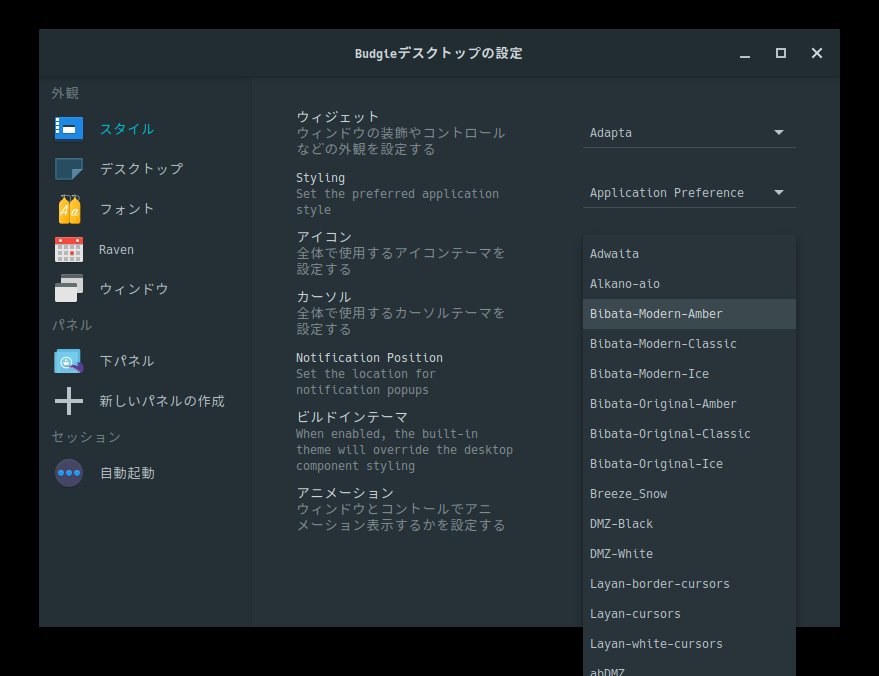
Recently bibata cursor theme is available on Debian (unstable) github.com You can install via sudo apt install -y bibata-cursor-theme. After you installed its theme, you can configure the cursor theme via desktop configuration. (budgie desktop screenshot)
Set bibata-cursor-theme
In bibata-cursor-theme, you can choose the following cursor themes:

Ian Jackson: SGO (and my) VPN and network access tools - in bookworm

Recently, we managed to get secnet and hippotat into Debian. They are on track to go into Debian bookworm. This completes in Debian the set of VPN/networking tools I (and other Greenend) folks have been using for many years. The Sinister Greenend Organisation s suite of network access tools consists mainly of: secnet secnet is our very mature VPN system. Its basic protocol idea is similar to that in Wireguard, but it s much older. Differences from Wireguard include: secnet was originally written by Stephen Early, starting in 1996 or so. I inherited it some years ago and have been maintaining it since. It s mostly written in C. Hippotat Hippotat is best described by copying the intro from the docs:
Hippotat is a system to allow you to use your normal VPN, ssh, and other applications, even in broken network environments that are only ever tested with web stuff . Packets are parcelled up into HTTP POST requests, resembling form submissions (or JavaScript XMLHttpRequest traffic), and the returned packets arrive via the HTTP response bodies.
It doesn t rely on TLS tunnelling so can work even if the local network is trying to intercept TLS. I recently rewrote Hippotat in Rust. userv ipif userv ipif is one of the userv utilities. It allows safe delegation of network routing to unprivileged users. The delegation is of a specific address range, so different ranges can be delegated to different users, and the authorised user cannot interfere with other traffic. This is used in the default configuration of hippotat packages, so that an ordinary user can start up the hippotat client as needed. On chiark userv-ipif is used to delegate networking to users, including administrators of allied VPN realms. So chiark actually runs at least 4 VPN-ish systems in production: secnet, hippotat, Mark Wooding s Tripe, and still a few links managed by the now-superseded udptunnel system. userv userv ipif is a userv service. That is, it is a facility which uses userv to bridge a privilege boundary. userv is perhaps my most under-appreciated program. userv can be used to straightforwardly bridge (local) privilege boundaries on Unix systems. So for example it can: userv services can be defined by the called user, not only by the system administrator. This allows a user to reconfigure or divert a system-provided default implementation, and even allows users to define and implement ad-hoc services of their own. (Although, the system administrator can override user config.) Acknowledgements Thanks for the help I had in this effort. In particular, thanks to Sean Whitton for encouragement, and the ftpmaster review; and to the Debian Rust Team for their help navigating the complexities of handling Rust packages within the Debian Rust Team workflow.

comment count unavailable comments

12 January 2023

Jonathan McDowell: Building a read-only Debian root setup: Part 1

I mentioned in the post about upgrading my home internet that part of the work I did was creating a read-only Debian root with a squashfs image. This post covers the details of how I boot with that image; a later post will cover how I build the squashfs image. First, David Reader kindly pointed me at his rodebian setup, which was helpful in making me think about the whole problem but ultimately not the direction I went. Primarily because on the old router (an RB3011) I am space constrained, with only 120M of usable flash, and so ideally I wanted as much as possible of the system in a well compressed filesystem. squashfs seemed like the best option for that, and ultimately I ended up with a 39M image. I ve then used overlayfs to mount a tmpfs, so I get what looks like a writeable system without having to do too many tweaks to the actual install. On the plus side I can then see exactly what is getting written where and decide whether I need to update something in the squashfs. I don t boot with an initrd - for initial testing I booted directly off a USB stick. I ve actually ended up continuing to do this in production, because I ve had no pressing reason to move it all to booting off internal flash (I ve ended up with a Sandisk SDCZ430-032G-G46 which is tiny). However nothing I m going to describe is dependent on that - this would work perfectly well for a initial UBIFS rootfs on internal NAND. So the basic overview is I boot off a minimal rootfs, mount a squashfs, create an appropriate tmpfs, mount an overlayfs that combines the two, then pivotroot into the overlayfs and exec its init so it becomes the rootfs. For the minimal rootfs I started with busybox, in particular I used the armhf busybox-static package from Debian. My RB5009 is an ARM64, but I wanted to be able to test on the RB3011 as well, which is ARMv7. Picking an armhf binary for the minimal rootfs lets me use the same image for both. Using the static build helps reduce the number of pieces involved in putting it all together. The busybox binary goes in /bin. I was able to cheat and chroot into the empty rootfs and call busybox --install -s to create symlinks for all the tools it provides, but I could have done this manually. There s only a handful that are actually needed, but it s amazing how much is crammed into a 1.2M binary. /sbin/init is a shell script:
Contents
#!/bin/ash
# Make sure we have a sane date
if [ -e /data/saved-date ]; then
        CURRENT_DATE=$(date -Iseconds)
        if [ "$ CURRENT_DATE:0:4 " -lt "2022" -o \
                        "$ CURRENT_DATE:0:4 " -gt "2030" ]; then
                echo Setting initial date
                date -s "$(cat /data/saved-date)"
        fi
fi
# Work out what platform we're on
ARCH=$(uname -m)
if [ "$ ARCH " == "aarch64" ]; then
        ARCH=arm64
else
        ARCH=armhf
fi
# Mount a tmpfs to store the changes
mount -t tmpfs root-rw /mnt/overlay/rw
# Make the directories we need in the tmpfs
mkdir /mnt/overlay/rw/upper
mkdir /mnt/overlay/rw/work
# Mount the squashfs and build an overlay root filesystem of it + the tmpfs
mount -t squashfs -o loop /data/router.$ ARCH .squashfs /mnt/overlay/lower
mount -t overlay \
        -o lowerdir=/mnt/overlay/lower,upperdir=/mnt/overlay/rw/upper,workdir=/mnt/overlay/rw/work \
        overlayfs-root /mnt/root
# Build the directories we need within the new root
mkdir /mnt/root/mnt/flash
mkdir /mnt/root/mnt/overlay
mkdir /mnt/root/mnt/overlay/lower
mkdir /mnt/root/mnt/overlay/rw
# Copy any stored state
if [ -e /data/state.$ ARCH .tar ]; then
        echo Restoring stored state
        cd /mnt/root
        tar xf /data/state.$ ARCH .tar
fi
cd /mnt/root
pivot_root . mnt/flash
echo Switching into root filesystem
exec chroot . sh -c "$(cat <<END
mount --move /mnt/flash/mnt/overlay/lower /mnt/overlay/lower
mount --move /mnt/flash/mnt/overlay/rw /mnt/overlay/rw
exec /sbin/init
END
)"
Most of what the script is doing is sorting out the squashfs + tmpfs backed overlayfs that becomes the full root filesystems, but there are a few other bits to note. First, we pick up a saved date from /data/saved-date - the router has no RTC and while it ll sort itself out with NTP once it gets networking up it s useful to make sure we don t end up comically far in the past or future. Second, the script looks at what architecture we re running and picks up an appropriate squashfs image from /data based on that. This let me use the same USB stick for testing on both the RB3011 and the RB5011. Finally we allow for a /data/state.$ ARCH .tar file to let us pick up changes to the rootfs at boot time - this prevents having to rebuild the squashfs image every time there s a persistent change. The other piece that doesn t show up in the script is that the kernel and its modules are all installed into this initial rootfs (and then symlinked from the squashfs). This lets me build a mostly modular kernel, as long as all the necessary drivers to mount the USB stick are built in. Once the system is fully booted the initial rootfs is available at /mnt/flash, by default mounted read-only (to avoid inadvertent writes), but able to be remounted to update the squashfs image, install a new kernel, or update the state tarball. /mnt/overlay/rw/upper/ is where updates to the overlayfs are written, which provides an easy way to see what files are changing, initially to determine what might need tweaked in the squashfs creation process and subsequently to be able to see what needs updated in the state tarball.

10 January 2023

Matthew Garrett: Integrating Linux with Okta Device Trust

I've written about bearer tokens and how much pain they cause me before, but sadly wishing for a better world doesn't make it happen so I'm making do with what's available. Okta has a feature called Device Trust which allows to you configure access control policies that prevent people obtaining tokens unless they're using a trusted device. This doesn't actually bind the tokens to the hardware in any way, so if a device is compromised or if a user is untrustworthy this doesn't prevent the token ending up on an unmonitored system with no security policies. But it's an incremental improvement, other than the fact that for desktop it's only supported on Windows and MacOS, which really doesn't line up well with my interests.

Obviously there's nothing fundamentally magic about these platforms, so it seemed fairly likely that it would be possible to make this work elsewhere. I spent a while staring at the implementation using Charles Proxy and the Chrome developer tools network tab and had worked out a lot, and then Okta published a paper describing a lot of what I'd just laboriously figured out. But it did also help clear up some points of confusion and clarified some design choices. I'm not going to give a full description of the details (with luck there'll be code shared for that before too long), but here's an outline of how all of this works. Also, to be clear, I'm only going to talk about the desktop support here - mobile is a bunch of related but distinct things that I haven't looked at in detail yet.

Okta's Device Trust (as officially supported) relies on Okta Verify, a local agent. When initially installed, Verify authenticates as the user, obtains a token with a scope that allows it to manage devices, and then registers the user's computer as an additional MFA factor. This involves it generating a JWT that embeds a number of custom claims about the device and its state, including things like the serial number. This JWT is signed with a locally generated (and hardware-backed, using a TPM or Secure Enclave) key, which allows Okta to determine that any future updates from a device claiming the same identity are genuinely from the same device (you could construct an update with a spoofed serial number, but you can't copy the key out of a TPM so you can't sign it appropriately). This is sufficient to get a device registered with Okta, at which point it can be used with Fastpass, Okta's hardware-backed MFA mechanism.

As outlined in the aforementioned deep dive paper, Fastpass is implemented via multiple mechanisms. I'm going to focus on the loopback one, since it's the one that has the strongest security properties. In this mode, Verify listens on one of a list of 10 or so ports on localhost. When you hit the Okta signin widget, choosing Fastpass triggers the widget into hitting each of these ports in turn until it finds one that speaks Fastpass and then submits a challenge to it (along with the URL that's making the request). Verify then constructs a response that includes the challenge and signs it with the hardware-backed key, along with information about whether this was done automatically or whether it included forcing the user to prove their presence. Verify then submits this back to Okta, and if that checks out Okta completes the authentication.

Doing this via loopback from the browser has a bunch of nice properties, primarily around the browser providing information about which site triggered the request. This means the Verify agent can make a decision about whether to submit something there (ie, if a fake login widget requests your creds, the agent will ignore it), and also allows the issued token to be cross-checked against the site that requested it (eg, if g1thub.com requests a token that's valid for github.com, that's a red flag). It's not quite at the same level as a hardware WebAuthn token, but it has many of the anti-phishing properties.

But none of this actually validates the device identity! The entire registration process is up to the client, and clients are in a position to lie. Someone could simply reimplement Verify to lie about, say, a device serial number when registering, and there'd be no proof to the contrary. Thankfully there's another level to this to provide stronger assurances. Okta allows you to provide a CA root[1]. When Okta issues a Fastpass challenge to a device the challenge includes a list of the trusted CAs. If a client has a certificate that chains back to that, it can embed an additional JWT in the auth JWT, this one containing the certificate and signed with the certificate's private key. This binds the CA-issued identity to the Fastpass validation, and causes the device to start appearing as "Managed" in the Okta device management UI. At that point you can configure policy to restrict various apps to managed devices, ensuring that users are only able to get tokens if they're using a device you've previously issued a certificate to.

I've managed to get Linux tooling working with this, though there's still a few drawbacks. The main issue is that the API only allows you to register devices that declare themselves as Windows or MacOS, followed by the login system sniffing browser user agent and only offering Fastpass if you're on one of the officially supported platforms. This can be worked around with an extension that spoofs user agent specifically on the login page, but that's still going to result in devices being logged as a non-Linux OS which makes interpreting the logs more difficult. There's also no ability to choose which bits of device state you log: there's a couple of existing integrations, and otherwise a fixed set of parameters that are reported. It'd be lovely to be able to log arbitrary material and make policy decisions based on that.

This also doesn't help with ChromeOS. There's no real way to automatically launch something that's bound to localhost (you could probably make this work using Crostini but there's no way to launch a Crostini app at login), and access to hardware-backed keys is kind of a complicated topic in ChromeOS for privacy reasons. I haven't tried this yet, but I think using an enterprise force-installed extension and the chrome.enterprise.platformKeys API to obtain a device identity cert and then intercepting requests to the appropriate port range on localhost ought to be enough to do that? But I've literally never written any Javascript so I don't know. Okta supports falling back from the loopback protocol to calling a custom URI scheme, but once you allow that you're also losing a bunch of the phishing protection, so I'd prefer not to take that approach.

Like I said, none of this prevents exfiltration of bearer tokens once they've been issued, and there's still a lot of ecosystem work to do there. But ensuring that tokens can't be issued to unmanaged machines in the first place is still a step forwards, and with luck we'll be able to make use of this on Linux systems without relying on proprietary client-side tooling.

(Time taken to code this implementation: about two days, and under 1000 lines of new code. Time taken to figure out what the fuck to write: rather a lot longer)

[1] There's also support for having Okta issue certificates, but then you're kind of back to the "How do I know this is my device" situation

comment count unavailable comments

9 January 2023

Russ Allbery: Review: Black Stars

Review: Black Stars, edited by Nisi Shawl & Latoya Peterson
Publisher: Amazon Original Stories
Copyright: August 2021
ISBN: 1-5420-3272-5
ISBN: 1-5420-3270-9
ISBN: 1-5420-3271-7
ISBN: 1-5420-3273-3
ISBN: 1-5420-3268-7
ISBN: 1-5420-3269-5
Format: Kindle
Pages: 168
This is a bit of an odd duck from a metadata standpoint. Black Stars is a series of short stories (maybe one creeps into novelette range) published by Amazon for Kindle and audiobook. Each one can be purchased separately (or "borrowed" with Amazon Prime), and they have separate ISBNs, so my normal practice would be to give each its own review. They're much too short for that, though, so I'm reviewing the whole group as an anthology. The cover in the sidebar is for the first story of the series. The other covers have similar designs. I think the one for "We Travel the Spaceways" was my favorite. Each story is by a Black author and most of them are science fiction. ("The Black Pages" is fantasy.) I would classify them as afrofuturism, although I don't have a firm grasp on its definition. This anthology included several authors I've been meaning to read and was conveniently available, so I gave it a try, even though I'm not much of a short fiction reader. That will be apparent in the forthcoming grumbling. "The Visit" by Chimamanda Ngozi Adichie: This is a me problem rather than a story problem, and I suspect it's partly because the story is not for me, but I am very done with gender-swapped sexism. I get the point of telling stories of our own society with enough alienation to force the reader to approach them from a fresh angle, but the problem with a story where women are sexist and condescending to men is that you're still reading a story of condescending sexism. That's particularly true when the analogies to our world are more obvious than the internal logic of the story world, as they are here. "The Visit" tells the story of a reunion between two college friends, one of whom is now a stay-at-home husband and the other of whom has stayed single. There's not much story beyond that, just obvious political metaphor (the Male Masturbatory Act to ensure no potential child is wasted, blatant harrassment of the two men by female cops) and depressing character studies. Everyone in this story is an ass except maybe Obinna's single friend Eze, which means there's nothing to focus on except the sexism. The writing is competent and effective, but I didn't care in the slightest about any of these people or anything that was happening in their awful, dreary world. (4) "The Black Pages" by Nnedi Okorafor: Issaka has been living in Chicago, but the story opens with him returning to Timbouctou where he grew up. His parents know he's coming for a visit, but he's a week early as a surprise. Unfortunately, he's arriving at the same time as an al-Qaeda attack on the library. They set it on fire, but most of the books they were trying to destroy were already saved by his father and are now in Issaka's childhood bedroom. Unbeknownst to al-Qaeda, one of the books they did burn was imprisoning a djinn. A djinn who is now free and resident in Issaka's iPad. This was a great first chapter of a novel. The combination of a modern setting and a djinn trapped in books with an instant affinity with technology was great. Issaka is an interesting character who is well-placed to introduce the reader to the setting, and I was fully invested in Issaka and Faro negotiating their relationship. Then the story just stopped. I didn't understand the ending, which was probably me being dim, but the real problem was that I was not at all ready for an ending. I would read the novel this was setting up, though. (6) "2043... (A Merman I Should Turn to Be)" by Nisi Shawl: This is another story that felt like the setup for a novel, although not as good of a novel. The premise is that the United States has developed biological engineering that allows humans to live underwater for extended periods (although they still have to surface occasionally for air, like whales). The use to which that technology is being put is a rerun of Liberia with less colonialism: Blacks are given the option to be modified into merpeople and live under the sea off the US coast as a solution. White supremacists are not happy, of course, and try to stop them from claiming their patch of ocean floor. This was fine, as far as it went, but I wasn't fond of the lead character and there wasn't much plot. There was some sort of semi-secret plan that the protagonist stumbles across and that never made much sense to me. The best parts of the story were the underwater setting and the semi-realistic details about the merman transformation. (6) "These Alien Skies" by C.T. Rwizi: In the far future, humans are expanding across the galaxy via automatically-constructed wormhole gates. Msizi's job is to be the first ship through a new wormhole to survey the system previously reached only by the AI construction ship. The wormhole is not supposed to explode shortly after he goes through, leaving him stranded in an alien system with only his companion Tariro, who is not who she seems to be. This was a classic SF plot, but I still hadn't guessed where it was going, or the relevance of some undiscussed bits of Tariro's past. Once the plot happens, it's a bit predictable, but I enjoyed it despite the depressed protagonist. (6) "Clap Back" by Nalo Hopkinson: Apart from "The Visit," this was the most directly political of the stories. It opens with Wenda, a protest artist, whose final class project uses nanotech to put racist tchotchkes to an unexpected use. This is intercut with news clippings about a (white and much richer) designer who has found a way to embed memories into clothing and is using this to spread quotes of rather pointed "forgiveness" from a Malawi quilt. This was one of the few entries in this anthology that fit the short story shape for me. Wenda's project and Burri's clothing interact fifty years later in a surprising way. This was the second-best story of the group. (7) "We Travel the Spaceways" by Victor LaValle: Grimace (so named because he wears a huge purple coat) is a homeless man in New York who talks to cans. Most of his life is about finding food, but the cans occasionally give him missions and provide minor assistance. Apart from his cans, he's very much alone, but when he comforts a woman in McDonalds (after getting caught thinking about stealing her cheeseburger), he hopes he may have found a partner. If, that is, she still likes him when she discovers the nature of the cans' missions. This was the best-written story of the six. Grimace is the first-person narrator, and LaValle's handling of characterization and voice is excellent. Grimace makes perfect sense from inside his head, but the reader can also see how unsettling he is to those around him. This could have been a disturbing, realistic story about a schitzophrenic man. As one may have guessed from the theme of the anthology, that's not what it is. I admired the craft of this story, but I found Grimace's missions too horrific to truly like it. There is an in-story justification for them; suffice it to say that I didn't find it believable. An expansion with considerably more detail and history might have bridged that gap, but alas, short fiction. (6) Rating: 6 out of 10

8 January 2023

Petter Reinholdtsen: LinuxCNC MQTT publisher component

I watched a 2015 video from Andreas Schiffler the other day, where he set up LinuxCNC to send status information to the MQTT broker IBM Bluemix. As I also use MQTT for graphing, it occured to me that a generic MQTT LinuxCNC component would be useful and I set out to implement it. Today I got the first draft limping along and submitted as a patch to the LinuxCNC project. The simple part was setting up the MQTT publishing code in Python. I already have set up other parts submitting data to my Mosquito MQTT broker, so I could reuse that code. Writing a LinuxCNC component in Python as new to me, but using existing examples in the code repository and the extensive documentation, this was fairly straight forward. The hardest part was creating a automated test for the component to ensure it was working. Testing it in a simulated LinuxCNC machine proved very useful, as I discovered features I needed that I had not thought of yet, and adjusted the code quite a bit to make it easier to test without a operational MQTT broker available. The draft is ready and working, but I am unsure which LinuxCNC HAL pins I should collect and publish by default (in other words, the default set of information pieces published), and how to get the machine name from the LinuxCNC INI file. The latter is a minor detail, but I expect it would be useful in a setup with several machines available. I am hoping for feedback from the experienced LinuxCNC developers and users, to make the component even better before it can go into the mainland LinuxCNC code base. Since I started on the MQTT component, I came across another video from Kent VanderVelden where he combine LinuxCNC with a set of screen glasses controlled by a Raspberry Pi, and it occured to me that it would be useful for such use cases if LinuxCNC also provided a REST API for querying its status. I hope to start on such component once the MQTT component is working well. As usual, if you use Bitcoin and want to show your support of my activities, please send Bitcoin donations to my address 15oWEoG9dUPovwmUL9KWAnYRtNJEkP1u1b.

Anuradha Weeraman: Parallelizing and running distributed builds with distcc

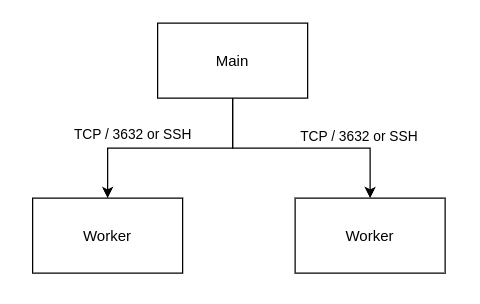
Parallelizing the compilation of a large codebase is a breeze with distcc, which allows you to spread the load across multiple nodes and speed up the compilation time.Here s a sample network topology for a distributed build:
Install distcc on the three Debian/Ubuntu-based nodes:
# apt install distcc
Edit /etc/default/distcc and set:
STARTDISTCC="true"

# Customize for your environment
ALLOWEDNETS="192.168.2.0/24"

# Specify your network device
LISTENER="192.168.2.146"
Additionally, the JOBS and NICE variables can be tweaked to suit the compute power that you have available.Start distcc:
# systemctl start distcc
Do the same all the nodes, and if you have a firewall enabled with ufw, you will need to open up the port 3632 to the master node.
# ufw allow 3632/tcp
Additionally, if you d like to use ssh over untrusted networks so code and communication with the worker nodes happen over a secure channel, ensure that SSH is running and is opened up to the master node in the same manner as above with the key of the master node in ~/.ssh/authorized_keys of the worker nodes. Opening port 3632 in this manner is a security hole, so take precautions over untrusted networks.Back in the master node, setup a DISTCC_HOSTS environment variable that lists the worker nodes, including the master node. Note the order of the hosts, as it is important. The first host will be more heavily used, and distcc has no way of knowing the capacity and capability of the hosts, so specify the most powerful host first.
export DISTCC_HOSTS='localhost 192.168.2.107 192.168.2.91'
At this point, you re ready to compile.Go to your codebase, in this case we use the Linux kernel source code for the purpose of example.
$ make tinyconfig
$ time make -j$(nproc) CC=distcc bzImage
On another terminal, you can monitor the status of the distributed compilation with distmoncc-text or tools such as top or bpytop.Network throughput and latency will be a big factor in how much distcc will help speed up your build process. Using ssh may additionally introduce overhead, so play with the variables to see how much distcc can help speed up or optimize the build for your specific scenario. You may want to additionally consider ccache to speed up the build process.There are some aspects of the build process that are not effectively parallizable in this manner, such as the final linking step of the executable, for which you will not see any performance improvement with distcc.Give distcc a spin, and put any spare compute you have lying around in your home lab to good use.

Scarlett Gately Moore: Debian: Coming soon! MycroftAI! KDE snaps update.

I am excited to announce that I have joined the MycroftAI team in Salsa and working hard to get this packaged up and released in Debian. You can track our progress here: https://salsa.debian.org/mycroftai-team Snaps are on temporary hold while we get everything switched over to core22. This includes the neon-extension, that requires merges and store requests to be honored. Hopefully folks are returning from holidays and things will start moving again. Thank you for your patience! I am still seeking work if you or anyone you know is willing to give me a chance to shine, you won t regret it, life has leveled out and I am ready to make great things happen! I admit the interviewing process is much more difficult than in years past, any advice here is also appreciated. Thank you for stopping by.

Antoine Beaupr : 20 years blogging

Many folks have woken up to the dangers of commercialization and centralisation of this very fine internet we have around here. For many of us, of course, it's one big "I told you so"... (To fair, I stopped "telling you so" because evangelism is pretty annoying. It's certainly dishonest coming from an atheist, so I preach by example now. I often wonder what works better. But I digress.) Colleagues have been posting about getting back into blogging. This post from gwolf, in particular, reviews his yearly blog output, and that made me wonder how that looked like from my end. The answer, of course, is simple to generate:
anarcat@angela:~$ cd anarc.at
/home/anarcat/wikis/anarc.at
anarcat@angela:anarc.at$ ls blog   grep '^[0-9][0-9][0-9][0-9]'   sed s/-.*//   sort   uniq -c    sort -n -k2
     62 2005
     49 2006
     26 2007
     25 2008
      8 2009
     16 2010
     24 2011
     19 2012
     17 2013
      7 2014
     19 2015
     32 2016
     43 2017
     40 2018
     27 2019
     33 2020
     22 2021
     45 2022
      1 2023
(I thought of drawing this as a sparkline but it looks like Sparklines are kind of dead. https://sparkline.org/ doesn't resolve and the canonical PHP package is gone from Debian. The plugin is broken in ikiwiki anyway...) So it seems like I've been doing this very blog for 18 years, and it's not even my first blog. I actually started in 2003, which makes this year my 20-year blogging anniversary. (And even if that sounds really old, note that I was not actually an early adopter. Jorn Barger having coined the term "weblog" in 1997. Yes, in another millenia.) Reading back some of the headlines in those older posts, I have definitely changed style. I used to write shorter, more random ideas, and more often. I somehow managed to write more than one article per week in 2005! Now, I take more time writing, a habit I picked up while writing for LWN (those articles), which started in 2016. But interestingly, it seems I started producing more articles then: I hit 43 articles per year in 2017, my fourth best year ever. The best years in terms of numbers are the first two years (2005 and 2006, I didn't check the numbers on earlier years), but I doubt they are the best in terms of content. Really, the best writing I have ever did was for LWN. I dare hope I have kept the quality I was encouraged (forced?) to produce, but I know I cannot come anywhere close to what the LWN editors were juicing out of me. You can also see that I immediately dropped to a more normal 27 article in 2019, once I stopped writing for LWN... Back when I started blogging, my writing was definitely more personal. I had less concerns about privacy back then; now, I would never write about my personal life like I did back then (e.g. "I have a cold"). I was also writing mostly in French back then, and it's sad to think that I am rarely writing in my native language here anymore. I guess that brings me an international audience, which is simultaneously challenging, gratifying, and terrifying. But it also means I reach out to people that do not speak English (or French, for that matter) as their first language. For me that is more valuable than catering to my little corner of culture, at least for now, and especially when writing technical topics, which is most of what I do now anyways. Interestingly, I wrote a lot in 2022. People sometimes ask me how I manage to write so much: I don't actually know. I don't have a lot of free time on my hand, and even less than before in the past two years, but somehow I keep feeding this blog. I guess I must have something to say. Can't quite figure out what yet, so maybe I should just keep trying. Or, if you're new to this Internet thing, Bring Back Blogging! Whee! PS: I wish I had time to do a review of my visitors like i did for 2021 but time is missing.

Russ Allbery: Review: Postwar

Review: Postwar, by Tony Judt
Publisher: Penguin Books
Copyright: 2005
ISBN: 1-4406-2476-3
Format: Kindle
Pages: 835
Tony Judt (1948 2010) was a British-American historian and Erich Maria Remarque Professor in European Studies at New York University. Postwar is his magnum opus, a history of Europe from 1945 to 2005. A book described as a history of Europe could be anything from a textbook to a political analysis, so the first useful question to ask is what sort of history. That's a somewhat difficult question to answer. Postwar mentions a great deal of conventional history, including important political movements and changes of government, but despite a stated topic that would suit a survey textbook, it doesn't provide that sort of list of facts and dates. Judt expects the reader to already be familiar with the broad outlines of modern European history. However, Postwar is also not a specialty history and avoids diving too deep into any one area. Trends in art, philosophy, and economics are all mentioned to set a broader context, but still only at the level of a general survey. My best description is that Postwar is a comprehensive social and political history that attempts to focus less on specific events and more on larger trends of thought. Judt grounds his narrative in concrete, factual events, but the emphasis is on how those living in Europe, at each point in history, thought of their society, their politics, and their place in both. Most of the space goes to exploring those nuances of thought and day-to-day life. In the US university context, I'd place this book as an intermediate-level course in modern European history, after the survey course that provides students with a basic framework but before graduate-level specializations in specific topics. If you have not had a solid basic education in European history (and my guess is that most people from the US have not), Judt will provide the necessary signposts, but you should expect to need to look up the signposts you don't recognize. I, as the dubious beneficiary of a US high school history education now many decades in the past, frequently resorted to Wikipedia for additional background. Postwar uses a simple chronological structure in four parts: the immediate post-war years and the beginning of the Cold War (1945 1953), the era of rapidly growing western European prosperity (1953 1971), the years of recession and increased turmoil leading up to the collapse of communism (1971 1989), and the aftermath of the collapse of communism and the rise of the European Union (1989 2005). Each part is divided into four to eight long chapters that trace a particular theme. Judt usually starts with the overview of a theme and then follows the local manifestations of it on a spiral through European countries in whatever order seems appropriate. For the bulk of the book that covers the era of the Cold War, when experiences were drastically different inside or outside the Soviet bloc, he usually separates western and eastern Europe into alternating chapters. Reviewing this sort of book is tricky because so much will depend on how well you already know the topic. My interest in history is strictly amateur and I tend to avoid modern history (usually I find it too depressing), so for me this book was remedial, filling in large knowledge gaps that I ideally shouldn't have had. Postwar was a runner up for the Pulitzer Prize for General Non-Fiction, so I think I'm safe saying you won't go far wrong reading it, but here's the necessary disclaimer that the rest of my reactions may not be useful if you're better versed in modern European history than I was. (This would not be difficult.) That said, I found Postwar invaluable because of its big-picture focus. The events and dates are easy enough to find on the Internet; what was missing for me in understanding Europe was the intent and social structures created by and causing those events. For example, from early in the book:
On one thing, however, all were agreed resisters and politicians alike: "planning". The disasters of the inter-war decades the missed opportunities after 1918, the great depression that followed the stock-market crash of 1929, the waste of unemployment, the inequalities, injustices and inefficiencies of laissez-faire capitalism that had led so many into authoritarian temptation, the brazen indifference of an arrogant ruling elite and the incompetence of an inadequate political class all seemed to be connected by the utter failure to organize society better. If democracy was to work, if it was to recover its appeal, it would have to be planned.
It's one thing to be familiar with the basic economic and political arguments between degrees of free market and planned economies. It's quite another to understand how the appeal of one approach or the discredit of another stems from recent historical experience, and that's what a good history can provide. Judt does not hesitate to draw these sorts of conclusions, and I'm sure some of them are controversial. But while he's opinionated, he's rarely ideological, and he offers no grand explanations. His discussion of the Yugoslav Wars stands out as an example: he mentions various theories of blame (a fraught local ethnic history, the decision by others to not intervene until the situation was truly dire), but largely discards them. Judt's offered explanation is that local politicians saw an opportunity to gain power by inflaming ethnic animosity, and a large portion of the population participated in this process, either passively or eagerly. Other explanations are both unnecessarily complex and too willing to deprive Yugoslavs of agency. I found this refreshingly blunt. When is more complex analysis a way to diffuse responsibility and cling to an ideological fantasy that the right foreign policy would have resolved a problem? A few personal grumblings do creep in, particularly in the chapters on the 1970s (and I think it's not a coincidence that this matches Judt's own young adulthood, a time when one is prone to forming a lot of opinions). There is a brief but stinging criticism of postmodernism in scholarship, which I thought was justified but probably incomplete, and a decidedly grumpy dismissal of punk music, which I thought was less fair. But these are brief asides that don't detract from the overall work. Indeed, they, along with the occasional wry asides ("respecting long-established European practice, no one asked the Poles for their views [on Poland's new frontiers]") add a lot of character. Insofar as this book has a thesis, it's in the implications of the title: Europe only exited the postwar period at the end of the 20th century. Political stability through exhaustion, the overwhelming urgency of economic recovery, and the degree to which the Iron Curtain and the Cold War froze eastern Europe in amber meant that full European recovery from World War II was drawn out and at times suspended. It's only after 1989 and its subsequent upheavals that European politics were able to move beyond postwar concerns. Some of that movement was a reemergence of earlier European politics of nations and ethnic conflict. But, new on the scene, was a sense of identity as Europeans, one that western Europe circled warily and eastern Europe saw as the only realistic path forward.
What binds Europeans together, even when they are deeply critical of some aspect or other of its practical workings, is what it has become conventional to call in disjunctive but revealing contrast with "the American way of life" the "European model of society".
Judt also gave me a new appreciation of how traumatic people find the assignment of fault, and how difficult it is to wrestle with guilt without providing open invitations to political backlash. People will go to great lengths to not feel guilty, and pressing the point runs a substantial risk of creating popular support for ideological movements that are willing to lie to their followers. The book's most memorable treatment of this observation is in the epilogue, which traces popular European attitudes towards the history of the Holocaust through the whole time period. The largest problem with this book is that it is dense and very long. I'm a fairly fast reader, but this was the only book I read through most of my holiday vacation and it still took a full week into the new year to finish it. By the end, I admit I was somewhat exhausted and ready to be finished with European history for a while (although the epilogue is very much worth waiting for). If you, unlike me, can read a book slowly among other things, that may be a good tactic. But despite feeling like this was a slog at times, I'm very glad that I read it. I'm not sure if someone with a firmer grounding in European history would have gotten as much out of it, but I, at least, needed something this comprehensive to wrap my mind around the timeline and fill in some embarrassing gaps. Judt is not the most entertaining writer (although he has his moments), and this is not the sort of popular history that goes out of its way to draw you in, but I found it approachable and clear. If you're looking for a solid survey of modern European history with this type of high-level focus, recommended. Rating: 8 out of 10

7 January 2023

Matthew Garrett: Asking ChatGPT to write my security-sensitive code for me

I have a patchset that makes it safe to use hibernation under Linux even in a secure boot world but it relies on preventing userland from using one of the TPM PCRs[1] that would otherwise be available to it. TPM 2 devices support emulating PCRs in NVRAM, which would obviously be beneficial in not taking away a scare resource, but the docs suggest there's no way to tie a key generation to an NVRAM value which makes this more complicated.

So, why not ask a computer to do this for me? I asked ChatGPT to write me some code that would bind a TPM key to an NVRAM value. After a couple of false starts it told me:To bind an encryption key to the value of a TPM NV index, you can use the TPM2_NV_DefineSpace command to define an NV index with the TPMA_NV_BIND attribute. Woo! That sounds perfect. Only one problem - I can't actually find the TPMA_NV_BIND attribute defined anywhere in the spec. Well, ask the AI again.

Here is the definition of TPMA_NV_BIND from the TPM 2.0 specification:
TPMA_NV_BIND (BIT 17) If SET, the contents of the NV Index are bound to the platform hierarchy.


Ok, that sounds convincing. Where is it in the spec?

The definition of TPMA_NV_BIND is on page 126 of the TPM 2.0 specification, in section 9.7.1 "TPMA_NV".

Huh. Nope. Page 126 says nothing about this. Section 9.7.1 says nothing about this. The TPMA_NV bits are actually described on page 168 of volume 2 of the spec, in section 13.4. Bit 17 is TPMA_NV_OWNERREAD. TPMA_NV_BIND does not appear in the spec anywhere. I told the AI that.

I apologize for the error in my previous response. You are correct that the TPMA_NV_BIND attribute does not appear in the TPM 2.0 specification.

To bind an encryption key to the value of a TPM NV index, you can use the TPM2_NV_DefineSpace command with the TPMA_NV_BIND attribute.


I'm not afraid of being unemployed in the near future.

[1] "Platform Configuration Registers" - a modern TPM has 24 of these. When something security sensitive happens, you generate a hash of that event and pass it to the TPM. The TPM appends that to an existing PCR value and then hashes that concatenated value and sets the PCR to that. This means the PCR value depends not only on the values provided, but also the order they're provided in. Various TPM operations can be made conditional on the PCR values meeting specific criteria.

comment count unavailable comments

6 January 2023

Thorsten Alteholz: My Debian Activities in December 2022

FTP master This month I accepted 276 and rejected 27 packages. The overall number of packages that got accepted was 288. Debian LTS This was my hundred-second month that I did some work for the Debian LTS initiative, started by Raphael Hertzog at Freexian. This month my all in all workload has been 14h but due to Christmas I managed only to do 10h. During that time I uploaded: Debian ELTS This month was the fifty third ELTS month. During my allocated time I marked all CVEs of the multipath-tools as not-affected and started to work on another snapd update. As I spend more time than expected with my family, I also failed to accomplish my ELTS workload. Last but not least I did some days of frontdesk duties. Debian Astro This month I uploaded improved packages or new versions of: I also updated almost all of the about 50 indi-3rdparty packages. Debian Mobcom This month I uploaded improved packages of: Debian IoT This month I uploaded improved packages of: Debian Printing This month I uploaded improved packages of: Other stuff This month I uploaded improved packages of: Further I uploaded new versions of a bunch of golang packages.

5 January 2023

Kentaro Hayashi: Rebuild mozc with Mozc UT Dictionary

When rebuilding mozc with Mozc UT Dictionary, it may be better to build in docker container because you don't want install unused IM development packages. In beforehand, download latest Mozc UT dictionary here. osdn.net In a debian/sid container, you need to do it:
# apt install -y devscripts
# (enable deb-src, modify /etc/apt/sources.list.d/debian.sources)
# apt source mozc
# cat mozcdic-ut-20221230/mozcdic-ut-20221230.txt >> mozc-2.28.4715.102+dfsg/src/data/dictionary_oss/dictionary00.txt 
# cd mozc-2.28.4715.102+dfsg/
# (edit debian/changelog such as 2.28.4715.102+dfsg-2.2.1 )
# debuild -us -uc -nc
After that, you can install
% sudo apt install ./emacs-mozc_2.28.4715.102+dfsg-2.2.1_amd64.deb ./emacs-mozc-bin_2.28.4715.102+dfsg-2.2.1_amd64.deb ./fcitx-mozc-data_2.28.4715.102+dfsg-2.2.1_all.deb ./fcitx5-mozc_2.28.4715.102+dfsg-2.2.1_amd64.deb ./ibus-mozc_2.28.4715.102+dfsg-2.2.1_amd64.deb ./mozc-data_2.28.4715.102+dfsg-2.2.1_all.deb ./mozc-server_2.28.4715.102+dfsg-2.2.1_amd64.deb ./mozc-utils-gui_2.28.4715.102+dfsg-2.2.1_amd64.deb
Then, you can use own build binaries.
% dpkg -l  \grep mozc
ii  emacs-mozc                               2.28.4715.102+dfsg-2.2.1               amd64        Mozc for Emacs
ii  emacs-mozc-bin                           2.28.4715.102+dfsg-2.2.1               amd64        Helper module for emacs-mozc
ii  fcitx-mozc-data                          2.28.4715.102+dfsg-2.2.1               all          Mozc input method - data files for fcitx
ii  fcitx5-mozc:amd64                        2.28.4715.102+dfsg-2.2.1               amd64        Mozc engine for fcitx5 - Client of the Mozc input method
ii  ibus-mozc                                2.28.4715.102+dfsg-2.2.1               amd64        Mozc engine for IBus - Client of the Mozc input method
ii  mozc-data                                2.28.4715.102+dfsg-2.2.1               all          Mozc input method - data files
ii  mozc-server                              2.28.4715.102+dfsg-2.2.1               amd64        Server of the Mozc input method
ii  mozc-utils-gui                           2.28.4715.102+dfsg-2.2.1               amd64        GUI utilities of the Mozc input method

4 January 2023

Enrico Zini: Staticsite redesign

These are some notes about my redesign work in staticsite 2.x. Maping constraints and invariants I started keeping notes of constraints and invariants, and this helped a lot in keeping bounds on the cognitive efforts of design. I particularly liked how mapping the set of constraints added during site generation has helped breaking down processing into a series of well defined steps. Code that handles each step now has a specific task, and can rely on clear assumptions. Declarative page metadata I designed page metadata as declarative fields added to the Page class. I used typed descriptors for the fields, so that metadata fields can now have logic and validation, and are self-documenting! This is the core of the Field implementation. Lean core I tried to implement as much as possible in feature plugins, leaving to the staticsite core only what is essential to create the structure for plugins to build on. The core provides a tree structure, an abstract Page object that can render to a file and resolve references to other pages, a Site that holds settings and controls the various loading steps, and little else. The only type of content supported by the core is static asset files: Markdown, RestructuredText, images, taxonomies, feeds, directory indices, and so on, are all provided via feature plugins. Feature plugins Feature plugins work by providing functions to be called at the various loading steps, and mixins to be added to site pages. Mixins provided by feature plugins can add new declarative metadata fields, and extend Page methods: this ends up being very clean and powerful, and plays decently well with mypy's static type checking, too! See for example the code of the alias feature, that allows a page to declare aliases that redirect to it, useful for example when moving content around. It has a mixin (AliasPageMixin) that adds an aliases field that holds a list of page paths. During the "generate" step, when autogenerated pages can be created, the aliases feature iterates through all pages that defined an aliases metadata, and generates the corresponding redirection pages. Self-documenting code Staticsite can list loaded features, features can list the page subclasses that they use, and pages can list metadata fields. As a result, each feature, each type of page, and each field of each page can generate documentation about itself: the staticsite reference is autogenerated in that way, mostly from Feature, Page, and Field docstrings. Understand the language, stay close to the language Python has matured massively in the last years, and I like to stay on top of the language and standard library release notes for each release. I like how what used to be dirty hacks have now found a clean way into the language:

Junichi Uekawa: debcargo rust repository and some observations.

debcargo rust repository and some observations. It's been about a week since I first started looking at Debian rust packages and adding some packages in preparation for crosvm. Some things that don't work quite well right now yet. My local branches disappeared. I don't have access and everything is through a merge request, presumably that is not a generally supported workflow and the team members are using branches to manage pending works. ./release.sh is optimized for updates and for new packages, they only build source packages and then I need to rebuild a binary-full package for the NEW queue. Maybe I will figure out. I haven't quite gotten the right IRC client. I was using the web UI but that seemed to disconnect without any warnings, and didn't tell me even when it is disconnected, it just can't post more messages and doesn't receive messages. That's not very useful. I started using Emacs IRC (rcirc) client. Not sure how useful that is.

3 January 2023

Enrico Zini: Things I learnt in December 2022

Python: typing.overload typing.overload makes it easier to type functions with behaviour that depends on input types. Functions marked with @overload are ignored by Python and only used by the type checker:
@overload
def process(response: None) -> None:
    ...
@overload
def process(response: int) -> tuple[int, str]:
    ...
@overload
def process(response: bytes) -> str:
    ...
def process(response):
    # <actual implementation>
Python's multiprocessing and deadlocks Python's multiprocessing is prone to deadlocks in a number of conditions. In my case, the running program was a standard single-process, non-threaded script, but it used complex native libraries which might have been the triggers for the deadlocks. The suggested workaround is using set_start_method("spawn"), but when we tried it we hit serious performance penalties. Lesson learnt: multiprocessing is good for prototypes, and may end up being too hacky for production. In my case, I was already generating small python scripts corresponding to worker tasks, which were useful for reproducing and debugging Magics issues, so I switched to running those as the actual workers. In the future, this may come in handy for dispatching work to HPC nodes, too. Here's a parallel execution scheduler based on asyncio that I wrote to run them, which may always come in handy on other projects.

Jonathan Dowland: Tex Shinobi first impressions

Happy New Year!
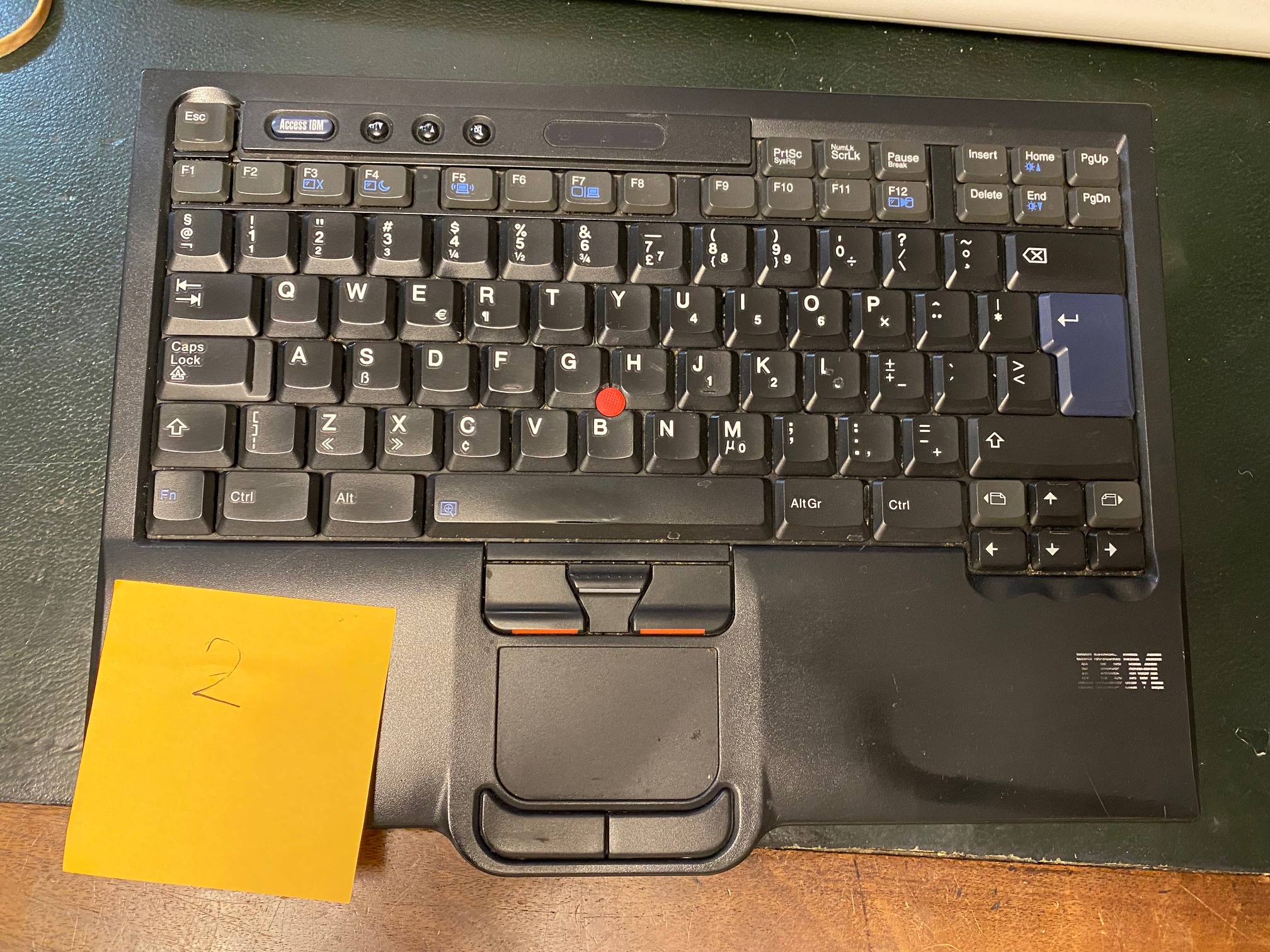
Older IBM Ultranav keyboard Older IBM Ultranav keyboard
For the last 13 years I've been using standalone versions of the Lenovo (formerly IBM) Thinkpad keyboard design with integrated trackpoint as my main computer input devices. My latest ("ThinkPad TrackPoint Keyboard II") was starting to fail so I decided to look into alternatives for a replacement. The sticking point was I really like the trackpoint as a mouse replacement, and very few other manufacturers offer that. I've thus far managed to avoid the money pit that are mechanical keyboards. I can see the attraction: in the 90s I used an IBM Model M PS/2 keyboard as my daily driver until one tea spillage too many finally killed it. A friend kindly gifted me another Model M more recently, but the buckled-spring technology it uses is too loud for use in a public office, and the resistance too strong for my modern fingers. The latter could perhaps be fixed with training. But still: no trackpoint. (less importantly, no Windows keys.) In anticipation of possibly getting a mechanical keyboard, I bought a passive 12 key "tester": 12 keyboard switches of different variants inside a perspex frame. This gives you a rough idea of the feel of each switch type, to try and narrow down what your personal preference might be. At the beginning I imagined I'd like something clicky and stiff, like the buckled springs (and the Cherry MX Green was closest to that), but I was gravitating more towards the more common MX Red (popular with gamers) and MX Brown (popular with typists).
Modern lenovo and sacrificial mech Modern lenovo and sacrificial mech
I wasn't totally sure yet so I decided to buy a sacrificial mechanical keyboard to test a switch type properly. I managed to find a second-hand one for 20 with brown switches. It was a bad layout (ANSI) which detracted from its use but was a useful exercise: I decided I didn't really like the Browns that much! It seems 13 years with scissor switches have softened me up so that I want very little resistance on my keys. So. most likely, MX Reds. Tex Shinobi
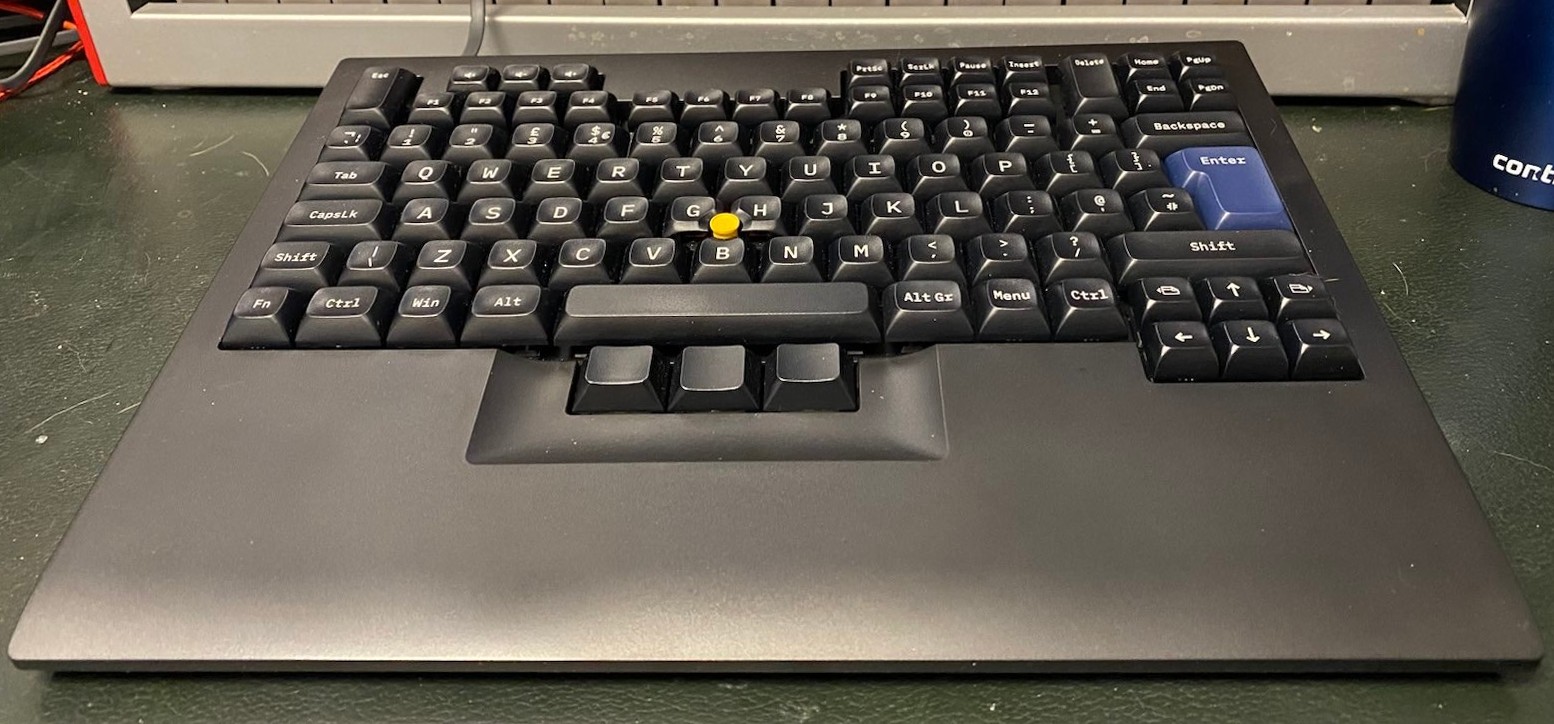
Shinobi, complete with cat hair Shinobi, complete with cat hair
A small Taiwanese company, Tex, produce a series of mechanical keyboards very openly inspired by the IBM/Lenovo trackpoint models that I've been using for so long, complete with trackpoints. I'd been eyeing up their Tex Yoda II keyboard for some time, which looks great, very minimalistic, but in practise I do use the keys it omits, and it's pricey. I decided to take the plunge and buy a more key-ful and reasonably priced Tex Shinobi ISO/UK layout, and I opted for Cherry MX Silent Red switches. Silent to give me the option of using in the Newcastle office, but also to reduce the risk of waking up the kids at home. The Silent Reds are a bit "squishier" than raw Reds which is a shame, but not enough of an obstacle to typing rapidly. The keyboard shape and layout is a close clone of the old IBM Ultranav keyboards I used to use so I was at home on it straight away. The real unknown quantity to me was how well the trackpoint works. I'd read mixed responses, but it's not clear that the people reviewing it were very familiar with the Lenovo ones. I am pleased to report that it's indistinguishable to the Lenovo one to me (and I used that a lot). The keyboard came in a funky replica Thinkpad box and with some keycap and trackpoint pointer options. I opted for a yellow "hat" shaped trackpoint cover (to appease my yellow-obsessed youngest daughter) and the blue IBM-style Enter keycap. Future I don't need any more keyboards! Unless I break this one. But in writing this I did notice that they are taking pre-orders on a new model Shura which seems to be halfway between the Yoda II and Shinobi. I imported the Shinobi from Tex direct (incurring the corresponding duty cost) but next time I might look for a UK distributor such as https://www.keyboardco.com/.

Russell Coker: Samsung Galaxy Note 10.1 2014

In May 2014 I bought a Samsung Galaxy Note 10.1 2014 edition tablet (wikipedia page [1]) with 32G of RAM. It s display is 2560 1600 resolution which still compares well to the latest tablets. The Galaxy Tab S8 [2] is the latest high-end tablet series from Samsung and the 11 inch tablet in that series also has a 2560 1600 giving it a slightly lower DPI! The latest series also has 12.4 and 14.6 tablets with resolutions of 2800 1752 and 2960 1848 respectively. Obviously if you want a 14 tablet then the latest offerings are good, but if you want a 10 or 11 tablet then Samsung hasn t improved much. The Note 10.1 has 3G of RAM and a choice of 16G, 32G, or 64G of storage. The latest Tab S8 tablets have 8G to 16G of RAM and 128G to 512G of internal storage, which are great if you need such things. For many tasks 3G of RAM is quite adequate and as I chose the 32G model I haven t had a problem with storage. The s-pen is a feature of this tablet which is also on the latest high-end Samsung tablets, it is useful for accessing small elements in web sites designed for desktop use and for graphics editing. One noteworthy feature of this tablet is the fact that when in landscape orientation it has speakers on each side, which is the correct layout as the vast majority of video with stereo sound is in a landscape orientation. After using that tablet for about 4 years I bought myself a newer tablet and gave it to my wife. She has since passed it on to another relative who is using it regularly. That tablet seems to have lasted well still being quite usable when it s almost 9 years old. The price including delivery was $579, that works out to about $1.30 per week (disregarding interest and inflation). According to the Reserve Bank of Australia inflation calculator [3] $579 in 2014 is equivalent to $652 in 2021, they don t have results for later than 2021 so I ll assume it would be $675 in 2023. Currently the main problems with this tablet are lack of USB-C support (which means it s difficult to connect to an external display among other things) and lack of a recent version of Android, 4.4.2 was the latest OTA update available. The XDA Developers forum has a section for this tablet [4] which includes discussion of updates to Android 5.x for devices which didn t get it automatically and for upgrading to very recent Android versions in LineageOS. I m idly considering one of those options, but for the current user the Google Play store is a requirement. Newer Samsung Tablets The current equivalent Samsung tablet is the Galaxy Tab S8 which is currently being sold for $1055 which is 56% higher than the inflation adjusted price of my tablet. I don t think this is reasonable given that I bought it 7 months after release and it s now 11 months since the release of the Tab S8. The Tab S8 has more RAM, more storage, and a faster CPU due to improvements over the entire computer industry replacing old parts with newer versions of the same things (including changing to USB-C) doesn t justify a price rise. Increasing RAM size by a factor of 3-5 and increasing storage by a factor of 8 over the last 9 years doesn t match the industry trends for PCs, also as an aside my latest laptop only has 8G of RAM and works well for much more demanding tasks. The Tab S8 series also has significantly better cameras, but I don t think that s a big deal, the 2Mp front camera in my tablet can provide adequate quality for video conferencing and usually saturate the upload bandwidth and again that s an issue of the entire industry moving to newer hardware. I don t think it s bad to take a form factor and display that works well and put newer versions of the CPU, RAM, storage, cameras, and OS on it. But asking for 56% more money for the updated tablet seems unreasonable. The current S8 Ultra is going for $1760 and the S8+ is $1479. I think those are ridiculous prices for tablets as there is a decent range of new laptops that are cheaper. I believe that the purpose of a tablet is to be easy to carry and quick to start using (no waiting for a laptop to connect to wifi after leaving suspend). The largest of the S8 Tabs is about the same length and width as a Thinkpad X1 Carbon with the benefits being that it s thinner and lighter, but if you got a tablet case with keyboard then it would be thicker and heavier. The S8 seems like bad value for money and the S8+ and S8 Ultra don t seem to compare well to laptops and Chromebooks with touch screens unless you have a specific need for Android tablet apps. If Samsung are going to just make new tablets without any significant improvements other than refreshing to the latest CPU, RAM, storage, and Camera technology and force users to upgrade via a lack of new OS support then they shouldn t charge so much. Stick well below $1000 and people will be more inclined to replace items, expensive items are expected to last. Conclusion Buying this tablet was definitely a good choice. It has performed well for many years and after a couple of years of light use it s back in daily use again. The value for money it offered was significantly greater than newer tablets, when it was new it was really high-end, the current S8 Tab series of tablets aren t anything special when compared to other tablets.

2 January 2023

Gunnar Wolf: Refueling the blog

So, it s this weird time of year where we make a balance and share with the world some ideas about the future. And yes, it s time to take care of this blog, as its activity has dropped once again. So maybe it d be nice to start this post by checking how much have I blogged over the years: (yes, this is an old blog) So yes, there is a clear downwards trend towards the last few years. And it does make sense, all in all: Not only have I managed to keep myself busier than before, but Blogging is a social endeavor. And as people have moved over to the different flavors of social networks, there is somewhat less fueling us to share our thoughts and experiences in this fashion. So this connects me to my first point: Staring at Noodles Emptiness, I got to a campaign to Bring Back Blogging. I stand by all of what they suggest: Blogs are a great invention, they allow the sharing of a great insight into a person s mind, ideas and worldview (and even more so if, like mine, it shows already a window of almost two decades of life! This year my blog will be old enough to vote!), they are completely decentralized, and can be easily grouped according to each readers preferences via the RSS format. Anyway I do want to write a post summing up 2022, as well as sharing some hopes and projects I have for 2023. But I don t want to make it too long to read. So That shall be the blog post for today! (post caption image by Walt Stoneburner on Flickr; CC BY 2.0)

Next.

Previous.