Search Results: "mt"

31 March 2009

Jon Dowland: nspluginwrapper

I installed nspluginwrapper on my laptop. It's a 32bit x86 machine and I'm using Adobe's flash 10 plugin. The crashes were getting really stupid. nspluginwrapper has totally cured the problem (at least, my browser hasn't crashed since) and the browser also feels a lot snappier. I will have to try this on my 64 bit work and home desktops.

Jon Dowland: first flat

I have just completed purchase of my first flat! I'm now in the process of sorting it out so I can move in. I may well be offline for a bit as a result.

Jon Dowland: nspluginwrapper.mwdn

Sven Mueller: Link collection 2009/03

Well, I normally despise of thinks like this link collection, but I thought I might add it anyway, since these are useful links for me and if I don t post them here, I m likely to forget where to find them in the near future:
  1. Sean Finney has a nice post about storing the list of parameters a (shell) script got in a way that it can be restored later. Quite handy if your script walks through the arguments parsing them (and consuming them while doing so) but you want to be able to display them in a helpful way if the parsing fails at some point.
  2. A while ago, Ingo J rgensmann had a post that helps retrieving files from lost+found after a filesystem check, provided that you run his helper script on a regular basis. The same approach can also be used if you have a backup of all files, but lost the sorting work you did after the backup was done. This is possible because running the script can be done more often then you would normally do backups.
  3. He also has a small post about mtr oddities when IPv6 comes into play
  4. Adeodato Sim wrote about databases and when timestamps that store the timezone information really are more useful then timestamps that don t.
  5. Adeodato also has a short post on using ssh as a socks proxy, which can be quite handy if you are behind a firewall.
Update: Fixed link to Ingo s file retrieval from lost+found article. Thanks to Patrick Schoenfeld who pointed me at the wrong link.
Also thanks to the anonymous poster who found an alternative way to store and (in a way) restore commandline parameters. The solution doesn t work in an as general way as that by Sean Finney et al., but it is much shorter and therefore interesting for where it can be used (when you control how commandline parameters are processed). See comments on this post for details.

28 March 2009

Chris Lamb: Orphaning the Gnome BTS Applet

As I haven't used Gnome in over a year, I'm orphaning my Debian BTS Applet (original blog post). After the original release it was forked for Launchpad and there were even plans for OpenSUSE fork. Jon Dowland also released his debgtd tool which isn't Gnome-specific and somewhat more useful for developers, although actual development has stalled with patches pending. I would be willing to sponsor uploads if a non-Debian Developer was to adopt it.

27 March 2009

Gunnar Wolf: La seguridad en c mputo: Con qu se come?

TitleLa seguridad en c mputo: Con qu se come?
Publication TypeMagazine Article
Year of Publication2009
AuthorsWolf, Gunnar
MagazineSoftware Gur
FrequencyQuarterly
Issue Number23
Pagination47
Date Published02/2009
Type of ArticleColumn
ISSN1870-0888
Key WordsSeguridad
Citation Key1928
Export

Gunnar Wolf: C mo ense ar a los programadores del futuro?

Title C mo ense ar a los programadores del futuro?
Publication TypeMagazine Article
Year of Publication2008
AuthorsGunnar, Wolf.
MagazineSoftware Gur
Issue Number22
Pagination64
Date Published11/2008
Type of ArticleColumn
ISSN1870-0888
Key Wordsense anza, paradigmas, motivaci n, autodidacta
Citation Key1927
Export

Gunnar Wolf: Coordinaci n de esfuerzos en grupos de desarrollo e integraci n de Software Libre

TitleCoordinaci n de esfuerzos en grupos de desarrollo e integraci n de Software Libre
Publication TypeMagazine Article
Year of Publication2008
AuthorsGunnar, Wolf.
MagazineSoftware Gur
FrequencyQuarterly
Issue Number21
Pagination62-63
Date Published08/2008
Type of ArticleColumn
ISSN1870-0888
Key WordsSoftware libre, comunidad, organizaci n
Citation Key1926
Export

Gunnar Wolf: La metaprogramaci n y los lenguajes din micos

TitleLa metaprogramaci n y los lenguajes din micos
Publication TypeWeb Article
Year of Publication2008
AuthorsGunnar, Wolf.
Access Date2009/03/27
Key WordsMetaprogramaci n, Ruby, programaci n
AbstractLa metaprogramaci n es una t cnica muy poderosa, y muy socorrida en el terreno de los lenguajes din micos. Puede llevarnos a reducir muy fuertemente el total de c digo que escribimos - Y lo que es mucho m s importante, a minimizar la cantidad de c digo repetido innecesariamente. Nos lleva claramente a aumentar la calidad y mantenibilidad de nuestro c digo.
URLhttp://www.sg.com.mx/content/view/718/1/
Citation Key1925
Export

Ingo Juergensmann

I just discovered that mtr has some problems with IPv6 enabled hosts when using the GUI. Try the following:

1) enter "mtr ipv6-host" in shell -> works
2) enter then an IPv4 only host Hostname input line -> doesn't work

3) quit mtr

4) enter "mtr ipv4-host" in shell -> works
5) enter then an IPv6 enabled host in Hostname input line -> tracing IPv4 part of IPv6 enabled host


So, something is broken, at least for 2). One could argue if 5) might be OK or the expected behaviour, but I believe that mtr should query the AAAA records and trace for the IPv6 hostname, regardless of whether you started with an IPv4 only host first.

Is there already someone tracking IPv6 related bugs in Debian? A tag in BTS maybe? Anyway, the above is reported as #521415.

Ingo Juergensmann: IPv6: oddities with mtr

I just discovered that mtr has some problems with IPv6 enabled hosts when using the GUI. Try the following:

1) enter "mtr ipv6-host" in shell -> works
2) enter then an IPv4 only host in Hostname input line -> doesn't work

3) quit mtr

4) enter "mtr ipv4-host" in shell -> works
5) enter then an IPv6 enabled host in Hostname input line -> tracing IPv4 part of IPv6 enabled host


So, something is broken, at least for 2). One could argue if 5) might be OK or the expected behaviour, but I believe that mtr should query the AAAA records and trace for the IPv6 hostname, regardless of whether you started with an IPv4 only host first.

Is there already someone tracking IPv6 related bugs in Debian? A tag in BTS maybe? Anyway, the above is reported as #521415.

UPDATE: added blog title ;)

Matthew Garrett: Reducing disk use

UNIX filesystems generally store three pieces of timing information about files - ctime (when the file was changed in any way), mtime (when the file contents, as opposed to its metadata, was last changed) and atime (when the file was last accessed by any process). This is a usefully flexible system, but the semantics of atime can be troublesome. atime must be updated every time a file is read, causing a read operation to instead become a read/write operation. This results in a surprising amount of io being generated in normal filesystem use, slowing the more relevant io and causing disks to spin up due to atime updates being required even if the file was read out of cache. It also results in a lot of unnecessary activity on flash media which may reduce their lifetime.

One option is to disable atime updates entirely. The problem with this approach is that certain applications depend on atime. This is especially common in mail clients which compare atime to mtime in order to determine whether a mailbox has been read since it was last modified. So, unfortunately, disabling atime entirely is impractical as a default. Back in 2006, Valerie Aurora submitted a patch that worked around this issue. The new relatime option meant that atime would only be updated if it would otherwise be older than ctime or mtime. Mail clients became happy and the world rejoiced.

Unfortunately, it turned out that there was one other common case of atime being used. Applications like tmpwatch monitor files in /tmp and delete them if they appear unused. In this case, "unused" means "has an atime older than a certain date". Since merely reading files doesn't update the ctime or mtime, relatime wouldn't cause the atime on these files to be updated and tmpwatch would happily delete them - even if users were reading them on a daily basis.

Ingo Molnar submitted a patch to add a further heuristic to the relatime behaviour. With it, the atime of a file will be updated if it's older than mtime, older than ctime or (and this is the important one) more than 24 hours in the past. This deals with the tmpwatch case nicely, while still providing a significant reduction in the quantity of atime updates.

Fedora shipped this patch for several releases, and Ubuntu have used it by default since 8.04. Unfortunately there were some concerns over certain aspects of its behaviour (in respect to its interface as opposed to the relatime functionality itself) and it never got merged. I pushed a trimmed down version that purely implements the change to the relatime behaviour, and earlier today Linus merged it and a further patch that makes relatime the default behaviour on Linux.

Most users won't notice this change in behaviour at all, other than as a small improvement in io performance and a reduction in the number of drive spinups. For users that do have issues, a new strictatime mount option has been added - using this will require an updated mount command, but it's a trivial patch. I'd be surprised if there are any real world use cases that are negatively affected by this, especially since it's been default behaviour in several distributions for a while, but there's always the potential that someone will be tripped up by it. We'll see.

20 March 2009

Wouter Verhelst: TomTom

Cheers.

18 March 2009

Jon Dowland: crypted lvm question

On my primary desktop machine at home, I have several volumes encrypted using dm-crypt/luks and mounted as part of my login thanks to pam-mount. On one hard drive is my main home directory and some small supplementary filesystems. On another hard drive I have several crypted volumes used for backing up my home partition but also other devices. This setup is largely transparent to me: all of the filesystems are individually unlocked and mounted as part of my login. It is however a bit messy to have so many small crypted filesystems (using the same passphrase) and the login is delayed a fair while too. What would be preferable would be to have one encrypted volume that was unlocked by my PAM keyphrase but which provided several sub-volumes which were mounted individually and had separate sizes, etc. It might be possible to achieve this by having the volume exported by dm-crypt be itself a LVM physical volume. Does this sound sane to anyone? Is there a better way to achieve the same thing? I could remove the first volume group and have a disk partition feed directly into dm-crypt but I would lose some flexibility (there are some things I backup but don't encrypt, such as my music collection, and now and then I need a large scratchpad). I'm not sure how well putting a VG ontop of a LV for a different VG would work, I'm also not sure how happy the LVM code would be with a VG appearing and disappearing (In practise, I log in once a month or so, so it wouldn't happen that often).

Michal Čihař: Gammu test version 1.23.91

Welcome back on weekly schedule of Gammu releases. The biggest change in this release is in SMSD and RunOnReceive scripting support, which has been improved and now can contain any arbitrary command. Besides that support for vNote format has been added for backups/restores and some minor bugs were fixed. Full list of changes follows: You can download from usual place: http://cihar.com/gammu/, Debian users will find packages in experimental soon, SUSE, Fedora and Mandriva users can check experimental repository in OpenSuse Build Service.

16 March 2009

James Morrison: Random Notes

Horse Gym USA has a picture of a Canadian at the top of the page.

San Francisco looks like a small place from the top, i.e. the top of Golden Gate Heights. It also seems like all the views of the city face northwards. Mt Davidson does have some views south, but they aren't as pretty. San Francisco is sand and rocks, the trees that do well here are not from here. The cloud forest plants should do well, the botanical garden has lots of them.

This post is for Akash. You'll have to ask him why.

Jon Dowland: rsi

I am currently suffering from a form of repetitive strain injury in my hands and arms, which I think is related to a cold I've got at the moment. There are a number of people who I have promised correspondence with recently; also a number of discussions I've taken part in (e.g. device access via group membership on debian-devel; doom-related virtual packages on debian-policy) which I haven't followed up on for a while. Just a note to say sorry for dropping off the face of the earth, I'll be back as soon as I can!

15 March 2009

Martin Michlmayr: SheevaPlug: the NSLU2 killer

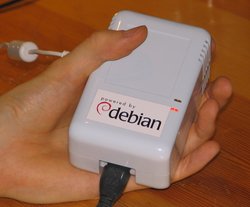
SheevaPlug in my hand I received a SheevaPlug this week, an intriguing device that packs incredible power and functionality into a tiny package. As many of you know, I've been doing a lot of work on Debian for the Linksys NSLU2 in the last few years. The NSLU2 is a key reason why ARM has become the third most popular architecture in Debian (after 32 and 64 bit x86), and I believe a main reason is that the NSLU2 is so incredibly cheap. At a price under $100, most people don't think too long and simply buy a device and do something cool with it. The SheevaPlug is being offered at the same price range but offers considerably more. Riku Voipio asked the right question: "What would you do with something approximately 10x more powerful with same prize/size range?" I believe the SheevaPlug is a killer replacement for the NSLU2 and here's why: I'm incredibly excited about the SheevaPlug and the first thing I did was to take the device apart and look at the inside. The results can be found in the SheevaPlug image gallery. My next project will be slightly more productive: porting Debian. As I see it, we should support the following three installation variants for the SheevaPlug: The first two should be relatively straight forward, but of course installing to the internal flash memory is particularly interesting given that 512 MB (plus compression) is enough for a basic installation of Debian. Unfortunately, installations to MTD flash are currently not supported in the Debian installer but I hope we can find a volunteer who wants to implement this functionality. My next steps are to put a kernel for the SheevaPlug into the archive and to get a basic installation going. From there we can look at more sophisticated installation options and other functionality.

Russell Coker: Why Cyrus Sucks

I m in the middle of migrating a mail server away from the Cyrus mail store [1]. Cyrus provides a POP and IMAP server, a local delivery agent (accepting mail via LMTP). It is widely believed that Cyrus will give better performance than other mail stores, but according to a review by linux-magazin.de Dovecot and Courier deliver comparable (and sometimes better) performance [2]. The biggest problem with Cyrus is that it is totally incompatible with the Unix way. This wouldn t be a problem if it would just work and if it would display reasonable error messages when it failed, but it doesn t. It often refuses to work as desired, gives no good explanation, and it s data structures can t be easily manipulated. Dovecot [3] and Courier [4] use the Maildir++ format [5] (as well as many other programs). I have set up a system with Courier Maildrop and Dovecot for the IMAP server [6] and it works well - it s good to have a choice! But also Maildir++ is reasonably well documented and is an extension to the well known Maildir format. This means that it s easy to manipulate things if necessary, I can use mv to rename folders and rm to remove them. Cyrus starts with a database (Berkeley DB file) of all folders in all mailboxes. Therefore it is not possible to move a user from one back-end server to another by merely copying all the files across and changing the LDAP (or whatever else contains the primary authentication data) to point to the new one. It also makes it impossible to add or remove folders by using maildirmake or rm -rf. The defined way of creating, deleting, and modifying mailboxes is through IMAP. One of the problems with this is that copying a mailbox from one server to another requires writing a program to open IMAP connections to both servers at once (tar piped through netcat is much faster and easier). Also if you need to rename a mailbox that contains many gigabytes of mail then it will be a time consuming process (as opposed to a fraction of a second for mv). Cyrus has a tendency to break while Dovecot is documented as being self-healing and Cyrus also seems to cope well in the fact of a corrupted mail store. Even manually repairing problems with Cyrus is a painful exercise. The Cyrus mail store is also badly designed - and it s design was worse for older filesystems (which were common when it was first released) than it is for modern ones. The top level of a Cyrus maildir contains all the messages in the INBOX stored one per file, as well as three files containing Cyrus indexes and sub-directories for each of the sub-folders. So if I want to discover what sub-folders a mailbox has then I can run ls and wait for it to stat every file in the directory or I can use an IMAP client (which takes more configuration time). As opposed to a Maildir++ store where every file that contains a message is stored in a folder subdirectory named new , cur , or tmp which means that I can run ls on the main directory of the mail store and get a short (and quick) result. Using tools such as ls to investigate the operation of a server is standard practice for a sysadmin, it should work well! A finall disadvantage of Cyrus seems to have many small and annoying bugs (such as the reconstruct program not correctly recursing the sub folders). I guess it s because not many people use Cyrus that such things don t get fixed. One trivial advantage of Cyrus is that by default it splits users into different sub-directories for the first letter of the account name. Dovecot supports using a hash of the user-name this is better than splitting by first-letter for performance (it gives a more equal distribution) but will make it slightly more difficult to manipulate the mail store by script. Ext3 can give decent performance without a two level directory structure for as many as 31,998 sub-directories (the maximum that it will support) due to directory indexing and Linux caching of dentries. There may be some other advantages of Cyrus, but I can t think of them at the moment. Here is a script I wrote to convert Cyrus mail boxes to Maildir++. To make this usable for a different site would require substituting a different domain name for example.com (or writing extra code to handle multiple domains) and inserting commands to modify a database or directory with the new server name. There is no chance of directly using this script on another system, but it should give some ideas for people performing similar tasks.

#!/bin/bash -e
# $1 is the user to move # BASEDIR is the directory for temporary files
BASEDIR=/mail/new
rm -rf $BASEDIR/$1 archive.tgz archive2.tgz ORIGSRV=$(echo "MYSQL_COMMAND_TO_GET_SERVER" mysql dbname)
echo "original server was $ORIGSRV" if [ "$ORIGSRV" = "" ]; then
echo "No server for account, strange error."
exit 1
fi ORIGPARENT="/mail/domain/e/example.com/$(echo $1 cut -c1)/user" # copy the data to a local archive
# USERDIR is for using ^ instead of . as Cyrus does.
mkdir -p $BASEDIR
cd $BASEDIR
USERDIR=$(echo $1 sed -e "s/\./^/g")
ssh cyrus@$ORIGSRV "(cd $ORIGPARENT ; tar czf - $USERDIR)" > archive.tgz
tar xzf archive.tgz
if [ "$USERDIR" != "$1" ]; then
mv $USERDIR $1
fi DEPTH=$(find . -mindepth 3 -type d wc -l)
if [ "$DEPTH" != "0" ]; then
echo "too deep"
exit 1
fi # remove cyrus index files
find $1 -name "cyrus.*" -exec rm \;
cd $1 # "mail" is a directory with sub-folders, every other name starting with
# [a-zA-Z] is a regular folder that needs to become a Maildir
for n in [a-zA-Z]* ; do
if [ "$n" != "mail" ]; then
cd "$n" ; mkdir new cur tmp ; touch maildirfolder
mv [0-9]* new true
cd .. ; mv "$n" ".$n"
fi
done # move the inbox files to Maildir storage
mkdir new cur tmp
mv [0-9]* new true
mv mail/[0-9]* cur true # move sub-folders of "mail/" and merge ones with duplicate names
cd mail
for n in * ; do
if [ -e "../.$n" ]; then
cd "$n"
mv [0-9]* "../../.$n/cur" true
cd .. ; rmdir "$n"
else
cd "$n" ; mkdir new cur tmp ; touch maildirfolder
mv [0-9]* new true
cd .. ; mv "$n" "../.$n"
fi
done
cd ..
rmdir mail # get a list of all names so we can recognise duplicates
find . -type d egrep -v "new cur tmp" cd $BASEDIR ssh root@localhost "mv /mail/new/$1 /mail/example.com ; chown -R mail:mail /mail/example.com/$1"
echo "MYSQL_COMMAND_TO_SET_SERVER" mysql dbname

14 March 2009

Matthew Garrett: ext4, application expectations and power management

Edited to add: Sorry, it turns out that ext4 does now have a heuristic to deal with this case. However, it seems that btrfs doesn't. My point remains, though - designing a filesystem in such a way that a useful behaviour is impossible is unhelpful for the vast majority of application writers, even if it does improve performance in some other use cases.

Further edit: It's mentioned in the comments that btrfs will force a flush of data when a rename is performed as of 2.6.30. That prevents the data loss, but it means that we're still stuck with disk access when we'd be happy with that being batched up for the future. It feels like we're optimising for the wrong case here.

Original text:

There's been a certain amount of discussion about behavioural differences between ext3 and ext4[1], most notably due to ext4's increased window of opportunity for files to end up empty due to both a longer commit window and delayed allocation of blocks in order to obtain a more pleasing on-disk layout. The applications that failed hardest were doing open("foo", O_TRUNC), write(), close() and then being surprised when they got zero length files back after a crash. That's fine. That was always stupid. Asking the filesystem to truncate a file and then writing to it is an invitation to failure - there's clearly no way for it to intuit the correct answer here. In the end this has been avoided by avoiding delayed allocation when writing to a file that's just been truncated, so everything's fine.

However, there's another case that also breaks. A common way of saving files is to open("foo.tmp"), write(), close() and then rename("foo.tmp", "foo"). The mindset here is that a crash will either result in foo.tmp being zero length, foo still being the original file or foo being your new data. The important aspect of this is that the desired behaviour of this code is that foo will contain either the original data or the new data. You may suffer data loss, but you won't suffer complete data loss - the application state will be consistent.

When used with its (default) data=ordered journal option, ext3 provided these semantics. ext4 doesn't. Instead, if you want to ensure that your data doesn't get trampled, it's necessary to fsync() before closing in order to make sure it hits disk. Otherwise the rename can occur before the data is written, and you're back to a zero length file. ext4 doesn't make guarantees about whether data will be flushed before metadata is written.

Now, POSIX says this is fine, so any application that expected this behaviour is already broken by definition. But this is rules lawyering. POSIX says that many things that are not useful are fine, but doesn't exist for the pleasure of sadistic OS implementors. POSIX exists to allow application writers to write useful applications. If you interpret POSIX in such a way that gains you some benefit but shafts a large number of application writers then people are going to be reluctant to use your code. You're no longer a general purpose filesystem - you're a filesystem that's only suitable for people who write code with the expectation that their OS developers are actively trying to fuck them over. I'm sure Oracle deals with this case fine, but I also suspect that most people who work on writing Oracle on a daily basis have very, very unfulfilling lives.

But anyway. We can go and fix every single piece of software that saves files to make sure that it fsync()s, and we can avoid this problem. We can probably even do it fairly quickly, thanks to us having the source code to all of it. A lot of this code lives in libraries and can be fixed up without needing to touch every application. It's not the end of the world.

So why do I still think it's a bad idea?

It's simple. open(),write(),close(),rename() and open(),write(),fsync(),close(),rename(), are not semantically equivalent. One is "give me either the original data or the new data"[2]. The other is "always give me the new data". This is an important distinction. fsync() means that we've sent the data to the disk[3]. And, in general, that means that we've had to spin the disk up.

So, on the one hand, we're trying to use things like relatime to batch data to reduce the amount of time a disk has to be spun up. And on the other hand, we're moving to filesystems that require us to generate more io in order to guarantee that our data hits disk, which is a guarantee we often don't want anyway! Users will be fine with losing their most recent changes to preferences if a machine crashes. They will not be fine with losing the entirity of their preferences. Arguing that applications need to use fsync() and are otherwise broken is ignoring the important difference between these use cases. It's no longer going to be possible to spin down a disk when any software is running at all, since otherwise it's probably going to write something and then have to fsync it out of sheer paranoia that something bad will happen. And then probably fsync the directory as well, because what if someone writes an even more pathological filesystem. And the disks sit there spinning gently and chitter away as they write tiny files[4] and never spin down and the polar bears all drown in the bitter tears of application developers who are forced to drink so much to forget that they all die of acute liver failure by the age of 35 and where are we then oh yes we're screwed.

So. I said we could fix up applications fairly easily. But to do that, we need an interface that lets us do the right thing. The behaviour application writers want is one which ext4 doesn't appear to provide. Can that be fixed, please?

[1] xfs behaves like ext4 in this respect, so the obvious argument is that all our applications have been broken for years and so why are you complaining now. To which the obvious response is "Approximately anyone who ever used xfs expected their data to vanish if their machine crashed so nobody used it by default and seriously who gives a shit". xfs is a wonderful filesystem for all sorts of things, but it's lousy for desktop use for precisely this reason.

[2] Yes, ok, we've just established that it actually isn't that in the same way that GMT isn't UTC and battery refers to a collection of individual cells and so you don't usually put multiple batteries in your bike lights, but the point is that this is, for all practical intents and purposes, an unimportant distinction and not one people should have to care about in their daily lives.

[3] The disk is free to sit there bored for arbitrary periods of time before it does anything, but that's fine, because the OS is behaving correctly. Sigh.

[4] Dear filesystem writers - application developers like writing lots of tiny files, because it makes a large number of things significantly easier. This is fine because sheer filesystem performance is not high on the list of priorities of a typical application developer. The answer is not "Oh, you should all use sqlite". If the only effective way to use your filesystem is to use a database instead, then that indicates that you have not written a filesystem that is useful to typical application developers who enjoy storing things in files rather than binary blobs that end up with an entirely different set of pathological behaviours. If I wanted all my data to be in oracle then I wouldn't need a fucking filesystem in the first place, would I?

Next.

Previous.