Search Results: "eric"

28 May 2009

Adrian von Bidder: Installing self-compiled packages

A script I keep reinventing again and again: installing those binary packages from a self-compiled package where the other (presumably older) version is already installed on the system. I don't have time to make this generic right now, but still...
for i in *deb; do 
    echo $ i%%_* ;
done   xargs dpkg -l 2>/dev/null \
      buthead 5 \
      cut -f 3 -d \  \
      while read p; do
         echo  $ p _4.2.3-1vbi_i386.deb;
      done \
      xargs sudo dpkg -E -i
Update: I don't know how I managed to see -E in dpkg's manpage but miss -O which is right above it. Thanks, Guillem. Josh: Either my english is just not good enough, or the manpage of debi is from a slightly different reality. I just can't make out what, exactly, the tool tries to do. (Ok, since dpkg -iOE does exactly what I want anyway I didn't try very hard either.) Update: RTFM.

27 May 2009

Gunnar Wolf: Encuentro Centroamericano de Software Libre

 vos tambi n pod s ir! Yup Over a month ago I was contacted by Norman Garc a (who I met via the various EDUSOL activities), and Ren Mayorga (who I met thanks to his Debian involvement) inviting me to join them for the First Central-American Free Software Encounter. I had insisted to several Central American friends on setting up such an encounter for several years, and I am really glad I was invited. So, if you happen to be near Central America between June 17 and 21, don't miss it! They are even organizing a bus (which still has place for more travellers!) going from Guatemala City, passing through San Salvador, Tegucigalpa and arriving to Estel , Nicaragua. I must also prominently thank Fernando Romo and Neocenter for kindly offering to sponsor my flight to Nicaragua. You rock!

25 May 2009

Erich Schubert: If you're wondering why your circle is a diamond ...

... you might be bitten by this Java bug rendering arcs as straight lines at large zoom levels.It looks like a classic to me: in order to improve rendering performance, you approximate arcs with straight lines at small resolutions (if it's just 2 pixels big, nobody will be able to tell the difference). Except of course, when you end up doing the same approximation at a large zoom value - of course a 100-pixel circle looks different from a 100-pixel diamond.Reported in 2005, still not fixed in current Java (we're in 2009 now).Sun is really slow at fixing Java bugs.See also a related Apache Batik bug report. Fortunately, this only applies to Java rendered graphics - SVG export, PDF, Postscript are all fine.

23 May 2009

Joey Hess: website backup RFC

So, I'm considering a backup system that has as its goal to let you backup all your data from third party websites, easily. The idea I have for its UI is you enter in the urls for all the sites you use, or feed it a bookmark file. By examining the URLs, it determines if it knows how to export data from each site, and prompts for any necessary login info. The result would be a list of sites, and their backup status. I think it's important that you be able to enter websites that the system doesn't know how to handle yet; backup of such sites will show as failed, which is accurate. It seems to almost be appropriate to have a web interface, although command-line setup and cron should also be supported. For the actual data collection, there would be a plugin system. Some plugins could handle fairly generic things, like any site with an RSS feed. Other plugins would have site-specific logic, or would run third-party programs that already exist for specific sites. There are some subtle issues: Just because a plugin manages to suck an RSS feed or FOAF file off a site does not mean all the relevant info for that site is being backed up. More than one plugin might be able to back up parts of a site using different methods. Some methods will be much too expensive to run often. As far as storing the backup, dumping it to a directory as files in whatever formats are provided might seem cheap, but then you can check it into git, or let your regular backup system (which you have, right?) handle it.
Thoughts, comments, prior art, cute program idea names (my idea is "?unsilo"), or am I wasting my time thinking about this?

John Goerzen: Review: In The Beginning. . . Was The Command Line

A few dud universes can really clutter up your basement. - Neal Stephenson, In The Beginning. . . was the Command Line
What a fun read. It s about technology, sure, but more about culture. Neal takes a good look at operating systems, why we get emotionally involved with them, and why Windows is still so popular. He does this with a grand detour to Disneyland, and a hefty dose of humor. The above quote was from near the end of the book, where he imagines hackers creating big bangs from the command line. He starts out the book from some anecdotes from the early 1970s, when he had his first computer class in high school. His school didn t have a computer, but they did have a teletype (the physical kind that used paper) with a modem link to some university s system. But time on that system was so expensive that they couldn t just dial in and run things interactively. The teletype had a paper tape device. You d type your commands in advance, and it would punch them out on the tape. Then when you dial in, it would replay the tape at high speed . Neal liked this because the stuff punched out of the tape were, actually, bits in both the literal and the mathematical sense. This, of course, led to a scene at the end of the schoolyear where a classmate dumped the bin of bits on the teacher, and Neal witnessed megabytes falling to the floor. Although the book was written in 1999, and needs an update in some ways, it still speaks with a strong voice today and is now also an interesting look at what computing was like 10 years ago. He had an analogy of car dealerships to operating systems. Microsoft had the big shiny dealership selling station wagons. Their image was all wrapped up in people feeling good about their purchase like they got something for their money. And he said that the Linux folks were selling tanks, illustrated with this exchange:
Hacker with bullhorn: Save your money! Accept one of our free tanks! It is invulnerable, and can drive across rocks and swamps at ninety miles an hour while getting a hundred miles to the gallon! Prospective station wagon buyer: I know what you say is true but er I don t know how to maintain a tank! Bullhorn: You don t know how to maintain a station wagon either! Buyer: But this dealership has mechanics on staff. If something goes wrong with my station wagon, I can take a day off work, bring it here, and pay them to work on it while I sit in the waiting room for hours, listening to elevator music. Bullhorn: But if you accept one of our free tanks we will send volunteers to your house to fix it for free while you sleep! Buyer: Stay away from my house, you freak! Bullhorn: But Buyer: Can t you see that everyone is buying station wagons?
That doesn t mean that Stephenson is just a Linux apologetic. He points out that the CLI has its place, and has a true love-hate relationship with the text-based config files (remember XF86Config before the days of automatic modelines? Back when you had to get out a calculator and work some things out with pencil and paper, or else risk burning out your monitor?) He points out that some people want to just have the thing work reasonably well. They don t want control in fact, would gladly give it up if offered something reasonably pretty and reasonably functional. He speaks to running Linux at times:
Sometimes when you finish working with a program and shut it down, you find that it has left behind a series of mild warnings and low-grade error messages in the command-line interface window from which you launched it. As if the software were chatting to you about how it was doing the whole time you were working with it.
Even if the application is imploding like a damaged submarine, it can still usually eke out a little S.O.S. message.
Or about booting Linux the first time, and noticing all sorts of cryptic messages on the console:
This is slightly alarming the first time you see it, but completely harmless.
I use emacs, which might be thought of as a thermonuclear word processor. . . Microsoft Word, were devoted to features like mail merge, and the ability to embed feature-length motion pictures in corporate memoranda, were, in the case of emacs, focused with maniacal intensity on the deceptively simple-seeming problem of editing text. If you are a professional writer i.e., if someone else is getting paid to worry about how your words are formatted and printed emacs outshines all other editing software in approximately the same way that the noonday sun does the stars. It is not just bigger and brighter; it simply makes everything else vanish. For page layout and printing you can use TeX: a vast corpus of typesetting lore written in C and also available on the Net for free.
I love these vivid descriptions: programs secretly chatting with us, TeX being a corpus of typesetting lore rather than a program. Or how about this one: Unix. . . is not so much a product as it is a painstakingly compiled oral history of the hacker subculture. It is our Gilgamesh epic. Yes, my operating system is an oral history project, thankyouverymuch. The book feels like a weird (but well-executed and well-written) cross between Douglas Adams and Cory Doctorow. Which makes is so indescribably awesome that I can t help but ending this review with a few more quotes.
Because Linux is not commercial because it is, in fact, free, as well as rather difficult to obtain, install, and operate it does not have to maintain any pretensions as to its reliability. Consequently, it is much more reliable.
what really sold me on it [Debian] was its phenomenal bug database (http://www.debian.org/Bugs), which is a sort of interactive Doomsday Book of error, fallibility, and redemption. It is simplicity itself. When had a problem with Debian in early January of 1997, I sent in a message describing the problem to submit@bugs.debian.org. My problem was promptly assigned a bug report number (#6518) and a severity level (the available choices being critical, grave, important, normal, fixed, and wishlist) and forwarded to mailing lists where Debian people hang out.
That should be our new slogan for bugs.debian.org: Debian s interactive Doomsday Book of error, fallibility, and redemption.
Unix is hard to learn. The process of learning it is one of multiple small epiphanies. Typically you are just on the verge of inventing some necessary tool or utility when you realize that someone else has already invented it, and built it in, and this explains some odd file or directory or command that you have noticed but never really understood before.
I ve been THERE countless times.
Note the obsessive use of abbreviations and avoidance of capital letters; this is a system invented by people to whom repetitive stress disorder is what black lung is to miners. Long names get worn down to three-letter nubbins, like stones smoothed by a river.
It is obvious, to everyone outside of the United States, that our arch-buzzwords, multiculturalism and diversity, are false fronts that are being used (in many cases unwittingly) to conceal a global trend to eradicate cultural differences. The basic tenet of multiculturalism (or honoring diversity or whatever you want to call it) is that people need to stop judging each other-to stop asserting (and, eventually, to stop believing ) that this is right and that is wrong, this true and that false, one thing ugly and another thing beautiful, that God exists and has this or that set of qualities.
The stone tablets bearing the Ten Commandments carved in immutable stone the original command-line interface
Apparently this actually works to some degree, for police in many lands are now complaining that local arrestees are insisting on having their Miranda rights read to them, just like perps in American TV cop shows. When it s explained to them that they are in a different country, where those rights do not exist, they become outraged. Starsky and Hutch reruns, dubbed into diverse languages, may turn out, in the long run, to be a greater force for human rights than the Declaration of Independence.
Unix has always lurked provocatively in the background of the operating system wars, like the Russian Army.
Available for free online, or as a 160-page book from Amazon.

22 May 2009

Martin F. Krafft: Django: a beautiful and truly thin web development framework

Take the following URL:
http://my.server.tld/wow/summary/2009/05/21/?style=boxed

and imagine the following Python function:
def summary(request, year, month, day):
    response = HttpResponse()
    // do something
    return response

If you see a relation between the two, then Django is for you. The missing part is a URL mapping, a list of regular expressions, which transforms a URL into a keyword list, and maps it to a function (a HTTP view, as it s called):
(r'^wow/summary/(?P<year>\d 4 )/(?P<month>\d 2 )/(?P<day>\d 2 )/$',
    mysite.wow.summary,  'additional':'information' )

You do not have to use keyword arguments, positional parameters will work as well, and you can do anything you like within the powers of regular expressions, but the result is always along the same lines: When someone visits the above URL, Django calls the above summary( ) function (defined in the modules mysite/wow.py) and passes an object encapsulating the request, along with the components from the URL as parameters:
summary(request, 2009, 05, 21,  'additional':'information' )

It then renders the return value. The function can also throw an exception if it need to communicate e.g. a 404 error. Very clean, and there are even generic views if your data doesn t need any massaging, of if you just want to do standard things like generate PDFs. This is the core idea of Django, which I ve gathered from one talk and four hours of invested time. It s a truly thin layer, and its elegance made me bouncey. The QUERY STRING of the request will be passed in the request object, along with all the other CGI variables you re familiar with. Django provides a large number of helpers and shortcuts to save you from having to do the ugly work, including topics such as internationalisation, syndication, authentication, file uploads, and caching. In addition, Django gives you an object-relational_mapper to map the data into, and manage the data definition within your favourite RDBMS, a templating language designed to fit in with the whole philosophy, and widgets to work with forms. You do not have to use any of those. You are free to use any other Python module for the task, just as you can use all of the other features of and modules written for Python. This is particularly powerful in the context of the middleware layer. There s also a large number of pluggable applications and snippets for re-use. The only concern I have at this point is whether features like tagging are going to find their way into the framework, because tracking numerous external plugins for a site and keeping them working across versions reminds me of the nightmares I had with Zope and Plone (I stopped working with (and on) those before I had a chance to dive into version 3 of each). The fact that Django leaves data storage to other tools (in fact, it s entirely up to you) makes those nightmares seem further distant. All in all, I am excited to have had a chance to take a brief glance at the software, and I am looking forward to doing more with it. Unfortunately, it looks like it will take quite some time to wade through existing plugins and design the rest of an application that can finally replace the horrific dung-pile that is my homepage.

21 May 2009

Romain Francoise: My contribution to dpkg 1.15

So, the first thing I do when I boot up my laptop is to dist-upgrade it, and I was getting a little tired of staring at the (Reading database ... message you get when dpkg is busy reading its file database (laptop disk + dm-crypt + cold cache = slow). To preserve my sanity, I contributed a minimal patch to add a progress report, which Guillem turned into a generic facility in libdpkg and is now in the new dpkg in unstable (1.15.1).

It doesn't make dpkg any faster, but at least now I know how slowly it's really going. :)

20 May 2009

Martin F. Krafft: Five days to free Aung San Suu Kyi

In Myanmar, Aung San Suu Kyi and 2 000 monks and activists are being detained, as the miltary junta in the country presses new, ridiculous charges against Suu Kyi a few days before the end of her house arrest. Suu Kyi, recipient of the Nobel Peace Prize and proponent of democracy, is leader of the opposition and the greatest threat to the junta s grasp on power. Given the inhumane conditions imposed upon the Burmese, and the ruthless slaughter of those who do not play by the military s rules, it is not hard to imagine that she would win any fair election, as soon as she would get a chance to run. However, if the junta are successful in pushing charges Suu Kyi is accused of breaching the house arrest after an American man sneaked into her house uninvitedly she could be locked up until after the elections in 2010, effectively disarming the threat she poses to the military regime. She is threatened to be kept in the notorious Insein Prison without medical care. As she is suffering from serious illness, this puts her life at risk. I do not usually campaign for political topics, but I ve been to Myanmar and this issue touches me deeply. The people in Myanmar need our support. Even though the 2007 Burmese anti-government protests seriously weakened the military and brought hope to the lives of millions that have been oppressed for years, the events quickly vanished from the media and allowed the junta to regain control. We must not let that happen again. It is of utmost importance to show our support and not look away. One way of doing so is by increasing visibility. If you care, please write to your newspapers, publish on your blog, and do everything else you can to raise awareness. Another way to help the Burmese people is through signing the avaaz.org petition to UN Secretary General Ban Ki-moon. Best to do all of the above! Unfortunately, avaaz.org force-subscribes everyone who signs a petition to their newsletter, which may well not be what you want. However, please do not let it stop you from signing the petition. You can later unsubscribe from the (infrequent) newsletter. I have informed the staff members of this concern. If you would like to voice your opinion too, write to info t avaaz dot org and encourage them to make the newsletter subscription optional. But make sure to also sign the petition, please.

19 May 2009

Neil Williams: libqof2

It's taken a lot longer than I expected (mostly due to getting other things done in Emdebian etc.) but now that Lenny is out, QOF can finally drop all the previously deprecated code and move to libqof2, so the upstream code has now been released via Alioth (0.8.0) and the binaries have been uploaded to Debian and are waiting in NEW.

QOF provides a set of C language utilities for performing generic structured complex queries on a set of data held by a set of C/C++ objects. This framework allows programmers to add query support to their applications without having to hook into a SQL Database. QOF is a large part of my attempts to get some degree of data freedom to complement the source code freedom. This remains a problem with certain applications, especially financial ones, so I've tried to make it easier to both import and export data between programs using QOF and to convert the default QOF data storage formats into other common formats using simple tools and scripts based on XSL or perl. Having a SQL-type query interface accessible via the command line is a huge bonus when dealing with large data sets.

There is a patch for gnotime that makes the final adjustments to handling the removed code. pilot-qof and gpe-expenses already build cleanly without the deprecated code but each of these is also pending a new upstream release, so rather than need a binNMU, I'm simply going to make those releases when QOF clears NEW.

Having said that, pilot-qof and gpe-expenses introduce new binary packages themselves so they will spend time in NEW too. pilot-qof will be the last of the set to be released because the new upstream version can use symbols from the new gpe-expenses release to make it easier to move data between applications. However, that support is optional at build time and could be done via a Debian revision, so I might do it that way.

This also marks the completion of the migration of QOF from SourceForge to Alioth - principally for easier bug tracking and a usable mailing list archive. The QOF VCS is in svn.debian.org.

The mailing list for QOF development is therefore at alioth:
QOF-devel and archives also.

I'm still working on two other QOF-based utilities - one that can handle simple accounts and one to handle simple invoices. The invoice handling is already partially implemented in pilot-qof but I'm looking at a GTK+ frontend with a robust command line interface so that scripts can update the invoice data behind-the-scenes. Hopefully, some form of arbitrary-format parser can be arranged that can handle extracting data from whatever form the client happens to send - typically PDF. It'll need tweaking for each client, but it could work. The objects used by gpe-expenses and pilot-qof (including invoices) are exposed via QOF and can be mixed together in any new QOF application, easily able to read data from multiple sources, merge data sets, query data sets and export into other formats. The core currency and expense types come from pilot-link but are then enhanced to support GnuCash conventions.

For information on another QOF application called "estron" - an idea for a data-driven query interface - see http://estron.alioth.debian.org/. Problem 1 with estron: the examples all rely on postgres and I just can't get that to setup properly as either a test system or as a Debian package. Problem 2: estron was intended to be an interpreter that could be written "in itself" but whilst this is possible for the simpler examples, doing more complicated stuff like calculating values from other values makes the estron XML very obtuse. The current codebase uses GOB2 to

QOF is now stable and I don't expect to need another SONAME bump for quite a while. If anyone is interested in taking on estron or helping with the Cash and/or Invoice frontends, let me know. The problem with estron currently is bitrot - the GTK+ frontend has too many gtk1.2 hangovers which now fail to build.

17 May 2009

Martin F. Krafft: Switzerland opts for biometric passports

Switzerland voted today for the introduction of biometric passports, with 50.1% for and 49.9% against, one of the closest votes since 1848 (according to NZZ). While the news don t fill me with glee there are too many unanswered questions around the digital passports one aspect of the decision surprised and even shocked me. I do not like biometric passports, because I like to know when my data are consumed, and by whom. The German government assures that only authorised parties can access those data, and published information about the security features of the German biometric passports, but I am unconvinced that those are adequate to protection for the 10 years of validity of the passport. Furthermore, I could find absolutely no information on who the authorised parties are, or which regulations cover who will become authorised in the near future. If that was properly addressed, e.g. by leaving it up to me and only me to decide who gets access, then the digital passport could actually be a good step forward, streamlining border control and making travel easier. But there is a completely different avenue of concern, no matter who gives permission to whom to consume whose data: how are they used, and where, and how long are they stored, and for what? Again, I cannot find any regulations. Instead, my question to the German Department of the Interior was answered (!) along the lines of it being up to each country to decide themselves over the use and storage of the data. In this light, it makes little difference that the German procedure for the digital passport does not permit the issuing bureau to store the data, while Switzerland s strategy is to build a central database of all these personal details (this is what shocked me). It might make you wonder what use the Swiss government is hoping for, and you might feel uncomfortable with your government building up an even tighter database of its people. But I d much rather have my data stored in Switzerland than consumed and stored every time I enter another country, because when I compare the style of governance of Switzerland to pretty much anything else out there, I am glad I get to live here (even though I am not Swiss and cannot vote). Yet, it s a worrying step in a direction of the glass human , of a society in which personal privacy is unknown and everything is part of the system. These are totalitarian visions, and it s doubtful whether we ll ever actually get there (so far, I don t think any state has come up with the information management strategies required to properly store, make use, and read sense out of the massive amounts of information), but the trend is clearly visible. In the end, however, what worries me the most is how relaxed people treat their personal information these days. Look at the infamous social networking sites, or other Web 2.0 gimmicks and you really start to wonder how headless people can be these days. I cannot immediately paint a scenario where it might be dangerous to push all kinds of information about yourself to the masses, but the mere idea of that is scary in and of itself. I d prefer to have the choice with whom to share what data. The biometric passports, despite the advantages they might bring, are one step away from that, because they empower the government to make that choice for you. I don t consider that progress at all. Update: NZZ reports that the issue is not closed. In the cantons of Grishuna and Lucerne, people are challenging the vote and a recount or even re-vote seems possible. I will post an update as soon as I know more. Then, I would also like to address some replies I ve received over the real problems behind the digital passports, because it cannot be just the central data storage it s not like your government doesn t already have all that, and I can t imagine how your fingerprint could be used against you.

16 May 2009

Erich Schubert: Adobe GoLive question

Is there any way to provide an alternate CSS stylesheet for GoLive CS2 only, not for regular browsers? Because there are some things in that layout that are too difficult for the GoLive renderer, it doesn't display them right. The pages are still editable (just plain XHTML), it's just not looking right in GoLive (advanced CSS).The site already has alternate stylesheets for browsers such as the broken Internet Explorers, so if I could convince GoLive to use their stylesheet it might be looking a lot better in the editor, too ...I am aware that GoLive CS2 has been abandoned in favor of DreamWeaver. Still it's going to be used in a project I help with the web templates.(Other options would be Kompozer and Amaya, but none of them seem really fit for production use: Amaya was just removed from Debian because it had some security issues and the maintainers had the impression the code was such a mess that there will be much more such issues. And Kompozer seemed to be a mostly dead branch of a Gecko hack (although there has been a new alpha release this year) ... is there some reliable opensource non-source HTML editor that I'm missing?)P.S. Sorry, no comments in this blog. Use Email: erich AT debian ORG

14 May 2009

Julian Andres Klode: PHP, MySQL, PostgreSQL, etc.


Well, I m currently writing a PHP and SQL application at school, so here are some of my thoughts on the problems I encounter. PHP is crap Many PHP applications are low quality applications. The problem is that PHP makes it hard for developers to write good applications. PHP developers tend to use many global variables, global code, and not many classes or functions. And when writing applications for the web, PHP makes it easy to mix PHP and HTML, in my opinion even too easy. Well-written applications follow some basic rules. First, separate your code into functions and classes, and (2) split your code over multiple files. And there is one rule which is especially important for non-commandline applications: (3) seperate logic and presentation. This means if you write a web application, use a template engine. PHP error and exception handling is also an interesting topic. The problem here lies in the distinction between the both. In my opinion, there should only be one way to handle such stuff: Using exceptions. Exceptions are a very widespread way to program today, and are used in languages like Java and Python for cases where PHP uses errors. The concept of PHP s errors results in code like @do_something or die("blah"); being written in libraries which is a problem as it clearly violates rule (3) I wrote above, because there is no way to catch this die() error. Furthemore, PHP has no clear concept of namespaces in the current stable versions (< 5.3). PHP 5.3 finally gets namespaces, but using a backslash character, which looks really bad and makes everyone think of eithers Windows systems or escape characters. There are even more problems with PHP. From time to time, PHP just crashes with a segmentation fault. MySQL vs. PostgreSQL MySQL seems to have many problems with checking data, which can confuse me. It got better in MySQL 5 with the introduction of the new sql_modes like STRICT_ALL_TABLES and TRADITIONAL. And using storage engines like InnoDB also allows you to take advantage of stuff like foreign keys and transactions. But MySQL is still problematic. For example, in an application I wrote I had multiple entries identified by a numeric id (an INTEGER). One day, I wanted to check whether my error handling was OK and requested an entry with the invalid ID 1X , which resulted in SELECT * from A where id='1X';. Now I expected to get an error or at least no result, but MySQL happily proceeded with the query and returned the entry with the ID 1. I tried the same thing on PostgreSQL and got an error message that 1X is not integer, as I expected it. As another example, when I run the same PHP application using PDO on a MySQL database and a PostgreSQL database, I always get strings from the MySQL database whereas I get integers from PostgreSQL if the columns are integers. Another thing which PostgreSQL does better than MySQL is password encryption. MySQL only provides access to the standard crypt() function and by default only generates DES passwords. It allows other methods to be used (although not all are available everywhere and therefore not documented), but it provides no way to create a salt for them, which makes them not very useful. PostgreSQL in contrast provides less encryption methods but it provides the gen_salt() function which can be used to generate salts for blowfish encryption (gen_salt('bf')). Another problem is that MySQL simply ignores references when they are added to the column definition instead of a separate FOREIGN KEY . Because MySQL gives no errors when a feature like REFERENCES is not supported, developers may think that the feature is supported and write code using this feature just to realize later that what they wrote does not what they want. And you can t write AGPL applications using MySQL client libraries, because MySQL is GPL-2 which is incompatible with the AGPL. You might think that the FOSS License Exception helps here, but this only lists (among others) the GPL-3. Or am I wrong? But PostgreSQL has other problems, at least when it comes to the performance of the information_schema.columns view. This may be related to the fact that PostgreSQL has > 1000 rows whereas MySQL only has 250. And PostgreSQL may be a bit harder to configure. Final words All in all, PHP and MySQL are not the best choices for writing applications. They are to tolerant, and do not treat errors in an acceptable way by aborting the current action. I can get around some problems in PHP by using error handlers which raise exceptions and setting error_reporting to E_ALL, but in fact this should be the default. MySQL problems can be solved to a large extend by setting sql_mode to TRADTIONAL and using InnoDB databases, which should in my opinion be the default and not an option. My recommendation is to use PostgreSQL servers and for the applications: use frameworks (if you are allowed to, which may not be always the case [e.g. when you are learning SQL, using a ORM is clearly the wrong way]), document your code, separate your code into classes and functions, and make sure you are not using to many global variables. And use a SCM to track your changes. Posted in General

13 May 2009

Lucas Nussbaum: UDD and packages metrics

Peter Eisentraut played with Ultimate Debian Database, and wanted to create a maintenance effort metric by multiplying each package s installed size by its popcon. His query is:
SELECT rank() OVER (ORDER BY score DESC), source,
sum(installed_size::numeric * insts) AS score
FROM packages JOIN popcon USING (package)
WHERE distribution = 'debian' AND release = 'sid'
AND component = 'main' AND architecture IN ('all', 'i386')
GROUP BY source, version ORDER BY score DESC LIMIT 30;
Besides all the interesting things that I learnt by looking at his query (rank(), and a bug in UDD because installed_size should really be numeric to avoid the conversion), Peter had a problem with his query: linux-2.6 is missing from the results, while it should obviously have a large popcon and a large install size. The problem is that the binary packages for linux-2.6 often change, so they don t get very high in popcon. The unstable kernel package gets a ridiculous popcon score: select package, insts from popcon
where package in (select package from packages where source ='linux-2.6' and release='sid')
order by insts desc limit 30;
package                             insts
----------------------------------+-------
linux-libc-dev                      38703
linux-source-2.6.29                   614
linux-headers-2.6.29-2-common         256
linux-image-2.6.29-2-amd64            239
A solution could be to change the metric to be: MAX(insts over all binary packages from this source package) * SUM(installed_size)
The good thing is that UDD already offers a popcon_src view, that gives the popcon score for a source package. So the query becomes:
SELECT rank() OVER (ORDER BY score DESC), source,
sum(installed_size::numeric * insts) AS score
FROM packages JOIN popcon_src USING (source)
WHERE distribution = 'debian' AND release = 'sid'
AND component = 'main' AND architecture IN ('all', 'i386')
GROUP BY source ORDER BY score DESC LIMIT 30;
 rank       source         score
------+---------------+-------------
1   openoffice.org      92177633504
2   qt4-x11             18503941620
3   linux-2.6           16036201020
4   gcc-4.3             14369300376
5   mesa                12962475968
6   eglibc              12581290240
7   gcc-4.4             11411296672
8   samba               10021083072
9   xulrunner            9037295424
10   mysql-dfsg-5.0      8348333532
This time, linux-2.6 shows up near the top of the list.

Peter Eisentraut: The Big Shots

As the occasional thinker about open-source development practices, communities, and issues, I have been wondering for a while: What are the largest open-source projects? What projects have the most code, the most users, and the most issues to deal with, and how do they cope?

The Debian archive should provide some insights into the first one or two questions, as it contains a very large portion of all available and relevant open-source software and exposes them in a fairly standard form. In the old days one might have gotten out grep-dctrl to create some puzzling statistics, but nowadays this information is actually available in an SQL database: the Ultimate Debian Database (UDD). (And it's in PostgreSQL. And it comes with a postgresql_autodoc-generated schema documentation. Excellent.)

So here is a first question. Well, the zeroth question would have been, which source packages have the largest unpacked orig tarball, but that information doesn't seem to be available, either via UDD or via apt. So the first question anyway is, which source packages produce the largest installation size across all their binary packages:
udd=> SELECT source, sum(installed_size)/1024 AS mib FROM packages WHERE distribution = 'debian' AND release = 'sid' AND component = 'main' AND architecture IN ('all', 'i386') AND section 
 'debug' GROUP BY source, version ORDER BY mib DESC LIMIT 30;                                                                                   
source mib
------------------+------
openoffice.org 1797
kde-l10n 648
gcj-4.4 544
vtk 465
linux-2.6 404
openclipart 353
vegastrike-data 311
ghc6 308
gclcvs 303
wesnoth 300
fpc 269
axiom 256
webkit 255
gcc-snapshot 255
lazarus 241
kdebase-workspace 226
plt-scheme 221
torcs-data-tracks 219
scilab 213
openscenegraph 211
eclipse 210
sagemath 201
insighttoolkit 198
acl2 195
kdebindings 181
atlas 165
gcl 163
trilinos 153
paraview 153
asterisk 144
(30 rows)
This produces a few well-known packages, but also a number of obscure ones. If you look closer, many of them appear to be themed around scientific, numerical, visualization, Scheme, Lisp, that sort of thing. Hmm.

Here is another idea. Take a package's installation footprint and multiply it by its popularity contest installation count. So you get some kind of maintenance effort score, either because the package is large or because you have a lot of users or both.
SELECT rank() OVER (ORDER BY score DESC), source, sum(installed_size::numeric * insts) AS score FROM packages JOIN popcon USING (package) WHERE distribution = 'debian' AND release = 'sid' AND component = 'main' AND architecture IN ('all', 'i386') GROUP BY source, version ORDER BY score DESC LIMIT 30;
rank source score
-----+-----------------------------+-------------
1 openoffice.org 12638492332
2 mysql-dfsg-5.0 3411344560
3 eglibc 3371485240
4 perl 3019183024
5 evolution 2669948000
6 samba 2308923872
7 mesa 1853902860
8 texlive-base 1684245516
9 gcj-4.3 1610495484
10 foomatic-db-engine 1608178104
11 foomatic-db 1423947704
12 inkscape 1413910080
13 qt4-x11 1258220636
14 gcc-4.3 1248741312
15 kdelibs 1021058256
16 gnome-applets 998434136
17 xulrunner 958232688
18 coreutils 954766896
19 openssl 877067672
20 ncurses 827679424
21 python2.5 815826384
22 aptitude 808161380
23 gimp 786015124
24 gnome-utils 781756328
25 nautilus 774319690
26 openoffice.org-dictionaries 761075576
27 eclipse 756072380
28 dpkg 736626200
29 openclipart 731244240
30 wine 707967500
(30 rows)
(Yeah, they run this thing on PostgreSQL 8.4 beta 1.)

I noticed linux-2.6 is suspiciously absent because of a low popcon score (?!?).

I don't want to dump the entire database into this blog post, but if you try this yourself you can look at about the first 200 to 300 places to find reasonably large and complex projects before it gets a bit more obscure. A few highlights:
  51   gnupg                           455660464
59 php5 386417572
60 mutt 381148176
83 icu 258602756
84 xorg-server 255186332
101 exim4 224857700
107 openssh 215792828
113 tar 201520400
114 postgresql-8.3 196844584
115 libx11 195856564
116 ruby1.8 194681656
272 emacs22 62047476
This is obviously still biased in a lot of ways, but it does show the major projects.

The UDD is also an interesting use case that shows how you can deploy a PostgreSQL database as a semi-public service with direct access. A great tool, and a great tool to build other great tools on top of.

12 May 2009

Erich Schubert: Dropbox experiences?

Has anyone experience with Dropbox?It seems to be an interesting web storage service, with 2 GB of free storage.However, the Linux client seems to be closed source (which is understandable, it seems to have a lot of neat features) - so I intend to use the web interface only (at least for now).Update #2: There is a RFP bug for Debian, some Source is on the download site. And while this sort (except the images) is GPL, it's just the nautilus integration part, not the daemon you also need.Did you try Dropbox? Does it work well? I know some people (especially Windows users) who could benefit a lot from a service like that, so I wonder if I should recommend them Dropbox. Or is there some better alternative (it should allow sharing of files though - synchronization is not as essential, it is a lot about exchanging files too large for usual email in small user groups; still synchronization probably is a comfortable way of transferring the files without having to think about it yourself)?No comments in this blog - email me via erich AT debian ORG.P.S. I know there is some referral program to get more storage, feel free to send me your referral link - I'll remove this PS once I've signed up.P.P.S. There also is Ubuntu one, but as far as I can tell Ubuntu only so far. Looks very similar.P.P.P.S. So far, I've received a lot of praise for DropBox.P^4.S. My own referral link, feel free to use this to sign up (+256 MB for you, too!) and "upgrade" my account.

10 May 2009

Ond&#345;ej &#268;ert&iacute;k: My experience with running an opensource project

Nir Aides, the author of the excellent winpdb debugger, sent me the following email on September 21, 2008, so I asked him if I can copy his email and reply in form of a blog post (so that other people can comment and join the discussion) and he agreed. It took me almost a year to reply, but I made it. :)

Hi Ondrej,

How are you?

I am about to publish a new free software project, a new simple PHP framework, and I am interested in your advice.

You started SymPy and were able to make other people join you and develop it with you.
How did you do it?
How did it happen?
Did you actively call for other people or they spontaneously showed interest and joined you?
Are the other major contributor people who were your friends before you started the project?
Did you need to create or manage the project in a particular way to make it attractive to other people?
Are there things you are aware of that promote collaboration or demote it?

I was never successful in doing the same with Winpdb, which while it became reasonably popular, no one has ever joined me to develop it, except for a notable tutorial contribution by Chris Lasher which was developed independently.

Now with the new project, I am wondering what are my chances of making other people try it and take it on. On the one hand it is a new and fresh code base in an interesting field, on the other hand, why would anyone bother to spend their energy on this new project when they have Symfony or Drupal?

What do you think?

BTW, Ohloh believes you have a median of 19,000 lines of changed code per month since the start of their log. Can this be true? Is this humanly possible? According to it SymPy has over 1,000,000 lines of code? I can't understand these numbers. Winpdb has about 25,000 lines after 3 years of development. And from my experience 1,000,000 lines of code projects need about 20-50 full time developers to work on for 2-5 years which is about 40-250 man years. And as if this is not enough you are listed as owner in a dozen other projects in Google code and have enough time to become an awarded scientist. How is this possible?

http://www.ohloh.net/p/sympy/contributors/

BTW2, do you still use Winpdb? If you find yourself using it less, can you say what are the reasons, or what it would take to make it more useful?

BTW3, How is SymPy doing?

Cheers,
Nir


So my most honest answer how to run a successful opensource project is: I don't know.

But nevertheless I tried to summarize some of my ideas and experience and some guidelines that I try to follow, maybe it will be useful to you Nir, or anyone else.

First of all, there has to be a public mailinglist (easily accessible), public bug tracker, nice webpage, easy to find downloads, frequent releases (once a month is good, but in the worst case at least 4 times a year) and a set of guidelines to follow in order to contribute. So that's a must, if the project doesn't have the above, it's almost impossible to become successful. However, that is just a start, just a playground. There are still many projects that have the above and yet they totally fail to attract developers.

So I think the most important principle is that I always think how to employ other people in what I do. If I have some plan in my head how to do something, e.g. how to move some things forward, I always create exact steps and put it to issues, or our mailinglist, so that each step can be done by someone who is completely new to sympy. So I try to look at things from other people's perspective and think -- ok, I quite like this SymPy project and I'd like to get this done (for example a new release, or something fixed, or implemented), but I have no idea how to start and what exactly needs to be done.

So what I try to do if someone comes to our list and asks for something, is that I create a new issue for it and think how I would fix it if I had time. Then write the necessary steps in the issue and invite the submitter to fix it and I offer help with explaining anything and guiding. Now there are two things that can happen. Either the submitter has time and a will to go forward and in this case he starts wrestling with it and whenever he has some code or a question, I need to find time, review it and offer some way out. Or the submitter is too busy, in which case the instructions simply rest in the issues and the next time someone asks for the feature, the instructions are already there. I don't have estimates how frequent either case is.

When I am working on something myself, I try not to code privately, but also put up issues first and put the steps needed in the issues, so that it's easy for other people to join in.

In general, the most precious value for me is the fact that someone else had to sit down at his computer and wrote the patch. So I do everything possible to get new (or more) people interested in the development. Some people think that only super programmers can do a decent job and it's useless to invest time in people that may just have started with Python. They are wrong. Among the SymPy developers (around 65 people total have contributed patches so far at the time of writing this post), we have all kinds of people. We have people from high school, we have a retired US army engineer, we have physicists, mathematicians, biologists, engineers, teachers, or just hobbyists, who do it for fun. Unfortunately, we do not have many women (I think no patch that made it into sympy was contributed by a woman, but I may be wrong), so if anyone has any ideas how to get more women involved, let me know (I know we have several women fans, so that's a good start:). We have people whose first open source project they ever contributed to was sympy and people who are new to Python.

Many times the first patch that a new potential developer submits is not perfect, usually it's faster for me to write it myself, than to help with the first patch, however my rule is to always help the submitter do that. Sometimes he sends a second patch, or a third, and usually it needs less and less work on my side and it already pays off, because he is then able to fix things himself, if he discovers a bug and sympy has just won a one more contributor.

So I came to the conclusion that all that is needed is an enthusiasm. You don't even have to know Python (as you can learn all these things on the way) and you can still do useful things for us and really spare our time.

To answer another question from Nir's email, SymPy has about 130000 lines of code and another about 20000 lines of tests, so I think those stats are wrong. Also the changed lines of code is in my opinion wrong, we usually have about 250 new patches per release (this depends how often we release and other things).

Yes, I am involved in couple other projects, e.g. Debian, Sage, ipython, scipy, hpfem.org (and couple more), basically everything that has to do with numeric simulation and Python, but my activity there varies. The most time consuming thing in the last couple years was definitely school, I was finishing my master in Theoretical Physics in Prague and then moved to the Nevada/Reno and I just finished my first semester here at PhD in Chemical Physics, and sometimes it was just crazy, e.g. I finished teaching at 7pm and instead of going home and sleep, I stayed in my office, fixed 10 sympy issues that were holding off a release, finished at 1am, went home (by bike, since I don't have a car yet), slept couple hours and then did just school again for a week, other people reviewed the issues in the meantime, and then I made the release (instead of sleeping again). In the last semester it was not unusual that I got home at 1am every week day, then slept most of Saturday to catch up, on Sunday I did some laundry and shopping, and the rest of time I did grading and homeworks for all my classes and teaching, no time for anything else (e.g. no friends, no girls, no rest, no hobby, no opensource stuff, nothing). So sometimes one has to work pretty hard to get through it, but fortunately it's behind me finally, if all goes well, I should be just doing research from now on and have a real life too. Also I am sorry I didn't manage to reply sooner. :)

To answer the other questions:
Are the other major contributor people who were your friends before you started the project?
No, not a single major contributor was my friend before I started the project. Every single one of them become a developer using the procedure I described above, e.g. first showed on the list or in the issues, and maybe even the very first patch was not a high quality one (and if I was stupid and arrogant, or didn't see the big potential, I would just ignore them). But when given a chance, they became extremely good developers and sympy would simply just not be here without them.

Did you actively call for other people or they spontaneously showed interest and joined you?
I very much encourage everyone to contribute, but the initial interest must be in them, e.g. they at least have to show around the mailinglist/issues, so that I know about them. But once I know they are interested in some issue, yes, I try to invite them to fix it, with my help.

One observation I made is that I have to always think in the spirit "how to earn new money, not how to spare the money I already have", e.g. when applied to sympy, how to get new developers, how to develop the new great things etc. Even if I am super busy as I was, I still have to think this way. Once I start thinking how to conserve and preserve what we already have, I am done, finished and that's the road to hell.

If I am open, positive, full of energy, I can see people joining me and we can do great things together. It probably sounds obvious, but it was not for me, when for example some people I worked with, started their own projects, when I got busy, and started to compete, instead of helping sympy out. And I felt betrayed, after so much work that I invested into it and started to become protective. And then I realised that's wrong. I can never stop other people do what they want to do. If they want to have their own project, they will have it. If they don't want to help sympy out, they won't (and what is more important, there is nothing wrong with either of that). It's that simple and being protective only makes things worse.

There is also a question of the license that you use for the project, e.g. one should basically only choose between BSD (maybe also MIT or Apache), LGPL and GPL (there are also several versions of the GPL licenses). Unfortunately the fact is, that there are people who will never contribute a code under a permissive BSD license (because it's not protecting their work enough) and there are also other people who really want to code to be BSD (or other permissive license) so they can sell it and they don't need to consult with lawyers what they are or aren't allowed to do and also so that they can combine it with any other code (opensource or not). It also depends if one wants to combine (and distribute) other codes together. So choosing a license is also important. I believe that for sympy BSD is the best and for other projects (like Sage) GPL is the best and one has to decide on a case by case basis. For Winpdb, I would make it BSD too, since you can get more people using it.

To conclude, SymPy is a little more than 2 years old, and it has been a great ride so far and more things are coming, e.g. this summer we have 5 Google Summer of Code students and people are starting it to use in their research and we plan to use it in our codes at our group here in Reno too, so things look promising. I am really glad, we managed to build such a community, so that when I am busy, as I was the last semester, other people help out with patches, reviews and other things, so that the project doesn't stall and when I got rid of my school duties now, we can move things forward a lot.

So maybe you can get inspired by some of the ideas above. I am also interested in any discussion about this (feel free to post a comment below, or send me an email, or just write to a sympy list about what you think).

7 May 2009

Robert Collins: 7 May 2009

My desktop machine blew up, so I got a lovely fresh install of Jaunty. And, X and Gnome still disagreed by default about my actual screeen size... it was unreadably small with the default fonts. I've posted the following instructions before - these are basically unchanged except that the location of the fonts dialog has moved. Tip for folk that would like X to show fonts (i.e. the GDM log in screen) in the correct size: Teach X about the dpi setting! Step 1: run xdpyinfo and look for the dimensions: line. There will be something like this: dimensions: 1280x768 pixels (266x161 millimeters) resolution: 122x121 dots per inch Grab a ruler and measure the screen you have. If it matches the millimeters reported by X, then skip step 2. Step 2: edit /etc/X11/xorg.conf, and locate your Monitor section: Section "Monitor" Identifier "Generic Monitor" Option "DPMS" DisplaySize 265 160 EndSection Add in a DisplaySize like I have there. Now logout of your GUI and restart X - you can run /etc/init.d/ g,k dm restart from the console, or do what I do - just hit ctrl-alt-bkspace so it restarts. Your login screen should change appearance slightly - either the fonts and regions will get bigger if your dpi was set too low, or vice verca. Step 3: (For KDE users, someone please tell me what it should be, for GNOME read on)... Run xdpyinfo again and find the Resolution: line. Ignore the fact that it may not be square, grab one of the two numbers ( I suggest the higher).. Go to System, Preferences, Appearance, and the Font tab. Select 'Details'. There is a Resolution field there. Put in the single number you chose. Changes should take effect immediately. Applications I know of which benefit from having this set correctly: xpdf, gnome-* (panels are readable etc etc), firefox.

5 May 2009

Biella Coleman: David Bollier at NYU

TIME: Monday, May 18, 7:00pm VENUE: Courant Institute
251 Mercer Street (Warren Weaver Hall)
Room 109 TITLE: The Struggle to Build a Digital Republic ABSTRACT: David Bollier will speak about the themes of his new book, Viral
Spiral: How the Commoners Built a Digital Republic of Their Own (New
Press). The book is the first comprehensive history of the free
culture movement and sharing economy that is empowering ordinary
people, disrupting markets and changing politics and culture. Bollier
will talk about the rise of free and open source software, Creative
Commons licenses, the new forms of non-market creativity (Wikipedia,
blogs, remix music, videos) as well as fascinating innovations in open
science, open education and open business models. More about the
book can be found at the website www.viralspiral.cc. More about
Bollier can be found at www.bollier.org. Bio
David Bollier is a leading American activist, author, blogger and
proponent of free culture on the Internet and the commons. He is an
editor of Onthecommons.org and Senior Fellow at the USC Annenberg
School for Communication. Bollier is also co-founder of Public
Knowledge, a Washington, D.C., organization that advocates for the
public s stake in the Internet and copyright law, and the author of
Silent Theft, Brand Name Bullies, and four other books. He lives in
Amherst, Massachusetts. VENUE: Courant Institute
251 Mercer Street (Warren Weaver Hall)
Room 109

4 May 2009

Manoj Srivastava: Manoj: Reflections on streetcars

Recently, I have made fairly major changes to kernel-package, and there were some reports that I had managed to mess up cross compilation. And, not having a cross-compilation tool chain handy, I had to depend on the kindness of strangers to address that issue. And, given that I am much less personable than Ms Vivien Leigh, this is not something I particularly look forward to repeating. At the onset, building a cross compiling tool chain seems a daunting task. This is not an activity one does frequently, and so one may be pardoned for being non-plussed by this. However, I have done this before, the most recent effort being creating one to compile rockbox binaries, so I had some idea where to start. Of course, since it is usually years between attempts to create cross-compiling tool chains, I generally forget how it is all done, and have to go hunting for details. Thank god for google. Well, I am not the only one in the same pickle, apparently, for there are gobs of articles and HOWTOs out there, including some pretty comprehensive (and intimidating) general tool sets to designed to create cross compilers in the most generic fashion possible. Using them was not really an option, since I would forget how to drive them in a few months, and have a miniature version of the current problem again. Also, you know, I don t feel comfortable using scripts that are too complex for me to understand I mean, without understanding, how can there be trust? Also, this time around, I could not decide whether to cross compile for arm-elf, as I did the last time, or for the newfangled armel target. A need for quickly changing the target for the cross compiler build mechanism would be nice. Manually building the tool chain makes a wrong decision here expensive, and I hate that. I am also getting fed up with having to root around on the internet every time I wanted to build a cross compiler. I came across a script by Uwe Hermann, which started me down the path of creating a script, with a help option, to store the instructions, without trying to be too general and thus getting overly complex. However, Uwe s script hard coded too many things like version numbers and upstream source locations, and I know I would rapidly find updating the script irritating. Using Debian source packages would fix both of these issues. I also wanted to use Debian sources as far as I could, to ensure that my cross compiler was as compatible as I could make it, though I did want to use newlib (I don t know why, except that I can, and the docs sound cool). And of course the script should have a help option and do proper command line parsing, so that editing the script would be unnecessary. Anyway, all this effort culminated in the following script: build cross toolchain, surprisingly compact. So I am now all set to try and cross compile a kernel the next time a kernel-package bug comes around. I thought that I would share this with the lazy web, while I was at it. Enjoy. The next thing, of course, is to get my script to create a qemu base image every week so I can move from user mode Linux to the much more nifty kvm, which is what all the cool kids use. And then I can even create an arm virtual machine to test my kernels with, something that user mode linux can t easily do.

1 May 2009

Simon McVittie: Implementing D-Bus clients with telepathy-glib (and telepathy-qt4)

(The much-delayed part 2 in an ongoing series: shiny things in telepathy-glib) Over a year ago I explained my first major round of work on telepathy-glib, with which it could be used to implement D-Bus services. I started to write this post shortly after, but then got distracted by a bee or something; recent discussion about having a D-Bus binding in GLib has finally prompted me to finish it. The second major round of work on telepathy-glib dealt with implementing client code, and went sufficiently well that telepathy-qt4 (currently under development) uses essentially the same model. Again, while telepathy-glib is intended for Telepathy implementors, I think TpProxy's ideas are generically useful, particularly for "large" D-Bus APIs.
Some background: dbus-glib and libtelepathy
GObject-CRITICAL: Assertion failed: proxy->convenient
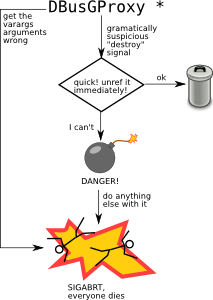
The life-cycle of a DBusGProxy (PD clipart credit: karderio and Andy)
The API provided by dbus-glib for client code is, er, rather less than ideal. The basic object is DBusGProxy, which has a few problems. There's one per interface, rather than one per object; this leads to a maze of twisty GObjects, all suspiciously similar. Our old client library, libtelepathy, got round this by subclassing DBusGProxy to make helper objects called TpChan, TpConn etc., which were simultaneously the proxy for the "main" interface (Channel, Connection etc.), and a factory for proxies for the other interfaces (like Channel.Type.Text and Channel.Interface.Password). This still wasn't ideal, but it was a start. If you use a DBusGProxy in any way after it has emitted the destroy signal, this is considered to be invalid use of the API, and dbus-glib asserts all over the place. We'd rather it didn't do that - remote objects becoming invalid is a fact of life, and if you don't immediately discard all your references to those objects, remote operations on them should just give you a runtime error. You have to be prepared to handle such runtime errors already, because any IPC call can fail at any time. The main API for calling methods uses varargs and is rather subtle. Notably, the calling convention for variant parameters (of D-Bus signature 'v') is not consistent with the calling convention for any other container. For any other container, for instance a GPtrArray *, you pass in a GPtrArray ** pointing to a GPtrArray * variable containing NULL; on success, a pointer to a new GPtrArray is written into that variable. For variant parameters, though, you must pass in a GValue * pointing to a zero-filled GValue, and the result will be written into that GValue. dbus-binding-tool generates thin wrappers around this method-calling API which provide type-safety, although they can't directly specify a non-default timeout. As for signals, before binding to a signal, you have to tell dbus-glib about its signature. This tells dbus-glib how it should push the signal arguments onto the C stack (in GObject terminology: how it should marshal them), to match the signature of the signal-handler function. The documentation claims that this isn't necessary for objects supporting the Introspect method, but that's untrue - on the other hand, if the documented behaviour actually happened, I would consider this to be a critical bug in dbus-glib, since it would enable remote objects to crash dbus-glib clients (by causing signal arguments to be pushed onto the stack in a way that does not match the signature of the signal handler). Of course, the signal-adding function takes varargs, and has to be called exactly once per signal per object. If you don't, dbus-glib asserts when you connect to the signal; if you call it twice, dbus-glib asserts anyway.

TpProxy TpProxy is a GObject subclass vaguely inspired by Python's dbus.proxy.ProxyObject. It isn't a subclass of DBusGProxy, which lets us encapsulate dbus-glib almost completely - in fact, all the references to DBusGProxy are in a separate header, proxy-subclass.h, only used by subclasses of TpProxy (as opposed to normal library API users). TpProxy instances are per-remote-object (per-object-path) like in dbus-python, rather than per-interface like in dbus-glib or QtDBus. As explained below, I believe that this is the most natural object mapping for D-Bus interfaces; in practice it tends to lead to clearer code for us, since one remote object often maps nicely to one UI element (of course, if your objects only have one interface, this approach is no better or worse than dbus-glib's). TpProxy provides support for the following common D-Bus things:
  • Calling methods
  • Connecting to signals
  • Objects becoming invalid
  • Objects with optional interfaces
  • Extensibility
It doesn't currently provide any particular help with Properties - the Properties interface is just another interface as far as we're concerned. We find that, in practice, that's not a problem (even though we use D-Bus properties extensively). In telepathy-qt4 we basically reinvented TpProxy in C++, as Tp::DBusProxy. I've put in some comments below illustrating how the general ideas we used in TpProxy translate into a different object mapping.

Calling methods Method calls on TpProxy are done through auto-generated wrapper functions, much like DBusGProxy. These look something like this:
typedef void (*tp_cli_channel_callback_for_close) (TpChannel *proxy,
    /* any 'out' arguments would go here - Close() doesn't have any */
    const GError *error, gpointer user_data,
    GObject *weak_object);
TpProxyPendingCall *tp_cli_channel_call_close (TpChannel *proxy,
    gint timeout_ms,
    /* any 'in' arguments would go here - Close() doesn't have any */
    tp_cli_channel_callback_for_close callback,
    gpointer user_data,
    GDestroyNotify destroy,
    GObject *weak_object);
Methods for some interfaces, like DBus.Properties, are available on TpProxy itself; others, like Telepathy's Channel.anything, are only available on a particular subclass, like TpChannel. Things to note here:
  • It's an asynchronous call with a callback. General design principle: "this is IPC, get over it". We don't try to hide the fact that IPC is taking place by doing pseudo-blocking calls.
  • The timeout is explicit (although you can always pass -1 to let libdbus pick a "reasonable" default for you). This is because the remote service might not respond, and API users should be at least vaguely aware of this: "this is IPC, get over it".
  • The callback isn't a GCallback; it has an explicit signature, for some semblance of type-safety (it's not much, but it's better than nothing).
  • The callback takes a GError, because any IPC call can fail for any reason.
  • A TpProxyPendingCall * is returned. This is a pointer to an object that only exists until just after the callback is called (so you can ignore it if you don't want it), with a method you can call to cancel the method call (with hindsight this is not ideal, and if I was writing this API now, I'd use gio's GCancellable). "Cancel" is perhaps slightly misleading: the method call still takes place (it was already in libdbus's outgoing queue) but the result gets ignored and the callback isn't called. This is mostly so you an object can forget all the calls it was busy making at the time that the results become irrelevant (e.g. the object is destroyed).
  • There is an extra weak_object argument, which is weakly referenced and is passed to the callback: in practice, most users of telepathy-glib use this as well as or instead of user_data. If the weak_object runs out of references, the callback is automatically cancelled, which means that in practice, explicit cancellation is almost never needed.
  • The generated code has as its first argument a suitable subclass of TpProxy, in this case TpChannel (we tell the code generator about subclasses).
  • You can't see it in the API, but the TpProxy gains an extra ref while a method call is in progress, so you never have to worry about what happens if the proxy gets unreffed during a method call.
  • There's an explicit destructor for the user_data, which is called even if you "cancel" the method call.
In telepathy-qt4, these methods are on small generated helper classes similar to dbus-python's dbus.Interface, one per interface (we provide accessors for them on the non-generated DBusProxy subclass). Instead of using callbacks, we return a temporary QObject per call, which emits a Qt signal on success or failure (that's how all async calls in QtDBus work).

Connecting to signals Similarly, signals have some generated functions:
typedef void (*tp_cli_channel_signal_callback_closed) (TpChannel *proxy,
    /* any arguments would go here - Closed doesn't have any */
    gpointer user_data, GObject *weak_object);
TpProxySignalConnection *tp_cli_channel_connect_to_closed (TpChannel *proxy,
    tp_cli_channel_signal_callback_closed callback,
    gpointer user_data,
    GDestroyNotify destroy,
    GObject *weak_object,
    GError **error);
API notes for these:
  • The callback doesn't take a GError any more, because signals can't fail; the weak_object and the user_data are the same as for method calls
  • This isn't actually a GObject signal at all: those aren't particularly typesafe, and lack namespacing. This might not be very binding-friendly, we haven't tried doing that yet... it might be worth introducing a signal with details, like in dbus-glib, for which these functions are "C bindings".
  • The returned TpProxySignalConnection lets you disconnect from the signal, just like the TpProxyPendingCall above; it can safely be ignored
  • Similarly, if the weak_object dies, then the signal automatically disconnects
  • It is possible for connecting to a signal to fail: this happens if the proxy doesn't actually have the requested interface. If this happens, it's graceful, not a crash. In practice, the flow of code is almost always such that error can safely be NULL because the interfaces are already known.
In telepathy-qt4 the per-interface generated helper classes emit Qt signals. In many cases, we end up proxying these signals by responding to them in the hand-written Tp::DBusProxy subclass by emitting a different signal, in order to give them a nicer representation.

Becoming invalid This is IPC, and any error can happen to you at any time. We found that it was useful to have a general concept of "this object is no longer useful", so we introduced the concept of an object becoming invalidated. The invalidation reason is stored on the object as a GError. If this GError is NULL (as it is initially), then the object is still expected to be valid; if it's non-NULL, the remote object has vanished and the local proxy no longer works. There are several ways a TpProxy can become invalid:
  • its bus name falls off the bus (the process exited or crashed)
  • application-specific reasons (usually triggered by a D-Bus signal in a subclass, like the Telepathy Channel's Closed signal)
  • the GObject gets disposed
Method calls on an invalidated object always fail, with the invalidation reason as the error. This means that calling a method on a TpProxy should never crash your process. The method's callback has to be prepared to handle an error in any case, because this is Sparta^WIPC, so there's no loss in giving it another error. Connecting to signals on an invalidated object always fails, and any existing signal connections are disconnected when it becomes invalidated. This means that if a new remote object appears, and it happens to have the same object path, bus name etc. as the old one, you won't get its signals. A TpProxy can either be bound to a unique bus name or a well-known bus name. In the equivalent code in telepathy-qt4, we call this "stateful" or "stateless" - these names don't capture the intention perfectly, but they're the best we could come up with. A proxy for a stateful API like Telepathy's Channel should always bind to a unique name - when the unique name falls off the bus, the TpProxy becomes invalidated automatically, representing the fact that the Channel you had no longer exists, and nothing can be a perfect replacement for it (the VoIP call has already been terminated, you've already left the chatroom, or whatever - if you make another Channel, that's e.g. a distinct VoIP call). A proxy for a stateless API like Telepathy's ConnectionManager, where an exiting process can disappear, be service-activated again, and still have exactly the same API, should bind to the well-known name. Proxies for well-known names aren't invalidated when the process exits. Qt doesn't have a natural equivalent for GError, so the invalidation reasons in telepathy-qt4 are just a pair of strings, the namespaced name and the message - basically a libdbus DBusError. The principle is the same, though.

Optional interfaces As mentioned above, TpProxy instances are per-remote-object (per-object-path) like in dbus-python, rather than per-interface like in dbus-glib or QtDBus. I believe that this is the most natural object mapping for the D-Bus object model, because the D-Bus interfaces on a remote object can behave like any of these:
  • classes and subclasses (Telepathy.Channel.Type.Text is a Telepathy.Channel)
  • shared interfaces (some Telepathy.Channel objects, of many Types, implement Telepathy.Channel.Interface.Group; any D-Bus object can implement DBus.Properties)
  • optional features (some Telepathy.Channel.Type.Text objects implement Telepathy.Channel.Interface.ChatStates, some do not)
  • discoverable extensions (some Telepathy.Channel.Type.Text objects implement Telepathy.Channel.Interface.Messages, which is more or less Text 2.0)
The way in which interfaces are discovered is also variable. The "classic" D-Bus way to discover interfaces would be to call Introspect. Telepathy services still support that style of introspection, but we don't use it for anything beyond d-feet:
  • Introspect returns a blob of XML, which you have to parse into something useful; if it was in a D-Bus data structure, you'd already have some sensible data structure.
  • Finding out more information about the supported interfaces than their names isn't very useful: in a static language like C you already need to know the methods, signals, properties and their signatures in order to write and compile your code, and in a dynamic language like Python consumers of Introspect end up being remotely crashable by services with unexpected method signatures (this is one of dbus-python's big mistakes in my opinion).
  • If a method that you want to call turns out to be missing, the worst that can happen (in a competently written service) is that it fails with a D-Bus error - and you have to handle D-Bus errors anyway, because this is IPC and anything could fail.
  • Static bindings like dbus-glib have poor support for removing interfaces for which C code exists at runtime, whereas Telepathy needs features like an IM connection that might or might not support avatars (we don't get to find out until we've successfully connected to the server).
Instead, our older interfaces have a method on the "base class" (Channel, Connection etc.) called GetInterfaces, which just returns an array of strings. Newer interfaces (like Account), and older interfaces that have been ported (like Channel), have a property called Interfaces which is, again, an array of strings - this lets us combine the download of the interfaces list with downloading other basic information in a GetAll call. To cater for all these ways to use interfaces, the TpProxy base class has very basic support for interface discovery - you can ask it whether it supports an interface, and you can tell it that it does, in fact, support an interface. Asking which interfaces are supported is directly useful for library users; it's also used as a check by the generated method-call and signal-connection stubs, which return a canned error (Telepathy.Error.NotImplemented in Telepathy's case) if the object isn't known to have the interface. Telling TpProxy that it does support an interface is intended for use by subclasses, and might have been protected if we were writing C++: what happens in practice is that a concrete subclass like TpChannel knows how to discover the fully supported interfaces for this particular object, does so, and calls methods on the TpProxy to tell it which interfaces can work.

Extensibility The API stubs used by TpProxy to call methods and bind to signals are generated from XML documents containing an augmented form of D-Bus introspection data. These XML documents contain various Telepathy-specific extensions, but none of the extensions are language-specific - telepathy-glib, telepathy-python and telepathy-qt4 all operate from exactly the same XML specification. telepathy-qt4's different object-mapping did require us to tighten up some rules that were previously only conventions, but even so, the format is the same. I think this is vitally important - it just doesn't scale to have one set of language-specific annotations in a D-Bus API for each language that will have bindings. One thing that we make heavy use of is what I call "Ugly_Case", which is camel-case with underscores at word boundaries. This gives us a simple, unambiguous and foolproof rule to use in code generators whenever we generate any of the popular conventions for identifiers:
  • CamelCase: delete underscores
  • javaCamelCase: force everything before the first underscore to lower case, then delete underscores
  • lower_case: force everything to lower case, retain underscores
  • UPPER_CASE: force everything to upper case, retain underscores
dbus-glib, by contrast, applies a complex and subtly buggy algorithm to the CamelCase D-Bus names, which results in our SendDTMF method being mapped into GLib as send_dt_mf, and requires that telepathy-glib's Python reimplementation of dbus-binding-tool uses a bug-for-bug compatible implementation (we ended up reimplementing dbus-binding-tool in order to generate the TpProxy-based bindings). Our code generation tools are still rather ad-hoc, because so is our spec format, but for draft interfaces it's possible to copy them into individual projects and use them to generate additional methods for TpProxy or any subclass. This is how we implement unfinished APIs like geolocation in Empathy, for instance. The Interfaces or GetInterfaces hook described above is entirely usable for these extension interfaces, and in fact that's how they're set up. In telepathy-qt4, the generated method stubs are genuine C++ methods, so we can't just append methods to an existing class: this is why we have one helper class per interface, so individual clients can generate a helper class for their particular version of an unfinished API, and instantiate an object of this class attached to a particular Tp::DBusProxy. When an interface becomes stable, it can be added to the set of interfaces for which code is generated in telepathy-glib or telepathy-qt4, at which point any client or service that was already using the final draft of that interface can easily be ported to the library version using sed (the API remains the same).

Becoming ready The concept of being "ready" does not directly exist in TpProxy, but is implemented in TpChannel, TpConnection and TpConnectionManager. The idea is that a freshly created proxy object isn't really fully usable yet - you have to connect to basic signals and recover the initial state of the remote object, as well as checking which extension interfaces are supported. In many well-designed D-Bus APIs you can do this initial setup with a few signal connections and a DBus.Properties.GetAll call. After doing that initial setup (which has to be done asynchronously, because it's IPC), the TpProxy subclass has a local cache of the remote object's state (not necessarily in the same format as the representation on the bus), which can be accessed synchronously at any time, and will be updated in response to change-notification signals. TpChannel and subclasses like it have explicit support for checking for readiness, and having a callback called when the object is ready or invalidated (whichever happens first). The "ready" property also supports the GObject notify signal. telepathy-qt4 took this concept and ran with it - there is library support for objects that can become ready, including a mixin. If I had as much time to work on telepathy-glib as I wish I had, this would be one of the first telepathy-qt4 features to be added to telepathy-glib.

Features becoming ready Going beyond that, in an extensible framework like Telepathy it's probable that not every client understands (or wants to understand) every feature of every object, so it's highly inefficient for every proxy object to subscribe to all the change notification signals and cache all the remote state on the off-chance that the library user wants them. In the API for TpContact (which is not actually a TpProxy for various reasons) we introduced the concept of optional features; telepathy-qt4 extended this idea throughout the library. The idea is that each library user knows which of the optional features are "interesting" to it, and makes a single asynchronous call (which expands into a series of D-Bus calls inside the library) to download the state for core functionality plus all of the selected features, and subscribe to change notification for all of those. This is another telepathy-qt4 thing that telepathy-glib still needs to catch up with; until someone works out how to make the clone() syscall apply to programmers, I fear all libraries are doomed to lag behind how their designers want them to look :-) (license: CC-BY-3.0 / LGPL-2.1+)

Next.

Previous.
