Search Results: "edd"

19 December 2013

Joachim Breitner: My contribution to XKCD s #949

Randall Munroe rightly put shame on all the geeks in the world when he pointed out that transferring files over the internet is still an unsolved problem. I am a big fan of FileTea s approach to transferring files, where they are streamed from browser to browser, without registration and without being stored on some central server, and where closing the browser tab reliably cleans up the transfer. But I wanted something that works from the command line, so I created a small tool called share-file that will use SSH port forwarding to serve the files from a local, embedded web server at a publicly available port, as shown in these screenshots:
It works without additional dependencies (but better with python-magic installed) and requires a publicly available SSH server configured with GatewayPorts clientspecified. For more details, see the README, and to try it out, simply fetch it with git clone git://git.nomeata.de/share-file.git. BTW, if someone implements a command line client for FileTea, I ll happily dump share-file for it.

18 December 2013

Daniel Pocock: Embedding Python in multi-threaded C++ applications

Embedding Python into other applications to provide a scripting mechanism is a popular practice. Ganglia can run user-supplied Python scripts for metric collection and the Blender project does it too, allowing users to develop custom tools and use script code to direct their animations. There are various reasons people choose Python:
  • Modern, object orientated style of programming
  • Interpreted language (no need to compile things, just edit and run the code)
  • Python has a vast array of modules providing many features such as database and network access, data processing, etc
The bottom line is that the application developer who chooses to embed Python in their existing application can benefit from the product of all this existing code multiplied by the imagination of their users. Enter repro repro is the SIP proxy of the reSIProcate project. reSIProcate is an advanced SIP implementation developed in C++. repro is a multi-threaded process. repro's most serious competitor is the Kamailio SIP proxy. Kamailio has its own bespoke scripting language that it has inherited from the SIP Express Router (SER) family of projects. repro has always been far more rigid in its capabilities than Kamailio. On the other hand, while Kamailio has given users great flexibility, it has also come at a cost: users can easily build configurations that are not valid or may not do what they really intend if they don't understand the intricacies of the SIP protocol. Here is an example of the Kamailio configuration script (from Daniel's excellent blog about building a Skype-like service in less than an hour) Kamailio also has a wide array of plugins for things like database and LDAP access. repro only had embedded bdb and MySQL support. Embedding Python into repro appears to be a quick way to fill many of these gaps and allow users to combine the power of the reSIProcate stack with their own custom routing logic. On the other hand, it is not simply copying the Kamailio scripting solution: rather, it provides a distinctive alternative. Starting the integration Embedding Python is such a popular practice that there is even dedicated documentation on the subject. As well as looking there, I also looked over the example provided by the embedded Python module for Ganglia. Looking over the Ganglia mod_python code I noticed a lot of boilerplate code for reference counting and other tedious activities. Given that reSIProcate is C++ code, I thought I would look for a C++ solution to this and I came across PyCXX. PyCXX is licensed under BSD-like terms similar to reSIProcate itself so it is a good fit. There is also the alternative Boost.Python API, however, reSIProcate has been built without Boost dependencies so I decided to stick with PyCXX. I looked over the PyCXX examples and the documentation and was able to complete a first cut of the embedded Python scripting feature very quickly. Using PyCXX One unusual thing I noticed about PyCXX is that the Debian package, python-cxx-dev does not provide any shared library. Instead, some uncompiled source files are provided and each project using PyCXX must compile them and link them statically itself. Here is how I do that in the Makefile.am for pyroute in repro:
AM_CXXFLAGS = -I $(top_srcdir)
reproplugin_LTLIBRARIES = libpyroute.la
libpyroute_la_SOURCES = PyRoutePlugin.cxx
libpyroute_la_SOURCES += PyRouteWorker.cxx
libpyroute_la_SOURCES += $(PYCXX_SRCDIR)/cxxextensions.c
libpyroute_la_SOURCES += $(PYCXX_SRCDIR)/cxx_extensions.cxx
libpyroute_la_SOURCES += $(PYCXX_SRCDIR)/cxxsupport.cxx
libpyroute_la_SOURCES += $(PYCXX_SRCDIR)/../IndirectPythonInterface.cxx
libpyroute_la_CPPFLAGS = $(DEPS_PYTHON_CFLAGS)
libpyroute_la_LDFLAGS = -module -avoid-version
libpyroute_la_LDFLAGS += $(DEPS_PYTHON_LIBS)
EXTRA_DIST = example.py
noinst_HEADERS = PyRouteWorker.hxx
noinst_HEADERS += PyThreadSupport.hxx
The value PYCXX_SRCDIR must be provided on the configure command line. On Debian, it is /usr/share/python2.7/CXX/Python2 Going multi-threaded My initial implementation simply invoked the Python method from the main routing thread of the repro SIP proxy. This meant that it would only be suitable for executing functions that complete quickly, ruling out the use of any Python scripts that talk to network servers or other slow activities. When the proxy becomes heavily loaded, it is important that it can complete many tasks asynchronously, such as forwarding chat messages between users in real-time. Therefore, it was essential to extend the solution to run the Python scripts in a pool of worker threads. At this point, I had an initial feeling that there may be danger in just calling the Python methods from some other random threads started by my own code. I went to see the manual and I came across this specific documentation about the subject. It looks quite easy, just wrap the call to the user-supplied Python code in something like this:
PyGILState_STATE gstate;
gstate = PyGILState_Ensure();
/* Perform Python actions here. */
result = CallSomeFunction();
/* evaluate result or handle exception */
/* Release the thread. No Python API allowed beyond this point. */
PyGILState_Release(gstate);
Unfortunately, I found that this would not work and that one of two problems occur when using this code:
  • The thread blocks on the call to PyGILState_Ensure()
  • The program crashes with a segmentation fault when the call to a Python method was invoked
Exactly which of these outcomes I experienced seemed to depend on whether I tried to explicitly call PyEval_ReleaseThread() from the main thread after doing the Py_Initialize() and other setup tasks. I tried various permutations of using PyGILState_Ensure()PyGILState_Release() and/or PyEval_SaveThread()/PyEval_ReleaseThread() but I always had one of the same problems. The next thing that occurred to me is that maybe PyCXX provides some framework for thread integration: I had a look through the code and couldn't find any reference to the threading functionality from the C API. I went looking for more articles and mailing list discussions and found implementation notes such as this one in Linux Journal and this wiki from the Blender developers. Most of them just appeared to be repeating what was in the manual, with a few subtle differences, but none of this provided an immediate solution. Eventually, I discovered this other blog about concurrency with embedded Python and it suggests something not highlighted in any of the other resources: calling PyThreadState_New(m_interpreterState) in each thread after it starts and before it does anything else. Combining this with the use of PyEval_SaveThread()/PyEval_ReleaseThread() fixed the problem: the use of PyThreadState_New() was not otherwise mentioned in the relevant section of the Python guide. I decided to take this solution a step further and create a convenient C++ class to encapsulate the logic, you can see this in PyThreadSupport.hxx:
class PyExternalUser
 
   public:
      PyExternalUser(PyInterpreterState* interpreterState)
       : mInterpreterState(interpreterState),
         mThreadState(PyThreadState_New(mInterpreterState))  ;
   class Use
    
      public:
         Use(PyExternalUser& user)
          : mUser(user)
           PyEval_RestoreThread(mUser.getThreadState());  ;
         ~Use()   mUser.setThreadState(PyEval_SaveThread());  ;
      private:
         PyExternalUser& mUser;
    ;
   friend class Use;
   protected:
      PyThreadState* getThreadState()   return mThreadState;  ;
      void setThreadState(PyThreadState* threadState)   mThreadState = threadState;  ;
   private:
      PyInterpreterState* mInterpreterState;
      PyThreadState* mThreadState;
 ;
and the way to use it is demonstrated in the PyRouteWorker class. Observe how PyExternalUser::Use is instantiated in the PyRouteWorker::process() method: when it goes out of scope (either due to a normal return, an error or an exception) the necessary call to PyEval_SaveThread() is made in the PyExternalUser::Use::~Use() destructor. Using other Python modules and DSO problems All of the above worked for basic Python such as this trivial example script:
def on_load():
    '''Do initialisation when module loads'''
    print 'example: on_load invoked'
def provide_route(method, request_uri, headers):
    '''Process a request URI and return the target URI(s)'''
    print 'example: method = ' + method
    print 'example: request_uri = ' + request_uri
    print 'example: From = ' + headers["From"]
    print 'example: To = ' + headers["To"]
    routes = list()
    routes.append('sip:bob@example.org')
    routes.append('sip:alice@example.org')
    return routes
However, it needs a more credible and useful test: using the python-ldap module to try and query an LDAP server appears like a good choice. Upon trying to use import ldap in the Python script, repro would refuse to load the Python script, choking on an error like this:
Traceback (most recent call last):
  File "/usr/lib/python2.7/dist-packages/ldap/__init__.py", line 22, in 
    import _ldap
ImportError: /usr/lib/python2.7/dist-packages/_ldap.so: undefined symbol: PyExc_SystemError
I looked at the file _ldap.so and discovered that it is linked with the LDAP libraries but not explicitly linked to any version of the Python runtime libraries. It expects the application hosting it to provide the Python symbols globally. In my own implementation, my embedded Python encapsulation code is provide as a DSO plugin, similar to the way plugins are loaded in Ganglia or Apache. The DSO links to Python: the DSO is loaded by a dlopen() call from the main process. The main repro binary has no direct link to Python libraries. Adding RTLD_GLOBAL to the top-level dlopen() call for loading the plugin is one way to ensure the Python symbols are made available to the Python modules loaded indirectly by the Python interpreter. This solution may be suitable for applications that don't mix and match many different components. Doing something useful with it Now it was all working nicely, I took a boilerplate LDAP Python example and used it for making a trivial script that converts sip:user@example.org to something like sip:9001@pbx.example.org, assuming that 9001 is the telephoneNumber associated with the user@ email address in LDAP. It is surprisingly simple and easily adaptable to local requirements depending upon the local LDAP structures:
import ldap
from urlparse import urlparse
def on_load():
    '''Do initialisation when module loads'''
    #print 'ldap router: on_load invoked'
def provide_route(method, request_uri, headers):
    '''Process a request URI and return the target URI(s)'''
    #print 'ldap router: request_uri = ' + request_uri
    _request_uri = urlparse(request_uri)
    routes = list()
    
    # Basic LDAP server parameters:
    server_uri = 'ldaps://ldap.example.org'
    base_dn = "dc=example,dc=org"
    # this domain will be appended to the phone numbers when creating
    # the target URI:
    phone_domain = 'pbx.example.org'
    # urlparse is not great for "sip:" URIs,
    # the user@host portion is in the 'path' element:
    filter = "(&(objectClass=inetOrgPerson)(mail=%s))" % _request_uri.path
    #print "Using filter: %s" % filter
    try:
        con = ldap.initialize(server_uri)
        scope = ldap.SCOPE_SUBTREE
        retrieve_attributes = None
        result_id = con.search(base_dn, scope, filter, retrieve_attributes)
        result_set = []
        while 1:
            timeout = 1
            result_type, result_data = con.result(result_id, 0, None)
            if (result_data == []):
                break
            else:
                if result_type == ldap.RES_SEARCH_ENTRY:
                    result_set.append(result_data)
        if len(result_set) == 0:
            #print "No Results."
            return routes
        for i in range(len(result_set)):
            for entry in result_set[i]:
                if entry[1].has_key('telephoneNumber'):
                    phone = entry[1]['telephoneNumber'][0]
                    routes.append('sip:' + phone + '@' + phone_domain)
    except ldap.LDAPError, error_message:
        print "Couldn't Connect. %s " % error_message
    return routes
Embedded Python opens up a world of possibilities After Ganglia 3.1.0 introduced an embedded Python scripting facility, dozens of new modules started appearing in github. Python scripting lowers the barrier for new contributors to a project and makes it much easier to fine tune free software projects to meet local requirements: hopefully we will see similar trends with the repro SIP proxy and other projects that choose Python. The code is committed here in the reSIProcate repository. These features will appear in the next beta release of reSIProcate and Debian packages will be available in unstable in a few days.

17 December 2013

Joey Hess: completely linux distribution-independent packaging

Sometimes it makes sense to ship a program to linux users in ready-to-run form that will work no matter what distribution they are using. This is hard. Often a commerical linux game will bundle up a few of the more problimatic libraries, and ship a dynamic executable that still depends on other system libaries. These days they're building and shipping entire Debian derivatives instead, to avoid needing to deal with that. There have been a few efforts to provide so-called one click install package systems that AFAIK, have not been widely used. I don't know if they generally solved the problem. More modern appoaches seem to be things like docker, which move the application bundle into a containerized environment. I have not looked at these, but so far it does not seem to have spread widely enough to be a practical choice if you're wanting to provide something that will work for a majority of linux users. So, I'm surprised that I seem to have managed to solve this problem using nothing more than some ugly shell scripts. My standalone tarballs of git-annex now seem fairly good at running on a very wide variety of systems. For example, I unpacked the tarball into the Debian-Installer initramfs and git-annex could run there. I can delete all of /usr and it keeps working! All it needs is a basic sh, which even busybox provides. Looks likely that the new armel standalone tarball of git-annex will soon be working on embedded systems as odd as the Synology NAS, and it's already been verified to work on Raspbian. (I'm curious if it would work on Android, but that might be a stretch.) Currently these tarballs are built for a specific architecture, but there's no particular reason a single one couldn't combine binaries built for each supported architecture. technical details The main trick is to ship a copy of ld-linux.so, as well as all the glibc libraries and associated files, and of course every other library and file the application needs. Shipping ld-linux.so lets a shell script wrapper be made around each binary, that runs ld-linux.so and passes it the library directories to search. This way the binary can be run, bypassing the system's own dynamic linker (which might not like it) and using the included glibc. For example a shell script that runs the git binary from the bundle:
exec "$GIT_ANNEX_LINKER" --library-path "$GIT_ANNEX_LD_LIBRARY_PATH" "$GIT_ANNEX_SHIMMED/git/git" "$@"
I have to set quite a lot of environment variables, to avoid using any files from the system and instead use ones from my tarball. One important one is GCONV_PATH. Note that LD_LIBRARY_PATH does not have to be set, and this is nice because it allows running a few programs from the host system, such as its web browser. worse is better Of course I'll take a proper distribution package anytime over this. Still, it seems to work quite well, in all the horrible cases that require it.

16 December 2013

Russ Allbery: krb5-strength 2.2

krb5-strength provides a plugin and external password checking program implementation of password strength checking for Kerberos KDCs. Management at Stanford has decided that we want to impose different character class restrictions by length, with longer passwords having fewer required character classes. This release therefore adds more comprehensive character class requirement support, including the ability to set varying requirements based on the length of the password. This release also improves the cdbmake-wordlist utility, adding support for removing words longer than a maximum length and filtering out words that match a user-provided regular expression. It can also be run in filter mode to generate a new wordlist instead of a CDB file. Finally, a file descriptor and memory leak in the embedded version of CrackLib has been fixed. (This was already fixed in the regular CrackLib release.) You can get the latest version from the krb5-strength distribution page.

Dirk Eddelbuettel: RProtoBuf 0.3.2

A new version 0.3.2 of RProtoBuf, is now on CRAN. RProtoBuf provides GNU R bindings for the Google Protobuf data encoding library used and released by Google. As for the last few releases, Murray took charge of most changes. The NEWS file entry follows:
Changes in RProtoBuf version 0.3.2 (2013-12-15)
  • Fixed a bug that erroneously prevented users from setting raw byte fields in protocol buffers under certain circumstances.
  • Give a user friendly error message when seting an extension to a message of the wrong type instead of causing a C++ check failure that terminates the Rsession.
  • Change object table lookup slightly to allow users to use the <<- operator in code using RProtoBuf without hitting a stop() error in the lookup routine.
  • Add missing enum_type method and improve show method for EnumValueDescriptors.
  • Improve documentation and tests for all of the above.
  • Rewrote tests/ script calling RUnit tests
CRANberries also provides a diff to the previous release 0.3.1. More information is at the RProtoBuf page which has a draft package vignette, a 'quick' overview vignette and a unit test summary vignette. Questions, comments etc should go to the rprotobuf mailing list off the RProtoBuf page at R-Forge.

This post by Dirk Eddelbuettel originated on his Thinking inside the box blog. Please report excessive re-aggregation in third-party for-profit settings.

14 December 2013

Dirk Eddelbuettel: RcppDE 0.1.2

A maintenance release (now at version 0.1.2) of my RcppDE package (previously described in these two posts) is now CRAN. More details about the package are available in the vignette also included in the RcppDE R package. Changes were minimal and driven mostly by some CRAN Policy changes which now prefer vignette sources files in (top-level) directory vignettes/ Courtesy of CRANberries, there is also a diffstat report for the most recent release. Current and previous releases are available here as well as on CRAN.

This post by Dirk Eddelbuettel originated on his Thinking inside the box blog. Please report excessive re-aggregation in third-party for-profit settings.

Dirk Eddelbuettel: random 0.2.2

A maintenance release of my random package for truly (hardware-based) random numbers (pulled from random.org) is now on CRAN. It's been a while since previous releases. The package is described in a detailed vignette as well as in a essay by Mads Haahr. Changes were minimal and driven mostly by some CRAN Policy changes which now prefer vignette sources files in (top-level) directory vignettes/ Courtesy of CRANberries, there is also a diffstat report for the most recent release. Current and previous releases are available here as well as on CRAN.

This post by Dirk Eddelbuettel originated on his Thinking inside the box blog. Please report excessive re-aggregation in third-party for-profit settings.

Dirk Eddelbuettel: gcbd 0.2.5

A maintenance release (now at version 0.2.5) of my gcbd package (described only in these two posts) is now CRAN. More details about the package are available in the paper which is also included in the gcbd R package. Changes were minimal and driven mostly by some CRAN Policy changes which now prefer vignette sources files in (top-level) directory vignettes/ Courtesy of CRANberries, there is also a diffstat report for the most recent release.

This post by Dirk Eddelbuettel originated on his Thinking inside the box blog. Please report excessive re-aggregation in third-party for-profit settings.

10 December 2013

Dirk Eddelbuettel: RcppArmadillo 0.3.930.1

A new Armadillo release 3.930 came out a few days ago, with a very nice set of changes (see below). I rolled this into RcppArmadillo 0.3.930.0. However, one of these changes revealed that R shipped only the standard SVD for complex-valued matrices, and not the more performant divide-and-conquer approach. So in R builds using the default built-in Lapack, at least one CRAN package no longer built. After some back and forth, Conrad put some branching in the library to fall back to the standard SVD, and I added a built-time configuration test for an appropriate preprocessor directive used by the fallback code. This is now on which is now on CRAN and in Debian as RcppArmadillorelease 0.3.930.1, and Conrad will probably update the Armadillo page as well (though the fix is only needed with R's builtin Rlapack). Also of note is that R Core already added the missing Fortran routine zgesdd to R 3.1.0 (aka "R-devel") so this issue goes away with the next release. Also of note, I wrote up a short Rcpp Gallery post illustrating the performance gains available from divide-and-conquer SVD. The complete list of changes is below.
Changes in RcppArmadillo version 0.3.930.1 (2013-12-09)
  • Upgraded to Armadillo release Version 3.930.1
    • Armadillo falls back to standard complex svd if the more performant divide-and-conquer variant is unavailable
  • Added detection for Lapack library and distinguish between R's own version (withhout zgesdd) and system Lapack; a preprocessor define is set accordingly
Changes in RcppArmadillo version 0.3.930.0 (2013-12-06)
  • Upgraded to Armadillo release Version 3.930 ("Dragon's Back")
    • added divide-and-conquer variant of svd_econ(), for faster SVD
    • added divide-and-conquer variant of pinv(), for faster pseudo-inverse
    • added element-wise variants of min() and max()
    • added size() based specifications of submatrix view sizes
    • added randi() for generating matrices with random integer values
    • added more intuitive specification of sort direction in sort() and sort_index()
    • added more intuitive specification of method in det(), .i(), inv() and solve()
    • added more precise timer for the wall_clock class when using C++11
  • New unit tests for complex matrices and vectors
Courtesy of CRANberries, there is also a diffstat report for the most recent release As always, more detailed information is on the RcppArmadillo page. Questions, comments etc should go to the rcpp-devel mailing list off the R-Forge page.

This post by Dirk Eddelbuettel originated on his Thinking inside the box blog. Please report excessive re-aggregation in third-party for-profit settings.

7 December 2013

Dirk Eddelbuettel: R and Big Data at Big Data Summit at UI Research Park

I spent yesterday at the very enjoyable Big Data Summit held at the University of Illinois Research Park at the edge of the University of Illinois at Urbana-Champaign. campus. My (short) presentation was part of a panel session on R and Big Data which Doug Simpson of the UIUC Statistics department had put together very well. We heard from a vendor / technology provider with Christopher Nguyen from Adatao talking about their "Big R", from industry with Andy Stevens talking about a number of some real-life challenges with big data at John Deere, from academia with Jonathon Greenberg talking about R and HPC for geospatial research and I added a few short comments and links about R, HPC and Rcpp. My few slides are now up on my talks / presentations page. Overall, a good day with a number of interesting presentations and of course a number of engaging hallway discussions.

This post by Dirk Eddelbuettel originated on his Thinking inside the box blog. Please report excessive re-aggregation in third-party for-profit settings.

3 December 2013

Dirk Eddelbuettel: digest 0.6.4

digest version 0.6.4 is now on CRAN and in Debian. This is a pure maintenance release which should help with a build issue affecting users on Solaris. CRANberries provides the usual summary of changes to version 0.6.3. Our package is available via the R-Forge page leading to svn and tarball access, my digest page, the local directory here as well as via Debian and its mirrors.

This post by Dirk Eddelbuettel originated on his Thinking inside the box blog. Please report excessive re-aggregation in third-party for-profit settings.

2 December 2013

Dirk Eddelbuettel: Recent Rcpp talks at U Chicago / Booth and U Kansas

In early October, I had an opportunity to talk about Rcpp and RcppArmadillo at the Statistical Computing Seminar at the Booth School of Business at the University of Chicago. And then two weeks ago, I had an invitation to talk at the Center for Research Methods and Data Analysis at the University of Kansas where I covered similar material as well as ongoing work on the RcppZiggurat package (for which I should have an updated version soon). Slides from both talks are now at the top of my talks / presentations page.

This post by Dirk Eddelbuettel originated on his Thinking inside the box blog. Please report excessive re-aggregation in third-party for-profit settings.

30 November 2013

Dirk Eddelbuettel: RcppCNPy 0.2.2

Right on the heels of release 0.2.1 of RcppCNPy, a new version 0.2.2 is now on CRAN. RcppCNPy uses the CNPY library by Carl Rogers to provide R with easy read and write access to NumPy files. The reason for the new version that I had experimented with a different way to test endianness (as needed for the NumPy file headers) but accidentally sent an interim tarball to CRAN which still wanted to include endian.h promptly breaking Windows builds. So now we do something even simpler and just rely on the (even more complete) test for endianness when R is built, which prevents all sorts of complications for us and builds everywhere (with thanks to Brian Ripley for the suggestion). While we were at it, we also added a new unit test. Full changes are listed below.
Changes in version 0.2.2 (2013-11-29)
  • Switched to using the result from the compile-time configuration for R to determine big or little endian (as needed for the NPy headers)
  • Added a new test (and test validation result file) for a complete save-reload cycle and comparison
CRANberries also provides a diffstat report for 0.2.2 relative to 0.2.1. As always, feedback is welcome and the rcpp-devel mailing list off the R-Forge page for Rcpp is the best place to start a discussion.

This post by Dirk Eddelbuettel originated on his Thinking inside the box blog. Please report excessive re-aggregation in third-party for-profit settings.

28 November 2013

Dirk Eddelbuettel: RcppCNPy 0.2.1

Version 0.2.1 of RcppCNPy is now on CRAN earlier. This version is a minor upgrade with a few small changes as detailed in the NEWS file:
Changes in version 0.2.1 (2013-11-28)
  • Synchronized code with the cnpy repository
  • Added new function to test from R whether integers supported
  • Updated tests for integer support, if available
  • Updated vignette and discussion about need for rebuilding only RcppCNPy with the -std=c++11 flag if integer support is desired
  • Updated tests for integer support, if available
  • Updated THANKS file
  • Ensure that inclusion of Rinternal.h does not affect other headers by adding RF_NO_REMAP
CRANberries also provides a diffstat report for 0.2.1 relative to 0.2.0. As always, feedback is welcome and the rcpp-devel mailing list off the R-Forge page for Rcpp is the best place to start a discussion.

This post by Dirk Eddelbuettel originated on his Thinking inside the box blog. Please report excessive re-aggregation in third-party for-profit settings.

26 November 2013

Daniel Pocock: Real-time streaming market data with free software

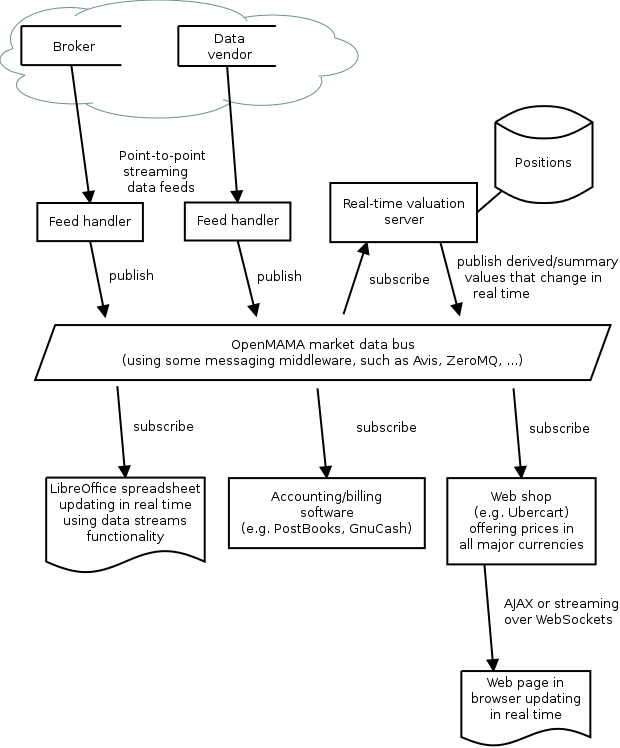
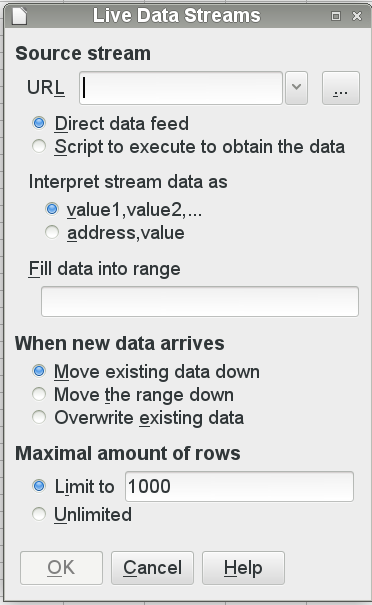
Here is an overview of the real-time market data architecture based on OpenMAMA: All these components may be running on a single host or they may be distributed across different servers and workstations in a LAN. The OpenMAMA market data bus ties them together. External data sources These are external sources of data. These could be currency trading firms, stock brokers, bullion dealers or even Bitcoin exchanges. Some exchanges don't provide data services directly to the general public and they distribute their price data through third-party data vendors such as Reuters and Bloomberg. Feed handlers The feed handlers manage the connections to external data sources. These are typically daemon processes that implement the wire protocols used by the external vendors for transmitting data over the public internet or a leased line. They typically use a point-to-point topology such as TCP connections. The feed handlers publish the data into the market data bus. In practice, the feed handler may be a proprietary application provided by the data vendor or it may simply be a Python script that fetches exchange rates from a URL every five minutes. OpenMAMA The market data bus is a distributed framework that is accessible to all of the local servers and workstations in the LAN. At the lowest level a messaging middleware solution is used to transport the data. The Avis Event Router is a free middleware. There is upcoming support for Apache QPID as well. Some commcercial middleware is supported too - here is the full list OpenMAMA does not provide a daemon or server process of its own. It is a set of libraries that operate on top of the middleware transport. In very general terms, the OpenMAMA libraries let applications publish messages (such as price ticks) or subscribe to receive the messages published by other applications. Spreadsheet application (for example, LibreOffice) LibreOffice is introducing a new data import feature for streaming time series data. This appears to provide a useful integration point for OpenMAMA and discussion is taking place in the development community. The spreadsheet can operate in various ways. A simple application may simply poll the currency prices when the spreadsheet is opened or refreshed. A more demanding application may see the spreadsheet come alive, recalculating all cells on every tick from the data vendor (several times per second). This latter scenario is more common in dealing rooms and hedge funds. Accounting/billing software There are many free accounting applications today, including PostBooks and GnuCash and some more heavyweight solutions like Adempiere and OpenERP. In a world where credit cards and the world wide web have made international trade an everyday activity, many people are using this software to track expenses and accounts in more than one currency. For example, a British business may be paying some suppliers in Euros and a Canadian may be charging some customers in US dollars. A Swiss person may be keeping some of their savings in gold bullion in the vault of one of their world reknowned Swiss banks. A common requirement for all of these users is the balance sheet. Using real-time market data sources, the balance sheet can be refreshed at any time from the live market prices. A home user may just find it convenient that they can open the balance sheet and always see their net worth immediately without having to manually cut and paste the currency prices from a web page. A business user operating in a competitive industry with low margins may be checking the balance sheet several times per day to ensure they remain solvent and profitable. Web shops Many web shops now offer the customers the convenience of viewing prices in their own currency. It is important to make sure these prices are accurate, especially when dealing with volatile currencies or when the products have a low profit margin. The web application server can receive the market data price ticks just like any other application in the network. Using this data, it can insert live prices into the pages as they are generated. If the currencies are particularly volatile, the web application could stream the prices to the browser using WebSockets and a JavaScript client embedded in the page would update the price field in real time. In fact, this web-based streaming price update mechanism is exactly how many online financial trading services offer live market prices to their customers. Real-time valuation server In a large organisation there may be many users looking at the same values. For example, in a trading desk, many users may need to see the desk's overall position in each market. In a busy web shop, many concurrent users may need to see the prices of common products. Rather than recalculating these values for each user in parallel, a common solution involves setting up a server to receive raw values (such as currency prices) from the data feed, calculate values needed by local users and then broadcast those values over the market data bus. How applications can integrate with real-time market data Here are some steps for getting started:

24 November 2013

Dirk Eddelbuettel: Website and blog updated

Earlier this year the blog had its tenth anniversary. I had meant to celebrate the occassion by revamping the site and blog a little. Having set up the updated R/Finance site, the Rcpp Gallery and Rcpp sites as well as the much-needed overhaul of the html side of the CRANberries RSS feed (which also integrates it with the static blog compiler I use), I figured I just needed a little time to get this done. Well, eight months later we're there. It still uses Twitter Bootstrap for layout, and a slightly modified Bootswatch theme. Comments welcome, and please let me know if links are missing or going nowhere in places.

This post by Dirk Eddelbuettel originated on his Thinking inside the box blog. Please report excessive re-aggregation in third-party for-profit settings.

22 November 2013

Iustin Pop: Z rich at night

Last weekend I realised that one of the advantages of winter is that it gets dark quite early - so I took a short walk through Z rich at night to take a set of pictures. I usually only shoot handheld at night, which has its limitations, and this time I took a tripod with me. It's a very cheap tripod which I have for many years now and I don't really use - and the test was to see if it's actually usable for long exposures. The results can be seen on my Smugmug gallery. Some of the pictures I really like, but that's not the main point - I learned a lot in just an hour or so. First, the tripod worked. Well, it's cheap and plasticky, so "mirror delay 3" was absolutely needed, but with that the pictures got out reasonably sharp, even at 30s exposure. Second, I forgot my cable release at home, even though I explicitly wanted to take it, so "mirror delay 3" became my remote release. Logistics aside, the most interesting thing was that in the dark, the enemy is light, and not darkness. In the city, the contrast between darkness and strong lights results in a large dynamic range requirement, and - to me - that was a surprising realisation. As an example, in this picture, I had to use f/22 to get the desired exposure time, as the light was too strong. Another surprising realisation was that, if you're shooting with 30s exposure time, a person passing in front of the camera (but not staying in the same place) will leave no trace. At shorter exposures, or when the person has a low transversal speed, then it will show, but otherwise, you don't have to care too much . Something that I knew but it was not nice to be reminded of is how "broken" auto white balance is in presence of artificial lighting (basically low temperature). Add the fact that in a non-trivial scene you have multiple lights with different temperatures makes any night scene interesting - I had to manually fix white balance for the entire album, and I don't think I got it right. And finally - light pollution. The sky above Z rich was cloudy, and the clouds were glowing orange/reddish. I can't wait to get somewhere a bit far from civilisation with a nice, dark sky

20 November 2013

Dirk Eddelbuettel: RcppArmadillo 0.3.920.3

Conrad released a bug fix version 3.920.3 for his Armadillo library. So I prepared a new release 0.3.920.3 of RcppArmadillo which is nor on on CRAN and also already in Debian. Note that we skipped interim version .2 which addressed an Atlas linking issue which doesn't affect us in the R context as we get LAPACK and BLAS via the R process we get used from. The complete list of changes is below.
Changes in RcppArmadillo version 0.3.920.3 (2013-11-20)
  • Upgraded to Armadillo release Version 3.920.3
    • fix for handling of tiny matrices by .swap()
Courtesy of CRANberries, there is also a diffstat report for the most recent release As always, more detailed information is on the RcppArmadillo page. Questions, comments etc should go to the rcpp-devel mailing list off the R-Forge page.

This post by Dirk Eddelbuettel originated on his Thinking inside the box blog. Please report excessive re-aggregation in third-party for-profit settings.

16 November 2013

Lars Wirzenius: Debian: developing it wrong

This is an essay form of a talk I have given today at the Cambridge Mini-debconf. The talk was videoed, so will presumably show up in the Debconf video archive eventually. Abstract Debian has a long and illustrious history. However, some of the things we do perhaps no longer make as much sense as they used to do. It's a new millennium, and we might find better ways of doing things. Things that used to be difficult might now be easy, if we dare look at things from a fresh perspective. I have been doing that at work, for the Baserock project, and this talk is a compilation of observations based on what I've learnt, concentrating on things that affect the development workflow of package maintainers. Introduction and background I have been a Debian developer since August, 1996 (modulo a couple of retirements), and have used it a little bit longer. I have done a variety of things for Debian, from maintaining PGP 2 packages to writing piuparts to blathering excessively on the mailing lists. My day job is to develop the Baserock system at Codethink. Baserock is a set of tools and workflows for developing embedded and appliance Linux systems. If you squint, it looks a bit like a source-based Linux distribution. I have worked on Baserock since September, 2011. Some of Baserock's design has been influenced by my experience with Debian. With Baserock I have the chance to fix all the things that are wrong in Debian, and this talk is me giving back to Debian by pointing out some the things I feel should be fixed. I don't have solutions for these problems: this is a bug report, not a patch. It's also perhaps a bit of a rant. I am specifically concentrating here on technical and tooling issues that affect the development process of Debian. I excluding social issues. I am also not trying to get Debian to switch to Baserock. Baserock is targeting embedded and appliance systems, and makes simplifying assumptions based on those targets, which Debian does not get to do. I am pointing out problems, and I am outlining solutions as implemented in Baserock, when I think the concept carries over well to Debian. Build tools should be intelligent, packaging should be dumb In Debian, the fundamental tool for compiling the upstream code and assembling a binary package is dpkg-buildpackage. It uses debian/rules, which is a Makefile with targets with specific names and semantics. By executing the right targets in the right order, dpkg-buildpackage tells the source package to build the binary package. On the one hand, this is a nice design, because it abstracts away the large variety of upstream build systems into one API for dpkg-buildpackage to use. On the other hand, it puts all the intelligence for how packages are built into the packages. Making packaging intelligent, rather than the build tool, means packagers need to do more work, and there's more work to do when, say, the Debian policy changes, or when there are other changes that affect a large number of packages. If packaging is intelligent, then every package needs changes. If the build tool is intelligent, then you change the build tool and re-build everything. In Baserock we put as much intelligence as we can into the Morph tool, which drives the build process. It turns out that today, unlike in 1995, most upstream projects use one of a handful well-known build systems: autotools, cpan, cmake, Python distutils, etc. With just a little extra logic in Morph we avoid having any delta against upstream in Baserock. This doesn't work for quite all upstream projects, of course, but we've spent the 2% (two, not twenty) of effort that solves 80% of the problem. In recent years, the dh approach to packaging has made a lot of packages be able to have only a minimal, 3-line debian/rules file. This is excellent. Wouldn't it be nice if even that wasn't needed? It'd save thousands of files in source packages across the archive, at least. It would be easy to: if the file is missing, have dpkg-buildpackage assume the 3-line version by default. Getting rid of a single file is, of course, not a particularly big win. The big win is the change in mindset: rather than dealing with all new issues in development by adding yet more fields to debian/control and more optional, competing tooling outside the core toolset, if you improve the tools everyone uses, then everyone's packages gets better. The goal should, in my opinion, be that for the large number of packages where upstream uses a well-known, well-behaved build system, and uses it in a reasonably sensible way, the Debian source package should not require anything added to make the package build. There will still be a need to add some stuff, such as the debian/copyright file, to make a good Debian package, but just getting the package to build should require nothing extra. (Side note: wouldn't it be nice if there was a well-known, widely used way to mark up copyright information so that debian/copyright could be constructed and updated automatically?) Configuration file handling on upgrades: add ucf to dpkg already In the 1990s, dpkg had excellent handling of configuration files and merging local changes with changes from the new package version, but it was excellent only because it tried to do that at all, and mostly nothing else did. It hasn't changed much, since, and it's not excellent on any absolute scale. We have the ucf tool, which can do a better job, but requires to be added to each package wanting to use it. Why don't we make dpkg smarter, instead? If ucf is not not good enough to be merged wholesale into dpkg, let's write something better. Making every package maintainer use ucf manually is just wasteful. This is not the kind of thing that should be done for each package separately: the package manager should be smart so that packaging can be stupid. The goal should be that dpkg is smart enough in its configuration file handling that having the package do it is a very rare special case. Clean building shouldn't be hard The basic tool for building a package is dpkg-buildpackage. It is ever so slightly cumbersome to use, so there are some wrappers, most importantly debuild. However, if you're making a build intended to be uploaded to the Debian archive, you should be doing a clean build. This means having to learn, configure, and use yet more tools. A clean build is important: security updates, development, debugging, quality control, porting, and user support become more difficult if we don't know how a package was built, and can't reproduce the build. It gets harder to keep build dependencies correct, making it harder for everyone to build things. Luckily, Debian has solved the clean build problem. Unluckily, it has solved it multiple times, creating the problem of having to choose the clean building approach you want to use. The default way of building is not clean, so then you have to remember to use the non-standard way. You also get to spend time maintaining the clean build environments yourself, since that doesn't seem to be fully automated. None of this is hard, as such, but it's extra friction in the development workflow. The primary approaches for clean building in Debian seem to be pbuilder, cowbuilder, and sbuild. I happen to use pbuilder myself, because it's what's been around the longest, but I make no claim of having made an informed choice. That is part of the problem here: why should I have to spend the effort to become informed to make a choice well? Why is the default way of building not clean? Don't say performance: Morph sets up a clean staging area in seconds, and does not offer you a choice of not doing so. It's a chroot, with everything but the build tree hardlinked from cached, unpacked build dependencies, and protected using read-only bind mounts. What's more, this approach avoids having to maintain the pbuilder base tarballs or sbuild chroots manually. It's all automatic, and up to date, for every build. Furthermore, the staging area contains only the specified build dependencies, and not anything else, meaning a build fails if a build dependency is missing, rather than succeeding because it happens to be in the default set of packages the build tool installs. Mass building shouldn't be hard Suppose you want to try out a large-scale change in Debian. It might be trying out a new version of GCC, or using llvm's clang as the default C compiler, or updating glibc, or doing a large library transition such as a new version of GTK+, or trying a new dpkg version, or even something more exploratory such as changing the default optimisation flags for all packages to see what breaks. All of these will require you to at least rebuild all affected packages. Ideally you'd test the built packages as well, but let's concentrate on the building for now. Here's what you do. You make the changes you want to try out, and build those packages. You create a dedicated APT repository, and upload your packages there. You configure your build environment to favour that APT repository. You make a list of all reverse build dependencies of the packages you changed. You write a script to build all of those, preferably so that if you change A, and rebuild B, then you also rebuild C which build depends on B. Each rebuilt package you also upload to your APT repository. You keep track of the build log, and success or failure, of each build. The people in Debian who do this kind of stuff regularly presumably have tools for doing it. It shouldn't be a rare, special thing, though. If my package has reverse build dependencies, I should at least consider testing building when I'm making changes. Otherwise, it might take years until the reverse build dependencies are rebuilt, and the problem is only found then, making it harder to fix. To be fair, building a lot of packages takes a lot of resources. It's not feasible to rebuild everything in Debian every time there's any change to, say, eglibc. However, it's feasible to do it, for large subsets of the archive, without huge hardware investments. One VCS to rule them all In 1995 there was really only one relevant version control system: CVS. It was not a great tool. In 2000, another contender existed: Subversion. It fixed some problems in CVS, but still wasn't a great tool. In 2005, there was a great upheaval and distributed version control systems started to become mainstream. There were a large handful of them. In 2010, it was becoming pretty clear that git had won. It's ugly, but it's powerful. I'm not going to debate the relative merits of different version control systems. Until recently, I was a Bazaar boy, and all of my personal projects were kept in Bazaar. (I have recently switched everything to git.) There are, however, strong benefits from everyone using the same system. Developers don't need to learn a dozen version control systems. Tools that operate on many repositories are easier to write and maintain. Workflows become simpler if one system can be assumed. Debian has a strong historical tendency to choose every option. This is sometimes a good thing, and sometimes a bad thing. For keeping source packages in version control I believe it is to be a bad thing. The status quo is that a Debian source package may not be in version control at all, or it might be in any version control system. This is acceptable when everyone only ever needs to maintain their own packages. However, in a distribution the size of Debian, that is not the case. NMUs, security support, archive wide transitions, and other situations arise when I might need to change yours, or you might need to change mine. We try to work around this by having a complicated source package format, using quilt to maintain patches to upstream semi-manually in a debian/patches directory. This is an awkward workflow. It's a workflow that trips up those that are not used to it. (I know quilt is a patch management system, not a version control system. I think git does it much better anyway.) It would be oh so much easier if everyone kept their source packages in the same, real version control system. I don't even care what it is, as long as it is powerful enough to handle the use cases we have. Imagine a world where every Debian source package is kept, for argument's sake, git, and everyone also uses the same layout and roughly the same workflow to maintain it. What would this mean? It would mean that if you want to inspect the history of your package, you know how to do that. If you want to merge in some bugfix from upstream code, you know how to do that, without having to figure out which of the several source package formats are in use. It would make feasible the development of more powerful, more higher level tooling. For example, it would allow Debian to have what we call system branches in Baserock. In Debian we have stable, testing, unstable, and experimental. We may get something like Ubuntu's PPAs, or perhaps an improved version of those. These are very poor versions of system branches, just like quilt is a poor way to manage patches and deltas against upstream. For example, you can upload an experimental version of gccto experimental, but then nobody else can upload another experimental version. You can set up your own PPA for this, but you'll still be affected by all the uploads to unstable while you're working. A Baserock system branch is a branch of the entire system, or the entire distribution in the case of Debian. It is isolated from other system branches. In branch in an individual repository is a well-known concept. A system branch is conceptually like branching every repository in the distribution at once. The actual implementation is more efficient, of course. This would be possible to implement without standardising on one version control system, but it would be much harder to implement, and would have to live with the lowest common denominator for features. CVS and Subversion, for example, don't really to merges, where Bazaar, Mercurial, and git do. Possible does not mean feasible. Any work you do in a system branch is isolated. Your work doesn't affect others, and theirs doesn't affect yours, until a merge happens. This is a simple, but very powerful tool. Cheap system branches, and powerful merging, makes it possible to do experiments safely, with little fuss. Combine that with being able to build everything cleanly and quickly, and get into a situation where there's no need to have make technical decisions based on arguments on mailing lists, and instead they can be done by choosing by looking at working code. I don't know how this could be implemented in Debian, but think about it. If Debian could have this, it might many archive-scale changes easier. debian/rules clean: really? One of the silliest things we require of packages is that they have a debian/rules clean rule that cleans up after a build perfectly so that we can do repeated builds in the same source tree. Let's just use git clean -fdx instead. This is a problem that is superbly well suited for automation. There is no point whatsover making packagers do any manual work for this. Large scale semi-mechanical changes require too much effort About a decade ago, we decided to follow a new version of the Filesystem Hierarchy Standard and transition from /usr/doc to /usr/share/doc. This was an almost entirely mechanical change: in many cases, a mere rebuild would fix it, and in almost every other case it was just a minor tweak to the packaging. A one-line change. It took us seven years to do this. Seven years. Think about it. In a recent discussion about building R binary data files from source at package build time it was suggested that we take 2-3 release cycles to get this done. That's four to six years. Think about it. These are not isolated cases. Every time we need to make a change that affects more than a small handful of packages, it becomes a major undertaking. Most of the time all the people involved in this are agreeable to the change, and welcome it. The change takes long because it requires co-ordinating a large number of people. Sometimes people are just busy. Sometimes they've left the project, but haven't properly orphaned their packages. Waiting for a timeout for answers about packages drags the process longer. Mechanical changes, or semi-mechanical ones, which are very easy and very quick to do should not take years. They should take an evening, no more. There's no end of changes we might want to do like this. In 2005 and 2006 I filed a few hundred bugs from failed piuparts runs. They're still being fixed, even when the fix is simple, such as adding a postrm script to remove, when the package is purged, a configuration file created by postinst, or starting the service with invoke-rc.d rather than running an init.d script directly. Mostly one-line changes. There's more mechanical changes that might happen. For example, changing the value of the VCS-Browser field when the Debian version control server changes domain names. It's not just about simple, mechanical changes, either. Transitions of important library packages, for example, which require changes to reverse dependencies due to a changed API are another source of pain. What should be a few evenings of build fixes can drag out to months of co-ordination. This is caused partly by technical issues, and partly due to social issues. The main social issue is that we have quite a strong ownership of packages, and NMUs are to be done carefully, and only in some cases. This is both good and bad, and I won't discuss that aspect now. The technical issues are that our tools are primarily intended for maintaining individual packages, rather than all of them together, making it harder to make even simple changes in large number of packages. In addition to easy mass building and system branches, as outlined above, large-scale changes would require testing tools so that you don't build the new package versions, but also test things automatically. Essentially, CI at the distribution level. Conclusion I've listed above a small variety of problems I see in the Debian development processes and tools. They're not the important part of this talk. The important part is that it we, the Debian developers, should look at our tools, and workflows, critically, and improve them when we can. Even small improvements are very useful, when they affect each of our twenty thousand source packages. The important change I argue for here is one in mindset, rather than any specific problem in any tool. We need a mindset of constant, incremental improvement for our tools.

Next.

Previous.