Search Results: "ed"

16 September 2024

Russ Allbery: Review: The Wings Upon Her Back

Review: The Wings Upon Her Back, by Samantha Mills
Publisher: Tachyon
Copyright: 2024
ISBN: 1-61696-415-4
Format: Kindle
Pages: 394
The Wings Upon Her Back is a political steampunk science fantasy novel. If the author's name sounds familiar, it may be because Samantha Mills's short story "Rabbit Test" won Nebula, Locus, Hugo, and Sturgeon awards. This is her first novel. Winged Zemolai is a soldier of the mecha god and the protege of Mecha Vodaya, the Voice. She has served the city-state of Radezhda by defending it against all enemies, foreign and domestic, for twenty-six years. Despite that, it takes only a moment of errant mercy for her entire life to come crashing down. On a whim, she spares a kitchen worker who was concealing a statue of the scholar god, meaning that he was only pretending to worship the worker god like all workers should. Vodaya is unforgiving and uncompromising, as is the sleeping mecha god. Zemolai's wings are ripped from her back and crushed in the hand of the god, and she's left on the ground to die of mechalin withdrawal. The Wings Upon Her Back is told in two alternating timelines. The main one follows Zemolai after her exile as she is rescued by a young group of revolutionaries who think she may be useful in their plans. The other thread starts with Zemolai's childhood and shows the reader how she became Winged Zemolai: her scholar family, her obsession with flying, her true devotion to the mecha god, and the critical early years when she became Vodaya's protege. Mills maintains the separate timelines through the book and wraps them up in a rather neat piece of symbolic parallelism in the epilogue. I picked up this book on a recommendation from C.L. Clark, and yes, indeed, I can see why she liked this book. It's a story about a political awakening, in which Zemolai slowly realizes that she has been manipulated and lied to and that she may, in fact, be one of the baddies. The Wings Upon Her Back is more personal than some other books with that theme, since Zemolai was specifically (and abusively) groomed for her role by Vodaya. Much of the book is Zemolai trying to pull out the hooks that Vodaya put in her or, in the flashback timeline, the reader watching Vodaya install those hooks. The flashback timeline is difficult reading. I don't think Mills could have left it out, but she says in the afterword that it was the hardest part of the book to write and it was also the hardest part of the book to read. It fills in some interesting bits of world-building and backstory, and Mills does a great job pacing the story revelations so that both threads contribute equally, but mostly it's a story of manipulative abuse. We know from the main storyline that Vodaya's tactics work, which gives those scenes the feel of a slow-motion train wreck. You know what's going to happen, you know it will be bad, and yet you can't look away. It occurred to me while reading this that Emily Tesh's Some Desperate Glory told a similar type of story without the flashback structure, which eliminates the stifling feeling of inevitability. I don't think that would not have worked for this story. If you simply rearranged the chapters of The Wings Upon Her Back into a linear narrative, I would have bailed on the book. Watching Zemolai being manipulated would have been too depressing and awful for me to make it to the payoff without the forward-looking hope of the main timeline. It gave me new appreciation for the difficulty of what Tesh pulled off. Mills uses this interwoven structure well, though. At about 90% through this book I had no idea how it could end in the space remaining, but it reaches a surprising and satisfying conclusion. Mills uses a type of ending that normally bothers me, but she does it by handling the psychological impact so well that I couldn't help but admire it. I'm avoiding specifics because I think it worked better when I wasn't expecting it, but it ties beautifully into the thematic point of the book. I do have one structural objection, though. It's one of those problems I didn't notice while reading, but that started bothering me when I thought back through the story from a political lens. The Wings Upon Her Back is Zemolai's story, her redemption arc, and that means she drives the plot. The band of revolutionaries are great characters (particularly Galiana), but they're supporting characters. Zemolai is older, more experienced, and knows critical information they don't have, and she uses it to effectively take over. As setup for her character arc, I see why Mills did this. As political praxis, I have issues. There is a tendency in politics to believe that political skill is portable and repurposable. Converting opposing operatives to the cause is welcomed not only because they indicate added support, but also because they can use their political skill to help you win instead. To an extent this is not wrong, and is probably the most true of combat skills (which Zemolai has in abundance). But there's an underlying assumption that politics is symmetric, and a critical reason why I hold many of the political positions that I do hold is that I don't think politics is symmetric. If someone has been successfully stoking resentment and xenophobia in support of authoritarians, converts to an anti-authoritarian cause, and then produces propaganda stoking resentment and xenophobia against authoritarians, this is in some sense an improvement. But if one believes that resentment and xenophobia are inherently wrong, if one's politics are aimed at reducing the resentment and xenophobia in the world, then in a way this person has not truly converted. Worse, because this is an effective manipulation tactic, there is a strong tendency to put this type of political convert into a leadership position, where they will, intentionally or not, start turning the anti-authoritarian movement into a copy of the authoritarian movement they left. They haven't actually changed their politics because they haven't understood (or simply don't believe in) the fundamental asymmetry in the positions. It's the same criticism that I have of realpolitik: the ends do not justify the means because the means corrupt the ends. Nothing that happens in this book is as egregious as my example, but the more I thought about the plot structure, the more it bothered me that Zemolai never listens to the revolutionaries she joins long enough to wrestle with why she became an agent of an authoritarian state and they didn't. They got something fundamentally right that she got wrong, and perhaps that should have been reflected in who got to make future decisions. Zemolai made very poor choices and yet continues to be the sole main character of the story, the one whose decisions and actions truly matter. Maybe being wrong about everything should be disqualifying for being the main character, at least for a while, even if you think you've understood why you were wrong. That problem aside, I enjoyed this. Both timelines were compelling and quite difficult to put down, even when they got rather dark. I could have done with less body horror and a few fewer fight scenes, but I'm glad I read it. Science fiction readers should be warned that the world-building, despite having an intricate and fascinating surface, is mostly vibes. I started the book wondering how people with giant metal wings on their back can literally fly, and thought the mentions of neural ports, high-tech materials, and immune-suppressing drugs might mean that we'd get some sort of explanation. We do not: heavier-than-air flight works because it looks really cool and serves some thematic purposes. There are enough hints of technology indistinguishable from magic that you could make up your own explanations if you wanted to, but that's not something this book is interested in. There's not a thing wrong with that, but don't get caught by surprise if you were in the mood for a neat scientific explanation of apparent magic. Recommended if you like somewhat-harrowing character development with a heavy political lens and steampunk vibes, although it's not the sort of book that I'd press into the hands of everyone I know. The Wings Upon Her Back is a complete story in a single novel. Content warning: the main character is a victim of physical and emotional abuse, so some of that is a lot. Also surgical gore, some torture, and genocide. Rating: 7 out of 10

15 September 2024

Dirk Eddelbuettel: RcppFastAD 0.0.3 on CRAN: Updated

A new release 0.0.3 of the RcppFastAD package by James Yang and myself is now on CRAN. RcppFastAD wraps the FastAD header-only C++ library by James which provides a C++ implementation of both forward and reverse mode of automatic differentiation. It offers an easy-to-use header library (which we wrapped here) that is both lightweight and performant. With a little of bit of Rcpp glue, it is also easy to use from R in simple C++ applications. This release turns compilation to the C++20 standard as newer clang++ versions complained about a particular statement (it took to be C++20) when compiled under C++17. So we obliged. The NEWS file for these two initial releases follows.

Changes in version 0.0.3 (2024-09-15)
  • The package now compiles under the C++20 standard to avoid a warning under clang++-18 (Dirk addressing #9)
  • Minor updates to continuous integration and badges have been made as well

Courtesy of my CRANberries, there is also a diffstat report for the most recent release. More information is available at the repository or the package page. If you like this or other open-source work I do, you can sponsor me at GitHub.

This post by Dirk Eddelbuettel originated on his Thinking inside the box blog. Please report excessive re-aggregation in third-party for-profit settings.

Raju Devidas: Setting a local test deployment of moinmoin wiki

~$ mkdir moin-test
~$ cd moin-test
~/d/moin-test python3 -m venv .                                00:04
~/d/moin-test ls                                        2.119s 00:04
bin/  include/  lib/  lib64@  pyvenv.cfg
~/d/moin-test source bin/activate.fish                         00:04
~/d/moin-test pip install --pre moin                 moin-test 00:04
Collecting moin
  Using cached moin-2.0.0b1-py3-none-any.whl.metadata (4.7 kB)
Collecting Babel>=2.10.0 (from moin)
  Using cached babel-2.16.0-py3-none-any.whl.metadata (1.5 kB)
Collecting blinker>=1.6.2 (from moin)
  Using cached blinker-1.8.2-py3-none-any.whl.metadata (1.6 kB)
Collecting docutils>=0.18.1 (from moin)
  Using cached docutils-0.21.2-py3-none-any.whl.metadata (2.8 kB)
Collecting Markdown>=3.4.1 (from moin)
  Using cached Markdown-3.7-py3-none-any.whl.metadata (7.0 kB)
Collecting mdx-wikilink-plus>=1.4.1 (from moin)
  Using cached mdx_wikilink_plus-1.4.1-py3-none-any.whl.metadata (6.6 kB)
Collecting Flask>=3.0.0 (from moin)
  Using cached flask-3.0.3-py3-none-any.whl.metadata (3.2 kB)
Collecting Flask-Babel>=3.0.0 (from moin)
  Using cached flask_babel-4.0.0-py3-none-any.whl.metadata (1.9 kB)
Collecting Flask-Caching>=1.2.0 (from moin)
  Using cached Flask_Caching-2.3.0-py3-none-any.whl.metadata (2.2 kB)
Collecting Flask-Theme>=0.3.6 (from moin)
  Using cached flask_theme-0.3.6-py3-none-any.whl
Collecting emeraldtree>=0.10.0 (from moin)
  Using cached emeraldtree-0.11.0-py3-none-any.whl
Collecting feedgen>=0.9.0 (from moin)
  Using cached feedgen-1.0.0-py2.py3-none-any.whl
Collecting flatland>=0.8 (from moin)
  Using cached flatland-0.9.1-py3-none-any.whl
Collecting Jinja2>=3.1.0 (from moin)
  Using cached jinja2-3.1.4-py3-none-any.whl.metadata (2.6 kB)
Collecting markupsafe<=2.2.0 (from moin)
  Using cached MarkupSafe-2.1.5-cp312-cp312-manylinux_2_17_x86_64.manylinux2014_x86_64.whl.metadata (3.0 kB)
Collecting pygments>=1.4 (from moin)
  Using cached pygments-2.18.0-py3-none-any.whl.metadata (2.5 kB)
Collecting Werkzeug>=3.0.0 (from moin)
  Using cached werkzeug-3.0.4-py3-none-any.whl.metadata (3.7 kB)
Collecting whoosh>=2.7.0 (from moin)
  Using cached Whoosh-2.7.4-py2.py3-none-any.whl.metadata (3.1 kB)
Collecting pdfminer.six (from moin)
  Using cached pdfminer.six-20240706-py3-none-any.whl.metadata (4.1 kB)
Collecting passlib>=1.6.0 (from moin)
  Using cached passlib-1.7.4-py2.py3-none-any.whl.metadata (1.7 kB)
Collecting sqlalchemy>=2.0 (from moin)
  Using cached SQLAlchemy-2.0.34-cp312-cp312-manylinux_2_17_x86_64.manylinux2014_x86_64.whl.metadata (9.6 kB)
Collecting XStatic>=0.0.2 (from moin)
  Using cached XStatic-1.0.3-py3-none-any.whl.metadata (1.4 kB)
Collecting XStatic-Bootstrap==3.1.1.2 (from moin)
  Using cached XStatic_Bootstrap-3.1.1.2-py3-none-any.whl
Collecting XStatic-Font-Awesome>=6.2.1.0 (from moin)
  Using cached XStatic_Font_Awesome-6.2.1.1-py3-none-any.whl.metadata (851 bytes)
Collecting XStatic-CKEditor>=3.6.1.2 (from moin)
  Using cached XStatic_CKEditor-3.6.4.0-py3-none-any.whl
Collecting XStatic-autosize (from moin)
  Using cached XStatic_autosize-1.17.2.1-py3-none-any.whl
Collecting XStatic-jQuery>=1.8.2 (from moin)
  Using cached XStatic_jQuery-3.5.1.1-py3-none-any.whl
Collecting XStatic-jQuery-File-Upload>=10.31.0 (from moin)
  Using cached XStatic_jQuery_File_Upload-10.31.0.1-py3-none-any.whl
Collecting XStatic-svg-edit-moin>=2012.11.15.1 (from moin)
  Using cached XStatic_svg_edit_moin-2012.11.27.1-py3-none-any.whl
Collecting XStatic-JQuery.TableSorter>=2.14.5.1 (from moin)
  Using cached XStatic_JQuery.TableSorter-2.14.5.2-py3-none-any.whl.metadata (846 bytes)
Collecting XStatic-Pygments>=1.6.0.1 (from moin)
  Using cached XStatic_Pygments-2.9.0.1-py3-none-any.whl
Collecting lxml (from feedgen>=0.9.0->moin)
  Using cached lxml-5.3.0-cp312-cp312-manylinux_2_28_x86_64.whl.metadata (3.8 kB)
Collecting python-dateutil (from feedgen>=0.9.0->moin)
  Using cached python_dateutil-2.9.0.post0-py2.py3-none-any.whl.metadata (8.4 kB)
Collecting itsdangerous>=2.1.2 (from Flask>=3.0.0->moin)
  Using cached itsdangerous-2.2.0-py3-none-any.whl.metadata (1.9 kB)
Collecting click>=8.1.3 (from Flask>=3.0.0->moin)
  Using cached click-8.1.7-py3-none-any.whl.metadata (3.0 kB)
Collecting pytz>=2022.7 (from Flask-Babel>=3.0.0->moin)
  Using cached pytz-2024.2-py2.py3-none-any.whl.metadata (22 kB)
Collecting cachelib<0.10.0,>=0.9.0 (from Flask-Caching>=1.2.0->moin)
  Using cached cachelib-0.9.0-py3-none-any.whl.metadata (1.9 kB)
Collecting typing-extensions>=4.6.0 (from sqlalchemy>=2.0->moin)
  Using cached typing_extensions-4.12.2-py3-none-any.whl.metadata (3.0 kB)
Collecting greenlet!=0.4.17 (from sqlalchemy>=2.0->moin)
  Using cached greenlet-3.1.0-cp312-cp312-manylinux_2_24_x86_64.manylinux_2_28_x86_64.whl.metadata (3.8 kB)
Collecting charset-normalizer>=2.0.0 (from pdfminer.six->moin)
  Using cached charset_normalizer-3.3.2-cp312-cp312-manylinux_2_17_x86_64.manylinux2014_x86_64.whl.metadata (33 kB)
Collecting cryptography>=36.0.0 (from pdfminer.six->moin)
  Using cached cryptography-43.0.1-cp39-abi3-manylinux_2_28_x86_64.whl.metadata (5.4 kB)
Collecting cffi>=1.12 (from cryptography>=36.0.0->pdfminer.six->moin)
  Using cached cffi-1.17.1-cp312-cp312-manylinux_2_17_x86_64.manylinux2014_x86_64.whl.metadata (1.5 kB)
Collecting six>=1.5 (from python-dateutil->feedgen>=0.9.0->moin)
  Using cached six-1.16.0-py2.py3-none-any.whl.metadata (1.8 kB)
Collecting pycparser (from cffi>=1.12->cryptography>=36.0.0->pdfminer.six->moin)
  Using cached pycparser-2.22-py3-none-any.whl.metadata (943 bytes)
Using cached moin-2.0.0b1-py3-none-any.whl (1.7 MB)
Using cached babel-2.16.0-py3-none-any.whl (9.6 MB)
Using cached blinker-1.8.2-py3-none-any.whl (9.5 kB)
Using cached docutils-0.21.2-py3-none-any.whl (587 kB)
Using cached flask-3.0.3-py3-none-any.whl (101 kB)
Using cached flask_babel-4.0.0-py3-none-any.whl (9.6 kB)
Using cached Flask_Caching-2.3.0-py3-none-any.whl (28 kB)
Using cached jinja2-3.1.4-py3-none-any.whl (133 kB)
Using cached Markdown-3.7-py3-none-any.whl (106 kB)
Using cached MarkupSafe-2.1.5-cp312-cp312-manylinux_2_17_x86_64.manylinux2014_x86_64.whl (28 kB)
Using cached mdx_wikilink_plus-1.4.1-py3-none-any.whl (8.9 kB)
Using cached passlib-1.7.4-py2.py3-none-any.whl (525 kB)
Using cached pygments-2.18.0-py3-none-any.whl (1.2 MB)
Using cached SQLAlchemy-2.0.34-cp312-cp312-manylinux_2_17_x86_64.manylinux2014_x86_64.whl (3.2 MB)
Using cached werkzeug-3.0.4-py3-none-any.whl (227 kB)
Using cached Whoosh-2.7.4-py2.py3-none-any.whl (468 kB)
Using cached XStatic-1.0.3-py3-none-any.whl (4.4 kB)
Using cached XStatic_Font_Awesome-6.2.1.1-py3-none-any.whl (6.5 MB)
Using cached XStatic_JQuery.TableSorter-2.14.5.2-py3-none-any.whl (20 kB)
Using cached pdfminer.six-20240706-py3-none-any.whl (5.6 MB)
Using cached cachelib-0.9.0-py3-none-any.whl (15 kB)
Using cached charset_normalizer-3.3.2-cp312-cp312-manylinux_2_17_x86_64.manylinux2014_x86_64.whl (141 kB)
Using cached click-8.1.7-py3-none-any.whl (97 kB)
Using cached cryptography-43.0.1-cp39-abi3-manylinux_2_28_x86_64.whl (4.0 MB)
Using cached greenlet-3.1.0-cp312-cp312-manylinux_2_24_x86_64.manylinux_2_28_x86_64.whl (626 kB)
Using cached itsdangerous-2.2.0-py3-none-any.whl (16 kB)
Using cached pytz-2024.2-py2.py3-none-any.whl (508 kB)
Using cached typing_extensions-4.12.2-py3-none-any.whl (37 kB)
Using cached lxml-5.3.0-cp312-cp312-manylinux_2_28_x86_64.whl (4.9 MB)
Using cached python_dateutil-2.9.0.post0-py2.py3-none-any.whl (229 kB)
Using cached cffi-1.17.1-cp312-cp312-manylinux_2_17_x86_64.manylinux2014_x86_64.whl (479 kB)
Using cached six-1.16.0-py2.py3-none-any.whl (11 kB)
Using cached pycparser-2.22-py3-none-any.whl (117 kB)
Installing collected packages: XStatic-svg-edit-moin, XStatic-Pygments, XStatic-JQuery.TableSorter, XStatic-jQuery-File-Upload, XStatic-jQuery, XStatic-Font-Awesome, XStatic-CKEditor, XStatic-Bootstrap, XStatic-autosize, XStatic, whoosh, pytz, passlib, typing-extensions, six, pygments, pycparser, markupsafe, Markdown, lxml, itsdangerous, greenlet, emeraldtree, docutils, click, charset-normalizer, cachelib, blinker, Babel, Werkzeug, sqlalchemy, python-dateutil, mdx-wikilink-plus, Jinja2, flatland, cffi, Flask, feedgen, cryptography, pdfminer.six, Flask-Theme, Flask-Caching, Flask-Babel, moin
Successfully installed Babel-2.16.0 Flask-3.0.3 Flask-Babel-4.0.0 Flask-Caching-2.3.0 Flask-Theme-0.3.6 Jinja2-3.1.4 Markdown-3.7 Werkzeug-3.0.4 XStatic-1.0.3 XStatic-Bootstrap-3.1.1.2 XStatic-CKEditor-3.6.4.0 XStatic-Font-Awesome-6.2.1.1 XStatic-JQuery.TableSorter-2.14.5.2 XStatic-Pygments-2.9.0.1 XStatic-autosize-1.17.2.1 XStatic-jQuery-3.5.1.1 XStatic-jQuery-File-Upload-10.31.0.1 XStatic-svg-edit-moin-2012.11.27.1 blinker-1.8.2 cachelib-0.9.0 cffi-1.17.1 charset-normalizer-3.3.2 click-8.1.7 cryptography-43.0.1 docutils-0.21.2 emeraldtree-0.11.0 feedgen-1.0.0 flatland-0.9.1 greenlet-3.1.0 itsdangerous-2.2.0 lxml-5.3.0 markupsafe-2.1.5 mdx-wikilink-plus-1.4.1 moin-2.0.0b1 passlib-1.7.4 pdfminer.six-20240706 pycparser-2.22 pygments-2.18.0 python-dateutil-2.9.0.post0 pytz-2024.2 six-1.16.0 sqlalchemy-2.0.34 typing-extensions-4.12.2 whoosh-2.7.4
~/d/moin-test[1] pip install setuptools       moin-test 0.241s 00:06
Collecting setuptools
  Using cached setuptools-75.0.0-py3-none-any.whl.metadata (6.9 kB)
Using cached setuptools-75.0.0-py3-none-any.whl (1.2 MB)
Installing collected packages: setuptools
Successfully installed setuptools-75.0.0
~/d/moin-test moin create-instance --full     moin-test 1.457s 00:06
2024-09-16 00:06:36,812 INFO moin.cli.maint.create_instance:76 Directory /home/raj/dev/moin-test already exists, using as wikiconfig dir.
2024-09-16 00:06:36,813 INFO moin.cli.maint.create_instance:93 Instance creation finished.
2024-09-16 00:06:37,303 INFO moin.cli.maint.create_instance:107 Build Instance started.
2024-09-16 00:06:37,304 INFO moin.cli.maint.index:51 Index creation started
2024-09-16 00:06:37,308 INFO moin.cli.maint.index:55 Index creation finished
2024-09-16 00:06:37,308 INFO moin.cli.maint.modify_item:166 Load help started
Item loaded: Home
Item loaded: docbook
Item loaded: mediawiki
Item loaded: OtherTextItems/Diff
Item loaded: WikiDict
Item loaded: moin
Item loaded: moin/subitem
Item loaded: html/SubItem
Item loaded: moin/HighlighterList
Item loaded: MoinWikiMacros/Icons
Item loaded: InclusionForMoinWikiMacros
Item loaded: TemplateSample
Item loaded: MoinWikiMacros
Item loaded: rst/subitem
Item loaded: OtherTextItems/IRC
Item loaded: rst
Item loaded: creole/subitem
Item loaded: Home/subitem
Item loaded: OtherTextItems/CSV
Item loaded: images
Item loaded: Sibling
Item loaded: html
Item loaded: markdown
Item loaded: creole
Item loaded: OtherTextItems
Item loaded: OtherTextItems/Python
Item loaded: docbook/SubItem
Item loaded: OtherTextItems/PlainText
Item loaded: MoinWikiMacros/MonthCalendar
Item loaded: markdown/Subitem
Success: help namespace help-en loaded successfully with 30 items
2024-09-16 00:06:46,258 INFO moin.cli.maint.modify_item:166 Load help started
Item loaded: video.mp4
Item loaded: archive.tar.gz
Item loaded: audio.mp3
Item loaded: archive.zip
Item loaded: logo.png
Item loaded: cat.jpg
Item loaded: logo.svg
Success: help namespace help-common loaded successfully with 7 items
2024-09-16 00:06:49,685 INFO moin.cli.maint.modify_item:338 Load welcome page started
2024-09-16 00:06:49,801 INFO moin.cli.maint.modify_item:347 Load welcome finished
2024-09-16 00:06:49,801 INFO moin.cli.maint.index:124 Index optimization started
2024-09-16 00:06:51,383 INFO moin.cli.maint.index:126 Index optimization finished
2024-09-16 00:06:51,383 INFO moin.cli.maint.create_instance:114 Full instance setup finished.
2024-09-16 00:06:51,383 INFO moin.cli.maint.create_instance:115 You can now use "moin run" to start the builtin server.
~/d/moin-test ls                             moin-test 15.295s 00:06
bin/      intermap.txt  lib64@      wiki/        wikiconfig.py
include/  lib/          pyvenv.cfg  wiki_local/
~/d/moin-test MOINCFG=wikiconfig.py                  moin-test 00:07
fish: Unsupported use of &apos=&apos. In fish, please use &aposset MOINCFG wikiconfig.py&apos.
~/d/moin-test[123] set MOINCFG wikiconfig.py         moin-test 00:07
~/d/moin-test[123] moin account-create --name test --email test@test.tld --password test123
Password not acceptable: For a password a minimum length of 8 characters is required.
2024-09-16 00:08:19,106 WARNING moin.utils.clock:53 These timers have not been stopped: total
~/d/moin-test moin account-create --name test --email test@test.tld --password this-is-a-password
2024-09-16 00:08:43,798 INFO moin.cli.account.create:49 User c3608cafec184bd6a7a1d69d83109ad0 [&apostest&apos] test@test.tld - created.
2024-09-16 00:08:43,798 WARNING moin.utils.clock:53 These timers have not been stopped: total
~/d/moin-test moin run --host 0.0.0.0 --port 5000 --no-debugger --no-reload
 * Debug mode: off
2024-09-16 00:09:26,146 INFO werkzeug:97 WARNING: This is a development server. Do not use it in a production deployment. Use a production WSGI server instead.
 * Running on all addresses (0.0.0.0)
 * Running on http://127.0.0.1:5000
 * Running on http://192.168.1.2:5000
2024-09-16 00:09:26,146 INFO werkzeug:97 Press CTRL+C to quit

Russell Coker: Kogan AX1800 Wifi6 Mesh

I previously blogged about the difficulties in getting a good Wifi mesh network setup [1]. I bought the Kogan AX1800 Wifi6 Mesh with 3 nodes for $140, the price has now dropped to $130. It s only Wifi 6 (not 6E which has the extra 6GHz frequency) because all the 6E ones were more expensive than I felt like paying. I ve got it running and it s working really well. One of my laptops has a damaged wire connecting to it s Wifi device which decreased the signal to a degree that I could usually only connect to wifi when in the computer room (and then walk with it to another room once connected). Now I can connect that laptop to wifi in any part of my home. I can now get decent wifi access in my car in front of my home which covers the important corner case of walking to my car and then immediately asking Google maps for directions. Previously my phone would be deciding whether to switch away from wifi due to poor signal and that would delay getting directions, now I get directions quickly on Google Maps. I ve done tests with the Speedtest.net Android app and now get speeds of about 52Mbit/17Mbit in all parts of my home which is limited only by the speed of my NBN connection (one of the many reasons for hating conservatives is giving us expensive slow Internet). As my main reason for buying the devices is for Internet access they have clearly met my reason for purchase and probably meet the requirements for most people as well. Getting that speed is not trivial, my neighbours have lots of Wifi APs and bandwidth is congested. My Kogan 4K Android TV now plays 4K Netflix without pausing even though it only supports 2.4GHz wifi, so having a wifi mesh node next to the TV seems to help it. I did some tests with the Olive Tree FTP server on a Galaxy Note 9 phone running the stock Samsung Android and got over 10MByte (80Mbit) upload and 8Mbyte (64Mbit) download speeds. This might be limited by the Android app or might be limited by the older version of Android. But it still gives higher speeds than my home Internet connection and much higher speeds than I need from an Android device. Running iperf on Linux laptops talking to a Linux workstation that s wired to the main mesh node I get speeds of 27.5Mbit from an old laptop on 2.4GHz wifi, 398Mbit from a new Wifi5 laptop when near the main mesh node, and 91Mbit from the same laptop when at the far end of my home. So not as fast as I d like but still acceptable speeds. The claims about Wifi 6 vs Wifi 5 speeds are that 6 will be about 3* faster. That would be 20% faster than the Gigabit ethernet ports on the wifi nodes. So while 2.5Gbit ethernet on Wifi 6 APs would be a good feature to have it seems that it might provide a 20% benefit at some future time when I have laptops with Wifi 6. At this time all the devices with 2.5Gbit ethernet cost more than I wanted to pay so I m happy with this. It will probably be quite a while before laptops with Wifi 6 are in the price range I feel like paying. For Wifi 6E it seems that anything less than 2.5Gbit ethernet will be a significant bottleneck. But I expect that by the time I buy a Wifi 6E mesh they will all have 2.5Gbit ethernet as standard. The configuration of this device was quite easy via the built in web pages, everything worked pretty much as I expected and I hardly had to look at the manual. The mesh nodes are supposed to connect to each other when you press hardware buttons but that didn t work for me so I used the web admin page to tell them to connect which worked perfectly. The admin of this seemed to be about as good as it gets. Conclusion The performance of this mesh hardware is quite decent. I can t know for sure if it s good or bad because performance really depends on what interference there is. But using this means that for me the Internet connection is now the main bottleneck for all parts of my home and I think it s quite likely that most people in Australia who buy it will find the same result. So for everyone in Australia who doesn t have fiber to their home this seems like an ideal set of mesh hardware. It s cheap, easy to setup, has no cloud stuff to break your configuration, gives quite adequate speed, and generally just does the job.

14 September 2024

Evgeni Golov: Fixing the volume control in an Alesis M1Active 330 USB Speaker System

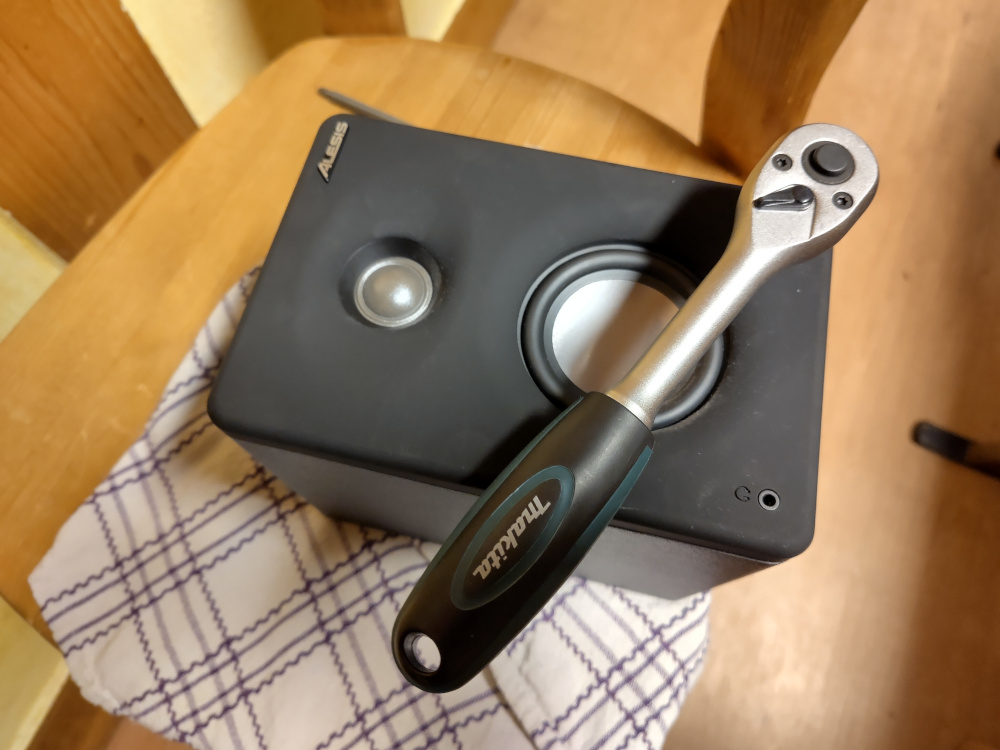
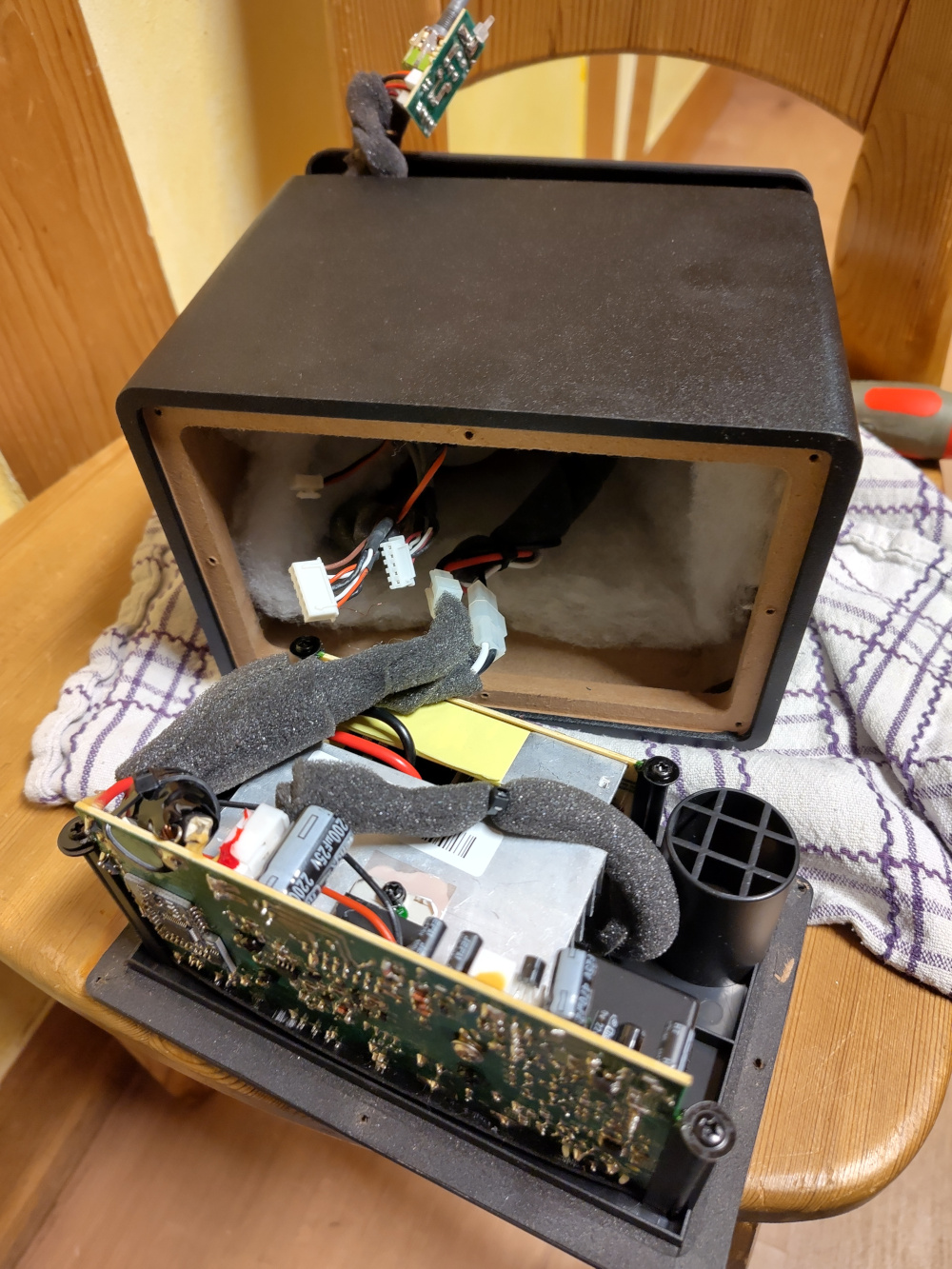
I've a set of Alesis M1Active 330 USB on my desk to listen to music. They were relatively inexpensive (~100 ), have USB and sound pretty good for their size/price. They were also sitting on my desk unused for a while, because the left speaker didn't produce any sound. Well, almost any. If you'd move the volume knob long enough you might have found a position where the left speaker would work a bit, but it'd be quieter than the right one and stop working again after some time. Pretty unacceptable when you want to listen to music. Given the right speaker was working just fine and the left would work a bit when the volume knob is moved, I was quite certain which part was to blame: the potentiometer. So just open the right speaker (it contains all the logic boards, power supply, etc), take out the broken potentiometer, buy a new one, replace, done. Sounds easy? Well, to open the speaker you gotta loosen 8 (!) screws on the back. At least it's not glued, right? Once the screws are removed you can pull out the back plate, which will bring the power supply, USB controller, sound amplifier and cables, lots of cables: two pairs of thick cables, one to each driver, one thin pair for the power switch and two sets of "WTF is this, I am not going to trace pinouts today", one with a 6 pin plug, one with a 5 pin one. Unplug all of these! Yes, they are plugged, nice. Nope, still no friggin' idea how to get to the potentiometer. If you trace the "thin pair" and "WTF1" cables, you see they go inside a small wooden box structure. So we have to pull the thing from the front? Okay, let's remove the plastic part of the knob Right, this looks like a potentiometer. Unscrew it. No, no need for a Makita wrench, I just didn't have anything else in the right size (10mm). right Alesis M1Active 330 USB speaker with a Makita wrench where the volume knob is Still, no movement. Let's look again from the inside! Oh ffs, there are six more screws inside, holding the front. Away with them! Just need a very long PH1 screwdriver. Now you can slowly remove the part of the front where the potentiometer is. Be careful, the top tweeter is mounted to the front, not the main case and so is the headphone jack, without an obvious way to detach it. But you can move away the front far enough to remove the small PCB with the potentiometer and the LED. right Alesis M1Active 330 USB speaker open Great, this was the easy part! The only thing printed on the potentiometer is "A10K". 10K is easy -- 10kOhm. A?! Wikipedia says "A" means "logarithmic", but only if made in the US or Asia. In Europe that'd be "linear". "B" in US/Asia means "linear", in Europe "logarithmic". Do I need to tap the sign again? (The sign is a print of XKCD#927.) My multimeter says in this case it's something like logarithmic. On the right channel anyway, the left one is more like a chopping board. And what's this green box at the end? Oh right, this thing also turns the power on and off. So it's a power switch. Where the fuck do I get a logarithmic 10kOhm stereo potentiometer with a power switch? And then in the exact right size too?! Of course not at any of the big German electronics pharmacies. But AliExpress saves the day, again. It's even the same color! Soldering without pulling out the cable out of the case was a bit challenging, but I've managed it and now have stereo sound again. Yay! PS: Don't operate this thing open to try it out. 230V are dangerous!
12 September 2024

Dirk Eddelbuettel: RcppArmadillo 14.0.2-1 on CRAN: Updates

armadillo image Armadillo is a powerful and expressive C++ template library for linear algebra and scientific computing. It aims towards a good balance between speed and ease of use, has a syntax deliberately close to Matlab, and is useful for algorithm development directly in C++, or quick conversion of research code into production environments. RcppArmadillo integrates this library with the R environment and language and is widely used by (currently) 1164 other packages on CRAN, downloaded 36.1 million times (per the partial logs from the cloud mirrors of CRAN), and the CSDA paper (preprint / vignette) by Conrad and myself has been cited 595 times according to Google Scholar. Conrad released two small incremental releases to version 14.0.0. We did not immediately bring these to CRAN as we have to be mindful of the desired upload cadence of once every one or two months . But as 14.0.2 has been stable for a few weeks, we now decided to bring it to CRAN. Changes since the last CRAN release are summarised below, and overall fairly minimal. On the package side, we reorder what citation() returns, and now follow CRAN requirements via Authors@R.

Changes in RcppArmadillo version 14.0.2-1 (2024-09-11)
  • Upgraded to Armadillo release 14.0.2 (Stochastic Parrot)
    • Optionally use C++20 memory alignment
    • Minor corrections for several corner-cases
  • The order of items displayed by citation() is reversed (Conrad in #449)
  • The DESCRIPTION file now uses an Authors@R field with ORCID IDs

Courtesy of my CRANberries, there is a diffstat report relative to previous release. More detailed information is on the RcppArmadillo page. Questions, comments etc should go to the rcpp-devel mailing list off the Rcpp R-Forge page. If you like this or other open-source work I do, you can sponsor me at GitHub.

This post by Dirk Eddelbuettel originated on his Thinking inside the box blog. Please report excessive re-aggregation in third-party for-profit settings.

11 September 2024

Jamie McClelland: MariaDB mystery

I keep getting an error in our backup logs:
Sep 11 05:08:03 Warning: mysqldump: Error 2013: Lost connection to server during query when dumping table  1C4Uonkwhe_options  at row: 1402
Sep 11 05:08:03 Warning: Failed to dump mysql databases ic_wp
It s a WordPress database having trouble dumping the options table. The error log has a corresponding message:
Sep 11 13:50:11 mysql007 mariadbd[580]: 2024-09-11 13:50:11 69577 [Warning] Aborted connection 69577 to db: 'ic_wp' user: 'root' host: 'localhost' (Got an error writing communication packets)
The Internet is full of suggestions, almost all of which either focus on the network connection between the client and the server or the FEDERATED plugin. We aren t using the federated plugin and this error happens when conneting via the socket. Check it out - what is better than a consistently reproducible problem! It happens if I try to select all the values in the table:
root@mysql007:~# mysql --protocol=socket -e 'select * from 1C4Uonkwhe_options' ic_wp > /dev/null
ERROR 2013 (HY000) at line 1: Lost connection to server during query
root@mysql007:~#
It happens when I specifiy one specific offset:
root@mysql007:~# mysql --protocol=socket -e 'select * from 1C4Uonkwhe_options limit 1 offset 1402' ic_wp
ERROR 2013 (HY000) at line 1: Lost connection to server during query
root@mysql007:~#
It happens if I specify the field name explicitly:
root@mysql007:~# mysql --protocol=socket -e 'select option_id,option_name,option_value,autoload from 1C4Uonkwhe_options limit 1 offset 1402' ic_wp
ERROR 2013 (HY000) at line 1: Lost connection to server during query
root@mysql007:~#
It doesn t happen if I specify the key field:
root@mysql007:~# mysql --protocol=socket -e 'select option_id from 1C4Uonkwhe_options limit 1 offset 1402' ic_wp
+-----------+
  option_id  
+-----------+
   16296351  
+-----------+
root@mysql007:~#
It does happen if I specify the value field:
root@mysql007:~# mysql --protocol=socket -e 'select option_value from 1C4Uonkwhe_options limit 1 offset 1402' ic_wp
ERROR 2013 (HY000) at line 1: Lost connection to server during query
root@mysql007:~#
It doesn t happen if I query the specific row by key field:
root@mysql007:~# mysql --protocol=socket -e 'select * from 1C4Uonkwhe_options where option_id = 16296351' ic_wp
+-----------+----------------------+--------------+----------+
  option_id   option_name            option_value   autoload  
+-----------+----------------------+--------------+----------+
   16296351   z_taxonomy_image8905                  yes       
+-----------+----------------------+--------------+----------+
root@mysql007:~#
Hm. Surely there is some funky non-printing character in that option_value right?
root@mysql007:~# mysql --protocol=socket -e 'select CHAR_LENGTH(option_value) from 1C4Uonkwhe_options where option_id = 16296351' ic_wp
+---------------------------+
  CHAR_LENGTH(option_value)  
+---------------------------+
                          0  
+---------------------------+
root@mysql007:~# mysql --protocol=socket -e 'select HEX(option_value) from 1C4Uonkwhe_options where option_id = 16296351' ic_wp
+-------------------+
  HEX(option_value)  
+-------------------+
                     
+-------------------+
root@mysql007:~#
Resetting the value to an empty value doesn t make a difference:
root@mysql007:~# mysql --protocol=socket -e 'update 1C4Uonkwhe_options set option_value = "" where option_id = 16296351' ic_wp
root@mysql007:~# mysql --protocol=socket -e 'select * from 1C4Uonkwhe_options' ic_wp > /dev/null
ERROR 2013 (HY000) at line 1: Lost connection to server during query
root@mysql007:~#
Deleting the row in question causes the error to specify a new offset:
root@mysql007:~# mysql --protocol=socket -e 'delete from 1C4Uonkwhe_options where option_id = 16296351' ic_wp
root@mysql007:~# mysql --protocol=socket -e 'select * from 1C4Uonkwhe_options' ic_wp > /dev/null
ERROR 2013 (HY000) at line 1: Lost connection to server during query
root@mysql007:~# mysqldump ic_wp > /dev/null
mysqldump: Error 2013: Lost connection to server during query when dumping table  1C4Uonkwhe_options  at row: 1401
root@mysql007:~#
If I put the record I deleted back in, we return to the old offset:
root@mysql007:~# mysql --protocol=socket -e 'insert into 1C4Uonkwhe_options VALUES(16296351,"z_taxonomy_image8905","","yes");' ic_wp 
root@mysql007:~# mysqldump ic_wp > /dev/null
mysqldump: Error 2013: Lost connection to server during query when dumping table  1C4Uonkwhe_options  at row: 1402
root@mysql007:~#
I m losing my little mind. Let s get drastic and create a whole new table, copy over the data delicately working around the deadly offset:
oot@mysql007:~# mysql --protocol=socket -e 'create table 1C4Uonkwhe_new_options like 1C4Uonkwhe_options;' ic_wp 
root@mysql007:~# mysql --protocol=socket -e 'insert into 1C4Uonkwhe_new_options select * from 1C4Uonkwhe_options limit 1402 offset 0;' ic_wp 
--- There is only 33 more records, not sure how to specify unlimited limit but 100 does the trick.
root@mysql007:~# mysql --protocol=socket -e 'insert into 1C4Uonkwhe_new_options select * from 1C4Uonkwhe_options limit 100 offset 1403;' ic_wp 
Now let s make sure all is working properly:
root@mysql007:~# mysql --protocol=socket -e 'select * from 1C4Uonkwhe_new_options' ic_wp >/dev/null;
Now let s examine which row we are missing:
root@mysql007:~# mysql --protocol=socket -e 'select option_id from 1C4Uonkwhe_options where option_id not in (select option_id from 1C4Uonkwhe_new_options) ;' ic_wp 
+-----------+
  option_id  
+-----------+
   18405297  
+-----------+
root@mysql007:~#
Wait, what? I was expecting option_id 16296351. Oh, now we are getting somewhere. And I see my mistake: when using offsets, you need to use ORDER BY or you won t get consistent results.
root@mysql007:~# mysql --protocol=socket -e 'select option_id from 1C4Uonkwhe_options order by option_id limit 1 offset 1402' ic_wp ;
+-----------+
  option_id  
+-----------+
   18405297  
+-----------+
root@mysql007:~#
Now that I have the correct row what is in it:
root@mysql007:~# mysql --protocol=socket -e 'select * from 1C4Uonkwhe_options where option_id = 18405297' ic_wp ;
ERROR 2013 (HY000) at line 1: Lost connection to server during query
root@mysql007:~#
Well, that makes a lot more sense. Let s start over with examining the value:
root@mysql007:~# mysql --protocol=socket -e 'select CHAR_LENGTH(option_value) from 1C4Uonkwhe_options where option_id = 18405297' ic_wp ;
+---------------------------+
  CHAR_LENGTH(option_value)  
+---------------------------+
                   50814767  
+---------------------------+
root@mysql007:~#
Wow, that s a lot of characters. If it were a book, it would be 35,000 pages long (I just discovered this site). It s a LONGTEXT field so it should be able to handle it. But now I have a better idea of what could be going wrong. The name of the option is rewrite_rules so it seems like something is going wrong with the generation of that option. I imagine there is some tweak I can make to allow MariaDB to cough up the value (read_buffer_size? tmp_table_size?). But I ll start with checking in with the database owner because I don t think 35,000 pages of rewrite rules is appropriate for any site.

Dirk Eddelbuettel: RcppSpdlog 0.0.18 on CRAN: Updates

Version 0.0.18 of RcppSpdlog arrived on CRAN today and has been uploaded to Debian. RcppSpdlog bundles spdlog, a wonderful header-only C++ logging library with all the bells and whistles you would want that was written by Gabi Melman, and also includes fmt by Victor Zverovich. You can learn more at the nice package documention site. This releases updates the code to the version 1.14.1 of spdlog which was released as an incremental fix to 1.14.0, and adds the ability to set log levels via the environment variable SPDLOG_LEVEL. The NEWS entry for this release follows.

Changes in RcppSpdlog version 0.0.18 (2024-09-10)
  • Upgraded to upstream release spdlog 1.14.1
  • Minor packaging upgrades
  • Allow logging levels to be set via environment variable SPDLOG_LEVEL

Courtesy of my CRANberries, there is also a diffstat report. More detailed information is on the RcppSpdlog page, or the package documention site. If you like this or other open-source work I do, you can sponsor me at GitHub.

This post by Dirk Eddelbuettel originated on his Thinking inside the box blog. Please report excessive re-aggregation in third-party for-profit settings.

Valhalla's Things: Two Linen Hoods

Posted on September 11, 2024
Tags: madeof:atoms, craft:sewing, FreeSoftWear
A woman wearing a white hood with a deep shoulder covering that ends in a point at about waist height.  The hood is not fitted, has a slight point because of the rectangular construction, and on the torso part one can see the big square gusset that gives it fullness. I ve been influenced again into feeling the need for a garment. It was again a case of multiple sources conspiring in the same direction for unrelated reasons, but I decided I absolutely needed a linen hood, made from the heavy white linen I knew I had in my stash. Why? I don t know. I do like the feeling of wearing a hood, and the white linen should give a decent protection from the sun, but I don t know how often I m going to wear these instead of just a hat. On the other hand the linen was already there and I needed something small to sew. A woman wearing a hood in the same shape, but made in tartan-print flannel.  It looks slightly smaller than the linen one. My first idea was to make a square hood: some time ago I had already made one out of some leftovers of duvet cover, vaguely inspired by the S , because I have a long-term plan of making one a bit more from scratch1. I like the fact that this pattern is completely made out of squares and rectangles, and while the flannel one is quite fitting, as suitable for a warm garment, I felt that by making it just a cm or two wider it would have worked nicely for a warm weather one, and indeed it did. A woman wearing some sort of white veil that covers the head and has two scarf-like appendages, one wrapped around the shoulders and falling on the back, and one falling on the front side, kept in place with one arm. Except, before I even started on the square hood, I started to think that the same square top would also be good for a hood-scarf, one of those long flowy garments that sit on the head, wrap around the neck and fall down, moving with the wind and the movements of the person. Because, let s be honest. worn in a way that look like a veil they feel nice, it s true. But with the help of a couple of pins then you can do this. A woman wearing what looks like a deep hood over some sort of fabric face mask, showing only the eyes, in a way that resembles characters in a video game.  There are again two scarf-like edges that fall on the front and back. And no, I ve never played that game2, and I m not even 100% sure what it is about, other than killing people, climbing buildings and petting cats3, but that s not really an issue when making a bit of casual cosplay of something, right? Anyway, should anybody feel the need to make themselves a hood or ten, the patterns have been released as usual as #FreeSoftWear: square hood and hood scarf.

  1. I m not going to raise the sheep :D I m actually not even going to wash and comb the wool, I ll start from the step just after those :D
  2. because proprietary software, because somewhat underpowered computers and other related reasons that are somewhat incidental to the game itself.
  3. at least two out of three things that make it look like a perfectly enjoyable activity.

Freexian Collaborators: Monthly report about Debian Long Term Support, August 2024 (by Roberto C. S nchez)

Like each month, have a look at the work funded by Freexian s Debian LTS offering.

Debian LTS contributors In August, 16 contributors have been paid to work on Debian LTS, their reports are available:
  • Adrian Bunk did 44.5h (out of 46.5h assigned and 53.5h from previous period), thus carrying over 55.5h to the next month.
  • Bastien Roucari s did 20.0h (out of 20.0h assigned).
  • Ben Hutchings did 9.0h (out of 0.0h assigned and 21.0h from previous period), thus carrying over 12.0h to the next month.
  • Chris Lamb did 18.0h (out of 18.0h assigned).
  • Daniel Leidert did 12.0h (out of 7.0h assigned and 5.0h from previous period).
  • Emilio Pozuelo Monfort did 22.25h (out of 6.5h assigned and 53.5h from previous period), thus carrying over 37.75h to the next month.
  • Guilhem Moulin did 17.5h (out of 8.75h assigned and 11.25h from previous period), thus carrying over 2.5h to the next month.
  • Lee Garrett did 11.5h (out of 58.0h assigned and 2.0h from previous period), thus carrying over 48.5h to the next month.
  • Markus Koschany did 40.0h (out of 40.0h assigned).
  • Ola Lundqvist did 14.5h (out of 4.0h assigned and 20.0h from previous period), thus carrying over 9.5h to the next month.
  • Roberto C. S nchez did 8.25h (out of 5.0h assigned and 7.0h from previous period), thus carrying over 3.75h to the next month.
  • Santiago Ruano Rinc n did 21.5h (out of 11.5h assigned and 10.0h from previous period).
  • Sean Whitton did 4.0h (out of 2.25h assigned and 3.75h from previous period), thus carrying over 2.0h to the next month.
  • Sylvain Beucler did 42.0h (out of 46.0h assigned and 14.0h from previous period), thus carrying over 18.0h to the next month.
  • Thorsten Alteholz did 11.0h (out of 11.0h assigned).
  • Tobias Frost did 2.5h (out of 7.75h assigned and 4.25h from previous period), thus carrying over 9.5h to the next month.

Evolution of the situation In August, we have released 1 DLAs. During the month of August Debian 11 "bullseye" officially transitioned to the responsibility of the LTS team (on 2024-08-15). However, because the final point release (11.11) was not made until 2024-08-31, LTS contributors were prevented from uploading packages to bullseye until after the point release had been made. That said, the team was not at all idle, and was busy at work on a variety of tasks which impacted both LTS and the broader Debian community, as well as preparing uploads which will be released during the month of September. Of particular note, LTS contributor Bastien Roucari s prepared updates of the putty and cacti packages for bookworm (1 2) and bullseye (1 2), which were accepted by the old-stable release managers for the August point releases. He also analysed several security regressions in the apache2 package. LTS contributor Emilio Pozuelo Monfort worked on the Rust toolchain in bookworm and bullseye, which will be needed to support the upcoming Firefox ESR and Thunderbird ESR releases from the Mozilla project. Additionally, LTS contributor Thorsten Alteholz prepared bookworm and bullseye updates of the cups package (1 2), which were accepted by the old-stable release managers for the August point releases. LTS contributor Markus Koschany collaborated with Emmanuel Bourg, co-maintainer of the tomcat packages in Debian. Regressions in a proposed security fix necessitated the updating of the tomcat10 package in Debian to the latest upstream release. LTS contributors Bastien and Santiago Ruano Rinc n collaborated with the upstream developers and the Debian maintainer (Bernhard Schmidt) of the FreeRADIUS project towards addressing the BlastRADIUS vulnerability in the bookworm and bullseye versions of the freeradius package. If you use FreeRADIUS in Debian bookworm or bullseye, we encourage you to test the packages following the instructions found in the call for testers to help identifying any possible regression that could be introduced with these updates. Testing is an important part of the work the LTS Team does, and in that vein LTS contributor Sean Whitton worked on improving the documentation and tooling around creating test filesystems which can be used for testing a variety of package update scenarios.

Thanks to our sponsors Sponsors that joined recently are in bold.

10 September 2024

Ben Hutchings: FOSS activity in August 2024

Freexian Collaborators: Debian Contributions: Python 3 patches, OpenSSH GSS-API split, rebootstrap, salsa CI, etc. (by Anupa Ann Joseph)

Debian Contributions: 2024-08 Contributing to Debian is part of Freexian s mission. This article covers the latest achievements of Freexian and their collaborators. All of this is made possible by organizations subscribing to our Long Term Support contracts and consulting services.

Debian Python 3 patch review, by Stefano Rivera Last month, at DebConf, Stefano reviewed the current patch set of Debian s cPython packages with Matthias Klose, the primary maintainer until now. As a result of that review, Stefano re-reviewed the patchset, updating descriptions, etc. A few patches were able to be dropped, and a few others were forwarded upstream. One finds all sorts of skeletons doing reviews like this. One of the patches had been inactive (fortunately, because it was buggy) since the day it was applied, 13 years ago. One is a cleanup that probably only fixes a bug on HPUX, and is a result of copying code from xfree86 into Python 25 years ago. It was fixed in xfree86 a year later. Others support just Debian-specific functionality and probably never seemed worth forwarding. Or good cleanup that only really applies to Debian. A trivial new patch would allow Debian to multiarch co-install Python stable ABI dynamic extensions (like we can with regular dynamic extensions). Performance concerns are stalling it in review, at the moment.

DebConf 24 Organization, by Stefano Rivera Stefano helped organize DebConf 24, which concluded in early August. The event is run by a large entirely volunteer team. The work involved in making this happen is far too varied to describe here. While Freexian provides funding for 20% of collaborator time to spend on Debian-related work, it only covers a small fraction of contributions to time-intensive tasks like this. Since the end of the event, Stefano has been doing some work on the conference finances, and initiated the reimbursement process for travel bursaries.

Archive rebuilds on Debusine, by Stefano Rivera The recent setuptools 73 upload to Debian unstable removed the test subcommand, breaking many packages that were using python3 setup.py test in their Debian packaging. Stefano did a partial archive-rebuild using debusine.debian.net to find the regressions and file bugs. Debusine will be a powerful tool to do QA work like this for Debian in the future, but it doesn t have all the features needed to coordinate rebuild-testing, yet. They are planned to be fleshed out in the next year. In the meantime, Debusine has the building blocks to work through a queue of package building tasks and store the results, it just needs to be driven from outside the system. So, Stefano started working on a set of tools using the Debusine client API to perform archive rebuilds, found and tagged existing bugs, and filed many more.

OpenSSH GSS-API split, by Colin Watson Colin landed the first stage of the planned split of GSS-API authentication and key exchange support in Debian s OpenSSH packaging. In order to allow for smooth upgrades, the second stage will have to wait until after the Debian 13 (trixie) release; but once that s done, as upstream puts it, this substantially reduces the amount of pre-authentication attack surface exposed on your users sshd by default .

OpenSSL vs. cryptography, by Colin Watson Colin facilitated a discussion between Debian s OpenSSL team and the upstream maintainers of Python cryptography about a new incompatibility between Debian s OpenSSL packaging and cryptography s handling of OpenSSL s legacy provider, which was causing a number of build and test failures. While the issue remains open, the Debian OpenSSL maintainers have effectively reverted the change now, so it s no longer a pressing problem.

/usr-move, by Helmut Grohne There are less than 40 source packages left to move files to /usr, so what we re left with is the long tail of the transition. Rather than fix all of them, Helmut started a discussion on removing packages from unstable and filed a first batch. As libvirt is being restructured in experimental, we re handling the fallout in collaboration with its maintainer Andrea Bolognani. Since base-files validates the aliasing symlinks before upgrading, it was discovered that systemd has its own ideas with no solution as of yet. Helmut also proposed that dash checks for ineffective diversions of /bin/sh and that lintian warns about aliased files.

rebootstrap by Helmut Grohne Bootstrapping Debian for a new or existing CPU architecture still is a quite manual process. The rebootstrap project attempts to automate part of the early stage, but it still is very sensitive to changes in unstable. We had a number of fairly intrusive changes this year already. August included a little more fallout from the earlier gcc-for-host work where the C++ include search path would end up being wrong in the generated cross toolchain. A number of packages such as util-linux (twice), libxml2, libcap-ng or systemd had their stage profiles broken. e2fsprogs gained a cycle with libarchive-dev due to having gained support for creating an ext4 filesystem from a tar archive. The restructuring of glib2.0 remains an unsolved problem for now, but libxt and cdebconf should be buildable without glib2.0.

Salsa CI, by Santiago Ruano Rinc n Santiago completed the initial RISC-V support (!523) in the Salsa CI s pipeline. The main work started in July, but it was required to take into account some comments in the review (thanks to Ahmed!) and some final details in [!534]. riscv64 is the most recently supported port in Debian, which will be part of trixie. As its name suggests, the new build-riscv64 job makes it possible to test that a package successfully builds in the riscv64 architecture. The RISC-V runner (salsaci riscv64 runner 01) runs in a couple of machines generously provided by lab.rvperf.org. Debian Developers interested in running this job in their projects should enable the runner (salsaci riscv64 runner 01) in Settings / CI / Runners, and follow the instructions available at https://salsa.debian.org/salsa-ci-team/pipeline/#build-job-on-risc-v. Santiago also took part in discussions about how to optimize the build jobs and reviewed !537 to make the build-source job to only satisfy the Build-Depends and Build-Conflicts fields by Andrea Pappacoda. Thanks a lot to him!

Miscellaneous contributions
  • Stefano submitted patches for BeautifulSoup to support the latest soupsieve and lxml.
  • Stefano uploaded pypy3 7.3.17, upgrading the cPython compatibility from 3.9 to 3.10. Then ran into a GCC-14-related regression, which had to be ignored for now as it s proving hard to fix.
  • Colin released libpipeline 1.5.8 and man-db 2.13.0; the latter included foundations allowing adding an autopkgtest for man-db.
  • Colin upgraded 19 Python packages to new upstream versions (fixing 5 CVEs), fixed several other build failures, fixed a Python 3.12 compatibility issue in zope.security, and made python-nacl build reproducibly.
  • Colin tracked down test failures in python-asyncssh and Ruby resulting from certain odd /etc/hosts configurations.
  • Carles upgraded the packages python-ring-doorbell and simplemonitor to new upstream versions.
  • Carles started discussions and implementation of a tool (still in early days) named po-debconf-manager : a way for translators and reviewers to collaborate using git as a backend instead of mailing list; and submit the translations using salsa MR. More information next month.
  • Carles (dog-fooding po-debconf-manager ) reviewed debconf templates translated by a collaborator.
  • Carles reviewed and submitted the translation of apt .
  • Helmut sent 19 patches for improving cross building.
  • Helmut implemented the cross-exe-wrapper proposed by Simon McVittie for use with glib2.0.
  • Helmut detailed what it takes to make Perl s ExtUtils::PkgConfig suitable for cross building.
  • Helmut made the deletion of the root password work in debvm in all situations and implemented a test case using expect.
  • Anupa attended Debian Publicity team meeting and is moderating and posting on Debian Administrators LinkedIn group.
  • Thorsten uploaded package gutenprint to fix a FTBFS with gcc14 and package ipp-usb to fix a /usr-merge issue.
  • Santiago updated bzip2 to fix a long-standing bug that requested to include a pkg-config file. An important impact of this change is that it makes it possible to use Rust bindings for libbz2 by Sequoia, an implementation of OpenPGP.

9 September 2024

Ben Hutchings: FOSS activity in July 2024

Wouter Verhelst: NBD: Write Zeroes and Rotational

The NBD protocol has grown a number of new features over the years. Unfortunately, some of those features are not (yet?) supported by the Linux kernel. I suggested a few times over the years that the maintainer of the NBD driver in the kernel, Josef Bacik, take a look at these features, but he hasn't done so; presumably he has other priorities. As with anything in the open source world, if you want it done you must do it yourself. I'd been off and on considering to work on the kernel driver so that I could implement these new features, but I never really got anywhere. A few months ago, however, Christoph Hellwig posted a patch set that reworked a number of block device drivers in the Linux kernel to a new type of API. Since the NBD mailinglist is listed in the kernel's MAINTAINERS file, this patch series were crossposted to the NBD mailinglist, too, and when I noticed that it explicitly disabled the "rotational" flag on the NBD device, I suggested to Christoph that perhaps "we" (meaning, "he") might want to vary the decision on whether a device is rotational depending on whether the NBD server signals, through the flag that exists for that very purpose, whether the device is rotational. To which he replied "Can you send a patch". That got me down the rabbit hole, and now, for the first time in the 20+ years of being a C programmer who uses Linux exclusively, I got a patch merged into the Linux kernel... twice. So, what do these things do? The first patch adds support for the ROTATIONAL flag. If the NBD server mentions that the device is rotational, it will be treated as such, and the elevator algorithm will be used to optimize accesses to the device. For the reference implementation, you can do this by adding a line "rotational = true" to the relevant section (relating to the export where you want it to be used) of the config file. It's unlikely that this will be of much benefit in most cases (most nbd-server installations will be exporting a file on a filesystem and have the elevator algorithm implemented server side and then it doesn't matter whether the device has the rotational flag set), but it's there in case you wish to use it. The second set of patches adds support for the WRITE_ZEROES command. Most devices these days allow you to tell them "please write a N zeroes starting at this offset", which is a lot more efficient than sending over a buffer of N zeroes and asking the device to do DMA to copy buffers etc etc for just zeroes. The NBD protocol has supported its own WRITE_ZEROES command for a while now, and hooking it up was reasonably simple in the end. The only problem is that it expects length values in bytes, whereas the kernel uses it in blocks. It took me a few tries to get that right -- and then I also fixed up handling of discard messages, which required the same conversion.

8 September 2024

Thorsten Alteholz: My Debian Activities in August 2024

FTP master This month I accepted 441 and rejected 15 packages. The overall number of packages that got accepted was 442. I am ashamed of some occurrences that happened this month and I apologize for this. Unfortunately I have no idea how to prevent this in the future without becoming a solo entertainer. Debian LTS This was my hundred-twenty-second month that I did some work for the Debian LTS initiative, started by Raphael Hertzog at Freexian. Unfortunately Bullseye was not handed over to LTS in August. So I only prepared new packages of asterisk, libvirt and tinyproxy and will upload them next month. Last but not least I did a week of FD this month. Debian ELTS This month was the seventy-third ELTS month. During my allocated time I uploaded or worked on: I also did a week of FD. Debian Printing This month I uploaded This work is generously funded by Freexian! Debian Astro This month I uploaded a new upstream or bugfix version of: Debian Mobcom The following packages have been prepared by the GSoC student Nathan: It was so much fun working with Nathan. Unfortunately GSoC is over now, but Nathan will continue working in Debian and become a Debian Maintainer. misc This month I uploaded new upstream or bugfix versions of: I also filed an RM bug against meep-openmpi. As Adrian made me ware, this package is no longer needed.

Dima Kogan: GNU Make: details regarding intermediate files

Suppose I have this Makefile:
a: b
      touch $@
b:
      touch $@
# A common chain of build steps
%-GENERATED.c: %-generate
      touch $@
%.o: %.c
      touch $@
%.so: %-GENERATED.o
      touch $@
xxx-GENERATED.o: CFLAGS += adsf
# Imitates .d files created with "gcc -MMD". Does not exist on the initial build
ifneq ($(wildcard xxx.so),)
xxx-GENERATED.o: xxx-GENERATED.c
endif
This is all very simple build-system stuff. Let's see how it works:
$ rm -rf a b xxx-GENERATED.c xxx-GENERATED.o xxx.so
  [start from a clean slate]
$ touch xxx-generate xxx.h
  [Files that would be available in a project exist; xxx-generate is some tool]
  [that would generate xxx-GENERATED.c                                        ]
$ touch a
  ["a" exists but the file "b" it depends on does not]
$ make a xxx.so
  touch b
  touch a
  touch xxx-GENERATED.c
  touch xxx-GENERATED.o
  touch xxx.so
  rm xxx-GENERATED.c
  [It built everything, but then deleted xxx-GENERATED.c]
$ make a xxx.so
  remake: 'a' is up to date.
  touch xxx-GENERATED.c
  touch xxx-GENERATED.o
  touch xxx.so
  [It knew to not rebuild "a", but the missing xxx-GENERATED.c caused it to]
  [re-build stuff                                                          ]
Well that's not good. What if we add .SECONDARY: to the end of the Makefile to mark everything as a secondary file?
$ rm -rf a b xxx-GENERATED.c xxx-GENERATED.o xxx.so
$ touch xxx-generate xxx.h
$ touch a
$ make a xxx.so
  remake: 'a' is up to date.
  touch xxx-GENERATED.c
  touch xxx-GENERATED.o
  touch xxx.so
  [It didn't bother rebuilding "a" even though its prerequisites "b" doesn't]
  [exist. But it didn't delete the xxx-GENERATED.c at least                 ]
$ make a xxx.so
  remake: 'a' is up to date.
  remake: 'xxx.so' is up to date.
  [It knew to not rebuild anything. Great.]
So it doesn't work right with or without .SECONDARY:, but it's much closer with it. The solution is to mark everything as not an intermediate file. mrbuild cannot do this without a bleeding-edge version of GNU Make, but users of mrbuild can do this by explicitly mentioning specific files in rules. This would suffice:
___dummy___: file1 file2
Detailed notes are in a commit in mrbuild (mrbuild 1.13) and in a post to LKML by Masahiro Yamada.

Antonio Terceiro: gotcha: using ccache in Debian package builds

Before I upload packages to Debian, I always do a full build from source under sbuild. This ensures that the package can build from source on a clean environment, implying that the set of build dependencies is complete. But when iterating on a non-trivial package locally, I will usually build the package directly on my Debian testing system, and I want to take advantage of ccache to cache native (C/C++) code compilation to speed things up. In Debian, the easiest way to enable ccache is to add /usr/lib/ccache to your $PATH. I do this by doing something similar to the following in my ~/.bashrc:
export PATH=/usr/lib/ccache:$PATH
I noticed, however, that my Debian package builds were not using the cache. When building the same small package manually using make, the cache was used, but not when the build was wrapped with dpkg-buildpackage. I tracked it down to the fact that in compatibility level 13+, debhelper will set $HOME to a temporary directory. For what's it worth, I think that's a good thing: you don't want package builds reaching for your home directory as that makes it harder to make builds reproducible, among other things. This behavior, however, breaks ccache. The default cache directory is $HOME/.ccache, but that only gets resolved when ccache is actually used. So we end up starting with an empty cache on each build, get a 100% cache miss rate, and still pay for the overhead of populating the cache. The fix is to explicitly set $CCACHE_DIR upfront, so that by the time $HOME gets overriden, it doesn't matter anymore for ccache. I did this in my ~/.bashrc:
export CCACHE_DIR=$HOME/.ccache
This way, $HOME will be expanded right there when the shell starts, and by the time ccache is called, it will use the persistent cache in my home directory even though $HOME will, at that point, refer to a temporary directory.

Jacob Adams: Linux's Bedtime Routine

How does Linux move from an awake machine to a hibernating one? How does it then manage to restore all state? These questions led me to read way too much C in trying to figure out how this particular hardware/software boundary is navigated. This investigation will be split into a few parts, with the first one going from invocation of hibernation to synchronizing all filesystems to disk. This article has been written using Linux version 6.9.9, the source of which can be found in many places, but can be navigated easily through the Bootlin Elixir Cross-Referencer: https://elixir.bootlin.com/linux/v6.9.9/source Each code snippet will begin with a link to the above giving the file path and the line number of the beginning of the snippet.

A Starting Point for Investigation: /sys/power/state and /sys/power/disk These two system files exist to allow debugging of hibernation, and thus control the exact state used directly. Writing specific values to the state file controls the exact sleep mode used and disk controls the specific hibernation mode1. This is extremely handy as an entry point to understand how these systems work, since we can just follow what happens when they are written to.

Show and Store Functions These two files are defined using the power_attr macro: kernel/power/power.h:80
#define power_attr(_name) \
static struct kobj_attribute _name##_attr =     \
    .attr   =               \
        .name = __stringify(_name), \
        .mode = 0644,           \
     ,                  \
    .show   = _name##_show,         \
    .store  = _name##_store,        \
 
show is called on reads and store on writes. state_show is a little boring for our purposes, as it just prints all the available sleep states. kernel/power/main.c:657
/*
 * state - control system sleep states.
 *
 * show() returns available sleep state labels, which may be "mem", "standby",
 * "freeze" and "disk" (hibernation).
 * See Documentation/admin-guide/pm/sleep-states.rst for a description of
 * what they mean.
 *
 * store() accepts one of those strings, translates it into the proper
 * enumerated value, and initiates a suspend transition.
 */
static ssize_t state_show(struct kobject *kobj, struct kobj_attribute *attr,
			  char *buf)
 
	char *s = buf;
#ifdef CONFIG_SUSPEND
	suspend_state_t i;
	for (i = PM_SUSPEND_MIN; i < PM_SUSPEND_MAX; i++)
		if (pm_states[i])
			s += sprintf(s,"%s ", pm_states[i]);
#endif
	if (hibernation_available())
		s += sprintf(s, "disk ");
	if (s != buf)
		/* convert the last space to a newline */
		*(s-1) = '\n';
	return (s - buf);
 
state_store, however, provides our entry point. If the string disk is written to the state file, it calls hibernate(). This is our entry point. kernel/power/main.c:715
static ssize_t state_store(struct kobject *kobj, struct kobj_attribute *attr,
			   const char *buf, size_t n)
 
	suspend_state_t state;
	int error;
	error = pm_autosleep_lock();
	if (error)
		return error;
	if (pm_autosleep_state() > PM_SUSPEND_ON)  
		error = -EBUSY;
		goto out;
	 
	state = decode_state(buf, n);
	if (state < PM_SUSPEND_MAX)  
		if (state == PM_SUSPEND_MEM)
			state = mem_sleep_current;
		error = pm_suspend(state);
	  else if (state == PM_SUSPEND_MAX)  
		error = hibernate();
	  else  
		error = -EINVAL;
	 
 out:
	pm_autosleep_unlock();
	return error ? error : n;
 
kernel/power/main.c:688
static suspend_state_t decode_state(const char *buf, size_t n)
 
#ifdef CONFIG_SUSPEND
	suspend_state_t state;
#endif
	char *p;
	int len;
	p = memchr(buf, '\n', n);
	len = p ? p - buf : n;
	/* Check hibernation first. */
	if (len == 4 && str_has_prefix(buf, "disk"))
		return PM_SUSPEND_MAX;
#ifdef CONFIG_SUSPEND
	for (state = PM_SUSPEND_MIN; state < PM_SUSPEND_MAX; state++)  
		const char *label = pm_states[state];
		if (label && len == strlen(label) && !strncmp(buf, label, len))
			return state;
	 
#endif
	return PM_SUSPEND_ON;
 
Could we have figured this out just via function names? Sure, but this way we know for sure that nothing else is happening before this function is called.

Autosleep Our first detour is into the autosleep system. When checking the state above, you may notice that the kernel grabs the pm_autosleep_lock before checking the current state. autosleep is a mechanism originally from Android that sends the entire system to either suspend or hibernate whenever it is not actively working on anything. This is not enabled for most desktop configurations, since it s primarily for mobile systems and inverts the standard suspend and hibernate interactions. This system is implemented as a workqueue2 that checks the current number of wakeup events, processes and drivers that need to run3, and if there aren t any, then the system is put into the autosleep state, typically suspend. However, it could be hibernate if configured that way via /sys/power/autosleep in a similar manner to using /sys/power/state to manually enable hibernation. kernel/power/main.c:841
static ssize_t autosleep_store(struct kobject *kobj,
			       struct kobj_attribute *attr,
			       const char *buf, size_t n)
 
	suspend_state_t state = decode_state(buf, n);
	int error;
	if (state == PM_SUSPEND_ON
	    && strcmp(buf, "off") && strcmp(buf, "off\n"))
		return -EINVAL;
	if (state == PM_SUSPEND_MEM)
		state = mem_sleep_current;
	error = pm_autosleep_set_state(state);
	return error ? error : n;
 
power_attr(autosleep);
#endif /* CONFIG_PM_AUTOSLEEP */
kernel/power/autosleep.c:24
static DEFINE_MUTEX(autosleep_lock);
static struct wakeup_source *autosleep_ws;
static void try_to_suspend(struct work_struct *work)
 
	unsigned int initial_count, final_count;
	if (!pm_get_wakeup_count(&initial_count, true))
		goto out;
	mutex_lock(&autosleep_lock);
	if (!pm_save_wakeup_count(initial_count)  
		system_state != SYSTEM_RUNNING)  
		mutex_unlock(&autosleep_lock);
		goto out;
	 
	if (autosleep_state == PM_SUSPEND_ON)  
		mutex_unlock(&autosleep_lock);
		return;
	 
	if (autosleep_state >= PM_SUSPEND_MAX)
		hibernate();
	else
		pm_suspend(autosleep_state);
	mutex_unlock(&autosleep_lock);
	if (!pm_get_wakeup_count(&final_count, false))
		goto out;
	/*
	 * If the wakeup occurred for an unknown reason, wait to prevent the
	 * system from trying to suspend and waking up in a tight loop.
	 */
	if (final_count == initial_count)
		schedule_timeout_uninterruptible(HZ / 2);
 out:
	queue_up_suspend_work();
 
static DECLARE_WORK(suspend_work, try_to_suspend);
void queue_up_suspend_work(void)
 
	if (autosleep_state > PM_SUSPEND_ON)
		queue_work(autosleep_wq, &suspend_work);
 

The Steps of Hibernation

Hibernation Kernel Config It s important to note that most of the hibernate-specific functions below do nothing unless you ve defined CONFIG_HIBERNATION in your Kconfig4. As an example, hibernate itself is defined as the following if CONFIG_HIBERNATE is not set. include/linux/suspend.h:407
static inline int hibernate(void)   return -ENOSYS;  

Check if Hibernation is Available We begin by confirming that we actually can perform hibernation, via the hibernation_available function. kernel/power/hibernate.c:742
if (!hibernation_available())  
	pm_pr_dbg("Hibernation not available.\n");
	return -EPERM;
 
kernel/power/hibernate.c:92
bool hibernation_available(void)
 
	return nohibernate == 0 &&
		!security_locked_down(LOCKDOWN_HIBERNATION) &&
		!secretmem_active() && !cxl_mem_active();
 
nohibernate is controlled by the kernel command line, it s set via either nohibernate or hibernate=no. security_locked_down is a hook for Linux Security Modules to prevent hibernation. This is used to prevent hibernating to an unencrypted storage device, as specified in the manual page kernel_lockdown(7). Interestingly, either level of lockdown, integrity or confidentiality, locks down hibernation because with the ability to hibernate you can extract bascially anything from memory and even reboot into a modified kernel image. secretmem_active checks whether there is any active use of memfd_secret, and if so it prevents hibernation. memfd_secret returns a file descriptor that can be mapped into a process but is specifically unmapped from the kernel s memory space. Hibernating with memory that not even the kernel is supposed to access would expose that memory to whoever could access the hibernation image. This particular feature of secret memory was apparently controversial, though not as controversial as performance concerns around fragmentation when unmapping kernel memory (which did not end up being a real problem). cxl_mem_active just checks whether any CXL memory is active. A full explanation is provided in the commit introducing this check but there s also a shortened explanation from cxl_mem_probe that sets the relevant flag when initializing a CXL memory device. drivers/cxl/mem.c:186
* The kernel may be operating out of CXL memory on this device,
* there is no spec defined way to determine whether this device
* preserves contents over suspend, and there is no simple way
* to arrange for the suspend image to avoid CXL memory which
* would setup a circular dependency between PCI resume and save
* state restoration.

Check Compression The next check is for whether compression support is enabled, and if so whether the requested algorithm is enabled. kernel/power/hibernate.c:747
/*
 * Query for the compression algorithm support if compression is enabled.
 */
if (!nocompress)  
	strscpy(hib_comp_algo, hibernate_compressor, sizeof(hib_comp_algo));
	if (crypto_has_comp(hib_comp_algo, 0, 0) != 1)  
		pr_err("%s compression is not available\n", hib_comp_algo);
		return -EOPNOTSUPP;
	 
 
The nocompress flag is set via the hibernate command line parameter, setting hibernate=nocompress. If compression is enabled, then hibernate_compressor is copied to hib_comp_algo. This synchronizes the current requested compression setting (hibernate_compressor) with the current compression setting (hib_comp_algo). Both values are character arrays of size CRYPTO_MAX_ALG_NAME (128 in this kernel). kernel/power/hibernate.c:50
static char hibernate_compressor[CRYPTO_MAX_ALG_NAME] = CONFIG_HIBERNATION_DEF_COMP;
/*
 * Compression/decompression algorithm to be used while saving/loading
 * image to/from disk. This would later be used in 'kernel/power/swap.c'
 * to allocate comp streams.
 */
char hib_comp_algo[CRYPTO_MAX_ALG_NAME];
hibernate_compressor defaults to lzo if that algorithm is enabled, otherwise to lz4 if enabled5. It can be overwritten using the hibernate.compressor setting to either lzo or lz4. kernel/power/Kconfig:95
choice
	prompt "Default compressor"
	default HIBERNATION_COMP_LZO
	depends on HIBERNATION
config HIBERNATION_COMP_LZO
	bool "lzo"
	depends on CRYPTO_LZO
config HIBERNATION_COMP_LZ4
	bool "lz4"
	depends on CRYPTO_LZ4
endchoice
config HIBERNATION_DEF_COMP
	string
	default "lzo" if HIBERNATION_COMP_LZO
	default "lz4" if HIBERNATION_COMP_LZ4
	help
	  Default compressor to be used for hibernation.
kernel/power/hibernate.c:1425
static const char * const comp_alg_enabled[] =  
#if IS_ENABLED(CONFIG_CRYPTO_LZO)
	COMPRESSION_ALGO_LZO,
#endif
#if IS_ENABLED(CONFIG_CRYPTO_LZ4)
	COMPRESSION_ALGO_LZ4,
#endif
 ;
static int hibernate_compressor_param_set(const char *compressor,
		const struct kernel_param *kp)
 
	unsigned int sleep_flags;
	int index, ret;
	sleep_flags = lock_system_sleep();
	index = sysfs_match_string(comp_alg_enabled, compressor);
	if (index >= 0)  
		ret = param_set_copystring(comp_alg_enabled[index], kp);
		if (!ret)
			strscpy(hib_comp_algo, comp_alg_enabled[index],
				sizeof(hib_comp_algo));
	  else  
		ret = index;
	 
	unlock_system_sleep(sleep_flags);
	if (ret)
		pr_debug("Cannot set specified compressor %s\n",
			 compressor);
	return ret;
 
static const struct kernel_param_ops hibernate_compressor_param_ops =  
	.set    = hibernate_compressor_param_set,
	.get    = param_get_string,
 ;
static struct kparam_string hibernate_compressor_param_string =  
	.maxlen = sizeof(hibernate_compressor),
	.string = hibernate_compressor,
 ;
We then check whether the requested algorithm is supported via crypto_has_comp. If not, we bail out of the whole operation with EOPNOTSUPP. As part of crypto_has_comp we perform any needed initialization of the algorithm, loading kernel modules and running initialization code as needed6.

Grab Locks The next step is to grab the sleep and hibernation locks via lock_system_sleep and hibernate_acquire. kernel/power/hibernate.c:758
sleep_flags = lock_system_sleep();
/* The snapshot device should not be opened while we're running */
if (!hibernate_acquire())  
	error = -EBUSY;
	goto Unlock;
 
First, lock_system_sleep marks the current thread as not freezable, which will be important later7. It then grabs the system_transistion_mutex, which locks taking snapshots or modifying how they are taken, resuming from a hibernation image, entering any suspend state, or rebooting.

The GFP Mask The kernel also issues a warning if the gfp mask is changed via either pm_restore_gfp_mask or pm_restrict_gfp_mask without holding the system_transistion_mutex. GFP flags tell the kernel how it is permitted to handle a request for memory. include/linux/gfp_types.h:12
 * GFP flags are commonly used throughout Linux to indicate how memory
 * should be allocated.  The GFP acronym stands for get_free_pages(),
 * the underlying memory allocation function.  Not every GFP flag is
 * supported by every function which may allocate memory.
In the case of hibernation specifically we care about the IO and FS flags, which are reclaim operators, ways the system is permitted to attempt to free up memory in order to satisfy a specific request for memory. include/linux/gfp_types.h:176
 * Reclaim modifiers
 * -----------------
 * Please note that all the following flags are only applicable to sleepable
 * allocations (e.g. %GFP_NOWAIT and %GFP_ATOMIC will ignore them).
 *
 * %__GFP_IO can start physical IO.
 *
 * %__GFP_FS can call down to the low-level FS. Clearing the flag avoids the
 * allocator recursing into the filesystem which might already be holding
 * locks.
gfp_allowed_mask sets which flags are permitted to be set at the current time. As the comment below outlines, preventing these flags from being set avoids situations where the kernel needs to do I/O to allocate memory (e.g. read/writing swap8) but the devices it needs to read/write to/from are not currently available. kernel/power/main.c:24
/*
 * The following functions are used by the suspend/hibernate code to temporarily
 * change gfp_allowed_mask in order to avoid using I/O during memory allocations
 * while devices are suspended.  To avoid races with the suspend/hibernate code,
 * they should always be called with system_transition_mutex held
 * (gfp_allowed_mask also should only be modified with system_transition_mutex
 * held, unless the suspend/hibernate code is guaranteed not to run in parallel
 * with that modification).
 */
static gfp_t saved_gfp_mask;
void pm_restore_gfp_mask(void)
 
	WARN_ON(!mutex_is_locked(&system_transition_mutex));
	if (saved_gfp_mask)  
		gfp_allowed_mask = saved_gfp_mask;
		saved_gfp_mask = 0;
	 
 
void pm_restrict_gfp_mask(void)
 
	WARN_ON(!mutex_is_locked(&system_transition_mutex));
	WARN_ON(saved_gfp_mask);
	saved_gfp_mask = gfp_allowed_mask;
	gfp_allowed_mask &= ~(__GFP_IO   __GFP_FS);
 

Sleep Flags After grabbing the system_transition_mutex the kernel then returns and captures the previous state of the threads flags in sleep_flags. This is used later to remove PF_NOFREEZE if it wasn t previously set on the current thread. kernel/power/main.c:52
unsigned int lock_system_sleep(void)
 
	unsigned int flags = current->flags;
	current->flags  = PF_NOFREEZE;
	mutex_lock(&system_transition_mutex);
	return flags;
 
EXPORT_SYMBOL_GPL(lock_system_sleep);
include/linux/sched.h:1633
#define PF_NOFREEZE		0x00008000	/* This thread should not be frozen */
Then we grab the hibernate-specific semaphore to ensure no one can open a snapshot or resume from it while we perform hibernation. Additionally this lock is used to prevent hibernate_quiet_exec, which is used by the nvdimm driver to active its firmware with all processes and devices frozen, ensuring it is the only thing running at that time9. kernel/power/hibernate.c:82
bool hibernate_acquire(void)
 
	return atomic_add_unless(&hibernate_atomic, -1, 0);
 

Prepare Console The kernel next calls pm_prepare_console. This function only does anything if CONFIG_VT_CONSOLE_SLEEP has been set. This prepares the virtual terminal for a suspend state, switching away to a console used only for the suspend state if needed. kernel/power/console.c:130
void pm_prepare_console(void)
 
	if (!pm_vt_switch())
		return;
	orig_fgconsole = vt_move_to_console(SUSPEND_CONSOLE, 1);
	if (orig_fgconsole < 0)
		return;
	orig_kmsg = vt_kmsg_redirect(SUSPEND_CONSOLE);
	return;
 
The first thing is to check whether we actually need to switch the VT kernel/power/console.c:94
/*
 * There are three cases when a VT switch on suspend/resume are required:
 *   1) no driver has indicated a requirement one way or another, so preserve
 *      the old behavior
 *   2) console suspend is disabled, we want to see debug messages across
 *      suspend/resume
 *   3) any registered driver indicates it needs a VT switch
 *
 * If none of these conditions is present, meaning we have at least one driver
 * that doesn't need the switch, and none that do, we can avoid it to make
 * resume look a little prettier (and suspend too, but that's usually hidden,
 * e.g. when closing the lid on a laptop).
 */
static bool pm_vt_switch(void)
 
	struct pm_vt_switch *entry;
	bool ret = true;
	mutex_lock(&vt_switch_mutex);
	if (list_empty(&pm_vt_switch_list))
		goto out;
	if (!console_suspend_enabled)
		goto out;
	list_for_each_entry(entry, &pm_vt_switch_list, head)  
		if (entry->required)
			goto out;
	 
	ret = false;
out:
	mutex_unlock(&vt_switch_mutex);
	return ret;
 
There is an explanation of the conditions under which a switch is performed in the comment above the function, but we ll also walk through the steps here. Firstly we grab the vt_switch_mutex to ensure nothing will modify the list while we re looking at it. We then examine the pm_vt_switch_list. This list is used to indicate the drivers that require a switch during suspend. They register this requirement, or the lack thereof, via pm_vt_switch_required. kernel/power/console.c:31
/**
 * pm_vt_switch_required - indicate VT switch at suspend requirements
 * @dev: device
 * @required: if true, caller needs VT switch at suspend/resume time
 *
 * The different console drivers may or may not require VT switches across
 * suspend/resume, depending on how they handle restoring video state and
 * what may be running.
 *
 * Drivers can indicate support for switchless suspend/resume, which can
 * save time and flicker, by using this routine and passing 'false' as
 * the argument.  If any loaded driver needs VT switching, or the
 * no_console_suspend argument has been passed on the command line, VT
 * switches will occur.
 */
void pm_vt_switch_required(struct device *dev, bool required)
Next, we check console_suspend_enabled. This is set to false by the kernel parameter no_console_suspend, but defaults to true. Finally, if there are any entries in the pm_vt_switch_list, then we check to see if any of them require a VT switch. Only if none of these conditions apply, then we return false. If a VT switch is in fact required, then we move first the currently active virtual terminal/console10 (vt_move_to_console) and then the current location of kernel messages (vt_kmsg_redirect) to the SUSPEND_CONSOLE. The SUSPEND_CONSOLE is the last entry in the list of possible consoles, and appears to just be a black hole to throw away messages. kernel/power/console.c:16
#define SUSPEND_CONSOLE	(MAX_NR_CONSOLES-1)
Interestingly, these are separate functions because you can use TIOCL_SETKMSGREDIRECT (an ioctl11) to send kernel messages to a specific virtual terminal, but by default its the same as the currently active console. The locations of the previously active console and the previous kernel messages location are stored in orig_fgconsole and orig_kmsg, to restore the state of the console and kernel messages after the machine wakes up again. Interestingly, this means orig_fgconsole also ends up storing any errors, so has to be checked to ensure it s not less than zero before we try to do anything with the kernel messages on both suspend and resume. drivers/tty/vt/vt_ioctl.c:1268
/* Perform a kernel triggered VT switch for suspend/resume */
static int disable_vt_switch;
int vt_move_to_console(unsigned int vt, int alloc)
 
	int prev;
	console_lock();
	/* Graphics mode - up to X */
	if (disable_vt_switch)  
		console_unlock();
		return 0;
	 
	prev = fg_console;
	if (alloc && vc_allocate(vt))  
		/* we can't have a free VC for now. Too bad,
		 * we don't want to mess the screen for now. */
		console_unlock();
		return -ENOSPC;
	 
	if (set_console(vt))  
		/*
		 * We're unable to switch to the SUSPEND_CONSOLE.
		 * Let the calling function know so it can decide
		 * what to do.
		 */
		console_unlock();
		return -EIO;
	 
	console_unlock();
	if (vt_waitactive(vt + 1))  
		pr_debug("Suspend: Can't switch VCs.");
		return -EINTR;
	 
	return prev;
 
Unlike most other locking functions we ve seen so far, console_lock needs to be careful to ensure nothing else is panicking and needs to dump to the console before grabbing the semaphore for the console and setting a couple flags.

Panics Panics are tracked via an atomic integer set to the id of the processor currently panicking. kernel/printk/printk.c:2649
/**
 * console_lock - block the console subsystem from printing
 *
 * Acquires a lock which guarantees that no consoles will
 * be in or enter their write() callback.
 *
 * Can sleep, returns nothing.
 */
void console_lock(void)
 
	might_sleep();
	/* On panic, the console_lock must be left to the panic cpu. */
	while (other_cpu_in_panic())
		msleep(1000);
	down_console_sem();
	console_locked = 1;
	console_may_schedule = 1;
 
EXPORT_SYMBOL(console_lock);
kernel/printk/printk.c:362
/*
 * Return true if a panic is in progress on a remote CPU.
 *
 * On true, the local CPU should immediately release any printing resources
 * that may be needed by the panic CPU.
 */
bool other_cpu_in_panic(void)
 
	return (panic_in_progress() && !this_cpu_in_panic());
 
kernel/printk/printk.c:345
static bool panic_in_progress(void)
 
	return unlikely(atomic_read(&panic_cpu) != PANIC_CPU_INVALID);
 
kernel/printk/printk.c:350
/* Return true if a panic is in progress on the current CPU. */
bool this_cpu_in_panic(void)
 
	/*
	 * We can use raw_smp_processor_id() here because it is impossible for
	 * the task to be migrated to the panic_cpu, or away from it. If
	 * panic_cpu has already been set, and we're not currently executing on
	 * that CPU, then we never will be.
	 */
	return unlikely(atomic_read(&panic_cpu) == raw_smp_processor_id());
 
console_locked is a debug value, used to indicate that the lock should be held, and our first indication that this whole virtual terminal system is more complex than might initially be expected. kernel/printk/printk.c:373
/*
 * This is used for debugging the mess that is the VT code by
 * keeping track if we have the console semaphore held. It's
 * definitely not the perfect debug tool (we don't know if _WE_
 * hold it and are racing, but it helps tracking those weird code
 * paths in the console code where we end up in places I want
 * locked without the console semaphore held).
 */
static int console_locked;
console_may_schedule is used to see if we are permitted to sleep and schedule other work while we hold this lock. As we ll see later, the virtual terminal subsystem is not re-entrant, so there s all sorts of hacks in here to ensure we don t leave important code sections that can t be safely resumed.

Disable VT Switch As the comment below lays out, when another program is handling graphical display anyway, there s no need to do any of this, so the kernel provides a switch to turn the whole thing off. Interestingly, this appears to only be used by three drivers, so the specific hardware support required must not be particularly common.
drivers/gpu/drm/omapdrm/dss
drivers/video/fbdev/geode
drivers/video/fbdev/omap2
drivers/tty/vt/vt_ioctl.c:1308
/*
 * Normally during a suspend, we allocate a new console and switch to it.
 * When we resume, we switch back to the original console.  This switch
 * can be slow, so on systems where the framebuffer can handle restoration
 * of video registers anyways, there's little point in doing the console
 * switch.  This function allows you to disable it by passing it '0'.
 */
void pm_set_vt_switch(int do_switch)
 
	console_lock();
	disable_vt_switch = !do_switch;
	console_unlock();
 
EXPORT_SYMBOL(pm_set_vt_switch);
The rest of the vt_switch_console function is pretty normal, however, simply allocating space if needed to create the requested virtual terminal and then setting the current virtual terminal via set_console.

Virtual Terminal Set Console With set_console, we begin (as if we haven t been already) to enter the madness that is the virtual terminal subsystem. As mentioned previously, modifications to its state must be made very carefully, as other stuff happening at the same time could create complete messes. All this to say, calling set_console does not actually perform any work to change the state of the current console. Instead it indicates what changes it wants and then schedules that work. drivers/tty/vt/vt.c:3153
int set_console(int nr)
 
	struct vc_data *vc = vc_cons[fg_console].d;
	if (!vc_cons_allocated(nr)   vt_dont_switch  
		(vc->vt_mode.mode == VT_AUTO && vc->vc_mode == KD_GRAPHICS))  
		/*
		 * Console switch will fail in console_callback() or
		 * change_console() so there is no point scheduling
		 * the callback
		 *
		 * Existing set_console() users don't check the return
		 * value so this shouldn't break anything
		 */
		return -EINVAL;
	 
	want_console = nr;
	schedule_console_callback();
	return 0;
 
The check for vc->vc_mode == KD_GRAPHICS is where most end-user graphical desktops will bail out of this change, as they re in graphics mode and don t need to switch away to the suspend console. vt_dont_switch is a flag used by the ioctls11 VT_LOCKSWITCH and VT_UNLOCKSWITCH to prevent the system from switching virtual terminal devices when the user has explicitly locked it. VT_AUTO is a flag indicating that automatic virtual terminal switching is enabled12, and thus deliberate switching to a suspend terminal is not required. However, if you do run your machine from a virtual terminal, then we indicate to the system that we want to change to the requested virtual terminal via the want_console variable and schedule a callback via schedule_console_callback. drivers/tty/vt/vt.c:315
void schedule_console_callback(void)
 
	schedule_work(&console_work);
 
console_work is a workqueue2 that will execute the given task asynchronously.

Console Callback drivers/tty/vt/vt.c:3109
/*
 * This is the console switching callback.
 *
 * Doing console switching in a process context allows
 * us to do the switches asynchronously (needed when we want
 * to switch due to a keyboard interrupt).  Synchronization
 * with other console code and prevention of re-entrancy is
 * ensured with console_lock.
 */
static void console_callback(struct work_struct *ignored)
 
	console_lock();
	if (want_console >= 0)  
		if (want_console != fg_console &&
		    vc_cons_allocated(want_console))  
			hide_cursor(vc_cons[fg_console].d);
			change_console(vc_cons[want_console].d);
			/* we only changed when the console had already
			   been allocated - a new console is not created
			   in an interrupt routine */
		 
		want_console = -1;
	 
...
console_callback first looks to see if there is a console change wanted via want_console and then changes to it if it s not the current console and has been allocated already. We do first remove any cursor state with hide_cursor. drivers/tty/vt/vt.c:841
static void hide_cursor(struct vc_data *vc)
 
	if (vc_is_sel(vc))
		clear_selection();
	vc->vc_sw->con_cursor(vc, false);
	hide_softcursor(vc);
 
A full dive into the tty driver is a task for another time, but this should give a general sense of how this system interacts with hibernation.

Notify Power Management Call Chain kernel/power/hibernate.c:767
pm_notifier_call_chain_robust(PM_HIBERNATION_PREPARE, PM_POST_HIBERNATION)
This will call a chain of power management callbacks, passing first PM_HIBERNATION_PREPARE and then PM_POST_HIBERNATION on startup or on error with another callback. kernel/power/main.c:98
int pm_notifier_call_chain_robust(unsigned long val_up, unsigned long val_down)
 
	int ret;
	ret = blocking_notifier_call_chain_robust(&pm_chain_head, val_up, val_down, NULL);
	return notifier_to_errno(ret);
 
The power management notifier is a blocking notifier chain, which means it has the following properties. include/linux/notifier.h:23
 *	Blocking notifier chains: Chain callbacks run in process context.
 *		Callouts are allowed to block.
The callback chain is a linked list with each entry containing a priority and a function to call. The function technically takes in a data value, but it is always NULL for the power management chain. include/linux/notifier.h:49
struct notifier_block;
typedef	int (*notifier_fn_t)(struct notifier_block *nb,
			unsigned long action, void *data);
struct notifier_block  
	notifier_fn_t notifier_call;
	struct notifier_block __rcu *next;
	int priority;
 ;
The head of the linked list is protected by a read-write semaphore. include/linux/notifier.h:65
struct blocking_notifier_head  
	struct rw_semaphore rwsem;
	struct notifier_block __rcu *head;
 ;
Because it is prioritized, appending to the list requires walking it until an item with lower13 priority is found to insert the current item before. kernel/notifier.c:252
/*
 *	Blocking notifier chain routines.  All access to the chain is
 *	synchronized by an rwsem.
 */
static int __blocking_notifier_chain_register(struct blocking_notifier_head *nh,
					      struct notifier_block *n,
					      bool unique_priority)
 
	int ret;
	/*
	 * This code gets used during boot-up, when task switching is
	 * not yet working and interrupts must remain disabled.  At
	 * such times we must not call down_write().
	 */
	if (unlikely(system_state == SYSTEM_BOOTING))
		return notifier_chain_register(&nh->head, n, unique_priority);
	down_write(&nh->rwsem);
	ret = notifier_chain_register(&nh->head, n, unique_priority);
	up_write(&nh->rwsem);
	return ret;
 
kernel/notifier.c:20
/*
 *	Notifier chain core routines.  The exported routines below
 *	are layered on top of these, with appropriate locking added.
 */
static int notifier_chain_register(struct notifier_block **nl,
				   struct notifier_block *n,
				   bool unique_priority)
 
	while ((*nl) != NULL)  
		if (unlikely((*nl) == n))  
			WARN(1, "notifier callback %ps already registered",
			     n->notifier_call);
			return -EEXIST;
		 
		if (n->priority > (*nl)->priority)
			break;
		if (n->priority == (*nl)->priority && unique_priority)
			return -EBUSY;
		nl = &((*nl)->next);
	 
	n->next = *nl;
	rcu_assign_pointer(*nl, n);
	trace_notifier_register((void *)n->notifier_call);
	return 0;
 
Each callback can return one of a series of options. include/linux/notifier.h:18
#define NOTIFY_DONE		0x0000		/* Don't care */
#define NOTIFY_OK		0x0001		/* Suits me */
#define NOTIFY_STOP_MASK	0x8000		/* Don't call further */
#define NOTIFY_BAD		(NOTIFY_STOP_MASK 0x0002)
						/* Bad/Veto action */
When notifying the chain, if a function returns STOP or BAD then the previous parts of the chain are called again with PM_POST_HIBERNATION14 and an error is returned. kernel/notifier.c:107
/**
 * notifier_call_chain_robust - Inform the registered notifiers about an event
 *                              and rollback on error.
 * @nl:		Pointer to head of the blocking notifier chain
 * @val_up:	Value passed unmodified to the notifier function
 * @val_down:	Value passed unmodified to the notifier function when recovering
 *              from an error on @val_up
 * @v:		Pointer passed unmodified to the notifier function
 *
 * NOTE:	It is important the @nl chain doesn't change between the two
 *		invocations of notifier_call_chain() such that we visit the
 *		exact same notifier callbacks; this rules out any RCU usage.
 *
 * Return:	the return value of the @val_up call.
 */
static int notifier_call_chain_robust(struct notifier_block **nl,
				     unsigned long val_up, unsigned long val_down,
				     void *v)
 
	int ret, nr = 0;
	ret = notifier_call_chain(nl, val_up, v, -1, &nr);
	if (ret & NOTIFY_STOP_MASK)
		notifier_call_chain(nl, val_down, v, nr-1, NULL);
	return ret;
 
Each of these callbacks tends to be quite driver-specific, so we ll cease discussion of this here.

Sync Filesystems The next step is to ensure all filesystems have been synchronized to disk. This is performed via a simple helper function that times how long the full synchronize operation, ksys_sync takes. kernel/power/main.c:69
void ksys_sync_helper(void)
 
	ktime_t start;
	long elapsed_msecs;
	start = ktime_get();
	ksys_sync();
	elapsed_msecs = ktime_to_ms(ktime_sub(ktime_get(), start));
	pr_info("Filesystems sync: %ld.%03ld seconds\n",
		elapsed_msecs / MSEC_PER_SEC, elapsed_msecs % MSEC_PER_SEC);
 
EXPORT_SYMBOL_GPL(ksys_sync_helper);
ksys_sync wakes and instructs a set of flusher threads to write out every filesystem, first their inodes15, then the full filesystem, and then finally all block devices, to ensure all pages are written out to disk. fs/sync.c:87
/*
 * Sync everything. We start by waking flusher threads so that most of
 * writeback runs on all devices in parallel. Then we sync all inodes reliably
 * which effectively also waits for all flusher threads to finish doing
 * writeback. At this point all data is on disk so metadata should be stable
 * and we tell filesystems to sync their metadata via ->sync_fs() calls.
 * Finally, we writeout all block devices because some filesystems (e.g. ext2)
 * just write metadata (such as inodes or bitmaps) to block device page cache
 * and do not sync it on their own in ->sync_fs().
 */
void ksys_sync(void)
 
	int nowait = 0, wait = 1;
	wakeup_flusher_threads(WB_REASON_SYNC);
	iterate_supers(sync_inodes_one_sb, NULL);
	iterate_supers(sync_fs_one_sb, &nowait);
	iterate_supers(sync_fs_one_sb, &wait);
	sync_bdevs(false);
	sync_bdevs(true);
	if (unlikely(laptop_mode))
		laptop_sync_completion();
 
It follows an interesting pattern of using iterate_supers to run both sync_inodes_one_sb and then sync_fs_one_sb on each known filesystem16. It also calls both sync_fs_one_sb and sync_bdevs twice, first without waiting for any operations to complete and then again waiting for completion17. When laptop_mode is enabled the system runs additional filesystem synchronization operations after the specified delay without any writes. mm/page-writeback.c:111
/*
 * Flag that puts the machine in "laptop mode". Doubles as a timeout in jiffies:
 * a full sync is triggered after this time elapses without any disk activity.
 */
int laptop_mode;
EXPORT_SYMBOL(laptop_mode);
However, when running a filesystem synchronization operation, the system will add an additional timer to schedule more writes after the laptop_mode delay. We don t want the state of the system to change at all while performing hibernation, so we cancel those timers. mm/page-writeback.c:2198
/*
 * We're in laptop mode and we've just synced. The sync's writes will have
 * caused another writeback to be scheduled by laptop_io_completion.
 * Nothing needs to be written back anymore, so we unschedule the writeback.
 */
void laptop_sync_completion(void)
 
	struct backing_dev_info *bdi;
	rcu_read_lock();
	list_for_each_entry_rcu(bdi, &bdi_list, bdi_list)
		del_timer(&bdi->laptop_mode_wb_timer);
	rcu_read_unlock();
 
As a side note, the ksys_sync function is simply called when the system call sync is used. fs/sync.c:111
SYSCALL_DEFINE0(sync)
 
	ksys_sync();
	return 0;
 

The End of Preparation With that the system has finished preparations for hibernation. This is a somewhat arbitrary cutoff, but next the system will begin a full freeze of userspace to then dump memory out to an image and finally to perform hibernation. All this will be covered in future articles!
  1. Hibernation modes are outside of scope for this article, see the previous article for a high-level description of the different types of hibernation.
  2. Workqueues are a mechanism for running asynchronous tasks. A full description of them is a task for another time, but the kernel documentation on them is available here: https://www.kernel.org/doc/html/v6.9/core-api/workqueue.html 2
  3. This is a bit of an oversimplification, but since this isn t the main focus of this article this description has been kept to a higher level.
  4. Kconfig is Linux s build configuration system that sets many different macros to enable/disable various features.
  5. Kconfig defaults to the first default found
  6. Including checking whether the algorithm is larval? Which appears to indicate that it requires additional setup, but is an interesting choice of name for such a state.
  7. Specifically when we get to process freezing, which we ll get to in the next article in this series.
  8. Swap space is outside the scope of this article, but in short it is a buffer on disk that the kernel uses to store memory not current in use to free up space for other things. See Swap Management for more details.
  9. The code for this is lengthy and tangential, thus it has not been included here. If you re curious about the details of this, see kernel/power/hibernate.c:858 for the details of hibernate_quiet_exec, and drivers/nvdimm/core.c:451 for how it is used in nvdimm.
  10. Annoyingly this code appears to use the terms console and virtual terminal interchangeably.
  11. ioctls are special device-specific I/O operations that permit performing actions outside of the standard file interactions of read/write/seek/etc. 2
  12. I m not entirely clear on how this flag works, this subsystem is particularly complex.
  13. In this case a higher number is higher priority.
  14. Or whatever the caller passes as val_down, but in this case we re specifically looking at how this is used in hibernation.
  15. An inode refers to a particular file or directory within the filesystem. See Wikipedia for more details.
  16. Each active filesystem is registed with the kernel through a structure known as a superblock, which contains references to all the inodes contained within the filesystem, as well as function pointers to perform the various required operations, like sync.
  17. I m including minimal code in this section, as I m not looking to deep dive into the filesystem code at this time.

7 September 2024

Sergio Durigan Junior: Chatting in the 21st century

Several people have been asking me to explain and/or write about my solution for chatting nowadays. I realize that the current scenario is much more complex than, say, 10 or 20 years ago. Back then, this post would probably be more about the IRC client I used than about different chatting technologies. I have also spent a non trivial amount of time setting things up the way I want, so I understand that it s about time to write about my setup not only because I think it can be helpful to others, but also because I would like to document things for myself.

The backbone: Matrix I chose to use Matrix as the place where I integrate everything. Despite there being some heavy (and justified) criticism on the protocol itself, it serves me well for what I need right now. Obviously, I don t like the fact that I have to provide Matrix and all of its accompanying bridges a VPS with 4GB of RAM and 3 vCPUs, but I think that that ship has sailed, unfortunately. In an ideal world, I would be using XMPP and dedicating only a fraction of the resources I m using today to have a full chat system. And since I have been running my personal XMPP server for more than a decade now, I did try to find a solution that would allow me to keep using it, but unfortunately the protocol became almost a hobbyist thing, so there s that.

A few disclaimers I self-host everything, including my Matrix server. Much of what I did won t work if you don t self-host Matrix, so keep that in mind. This won t be a post teaching you how to deploy the services. My intention is to describe what I use and for what purpose. Also, as much as I try to use Debian packages for everything I do, I opted to deploy all services using a community-maintained Ansible playbook which is very well written and organized: matrix-docker-ansible-deploy. Last but not least, as I said above, you will likely need a machine with a good amount of RAM, CPU and storage, especially if you deploy Synapse as your Matrix homeserver (which is what I recommend if you plan to use the bridges I ll mention). My current VPS has 4GB of RAM, 3 vCPUs and 80GB of storage (of which I m currently using approximately 55GB).

Problem #1: my Matrix client(s) There are a lot of clients that can talk the Matrix protocol, but most of them are either web clients or GUI programs. I live on the terminal, more specifically inside Emacs, so I settled for the amazing ement.el Emacs mode. It works surprisingly well, but unfortunately doesn t support end-to-end encryption out of the box; for that, you have to hook it up with pantalaimon. Unfortunately, the project seems abandoned and therefore I don t recommend you to use it. I don t use it myself. When I have to reply some E2E encrypted message from another user, I go to my web browser and use my self-hosted Element client. It s a nuisance, but one that I m willing to accept because of security concerns. If you re into web clients and don t want to use Element (because it is heavy), you can try Cinny. It s lightweight and supports a decent set of features. If you re a terminal lover but don t use Emacs, you may want to try gomuks or iamb.

Problem #2: IRC bridging There are basically two types of IRC bridges for Matrix:
  • The regular and most used matrix-appservice-irc. This bridge takes Matrix to IRC (think of IRC users with the [m] suffix appended to their nicknames), and is what the matrix.org and other big homeservers (including matrix.debian.social) use. It s a complex service which allows thousands of Matrix users to connect to IRC networks, but that unfortunately has complex problems and is only worth using if you intend to host a community server.
  • A bouncer-like bridge called Heisenbridge. This is what I use personally. It takes IRC to Matrix, which means that people on IRC will not know that you re using Matrix. This bridge is much simpler, and because it acts like a bouncer it s pretty much impossible for it to cause problems with the IRC network.
Due to the fact that I sometimes like to use other IRC clients, I still run a regular ZNC bouncer, and I use Heisenbridge to connect to my ZNC. This means that I can use, e.g., ERC inside Emacs and my Matrix bridge at the same time. But you don t necessarily need to run another bouncer; you can simply use Heisenbridge and connect directly to the IRC network(s) you want. A word of caution, though: unlike ZNC, Heisenbridge doesn t support per-user configuration when you use it in bouncer mode. This is the reason why you need to self-host it, and why it s not possible to offer the service to other users (they would have access to your IRC network configuration otherwise). It s also worth talking about logs. I find that keeping logs of everything that goes on IRC has saved me a bunch of times, and so I find it really important to continue doing that. Unfortunately, neither ement.el nor Element support logging things out of the box (at least not that I know). This is also one of the reasons why I still keep my ZNC around: I configure it to log everything.

Problem #3: Telegram I don t use Telegram myself, but unfortunately several people from the Debian community do, especially in Brazil. There is a whole Debian community on Telegram, and I wanted to be able to bridge our Debian Matrix channels to their Telegram counterparts. I am currently using mautrix-telegram for that, and it s working great. You need someone with a Telegram account to configure their credentials so that the bridge can connect to it, but afterwards it s really easy to bridge channels together.

Problem #4: GitLab webhooks Something else I wanted to be able to do was to receive notifications regarding new issues, merge requests and other activities from Salsa. For this, I m using maubot, which is awesome and has a huge list of plugins. I m using the gitlab one.

Final thoughts Overall, I m satisfied with the setup I have now. It has certainly taken some time and effort to find the right tool for each problem I needed to solve, and I still feel like there are some rough edges to soften (like the fact that my Emacs client doesn t support E2E encryption out of the box, or the whole logging situation), but otherwise things are working fine and I haven t had any big problems with the deployment. You do have to be much more careful about stuff (for example, when I installed an unrelated service that hijacked my Apache configuration and made Matrix s federation silently stop working), though. If you have more specific questions about any part of my setup, shoot me an email and I ll do my best to help. Happy chatting!

Paul Wise: FLOSS Activities August 2024

Focus This month I didn't have any particular focus. I just worked on issues in my info bubble.

Changes

Issues
  • Regressions in adequate (1 2 3 4)

Review
  • Debian publicity: reviewed Debian birthday post

Administration
  • Debian servers: contributed to a review of current Debian Partners

Communication
  • Respond to queries from Debian users and contributors on IRC

Sponsors All work was done on a volunteer basis.

Next.

Previous.