Search Results: "bod"

13 March 2015

Richard Hartmann: Release Critical Bug report for Week 11

The UDD bugs interface currently knows about the following release critical bugs: How do we compare to the Squeeze and Wheezy release cycles?
Week Squeeze Wheezy Jessie
43 284 (213+71) 468 (332+136) 319 (240+79)
44 261 (201+60) 408 (265+143) 274 (224+50)
45 261 (205+56) 425 (291+134) 295 (229+66)
46 271 (200+71) 401 (258+143) 427 (313+114)
47 283 (209+74) 366 (221+145) 342 (260+82)
48 256 (177+79) 378 (230+148) 274 (189+85)
49 256 (180+76) 360 (216+155) 226 (147+79)
50 204 (148+56) 339 (195+144) ???
51 178 (124+54) 323 (190+133) 189 (134+55)
52 115 (78+37) 289 (190+99) 147 (112+35)
1 93 (60+33) 287 (171+116) 140 (104+36)
2 82 (46+36) 271 (162+109) 157 (124+33)
3 25 (15+10) 249 (165+84) 172 (128+44)
4 14 (8+6) 244 (176+68) 187 (132+55)
5 2 (0+2) 224 (132+92) 175 (124+51)
6 release! 212 (129+83) 161 (109+52)
7 release+1 194 (128+66) 147 (106+41)
8 release+2 206 (144+62) 147 (96+51)
9 release+3 174 (105+69) 152 (101+51)
10 release+4 120 (72+48) 112 (82+30)
11 release+5 115 (74+41) 97 (68+29)
12 release+6 93 (47+46)
13 release+7 50 (24+26)
14 release+8 51 (32+19)
15 release+9 39 (32+7)
16 release+10 20 (12+8)
17 release+11 24 (19+5)
18 release+12 2 (2+0)
Graphical overview of bug stats thanks to azhag:

12 March 2015

Marko Lalic: solicit - an HTTP/2 Library for Rust

For quite some time now, I've been following Rust, a new(ish) programming language by Mozilla. It's been around for a while, but recently it's been attracting a lot of buzz. Around the new year, I finally decided to take a deeper look into the language. I find that the best way to learn a new programming language is to simply dive in and try to build something nontrivial. At that point I'd also been interested in learning more about the specifics behind the new HTTP/2 spec, so I decided to combine the two... The result is a (work in progress) client library for HTTP/2 written in Rust, which can be found at this GitHub repository: https://github.com/mlalic/solicit What follows is a description of what I aim to achieve with the library, as well as an overview of its current design. If that doesn't interest you, you can just check out the GitHub repo for some examples or the source code itself. Goals Given that there are already some fairly popular HTTP libraries for Rust (hyper leading the way), I decided that I wouldn't aim to replace them. Rather, the idea is to focus on the lower levels of the HTTP/2 protocol what is essentially another transport protocol and expose an API that allows those libraries to use an HTTP/2 connection to send requests and receive responses. HTTP/2 doesn't change the semantics of the protocol, so once any HTTP/1.1 library gets the raw headers and body, it should be able to represent the response regardless of the fact that it came on an HTTP/2 connection. The same holds for sending requests: only the representation of the request changes, not its content. There are some minor differences, such as HTTP/2 doing away with the reason phrases being part of the response, but those were only meant to be human readable and "MUST NOT" have had any influence on the semantics of the response. Therefore, the primary goal for the library is to provide an API for using an HTTP/2 connection on the lowest level, but making it easy for clients to customize or augment any particular step of handling a response, without having to know the details of functionality below the layer they want to customize. As an example, if one wanted to build a client that sends out progress notifications for downloads, it wouldn't be good if they needed to muck about with raw HTTP/2 frames ideally, they'd only need to implement a new way to handle incoming data chunks for streams. The same applies for implementing a client that streams the download into a file (instead of saving it in memory) or one that sends the chunks to a different component for processing as soon as they're received (e.g. parsing HTML). Since the Rust standard library only exposes blocking IO primitives, I decided to base this library on blocking IO, as well. However, the goal was to make it flexible enough so that clients that would like to allow multiple requests to be sent concurrently on the same HTTP/2 connection can be built, but without the library itself spawning any threads. Finally, on a less conceptual level (and more of an implementation level), the code should have extensive test coverage. Design The library is split into several layers, each of which provides services to the one above it. A brief description of each layer follows. Transport Layer This layer provides the API for raw byte stream communication with the peer. Essentially, it's a wrapper around the particular transport protocol that is used for the HTTP/2 connection. As the HTTP/2 spec allows the transport protocol to be either a cleartext TCP connection or a TLS-protected one, those are the ones that need to be implemented at this level. The API of the layer is represented by a single trait TransportStream that simply requires io::Read and io::Write to be implemented and (for now) provides a single convenience method based on the underlying io::Read implementation. For a clear-text TCP connection, the only thing that was required to implement it was one line of code:
impl TransportStream for TcpStream  
HTTP/2 Connection Layer The connection layer provides an API for reading and writing to a raw HTTP/2 connection. This means reading and writing HTTP/2 frames, not arbitrary bytes. Each HTTP/2 frame has to follow the same basic structure(a 9-byte header followed by a sequence of byte representing the payload of the frame). This is represented by the RawFramestruct. Each HTTP/2 frame type can have its own specific format for the content of the payload and assign meaning to the flags found in the header. Therefore, each frame needs to have its own implementation that can parse a RawFrame or return an error if the raw frame does not represent a valid frame of that type. Some common methods that each frame type implementation needs to support are given by the Frametrait that must be implemented by the implementations. Finally, the HttpConnectionstruct handles reading the byte stream from the underlying TransportStream instance, correctly delineating frames and parsing them into the appropriate frame type implementation (by delegating to the correct Frame implementation based on the frame type found in the header). Obviously, varying the implementation of the transport layer is a matter of choosing the appropriate TransportStream implementation. This includes using mock implementations for testing the HttpConnection itself. HTTP/2 Client Connection The ClientConnectionbuilds upon the HttpConnection by using it to expose functionality that is specific to the client side of an HTTP/2 connection. This includes sending requests and reading responses. The struct takes care of creating frames that need to be sent for a given request (including HPACK header encoding) and shipping them off to the server (using the underlying HttpConnection instance). As for handling a response, the ClientConnection expects to get an instance of a struct implementing the Sessiontrait when constructed. This trait essentially defines a number of callbacks: methods that will be called on this instance when the corresponding event occurs in the ClientConnection. Therefore, the ClientConnection understands the semantics of the particular frames that it reads (e.g. performs the decoding of the HEADERS frames' payloads, passing the raw data received in a DATA frame to the session, etc.). However, it does not know anything about streams; it only passes the stream ID up to the session layer, without thinking about whether the stream is open, valid, etc. HTTP/2 Session As mentioned in the previous section, each ClientConnection requires an instance of a struct implementing the Sessiontrait to be passed to it at construction time. The Session trait defines a number of callbacks that are invoked in the appropriate moments during the processing of frames read on a client connection. For example, new_headers (takes a list of heaers and a stream on which they were received) or new_data_chunk (a buffer and a stream on which the data arrived). The session is in charge of handling these events as they arise. It is up to it to decide what (if anything) should be done with the data that it receives. There is a default implementation of the Session trait (unimaginatively named DefaultSession), which provides an implementation that tracks which streams are currently open and delegates the processing of new events on particular streams to instances of a Streamtrait. This allows for client implementations to simply vary the implementation of a Stream that they provide to the DefaultSession in order to change how a particular part of a response is handled, but let the DefaultSession take care of tracking which streams are open and valid. Different implementations of a Session still can exist, if the particular client needs more fine-grained customization over how these events are handled, but for most purposes the default session, along with Stream customization should probably be enough. HTTP/2 Stream Again, as mentioned previously, the DefaultSessionimplementation of the Session trait relies on a Streamtrait providing the handling for events arising on individual streams. This level should be the one that gets customized most often in alternate implementations. A default stream implementation DefaultStreamhandles the messages by building up a response in-memory. Different implementations could instead send progress notifications on an associated channel, for instance. HTTP/2 Client The final layeris that of a client that exposes methods that would usually be expected for a client HTTP library: sending requests, obtaining responses. This layer is not the primary focus, though, and it only exposes two simple implementations that showcase how the lower level APIs can be used to build a client. The second purpose it fulfills is as a "sanity check" that the APIs actually do allow the goals to be met. Therefore, one of the clients allows for requests to be sent from concurrently running threads and the responses to those requests to be obtained asynchronously (in the form of a Future<Response>). However, the responses are basic and very raw: they are stored fully in memory (not available until they've been read until the end) and both the body, as well as the headers, exposed as raw byte sequences. As an example how this clientcan be used (as well as the simpler single-threaded version), check out the Examplessection in the GitHub repository's README file. Future Work Refactoring APIs As the project was started as a Rust learning exercise, the initial APIs are slightly awkward and fairly inefficient to work with. For example, the solicit::hpackmodule requires headers to be represented as a tuple of Vec<u8>, which means that whenever we need to encode a header list, even though their values might be (statically known) byte sequence literals, such as (b":method", b"GET"), we need to make a bunch of to_vec calls on the &[u8]s before passing them to the encoder, leading not only to a really ugly and tedious way of obtaining the encoded representation of the headers, but also to a lot of unnecessary allocations. Another API that will see some refactoring and improvement is the TransportStream, as well as the HttpConnection in order to make it possible to have separate threads perform reads and writes on the connection. Currently, the socket is owned by the HttpConnection instance and all writes and reads require a &mut reference, making this impossible. This change would tackle this by embracing Rust's new try_clone method on the TcpStream into the TransportStream and refactoring the HttpConnection to allow splitting it into a write and read handle. HTTP/2 Features As already mentioned, only a small subset of the full HTTP/2 spec is currently implemented, so, obviously, implementing the rest of it falls under the most important future work. Some near- to mid-term priorities that will be tackled are: Obviously, those aren't all the features of HTTP/2, but it's a rough list of things I'm planning on working on myself as the next steps. Integration With an (existing?) HTTP Library I would like it if in the end the library or at least some of its pieces ended up being used in the scope of one of the fully featured HTTP libraries. If there's any interest in this, I wouldn't mind putting in some extra legwork to help make it happen. Conclusion While I'm certain that there can be better, more efficient, more elegant implementations, I've had a lot of fun working on this so far (learning new things is always fun!) and if nothing else I'll continue in order to gain the deepest possible understanding of HTTP/2. For anyone that might have read all the way through, thanks for reading and I'm open for any sort of feedback!


Erich Schubert: The sad state of sysadmin in the age of containers

System administration is in a sad state. It in a mess.
I'm not complaining about old-school sysadmins. They know how to keep systems running, manage update and upgrade paths.
This rant is about containers, prebuilt VMs, and the incredible mess they cause because their concept lacks notions of "trust" and "upgrades".
Consider for example Hadoop. Nobody seems to know how to build Hadoop from scratch. It's an incredible mess of dependencies, version requirements and build tools.
None of these "fancy" tools still builds by a traditional make command. Every tool has to come up with their own, incomptaible, and non-portable "method of the day" of building.
And since nobody is still able to compile things from scratch, everybody just downloads precompiled binaries from random websites. Often without any authentication or signature.
NSA and virus heaven. You don't need to exploit any security hole anymore. Just make an "app" or "VM" or "Docker" image, and have people load your malicious binary to their network.
The Hadoop Wiki Page of Debian is a typical example. Essentially, people have given up in 2010 to be able build Hadoop from source for Debian and offer nice packages.
To build Apache Bigtop, you apparently first have to install puppet3. Let it download magic data from the internet. Then it tries to run sudo puppet to enable the NSA backdoors (for example, it will download and install an outdated precompiled JDK, because it considers you too stupid to install Java.) And then hope the gradle build doesn't throw a 200 line useless backtrace.
I am not joking. It will try to execute commands such as e.g.
/bin/bash -c "wget http://www.scala-lang.org/files/archive/scala-2.10.3.deb ; dpkg -x ./scala-2.10.3.deb /"
Note that it doesn't even install the package properly, but extracts it to your root directory. The download does not check any signature, not even SSL certificates. (Source: Bigtop puppet manifests)
Even if your build would work, it will involve Maven downloading unsigned binary code from the internet, and use that for building.
Instead of writing clean, modular architecture, everything these days morphs into a huge mess of interlocked dependencies. Last I checked, the Hadoop classpath was already over 100 jars. I bet it is now 150, without even using any of the HBaseGiraphFlumeCrunchPigHiveMahoutSolrSparkElasticsearch (or any other of the Apache chaos) mess yet.
Stack is the new term for "I have no idea what I'm actually using".
Maven, ivy and sbt are the go-to tools for having your system download unsigned binary data from the internet and run it on your computer.
And with containers, this mess gets even worse.
Ever tried to security update a container?
Essentially, the Docker approach boils down to downloading an unsigned binary, running it, and hoping it doesn't contain any backdoor into your companies network.
Feels like downloading Windows shareware in the 90s to me.
When will the first docker image appear which contains the Ask toolbar? The first internet worm spreading via flawed docker images?

Back then, years ago, Linux distributions were trying to provide you with a safe operating system. With signed packages, built from a web of trust. Some even work on reproducible builds.
But then, everything got Windows-ized. "Apps" were the rage, which you download and run, without being concerned about security, or the ability to upgrade the application to the next version. Because "you only live once".
Update: it was pointed out that this started way before Docker: Docker is the new 'curl sudo bash' . That's right, but it's now pretty much mainstream to download and run untrusted software in your "datacenter". That is bad, really bad. Before, admins would try hard to prevent security holes, now they call themselves "devops" and happily introduce them to the network themselves!

9 March 2015

Ulrike Uhlig: Final report from the Outreach Program round 9

Between december 9th 2014 and march 9th 2015 I ve been working as an intern for Debian on Improving AppArmor support in Debian. Progress Before the internship started, I had no clue about AppArmor at all. Reading the Wikipedia page and the AppArmor wiki did barely enlighten me. At least, until I got my hands dirty and installed and activated it. I was able to do this only because there was already some basic documentation on the Debian wiki on how to get AppArmor running on a Debian system. When the internship started I felt a little bit lost. I started to read the documentation and to play around with some AppArmor profiles. But the error messages I saw and the profiles I opened for reading overwhelmed me. What did all these lines mean? Then one mentor briefed me about the current status of AppArmor in Debian. I took many notes and tried to bring some order into the information I was being given. These notes became the first page of the documentation and my first blog post.
Surprise: suddenly I was in the middle of knowing what we were talking about and how the next few weeks would look like. To start with, I have set up a test environment and continued to test some of the profiles which came with the packages I had installed, namely apparmor-profiles-extra which provided me with a profile for Pidgin. I was very much interested in securing this several thousand lines long C-code application on my machine! As a Pidgin user, I noticed immediately that one of my favourite features pidgin blinklight threw an error in the logs. I tried to fix it on my test VM and eventually made it work. Now knowing that such fixes should first be done upstream, i cloned the corresponding upstream repository and sent my first patch. It was not easy at first to switch to another VCS than Git, although I had been using Bazaar and Subversion years ago. Shortly afterwards, I saw my patch showing up on the upstream mailing list, and some days later it got merged. That was a huge encouragement. I was now able to write more documentation on how to contribute upstream. In order to organize the documentation, we ve set up some User Stories. I did not know about this tool before and had quite a hard time to grasp all the details but it proved to be very useful as some pages started to become long and confusing. Writing the documentation took up a lot of time, but before being able to write anything down, I needed to work everything out! This way I incidentally learned how to interact with many parts of Debian s infrastructure: While playing around with the tools provided to inspect AppArmor status on the system, I even accidentally found a little bug in one of the upstream tools. It got fixed very quickly after I mentioned it on the AppArmor team s mailing list. Organization Although I was uncomfortable with this in the beginning, we organized public meetings every two weeks on IRC. These meetings were also attended by MeetBot who took care of taking notes and leaving a trace of our discussions.
Based on the meetings, I maintained a progress page and todo list on the Debian wiki, which helped us to know which tasks were planned for the next two weeks. Before each meeting I sent a status update to the mailing list, so the mentors could catch up with my work. During the meetings I was not only asked to provide feedback on progress but also on mentoring itself. It proved to be very useful to be able to say where I was stuck and if the mentoring process worked out well enough (it did!).
Furthermore, I got regular, detailed and pedantic (thanks for trying to push me to perfection!) feedback on the team s mailing list. The mentors had introduced me on the upstream IRC channel in the beginning, so most of the people who are active there knew about my existence, something which also proved to be handy! Future The internship time is over, but some work remains to be done. As a new member of the AppArmor Packaging team, I am committed to make it happen: Thanks I feel much more confident after these three months, technically but also personally. Thank you: Holger Levsen and intrigeri for mentoring and encouraging me on this journey and to upstream contributors Christian Boltz, Steve Beattie (and everybody else I might forget here) for providing help and feedback. The Debian community (OPW organizers, sponsors, Alioth maintainers, planet.debian.org maintainers although my posts don t show up anymore :( -and others) has been very friendly and welcoming and I am very happy to be part of it.

8 March 2015

Joey Hess: 7drl 2015 day 2 level generation and game concept

Much as I want to get my @ displayed and moving around screen, last night and today have focused on level generation instead. Scroll has kinda strange level generation method, compared to how I suppose most roguelikes do it. There are only 3 calls to rand in all of Scroll. Just a 3 random parameters, but that's enough to ensure a different level each time.
-- Random level generation function.
level :: Bool -> StdGen -> [String]
level randomize r = concat
        [ final (length tutorial + extra) $ concat $ rand mariner1body
        , concat $ rand mariner1end
        , concatMap rand kubla
        ]
  where
    -- here be spoilers
You could say there are two influences in Scroll's level generation method: Nick Montfort and Samuel Taylor Coleridge.
I have thought some about Scroll before starting the 7drl week, but my idea for the game was missing some key concepts. There was nothing to keep the player engaged in moving forward, an unclear victory condition, no clue how to generate appropriate random levels, a large potential for getting stuck, and no way to lose the game. This is all a problem for a roguelike. But, I had an idea finally last night, about a single unified thing that all of that stuff falls out from. And it's right there in the name of the game! Now that I understand Scroll better, I wrote the tutorial level. It's a very meta tutorial level that sets the scene well and serves more purposes than are at first apparent. I count a total of 6 things that this "tutorial level" will let the user do. And interestingly, while the tutorial level is static, it interacts with the rest of the game in a way that will make it be experienced differently every time through.
The strangest line of code I wrote today is:
import GPL
Somehow, I have never before, in all my time programming, written a line like that one.
Finally, after 7 hours of nonstop coding, I got ncurses to display the generated game world, scrolling around in the display viewport. No @ yet; that will need to wait for tonight or tomorrow!

6 March 2015

Eddy Petri&#537;or: Occasional Rsnapshot v1.3.1

I was writing in the previous post about Occasional Rsnapshot and how I ended up writing it.

Just before releasing v1.2.1 I realized it would make sense Semantic Versioning which, in just a few words means:
Given a version number MAJOR.MINOR.PATCH, increment the:
MAJOR version when you make incompatible API changes,
MINOR version when you add functionality in a backwards-compatible manner, and
PATCH version when you make backwards-compatible bug fixes.
I just released Occasional Rsnapshot v1.3.1 which mainly fixed issue 4:
When deciding to do a backup for interval INT, there should be a check that the oldest snapshot in INT-1 interval is older than the threshold for the INT interval. Otherwise the INT interval will be populated with backups more frequent than desired and it is possible older backups in INT interval to completely lost.
The condition should be:
ts(oldest(INT-1)) - ts(newest(INT)) >= threshold(INT)
For example:
  • if weekly.0 is from 15th of February and daily.6 is from 17th of February, weekly should not be triggered, but
  • if weekly.0 is from 15th of February and daily.6 is from 23rd of February, weekly shall be triggered
This extra check should probably added in can_backup_interval.
It was a small bug, but it might have lead to losing important older backups because newer and more frequent backups would be pushed from hourly, interval by interval up to the yearly interval, in spite of the fact that the distance between backups wouldn't have been respecting the upper interval minimum distance in time.

There was also a small syntax bugfix, but functionally nothing has changed because bash was doing the right thing even with that small error.

If you have started using Occasional Rsnapshot, you definitely want now Occasional Rsnapshot v1.3.1. If you haven't started and you don't have backups, please start doing backups, and while you're at it, you might want to try Occasional Rsnapshot (with Rsnapshot).

Richard Hartmann: Release Critical Bug report for Week 10

The UDD bugs interface currently knows about the following release critical bugs: How do we compare to the Squeeze and Wheezy release cycles?
Week Squeeze Wheezy Jessie
43 284 (213+71) 468 (332+136) 319 (240+79)
44 261 (201+60) 408 (265+143) 274 (224+50)
45 261 (205+56) 425 (291+134) 295 (229+66)
46 271 (200+71) 401 (258+143) 427 (313+114)
47 283 (209+74) 366 (221+145) 342 (260+82)
48 256 (177+79) 378 (230+148) 274 (189+85)
49 256 (180+76) 360 (216+155) 226 (147+79)
50 204 (148+56) 339 (195+144) ???
51 178 (124+54) 323 (190+133) 189 (134+55)
52 115 (78+37) 289 (190+99) 147 (112+35)
1 93 (60+33) 287 (171+116) 140 (104+36)
2 82 (46+36) 271 (162+109) 157 (124+33)
3 25 (15+10) 249 (165+84) 172 (128+44)
4 14 (8+6) 244 (176+68) 187 (132+55)
5 2 (0+2) 224 (132+92) 175 (124+51)
6 release! 212 (129+83) 161 (109+52)
7 release+1 194 (128+66) 147 (106+41)
8 release+2 206 (144+62) 147 (96+51)
9 release+3 174 (105+69) 152 (101+51)
10 release+4 120 (72+48) 112 (82+30)
11 release+5 115 (74+41)
12 release+6 93 (47+46)
13 release+7 50 (24+26)
14 release+8 51 (32+19)
15 release+9 39 (32+7)
16 release+10 20 (12+8)
17 release+11 24 (19+5)
18 release+12 2 (2+0)
Graphical overview of bug stats thanks to azhag:

3 March 2015

Daniel Pocock: Wrong day or wrong volcano?

On our last visit to Chile, we stayed in Pucon for a few days and went to climb the Villarrica volcano: It is demanding (1500 meter rise in elevation from the bus stop, crampons must be worn on the glacier) but the view is breathtaking. While we were there, another nearby volcano erupted. Today, Villarrica Volcano had its turn:

27 February 2015

Richard Hartmann: Release Critical Bug report for Week 09

The UDD bugs interface currently knows about the following release critical bugs: How do we compare to the Squeeze and Wheezy release cycles?
Week Squeeze Wheezy Jessie
43 284 (213+71) 468 (332+136) 319 (240+79)
44 261 (201+60) 408 (265+143) 274 (224+50)
45 261 (205+56) 425 (291+134) 295 (229+66)
46 271 (200+71) 401 (258+143) 427 (313+114)
47 283 (209+74) 366 (221+145) 342 (260+82)
48 256 (177+79) 378 (230+148) 274 (189+85)
49 256 (180+76) 360 (216+155) 226 (147+79)
50 204 (148+56) 339 (195+144) ???
51 178 (124+54) 323 (190+133) 189 (134+55)
52 115 (78+37) 289 (190+99) 147 (112+35)
1 93 (60+33) 287 (171+116) 140 (104+36)
2 82 (46+36) 271 (162+109) 157 (124+33)
3 25 (15+10) 249 (165+84) 172 (128+44)
4 14 (8+6) 244 (176+68) 187 (132+55)
5 2 (0+2) 224 (132+92) 175 (124+51)
6 release! 212 (129+83) 161 (109+52)
7 release+1 194 (128+66) 147 (106+41)
8 release+2 206 (144+62) 147 (96+51)
9 release+3 174 (105+69) 152 (101+51)
10 release+4 120 (72+48)
11 release+5 115 (74+41)
12 release+6 93 (47+46)
13 release+7 50 (24+26)
14 release+8 51 (32+19)
15 release+9 39 (32+7)
16 release+10 20 (12+8)
17 release+11 24 (19+5)
18 release+12 2 (2+0)
Graphical overview of bug stats thanks to azhag:

26 February 2015

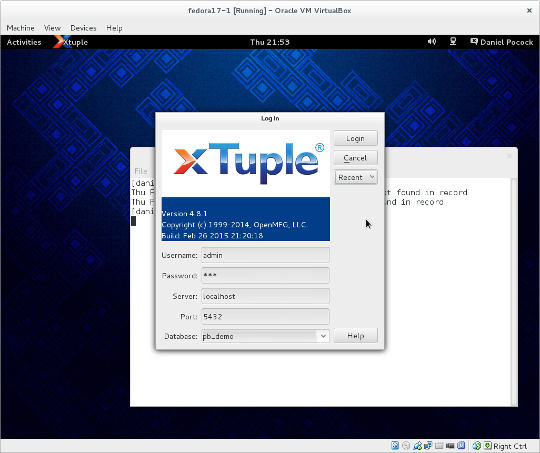
Daniel Pocock: PostBooks accounting and ERP suite coming to Fedora

PostBooks has been successful on Debian and Ubuntu for a while now and for all those who asked, it is finally coming to Fedora. The review request has just been submitted and the spec files have also been submitted to xTuple as pull requests so future upstream releases can be used with rpmbuild to create packages. Can you help? A few small things outstanding:
  • Putting a launcher icon in the GNOME menus
  • Packaging the schemas - they are in separate packages on Debian/Ubuntu. Download them here and load the one you want into your PostgreSQL instance using the instructions from the Debian package.
Community support The xTuple forum is a great place to ask any questions and get to know the community. Screenshot Here is a quick look at the login screen on a Fedora 19 host:

23 February 2015

Simon Josefsson: Laptop Buying Advice?

My current Lenovo X201 laptop has been with me for over four years. I ve been looking at new laptop models over the years thinking that I should upgrade. Every time, after checking performance numbers, I ve always reached the conclusion that it is not worth it. The most performant Intel Broadwell processor is the the Core i7 5600U and it is only about 1.5 times the performance of my current Intel Core i7 620M. Meanwhile disk performance has increased more rapidly, but changing the disk on a laptop is usually simple. Two years ago I upgraded to the Samsung 840 Pro 256GB disk, and this year I swapped that for the Samsung 850 Pro 1TB, and both have been good investments. Recently my laptop usage patterns have changed slightly, and instead of carrying one laptop around, I have decided to aim for multiple semi-permanent laptops at different locations, coupled with a mobile device that right now is just my phone. The X201 will remain one of my normal work machines. What remains is to decide on a new laptop, and there begins the fun. My requirements are relatively easy to summarize. The laptop will run a GNU/Linux distribution like Debian, so it has to work well with it. I ve decided that my preferred CPU is the Intel Core i7 5600U. The screen size, keyboard and mouse is mostly irrelevant as I never work longer periods of time directly on the laptop. Even though the laptop will be semi-permanent, I know there will be times when I take it with me. Thus it has to be as lightweight as possible. If there would be significant advantages in going with a heavier laptop, I might reconsider this, but as far as I can see the only advantage with a heavier machine is bigger/better screen, keyboard (all of which I find irrelevant) and maximum memory capacity (which I would find useful, but not enough of an argument for me). The sub-1.5kg laptops with the 5600U CPU on the market that I have found are:
Lenovo X250 1.42kg 12.5 1366 768
Lenovo X1 Carbon (3rd gen) 1.44kg 14 2560 1440
Dell Latitude E7250 1.25kg 12.5 1366 768
Dell XPS 13 1.26kg 13.3 3200 1800
HP EliteBook Folio 1040 G2 1.49kg 14 1920 1080
HP EliteBook Revolve 810 G3 1.4kg 11.6 1366 768
I find it interesting that Lenovo, Dell and HP each have two models that meets my 5600U/sub-1.5kg criteria. Regarding screen, possibly there exists models with other screen resolutions. The XPS 13, HP 810 and X1 models I looked had touch screens, the others did not. As screen is not important to me, I didn t evaluate this further. I think all of them would suffice, and there are only subtle differences. All except the XPS 13 can be connected to peripherals using one cable, which I find convenient to avoid a cable mess. All of them have DisplayPort, but HP uses DisplayPort Standard and the rest uses miniDP. The E7250 and X1 have HDMI output. The X250 boosts a 15-pin VGA connector, none of the others have it I m not sure if that is a advantage or disadvantage these days. All of them have 2 USB v3.0 ports except the E7250 which has 3 ports. The HP 1040, XPS 13 and X1 Carbon do not have RJ45 Ethernet connectors, which is a significant disadvantage to me. Ironically, only the smallest one of these, the HP 810, can be memory upgraded to 12GB with the others being stuck at 8GB. HP and the E7250 supports NFC, although Debian support is not certain. The E7250 and X250 have a smartcard reader, and again, Debian support is not certain. The X1, X250 and 810 have a 3G/4G card. Right now, I m leaning towards rejecting the XPS 13, X1 and HP 1040 because of lack of RJ45 ethernet port. That leaves me with the E7250, X250 and the 810. Of these, the E7250 seems like the winner: lightest, 1 extra USB port, HDMI, NFC, SmartCard-reader. However, it has no 3G/4G-card and no memory upgrade options. Looking for compatibility problems, it seems you have to be careful to not end up with the Dell Wireless card and the E7250 appears to come in a docking and non-docking variant but I m not sure what that means. Are there other models I should consider? Other thoughts?

22 February 2015

Rog rio Brito: User-Agent strings and privacy

I just had my hands on some mobile devices (a Samsung's Galaxy Tab S 8.4", an Apple's iPad mini 3, and my no-name tablet that runs Android). I got curious to see how the different browsers identify themselves to the world via their User agent strings and I must say that each browser's string reveals a lot about both the browser makers and their philosophies regarding user privacy. Here is a simple table that I compiled with the information that I collected (sorry if it gets too wide):
Device Browser User-Agent String
Samsung Galaxy Tab S Firefox 35.0 Mozilla/5.0 (Android; Tablet; rv:35.0) Gecko/35.0 Firefox/35.0
Samsung Galaxy Tab S Firefox 35.0.1 Mozilla/5.0 (Android; Tablet; rv:35.0.1) Gecko/35.0.1 Firefox/35.0.1
Samsung Galaxy Tab S Android's 4.4.2 stock browser Mozilla/5.0 (Linux; Android 4.4.2; en-gb; SAMSUNG SM-T700 Build/KOT49H) AppleWebKit/537.36 (KHTML, like Gecko) Version/1.5 Chrome/28.0.1500.94 Safari/537.36
Samsung Galaxy Tab S Updated Chrome Mozilla/5.0 (Linux; Android 4.4.2; SM-T700 Build/KOT49H) AppleWebKit/537.36 (KHTML, like Gecko) Chrome/40.0.2214.109 Safari/537.36
Vanilla tablet Android's 4.1.1 stock browser Mozilla/5.0 (Linux; U; Android 4.1.1; en-us; TB1010 Build/JRO03H) AppleWebKit/534.30 (KHTML, like Gecko) Version/4.0 Safari/534.30
Vanilla tablet Firefox 35.0.1 Mozilla/5.0 (Android; Tablet; rv:35.0.1) Gecko/35.0.1 Firefox/35.0.1
iPad Safari's from iOS 8.1.3 Mozilla/5.0 (iPad; CPU OS 8_1_3 like Mac OS X) AppleWebKit/600.1.4 (KHTML, like Gecko) Version/8.0 Mobile/12B466 Safari/600.1.4
Notebook Debian's Iceweasel 35.0.1 Mozilla/5.0 (X11; Linux x86_64; rv:35.0) Gecko/20100101 Firefox/35.0 Iceweasel/35.0.1
So, briefly looking at the table above, you can tell that the stock Android browser reveals quite a bit of information: the model of the device (e.g., SAMSUNG SM-T700 or TB1010) and even the build number (e.g., Build/KOT49H or Build/JRO03H)! This is super handy for malicious websites and I would say that it leaks a lot of possibly undesired information. The iPad is similar, with Safari revealing the version of the iOS that it is running. It doesn't reveal, though, the language that the user is using via the UA string (it probably does via other HTTP fields). Chrome is similar to the stock Android browser here, but, at least, it doesn't reveal the language of the user. It does reveal the version of Android, including the patch-level (that's a bit too much, IMVHO). I would say that the winner respecting privacy of the users among the browsers that I tested is Firefox: it conveys just the bare minimum, not differentiating from a high-end tablet (Samsung's Galaxy Tab S with 8 cores) and a vanilla tablet (with 2 cores). Like Chrome, Firefox still reveals a bit too much in the form of the patch-level. It should be sufficient to say that it is version 35.0 even if the user has 35.0.1 installed. The bonus points with Firefox is that it is also available on F-Droid, in two versions: as Firefox itself and as Fennec.

20 February 2015

Richard Hartmann: Release Critical Bug report for Week 08

The UDD bugs interface currently knows about the following release critical bugs: How do we compare to the Squeeze and Wheezy release cycles?
Week Squeeze Wheezy Jessie
43 284 (213+71) 468 (332+136) 319 (240+79)
44 261 (201+60) 408 (265+143) 274 (224+50)
45 261 (205+56) 425 (291+134) 295 (229+66)
46 271 (200+71) 401 (258+143) 427 (313+114)
47 283 (209+74) 366 (221+145) 342 (260+82)
48 256 (177+79) 378 (230+148) 274 (189+85)
49 256 (180+76) 360 (216+155) 226 (147+79)
50 204 (148+56) 339 (195+144) ???
51 178 (124+54) 323 (190+133) 189 (134+55)
52 115 (78+37) 289 (190+99) 147 (112+35)
1 93 (60+33) 287 (171+116) 140 (104+36)
2 82 (46+36) 271 (162+109) 157 (124+33)
3 25 (15+10) 249 (165+84) 172 (128+44)
4 14 (8+6) 244 (176+68) 187 (132+55)
5 2 (0+2) 224 (132+92) 175 (124+51)
6 release! 212 (129+83) 161 (109+52)
7 release+1 194 (128+66) 147 (106+41)
8 release+2 206 (144+62) 147 (96+51)
9 release+3 174 (105+69)
10 release+4 120 (72+48)
11 release+5 115 (74+41)
12 release+6 93 (47+46)
13 release+7 50 (24+26)
14 release+8 51 (32+19)
15 release+9 39 (32+7)
16 release+10 20 (12+8)
17 release+11 24 (19+5)
18 release+12 2 (2+0)
Graphical overview of bug stats thanks to azhag:

19 February 2015

Matthew Garrett: It has been 0 days since the last significant security failure. It always will be.

So blah blah Superfish blah blah trivial MITM everything's broken.

Lenovo deserve criticism. The level of incompetence involved here is so staggering that it wouldn't be a gross injustice for the company to go under as a result[1]. But let's not pretend that this is some sort of isolated incident. As an industry, we don't care about user security. We will gladly ship products with known security failings and no plans to update them. We will produce devices that are locked down such that it's impossible for anybody else to fix our failures. We will hide behind vague denials, we will obfuscate the impact of flaws and we will deflect criticisms with announcements of new and shinier products that will make everything better.

It'd be wonderful to say that this is limited to the proprietary software industry. I would love to be able to argue that we respect users more in the free software world. But there are too many cases that demonstrate otherwise, even where we should have the opportunity to prove the benefits of open development. An obvious example is the smartphone market. Hardware vendors will frequently fail to provide timely security updates, and will cease to update devices entirely after a very short period of time. Fortunately there's a huge community of people willing to produce updated firmware. Phone manufacturer is never going to fix the latest OpenSSL flaw? As long as your phone can be unlocked, there's a reasonable chance that there's an updated version on the internet.

But this is let down by a kind of callous disregard for any deeper level of security. Almost every single third-party Android image is either unsigned or signed with the "test keys", a set of keys distributed with the Android source code. These keys are publicly available, and as such anybody can sign anything with them. If you configure your phone to allow you to install these images, anybody with physical access to your phone can replace your operating system. You've gained some level of security at the application level by giving up any real ability to trust your operating system.

This is symptomatic of our entire ecosystem. We're happy to tell people to disable security features in order to install third-party software. We're happy to tell people to download and build source code without providing any meaningful way to verify that it hasn't been tampered with. Install methods for popular utilities often still start "curl sudo bash". This isn't good enough.

We can laugh at proprietary vendors engaging in dreadful security practices. We can feel smug about giving users the tools to choose their own level of security. But until we're actually making it straightforward for users to choose freedom without giving up security, we're not providing something meaningfully better - we're just providing the same shit sandwich on different bread.

[1] I don't see any way that they will, but it wouldn't upset me

comment count unavailable comments

Michal &#268;iha&#345;: Weblate 2.2

Weblate 2.2 has been released today. It comes with improved search, user interface cleanup and various other fixes. Full list of changes for 2.2: You can find more information about Weblate on http://weblate.org, the code is hosted on Github. If you are curious how it looks, you can try it out on demo server. You can login there with demo account using demo password or register your own user. Weblate is also being used https://hosted.weblate.org/ as official translating service for phpMyAdmin, Gammu, Weblate itself and other projects. If you are free software project which would like to use Weblate, I'm happy to help you with set up or even host Weblate for you. Further development of Weblate would not be possible without people providing donations, thanks to everybody who have helped so far! PS: The roadmap for next release is just being prepared, you can influence this by expressing support for individual issues either by comments or by providing bounty for them.

Filed under: English phpMyAdmin SUSE Weblate 0 comments Flattr this!

18 February 2015

Mark Brown: Kernel build times for automated builders

Over the past year or so various people have been automating kernel builds with the aim of both setting the standard that things should build reliably and using the resulting builds for automated testing. This has been having good results, it s especially nice to compare the results for older stable kernel builds with current ones and notice how much happier everything is. One of the challenges with doing this is that for good coverage you really need to include allmodconfig or allyesconfig builds to ensure coverage of as much kernel code as possible but that s fairly resource intensive given the size of the kernel, especially when you want to cover several architectures. It s also fairly important to get prompt results, development trees are changing all the time and the longer the gap between a problem appearing and it being identified the more likely the report is to be redundant. Since I was looking at my own setup and I know of several people who ve done similar benchmarking I thought I d publish some ballpark numbers for from scratch allmodconfig builds on a single architecture:
i7-4770 with SSD 20 minutes
linode 2048 1.25 hours
EC2 m3.medium 1.5 hours
EC2 c3.large 2 hours
Cubietruck with SSD 20 hours
Intel Celeron N2940 1.75 hours
All with the number of tasks spawned by make set to the number of execution threads the system has and no speedups from anything like ccache. I may keep this updated in future with further results. Obviously there s tradeoffs beyond the time, especially for someone like me doing this at home with their own resources my desktop is substantially faster than anything else I ve tried but I m also using it interactively for my work, it s not easily accessible when not at home and the fans spin up during builds while EC2 starts to cost noticeable money to use as you add more builds.

17 February 2015

John Goerzen: Has Linux lost its way? comments prompt a Debian developer to revisit FreeBSD after 20 years

I ll admit it. I have a soft spot for FreeBSD. FreeBSD was the first Unix I ran, and it was somewhere around 20 years ago that I did so, before I switched to Debian. Even then, I still used some of the FreeBSD Handbook to learn Linux, because Debian didn t have the great Reference that it does now. Anyhow, some comments in my recent posts ( Has modern Linux lost its way? and Reactions to that, and the value of simplicity), plus a latent desire to see how ZFS fares in FreeBSD, caused me to try it out. I installed it both in VirtualBox under Debian, and in an old 64-bit Thinkpad sitting in my basement that previously ran Debian. The results? A mixture of amazing and disappointing. I will say that I am quite glad that both exist; there is plenty of innovation happening everywhere and neat features exist everywhere, too. But I can also come right out and say that the statement that FreeBSD doesn t have issues like Linux does is false and misleading. In many cases, it s running the exact same stack. In others, it s better, but there are also others where it s worse. Perhaps this article might dispell a bit of the FUD surrounding jessie, while also showing off some of the nice things FreeBSD does. My conclusion: Both jessie and FreeBSD 10.1 are awesome Free operating systems, but both have their warts. This article is more about FreeBSD than Debian, but it will discuss a few of Debian s warts as well. The experience My initial reaction to FreeBSD was: wow, this feels so familiar. It reminds me of a commercial Unix, or maybe of Linux from a few years ago. A minimal, well-documented base system, everything pretty much in logical places in the filesystem, and solid memory management. I felt right at home. It was almost reassuring, even. Putting together a FreeBSD box is a lot of package installing and config file editing. The FreeBSD Handbook, describing how to install X, talks about editing this or that file for this or that feature. I like being able to learn directly how things fit together by doing this. But then you start remembering the reasons you didn t like Linux a few years ago, or the commercial Unixes: maybe it s that programs like apache are still not as well supported, or maybe it s that the default vi has this tendency to corrupt the terminal periodically, or perhaps it s that root s default shell is csh. Or perhaps it s that I have to do a lot of package installing and config file editing. It is not quite the learning experience it once was, either; now there are things like paste this XML file into some obscure polkit location to make your mouse work or something. Overall, there are some areas where FreeBSD kills it in a way no other OS does. It is unquestionably awesome in several areas. But there are a whole bunch of areas where it s about 80% as good as Linux, a number of areas (even polkit, dbus, and hal) where it s using the exact same stack Linux is (so all these comments about FreeBSD being so differently put together strike me as hollow), and frankly some areas that need a lot of work and make it hard to manage systems in a secure and stable way. The amazing Let s get this out there: I ve used ZFS too much to use any OS that doesn t support it or something like it. Right now, I m not aware of anything like ZFS that is generally stable and doesn t cost a fortune, so pretty much: if your Unix doesn t do ZFS, I m not interested. (btrfs isn t there yet, but will be awesome when it is.) That s why I picked FreeBSD for this, rather than NetBSD or OpenBSD. ZFS on FreeBSD is simply awesome. They have integreated it extremely well. The installer supports root on zfs, even encrypted root on zfs (though neither is a default). top on a FreeBSD system shows a line of ZFS ARC (cache) stats right alongside everything else. The ZFS defaults for maximum cache size, readahead, etc. auto-tune themselves at boot (unless overridden) based on the amount of RAM in a system and the system type. Seriously, these folks have thought of everything and it just reeks of solid. I haven t seen ZFS this well integrated outside the Solaris-type OSs. I have been using ZFSOnLinux for some time now, but it is just not as mature as ZFS on FreeBSD. ZoL, for instance, still has some memory tuning issues, and is not really suggested for 32-bit machines. FreeBSD just nails it. ZFS on FreeBSD even supports TRIM, which is not available in ZoL and I think fairly unique even among OpenZFS platforms. It also supports delegated administration of the filesystem, both to users and to jails on the system, seemingly very similar to Solaris zones. FreeBSD also supports beadm, which is like a similar tool on Solaris. This lets you basically use ZFS snapshots to make lightweight boot environments , so you can select which to boot into. This is useful, say, before doing upgrades. Then there are jails. Linux has tried so hard to get this right, and fallen on its face so many times, a person just wants to take pity sometimes. We ve had linux-vserver, openvz, lxc, and still none of them match what FreeBSD jails have done for a long time. Linux s current jail-du-jour is LXC, though it is extremely difficult to configure in a secure way. Even its author comments that you won t hear any of the LXC maintainers tell you that LXC is secure and that it pretty much requires AppArmor profiles to achieve reasonable security. These are still rather in flux, as I found out last time I tried LXC a few months ago. My confidence in LXC being as secure as, say, KVM or FreeBSD is simply very low. FreeBSD s jails are simple and well-documented where LXC is complex and hard to figure out. Its security is fairly transparent and easy to control and they just work well. I do think LXC is moving in the right direction and might even get there in a couple years, but I am quite skeptical that even Docker is getting the security completely right. The simply different People have been throwing around the word distribution with respect to FreeBSD, PC-BSD, etc. in recent years. There is an analogy there, but it s not perfect. In the Linux ecosystem, there is a kernel project, a libc project, a coreutils project, a udev project, a systemd/sysvinit/whatever project, etc. You get the idea. In FreeBSD, there is a base system project. This one project covers the kernel and the base userland. Some of what they use in the base system is code pulled in from elsewhere but maintained in their tree (ssh), some is completely homegrown (kernel), etc. But in the end, they have a nicely-integrated base system that always gets upgraded in sync. In the Linux world, the distribution makers are responsible for integrating the bits from everywhere into a coherent whole. FreeBSD is something of a toolkit to build up your system. Gentoo might be an analogy in the Linux side. On the other end of the spectrum, Ubuntu is a just install it and it works, tweak later sort of setup. Debian straddles the middle ground, offering both approaches in many cases. There are pros and cons to each approach. Generally, I don t think either one is better. They are just different. The not-quite-there I said that there are a lot of things in FreeBSD that are about 80% of where Linux is. Let me touch on them here. Its laptop support leaves something to be desired. I installed it on a few-years-old Thinkpad basically the best possible platform for working suspend in a Free OS. It has worked perfectly out of the box in Debian for years. In FreeBSD, suspend only works if it s in text mode. If X is running, the video gets corrupted and the system hangs. I have not tried to debug it further, but would also note that suspend on closed lid is not automatic in FreeBSD; the somewhat obscure instuctions tell you what policykit pkla file to edit to make suspend work in XFCE. (Incidentally, it also says what policykit file to edit to make the shutdown/restart options work). Its storage subsystem also has some surprising misses. Its rough version of LVM, LUKS, and md-raid is called GEOM. GEOM, however, supports only RAID0, RAID1, and RAID3. It does not support RAID5 or RAID6 in software RAID configurations! Linux s md-raid, by comparison, supports RAID0, RAID1, RAID4, RAID5, RAID6, etc. There seems to be a highly experimental RAID5 patchset floating around for many years, but it is certainly not integrated into the latest release kernel. The current documentation makes no mention of RAID5, although it seems that a dated logical volume manager supported it. In any case, RAID5 does not seem to be well-supported in software like it is in Linux. ZFS does have its raidz1 level, which is roughly the same as RAID5. However, that requires full use of ZFS. ZFS also does not support some common operations, like adding a single disk to an existing RAID5 group (which is possible with md-raid and many other implementations.) This is a ZFS limitation on all platforms. FreeBSD s filesystem support is rather a miss. They once had support for Linux ext* filesystems using the actual Linux code, but ripped it out because it was in GPL and rewrote it so it had a BSD license. The resulting driver really only works with ext2 filesystems, as it doesn t work with ext3/ext4 in many situations. Frankly I don t see why they bothered; they now have something that is BSD-licensed but only works with a filesystem so old nobody uses it anymore. There are only two FreeBSD filesystems that are really useable: UFS2 and ZFS. Virtualization under FreeBSD is also not all that present. Although it does support the VirtualBox Open Source Edition, this is not really a full-featured or fast enough virtualization environment for a server. Its other option is bhyve, which looks to be something of a Xen clone. bhyve, however, does not support Windows guests, and requires some hoops to even boot Linux guest installers. It will be several years at least before it reaches feature-parity with where KVM is today, I suspect. One can run FreeBSD as a guest under a number of different virtualization systems, but their instructions for making the mouse work best under VirtualBox did not work. There may have been some X.Org reshuffle in FreeBSD that wasn t taken into account. The installer can be nice and fast in some situations, but one wonders a little bit about QA. I had it lock up on my twice. Turns out this is a known bug reported 2 months ago with no activity, in which the installer attempts to use a package manger that it hasn t set up yet to install optional docs. I guess the devs aren t installing the docs in testing. There is nothing like Dropbox for FreeBSD. Apparently this is because FreeBSD has nothing like Linux s inotify. The Linux Dropbox does not work in FreeBSD s Linux mode. There are sketchy reports of people getting an OwnCloud client to work, but in something more akin to rsync rather than instant-sync mode, if they get it working at all. Some run Dropbox under wine, apparently. The desktop environments tend to need a lot more configuration work to get them going than on Linux. There s a lot of editing of polkit, hal, dbus, etc. config files mentioned in various places. So, not only does FreeBSD use a lot of the same components that cause confusion in Linux, it doesn t really configure them for you as much out of the box. FreeBSD doesn t support as many platforms as Linux. FreeBSD has only two platforms that are fully supported: i386 and amd64. But you ll see people refer to a list of other platforms that are supported , but they don t have security support, official releases, or even built packages. They includ arm, ia64, powerpc, and sparc64. The bad: package management Roughly 20 years ago, this was one of the things that pulled me to Debian. Perhaps I am spolied from running the distribution that has been the gold standard for package management for so long, but I find FreeBSD s package management even pkg-ng in 10.1-RELEASE to be lacking in a number of important ways. To start with, FreeBSD actually has two different package management systems: one for the base system, and one for what they call the ports/packages collection ( ports being the way to install from source, and packages being the way to install from binaries, but both related to the same tree.) For the base system, there is freebsd-update which can install patches and major upgrades. It also has a cron option to automate this. Sadly, it has no way of automatically indicating to a calling script whether a reboot is necessary. freebsd-update really manages less than a dozen packages though. The rest are managed by pkg. And pkg, it turns out, has a number of issues. The biggest: it can take a week to get security updates. The FreeBSD handbook explains pkg audit -F which will look at your installed packages (but NOT the ones in the base system) and alert you to packages that need to be updates, similar to a stripped-down version of Debian s debsecan. I discovered this myself, when pkg audit -F showed a vulnerability in xorg, but pkg upgrade showed my system was up-to-date. It is not documented in the Handbook, but people on the mailing list explained it to me. There are workarounds, but they can be laborious. If that s not bad enough, FreeBSD has no way to automatically install security patches for things in the packages collection. Debian has several (unattended-upgrades, cron-apt, etc.) There is pkg upgrade , but it upgrades everything on the system, which may be quite a bit more than you want to be upgraded. So: if you want to run Apache with PHP, and want it to just always apply security patches, FreeBSD packages are not up to the job like Debian s are. The pkg tool doesn t have very good error-handling. In fact, its error handling seems to be nonexistent at times. I noticed that some packages had failures during install time, but pkg ignored them and marked the package as correctly installed. I only noticed there was a problem because I happened to glance at the screen at the right moment during messages about hundreds of packages. In Debian, by contrast, if there are any failures, at the end of the run, you get a nice report of which packages failed, and an exit status to use in scripts. It also has another issue that Debian resolved about a decade ago: package scripts displaying messages that are important for the administrator, but showing so many of them that they scroll off the screen and are never seen. I submitted a bug report for this one also. Some of these things just make me question the design of pkg. If I can t trust it to accurately report if the installation succeeded, or show me the important info I need to see, then to what extent can I trust it? Then there is the question of testing of the ports/packages. It seems that, automated tests aside, basically everyone is running off the master branch of the ports/packages. That s like running Debian unstable on your servers. I am distinctly uncomfortable with this notion, though it seems FreeBSD people report it mostly works well. There are some other issues, too: FreeBSD ports make no distinction between development and runtime files like Debian s packages do. So, just by virtue of wanting to run a graphical desktop, you get all of the static libraries, include files, build scripts, etc for XOrg installed. For a package as concerned about licensing as FreeBSD, the packages collection does not have separate sections like Debian s main, contrib, and non-free. It s all in one big pot: BSD-license, GPL-license, proprietary without source license. There is /usr/local/share/licenses where you can look up a license for each package, but there is no way with FreeBSD, like there is with Debian, to say never even show me packages that aren t DFSG-free. This is useful, for instance, when running in a company to make sure you never install packages that are for personal use only or something. The bad: ABI stability I m used to being able to run binaries I compiled years ago on a modern system. This is generally possible in Linux, assuming you have the correct shared libraries available. In FreeBSD, this is explicitly NOT possible. After every major version upgrade, you must reinstall or recompile every binary on your system. This is not necessarily a showstopper for me, but it is a hassle for a lot of people. Update 2015-02-17: Some people in the comments are pointing out compat packages in the ports that may help with this situation. My comment was based on advice in the FreeBSD Handbook stating After a major version upgrade, all installed packages and ports need to be upgraded . I have not directly tried this, so if the Handbook is overstating the need, then this point may be in error. Conclusions As I said above, I found little validation to the comments that the Debian ecosystem is noticeably worse than the FreeBSD one. Debian has its warts too particularly with keeping software up-to-date. You can see that the two projects are designed around a different passion: FreeBSD s around the base system, and Debian s around an integrated whole system. It would be wrong to say that either of those is always better. FreeBSD s approach clearly produces some leading features, especially jails and ZFS integration. Yet Debian s approach also produces some leading features in the way of package management and security maintainability beyond the small base. My criticism of excessive complexity in the polkit/cgmanager/dbus area still stands. But to those people commenting that FreeBSD hasn t lost its way like Linux has, I would point out that FreeBSD mostly uses these same components also, and FreeBSD has excessive complexity in its ports/package system and system management tools. I think it s a draw. You pick the best for your use case. If you re looking for a platform to run a single custom app then perhaps all of the Debian package management benefits don t apply to you (you may not even need FreeBSD s packages, or just a few). The FreeBSD ZFS support or jails may well appeal. If you re looking to run a desktop environment, or a server with some application that needs a ton of PHP, Python, Perl, or C libraries, then Debian s package management and security handling may well be attractive. I am disappointed that Debian GNU/kFreeBSD will not be a release architecture in jessie. That project had the promise to provide a best of both worlds for those that want jails or tight ZFS integration.

16 February 2015

Julien Danjou: Hacking Python AST: checking methods declaration

A few months ago, I wrote the definitive guide about Python method declaration, which had quite a good success. I still fight every day in OpenStack to have the developers declare their methods correctly in the patches they submit. Automation plan The thing is, I really dislike doing the same things over and over again. Furthermore, I'm not perfect either, and I miss a lot of these kind of problems in the reviews I made. So I decided to replace me by a program a more scalable and less error-prone version of my brain. In OpenStack, we rely on flake8 to do static analysis of our Python code in order to spot common programming mistakes. But we are really pedantic, so we wrote some extra hacking rules that we enforce on our code. To that end, we wrote a flake8 extension called hacking. I really like these rules, I even recommend to apply them in your own project. Though I might be biased or victim of Stockholm syndrome. Your call. Anyway, it's pretty clear that I need to add a check for method declaration in hacking. Let's write a flake8 extension! Typical error The typical error I spot is the following:
class Foo(object):
# self is not used, the method does not need
# to be bound, it should be declared static
def bar(self, a, b, c):
return a + b - c

That would be the correct version:
class Foo(object):
@staticmethod
def bar(a, b, c):
return a + b - c

This kind of mistake is not a show-stopper. It's just not optimized. Why you have to manually declare static or class methods might be a language issue, but I don't want to debate about Python misfeatures or design flaws. Strategy We could probably use some big magical regular expression to catch this problem. flake8 is based on the pep8 tool, which can do a line by line analysis of the code. But this method would make it very hard and error prone to detect this pattern. Though it's also possible to do an AST based analysis on on a per-file basis with pep8. So that's the method I pick as it's the most solid. AST analysis I won't dive deeply into Python AST and how it works. You can find plenty of sources on the Internet, and I even talk about it a bit in my book The Hacker's Guide to Python. To check correctly if all the methods in a Python file are correctly declared, we need to do the following: Flake8 plugin In order to register a new plugin in flake8 via hacking, we just need to add an entry in setup.cfg:
[entry_points]
flake8.extension =
[ ]
H904 = hacking.checks.other:StaticmethodChecker
H905 = hacking.checks.other:StaticmethodChecker

We register 2 hacking codes here. As you will notice later, we are actually going to add an extra check in our code for the same price. Stay tuned. The next step is to write the actual plugin. Since we are using an AST based check, the plugin needs to be a class following a certain signature:
@core.flake8ext
class StaticmethodChecker(object):
def __init__(self, tree, filename):
self.tree = tree

def run(self):
pass

So far, so good and pretty easy. We store the tree locally, then we just need to use it in run() and yield the problem we discover following pep8 expected signature, which is a tuple of (lineno, col_offset, error_string, code). This AST is made for walking The ast module provides the walk function, that allow to iterate easily on a tree. We'll use that to run through the AST. First, let's write a loop that ignores the statement that are not class definition.
@core.flake8ext
class StaticmethodChecker(object):
def __init__(self, tree, filename):
self.tree = tree

def run(self):
for stmt in ast.walk(self.tree):
# Ignore non-class
if not isinstance(stmt, ast.ClassDef):
continue

We still don't check for anything, but we know how to ignore statement that are not class definitions. The next step need to be to ignore what is not function definition. We just iterate over the attributes of the class definition.
for stmt in ast.walk(self.tree):
# Ignore non-class
if not isinstance(stmt, ast.ClassDef):
continue
# If it's a class, iterate over its body member to find methods
for body_item in stmt.body:
# Not a method, skip
if not isinstance(body_item, ast.FunctionDef):
continue

We're all set for checking the method, which is body_item. First, we need to check if it's already declared as static. If so, we don't have to do any further check and we can bail out.
for stmt in ast.walk(self.tree):
# Ignore non-class
if not isinstance(stmt, ast.ClassDef):
continue
# If it's a class, iterate over its body member to find methods
for body_item in stmt.body:
# Not a method, skip
if not isinstance(body_item, ast.FunctionDef):
continue
# Check that it has a decorator
for decorator in body_item.decorator_list:
if (isinstance(decorator, ast.Name)
and decorator.id == 'staticmethod'):
# It's a static function, it's OK
break
else:
# Function is not static, we do nothing for now
pass

Note that we use the special for/else form of Python, where the else is evaluated unless we used break to exit the for loop.
for stmt in ast.walk(self.tree):
# Ignore non-class
if not isinstance(stmt, ast.ClassDef):
continue
# If it's a class, iterate over its body member to find methods
for body_item in stmt.body:
# Not a method, skip
if not isinstance(body_item, ast.FunctionDef):
continue
# Check that it has a decorator
for decorator in body_item.decorator_list:
if (isinstance(decorator, ast.Name)
and decorator.id == 'staticmethod'):
# It's a static function, it's OK
break
else:
try:
first_arg = body_item.args.args[0]
except IndexError:
yield (
body_item.lineno,
body_item.col_offset,
"H905: method misses first argument",
"H905",
)
# Check next method
continue

We finally added some check! We grab the first argument from the method signature. Unless it fails, and in that case, we know there's a problem: you can't have a bound method without the self argument, therefore we raise the H905 code to signal a method that misses its first argument. Now you know why we registered this second pep8 code along with H904 in setup.cfg. We have here a good opportunity to kill two birds with one stone. The next step is to check if that first argument is used in the code of the method.
for stmt in ast.walk(self.tree):
# Ignore non-class
if not isinstance(stmt, ast.ClassDef):
continue
# If it's a class, iterate over its body member to find methods
for body_item in stmt.body:
# Not a method, skip
if not isinstance(body_item, ast.FunctionDef):
continue
# Check that it has a decorator
for decorator in body_item.decorator_list:
if (isinstance(decorator, ast.Name)
and decorator.id == 'staticmethod'):
# It's a static function, it's OK
break
else:
try:
first_arg = body_item.args.args[0]
except IndexError:
yield (
body_item.lineno,
body_item.col_offset,
"H905: method misses first argument",
"H905",
)
# Check next method
continue
for func_stmt in ast.walk(body_item):
if six.PY3:
if (isinstance(func_stmt, ast.Name)
and first_arg.arg == func_stmt.id):
# The first argument is used, it's OK
break
else:
if (func_stmt != first_arg
and isinstance(func_stmt, ast.Name)
and func_stmt.id == first_arg.id):
# The first argument is used, it's OK
break
else:
yield (
body_item.lineno,
body_item.col_offset,
"H904: method should be declared static",
"H904",
)

To that end, we iterate using ast.walk again and we look for the use of the same variable named (usually self, but if could be anything, like cls for @classmethod) in the body of the function. If not found, we finally yield the H904 error code. Otherwise, we're good. Conclusion I've submitted this patch to hacking, and, finger crossed, it might be merged one day. If it's not I'll create a new Python package with that check for flake8. The actual submitted code is a bit more complex to take into account the use of abc module and include some tests. As you may have notice, the code walks over the module AST definition several times. There might be a couple of optimization to browse the AST in only one pass, but I'm not sure it's worth it considering the actual usage of the tool. I'll let that as an exercise for the reader interested in contributing to OpenStack. Happy hacking!
The Hacker's Guide to Python
A book I wrote talking about designing Python applications, state of the art, advice to apply when building your application, various Python tips, etc. Interested? Check it out.

15 February 2015

Matthew Palmer: The Vicious Circle of Documentation

Ever worked at a company (or on a codebase, or whatever) where it seemed like, no matter what the question was, the answer was written down somewhere you could easily find it? Most people haven t, sadly, but they do exist, and I can assure you that it is an absolute pleasure. On the other hand, practically everyone has experienced completely undocumented systems and processes, where knowledge is shared by word-of-mouth, or lost every time someone quits. Why are there so many more undocumented systems than documented ones out there, and how can we cause more well-documented systems to exist? The answer isn t people are lazy , and the solution is simple though not easy.

Why Johnny Doesn t Read When someone needs to know something, they might go look for some documentation, or they might ask someone else or just guess wildly. The behaviour look for documentation is often reinforced negatively, by the result documentation doesn t exist . At the same time, the behaviours ask someone and guess wildly are positively reinforced, by the results I get my question answered and/or at least I can get on with my work . Over time, people optimise their behaviour by skipping the look for documentation step, and just go straight to asking other people (or guessing wildly).

Why Johnny Doesn t Write When someone writes documentation, they re hoping that people will read it and not have to ask them questions in order to be productive and do the right thing. Hence, the behaviour write documentation is negatively reinforced by the results I still get asked questions , and nobody does things the right way around here, dammit! Worse, though, is that there is very little positive reinforcement for the author: when someone does read the docs, and thus doesn t ask a question, the author almost certainly doesn t know they dodged a bullet. Similarly, when someone does things the right way, it s unlikely that anyone will notice. It s only the mistakes that catch the attention. Given that the experience of writing documentation tends to skew towards the negative, it s not surprising that eventually, the time spent writing documentation is reallocated to other, more utility-producing activities.

Death Spiral The combination of these two situations is self-reinforcing. While a suitably motivated reader might start by strictly looking for documentation, or an author initially be enthused to always fully documenting their work, over time the reflex will be for readers to just go ask someone, because there s never any documentation! , and for authors to not write documentation because nobody bothers to read what I write anyway! . It is important to recognise that this iterative feedback loop is the natural state of the reader/author ecosystem, resulting in something akin to thermodynamic entropy. To avoid the system descending into chaos, energy needs to be constantly applied to keep the system in order.

The Solution Effective methods for avoiding the vicious circle can be derived from the things that cause it. Change the forces that apply themselves to readers and authors, and they will behave differently. On the reader s side, the most effective way to encourage people to read documentation is for it to consistently exist. This means that those in control of a project or system mustn t consider something done until the documentation is in a good state. Patches shouldn t be landed, and releases shouldn t be made, unless the documentation is altered to match the functional changes being made. Yes, this requires discipline, which is just a form of energy application to prevent entropic decay. Writing documentation should be an explicit and well-understood part of somebody s job description. Whoever is responsible for documentation needs to be given the time to do it properly. Writing well takes time and mental energy, and that time needs to be factored into the plans. Never forget that skimping on documentation, like short-changing QA or customer support, is a false economy that will cost more in the long term than it saves in the short term. Even if the documentation exists, though, some people are going to tend towards asking people rather than consulting the documentation. This isn t a moral failing on their part, but only happens when they believe that asking someone is more beneficial to them than going to the documentation. To change the behaviour, you need to change the belief. You could change the belief by increasing the cost of asking. You could fire (or hellban) anyone who ever asks a question that is answered in the documentation. But you shouldn t. You could yell RTFM! at everyone who asks a question. Thankfully that s one acronym that s falling out of favour. Alternately, you can reduce the cost of getting the answer from the documentation. Possibly the largest single productivity boost for programmers, for example, has been the existence of Google. Whatever your problem, there s a pretty good chance that a search or two will find a solution. For your private documentation, you probably don t have the power of Google available, but decent full-text search systems are available. Use them. Finally, authors would benefit from more positive reinforcement. If you find good documentation, let the author know! It requires a lot of effort (comparatively) to look up an author s contact details and send them a nice e-mail. The like button is a more low-energy way of achieving a similar outcome you click the button, and the author gets a warm, fuzzy feeling. If your internal documentation system doesn t have some way to close the loop and let readers easily give authors a bit of kudos, fix it so it does. Heck, even if authors just know that a page they wrote was loaded N times in the past week, that s better than the current situation, in which deafening silence persists, punctuated by the occasional plaintive cry of Hey, do you know how to ? . Do you have any other ideas for how to encourage readers to read, and for authors to write?

13 February 2015

Richard Hartmann: Release Critical Bug report for Week 07

The UDD bugs interface currently knows about the following release critical bugs: How do we compare to the Squeeze and Wheezy release cycles?
Week Squeeze Wheezy Jessie
43 284 (213+71) 468 (332+136) 319 (240+79)
44 261 (201+60) 408 (265+143) 274 (224+50)
45 261 (205+56) 425 (291+134) 295 (229+66)
46 271 (200+71) 401 (258+143) 427 (313+114)
47 283 (209+74) 366 (221+145) 342 (260+82)
48 256 (177+79) 378 (230+148) 274 (189+85)
49 256 (180+76) 360 (216+155) 226 (147+79)
50 204 (148+56) 339 (195+144) ???
51 178 (124+54) 323 (190+133) 189 (134+55)
52 115 (78+37) 289 (190+99) 147 (112+35)
1 93 (60+33) 287 (171+116) 140 (104+36)
2 82 (46+36) 271 (162+109) 157 (124+33)
3 25 (15+10) 249 (165+84) 172 (128+44)
4 14 (8+6) 244 (176+68) 187 (132+55)
5 2 (0+2) 224 (132+92) 175 (124+51)
6 release! 212 (129+83) 161 (109+52)
7 release+1 194 (128+66) 147 (106+41)
8 release+2 206 (144+62)
9 release+3 174 (105+69)
10 release+4 120 (72+48)
11 release+5 115 (74+41)
12 release+6 93 (47+46)
13 release+7 50 (24+26)
14 release+8 51 (32+19)
15 release+9 39 (32+7)
16 release+10 20 (12+8)
17 release+11 24 (19+5)
18 release+12 2 (2+0)
Graphical overview of bug stats thanks to azhag:

Next.

Previous.