Search Results: "beh"

14 July 2013

Lisandro Damián Nicanor Pérez Meyer: My experiences with KMail2 in Debian

Thanks to the Qt/KDE team, specially to Maxy who has done most of the packaging and uploading, sid users are now enjoying KDE 4.10.5, including the new KDE PIM stuff that we have held out for the Wheezy release.

I started using KMail2 (inside Kontact) a few days after Wheezy's release, getting it from experimental. And I have to admit that I really like it, just like with KMail1.

But my upgrade did have some bumps on the road, so I'm sharing them here so you can now how I solved them.

Mail import worked as we were waiting: it did work. So it was really useful to hold back Kmail1 until this really worked.

Now, I had a problem with my hard disk: whenever KMail started, it would start accessing it without pause. There where two reasons (for what I could test, I haven't looked at the source to really see if there was some other oddity) for this: I had a nepomuk/virtuoso DB created quite some time ago and initial mail indexing.

The initial mail indexing takes lots of time. For 1GB of DIMAP I had to wait like 5 hours (yes, 5 hours) on a 5600 rpm disk to let it fully finish. My desktop machine, with a faster hard drive, took a little less.

As far as people told me, that should have been enough, but my disk kept crawling. So I remembered someone from the team saying something about people with early-created nepomuk/virtuoso databases will have some speed issues. Mine where more than that, buy trying was worth the shot.

I had nepomuk disabled since I tried it the first version due to this exact problem. So I closed my KDE session and removed the nepomuk/virtuoso data:

rm -r ~/.kde/share/apps/nepomuk/

Then I logged back in KDE and waited (again) the 5 hours to let nepomuk re index my mail, this time totally finishing after 5 hours. Starting from that point, I get some one or two minutes of disk trashing some times I log in (not always), but it's actually not that bad. And I heard that in KDE 4.11 this has been improved a lot, so I should see a better behavior from that point on.

Please understand that this was my trial-and-error fix, it may be possible that someone comes with a better solution :-)

11 July 2013

Matt Zimmerman: Scaling Human Systems: From individual achievement to teamwork

This is part 4 in a series on organizational design and growth. What it means

Getting things done together, as a team, achieving more than the sum of our individual efforts. Why it s important

Once a company reaches a certain size, perhaps with a substantial customer base and ambitious goals for the future, it takes a lot more momentum to move it forward. No one person can do it alone. From product delivery, to strategic decision making, to customer service, no single individual has all of the knowledge, skills or time necessary to perform these functions at the scale and velocity necessary to make real progress. Cooperation is not just a good idea: it s essential to success.

The most important system we re building is the company itself: a system of people working together to achieve common goals. Old status quo

In a startup, everyone embodies the spirit of the pioneer: passion, fortitude, individualism, daring, and the willingness to do whatever it takes to reach the goal. Individuals wear many hats: engineering, product management, marketing, customer support. We often don t even think of them as distinct disciplines. Projects often depend on the resoluteness of a single Jill-of-all-trades to drive them to completion, and the culture may reward this kind of heroism. Thanks to the relatively small scale of the company and its customer base, one person working independently can effect significant change without much risk. If what was delivered wasn t good enough, it could be discarded with no great loss. New status quo

In a growing company, we still need a variety of different disciplines in order to reach our goals, in fact more than ever. A successful product needs to be conceived, validated, designed, built, documented, adopted, supported, and we need to confirm that it satisfies customers over time. These elements are all essential, and each requires deep knowledge, expertise and practice. Good engineering + mediocre product management + inept marketing = total failure. It s not realistic to expect one person to do all of these things and deliver consistently good results, but consistently good results are exactly what we need. The solution is to organize for individuals to do what they do best, and cooperate effectively together. We also need to manage risk more carefully: our customers are depending on us. We have a lot more to lose now, and need to learn how to maintain forward progress while continuing to meet our customers expectations. Delivering sub-par products would damage our reputation and erode their trust. Most of all, we need to be getting better at all of this over time, faster than our competition. Behaviors that help

Obstacles that get in the way

9 July 2013

Wouter Verhelst: Mark groet 's morgens de dingen

Or, Mark greeting the things in the morning
Dag ventje met de fiets op de vaas met de bloem Hi little guy with the bike on the vase with the flower
ploem ploem ploum ploum
Dag stoel naast de tafel Hi chair besides the table
Dag brood op de tafel Hi bread on the table
Dag visserke-vis met de pijp Hi fishery-man with the pipe
en and
Dag visserke-vis met de pet Hi fishery-man with the hat
goeiendag good day
Daa-ag vis Bye-ee fish
Dag lieve vis Bye dear fish
Dag klein visselijn mijn Bye my little fishery-fish
The above is one of Paul van Ostaijen's poems, and is, in my opinion, one of his finest. I tried translating it to English so that my non-Dutch-speaking readers could appreciate it (Dutch-speaking readers will most likely already know it anyway), but it's almost impossible to properly translate it. In this poem, van Ostaijen invents a few words that aren't part of the Dutch language proper. A good example is 'visserke-vis'. The first part, 'visserke', is (now) a dialect diminutive of 'visser', which translates to "fisherman" (though it is likely that in Van Ostaijen's days, 'visserke' wasn't considered to be a dialect word). The second part, 'vis', is just Dutch for 'fish'. A literal translation would thus be 'fishereman-fish' On the other hand, given the relative similarity of both words, it is conceivable that Van Ostaijen is just playing with the sound of those words here (he does that later in the poem, anyway), and as such, it's not entirely clear whether he's talking about a fish with a pipe and a had, or about a fisherman with a pipe and a hat. It could be both. His use of the word 'Dag' adds to confusion. In Dutch, the word 'Dag' can be used as a greeting when seeing people for the first time in the morning, but it can also be used as a greeting when leaving people in the evening. Since this is used near the end of the poem, I translated it by using its second meaning; but it's also possible that Van Ostaijen is just playing with us. Of that final line, I should add that the size of the letters is not my doing; Van Ostaijen's original version contained this. In fact, he is known for his expressionistic way of using letters, and some of his other poems go into extremes with that; his wikipedia entry has a nice example. The final verse of the poem sounds pretty well, but defies all grammar. In proper grammar, the verse would read "Dag mijn klein visje". Van Ostaijen turns 'visje' into 'visselijn' so that it rhymes on 'mijn', and puts 'mijn' at the end. Whereas it's still possible to figure out a meaning of the first part of 'visserke-vis', this certainly isn't possible with 'visselijn'. It just isn't a word; all you can make of it is that he's talking about a fish. This certainly contradicts the idea that he was talking about a fisherman earlier. All in all, "Mark groet 's morgens de dingen" is a very funny poem; it describes a man or a boy who does nothing else than say hello to objects when he gets up in the morning; and though it's necessary to explain the language if you don't speak Dutch to fully appreciate it, the idea that there's much more to be found behind the words is most likely wrong. This is just silly amusement.

6 July 2013

Yves-Alexis Perez: Xfce 4.10, final part

Someone recently asked me about the Debian Xfce 4.10 status, as apparently I forgot to update this post series. So, as you might have noticed, the full Xfce 4.10 desktop environment is currently in Debian Jessie (current name for testing). All in all, the transition went well and smooth. One of the most regular question I get about Xfce 4.10 is the panel behavior when it comes to the task bar expansion. In xfce4-panel 4.8, when people wanted to have a full side panel with a task bar plugin inside, they added a Windows buttons plugin and configured the panel to 100% length. Then the Windows buttons would expand to occupy all the free space on the panel. It was a special case plugins, as usually other plugins only used a fixed space. Now, in 4.10, this is not the case anymore. Windows button uses a fixed size. And the plugins are left-aligned, which means usually people end up with some space at the far right of the panel. To restore the previous behavior back (which is actually the pre-4.8 behavior, 4.8 was an exception by itself), one needs to add a Separator plugin, then configure it to expand (and optionnally select a transparent handle). Then move it next right to the Windows buttons plugin. Another thing which might be a bit surprising for upgrading users is the change in the Action buttons plugin, which people usually use to logout. In 4.8, by default, it's set to run the logout dialog. In 4.10, by default, it's set to logout directly (but with a confirmation dialog). If you prefer the previous behavior, you can just configure the Action buttons plugin and select the Log out item instead of the Log out one (I know, it's a bit confusing). If you have any question, don't hesitate to reach us by mail or on irc (#debian-xfce on Freenode). Other than that remember that Xfce really needs you help, both in Debian and upstream (and at that point, I'd say *especially* upstream). There's a lot of unmaintained project under the Xfce umbrella, some of them part of the core (like xfce4-power-manager), so if you have some spare time and some C/GTK+ knowledge, feel free to contact the Xfce team on the mailing list.

3 July 2013

Matthew Garrett: Explaining Intel Rapid Start Technology

Recent Intel-based systems often implement something called Intel Rapid Start Technology. Like many things with the word "Technology" in the name, there's a large part of this that's marketing. The relatively small amount of technical documentation available implies that it's tied to your motherboard chipset and CPU, but as far as I can tell it's entirely implemented in firmware and could work just as well on, say, a Cyrix on a circa 1996 SIS-based motherboard if someone wrote the BIOS code[1]. But since nobody has, we're stuck with the vendors who've met Intel's requirements and licensed the code.

The concept of IRST is pretty simple. There's a firmware mechanism for setting a sleep timeout. If you suspend your computer and this timeout expires, it'll resume. However, instead of handing control back to the OS, the firmware just copies the entire contents of RAM to a special partition and turns the computer off. Next time you hit the power button, the firmware dumps the partition contents back into RAM and resumes as if nothing had changed. This takes a few seconds longer than resume from S3 but is far faster than resume from hibernation since it starts the moment the system gets power.

At a more technical level, it's a little more complicated. The first thing to know about this feature is that it's entirely invisible unless your hard drive is set up correctly. There needs to be a partition that's at least the size of your system's physical RAM. For GPT systems, this needs to have a type GUID of D3BFE2DE-3DAF-11DF-BA-40-E3A556D89593. For MBR systems, you need a partition type of 0x84[2]. If the firmware doesn't find an appropriate partition then the OS will get no indication that the firmware supports it. Boo.

(The second thing is that it seems like it really does have to be on an SSD, and if you try to do this on spinning media your firmware will ignore it anyway)

If all the prerequisites are in place, an ACPI device with an HID of INT3392 will exist. It has four methods associated with it: GFFS, SFFS, GFTV and SFTV. GFFS returns an integer representing the events that will cause the system to wake up from S3 and suspend to SSD. The system will wake after the timeout expires if bit 0 is set, and will wake when the battery becomes critically low if bit 1 is set. The other bits appear to be unused at the moment[3]. SFFS sets the wakeup events, using the same bit values as GFFS. GFTV returns an integer containing the current wakeup timeout in minutes. SFTV sets it. Values above 1440 (ie, 24 hours) seem to be considered invalid - if I set them the value instead ends up as 10 and the timeout flag gets cleared from the wakeup events field.

I've submitted a patch that adds a sysfs interface for setting these values, and unless anyone objects it'll probably end up in 3.11. There's still the remaining question of how userspace should make use of these, and also how installers should behave when it comes to systems that support IRST. As previously mentioned, there's no obvious indication to the OS that the feature is supported unless the appropriate partition already exists. The easiest way to deal with this is for installers to default to retaining any partitions with the magic IDs, but I'm still looking into whether it's possible to get the firmware to cough up some more information so it can be created automatically even if the drive's entirely blank.

And now, having got this working on a test machine, I just need to split my Thinkpad's swap partition in half and make sure it works here as well. Woo.

[1] Note: I am not going to do this.
[2] Conveniently, the same as the partition type that APM systems used for suspend to disk back when dubstep hadn't been invented yet
[3] At least, if you attempt to set them they get ignored.

comment count unavailable comments

Petter Reinholdtsen: Fourth alpha release of Debian Edu/Skolelinux based on Debian Wheezy

The fourth wheezy based alpha release of Debian Edu was wrapped up today. This is the release announcement: New features for Debian Edu 7.1+edu0~alpha3 released 2013-07-03 These are the release notes for for Debian Edu / Skolelinux 7.1+edu0~alpha3, based on Debian with codename "Wheezy". About Debian Edu and Skolelinux Debian Edu, also known as Skolelinux, is a Linux distribution based on Debian providing an out-of-the box environment of a completely configured school network. Immediately after installation a school server running all services needed for a school network is set up just waiting for users and machines being added via GOsa , a comfortable Web-UI. A netbooting environment is prepared using PXE, so after initial installation of the main server from CD, DVD or USB stick all other machines can be installed via the network. The provided school server provides LDAP database and Kerberos authentication service, centralized home directories, DHCP server, web proxy and many other services. The desktop contains more than 60 educational software packages and more are available from the Debian archive, and schools can choose between KDE, Gnome, LXDE and Xfce desktop environment. This is the fourth test release based on Debian Wheezy. Basically this is an updated and slightly improved version compared to the Squeeze release. Software updates Other changes Known issues Where to get it To download the multiarch netinstall CD release you can use The MD5SUM of this image is: 2b161a99d2a848c376d8d04e3854e30c
The SHA1SUM of this image is: 498922e9c508c0a7ee9dbe1dfe5bf830d779c3c8 To download the multiarch USB stick ISO release you can use The MD5SUM of this image is: 25e808e403a4c15dbef1d13c37d572ac
The SHA1SUM of this image is: 15ecfc93eb6b4f453b7eb0bc04b6a279262d9721 How to report bugs http://wiki.debian.org/DebianEdu/HowTo/ReportBugs

2 July 2013

Ondřej Čertík: My impressions from the SciPy 2013 conference

I have attended the SciPy 2013 conference in Austin, Texas. Here are my impressions.

Number one is the fact that the IPython notebook was used by pretty much everyone. I use it a lot myself, but I didn't realize how ubiquitous it has become. It is quickly becoming the standard now. The IPython notebook is using Markdown and in fact it is better than Rest. The way to remember the "[]()" syntax for links is that in regular text you put links into () parentheses, so you do the same in Markdown, and append [] for the text of the link. The other way to remember is that [] feel more serious and thus are used for the text of the link. I stressed several times to +Fernando Perez and +Brian Granger how awesome it would be to have interactive widgets in the notebook. Fortunately that was pretty much preaching to the choir, as that's one of the first things they plan to implement good foundations for and I just can't wait to use that.

It is now clear, that the IPython notebook is the way to store computations that I want to share with other people, or to use it as a "lab notebook" for myself, so that I can remember what exactly I did to obtain the results (for example how exactly I obtained some figures from raw data). In other words --- instead of having sets of scripts and manual bash commands that have to be executed in particular order to do what I want, just use IPython notebook and put everything in there.

Number two is that how big the conference has become since the last time I attended (couple years ago), yet it still has the friendly feeling. Unfortunately, I had to miss a lot of talks, due to scheduling conflicts (there were three parallel sessions), so I look forward to seeing them on video.

+Aaron Meurer and I have done the SymPy tutorial (see the link for videos and other tutorial materials). It's been nice to finally meet +Matthew Rocklin (very active SymPy contributor) in person. He also had an interesting presentation
about symbolic matrices + Lapack code generation. +Jason Moore presented PyDy.
It's been a great pleasure for us to invite +David Li (still a high school student) to attend the conference and give a presentation about his work on sympygamma.com and live.sympy.org.

It was nice to meet the Julia guys, +Jeff Bezanson and +Stefan Karpinski. I contributed the Fortran benchmarks on the Julia's website some time ago, but I had the feeling that a lot of them are quite artificial and not very meaningful. I think Jeff and Stefan confirmed my feeling. Julia seems to have quite interesting type system and multiple dispatch, that SymPy should learn from.

I met the VTK guys +Matthew McCormick and +Pat Marion. One of the keynotes was given by +Will Schroeder from Kitware about publishing. I remember him stressing to manage dependencies well as well as to use BSD like license (as opposed to viral licenses like GPL or LGPL). That opensource has pretty much won (i.e. it is now clear that that is the way to go).

I had great discussions with +Francesc Alted, +Andy Terrel, +Brett Murphy, +Jonathan Rocher, +Eric Jones, +Travis Oliphant, +Mark Wiebe, +Ilan Schnell, +St fan van der Walt, +David Cournapeau, +Anthony Scopatz, +Paul Ivanov, +Michael Droettboom, +Wes McKinney, +Jake Vanderplas, +Kurt Smith, +Aron Ahmadia, +Kyle Mandli, +Benjamin Root and others.


It's also been nice to have a chat with +Jason Vertrees and other guys from Schr dinger.

One other thing that I realized last week at the conference is that pretty much everyone agreed on the fact that NumPy should act as the default way to represent memory (no matter if the array was created in Fortran or other code) and allow manipulations on it. Faster libraries like Blaze or ODIN should then hook themselves up into NumPy using multiple dispatch. Also SymPy would then hook itself up so that it can be used with array operations natively. Currently SymPy does work with NumPy (see our tests for some examples what works), but the solution is a bit fragile (it is not possible to override NumPy behavior, but because NumPy supports general objects, we simply give it SymPy objects and things mostly work).

Similar to this, I would like to create multiple dispatch in SymPy core itself, so that other (faster) libraries for symbolic manipulation can hook themselves up, so that their own (faster) multiplication, expansion or series expansion would get called instead of the SymPy default one implemented in pure Python.

Other blog posts from the conference:

1 July 2013

Russ Allbery: Review: Dark Lies the Island

Review: Dark Lies the Island, by Kevin Barry
Publisher: Greywolf
Copyright: 2012
Printing: 2013
ISBN: 1-55597-651-4
Format: ARC
Pages: 185
This is a literary short story collection by a mainstream Irish writer, rather far from my normal fare. It was the second book in a shipment of Powell's Indiespensable, which is generally (when there is one) a proof or Advanced Reading Copy of something relatively obscure. I'm not really the target audience, not being much of a short story aficionado, but the whole point of doing this Indiespensable experiment is to stretch my reading range. First off, as I would generally expect by mainstream fiction, the quality of the writing is excellent. One thing I particularly like about Barry is that he's refreshingly and unhesitatingly profane. His characters curse like I expect people to curse, some of them at the drop of a hat, and for me it gives a feel of solid realism to his dialogue. He's also very good with eye dialect, giving the impression of accents without making the text hard to read. Some of these stories I liked a great deal, rather more than I had expected. But if there was a general undermining flaw for me, it was that I prefer stories that go somewhere, that have a plot or lead up to a definite point. Some of Barry's do, but a lot of them seem more vignettes or just scenes, sketches of characters, that drift off without resolution. I can admire those as writing exercises, but for me they don't fill the desire I have when I sit down with a story. I'm not sure how useful these reviews will be, given that I don't have a lot of mainstream fiction background to compare them with, but here are some reactions, for whatever they're worth. "Across the Rooftops": This is one of those sketches, but it's one of the best of them. It's a single moment on the rooftops, an attempt to capture the moment of possibility around the first romantic overture. It's sadly quite conventional in gender roles (nervous man initiating, woman as relationship gatekeeper), but apart from that it's very well-written. This kind of thing is normally not to my taste, but Barry does such a great job capturing the sense of uncertainty and the sharp focus on detail that I couldn't help but like it. (7) "Wifey Redux": This is by far my favorite story of this book. I think it's both hilarious and brilliant, right from the starting line.
This is the story of a happy marriage but before you throw up and turn the page let me say that it will end with my face pressed hard into the cold metal of the Volvo's bonnet, my hands cuffed behind my back, and my rights droned into my ear this will occur in the car park of a big-box retail unit on the Naas Road in Dublin.
It's the story of a marriage and how it changes over time, but also the story of being a father and his baffled, flailing reactions to his daughter's sexual explorations. But that's not what makes the story. What makes the story is what leads up to the arrest at the end, which had me laughing out-loud in delight. Barry is great at writing a sort of devilish humor; I wish more of the collection was like this. (9) "Fjord of Killary": This is another one of the ones I enjoyed. It's about an author who buys a hotel (with a bar) on the fjord of Killary thinking that the local culture and contact along with the wild beauty would inspire his poetry. At the start of the story, he's thoroughly sick of both the climate and the people, and the collision between his idyllic dreams and the reality, as well as his acerbic first-person complaints, is quite entertaining. A huge storm and resulting flood provides the conflict and impetus for change, and a few moments of humor in the understated local reactions. I thought the closing epiphany was a bit too obvious and expected, and the ending didn't quite work for me, but it has some good moments. (7) "A Cruelty": Here's where the collection started losing me. This is still well-written and closely observed, but in the case of this story, I wish it weren't, since I found it extremely uncomfortable. The viewpoint character is vulnerable to an encounter of unalloyed nastiness. I'm sure that's the point, but, similar to how I avoid horror, it's the sort of story I'd rather not read. (3) "Beer Trip to Llandudno": This was my second-favorite story of the collection. It's about a group of men who take periodic beer-tasting trips and rate beers. They're just normal men, from a variety of backgrounds and professions, and I thought Barry did a great job capturing the sort of camaraderie that comes from long association with a hobby. That includes, here, the awkward limits on what one talks about and the tendency to use the hobby as a shield from anything that drifts into less certain territory. I thought the story suffered somewhat from not having much of a plot or conclusion, but that's also necessary from the setup. This group of people isn't actually going to solve problems, but will be there for each other in their own way. (8) "Ernestine and Kit": Another very dark story, although that's not quite as obvious at the start. As with "A Cruelty," it's well-written but disturbing and lacks any sort of positive resolution. Here, I think Barry went a bit far into portraying people who are a large part of the popular imagination but who are exceptionally rare in reality. It's the kind of story that, at least for me, plays badly with my brain's threat analysis: too memorable for the level of actual risk, and feeling like it was playing a bit too much with popular boogeymen. (4) "The Mainland Campaign": This one was just too subtle for me. Some of the summaries for this book hint at a meaning for the story that I didn't pick up at all on my first reading. On re-reading, I suspect that analysis is right, but even re-reading the story with that interpretation in mind (this is the sort of story where I'm not sure the average American would pick it up on first reading, but others might), I still don't understand exactly what happened. I think some mainstream writing, and some short stories, tends to err on the side of subtle. (4) "Wistful England": Another one that's way over on the sketch of a moment side of stories. Unlike "Across the Rooftops," it failed to make any impression on me whatsoever; I had to skim it just now to remind myself of any details at all, and by the time I edited this review for posting, I'd forgotten it again. I think it was aiming at capturing a mood, but the mopey viewpoint character didn't mean anything to me. (3) "Doctor Sot": This is another odd one, and I'm not quite sure what I think of it. Either it's another character sketch without much of a plot, or the plot was too subtle. The protagonist is a rather unlikable drunk who doubles as a small town's incompetent doctor. The story involves his encounter with a local sort of hippie encampment, which is moderately interesting even though I couldn't stand the man. Then it leads to an encounter that clearly meant something, but which was entirely lost on me. (4) "The Girls and the Dogs": And from an absence of plot back to the deeply disturbing. This story is about a moderately unlikable drug dealer who gets refuge from an extremely unlikable crazy person in a weird relationship with a woman and her sister. (As is sadly typical, polyamory only makes an appearance when the author wants to paint a scenario that's utterly fucked up and psychotic.) There's a pseudo-fantasy element here in that the characters talk about spells, but I think the only spell involved is authorial fiat to create a deeply broken and sick game that plays into a host of negative stereotypes. Despite myself, I did get drawn into the suspense of the story (Barry's undoubtedly a good writer), but it left me feeling dirty on several levels. (4) "White Hitachi": Finally, another story that I liked, although not as good as the ones earlier in the collection. This one follows a con man and two-bit thief as he gets his brother out of lockup and tries to resolve, or at least stay ahead of, various problems in his life. Again, no real ending, but I thought Barry did a good job at taking a snapshot of a life from a perspective that I don't read much in literature (along with all the sexism and racism that comes along with it). It sort of drifts off rather than ends (although the last sentence is a great bit of characterization), but I found it oddly enjoyable. (6) "Dark Lies the Island": I'm not sure what to make of this. It's another character sketch, a moment of deep psychological significance for a character, floating somewhat alone but described in detail. But the character is a girl struggling with cutting, from a male author whose other stories did not fill me with confidence in his handling of female characters. Barry makes this psychologically believable, but I'm a little nervous about trusting his portrayal of that mindset. It's also, again, just a bit too subtle; I had a hard time getting an emotional feel for how the events of the story connect. (5) "Berlin Arkonaplatz My Lesbian Summer": The final story of the collection is fairly typical of the problem I had with most of it. It seems reasonably well-written, I had a hard time connecting with the protagonist or understanding his motivations. It looks at a slice of life with which I have no familiarity at all (and is interesting for that reason), but I don't quite trust the story enough to submerge in it. Barry seems to write a lot of protagonists who seem aimless, befuddled, or just largely out of control, and I like a bit more agency in the primary character. Silvija is an interesting character, even shown from another's perspective, but the story is almost purely observational: showing her without comment, without obvious motive, and mostly without plot. It's strangely compelling, but not quite compelling enough that I'd actually seek it out. Which, really, is the whole book in a nutshell. (6) Rating: 6 out of 10

28 June 2013

Vincent Bernat: lan o: a task launcher powered by cgroups

A few months ago, I was looking for a piece of software to spawn long-running tasks on behalf of some daemon with the benefit of the tasks not being interrupted when this daemon is restarted. Here are the specifications: The last requirement explains why tasks are not spawned directly by the daemon requesting them: its complexity or the way it needs to be operated may need frequent restarts. Even if it is possible to re-execute a daemon while keeping its children, like stateful re-exec support in Upstart, this is quite difficult: internal state should be serialized and restored. Part of this state can be contained into a third-party library. While Upstart or systemd seemed to be good candidates for this purpose, I didn t find a straightforward way to run arbitrary tasks without any privilege1. Here comes lan o2. It is a very simple task launcher. It can run any tasks, stop them and check if they are still running. It leverages cgroups in recent Linux kernels and avoids the use of any daemon.

Quick tour Before looking at how lan o works, let s have a look at how it can be used. To avoid usage conflicts, each task is run in the context of a namespace that needs to be initialized:
$ sudo lanco testns init -u $(id -un) -g $(id -gn)
This is the only command that needs to be run as root. Subsequent ones can be run as a normal user. Let s run some task:
$ lanco testns run first-task openssl speed aes
$ lanco testns check first-task && echo "Still running"
Still running
$ lanco testns ls
testns
   first-task
      28456 openssl speed aes 
  
The output of the task is logged into a file:
$ head -3 /var/log/lanco-testns/task-first-task.log
Doing aes-128 cbc for 3s on 16 size blocks: 8678442 aes-128 cbc's in 2.85s
Doing aes-128 cbc for 3s on 64 size blocks: 2478283 aes-128 cbc's in 2.99s
Doing aes-128 cbc for 3s on 256 size blocks: 628105 aes-128 cbc's in 3.00s
If the task is too long, we can kill it:
$ lanco testns run first-task openssl speed aes
$ lanco testns stop first-task
You cannot run a task that already exists or kill a task that does not exist:
$ lanco testns run first-task openssl speed aes
2013-06-09T22:50:34 [WARN/run] task first-task is already running
$ lanco testns stop second-task
2013-06-09T22:50:45 [WARN/stop] task second-task is not running
Thanks to the use of cgroups, lan o is able to track multiple processes even when they are forking away3:
$ lanco testns run second-task sh -c \
>  "while true; do (sleep 30 &)& sleep 1; done"
$ lanco testns ls
testns
   first-task
      28456 openssl speed aes 
   second-task
      29572 sh -c while true; do (sleep 30 &)& sleep 1; done 
      29575 sleep 30 
      29593 sleep 30 
      29596 sleep 30 
      29599 sleep 30 
      29622 sleep 30 
      29644 sleep 1 
      29645 sleep 30 
  
$ lanco testns stop second-task
$ lanco testns check second-task   echo "Killed!"
Killed!
Also, there is a top-like command (lanco testns top): lanco top

Using cgroups Control groups (cgroups) is a mechanism to partition a set of tasks and their future children into hierarchical groups with a set of parameters.

Hierarchy Let s start with the hierarchical stuff first. To create a new hierarchy, you have to mount the cgroup filesystem on some empty directory. Usually, cgroups hierarchies are setup in /sys/fs/cgroups which is a tmpfs filesystem:
# mount -t tmpfs tmpfs /sys/fs/cgroup -o nosuid,nodev,noexec,relatime,mode=755
Now, we can create our first hierarchy:
# cd /sys/fs/cgroup
# mkdir my-first-hierarchy
# mount -t cgroup cgroup my-first-hierarchy -o name=my-first-hierarchy,none
# ls -1 my-first-hierarchy
cgroup.clone_children
cgroup.event_control
cgroup.procs
notify_on_release
release_agent
tasks
We ll see later the purpose of none. The most interesting file is tasks. It contains the PIDs of all processes in our group. Since there are currently no sub-group, all processes are part of it. Let s create a sub-group and attach a process to it:
# mkdir first-child
# cd first-child
# ls -1
cgroup.clone_children
cgroup.event_control
cgroup.procs
notify_on_release
tasks
# echo $$ > tasks
# cat tasks
23184
23311
# cat /proc/$$/cgroup 
9:name=my-first-hierarchy:/first-child
8:perf_event:/
7:blkio:/
6:net_cls:/
5:freezer:/
4:devices:/
3:cpuacct,cpu:/
2:cpuset:/
1:name=systemd:/user/bernat/1
We have added our shell to the new cgroup. Moreover, all its children will also be part of this group. This explains why we have two tasks: the shell and cat. The last command is quite interesting: for each hierarchy, it shows which cgroup the task belongs to. For a given hierarchy, each task is exactly in one group. The most useful features of lan o are done using just this: a namespace is a named hierarchy and each task is enclosed into a cgroup so it can be tracked properly.

Subsystems A subsystem makes use of the task grouping provided by cgroups to assign resources to a set of tasks. Each available subsystem can only be in one hierarchy, so the usual way to setup things is to assign a hierarchy for each subsystem4. Let s have a look at the cpuset subsystem: it allows to assign tasks to specific CPUs and memory nodes (for NUMA systems). Let s suppose we have 4 cores and we want to assign the first core to common system tasks and the three remaining ones to nginx:
# cd /sys/fs/cgroup
# mkdir cpuset
# mount -t cgroup cgroup cpuset -o cpuset
# echo 0-3 > cpuset/cpuset.cpus
# echo 0 > cpuset/cpuset.mems
# mkdir cpuset/system
# echo 0 > cpuset/system/cpuset.cpus
# echo 0 > cpuset/system/cpuset.mems
# for task in $(cat cpuset/tasks); do
>    echo $task > cpuset/system/tasks
> done
# mkdir cpuset/nginx
# echo 1-3 > cpuset/nginx/cpuset.cpus
# echo 0 > cpuset/nginx/cpuset.mems
# for task in $(pidof nginx); do
>    echo $task > cpuset/nginx/tasks
> done
The first mount is not needed if something else (like systemd) has setup the appropriate subsystem. Now, even if some system process is going crazy, it won t affect the performance of your webserver. The kernel comes with a more complete documentation if you need additional details on cgroups. There are high level tools to manipulate them, like the tools provided by libcg, but they are currently quite buggy and invasive.

Use in lan o Here are the features used by lan o:
  • For each namespace, a specific named hierarchy is created.
  • By setting the appropriate permissions on the hierarchy, an unprivileged user can create subgroups.
  • Each submitted task has its own sub-group for tracking purpose.
  • Actions can be executed when a task terminates by using the release agent mechanism5.
  • The cpuacct subsystem is used to track CPU usage: a group is created in this subsystem for this purpose.

  1. Both systemd and Upstart are difficult to run without being PID 1 and without being root. They both support user sessions but this requires to use them as PID 1 as well. I discovered later than runit would have been a good fit: it does not require to be PID 1, it does not need to be run as root and the service directory can be specified by an environment variable. It could have been tweaked to meet the above requirements.
  2. Lan o means launcher in esperanto. The unusual diacritic on the letter c is not present in many web fonts, so the rendering may be a little odd.
  3. Linux cgroups do not provide any facility to kill a whole group. We need to iterate through the processes and kill them one by one. lan o does not try to freeze processes before killing them and therefore may be inefficient against violent fork bombs.
  4. The cpu and cpuacct subsystems are the notable exception. There seems to be little use to keep them in separate hierarchies, so they are part of the same hierarchy.
  5. Unfortunately, only one global release agent per hierarchy can be used. Since lan o provides with the ability to execute an arbitrary command when a task terminates, the command needs to be stored on the filesystem for the release agent of the namespace to execute it.

Matt Zimmerman: Scaling Human Systems: Making and keeping commitments

This is part 3 in a series on organizational design and growth. What it means

Taking responsibility for action, and following through. Every time. Why it s important

Commitments are a cornerstone of collaborative teamwork. Knowing what to expect from others makes it possible to plan beyond your own work. If you aren t sure whether a task will be completed, you carry that uncertainty as low-grade anxiety, which accumulates and creates cognitive load. You may even spend extra time checking back to make sure the need has been met. Old status quo

Most work happens without an explicit commitment at all. Consistency is highly variable from one individual, team or circumstance to another. Tasks fall through the cracks, and we may not even realize it until much later. New status quo

When something needs to get done, someone agrees to take responsibility for it. When this happens, everyone involved can trust that it will get done. When exceptions happen, we acknowledge them, and seek to understand what happened so that we can do better in the future. Behaviors that help

Obstacles that stand in our way Further reading

27 June 2013

Russ Allbery: Review: The Odd Clauses

Review: The Odd Clauses, by Jay Wexler
Publisher: Beacon
Copyright: 2011
ISBN: 0-8070-0089-2
Format: Trade paperback
Pages: 193
The subtitle of this book summarizes it nicely: Understanding the Constitution through Ten of Its Most Curious Provisions. (The constitution in question is the United States Constitution.) It's a sort of popularization of US constitutional law, but rather than look at the most well-known and controversial parts, it takes a look at some of the odd side points, obscure clauses, or clauses that one rarely thinks about because they rarely appear in the news. This is partly a tour of curiosity aimed at those who like legal trivia, but it also provides, indirectly, a look at how constitutional law is made and debated, and at some of the burning concerns at the time of the writing that have since faded away. Sometimes why the concern has faded is as interesting as the original problem. This is the sort of book whose table of contents provides a lot of insight into what you're getting. It has ten chapters, each devoted to a particular clause or amendment: incompatibility, weights and measures, recess appointments (one of the rare ones that has made the news), original jurisdiction, natural-born citizen (odd, but sadly now not at all obscure), letters of marque and reprisal, titles of nobility, bills of attainder, and the 3rd and 21st amendments. (For those who haven't memorized all the amendments to the US Constitution, the 3rd is the prohibition on quartering soldiers in private homes and the 21st is Prohibition, which here is examined not for its core intent but for the implications for federalism.) As you can see, this is quite a selection, and while the clauses are often obscure, the issues raised by them are still generally quite active. There are some that were intensely controversial at the time of the original debate that are little more than amusing trivia at this point (the prohibition on officers of the United States taking titles of nobility), or have become so much a part of the structure of the government that people rarely given them a second thought (such as the incompatibility clause, which prohibits members of Congress from holding positions in the executive branch). But most of these clauses establish ground rules for the US government that are still quite current today, even if the legal terminology used at the time is no longer familiar. A good example is the clause prohibiting bills of attainder, something that the writers of the US Constitution saw no need to define. A bill of attainder is an act of a legislature declaring a person guilty of a crime and assigning some punishment without trial. Framed that way, it seems like an obvious extension of the separation of powers system that the US government is constructed around, but unlikely to provoke much modern controversy. However, as Wexler explains quite lucidly, there's a reason why this clause is right next to the prohibition on ex post facto laws. While no one would stand for the US Congress declaring guilt on a matter of criminal law, it has written some startlingly specific laws that seem aimed solely at specific individuals or organizations, which is exactly the sort of behavior that this prohibition, interpreted broadly, was intended to prevent. Similarly, one might think that Congress's power to issue letters of marque and reprisal is little more than ground for an interesting history lesson. But that clause is deeply entangled with the checkered history of US declarations of war and controversies over Congressional oversight, and Wexler uses it as a jumping-off point to take a look at the implications for the modern habit of undeclared wars fought by military contractors. This is a short book, so these treatments are necessarily brief. Some of them are also fairly minor; for example, the discussion of the weights and measures clause is mostly an extended rant on the US refusal to adopt the metric system. That's a sentiment with which I entirely agree, but I'm not sure it has much to do with constitutional law. But Wexler is an entertaining and concise writer; even when the discussion is relatively shallow, I enjoyed reading his analysis. (I will warn, though, that he takes a few potshots from a liberal perspective, so one's enjoyment of his humor may to some extent depend on your personal political allegiances.) I wouldn't rush out to find this book, but I found it mildly diverting and occasionally quite informative. The chapter on original jurisdiction, for instance, explained how the Supreme Court handles certain classes of cases that must be filed directly with it, despite not being a trial court. This was a question that I didn't even know I had, and a side system of judicial procedure that turned out to be surprisingly interesting. I suspect The Odd Clauses will be the most interesting to people who have only a news media understanding of the US Constitution. I went through a personal libertarian period, during which I read the constitution in detail and sought out some discussions of its specifics, so quite a bit of this book was familiar ground to me. Others without that study background may find more novelty. But even with that background, I was entertained, and don't regret buying it. One note, though: I bought this book on the recommendation of Kevin Underhill, author Lowering the Bar, which is a masterpiece of dry humor. If you're looking for legal humor, parts of The Odd Clauses are mildly funny, but Lowering the Bar is the sort of site that will have you staying up late reading just one more page of archives and reading bits aloud to anyone nearby. Rating: 7 out of 10

26 June 2013

Matt Zimmerman: Scaling Human Systems: From implicit to explicit

This is part 2 in a series on organizational design and growth. What it means Carefully communicating about what s going on, and making fewer assumptions about what others know or think. Why it s important As companies grow, many new people join who don t have as much shared context. Many employees will also interact less frequently with each other, as we may not be able to maintain the same level of relationship with everyone. When we make assumptions about what our co-workers know, think or feel, we will increasingly be making errors of judgment. By replacing these tacit assumptions with explicit communication, we can help avoid mistakes and support cooperation within and between teams. Explicit communication is a vital tool for coming to agreement: by putting an agreement into words, we stand a better chance of understanding what we re agreeing to, and can change it together. Old status quo We take a lot for granted. We know quality when we see it, but can t explain it. New team members are expected to learn through osmosis or trial and error. Expectations are often ambiguous. Procedures live in our heads, and evolve in ad hoc fashion. New status quo We exercise care and thoughtfulness in our internal communications, telling others clearly what we expect and what they can expect from us. Key information and procedures are written down, and can be instantly shared with as many people as needed. We change them whenever we need to, and everyone concerned stays in the loop. Behaviors that help Obstacles that hold us back

25 June 2013

Dirk Eddelbuettel: Rcpp 0.10.4

A new version of Rcpp is now on the CRAN network for GNU R; binaries for Debian have been uploaded as well. This release brings a fairly large number of fixes and improvements across a number of Rcpp features, see below for the detailed list. We are also announcing with this release that we plan to phase out the RCPP_FUNCTION_* macros. Not only have they been superceded by Rcpp Modules and Rcpp Atributes (each of which has its own pdf vignette in the Rcpp package), but they also appear to be at best lightly used. We are for example not aware of any CRAN packages deploying them. To provide a smooth transition, we are aiming to keep them around for another twelve months, but plan to remove them with the first release after that time window has passed. As before, we tested the release rather rigorously by checking against all packages I could (relatively easily) built on my server: this time it covered 91 of the 124 CRAN packages depending on Rcpp. As all of these 91 packages passed their checks, we do not expect any issues with dependent packages. The complete NEWS entry for 0.10.4 is below; more details are in the ChangeLog file in the package and on the Rcpp Changelog page.
Changes in Rcpp version 0.10.4 (2013-06-23)
  • Changes in R code: None beyond those detailed for Rcpp Attributes
  • Changes in Rcpp attributes:
    • Fixed problem whereby the interaction between the gc and the RNGScope destructor could cause a crash.
    • Don't include package header file in generated C++ interface header files.
    • Lookup plugins in inline package if they aren't found within the Rcpp package.
    • Disallow compilation for files that don't have extensions supported by R CMD SHLIB
  • Changes in Rcpp API:
    • The DataFrame::create set of functions has been reworked to just use List::create and feed to the DataFrame constructor
    • The operator-() semantics for Date and Datetime are now more inline with standard C++ behaviour; with thanks to Robin Girard for the report.
    • RNGScope counter now uses unsigned long rather than int.
    • Vector<*>::erase(iterator, iterator) was fixed. Now it does not remove the element pointed by last (similar to what is done on stl types and what was intended initially). Reported on Rcpp-devel by Toni Giorgino.
    • Added equality operator between elements of CharacterVectors.
  • Changes in Rcpp sugar:
  • Changes in Rcpp build tools:
    • Fix by Martyn Plummer for Solaris in handling of SingleLogicalResult.
    • The src/Makevars file can now optionally override the path for /usr/bin/install_name_tool which is used on OS X.
    • Vignettes are trying harder not to be built in parallel.
  • Changes in Rcpp documentation:
    • Updated the bibliography in Rcpp.bib (which is also sourced by packages using Rcpp).
    • Updated the THANKS file.
  • Planned Deprecation of RCPP_FUNCTION_*:
    • The set of macros RCPP_FUNCTION_ etc ... from the preprocessor_generated.h file will be deprecated in the next version of Rcpp, i.e they will still be available but will generate some warning in addition to their expected behavior.
    • In the first release that is at least 12 months after this announcement, the macros will be removed from Rcpp.
    • Users of these macros (if there are any) should start replacing them with more up to date code, such as using Rcpp attributes or Rcpp modules.
Thanks to CRANberries, you can also look at a diff to the previous release 0.10.3. As always, even fuller details are on the Rcpp Changelog page and the Rcpp page which also leads to the downloads, the browseable doxygen docs and zip files of doxygen output for the standard formats. A local directory has source and documentation too. Questions, comments etc should go to the rcpp-devel mailing list off the R-Forge page

23 June 2013

Ben Armstrong: Tutorial: wheezy live iso-hybrid with persistence on USB

As of wheezy, Debian no longer offers for download any prebuilt hdd (formerly known as usb-hdd) live images, which, in squeeze, were necessary if you wanted to use persistence. The good news is, since the new wheezy iso-hybrid images use xorisso, you can copy an image to a USB key and repartition it to add a persistence partition. Unfortunately, the filesystem itself is read-only, so you have to manually append the persistence boot parameter each time you boot the image. If that doesn t bother you, you can skip this whole tutorial and just follow the instructions in live-manual for adding a persistence partition and you re all set. This tutorial explains how to extract the contents of a wheezy iso-hybrid live image to a USB key and modify it to boot with this parameter permanently enabled. I am writing it solely as a workaround and do not endorse this as a means to customize Debian Live images in general. I would love to help make a more convenient, supported way to accomplish the same thing for a future release. Meanwhile, the supported and recommended way to make any change to a Debian Live image is to build it from scratch using live-build, as described in live-manual. A simplified Debian Live Images Autobuilder web service is available that works well for many common customizations, if you prefer. Please use one of these methods if you want to do this, or other customizations in the supported way. Otherwise, read on. Prerequisites Identify the USB key device Caution: Always double-check the device you are writing to is the correct one to avoid losing precious data. There are two things to do to protect yourself. The first is, don t write the USB key as root. The second is, first use ls -l /dev/disk/by-id to identify which device is the target USB key.
lrwxrwxrwx 1 root root  9 Jun 22 11:58 
usb-SanDisk_Cruzer_Contour_0000184CA87406BC-0:0 -> ../../sdb
As you can see, my SanDisk Cruzer Countour is /dev/sdb. For the rest of the tutorial, I ll be referring to this device as /dev/sdX to avoid unfortunate cut-and-paste disasters. When you follow along, make sure you substitute the correct device for your USB key on your system. Initialize the USB key Start by plugging in the key and unmounting any automounted partitions to ensure nothing is accessing the device, e.g.
$ umount /dev/sdX1
Now make changes to the partition table. Use parted because it may be run as an ordinary user and has some advanced capabilities beyond more basic tools like fdisk.
$ /sbin/parted
WARNING: You are not superuser.  Watch out for permissions.
GNU Parted 2.3
Using /dev/sdX
Welcome to GNU Parted! Type 'help' to view a list of commands.
(parted) print devices
/dev/sdX (8221MB)
(parted) select                                                           
New device?  [/dev/sdX]?                                                  
Using /dev/sdX
(parted)
Note that when run as an ordinary user, if you only have one removable drive (which may include mp3 players, cameras, e-readers) plugged in, parted immediately selects that device. But just to be sure, use print devices to list the devices and select to if you need to select a different one, as shown above. Repartition the USB key Once you ve verified you have the correct device, start repartitioning. Write a new partition table with mklabel msdos to wipe out all of the old partitions on it. You may skip this step and adapt the remaining instructions if there are partitions you need to keep. This is your last chance to bail if the device is wrong, so make sure it is the correct one before proceeding.
(parted) mklabel msdos
Warning: The existing disk label on /dev/sdX will be destroyed and all data
on this disk will be lost. Do you want to continue?
Yes/No? y
Error: Partition(s) 1, 2, 3, 4, 5, 6, 7, 8, 9, 10, 11, 12, 13, 14, 15, 16 on
/dev/sdX have been written, but we have been unable to inform the kernel of
the change, probably because it/they are in use.  As a result, the old
partition(s) will remain in use.  You should reboot now before making further
changes.
Ignore/Cancel? i
(parted)
The error is normal, and appears when you run parted as an ordinary user, so it is OK each time it appears to press i to ignore it. For the rest of this tutorial I will omit these errors from the output for brevity. Make three partitions, a fat32 partition for the image itself that is 5% larger than the size of the ISO, a 1G ext4 partition for persistence, and an extra fat32 partition for the rest of the space. Put the extra partition first so that other OSes you might use the key with will be able to use it. Use relative positioning from the end of the device to make it easy to put all of the rest of the space in the first partition. Finally, flag the live image partition bootable.
(parted) mkpart primary fat32 1 -1897M
(parted) mkpart primary ext4 -1897M -897M
(parted) mkpart primary fat32 -897M -0
(parted) set 3 boot on
(parted) quit
Information: You may need to update /etc/fstab.
Unplug the USB key and plug it in again so that the kernel will re-read the updated partition table. If there were old filesystems on the key that were automounted, unmount them again. Now we re ready to make the new filesystems.
$ umount /dev/sdX1
$ /sbin/mkdosfs -nEXTRA /dev/sdX1
mkdosfs 3.0.16 (01 Mar 2013)
$ /sbin/mkfs.ext4 -q -Lpersistence /dev/sdX2
$ /sbin/mkdosfs -nLXDE /dev/sdX3
mkdosfs 3.0.16 (01 Mar 2013)
Make the USB key bootable Use install-mbr to install an MBR on the key and syslinux to install the bootloader to boot into your live image partition.
$ /sbin/install-mbr /dev/sdX
$ syslinux -i /dev/sdX3
Mount the partitions Unplug the key and plug it in again so the new partitions will be automounted. Observe where the partitions are mounted with df.
$ df
...
/dev/sdX1        6204568         4   6204564   1% /media/EXTRA
/dev/sdX3         831888         4    831884   1% /media/LXDE
/dev/sdX2         944120      1204    894124   1% /media/persistence
Extract the ISO contents to the key To continue preparing this key as an unprivileged user, use p7zip to extract the ISO. You may alternatively mount the ISO loopback and extract it that way, but you must be root to do that.
$ cd /media/LXDE
$ 7z x ~/debian-live-7.0.0-amd64-lxde-desktop.iso
...
Extracting  live/filesystem.packages-remove
...
When live/filesystem.squashfs is extracted (right after live/filesystem.packages-remove) it will take the longest time of all of the files to extract, as it contains the whole live filesystem. Be patient and eventually it and all other files on the image will finish extracting.
...
Everything is Ok
Folders: 245
Files: 370
Size:       892183367
Compressed: 895483904
Modify the bootloader configuration files The syslinux bootloader configuration directory and files within it are named isolinux when installed on an ISO. You need to rename the directory and two files changing isolinux to syslinux so the bootloader will find them on your fat32 live image partition.
$ mv isolinux syslinux
$ mv syslinux/isolinux.cfg syslinux/syslinux.cfg
$ mv syslinux/isolinux.bin syslinux/syslinux.bin
Enable full persistence Next, append persistence to the live boot parameters and turn on full persistence by putting / union in a persistence.conf file in the persistence partition.
$ sed -i 's/\(append boot=.*\)$/\1 persistence/' syslinux/live.cfg
$ cd /media/persistence
$ echo / union > persistence.conf
Reboot into the live system Now your USB key is ready to boot with full persistence enabled. Have fun!

20 June 2013

Matt Zimmerman: Scaling Human Systems: Alignment

This is part 1 in a series on organizational design and growth. An important lens for thinking about organizations at this stage of growth is alignment. In an organization which is aligned, the efforts of different people and teams all contribute to forward progress in a shared direction. If two teams are pulling in opposite directions they may make little progress despite great effort, and quickly become frustrated. To take an obvious example, if a marketing team is targeting an audience of large enterprises while the product being developed is only suited for small businesses, the end result of both teams doing a good job will be a failure (i.e. unhappy customers). It s important to note that alignment does not imply sameness. Different teams within an organization can function and behave very differently while still being strongly aligned with each other. When an organization is small, alignment comes naturally. Everyone has some visibility on what everyone else is doing, and when something doesn t line up, the people involved can talk it over and resolve the issue relatively easily. But as the organization grows, the propensity for misalignment increases, and these situations become much more difficult and time-consuming to resolve. The metaphor of the right hand, which doesn t know what the left hand is doing, seems like something that would only happen in larger companies, but it begins much earlier, especially when the company goes through a period of rapid growth. Critical infrastructure, such as communication tools and patterns, lags behind the accelerating needs of the people involved, creating a surprising distance between teams. Organizational alignment is a critical part of scaling successfully. With alignment, growth and momentum are assets. Without it, they are liabilities. Further reading: The Advantage: Why Organizational Health Trumps Everything Else in Business

19 June 2013

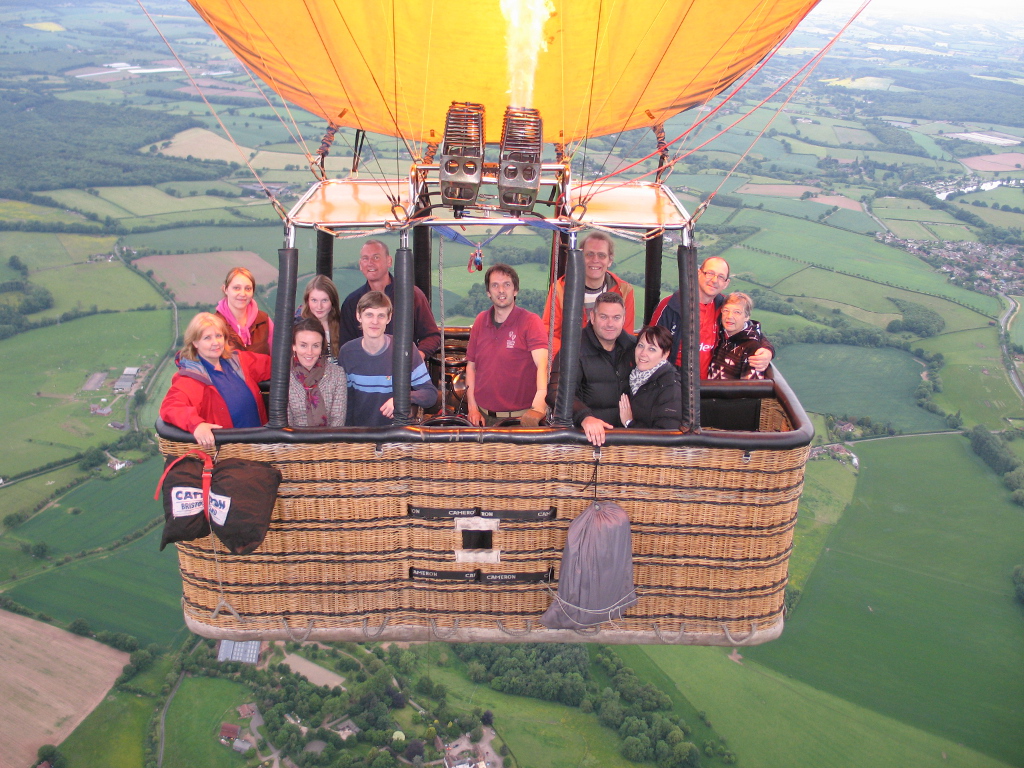
Jonathan Wiltshire: Ballooning

Charlie s birthday present this year, it being an important year: charlie_ballooning I chose Wickers World for the flight, since they have sites nearby and seemed the most professional. We were lucky enough to fly on the first attempt and had beautiful weather, although there was rain behind us.
Ballooning is a post from: jwiltshire.org.uk Flattr

Daniel Pocock: Australia's war on brains (and immigration)

Some weeks ago, our Prime Minister was slashdotted when she suspended her usual racist attacks on refugees to attack foreign IT workers and the companies that employ them with absurd accusations of "rorts" and "stealing" jobs. Today, she's introduced new laws in the parliament aiming to further bastardization of intelligent, skilled and educated workers and anybody who associates with them, including Australian employers. Unwarranted attention on a minority of IT workers This is not just some random bill before the parliament. There are just two weeks left before the parliament concludes and an election campaign begins. It is clear that what we are seeing now is the Real Julia coming though, choosing to make the small minority of foreign workers in our country at the center of people's thoughts as they go to vote in September. A debt of gratitude to foreign workers These verses from our national anthem, Advance Australia Fair say a lot about how Australia became what it is today:
For those who've come across the seas

We've boundless plains to share;

With courage let us all combine

To Advance Australia Fair.
The last 200 years of Australia's history has been a story of immigration. It is not something to be afraid of: our forefathers celebrated it. Foreign workers: why Australia needs you Australia has had some appalling flops in IT and engineering: There is no doubt in my mind that additional foreign workers would have made a positive contribution to all of these problems or can do so in the future. The sun never sets on IT Every day, I collaborate with dozens of IT specialists all over the world through the virtual workplace that is the Internet, particularly in the free and open source software community. Many of these people, I've never even met and in most cases I don't even know where they are, where they were born or what is the colour of their skin. Those details wouldn't make any difference to the way that we work in IT today. How many IT managers have time to waste dealing with more real world bureaucracy when they've experienced online, global productivity? How many IT workers feel demotivated by having to explain trivial details about their personal life to a Government bureaucrat who doesn't understand their skills and just looks at their colour? If you think about it, any immigration officer who really understands IT wouldn't be an immigration officer. They would be working in IT themselves. Immigration officers, who don't understand IT, are now going to be further empowered to bully companies away from employing some talented workers on the basis of race or nationality. Hiring managers will be intimidated into these prejudiced and biased decisions by delays, processing fees and invasive demands for sensitive documents about business planning and recruitment strategies. Australia's immigration system already has a horrendous reputation. Any visa application seems to take more than a year: no small company can keep a job position vacant that long. Families can't plan their children's schooling. Other life events come and go. There are exhorbitant fees, 1000% higher than in other western countries. Fewer and fewer self-respecting skilled workers are willing to put their spouses and children through the degrading medical examinations. Judging the impact of poor immigration policy While the economic impact of this immigration mess on industry is hard to quantify with an exact figure, we can take some insight from the education system. As the visa system has been hijacked by racists over the last 10 years, there has been a dramatic fall in participation (and revenues) from foreign students. In one year, enrolments (and revenue) fell 30%. This is not just bad for the balance sheets of the universities, it also means that in a future where commerce is global, Australians are more and more isolated and inexperienced culturally. IT workers and their employers have plenty of choices: Australia's close neighbor, Singapore, is one of them. Visas are granted in 2 weeks, no degrading medical exam required, low taxes and tropical sunshine all year round. Many companies that find it impractical to deal with Australia's bureaucracy end up moving their best Australian workers to places like Singapore to be part of a global team. This can't be good for the workforce that is left behind without jobs. The training delusion Government officials continue to rant and rave about companies failing to train Australian workers. The new laws supposedly force companies to "fix" this problem and train Australian workers. This, too, is a delusion: employers are not to blame. Some of the best Australian workers are already long gone to places like Singapore, London and the US. With talented foreign workers denied the opportunity to come and fill the void, there is less opportunity for skills to be acquired by more junior workers in Australian workplaces. It is also extremely difficult for more junior workers to get a foot in the door in the international job market and the primary reason for this is the Australian Government's failure to fund university programs beyond a bachelor's degree. Compare this to Europe and the US where all competent graduates are funded through to a Masters or PhD program. The bottom line is that more junior workers are denied the opportunity to get the best training either at home or abroad and in both cases it's not the foreign workers that can be blamed: it's the Government's own fault. Why do we need skilled foreign workers when Australians can win Nobel Prizes? The Australian press recently went into a frenzy when an Australian won the Nobel Prize for physics. There was a catch though: he's a migrant from the United States (just don't tell the Prime Minister). Dr. Schmidt migrated to Australia 20 years ago when the immigration system was not the same as today. Today, future Nobel Prize winners are being shown a brick wall - maybe we even have one of them rotting away in our death camps or left in the sea for sharks to eat. The BBC recently revealed that Britain's successor to Stephen Hawking may be a young girl who migrated from India - it is chilling to imagine where a child like this may be hidden away under Australia's immigration system. Bureaucracy leads to fraud and exploitation It's been clearly demonstrated that wherever you have elaborate, artificial systems of bureaucracy it leads to inefficiency, it suppresses innovation and in the worst cases it enables fraud and exploitation. The typical examples usually involve police in some third-world African nation setting up road blocks and collecting fees from travellers who want to pass the queues. This type of opportunism has also been found in Australia's immigration system, with one Federal politician already directly implicated and jailed for his role in a visa racket. Gillard's own bullet man A Queensland pensioner made international headlines recently when he was caught sending bullets in the mail to the Prime Minister. His demands were clear: stop immigration. While most world leaders refuse to let nutcases like this dictate their actions, Gillard appears to have been transcribing his racist letters directly into these newest immigration laws. It is a sad reality that Australian politics regularly seeks to appeal to the worst instincts in people like bullet man. The ultimate political failure When politicians stoop to the level of demonizing immigrants it is usually a clue that the politicians themselves are past their use-by dates and out of fresh policy ideas. When former French president Sarkozy tried to play the racist card in his campaign for re-election, it bit him in the bum and he was swept from power by the socialists. As always in politics, there is an element of hypocrisy at work: neither our Head of Government (the Prime Minister) nor our Head of State (the Queen) was born in Australia. Gillard was born in Wales and migrated to Australia as a child. If Australians don't vote for her in September, will she be given 28 days notice to pack her bags and go back home'? From the frying pan and into the fire Tony Abbott, Australia's would-be Prime Minister contemplating his colleague's statements on bestiality The scariest thing is that if Australians see through this racist charade and refuse to vote for it, we could end up with something equally obnoxious: the other major political party is now gaining worldwide attention for their campaign linking gay marriage and homosexuals to bestiality. Which prejudice is the lesser evil: racism or homophobia?

17 June 2013

Michael Stapelberg: Talk about Debian Code Search

At this year s GPN13 I gave a talk about Debian Code Search. It was in German, so I spent a few hours creating english subtitles. You can watch the video at youtube.com/watch?v=n6DtW3zCTvk with english subtitles. In case you prefer to download the file(s), get http://ftp.ccc.de/events/gpn/gpn13/gpn13-debian-code-search.mp4 (84 MiB) and the corresponding subtitle file at http://t.zekjur.net/gpn13-debian-code-search.srt. Drop both files in the same directory, run mplayer gpn13-debian-code-search.mp4 and press v to enable subtitles. I intend to eventually put the (subtitled) video on YouTube and refer to it from codesearch.debian.net, but I wanted to post the video in its current form already. The presentation itself explains the motivation behind Debian Code Search and how it works. You don t need any knowledge of the system in order to understand the talk. Enjoy!

Petter Reinholdtsen: Debian Edu interview: Victor Ni u

The Debian Edu and Skolelinux distribution have users and contributors all around the globe. And a while back, an enterprising young man showed up on our IRC channel #debian-edu and started asking questions about how Debian Edu worked. We answered as good as we could, and even convinced him to help us with translations. And today I managed to get an interview with him, to learn more about him. Who are you, and how do you spend your days? I'm a 25 year old free software enthusiast, living in Romania, which is also my country of origin. Back in 2009, at a New Year's Eve party, I had a very nice beer discussion with a friend, when we realized we have no organised Debian community in our country. A few days later, we put together the infrastructure for such community and even gathered a nice Debian-ish crowd. Since then, I began my quest as a free software hacker and activist and I am constantly trying to cover as much ground as possible on that field. A few years ago I founded a small web development company, which provided me the flexible schedule I needed so much for my activities. For the last 13 months, I have been the Technical Director of Funda ia Ceata, which is a free software activist organisation endorsed by the FSF and the FSFE, and the only one we have in our country. How did you get in contact with the Skolelinux / Debian Edu project? The idea of participating in the Debian Edu project was a surprise even to me, since I never used it before I began getting involved in it. This year I had a great opportunity to deliver a talk on educational software, and I knew immediately where to look. It was a love at first sight, since I was previously involved with some of the technologies the project incorporates, and I rapidly found a lot of ways to contribute. My first contributions consisted in translating the installer and configuration dialogs, then I found some bugs to squash (I still haven't fixed them yet though), and I even got my eyes on some other areas where I can prove myself helpful. Since the appetite for free software in my country is pretty low, I'll be happy to be the first one around here advocating for the project's adoption in educational environments, and maybe even get my hands dirty in creating a flavour for our own needs. I am not used to make very advanced plannings, so from now on, time will tell what I'll be doing next, but I think I have a pretty consistent starting point. What do you see as the advantages of Skolelinux/Debian Edu? Not a long time ago, I was in the position of configuring and maintaining a LDAP server on some Debian derivative, and I must say it took me a while. A long time ago, I was maintaining a bigger Samba-powered infrastructure, and I must say I spent quite a lot of time on it. I have similar stories about many of the services included with Skolelinux, and the main advantage I see about it is the out-of-the box availability of them, making it quite competitive when it comes to managing a school's network, for example. Of course, there is more to say about Skolelinux than the availability of the software included, its flexibility in various scenarios is something I can't wait to experiment "into the wild" (I only played with virtual machines so far). And I am sure there is a lot more I haven't discovered yet about it, being so new within the project. What do you see as the disadvantages of Skolelinux / Debian Edu? As usual, when it comes to Debian Blends, I see as the biggest disadvantage the lack of a numerous team dedicated to the project. Every day I see the same names in the changelogs, and I have a constantly fear of the bus factor in this story. I'd like to see Debian Edu advertised more as an entry point into the Debian ecosystem, especially amongst newcomers and students. IMHO there are a lot low-hanging fruits in terms of bug squashing, and enough opportunities to get the feeling of the Debian Project's dynamics. Not to mention it's a very fun blend to work on! Derived from the previous statement, is the delay in catching up with the main Debian release and documentation. This is common though to all blends and derivatives, but it's an issue we can all work on. Which free software do you use daily? I can hardly imagine myself spending a day without Vim, since my daily routine covers writing code and hacking configuration files. I am a fan of the Awesome window manager (but I also like the Enlightenment project a lot!), Claws Mail due to its ease of use and very configurable behaviour. Recently I fell in love with Redshift, which helps me get through the night without headaches. Of course, there is much more stuff in this bag, but I'll need a blog on my own for doing this! Which strategy do you believe is the right one to use to get schools to use free software? Well, on this field, I cannot do much more than experiment right now. So, being far from having a recipe for success, I can only assume that: I also see some problems in getting Skolelinux into schools; for example, in our country we have a great deal of corruption issues, so it might be hard(er) to fight against proprietary solutions. Also, people who relied on commercial software for all their lives, would be very hard to convert against their will.

13 June 2013

Daniel Pocock: Skype Scandal and the Jedi Council

Normally Skype isn't mentioned by name on this blog, but today I'm making an exception. When a new scandal broke out in the Australian Army today, one of the first questions asked was how does it compare to the Skype Scandal which had everybody talking (and blushing) in 2011. A concise military reply direct from the General: "I'd say it's worse than the Skype matter" (the original Skype Scandal cadets are going on trial in six weeks) Jedi Council brings cultural change in the Army: from Skype to email Since the original scandal, there have been plenty of PR-orchestrated headlines about cultural change in the Army. Sadly, it seems that several ranking officers believed that was a cue to simply start using email instead of live feeds Operating under the operational code name Jedi Council, they've apparently been swapping annotated images of female colleagues and members of the public service. A more detailed account summarises it: "They were calling themselves the Jedi Council but they were doing the exact opposite of what Jedis are supposed to do" While the Skype scandal involved cadets behaving much like college kids elsewhere, this latest scandal involves the officer corp, the most senior officer implicated is allegedly a Lieutenant Colonel. Senior ranking officers like this have given many years of dedicated service to the country. They are widely respected and the vast majority of officers in these positions are unlikely to ever be implicated in such a scandal. Officers are in leadership roles, it should be no surprise if they have top secret security clearances. After the revelation that Australia has a direct and high-volume data sharing arrangement with the US Government (and in turn Facebook, Google, etc), there are all kinds of questions about whether a couple of rogue officers have access to pursue their private Jedi Council project using tools like PRISM and Boundless Informant. It's already been confirmed that they were keeping their own Jedi database of their victim's names, phone numbers, home addresses and various clothing measurements and if they are already emailing these photos about on Defence computers, does it seem improbable that they would be using PRISM or other sources to cross-reference their data? Behavior described as systematic and predatory It can't be ruled out that some defence computer systems may have direct access to NSA copies of images from those invasive airport body scanners - like these pictures that were not supposed to exist. Just like the British undercover cops stealing the identities of dead children and fully engaging with impressionable young women from environment campaign groups, there are a long list of possible abuses when the security state is over-empowered. While this latest Army example involves private pursuits, it is not hard to imagine many other permutations: perhaps a couple of rogue Government employees making unauthorised use of PRISM data for a commercial objective and gaining the upper hand on private sector competitors who have no such data feed. 100% trust? In every organisation there will always be a few people bending the rules. It's human nature, if it wasn't that way, we'd all be robots (or drones). The Army and the Catholic Church tend to be hammered a lot more in the public eye when these transgressions are discovered although statistically their crime rates are no higher than average. The bottom line is that no organisation is perfect and people have to take some responisbility to object to the excessive growth of the security state and keep our data to ourselves as you just never know who you can trust.

Next.

Previous.